 |
|
[Page 26]
|
Six choices in the city council election in 1916. – Endekes boycotts the
elections. – The fight among the Jewish proletarian parties. – The
results of the election. – The elected councilmen. – The president
and the aldermen. – The city council settles for dissolution. – The
activity of the city council.
|
Elections to the first city council took place in the winter of 1916. Six choices existed then. Belonging to the first five choices were: the diplomaed intelligentsia, large merchants, manufacturers and other privileged strata. Workers and ordinary, poor people belonged to the last choice.
Because no agreement took place among the Jewish [electoral] lists and the Endekes [Polish antisemitic nationalist party], the latter withdrew their list and all candidates from the Jewish bourgeois lists were automatically elected.
An election fight took place only among the proletarian parties: Poalei-Zion, the Bund and the S.D. P.Z. [elected] three councilmen: Y.L. Fajner, Hershl Sztatler and Henrikh Wolf and the Bund, Yitzhak Pesakhzon.
The following councilmen were elected from the first five choices: Gustav Wajnciher, Dr. Wajnciher, Gershon Rechnic, L. Rubinlicht, Saloman Potok, Laks, A. Perlmuter, D. Sztokband, Hendl Bunberg, Herman Nunberg, Yakov Sztatler, A. Lidzbarski, L. Goldsztajn, D. Zmigrod, Yehiel Kurland, Y. Goldfeld. Mikhal Lewin, Y. Regirer, Lazar Sercacz and Isidor Sercacz.
Gustav Wajnciher was the chairman of the city council. As first mayor, the occupying regime nominated Dr. Szreter; Rip, who had been burmistrz during the Russian times. was designated as second mayor.
Elected as alderman were: Dr. Wajnciher, Lawyer Rider, Lazar Sercacz, Yeshaya Ratner and Zaleski.
After the rise of the revived Poland, the city council at its own initiative, gave their resignations and a provisional committee was chosen that was active until the moment of electing a new city council on the basis of the Polish election ordinances.
The city council excelled in its functioning and carried on fruitful activity, of which both the Jewish and Polish society were satisfied.
|
The founding of the Ivirya [Society for the instruction of Hebrew] society.
– The purpose and the activity of the society. – P.Z. [Poalei-Zion]
groups in Ivirya. – The founders of the society.
|
The Ivirya society was founded at the end of 1914. The purpose of the society was spreading the Hebrew language, literature and Jewish history among the young.
A library also was opened at Ivirya and a dramatic group was founded, which carried out a series of one-act plays by Sholem Aleichem, Sholem Asch and so on. In addition to this, recitation evenings often took place where the creations of various Hebrew poets were recited.
Lectures were also held on scientific and literary themes by Engineer Czmudzki, the Hebrew teacher Janowski, Tevl Klajnman, Rozenkwit, Y.L. Traub and others.
The Ivirya Society was the only cultural center then in Będzin, which drew to it large masses of the Jewish young.
Groups from P.Z. who later organized as a separate group were trained at the Ivirya.
Among the founders the Ivirya were: Tevl Klajnman, Moshe Rotenberg, Moshe Rozenker, Khona Leah Kowalska and Yisroel Leibish Traub. Later, the following Ivirya workers also joined: Miriam Tenenbaum, Rekhl Graubart, Berta Tropauer, Motl Erlich, Elimelekh Rotner, Aydl Szenberg, Yehiel Domb, Yehiel Tencer, Moshe Dovid Malec and Ester Laker. Active as teachers were: Moshe Zajdeman, Kalman Zilberberg, Y.L. Traub, Churgl, Sh. Sobutki and Janowski.
|
The founding of Ezra [Help] Society. – Its activities in the philanthropic
and cultural areas.
|
At the beginning of 1915, the Ezra Society arose whose task was to support with food the impoverished artisans and shopkeepers who had lost their income because of the war.
People grouped around Ezra who felt the impulse for communal work and from them were recruited various communal activists in Będzin.
In addition to philanthropic activity, Ezra also carried on cultural work. A drama group was created at the society and conversations on various literary themes took place.
The very talented, popular speaker, Moshe Kaminer, who died young at the age of 25, was the chairman.
|
The Hashomer during the Russian times and its activity. – The pre-war
guards. – The upsurge in the years 1915-1916. – The Hashomer
transforms into Hashomer Hatzair [the Youth Guard – Zionist-Socialist
youth organization]. – The later Hashomer activists. – The
Będzin Hashomer, as the first organization in the country, sends
instructions to other cities.
|
In 1913, a group of students from the former trade school in Będzin split from the general scout organization and created HaShomer, which already existed then in Galicia.
The activity that was illegal was carried out in an attic room in Zmigrod's house at Sławkowa Street.
Among the pre-war scouts were
[Page 27]
students: Maks Zmigrad, Lucian Rechtman, Itsek Brauner, Ahron Hampel, Jakov
Erlich and Moshe Krosman.
A large upswing came in the movement in 1915-16 when an opportunity arose for legal activity; almost all of the synagogue youth were then drawn into the ranks of HaShomer.
The activity of HaShomer consisted of Zionist and scout work.
Beginning in 1918, HaShomer, thanks to its constructive work, gradually moved from its ideological position to the transformation to today's HaShomer Hatzair.
Later, the following HaShomer activists joined: Yosef Abramzon, Lolek Glik and Ester Lasker, who organized the first woman's division of HaShomer in Zagłębie.
It must be emphasized that the Będzin HaShomer organization was the first in Poland. The local organization later sent instructors to a series of cities such as Dąbrowa, Kielce, Częstochowa and so on to found HaShomer organizations.
|
The founding of the Tzei'rei Zion [Youth of Zion – Labor Zionists]
organization. – The active workers of the organization. – The
delegate to the Tzei'rei Zion conference.
|
Simultaneously with the rise of the Tzei'rei Zion movement in Poland, an organization also was founded in Będzin that consisted of young people who could not live within the frame of HaShomer.
Among active Tzei'rei Zion workers were Tevl Klajnman, Ahron Hampel, Churgel, Yitzhak Tencer, Moshe Openheim, Moshe Leib Kozlowski, Moshe Rozenker and Moshe Kaminer.
At the first Tzei'rei Zion conference, which took place in 1917 in Warsaw, the Będzin organization was represented by the delegate Moshe Rozenker.
|
The rise of Hahalutz [The Pioneer – a movement with preparatory training
for young Jews hoping to settle in Eretz Yisroel]. – Hahalutz becomes a
place for their convictions and the undertaking of practical work. –
Hahalutz members travel to Eretz Yisroel and open the Third Aliyah. – A
second group travels to Eretz Yisroel. – The founders of Hahalutz.
|
At the beginning of 1918, a group of young people from Tzei'rei Zion and from Ivirya moved forward with productive work and created the Hahalutz organization.
Hahalutz received for its use a large plot of land from Yakov Gutman and under the leadership of a specialist, the members began to cultivate the land.
Many city residents willingly bought the successful fruits and vegetables that grew in the tract of the Hahalutz garden.
In October 1918, when millions of soldiers were still in the trenches and the seas were still full of mines, a group of Hahalutz members traveled to Eretz Yisroel. This was the first contingent of immigrants in all the world who opened the Third Aliyah [Third wave of immigrants] to Eretz Yisroel.
The group traveled through Lemberg, Odesa, Constantinople and from there to Jaffa on a small coal ship. The trip, which was full of danger, lasted six weeks.
The first group consisted of Sender Lubling, Yakov Lasker, Yisroel Openhaim, Yitzhak Handelsman, Yakov Zmigrad, Dovid Majtlis and Itshek Birncwajg.
A short time later, a second group left. The trip lasted six months because the emigrants were interned in Italy and in other countries. After long wandering, they arrived in Jaffa, erev Pesakh [on the eve of Passover], 1919.
Belonging to the second group were the brothers Moshe and Yakov Rotenberg, Avraham Goldberg, Mordekhai Winer, Hershl Tenenbaum, Yosef Zabuski and so on.
Sender Lubling, Yakov Erlich, Yakov Lasker, Yakov Rotenberg, Yisroel Sztrochlic, Yosef Abramzon, Mirl Rotenberg and Dovid Majtlis belonged to the third group of halutzim.
|
The reorganization of the P.Z. party. – The founding of the Worker's Home
society. – A tea house is opened. – The support for refugees from
Germany. – P.Z. is active in all political and social actions.
|
In 1915, the old P.Z. activists undertook a reorganization of the party. Their activities consisted of carrying on secret groups; this lasted until the first city council elections during which the P.Z. began to publicly appear politically.
After the city council elections, during which P.Z. received three councilmen, the society opened a workers' home.
The newly arisen society began intensive political and cultural work and drew a part of the Jewish workers and working intelligentsia.
A tea hall was created at the “workers' home,” where the members received tea and a snack for a minimal payment. The tea hall functioned well and was maintained with good hygienic conditions that, because of the war time, was a very difficult task. The tea hall also gave out an evening meal free-of-charge and small donations to the workers who had escaped from Germany who had been sent to forced labor. Masses of escaping workers came to Będzin in 1917, when severe hunger reigned in Germany. The “workers' home” also helped the refugees smuggle themselves through German positions that guarded [against their] departure for Będzin, A number were provided with passports and a number were just smuggled [out of Germany].
Later, the workers' home also opened a food cooperative that took care of its members with food supplies, which the society received from the chief food supply committee.
The P.Z. took part in all of the important political and social actions that were carried out by the entire Zagłębie labor force.
[Page 28]
|
The first attempts to create a workers' organization. – The conference
about the matter. – A group is created that makes contact with the
newspaper, Lebns-Fragn [Life Questions] and with V. Medem. – An
organization of the Bund is created. – The activity during the first
years. – The recruiting of members. – The political-cultural work.
The Bund during the city council election. – The founding of Groser Klub
[Groser Club] and of the Kultur Lige [Culture League].
|
At the beginning of 1915, various attempts to erect a workers' organization were made by a group of local political-communal activists in order to carry out political-cultural activity among the Jewish labor force.
A series of conferences with the participation of invited workers were called for this purpose. Besides pure organizational matters and with various actual questions, the conferences were occupied with the problem: “national cultural autonomy.”
As a consequence of the discussions, a group was created that particularly interested itself in specific Jewish national questions. This group made contact with the weekly Lebns-fragn [Questions of Life], the central publication of the Bund in Poland, in whose columns the problems mentioned were examined. In addition to this, the group also established contact with V[ladimir] Medem, the [now-deceased] leader of the Bund.
A short time later, the initiators, who consisted of the brothers Yehiel and M.V. Kaminski, L. Kornfeld, M. V. Fishl and Goldman, decided to transform the group mentioned into a local division of the General Jewish Workers Bund in Poland.
At first, the activity of the organization consisted of spreading the Lebns-fragn and recruiting members.
Over the course of several weeks, a large number of workers were successfully recruited for the movement for whom lectures on the political economy and the bases of Marxism and Socialism were arranged.
Active as lecturers then were: Y. Pesakhzon, Lipson and the students, Kh. Perl, Sh. Berkowicz and Lipszic. Later, also active, were M. Aronowicz, Y. Brukner and Y. Frajlich.
In addition to this, a series of public lectures on literary themes was organized, which had great success; evening courses also were founded, which were led by Kh, Perl, Y. Frajlich and D. Fajerman.
When, in 1916, the city council elections took place, the Bund was seen for the first time as a political-communal force with a well-planned and extensive organization and at the many meetings, informational and propaganda work was carried out for socialism.
The result of the election gave the Bund a councilman in the person of Yitzhak Pesakhzon, one of the most capable and strongest personalities in our city. Pesakhzon won fame with his courageous appearances and brilliantly construed proposals on the forum of the city council on behalf of the municipal economy.
In 1917, the Groser Klub also was founded, which carried out good work in the area of theater and literature. A Kultur Lige [Culture League] division also was created, which carries on communal-cultural work until today.
|
The activity of the S.D. at the Kultura library. – The meeting place of
the S.D. – Help for the poor. – The active workers.
|
During the occupation, the Social Democrats carried on political-cultural work at the Kultura library, where lectures were held on political and literary themes. Discussion evenings with the participation of members of various political groupings took place.
The meeting place of the S.D. activists was a tea hall at Malachowski Street.
Besides this, S.D. members were busy bringing help for the poor worker in the form of inexpensive food products and lunches.
The tea hall was closed later by the occupation regime because it found the members at a lecture in the Polish language that was being given by Miss Sercacz.
Carrying on the activity of the library and tea hall were: Walter Szolc, Zigmunt Inwald (was interned in Modlin), Y. Kozlowski, L. Nowogrudzki and so on.
&npsb;
|
The founding of the legal Zionist organization. – The composition of the
managing committee. – The main activists of the Zionist organization.
|
The legal Zionist organization was first created on the 11th of March 1917. Then the founding meeting took place with the participation of the central committee member from Warsaw, M. Y. Frajd.
The general meeting was held at the premises of the Hotel Monopol (today Yesodei haTorah kheder [the Foundations of Torah school] is located there).
Elected to the managing committee were: B. Preger, D.M. Ratner, M.K. Erlich, N. Londner, A. Liwer, Sh. Klajner, Y. Najmark, A. Diament, Y. Sztatler, C. Fefer, N. Ollert, Kh.D. Rozenblum and B. Berlach.
The Zionist activity since 1917 was principally in the hands of Y. Wigodzki, A. Liwer and N. Ollert.
[Page 29]
|
The founding meeting of Mizrakhi and Tsei'rei Mizrakhi. – A joint managing
committee is created. – The composition of the managing committee. –
The delegates to the first Mizrakhi national conference. – The education
of an independent Tzei'rei Mizrakhi organization. – The active Tzei'rei
Mizrakhi workers.
|
After the Balfour Declaration (1917), strong activity by Mizrakhi began. The founding meeting of Mizrakhi [religious Zionists] and Tsei'rei Mizrakhi [Young Mizrakhi] took place then, to which the present Chief Rabbi in Tel Aviv, Rabbi Amiel, came.
At first, both organizations worked together and a joint managing committee was chosen with the following composition: Berish Preger, Yeshaya Hendl Erlich, Shalom Klajner, Leibish Buchwac, Yakov Najmark, Y.M. Kurland, Leibish Dimant, Mashalom Liwer, Leibish Banach, Dovid Erlich, Yehosha
|
|
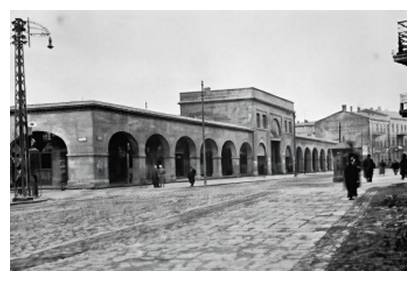
| Market Square (previously Targowiska) |
Moshe Tencer, Yehosha Rozenker (Mizrakhist), Chaim Welner, Hilel Czabne and Yeshaya Yona Przenica (Tzei'rei Mizrakhi).
At the first Mizrakhi national conference, which took place in 1917, Będzin was represented by the delegates: Berish Preger, Yeshaya Hendl Erlich, Lipa Zachariasz and Yehosha Moshe Tencer.
|
The Agudah before the war. – The founding meeting in 1917. – The
composition of the managing committee.
|
After the conference of Agudas Yisroel [Union of Israel], which took place in Katowice (1912), a group of the organization was created in Będzin. At the head was: Shlomo Yitzhak Rinski, Henekh Zilberszac, Moshe Chaim Kaminer, Berl Recht and Lipa Kaminer.
The founding meeting took place in April 1917 in the Harmonia Hall.
A managing committee of the following composition was elected: Shimkha Binem Bonhart (chairman), Yankele Gutman (vice chairman), Berl Recht (secretary), Berish Liwer (treasurer), Avraham Liwer, Dovid Skurnik, Dovidl Turner, Wolf Nakhum Gutsztajn, Zalman Ernst, Zisman Londner, Chaim Meir Zajdner, Yisroelke Cigler, Lipa Kaminer, Mendl Szpiro, Mendl Domb, Moshe Najberg, Mendl Ajlnberg, Sholem Lasker, Nakhum Avraham Arner, Shlomo Zilberberg, Shlomo Yitzhak Rinski and Moshe Chaim Kaminer.
|
M. Frenkl was active in Switzerland. – When the war broke out, he joined
the Legions. – Frenkl refuses to swear loyalty to the Germans and is
interned. – He contacts Commandant Pilsudski. – Frenkl is designated
as the vice-commandant of Będzin. Ahron Frenkl was active in Switzerland.
– He enters the Legionnaires at the beginning of 1914. The Legionnaire
Yitzhak Jungerman. – His participation and heroism in many battles. –
He falls on the battlefield and is awarded the [Order of the] Virtuti Militari
[for military virtue]. – The Legionists: Sh. Szwicer, Dovid Moneta,
Shimeon Borzykowski, B. Andlzowicz, and Sender Gutman.
|
Many members of the Jewish student body abroad were active in the liberation movement of Poland before the [First] World War.
Among the most active workers was Matisyahu Frenkl, who was active in Switzerland in the Union of Active Struggle there, where since 1913 he had been an instructor.
When the war broke out, he came to Krakow and joined the Fifth Legion regiment of the First Brigade. He fought heroically in all battles carried out by the regiment.
When the Germans ordered the Legionnaires to swear loyalty to the central state, Frenkl categorically refused to do this and, therefore, he was interned in a prison camp. There, he was elected as an elder of the prisoners and led the entire camp. He also succeeded in making contact with Commandant [Józef] Piłsudski, from whom he received instructions for the entire camp.
After disarming the Germans in 1918, Frenkl was designated as vice commandant in Będzin.
Later, he also participated in the war campaign in 1920 and then returned to his pedagogical profession. Today, Frenkl is active as the director of a private women's gymnazie [secondary school] in Warsaw.
M. Frenkl was awarded the Independence Cross as well as the Szczypiorno Cross [Szczypiorno Commemorative Badge – a cross-shaped medal awarded by Poland to those who rejected involvement with a foreign miliary and chose imprisonment].
His brother, Ahron Frenkl, also was active in Switzerland in the independent organization, also later joined the Legions where he took part in and excelled in many battles.
Yitzhak Jungerman belonged to the most heroic Legion Medics. He joined the Legion on the 26th of
[Page 30]
August 1914, as a medic-corporal and, as an officer of a sanitary patrol, he
took part in all the battles where, with great self-sacrifice, he worked with
the wounded legionnaires. During heavy shooting, he risked his life, saved the
heavily wounded Captain Heler from the first line of fire when he himself was
already wounded and he further did his duty until he fell on the battlefield in
1919.
Thanks to the intervention of General [Edward] Rydz-Śmigły, the young man was decorated with the highest military recognition, Virtuti Militari [For Military Virtue].
Shmuel Szwajcer joined the legionnaires as a 17-year-old student and took part in a series of battles. He refused to swear devotion to the Germans and because of this he was interned in Szczypiorno [prisoner of war camp] where he experienced a severe illness. Szwajcer died on the 25th of April 1922 and was awarded the Cross by the First Brigade for devoted service.
Dovid Moneta was a section leader in the Fifth Company of the First Regiment. He took part in various battles and perished on the 10th of July 1916 outside Opatow.
Shimeon Borzikowski joined the Legion on the 20th of December 1914. He took part in a series of battles and was wounded in 1915 at the Bessarabian front.
Sender Gutman was in the Legion starting in 1915, went through several battles and, later died of depression because he had experienced difficult war campaigns.
1. The Knight Benda
In the time of Balek Chrobry [Bolesław I the Brave] lived a knight above all of the other knights with the name Benda. He was an inseparable friend of the king in all of the crusades he undertook, with the purpose of uniting the Slavic tribes under his scepter. For self-sacrificing and devoted service, the knight received from the king a gift of a large piece of wild forest around the Black Przemsza [River] and several settlements that were scattered here and there in the empty forest silence. When the knight came to take over the gift, he searched for a place where he could erect his headquarters. Suddenly, he noticed that he was under the Będzin mountain. Noticing many cliffs around him that extended far over the surrounding forests, he decided to erect a court among them. In a short time, he turned this decision into a deed. With an inadequate number of people in the area necessary to erect the castle, he sent servants through the forest with an order that they should, through good or evil, round up the population from the settlements behind the mountain. When this happened, he ordered those driven together to chop down the trees and split the rocks. Then he forced them – under his own supervision – to build a fortified castle. When after more difficult and longer effort, they ended the work, he dispersed the group, not giving them the least wages. This was the first injustice that the knight committed against those who only a short time before felt like free people in the large, wild forest. And later, more large and difficult injustices constantly came. These people, groaning under the yoke of the ruler as his servants, cursed that moment when free people were turned into slaves.
|
|
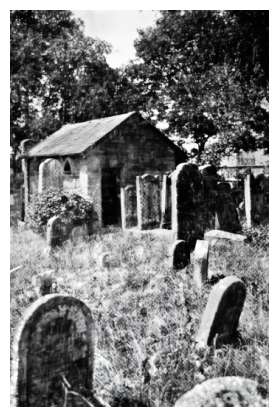
| The old cemetery at Zawaler Street |
This lasted so long that the measure of his evil overflowed. With God's will, a great misfortune befell the monster, the torturer of people. On a certain day, he lost his wife and all of his children who were shattered by a piece of falling rock.
After this incident, the regretful monster disappeared from the castle forever.
As the legend says, from this Benda, the castle as well as the city received the name Bendin, which was later changed to Będzin.
A second legend tells that when King Kazimierz the Great in his long peasant coat once traveled to Breslau, he stopped in the local area. The king's officials, seeing that there would be few residences for the king and the members of his court, advised changing the rest stop. To this, the king answered: “My stąd będziemy tam, albo jak tu miejsca mało będzie, to niech stanie Czeladź.” (“We will stand over there, and if there is too little space here, then let the people from Czeladź stand here.”)
The king's words were welcomed and from them arose the names: Będzin, Małobądz and Czeladź.
[Page 31]
This was at the time when the famous Jan Haler, whose advisors were Klimont Strakh, Wojciech Zaremba, Urban Pirošek and the village mayor, Łukasz Sendzicki, sat on the burmistrz's [mayor's] seat.
Just then, a certain Mrs. Szitko died in the city, the owner of a house that was located at the market, next door to Kajler Wanka and Kryzsztof Gorocki. Since she left this world childless – all her possessions – according to the directive of the Codex Law – were supposed to become the property of Prosper Prowani, who was simultaneously, the Będzin village elder and an official of the Krakow salt office. Before all the formalities were carried out, this house of the deceased was sealed and strongly guarded. Because of this, it was said in the city that in addition to the house, Mrs. Szitko had let two full pots of gold that she had hidden in a locked chest.
On the third Sunday, after the holiday of St. Michael, in 1579, the great Margrabia Court, with the landwójt [rural magistrate] at the head and with the aldermen, Bartołmiej Szczigiel, Jaub Szwancer, Albert Lupa, Bartołmiej Gniewzi-Szwinia, Jan Laginski and Laurenti Warmus came together. This court, on the basis of Prowani's letter, let Mrs. Szitko's house be given to Lukasz Sendzicki, who had bought it from the village elder for 32 Polish gildn.
When the honorable court, headed by Jan Haler, appeared before the Szitko's house, it turned out that someone already had control of the house because the back door was broken open, the lock torn off, the chests smashed and empty. The investigation carried out did not reveal the burglar. A few months later, suddenly, the city received the news that the village elder had confessed on his death bed that he himself had on that night stolen the two pots of money, but out of fear that he would be discovered, he had buried them behind the church of the Holy Tomasz. After his death, the city regime began to look for the money, but all efforts to find it were without success.
Later, various wealthy candidates began to search for the treasure. There were many such amateurs over the course of a few years, but these fortune-seekers also found nothing.
Therefore, Szitkowa's[1] treasure stills lies in the earth, near the church and waits patiently for its discovery.
A person dies and a stone remains. And it happens that a dead stone reminds [one] of the good traits and good deeds of a person who once lived hundreds of years ago.
One of such “talking” stones is at the Będzin very old cemetery which today is located in the middle of the city at Zawale Street.
The stone is near the wall – a deep, curved headstone that is always covered with himl kvitlekh [handwritten papers on which one asks for a blessing from heaven], bits of candles, stones and shaimos [parts of religious books and discarded religious items]. All of these remedies are placed by Jewish men and women from Zagłębie and Upper Silesia who come from time to time to this headstone asking for themselves and their families, health, livelihoods. The number of those seeking help is particularly large on the seventh day of the month of Adar, on which the Reb Uriel's yahrzeit [anniversary of a death] falls.
We know that under the sunken headstone, the tzadek Reb Uriel was buried. And if one scraped off the damp moss from the old stone, one could still clearly read the beginning of the hammered-out inscription: “He who decides comes from the tribe of Levi.”
The usual meaning of the inscription was interpreted as: “He who decides comes from the tribe of Levi.”
The people, however, interpreted the inscription as: “It was light until after the funeral.”
Why the people did it thus and not understand it differently will become clear when we will spin the legend further to the end.
Reb Uriel lived in the shtetl Bytom (Upper Silesia). He was a simple man, but a very strictly observant Jew. He drew his livelihood from trading in the villages. He sometimes bought a bushel of potatoes, a measure of wheat, a wagonload of wood or just a few hare skins from this or that peasant. But he barely earned more than was needed to live through the day with his family; he gave away the rest to the poor.
Separately, Reb Uriel seriously observed the Shabbos [Sabbath]. On Friday, after 12 o'clock by day, when if he were even able to earn a fortune, he did not want to hear any more about weekday matters. And knowing of his great honesty and about his risking his life for the truth, people came to Reb Uriel with the most difficult religious questions, and coming to him were not only Jews, but non-Jews, too, who relied on his judgement.
And when the time came for Reb Uriel's death, it was first seen that a great tzadek had left the world.
As the Bytom kehile [organized Jewish community] in those old times did not yet have its own cemetery, the corpses there were driven or carried to Będzin. Naturally, Reb Uriel was carried the entire way. It was a great privilege for each Jew, to carry the holy deceased on his shoulder.
From Bytom to the Będzin cemetery is however a great distance and, in addition, the road is bad. And so, when the funeral first found itself half on the way, they suddenly saw
[Page 32]
that it was already turning into night. And the night really was so pitch-black
that one could not see the other person's face and it was impossible to take a
step forward. The funeral stood still and with the mite [board on which the
deceased is carried] on their shoulders, the Jews began to recite the
Minkhah-Maariv [afternoon and evening] prayers.
However, suddenly an extraordinary thing happened. Before the funeral participants finished praying, they heard something wave with a gentle murmur as if over their heads. And when they raised their eyes, they saw a multitude of white doves with lit candles in their beaks flying over Reb Uriel's mite. The congregation understood that God had sent down angels who would accompany Reb Uriel to the gates of heaven with lit candles.
|
|
|
The ohel [structure] at the grave of Rabbi,
Reb Yisakhar Berish, of blessed memory |
During the winter nights, at the warm house of prayer oven, one still hears the old men tell this story, but the young people also know about it and even in seforim [religious books] it is written in memory for eternity.
Generations ago, Rabbi, Reb Moshele sat on the Będzin rabbinical seat. This was a Jew, the embodiment of fairness and justice – and he knew little about monetary matters and, in addition, was a truly modest person. The Będzin kehile at that time was still small and poor and the few gildn that they paid the rabbi monthly barely sufficed for him for “the bread of affliction.” He, therefore, always suffered from poverty, but he never complained and he pinched and scraped as a man of flesh and blood.
Thus, the years passed until a time came when the Rabbi, Reb Moshele's daughter was old enough to get married and he did not possess a penny. However, the rabbi was little bothered by this. His beloved answer to all arguments from the rebbetzin [rabbi's wife] was: Kol ma deavid ranchman letav avid (Whatever the One Above does is for the good). The rebbetzin could not bear such a shame and constantly began to coax him: Become a rabbi in a larger city; so many kehilus are arguing over you; they want to give you an income and even they want to take care of our bride-daughter.
Finally, Reb Moshele could no longer bear the worry of the rebbetzin and when new emissaries arrived, he agreed to become the rabbi in a larger kehile.
The entire city – men, women and children – began to weep and lament when they had to take leave of its long-time and beloved rabbi. “To whom, holy tzadek [righteous man] are you leaving us! At least give us your blessing before leaving!
However, Reb Moshele kept to his decision to leave Będzin. And when fate began to move him from the place, he raised his hands to heaven and blessed the Będzin Jews and doing so said: “If, God forbid, a fire is decreed in your city, may it affect not more than one house.
And, actually, until today, the tzadek's blessing holds. If a fire sometimes breaks out in Będzin, only one house is burned. Two houses have not burned at once in our city since then…
Sources and Bibliography:
Archives of the city of Będzin. Pinkes [book of records] of the Khevra Kadishe [Burial Society]. Pinkes of the Khevre Khayatim [Tailors Society]. / Pinkes of the Khevre haTilim [Psalm Society], Pinkes of the Khevre Hachnosas Kallah [Society to Help Poor Brides]. / Stories from Będzin old men. / Conversations with Będzin political and communal activists. / Otzar Yisrael [Treasury of Israel – Hebrew Encyclopedia], New York 5672 [1912]. / Yevreyskaya Entsiklopediya [Jewish Encyclopedia], Petersburg. / Encyklopedia Judaika, Berlin 1929. / Moshe Fajnkind, Di Geshikhte fun der Bendiner Kehile in der Tsvayter Helft fun 19th Y.H. [The History of the Bendin Jewish Community in the Second Half of the 19th Century], a series of articles published in the Zaglembier Zeitung [Zagłębie Newspaper], 1934 numbers 1-4. / Dr. R. Mahler and Dr. E. Ringelblum, Geklibene Mekoyes fun di Yidn in Poyln un Mizrakh Eyrope [Collected Sources for Researching the History of Jews in Poland and in Eastern Europe], Warsaw 1930. / Dr. Y. Sziper, Di Virtshafts-Geshikhte fun di Yidn in Poyln besn Mitlalter [The Economic History of the Jews in Poland during the Middle Ages], Warsaw 1926. / Historishe Shriftn [Historical Writings] 1 volume, Warsaw 1929. / Gershom Bader, Draytsik Doyres Yidn in Poyln [Thirty Generations of Jews in Poland], New York 1927. / N.A. Buchbinder, Di Geshikhte fun der Yidisher Arbeter Bavaygung in Rusland [The History of the Jewish Workers Movement in Russia], Vilna 1931. / Yitzhak Nissenbaum Ale Heldi [Pages of My World], Warsaw 5689 [1929]. / M. Kantor-Mirski Z Przezloscki Zaglebia Dabrowskiego I Okolicy [From the Past of the Dąbrowa Basin and the Surrounding Area], Sosnowiec, 1931 / Zydzi w Polsce Odrodzonej [Jews in Reborn Poland] Warsaw, 1932. / Stanislaw Kutrzeba Historja Ustroju Polski w Zarysie [A Concise History of the Polish Political System], vol. III, Lwów 1917.
Original footnotes:
Translator's footnote:
|
JewishGen, Inc. makes no representations regarding the accuracy of
the translation. The reader may wish to refer to the original material
for verification.
JewishGen is not responsible for inaccuracies or omissions in the original work and cannot rewrite or edit the text to correct inaccuracies and/or omissions.
Our mission is to produce a translation of the original work and we cannot verify the accuracy of statements or alter facts cited.
 Będzin, Poland
 Yizkor Book Project
 JewishGen Home Page
Copyright © 1999-2026 by JewishGen, Inc.
Updated 04 Oct 2026 by OR