 |
|
[Page 119]
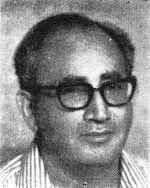
by Moshe Vald
|
Our small town had always been attuned to each new development – social, cultural, or societal – that took place in the life of our nation. The basic notion of “national revival,” whether through the early Tze'irei Tziyon or later, came to Grabowiec and drew young people. Many of them were yeshiva students, the sons of pious, learned Jews who were nonetheless practical in daily life. Grabowiec was populated by many such families.
Jewish young people of the town were changing their outlook on life. There was a general belief in imminent national salvation in the Land of Israel. The movement was channeled into organizations and political parties, each with its own ideological direction. The members were closely allied, and participated in all party activities and duties. One of the major changes that took place in public culture was increased interest in the study and knowledge of Judaism.
Once the idea of a religious-national party within the World Zionist Organization had taken shape as the Mizrachi movement, young yeshiva students adopted it as their blend of national awareness and religious outlook. [1] They established a branch of the movement in our town.
[Page 120]
|
|
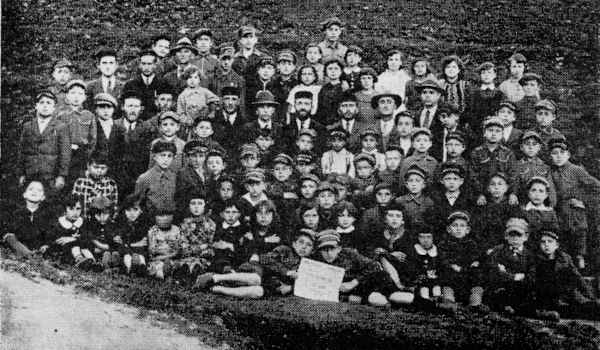
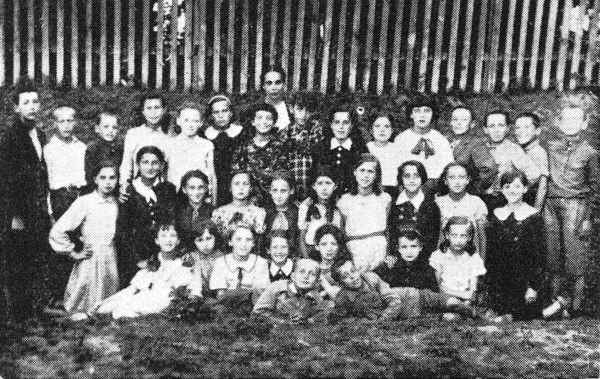
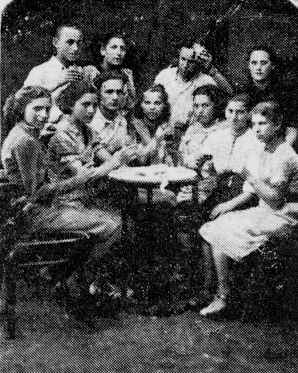
| Fourth-grade students of the Yavneh elementary school in Grabowiec, 1938 |
I had the honor of being one of the founding students, together with my friends Michal Stein, Moshe Gero, and David Shisler. We were among the first members of HaPoel HaMizrachi in town.[2] We received our ideological materials through newspapers from the movement center in Warsaw, and we would gather to read the newspapers and discuss the article. We enjoyed the spirit of national excitement in the articles, and met with other young people to advance the notion of national-religious revival. There were well-publicized lecture series on related topics. We joined Zionist activities in town, and participated in conventions in Tomaszów Lubelski.
The pious folks in town soon became interested in the movement, and a local branch of the Mizrachi party was established. They began to carry out various cultural activities. The branch was headed by Faivel Hustik, Ya'akov Heeter, and Moshe Shvartz. They were helped by other members from pious and Hassidic homes, who were captivated by the national spirit that was overtaking the Jews of Poland.
This was the background for the establishment of the Yavneh school, which created a strong impression in town. After considerable effort, we convinced the pious families to send their children to the Yavneh school rather than to the traditional cheyder, and soon had many students. The first teacher was Moshe Kleinmintz from the nearby town of Wojsławice. He did much to raise the quality of education. Mr. Kleinmetz-Sagi lives in Israel, in Tel Aviv.
[Page 121]
Before Kleinmetz-Sagi went to the Land of Israel, he recommended Shlomo Shtrasberg as his replacement. Shtrasberg was another Wojsławice native, who had graduated from the Warsaw rabbinical Tachkemoni school. He fulfilled our expectations of him as an educator in Grabowiec, as he supported and advanced Hebrew and Jewish education. Shlomo Ofir (Shtrasberg) became a great educator in the Land of Israel, and is now the devoted principal of a high school in Petach-Tikva.
Other teachers at the Yavneh school were Zilberman, from Tomaszów Lubelski, and Lichtasz-Neri, now the secretary of the Netanya municipality. Both carried out their mission of connecting the children of Grabowiec with their nation and homeland, within the narrow framework of their school.
The positive influence of the school is clear from the increase in student numbers, which led to its being relocated several times. At first, it was housed in David Boym's apartment. The local movement leaders devoted most of their energy to maintaining the school, strengthening the devotion of teachers and parents to national and religious values. A kibbutz training center was established, to further these values among those planning to emigrate to the Land of Israel. Moshe Gero, David Shisler, and I travelled to Komarów to interest young people in the program. The central committee later sent us a female comrade to help; this was Devora Mirochnik. Our local young people became excited about the concept of religious Zionism, and large numbers of them joined the movement, enthusiastic about the Land of Israel and about Zionism,
|
|
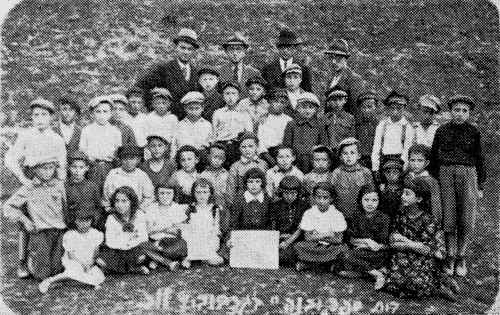
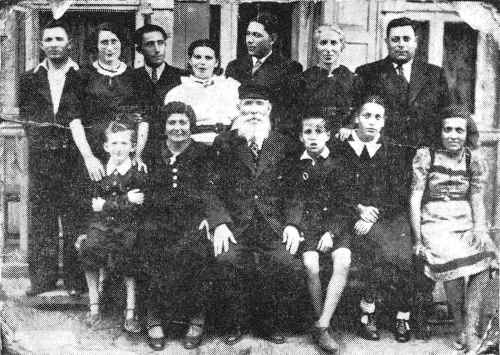
| Students of Grabowiec Yavneh school |
[Page 122]
with the firm hope that they would one day settle in the Land of Israel and build the country as well as new lives for themselves. There were no factories in Grabowiec, and the training camp members had to chop wood until they found work in other places; we couldn't offer steady employment at that job.
The schoolchildren participated in cultural activities of the town. The drama club, led by the devoted, tireless Avraham Geist, was especially active. Its performance proceeds were dedicated to maintenance of the school. Singing and dancing were integral elements of the curriculum; these activities invigorated and encouraged the students to broaden their interests. The parents of our students were pleased to see their children full of excitement, which overflowed into the home. They, too, were “infected” with the grand Zionist vision, and hoped to join their children one day in the Land of Israel.
Our local Mizrachi members were very active in relation to Zionist Congress elections, and other special Zionist projects. The adults were invigorated by the excitement that radiated from the young folks, which guaranteed the continued existence of the Mizrachi party in town.
The local political youth organizations competed with each other, and led to ongoing stormy debates between the parties. Our branch stood firm. We held lectures, field trips, and meetings with members in the area; we also contributed to the various fund drives, and played a significant role in the town's cultural life.
Translator's footnotes:
by Shlomo Ofir (Shtrasberg)
There once was a town named Grabowiec. It was small, and did not have many residents. But it contained everything. In addition to the synagogue and study house, there were small synagogues of the Hassidic groups. Like all the towns in the area, it included parties that spanned the political spectrum: Po'aley Tziyon, Mizrachi, Beitar, and Communists, But Grabowiec was different from other towns. Not one, but two Hebrew-language schools were established there. One was at the initiative of the left-wing Po'aley Tziyon, and the other, the Yavneh school, was founded by the religious Mizrachi party. I was fortunate to become a teacher and principal of Yavneh; simultaneously, my distant relative Baruch Eynes (and dear friend) was principal of the competing school.
|
There were few Hebrew-language schools in the small towns of Poland. This was the case in the nearby towns of Wojsławice (my home town), Uchanie, Krasnystaw,
[Page 124]
Szczebrzeszyn, and Tyszowce. Jewish children attended official Polish schools, according to law, and went to cheyder in the afternoons.
How did Grabowiec become different? Only God knows. But, the fate that led me to continue being teacher and principal still fills me now, forty years later, with longing for those years, which were far happier than my current life…
Jews in the small towns led hard lives. The authorities were hostile, and making a living was difficult. But the Jews of Grabowiec were not deterred from studying Torah and other topics. It seemed that the opposite was the case. The greater the distress, the more social and cultural activity took place in town. The schools were the focus and center of cultural and spiritual life. We had libraries, study courses, and lectures. We also mounted stage productions; but the two schools invariably scheduled their shows on the same evening. Yet both halls were full of spectators. As the Jewish sages said, “Scholarly rivalry breeds wisdom.”[1]
There was similar rivalry in a different sphere. While I was in Grabowiec (I lived there for a single year), there were elections for the Zionist Congress. Public excitement was high, and young people, especially, were very active; their hard work and zeal for the cause are unmatched to this day. In actual fact, however, their real-life influence over the outcome of the election was minute. The residents of Grabowiec, though, did not think so. They thought they were at the center of the world. The local election results would dictate the fate of the nation, of the Zionist movement, and of the settlements in the Land of Israel.
|
The town was Zionist, with much activity to support Hebrew, the Jewish National Fund, and emigration to the Land of Israel. When a resident was able to emigrate there, the entire town rejoiced.
[Page 125]
|
|
|
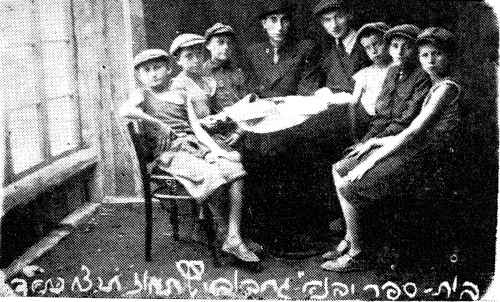
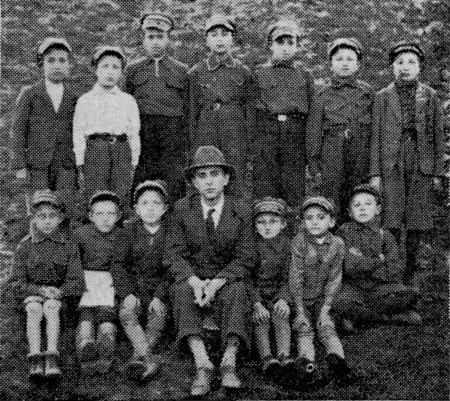
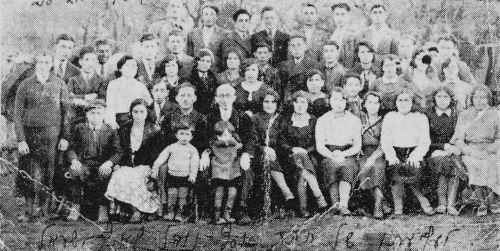
Students of the elementary school with the Jewish History teacher.
Rivka, Moshe Vald's sister, is on the right. |
But in that area, as well, political rivalries were clear. If a member of one party emigrates to Palestine, that party gains in significance. The party's celebration of success must therefore be spoiled. When one of our members, David Zinger (of blessed memory) left for Palestine, I organized a farewell party. There was a large crowd, which celebrated and rejoiced; yet some were envious. I was giving the farewell speech, when I was told to stop the party and leave the hall. Apparently, this was a month of mourning that the Polish government had decreed to commemorate its deceased leader, Jozef Pilsudski. Policemen showed up to arrest me, for disturbing the mourning… Luckily, there were no complications. I left Grabowiec that very evening (it was impossible to hide in the town), boarded a hastily hired wagon, and went to my home town, Wojsławice. I returned two or three days later, and the police apparently forgot about the entire incident and stopped searching for the “criminal.”
These have been some reminiscences of the year I spent living in Grabowiec before immigrating to the Land of Israel. I have vivid memories of some of the activists who were completely devoted to the establishment of a Hebrew school, teach the Hebrew language, and further the ideas of Zionist laborers. They believed with all their hearts that it was their vocation. They deserve to be mentioned by name, but others can do that much better than me.
Translator's footnote:
by Yosef Boym
|
As one of the Zionist organization's most active members, I well remember the day the first group left Grabowiec for the Land of Israel. It was 1923, and the day turned into a general celebration in the town. People greeted each other joyfully, and asked about the young immigrants. All the movement's activists took to the streets to accompany the fifteen young men who were the first to emigrate from our town. We met a band that was coming to play at a wedding; they were non-Jews, and didn't understand the reason for our celebration. When we told them that these young people were going to build a new life in the Land of Israel, they picked up their instruments and began to play. Everyone sang with us and began to dance the hora in a circle. It was a fiery dance; with eyes shining, the dancers shouted “God will build Galilee; we will build Galilee…” We translated the words for the musicians, and they seemed to join us in our vision. That day, we sang songs in Yiddish and Hebrew, as well as Hassidic melodies that our parents sang with devotion and longing. We kept singing for hours, unaware that we were expressing our own longings for a life in the homeland.
Translator's footnote:
by David Ben-Zvi Erlich
|
During the week of Pesach, 1933, we (Leibush Hauz, the son of Shimon the “Doctor,” David Glomb, the son of Pinches, Nochumtshe's son), Ben-Tziyon Fink (may he live long) and the present author) met and decided to found a branch of Beitar in our town.
We were thirteen years old. It should be mentioned that establishing a Beitar branch in Grabowiec was not easy at the time. Preparations were under way for the 18th Zionist Congress, after the split with the Revisionists in Katowice, when Meir Grossman and his followers left the Jabotinsky League and founded the Jewish State Party[1]. That was also when the Mizrachi organization was founded. However, the majority of Jews in town belonged to the right-wing Po'aley Tziyon and allied groups. Those were the conditions when we decided to found a branch of Beitar; it was an experiment in organizing. We had not yet graduated from elementary school; but two months later we already numbered fifteen, and had found a place to gather. We attracted many people, who wanted to view a Jewish military force with their own eyes[2]. Members of left-wing organizations also came to harass us.
[Page 128]
They broke our windows, and the town was in turmoil.
The left-wingers' attack was meant to frighten us, but had the opposite effect. We became more resolved to overcome all the difficulties. Some parents guaranteed their responsibility for all our activities, so that we could gain legal standing as an organization. Among our new members were Eliyahu Rikel, Rafael Lerner, Shlomo Erlich, Ch. L. Fink, and many others. We now numbered 90 members. Eliyahu Rikel was the commander. He had studied in Vilna, knew Hebrew, and organized Hebrew lessons for groups that were held almost daily.
Our work steadily became more intensive and varied. There were talks on different topics and “box-evenings.” Members of Beitar's central committee also visited. Sports were a major part of our activity. We had a special instructor who came from a branch in another town, and led our exercises. Many schoolchildren joined us. Our clubhouse became too small, and we had to rent a larger place, enabling us to broaden our activities and include more topics. We rented the new clubhouse from the children of Shayeh the baker; eventually, we needed a larger place again, and found it nearby.
When Eliyahu Rikel left for Hrubieszow, where he was married, he was replaced as commander by Shlomo Erlich, who was also involved in the Revisionist petition to the King of England, to permit Jews to immigrate freely to the Land of Israel. The petition was signed by more than 800 people from Grabowiec and the region. The movement's Central Committee sent speakers who appeared in the large study house after evening prayers; they sometimes spoke in large private homes as well. One of the most successful evenings was that of Leybl Horowitz, son of the Zamość Rabbi (now living in Kiryat Motzkin). His speeches, like those of David Gorfinkel, made a strong impression and contributed to the growing popularity of the Revisionist ideals.
Another very impressive occasion was when we paraded the flag of the Grabowiec
[Page 129]
Beitar branch. We marched through the town, together with members of the Revisionist Veterans Association, which was led by Avraham Shtarker. Other participants in the march included Beitar members from Uchanie, Wojsławice, Hrubieszow, and Zamość. The parade entered the large study house, with the chairman of the city council, the chief of police, the school principal, and the Jewish members of the city council, headed by Shimon Hauz the “Doctor”. The rabbi greeted us, as did the council chairman. Shimon Rikel concluded the event. It was followed by a party at our clubhouse, with the participation of all the guests; it continued late into the night.
We also had a Beitar settlement training group numbering about twenty, that was active for about eight months. However, when no Beitar members were granted immigration certificates, the group dissolved, and its members returned to their homes. They were fine young men. I remember the names of Shmuel Klarman, Aharon-Wolf Langart, among others, who were murdered in Izbica.
When Beitar of Poland began sending its members to the Land of Israel through illegal immigration, we in Grabowiec didn't lag behind, and also began to prepare for immigration. However, the outbreak of war destroyed all our plans.
I was the last commander of Beitar in Grabowiec; and was joined in the command by Simcha Tenenboym, David Glomb, Gitl Lerner, and Nechemiah Eynes. When the town was destroyed, Beitar members Nachum Glomb (who commanded the younger group), Shmuel Hauz, Yechiel Groman, Grineh Mitler, and others were murdered. Murdered members from Maniewicze (Ukraine) were Simcha Tenenboym, David Glomb, and others. Revisionists Shlomo Erlich, Chava Rozenfeld, Leah Boym, Zingerman, and others, were murdered.
The few survivors were Reyzl Hustik and her sister Pesse (in Russia), Chana Mernshteyn, Motl Birn (in Brazil), Leah Padel, Nechama Glomb, Nechemiah Eynes, and David Erlich (in Israel). Other survivors were Avraham Shtarker and Yekutiel Shad, both of whom died in Israel.
[Page 130]
Keepers of the Beitar Flag in Our Town
The Beitar (named for Yosef Trumpeldor) movement branch in Grabowiec was established in 1933[3]. The first branch commander was Eliyahu Rikel, who knew Hebrew, organized various classes, and was the life and soul of every event. The members of the command group were Leibush Hauz, David Glomb (may his memory be for a blessing), Ben-Tziyon Fink, and the present writer.
Although we were only thirteen years old, we were aware of Beitar's ambition: to create a healthy, confident Jewish person on the basis of Beitar grandeur, who would always serve the goal of achieving a Jewish state and would be a citizen of the future state[4]. Zionist Revisionist and Beitar ideology were oriented toward a goal that we viewed simply as the establishment of a Jewish state on both sides of the Jordan River. That was the essence of the movement; all the rest was elaboration. We didn't need to consult other ideologies for meanings or conclusions; those were very clear to us. We also knew that this movement, which began as a small, modest group, gradually became one of the most active and significant Jewish youth movements in Poland.
The Revisionist ideology of a militant Zionist movement inspired us. In time, we attracted dozens of young high-schoolers. These young people of Grabowiec, who sought new meaning in their lives, became a major influence on the town's culture. They were especially excited by the idea of militancy and military discipline. The left-wing youth movements regarded
|
|
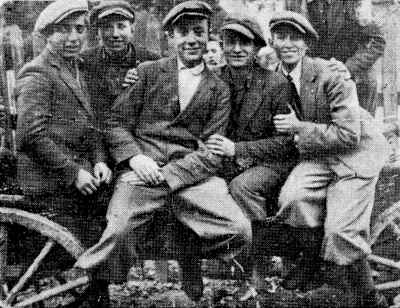
| From right: Leibush Hauz, David Erlich, Ben-Tziyon Fink, Shmuel Hauz, David Glomb |
[Page 131]
them as their major rivals in the struggle for the young people of Grabowiec, mocking them as “kiddies with rifles and tiny swords.” The incitement against us had the opposite effect: young people began flocking to join us, and we were able to expand our activities and capacities.
While we adopted and practiced a military approach, we did not concentrate exclusively on physical and military training. We strove to have our members behave with the nobility and bravery of our nation in antiquity. “Beitar grandeur” comprises physical beauty, self-confidence, respect towards others, fidelity, and nobility.
We also had a settlement training camp. As our numbers increased, we established a sports team. Our local leaders changed from time to time; I was the last of them. My partners in the command were Simcha Tenenboym, David Glomb, Gitl Lerner, and Nechemiah Eynes.
Unfortunately, I am unable to list all our members those who are no more. They all dreamed of dying for the sake of the ancestral home. Beitar prepared many young men and women for immigration to the Land of Israel, but the British authorities did not grant us enough immigration certificates.
The catastrophe came, and those who had had to stay in Poland were decimated by the Nazi murderers; they were killed, slaughtered, and suffocated in the gas chambers.
We shall remember them forever.
|
|
| Beitar activists | |
|
Standing, from right: Rachel Miller, Simcha Tenenboym, Gitl Lerner, Avraham Mernshteyn
Seated: Leah Fodem, Matle Birnboym, Nechama Glomb, Hannah Mernshteyn, David Erlich, Reyzl Hustik, and Grineh Mitler |
Translator's footnotes:
by Chaya Tsigel-Lerer,
Kibbutz Hatzor, Israel
The young Jews of Grabowiec lived in a world of ideological struggle and
constant search for ideals, both national and social. They sought a better
economic life as well as an interesting spiritual life. Some considered their
personal future, and the future of the Jewish nation, to lie in emigration to
the Land of Israel, whereas others hoped to improve their current conditions in
Poland while elevating the status of the Jewish worker. My father, Yehoshua
Lerer, was the only teacher in town who taught several languages: Yiddish,
Hebrew, Polish, and Russian. However, with all this, he could not make a
living. Poverty and need reigned at home. My parents raised their children in
the spirit of Jewish tradition.
At the age of 16, I started to learn a trade from Bracha the seamstress. I met Bracha's son, who worked as a tailor in Hrubieszow and would occasionally visit his home in Grabowiec. He brought with him the politics of the Jewish laborers who were organized in the Bund. Thanks to his intelligence, he became the leader of the Socialist trend in town. He was completely devoted to the Bund's ideology, and his enthusiasm influenced others. At his initiative, a group of tailors' apprentices was organized. I joined the group, which eventually established the Grabowiec branch of the Bund. Some of the original members were Leibush Nudel, Henekh Heeter, and Nochem Sukenik.
At that time, our activities were still limited. We had no gathering place of our own. We met when
[Page 133]
we borrowed books from the library, which was located at the home of the brothers Eli and Moshe Firsht, Efrayim Firsht's sons. This was one of the town's progressive families, in whose home we met with other young Zionists. We set up a charity hostel for the sick, where they could stay and receive medical care. Those were the locations where we could meet and discuss issues that pertained to the party.
One of the Bund's activities assured poor families of free matzahs for Pesach. We began baking matzah ourselves. The more well-to-do among us paid a larger share of the expenses, and any leftover income was given to the charity hostel.
The Cultural Association[1]
The association was established in 1918, and attracted young people of all types. The teacher, Rosen, was its leader. He taught Polish in the Zionist HaTikvah school, and was the only Folkist in town[2]. The association hosted lectures that attracted all the young people, regardless of political affiliation. The left-wing groups, such as Bundists and Communists, had the greatest influence on working young people. That is where apprentices of tailors, shoemakers, and seamstresses, were first introduced to world affairs, well as to Yiddish literature. They also started a drama club, under the leadership of Avraham Geisner. Performance proceeds were dedicated to the charity hostel and to the library, which gradually expanded.
In the Fall of 1918, Poland became an independent state, and rapidly developed a state structure. Independence encouraged the rise of intense social conflicts. The Polish Socialists should have been the first to recognize the problem, but most of them became captivated by the general trend toward nationalism. The Jewish masses followed other directions,
[Page 134]
such as seeking freedom from the troubles that followed the war, such as hunger, poverty, and unemployment.
Shlomo Tsigel (Bracha the seamstress's son) worked ardently for the cause at the time. He always pointed out the problems of the new republic – severe poverty, police arbitrariness, outbreaks of fierce antisemitism, and cruelly repressive actions against workers in general and Jewish workers in particular. Tragedies were common, and Shlomo was unable to remain silent. He believed that the Bund had the historical right to become the force that would gather up all the repressed proletarian revolutionary elements of society, and reverse the demoralization of reborn Poland. Slowly, however, he came to realize that all the slogans and promises had proved false, and turned to Communism.
His move was followed by all the previous Bund members, among them me. I had already become his intimate friend, and was familiar with his personality, simplicity, kindness, and profound faith in the redemptive idea of Communism. We came to Communism with open hearts, the inner flame of human kindness, and an absolute belief in a better tomorrow. Inspired by this flame, we left for Argentina in 1922. With our own honest labor, we created our own family nest, while at the same time continuing to spread the Communist ideal as fervent believers. We raised our five children in this spirit.
We first came to our senses after the murder of the Soviet Jewish writers, and the unsuccessful trials of the Soviet Jewish doctors[3]. We began to realize that we had been viciously deceived, and finally came to understand the importance of a national home for the Jews – a Jewish state. We started to prepare ourselves for emigrating to the Land of Israel. However, my husband Shlomo Tsigel did not live to see that day. Cruel death snatched him away, ending his hopes of settling in Israel.
[Page 135]
My two daughters and their families have joined me and settled in Kibbutz Hatzor. Israel has become our permanent home. It is my dearest wish that the son and daughter who remained in Argentina, as well as the son in New York, will decide to come here and will be with us forever in our own country, the State of Israel.
Translator's footnotes:
by Moshe Shek,
Hod HaSharon, Israel
These brief reminiscences are my contribution to this memorial book, the
monument to our destroyed Jewish community of Grabowiec. It is a monument to
the martyrs, our nearest and dearest who were murdered by the Nazi slaughterers.
During World War I, my parents left for Russia, with the entire family. They arrived in Grabowiec only in 1920. The town is engraved in my memory: its alleys, houses, and, above all its residents. They were ordinary, decent Jews, and the young people were idealists. I remember the library, which was in a small room in the narrow alley that started at Shlomo-Yantshe's house and ended at the corner of a street mainly populated by Christians.
At twilight, the library would be filled with young people bubbling with ambition, who wanted to amass as much education and knowledge as possible. The room was too small for the large number of participants, but it was perhaps for that reason that the atmosphere was warm, glowing, and effervescent with excitement until late into the night.
[Page 136]
The library later moved to a different location, into a building owned by the Gentile Czerniak. The Christian neighborhood was considered a suburb. The new library occupied two rooms and an entrance hall. The larger room held the books, and the smaller was the reading room. Occasionally, it was the scene of “box-evenings,” discussions, and other social and cultural events.
We also had a drama club, which presented performances in the local firefighters' hall. Spectators would sit as though on pins and needles, for the simple reason that the boards of the benches had not been planed smooth. However, the audience behaved politely. They sat quietly, hanging on every word that the “artistes” spoke with great excitement and pathos.
The stage, poor thing, wobbled and shook like a lulav. Its boards creaked with every step and movement of the actors. The prompter sat underneath the floor, his head protruding into an overturned box to hide him from view and to make his voice inaudible to the audience. The prompter's head ate its fill of dust, kicked up by the feet of the “artistes,” as they danced or hopped around on the stage.
Despite the fact that the “artistes” had to act in very uncomfortable conditions, they carried out their mission like a sacred obligation, with great enthusiasm. They swept away the audience, which greatly enjoyed the dialogues and scenes that they saw on the stage.
There were some talented members of the drama club; I remember Rivka Zilberzweig, Itta Weinryb, Sara Zilberzweig, Natan Licht, Baruch Eynes, and Shabtai Shek. Shabtai was such a convincing actor that when he came onstage people in the audience didn't notice his limp. There were many more, but their names have vanished from my memory.
by Itta Shtarker
After World War I, our town experienced a social flowering. Political parties,
organizations, and various institutions began to be active, and social life was
lively. Zionist youth were especially animated, as were their opposites,
Communist youth.
In some households, one son could be a fervent Zionist and the other a hot-headed Communist. My own brother Meir was a Zionist, whereas my other brother, Shabtai, was a Communist. They would argue and bicker constantly at home. Shabtai said that Communism would take over the world, as it was the only ideology that was worth fighting for. Meir claimed that Jews needed their own country, where they could enjoy their own economy and culture, and that the Jewish question could not be solved in any other land, regardless of ideology.
Because of their political differences, my brothers were always irritated with each other. I remember one evening when Meir came in with his friends Yosl Fink, Moshe (Moshkehh) Shroyt, Moshe Lerner, and others. They all sat down to discuss the creation of a charity hostel organization in our town. The discussion was very serious. Suddenly, Shabtai came in with his friends Shlomo Tsigel and Avraham Geisner, to discuss their plans to create a cultural club. As they did not have a venue, the club would be located in our home. When Shabtai and his friends heard
[Page 138]
of Meir's plans to start a charity hostel, he announced that he didn't believe in philanthropy or philanthropic institutions.
My father was sitting in a corner, listening to the conversation. When he heard Shabtai's words, he sprang up and began speaking irritably. “Kids, I'll give you my house, rent-free, as long as you establish your charity hostel!” And so it was. The charity hostel in our house was one of the most amazing institutions in town. Its sole activity was helping the sick, paying for doctors and medicines, and, if necessary, supplying better food such as rolls, milk, butter, and the like. Everything was free of charge, and made a huge difference in the town, which lacked a hospital and had many poor people. When these penniless folks became sick, they suffered a tragic fate.
Every Jew in town felt that the hostel was important. Many homes couldn't afford to pay a doctor. There were homes in which the illness of one family member, whether adult or child, meant that everyone went hungry. Sometimes the breadwinner had to leave the sick person at home alone in order to earn a living, even in freezing weather and snowstorms; the sick family member would be in an unheated home, with no one to calm a raging fever with a drink of water.
The young people of Grabowiec were sensitive to injustice and the victims of circumstances. They therefore considered work for the charity hostel a sacred mission. Each of us often spent days or nights caring for the sick, even if we had our own families to care for. When sickness was rampant, the overworked hostel staff needed help, and we volunteered. There were some sleepless nights, when we had to run for help. The work took over our young lives and senses. Besides,
[Page 139]
it required money, which we had to collect at certain occasions in town, such as weddings and circumcision ceremonies. We also organized our own events and presentations, with all the proceeds going to benefit the sick.
The young activists of the charity hostel were concerned not only with the sick, but with all the needy in town regardless of their health. When Pesach drew near, we began collecting money for flour.[1] This project was managed mainly by the girls, who were busy kneading dough and rolling out matzahs. The most active girls were Mekhele Goldfarb, Chana Brandl, Fradl Alis, Feyge Zinger (Feivl's daughter), and many others, with whom I worked in the Zionist organization for many years.
That was life in our town. Our young people were idealists, many of whom came from the study house, Hassidic synagogues, and the yeshiva. We held educational lectures, “box-evenings,” and discussions. Speakers came from other towns and presented talks. Eventually, crises occurred; many members went to live in larger cities, or abroad. My brother Shabtai went to France and lived in Paris for many years. He, his wife and their three children were murdered in Auschwitz. The Nazis also murdered my brother Meir, his wife, and their three children, in Tyszowce.
My dear brothers, my hands tremble as I write about you. My brain cannot comprehend the fact of your deaths, or their horrible manner. I see your figures constantly before me, and sense your idealism and devotion. I will never forget you as long as I live, and will pass your shining memories on to my children, for future generations.
Translator's footnote:
by Clara Reichman-Trug
The day a Torah scroll was brought into the synagogue of the Husiatyn Hassids
still lingers in my memory. My father Berish attended prayers there diligently.
I was twelve years old, and the memory of our home's festive atmosphere is
indelible. We, children and parents, dressed in our holiday best. The Tyszowce
klezmer musicians paraded along the homes of the Husiatyn followers, playing
Hassidic marches. Their entrance into our house was cause for celebration, and
enduring moments of great joy. Our childish hearts, like those of our parents,
felt a profound connection to the Torah. That evening, Papa took us with him to
the Hassidic synagogue, to join in the ceremony. I was with my brother Yoeli
and my sister Shprintze. Only little brother Moshkeh stayed home. That was life
in our home town. The long days of labor were illuminated by holidays and
joyous occasions.
Shabbat in our town was unforgettable. We prepared for it all week. You felt the approach of the holy day on Friday. Mama washed the hair of every child. Then we stood at the windows and waited for the shout of Yehiel, Mendl's son, “Time to go to synagogue, time to go to synagogue!” Mama would then say, “Children, it's Shabbat!” and approach the table with its white tablecloth. She'd close her eyes and cover them with her hands, while her lips moved in silent prayer. She prayed for her children, for all the Jews in town, and for all the Jews in the world.
by Ya'akov Reichman
Netanya, Israel
Tailors
Small as the town was, it was home to about forty tailors. They all worked locally, in Grabowiec, and tried to make a living; but the Jews in town were clearly unable to support them. So, they would wait expectantly for the weekly fair, when peasants from the surroundings came into town. The tailors and their wives would visit all the shops in search of a customer who would buy their products. Often, ten tailors would rush a single customer. Fights sometimes broke out between them over a purchase, but the shopkeepers would intervene and calm tempers.
Each shopkeeper had his own favorite tailor, whom he recommended to the customers. Nowadays, it would be called favoritism; then, though, it was simply the way things were done. Tensions between the tailors were high, and they caused occasional fights that were resolved by discreet conversations. The tensions then subsided and the tailors became good friends again.
Let me mention the names of the simple, kind Jews who had roots in the town and were deeply engaged in Jewish life with all its joys and sorrows: Nuteh Reichman, Nochem Reichman, Simcha Reichman, Yosef and Berish Reichman, Elazar Sher, Mekhl Sher, Hersh Fishler, Avraham Eynes, Elkanah Bezin, Mordechai Glomb, Nachum Sukenik, Eliezer Fidler, Yitzchak Feld, Nuteh Fuks, Avraham Nudel, Baruch Shtengl, Peretz Shtengl, Ya'akov-Sholem Akel, Yisra'el Shteinberg, Yisra'el Peltz, Ya'akov Eynes, Moshe Zatz, Aharon Zatz, Mendl Zatz, Yechezkel Zatz, Moshe Zatz,
[Page 142]
Chaim Zatz, Mordechai Tsigel, Eliezer Zatz, Yosef Haas, Feivish Katz, Ben-Tziyon Heeter, Menny Rab, Meir Katz. Only three of these survive today: Berish Reichman, Avraham Nudel, and Yisra'el Peltz.
The Victory of the Artisans
In 1938, the artisans of Grabowiec voted to appoint a rabbi, whom they titled “the Rabbi of Yanov.”[1] This initiative was supported by the local shop owners. My father, Nuteh Reichman, who headed the artisans and was chairman of their association, was also involved in the campaign. They considered the success of the campaign a victory. The rabbi was an intellectual, spoke fluent Polish, and was considered a representative figure.
|
|
| The Reichman family |
Nuteh Reichman was one of the founders of the artisans' association and sick fund. The artisans held their daily prayers in his house.
[Page 143]
However, the Jews of Grabowiec did not live to see the rabbi take up his position, due to the outbreak of the war that destroyed the Jewish community.
Miracles
Refael Blechman was a tinsmith and roofer by profession, but luck eluded him.[2] He had to wait for the miracle customer who would come by and purchase a small tub for his children. No one in town had a full-size bathtub, because no home had a space large enough to accommodate it. A miracle would occur if someone's roof sprang a leak, and Refael Blechman was called to repair it. He was also the accountant of the artisans' bank, where there was never any cash. His monthly wage was 30 złoty, but at the end of the month no one was able to pay him.
He was quiet and calm by nature, and was never irritated. He'd slowly walk to prayers every morning, after first checking his tallis bag to make sure that he had everything. Yet each time he'd return home two or three times, until he was finally satisfied that all was in order, and announce, “The tallis is here, the tefillin are here, and the prayerbook is also here. Now I can go to prayers.”
His toolbox, was just as orderly, though he kept checking it. Was the hammer in its place, the pliers, the hatchet, the nails? These checks could take hours, after which he would start to work, though he never earned enough for a single day's living.
Translator's footnotes:
by Hershel Reiz
Grabowiec was a Hasidic town, but no rebbe had established a “court” there. The local Hasids traveled to their respective rebbes in various locations. Rebbes also came to Grabowiec occasionally, to visit their followers.
I have vivid memories of the visit by Leybeleh, the rebbe of Kielce. There was great excitement in the town. Both men and women came to him with written requests, which they handed over with a gift, according to their means. They left the rebbe in an exalted mood, believing that his blessings and good wishes would come true.
During that visit, the town's ritual bath was out of order. On Friday, it seemed that the rebbe would not be able to do the immersion required before Shabbat. The rebbe's followers were unable to solve the problem, until they eventually found a solution. Mordechai Seglitzer managed a water-powered mill not far from town, where the visiting rebbe could immerse himself in the river. There was no other choice. The rebbe, along with several important Jews of the community, walked to the mill. My father came out to greet him. I also greeted him, and listened to the blessings that the rebbe bestowed on my father.
At first, Father was worried that the wives and children of the farmhands would come for water, and jeer at the rebbe and his followers. However, they were confident that, thanks to the rebbe's merit, not a single Gentile would appear at that time.
[Page 145]
And that, indeed, was the case. No stranger appeared throughout the disrobing, immersion, and dressing processes.
Other rebbes would come, stay for Shabbat, and celebrate with many guests: their own followers, as well as simple Jews – both men and women – would come to pour out their hearts and relate their worries and problems. The rebbe's blessings heartened and encouraged them, to continue fighting for their livelihoods and very existence.
Some Hasids in Grabowiec were so poor that they couldn't afford to travel to request the blessing of their own rebbe. They contented themselves by writing a letter that detailed their problems and worries, and usually added a gift to the letter. The rebbe answered everyone, with a blessing and advice on how to extricate themselves from the difficult situation.
Malicious Antisemitism in Our Town
Every town in Poland suffered from antisemitism, and Grabowiec was no exception. Both Polish officials and simple peasants carried hatred of Jews in their hearts. I can remember one scene that involved Shimon Menashe's son, Fishl Groyser.
As is well known, every gentile landowner had 'his' Jew, with whom he did business, and often borrowed money from. The landowner's manager, whose name was Zark, was himself the organizer of a boycott of Jewish-owned businesses. He called on the peasants to shop only at their cooperatives and never at a Jewish business. He himself, however, shopped at Fishl's, and also sold him the grain from the estate, as it was more profitable than doing business with the Polish cooperatives.[2]
In the summer of 1932, that particular antisemite wanted to amuse himself at the expense of 'his' Jew, who was very pious. The manager employed several young
[Page 146]
gentile women on his farm. One day, the drunken manager announced that any woman who would kiss Fishl would receive 100 kilograms of wheat. When I heard about this, I decided to help Fishl and not permit this shameful event to happen. I tried to address the Pole's conscience, but he became enraged, insulted me, and refused to hear me out.
I often experienced such malicious pranks on the part of the Polish antisemites. All the levels of Polish society were equal in this respect – educated and peasants, Fascists and Communists. They all, openly or secretly, hated Jews.
Translator's footnotes:
by Yosef Nudel
Ramat HaSharon, Israel
|
Whenever I think of our lives in Grabowiec, I think that it wasn't distinguished by any unusual events. There were several fires that served as historical markers; people used them to denote watershed events in community life or in family histories. It was common to hear personal 'calendars,' such as, “Chaya-Dvora was born before the first conflagration; Moshe-David was married after the second firestorm,” and the like.
[Page 147]
Whenever a new rabbi or ritual slaughterer had to be selected, the quiet life of the town was somewhat disturbed. There were excited arguments, conversations, slanderous rumors, and other expressions of opinion, as usual in a small town.
The uproar lasted for a while, and then life reverted to its usual calm and quietness. On one side of town loomed Castle Hill, the scene of many romantic days and evenings. On the other side, the two massive churches dominated the view. Jewish children avoided them, and had no idea what transpired inside.
Poverty reigned in the town, in which Jews were the majority. Only a very few were considered wealthy, but their 'wealth' went no further than providing them only with a quiet, middle-class life. Later, when cultural and political movements came to the community, as well as youth movements, life still stayed within the old boundaries. The name of the town was rarely mentioned by the world at large. Grabowiec is mentioned in M. B. Stein's play “Earth and Sky,” in which a Jew of Grabowiec is a major figure of Kotsk Hasidism.[1]
|
|
|
Farewell party for Yosef Nudel before he left Grabowiec
to settle in Palestine with a HeChalutz group, 1934 |
[Page 148]
Somewhere in this book, there has been mention of the “Black Rabbi's” daughter, who commanded a group of soldiers in the Bolshevik army. She couldn't bear injustice, and was always ready to do a Jew a favor.
I see before my eyes, as plain as day, the alleys with the broken footbridges, where people stumbled and fell at night – there were no street lights. That was the case in summer. In winter, people sank into the deep mud and snowdrifts.
I remember coming from Hrubieszow with Hersh, the bath-house attendant. The cart rolled downhill. On our left lay the old Jewish cemetery, where people would come on Tisha B'Av to pick crabapples for a snack. The well was a bit further on, at the foot of the hill. People would stop there on Shabbat for a cool, fresh drink of water. Some people even filled a bucket to take home. Father used to say that it was better than the soda water sold by Aryeh's son, Shiyeh.
The new cemetery was on the right, where a footpath to BereϾ began. Near the hill, the sound of dogs barking filled the air. The barking came from the home of the Grabowiec dog-catcher. Castle Hill was in the same area; young people would take Shabbat walks there in summer, after the midday meal. A bit further on was the grove, where serious couples would spend time.
The road down the hill led to the bridge over the river on the road to Siedlice. The water-powered mill was near the bridge. On summer Saturdays, people would bathe in the river there. At the bridge, the river became known as Wielwol and continued towards Dańczypol. Yashkin's garden was to the right of the bridge, as well as the street that led to the Bechers and the Polish church. The main road to the market began at the bridge. To the left was the street of Zindl, Motl's son, which stretched to the garden of Yankev-Itshe, Lozer's son.
The bath-house was on the left. When it was in good repair; firewood was available; and the female attendant was healthy, she would
[Page 149]
heat the building on Fridays, and the Grabowiec Jews would come on Friday afternoons. They'd sit on the top bench, and have their bodies thrashed by whisks. After a week of hard work, the heat and scorching steam cleansed the men's weariness and grime. It was part of preparation for Shabbat, for the joy of the holy day, and for the ministering angels who welcome and accompany every Jew on that day.
The town's toilets were also near the bath-house, and were known as “the benches.” One side was for men and the other for women. There were no signs, but the Jews of Grabowiec located them even in the dark. It did not go so well when a stranger to the town mistakenly entered the wrong side.
The street that led to the small Hasidic synagogues branched off here. The study house was between the Turisk and Kuzmir synagogues; it was used by Jews who did not follow a Hasidic rebbe, yet were devout and God-fearing. In winter, it was a place for a hasty prayer, as it was not heated. Latecomers prayed in the entry hall. The Shatin Hasidic group's synagogue was next to the Kuzmir synagogue.[2] It was followed by the Belz and Radzin synagogues, which were separated by an alley between Perl Yankev's house and Leyzer's sidewalk. The town's butcher shops were in this alley.
Leibush, Baruch's Son
The main road crossed the bridge and continued to the marketplace, where the town's commercial life was concentrated. The two churches were at one side, and shops stood behind the sidewalks. Baruch's son Leibush also had a shop there. any people in Grabowiec didn't know his last name. But how many Grabowiec natives knew the last names of other residents?
[Page 150]
Everyone knew him, though, not only residents of Grabowiec. Whenever an itinerant preacher arrived, or the descendant of an important Hasidic family – or just a traveling beggar who had to be housed and fed – Leibush would take care of their needs, and even collect money for the beggar. Often such a beggar suddenly became ill and needed to be fed and watched closely; Leibush would make sure that he was supplied with the necessities, and would sit with him all night.
Sometimes he gave a poor man the fresh linen he had been given by his own wife before going to the bath-house, realizing that the man hadn't changed in a long time and had no clothes of his own. When a circumcision ceremony or a wedding took place in a poor home, Leibush knew that there was no one to take charge of the celebration. He then appointed himself the senior family member, and made sure the occasion was properly marked and the poor relatives weren't shamed. He did everything joyfully, from the bottom of his warm Jewish heart. Sometimes he thought someone was embarking on the wrong path in life and needed help; he would approach that person carefully, making sure not to offend him by being too severe.
I still remember one of his parables, which explained why Jews needed to be pious. When a person enters through a locked door and sees two bottles, one of which contains a liquid that leads to instantaneous death, but doesn't know which one that is, he shouldn't touch either of the bottles. The moral is that the world is full of dangers that lie in wait for each person, intending to lead him astray. The only solution is to avoid all temptations, and stay on the right path as dictated by the commands in the Torah – the one and only guide in this sinful world.
[Page 151]
Leibush had no children of his own, which greatly disturbed him. He suffered because of this, and directed his fervency towards helping the poor and working for community goals.
Our town produced no great men. It was a town of simple, ordinary Jews; yet there were those who distinguished themselves by their initiative in community affairs. They devoted much energy to these goals. Leibush was one such person, a Jew with a large, warm heart, who was pious and sociable.
I see our town, with its alleys, houses, and people – but mainly the people connected with these alleys and houses, and the surrounding landscape: fields, meadows, and forests, where the young folks took walks and dreamed about achieving lofty ideals. Although the green meadows on all sides were accessible and familiar, and it was pleasant to linger in the quiet forest, with its mystery and beauty, young people still longed for distant locations and for a better world. These longings expressed the finest aspirations of young and old in our town.
Translator's footnotes:
|
JewishGen, Inc. makes no representations regarding the accuracy of
the translation. The reader may wish to refer to the original material
for verification.
JewishGen is not responsible for inaccuracies or omissions in the original work and cannot rewrite or edit the text to correct inaccuracies and/or omissions.
Our mission is to produce a translation of the original work and we cannot verify the accuracy of statements or alter facts cited.
 Grabowiec, Poland
 Yizkor Book Project
 JewishGen Home Page
Copyright © 1999-2026 by JewishGen, Inc.
Updated 10 Feb 2026 by OR