 |
|
|
[Page 99]
by Yehuda Gilboa
Grabowiec is situated in a marshy depression, surrounded by a wall of forested hills. According to local tradition, it was built in a patch that had been cleared of forest. It lies in the triangular area between Chelm, Hrubieszow, and Zamość, historic cities of Poland, ruled by nobles who had vast land possessions.
The town might have been named for the local hornbeam trees.[1] Like hundreds of other towns in Poland, it grew after feudalism was abolished. According to the Jewish old-timers, the first Jews arrived in the 19th century, thanks to the noble landowner who gave them the right to lease various property as well as a large tract of land. Over the generations, the noble's land passed to various heirs, and finally was entirely worked by non-Jews. The town was nowhere near a highway or a commercial road. It supplied its peasant surroundings with tradesmen and crafts. The Jewish population of Poland grew; on the eve of World War I Grabowiec numbered five hundred Jewish families.
The Jews of Grabowiec lived simple, traditional lives in their marshy town, surrounded by non-Jews. Each of the latter had a shack and a yard with farm buildings, surrounded by fields, orchards, and communal grazing areas. The Jews lived in the middle, in crowded wooden structures that were supported by each other, forming a square. The center was occupied by a rounded brick structure with shops, that was termed ‘town hall.’ It was topped by the bell that summoned the residents to meetings or sounded a fire warning; it was also the site of two churches, Orthodox and Catholic. The town well was located there, and the Jewish water-carriers would come early with their shoulder yoke buckets to draw water for all the Jewish homes.
The town was wiped out during the catastrophe that engulfed the Jews of Poland. The Jewish natives who had emigrated to the Land of Israel set down their memories of the town and its characters. Though it was a town of shops, workshops, and make-believe businesses, it was still suffused with the aromas of forests and fields.[2] Some Jews who were the descendants of the physically strong previous generations of farmers were still living in the town.
[Page 100]
Jewish communal history in Grabowiec included a stormy, prolonged conflict between two Hassidic groups that lasted for years. At one point, the Rabbi's home was set on fire during the “days of repentance” before Rosh Hashanah.[3]
There were two rabbis in the town: the “Black Rabbi” and the “Yellow Rabbi.” Their adherents were in conflict: the followers of the “Black Rabbi” were simple Jews, artisans, who prayed in the study house. The others, who followed the “Yellow Rabbi,” considered themselves of higher quality, and prayed in the small synagogues. The residents remembered the incident of the “Black Rabbi's” beautiful daughter who was an officer in the Bolshevik forces, who burst into the town, uniformed and fully armed, in search of her family – an event that happened during the terrible civil war that was part of the great Russian revolution.
The pious Jews of the town avoided all connections with non-Jews, for fear of proselytization. A poor teacher of the youngest boys in Jewish families who lived among non-Jewish peasants in the countryside, had to hire a non-Jewish cart driver so that he could return home for the High Holy Days. When the driver stopped near the church, the Jew was afraid of forced conversion. He jumped off the cart and began running with all his might, shouting back to the driver as he ran, “Give me my bundle, I don't want to convert!”
Motl Hurshiver was a prosperous, honest Jew. When a non-Jew came into his store to buy something, and Motl's wife charged him a bit over the price, Motl would grab the money from her and return the extra payment with profuse apologies.
Zisheh and Felig were the two water-carriers. They were talking on a hot summer day, as their parched boots were chafing their feet. One asked the other, “What would you do if you suddenly became a king?” The other replied, “I would buy a barrel of tar and soak my boots in it.” They would rise before dawn to start working. A Jew who lived near Zisheh remembered the Jewish rule, “When can one start the morning prayers? When light-blue can be distinguished from white.”[4] He would stick his head out of the window in early morning, and call to his neighbor Zisheh (who was already carrying his yoke and buckets), “Zisheh, can you see me?” When the latter answered in the affirmative, the neighbor would begin his morning prayers. By the way, when Sanneh, Zisheh's son, joined the workers in the Jewish Bund movement, Zisheh's wanted to drown himself out of chagrin.[5]
Yitzchak “Holy Flock” came to town from unknown parts. He was elderly, had no family, and lived alone at the edge of town. Once a year, on Simchat Torah, he became a king.
[Page 101]
He would gather the neighborhood boys and parade around town with them, singing and dancing. Every now and then he would roar “Holy flock!” and the boys would respond, bleating “Mehhh, mehhh!”[6]
Yechiel, the son of Mendl the shammes, would awaken Jews for prayers and to chant Psalms. He carried flour from the large grain mill to the merchants. His son joined the Communist underground, which pained his father greatly.
Shmulik Smolazh sold tar for greasing wagon wheels.[7] Eventually, he joined forces with the non-Jew “Goliath” to fight the rich landowner for the forest areas that belonged to Grabowiec households.[8] Shmulik was admired by non-Jews, and even the local nobleman sent him gifts to stop his campaign. Though he lived in poverty, he refused the gifts and carried on his justified battle.
Mekhl, the “doctor,” was a medic, and he carried out all medical functions in the town. One story about him is as follows. He would have the following conversation with a patient, “Are you warm when you're under the covers?” “Yes.” “And when the covers fall off at night, are you cold?” “Yes.” “That's it!” Mekhl's diagnosis was complete. His treatments were cupping, and castor oil.
Simcheh, the “emperor,” was a strong, handsome young man who was admired by ordinary folks, especially young people. When a dispute broke out, he was called in to mediate, and his judgment prevailed. On Saturdays, he would go for walks wearing polished boots and a pocket watch with a broad chain. Everyone made way for him. The maids in the rich houses pined for him. After the regime changed, his importance lessened; he eventually became ill with a terminal disease, and died.
The “Cossacks” were a band of brothers who were strong and unified, and spread fear among the nearby peasants. If non-Jews tried to cause trouble on market day, the “Cossacks” would show their muscle. One summer day, when the cart drivers and horse traders untied their horses and turned them loose to graze while they stood and talked, one of the “Cossacks” began to tease a cart driver, who slapped the “Cossack's” face. The “Cossack” wiped his face and said, “The ‘Cossacks’ seem to have lost power, together with the Czar.”
Yehuda's mother, Esther-Devora, lived in a stone house that belonged to her father, Aryeh Vaynshtrukh, a follower of the Kuzmir Hassidic sect. He was tall and strong, with a fine black beard that he carefully nurtured.
[Page 102]
|
|
Esther-Devora's father, Aryeh, was still a farmer inside the Grabowiec town limits. She could show her son, Yehuda, the fields that had been “ours,” but Aryeh had become the owner of a soda factory, which mainly supplied carbon dioxide gas to the canisters used by soda stall owners, as well as syrups, blocks of ice, and other needs.
Yehuda's father, Eliezer Shpirer, was a scholar and a member of the Gur Hassidic group. He had joined the family as a son-in-law, and his dowry was a textile store with guild privileges – a rare honor in the town. His home was welcoming to all, warm and generous. Eliezer was well-to-do, devout and a dedicated Hassid. However, the atmosphere was glum, because the couple were not blessed with children. For twenty-five childless years, they lived in harmony, and Eliezer was unwilling to divorce his wife, as permitted by religious law.[9] When the Hassidic rabbi came to town, he would stay with the family.
Esther-Devora became pregnant at age 45, and gave birth to Yehuda, in 1906. The townspeople believed that it was thanks to the rabbi's blessing. The family's happiness, however, was short-lived. Robbers attacked their shop when Yehuda was two years old. While Eliezer tussled with the robbers, the attackers threatened to kill the child. Eliezer was seriously injured. He remained an invalid and died four years later.
Esther-Devora had to provide a livelihood for herself and her son. Actually, she had run the shop earlier as well.
[Page 103]
Her husband was always on the road, bringing and delivering merchandise. Yehuda was cared for by a nursemaid whom he loved and provided for in later years. She was a distant relation from the town who had been taken in by the family and was treated like a daughter.
In 1914, with the outbreak of World War I, Esther-Devora packed up her belongings and moved to Berdichev (Russia) with her son.[10] Here, too, she ran a textile shop until the Revolution began, followed by the civil war with its chaos and terror. Her property was taken, and people were murdered in the streets for a slice of bread and a sip of vodka. The tough, practical Esther-Devora was not overwhelmed and successfully forged a path for herself and her child through the turmoil.
Yehuda's education followed the conventional path for a Jewish boy. He entered cheyder in Berdichev at age 3, and later ran away to a nearby town in order to study in a yeshiva there. With some difficulty, his mother was able to convince him to return home
She returned to Grabowiec in 1922, was able to collect some of the money she was owed, and re-opened her shop. Yehuda wanted to study, but had to help his mother make a living. At the age of fourteen, he spent all day working in the shop and studying on his own. He also taught younger children, without payment, but for the sake of disseminating the Torah. He was gifted in many ways, and absorbed knowledge in the humanities as well as the sciences. He wanted to go to Vilnius and study in its technical university, but his mother vehemently refused to allow it. Yehuda studied accountancy through the mail. At age 16, he was an adult, studying his surroundings and deciding on his future road in life.
Until 1914, education in Grabowiec was still grounded in the traditional cheyder. The HaTikva society was founded in 1916 by yeshiva students who created a library in the home of Efrayim Firsht. The girls prepared blue-white ribbons for the grand opening.[11] That evening, an enthusiastic young man walked 22 kilometers from Hrubieszow to bring the blue collection box for Zionist causes. That same evening, the local Zionist organization, HaTikva, was founded.
The entire town celebrated the occasion. Images of Herzl decorated the walls.[12] Two students from Hrubieszow made festive speeches. Young people from Grabowiec began emigrating to the Land of Israel at about the same time. Pious Jews considered this a step on the way to apostasy: “You start by brushing your teeth, then you visit the HaTikva club, and the only thing you lack is a crucifix…”
[Page 104]
|
|
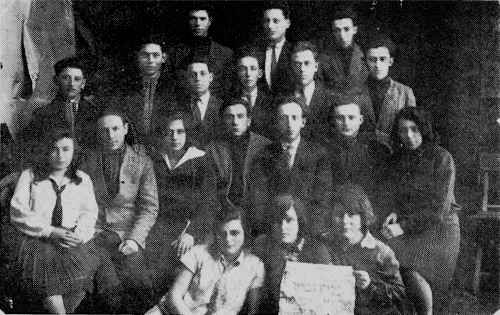
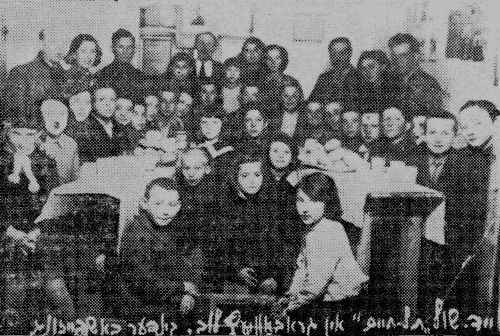
Avraham Messer, Lerner, Pinchas Leyb. Meir Vaynshtok. Chaim Edelman, Yosef Boym, Adina Kutser, B. Zisman, Peck, Ya'akov Nudel, and others |
The Jews who had left Grabowiec for Russia during World War I began returning to the town in 1918. Young people started to seek secular organizations, and the winds of revolution came to town.
Socialist Zionism was established in Grabowiec in 1926-1927. Yehuda was one of the founders. Zionist society in Palestine was in crisis; many of the earlier pioneers had returned, disillusioned, to their homes, including young people from Grabowiec. The Yevsektsiya flourished, gloating: “In Palestine, your utopia, people are hungry!”[13] Young people who believed in Zionism were in mourning.
A few young folks who had developed socialist leanings over their years in town yet were not ready to relinquish their Jewish instincts, organized as Socialist Zionists before they ever encountered Borochov's theories.[14] Young men and women of all social classes felt a deep commitment to this way of life. They were faced with serious problems such as the Yevsektsiya's sloganeering, and older, authoritative politicians. The Tarbut library that was established along with the HaTikva organization was recognized by the authorities as a public institution. However, the Communists infiltrated the library committee and utilized the library itself (as they did with other humanitarian institutions)
[Page 105]
in Grabowiec. During the crisis in Palestine, the entire library became a tool of the Communist party.
A branch of the Socialist-Zionist Po'aley Tziyon was now established in the town, helping the struggling young people to find their way. Once they realized that the library could not be regained, they founded a new library, which served as a party clubhouse. They were now free of ongoing contact with the Yevsektsiya. These young folks had strong convictions and withstood the ideological storms of the time. On Friday nights, after the official program, they would stay in the dark room and talk for hours. With no designated leader, the group slowly found its way to the Palestine solution to the Jewish problem.
The youth of Grabowiec was revolution-oriented, and mostly rejected the ideas of the older generation. After Freiheit was established, it became the dominant movement in town, rivalled only by the Communists.[15] The spirit of resistance to Fascist rule in Poland, which encouraged the pact with Nazi Germany, oppressed the labor movement, and challenged the rights of Jews and other minorities in Poland
|
|
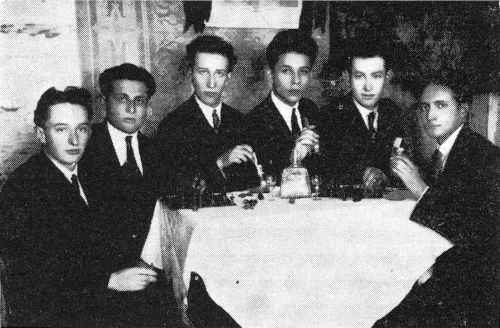
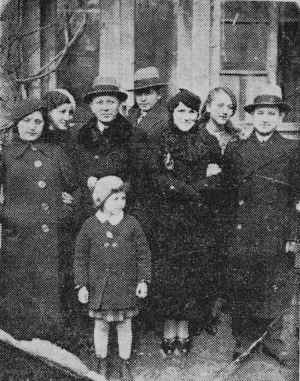
From right: Ya'akov Becher, Hersh Aba, Chaim Kutser, Yehuda Shapira, S. Puter, Yosef Gofer |
[Page 106]
|
|
affected all the young people in town. The danger of arrests and torture led them to be responsible in their actions. They were able to fight the Communists without involving the police. Once, the Communists had come to break up a Freiheit meeting and were fighting with the Freiheit members; but when the police appeared, the Communists quickly melted into the group and could not be identified.
Freiheit supplied the young people with a firm foundation, and soon spread throughout the town. The arrival of a speaker was a festive occasion. The members distributed the party newspaper, and collected funds for the Jewish National Fund as well as for the Jewish Labor Party in Palestine. The drama club they started was a welcome addition to the town's culture. The old library, now held by Communists, was closed. The Freiheit clubhouse and its library became the center of activity and influence.
Regional conventions were important. Traveling to the convention and assembling were a display of Labor Zionist power, yet harbored a danger of conflict with non-Jews, the police, and the Communists. Fights were common, and our young people gave as good as they got. In one case, the Freiheit members beat up their comrades from other towns, because they couldn't identify each other. After this incident, members had to wear their club uniforms to conventions.
[Page 107]
Freiheit resolved that its members should emigrate to the Land of Israel, and settle there as farmers. Two groups of members underwent seasonal agricultural training in nearby farms, where they worked in the harvest. When winter began, they returned to their homes, and prepared to leave when their turns came.[17] It was only in the 1930s that regular training for kibbutz life began.
The clubhouse served as a warm home to its members. Yehuda exhibited unusual initiative. Temporary jobs were found for the members who had returned from training. All the members worked at jobs such as felling trees. The wages were set aside to help poorer members emigrate.
The Grabowiec Freiheit club participated in various movement activities, based on the decisions of the Central Committee. Eventually, our members took part in organizing agricultural training for members in Galitzia, where most of our members went before leaving.[18]
|
Eventually, the movement decided to form a framework of younger children, which was named “Scouts.” It was based on the spirit of the established movements in town, which provided an alternative education.[19] Young people no longer attended the Talmud-Torah, hardly went to school, and had nowhere to turn. They spent their time in the meadows outside town. Some were short of food, and many others sought love, a warm environment, and guidance. There was a debate whether to accept children who were neglected and left on their own. Yehuda participated in this debate, and once the issue was decided in the affirmative, he began organizing these children. The Scouts, headed by Yehuda, were able to attract them. He was able to gain the trust of these children whose lives had taught them to rebel against authority.
“We were thirsty for a friendly word. After our first conversation, we believed that
[Page 108]
Yehuda could offer that to us. We were attracted by games and books, and sought a quiet corner. The club provided that, and Yehuda read to us.” Yehuda knew how to educate them, and teach them reading, writing, and arithmetic. The ordinary Jews of Grabowiec approved of the Scouts, and would come to request that their children be enrolled. The Scouts became a significant force in Grabowiec. “When all of us – 120-130 children in four age groups – went on a walk in our ‘Red Scout’ uniforms of gray blouses, even the non-Jews noticed, and we were filled with pride.”
Yehuda worked in his shop during the day. He became known for his patience, decency, and dedication. People turned to him for advice. He would write letters to the authorities for people who needed help, and in the evenings he was a youth leader, lecturer, and teacher. He lived in and for the movement.
The wooden houses of the town are shrouded in darkness. A few windows show the faint flickering of kerosene lamps, which are too weak to penetrate the gloom. The few rays of light that shine through illuminate the mud and filth in the streets. All the lights on a dim street at the edge of town have gone out, as the residents – tailors, shoemakers, and small shopkeepers – have gone to bed worrying about their lack of security. Darkness and fear slink across roofs and walls, and dominate the hearts of the Jews, who are trying to rest.
One house, however, shows a faint light in the window, and singing is audible, challenging the terrible blackness. It is the Yiddish song “No more wandering aimlessly in the dark, no more stumbling through the night.” It is soon replaced by a song of longing for distant, lovely days and nights: “Sleep, Valley, land of glorious beauty. We will guard you.”[20]
Who are those who dare to sing, in this mire? Who has the strength to challenge the heavy darkness? Who dares to dream of beautiful, sunny days and flourishing fields in the ancestral homeland? They were Jewish boys and girls that Yehuda called out of their miserable homes. Many of them had to stop their studies in order to help make a livelihood for their young siblings. Yehuda has collected these “little Jews” lovingly,
[Page 109]
and has begun straightening the young backs that are already bowing under the burden of work. He is teaching them a new way of life.
He faces them with all his enthusiasm and loving kindness, which capture their hearts, and introduces the young people to new, strange, and wonderful worlds. He tells them that people are not born poor or rich, miserable or happy. Everyone is born equal, and all children have the right to learn and play. Evil people have decided to rob the children of their rights. He tells them that the Jews, too, have an ancient homeland, which they fought for against great, powerful enemies. The Jews worked their land, and ate its produce.
Yehuda goes on to tell them that now, in our times, young Jews have risen and returned to the homeland, which they are making bloom. They are building Jewish villages in which everyone lives and works together, and protects their produce from enemies. The boys and girls are fascinated as they continue to listen. The simple room is alive with young people every evening, regardless of rain, snow, or ice, all entranced by Yehuda's radiant personality. Sometimes the story is cut short by a violent kick on the door and loud yells, “Filthy Jews, damned Communists, scatter immediately!” The Polish policeman's whip whistles through the air and lands painful blows on their heads. The wall decorations of posters and images of heroes are plucked off and trampled under the dirty boots of the policeman. Yehuda is not afraid. He teaches the young people not to fear, either. He gathers them together the next day, sets a few of them on watch to warn against impending danger, and is even more adamant about preparing them for their new path.
Indeed, many of the young townspeople followed the road that led them to a new life, thanks to Yehuda, who showed them the way.
Yehuda provided for himself and his mother by working at the shop. He was more interested in movement issues than in the shop. The square outside the shop door was the site of members' debates about the movement and their own futures. His mother, whom he had to stay behind to support instead of leaving for Palestine, was not pleased. His situation wasn't easy for him; his friends and students had left, while he was still mired in the swamp. Yehuda believed in practicing what he preached.
[Page 110]
He sometimes neglected shop business in favor of movement affairs. If his mother was traveling to purchase merchandise, and there was a meeting he had to organize, he would simply lock up the shop. He was in charge of May 1 demonstrations, and the police, who were aware of his role, would come to arrest him the night before.[21]
The Jewish school of Grabowiec was established in 1933, with Yehuda as one of the founders. He set the tone in the school. The Polish school taught no Hebrew. The Jewish school fought against Communist assimilation on the political left, and against Jewish religious pressure on the right. Yehuda realized that he lacked educational materials for the battle; orally educating the young people was not enough. The Polish books needed to be countered by Jewish books. All the young people spoke and lived their everyday lives in Yiddish, but could not read it. That was the impetus for founding a Jewish school.
Efforts to gain the support of the Party's Central Committee were fruitless.[22] They feared complications, and demanded that a location, teachers, and everything required for an official State school be secured before anything else. The founders, though, had something more limited in mind. They wanted to offer the many Jewish young people who had completed elementary school extra classes for another year or two.
Our young people faced another danger at that time: the “uniformed” Beitar movement, which was now on the ascendant.[23] The elections for the 18th Zionist Congress (a decisive battle for power between the right-wing Revisionist movement and the Zionist Labor movement) ended with a victory by the latter. When the news came about the assassination of Chaim Arlozorov, a mass meeting was called at party headquarters in the center of town.[24] Yehuda opened the meeting, during which a school for advanced Zionist education named Tel Chaim, in commemoration of the slain Labor leader, was founded.
|
|
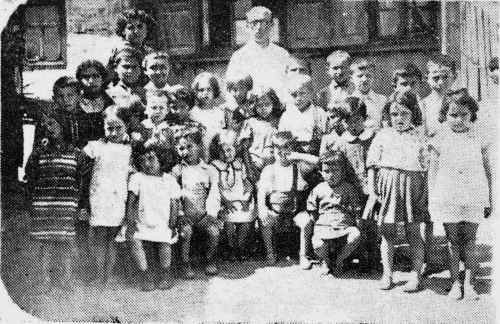
The principal Baruch Eynes (first on the left), is next to Moshkehh Shroyt, who was greatly admired by residents of Grabowiec. See Mordechai Fink's article about Moshkehh. |
[Page 111]
As the Central Committee and the schools committee did not support the school, the local movement shouldered the financial burden. The Society of Grabowiec Natives in the United States, whose secretary was a member of the left-wing Po'aley-Tziyon, and who sent a contribution every year before Pesach, augmented the donation in order to help the school. Yehuda was sent to Lublin as well, where he obtained the support of HIAS for a daily glass of milk with a roll, so that the children could go to the Jewish school immediately after they concluded the day in the Polish school.[25] The founding members visited every household to encourage the impoverished parents to send their children to the free school, where they would receive books and notebooks. The two-year program included Bible and literature, as well as Socialist Zionist theory. The aim of the school was to prepare Zionists for emigration and settlement in the Land of Israel.
Yehuda was the only person, besides Eynes, who was wholly devoted to the project. He was primarily active in the areas of education and curriculum, rather than in finances and organization.
The school held parents' meetings every Saturday; these were an important tool to disseminate culture and ideals, as well as to broaden support for the project. The plays mounted by the children for every holiday were another tool that bolstered the parents' connection to the school. They gradually became used to helping with the expenses, and the school gained public recognition. Even the Communists recognized the school, and hoped to enhance their membership with these young people who were receiving a Socialist education.
I remember a play that was performed in the barn, and prepared with great enthusiasm. The Hrubieszow school was invited. All were amazed at the way the children presented a wonderful evening by the light of a kerosene lamp, in a rough structure, with no support. Eventually, an annual donation day was organized in Grabowiec, with the participation of different community groups.
The school graduated its first students in 1935, and gained recognition throughout Lublin county. Younger children began to be cared for as well. First- and second-grade students who attended regular school in the afternoons came in the mornings. Even the Szul-Kult organization adopted this system and opened similar courses in many locations; they requested learning materials and curricula.[26]
Yehuda was still unmarried, but through his work he had developed a relationship with Esther, who participated in the movement's activities. After the death of her parents, she had to care for her ten-year-old sister, Elka. The two decided to marry.
[Page 112]
They lived, together with Elka, and with Yehuda's mother. Esther worked in the large, thriving shop, which produced a fine income. In 1937, their son Eliezer was born, to the delight of his parents and grandmother.
World War II broke out. The Russians entered Grabowiec before the German forces arrived, but stayed for only two weeks. They had only three officials, as well as committees they created among the local Communities. The Jewish grain mill ground flour for the Red Army.
Yehuda's mother refused to leave town when large numbers of townspeople went to the USSR; she died in her own home. Yehuda and his family joined many others and crossed the Bug River to Volodymyr-Volynsk after the western bank of the river became German territory thanks to a treaty.
Yehuda exhibited a profound grasp of the constantly changing conditions. In January, 1940, the Soviet authorities announced enrollment for labor. Those wishing to enter Russia and work there had to join the list. Yehuda elected to stay in Grabowiec, with “refugee” status, in order to exit more easily later. Even during this period, Yehuda and Esther's home was a meeting place for movement members, and a center where consultations and decisions were made. Yehuda took very good care of little Elka, who was a model student, and was proud of her brother-in-law Yehuda, the leader of the local Jews. Naturally, their home became a refuge for the Jews who fled from work in the distant forests of Russia.
In June, 1940, the order deporting Jews to the east was given. No questions or enrollment were involved. Jews had one week to obtain a Russian passport and go one hundred kilometers east of the border. Trucks transported the refugees. Those who considered themselves clever and hid in place soon found themselves trampled under the brutal boots of the German occupation.
Asino, in a region near the Ob River, was a gathering place for many refugees from Grabowiec.[27] Like many others, Yehuda and his family were taken to the Yaya sovkhoz[28]. They lived in a shack crowded with refugees for about two months. Yehuda, who had been a pampered only child, accepted the hard labor and dismal conditions with a smile. Digging up the soil was an extremely tough job. Everyone worked, even little Elka. Food was scarce, and often spoiled. The damp bread contained gravel. Nights were devoted to the endless battle against the enemies of refugees – bloodthirsty bedbugs.
The five HeHalutz members from Grabowiec organized themselves into a “brigade.” Yehuda led them to increase their output – the Jews had to prove they could be productive! He was always alert and full of good humor. Their conversations involved the Land of Israel, which brightened the grim life of the remote sovkhoz.
[Page 113]
When winter began, Esther could barely feed Eliezer. A Russian selection committee transferred families with young children to Sverdlovsk. Yehuda and his family finally had a decent apartment, and were even given permits to attend the bath-house! Work was in the mines, Yehuda soon became a brigadier's assistant, and here, too, was able to increase the workers' output. He was never ill and didn't miss a day of the work he was conscientious about.
They were transferred to Ural in 1941, to a location 60 kilometers east of Sverdlovsk, where copper was mined. He was in the group of porters who loaded train cars with ore, and soon became the center of a group of forty Russian workers, kulaks who were transferred to Siberia because of their opposition to collectivization.[29] Yehuda became a “Stakhanovite” when he led his group to production that exceeded their quota.[30] Even there, in remote Ural, he never lost hope, and was sure better days were coming.
When Russia joined the war, the refugees began to hope that they could return home. The bread shortage grew dire. People spent all night standing in line, and little Eliezer's tears froze on his cheeks in the severe cold. Although some people were transferred to warmer locations, Yehuda was indispensable. He was the brigadier's devoted, serious-minded aide, one of a kind.
They decided to move without permission. Everyone was headed for central Asia, to Tashkent, “the city of bread.”[31] Eliezer contracted a severe case of measles during their travels, and was admitted to a special hospital for refugees, where his mother was not allowed to visit him. During his convalescence, they reached a kolkhoz in Uzbekistan.[32] It was freezing; they did not know the language, and the refugee experience continued: wandering, crowds, hunger, want. The family was broken up, with Elka searching for Yehuda while Yehuda searched for his family.
They finally all reached Turkestan, where they remained for four and a half years.
The terrifying news about the Germans gradually reached them, and they were unable to rest. Once they heard rumors about Jews enlisting to fight Hitler, Yehuda organized a letter to the Turkestan authorities requesting the right to enlist as a Jewish battalion in the Red Army. The delegation that was sent to Kuibyshev returned after being turned down, but Jews were being accepted into the Polish army, under the command of General Anders.[33] 120 Jews, among them Yehuda, left for that army in May, 1942. They were mobilized in Persia; Yehuda served mostly in Iraq.[34]
Yehuda joined an army convoy that was headed for Egypt. They passed through Kibbutz Tel Yosef in Palestine, where many emigrants from Grabowiec had settled. In 1943, he decided to desert, as
[Page 114]
the Polish army was not fighting at all, let alone fighting Hitler, and he could finally settle in the place he had always longed for.[35] Two weeks later he was in Tel Yosef, where he changed his last name to Gilboa, after the mountain that dominated the local landscape. He began working with sheep, leaving behind his previous ways of life: the well-to-do shopkeeper of Grabowiec, the ideologue and public speaker, the Jew wandering through the USSR, and the Jewish member of the Anders army. He devoted himself to his charges, herding them to pasture, milking them, selling lambs to livestock dealers, negotiating with neighboring Arabs (though he did not know Arabic at all). His modest room contained a narrow bed covered by a dark blanket, and very few pieces of simple furniture. His evenings were spent reading, listening, and learning all about his new life.
He keenly missed his family, who were still in a foreign country. Were they alive? Healthy? Could Eliezer read? Did Elka know she was Jewish? How was Esther managing in such difficult circumstances? He was restless, and felt guilty about the peace and security he was enjoying while his family was over there. He hadn't heard a word from them, or any news of them, since June, 1942.
Only a few soldiers' wives were permitted to live near the army camps in Iraq. Esther was able to obtain a permit with great effort and despite many difficulties, but when the convoy was about to leave Eliezer contracted severe dysentery. When he regained his health, no convoys were leaving, and the move never took place. The family stayed in Turkestan for four more years. She received Yehuda's letters, but her responses were lost en route from the USSR. All this happened while Yehuda was still in Iraq. He made one more effort to bring his family over, and gave a British officer $500 to facilitate the move. However, the officer disappeared and the family remained in Turkestan. They were impoverished, and one of their only pleasures was the reception of a letter from Yehuda. He would write, “I write you twice a week, but receive no responses! Maybe, if you send telegrams, they'll arrive!” Elka was a teenager and a member of the Komsomol.[36] She believed every word of Yehuda's letters, and, though she was a Soviet patriot, the wonderful letters aroused her longings and amazement. She showed the letters to her friends, and they, too, began to long for distant, beautiful places.
Yehuda wrote a Hebrew letter to his uncle, who lived abroad. His pride in his new life in the kibbutz and in Palestine was clear.
[Page 115]
“… I received your letter of April, and the $45 as well. I thank you heartily, but please do not send me money in the future! You're not wealthy, or young… I've become a sheep-raiser (“Mesha, king of Moab, was a sheep-raiser” 2 Kings, 3, 4) I'm enclosing a picture from an exhibition of our kibbutz's produce, in which I participated. I'm happy with my work, and especially happy to be in our country. I traveled through many countries on my way here: enormous Russia, Siberian steppes, Asian countries, all the way to the Caspian Sea. I spent nine months in Teheran, Persia; a year in Bagdad, Babylonia, and traveled through Syria and Lebanon as well. But there is no place as beautiful as our country, where you feel freer than anywhere else. Here, we walk with heads held high, independent, and self-confident. We're on solid ground, feeling that it is all ours, and no power in the world can dislodge us. Uncle, I wish you could see the young people who were born here – their clear gaze, confident gait, and pride… The land responds to us. We know what the first and last rains of the year mean. We celebrate the festival of first fruits, and the festival of harvest. I'm sorry that you in America can't feel all this, and the Jews around you haven't learned from the disaster that swallowed up the Jews of Europe… My son sent me a letter in Hebrew, in which he said that a pious old Jew was teaching him Torah and Rashi commentary, as well as Hebrew. Naturally, this pleases me immensely.” It turned out that the old man had served a sentence for teaching Hebrew in the USSR. He was secretly teaching Hebrew in Siberia, to Eliezer and other children. He was compensated from the meager food allotment the family received.
When the war was over, Yehuda's family was among the first to receive immigration certificates. The last letters they received from Yehuda before they left described a peaceful, comfortable life, “that one could only dream of.” Esther was happy at the prospect of the peace and quiet they would finally enjoy, after all their trials.
He received a telegram from Paris on June 10, 1946. They were en route to the Land of Israel, where they arrived on June 20. As they entered the kibbutz, they saw a hay wagon carrying young men with pitchforks, and could not believe they were Jewish. However, when they saw Yehuda's home – a plain wooden structure supported by poles, like a pigeon house, the dream that Yehuda had delineated vanished. Seeing her disappointment, Yehuda said, “Esther, life anywhere else is worthless. This is where life is meaningful and interesting. Wait until you get to know it.”
However, Fate had the last laugh. June 29, 1946, became known by Palestinian Jews as “Black Friday.”[37] Yehuda was arrested, with many others, and sent to prisons in Atlit and Rafah. He was away for six weeks.
Yehuda lived in Tel Yosef for three years, and identified with kibbutz life. He now had to convince his family to reach the same conclusion. He had to explain why
[Page 116]
he was living in a simple wooden structure while others lived in buildings, why Esther had to hand their son over to the kibbutz's children's house, why he himself had to work long days with the sheep, and sometimes, during the lambing season, spend nights there as well. Once again, as in the old days in his home town, he had to overcome his family's opposition. He feared having to leave the life that gave him such great satisfaction. He marshaled all his convictions to rescue the relationship between his family and the kibbutz. “If I could convince you that this life is beautiful, I'd be the happiest man in the world,” he told Esther. Thanks to ongoing discussions and conversations, he was able to avoid anger and tension, as he sang the praises of kibbutz life. He taught Esther Hebrew. When their second son, Avishai, was born, Esther made peace with kibbutz life. She was especially pleased with the quality of education. Yehuda was happy.
When Avishai was only six months old, Yehuda became very ill; he was bedridden for six months. He could not return to raising sheep, which led to severe depression.
It was the time of the bitter split in the kibbutz movement.[38] Yehuda could not decide: could he move to a different kibbutz in his poor physical shape? He finally decided to take that step, along with other members of Tel Yosef. However, three days after the move he suffered a heart attack, and was incapacitated for a few weeks, unable to speak or move. When his condition improved, he returned to his new home.
He began to work at home, and eventually took on the management of work records. He enjoyed this work, and was happy to be useful. He had no regular hours or routine, working in the evenings and on Shabbat, but developed new work methods. A summary of the previous month's work would now appear on the kibbutz bulletin board on the first day of the new month. The kibbutz management was able to keep track and plan for the future. Yehuda worked single-handedly, with no assistants. He patrolled all the paths of the kibbutz, asking questions and taking with members as he went, following every development of kibbutz branches, beaming as he went.
On February 21, 1959, he was following his usual routine, when his heart suddenly stopped. He was gone.
Information about Grabowiec and Yehuda, of blessed memory, was provided by Chaim Edelman, Baruch Eynes, Zachary Eshel, Avraham Eshkol, Ya'akov Becher, Yosef Gofer, Alter Gafni, Chana Zilberzweig, Gideon Kena'ani, Dan Carmel, Yosef London, Azriel Sapir, Leah Shroyt, and family members.
Translator's footnotes:
by Mordechai Fink
Noteworthy among Moshkehh's qualities was his Zionist enthusiasm, which came from deep conviction and daily actions. He was one of the founders of the local branch of Tze'irei Tziyon, and was fully committed to it. His devotion was absolute – Moshkehh didn't believe in partial measures. Once he was convinced that he was on the right path, he knew no rest until he saw his ideal coming true. His strong will, concentrated energy, and practical sense enabled him to balance leadership and comradeship, and establish the movement firmly in our town. He created a role for himself in the nascent movement, and became its ideological and practical leader.
For us, its earliest members, the movement was revolutionary. We relinquished our earlier ideals and became almost religiously dedicated to the new movement. The activity was the basis for our renewal, and it enriched our lives with content. Moshkehh was our example of a dreamer who was also a man of action. Preserving all that was sacred in love of homeland, love of work, a life of freedom, equality, and justice – these would be the basis of the Jewish state.
Moshkehh's practicality, will to act, and persistence helped him view reality without frills. He strove to make the Zionist ideal come true in real life. Moshkehh was aware of the hopelessness of Jewish life in the diaspora, and of Zionism, the only solution that would bear fruit. All his energies were directed toward this goal. Enthusiasm and practicality were not Moshkehh's only qualities; his warm heart further enriched his personality, as did his strong emotions and vivid imagination.
[Page 118]
He loved the townspeople dearly for their decency and hard work, and was profoundly connected to his friends and comrades.
We worked together for a few years, and I can honestly say that he was never too tired to help a friend. His inner warmth also animated his political activity, and fueled his consistency and determination. A profound faith combined with lofty ideals were the basis of his realization that no other way could save the nation from its unhappy situation. His conviction was infectious, and he was loved by everyone he came into contact with.
It was interesting to watch and listen to him during public debates with his adversaries, especially Bund activists (headed by Shlomo Tsigel). Moshkehh was very knowledgeable about the details of Bund theory. Local Bund members would invite people from their central committee to these debates, and our Moshkehh held his own, with animation and enthusiasm for Zionist ideals. The listeners became aware of Moshkehh's qualities, which joined excitement with practicality. Only someone with his self-discipline could hold these qualities in check. His interpretive capacity and clarity of expression enabled him to express his opinion that the Bund was no more than an illusion as far as the Jews were concerned. He amazed us with his broad knowledge, rich thought, and analytical capacity.
Moshkehh believed in the power of information and proof, and defended his positions strongly. At the same time, he had the gift of being a good listener. He listened to his comrades intently, as though wishing to retain every phrase. During debates, he followed every claim of his opponents, and was ready to respond, inform, emphasize, criticize, and fight.
After the party was established in our town, headed by Moshkehh and Baruch Eynes (long may he live), I was lucky enough to work with them as a member of the central committee. Both Moshkehh (as chairman) and Baruch (as secretary) were revealed as gifted leaders and teachers. I mention these two men together, as they were instrumental in all the activities of the organization. We became close friends, and remain so to this day.
I consider Moshkehh one of the few figures that leave an indelible impression on one's soul, and accompany one throughout the course of life.
|
|
JewishGen, Inc. makes no representations regarding the accuracy of
the translation. The reader may wish to refer to the original material
for verification.
JewishGen is not responsible for inaccuracies or omissions in the original work and cannot rewrite or edit the text to correct inaccuracies and/or omissions.
Our mission is to produce a translation of the original work and we cannot verify the accuracy of statements or alter facts cited.
 Grabowiec, Poland
 Yizkor Book Project
 JewishGen Home Page
Copyright © 1999-2026 by JewishGen, Inc.
Updated 19 Jan 2026 by JH