 |
|
[Page 152]
by Yeshayahu Heeter (of blessed memory)
I was born and raised in Grabowiec, our small town, where I experienced all the joys and sorrows, and lost my parents, sisters and brothers, who were martyred as Jews, tortured and massacred by Hitler's murderers. The memories of the martyrs will forever remain in our hearts, and it is our duty to recount to our children and grandchildren the lives and deaths of our parents and grandparents to future generations, as well as the ethics that guided all their affairs, and the beauty of the Jewish traditions that were preserved in our town.
My father, Ben-Tziyon Heeter, was known in town as Bentshe-Avrahamtshe, Yitzchak's son. My dear mother, Etel, was called Bentshe's Etel. My brother was Ya'akov-Meir, and my sisters were Itta-Leah and Chana-Gitl. These names are part and parcel of my life; their souls are forever engraved deep in my heart, and I will honor their memory as long as I live. I think of them and the many-faceted life of our town, day and night. I constantly see the young people, who were inspired by ideals, spent time together, longed for a finer, better life, far from the deep mud and dark winter nights, when the stifling small-town conditions grew oppressive and their dreams gave them wings.
Our summer twilight walks to Castle Hill, near the cemetery, are unforgettable, as are those days and nights. We don't want to part with them, because they hold
[Page 153]
all the beauty, dreams, and longings of the youthful years we passed in our town.
I lived in Grabowiec until 1934, when I was married in Zamość. But I was always connected to our town and was unable to relinquish my nearest and dearest, family and friends. My last visit to Grabowiec was in 1939, the year the war broke out. It was the last Sukkot holiday that I spent with my parents. We felt intimations that a terrible catastrophe that would overtake the Jews, but certainly did not imagine the gruesome ending that lay in store. When I returned to Zamość after the first day of the holiday, we saw images that presented destruction and ruin. We immediately fled to Lemberg, from which we were forced to go to Siberia.[1]
In Siberia, I received two more letters from my brother Ya'akov-Meir. He made efforts to write about their situation calmly, writing that they were healthy, but had to walk three kilometers to the bakery; every bit of food necessitated a long walk. Though it was difficult to get a clear picture, I was able to imagine the seriousness of their situation. We in Siberia were also struggling; our lives were very difficult. Yet we still had a spark of hope.
All our hopes turned to ashes. Of my entire family, I was the sole survivor, except for my brother, who escaped to Cuba, where he lived until times improved. Nowadays we both live in Israel.
Translator's footnote:
by Moshe Shek
Ramat HaSharon, Israel
|
|
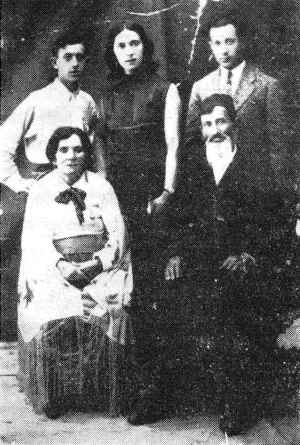
| The Shek family |
I love the memory of Grabowiec, my town, and hold it dear. It lay next to the Kalinówka River, surrounded by hills, fields, and forests, and was always teeming with life. Jewish men, women, and children filled the narrow streets. Children went to cheyder, and played in the street. Women were busy with their affairs – looking after their homes and shops, carrying on conversations through the open doors of homes and shops. Men who were idle argued over politics and community topics. Others roamed the streets, trying to earn some money.
Shabbat Eve
I recall one frosty Friday, at dawn, when the town was still enveloped in darkness, and a hoarse voice disturbed the profound stillness, calling out:
[Page 155]
“Get up, get up for prayers!” The voice repeated the call every few minutes as it grew more distant along the streets, but its echo lingered. It was Mendele's son, Yechiel, summoning the Jews of the town to start preparing for Shabbat – particularly the women, who were responsible for preparing everything ahead of time, so as not to desecrate the holy day. Yechiel was broad-shouldered, with strong hands. He constantly worked hard in order to make a living; serving as shammes in Grabowiec, he did not earn enough. The town was rich only in mud…
My home began to stir. Mother was the first to rise, and immediately began to knead and roll out dough for challahs, noodles, flat rolls, or cookies. The house soon filled with pleasant aromas that roused the family. I would get up and climb off the bench that served as my bed. In Grabowiec, bench-beds were a kind of sofa: a broad bench was covered and used during the day for seating. The cloth cover was removed at night, and the bench became a bed.
The first thing that greeted me when I got up was the tempting fragrance of the babashkes, pancakes that were fried inside the oven on a special metal sheet by a process known as “at the flame.” The flame itself looked like a huge red tongue that extended right into the black chimney. Moshe the chimney-sweep would clean it from time to time, but long periods often passed without a cleaning.
Another bell would ring around 12 noon: “To the bath-house!” Some people immediately hurried away, but most went later in the afternoon. The bath-house was an old, part-brick structure, constantly damp from the steam on Fridays. Coming into the building, your exhaustion and everyday worries were instantly wiped away. You cleansed yourself of the grime, along with the week's burdens. Bodies warmed up in the bustle. People sweated, soaped and rinsed themselves, and donned fresh shirts. These Jews, who had labored all week to make a living, now suddenly felt clean and elevated, freed of their mundane
[Page 156]
needs, purified, and renewed. Their bodies hummed with the approach of Shabbat. They left the bath-house refreshed and relaxed, and stopped talking; they began to think about sanctity and prayers. Their hearts filled with joy at the thought of the oncoming luminous Shabbat.
Still standing at the river were blind Shlomo and Chaim-Ber, catching fish for Shabbat. Chaim-Ber would agitate the water with a rod, and Shlomo held out a net, or a small sack, to catch the fish, all the while shouting, “Chaim-Brrr, I don't see a single fish.”
By dusk, the homes of Grabowiec had been scrubbed. The table was covered with a white tablecloth and adorned by the silver candlesticks that had been scoured with sand until they shone. Two beautiful challahs were covered by a napkin. Mother bent over the lit candles, her lips murmuring the candle-lighting blessing. She prayed for her husband and children, asking for health, long life, consolation, security, and salvation. Mother's eyes were as holy as her sorrow, as the candles that had been blessed, as the joy with which she welcomed the Shabbat Queen. Her white hands, like the sheltering wings of the Shechina, hovered over the Shabbat candles.
Now another cry was heard from outside. Mendele's son Yechiel called hoarsely, “To the synagogue, to the synagogue!” Soon, fathers and sons would be going to the Shabbat-welcoming service. Inside the study house, the community of worshippers was bathed in the light of all the lamps. The leader, or cantor, sang out, “Lecha Dodi Likrat Kallah”, inviting the Shabbat bride in with music praising her beauty[1]. Hearts grew warm with joy in community. Shabbat arrived, not only like a beautiful bride, but
[Page 157]
also like the loving parents who transformed the meager homes into palaces full of beauty and song.
Although I left Grabowiec early, these memories arouse my love and sorrow for those who are gone, those who were hideously murdered.
Translator's footnote:
by Esther Shteinberg-Zamuster
I tremble all over when I remember our town, and see before me the martyrs who were so gruesomely killed by the Nazi murderers. They were holy when they lived, and even holier after their deaths. They observed Shabbat and holidays strictly, according to their individual means. They worked hard all week, in order to welcome Shabbat properly, to prepare Shabbat dishes and clothes for themselves and their children.
During the week, the Jews of our town made do somehow. Some families lived on crusts of dry bread and potatoes. Some pasta and potatoes with bits of onion and chicken fat were cause for rejoicing. But they prepared fresh challah and fish, wine, and some meat for Shabbat. There were certainly some people who couldn't afford to buy everything; they were helped by others who made sure they were fully supplied and would be able to welcome Shabbat suitably.
[Page 158]
In all Jewish homes, Friday evenings were beautiful. The children were especially conscious of the change. Mother would be unusually attentive, washing their hair and laying out fresh clothing.
The entire town took on a different appearance on Fridays. People's expressions, feelings, and thoughts were transformed. After all, Shabbat was at hand. The home changed; it was cleaner and brighter. A white cloth gleamed on the table, reflecting the shine of the silver candlesticks and the egg-washed challah.
Preparations actually began on Thursday. Mother was up until midnight, kneading dough for challahs and baking bread for the entire week. The oven had two sections, one for bread and the other for flat rolls, small knishes with cheese and other fillings. When the firewood was consumed, Mother would scrape out the coals and bring them to the kitchen, where cooking was done on weekdays. She would start a stew over the coals, and we ate fresh flat rolls with meat on Fridays. That was the main meal, which we ate between noon and one.
Jewish homes were bright and merry on Friday nights – moments that remain sacred and beloved in our memories.
I remember, when I was already a member of the local Scout section, and our counselors were Yidl Shapira, Ya'akov Becher, and Yosef Nudel, who led us in conversations about many topics, mainly pertaining to Zionist ideology.
Early on Shabbat mornings, we would go to Castle Hill, carrying books to read and later discuss. Sometimes, we would meet at Malka Geist's home. Her father had died, and her mother would travel to all the fairs and sell candy. This barely provided her and her three children with a living.
[Page 159]
They were three sisters: Malka, Soreh, and Hindeh. All were extraordinarily pretty, although they lived in cramped conditions: one small room, three by five meters in size. We held our meetings there. The Jewish Scouts had already become active in Grabowiec. We loved that small space, where we had festive meals accompanied by songs. We felt connected by a lofty ideal and profound friendship.
My parents, Yerucham and Gitl Shteinberg, had seven children, three daughters and four sons. My oldest brother Shabtai was killed in France, with his wife Beyle and their two children. The second oldest, Yisro'el, was murdered in Grabowiec, with his wife Eydl and their two children. My third brother, Hersh-Leyb, was also killed, together with his wife and our parents. The fourth brother, Binyomin, was killed in Warsaw.
My sister Rokhl-Leah and her husband Berish Druker suffered the same fate. They were killed in Świdnik, shortly before Liberation. They had hidden in that town throughout the war, until Gentiles tracked them down and beat them to death with sticks. My other sister lived in Zamość, where she was murdered together with her husband and two children.
I am the only survivor of my large, widespread family. I mourn their tragic deaths constantly.
|
JewishGen, Inc. makes no representations regarding the accuracy of
the translation. The reader may wish to refer to the original material
for verification.
JewishGen is not responsible for inaccuracies or omissions in the original work and cannot rewrite or edit the text to correct inaccuracies and/or omissions.
Our mission is to produce a translation of the original work and we cannot verify the accuracy of statements or alter facts cited.
 Grabowiec, Poland
 Yizkor Book Project
 JewishGen Home Page
Copyright © 1999-2026 by JewishGen, Inc.
Updated 10 Feb 2026 by OR