 |
|
|
[Page 93]
|
[Page 94]
by Mordechai Fink
The period of World War I deserves a special place in this memorial book. That was when the young people of the town changed course as far as Zionism and culture were concerned. The war caused the young Jews of Poland to transform their concepts of the future, following the terrors of the war and the horrible images, and their severe effect on the Jewish population. The young people of Grabowiec also realized the plight of Jewish life in the Diaspora. They suddenly grasped that they stood at the edge of a roiling abyss and were in danger of falling into it.
Our town was able to join the Jewish national movements that began stirring at the time. Trying to solve daily problems, they started thinking about the fate of the nation.
|
|
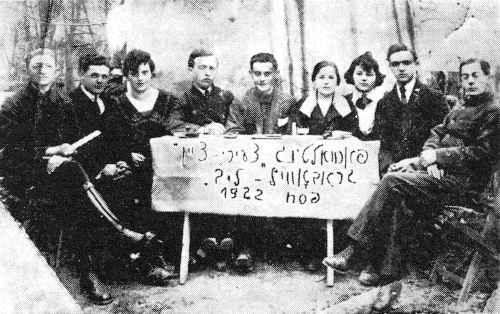
Right to left: Yosef Fink, Mordechai Fink, Itta Shtarker, N. Goldfarb, Moshe (Moshkehh) Shroyt, Baruch Eynes, Hanna Brendel, Abush Goldfarb, Moshe Lerner |
[Page 95]
We can definitely say that at the outset of that period the young people of Grabowiec were ready to join a national movement. They all came from a religious environment, and grew up in an old history-rich tradition, which gave rise to national aspirations. They observed three weeks of mourning annually, between the 17th of Tammuz and the 10th of Av, and fasted on the last day.[2] Along with lamenting the tragic past, they prayed for future salvation. Traditional messianic beliefs held that salvation, along with the revival of prophecy and the resurrection of all the Jewish dead, would come by way of a miracle. Even this view, however, included political aspects: the notion of salvation was always linked with the fate of the nation. Religious faith therefore included the consciousness of belonging to a nation whose current situation was dire, but which had enjoyed heavenly support in the past and whose future was bright. The Zionist idea was anchored in the ancient messianic faith.
True, the historic role that we members of Tse'irei Tsiyon in Grabowiec embraced was not the realization of the messianic promise, even as far as the nation was concerned. Most of the young people forsook their traditional way of life and were in touch with modern social trends, which were popular throughout Poland and had reached our town. We wanted to create a new society, and thus rebelled against our parents' way of life. We considered a basic change in our social structure to be imperative.
Our town had an affinity with modern Zionism. Young people were active in various public spheres as well as in ongoing Zionist work. Our numbers constantly increased. Cultural activity improved in quality and became structured. The organization was now the center of an unfamiliar way of life. The past seemed to be but a preamble to a new life. Young Jews found an outlet for their dreams and desires. The lectures, debates, and songs of the new society forming in Palestine provided common ground for people of all ages and economic backgrounds. Young people, in particular, were nourished by these activities. Education received new impetus as areas previously not addressed became accessible.
I remember that during a visit to the central office of Tse'irei Tsiyon in Warsaw, the chief officer said, in earshot of the entire leadership, “You Grabowiec young people are distributing more copies of the movement's newspaper than we are! Excellent work!”
He continued to compliment us, saying, “Your town is positively bubbling with movement activity!” My heart filled with pride.
Translator's footnotes:
by Yosef Gofer
The town seemed like all the other small towns of Poland, suffering from poverty and neglect, having a traditional life. The Jews seemed the same as well: ordinary, simple and unassuming, and worried about daily life. Shabbat was the exception: that was when everyday issues receded and ordinary conversation took place alongside prayers. People went for walks outside town as well as in the forest. This was part of the generations-old way of life, with its light and serious sides. Yet there was one thing about our town that served as a model for the surrounding towns: the effervescent social activities of our young people.
At the close of World War I, the Zionist movement began to organize a local branch.
|
|
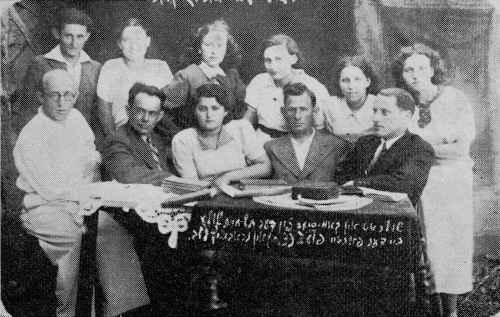
Survivors: Yitzchak Boym, Baruch Eynes (left), Chana Zilberzweig (middle), Leah Shroyt Holocaust Victims: Avraham Messer, Chana Reichman, Rivka Cahan, Golda Hey |
[Page 97]
As it began its activities, priority was given to cultural and educational activities. Thus, the Tarbut library was established, aiming to supply spiritual sustenance to all.[1] Naturally, participation in the activities of the Polish Zionist movement was most important. The young people themselves did most of the work, and continued to nurture the dream like a sacred spark, always ready to fan it into life. The drama club played an important cultural and social role. Every performance was an occasion. There were several performances a year, and each time the small town, in which life held few surprises, was filled with excitement. The income from performances was devoted to various funds and to the library, which expanded and developed. It was used not only by the local Zionists but also by hundreds of town residents, for whom it was a major cultural resource.
The excitement waned after two years of hard work, for reasons common to many small towns. Most important, however, was the war that had broken out between Poland and Bolshevik Russia. All activities ceased, and the Hebrew school closed down. The library lost one of its founders and most active members.
The recovery began after the war, though with less energy than the original impetus. The young people gathered and reorganized. A large new library was established, again named Tarbut, and became a center for all the young people in town. Once again, a drama club was founded, and performances, lectures, and question-and-answer sessions were held. The latter were called “box-evenings”: anyone who had a question on political or literary current affairs wrote the question down on a note and placed it in the box. On the appointed evening, all the questions were taken out of the box, and a group of intellectual, worldly members stood ready to respond and debate.
New breezes were blowing from the east and from the west, with the idea of emigrating to the Land of Israel. The entire activist group left, leaving a vacuum that could not be filled. Communist cells had already appeared in town; they took control of the library and continued their subversive activities under the guise of cultural activities.
A small group of our members began to agitate among the young people, and reinvigorated the
[Page 98]
Zionist Socialist club, which joined the Po'aley Tziyon movement in town. Thus, the Zionist Socialist movement was renewed. A branch of Freiheit, the Zionist Socialist youth movement, was also established. They began to reinvigorate the library, as well as organizing political and general cultural activities. A branch of the HeHalutz youth movement was also opened.
Activities at the HeHalutz branch soon included cultural and social projects. The scope of activities resembled the flourishing of Tze'irei Tziyon. Speakers and lecturers were sent from Zionist institutions; there were book clubs, and daily newspapers became available. There were also weekly and monthly publications in Hebrew and Yiddish, as well as a Yiddish language study group. On summer evenings, we would gather on the hill where an ancient fortress used to stand.
Our Zionist groups became well-known throughout the area. The members participated in every public activity and were active in local and regional affairs. The regional conference was planned for Grabowiec, to express the movement's faith in our local branch. Our efforts to make the conference a success were productive. Everything was done by volunteers, who donated their time and effort to the movement, with no compensation. A torchlight parade on the first evening of the conference went off well. We organizers were very proud of the results of our hard work.
Now the Zionist groups began to clash with the Communists, who tried to attract our youngest members, claiming that the impending revolution would solve all the problems of the workers, including the Jews. Economic conditions were bad, and the young members were attracted by the Communist slogans. We organized widespread efforts against this dangerous trend.
Our Grabowiec Zionist branch was very active during elections to Zionist congresses and in work for institutions such as Keren HaYesod and the Jewish National Fund.[2] I remember that the Grabowiec branches of Po'aley Tziyon and Freiheit produced the largest number of members who participated in elections for the Conference of Jewish Workers in Palestine. Participation involved purchasing a ticket, which the voters in Grabowiec met with dedication despite some economic difficulty.
All the young Zionists in Poland were murdered during the Holocaust.
Translator's footnotes:
|
|
JewishGen, Inc. makes no representations regarding the accuracy of
the translation. The reader may wish to refer to the original material
for verification.
JewishGen is not responsible for inaccuracies or omissions in the original work and cannot rewrite or edit the text to correct inaccuracies and/or omissions.
Our mission is to produce a translation of the original work and we cannot verify the accuracy of statements or alter facts cited.
 Grabowiec, Poland
 Yizkor Book Project
 JewishGen Home Page
Copyright © 1999-2026 by JewishGen, Inc.
Updated 06 Jan 2026 by JH