 |
|
|
[Page 536]
Translated by Ala Gamulka
Edited by Karen Leon
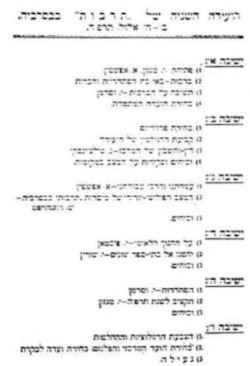
The second conference of Tarbut
The second Tarbut conference met 1 - 4 September, 2924, during the 1924/25 school year. It took place after yet another year in which the national educational institutions lived under the constant fear of destruction, a threat hanging over them from the Liberal governing party.
In addition to representatives of Tarbut branches and schools and the Hebrew Teachers Union of Bessarabia, leaders of the Zionist Federation of Romania were also present, along with various Zionist members and delegates from other cultural associations.
The opening session drew a large crowd, especially from youth movements. They filled the Express Theatre to its capacity of 3,000 seats. It was a wonderful and impressive demonstration of the vitality of the Jewish community, in contrast to the government's alienation of the Jewish minority. The regime was denying the rights to a national school, even though it would not have been a financial burden. The opening remarks of chairperson Yechezkel Monzon and Avraham Epstein as well as the remarkable closing speech by Yakov Wasserman, reflected the sentiments.
|
|
[Page 536a]
|
|
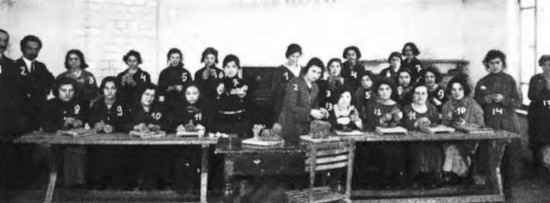
At the table, from left to right: 1. Teacher Marniansky, 2. Y. Alterman, 3. Drakhlis, 4. Peter, 5. R. Tzukerman, 6. Kh.S. Twersky, 7. M. From, 8. F. Fishman, 9. R. Kirzhner, 10. M. Shteinberg, 11. L. Levental At table #2: 1. I. Yankelevitch, 2. B. Friedman, 3. Yadlin, 4. Kh. Gorenshteyn, 5. K. Grinberg, 6. L. Twersky, 7. R. Lev, 8.Sh. Séfarade, 9. M. Moshenzon, 10. L. Steiner, 11. B. Shneerson, 12. T. Geissiger, 13. B. Messerman, 14. unidentified, 15. G. Grashnuk |
|
|
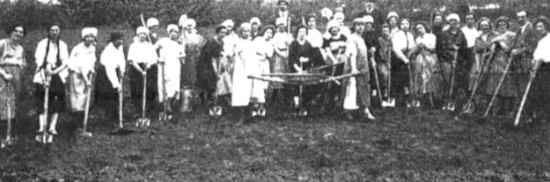
From right to left: R. Tzukerman, Y. Alterman, L. Twersky, A. Kharakh, Sh. Gorenshteyn, R. Kirzhner, Ahuva Tal, D. Push (?), L. Levental, Kh. S. Twersky, Sh. Staratz, Shinhar, G. Grashnuk, unidentified, M. Shteinberg, I. Yankelevitch, B. Messerman, unidentified, Kh. Peter, B. Friedman, unidentified, F. Fishman, unidentified, M. Flom, Kh. Bershteyn, 3 unidentifieds, B. Duchovny, Rachel Lev |
|
|
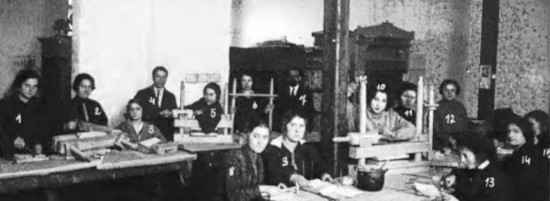
From left to right, at the table: 1. Sh. Gorenshteyn, 2. unidentified, 3. I. Drakhlis, 4. Instructor, 5. Pakelman, 6. Liberzon, 7. Y. Alterman At table 2: 8. Kh. Sobelman, 9. Yadlin, 10. L. Shteinberg, 11. Hadassah Margalit,12. Kh. Rekhter, 13. A. Radoshovtzky, 14. Kh. Peter, 15. unidentified |
[Page 536b]
|
|
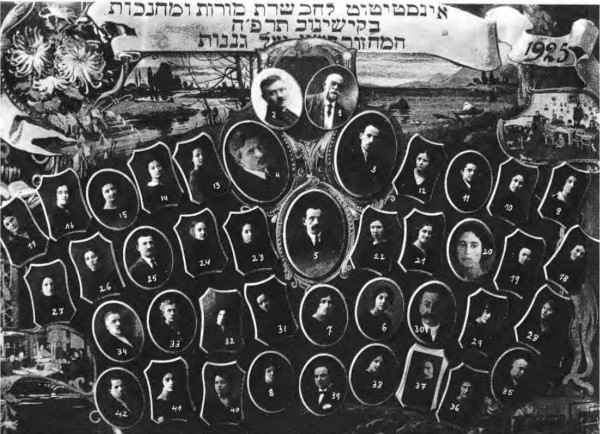
1. Dr. I. Bernstein-Cohen, 2. Yakov Fishman, literature teacher, 3. N. Tulchinsky, Hebrew and Bible teacher, 4. A. Epstein, literature teacher, 5. Y. Alterman, Principal, 6. Kh. Gorenshteyn, 7. B. Alterman, director of the model kindergarten, 8. M. Landau, official principal and teaches Romanian, 9. R. Brin, 10. Kh. Bershteyn, 11. L. Glantz, 12. A. Kharakh, 13. Sh. Gorenshteyn, 14. A. Radoshovtzky, 15. Sofia Grig, rhythmics teacher, 16. A. Broitman, 17. R. Berkovitch, 18. Mrs. Schneider, 19. Kh. Rekhter, 20. Piano teacher, 21. Kh. Sobelman, 22. M. Shor, 23. Kh. Vaughan, 24. D. Polk, 25. Mariansky, art teacher, 26. Mrs. Baron, 27. D. Heissiger, 28. B. Shpan, 29. M. Diner, 30. Prof. Pozhoga, psychology teacher, 31. Kh. German, 32. Sh. Tabatchnik, 33. Teacher, 34. Torobokin, carpentry director, 35. Fikhendler, agronomist, 36. Troib, 37. Sh. Staratz (?), 38. Kh. Peter, sewing teacher, 39. Hazing, carpentry teacher, 40. Mrs. Liberzon, 41. Mrs. Danishansky, 42. Bookbinding teacher |
[Page 537]
N. Tulchinsky (Tal), secretary of the central committee, presented the successes and failures of the last two years, some of which could not be prevented. Thanks to tremendous effort, it was possible in most cases, to overcome the difficulties, and to secure the cancellation of the terrible decrees that damaged our honor and our rights. We stood alone in this battle. Not all Jewish representatives in Parliament and the Senate were able to defend their people.
Despite the stifling atmosphere of decrees and persecutions, the central committee was able to produce several important results. The greatest achievement was the Institute for the Training of Teachers and Educators in Kishinev, which succeeded at a level never seen before.
During the delivery of reports and discussions, parents and teachers finally expressed the grievances that they had suppressed for a long time. Their feelings of resentment arose from the oppressive actions by the educational authorities, and the signs of indifference about the fate of the school shown by some groups who did not want to carry the heavy load.
Sections of an article written by N. Ben-Levi (Tulchinsky-Tal) and published in Haolam of October 10, 1924, follow:
The following meetings were dedicated entirely to the clarification of the situation in the organization and to establish future roads to be taken. Several lectures were given, each one touching on different issues. The most important was Avraham Epstein's lecture about “Our stance and methods of work,” which was informative and well structured.Mr. Epstein emphasized the central goal of Tarbut: mastering the Hebrew language for use in life and in school. This principle developed over many years through Jewish spirit and knowledge. It is the fruit of trials and searches of many generations, linked together with the idea of national revival. Tarbut cannot, and must not, compromise on this principle. The strength of Tarbut lies not in excessive expansion, but from narrowing its work and strengthening itself. In this regard, our movement is like Hechalutz, which also demonstrates the strength of our culture. Hechalutz succeeds because it dedicates its uncompromising energy to its goals. Tarbut in Bessarabia must give up its imagined strength and withdraw from schools that changed the language of instruction. It must concentrate on work in schools that are loyal to it. There is much work to be done. There is a great chasm between the school and the public. The Jew is immersed in the gates of impurity, and must be brought closer to renewal to reveal the beauty of our culture.
[Page 538]
The school will slip off the ground and remain in the air. It is necessary to bridge the gap between the public and our school. There is much work to be done outside the school. More fighters will come forward and we will not lose our rights without a reaction.
The lecture by attorney Sh. Rozenhaupt described the political and judicial conditions of cultural institutes in Bessarabia. He expressed the anger of the Jewish public about its loss of rights. He spoke about the history of the Hebrew school beginning from the day Bessarabia was annexed by Romania. In the first three years, as long as the government still depended on public opinion, the Hebrew school emerged with government assistance and the great efforts of the Jewish public. No effort was considered too difficult to improve the conditions of the school. However, from 1922 onward, especially during the rule of the Liberals, the situation declined. One by one, we lost the government Hebrew schools, elementary schools, middle schools, high schools, and the teachers' seminary. There was a flood of circulars, orders and decrees issued by officials at all levels.
The same was true for the private Hebrew schools. Finally, the government decided to cut off support for all schools where Romanian was not the language of instruction. Even now, after the law was passed to support all minority schools, nothing was easy. Due to the arbitrariness of the Minister of Culture, we were removed from the group of minorities. This was not even explicitly stated, but was included in an off-hand remark during a debate in parliament. Our situation is dire. We insist the government follow its own laws, but no one pays attention to our demands. We are not the ones who defy the law; it is the government that does so. Sh. Rozenhaupt ended his remarks with a call to the Jewish community not to relax, but to continue the struggle.
The practical proposals in the lectures by I. Schwartz, “Our comparison to other schools,” and that of I. Wasserman on the Histadrut Organization, were shaped by the difficult times.
Almost unnoticed was the lecture by the poet Yakov Fishman on “national education.” His words matched our desperate situation. He urged the conference to rise above daily troubles and to see itself simply as a link in the great chain of cultural education. We continue this chain just as past generations of our people did in many lands. One of the most difficult problems we constantly face is the rift between our original culture and the culture of the country in which we live. We must not ignore the connection between Hebrew culture and general culture. Our history in the Diaspora shows that there were times when we were able to put down roots and draw strength from the surrounding culture.
[Page 539]
Even the Jews of Bessarabia will soon need the surrounding culture. Even if it does not enrich our own, there is a real danger that our culture will decline and become a weak and isolated Levantine remnant. This is why we must now strengthen the foundations of education in our schools. Alongside schoolwork, it is important and necessary to cultivate local literature for both children and adults. Such literature would be connected to its environment and would grow through that contact.
The poet described the future of our Hebrew literature as one that could become universal, uniting foreign and national elements. We need other peoples, and we benefit from other cultures. Hebrew literature, nourished by the homeland and expressing ideals that speak to all humanity, will only be enriched. We must not look down on any other culture, nor should we fear its influence. We will absorb what is foreign and shape it in our own way. There is within us a natural capacity for synthesis, and through our Hebrew language.
Most of the delegates took part in the debates that followed the lectures. The more complex presentations led to weak discussions, while the practical topics sparked lively and quite heated discussions. Overall, the need for practicality was evident throughout the conference. The delegates focused on, and were fully engaged with the most important issue: the future of the Hebrew school. This is often the case at conferences called in times of emergency, when “burning issues” overshadow other matters requiring a deeper approach. The delegates' experience with past suffering and their concern for the future, created a special atmosphere of practicality and purpose, with little room for spiritual uplifting or enthusiasm.
Despite everything, the conference was successful. All decisions were based on the future of Tarbut's work. Any doubts about Tarbut's relationship with the “Romanized institutions” were put to an end. It was clear that Tarbut would not give up its demands and would remain true to itself in all matters. Guidelines were set for methods to be used in various areas of work. There was supposed to be a cultural union of Bessarabia and Romania. It was hoped that the Romanian delegates who were taking part for the first time, whether official or not, would continue this contact. This would be beneficial for both sides. It is also important to note that the conference awakened the Jewish public and led to a strong protest. This resulted in political resolutions and in a memo presented to the government. It is not certain that this will bring about actual results or changes.
[Page 540]
There was great value in the fact that the silence was finally broken. The Jewish public had fallen into despair. The Jews of Bessarabia used the occasion to again proclaim its existence as a national group which would not give up its rights and would not accept the loss of its legal standing. If this was the only result of the conference, it would have been enough!
The new law relating to private and public education
The Prime Minister, Ionel Bratianu, and the associate Interior Minister, Georgi Tatarescu, did not seem to be as rigid in their views about the national school as was their colleague, the Minister of Education, Dr. Angelescu. When Minister Tatarescu came to Kishinev, the Tarbut representatives speaking on behalf of the conference, presented him with a detailed report[27] about the persecutions against the national school. They asked for full rights to be restored. The Minister promised to bring the matter to the government at its next session and even to support the just demands of the Jews, especially as they pertained to public schools. However, even after all this, there was no change. It was either because they agreed with the Minister of Education or because they lacked the power to persuade him. The Minister was firm in his beliefs and had a major influence in the government.
From the beginning of the 1924–25 school year, the Hebrew school no longer faced pressure. It could be that by then, the rules for private education (that is, schools outside the system) were already being prepared and would anyway prevail. The proposal for the new law was brought to parliament in May 1925. The main dispute centered in sections 35 and 36, which would ultimately determine the nature of the Jewish school in Romania. There was also a ban on using public funds to open a Normal School for teacher training. The Minister's intent was quite clear, without any disguise, as observed in the following:
Section 35: In private schools, where students attending have a mother tongue that is different from that of the state, their own language can be used as a language of instruction. These schools will accept only those whose mother tongue is the language used for instruction in the school.
[Page 541]
Section 36. In the private Jewish schools, the language of instruction is Romanian. However, the teaching of Hebrew and religion is allowed in the Hebrew language.
In his reasons for the proposed law, the Minister of Education pointed out that the population of Romania is 17 million, of whom three and a half million are of foreign provenance: Hungarians, Sashites, Russians, Rumanian, Jews, Serbians, Bulgarians, and others. However, he believed that the mother tongue of Jewish students is Romanian. He argued that Jews usually speak the language of the state where they live. He added that the Hebrew language does not really exist as a living tongue. Like Latin, it is a dead language.
Tarbut led the national front against the proposed law. It appealed to the will of the people by organizing demonstrations, sending circulars, and writing articles full of resentment against the injuries done to the spirit of the people. It published an explanatory booklet, in Romanian, containing articles and factual material on the nature of the persecutions and restrictions placed on the national school at its various stages. A memo signed by thousands of residents in Bessarabia was also sent to the government. The following proclamation by the central and local institutions was printed in the Kishinev press, in Romanian, Russian and Yiddish[28]:
Recently, the Minister of Education proposed a law to the Senate and Parliament which allows all minorities to teach their mother tongue in their schools, but one nation has been attacked and removed from the other minorities. It is the Jewish community, numbering about a million people. The proposed law states that the mother tongue of the Jews is Romanian. Therefore, the language of instruction, even in private schools, will be Romanian.
We, the undersigned representatives of educational and public institutions in Kishinev, are worried and fear that the law will be passed in Parliament. We see the need, due to the shocking and terrible injustice planned against the Jewish population, to lift our voices and ask all liberal parties and all those who struggle for justice for all people, to strongly object to passing this law in parliament. It is a crime to suffocate and destroy what remains of the Jewish school.
[Page 542]
All honest politicians and activists should know that the Jews of greater Romania (censored line) are being attacked by this twisted act.All citizens of Romania (censored line)
All members of the newly awakened Romanian nation should remember that the deed by the Minister of Education has brought great sorrow and anger among the Jews. All Jews, young and old, will not allow this deed to be perpetrated on the progressive members of the Romanian nation (censored line). They are totally opposed to this frightening assault that is being planned against one of the oldest nations in the world!
Everyone should remember that the eyes of the Jewish population in Rigat and all annexed provinces are watching this situation. The conscience of the Romanian nation, the young Romanian rejuvenated nation (censored line) should not allow the destruction of the national Jewish school.
Signed:
Central committee of Tarbut: I. Monzon, Sh. Berliand; Central Committee of General Zionists - engineer M.A. Gotlieb; Central Committee of Hechalutz - L. Glantz; Central Committee of ORT - Sh. Yasky; Central Committee of Maccabi - vice chair attorney B. Dubinsky; Merchants Federation - vice chair Kh. Grubdruk; commerce assistants - attorney L. Dalys; Central Committee of Culture League - Dr. I. Bergman; Magen David high school - P. Grinberg, I. Baron
#31 Kilya Talmud Torah - chairman Sh. Grinberg; 69 Sandino Talmud Torah - A. Hershnok; old Talmud Torah - P. Kaushansky; Ozrei Hamiskhar school - Z. Rosenfein; directors of boys and girls schools of Ozrei Hamiskhar - M. Zein, I. Ris; professional girls education - unclear signature; directors of school for the poor - attorney I. Paris; Yavne school - I. Berman; Munka school-K. Bukshpan; Central Committee of AZA - Dr. Sh. Yakir; public institutions - Sh. Shor; Somekh Noflim-Kh. Itkis; Ezra's Kholim - I. Finkelshteyn; children's house - I. Babitch; many signatures of gabbais from important synagogues.
At the initiative of the district committee of Zeirei Zion and the Central Committee of Rinastria in Rigat, there was a special consultation in this matter[29], held at the home of Dr. Adolph Shtern (former president of Unionia), member of parliament from Bucharest.
[Page 543]
Other participants were: the Rabbi of Romania, Dr. Yakov Nemirover, representing the Communities Committee; Chief Rabbi of Bessarabia - I.L. Tzirelson; Salo Veisselberger - Senate representative from Czernowitz; Dr. Cornel Yancheng and pharmacist Adolph Solomon, representing Tarbut from Bucharest; Dr. Sh. Zinger from the Zionist federation in Rigat; Teachers Federation of Bucharest; M. Landau from the Zionists of Bessarabia and Sh. Rozenhaupt, the legal counselor of Tarbut in Bessarabia; members of Tarbut Council, principal of the high school in Akkerman, Yakov Berger; and Yitzhak Khitron from Soroca. The directorate of Unionia in Rigat, headed by Dr. V. Filderman and Horaya Karp, declined to participate and preferred to deal with the issue on their own.
Those from Bessarabia and members of Zeirei Zion wanted both Hebrew and Yiddish to be taught. The others wanted only Hebrew. After a lengthy discussion it was decided to follow the proposal of the representatives from Bessarabia.
The Zionist federation in Bucharest also published a communique in the press. It described the attitude of Minister, Dr. Angelescu, who regarded Hebrew as a dead language. Among other remarks, the communique stated:[30]
The British government, appointed by the League of Nations, of which Romania is a member, recognized Hebrew as an official language from the start. Today, Hebrew is used as the language of instruction in all educational institutions in Eretz Israel from kindergarten to university. Most European countries accept graduation diplomas from high schools in Eretz Israel where Hebrew is the language of instruction.Just two months ago, the cultural world celebrated the opening of the university in Jerusalem, in Hebrew.
Among the thousands of congratulations that were received, was a warm message from the Romanian Academy, expressing its hopes for the growth of the institute that has opened its doors in a land so full of special memories.
The proposed law concerning private education, in its present form, deprives the Jews of Romania of the possibility of satisfying their children's desire for Hebrew culture. It takes away their ability to remain in contact with their brethren who speak only Hebrew.
[Page 544]
We call on the people of Romania to lift their voices together with us to prevent diversion of the law because of a serious mistake. This would not benefit our country.
The vigorous protest by the Jews of Romania, which, in the meantime had won the support of other parliamentarians and members of the Liberal cabinet, forced Minister Angelescu to remove the proposal from the agenda. Several amendments were entered for the benefit of the Jewish minority.
Shelling of the Senate with protest telegrams
To be historically correct, it is important to focus on a typical event that finally led to the Minister withdrawing and removing the proposal from the summer session agenda of Parliament. It was a remarkable action organized by Tarbut. Protest telegrams were sent to the Senate from local public institutions. Among them were non-Jewish groups from Kishinev and other towns, and from every city in Bessarabia. The telegrams were sent to the chairman of the Senate, Herman Vasilievitch Pintya, a leader of the Liberal Party in Kishinev.
The dozens of detailed and well–crafted telegrams received by Pintya demanded a fair attitude toward the Jewish minority, without prejudice, and for the recognition of its right to establish schools in its national language, as pronounced by the king in 1918 and written in the constitution of the new state.
Pintya felt superior as everyone looked up to him as the only savior. He never imagined how high his public image in Bessarabia, including among the Jews, would rise. People from Novoselitza in the north of Khotin province to new Kilya, in the south in Izmail, and across the whole country spanning 600 kilometers, were watching. Like a lunatic, he ran from the prime minister, Bratianu, to the foreign minister, Duka and from one minister to another. He showed the stack of protest telegrams and shouted with excitement: “Do you want the population of Bessarabia to rise against us? Go out and see what is happening there now. The grievances are growing, and this can harm the very foundation of our state. It can even cost us the next elections!” His words affected the prime minister so deeply that he forced Minister Angelescu to change his mind and remove the proposal from the agenda, postponing the amendments until the next session in the fall.
[Page 545]
I. L. Tzirelson, the chief rabbi of Bessarabia and member of parliament, undertook a great, bold action. He stood at the entrance to the meeting hall and personally gave out the booklet Tarbut prepared, written in Romanian, explaining the situation. The booklets were printed in Bucharest because Bessarabia was under siege and strict censorship.
Tarbut used the breathing space to prepare for what was to come. It organized dozens of protest assemblies of teachers and parents in the north and south of Bessarabia. The goal was to strengthen this position and to provoke a strong protest against the Minister. In fact, the protests were covered in the Romanian and Bessarabian press. A special emissary (the author of this article) represented Tarbut in Lvov, and Galicia, outside the borders of Romania. He smuggled source materials about the attacks and harassment of the national school by the Romanian authorities, to Dr. Avigdor Yakobson, the representative of the Zionist Federation to the League of Nations in Geneva. Special emissaries were also sent to the Jewish kibbutzim and the national federations in Bucovina, Transylvania, and Rigat. They wanted to ensure that active protests against the new proposal were brought to Parliament. All Jewish representatives in Parliament and the Senate, from different parties, were organized to defend the unified position of Tarbut regarding Jewish educational rights. And, that it was necessary to add a
The hesitations of the “traitor”
detailed section stating that both languages, Hebrew and Yiddish, would be used for instruction in the national school. However, the central committee of the Bund in Czernowitz, tried to designate Yiddish as the “mother tongue” and sole language of instruction in the Jewish school. This was the custom in other minority schools. The Yiddishists had not been able to persuade the Jewish community to accept this, from a positive point of view, neither out of love for the Yiddish school nor out of any willingness to support it, yet Tarbut had succeeded in doing so. The Yiddishists now tried to reach their goal with the proposed law. However, the members of the Culture League in Kishinev (which included the Bund), realized that their original aim was contrary to the true desires of the general Jewish community in Bessarabia, and the teachers, in particular.
They discovered how deeply rooted the Jews held to their national tradition, and that the ordinary Jew supported the Hebrew school. This is where he felt at home and inspired.
[Page 546]
The editor of “Erd und Arbeit” in Kishinev, L. Glantz wrote an article entitled “The Gall of the Bund”, published May 22, 1925. It describes the Bund's original attitude before Dr. Pistiner was convinced to appear in Parliament to promote the mediated formula:
The international social-democratic party, “Hagoel Hayachid” (The Sole Redeemer) of the Jewish proletariat, the holy “Bund”, wished to cover up its treacherous behavior against the Hebrew language. It did something no honorable party would do. These were tough times. Outside regulations caused a depression among the Jewish population, and closed off the path to cultural growth. In its newspaper, “Das naye Leiben” (New Life), the Bund published a hateful article which accused the Zionists of working hand in hand with Unionia (the Association of the Jews of Romania) and of “being traitors to Jewish nation and its language, while there is a political danger.”Only a party that ignores public opinion and denies it could publish such a vicious lie. It should be ashamed of its lies and its slander.
Thanks to the initiative of our friends, Zeirei Zion in Bucharest, and the members of Rinastria there, in response to the destructive decree against the school, the Zionist organization, together with representatives of the central committee of Tarbut, developed an extensive plan of action. It was a bold program for the benefit of both Hebrew and Yiddish. This was so, even though we were building a Hebrew school and not a Yiddish one. We did not want our difference of opinions to be used to boycott the language of the masses.
Our position was the reason that the committee of all Jewish representatives in both houses, together with the Zionist circles in Bucharest (see “Erd und arbeit”, #19-20), failed to achieve results. The Unionia had a different point of view. That is why Zeirei Zion, general Zionists and Rabbi Tzirelson, acted independently to protest the destructive decree. They demanded equal rights for Hebrew and Yiddish.
Our press continued to encourage the public to act in that direction. Signed proclamations were published in the name of all public and political bodies. It was clear that the Bund's attempt to turn the public against their beloved Zionists was fraudulent. It should be noted that the Tarbut proclamation was signed by the Culture League. It definitely did not wish to go against Yiddish culture.
The core of the shameless anger and lies from the newspaper “Das naye Leben”, was rooted in the fact that the Zionists were among the first of the Jewish population in Romania, to speak out and protest in the press.
[Page 547]
They were the ones who published a special booklet in Romanian in which all of the essential details about the matter were outlined. There were also articles full of grievance and anger about the fraudulent act against our culture and our two national languages.It is true that the people of Unionia toiled hard for the Hebrew language while the international Bund was more interested in protecting the mother tongue of Yiddish. Both the Unionia and the Bund were representatives of assimilation. They both filled a role in our struggle for national rights.
The true faithful of the Jewish nation and the builders of its future understood both the past and the present. They carried the cause of national redemption in Eretz Israel and in the Diaspora.
We would not have mentioned the matter, as we see no special right in it. What else could we do? We are the ones who are diligent and persistent in awakening the national cultural spirit. We could not remain silent in the face of the Bund's gall - the assimilationist from Czernowitz. They are eager to have political gain during our national disaster. They are not ashamed to spew such blatant lies.
The time for a new discussion of the law in the fall session of Parliament was approaching. A call went out to the public, to stage vigorous protests, separately, in the name of the Jews of Bucovina and Rigat, against the government's attempts to undermine the national school. The signatories for Bucovina were: the Executive Committee of the Zionist organization in Bucovina, the Central Agency of Bund in Romania, the Executive Committee of Poalei Zion, the Executive Committee of Zeirei Zion and the Executive Committee of the religious organization, Mizrachi. The signatories for the Jews of Rigat were: the political-cultural group Rinastria, the Zeirei Zion organization, the Zionist Student's Organization (Hasmonia), and the Hebrew cultural organization, Tarbut.
The differences of perception among the Jews
The time came for all Jewish representatives from all parts of Romania to present a united proposal about the language of instruction in their schools. There were major differences of perception, and a clash of views became apparent. The representatives of Tarbut who were leading the struggle for our rights to a language of instruction, wanted to propose “Hebrew or Yiddish”. They were joined by representatives of the Zionist organization in Bucovina.
[Page 548]
The organization was deeply rooted in national tradition. However, at that time, there were not as many Hebrew schools in other communities as there were in Bessarabia. Even the Yiddishists changed their minds and accepted the new slogan. On the other hand, some Zionist groups in Rigat insisted on ensuring the rights of the Hebrew language, only, as the language of instruction. Even some of the members of the “cabinet” shared this view.
The attitude of the representatives of the Unionia Evreilur (Jewish Association) in Rigat was different. Led by Dr. Wilhelm Filderman, they simply did not understand: “Yiddish - what is it doing here?” They perceived it as a street language, not a language of education. Hebrew language could be given an extra hour each day, while the language of instruction should remain Romanian.
At the other extreme were representatives of the Jews of Transylvania, where there was a mixture of fierce religion and assimilation. The assimilationists declared themselves as “Mosaic Hungarians,” which is why they were seen as champions of assimilation. Their opposition to Romanization came from a different perspective. They were attached to the Hungarian language, their mother tongue, learned in school, and the language of the Hungarian minority. One passionate fanatic even complained to the League of Nations in Geneva. For the Zionist assimilationist, Rabbi Dr. L. Ktchekmat believed that separation from the Hungarian language was a national tragedy. He declared: “Hebrew language - or I will forever remain Hungarian!”[31]. The authorities labeled him as an agent of the enemy who publicly agitated against the official language of the Romanian state. Overall, the Orthodox made up more than two thirds of the entire Jewish population of Transylvania. There were 121 Jewish institutions there, and 86 of them were controlled by the Orthodox. In their eyes, using Hebrew as a spoken language was a desecration of the Holy. The committee of Jewish schools, which included representatives of all three groups (Orthodox, progressives and the Status quo), felt that it was sufficient to teach religion in Hebrew for one hour a day.
[Page 549]
That is why the Mosaic Hungarians should run their schools at their own expense.
Struggle in Parliament
On 2 December 1925, a unified Jewish delegation came to speak to Education minister Angelescu, to demand justice and honesty. The Minister of Foreign affairs, Duka, was also present. Members of the delegation included representatives of Tarbut in Bessarabia, Yechezkel Monzon and legal counsel Shmuel Rozenhaupt, along with Member of Parliament Dr. Yakov Fistiner, Dr. Friedman, representatives of the Bund from Bukovina, and Dr. Meir Avner from Bukovina.
The delegation informed the ministers that in their firm opinion, it was necessary to establish in law, a clear statement as to the language of instruction in the private Jewish schools, Hebrew or Yiddish, as requested by the leaders of the institutions.
At first, minister Angelescu was against the idea that students in private schools could be educated in a language other than Romanian. In the end, he expressed a preference for Hebrew. In schools where Romanian is the language of instruction, Hebrew subjects will be taught in Hebrew, while in Hebrew language schools, instruction in general subjects, such as history, geography, and language, will be in Romanian.
The members of the delegation insisted on their demand that the Jews have the right to choose one of their national languages. To support his opinion, Dr. Avner even added that the Zionists planned to use Hebrew only in their schools, which made up most of the existing educational institutions. However, they were not prepared to break the united front that was achieved between the Hebraists and the Yiddishists. It could not be acceptable to deny the schools their choice of language.
The two ministers left to confer and returned with a declaration of their willingness to accept the proposal. They set one condition, that the representatives of Rigat, the Unionia, would also agree.
The following day members of the delegation met with representatives of Unionia at the home of their chair, Dr. Willy Filderman. Others who took part were Unionia's general secretary Zeltzer-Saratzioanu, Chief Rabbi Dr. Yakov Nemirover, and attorney Mishu Weisman from the Rigat Zionist Organization. The latter two initially hesitated to accept the opinion of the representatives from Bessarabia and Bukovina.
[Page 550]
Finally, they were convinced and joined the group. Dr. Meir Avner reported on the situation and asked Unionia to support the delegation's opinion. In a long and detailed speech, Filderman described the extent of damage to the economic situation of the Jews of Romania caused by these unnecessary national efforts. Yiddish was not acceptable to him, but Hebrew was. For this reason, he spoke with Minister Angelescu and tried to convince him to take a positive stance.[32]
Everyone present took part in the long debate. Some even sharply attacked Dr. Filderman's assimilationist politics, but it was all in vain. Filderman stood firm in his opinion and refused to agree to the delegation's proposal. This is how a barrier was created between him and the “fanatics of excessive nationalism.”
It seems that Angelescu and Doka knew in advance that Filderman would not agree to the demands of the representatives from the annexed provinces and would remain firmly against Yiddish. They decided to make him the scapegoat. Meanwhile, Angelescu retreated from his previous position in the face of much criticism. He decided to issue a governmental regulation about teaching the mother tongue of the child. He returned to the first version in section 3.5, that “for Jewish students the language of the country is the language of instruction.” However, even these “clever” steps missed the target. Those leading the defense were determined: a. To expose the true stance of the government toward the cultural world and its criminal policy towards the Jews - that is, not recognizing them as a Jewish minority, but rather as Romanian Mosaic people. b. To insist on the right to use both national languages for instruction in public schools.
The days of parliamentary debate about the laws of private schools became an extraordinary national demonstration. Representatives of the right and the left in the Jewish world stood solidly together: the government must not interfere in the struggle over language. It was only up to the parents to decide.
The Jewish members involved in this story were: Rabbi Yehuda Leib Tzirelson, elected on the Jewish list in Kishinev; Dr. Yakov Pistiner, elected under the social-democratic list with the Bund, in Czernowitz; Natan Lerner, elected on the Tsarist list in Khotin province, and Dr. Adolph Shtern, elected on the Agrarian list in Bucharest in cooperation with the Union of Jews for Eretz Israel.
[Page 551]
Their appearance drew the members' attention to the Jewish question and exposed their true views. Each one defended the community's spiritual legacy as he understood it. They all had to endure interruptions from the Liberal majority. Dr. Shtern became the main target for endless barbs. Even Dr. Angelescu interrupted him from time to time, to argue with him. However, the Jewish intellectual emerged from the struggle with dignity.[33]
After considerable struggles and persuasive explanations, a compromise was finally reached. It recognized both languages, stating that the language of instruction in the Jewish private schools of the Jews will be either Romanian or the language of the Jews.[34]
The victims were, of course, the Jews of Transylvania. As a result of the new law, they had to accept the official language or go back to their origins.
Acknowledgement of the Bund
The loyal position of the Hebraists, who defended the rights of the Yiddish language, even while those of Hebrew were guaranteed, was finally viewed positively by the Yiddishist camp. In an article “Hebrew or Yiddish”, published in the Bund's weekly Das Naye Leben, in Czernowicz[35], we can read the following:
Despite the contrast between the Hebrew and the Yiddishists, the Yiddishists will not allow Angelescu to destroy the Hebrew schools. In addition, despite their limited affection for jargon, the Hebrews clarified, in no uncertain terms, that in their struggle with the Yiddish schools, they will not rely on government help. This is a rare historical moment. A situation was created, unlike that in any other country: the strongest opponents in political and cultural spheres, now stood together in a struggle for the existence of the private schools, and for the language of instruction in public schools, either in Hebrew or Yiddish. It is important to note that our Hebrew rivals did not abandon their battle for the public schools even after they were promised that Hebrew would be the language of instruction.
[Page 552]
This happened only once, when the Zionist, the Bundists, and the religious, were united to demand from the Minister of Education: a free hand for the private schools. Yiddish or Hebrew, the choice is ours. We pay for them, and you, Minister, must let us live!
Hopes and disappointments
Compared to the great danger that had befallen Hebrew education in Bessarabia, the new law, in its definitive version, was a small triumph, one that was achieved due to the valiant struggle that lasted three years. Now there was a legal opportunity for schools to use Hebrew as the language of instruction. The arbitrary acts from the Angelescu days were over. On the other hand, there were some obstacles, directly and indirectly, in the normal existence of the national school, clearly intended to gradually eliminate it. For example: A. The prohibition on opening a teacher training seminar (Normal School) at the expense of the public. B. The demand to have all students, including those in Grade One, pass tests at the end of the school year, instead of only at the end of Grade Four. C. The levy of an expensive test tax. D. A prohibition on using texts published outside of the country, etc. All these restrictions made the existence of Hebrew school difficult. It was impossible to function without qualified teachers, from a pedagogical or legal point of view. The insistence on tests at the end of the year prepared by a special committee would humiliate the Hebrew school and its teachers and reduce its value. The high cost of the testing tax burdened parents and posed difficulties for the school as well. The prohibition on using outside texts had a purpose understood by all. In addition, it was feared that intermediary laws would make matters worse.
After the new reality, the plenum of Tarbut met on March 2nd and 3rd, 1926, to coordinate the work of the central committee and the future endeavors of the institutions. It was decided to fulfill all legal requirements exactly, and to submit to the authorities all necessary documents for the opening of schools in the coming academic year, by mid March. A special pedagogical committee was formed to prepare a curriculum for Hebrew studies in kindergarten, elementary and high school to be presented with the other documents. The pedagogical committee also decided that in the three upper grades of the elementary school, grades 5, 6 and 7, the students would receive preparation for daily life.
Original footnotes:
|
|
JewishGen, Inc. makes no representations regarding the accuracy of
the translation. The reader may wish to refer to the original material
for verification.
JewishGen is not responsible for inaccuracies or omissions in the original work and cannot rewrite or edit the text to correct inaccuracies and/or omissions.
Our mission is to produce a translation of the original work and we cannot verify the accuracy of statements or alter facts cited.
 The Jews in Bessarabia
 Yizkor Book Project
 JewishGen Home Page
Copyright © 1999-2026 by JewishGen, Inc.
Updated 28 Jun 2026 by LA