 |
|
|
[Page 31]
by Yitzhak Kazimierski
Translated by Asher Szmulewicz
The beginning of the Jewish settlement in Wiślica is unknown. This shtetl never held a particular importance in the history of the Jews of Poland. Therefore, there are no accurate historical sources that can establish the foundation date of the Jewish settlement in Wiślica.
Wiślica, located on the bank of the Nida River, is considered one of the oldest towns in Poland, with a history that spans over a thousand years. In old-time Poland Wiślica (Wishlitza) was surrounded by fortified walls containing a castle. The town also included the Goryslawice suburb and extended up to the Kuchary village. There were three Catholic churches in town. In these times the town was part of the protectorate of the King Wladislaw Lokietek, the father of Casimir the Great and it was his beloved town. The reason was that when returning back to Poland after his exile, when he reclaimed the throne of Poland, Wiślica was the first town to welcome him as the legitimate King. In memory of this event, the King Wladislaw Lokietek built the great church in Wiślica.
As it is known the great Jewish migration from Germany and Bohemia to Poland started at that time, when Casimir the Great reigned (1310-1370). He was a friend of Israel (according to a legend his wife was Jewish, Estherke) and welcomed the Jews with open arms and gave them full citizen rights to defend them.
[Page 32]
against the burghers (“mieszczanie”) who were afraid of the Jewish competition in business and handcraft.
It is probable that Jews came to such an important town as Wiślica in order to live directly under the protectorate of King Casimir the Great. It is possible that Jews had already been there earlier because the purpose of the King was to develop the country with the help of the Jewish immigration. The importance of Wiślica at that time is proved by the fact that when Casimir the Great wanted to give a written constitution to the Polish people, he gathered the aristocracy and the elders in a large assembly in Wiślica in 1347 and there he proclaimed the first constitution that was called the “Wiślica statutes”.
The new constitution and the status of the Jews is related by the famous Jewish historian professor Shimon Doubnov:
“All these rights (burghers rights for Jews) were instituted by Casimir the Great with the agreement of the aristocratic leaders with whom he consulted, but the ordinance about the Jews raised the opposition of the representatives of the small real estate landlords “the battle”. In the Wiślica conference (Wishlitza) in 1347 the hatred of the Lesser-Poland succeeded to limit the business of the Jewish credit.
The historian B. Mark wrote on this subject:
“In the assembly of the Polish “Sejm”[1] in Wiślica in 1347, it was decided to lower the interest rate of loans from Jews and to limit the mortgages only on real estate properties. In the assembly of the Polish “Sejm” in Wiślica in 1368, it was decided that the Polish parents will not be liable for their children´s debts contracted to Jews.”
Sh. Doubnov wrote on the same subject:
“Wladyslaw Jagiello had to give away under the double pressure of the clergy leaders on one side and the assembly of the leaders of the institutions in Warta in 1423. He renewed the limitations of the Wiślica assembly in 1347, that Jews could only loan money for a gage and not for exchange or mortgage, with the same hurtful reasons of the Wiślica conference and with a harsher formulation.
[Page 33]
We can establish from the importance of the town that Jews already lived in Wiślica, as in all other important towns in Poland in this period.”
From materials which were published by Mgr. Eliezer Feldman in “Young Historian” number 3 it is said:
“According to documents of the Polish archives, Jews lived in fourteenth, fifteenth, and sixteenth centuries in the following shtetls of Sandomiezh district: Opatow, Pilzno, Pintshew, Palanitz, Radom, Radziwilow, Rakow, Sandomiezh (Tzozmir), Chentshin, Chmelnik, Globatshow, Gjmalow, Ivaniska, Yanawitsh, Kartshin, Nowe-Miasto, Opatowish,Sheintze, Stashew, Stanavitze, Tarnow, Wiślica, Zwalin.
In these times in Poland, Wiślica was an important town in the Wislitz district of the Sandomiezh governorate.
In 1407, during the reign of the King Wladyslaw Jagiello (1386-1434), pogroms against Jews broke out in Krakow, after a speech of the Magister Bodek, the church vicar of Wiślica in the church of “The Saint Barbara” in Krakow. The chief of the town (Wiślica) fortress, under the influence of the Wiślica Jews, came to help the Jews of Krakow with his armed soldiers and saved the Jews of Krakow from a pogrom. It is worthwhile to point out that the chief of the Wiślica fortress
|
|
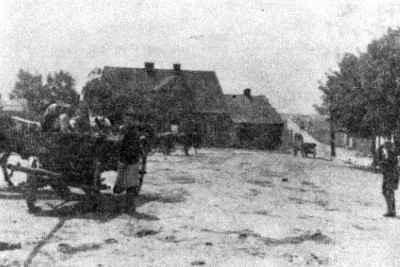
| Zamkovy square |
[Page 34]
was a regular customer of the Jewish bankers in Krakow. (The first Polish historian, Jan Dlugosz, was a prelate of the famous “Collegiate” of Wiślica and in the fifteenth century he built a house in Wiślica that is known under the name “Dlugosza”).
First historical documents
The first official documents containing details about the Wiślica Jews are from the year 1514, during the period of King Sigismund the First when he ordered his sister not to expel the Jews of Wiślica until he himself would come to Wiślica.
Since the Jews established themselves in Wiślica, they held a difficult fight against the burghers, principally in the economic domain, because of their fear of the Jewish competition in trade and craft, until they came to an agreement with them in 1545, that was later acknowledged by the King Sigismund the First. Despite this agreement between burghers “mieszczanie” and the Jews, the Jews succeeded to obtain from King Sigismund August the authorization to dwell only inside the walls of the town, in a place called “Jidowiecz”. This was the Jewish quarter, inside the town walls at the border of Goryslawice, on the road to Kabilnik. Later, the burghers made peace with the Jews.
During the reign of King Sigismund August (1548-1578) Jewish refugees came to Poland from Czechia, who were expelled from Prague. Some of them came to Wiślica and built a synagogue. The year 1656, during the Swedish invasion of Poland, was a very difficult period for Wiślica and its Jews in particular. During the war against the Poles, the Swedes destroyed the walls of the city, they burnt the famous palace of Wiślica. The town suffered a lot from the war. The Polish Hetman Stefan Czarniecki, who was famous for his pogroms against Jews, wanted revenge from his military defeats. For this reason, he was a defamer of the Jews, saying that they helped the Swedes. Hetman Czarniecki went from town to town and murdered a lot of Jews. In our vicinity, he murdered and destroyed the following communities: Rakow, Chenshin,
[Page 35]
Chmelnik, Shidlow, Waidjislaw and also, he went up to Pintshew, but there the count (Borgrabia) opposed and the Jews of Pintshew were saved. Also, Wiślica was not spared by the hater and the whole Jewish population of 50 families was murdered. The Jewish quarter behind the city walls was destroyed to the ground and in its place was never again established a Jewish settlement. The war and the pogroms wrecked the economic life, and the fate of the Jews and the communities was wandering and poverty, anxiety, and weakness. The same way in the old times when the Jews were concentrated in the majority of Polish towns in special quarters of the town, the same way after the “Czarniecki slaughter” the Jews began to settle anew in Wiślica, in the northwest part of the town in a separate quarter. They built a synagogue, a house of study, a mikveh and a cemetery. The quarter developed itself around the synagogue. As time passed by, in the framework of their economic-commercial development, the Jews spread out from their quarter to all sides of the town and opened shops in buildings.
In the sixteenth century in the framework of the Jewish autonomy institution in Poland, “Council of Four Lands”, in the committee of Krakow-Sandomiezh, the Rabbi of Krakow was only the Rabbi for half of the country. In the other half, the same mission was accomplished by the Rabbi of Pintshew or Waydjislaw, the sessions of the committee took place in Pintshew, Waydjislaw, and Stupnitz.
Wiślica was in the district committee of Shidlow together with another 17 communities. These were: Shidlow, Rimanow, Zhmigrod, Tarnow, Dulka, Nowemiasto, Patzantow, Aleshnitza, Zhabna, Rakow, Dambrowo, Bagaria, Stofnitza, Korazwienki, Palanitz, Stashew. The committee was led by a Rabbi and a community leader from Batzirk. In the seventeenth and eighteenth centuries, the district committee sat in Chmielnik.
In the meeting of the “Council of Four Lands”, on July, 20th 1755 (12 Av 5606) in Constantin an agreement was achieved, with the help of the council, between the committee of Batzirk Krakow-Tzozmir (Sandomiezh) and the committee of Palanitz-Wislitz about the yearly tribute that had to be paid by the communities to the district committee.
[Page 36]
In 1765, 256 Jews lived in Wiślica. The town was part of the Sandomiezh district. About the activities of the communities in Poland at this time, Dr. Raphael Malher wrote:
“We possess direct proof that the original counting lists were written in Hebrew. The census of the Jews in the whole governorate in 1764 were left in the royal main archive in Warsaw in 3 volumes “inventory” of the three districts (powiat) Tzozmir, Wislitz (Wiślica) and Pilzen”.
During this period, two great Chasidim wandered among the Jewish communities in Poland: The righteous Rabbi Elimelech of Lizhensk and his brother Rabbi Zusha of Hanipol. In their wandering “practice of the exile” both Rabbis came to Wiślica. They stayed in Wiślica in a house in the central place, known in our days as the house of Reb Ozer Triger.
Later, the Rabbi of Wiślica was the famous righteous Rabbi Moshe David Lida of blessed memory, the author of the book “the tower of David”, the grandson of Rabbi David son of Arye Leib Lida from Amsterdam who was famous thanks to the large number of books he published. Rabbi Moshe David Lida was a student of the righteous Rabbi Elimelech of Lizhensk and of the “Chozeh” (the Seer of Lublin). During his tenure, Wiślica became a Chasidic center. The “Chozeh” prescribed to the righteous Rabbi Yitzhak of Warta to stay a full year in the house of Rabbi Moshe David Lida and to learn from his behavior. Also, the righteous Rabbi Kalonymus Kalman Epstein (known as Maor Vashamesh after his book) stayed in the house of Rabbi Moshe David Lida and they learned together the secrets of the Kabbalah. Also, the righteous Rabbi Meir of Apta visited Rabbi Moshe David Lida in Wiślica following the order of the “Chozeh” (there are a lot of Chasidic stories about the miraculous actions of the Rabbi Moshe David Lida). The house of Rabbi Moshe David Lida was located close to the synagogue, in the corner of the Zlata-Akapowa Street (the house was burnt during World War I). Rabbi Moshe David Lida traveled to Hungary, he passed away there in the town Altendorf on Tisha beAv 5589 (1828).
After the death of Rabbi Moshe David Lida, his son-in-law Rabbi Aryeh Leibush Stenitzer of blessed memory became the Head of the Rabbinical Court of the Holy Community of Wiślica, a son of the righteous Rabbi Moshe Stenitzer of blessed memory from Zhelechow. It is said that the “Chozeh” was Rabbi Arye's matchmaker, when he married
[Page 37]
the daughter of Rabbi Moshe David Lida of Wiślica and they learned the “Peshtel” (ingenious explanation) that was told during the betrothal. The son-in-law of Rabbi Aryeh Leibush Stenitzer (the husband of his daughter Mrs. Sarah Leah) was Rabbi Yaacov Yitzhak Horowitz, the son of the righteous Rabbi Yossef David Horowitz, the Rebbe of Pintshew.
A Jewish majority in shtetl
In 1862-63, the Jews were restricted in their travel because of the border proximity. Other Jews were prohibited from settling in Wiślica because it was close to the border after the partition of Poland. In 1856, Wiślica was part of the Stupnitz district in the Radom governorate. 1383 Jews lived in Wiślica among 1997 inhabitants. In 1867, 1083 Jews lived in Wiślica out of 2333 inhabitants. In 1879, there was already a doctor, 2414 Jews lived there among 3279 inhabitants.
In 1889, there was a synagogue, an accommodation for the needy people, a government school with 190 pupils, and six Jewish “Cheders” with two hundred schoolboys. There was also a pharmacy, 11 restaurants, and seven bakeries. According to the 1897 census, 1755 Jews lived in Wiślica out of a total of 2508 inhabitants.
Until 1923, the Head of the Rabbinical Court in Wiślica was the righteous Rabbi Israel Horowitz of blessed memory, a great Torah scholar with the good qualities of the grandchildren of Rabbi Naphtali from Raptshitz of blessed memory. In his youth, he learned and was educated in Torah in the house of Rabbi Yossef Baruch from Neushtat, who was nicknamed “the good Jew”. Reb Israel Horowitz had three sons and a daughter: Rabbi Naphtali Chaim Horowitz in Stashow, Rabbi Meir Horowitz in Wiślica, and Rabbi Yankel Horowitz, the son-in-law of the Rebbe of Radowitz in Pietrkov. His son-in-law was Rabbi Shem Klingberg, the Rebbe of Dzialowitz hy”d[2] who lived in Krakow, he was murdered sanctifying the Holy Name in the “Yarozalimski” deportation camp close to Krakow in 1942.
At the end of the nineteenth century, there lived in Wiślica 779 Christians and 2090 Jews. A quarter of the Jewish population left Wiślica during the years 1897-1921. In 1912, before the First World War, Reb Nathan David Hershkowitz came to Wiślica as a Shochet, who had been previously a shochet in the Shidlow community.
[Page 38]
He was the right hand of Rabbi Israel Horowitz in all the community's matters. The position of the second shochet was held by Reb Yankel Grinblat of blessed memory. The previous two Shochets were Reb Berl Kasirer z”l[3] and Reb Shmuel Bekerman (the father-in-law of Reb Yankel David Grinblat). Reb Zalman Shreiber was nominated, accredited, and in charge of the kashrut. At the end of World War I, he was nominated to be the Rabbi of Zharnawotze. The two community leaders at the end of World War I were Reb Yatshe Shwager and Reb Mendel Zeidner.
By miracle the Jews of Wiślica escaped from a definite pogrom thanks to the alertness of Reb Yatshe Shwager. The event was as follows: In 1912 in Wiślica a Jew called Hershel B. converted to Christianity, once Jewish children threw stones at him and insulted him. This was before Pesach. The converted denounced the Jews to the antisemitic municipal authorities that they wanted to kill him and use his blood to make matzoth. The municipal authorities silently prepared a pogrom during Easter. When Reb Yatshe Shwager became aware of this, he immediately called upon the mayor and asked him to calm down the overexcited mob. The mayor advised the Jews to lock themselves inside their houses and close the shutters. The Jews were greatly afraid, it was impossible to travel to Pintshew to ask for help from the governor, it was too dangerous. Reb Yatshe Shwager called upon Ber Kraus, one of the Wiślica heroes. Riding on a horse, Ber arrived at the Russian commander in Pintshew, and the commander immediately sent 50 mounted Cossacks to Wiślica. They arrived on Easter morning in Wiślica and did not let the non-Jews from the surroundings into the town. In town itself, they pushed away all the fanatical people who gathered. Thanks to them, Wiślica was saved from a pogrom.
In 1914, the First World War broke out. The battles were on both sides of the Nida River. Wiślica was in the front line. The population greatly suffered, and a large number of inhabitants had to flee to the villages further away from the front, such as Bosk, Stupnitz, Stashew, Chmielnik, and others. The few ones that remained in town had to live in cellars for six months.
[Page 39]
The Russians used the Jews for various military support tasks and also to dig trenches on the front. The sufferings lasted until the Austrians entered Wiślica and the Russians left the town.
During the First World War, when marshal Josef Pilsudski, then the commander of the Polish legions, moved the headquarters to Nowy Kartshin, he suddenly appeared in Wiślica at the head of his legions, on Yom Kippur 1916, he demanded from the Wiślica Jewish population a large sum of money as a contribution. It was not easy at this time of the war, when the Jews were impoverished to gather a large amount of money, especially on Yom Kippur, but Pilsudski did not go back to Kartshin until he received the money he demanded.
The rise of free Poland aroused a tremor by the Wiślica Jews. They were afraid of the vacuum that would happen before the creation of the institutions of the new Polish state. Robbers started to appear who imposed fright on the Jews. There was a case of a well-organized group of robbers who came to rob Jews during daylight. A fear fell upon the robbers approaching the town when they came against a large mob led by armed people.
|
|
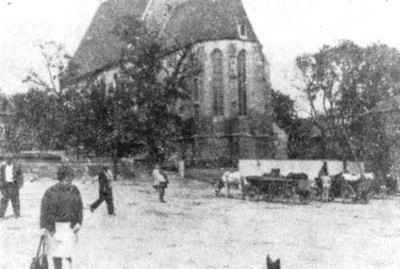
| The stone square |
[Page 40]
They wrongly thought that it was a large defense force. They fled without robbing the Jewish population.
The economic situation
The economic situation of Jews in Wiślica at the beginning of the twentieth century worsened, especially after the rise of the new Polish state in 1919, because of the high taxes that were imposed on Jewish dealers and craftsmen. In 1921, there lived in Wiślica 1341 Jews out of a total of 2127 inhabitants (63%). The Jews kept leaving the shtetl, either out of the country or to bigger cities like Warsaw, Krakow, Sosnowiec, Kielce, and so forth, where the opportunities for livelihood were better. The community organized itself from anew. The district head in Pintshew appointed a new community committee in Wiślica, constituted of the community elders Messrs.: Ozer Triger, Shmuel Weintzberg, Berl Heler, Yatshe Shwager, Elimelech Kazimirski, Yeshayahu Rosenwasser, and Zelig Bornshtein. Zelig Bornshtein was appointed as secretary of the community committee and stayed at this position until World War II.
The Jews of the nearby villages from the county of Wiślica, belonged to the Wiślica community: Goryslawice, Chotel, Garki, Kanietzmasty, Kochary, Zlate, Yorkow, Kalasi, Sakalin, Kamhenena, Tzudzewitz, Kochin, Dembiani, Faltzisk, and so forth.
In 1919, the Zionist organization was founded. The founders were: Yosel Yakowski, Israel Buchman, Shaul Zuckerman, W. Blum, Meir Nazhitze, Chaim Hofenberg, and others.
In 1923, the Wiślica righteous Rabbi Reb Israel Horowitz ztz”l[4] passed away. A delegation of the Wiślica community, composed of Messrs.: Elimelech Kazimirski, Avraham Shidlowski, and Zelig Bornshtein went to Pintshew, in order to invite his son to inherit his father´s position. Because of unknown reasons, his son Yankele Horowitz declined the offer of the Wiślica Rabbi seat.
During the life of Reb Israel Horowitz, the Gur Chasidim in Wiślica wanted Rabbi Moshe (Meirle) Zeidner, the deputy of the “old Rabbi” to be a judge in Jewish law, The Rabbi was sick
[Page 41]
And could not fulfill his duties. The old Rabbi was affected and suspected that Rabbi Moshe Zeidner would take his place while still alive. In the shtetl, a controversy broke out between the followers of the “old Rabbi” and the Gur Chasidim, followers of Rabbi Moshe Zeidner. When Rabbi Moshe Zeidner was not elected to be a judge in Jewish law, he left the town and became Rabbi in the shtetl Washniw, close to Ostrowtze.
In 1924, the Rabbi scholar Chaim Shlomo HaCohen Shwartz hy”d of Bugaria was elected as the Rabbi of Wiślica, who was known as one of the greatest Rabbis in the region. His son was the Rabbi of Bulgaria, Rabbi Berele HaCohen Shwartz hy”d. From all the Rabbi's children, only one son survived the war, Rabbi Elimelech HaCohen Shwartz who is currently a Rabbi in Los Angeles U.S.A. Rabbi Chaim Shlomo HaCohen Shwartz was for several years chairman of the community, and his deputy was Reb Yossef Tapf hy”d. Previously, Reb Ayzik Flam was the community chairman.
In 1923-1924, the Polish authorities built a train line through Wiślica from Yendzheyew to Katzmizhow, close to Krakow. The train station was constructed in the village Kanietzmasti close to the town. The construction of the train line gave a big thrust to the economic life of the town, especially for the Jewish population.
Jews moved close to the train station and opened warehouses for grain, coal, steel, cement, timber. A Jew named Arland opened a large gypsum factory whose production spread later in Poland.
In these times, there was a justice court in town. The judge was a professional one (Lubawitzki) not like the two counselors, one of whom was always a Jew, representing the society.
In August 1927, a Jewish cooperative bank opened in Wiślica under the name “Bank Ludawi” that was founded by the father-in-law of Henech, the wealthiest Jew in Wiślica, together with his father-in-law Reb Shlomo Sheiner. The bank faithfully served the Jews of Wiślica and eased the difficult economic situation. Many burghers used this bank, which supported them with its full possibilities.
[Page 42]
Among the Jews of the town, the Gemach “Matan beSeter”[5] was widely known to help the needy ones.
The first director of the “Bank Ludawi” was Reb Shlomo Sheiner (who lives with us in Israel) and his deputy was Mr. Moshe Apelblat. When Reb Shlomo Sheiner moved to Pintshew in 1929, Kalman Charmatz from Nowi-Kartshin was nominated bank director. In the bank hall, there was a Zionist minyan and people prayed there on Shabbat and Festivals.
In 1926, the society “Linat Tzedek”[6] renewed its activity after several years of inactivity, thanks to Doctor Meir Nazhitze, one of his tasks was to provide medical help and money support to the needy ones, in order to buy medicines. In the committee of “Linat Tzedek” participated: Meir Nazhitze as chairman, Nathan Tshichi, Getzel Burshtein, Yechezkel Kazimirski, and Yaacov Weitzberg.
After the 1929 pogrom in Hebron, that led to the closure of the Jewish aliyah to Israel by the English Mandat authorities, demonstrations occurred all over the world to protest against England. In Wiślica, the shops were closed in protest, and there was a protest meeting in the great house of study. The Rabbi Yerachmiel Walbomski, the son-in-law of the Wiślica Rabbi, spoke to the gathered crowd.
After the death of the shochet, Reb David Grinblat z”l, in 1930, a serious argument broke out. The town was separated in two sides: the family of the deceased shochet and some supporters that wanted to nominate his son Reb Yechiel Grinblat to the position and those people that did not want to nominate the son, arguing that the son was not like his father. Since this argument lasted for a few years, the Pintshew district head decided to transfer the shochet Reb Shmuel Hirsh Ayzen from Dzialoshitz to Wiślica, and this ended the dispute in 1935.
In 1930, the elections to the “Sejm” and the Senate took place in Poland. The Jews of Wiślica took an active part in the elections and the majority supported the list of “The National Jewish Bloc”. Afterwards, since there were forgeries in the district “Sandomierzh-Stufnitz-Pintshew” a new election occurred in this district.
[Page 43]
Before the vote, Dr. Moshe Kleinbaum (today Moshe Sneh) came to visit In Wiślica in the name of “The National Jewish Bloc”. Dr. Kleinbaum appeared in a public election meeting (in the large hall at the gate of Mrs. Rozhe Zaltzman in the market) after he was bothered by the “Agudath Israel” during his speech at the great house of study. The representatives of the election committee of the “National Jewish Bloc” organized themselves in the Pintshew district with the participation of Moshe Kleinbaum, member of the Polish parliament “Sejm”. The struggle was conducted by the “National Jewish Bloc” in order to bring another Jewish representative in the Polish parliament. The candidate was Avraham Goldberg, editor of the Warsaw newspaper “Haynt”[7].
In May 1931, there was an election of the community committee in Wiślica. The following elders were elected: from the “United Bloc” - Wolf Bernshtein, Kapel Banach, Itshe Shwager, David Avzhanski, from the “Craftsmen Association” – Yossef Flum, Wolf Bachenek, David Levi, from the “Agudath Israel” – Yeshayahu Rosenwasser. The elected chairman was Wolf Bernshtein.
In the beginning of the 1930, a “Gordonia”[8] training center was established in the shtetl. The pioneers worked in the sawmill of the Hoffenberg brothers. At that time, an emissary from Eretz Israel visited the training center in Wiślica, it was Pinchas Lobianski (today Lavon). In 1933, Yaacov Zrubavel visited the branch of the left Poalei-Zion in Wiślica.
In 1934, Dr. Gotesdiner (Ovadia) visited Wiślica from the direction of the KKL (Jewish National Fund) in Warsaw and made a public address in the great house of study. In the same year, the old cemetery of Wiślica was closed according to the order of the Pintshew district head. The pretense of the state institution was that there is no more place to bury people. The truth was different. In the same sector lived Poles who argued that the cemetery was too close to the town. The community wanted to enlarge
[Page 44]
the cemetery by buying a large plot of land, but the authorities were against enlarging the cemetery, after many difficulties, the community activists, led by Reb Kalman Bachenek gathered a large sum to buy a large plot of land on the road to Kabilnik. The new cemetery was dedicated with the participation of a large crowd, and also by the Admor[9] Rabbi Moshe Mordechai Twerski from Lublin.
On May 12 1935, a very sad event dominated Polish Jewry, the death of Marshal Josef Pilsudski. In Wiślica, great sadness was also felt. The next Shabbat, the day of the burial, a commemorative gathering took place in the great synagogue, with all the local Jews. The memorial was conducted by the cantor Reb Mishael Kuperman, and the Rabbi of Wiślica Chaim Shlomo Hacohen Shwartz hy”d spoke. The Polish authority representatives participated in the memorial.
In 1937, elections to the community committee took place. All the elders were elected: Itshe Shager, Yeshayahu Rosenwasser, Kapel Banach, Leibel Kleinplatz, Yossef Flaum, David Abzhanski, Shmuel Shmulewitz, and David Levi. Yossef Flaum was elected as the chairman, he remained in this position until the deportation of the Wiślica Jews. The following Jewish activists participated in the town council: Reb Yeshaya Rosenwasser, Israel Buchman, Itshe Ostrowitz. In the town council office there was only one Jewish employee, Aaron Kliger.
In Wiślica existed: a Zionist organization, the general Zionist pioneer, Zionist youth movements, Beitar, Gordonia, the left Poalei-Zion, the religious guard, and Agudath Israel.
The united committee of the KKL was composed of representatives from all the Zionist shades. These representatives participated in the shekel committee and the election committee to the Zionist congresses. In the beginning of 1939, a girl school “Beit-Yaacov” was founded by the “Agudath Israel” in the house of Yakel Zak in the Okopatow street. In 1939, there lived 1437 Jews in Shtetl.
The extermination
On Friday September 1st, 1939 World War II broke out, immediately starting the terrible extermination.
[Page 45]
From fear of the Germans and under the influence of the Poles, who argued that the front would be on the Vistula River, the Jews began to flee from the shtetl eastward.
A general chaos prevailed in Poland. The carriageways and the roads were full of refugees fleeing on foot or by car, this impeded the retreat of the Polish army. The majority of the fleeing people came back to the shtetl after a short while, after tasting the wandering. Even some people who attained Lemberg came back, seeing that there was nowhere to flee, as during that time the Germans occupied almost the whole Poland.
Some of the fugitives arrived in Russia and stayed there during the war. Part of them were lost in the infinite remoteness of Russia during the war. Of the Jewish soldiers, the reservist Mendel Mandelowitz fell in combat, the son of Zalman Staniewitzer. The Polish army took a stand on the bank of the Nida River and in town. The Germans shelled with success the great bridge on the Nida. When the front got near the town, the Polish army came to the conclusion that it did not have the strength to oppose the strong pressure of the Germans, it was then decided to retreat on the eastern side. It burned a part of the Dlugosha street and of the central square and positioned in the direction of Stupnitz. The whole area was full of Jews. On September 8, 1939, the Germans invaded Wiślica. A description of the German entering Wiślica can be found in the “Book of atrocities”, there is a narrative of a refugee from Bilitz who came to Wiślica and describes her escape from the Germans. We can read there.
During the night we arrived in the shtetl Wiślica. The same day the front was found there, we all fled to the cellars. During the whole night there was violent shooting, in the morning the Germans entered the shtetl. One of the soldiers turned around between the cellars and shouted:” Jews out! Jews out! If not, I will kill everybody!” Zeev came out immediately and was sent to work. Also, Rachel's brother, Avraham, came out. In the evening when Rachel wanted to serve them some food, she found her husband and her brother murdered by shooting, lying and thrown under the Christian church, together with several other Jews and Jewish soldiers from the Polish army who were murdered there.
[Page 46]
I saw the murdered ones and the wives tore their hair in great sorrow, the Germans stood by and laughed at them. At first, the Germans did not allow them to bury the murdered people. The Jews from the shtetl went to speak with a high-ranking officer and received the permit to bury the murdered ones.
The Germans strengthened their position in town and then burned the synagogue, with all the Torah scrolls and the Torah Ark. A disastrous beginning for the shtetl. The next morning the Germans ordered all the Wiślica Jews to come to the central square, and from there they were driven outside the town to the pasture grounds (Blonie). On the way, the Germans took the money they had, and in the evening they were brought back to town. The citizen administration was fast organized. Wiślica was connected to the Kazimierzh district.
The Germans demanded a contribution of 30,000 zlotys from the Jewish community of Wiślica. In order to obtain this, the Germans took ten hostages: “Rabbi Chaim Shlomo Hacohen Shwartz hy”d, Yossef Flaum, David Abzhanski, Leibel Yashkowitz, Chaim Hofenberg, Yochanan Hamer, Wolf Barnshtein, Yechezkel Kazimirski, Kopel Banach, and Leib Wloch. With great effort, the money was transferred to the Germans. The Jewish community organized itself anew, and its new office was moved to the house of Mr. Zuckerman on Pilsudski street. The name of the community committee became “Judenrat”.
In the new community committee sat several previous committee members and also several new ones. The chairman was Yossef Flaum, his deputy was David Abzhanski, and the members of the committee were Yochanan Hamer, Chanoch Weitzberg, Yossel Baum, Leibel Yashkowitz, Itshe Ostrowitz, and David Levi. The secretary was Meir Zachin, the employee of the previous “Ludawi bank”.
It was a difficult time for the Jews in all regards. The Germans started to confiscate the Jewish properties and goods: they took everything that could be useful to them.
December 1st, 1939, the first decree about the yellow star was published. Every Jew more than ten years old had to wear on his right hand a blue star of David on a white armband. Then a decree of forced labor. Every Jew more than 18 years old had to perform various tasks for the Germans without any payment.
[Page 47]
The first winter of the war, the Jews were employed to clean the train tracks from the huge snow that was piled up. They worked in severe conditions, it was very cold. According to the order of the Germans, ten young men were sent to forced labor in the region of Bila-Podlaska. They performed forced labor in swamps, drying mud and digging trenches near the Russian border.
The stream of refugees began to come to Wiślica from the big cities in Poland (Warsaw, Lodz, Krakow, Kielce, Radom, Sosnowiec) where the Germans forced the Jews to be in closed ghettos. The majority of the refugees were born in Wiślica and had left the town. Here in Wiślica, life was relatively easier and freer than in the big cities. There was no closed ghetto. Thanks to this, there was an easier and freer access to the surrounding villages, which were the source of food.
In 1940, the district office was transferred to Busk. The head of the district was held by a “district captain”. To facilitate the travel to Wiślica for the Germans, the Jews had to pave a new road from Wiślica to Busk. So the new road from Wiślica to Busk was built by the Jews. Jews worked in swamps in the fields close to the shtetl. They built a new road by the Asiere “Flit” to the pasture near the town, which served as a dam against flooding.
Jewish young women were sent to agricultural work in the real estates of the “landowners” that were confiscated by the Germans like for instance in Zlota, Latonitz, Garki and so on.
Regular trade was completely non-existent. Not only Jews, were busy with illegal trade or smuggling. The shops could not renew their stock after selling their goods, there was nowhere to buy supplies. Many trade sectors closed out, like for example textile, leather, shoes, tailoring. Supplies from foreign countries disappeared and shops closed out. There was only one government shop for leather and one for textile. In these shops, the products were sold “for points” and only for the peasants
[Page 48]
who gave the “quota” of their agricultural production to the German authorities.
The Germans opened a governmental warehouse for sugar that was swapped for eggs, one kilogram of sugar was given against one kilogram of eggs. Jews bought eggs from the peasants and swapped them for sugar in the warehouse. They sold the sugar against money or other goods, but this also came to an end. The Germans forbade the Jews to swap eggs for sugar.
Jews bought from the villagers various goods they brought into the town. Afterwards, the Jews were not allowed to leave the town. The Jews sold the food products to professional smugglers who came every evening from Warsaw, Kielce, and Krakow. The smugglers brought various goods such as leather, textile, tailoring, socks, tea, coffee, and more. They sold them for money or other goods, Wiślica Jews lived from this.
Over time, this trade became more and more difficult. The Germans began to search for hidden goods among Jews. The secret police came from time to time to search among Jews.
In a certain measure, there was a common trade between Jews and Poles. Jews hid various goods with honest Poles. There was no search for goods in the Polish houses. In the end, these Poles became the inheritors of these goods when the Jews were expelled from Wiślica. Also, several Poles did not want to give back the goods hidden in their homes, and also denounced to the Germans the hide-outs of the Jews.
On Thursday, the market day, (before it was moved to Shabbat) the Jews
still came with some goods to sell for instance: kitchen utensils, haberdashery, food products. There were no more important goods in the market. Jewish tailors and shoemakers and invited home known honest gentiles to sell them the necessary goods.
There was a rule, that every good could be sold but not only for money. The Gentiles had to bring with them also various
[Page 49]
Products like flour, potatoes, chicken, eggs, wood and so on. There was a kosher slaughtering in the shtetl during all the years of occupation. The shochet and the butchers had a routine when going to slaughter livestock or veal. Most of the time the slaughter was in a stable and for this risk the stable owner received a nice payment. This was the economic life in such a place of trade and it lasted until the Jews were expelled from Wiślica.
It was forbidden to the Jews to stay outside their houses after 8pm. It was also forbidden to travel by train, but what should a Jew do when he needs to make a living and wants to travel to Krakow, to buy some goods and make some benefit? The Jews travelled to Opatowice on the Vistula River, about 10 kilometers away and from there by boat in the direction of the line Nowy-Kortshin to Krakow, most of the travelers were Jews. This lasted throughout 1940 until a decree was published forbidding the Jews to leave their home town. In 1940, there lived 2200 Jews in Wiślica.
In February 1941, the community received an order from the captain of the Busk district to prepare itself to host 150 families who were expelled from Platzk. Platzk was annexed in the German Reich. The Germans wanted to get rid of Jews. Moreover, the community received an order to host another 50 families who were expelled from Radom, which had been converted to be the capital of the General Government[10] and the Germans wanted to expel part of the Jews from it. They all came bare and without any means. They needed everything and a roof over their heads. The community was not prepared to host such a large number of refugees. First of all, they had to enlarge the dwelling possibilities. The housing was already very bad. Also, a public kitchen was also needed for the refugees and the local needy.
In order to install the refugees, the community elders gathered in the house of Yossef Flaum, the chairman and decided to create a “Social Help Committee” that would help the community and distribute help to the needy. In the committee were elected Yossef Flaum, Chanoch Shwager, Elimelech Kazimirski, Wolf Bornshtein, Israel Buchman, Itshe Ostrowitz,Yossef Baum, David Abazhanski and others. Several members of the
[Page 50]
“Social Help Committee” were in agreement with Chanoch Shwager. They travelled to the surrounding Polish landlords' real estates and asked them to help with various food commodities that were in these times more significant than money. This first activity in this direction was successful. The landlords donated a lot of food commodities, for instance: potatoes, cereals, beans and firewood. In the house of Reb Itzik (Yosifes) Yashkowitz on Pilsudski street, a large kitchen was built in order to distribute several hundred lunches a day. Since conducting a distribution of food at midday in the kitchen demanded physical effort, it was decided by the “Social Help Committee” to create a second committee under the name “Youth Help Committee” that was helping the work to be done in the kitchen of the “Social Help Committee”. A daily tour of duty was organized for the youth in the kitchen during the preparation and the serving of the hot lunches.
The community began to confiscate apartments for the refugees from Plonsk and Radom. The committee decided that the refugees from Plonsk will receive private rooms, and everyone who had a large apartment was required to give a room. The refugees from Radom were hosted in the great house of study that was empty because people were afraid of the Germans and did not come there to pray. The Wiślica Jews prayed in private minyanim. In the great house of study, bunk beds were installed for the Radom refugees, and they organized themselves to live family next to family. The Radom refugees were sick and poor. The community severely impoverished itself because of the large number of poor people who needed help. In 1941, the Jewish population in Wiślica numbered 2052 Jews.
In the spring of 1941, a branch of the “Jewish Social Help Committee” (Zydowska Samopomoc Spoleczne) was founded in Wiślica, this was a general state committee for social help, the chairman was Dr. Michael Weichert. Avraham Ostrowitz (head), Moshe Flaum and Bershtein
[Page 51]
Belonged to the local branch committee. According to the guidance of the district committee of the “Jewish Social Help Committee” in Busk, the social kitchen was transferred to the direction of the “Jewish Social Help Committee”. Because of a controversy between the “Jewish Social Help Committee” and the “Youth Help Committee” that was part of a stormy meeting about the management of the social kitchen and other social matters, the members of the “Youth Help Committee” resigned, and a new committee was elected, composed of people recommended by the “Jewish Social Help Committee”.
In the summer of 1941 the community organized a “Jewish militia” ordered by the district commander in Busk, a Jewish militia to help the community. In the meeting of the district committee of the Jewish communities in Busk, the chairman of this committee Mr. Yossef Tapiel, a well-known Zionist activist, the owner of the “Tapiel printing house”, ordered that the members of the “Jewish militia” be chosen among respectable young men, sons of town elders, that would work faithfully and would not fail in their tasks. The community of Wiślica found it necessary to recommend to the authorities the members of the former “Youth Help Committee” who had resigned from their positions.
The Wiślica community entered a very difficult period. It was not enough to confiscate apartments for the refugees, but a special attention was needed for the cleanness in the great house of study. The collection of the community taxes from the well-to-do people became very difficult. The situation worsened, the number of givers diminished. On the contrary the number of needy people increased. The committee fund was emptied, and especially the budget needed to help the local indigent people and the refugees was missing. The Germans demanded from the community various goods and money. They had to give up commodities to the Germans that could not be obtained such as textile, leather, tea, coffee, soap, strong alcoholic drinks, jewelry and so on. The sources of the German income were exhausted. The majority of the shop closed, which created a sad feeling. Families starved for hunger. It was forbidden to go outside to the villages to bring food. Anyone who left the town put his life in danger.
[Page 52]
There was a case in autumn 1941 when the Germans shot and murdered the daughter of Israel Amber close to the great bridge on the Nida River, not far from the of the Hoffenberg brothers' sawmill. This happened when she went to the Kanietzmasti village, something that was forbidden for the Jews.
In autumn 1941, the delegation of the Busk district committee of the “Jewish Social Help Committee” came to visit Wiślica together with the Dr. Goldschmidt, Dr. Nadel and Leib Preiss, who wanted to see on site the management of the help needed to the local needy people and the refugees.
In winter 1941, the Germans confiscated all the fur coats from the Jews, as these were needed by the soldiers on the eastern front. Every morning the Jewish forced laborers came to be counted before going out to work, at the apartment of the community chairman on the central square. Each worker received a piece of bread for a day of work. The community had to supply flour to the Jewish bakery of Yaakov Meler to bake bread, the only one in town that was allowed to bake bread by the authorities.
Because of the crowdedness in the apartments and the difficulty to obtain disinfection products and soap, an epidemic of typhus broke out in town, which brought many victims. Among others the Rabbi Meirl Horowitz ztz”l passed away. The leaders of the community made a lot of effort with the German authorities to bury Rabbi Meirl in the “Tent” where his father, Reb Israel Horowitz ztz”l, was buried in the old cemetery. The authorities did not allow it, and finally he was buried in the new cemetery.
Because of the hard situation, a hospital had to be established for the typhus patient. This hospital was located in the large hall of the “Ezrat Nachim” of the great house of study that was especially arranged with beds and all kinds of furnishings. All typhus people were brought to this hospital. In order to avoid the spreading of the disease, all the refugees went through a severe disinfection in the bathhouse. The sick children's hair was shaved, and they were placed under a strict sanitary watch. The hospital was managed by the “Jewish Social Help Committee” under the direction of the doctors Victor Granitshi and Meir Nazhitze.
[Page 53]
In 1942, 2165 Jews lived in Wiślica. In the spring of that year a decree from the district commander in Busk was enacted forbidding Jews to dwell in villages and they had to move to the town. Again, there began a shortage of apartments. There was no room to install the Jews from the villages. With a lot of difficulties, the problem was indeed solved but the overcrowding was great and became unbearable.
During this period the Germans nominated commissioners on the Jewish businesses that still existed then. The gypsum factory of Mr. Arland was confiscated by the Germans. About the sawmill of the Hoffenberg brothers in Zielanke-Kwartal a Polish commissioner was nominated and the owners were moved away. In all the other Jewish businesses a Polish commissioner was nominated, for instance in the construction materials, steel, haberdashery, shoes, tailoring, instruments, food, homeware and kitchenware and so on. The market day that had always been on Thursdays was moved to Saturdays to force the Jews that wanted to trade on the weekly market to violate the Shabbat.
We are drawing near from the last tragic chapter of the extermination period. Life in the shtetl was really sad, nobody knew what the next day would bring. Everybody was gloomy, anxious not knowing what to do. It was also forbidden to the Jews to go to the Nida River to bathe, the youth were really fond of this place. The last decree was to forbid Jews to wear a beard. All the Jews have to be shaved. The decree was published that the Jews must cut their beard, then we could not recognize the Jews from the town. Almost everybody's face changed. We had to look at somebody's face in order to recognize him. Sometimes we had to ask in the street who is he? The fear also changed people's faces. Only two people did not shave their faces until the end: The Rabbi Chaim Shlomo Hacohen Shwartz hy”d and Rabbi David Nathan Hershkowitz the shochet hy”d.
There was no more life in the shtetl. No synagogue, no house of study, no shtibelekh[11]. There was no youth movement anymore. No organizations, no library. There was no more social life at all. Only was left the constant fright and the question “what is going to be “?
[Page 54]
At the end of the 1942 summer, Polish worker teams began removing the tombstones of the old Jewish cemetery, following the order from the Germans. After the deportation of the Jews from Wiślica, a sidewalk was constructed from these tombstones on the way to the railway station in Wiślica.
Whispers of the deportation reached the town from various locations.. It was said that Jews were being expelled to a “work concentration camp”. Nobody knew what to answer. The information came from Polish intermediaries, smuggling food stuff to the big cities such as Krakow, Kielce and Radom. The Jews from the shtetl lived under the illusion that “this will not happen to us”. News arrived about deportations from the Miechow district. A week before Rosh Hashanah 5703 (September 1942) the Jews from Dzialowitz were deported, many of them were murdered. Many Jews from Dzialowitz fled to Wiślica. The Germans ambushed them. In the shtetl, a great nervousness began to predominate. The Jews began to foresee that soon their end would come.
On Shemini Atzeret 5703 (October 3,1942) in the morning, the Germans, the Polish police and the members of the “Polish worker group” surrounded the town, in order to prevent escaping. When the Jews woke up, came the order to gather things and to stand on the central square. The surrounding peasants received the order to appear with their cars to bring the Jews to Pintshew. The community chairman bribed the commander of the German gendarmerie not to pay too much attention to those who were escaping. Many Jews indeed escaped during the transportation to Pintshew. Part of them survived and part of them was murdered by the Germans or the Poles who stole their money.
On the same day Jews from Busk also arrived in Pintshew, they were deported along with the Wiślica Jews. Before the deportation, 2200 Jews stood on the central square. From Pintshew, the Jews from Wiślica, from Pintshew and Busk were deported to Yenzheiew. Only 2000 Jews from Wiślica arrived to Yenzheiew, and from there they were deported by train to Treblinka.
May their souls be bound up in the bond of everlasting life.
Translators footnotes:
|
|
JewishGen, Inc. makes no representations regarding the accuracy of
the translation. The reader may wish to refer to the original material
for verification.
JewishGen is not responsible for inaccuracies or omissions in the original work and cannot rewrite or edit the text to correct inaccuracies and/or omissions.
Our mission is to produce a translation of the original work and we cannot verify the accuracy of statements or alter facts cited.
 Wiślica, Poland
 Yizkor Book Project
 JewishGen Home Page
Copyright © 1999-2026 by JewishGen, Inc.
Updated 5 Jul 2026 by LA