 |
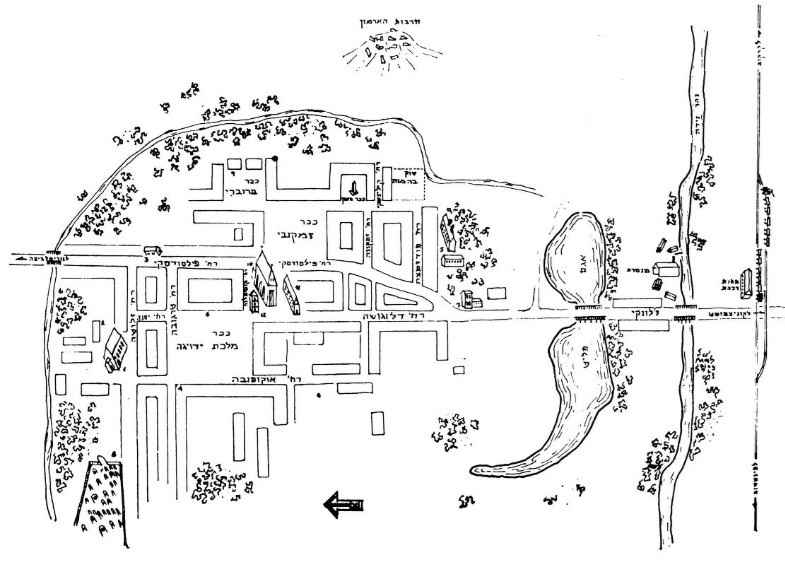
- Synagogue
- Beit Midrash [seminary]
- Town council
- Post office
- Town council
- Police station
- Fire department
- Old cemetery
- Slaughter house
- Christian church
- Dalugosh house
- Bell tower
|
[Page 3]
|
Legend:
|
||
| Map of the city of Wiślica | |||
[Page 4]
|
|
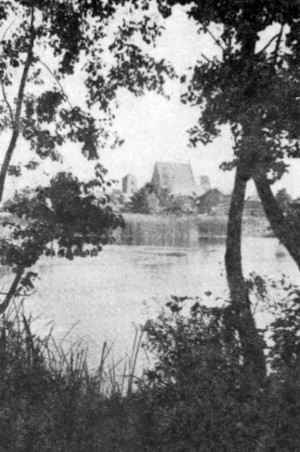
| General view from the “Plit” side |
Translated by Sara Mages
Our town, Vayslits (Wiślica in Polish), was one of the oldest towns in Poland with a long history of enterprises and achievements.
Over the years, this small community has shown activity worthy of its name in various fields. Well-known rabbis served there, many synagogues and Batei Midrash were built there, and also various public institutions were established there. Of course, the main organization of the Jewish community t took place in the period between the two world wars. Almost all the parties that existed on the Jewish street throughout Poland also operated in Vayslits, some on a smaller scale and some on a larger scale. Zionism has found a way here into the hearts of both the elder and younger generation, and young people from Vayslits also started to make aliyah to Eretz Yisrael “before the flood.” They were joined by Holocaust survivors who mainly made aliyah in the first years after the war. Survivors, from among the Jews of Vayslits, are now also in the United States, Canada and in other countries around the world.
The community of Vayslits was one of many on Polish soil that led their own way of life. There were moments of sorrow and joy, secular and sacred, and it is natural that the memoirs published about the community, written by the townspeople, have the potential to arouse interest among those near and far.
Many efforts have been invested by the Association of Former Residents of Vayslits collecting the material on our town that was and is no longer. The material is written mostly in Hebrew and in small quantity in Yiddish. There are interesting chapters here about the history of the town and the Holocaust period, its synagogues, its institutions and the political parties that were active there. Blessings to all the authors of the articles and those who helped us to complete the task of publishing the book that is now before you. We received a lot of help, both financially and also in good advice, from former residents of Vayslits in the United States and Canada.
There was a Jewish community named Vayslits. It was a community teeming with life, which would certainly still exist today if the Germans, and their helpers from among the local Polish population, had not risen against it and destroyed it with a malicious hand. Indeed, Jewish Vayslits no longer exists. Its sons were sent to extermination camps or joined the partisan companies and scattered everywhere. This matter is already a historical legacy, but the former residents of Vayslits everywhere will carry the memory of their community in their hearts to their last day. After all, in Vayslits we saw the light of the world and to this day we are connected to it by thousands of capillaries. The purpose of the book is to perpetuate the memory of our dear community, for our sake and for the sake of future generations. This book is of particular importance for the young generation, who did not know the Diaspora in general and the community of Vayslits in particular. These youth, if they read the book, will be able to learn quite a bit from it about a period that, due to the circumstances in which we live, will soon be forgotten from the heart. It is difficult, of course, to include everything in the framework of a small book. We have not been blessed with many people who write books, but even what we have been able to compile - testifies to the intensive life of a Jewish community that has experienced much until the reaper ascended upon it.
With awe and reverence we present this book to readers, both for our townspeople and former residents of other Jewish communities. Please read the book and you will find informative material about Vayslits, dear to us all. We will never forget you Vayslits! Your memory will be a blessing to us!
by Shimon Silberstein
Translated by Sara Mages
The city of Wiślica (Vayslits ) has always held a prominent place in Polish history. Kings and counts often visited it, and the Polish constitution known by the name “Statut Wiślica” was also published here. This historical document constitutes an initial milestone for the regulation of life in Poland on a constitutional basis, including the relations between the Jews and the general population of the country.
It is not known exactly when the first Jew arrived in Wiślica, but according to all data a Jewish settlement existed there for hundreds of years. Various legends have spread about the Jewish life in our city. Our community suffered severely from anti-Semitism like other Jewish communities. The economic competition between Jews and Poles also contributed to this to a considerable extent, but despite this attitude, the Jewish community in Wiślica continued to develop. Over time, the Jews moved from the suburb outside the wall to live in other parts of the city and settled among the Christian residents. They built houses there, synagogues and Batei Midrash, and, of course, schools for their sons. At the same time, the Jews developed the trade in the city and even established economic ties with all the surrounding villages. Thanks to this, Wiślica has become, at various times, a prosperous city for the benefit of its entire population. The city became the center of the entire area also thanks to the organizational and commercial ability, the funding, marketing of goods, and the Jews' credit. Over the generations, Wiślica Jews expanded their borders, from the big bridge over the Nida River, on the way go the railroad track and the small lake. The days have come when the Jews lived in the city center and nearby streets, while the Christians lived in side streets, in winding alleys at the back of the city. It was a kind of unofficial segregation between us and them.
The personal relations between the Jews and Christians, even on normal times, were generally very formal and even tense. When the German murderers, and their Polish assistants, deported the Jews of Wiślica to the gas chambers of Treblinka, the Polish population stood on the side and rejoiced at our great calamity. They did not extend a helping hand to us and did not even show humane attitude towards us. The number of cases in which the Poles gave shelter to Jews was relatively small. The destruction of the Wiślica community reflected in a small scale the profound human tragedy of the Diaspora Jewry.
May these humble pages, presented to the reader, serve as a memorial candle for the community of Wiślica, which was and is no longer. We present this book to our townspeople, and to former residents of other cities, in the hope that they will find interesting material about a period that soon there will be no trace of it left.
|
|
JewishGen, Inc. makes no representations regarding the accuracy of
the translation. The reader may wish to refer to the original material
for verification.
JewishGen is not responsible for inaccuracies or omissions in the original work and cannot rewrite or edit the text to correct inaccuracies and/or omissions.
Our mission is to produce a translation of the original work and we cannot verify the accuracy of statements or alter facts cited.
 Wiślica, Poland
 Yizkor Book Project
 JewishGen Home Page
Copyright © 1999-2026 by JewishGen, Inc.
Updated 18 Jun 2026 by LA