 |
|
|
[Page 178]
Grigory Aronson
1. I Am a Vitebsker
When I settled in Vitebsk–this was in the fall of 1913–I immediately found myself in an intimate and close environment. This was not only because my parents then lived in Vitebsk. (My father, a director in the local branch of the Russian-Asian bank, left Vitebsk a few months later.) The friendship and intimacy of the Vitebsk environment could also be felt in my professional work–I was invited to edit a small Russian daily paper that was headed by a broad communal group led by the local liberal activist Alexei Voklovitsh and Dr. Grigory Bruk. But the special feeling of closeness in Vitebsk that went deep inside of me and always bound me to Vitebsk was not only there. My feeling had a historical background. It had to do with my distant past, whose memory barely remained over time. But then, as if by a miracle, that feeling began to dredge up faded pages from the story of my life that shook me to the depths of my soul.
Here is the story. As soon as I arrived in Vibtebsk, I recalled that I was actually Vitebsker. My family came from Velizh, and the same blood libel was closely tied to Vitebsk. Here the tragedy was also my tragedy,
[Page 179]
and it bound me to the terrible catastrophe that in the days of Alexander I destroyed a Jewish shtetl in White Russia with the demonic power of a shameful and deranged malevolence that threw itself on the peaceful home of the old woman Mirele Aronson, led to her death, to the imprisonment of her children and her grandchildren and other relatives, shut down all the beis-medreshes and cheders in the city, devastated and destroyed over 10-12 years a whole community of Jews. The blood libel in Velizh was my “pedigree.” So it is no wonder that in 1913, in the days of the Beilis trial in Kiev, there awoke in me the half-forgotten memories of the past.
The Beilis trial in those days stood in the center of our lives in Vitebsk. People read all the telegrams from Kiev with bated breath. People waited impatiently for the major newspapers from Petersburg, Moscow, and Kiev at the train station until one or two in the morning. My editorial board had its own “correspondent” in Kiev, a student, Yudl Mitliansky. I do not recall what our “correspondent” sent to the Vitebsk newspaper, but I will never forget the telegram that I received from him from Kiev that Beilis had been released. I ran with this telegram to Dr. Bruk, where our closest friends were sitting and waiting for news. Dr. Bruk, who was always expansive and loved to hug and kiss, kissed everyone from joy. Tears of excitement stood in everyone's eyes. I particularly remember how Alexei Volkovitsh, who also had tears in his eyes, kissed everyone and in his usual deep voice said, “I won't congratulate you, but I will congratulate the simple peasants of Kiev for this sentence. They have thus defended the honor, the good name of Russia…”
I must thank Dr. Bruk for having invited me to be the editor of the community Russian newspaper. After my youthful years in Gomel, I knew well those two rare people, very alike and very different–the two brothers the Bruk doctors. As one of the leaders of Russian Zionism, Grigory Bruk was socially distant from me. To the contrary, his older brother, Avraham Bruk, a principled unaffiliated man, was close to the democratic and socialist circles and always
[Page 180]
supported the “Bund.” In later years, before I came to Vitebsk, I was quite friendly with Avraham Bruk and his wife, the Bundist Rosa Korobotshkina. But both brothers, whether as Jewish community activists, as human beings, or as doctors, maintained a high moral stature. For us, young men and women, they always remained as unmatchable masters of crystal clear personality who did not pursue wealth, who did not care for worldly goods, but who were dedicated to the quiet quest to help those who were in need. And I was delighted to have in Vitebsk such a friend as Dr. Grigory Bruk, even though he was in the camp of my political opponents.
2. The General Picture
According to official data that were known before the First World War, it was determined that the population of Vitebsk amounted to about 106,000 people. But a few years later, in 1915, the population almost doubled. The civilian population–that is, omitting the army–amounted to about 195,000 people.
The greater growth of the Vitebsk population came with the war and with its catastrophic accompaniments. The defeat of the Russian army and the evacuations from cities and towns caused by the Germans brought to Vitebsk, as to one of the first points of the “nearest protection,” thousands and thousands of refugees.
Already in the first year of the war, the high command, Grand Duke Nikolai Nikolaevich, and the chief of the general staff, General Yanushkevich, ordered the Jews to be removed from the places closest to the front. Those driven out had twenty-four hours to leave behind their possessions and leave. In May-June of 1915, more than 200,000 Jews were cruelly deported from Courland and Kovno Gubernias. Each of us who lived through those terrible weeks will never forget the freight trains with the thousands and thousands of refugees that the brutal military powers had forced into an “unspecified direction.” Vitebsk became one of the transit points, and many of the refugees found there their first shelter, their first place of refuge.
[Page 181]
How many Jews there were in Vitebsk during the First World War is difficult to say. People estimate that before the War there were 50,000 Jews in Vitebsk. But the number increased at the beginning of the war and continued to increase from month to month.
Considering the population's national make-up, we get a colorful picture of a multi-national city: Russians, Poles, Jews, and later on Latvians and Lithuanians. If we would schematize the sociological situation of the population, we would get this picture: the Russians were either government officials or bi-national townspeople, Poles consisted of a group of intelligent and wealthy landowners, Latvians and Lithuanians worked for the army and some of them belonged to the classless refugees. The Jews formed their own differentiated nation with all classes and all of the city's professions: merchants, factory owners, craftsmen, workers, clerks in offices and businesses, as well as in the liberal professions such as doctors, dentists, lawyers, teachers, and so on. As far as can be determined, there was no Russian social fabric. The Poles, too, lived in their own national surroundings. Only we Jews had noisy, passionate, and diversified community life with its almost inevitable party and movement battles.
In the Russian interior, as is known, there was often in the center of community life city self-management. But in the northwest area, and especially in a city like Vitebsk, it was very difficult to adopt such institutions for community affairs. In the city council there were only Chrtistian homeowners. The Jews, who comprised a majority of homeowners, had no voting rights for the city council. As for the zemstvo, which had existed only for a few years according to the ruling of Stolypin, its chief goal was to weaken the position of the Polish landowners and not to allow the Poles to have any importance in the affairs of the zemstvo. In this situation, the city council and the zemstvo in Vitebsk had the reputation of the whole governmental administration. Only in exceptional cases did they draw any community attention.
Such cases, when the city council emerged to the surface, happened a couple of times on the eve of the First World War.
[Page 182]
This was possible because among the members of the city council were some “white ravens,” two or three liberals. At the end of 1913, for example, when the national Duma passed a law about general school education, the chair of the committee in the Vitebsk city council, the excise officer Pyotr Sinokov went to some Jewish community activists with a suggestion to work out a plan to include the Jewish school system in the general city education system. At a meeting of the Vitebsk branch of the M'fitzei Haskalah (OPA [Spreaders of Haskalah), we considered the issue and worked out a plan. Dr. V. Yakerson were empowered to defend this plan at a planning meeting of the city council. A bit later, in 1914, I, with the help of the councilman from the city council, the Polish lawyer Waclaw Feodorovitsh (who after the revolution was named as commissar of the temporary government for the Vitebsk region) made a proposal in the city council for protecting the unemployed.
But these were exceptions. For Jews, the city council was generally a distant, foreign matter. The two Jewish councilmen–Dr. Lazar Isserman and the printer Neuman–were by law named by the governor and could not, you understand, play a role in the council. If I am not mistaken, both of these councilmen in fact sabotaged the city council meetings. And in the time of the First World War, the situation did not change.
3. The Inter-national Attitudes
Before I provide a more or less exhaustive account of Jewish life in Vitebsk, of its institutions and of the battle for the creation of a Jewish democratic kehillah in unfavorable conditions during the czarist regime, especially during the war, I will first mention a few, from the Jewish intelligentsia who, though little known, tried to undertake cooperative action with representatives of the Russian and Polish intelligentsia. The political crisis in the country, the agitation that was created by the defeats at the front, sharply stimulated the need for such contact between the democratically inclined community activists of different peoples. In general these activities in Vitebsk mirrored in a certain
[Page 183]
sense, the all-Russian tendency toward coalition, to the working together of people and groups that had the feeling that we were nearing the end of an old era and that we were standing on the threshold of a new one. We thought that we all, whether consciously or unconsciously, through our common contacts, were preparing for the revolution that was fluttering over our heads.
Interest in general politics greatly increased after the outbreak of the war, especially when highly placed visitors to Vitebsik, deputies from the national Duma and others, informed us about the actual issues. The first to come from Petersburg was A. Kerensky. This was even before the war. He held an open lecture, after which the representatives of the business clerks union made a small banquet for him. (Shortly before that, Kerensky was the head of the congress of the clerks in Moscow, which the regime had broken up.) After that came the leader of the Cadets, Prof. P. Milikov. He held a lecture about national issues. In a small group we wrung our hands with him until the roosters reminded us that day had dawned. A couple of times the deputy A. Shingariov came to us. He received material from us for an inquiry in the Duma into the “patriotic” and antisemitic speculations about the front in which the Vitebsk head of the zemstvo Kartashev and the Vitebsk member of the national soviet Afrosimov were involved. Other prominent people came from Petersburg: the Cadet V. Nabokov, the famous Russian writer Feodor Sologub, the literary critic Prof. D. Avsianilov-Kulikovsky, the Russian-Jewish writer and philosopher N Minsky (Vilenkin). With all of them we had smaller or larger private meetings.
Central to our lives were mainly these political issues: the conflict between the Duma and the regime, the abyss that daily grew deeper between the czarist court and all levels of the people, the demoralization caused by Rasputin's followers, the conflict between the two tactics: between the moderates, who hoped that the progressive bloc would find a way out, a compromise, with certain elements of the bureaucracy, and the leftist circles who saw the only alternative as a revolution or an overthrow of the court. The
[Page 184]
intense situations in the country and at the front unnerved everyone. And we, in quiet Vitebsk province, were seized by the general mood of the country.
What were we waiting for? What did we hope for in the years 1914-01916? It is now difficult to answer those questions. But as a response to our trepidation, we in Vitebsk organized irregular meetings of the local intelligentsia. At these meetings there was a political, non-binding exchange of opinions. These meetings were called every 2-3 weeks. Twenty-five to thirty people were invited: Jews, Russians, Poles. They took place in private dwellings or at the home of the former deputy in the First Duma, the Cadet Alexei Volkovitsh or at the home of Dr. Biershteyn, who belonged to no party but was “left of the Cadets.” Dr. Biershteyn had come to Vitebsk not long before. His wife, Sofia, also a doctor, was the sister of Dr. Grigory Bruk, who was popular in Vitebsk.
Russian and Polish Cadet-liberals participated in these meetings, as did Jewish democrats and Zionists, and socialists of various stripes. But I must say that not only in these meetings, but also outside of the four walls of the meetings, the participants bore no party stamp. I believe that this was characteristic of nearly the whole province at that time. There were almost no party people. The ties to party centers were either torn or weakened. The party centers themselves almost did not exist. These remarks apply to socialist parties. For the Cadets it was always characteristic to be not party people but fellow travelers.
When I think about that time, I will especially single out a meeting that was called in the first year of the war and that considered a painful problem: the relations between Poles and Jews. This was a time of economic boycott in Poland. A student, Feodorovitch, came from Petersburg. On his own he called together a group of people in his home–he invited five representatives of Poles, Jews, and Russians–the last as arbiters. I cannot provide details of what happened at that meeting. I remember only that the speaker
[Page 185]
protested against V. Jabotinski's expression, published, I think, in “Rasvet” [“Dawn”], that from the perspective of Russian Jews, Polish independence was not as necessary as a good Russian governorl. The Zionist Solovay, the son of a local banker, felt that we must distance ourselves from Jabotinsky's unfortunate expression. In general I have to say that these internal meetings and the attempt to bring Jews closer to Poles brought about certain positive results in the interests of local matters. I should add that the student Feodorovitsh, our speaker, later stood with Pilsudski, participated in Pilsudski's Austrian army, fell into the hands of the Russians, and ended his life on the gallows.
We awaited the possibility of making contacts in another direction: with a group of officers. They served in the headquarters of the Dvinsk military district, which was then in Vitebsk. I do not recall how we learned about it, but only that we learned that in this military center there were a number of intelligent officers who would join with us. These were Cossack Yesaul [Captain] Mikhail Gniloribov, who had graduated from the military judicial academy; Colonel S. Karanev, adjutant to General Zoyev, the chief officer in the headquarters; Captain Bazilev, and a few others. We met with them, discussed some local issues, and then turned to political issues. Over time we came up with a circle of military and civilian people–about 8-10 people. Among us, relations were very friendly. I often went to Gniloribov. We were chosen to edit a small cooperative journal (which appeared twice). Gniloribov helped us get permission to open a consumer organization at the Vitebsk workers' fund for the ailing. Thanks to his efforts, the situation of 15 Zionists who had been sent to Siberia was eased. They had been accused of collecting funds for enemy purposes (which meant for Eretz Yisroel, which at that time belonged to Turkey).
To end this chapter I will tell of a matter that even today is hidden under a veil. But the issue deserves to be remembered. There existed in Vitebsk a Masonic lodge. Jews, too, participated there (Dr. Bruk Mikhail Zeitlin,
[Page 186]
B. Ginzburg, and others). The existence of this lodge was a secret. None of the participants breathed a word about it. As far as we knew, the local Masonic lodge had arranged for its representative, Kolyubakin, who had made a trip to the front at the beginning of the war. I also know that Alexander Kerensky went to a meeting of the Masonic lodge in Vitebsk and brought along my friend who had the opportunity later to tell me about the details.
I never heard about the Masons, and I do not know what the Masons' role was in Russia during the war and the February Revolution. If as the basis of the Masonic movement was the idea of unifying a coalition of the representatives of varying political groupings, then our meetings had the same purpose. The meetings of the local intelligentsia from different political directions and from all national groups then bore an unpartied and inter-party character and secured the unity for community power. To this day I do not understand why we needed a Masonic lodge in Vitebsk. Unfortunately, the story of the Masons has not yet been written, and the Masons hold fast to their secrets.
4. On the Jewish Streets
Jewish community life in Vitebsk, never mind the published material on the eve of the First World War, bubbled and boiled. Not only the active representatives of the intelligentsia took part in kehillah matters, but also merchants, industrialists, craftsmen, and workers participated in Jewish industries, associations, and unions.
In a certain sense we can divide the community into three sectors: the first sector–the religious–consisted of rabbis, shochets, cantors, teachers, and religious Jews. The second sector included the modern communities, which in the Jewish province mainly increased after the 1905 Revolution, and whose institutions were led by the democratic circles of the intelligentsia: doctors, lawyers, secular teachers, and others. From the second sector, one can easily see a connection to the third sector, the worker and clerk sector, which
[Page 187]
had its own institutions. But it also felt more of a need for a broader cultural environment and a national-democratic atmosphere. The proletarian, socialist party intelligentsia was then quite small in Vitebsk, which makes even clearer the contact between the two latter sectors.
It also appears that the more democratically inclined industrialists and merchants, who were interested in community labor, all the more distanced themselves from religious tradition. They ceased participation in the institutions led by the first sector–the religious. They paid their contributions and their annual and monthly payments to various charity organizations, such as Linas-HaTzedek, the fund for the fallen, the fund for poor brides, the fund for guests, and so on. But this was nothing more than a formality. Their community aspirations were not tied to these institutions, which were led In a patriarchal way and which the gabbais conducted in an old-fashioned manner. At the same time, they were drawn to the effort to help the craftsmen through the savings and loan bank, founded by YIKO (The Jewish Colonizing Association) and later in the community aid through labor. They also showed a certain interest in the new Jewish culture and literature. It is totally possible that “Yiddishism” then had such an attraction that it was hard not to be interested in it. The Vitebsk branch of the literary society on the eve of the war played one of the central roles in the Jewish life of the city. Incidentally, I remember that on the appeal of Shmuel Niger, who then lived in Petersburg, I led a fund-raising project in Vitebsk for the Peretz Society. Among the donors, for the most part, were older people, the well-known wealthier people and merchants of the city.
A generation goes and a generation comes! Already at that time the younger generation was beginning to replace the older. When I came to Vitebsk, people still remembered the name of the wealthiest woman in the city, the old Chana Gurevitsh, who not long before had had some authority in community affairs. Her children had earlier also played a community role in Vitebsk. But her sons settled in Petersburg, and she herself was too old to take part in community activities. The same thing
[Page 188]
could be said about the famous bankers: Moyshe-Leyb Ginzburg and Solovay, and also about several merchants who had earlier had certain offices: Leib Markovitsh, Hershman, Pisarevsky, and others. The place of the older generation was taken by their children, new people. Even the banker Yisroel Vishniac, who was considered a patron, ceased dealing with community matters.
Incidentally, I recall that as soon as I arrived in Vitebsk, Vishniac arranged a concert in his beautiful palace. He invited to this concert a small but distinguished audience: from the governor to my insignificant self. It is fitting to say that the musician, when he ended the Chopin program, came up to me with a password from my party comrades. He was Constantin Kliatchko, who had been expelled from Petersburg to Vitebsk for taking part in social-democratic activities. Here in Vitebsk we befriended him. His death in Washington ended our friendship.
That a generation goes and a generation comes was felt at all levels. For example, no one had played a role in Jewish life, especially in the Zionist movement, for as long as Dr. Lieberman. Among the activists, I had never yet met Lieberman, and the same could be said about the rabbinic circles. Soon after my arrival in Vitebk, I was invited to Rabbi Schneerson for a seudah on the nineteenth of Kislev (the anniversary of Rabbi Schneour Zalman's release from prison). For this I largely have to thank one of the rabbi's sons, who was a Bundist. In the Bundist circles he was called “Podrabinik.” Later, when the Va'ad was organized in Vitebsk, Rabbi Schneerson was not among its rabbis.
There was no lack of assimilationists in Vitebsk either. They held a prominent place, often even important positions. Who were these assimilationists? These were the Jewish Cadets, the so-called “Vinaverovtzes.” Some of our intelligentsia belonged to them. In the new conditions, they felt a bit isolated. They could not enlist. But one had to reckon with them. They themselves showed no ambition. They were unassuming and did not pretend to work actively for Jewish community life.
An interesting case was that at the beginning of the war we had to send two delegates to a general Jewish meeting that
[Page 189]
was called in Petersburg. The invitation, signed by Henrich Slioberg, we received from the Petersburg office of the Jewish deputies of the Fourth Duma. It was addressed to Dr. Lazar Isserson, to the lawyer Yakov Yudin, and to me. We convened a meeting of about 50-60 people, representatives of all the movements and interests. Shemaryahu Mekler was chosen as a delegate at this meeting. He was a very moderate community worker, a religious person who did not belong to the “Vinaverovtzes” nor to the Zionists; I was chosen as a second delegate. The assimilationists did not choose to send a representative, and the Zionists were too weak, Dr. Bruk having been mobilized into the army. The left united behind my candidacy.
I will show via some details what applied to my candidacy. I had no desire to go to Petersburg. I greatly desired that the central committee of the “Bund,” particularly Mark Lieber, who had not long before visited Vitebsk, to participate in the meeting. I had certain grounds to believe that people would take my suggestion that Lieber, rather than me, should represent Vitebsk at the meeting. I had already written to Mr. Ehrlich and Mr. Rafess who then led the central Bundist party in Petersburg. With great surprise I read their response, that the central party of the Bund knew nothing about this meeting. In that case, I decided to use my mandate and go to the first Jewish meeting in the time of the World War.
On the eve of the meeting something happened in Vitebsk that it is appropriate to note. In the fall of 1914, an article was published in the official government newspaper “The Vitebsk Messenger” (number 188) that had antisemitic overtones. The article, “Incomprehensible Facts,” related an old wives' tale that Jewish women who brought gifts to the transports with wounded soldiers showed a special interest in the captured German soldiers. It added a variety of rumors about telephones, relatives with gold, about treason and other stories that had no basis.
This article, especially in an official newspaper, naturally caused great unrest in the Jewish population. A meeting was called and a delegation was sent to the governor Artzimovitsh. In the
[Page 190]
were Doctors Isserson and Biershteyn. The governor, as he told the delegation, had not read the article; then, when he read it through, he suggested that the Jewish kehillah should respond to the article, and he ordered that the response be printed in the official newspaper. I wrote the response on behalf of the kehillah, and it was printed in the “Vitebsk Messenger.”
I still have that response, which was a protest “against the accusations directed at a whole people” and about how “the terrible atmosphere such articles create in the Jewish community at this stressful moment of shared sorrows and victims”…”We bear,” we read further in the response, “many sacrifices in lives and property, in the blood of thousands of soldiers in the field of war and in the economic destruction of our hardworking people. In such a moment it Is impossible to be silent about these terrible sacrifices that the Jews make in the theater of war, the material sacrifices of the business owners and their employees in the cities and towns, borne equally with others…One must totally distort the true picture in order to single out uncharacteristic and, according to the author of the article, incomprehensible facts. This tendency of the author forces him to go beyond the facts to wild accusations against Jews, who supposedly aid the enemy in the war to accusations whose origins we attribute totally to the author. We hold it to be beneath our civil and national honor to respond to his insinuations.”
Thus did the Vitebsk kehillah react to the attacks of the malevolent antisemites who occupied the editorial office of the official newspaper. It is possibly thanks to the fact that Governor Artzimovitsh was not an antisemite but a liberal. He soon left his position because he did not want to work together with Minister for Internal Affairs Khvostov, who was one of Rasputin's confederates.
There was another situation in which our delegation easily succeeded in showing the governor that a great injustice had been committed against the Jewish population and should be rectified immediately. Among our delegates was Dr. A. Biershteyn, a man of many fine qualities such as people seldom
[Page 191]
encounter. Dr. Biershteyn, a splendid surgeon treated everyone equally–plainly and simply–whether it was the governor or a simple water carrier. He was calm and correct, noble and judicious.
After Biershteyn graduated from Moscow University, he went to work in the provincial hospital system–in Smolensk, in Tver, and in other gubernias. Everywhere he had a good reputation as an outstanding doctor and as an honored community worker. In 1905, after the manifesto of October 17, a pogrom against the intelligentsia and against Jews was organized in Tver, as it was in other cities. Dr. Biershteyn was injured in the pogrom. One of the most famous Russian liberals, Ivan Petrunkevitsh, who was his friend, recalls in his memoirs: “Avadi Davidovitsh Biershteyn,” he writes, “one of the noblest people, a smart and talented surgeon, a scrupulous leader in the community, came from Tver with a head injury. Through luck he had escaped death” (“Notes of a Community Activist,” in “Archive of the Russian Revolution,” volume 21, Berlin, 1934, page 404).
5. Jewish Societies and Parties
We knew well at that time Vitebsk's secular institutions and their many-branched efforts: the community Mefitzei Haskalah (OPA) [Spreaders of the Haskalah], The Jewish Literary Society, OZE (The Society to Protect the Health of Jews), The Workers' Aid (the Vitebsk “ORT”), The Society to Aid the Victims of War, which came along during the war and which later, in fact, conducted the functions of the Jewish kehillah (the community council), the savings and loan bank, which played a huge role in the lives of Vitebsk's working people. I participated actively in all of these societies and institutions. I was also involved in several labor unions: the union of business clerks, the printers' union, the shoemakers' cooperative, and primarily in was involved with the treasury for the ill, which was a central workers' organization for Jews as well as non-Jews. Jews held an overwhelming majority in this treasury and really dominated in its activities.
All of these organizations hid
[Page 192]
the true face of Jewish social life in Vitebsk. In order to provide a full and clear picture of Vitebsk, I will offer a few words to characterize the political activities of the Jewish street.
The Zionist organization was at that time the only organized Jewish group. But it had no influence over community life except in the narrow circle of its followers. The Zionists played no prominent role in Jewish institutions. Even in the council for the Jewish kehillah, when it was formed later on, the Zionists were only a small minority
Why was this? I believe this shows the lack of representative people. The Zionists in Vitebsk, especially at the time of the First World War, had little ideological differentiation. It lacked direction and nuance. The Poalei-Tzion and the Sejmists did not participate in community life. At that time we did not even have an organized Tze'irei-Tzion group, although we heard that in the high school there were quite a number of young Zionists. Among the young Zionists there was a gifted writer whose poems were published in the Russian Zionist journal “Razsvet” [“Dawn”]. This was a student in the gymnasium, Sh. Levman. Later he joined the communists, put out some books of stories in Russian, and also distinguished himself as a chess player. It appears that the Vitebsk Zionists centered around this element, which no influential activists arose.
Aside from Dr. Bruk, who was then serving in the army, the active Zionists were: the Kozianer Rabbi Melamed, a learned but quiet and modest man; the owner of a brickyard, Volfson, a sympathetic, generous, religious man with strong community inclinations; the young son of the banker Solovay, a proper young man but without character; the owner of a borscht factory Avraham Sobolovitsh, who later became wealthy abroad and donated generously to Zionist undertakings. All of these constituted the official representation of Zionists in Vitebsk.
The “Bund” in those years also did not play a large role in community life. Two of its recognized leaders, Dr. Ben-Tzion Shaynun and Dr. V. Yakerson, were mobilized at the beginning of the war. Consequently, some societies that they led suffered.
[Page 193]
Those that suffered most were Mefitzei-Haskalah, which was led by Dr. Shaynun. The official leadership of the “Bund” was in my hands. In the Jewish worker circles, the “Bund” was still somewhat important. There were no other parties in Vitebsk. Among the shoemakers there was a group of old and faithful Bundists. One of them, Mendel Ratchkovsky, a clever and good speaker, a member of the Minsk Combat Squad after 1905, was a friend of mine for many years. The “Bund” aroused sympathy beyond its organizational capabilities. At the beginning of the war, the “Bund” had an illegal collective, that consisted of three workers and two from the intelligentsia. We also organized some worker circles, where there were discussions about the “treason” of the German Social-Democrats, about Plekhanov's patriotic position, about international attitudes, and about socialism.
But illegal efforts became weaker and weaker. The great events, especially the refugee problem, incited the small number of Bundists increasingly to take part in legal community efforts. At that time the gendarmes made few arrests. I remember only one case when four young Bundist craftsmen who were somewhat involved in a small strike were arrested and exiled. I also know of a case when the Bundist collective had gathered signatures to encourage the Social-Democratic faction in the Duma and the printer Offin brought them to Petersburg. The Social-Democratic deputies were very popular among the Jewish population because they would often stand up in the Duma for the welfare of the Jews. At that time the deputy Chkheaidze a letter via M. Raffes (who in Petersburg went by the name Vaysenberg) saying that he had received 15,000 dollars from the Workers' Circle in America that were intended for Jewish labor undertakings.
Occasionally representatives of the “Bund” central committee would come to Vitebsk. First came Rosa Levitt, and then from abroad came Mark Lieber (Goldman), who quickly became oriented and interested in our community matters.
It is appropriate to recall that Lieber was more interested in the
[Page 194]
new forms of community life that we had shaped than in direct contact with the small illegal Bundist organization. I even suspected that he had no interest in attending meetings of the collective. He therefore supported the idea that had come to us of creating an unaffiliated workers consultative body that would coordinate our activities. At one such consultation, Lieber gave a talk about the situation in the Socialist International and particularly defended the heretical view of the socialists who, in France, Belgium, and England, joined with the government. In addition to the Bundists, those participating in these consultations were the Socialist-Revolutionary Mikhail Zeitlin, some Mensheviks–Guterman, Liebinson–the eminent Seimist Bar-Lvav Ginzburg, and others.
There we also dealt with various issues in Vitebsk's kehillah life. The issue of participation in the kehillah was always on the agenda. The workers were generally against the socialists having a connection to the kehillah, because in fact they would have a bourgeois majority and therefore things would be managed by the traditional big shots, the homeowning element, and the Zionists. They were especially opposed to joining with the kehillah when they learned that in the kehillah's budget there were provisions for paying salaries to the rabbis. (There were at the time six rabbis in Vitebsk.)
At that time Lieber had made his second visit to Vitebsk. We decided that he should go with us to the meeting of the board and give a talk. It was not easy for us to talk him into going with us to the meeting. But it is interesting that the kehillah had indeed made a strong impression on him. (He captured everyone with his sparkling talk.). Although Lieber at first shared the workers' doubts about the kehillah, he now urged that the workers should be part of the board.
People would be incorrect if they thought that the leftist element in our community life was exclusively Bundist. The truth is that the Democratic-Socialists had the upper hand. They had dedicated and qualified activists: some prominent Bundists–Shmuel Pisarevsky, the lawyer Shepsl Levinson, and the economist Yevgeny Luria. Also participating was the engineer Zalmen Gurevitsh (who for a long time lived in the Paris emigration, known by the Mensheviks
[Page 195]
under the pseudonym Negoyev) and sometimes Aharon Ginzburg, who took part in the Yakutsk Revolution in 1904 (“Romanovtses”). This group was an important part of Jewish life. It would be no exaggeration to say that the initiative in almost all community matters during the war came from our Democratic-Socialists.
The situation was somewhat different before the war, when the center of the Jewish community was found in the Literary Society. The chair of the Literary Society was Dr. Grigory Bruk, the leader of the Zionist organization. He was really a remarkable personality, with a deeply democratic nature and a love of Yiddish. He, the Zionist, gathered around himself the Yiddishist element of the city, led by the teacher Yakov Gershteyn and Z. Khrapkovsky. In the Literary Society there was an ongoing heated debate over the eternal language question: Yiddish or Hebrew. Bruk often offered to introduce a compromise into the debate. So it was when Yisroel Yefroikin from Petersburg and Lazar Matiliov from Moscow would come to lecture in Vitebsk. It was a real holiday for us when Zinovy Kisselgof, who had been born in Vitebsk, would come from Petersburg with his “musical lecture.” He had worked with Sh. An-sky on his famous folkore expedition. From other lectures at the Literary Society, I recall Chaim Greenberg and Sophia Dubnow-Ehrlich (who spoke about Bialik).
Two other secular associations–OPA and OZA-led a modest life.
OPA had some schools for girls with capable women teachers: Krentzel, Rozovskaya, and others. Yiddish was prohibited as a language of learning. But they showed signs of lightening that rule. People tried to use the rule of mother tongue. We tried to negotiate this with the director of the Folk School. OPA could not avoid the debate–Yiddish or Hebrew. The Petersburg OPA called together a consultation, so we had to send our representatives. At a meeting to choose delegates, a discussion began about the language issue. The Zionists mobilized their people and the Yiddishists theirs, with the result that neither side persuaded the other…
[Page 196]
During the war, and perhaps a bit earlier, OZA began to be more important in the city. It worked on organizing around itself a group of doctors. With their help, they created some important institutions, such “Milk Drops” and others that aroused good feelings. “Milk Drops” was concerned with milk for young mothers and small children. Dr. Sophia Bezmertnaya-Bruk ran this organization. OZA also created some kindergartens. They were led by Olga Reyn, the youngest sister of R. Abramovitsh.
Later on, when we had created the kehillah board, a question arose about taking over the Jewish hospital. We made an inspection of the hospital and worked out a budget. We had to give a report to doctors at a meeting and lay out a plan for how to include the hospital in the kehillah budget. The oldest doctor at the hospital was Lazar Isserson. The director had been a Bundist official. His address was even at the Bund office.
6. The Vitebsk ORT
Shortly before the First World War a new society was formed for us, “Aid through Labor.” It is appropriate to speak at some length about this society. And this is not only because “Aid through Labor” took a central place in our community life, but to a certain extent it was involved in some interesting moments.
Mrs. Paniavsky passed away. She was born in Vitebsk, where she took part in the famous textile firm Panizavsky (in Lodz and in Moscow). In her will she left the Vitebsk kehillah 140,000 rubles. Her son, Matvey Grigoryevitsh Panizavsky, came from Moscow to Vitebsk, called together the major community activists and posed a question: on what to spend such a large sum? After long deliberation, it was decided to create a fund to help Jewish craftsmen in Vitebsk. At first people wanted to use the savings and loan bank for this purpose. The director of the fund, the devoted activist Shalit, supported this idea. Eventually it was decided to establish a special society that would operate independently but also maintain close contact with the savings and
[Page 197]
loan bank. Steps were taken to establish a relationship with ORT in Petersburg and to ask the well-known ORT leader, the engineer L. Bollotin, a specialist in issues of craftsmanship, to work out a program of “Aid through Labor.” Bollotin never visited Vitebsk. A special committee of local leaders worked with him. An important role in working out the program for the new society was played by Yevgeny Luria. A democratic leader in Vitebsk who was a member of the economic committee of ORT in Petersburg. He had published a number of articles in the Russian press about problems with economic self-help for Jews.
When all of the formalities were completed, a general meeting was called and a committee was elected for the new society. Chosen as chair was Dr. Grigory Bruk. On the committee, aside from Bruk, were: Yevgeny Luria, Shemaryahu Mekler, Max Tubin, Bar-Lvov Ginzburg, Shmuel Pisarevsky, me, and a few others. The engineer Zalman Gurevitsh was invited to be a director, and as secretary of the society Lazar Freidson. At the beginning our work consisted of giving loans to the craftsmen as well as teaching and placing specialized apprentices with them. Later, still during the war, there were more complicated jobs: establishing workshops for tailors, shoemakers, laundrymen, and fulfilling large orders for the army. These labors provided income for thousands of families for us in the city.
Through the “Aid through Labor” society, a labor office was established on an autonomous foundation. Its goal was to find work both for the unemployed in Vitebsk and for refugees who had come to Vitebsk. This labor office–led by Yevgeny Luria and myself–quickly became one of the pillars of the workers movement in the city and attracted many young people to work (Vimenitz, L. Ginzburg, Khanin, and others).
It is appropriate to mention items that characterized the work of the society. For the first six months–“Aid through Labor” produced for the army 100,000 hats, 20,000 military coats, 50,000 shirts, 400,000 pairs of epaulets. Eighty workers thereby earned more than twenty thousand rubles. The “Aid through Labor” Society, together with
[Page 198]
the savings and loan bank, produced for the army 3,421 pairs of boots for 15,776 rubles. In two and half months, 103 shoemakers did the work. Among them were 31 non-Jews (“The Jewish Week,” 1915, number 29). Also established were several community workshops with 10-20 workers in each.
The work of our labor office developed quickly. In only three months–from June 28 to September 28–we registered 1,189 workers. There were 1,691 job openings, but only 551 were used, that is 46.3%. With the intercession of the labor office, 80 workers found jobs in other cities. We dealt with money issues, so that they would have possibility of traveling to the designated cities. The need to coordinate our activities with other cities led to the idea of calling a conference of all the labor offices. The Vitebsk raised the issue in the press and joined with other offices to support the conference. In February of 1916, the Petersburg ORT called a meeting, at which I represented Vitebsk.
But it would not be right to evaluate the “Aid through Labor” Society and our labor office only from a practical standpoint. Not only our practical and direct labor aided the broader levels of the Jewish population. In 1914-1916, our society became the center of Jewish life and in a certain way took the place that had been occupied in earlier times by the Jewish Literary Society. It was enough to sense the tone of that meeting for it to be clear that discussions about burning Jewish problems were the opposite of the sleepy political situation. Representatives from all political directions came to the gathering. Debates lasted until late at night. The police, who generally showed little interest in internal Jewish matters, had to notice the unusual revival. Eventually the administration forbade our mass gatherings. In 1916, the government shut down the two societies–the Literary Society and “Aid through Labor”–which had poked the government in the eyes.
By chance I had a connection to the liquidation of both organizations. I then represented the chairs of those
[Page 199]
societies. Dr. Bruk, the chair of “Aid through Labor,” was at the front. The chair of the Literary Society, Adolf Levinson, was not in the city. He was traveling somewhere. Early one morning in the summer of 1916 I received an urgent invitation to come to the head of the gendarmerie, Colonel Schultz. He let me know that by order of the ministry and of the commander of the Dvinsk military circle, both societies were being shut down, and he wanted me to sign the official report. I hesitated at first and protested the decision. I tried to show him that this was absurd and it was detrimental to the Jewish population. Colonel Schultz called for the “article,” read it to me ceremoniously, and then said that he found that my activities in Vitebsk were detrimental to the interests of the government and that he had recommended to the minister and to the military commander that I be sent to eastern Siberia for five years. He was awaiting a positive answer from Petersburg. Nothing came of that–I was not arrested and not sent to Siberia. In a mysterious circular that fell into my hands after the revolution, I learned that Schultz's request had not been approved because the police department opposed to arresting and exiling people who occupied legal positions in the labor movement. I was then the secretary of the city fund for the ill.
7. In the Worker Environment
Among the various legal institutions of the working class, the city-wide fund for the ill took a central place. The composition of the fund was mixed, international, but the leading posts were taken by Jewish activists. The leader of the fund from its beginning until the October Revolution, if not later, was Bar-Lvav Ginsburg, the first secretary was Naum Bikhovsky, a social democrat. A certain influence on attracting the workers to the security movement was conveyed by the representatives of the governor's security division. Among the representatives of the workers were: B. Ginzburg, a Russian social-democrat named Borisenko, and the leader of the fund in Galiarkin's glassworks in Novki, one Grigory Braude, a very clever
[Page 200]
and talented worker. Later on, together with Kuzma Gvodiovn, he played a major role in Petersburg's workers movement and was also the vice-chair of the central workers group in the military-industrial committee. Together with them, we began to hold meetings in order to deal with various questions relevant to community workers lives.
In connection with the security issue, the well-known Social-Democratic activist Baturski came to us from Petersburg. He was the editor of the Russian Social-Democratic organ “Strakhovania Rabotshikh” [“Workers' Insurance”]. Baturski was from Vitebsk.
Baturski, when he would come to Vitebsk, had little interest in the various illegal circles that tried to accomplish the impossible. He was a faithful “liquidator” and was only interested in the new forms of legal socialist activities that were possible in Russia between the two revolutions. I quickly became quite friendly with him.
A second guest, the later Bolshevik writer Sergey Reshetov, came specially to us from Moscow to deal with issues for the labor office. In a small, non-party circle we handled all those issues. We also spoke about other issues–about our participation in the conference that the Social-Democratic faction of the national Duma had announced in Moscow for the fight against rising prices. We chose Bar-Lvav Ginzburg as a delegate. All the labor organizations–the fud for the ill, the clerks union, the printers–supported his candidacy. If I am not mistaken, Ginzburg was the only Jewish delegate at the conference, which was called for Moscow at the end of 1915.
The other labor organizations that I mentioned earlier were less active. The printers union dealt only with professional matters. The same could be said for the clerks union. But I should dwell a little longer on this subject. The clerks union had, in its character and in its leader, another appearance than the other labor organizations. In its current activities, one could feel the spirit of the distant past. In the union, founded years ago, could be found clerks and landlords. Understand, then, that the class character of the union was therefore fuzzy. Even
[Page 201]
after the reforms of 1905, it was still an aid organization and nothing more. Everything was done in a patriarchal manner, very modestly. The head of the union, Babun, an unaffiliated by liberally inclined person, far from being a fighter, was more representative of the union than the few former Bundists or Bar-Lvov Ginzburg, although the latter was quite important.
Here I will recall the small shoemakers' cooperative, which consisted of about 14 people in all. They had formerly worked for the larger businesses, but they now wanted to be free of exploitation. I helped them work out their statutes as well as their internal constitution. Two Bundists led the cooperative–Hendl Ratchkovsky and Sh. Rivkin, who generally played a large role in the labor movement. This attempt largely succeeded.
During the war in Vitebsk, as in other cities, a workers group was organized by the military-industrial committee. This group called together several gatherings where there were sharp debates between the “defenders” and the “internationalists.” Both groups were weak and unimportant. As for the Bolsheviks, there was not a single one in Vitebsk. Sometimes a Vitebsker would come from Moscow, a student, Rosengoltz. His father, the owner of a weapon shop, had a bad reputation in town. He was considered a traitor. The Bolshevik Rosengoltz did not participate in Vitebsk matters. After the October Revolution, he took significant posts in Moscow. For a long time he was the Minister of External Affairs; and at one of the Moscow trials in 1937, when Stalin reckoned with the right and left communists, he was one of the victims.
8. Refugees in Vitebsk
The war began to fill up the city. Camps of people–Jews and non-Jews–swarmed in. Over the course of several months, several thousand refugees arrived. They came from Riga, Dvinsk Shavl, Vilna, from the numerous small towns of the northwest area. Vitebsk was considered a secure and stable spot. People brought their undertakings and institutions,
[Page 202]
factories and workshops. The great printer from Riga that belonged to the Riga-Orlov railroad was evacuated to Vitebsk. Also the Vilna Jewish gymnasium of Feivel Netz came here.
Dr. Bruk came for several days. Before he came, he had changed greatly. He appeared tired, and he had gone gray. The news that he brought us was not happy. Shortly before, he had met with Miliukov, from whom he had learned about the mood in the Petersburg political sphere. The news was not optimistic.
We wept a bit over the war and over the many crises–like the housing crisis, the wood crisis, the food crisis, and so on. And there was no lack of speculation among us. In short, the atmosphere in Vitebsk felt like “an approaching missile.”
Soon another Gehenna! We fell into the depths of Jewish tragedy. News came from the front of an open, brutal pursuit of Jews. Fantastic stories of Jewish treachery, made-up stories about Jewish spying were published in the official military newspapers. Among all of these libels came the story of Kuzhi,[1] which distressed the whole Jewish population. It reminded us o the pogrom years, the Beilis trial, the expulsions and persecutions of former times. In order to clarify the story of Kuzhi, the leftist factions in the national Duma sent Kerensky there to research the story. The Jewish deputy Friedman–who was not allowed in Kuzhi–questioned the local people. From this research it became clear that the whole story about Kuzhi was a simple libel, thought up and carried out by the antisemites in the “Stavke.” The lawyer Aharon Patkin came to us from Moscow. He had also investigated Kuzhi. In his talk he revealed to us the evil of the high command in the Russian army who, with the growth of rumors about the alleged Jewish treason, laid the groundwork for further persecutions of Jews.
[Page 203]
Soon enough we felt the sorrowful consequences. In May-June of 1915, mass deportations of Jews from the Baltic regions and Kovno Gubernia began. A new chapter of the great Jewish tragedy began. No one who had only seen the misfortunes with his own eyes could ever forget those terrible nights when freight trains came to Vitebsk one after the other, crowded with women and children, with the old and the sick. Whole orphanages, whole asylums were evacuated. Shocked, filthy, with blank faces, lost, forgotten by God and by mankind they looked at us with blank eyes, and those were the “lucky” ones. We gave them food and drink and, when necessary, medicine.
It was 2 or 3 in the morning. We, a group of Vitebsk Jews, waited at the tracks, not far from the station, for the freight train, for “our” train. We knew that this time the refugees were coming to us and we would have to take care of them in Vitebsk. A black cloud hung over us. Fifteen to twenty people from Vitebsk's Jewish intelligentsia bumbled about in the night's darkness. Railway employees, either brutal or drunk, drove us away from the tracks and heaped on us their Russian “blessings.” Our protests helped little. But here to give further help[ was Dr. Biershteyn. He had telephoned the governor at home. The governor had assured him that he would immediately call the station and order them to allow us to help the refugees. In a half hour, a clerk came from the governor and put things in order. We divided the refugees into several groups, and under the supervision of our young people, led them to dwellings that had been designated for them.
It was not easy to find places for so many refugees. At first they were taken to the beis-medreshes, and them homes were found for them. Groups of women, teachers, and others took it upon themselves to help the refugees with food and clothing. Doctors also came to this rescue work. Young people, who earlier had stood apart from community and philanthropic work, now spontaneously joined the action. The whole Jewish population, as soon as they learned of hundreds, of thousands of refugees, came to help. Each one took upon himself certain responsibilities. The city felt that a new catastrophe had come. And as always in a time of great troubles, our Vitebsk Jews forgot all of the conflicts and
[Page 204]
controversies and went to help the unfortunates. With the administration's permission, people quickly organized the “Society to Aid Victims of War.” According to reports published in the press, at the beginning of June “there were in Vitebsk more than 3,000 refugees…The most pressing issue concerned housing. The refugees live in damp and dark buildings, in the beis-medreshes, crowded and impoverished. Many sleep on the floor. Most of the refugees–women, children, and old people–cannot work” (“Jewish Week,” 1915, number 3). Later on the number of refugees who had to be cared for grew to 5,000-6,000.
Not only in Vitebsk but around Vitebsk in other cities and towns of Vitebsk Gubernia a many-branched developed to help the refugees. Our new “Society to Aid Victims of War” immediately called a meeting. To this meeting especially came a group of leaders from the central Jewish societies under the leadership of Meir Feinleib and his closest co-workers: Mrs. Feinleib-Logunova, Valtentina Vinaver, Vernick, and others. The Central Society for Aiding Refugees (YEKOPO) had named a special leader, Dr. Hodes, to help us with the relief work. The well-known leader Miron Kreinin also came right away.
At the same time, the Zemsk Committee in Moscow sent to Vitebsk its leader Shpoliansky to organize aid for the refugees–Jews, Latvians, Lithuanians, and others. They formed a special international committee under the leadership of the chair of the Vitebsk Zemstvo Kartashev. Also arriving from the “Stavke” in Pskov was the member of the national Soviet S. Zubtshaninov whom the government had sent to organize aid for the refugees according to government standards. A branch also formed of the “Tatyana Committee”–a similar official institution that shared the same goals.
I will tell here about all the societies, therefore, that we the representatives of Jewish societies had to deal with. We demanded support from them for the Jewish refugees. If I am not mistaken, three men–Dr. Isserson, Dr. Biershteyn, and I–were devoted to dealing with these committees. More than once we held meetings with the chair of the Vitebsk Zemstvo Kartashev. One meeting–I
[Page 205]
think–was held with the governor. There we established the budget for the “Society to Aid Victims of War.”
9. The Attempts to Create the Jewish Kehillah
All of our concerns were focused primarily on the single and most important question: how could we get the financial wherewithal to alleviate the growing needs. This meant reimbursing the budgets of the institutions. It became clear that without a legal, governmentally acknowledged kehillah, we could not solve the problem. The Jewish kehillah was for us a daily problem. A kehillah that would have the right to impose an obligatory donation on the Jewish population would be the only salvation, the only exit from our financial difficulties. Even earlier we had tried to impose a self-tax within the framework of the “Society to Aid Victims of War.” I have the report of the self-tax, and I can furnish some interesting numbers and data.
The self-tax imposed by the “Society to Aid Victims of War” affected 4,600 taxpayers and brought in for seven months (from September, 1915, until April, 1916) more than 100,000 rubles. It is very important to add that not only the wealthy levels of the Jewish population paid the tax, but also small businessmen, craftsmen, clerks, and workers did their share in this action. The democratic character of this collection can be seen in the following table:
Number of
DonationsFrom-To Number of
DonationsTo 2,500 1-3 Rubles 2 800 Rubles 1,000 3-10 Rubles 1 900 Rubles 500 10-25 Rubles 1 1100 Rubles 250 25-60 Rubles 3 1200 Rubles 60 60-100 Rubles 3 1300 Rubles 100 100-300 Rubles 2 1400 Rubles 25 300-500 Rubles 1 1500 Rubles 10 500-700 Rubles 1 2000 Rubles
From the start it became clear to us that it would be impossible to create the whole budget for the Jewish kehillah from voluntary contributions. The donated 100,000 rubles amounted to a little more
[Page 206]
than a third of the budget. Still, this was a step up compared to the routine methods of collecting funds in the beis-medreshes, with their “collection plates” and with their “competitions” that they held in selling aliyahs. Even the street collections that we occasionally organized did not produce such results–not more that 2,000-5,000 rubles. (Only in 1915 did such street collections amount to 13,000 rubles.)
Despite the fact that these self-imposed donations covered only a third of the kehillah budget, they showed the way that the Jewish kehillah had to go in the future. One must not forget that in Vitebsk the Jewish population amounted to no more than 10,000-12,000 families. And if one removed 4,600 families who were already prepared to support our institutions, that was a sign that the kehillah had good prospects.
The concern of covering the budget from all the Jewish institutions was not only an issue for Vitebsk's Jewish population. All of the cities and towns that had a Jewish population shared the same concern. Of course, part of the kehillah budget would be covered by the “karabka” [the tax on kosher meat]. Our attitude toward the karabka was generally negative. This was a tax on kosher meat, that is, a special tax on Jews. The management of the tax lay in the hands of the city board, which, together with the “wealthy Jews–residents of the city” had to distribute the income from the karabka. In fact, the person responsible for the tax not infrequently profited from the business.
One time, totally unexpectedly, the issue of the karabka surfaced at a meeting. At the meeting was Yisroel Vishniac, a banker and an old leader in the city. He showed us that the karabka, which brought the person who ran it not less than 200,000 rubles in income, would be more purposeful if it were in hands of the community. If the community leaders were given control of the karabka for the benefit of the community, we would receive not 48,000 rubles for our institutions, as was the case for the current year, but 200,000 rubles. With that amount, along with the 100,000 rubles from the donations, we could cover the whole kehillah budget. This plan really pleased us. This was especially so because we understood that we would have a long wait for the Jewish kehillah to become legal.
[Page 207]
Although this project lay with the national Duma, it was clear that it would not happen quickly. In the meantime, we would have to find temporary measures. We were in a lively correspondence with other kehillahs in order to clarify the situation. Since the city council was then, during the war, a bit more progressive, it might be practical to utilize the institution of the “wealthy residents” and under that pretext try to legalize the kehillah and take over the karabka, which would give us great resources.[2]
The prospect of obtaining 300,000 rubles for the kehillah would give us the possibility of managing the budget not only for the traditional religious and other learning institutions but also the budgets of all the cultural and modern economic societies that always needed funding. And our hopes were not only financial, but they also gave us strength for further community work.
I will briefly describe how we organized the kehillah in Vitebsk, the board. First we went to all the Jewish societies so that they could give us the information that we needed about the number of their members and the amounts of their income and expenses. We needed this information in order to know how to make the budget for the kehillah. Then we proposed that each society should choose–if possible at a general meeting–two delegates to be on the kehillah council. And if it was not possible to call a general meeting, then the board of the institution should temporarily choose two delegates. Other important organizational questions quickly arose, like, for example, the question of how the beis-medreshes should be treated and whether rabbis should be on the kehillah council. We decided these questions in a positive way, that is, the six rabbis who were then in Vitebsk were put on the kehillah council. Furthermore, a portion of the rabbis' salaries was included in the budget.
From the beginning it was clear that it would be impossible to establish
[Page 208]
a secular, worldly kehillah. There was too much in our Jewish life that was bound to religious tradition. But opposition quickly arose, especially in the Bundist workers circles, against the recognition, whether in principle or in practice, of a religious kehillah. I spoke about this a little earlier when I characterized the socialist circles. Finally the Bundist workers who were on the kehillah council made peace with the idea that the rabbis and gabbais from the beis-medreshes were an organic part of the Jewish democracy. This was helped by a psychological factor, for in a meeting, the rabbis and gabbais had not made a bad impression on the workers' leaders. Quite to the contrary, they had impressed them with their conduct.
But we were not finished with the preparatory work. We had only just convened the kehillah council. It consisted of seventy members. (Among ourselves we called it our Sanhedrin.) I cannot now recall the names of the members of the kehillah council. Its executive committee, if I am not mistaken, consisted of five members: Dr. Lazar Isserson was chosen as chair. Members of the executive committee were the lawyer Yakov Yudin and the flax merchant Max Tubin. All three belonged to Vinaver's group. The treasurer was the lumber merchant Moyshe Levinson, and I was the secretary.
I will here recall the several leaders who devoted themselves heart and soul to the work of the kehillah: Shemaryahu Mekler, a very clever and competent man; Rabbi Medalia, who was outstanding in his secular and truly democratic attitudes toward people; the short, fiery, temperamental speaker for the Zionists, Volfson; the owner of a large glass factory, Galiorkin; the energetic and practical leader Imenitov, who had a reputation as a “hostile Jew”–with his hostility he camouflaged his generosity to relief projects. These were the representatives of the rightist faction on the board.
We Bundists and socialists represented the left on the council. I can recall Bar-Lvov Ginzburg and the shoemakers Rivkin and Ratshkovsky from among them.
Between the two extremes, which were really not so extreme,
[Page 209]
there was also a group of democratic leaders–former socialists who were now a bit more moderate. They concealed from us their deepest convictions. I have already had the opportunity to characterize them and mention their names. Especially prominent among them was Shmuel Pisarevsky, an educated and clever man who commanded respect from all of us. Shmuel Pisarevsky especially stood out in the Jewish circles in 1917 after the October Revolution, when he was the chair of a committee that had to organize in Vitebsk a democratic Jewish kehillah on the basis of general and equal voting rights. I do not know why it took so long to organize the kehillah. At the time of the February Revolution, people did not take advantage of that opportunity. Elections for the Jewish kehillah were first conducted in March-April of 1918. I do not know the results of that election. I had to leave Vitebsk before that time because it was already under the pressure of Bolshevik terror. But even when I was not in Vitebsk, the “Bund” advanced my candidacy in the elections for the kehillah and I was elected. In June of 1918 there took place in Moscow the first conference of Jewish kehillahs in Russia. Rabbi Medalia, who was also elected as a delegate to the conference, gave me my mandate in Moscow.
To conclude, I will recall why in 1917 I was removed from the board. On the eve of the February Revolution a conflict erupted in the kehillah between us, the left, and the right. The military powers had seized people on the streets and sent them to do various kinds of hard labor around the city. No protests were effective. Some of our ringleaders came up with the idea of hiring poor people at the expense of the wealthy young men and sending them to do the work. The fiery Volfson was the advocate for this brilliant idea. We, the socialists, fought strongly against it. We held that the Jewish kehillah should not be involved with such a business. After the majority accepted the proposal, the leftists left the meeting. We were involved in an enduring conflict. But we soon forgot about this conflict when the Revolution broke out.
Original footnotes:
Zvi Cohen
Translated by Theodore Steinberg
The city of Vitebsk held a very significant position in the history of Chasidism because in Vitebsk lived two of its greatest pillars and there developed their outlook on the world. These were the two great students of Dov-Ber of Mezeritsh, who was the interpreter and spreader of the Chasidic movement. The first was R' Menachem-Mendel from Vitebsk, the creator of the “Kollelot” [“Communal”] movement in Eretz Yisroel, and the second was–R' Shneur-Zalman ben R' Baruch, the creator of the Chabad movement in Chasidism.
The name “Kollelot” is actually a later development. Earlier, the funds that had been gathered in Lithuania and in Russia to support those who lived and studied in Eretz Yisroel, were called “Chalukah” [division]. Later, when people began to collect funds for this purpose also in other countries, such as Poland, Germany, Hungary, Romania, and others, it was natural that each country wanted a special group (a kolel) that would look after its scholars in Eretz Yisroel. Thus were created the “kollelot”, that were known as the Russian kolel, the Polish kolel, the German kolel, and so on.
In his younger years, R' Menachem-Mendel studied with the Magid of Mezeritsh, even before the latter was the Baal Shem Tov's spiritual heir, and later, after the Baal Shem Tov's death, R' Menachem-Mendel traveled to the Magid and became one of his Chasidim. He would celebrate with him and speak for hours about things both open and hidden.
In the Chasidic world there is a legend that R' Menachem-Mendel was the leader of the Chasidic movement in White Russia.
At that time, a journey from Lithuania and Belorussia to Mezeritsh was a difficult matter. One had to be in a cart for weeks
[Page 211]
and occasionally go on foot. The Magid's Chasidim therefore complained to him about the journey. The Magid told them:
“I have a suggestion for you. You don't have to come to me all the time. It's enough that you see R' Mendel of Vitebsk and he will help you. Go to him and give him my stick and my belt and tell him that he should put them on immediately, before your eyes.”
So a group of Chasidim quickly traveled to Vitebsk and looked for someone named R' Mendele, but they could not find him. A Jewish woman stopped them and asked whom they sought. They told her:
“Someone named R' Mendel.”
The woman responded:
“I don't know any R' Mendel. Here in Vitebsk there are many Jews called Mendel. I have a son-in-law named Mendel. He prays and learns day and night, so you could call him R' Mendel. Do you maybe mean him?”
The Chasidim immediately understood that this was the one and they went right to him, giving him the Magid's stick and asking him to don the belt. Immediately he became another man, and the Shechinah rested upon him. Since then he has been known as R' Menachem-Mendel of Vitebsk, rabbi and leader.
The Chasidic legend also tells about R' Menachem-Mendel that he liked to be dressed in nice clothing, which was certainly not the custom among the young students in White Russia at that time. He was also fastidious that his hair be combed and that he should look good. People say that because of this habit, on one Friday night he made the Baal Shem Tov wait for him for two hours and delayed his preparations for honoring Shabbos. Here is the story, according to the Chasidim: When R' Menachem-Mendel was still a young man, he learned with R' Dov-Ber of Mezeritsh. One time R' Dov-Ber saw how he sat and learned and was so happy, while his hat was off to the side and about to fall. R' Dov-Ber quietly asked:
“How many pages of Gemara have you learned today?
The young man responded:
“Six”
Said R' Dov-Ber:
[Page 212]
“If from six pages of Gemara your hat is so far off to the side, how many pages of Gemara would it take to make it fall off?”
R' Menachem-Mendel understood that R' Dov-Ber was scolding him for being too intense about his learning, and he began to cry. R' Dov-Ber consoled him and said that he would take him to Medzhibozh to the Baal Shem Tov. They traveled there and arrived on a Friday. R' Dov-Ber quickly went to the Baal Shem and told him about the young man whom he had brought with him and who would be coming soon. R' Menachem-Mendel, however, was busy fussing over himself, so that two hours passed before he came to the Baal Shem. The Baal Shem had the custom of welcoming in Shabbos when Friday was half over. He therefore did not receive or even say “sholem aleichem” until the next night, after he had lit his pipe.
After the Baal Shem's death, R' Menachem-Mendel traveled to the Magid with his friend R' Shneur-Zalman ben Baruch. The Magid R' Dov'Ber passed away on the 19th of Kislev in 5533 (December, 1772). Even before his death, the religious split began, when in Vilna a cherem [excommunication] was imposed on the Chasidim. The cherem was a blow for the Chasidic movement. In many places, their minyanim were dispersed. After a while they recovered from this blow and again began to hold their minyanim. This was particularly possible in White Russia. By chance, in that same year White Russia was torn from Poland and made part of Russia.
The cherem caused no little trouble. It aroused hatred, quarrels, and even denunciations on both sides–misnagdim [opponents of Chasidim] and Chasidim. At the same time, however, the cherem brought out in the Chasidim a strong will to spread their teaching. They could not forget the words of the Baal Shem Tov:
“Once,” he said, “I met on the way to Heaven the Messiah, and I asked him when he would come. He answered, ‘I will come at the time when all of your thoughts and all of your secrets, which I have revealed to you, will be known by the whole world…and your students will have believed with total faith that the people of Israel will not be rescued before your teaching has captured the world.’”
After the Magid's death, his students traveled to different countries. A group of Chasidim from White Russiao–R' Menachem-Mendel
[Page 213]
of Vitebsk, R' Yisroel Polotzker, and R' Avraham Kalisker–began to spread Chasidus in their areas. By mutual accord, R' Menachem-Mendel would be their rebbe, and R' Shneur-Zalman was the first to declare that he was his Chasid. R' Menachem-Mendel was very popular with the Chasidim. He was their teacher and advisor.
We can learn a lot about R' Menachem-Mendel's behavior from his letters, which were published in “Sefer P'ri Ha-Aretz,” which his students had printed after his death. In them we can see that he did not conduct himself like other tzadikim [Chasidic rabbis]. He was very modest and did not hold by miracles. In one letter he responds to one of his Chasidim who had asked him to intervene with the Blessed Holy One so that his wife would bear a son. He wrote back thus: “But in the matter of asking for children…I am embarrassed. Am I in the place of God? Yes, God's word came to the Baal Shem. He decreed it, and so it was. He was singular from of old, and his like is no more. After him, who could stand on this earth? Surely many of our great tzadikim in our generation have mouths and speak and deliver prophecies. But I am not one of them…”
R' Menachem-Mendel was the rabbi for five years, from 5532 until 5537 (1772-1777). He lived then in the shtetl of Horodok, near Vitebsk. Later on, he saw, as is told, that he could have no spiritual elevation as long as he was in exile, and he developed the idea of settling in Eretz Yisroel. It could also be, however, that R' Menachem-Mendel, who had always sought to make peace between the two directions in Jewish life–between the misnagdim and the Chasidim–could no longer bear the persecutions from the other side and decided to go to Eretz Yisroel where, since 1764, the Baal Shem's students from Ukraine had settled–R' Nachamn Horodenker and R' Mendel Promishlianer, along with a group of Chasidim from Galicia.
When his nearest comrades and friends heard this, they told him, as Ruth told Naomi, “Wherever you go–I will go.” Soon thereafter, a movement of 300 Jews was formed who decided to go up to Eretz Yisroel with him. About this mas emigration to Eretz Yisroel, the firtst in several hundred years, there are many legends in the books of the Chasidim, but one thing is for certain, that R' Menachem-Mendel of Vitebsk wanted, before he went to Eretz
[Page 214]
Yisroel, to make peace between the Chasidim and the misnagdim, so that the house of the Jews could again be united. To this end, he agreed with his young friend, R' Shneur-Zalman, that they should go to Vilna and there speak with the Vilna Gaon. They hoped that he would give them his permission to make peace between the two sides. But those close to the Gaon worked on him to refuse to do so. These intimates feared lest the Vilna Gaon would speak with them and then make peace with the Chasidim. Following their advice, he left Vilna for several days and only returned when R' Menachem-Mendel of Vitebsk and R' Shneur-Zalman had returned home.
Soon thereafter, R' Menachem-Mendel, together with R' Yisroel Polotzker and Avraham Kalisker, in the middle of Adar, 5537 (1777) left Russia at the head of about 300 Jews. In the same year, in the month of Elul, they arrived at Tzfat.
When R' Menachem-Mendel was prepared to go to Eretz Yisroel, it is told, the Chasidim cried to him, and pleaded, “To whom, Rabbi, are you leaving us?” R' Menachem-Mendel pointed to R' Shneur-Zalman and said, “He is worthy of taking my place!” And so it happened. R' Shneur-Zalman quickly became, after R' Menachem-Mendel's departure, the head and leader of all Chasidic groups in Lithuania and Russia.
But in Israel as well the fanatical misnagdim did not leave the Chasidim in peace. They sent to Eretz Yisroel their special emissary, R' Saadiah, who there, too, created controversies. In his letters, R' Menachem-Mendel complains about the misnagdim who wanted to create conflicts even in the Holy Land. He was in close contact with the Chasidim in White Russia. As Sh. Dubnow tells in his “History of Chasidism,” R' Menachem-Mendel would “send to his Chasidim in the diaspora letters in which he would teach the ways of Chasidus and answer their questions about matters of faith and also about secular matters.”
R' Menachem-Mendel died in Tiberias on Rosh Chodesh Iyar, 5345 (1785)
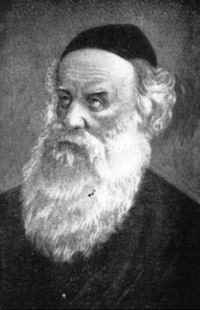
2. The Rabbi R' Shneur-Zalman
It was in the city of Vitebsk that the great master, rabbi, and philosopher, decisor and organizer, R' Shneur-Zalman ben Baruch, devised the profound doctrines of Chabad (an acronym for chachmah, binah, and de'ah [wisdom, understanding, and knowledge]).
[Page 215]
|
|
[Page 216]
R' Shneur-Zalman was born in 5508 (1748) in the shtetl of Liozna to a prominent family. At age 15 he married the daughter of the wealthy Vitebsker R' Yehuda-Leib Segal. He had come to an agreement with his father-in-law that he would give him a room of his own where he could nsit and learn. In that room, R' Shneur-Zalman, at an early age, began to build the great structure that he completed much later after he had been in Mezeritsh and “poured water” on the hands of the Magid, Dov-Ber.
At age 20, Shneur-Zalman remained at a crossroads. He had sought for himself a guide. The name of the Mezeritsh rabbi, R' Dov-Ber, was known to him. He had heard of his greatness in Kabbalah and he also knew of the Chasidic movement. But on the other side, he was also drawn to the Vilna Gaon. The questions before him were which way to go and who should be his teacher and guide. He finally decided to go the Magid in Mezeritsh. His father-in-law did not want him to go, so he left on foot.
At the Magid's place in Mezeritsh he met the greatest tzaddikim of that time: R' Levi-Yitzchak of Berditchev, R' Nachum of Chernobyl, R' Aharon Karliner, R' Mendel of Vitebsk, R' Elimelech of Lizensk, and others. As Sh. A. Horodetzki related in his Chasidism and its Leaders, “The Magid recognized in him what he was and what he would become. He was very close to him and made him a friend of his only son, R' Avraham, who was known in the Chasidic world as “the Angel.” R' Shneur-Zalman learned sacred texts from him, and R' Avraham learned Kabbalistic texts from R' Shneur-Zalman.”
One time–it is told–Shneur-Zalman went to the Magid and the Magid called out, “The Litvak has capitulated.” When the Magid saw that Shneur-Zalman was embarrassed, he added, “Have no fear. You have not capitulated, but the Litvak in you has capitulated, and now you have become one of us.”
R' Shneur-Zalman remained in Mezeritch for a year and a half, and then he returned home to Vitebsk, as he had promised his wife. But he did not remain home for long. He was drawn back to the Magid in Mezeritch.
But it is also noteworthy that already at a young age, Shneur-Zalman was not only interested in spiritual matters but that he also had an interest in the economic situation of the
[Page 217]
Jews. We can find evidence for this in what was written by the Lubavitsh rabbi, our Teacher and Rabbi R' Yosef-Yitzchak Schneerson, the sixth in the line of Chabad princes:
“Sacred honor, the Alter Rebbe (R' Shneur-Zalman), who was known as the Rabbi from Liady, the Baal ha-Tanya, who was born in a village and in his youth loved the fields, was among the first person among Jews of his time to travel through the Jewish world saying aloud that they should turn to agriculture. When he was still a young man, he intervened when many Jews were driven out of Bem [?]. They were known as the “refugees from Bem.” He urged them to settle on the soil, near the land of his father R' Baruch, z”l. Many did so and lived in that area.”
Our teacher and rabbi R' Yosef-Yitzchak writes further:
“When the Alter Rebbe married the daughter of R' Yehuda-Lieb Segal in Vitebsk, he agreed to the marriage on the condition that the bride's father should give him the whole dowry, which amounted to 5,000 gold coins so he could do with them what he liked, and his father-in-law should not interfere. A year after the wedding, the Alter Rebbe, with the encouragement of his wife, Rebbetzin Sterne, gave the whole dowry to a group of Jewish families who wanted to settle on the soil and take up agriculture. The money was given in order to purchase tracts of land, cattle, farm implements and to build a mill, a spinning room for wool and flax, and to build houses for the families who would settle there…The rabbi did not want to participate in this endeavor himself, but he visited from time to time to deliver d'rashas for everyone, saying that the Jews should abandon their worthless professions on the street or in the market and occupy themselves with agriculture. He would also go to the men and encourage them to set aside time for studying Chumash, Midrash, and, for those who could. Gemara.”
Moreover, the Alter Rebbe began to interest himself in the economic situation of the Jews when he was first in Mezeritch and saw that the Chasidic movement sought to improve Jewish incomes.
“When the Alter Rebbe was first in Mezeritch, he learned about the Baal Shem's concern to improve the incomes of the Jews through agriculture by sowing corn and
[Page 218]
taking up poultry and cattle breeding, as well as catching fish and spinning wool and flax. Consequently, when he returned home to Vitebsk, he stopped in many towns and urged Jews to take up agriculture. He was also interested in how Jews educated their children and urged everywhere that people should see to it that young people learn Torah and that all Jews should have the spirit of Torah.”
“At that time”–R' Yosef-Yitzchak Schneerson writes–“there was a government order that people who were involved in agriculture should be exempted from the head tax. This resounded mightily in all of the Jewish communities, and many Jews who had uncertain incomes turned to agriculture…”
3. The Building of Chabad
R' Shneur-Zalman was one of the few “lights of the exile”, from that well-known “religious-and-secular” epoch that began with R' Amram in the 10th century and extended through Rambam and further into the 14th century.
R' Shneur-Zalman was similar to the Rambam in many ways. Just like R' Moshe ben Maimon in his time, so he created for Jews a collection of rulings presented in a clear and simple form. Also like the Rambam, he cared for Jews who were perplexed and created for them his “Tanya” to show them the way, teaching faith with reason, like the “Guide for the Perplexed”–faith through “contemplation.”
The rabbi was a many-faceted personality who could always show a new side of himself. He was like a minyan in one body. He was an expert in. halachah, more than anyone in his time aside from the Vilna Gaon. He was one of those few who could enter “Pardes” [Paradise] and leave unharmed; he was a rabbi who strove to help every Jew; and on the other hand, he was an erudite man of great means; he was a community activist who strove to better the condition of the Jews through agriculture and healthful occupations; he was also a famous teacher who created educational sites for Jewish children; and he was a visionary for the future; he was a remarkable organizer who did all of these things with a firm hand; and he was a great seeker of peace.
[Page 219]
He was ten in one. But we should not stop even at ten, because he was truly much more.
Such was the father of Chabad. But what was his method? What did he intend with his philosophical-mystical teaching that he called “Chabad”?
We will try to answer this briefly. According to Chabad tradition, the rabbi began where the Baal Shem left off. In other words, the rabbi extended the string. R' Shneur-Zalman used to say about the Baal Shem that he was his grandfather and that he considered himself the Baal Shem's spiritual grandson. Also, in the generations of princes of Lubavitsch, people consider the Baal Shem, the first of the line. Therefore, according to Chabad, their doctrine was not new but only a continuation of what the Baal Shem had taught.
According to the “Tanya,” everything in the world is only the garb of the Holy One, Blessed Be He. In that garment, the Holy One, Blessed Be He, is revealed to humanity. Everything in the world is truly nothing in regard to the “Divine Power” that resides in the thing. That is the power that makes it be, gives life and form, creates from a “nothing” a “there is”. When we see something and think that it is the actual thing, that it is the “there is,” that it is the absolute reality and there is nothing else, we are mistaken. We do not see, and cannot see with our flesh-and-blood eyes the divine Power that is in every thing, in every created thing, and is millions of times more powerful, greater, and higher than the thing itself. When sometimes a miracle occurs and we can see with our human eyes the Being and the Divine Power of each thing, and when we can absorb the spirituality of each thing that gushes with the Godly Power that resides within it, then will the materiality of each thing, its whole matter, become as nothing, because it will be completely nullified in relation to the life of the Divine Power of the thing, which is without limits, both higher and deeper.
The soul of men, teaches Chabad, has two foundations, one animal and the other heavenly. And in people there is also a demon from whom come all our desires for pleasure, for this world, for evil qualities but people also have within them the Divine Power that calls them to behave properly, to mercy, to love, to justice and righteousness, to mutual assistance.
The Godly aspect of the human soul has three
[Page 220]
foundations: Chochmah, Binah, Da'as [literally Wisdom, Understanding, Knowledge]. “Chochmah” is Chesed [kindness], “Binah” is Din [religious law] (which always has to be carried out–“The Law should be upheld even if the heavens fall”), and Da'as means an understanding of both, a uniting of the other two in order to create a single path. “Know the Lord your God” means to create from Chesed” and from “Din” –a single path of fairness and righteousness.
According to Chabad, “contemplation is above deeds”. This means that understanding something through reason is higher than simple enthusiasm. Reason outranks feeling. Therefore “the mind must rule over the heart.” People should serve the Master of the Universe “from the depths of contemplation” and not “from the depths of emotion” alone, which means neither from love nor from fear. The love or fear that a person has as a result of recognizing His ways, and therefore seeing His ways through the Torah is higher than the love or fear that comes from the heart, a higher recognition of the Holy One, Blessed Be He. One must uphold all the laws of the Shulchan Aruch, because they reflect the will of the Creator.
According to Kabbalah, there are four worlds that derive from the Ein Sof: “the world of Atzilus [Emanation],” “the world of Beriah [Creation],” “the world of Yetzirah [Formation],” and “the world of Assiyah [Action].” The world of Atzilus is the highest and is ruled by the greatest harmony among ideas, thoughts, concepts, and ideas. There is no conflict there, because this world is above everything. It is that which existed before all else began.
The “world of Atzilus” is entirely spiritual. It is the world where there are no conflicting ideas. The “world of Beriah” is the world of birth, the world where things and words are born. But they have no form there. It is the world of matter, the material of all things that first comes to the wider world. The “world of Yetzirah” is the world where everything takes on form, where everything receives an appearance, where everything is finished and completed; from this world, people come to the “world of Assiyah,” which is our world, actuality.
According to Chabad, a Jew should live in all those worlds. He should begin in the “world of Assiyah,” where he must earn a living, then to the “world of Yetzirah,” from there to the “world of Beriah,” and then to the “world of Atzilus,” where people are above everything.
But the Rabbi knew that this was too much to expect from everyone. The Rabbi himself could move from one “world” to another, just as a person goes from one room to another. But not everyone is worthy of having such qualities. Therefore he devised a way for
[Page 221]
a person who could not reach such heights–a way for the average person, for those “in-between,” who could not climb so high. He dedicated his book to them, to those “average men” and in fact called it “the book of average men.” He showed thereby that even average people can raise themselves up. They need only to desire it and to do so in stages.
4. The Rabbi as a Seeker of Peace
The Rabbi put striving for peace in the center of all of his activities, because he saw in that the outcome of all his Chabad world outlook. Peace and unity lead to the secret of “Oneness” and to the Thirteen Attributes of God (in gematria, the word for Oneness, Echad, adds up to thirteen). Harmony means wholeness, fullness; peace [shalom] is completeness [shlimus]. When people are worthy of the completeness of creation, then will the scar of the first man's sin be healed, and that of Cain, and those of all who came after, who waged war and shed blood. But the initial unity must come from Jews, because “Who is like your people Israel, a unique nation on earth” [2 Samuel 7:23]. Jews must be a “unique nation.”
And therefore the Rabbi devoted most of the days of his life to peace, because when there will be peace among Jews, then there could be peace for the whole world–eternal peace.
Even at first, when he became a rabbi, he set out on the path of peace and suffered more than a little persecution from his opponents. His first step was to say that he would go to the Vilna Gaon to make peace between both camps–the Chasidim and the misnagdim. R' Shlomo Karliner came out sharply against him, who urged other rabbis to join the opposition. R' Shlomo said that he was sure that the misnagdim did not want peace. Therefore, he held that one should not humiliate himself before them. But the Rabbi believed differently. He said that if there was not glimmer of hope for peace, even as thin as a hair, people must still try. The result was that R' Shneur-Zalman went together with R' Mendel of Vitebsk to Vilna, to the Gaon, who would not see them. He told them to leave. Finally, the Gaon left the city and only returned when they had departed.
Later on the Rabbi made other attempts to achieve peace between the Chasidim and the misnagdim, but the misnagdim did not want to make peace with the Chasidim. Quite the opposite: the quarrels became sharper and led to denunciations [to civil authorities]. The first victim was R' Shneur-Zalman. He was denounced as being politically dangerous for the Russian regime, because with his collection of funds for Eretz Yisroel, he was supporting the Turks against Russia. R' Shneur-Zalman was arrested and imprisoned in isolation
[Page 222]
in the Petropavlovsk Fortress, from which he was released on the 13th of Kislev in 5559. The day of his release is a holiday for the Chabad Chasidim, which they celebrate even now.
But even after R' Shneur-Zalman's release, the misnagdim did not cease their persecution of Chasidim. Their goal was to go after the head of the Chasidim, R' Shneur-Zalman. Again he was denounced, and again he was brought to Petersburg, and for a second time he was arrested. This time he was not detained for long, about two weeks, but he did not dare to leave Petersburg until the senate made a definite decision. But finally the new Russian czar, Alexander I, on his accession in 1801, freed him.
When the Rabbi left prison, he did not lose his faith in people, and he made further attempts at peace. This time the conflict was internal, between Chasidim. There was a story about R' Baruch of Medzhibozh, who was angry with the Rabbi who came into his area to collect money for the poor who had been driven out of their villages. R' Baruch held that R' Shneur-Zalman had no right to enter his “kingdom” without his permission. When the Rabbi showed him that many of these poor, exiled Jews were starving and that people had to take action for them, R' Baruch asked, “What's it to you that they're starving?” To this question, R' Shneur-Zalman had no answer.
Earlier he had made a great effort at peacemaking when a quarrel had broken out between him and the new representative of the “kollelot” in Eretz Yisroel, R' Avraham Kalisker, who had taken the place of R' Mendel of Vitebsk after the latter's death. He, R' Shneur-Zalman, had elevated R' Avraham Kalisker and treated him like a prince, and he had called on everyone to treat him with the same respect that they had shown to R. Mendel of Vitebsk, z”l. But hardly had this new prince, R. Avraham Kalisker, whose territory did not include that of R. Shneur-Zalman, taken over the reins than he attacked R' Shneur-Zalman for collecting funds for the “kollelot” without his permission.
The last attempt at making peace in the life of R' Shneur-Zalman was to make “peace” in heaven between the leader of Russia and the leader of France in the time of the Napoleonic Wars.
The Rabbi was certain that if Napoleon won, it would be
[Page 223]
a great evil for the study of Torah. Jews would have better incomes, but Torah study would decrease and it might happen, God forbid, that “Torah study would be forgotten in Israel.” He therefore called on all the tzaddikim of that generation to pray that Napoleon would lose the war.
But many tzaddikim opposed him, especially R' Yisroel Koszenitzer, who asked the Master of the World that Napoleon should triumph, so that Jews would have better incomes. But in heaven they did not know what to do, which of these elevated parties should prevail. Legend tells us that the decision remained open until Rosh Hashanah, when the shofar would be blown: whoever did all the tones of the tekiyah earlier, his side would win over the other.
But, the legend goes on, when R' Shneur-Zalman learned of this, he said nothing to anyone, but he thought to himself and early on Rosh Hashanah, while R' Yisroel Koszenitzer was preparing for shofar blowing and for his devotions, R' Shneur-Zalman called on the shofar-blower of his prayer house to blow the shofar before the morning service and thus assured that the “leader of Russia” would triumph.
And so it was. Immediately those in heaven inscribed the victory of the “leader of Russia.” And when R' Yisroel Koszenitzer later blew the shofar with great devotion, he was given to know what had already happened, that R' Shneur-Zalman had preceded him. R' Yisroel Koszenitzer wrung his hands and said,
“The Litvak has seized the shofar notes!”
But later on, R' Yisroel Koszenitzer himself also admitted that the Rabbi was right.
Later, during the war, the Rabbi had to flee from Liadi. With difficulty he reached the Kursk region, at the end of Shabbos, on the 24th of Kislev, he passed away.
The influence that R' Shneur-Zalman exercised in Vitebsk was extraordinary. Chabad shuls were there for many years, where people were proud that the founder of Chabad was like a fellow citizen; and until the Bolshevik Revolution, people in Vitebsk could feel that Chabad Chasidism had put its stamp on the city of Vitebsk and that R' Shneur-Zalman had many heirs there who passed on their inheritance to their children and to their children's children, from generation to generation.
|
|
JewishGen, Inc. makes no representations regarding the accuracy of
the translation. The reader may wish to refer to the original material
for verification.
JewishGen is not responsible for inaccuracies or omissions in the original work and cannot rewrite or edit the text to correct inaccuracies and/or omissions.
Our mission is to produce a translation of the original work and we cannot verify the accuracy of statements or alter facts cited.
 Vitsyebsk, Belarus
 Yizkor Book Project
 JewishGen Home Page
Copyright © 1999-2026 by JewishGen, Inc.
Updated 03 Apr 2026 by JH