 |
Tzilah Volfson-Honikberg
|
|
[Page 93]
by Yisroel Zev Wolfson
Translated by Theodore Steinberg
One of the former rabbis in Vitebsk was R' Eisik B'harad. He was our rabbi in the city for about sixty years. He was sent to us by the Baal Tanya [Rabbi Shneour Zalman of Liadi], who had ordained him, because at that time the city was an important center of Chasidism. R' Eizik, who was a great scholar, was known as a lenient interpreter of the laws. His decisions served as precedents, and his successor, Rabbi Landau, held by the rule: “Thus did the old one decide.” He also impressed with his decisions in matters of money, and merchants and industrialists would come to him for Torah judgments. Even non-Jews would come to him over monetary disagreements. He led the rabbinical office with a strong hand; he showed no favoritism, and he took strong measures against those who had committed transgressions. Vitebskers remember his name with great honor until this day. He is counted among the former Chasidic rabbis–on the same level as the rabbi R' Eizik Homler.
At that time there existed in Vitebsk a great and famous yeshiva headed by R' Yechezkel Mirkin, author of “Binyan Yechezkel,” R' Avraham Ettinger, who was later the religious judge in the second city district, and R' Aharon Levin, or as people called him R' Archie Lodzer. The high point of the yeshiva's development came when the gaon R' Yekutiel-Zalmen Landau was its head. At that time about eighty students learned in the yeshiva, among them many righteous men, assiduous students, and geniuses.
After the death of Baal Tzemach Tzedek, his younger son, the Maharash, came to R' Eizik for a blessing. R' Eizik responded: “The son of Baal Tzemach Tzedek needs no blessing from me.” At the time when
[Page 94]
the “Tanya” [Rabbi Shneour Zalman of Liadi's famous book] was being published, R' Shneour Zalman's children came to him to get his endorsement for the front of the book. R' Eizik gave it and got the endorsements of the other rabbis of Vitebsk–R' Yishayahu Levin and Rabbi Landau. R' Eizik lived in the second city district in his own house. The Zarutshayer Shul had a special building in R' Eizik's name.
There were rabbinical judges in Vitebsk at that time–R' Yenkel's son R' Eizi, that rabbi of the Ashkenazic (Misnaggid) congregation in the first district, and the aforementioned Yishayahu Levin in the third district.
R. Eizik lived long and passed away at the age of ninety (in about 1867-1868).
After R' Eizik's death, R' Yekutiel-Zalman Landau, the head of the yeshiva, was made Av Beis-Din [head of the rabbinical court] in Vitebsk. He was from the famous Landau family in Vilna, and he was the son-in-law of the famous leader R' Dov Rapoport from Tshashnik (a shtetl 100 kilometers from Vitebsk). The Rapoport family was the richest in the whole area. They dealt in lumber and used to send rails to Riga. R' Yekutiel-Zalman Landau was a partner in the business. A severe crisis in this branch of business led to the family losing its possessions. R' Yekutiel-Zalman suffered from poverty. When the people of Vitebsk became aware of this, the leaders of the kehillah, with the agreement of R' Eizik, went to him to make him the head of the yeshiva and also to have him sit with R' Eizik in the office of the Beis Din to help him with his decisions. R' Eizik, who was blind as he aged, received him cordially. He would say that the One Above had sent in his old age a living library in the person of R' Yekutiel-Zalman, because aside from his sagacity and brilliance, R' Yekutiel-Zalman was also an expert, a Sinai among mountains.
R' Yekutiel-Zalman conducted his rabbinical activities gently. He was beloved and esteemed, and his prestige was recognized by everyone. He was very generous in the interests of the kehillah and showed no favoritism.
Even when he became the rabbi, he did not neglect the yeshiva, which was widely considered his cherished child, so that people called it “Landau's yeshiva.” The yeshiva's students came to him about both material and spiritual matters. The yeshiva always occupied the center of his thoughts. It used to be that when he
[Page 95]
would go with community leaders on kehillah business and on the way meet yeshiva students, he would become so engrossed in their issues that he would totally forget why he was there. Consequently, some of the leaders complained that he was neglecting the kehillah's interests because of his unbound devotion to the yeshiva. This grieved him.
In his day there was a person named Victor, a respectable priest and a lover of Israel. R' Yekutiel-Zalman was closely tied to him in practical matters concerning the kehillah and also in spiritual matters. They had discussions about Judaism. The two of them were good friends, and the Vitebsk kehillah benefited from their friendship. (He used to teach the non-Jews in his parish why the Jews did not observe Sunday, and he would use the example of the Jewish craftsmen who worked for him, who on Friday would set aside their work in order to prepare for Shabbos.)
In 1875, the Chasidic kehillah in Petersburg invited R' Yekutiel-Zalman to become their rabbi. He agreed, and he remained the rabbi in Petersburg until his death.
After R' Yekutiel-Zalman left Vitebsk, there were disagreements between the Misnagdim and the Chasidim over who should be the head of the rabbinical court. The result was that the position was entirely abandoned, leaving only the district rabbis.
In the first district there were R' Zalman Ostrovner, who was the judge after the time of R' Eizik B'harad, and R' Yekutiel-Zalman Landau. In the second district there were two rabbis: R' Avraham Ettinger and R' Chaim Fogelman; and in the third district, after the death of R' Yeshayahu Levin, his place was taken for the Chasidim by R' Mordechai Schneeurson, a grandson of Baal Tzemach Tzedek, and for the Ashkenazim (Misnagdim) by R' Eliyahu Slobodkin.
Various groups of residents began to complain because there was no head of the rabbinical court. After the death of R' Zalman Ostrovner, people again took up the issue. After long meetings, people decided to accept as head of the rabbinical court the Lublin rabbi R' Shneour-Zalman Fradkin, the Torah scholar. He was one of the most well-known of the Chasidic rabbis and was known as a great scholar. The Baal Tzemach Tzedek ordained him and was very close to him.
The most esteemed citizens of the city sent to Lublin two envoys,
[Page 96]
R' Yisroel Rashkin and R' Sholem-Simcha Sheinfinkel, with a rabbinical letter and money for travel expenses for the rabbi and his household. Rabbi Fradkin agreed to become the rabbi in Vitebsk and began making preparations for the trip. But in the city there were groups who intrigued against this appointment, which led to denunciations. People circulated a report that the rabbi's children belonged to revolutionary circles…At that time the governor of Vitebsk was the famous Von Wahl, who was later associated with the Lekert trial in Vilna. He was then a liberal and his attitude toward Jews was respectful. (He came to Vitebsk from Kharkov, where he was in contact with the governor general Loris-Melikov, who was a known liberal.)
Von Wahl called together the kehillah leaders and told them that “they should not dare to take Rabbi Fradkin as the head of the rabbinical court. If they would disobey and invite him, Von Wahl would, within 24 hours, expel him from the city.” These words shocked everyone, and the preparations for receiving the new rabbi came to a halt.
After long meetings, people approached the governor through intermediaries. They told him that this denunciation had not merit, and they proposed that he should go officially to the governor of Lublin for clarification. (Rabbi Fradkin was the governmental rabbi in Lubin.) Von Wahl did as they said. Shortly thereafter he called together the kehillah leaders and let them know that he had received from the Lublin governor a report that was totally favorable to Rabbi Fradkin. He withdrew his earlier order and was totally satisfied with the appointment. There was joy in the city. But the matter never came to fruition because Rabbi Fradkin meanwhile decided to settle in Eretz Yisroel, and Vitebsk remained still without a head of the rabbinical court. From then on, the position of head of the rabbinical court was terminated.
Then a dispute began in the city on the subject of the first district, where, for the whole time, there was no rabbi with seniority, which caused a decline in the prestige of the Vitebsk kehillah. One of the reasons that people wanted to create a position for the head of the rabbinical court was the rapid growth of the Jewish population in the third district.
[Page 97]
|
|
Tzilah Volfson-Honikberg |
[Page 98]
A whole 40 percent of the Jewish population lived there, and they had great influence in kehillah matters. In this district was R' Mordechai Shneeurson (R' Mordechai Rabash). He was greatly beloved at every level of the population because of his lineage, as a grandson of Baal Tzemach Tzedek, and also because of his noble nature. His influence extended well beyond the borders of his third district, and the Jewish residents of the third district felt that they did not need a head of the rabbinic court and they did not want to participate in the financial aspects of having one.
In the first city district, they accepted as their rabbi R' Zalman Neumark, one of the most eminent rabbis of the Chabad Chasidim. Because of a disagreement that erupted, two years later he left the city and settled in Nevel. After him, they took as their rabbi R' Dov-Nachman Hurvitz from Glukhov in the Chernigov Gubernia. R' Dov-Nachman was a major Torah figure and a talented writer. His articles about religious and national problems that were published in “Ha-Tzefirah” under the pseudonym BN drew the attention of all readers. Nachum Sokolov himself regarded him highly. His articles served as a stimulus for Nachum Sokolov's series of articles “L'maranan v'rabanan” [“To our Masters and Rabbis”], which later appeared as a book.
At first Rabbi Hurvitz was an adherent of Zionism. After the “Poltaver Rebellion” (the opposition which the Poltaver Rabbi, Rabbi Akiva Rabinovitch established in connection with the cultural issue of the Second Zionist Congress), he joined the group “Ha-poles” {“The Scale”). He was a co-worker on the anti-Zionist journal that Rabbi Rabinovitch put out. This secret was revealed by his own son, the fervent Zionist Chaim-Binyami Hurvitz, z”l, an active worker for the Mizrachi in Vitebsk. He died at the young age of 35. Rabbi Hurvitz met with great misfortunes: in one year, his wife, his son, and his grandson died. This threefold tragedy so disturbed him that a short time after, he himself died.
In his will, he named as one of the executors a Zionist activist who was a close friend of his son. He also announced that his book “Chidushei of BN,” which he had prepared for publication, should come out. With the executor's help, the book appeared in 1903 in Vilna and made its mark in learned circles. The Gaon of Rogochev, R' Yosef Razin, gave the book his endorsement.
[Page 99]
The Gaon and the deceased had engaged in an exchange of questions and answers [on religious matters]. Long before his death, Rabbi Hurvitz, under the influence of his son's friend modified his opposition to Zionism, and in his later utterances he did not evince the sharpness toward Zionism that had marked his earlier work in “Ha-poles.”
After Rabbi Hurwitz' death, the Gomel rabbi, Rabbi Yehuda-Leib Schneeurson, became the rabbi in the first district. He was a nephew of Baal Tzemach Tzedek and a grandson of the Baal Tanya. He remained in that position until the First World War and even after the Revolution.
After the death of Avraham Ettinger, R' Mordechai-Dov Hurvitz became the rabbi in the second district. He was known as a great scholar and a Zionist sympathizer. He tried throughout his life to get to Eretz Yisroel. After the Revolution he was the rabbi.
After the death of R' Mordechai Schneeurson, R' Shemayarhu-Leib Medalia became the rabbi of the third district. Aside from being a great scholar, he was also an accomplished community organizer. At the time of the First World War when thousands of refugees came to Vitebsk, he was among the most active people on the relief committee that had been formed. He had a fine sensitivity for all community matters in Jewish life. He often participated in rabbinical meetings in Petersburg and Moscow. The close ties between him and the Lubavitch rabbi did not allow him to be close to the practical side of Zionism, but his active contributions to community needs brought him to understanding and cooperating with the Zionists in a number of ways, and relations between them were polite.
After the Revolution, he suffered from the Yevsektzia [the Jewish section of the Communist Party, which was actually not friendly to Jews]. They saw him as an obstacle to their control of the Jewish street, and they persecuted him, although he was one of the rabbis who signed (to be sure, against his will) the well-known declaration that in Russia there was absolutely no persecution of religion. Because of the persecutions, which became more severe, in 1930 he left Vitebsk and went to Moscow, where he was the rabbi for two years. His devoted activities in all community matters–although he actually had official permission for them–attracted the attention of the government and he, along with some of his household was sent to Siberia.
[Page 100]
Despite all of our efforts, we have not been able to ascertain his fate.
After the death of Rabbi Slobodkin. R' Abba-Leib Shapiro, z”l, became the rabbi for the Ashkenazim. He was a great Torah scholar and much loved by everyone. He regarded Zionism positively. After his death, his son-in-law took his place, R' Boruch Rabinovitch, a devoted Zionist. The Yevsektzia also persecuted him. In 1925 he was persuaded to leave Russia, and he became a rabbi in Chicago.
State-Appointed Rabbis in Vitebsk
After the death of R' Eizik B'harad, who was also a state-appointed rabbi, R' Eliezer Koder was named as state-appointed rabbi. He was a brother-in-law of R' Shneour Zacks, born in Zhager, Lithuania, which was known as a city full of sages. He was a modest man, a lover of animals, and a fine person who was devoted to his duties. He had issued a commentary on the Maharash. Although his knowledge of Russian culture was not too great, his nobility and courtesy to everyone made him quite beloved. He was very concerned with the welfare of Jewish soldiers who served in the Vitebsk brigade. On every holiday he would work with the military administration to be certain that the Jewish soldiers were given off for the holiday. This intervention often caused him great difficulties, but he undertook it with love. His naivete and simplicity often led to absurdities, and thus he could not take a position as a representative of the esteemed kehillah. His Russian speech with a Lithuanian accent when he spoke from the bimah on official holidays or on other official public occasions, did not make him a good representative of our city. For this reason he also had little influence on young people. He did not mix into general community matters, although the government showed him great respect. Once it happened that an officer, a bitter antisemite, was stubborn and would not give soldiers time off for a seder, holding that the order had only freed them for the day of the holiday and not for the evening before. Rabbi Kader did not consult anyone and decided to go to Mayor Pozner, who was known
[Page 101]
for his friendly attitude toward Jews, and to seek his help. The mayor gave him a letter of recommendation to Governor Von Wahl. Rabbi Kader, in his simplicity, viewed this as a successful step and sought an audience with the governor. For this audience, he sent the letter to the governor via his secretary and waited in line. The governor made him wait until the last moment, and when he received him, he said, “I have deliberately kept you for the end. Since when does a rabbi need a recommendation to me from the mayor?” Then he sat down and wrote a letter to the general of the brigade to which the officer belonged. The order was immediately recalled and the soldiers celebrated a joyous seder.
At Von Wahl's suggestion, the position of “Jewish expert” was renewed at the office of the governor. In previous years that office was held by R' Lippa Zeltzer, a well-known Maskil who corresponded with Yitzchak-Ber Levinson (“Rib'l”). For some years that office had been terminated.
To the renewed post Von Wahl named the governmental rabbi in Reszhitza, R' Yissachar-Ber Gittelson, a graduate of the government teaching institute in Vilna. A man with a thorough Jewish and general education, he was respected by the government, and his speeches in Yiddish and Russian made an impression on his audiences. Von Wahl also named him as the Jewish representative on the gubernia commission that was supposed to handle Jewish issues. This commission was created by order of Ignatiev in 1881. The rabbi's speeches in this commission in response to the heated speeches of the antisemites were very significant and people listened to them with great interest. Von Wahl, who chaired the commission, received him courteously and always gave full opportunity to respond to the attacks on Jews. With true national pride, the rabbi repulsed the slanders and malevolent accusations against Jews. This gave strength to the Jewish community, which was beaten down by the pogroms and by Ignatiev's cruel decrees.
After the death of Rabbi Kader, Yissachar-Ber Gittelson was chosen as the state-appointed rabbi in Vitebsk without opposition. He was truly fit for this position, in hindsight. He was proficient in old and new Hebrew
[Page 102]
Literature, and he also had a broad general education. He became a teacher of Jewish religion in the government gymnasium for girls that was named for Maria Fyedorovna. His lectures were interesting and planted a love for Judaism in all who heard him. He had a positive attitude toward Zionism. He spoke in the Great Shul, where he always prayed, at every Zionist celebration, and people from different persuasions would come specially to hear his talks. When the “Bund” became stronger in Vitebsk, it led a battle against Rabbi Gittelson and accused him of having a hand in the secret police. This accusation was based on the fact that he, as a government rabbi, had to translate Yiddish and Hebrew documents that were found in various home inspections. In truth, there was no basis for these accusations. On the contrary, at every opportunity he sought to tone down things and to prevent whatever was possible from falling into the paws of the government
One time on Shabbs Nachamu, when there was normally a meeting of Zionists, the Bundists burst into the shul during the speech and began to heckle the speaker and interrupt. A tumult ensued, with the result that the hecklers were thrown out of the shul and the rabbi resumed his talk.
Rabbi Gittelson was interested in the affairs of all the shuls in the city. He took different opportunities to speak in them. He held his position for fifteen years, and in the last election in 1901 he lost his place and was replaced by Dr. Zvi Bruk, who was then the Zionist representative for the Minsk, Mohilev, and Vitebsk gubernias. The Zionists had a great victory in this election.
There were different circumstances for this Zionist victory. The chief reason was the tense relationship between Rabbi Gittelson with his aide Perlshteyn and public opinion, which was very unhappy with how much the rebbetzin interfered in rabbinic matters. The Zionists, who had adopted the motto “Win over the kehillahs,” took this unexpected opportunity and nominated Dr. Bruk. After Dr. Bruk was elected for the Third Zionist Congress as plenipotentiary from the White Russian gubernias, his popularity spread well beyond his home town of Gomel
[Page 103]
where he was a medical doctor, and spread throughout the area. In addition, he had family ties to Vitebsk. His mother was from Vitebsk, the daughter of R' Aharon Treynin, from one of the most eminent families in the city. His first visit to Vitebsk, after he had been elected as Zionist plenipotentiary, made a big impression. With his courtesy and aristocratic bearing, he was beloved by all. For his visit, people arranged meetings with the city's intelligentsia at the home of the engineer Sh. Hurvitz, the won of the famous R' Leib Hurvitz and friend of Dr. Chaim Zhitlovsky. At one meeting there was a discussion between Dr Bruk and the opponents of Zionism, among whom was the leader of the Jewish government-school Mr. Yungburg. The Zionist side emerged triumphant, and Dr. Bruk's popularity became even greater.
When people proposed his candidacy, a battle broke out between the Zionists and Dr. Bruk's followers, on one side, and the Orthodox circles and the followers of Rabbi Gittelson on the other. Among the Zionists there were some who went a little too far. First, there were not enough weighty community circumstances to deny Rabbi Gittelson his place. Also, people still remembered his earlier years when he took a proud stance against the government in defense of Jews. People wanted to uphold his honor and not cause him any embarrassment. Second, Dr. Bruk's personality was too large and his work too important for the Zionists to impose on him the burden of a government rabbi, which officially had no more than a perfunctory role. It would make him spend his time on details and he would have no time to devote to his Zionist work. You must understand that these people did not present these reasons to the public. They were only for internal debates. Both sides fought sharply with respectable, and even non-respectable, means, as was usual in the heat of battle. Typically only a couple of hundred people participated in the elections, which were mostly pro forma, and they did so to honor the rabbi. But this time the elections raised an extraordinary interest and excitement in the kehillah. There were meetings and fiery debates in all the shuls, and things went so far, that people
[Page 104]
began to think of it as a was over a mitzvah. Understand that in such conditions there were among the battlers on the Zionist side people who permitted tactics that edged over into desecration. The extreme Orthodox and the Lubavitch Chasidim, who were the greatest opponents of the Zionists because of the famous letter against Zionism by the Lubavitch rabbi, considered Zionism a religious catastrophe. They considered every means kosher for this battle. On the day of the election, the rabbi sent a telegram to each of his Chasidim not to vote for the Zionist candidate.
The election was held in city hall under the personal supervision of Police Chief Alleyn–itself a rare occurrence that gave the election a special character. The police chief and the whole police force were on the Zionist side, thanks to the influence of Perlshteyn, Gittelson's aide, who was irritated by the whole thing. The election was on a Thursday. It began at nine in the morning and lasted until midnight. Fifteen hundred people participated. On the Zionist side, the young people especially took part, heart and soul. The Zionists came to city hall early and filled the large hall and the side rooms so that it was very hard for the other side, who came a bit later, to move around and to register. Bu their determination to carry out the rabbi's order gave then strength and they stood all day, till late at night, in the congestion.
Even after the voting location closed, people did not go home. They waited in greqt suspense until morning to hear the results. The Zionist candidate received 1,250 votes out of 1,500. The results were received with applause.
The sharp opponents of the Zionists–the Chasidim and some of the bourgeoisie–were not satisfied with the election results. They sent a special delegation to the governor asking him to annul the election because it had not adhered to the law–the Zionists had seized the voting location and did not allow the opposing side to vote. This claim made a strong impression on everyone and provoked bitterness against the leaders who allowed such an anti-community step at such a difficult time.
[Page 105]
The governor's response was that he could not understand how such a violation of the rules could have occurred while the police chief was supervising. The election results were confirmed, and Dr. Bruk was awarded the office.
Dr. Bruk remained in the office until 1906. Even when he was a deputy in the First Duma, in which he represented Vitebsk Gubernia, he did not abandon the office. Because he was part of the famous Vyborg Rebellion of deputies in the First Duma, after which the Duma was dissolved, he was threatened with prison and he lost the right to be a governmental rabbi as well as to hold other community posts.
There were many candidates for the position of governmental rabbi. Among them was the well-known Rabbi YL. Tzirlson from Priluk (and later the rabbi in Kishinev). His candidacy was proposed and supported by many in the third district, which then lacked a rabbi thanks to the death of Rabbi Shneeurson, z”l. These residents intended that he should take a double rabbinic place, which he himself wanted. Consequently he came to Vitebsk for a week and spoke in several shuls. With his sermons and with his other virtues, he was well received by everyone. Even the Zionists did not oppose his candidacy, although there was a rumor that he was an enemy of that movement. While he was in Vitebsk, he met with the city's Zionist leaders and assured them that the rumor was false. He had, indeed, participated in “Ha-poles,” which was known to be in opposition to Zionism, and he published a special position about Zionism in his pamphlet “A Thorn in the End.” He became devoted to Zionist thought in a broader scope and agreed with its outlook with his whole heart.
But he was not elected, even though he also had followers in the other districts. The main reason was the unwillingness of most people in the city to unite two offices, rabbi and governmental rabbi, in one person.
The Zionists then suggested the candidacy of Rabbi Yosef-Elkhanan Melamed, governmental rabbi in Mozir, Minsk Gubernia, and before that the leader of the vocational school in Dvinsk. He was known as a worker for the community and as a devoted Zionist since the First Zionist Congress. He was well-versed in
[Page 106]
Hebrew literature and had a reputation as an eminent writer with his books “The Tribes of Israel” and “Rabbi of All those in Exile.” And most of all he was known as an outstanding speaker. He was elected almost without opposition. He devoted himself to cultural work and his talks made a great impression. He remained in the position until the October Revolution, when the governmental rabbis were abolished.
Shuls and Study Houses
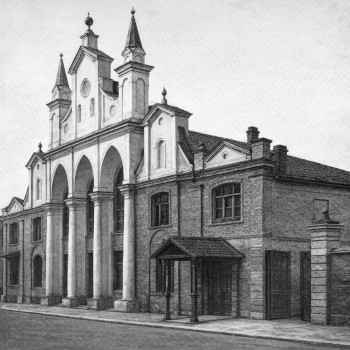
With the growth of the Jewish population came new shuls and study houses. Many of the old shuls built new wings and special buildings. In the first district, on the old historical place that the Jews had bought after the First Polish War, on Ofitzersk Street (later Suavarov Street), in the center of the city, the Great Shul was built, the so-called Zaharia Shul, that was completed in 1810. That is where the most eminent citizens prayed. Around 1812, the Chabad Chasidim began to build their own shul. The foundation stone was laid while the Baal Tanya was still alive. His son, known as the Middle Rabbi, participated in the ceremony. In the building, which was completed after the death of the Baal Tanya, almost all of the Chabad Chasidim prayed. Because of the dispute several years later, the Chasidim of the Middle Rabbi and the Chasidim of Rabbi Aharon Staroselier (a student of the Baal Tanya) peop0ole separated. At the suggestion of the Lubatvitsch rabbi, who made peace between the two parties, the Lubavitsch Chasidim paid the opposing side for their “share” of the shul 3,600 banknotes (given that the Lubavitch Chasidim could not collect this sum all at once from their adherents, they received a loan from two Chasidim, R' Avraham Berlson and R' Moyshe Charnomordik). For that money, the Staroselier Chasidim built two shuls–one in the shul courtyard which people called by the name of Gavriel Vilenkin, a Staroselier Chasid. Later on it was called the Carliner Shul. The second was built on Dvortzav Street. In these two shuls the Staroselier Chasidim prayed. But this did not last long. After the death of R' Aharon Staroselier, all of his Chasidim went over to the Middle Rabbi. Since both groups of Chasidim shared the same prayer tradition, the names remained only as a reminder. Later, when the number of those who prayed there grew,
[Page 107]
|
|
In the shul courtyard were built two more two-story buildings that people called the Old Chabad and the New Chabad Shuls. In one of these buildings was a Talmud Torah, and in the second there was a mikveh for men.
This synagogue courtyard was central for everyone who prayed in the first district. The most important citizens prayed there–whether Chasidim or Misnagdim–and relations were friendly among them. In the course of time, there were seven shuls in the district. Over all there were 25 shuls.
[Page 108]
In the second district there were about 20 shuls.
In the third district there were about 30 shuls. In this district there was a historical shul in a wooden building, where the Baal Tanya had prayed when he lived in Vitebsk with his father-in-law R' Leib Segal, one of the most prominent citizens, from the Pisarevsky family. This shul was built on the family's property and was called by their name. Situated in the center of the city, on Vokzal {Train Station] Street, the shul was always full of people praying, one minyan after another, from early in the morning until the evening.
Later the homeowners of the area decided to build a large shul in the shul courtyard. To this end, they decided to tear down the old wooden building and build on the site a large store, the income from which would go to the shul. But the people who prayed there did not agree–the shul in which the Alter Rebbe had prayed must remain as it was. A dispute broke out over this issue between the Pisarevsky family and the people who prayed there.
In 1881, a One of the huge fire broke out in the neighborhood of the shul. Governor Von Wahl himself came to the fire with the firemen. In order to prevent the fire from spreading, they decided to tear down the old building. Those who prayed there begged the governor not to do so. He agreed and–a miracle–the building remained untouched by the fire. The Chasidim saw in this event the finger of the rabbi, who protected his shul. After the death of the elder Pisarevsky, the dispute dissipated. The old building won out over the new one that was built. While the old building was always full of people praying, so that people often had to wait outside for a spot to open up, the new shul was nearly empty. Sometimes it had trouble gathering a minyan.
Cemeteries and Chevra-Kadishas
In the course of things, the residents of the different districts came together for important community matters, but when it came to a cemetery and a chevra-kadisha, there were different reasons for dividing the activities according to district. One of the main reasons was the Dvina, which separated the third district from the other two. Before the iron bridge was built over the river, in spring every connection between the districts
[Page 109]
was gone, and it was impossible to bring a corpse to its eternal resting place. People therefore decided that the third district should have its own cemetery and chevra-kadisha.
The first cemetery existed from the earliest days of the Jewish settlement in Vitebsk. It was in the first district, by the shore of the river. At that time, this site was outside of the city, but as the city grew over time, the cemetery was located in the center. Around the cemetery was an attractive stone wall. For a century, this was the only cemetery in the city. When there was no more room in the cemetery, the chevra-kadisha bought a place from Mr. Kossov for a cemetery in the second district. People were buried there for 180 years. When this cemetery also became full, a difficult “judicial” problem arose that was reported in the Russian press. New land had to be purchased. Legally, a cemetery could only be put outside of the city, but according to the ordinances of Ignatiev, Jews could not buy land there. In other words, Jews could not have a cemetery. The best lawyers in the country spent years on this issue without coming up with a solution, so they sent it to the senate. At the suggestion of Governor Von Wahl, they came to a compromise. The chevra-kadisha should rent a tract of land from Kossov and there extend the cemetery. And so it was done. It is appropriate to recall that the local government looked through its fingers and did not get involved in the matter.
In 1910, people bought in the first district, in a corner of the city, a large area for a third cemetery. The trustees succeeded in imposing a fine order in the cemetery. The rows were numbered and there were fine buildings, like, for example, a nice shul for the residents of the area, a room for purifying the dead, an attractive platform for eulogies, and so on. All of these were made with the financial help of Mrs. Mazah, the widow of Shimon-Dov Mazah, z”l. Among the trustees of the chevra-kadisha who impressed with their devotion, it is appropriate to remember R' Yisroel Vishniac and R' Moyshe-Leib Ginzburg.
In 1910 a field for a cemetery was also purchased in the third district.
[Page 110]
Yeshivas in Vitebsk
The large, famous Vitebsk yeshiva that was located in the Great Shul was established in the time when R' Eizik B'harad. Was rabbi. When the head of the yeshiva, R' Yekutiel-Zalman Landau became the rabbi in Petersburg, he proposed as his successor R' Aharon-Chaim Ilah, who was then then supervisor of kashrus. He was a great scholar and an impressive leader of the yeshiva. In his time, the yeshiva moved from the Old Shul to the shul of the Padlo area in the first district. The old building need many repairs, and there were no funds for them. He remained in this position for about fifteen years. Because of his advanced age, he left the position and settled in his birth town of Kaytanov. There he published his work “Divrei Chaim,” Torah interpretations, which was well-received by the sages of his generation, including Rabbi Landau. In his time, there were about fifty students in the yeshiva, but its splendor began to increase, and the yeshiva's influence had begun to wain and played a sall role in the life of the city.
After him, the head of the yeshiva was R' Zev-Volf Rakover. He began as a preacher in the Great Shul in Zahoria in the first district. Earlier he had held the same position in Shklov. Until then there had not been in Vitebsk–a city with many Chasidim–any city preachers. Because of the bitter events, there was a powerful spiritual awakening among the masses. People began going eagerly to the shuls, and it was considered necessary to engage a preacher. R' Zev-Volf Rakover formed fellowships to study Gemara, “Eyn Yakov,” and books of Mussar in many shuls, mainly in the Great Shul, where he always prayed. He had a strong influence on the masses. Other people regarded him with great respect, and even the Chasidim, who generally did not approve of preachers, were friendly toward him because of his general excellence and good deeds. Aside from the normal lessons, every Shabbos he would speak about current events. On certain Shabboses, for instance on Shabbos Ha-gadol, Shabbos Chazon, Shabbos Nachamu, and Shabbos Shuvah, people would come from every part of the city and pack the shul. He was a friendly person, a lover of peace and a pursuer of peace.
When R' Zev-Volf Rakover was named as head of the yeshiva, his lessons on halacha became famous for their insights and mastery.
[Page 111]
In addition, he influenced his students spiritually and morally, and they loved him wholeheartedly. About forty students studied in the yeshiva then. After the death of R' Zev-Volf Rakover, a couple of years before the First World War, the yeshiva totally lost its prestige and the students departed.
Then R' Michael Polski, the Zdonaver, started a small yeshiva in the second district. R' Michael was one of the most eminent Chabad Chasidim, a distinguished scholar and a fine teacher. But the yeshiva had little influence.
In the First World War, when swarms of refugees came to Vitebsk from areas near the front, among them were many Torah scholars and yeshiva students. At the initiative of R' Boruch Rabinovitsch, the rabbi of the Ashkenazic (Misnagid) kehillah, and of the community leader R' Yizchak Levin, the son of R' Yehoshua Levin of the Volozhin dynasty and author of “Tzion L'Yehoshua,” a yeshiva was established. It soon became famous in the whole region. Lessons were given there by the rabbi from Grobin, Rabbi Hirshovitsch, the in-law of Rabbi Kook, z”l, and others. Rabbi Rabinovitsch also gave lessons several times a week. R' Yitzchak Levin, who oversaw the material needs of the yeshiva, also taught Tanach. Among the students were many talented people. Some of them went to Eretz Yisroel, where they became renowned Torah scholars. One of them, Lipin, was killed as a martyr in Hebron in 1929. Another, Guterman, a son of the Sirotiner rabbi, was at the Yablon commune in Kfar Chasidim. He was a farmer and was killed in 1927 (?).
The yeshiva was in the Great Shul in Zahoria. Part of its budget came from the city committee to help refugees. The yeshiva lasted until 1919. After the Bolsheviks started persecuting these institutions, the yeshiva departed. Some of the students continued their studies in secret. Rabbi Rabinovitsch bravely called these students to his home and gave lessons. The secret police learned of this and seized the rabbi at a lesson. The yeshiva was forbidden, and the rabbi was taken to court. The best rabbis in the city defended the rabbi. When he was accused in court, he openly and fearlessly defended the right to study Torah. The result of the trial was the imposition of
[Page 112]
a heavy fine. This fine was immediately paid by the kehillah, and Rabbi Rabinovitsch was released.
Talmud Torahs
There were Talmud Torahs in every district of Vitebsk.
In the first district, the Talmud Torah was in a special two-story building in the shul courtyard on Afitsersk Street (later Suvarov Street). The first story was built for the Talmud Torah from the donation of R' Chaim Schmerling. There were four rooms, and a hundred children studied there. On the second story there was a new Chabad shul.
The Talmud Torah was in the center of the city and under the supervision of the wealthiest and most prominent citizens, like R' Ephraim-Zalman Shorr, R' Moyshe Ginzburg (Cherniak), the women under the leadership of Rochel Shorr, the wife of R' Ephraim-Zalman, who supplied the students with clothing and shoes, took care of the kitchen and the other material necessities of the poor students. Even so, the general condition of the institution was poor. There was a general sense of neglect. The teachers and the teaching methods were old-fashioned. The students' parents, who were poor people, had no knowledge about the Talmud Torah. The students were required to go to the funerals of wealthy people, summer and winter, in the greatest heat or the greatest cold. In addition, they had to say Psalms when a wealthy person was ill. In the new spirit of the age, and at the demand of the government, they began to teach Russian. Two teachers from the Jewish government school, Weinshtock and Rabinovitsch, would come to the Talmud Torah every day to teach Russian and other elementary subjects to the children. These teachers did their work faithfully, but they did not get involved in the running of the Talmud Torah. So everything went according to the old ways.
In the 80s, some Maskilim, among them Michael Geltzer, the trustee of the Great Shul, and R' Gershon Imenitov tried to instill a new order in the Talmud Torah in the spirit of the times. They dismissed some of the old teachers and brought in new ones. They did away with the tradition of going to the funerals. But they did not put the institution on a new foundation.
The flowering of the institution came only in 1898, after
[Page 113]
the death of the wealthy Ephraim-Zalman Shorr, who left all his possessions, the building and the store, for charitable purposes, and fifteen percent of his estate for the Talmud Torah. Thanks to the efforts of the trustee of the Talmud Torah, part of the courtyard was reserved for a Talmud Torah, and the necessary preparations were made to have a Talmud Torah there. Modern teachers were hired, and they had a system of teaching Hebrew in Hebrew [in other words, a modern method], with a nationalistic spirit. Under the influence of the supervisors, who were elected from the whole Jewish community in official elections, confirmed by the local government, and under the influence of the Zionists, the institution gradually took on a suitable form and a nationalistic appearance. Not only poor children received an education there, but so did middle-class children, who saw in the institution's educational program the development of an educational ideal.
In the second district, the Talmud Torah was in a wooden building that had been donated by R' Chaim B'harad. About seventy students studied there.
In the third district, the Talmud Torah was in a single-story brick building. A hundred students studied there. Thanks to the work of the supervisors, all was in order there.
In 1909, the Zionists succeeded in taking over management of the Talmud Torah. Those elected were: Dr. Lieberman, Mr. Finkelshteyn (the director of the United Bank), Rabbi Z.A. Shneeurson (the older brother of the Lubavitsch rabbi), the lawyer Zeitlin, and Z.V. Volfson. The first meeting of the new directorate was at the home of Rabbi Z.A. Shneeurson, although this violated tradition, because meetings were supposed to occur in the Talmud Torah building. But because Rabbi Shneeurson was not in the best of health, he was given this honor. People placed great weight on his participation in the work, because he was very influential in broad circles, especially among Chasidim. He was the oldest son of the previous Lubavitch rabbi, R' Shmuel. After that rabbi's death, the Chasidim earnestly pleaded with his son to take his place. He had a sharp mind, a wam heart, a wonderful way with words, and a broad outlook on the world. At first he refused, but the Chasidim persisted, so he had to take on the burden. He occupied the rabbinical chair for a half year until
[Page 114]
an internal war broke out within him and he had to leave his position.
We came a little early to the first meeting in order to learn his view on education and on the program of study in the Talmud Torah. He said that he thought it important that the children should know the language before they moved on to the study of Torah. The traditional way of learning in cheder he likened to one who is given the inside keys to a treasure before he is given the keys to enter the place where the treasure is kept. He took this opportunity to say that when he was six years old and studied the parasha of B'reishis is cheder, he asked his teacher who had created the Creator. Know that his teacher became angry at him. And on Friday, when the teachers would bring the children to the Old Rabbis, to the Baal Tzemach Tzredek, so that he could question them, the teacher complained that this student posed strange questions. The rabbi asked what questions these were, and when the teacher told him, he smiled. This desire to get to the bottom of things remained with him for his whole life. His conscience bothered him when he noticed that he did not have the same opinions as his Chasidim. One of his admirers told what he had heard about his struggles. “When I occupied the rabbinical chair, people came to me, poured out the bitterness in their hearts, and awaited my advice. Sometimes I would think that I occupied their problems and truly suffered with them as if the problems were my own. Later, when I had my own woes, I saw how far I was from true participation in the sorrows of the people who came to me.”
After this conversation at the first meeting, we saw that his participation in the educational efforts would be of great use. Our concern was to lead to improvements in the methods of teaching and to spread knowledge of the language. We greatly feared the opposition of the religious parties, mainly the Lubavitch Chasidim, who defended with militant fanaticism the system of the Rahav, which stood opposed to even the slightest innovations. We found support for our program in his words.
At the first meeting we considered only the question of the composition of the board. Rabbi Shneeurson was elected
[Page 115]
chair. We were all delighted that we had such a personality for our project. But our joy was cut short. His illness grew worse, and in a matter of months he passed away. Thousands of people took part in his funeral, and in accordance with Chasidic tradition, there was no eulogy.
We all felt that a great person had left us. Dr. Lieberman wrote an article about him for “Ha-poles”, but his appraisal could not fully encompass the life's work of this unique man. He went through several stages in his life, and not all of them were apparent. After he abandoned his hereditary position, he used his father's legacy to develop Jewish industry. This legacy was determined to be 200,000 rubles. His rebbetzin and his brothers agreed to use the whole sum. They built a soap factory and intended that their product should be comparable to the product of the greatest Russian soap factory. He intended that Jews in general, and Chasidim in particular, would help to distribute the product. This daring experiment did not succeed. There were a number of reasons, but the main one was that the scope was too big. In addition, he trusted everyone and believed in everyone's honesty. The result was that the factory shut down. He later tried his luck in the lumber business, in a sawmill, but there, too, he had little success. He was beset by family disagreements. Understand–the Chasidim saw in this a divine punishment for his having abandoned his hereditary rabbinical position and having taken up worldly matters.
At the end he realized that he had no business sense, so he gave up all his businesses and settled in Vitebsk in his family's home. There he lived modestly and simply. He received an income from arbitration. Although he was unsuccessful in his own businesses, he knew how to get his supplicants to make compromises. He also did some teaching and literary work.
At the first meeting of the board, the issue arose of naming a principal for the Talmud Torah. This
[Page 116]
job was given to Dr. Lieberman and the author of these lines. After an announcement in the newspaper, there were many candidates. Chosen was Mr. Neuman, a graduate of the Vilna Institute, a man with long experience in teaching Hebrew by the natural method. He also had a positive attitude toward tradition.
With his arrival at the Talmud Torah, he brought in new life. He was totally dedicated to his work; he did not speak much, but he concentrated on action. On his recommendation, the teaching personnel were changed, although here we were deceived. The new teachers were graduates of Konshtam's pedagogical classes[1] in Grodno, comfortable in their profession, but their ways were not our ways. They did their work the wrong way, even though in the Talmud Torah they had to follow our program that had been worked out by the principal and the board. Over time, we found that the principal suffered greatly from these teachers, who wanted to make radical changes in the program, mainly over the issue of extending the teaching of Hebrew. People could not consider countering the teachers, because at that time it was difficult to find suitable teachers. Also, the principal, who was by about a quiet person, did not want to raise the issue with the board. He only received help from the teacher Briskin, a man dedicated to Jewish tradition and to the Hebrew language. Although the other teachers launched a wqr against Neuman, they respected his integrity.
Then there arose the issue of a central building for the Talmud Torah in the center of the city, to provide the residents of all three districts the possibility of sending their children to the institution. Such a building required a huge investment–about 40,000 rubles. Such a sum could not be raised with local resources. Also, the issue could not be discussed openly, because the city also had great need for a modern old-age home. The old one was in the hospital courtyard in a wooden building that had only 40 beds, when about 200 were required.
Luckily, we then learned that Baron Ginzburg
[Page 117]
had received from a native Vitebsker named Tubin a fund to improve the education of poor children. This Tubin had left our city as a child and lived in various countries. Finally he settled in Vienna and became rich. His conduct was strange. He was estranged from his family. Herzl mentions him in his diary, because he had given him a large sum for Zionist causes. After Herzl got to know him better, he distanced himself from him. This man remembered his birth city and gave Baron Ginzburg 20,000 rubles for education in the city. After Ginzburg's death, the fund passed to his eldest son David, who looked after it. Through prudent investing, the fund grew to 35,000 rubles. Only certain people knew of the fund. The donor insisted that the institution that would receive the fund must have a traditional character. The baron himself felt the same way. Because of all these conditions, the fund remained frozen.
At that time, Dr. Bruk had returned to the city after he had specialized in certain medical areas in Petersburg. He opened a clinic for neurology. And keep in mind that he was also involved in community activities.
At one of the board meetings, it was decided to involve him in the board. This decision was not official, because the government would get involved and nullify his candidacy because of his political transgression. He was forbidden to attend meetings and to take an active part in our work. He raised the issue of Tubin's legacy. Mr. Finkelshteyn brought it up with the baron. A couple of months later, the baron gave the money to the board. We got to work. We had to buy a spot in the center of the city, near the historical hill that was named for Napoleon, in the area of the beautiful governmental court and the gymnasium named for Alexander II. The city architect, who had renovated the Zarutsheyer Shul after the fire, worked on the plans.
A special committee was created to deal with the supervision of the building. It included the board of the Talmud Torah and other city leaders. Prominent among them was
[Page 118]
Mr. Avraham Eliyahu Sobolevitsh. According to the budget from the architect, we needed 50,000 rubles to carry out his plans. The committee set about collecting the remaining funds. Mr. Sobolevitsh led this effort, and thanks to his energetic efforts and the help of committee members, the required sum was raised.
According to a competition that had been announced, the work was awarded to the entrepreneur M. Luria. Over six months, he built a three-story building with a basement. It was quite beautiful, with separate rooms for each class, workrooms, and a kitchen. On the third story there was a large room for meetings and lectures. In that room, Rabbi Melamed held his scholarly lectures, which were attended by about 500 people. About 400 students studied in this Talmud Torah, and it was the only community institution that inspired city pride. The principal, Mr. Neuman, and the whole board gave the institution the stamp of a modern school with a traditional spirit.
In time, the issue arose of starting a vocational school near the Talmud Torah. The heirs of Mrs. Ponizovsky, who was born in Vitebsk and who left in her will 140,000 rubles for the city, agreed to assign the money to this end. At a large gathering, that occurred with the participation of the heirs, it was decided to use the money for a large vocational school with a variety of workshops. A special committee was chosen under the leadership of Mr. Vishniac. A spot near the Talmud Torah was proposed. Unfortunately, the First World War broke out and the army confiscated the Talmud Torah building to use as a hospital.
Consequently, because the Talmud Torah was transformed into a military hospital, work on the institution suffered. Because of military responsibilities, it was difficult to get another suitable building, and it was impossible to house the whole institution under a single roof. Supervision of the students suffered. Truly, after the February Revolution, efforts were made to recover the building, but not for long. After the October Revolution, the Bolsheviks once again confiscated it. Mr. Neuman suffered from this
[Page 119]
situation. All of his efforts became futile. The teachers again became self-confident and produced confusion among the students, although the government did not interfere in the school's internal matters. In 1918, Mr. Neuman died after a long illness.
Educational Institutions
The Jewish governmental school was established in the 60s, the Haskalah years. Its first head was Mr. Vaynshtock, a graduate of the “Institute.” Mr. Rabinovitsh and Mr. Abramovitsh taught there. The latter also taught religion in the government gymnasium named for Alexander II. This school impressed with its fine order, although the students of religion were taught without any system or religious feelings. However, the school's influence was known in t the city. Its graduates were in full command of the Russian language and received good positions. They were also accepted into high schools with no difficulty.
After the death of Mr. Vaynshtock, Mr. Yungberg was named as head of the school. He had a good reputation as an impressive teacher and a capable administrator. The school reached its high point under his leadership. At first he was hostile to Jewish studies and especially to the nationalistic spirit. He especially emphasized his hostility to Zionism. Later, with the growth of Zionism, he changed his stance on the value of nationalism and on Zionism. His pedagogical and administrative abilities attracted the attention of the government and he was made head of a school in Petersburg. He was replaced by the teacher Volkin.
Near the school was a vocational school in which students studied carpentry, locksmithing, and bookbinding. The school had about 200 students.
At that time a government school opened in the third district under the leadership of the teacher Yunavitsh, where a hundred students studied. This school had a good reputation for its fine order and good teachers.
In the district schools, which were then run by the city, there were
[Page 120]
also some Jewish children, although there was a quota for them.
Beginning in 1905, during the political spring in Russia, a number of private schools opened in Vitebsk. Jewish children were accepted there without limits, and some of them were almost a hundred percent Jewish. The first private gymnasium was opened by the gymnasium teacher Mr. Narosh. In addition, two commercial schools were opened–one private and the other public, established by the community business employees. These schools had a good reputation and stood at a high level. Their diplomas opened doors for their graduates to other schools without entrance exams, according to the usual norm for Jews. The teachers in these schools were first class, with many years of experience. In the First World War, when the number of refugees was so large, the engineer Gutman opened another private gymnasium. Mr. Getz transferred his gymnasium, which had an openly religious coloration, from Vilna to Vitebsk.
Aid Organizations
1. The Jewish Hospital
In the 70s, Baron Ginzburg, in honor of his father R' Yozel Ginzburg, who was born in Vitebsk, bought a large house with large grounds and a garden in the third district for use as a hospital. The hospital developed in a wonderful way under the leadership of the elite from the Jewish community and the supervision of city hall. Its high point came under the leadership of Dr. Isserson, who was a famous doctor and a first-class administrator. His fatherly attitude toward the ill, and especially to the poor who were ill, was renowned. In his younger years, he was not particularly interested in Jewish affairs. But after he graduated from university, he became a doctor in one of the central Russian cities. He excelled in his work, and the government assigned him to Polotzk as a doctor for the railroad. There he began to take an interest in Jewish life. He would take on poor patients without payment and even supplied them with medications and
[Page 121]
food for their illnesses. Legends spread about him. Once, unfortunately, he was ill and the doctors gave up on him. People say that he then said this prayer: “Master of the universe, Just as I have healed your ailing children everywhere, so heal me.” It is further told that this prayer was accepted and he soon became better.
When he came to Vitebsk, he became move involved in Jewish community affairs. Although people called him for consultations in cases of serious illness even among the upper classes, he would more quickly go to a poor sick person than to someone from he could make more money.
Under his influence, the eminent men of the city joined the hospital administration. Among these Dov Hershman distinguished himself as he worked on the financial side of the hospital.
Aside from the hospital, Dr. Isserson also dealt in other community matters. He was active in the cooperative bank and also in the administration of other philanthropic institutions in the city. At the time of the elections for the First Duma, he led a movement for the Cadets, although most Jews supported the candidacy of Dr. Chaim Zhitlovsky, who then lived in Vitebsk with his relatives and allowed himself to be a candidate. Ultimately the government cancelled his residency and nullified his candidacy.
During the war, Dr. Isserson was chosen to lead the committee that dealt with Jewish issues in the city. In this role, he made friends in every quarter.
Aside from Dr. Isserson in the hospital, others were: in the surgical section, Dr. Pollack; for eye ailments–Dr. Yakerson; and for internal medicine–Dr. Natanson. Later on a division was opened for obstetrics in a separate building, under the leadership of Dr. Rivess. The hospital had a good reputation, so much so that even wealthy people would rather go there than to a private hospital. The hospital had fifty beds. In the courtyard a special house had been built–a home for poor, older invalids.
[Page 122]
This home, too, was under Dr. Isserson's supervision.
2. Visiting the Ill
There were two societies for visiting the ill: one in the first and second districts and two in the third district. The society in the first and second districts was established by a group of active women, who devoted their time to it. Their chief was Mrs. Cohen. Later on they were joined by men in the society, among them Mrs. Cohen's son, who was chosen to lead the committee. The society's functions were: to provide medical help through a number of doctors, who received a stipend from the society treasury, to obtain medicines cheaply through special arrangements with the pharmacies, to look after food for indigent patients and those who needed special diets, for example, milk, wine, meat, and so on. The society's income came from members' dues, from an annual event that became a tradition, from donations for being called to the Torah, and from special collections. The members of the committee had meetings every Saturday night, where people considered how to improve the society's activities. Oner member was R' Leib Malkin, from an eminent family in Vitebsk in the second district. The study house founded in the name of his father (R' Avraham-Aharon Malkin's Study House) was there. When he was old, he was entirely devoted to acts of charity and he became very popular among the masses in the first and second districts, where he was called Dear R' Avraham-Aharon's Son.
R' Leib Malkin was an interesting person. He devoted each day of the week to a particular charity. In the winter, on Sundays, which for us were market days, he bought wood and divided it among Christians. Another day he would devote only to good deeds for small businessmen and craftsmen. And so on for each day. For visiting the ill, however, he did not reserve only a single day. Once, late at night–people say–he knocked on a relative's door, bid him load a sleigh with wood, and led him to a distant section of the city to a poor woman who was in labor, lying in a cold room. He had many fine character traits. He received
[Page 123]
every person warmly and tried to offer encouragement. He would give respectable families help in the form of secret gifts even before they appealed to him. People loved him for these virtues, and no one ever refused his requests. On the contrary, people would bring money to him for various purposes before he asked for it. For the Visiting the Ill Society, he would personally go to the ailing and help them. He lived a long time and left behind a reputation as an doer of good deeds of the old sort. People expressed their admiration for him and built in the first district, as an eternal memorial, “R' Avraham-Aharon's Leibke's Study House.”
In the third district, it was mostly young people who visited the ill. Outstanding among them was R' Duvid Yochnin and R' Shmaryahu Mekler, two of the most prominent activists in the district. When Dr. Bruk was the governmental rabbi, the two societies united, and thanks to his efforts, this united society was incorporated in the administration.
3. The Tree Society
The goal of the Tree Society was to provide wood for the poor in winter, either for free or at a low price. Especially active in this society were R' Moyshe Ingin and R' Avraham Berlin. In the summer they would buy wood and send it on rafts on the Dvina and put it in the courtyard of R' Ephraim-Zalman Shorr, who devoted his home to charitable ends; and in winter they would distribute it according to the needs of the Christians. The two leaders would not only gather money for this purpose but also give personal attention to its distribution so that it would be correct. At the time of the October Revolution, the society had a great reserve of wood, and although the order of the society was excellent, the Bolsheviks intervened and distributed the wood according to their own views. This upset the society, so its members left, and later it was dissolved entirely.
This society was active in the first district. In other districts there were also societies, but they were not as active as in the first district.
[Page 124]
4. The “Kosher Meal” Society
The “Kosher Meal” Society was established in the 80s at the request of Jewish soldiers and on the initiative of community activists, among whom R' Zev Pines and R' Mordechai Vinietz stood out. The society opened a kosher kitchen for Jewish soldiers, who numbered about 500, and gave them the possibility to be close to Jewish residents and not to feel totally estranged.
The society created astonishment even among the military leadership. On the birthdays of the royal family and other patriotic holidays, people would organize special celebrations for Jewish soldiers in the Great Shul, which would be attended by regimental officers. Among the soldiers there were a number of yeshiva-bachurs and observant young men. On religious holidays, the Jewish soldiers would be invited guests in the nicest Jewish homes of the city. The Jewish soldiers decided to donate a Sefer Torah. This gift was celebrated with a grand parade, in which the higher officers participated, with the permission of the military command.
This society existed for about ten years. Toward the end, the government limited the society's activities, and it ceased to exist.
5. Societies for Charitable Purposes
Vitebsk did not have a central society for doing good deeds, only local societies in each shul. The best organized such society was that established by R' Ephraim-Zalman Shorr. He created a private building in the courtyard of the Great Shul on Zahoria and there created a shul in his and his wife's names. The shul was small but quite nice, and it impressed with its fine order. R' Ephraim-Zalman Shorr also supplied capital for the Society for Good Deeds and took an active interest in its activities. Leadership was given to R' Shmuel-Noach Rosenfeld, one of the distinguished people who prayed in the shul. Once, when the society's coffers were empty and the needs were great, the secretary went to the founder of the society for a loan. He was told: “You are still a young man and you have forgotten that deeds of lovingkindness are among the things to which there is no limit.” But he gave him the loan.
[Page 125]
The Economic Situation
Because of the new train lines, Oriol-Vitebsk and Dinaburg-Vitebsk, our population in the city increased, particularly the Jewish population. The years 1863-1881 marked a period of blooming and development of each part of the city. Business especially grew. From 14,000 Jews in 1863, we grew to 24,000 Jews in 1881. Over all, the city took on a new appearance. The streets were paved. New governmental and business buildings were built. In the middle of the city, a new iron bridge was built over the Dvina.
The upsurge also developed because many cities in Vitebsk, Pskov, and Smolensk Gubernias no rail lines, so that their merchants had to take their imports and exports through Vitebsk. Consequently, large businesses and stores opened. Food, flour, sugar, and other products were exported. These exports involved large sums. Imports came from Pskov and Smolensk Gubernias. From these gubernias people would bring flax, hemp, furs, rags, and pig bristles. The largest merchants were Jews. In all of Vitebsk there were only two large businesses owned by non-Jews–one was a retail food business and the other dealt in food and flax.
At around the same time, a brewery was established by Levinson in Vitebsk. It became famous for its products throughout White Russia.
Another important factor in the economic development of the city came in the 90s after the expulsion of the Jews from Moscow. Large merchants transferred their goods from Moscow to Vitebsk. This was especially true of manufacturers. Shops opened in the city with colossal inventories. All the Jewish merchants of the province who had ties to Moscow began to do business with Vitebsk. Those driven out of Moscow began to build new factories in Vitebsk, like, for example, the iron refinery of Persitz and Velikovsky, clothing and purse factories, and others. These industries had ties to all of Russia, and their agents went to the furthest areas of Russia, including Siberia. Hundreds of people found work in these industries, and their success led people to open others. The Belgian firm
[Page 126]
opened a large linen factory that employed 1,500 workers. Two large oil presses opened–one for sesame oil and one for hemp oil. One of the presses belonged to Manoach Sverdlin and the other to the Levy brothers from Vilna. Factories for oil paint, lights, shoes, yeast, and saws also opened. On the initiative and mediation of Yosef Zhitlovsky (Chaim Zhitlovsky's father), a Belgian firm received a concession to build an electric tramway in the city and install plumbing. All of these undertakings were in Jewish hands, aside from the plumbing.
At the beginning of the twentieth century, two more train lines went through Vitebsk–Vitebsk-Zhlobin and Petersburg-Vitebsk. These lines led to new business relations with many cities in Vitebsk Gubernia.
Another factor in economic life was the army, which was quartered in the large barracks. Many people drew their livelihood from the army.
Banks in Vitebsk
In 1874, at the instigation of the Jewish merchants circle, a bank for cooperative credit was established in Vitebsk. The bank developed quite quickly, such that its capital grew to 120,000 rubles. It was then the only bank in Vitebsk and in the whole area. Its importance for economic life was huge. It was mainly used by wood merchants–a branch of commerce from which thousands of people drew their livelihood. The bank had the full trust of its clients and amassed great reserves. The president of the bank and the director were non-Jews who had a good reputation in the business world and in government circles. When a branch of the government bank opened in Vitebsk in 1885, the cooperative bank assisted it by giving it much credit.
On the responsibility of the board and the carelessness of the their advisors, the bank erred ion giving too much credit to lumber merchants, which over time developed into a crisis.
The bank business went badly when they had to pay off their debts. Later on, they again got on their feet. They took on new members, and a new board was chosen, totally in Jewish hands.
[Page 127]
Gradually the bank again played a role in economic life, but its former status did not reappear. Its activities were limited, so that only small merchants used it. The bank existed until the October Revolution.
There was also an agricultural bank in Vitebsk. The administration was for the most part in the hands of the Polish landowners. Few Jews made us of credit from this bank, but it did have many Jewish depositors. The capital of this bank amounted to a million rubles, and almost all financial businesses and transactions in Vitebsk and in the area went through this bank.
When a branch of the government bank opened in Vitebsk in 1885, two Jews from among the eminent merchants were on the board. They were knowledgeable about the credit branch, and people trusted their opinions. One of them, Mr. Dov Hershman, received a gold medal for his activities and remained in his position for the rest of his life.
In the 90s, a branch of the Moscow bank opened and later took the name United Bank. A branch of the Northern Bank, formerly the Asiatic Bank, also opened.
In addition, there were many private banks, among them the bank of the Ginzburg brothers, of Vishniac and Solovay, who took risks in business. They greatly aided the development of business and industry in the city and in the region.
In the 80s, the city directorate opened a city bank. Its starting capital–40,000 rubles–belonged to the city directorate. Credit was given to householders and merchants on bills of credit and on jewelry. Everyone trusted this bank, and its capital amounted to a half-million rubles. Jews were also on its board.
In the 90s, on the initiative of local community big shots, a cooperative treasury was opened as the “Credit for Workers.” Its director was Mr. Shalit, one of the initiators of the idea and a specialist in cooperatives. A fine and energetic man, under his leadership and with the help of other community activists, the treasury grew and developed. Later its name was changed to the “Savings and Loan.”
[Page 128]
Its capital came from member payments and deposits. The board consisted of energetic community activists who were devoted to the institution. The treasury gave aid and loans to craftsmen and small businessmen. It also opened a consumer cooperative that offered various goods to its members. The most active community leaders, led by Dr. Zvi Bruk, focused on this institution. Until the war, its budget came from YIKO (The Jewish Colonization Society) and during the war years from YEKOPO (The Jewish Relief Committee for Victims of the War). When economic problems increased, the activities of the business branch intensified, as did those of the consumer cooperative, thus improving the condition of the members, who numbered about 4,000. The government was also happy with the institution because of its cooperative character. The treasury board was chosen at an annual meeting of the members. This institution lasted until about two years after the Revolution, under the administration of community leaders. Only in 1919 did the Soviet government lay its hands on the funds of the treasury, dismissed the leadership of non-communist leaders, and only the director, who was a specialist, remained. The treasury was later entirely dissolved.
Relations between Jews and Non-Jews
Relations between Jews and non-Jews were friendly. There was no animosity between them. All of the business ties involving imports and exports in Pskov and Smolensk Gubernias were with non-Jews, who received much credit from the Jewish merchants.
Two characteristic events illustrate the relations. A Jewish entrepreneur proposed in city hall a tax on products that were brought to the city market. That is, he proposed that every peasant should pay a tax on every wagon of their produce. This entrepreneur also proposed a large sum of money for the person who would collect the tax. City hall adopted this proposal. The Old Believers of Vitebsk were
[Page 129]
greatly affected by this ordinance, because most of them were gardeners, and they strongly protested against it. The other city residents, too, in a great mass of workers with limited incomes, were unhappy with the new dictum, but the entrepreneur was influential with the councilmen, especially with Golova, who approved the order. It was also approved by the governor. And this entrepreneur, of course, got the contract to collect the tax.
This business aroused great indignation among the non-Jewish population and there were hints of a pogrom. On the day when the new tax was supposed to begin, hundreds of Gentiles came, descended on the taxmen, and drove them away. Then they went to the entrepreneur's home and destroyed it. Although the police were on the entrepreneur's side, they were powerless to protect him and they could not restore peace. Rumors spread that the mob was going to the Jewish neighborhood, but the ringleaders let it be known that they had nothing against the Jews and wanted vengeance only on the entrepreneur and his lackeys. By this action, the masses won. The governor saw in this outbreak no political organization against the government nor a threat to the Jewish population. He repealed the ordinance. The police chief, who was on the side of the entrepreneur, took him to another city.
A second event happened in 1891, a year of great famine in Russia. The government had forbidden the export of grain beginning on August 15, 1891. Thousands of speculators used the interval between the announcement of the order and its inception and bought millions of poods [a pood equals about 36 pounds] of grain, sent it to Riga, and from there sent it abroad. Each day, thousands of wagons would come to Vitebsk with grain for export. The danger that these exports would lead to mass hunger led to an air of panic. Thousands of upset and agitated people went to the third district, where the grain had been loaded onto trains, in order to block them. They also attacked the homes of the two largest Jewish merchants and turned them into rubble. Once again
[Page 130]
rumors of a pogrom spread. But the ringleaders this time, too, made it known that they had no argument with Jews in general. They were only after the speculators and no one else.
The government, on its part, took strong measures to quell the unrest. They declared martial law and the city came under military control, under the leadership of General Richter, the commander of the Sixteenth Corps. At the general's order, a warning was given to the crowd to disperse. But the situation was so dire that the crowd did not obey. Then the army shot at the crowd, who dispersed in great confusion. Two people were killed. In the city, people said that these two deaths had a bad effect on the general and he was quite depressed. A couple of months later, he died from his great sorrow.
The Attitude of the Local Government toward Jews
The attitude of the local government toward Jews was good. Almost all of the governors for the 70 years before 1917 were friendly and tried as much as they could to alleviate the edicts of the central government in Petersburg. There were even cases when at their suggestion higher officials were removed from their offices because they interpreted edicts too strictly. These involved taxes and business rules that greatly impacted Jews.
One such case involved the finance inspector Narkevitsh who had transferred to Vitebsk from Klimovitsh, a district city in Moholiev Gubernia. He would interpret rules in the strictest way and impose on the merchants taxes that they could not bear.
The business laws divided the merchants into two categories–a higher and a lower. Previous inspectors did not worry when they found in a lower category business a little bit of merchandise that belonged to the higher category. But Narkevitsh was quite different. If he found in a lower category business the slightest bit of merchandise from a higher category, he would impose on the merchant a severe penalty, and he would also have to pay for
[Page 131]
for a permit for the higher category. This terrible attitude led to disagreements and often to police intervention. The merchants complained about him to the government office that had jurisdiction over the finance inspector, but nothing happened. Their response was short and clear: Narkevitsh was following the law and we should not interfere with his business.
One time, on the night of December 31, 1885, the last day for renewing business permits, he searched in all the large businesses and stores and imposed large fines on many merchants, and on those that he thought belonged to the higher category he imposed a higher fee for the permit as well as a fine amounting to twice the fee for the permit. There was an outcry in the city that went as far as the police chief. He went with a memorandum to the governor, Prince Dolgorukov (Alexander II's brother-in-law) and told him that this terrible interpretation of the law would lead to a crisis and to the economic ruin of the city. The governor agreed with this view and empowered the police chief to go in his name to the director of the government finance chancellery and show him the great danger to the city in this business. The director responded that the governor had no right to interfere in this business, which was conducted according to the law.
So understand that the governor received this message and immediately sent a telegram to the Minister of Internal Affairs. Also, the colonel of the gendarmerie, Prince Shakhovskoi, who knew about the unrest that dominated the city, had summoned the finance inspector and shown him the disruption that his actions had caused. The finance inspector had a response: I act according to the law. The prince responded sharply: “I, too, know the law, but you also have to understand the intention of the lawgiver.” He immediately stood together with the governor and with the central government in Petersburg, and after two days an order came from the finance minister that the finance inspector should be removed from his position according to paragraph 3, that is, that he could not receive any other position. Understand that in thos difficult years, this event was an exception. The city breathed
[Page 132]
freely. Also, the government chancellor was transferred to another city.
Only one governor in Vitebsk had a bad attitude toward Jews. This was Levshov, who came from Vladimir. He issued secret orders to all districts that people should pay attention to Jews who lived in the villages and expel all who had settled there after May 1, 1882. He was a hypocrite. When he needed, he went to the Jewish merchants with flattery in order to get donations for government institutions, telling them that these institutions were in the best interests of the Jews.
Such a case arose in 1895, when the czarina Alexandra Feodorovna (the wife of Czar Nicholas II) took the initiative to create a network of workshops (like “Friends of Labor”) in Russian cities in order to provide labor and domestic industry for the aged and for invalids. To this end, she called a conference of governors in Petersburg and proposed creating such institutions in their cities. Understand that Levshov also wanted to show his dedication to the wishes of the czarina and to establish such an institution on the basis of Jewish donations. When he returned from the conference, Levshov called some Jewish leaders to him. He received them in the “czarist” hall of his palace. He received his invited guests and told them that he had just returned from Petersburg where–as he thought–new winds were blowing regarding the minority and that they would receive equal rights. The new idea, the czarina's initiative to build institutions for the aged who could still work at light jobs and industries, would be useful for the whole country. In such institutions people would accept all applicants without regard to faith or extraction. His conclusion was: Jews should dig deep into their pockets. His guests complied. Large sums were collected. A week later, the Jews learned that this same Levshov had sent a strict order to the commander in Velizh that he should take severe measures against the Jews in that district. Despite his secrecy in this matter, a copy of the order fell into the hands of certain Jewish leaders, and they published it. And you must understand that nothing resulted from all of his fine promises.
[Page 133]
The assassination of Alexander II hit most of Russia's Jews like thunder. The reports that spread that Jews had participated in the movement that carried out this murder, and the propaganda among the masses that Jews were exploiting them, depressed everyone. Although relations between Jews and non-Jews were more cordial in the northwest areas than in the south, that area was not totally free the mood of panic. Indeed, the idea that Jews were lazy and would not work was not true for the Jews of Vitebsk, who did the hardest work in the brick factory and in other building trades, which showed them to be diligent, so that even Gentiles preferred Jewish workers to Gentiles. But this was not guaranteed. Rumors spread that there would be a pogrom in the city. People even named a time–May of 1881, when the army would be in their summer camp in Mohilev. Terror fell upon Vitebsk's Jews, and people wondered what to do. Then the commander of the Vilna area (including Vitebsk), Count Totleben came to the city. He stayed at the governor's palace. The Jews sent a delegation to the count to draw his attention to the tense situation that had arisen. The delegation was received by Governor Von Wahl, who said, “I have already spoken to the count about the situation, and he decided not to withdraw the army from Vitebsk. They'll build special barracks for the army in this area. You can be sure that I will allow no pogrom.” His words calmed the mood, and he kept his word. The army remained in the city, with only some of the soldiers going to maneuvers in Mohilev.
The Zionist Movement
But the tense situation in the country badly affected Vitebsk. There was a club in Vitebsk whose members whose members came from the aristocracy and the intelligentsia. Only certain Jews, like doctors and major merchants, were accepted. In the club itself there was no racial discrimination. But in those critical days when the antisemites moved in the “higher spheres,” attitudes changed as well. One time at a meeting, a doctor exclaimed, “Damned Jews.” Two Jews, well-known doctors, Dr. Maizel and Dr.
[Page 134]
Velikovsky (Antokolsky's brother-in-law) stood up and banged the table: “We are also damned Jews that you want to cut off. We say that we're proud of our heritage.”
These words quickly spread throughout the city and made a commotion. Young and old, even people who had long ago distanced themselves from Jewish interests, began to speak about this victory for Israel. There lived in Vitebsk at that time the well-known Mikhil Halpern, and the city's intelligentsia use to come to his home and discuss these issues. In such a discussion, Dr. Eliashberg posed the question: Are we Jews not capable of building a Jewish state? We have enough intelligent strength for it. If we would raise the question openly, we would undoubtedly find a response, and it would provide the help that we need for such a thing.
On the other side, people had to think about immediate aid for the victims of pogroms. Under the leadership of Baron Horace Ginzburg, a committee was formed for this purpose, and it had a chapter in Vitebsk. The Vitebsk leaders R' Shloyme Schmerling, the Amtshislav rabbi R' Hillel Salanter, and others joined in this work. One time after a gathering, the participants went to consult the Lubavitch rabbi, the son of the Baal Tzemach Tzedek. From Lubavitch, most of the participants went to Petersburg. A closed-door meeting was held there, and even representatives of the press were not allowed in. Something happened at this meeting that shook up the Jewish world. R' Shloyme Shmerling with great agitation painted the situation, and suddenly he fell dead of a heart attack. People regarded him as a martyr. In his clothing he had 10,000 rubles that he had prepared for the pogrom victims.
The idea of a Jewish state spread quickly in Vitebsk. For the Hebrew press of those years–“HaMelitz,” “HaMagid,” “HaShachar”–there was only a small number of subscribers. Mostly people subscribed to “HaMelitz.” People in the city hardly saw the others.
“Ha-Tzefirah” in those first years was neutral about the idea. The few readers of “HaMelitz” were from the middle class, who had little influence in general life. They would sit and argue over the issue, but people
[Page 135]
generally regarded them as foolish. Actually, people said that in other cities–Vilna, Bialystok, Kovno–the idea was the focus of Jewish interest.
In Vitebsk, the idea appeared in the establishment, on the initiative of a Hebrew teacher, Khasin, of Hebrew library in the third district. The library was in a small room in Khasin's apartment and had a very limited number of books and journals. It was maintained by a couple of children from leading families. People would come there to discuss an article in “HaShachar” or “HaBoker Ohr.” Thus were planted the first seeds of Hibbas Tzion [Love of Zion] in Vitebsk. But the whole matter was not clear. ARZ (Alexander Tzederboym) in “HaMelitz”, which was the first newspaper with a positive attitude on the issue, had not yet responded to the question: To emigrate or to remain in place? And if to emigrate, where? And then people encountered two difficulties. The observant interpreted the step as “an attempt to hasten the coming of the Messiah.” The young intelligentsia were inclined toward the Russian Revolution.
This was the situation for the Hibbas Tzion movement in Vitebsk in 1881-1882. Ignatiev's resignation calmed people down, but not for long.
In 1883, R' Moyshe Vittenberg, one of the leading citizens of Vitebsk, left for Eretz Yisroel. He took with him all of his fortune, which people estimated at 70,000 rubles. He built in Jerusalem the famous Vittenberg houses. People said in the city that a search that was made in his house, had a lot to do with his decision to go to Eretz Yisroel. Because Vittenberg was fervent Chasid, a follower of the Lubavitch rebbe, it was certain that he left with the rebbe's agreement. He was accompanied by a young man from an eminent family–Yitzchak Kamienetz. In Israel he changed his name to Khagiz, went into business, and became wealthy. Vittenberg's letter convinced another man–Levi-Yitzchak Idelson, the father of Shmuel Idelson from Tel Aviv–to go to Israel.
The idea of Hibbas Tzion made progress when the famous preacher R' Chaim Zundl Maccabee came to Vitebsk. He was in the city for two months, and the whole time the shuls were crowded. People even came from neighboring towns
[Page 136]
to hear him. He would speak at length, sometimes even for three hours. The idea of Hibbas Tzion he wove incidentally into his talks. In this way he engaged even the large shul in Zahorya, whose leaders were opposed to the movement.
At that time, an announcement spread under the seal of R' Mordechai Eliashberg and R' Shmuel Mohilever that on Erev Yom Kippur, every shul should put out a collection plate for settlements in Eretz Yisroel. In Vitebsk, a number of young people did so, and the results were quite good. Also at that time people began to sell esrogim from Eretz Yisroel, mostly after the pogrom in Corfu. One of the largest esrog merchants in Vitebsk, R' Hillel Rivlin, who used to go every year to Trieste to buy esrogs and lulavs, went to Eretz Yisroel and brought these items from there. Even the Chabad Chasidim used the esrogs from Eretz Yisrroel.
These strivings were galvanized by the Katowice Conference, and soon after that a representative was chosen from Vitebsk–Emanuel Solovoy. He was very devoted to the movement and went around to people's homes to recruit members. After the expulsion from Moscow, Reuven Breinen, Duvid Pinski, and Breinen's brother-in-law Amsterdam (then still an avid member of Hibbat Tzion) settled in Vitebsk. Breinen's home was the center of Hibbat Tzion propaganda. Breinen also was in charge of propaganda in the shuls. Once, when he was supposed to give a speech in the Great Shul in Zahorya, the religious fanatics, for whom the name Breinen deserved not to be remembered, interrupted and would allow him to speak. Pinski and Amsterdam were also very active in spreading the idea among young people and to the masses.
At that time the teacher Meir Magergut started a new-style cheder. Other teachers also began to teach the Hebrew language. One young man, Malkin, opened a Hebrew library. In it were books that only dealt with the issue of Hibbat Tzion. Also founded was a speakers circle that provided speakers for meetings. Among these speakers, one who stood out was a student from the legal faculty, Pruskov.
The question of language soon arose. Breinen was a fierce opponent of Yiddish and spoke only Russian. Others held that Yiddish had a deleterious influence on the masses and that there was no
[Page 137]
fear that Yiddish would replace the Hebrew queen. But the adherents of Yiddish were also jealous of the Hebrew language and they made the issue public.
Breinen's stance on Yiddish was a little odd. He himself was raised on this language, and his outlook brought him close to the masses. The intelligentsia, you understand, held with Breinen's viewpoint and conducted their discussions in Russian. It was difficult to speak Hebrew, and even the zealous supporters of Hebrew themselves had difficulty expressing themselves in Hebrew and had to help themselves out with Russian or Yiddish. The majority, however, favored Yiddish. Breinen himself later saw that his opponents were correct, and he himself spoke a juicy, literary Yiddish.
Over all, Breinen had a powerful influence on the young people and brought them into national values and Hibbat Tzion. The discussions, in which both religious and secular young people participated, had the result that the secular young people gradually drew closer to the religious outlook and no longer thought like remnants of middle-aged reports. Breinen was a master of detail. He was very careful with his words and always showed the greatest respect for the opinions of others.
In one of his talks he said that the movement could develop in countries where the Jewish situation was not normal, was quite bad. There people would decide that there was no other way out except Eretz Yisroel. But also in a country where Jews had received equal rights, the thought could also arise of renewing the kingdom of the House of David, and his example was the Rothschild family in France. One of his listeners, a religious young man, found support for this thought in the Gemara: The Messiah will not come except in a generation that is totally alive or totally worthy.
It is appropriate to recall the friendly demeanor of Mrs. Breinen. Although she did not share the outlook of her husband and was more disposed to the left, she warmly received all who came to her home on issues of Hibbat Tzion. The burden of receiving guests, you understand, fell on her, and she was committed to making everyone feel at home. The Breinens lived in Vitebsk for about two years. Although their material situation did not
[Page 138]
improve, Reuven Breinen decided to go abroad and there continue his academic studies.
In all circles people began to relate to the Hibbat Tzion movement with respect. Even the Orthodox opposition saw that the movement “cleansed the impure”–that is, it brought many young people to Judaism and Yiddishkeit. Generally the movement in Vitebsk even drew religious people whose religiosity was recognized by the Chabad Chasidim. The followers of Hibbat Tzion brought to it a Chasidic fervor and immense ardor.
Aside from members of the intelligentsia, the expulsion from Moscow brought to Vitebsk a number of eminent industrialists and businesspeople who were allied with the Hibbat Tzion movement. The most prominent among them was Velikovsky. After the first leader of the Odesa, Emanuel Solovoy, went to Bobroisk, Velikovsky took his place. Velikovsky, who was himself religious, had contacts with groups of religious people and the intelligentsia. He was especially close to the doctors Avraham Koralchuk, Mordechai, Lieberman, and Hamburg.
Dr. Lieberman was from Shklov, son of a religious man who also had a general education. When he was 13, he began to study with R' Zev-Volf Rakover, the Shklov Maggid. (The rabbi at the time was R' Y. L. Diskin, who later went to Eretz Yisroel and there became known as the Brisker Rabbi.) R' Zev-Volf Rakover was highly educated and greatly influenced his student. Lieberman always called him “My Rabbi.” Even later, when he was already a famous doctor, he remained close to him. As a student at Kharkov University, he carefully observed Shabbos and holidays. People say that one time the rector invited him to his house. Understand that he did not eat anything. When he was offered a glass of wine and he declined to drink it, the rector asked, “You avoid it?” The student Lieberman responded, “Since our land was destroyed, we must ascetically distance ourselves from the pleasures of life.” This response greatly struck the rector. Because Lieberman also had distinguished himself with his knowledge of ancient languages and
[Page 139]
other fields, the rector engaged him as a tutor for his son.
Lieberman remained faithful to his rabbi's Torah later, as well, when he was already a famous doctor. He observed Shabbos and holidays, and every day, whenever it was possible, he devoted time to learning. His attitude toward patients was extraordinary. In many cases he would not accept payment. Sometimes he would leave some rubles. One professional encounter with one of the members of Hibbat Tzion in Vitebsk led to their remaining best of friends for their whole lives. This person was the owner of a factory at the edge of the city. One of his workers, who lived in a little room in the factory courtyard, suddenly became quite ill. The sick man's wife called for Dr. Lieberman. It appears that the patient, who was an alcoholic, had a stomach inflammation. The factory owner, who always scolded the worker and his wife for being so engaged in drinking and spending all their money on it, took this opportunity to scold the wife: “Now you see the result of your conduct. You don't have a groschen and you have to pay the doctor.” After the visit, when Dr. Lieberman had left, the owner wanted to pay him for the visit, but he did not want to take it. In the morning, the sick man was worse and the wife again sent for Lieberman. At the time of his visit, she said to him that no doubt the owner had paid him. Lieberman did not respond. But when he left the patient, he went angrily to the owner and said, “How did you fool the woman and tell her that you paid for the visit when I take the opportunity to serve God [by not taking money] in such cases.” The owner tried to explain the situation, but Lieberman left in anger. Finally Lieberman realized why the owner had done what he did, and the two of them remained best friends.
Because of his work in the Hibbat Tzion movement, Dr. Lieberman came in friendly contact with Dr. Koralchuk. Aside from his great experience in medicine, Dr. Koralchuk was also interested in the philosophical aspects of religion, which bound them together. The problem of education played an important role in the Hibbat Tzion movement. For a long time they urged the teachers
[Page 140]
and the heads of yeshivas to make moderate reforms in the method of instruction. This was not an easy task. They had to call meetings and try to influence the teachers, who held that “any new thing was forbidden by the Torah.” Only after Dr. Koralchuk demonstrated the low social level of the teacher, which made them synonymous with beggars, did the teachers see that they should do something to improve the situation.
The practical work of drawing members into the movement was done by Velikovsky, the head of the Odesa committee. He did such great things that Yitzchak Nissenboym, R' Shmuel Mohilever's secretary, mentioned him in “HaMelitz” and thereby showed that Vitebsk was one of the active cities in the movement.
At that time, the revolutionary movement began to compete with Hibbat Tzion. From its international standpoint it took to fighting with the nationalistic movement that stood on the basis of negating the Diaspora. There were heated debates and sometimes they went even further…The nationalists sought to use moral strength and “the voice of Jacob,” while the other side stood for “the hands of Esau.” In this endeavor, Yakov Sapgir and Yakhnin stood out. They received substantial help from the young people who used to speak in the schools, under the direction of the two devoted activists–Dr. Lieberman and Dr. Koralchuk. Among these, it is appropriate to recall the skillful Shloyme-Eliezer Rim, Mendel Hurvitz (later a teacher in Cohen's gymnasium in Vilna) and others.
The tempo of the work was a bit held up by news about crises in Eretz Yisroel. Also, Ahad Ha-Am's criticism slightly cooled enthusiasm. Dr. Lieberman was a devotee of Ahad Ha-Am and strongly agreed with him, although he did not agree with his religious outlook.
In this atmosphere, Herzl's “Judenstadt” appeared. The nationalists in Vitebsk were immediately captivated by this book. The opponents saw in it a new Shabbatai-Zvi'ism. The news of a Congress dominated people's spirits, and people waited impatiently for it to open. For weeks, this Congress was the only subject of conversation. When people read Herzl's and
[Page 141]
Gordon's speeches in the newspapers, they were speechless. Even the religious extremists admitted that this was a prophetic vision!
The Vitebsk delegate to the Congress was Emanuel Solovay, who was the first chair of the Hibbat Tzion in Vitebsk, but at the time of the Congress he lived in Bobroisk. Although he was not an accomplished speaker, he gave a report to a limited group. The masses received their information from the circulars that came from Dr. Cohen-Bernshteyn in Kishenev. They announced the collection of shekels and made the masses participants in the movement. The leadership of the shekel collection was taken by Dr. Adler, a grandson of R' Yisroel Salanter wo lived with us in the city. In the first year, 1,000 shekels were collected in the city.
People began to prepare for the second Congress. Cultural work also increased. There were also new modern cheders. People began to use the Hebrew language at open appearances and gatherings. Shimon Velikovsky was chosen as a delegate to the Congress. At that time Zionist Vitebsk suffered a great loss. Dr. Karalchuk died from typhus, which he caught from a patient. In “HaMelitz” appeared a eulogy by R' Yitzchak Nissenboym. He said that the deceased had worked out a plan for irrigation in Eretz Yisroel.
After the Second Zionist Congress, we in Vitebsk also began to purchase stock in the Jewish Colonial Bank. The starting capital of the bank stood at twenty million rubles. At Succos, a large meeting was called for one of the largest halls. People who had formerly kept their distance attended, Three hundred shares were purchased on the spot. A special committee was formed for this purpose. They divided the city among them, and people went from house to house according to a prepared list. Not everyone received them well. There was one case when Mr. Velikovsky, the project leader, came with Mr. Bezsmertani to a rich man, an opponent of Zionism, who did not want to purchase shares. A sharp discussion ensued between him and Velikovsky, who, in great agitation, fainted. Seeing
[Page 142]
this, the rich fellow bought ten shares. But his son was so moved by Velikovsky's devotion that he himself became a Zionist.
Every winter, Rabbi Melamed came to Vitebsk. He was the head of the vocational school in Dvinsk and the leader of the opposition to the central Zionist authority. He spoke against Zionism at a large gathering in the large Zarutsheyer Shul. After his speech, the Zionist activists, with the writer Yakov Rabinovitsh, who was then a teacher in Vitebsk, came to his hotel room and spent long hours over a glass of Carmel wine (which was at that time the only product of Eretz Yisroel) speaking of Zionist matters.
In that year, a great deal was accomplished in Zionist and literary activities. The modern cheder of Meir Magerut made great progress. Among the other Hebrew teachers were Manievitsh, Melamedov, and Khaikin. They were all devoted to the Zionist idea.
There were elections in Vitebsk for the Third Zionist Congress. Dr. Lieberman was chosen as a delegate. There was great ferment in the city because of the exit of Rabbis Akiva Rabinovitsh and Y.L. Zirlson from the Second Congress. They began to work vigorously against official Zionism. When Dr. Lieberman returned from the Congress, he gave a report in which he spoke with great enthusiasm about Herzl. On Chol HaMoed Succos he gave a report to a large gathering in the Zarutsheyer Shul.
The Zionist speaker Rabbi Diskin had come to Vitebsk to promote Zionism. After Dr. Lieberman's report the Zarutsheyer Shul, Rabbi Diskin ascended the bimah and said a few words. In his talk, he let out a few unfortunate comments about a comment by Chazal on the passage “Moses' face had become radiant” [Exodus 34:35]. When he finished, Dr. Lieberman reascended the bimah and sharply protested against these words and said that it was clear why the religious factions opposed Zionism, because the Zionist speakers, with their irresponsible talk, provoked them. He concluded that in the morning at the meeting that was called because of Rabbi Diskin's visit he would show that he was correct. This business caused consternation for everyone, especially for
[Page 143]
the young people, who thought this was insulting to their guest. In the morning, some Zionists came to the writer of these lines, who was Dr. Lieberman's friend and who had influence with him. They asked me to dissuade Dr. Lieberman from attending the gathering, because his presence would lead to unpleasantness. The writer of these lines undertook this mission and tried to show Lieberman that it was probably a misunderstanding–that the rabbi had not used the proper expression but that he had not meant anything bad. Dr. Lieberman responded that he thought it was his sacred duty to make things clear. This he did. He came to the meeting, in the large Lubabitsher shul, and did what was necessary to assure openness for speakers.
This event affected Dr. Lieberman so that he began to have doubts about whether he had the right to remain in the Zionist organization. At that time the wound caused by a circular from Dr. Cohen-Bernshteyn about the Shabbos question had not yet healed. In addition, sad news had come from Eretz Yisroel about the religious life among the young people. Dr. Lieberman left the Zionist organization. A number of the intriguers used this opportunity for anti-Zionist propaganda, the concern of the religious circles where Dr. Lieberman had great influence. A number of religious Zionists, however, maintained their friendly relations with him in the hope that he would return to the movement, although he had begun to write for “HaPoles.” His trust and devotion to the Lubavitsh rebbe led him so far that he was even opposed to Dr. Bruk's candidacy as governmental rabbi in Vitebsk. Later, Dr. Lieberman returned to the Zionist movement.
At the Third Zionist Congress in 1899, Dr. Bruk was chosen as plenipotentiary for White Russia, which included the areas of Minsk, Vitebsk, and Mohilev. That winter he came to us for his first official visit. He stayed with his relatives, the Trinen family. There he met with active Zionists from the city. He made a wonderful impression on everyone who had gathered there. He spoke enthusiastically about Herzl and established himself as a true student of the Rebbe. He demanded obedience from the people in the movement and posited that each person
[Page 144]
must take on the duty that is assigned. During this visit he also met with the city's intelligentsia in the home of Mr. Gurevitsh, where there was a political discussion.
At that time the slogan spread of taking over the kehillahs. The question arose of choosing a Zionist as the governmental rabbi. Understand that there was no candidate better than Dr. Bruk. But for him this meant great sacrifices. One of his admirers took the opportunity to remind them of the definition of one who collected funds for religious purposes that was offered by the “Middle Rabbi.” When people asked him what spiritual qualities such a collector needed, he answered that for the needs of the movement they should choose a a good soul and leave the rest to chance. Dr. Bruk was chosen. When he took the new position, his first official visit was to Governor Artzimovitsh. The governor received him in a very friendly fashion, and they had a long conversation. The governor said,” I am very happy that the Jewish intelligentsia finally are serving their people.” Understand that this was a hint that Jews should not make strange marriages…Dr. Bruk responded, “Yes, Excellence. I intend to serve the people and not rule over them.”
News of this conversation spread over the city, and everyone had the feeling that standing at the head of the Jewish community and its work was a man with a noble mind who knew how to defend his people's honor. Dr. Bruk's visit made a good impression on the governor, who respected him. The governor gave him permission to hold open talks about Zionist matters without police oversight. Dr. Bruk used this opportunity and every Saturday evening he held a lecture in the large Kisselgof Hall. Tickets were required for entry, and the demand for tickets was enormous.
Over the course of several months he analyzed the foundational principles of Zionism and Jewish nationalism. He conducted a sharp polemic with Bickerman, who had attacked Zionism in a number of articles. In addition, the opponents of Zionism would come to these talks and participated in the discussions.
On Friday nights he would hold an open house. Young people would come and discuss Zionism. Among them were
[Page 145]
a number of capable people, like Tzvi Zachkeim, his nephew Mitlansky, the son of the Shumiatsher Rabbi R' Chaim Shavler, and Ashbal, the brother of the Ashbal family in Eretz Yisroel. They devised their own doctrine of Zionism. They established the Zionist Workers Movement in the city. Although their relations with Dr. Bruk remained cordial, in their activities they were not close to him. In accordance with Herzl's view, he held that until the Zionist ideal could be worked out, we did not have the right to divide our powers and upset the unity of the Jewish front. Rather, he held that people who did not totally agree should work together. Accordingly, the frictions in community activities diminished, and even the “Bund,” which was then quite strong in Vitebsk, often came to an agreement and cooperated with Dr. Bruk. Many of the local “Bund” leaders were his friends and admirers.
In the elections for the Fourth Zionist Congress in London, the Zionist activist Ben-Tzion Hurvitsh was chosen as a delegate. He was a Maskil of the old sort, comfortable in earlier and more recent Hebrew literature. He was an agent for one of the large landowners, Tzechnovitsky, who had obtained the concession for the city water management. Hurvitsh was in charge of purchasing materials and hiring workers. He therefore had to deal with people from differing circles and tried to enlist them in the Zionist movement. When he returned from the Congress, he gave a talk in the Zarutsheyer Shul.
Despite the sharp opposition of the “Bund,” Zionism greatly increased. At the same time, the cultural work progressed. At the same time, the preacher R' Yitzchak Brisker lived in the city. He had opened a modern cheder where all subjects, even Gemara, were studied using the method of everything in Hebrew. This school was welcomed by everyone. This doctrine was adopted by the teachers Melamedov, Khaikin, the blind Schneour, Tzelnikov, Yosef Gutkind, Blinner, and Kasurkin. They also used it successfully.
Zionism also made headway among the rich merchants in the city. R' Yakov Sapgir, Yisroel Katzenelson, and his wife Michle, who knew Hebrew, propagandized among them. Also drawn into this project was the merchant Berkovsky, an agent of the large
[Page 146]
Belgian linen factory. He convinced many merchants in this branch to join the movement.
Dr. Bruk was the delegate to the Fifth Zionist Congress from Vitebsk. When he returned home, he gave a report and told about the decision to call a conference of Russian Zionists in Minsk, and he soon began to make preparations for the conference. In Vitebsk, people debated about the government's permission for a conference in Minsk. Some maintained that the government regarded Zionism as a lightning rod against revolutionary ideas. Others thought that the government were suspicious of the movement and wanted to keep an eye on it.
At that time, Sholem-Noach Galasker, a man of wide erudition, was active in the Zionist project. He was so dedicated to the project that he did not want to tolerate any other community projects and regarded them as competitors with Zionism. Someone else who dedicated his whole life to the idea was Chaim-Binyamin Hurvitsh, the son of Rabbi Hurvitsh in the first district. He died young, and the movement really felt his loss. Also the watchmaker Shmuel-Noach Gilkin was such a person. He was sickly, always suffering from asthma. He worked hard and lived wretchedly. But he had few needs and lived only for the movement. He also loved singing and tried to form a choir in the Zarutsheyer Shul. He had the good fortune to settle with his family in Eretz Yisroel. One of his sons was the teacher Shalgi in Haifa.
Also among the hard workers were many dedicated Zionists. Among them should be remembered the Minkin family, carpenters, who worked hard and found spiritual comfort in the Zionist project. There was the pastry chef Khaikin, in whose basement Zionists would gather to discuss the movement's problems. He subscribed to a variety of Zionist and Hebrew newspapers. And Eliyahu Bezsmertani, who, although his material situation was difficult, was careful not to take too much pleasure from his Zionist efforts.
At the Zionist conference in Minsk, conflict broke out between the faction of Achad Ha-Am, on one side, and the faction of Herzl and Nordau on the other. This conflict found an echo in Vitebsk. Although people intended that each stream could
[Page 147]
go on its own way and not disturb the other, the suspicion arose in the ranks of the religious that it was impossible to make peace between the outlook of Ahad Ha-Am and tradition. Actually, for us in the city, under Dr. Bruk's influence, the conflict was somewhat modified.
Meanwhile, Von Plehve's circular became known, and the government's attitude toward the Zionist movement became clear. This edict strongly oppressed the movement. The police began to regard members with great suspicion. People had to be very careful about meetings and assemblies. Suspicion even fell on Dr. Bruk. He was helped by his aide, Perlshteyn, who had connections in police circles, and he paid attention so that Dr. Bruk would not make errors…
The pogrom in Kishinev disturbed the whole Jewish world. In Vitebsk, too, people were thunderstruck by the news. Belkin's suggestion that the orphans should be taken to Eretz Yisroel found a warm reception. Committees were established in all cities for this purpose. People began to collect funds in Vitebsk, too. The famous chazzan R' Leib Schlossberg (Anikster) offered to lead Shavuos services for free. He rented a large hall, and all the tickets were sold. At the services, Dr. Bruk gave a fiery talk that penetrated the hearts of everyone. One person, a worker, later during the revolution–he was already then a communist–told me, “Until today, Dr. Bruk's words from twenty years ago ring in my ears. I remember that when he called out, ‘Open a window so that our cries of woe can travel through the world!’ a shudder went through the crowd.” A large sum of money was collected.
The undertaking was forestalled because of a case of desecration of a religious holiday. Several enthusiastic young people sold tickets on the holiday. The writer of these lines went to Dr. Bruk and told him. He was quite upset and apologized for not knowing about it.
That summer, Zionist activities focused on daily work: help for the victims of the pogrom, making arrangements for the orphans, and arranging for self-defense. The Bundists announced
[Page 148]
that they had come up with the idea. The truth was that the Zionists had a great share in this undertaking.
Suddenly the news arrived that Dr. Herzl was traveling to Petersburg to see the enemy Von Plehve. This journey had been kept secret, and even the Zionist leaders knew nothing of it. Only Dr. Katzenelson went with Herzl. When they passed through Dvinsk, which was in Dr. Bruk's territory, they asked him to accompany them to Petersburg. Dr. Bruk resented that Herzl had not consulted with the Russian Zionists about his trip. He tried to tell Herzl that this journey had given ammunition to the opponents of Zionism. They would say that Zionism was a reactionary movement that was prepared to deal with that reactionary. Herzl insinuated that he was not seeking advice. When Herzl returned from Petersburg, Dr. Bruk accompanied him as far as Dvinsk.
After Herzl's visit to Russia, rumors spread that Herzl had a suggestion from one of the largest governments that would bring an upheaval to the course of Jewish history and particularly of Zionism. Meanwhile it was a secret that would only be revealed at the Zionist Congress. This secret exploded like a bomb at the Sixth Congress. This was the suggestion regarding Uganda.
When Dr. Bruk returned from the Congress, we noticed that deep down he seemed inclined to the idea of Uganda. He relied on Rabbi Y.Y. Reines, who was one of the leading supporters of the suggestion. But there were very few in the city who supported the idea.
Suddenly the bitter news arrived that Herzl had died. A terrible sadness seized the whole city. Dr. Bruk went to the funeral. When he returned, he gave a eulogy for Herzl in the Great Shul in Zohoria. Although the eulogy had not been made known publicly, thousands of people came. The police knew about it and came to investigate, But when they saw Dr. Bruk on the bimah, they quietly departed. Dr. Bruk then delivered a brilliant speech whose theme was more or less: “We are truly guilty” [Genesis 42:21] that we did not respect this man appropriately.
After Herzl's death, many Zionists, even some of the leaders, felt helpless. Such a devoted and true students as
[Page 149]
Dr. Bruk confided in a private conversation: “Since Herzl's death, I have ceased hearing the sound of angel wings that surrounded us.” We began to miss Herzl's personality. A year later, in a talk that he gave at the Great Shul in Zohoria, he alluded to “I see him, but not now; I perceive him but not nearby” [Numbers 24:17].
Then the Japanese War broke out. Antisemitism sharply increased. A regiment of Cossacks was quartered in the city. They always sought an excuse to attack Jews. The Zionist project slackened because of heavy agitation from the “Bund.” Many of the teachers in the schools were Bundists. The Yiddishist movement was like a knife in the back of our cultural work, which was not established as had been earlier. Even Dr. Bruk was a bit discouraged in his cultural activities. He was tolerant of the Yiddishist movement and took part in arranging the club where the Bundists were the moving spirit. He was convinced that the Jewish masses would come to Zionism through the people's language.
After the defeat of the Russian soldiers at the front, the czar decided to make a tour of Russian cities in order to calm the people. He came to Vitebsk. The representatives of the Jewish kehillah were invited to the reception. It was decided to give him a Sefer Torah in an ark as a present. It was made out of silver and decorated with gold that was made specially by a goldsmith in Vilna. The ark cost 1,300 rubles. On it was written in golden letters “A gift from the Jewish community in Vitebsk.” The Sefer Torah was written on deer skin that was nicely prepared. The community's representatives, with Dr. Bruk, gave the Sefer Torah and the ark to the czar. He took the Sefer Torah, but he gave back the ark, because the Russian kings would not take gifts of gold or silver. On those days of meeting, Dr. Bruk became quite irritated. He said to the writer of these lines, “Consider my situation when I had to meet face to face with the enemy of our people, the cause of all the misfortunes of our unfortunate people, and I had to extend my hand to greet him.” Understand that the leftist movement throughout the country, as well as in Vitebsk, attacked the representatives of the kehillahs for their servile humility and for their kissing the feet that stomped on them.
The year 1905 arrived. There was turmoil throughout the country. On October 15, in broad daylight, a bullet struck a gendarme officer and killed him. The police suspected Jews and threatened them, “This will cost you.” Two days later came news of a new constitution. The good news was announced by the editor of the official newspaper in Vitebsk from the balcony of the editorial office. A huge crowd had gathered and applauded the news. Suddenly, Cossacks appeared and seeking to disburse the crowd, shot at them. Seven people fell dead, among them a little old man, a knife sharpener whose workshop was nearby. In the morning, the victims were buried in the old cemetery in Zarutsheya. Tens of thousands took part in the cemetery.
In preparation for the election to the national Duma, new newspapers began to g out in the provincial cities. In Vitebsk, “The Voice of Vitebsk” began to appear in Russian, edited by Dr. Bruk and Michael Gurevitsh, the son of the well-known leader Leib Gurevitsh. The newspaper was founded with Gurevitsh's money. A sharp battle began the Zionists and the Bundists. The Zionist side proposed the candidacy of Dr. Burk to the first Duma, and he was selected. On the same list, Alexei Volkovitsh was selected, a cadet, a liberal, who had a positive attitude toward Jews.
For us Vitebsk Zionists it was a great surprise to hear that there were differences of opinion between in the Duma between Dr. Bruk and the other Zionist deputies. The other Zionist deputies certainly wanted to have a separate Jewish faction to deal with Jewish interests and not to be followers of any other party. Dr. Bruk was against a Jewish faction. Was this a deviation from his Zionist views or a desire for working together with all “progressive forces”? In any case, many people wondered where was the discipline and the faithfulness to a principle.
As a response to the dissolution of the First Duma came the famous Vyborg Declaration. All of the Jewish deputies
[Page 151]
signed the declaration, including Dr. Bruk. They all received three months in prison. Dr. Bruk also lost the right to be a governmental rabbi. This was a heavy blow to him. In addition, his material situation deteriorated. From his community activities he did not derive even a p'rutah. He abandoned his medical practice. His only income was from the inheritance that his father had left him. He decided to specialize in his profession. He went to Petersburg and began to work in the clinic of Yevgeny Pavlovna.
Among us, the Jewish Socialist Workers Part (YYS) became stronger under the leadership of Yehudak Novakovsky and Yisroel Yefroikin. The YYS clashed strongly with the “Bund.” In the elections to the Second Duma, the previous enthusiasm was lacking. People considered the candidacy of Dr. Chaim Zhitlovsky. To this end, he came to the city and participated in meetings.
Zionist activities at that time focused on cultural and educational projects. There were speakers who clarified for people the main problems of Zionism and nationalism. Jabotinsky gave two talks–about the Hebrew University and about the Hebrew language. He gave the talks in the city theater. Not only the Zionists were impressed with his talks, but so were their sworn opponents. After his talk, people made a reception at Dr. Bruk's home. It was hard to believe that this quiet man, from whom it was difficult to extract a word, was the same person who an hour earlier had give such a fiery talk. He barely responded with a word. Dr. Klasuner, too, spoke (in Russian) about the problem of Hebrew culture. The hall where he spoke, the Citizens' Club, was crowded, and his talk was received with great enthusiasm.
The practical Zionist work consisted of selling shekels and gathering funds for Keren-Kayames and selling shares for the planters' union in Eretz Yisroel. Contributing most to this work were our members Yitzchak Pekler and Shmuel Ratzer. They toured Eretz Yisroel. In 1915, Pekler was arrested and sent to Siberia for his Zionist activities. After the war, he settled in Eretz Yisroel.
[Page 152]
The First World War
In the first half of 1914, work proceeded regularly. Even after the assassination of the Austrian Crown Prince in Sarajevo, as the situation developed, no one wanted to believe that a crisis and a war would come. On July 16 (July 29), a telegram arrived saying that a partial mobilization had been announced for some military districts in Russia. But even then people did not believe that Russia would be drawn into a war. That day Rabbi Meir Berlin came to us. A group of active Zionists gathered in Rabbi Melamed's house and heard a report from the guest about the situation of Zionism. Understand, people touched upon the question of a possible war and its effect on the Jewish people and on Zionism. No one guessed that in a couple of hours mobilization would be announced for the Vilna military district. Miraculously, Rabbi Berlin advised crossing the Russian border.
At three in the morning the police came and told the writer of these lines that a general mobilization had been declared. They suggested that we should settle accounts with the workers from the factory, who would have to go off to the army. In the afternoon, when I went to the United Bank, the director told me that a telegram had arrived saying that Germany had declared war on us. This was the eve of Tisha b'Av.
People whispered that the war was a punishment for the Beilis Trial. The outbreak of the war first of all had a bad effect on business. The mobilization alone had involved tens of thousands of people, who were left without incomes. All the banks temporarily suspended their operations. Understand that the private lenders, too, had suspended operations, and the lack of food increased, so that even wealthy firms were struggling. In that year the government began to build in Vitebsk large buildings, like the Agrarian Bank and the Finance Bureau. Many people worked in those buildings. Also the factories for building materials were involved in this undertaking. As soon as the war broke out, all of this work ceased.
The financial crisis worsened. When the writer of these lines presented a bill to the Belgian linen factory, the director told him that in their account they had only
[Page 153]
15,000 rubles, which were designated for workers' pay. If there was no end to this situation, the factory would have to close. Panic broke out in the business world. The government soon took action and decided to aid the industries and the building projects. Telegrams arrived saying to continue with their businesses as usual. Over the course of two weeks, returned to normal. Although our city was far from the front, the war was still always present for us. Many military hospitals opened. People saw many wounded and bloodied soldiers on stretchers. Even more, people saw horrible scenes of the blow that General Renenkampf had received in East Prussia.
But economic life improved. Also the political stance on the Jewish question temporarily improved. The Jewish-hating press at the beginning of the war stopped its wild provocations. Because of the great number of refugees from the border cities and the area at the front, people began to allow Jews to go deeper into Russia. A little later, people learned of the persecutions of Jews in the border area and near the front. Then people learned of the order from the commander-in-chief Duke Nikolai Nikolaevich and his adjutant Januszkiewicz about alleged “Jewish espionage.” From Jewish refugees we heard about the common slanders against Jews, which led to expulsions from places where such “evacuations” were not necessary for military reasons, as shown by the fact that non-Jews were not treated in the same way.
The first person who gave us this sad news was Rabbi Viener, from Yedvabna, Lomzh Gubernia, who came to us as a refugee. Some days later, more news arrived from Petersburg that people there were taking up the issue. We learned further that Gruzenberg, “the defender of the Jewish people,” had formed a special committee to give judicial help to Jews accused of espionage. Meanwhile, news arrived that death sentences had already been carried out against some of the accused. The question also arose about the economic rehabilitation of the refugees. About this there were two different opinions among the Jewish operatives: people should demand the maximum aid from the government and people should settle
[Page 154]
should settle the refugees in the Russian interior. This is what people thought for the future. They thought that since the refugees were being organized, they should now stay where they were. Soon the interior of Russia would be open to Jews. On the other side, people held that one dared not rely on the kindness of the hostile government. We ourselves should do everything that we could for the refugees. The decision of where to settle should be left to the refugees themselves.
In Vitebsk there was the same question about the agenda. The Zionists held that aside from economic needs, the refugees also had religious, cultural, and community needs, and people could not expect Tambov, for example, to respond to these needs. It was therefore better for the refugees to remain in the Pale of Settlement. The opponents raised the question: where will the funds come from? To this the Zionists expressed their conviction–people on the spot had taxed themselves a large amount, which made an impression even on the opposition. One of them said, “I see that those are correct who have full confidence in the feeling of brotherhood among our residents. We should take on all the whole burden.”
Several members of the committee were stubborn and held that people should not rely on the openheartedness of individuals. In addition, this was only the beginning. Who knew how many other refugees would come? To this the Zionists answered, “We ask only that in the name of the committee you should allow us to begin collecting money in the shuls. We will begin in the poorer neighborhoods, and according to the results we will be able to make a decision in the next meeting of the committee.”
This suggestion was adopted. We worked out this plan, the writer of these lines and R' Avraham Berlin, who was not a Zionist but was a real mentsh. We would go to two shuls on Shabbos during the prayers in the neighborhoods of Piskevatshik and Slobodka and make an attempt. After the Torah reading, we went up on the bimah and spoke for about ten minutes. We explained that they were the first with whom we tried to see how Jews would respond to the catastrophe of their brothers in Poland and Lithuania. And then the old saying was made manifest to us: The Jews are a merciful people. They opened their hearts and began to offer sums
[Page 155]
such as we never expected from poor working people–as much as three or five rubles. In the two shuls we collected 700 rubles.
Understand, this approach worked, so that at the committee meeting we decided to begin an energetic collection and also to go to the local government to get permission for certain categories of refugees to settle in the city with us. The committee also suggested that the refugees should be quartered in the shuls. The writer of these lines opposed this suggestion. As long as we had not taken refugees into our homes, we did not have the right to take this step. It was decided to quarter the refugees in private dwellings.
In the meantime, the awful news came that all Jews from Kovno Gubernia and from Courland had been evacuated. The first of these evacuees arrived on a Shabbos in sixteen wagons. The active volunteers went to receive them at the train station. We were warned that they had to leave their wagons in six hours. There was no choice. We had to quarter them in the shuls. In only one shul did the gabbai deny them entrance. He locked the shul and guarded it. When we got there, the doors were locked. As a member of the aid committee, the writer of these lines accompanied the refugees there, and seeing the locked doors, he disregarded the laws of Shabbos and called for the lock to be broken.
The number of evacuees in the city grew rapidly. In the morning there were already 2,500. Mr. Imenitov, an active member of the committee, Avraham Berlin, and I went to Rabbi Medalia, who was also on the committee. We had to consult about the situation. We decided to invite about 60 of the richest and most prominent citizens to a meeting in the rabbi's home. At three o'clock on that day, they all came. Right on that spot we collected some 50,000 rubles, aside from pledges of monthly contributions.
We began to organize the refugees. A new neighborhood was constructed in the second district, and tents were put up for the refugees. In different parts of the city, people opened public kitchens. Special cheders were opened for the children. Also the yeshiva reopened under the leadership of Rabbi Rabinovitsh and the noted activist R' Yitzchak Levin. The refugees received medical help from Dr. Isserson and Dr. Lieberman.
[Page 156]
The number of refugees sustained by the committee came to 4,000. In addition, a number of wealthier Jews from the evacuated territories settled in the city.
The economic situation in the city improved. Business increased. A number of government buildings were constructed, largely military hospitals, as well as private ones. New factories opened and military bakeries for crackers. The refugees soon got organized and were successful. Among the refugees were a number of scholars, who gave lessons in the shuls. Among these we should remember Mr. Friedman from Suavalk (the father of D.A. FRIEDMAN). A number of rabbis settled in the city and received monthly payments. For this purpose, the committee received a subsidy from YEKOPO [a Jewish aid organization].
In general the Vitebsk aid committee distinguished itself with its work. The chair of our committee was Dr. Issenson, and the chief secretary was Grigory Aronson (a nephew of R' Mordechai ben Hillel HaCohen), a talented young man, a reluctant speaker but an enthusiastic activist. Although he was a socialist and belonged to the “Bund,” he was nevertheless a fan of Dr. Bruk. Their differing opinions about Jewish nationalist problems did not interfere with their joint community labors. Aronson devoted much time and energy for our committee. Vitebsk's Jews, even his ideological opponents, regarded him with great respect. Our committee made great use of his important work.
In the summer of 1915, the military situation deteriorated, and the Germans approached Dvinsk. The commander of the region was General Zuyev, and his headquarters were in Vitebsk. Slanders about Jewish espionage also began in our midst. At the end of July the situation worsened, and the army began to dig trenches around the city. The civil powers had to organize work brigades from among the civilian population. “Seizures” began to take place in the streets. They seized whomever they could. They surrounded the brick factory, in which about 400 men worked, both Jews and non-Jews, and they took them to work digging trenches. These “seizures” demoralized everyone, so we went to the government and asked for permission for the civilian population themselves to organize work
[Page 157]
brigades. At the end of September, the police chief let us know that an order had arrived that 400 men were needed for six weeks to dig trenches. There ensued a fierce debate between the Zionists and the Bundists on the committee. The Bundists maintained that organizing these work brigades was reminiscent of the system of “kdnappers” for the “draft system” of a while back. It was decided to make an attempt, and to this end the “Dairymen's Beis-Midresh” was chosen, a place where hard workers prayed. The matter was laid before the people who prayed there, and they responded positively. Hundreds volunteered.
The Arrest of the Zionists
In October of 1915, the military power took over the whole governance of the city. The commander, Zuyev, named his adjutant Stepanov as supervisor of order in the city. He was a cunning and corrupt man, who quickly began to do great wrongs. People knew that he was not opposed to bribes. Three members of the refugee committee were chosen–Imenitov, Berlin, and Volfson, to have a conversation with him. But they were also supposed to “smooth out” things. Understand that everyone in the city knew about this. Soon there was a change for the better. Mr. Imenitov handled the direct negotiations.
On the Shabbos of Chanukah, the Zionists spoke in the shuls about the situation of the refugees and begged for protection for them. That night there were searches in the houses of many members, and ten of them were arrested. We went immediately to Stepanov. In the presence of Mr. Imenitov, Stepanov telegraphed the captain of the gendarmes, Govorovitsh, and said to him: “I have heard that there were seizures tonight for which we did not give permission.” He answered that “They arrested Zionists.” At this, Stepanov said, “Don't you have anything better to do? I mean, these people are not at all important to us.”. And to Imenitov he said, “Don't worry. I will take an interest in this, and those arrested will soon be released.”
He leased an attic. The arrested were there for two months. Stepanov assured us that the arrested
[Page 158]
were being held only as a formality. They would soon be released. The writer of these lines had learned by chance from a co-worker on the official newspaper that the arrested had been sentenced to exile in Siberia. We saw that Stepanov had misled us. Dr. Bruk, who had been mobilized into the army, was then in the city with us, and we accompanied him to a meeting the home of Mr. Tubin. Dr. Adler, Rabbi Medalia, and Shemaryahu Mekler also took part in the meeting. We decided to send a messenger to the Petersburg Zionists to see Protopopov, the Minister for Internal Affairs. Meanwhile the arrested–Beilin, Pekler, Meykin, Ripin, and the blind Schneour–were sent away. The others were released.
The writer of these lines went to Rabbi Melamed and asked him to use his personal relationship with Zuyev, which he had had since his visit to the shul, and try to work something out. Rabbi Melamed agreed, with the understanding that Rabbi Medalia should also be part of the delegation. But we could not get an audience with Zuyev on that day. We decided to send a messenger to Smolensk with the hope that these Zionists could help to detain the prisoners in Smolensk until we could intercede in Petersburg.
As I went on Smolensk Street, I saw our friends locked in chains and under guard. Blind Schneour was sitting on a sled, and for sure his face was shining and smiling. We decided to send our friend Baruch Ratz to Rivkin in Smolensk. Rivkin was employed by Mr. Schwartz, the famous activist. With his help we would try to detain the arrested men in Smolensk.
In the morning, I met the police officer Rikov, who asked, “Where are your Zionists?” I answered, “I know that yesterday they were sent away.” Then he said, “You should know that an order arrived from the military commander to release them. So see to it that they are detained in Smolensk.” I decided to go to Smolensk immediately. I went home to tell them. In the evening I arrived in Smolensk and immediately went to Rivkin, where I met Baruch Ratz. I told them the good news.
Rivkin was a learned man. He had published a historical work on the Jews in Russia. He was also a devoted
[Page 159]
Zionist. Mr. Schwartz was a strong opponent of Zionism. He was wealthy–he owned a bank and a factory.
In the morning we came to Mr. Schwartz's bank. Rivkin introduced us, and I told him about what had happened. In our presence he telegraphed the vice-governor, who was in charge of the central prison. The manager of the prison received us helpfully and led us into his office, where we met our arrested friends. They were shocked, because they thought that we, too, had been arrested. We told them the good news, but then it appeared that the Vitebsk police office had made an error. The order was not to free them but to allow them to travel to their place of departure on their own account, accompanied by police.
The Espionage Trial of Ephraim Leibovitsh, a Student in the “Chofetz Chaim” Yeshiva
Late one Shabbos night in the month of Tevet, 5677, my friend Rabbi Baruch Rabinovitsh, the rabbi of the Ashkenazic congregation in Vitebsk, came to me with the son-in-law of the Chofetz Chaim, R' Aharon HaCohen. They told me about the arrest of a young student in the “Chofetz Chaim Yeshiva” in Radin in 1914 on the charge of espionage. He was turned in by a shoemaker, who had himself participated in this contemptible profession. The accused was a fifteen-year-old boy from Memel, the son of wealthy parents. The accuser knew the boy, visited him in his quarters, and put there a couple of German books with military maps. That night the local police made a search and found the suspicious material. The boy was arrested and sent to Oshmena and later to Vilna and from there further inside Russia. Meanwhile, the Chofetz Chaim had to move his yeshiva to Shumiatsh, Mohilev Gubernia. The Chofetz Chaim did not give up trying to learn his student's fate. It turned out that his trial was scheduled for Vitebsk and that the boy was now in the Vitebsk prison. For this reason, the Chofetz Chaim sent his son-in-law and one of the older students, Mendel Zaks, to organize a defense.
[Page 160]
It turned out that the court had already assigned a military lawyer to the defense. We met with him and we could see that he was a fine man with no prejudices against Jews. We asked him if he was opposed to our attempt to get more judicial help from the judicial circle in Petersburg under the leadership of the lawyer Gruzenberg. He assured us that he was not opposed to it.
After a serious meeting with the Chofetz Chaim, we decided that he himself should meet with Gruzenberg. The result of this meeting was encouraging. For the trial, a Russian lawyer was sent from Petersburg to help with the defense. The Chofetz Chaim, his family, and head of the yeshiva were called as witnesses. The Chofetz Chaim came a week before the beginning of the trial. When we went to see him an hour after his arrival, we found deep in a volume of Gemara. On Shabbos, at the request of the shul officials, the Chofetz Chaim preached in the Great Shul of Zaharia.
The trial lasted two days. The sentence was ten years at hard labor. The Chofetz Chaim was not surprised at this sentence. He only said, “Who knows what tomorrow will bring?” Two weeks later the revolution broke out. The judicial council in the city decided to release all detainees. Hundreds of detainees were out in the streets. I remembered the “spy” Leibovitsh and called out, “Which one of you is Leibovitsh, a student of the Chofetz Chaim?” A thin, very happy young man appeared. I took him home for Shabbos, and hundreds of people came to greet him.
In the Time of Bolshevism
In the first months after the (October) Revolution, the new regime did no stir up strong feelings for us in the city. Business and community life went on undisturbed. The new regime expended all its strength on fighting enemy number one, that is, the strength it took to replace czarism. Over time, they began to include in that category the parties that did not want to unite with the Bolshevik regime. Citizens had no Shulchan Aruch to tell them what they could and could not do. Everyone was in danger of being arrested at any time.
[Page 161]
At that time the Zionists started an organization called “Shivas Tzion” whose purpose was settlement in Eretz Yisroel. Members were required to pay into the central office 3,000 rubles over five years. Members Meirovitsh, Shevelev, Boym, Beilin, and others played an active role in this organization. Another organization, “Sha'arei-Tzion,” was founded. Members Galiorkin, Rabbi Rabinovitsh, Zalman Jacobson, Dr. Lieberman, and others were active in this organization.
In July of 1918, the local government placed a tax on the Jewish population amounting to about seven million rubles. This was a risky sum and well beyond the power of the residents. After some investigation, a list of names was drawn up and they started to collect the money. Panic seized everyone, and people began to flee the city. We discovered that the chair of the appraisal committee was a Latvian, Borodeczki. We went to him for a meeting. He asked us to review the list, and in many cases, where the tax was a hundred thousand rubles, to remove 25,000. At one of our meetings, the Jewish communist Pikman attacked us with terrible abuse. He could not understand how communists could allow themselves to sit at a table with snakes and scorpions.
After the kehillah was officially dissolved, we were given to organize a committee of beis-medreshes in the first district. The committee opened a people's kitchen in the former Talmud Torah under the leadership of Mr. Zalman Jacobson. In 1920, 3,000 people used the kitchen. We also started classes in Hebrew and Tanach in the Lubavitsh Shul. We received funds for these from private people. Once when I was given a sum of money, a young man, an ardent Bundist, interfered with this remark: “It doesn't bother me that Jews should eat from Krilov's slaughtering.” (Krilov was the leader of the Cheka [the Soviet secret police] in Vitebsk.). A few days later, this young man committed some transgression and himself became a victim of Krilov's slaughtering.
One Shabbos at the beginning of 1919, Rabbi Melamed came to me and told me that in the local official newspaper that representatives of the cults were asked to attend a meeting. Rabbi Melamed, Goliarkin, and I went. At the meeting,
[Page 162]
a circular from the central government was read about the lack of school buildings and they wanted to know the number of houses of worship. I responded that houses of worship were not suitable for this purpose and that there were many empty buildings in the city that with few alterations would be fine for this purpose.
Soon an order arrived to confiscate silver and gold objects from churches and synagogues. The coordinator of these confiscations was, to our shame, a Jew. When soldiers surrounded the church and wanted to carry out the confiscation, thousands of Gentiles ran over and would not allow the soldiers into the church. Also some of the Czech people who were then with us in the city stood by the side of the Christian parishioners. The Bolsheviks then called a meeting and decided to abandon the plan.
From that time on, there developed a strong antisemitic mood. The Jews–people said–wanted to weaken the churches. We called a meeting of the committee for the synagogues in the Lubavitsh shul. We decided to protest this sacrilege. The resolution read something like this: “We Jews, who have always suffered from religious persecution, take upon ourselves the responsibility to protest this development.” With the permission of the military censor, we published this and distributed a thousand copies.
In that year, we founded a cooperative, “Achiezer” [My Brother is Help] in the first and third city districts. We also began to think about matzos for Pesach. We received permission from the government, and we began to obtain flour. Later we were informed that on a certain day the flour would be distributed. At the time of the distribution, suddenly soldiers attacked with the cry, “We'll show you what a revolution means!” I said to the leader of the soldiers, “Everything that we're doing is with the government's permission.” He demanded that we show him identification cards. Not everyone had such cards with them. They were arrested. I, too, did not have a card, so I was also arrested. I gave the money and the receipts to Galiorkin, who had his cards. Meanwhile, a soldier came to me and asked me to exchange a czarist fiver, which according to the law was worthless. I did so. Soon another one came
[Page 163]
and asked me to exchange a bank note for 250 rubles. I told him that I could not give away such a sum. He showed me his rifle and said, “I've killed more than one Jew with this rifle…”
Later on it appeared that this had all been a misunderstanding. A lot of people had gathered at a warehouse, and someone cried out that they should break in. Someone telegraphed the authorities that bandits were attacking the warehouse for the cooperatives. By chance, there was in the city an anarchistic brigade under the command of the famous anarchist Ivanov. The authorities ordered him to restore order. About forty of us were taken to prison. The matter was later clarified and we were released.
Later on, after the Zionist hall was confiscated, we received permission to operate a library in a private house on Bod Street. Soon, the Yevsektzia (the Jewish Section of the Communist Party) also drove us out of there. Once we were asked to come to the house of our comrade Meirovitsh. There the officers of the Yevsektzia demanded that we turn over to them all of our Zionist materials, because work for Zionism was forbidden. A few hours later, there were searches of our members' houses. The search of my house lasted four hours. They found an English brochure that my son, a captive in Germany, had brought back with him. They threw themselves upon it as if it were a precious jewel: a sign that we were still in contact with imperialistic England. Two days later, late in the evening, I was called to the Cheka, which was then found in the Savoy Hotel. Rabbi Melamed was brought there, as were Galasker, Beilin, Mekler, Shloyme Shpira, and Gissia Liburki. After an investigation that lasted for several days, we were released.
In April of 1920, we received a circular from the Zionist headquarters in Petersburg saying that there would be a conference on the 20th of the month. It was difficult at that time to get permission to travel on the train. Because I worked in a labor bureau, it was easier for me to get such permission. So I was chosen as a delegate. Our member Meirovitsh was sent by the “Shivas-Tzion” organization. At the last meeting, this happened: about fifteen armed men, under the
[Page 164]
leadership of a woman, and ordered an end to the meeting. Meanwhile, a military company arrived and surrounded the house. We were quite frightened. Many of the delegates had documents that could have been very troublesome. By a miracle, these papers were destroyed. Meirovitsh had destroyed the financial report of “Shivas-Tzion” that he had with him. We were arrested. We sat in prison for 48 days and were finally released.
On Succos, a person who posed as a rabbi came to us. He was sent to us to start a new organization–“Setmas”–a union for the Jewish working masses. On Shemini Atzeres we got word that on Simchas Torah Rabbi Tversky, the founder of “Setmas,” would speak in the Great Synagogue. In his speech, he attacked the middle class as swindlers. At that time, there was in the shul a high Jewish officer who used to come to say kaddish for his mother. When he heard the rabbi's speech, he went up onto the bimah and asked the rabbi who had given him permission to speak. The rabbi took out a paper and showed him. I dared to ask him who had given him the right to repeat these old slanders of the enemies of Zion.
The Trial over the Cheder
At the beginning of January in 1921, I, as the chair of the “Committee of Synagogues,” was called to the office of Yevkom (the Jewish Commissariat). There the leader, one Feikin, who was a teacher and a Bundist, solicited my help. A decision had been made to hold a public debate about the cheder. I told him that there was no need for such a debate. Actually, the theme of such a debate was the question of Jewish education. And what suddenly thrust the cheder into the center? At a meeting of our committee, I reported on my meeting with Feikin. I was very surprised when I heard that the others maintained that we had to take part in the public discussion. If not–they held–that would be taken as a capitulation on our side. On our side, those participating in the debate would be Dr. Lieberman, Rabbi Melamed, Zaks, and myself.
[Page 165]
A couple of days later, large posters appeared in the city about the public trial of the cheder…I immediately protested against this transformation from debate to trial. However, we participated in the trial. But because the hall where the trial was supposed to take place was not large and the public who clamored to attend was very large, the trial was postponed to another day–and this time in the city theater. The local Yevsektzia organ, “Der Shtern,” had, based on nearly nothing, occupied itself with the trial of the cheder. Understand that it spread pitch and sulfur on the cheder.
On the evening when the trial began, a company of soldiers stood in the area of the theater. More than a thousand people filled the hall. The chair was Slavin, lawyer and leftist Bundist. The judges were: Ratchkovsky, a shoemaker, a leftist Bundist; Katzman, a worker, a leftist Bundist. The plaintiffs were: Chrapkovsky, an eminent teacher in the Talmud Torah; Levman, a writer in Russian and Yiddish, a prominent, active Young Zionist and at the time a member of the Yevsektzia; and Krasinsky, a leftist Bundist. As an expert there was Rosenzweig, a teacher in the Talmud Torah, a man with Zionist tendencies who was later a member of the communist party.
Mrs. Krentzl, a teacher in a local school, opened for the prosecution. She said that a commission from Yevkom had researched the situation of the cheders and found them deficient from the standpoints of pedagogy, sanitation, personnel, and programs. The conclusion was that they should be closed and all those who were guilty of supporting such a savage system of education should be held responsible.
After these accusations, witnesses were called for the prosecution. They said that they had learned in cheders and told what they had experienced. They told wild exaggerations. One of the witnesses was a high official in the police. He made such accusations against his rabbi that they cannot be described in words. To the defense's question, “Did you get nothing positive from the cheder?” he responded, “I got nothing from the cheder!” From the auditorium a woman called out, “Mr. Rivkin, from the cheder that you're now in, you're getting a lot more!” At these words, everyone
[Page 166]
applauded vigorously. Then witnesses were called from the defense. The defense responded that they had not prepared witnesses, but they would have no objection if the court called witnesses from the auditorium. One Milshteyn ascended the stage and said that he had learned in a cheder from age five to eleven and that he loved the cheder. The plaintiffs asked him stupid questions and then let it be known that he was an invalid witness, that he was not a proper proletarian but was an entrepreneur and therefore could not be believed.
In the middle of questioning the witnesses, the plaintiffs suggested that they should allow one of the plaintiffs, Meirson, make a statement, because he had to leave. The defense protested that this violated customary procedure. The chair responded that the courts of the new regime were not bound by such procedures from the old regime. Meirson then made his accusations.
Then they continued to call witnesses. A tailor ascended the stage, the son of a tailor, named Mintz. He had studied in cheder until the age of twelve and was certainly very happy with it. The plaintiffs and the expert posed various questions to him, about the red heifer and other such questions. He responded simply. When it came to speaking about “You should not allow the wages of your worker to go unpaid over night,” the witness said that even in government factories they were lenient about this mitzvah. The plaintiffs posed further questions to the witness, such as about permission to take interest from a non-Jew and about killing the Canaanite people. These were actually questions that had nothing to do with the cheder. Their purpose was only to confuse the witness.
After the witness, it was the turn of the expert. In a long speech, he attacked the teachers and the cheders, saying that because of them we had so many failures. He called on Mendele, Sholem Aleichem, and even on Opatashu, who had been critical of cheders. He even cited Ephraim of Luntchitz [Torah commentator, 1550-1619] and his book “Amudei Sheish,” where he was critical of the cheder and its educational level. To the defense's inquiry of who was R' Ephraim of Luntchitz and what other books he had written, the expert stumbled and could give no clear answer. The defense turned to the audience and said that R' Ephraim of Luntchitz was the author of “Ol'los Ephraim” and other works
[Page 167]
that probably few in the audience knew. The defense continued: “You probably know that your arguments are not new. There have already been people who said to God, ‘Turn away from us and we will not know Your ways.’ Perhaps you know when this was?” Again the expert tried obfuscate, but someone from the audience called out, “If you're such an expert and scholar of Tanach, you have to give a clear answer.” The audience applauded vigorously.
At the end of the session, the chair let it be known that the next session would take place on the next day, that is, on Friday night. The defense announced that it saw this as a desecration of Shabbos and would not participate in the session. The chair reconsidered and the session was announced for Saturday night.
At the next meeting, participating on the side of the plaintiffs were Dr. Nezlin, a physician, and Mr. Ziv, a teacher in the high school. They reported on the scholarly aspect of the question and not on the religious Dr. Nezlin spoke about the cheder from a hygienic perspective and Mr. Ziv from a pedagogical standpoint. Dr. Nezlin himself said that many of the negative aspects of the cheder were unavoidable under the old regime.
The defense expert, Rabbi Melamed, led the discussion in the proper direction. In a little over an hour, he related the history of the cheder and of Jewish education. He concluded with a suggestion that a joint commission should be created that should consider the issue. People immediately started asking silly questions, among them: is the Torah divine?
The local newspaper, “Der Shtern,” which had published each day a report on the course of the trial, made it appear that Rabbi Melamed did not know how to answer this question, although he had given an absolutely positive response.
Before the last meeting, Rabbi Medalia came to us, wishing to participate in the defense at the last meeting. This session was wholly devoted to speeches from the plaintiffs and from the defense. For the plaintiffs there were Chrapkovsky, Levman, Krasinsky, and for the defense were Zaks, Rabbi Medalia, and Volfson. The plaintiffs made the cheders the object of shame and derision. Every water carrier,
[Page 168]
beset with poverty, became a teacher. Levman brought up the injustices of Esau. The lawyer Zaks made it known that for many years he had fought against the negative aspects of the cheder. But that did not mean throwing out the child with the bathwater. Rabbi Medalia spoke with passion. He said, “The question was raised as to whether the Torah is divine. And I tell you, the Torah is divine.” He repeated this three times, and a large part of the audience said after him, “The Torah is divine.”
The last speaker for the plaintiffs, Krasinsky, took a new tone in the discussion. The cheder was taking the role of a demon on the road of the revolution. He cited examples like “Bontshe Shvayg” [“Bontshe the Silent,” a famous story by I.L. Peretz], who had no feeling of self-respect, and the later jackasses who took Sefer Torahs to the czar.
I was the last among the defense to speak. I showed that in Jewish tradition, the cheder and its teachers were the fortress and the guardians of the city. The cheder did not cripple the minds but, on the contrary, sharpened them. From the cheders came gaonim and brilliant minds. And the cheder also taught deportment and good qualities. As evidence, Jewish family life was always admired by the world. The number of Jewish lawbreakers was always negligible. Furthermore, the cheder had always produced practical people: the Poliakovs, the Brodskys, the Poznanskys–all of them came from the cheder. Not for nothing did the folktale say that the Baal Shem Tov, before his revelation, had given himself to such teaching. And now, I said, I will tell something of my own experience with the cheder: I was born in the small shtetl of Liadi. There were fourteen cheders and teachers there. I knew them all, and I can tell you in good faith, that they were learned men and fine people. Among them all, there was only one, the Lezhner melamed, who had a reputation as a stickler. He was not sparing with the whip. He was only given unruly children, mischievous ones, whose parents saw no alternative. But people regarded him negatively. An older Chasid said that he once saw a teacher strike a child and he corrected him: “I can't watch when even a non-Jew strikes a Jew.”
Once a poor village Jew came to me seeking work. He had left his wife and child in the village when he left to seek work. As soon as he earned a couple of groschen, he sent them
[Page 169]
home. Because he was largely unlettered, I handled his correspondence. In the first letter from his wife, she gave him an account of what she had done with the money. She had given three rubles to the teacher. When he heard this, the man's face lit up: “Good! Good!” This man was also the product of a cheder.
The chair resumed control of the whole trial. The judges went to a private room to deliberate. Their verdict was just what we had expected. The communists published the proceedings in a book, “The Trial of the Cheder.” In that same year, people began to conduct trials of teachers, with serious punishments. The judge asked one of the teachers, “Is it true that you taught children?” and he responded, “Not only have I taught children, but I teach them now and I will continue to teach them.”
Confiscation of the Synagogues
In the month of Adar, soon after Purim, I was called to the Yevkom office. Mr. Abram welcomed me and informed me of the decision by the government bureau to confiscate the shul courtyard and all the buildings. They gave us two days to remove the Sefer Torahs and other sacred objects. We immediately called a meeting of the committee for the shuls where we decided to send a delegation of six men to the government bureau. In the delegation was the rightist Bundist Bezprovany, who used to come to shul. In addition, there were Rivlin, Zaks, Jacobson, Mintz. And Volfson. In the morning we came to the office of the department head at the appointed time. He refused to deal with the issue because he could not mix into issues that had already been decided. We told him that we were all members of professional unions and had a right to expect that the decision would not be carried out without a directive from the central government. He told his secretary to call a meeting for three o'clock that afternoon. That meeting was chaired by Varicks. I was allowed to speak. I asserted that this step greatly offended the religious feelings of the Jews. In addition, we saw in it a particular discrimination against Jews. I was followed by Bezprovany, who emphasized my point. The chair of the Cheka, Schwartz, interrupted him and said, “Now you're interfering
[Page 170]
in religious matters? I could understand that from older people, but from your words I can see that you're getting political. We'll deal with you at another opportunity.”
A little later, they let us know that the first decision was firm. We decided to gather at the shul in the evening and let people know that results. In the meantime, we learned that some workers had gone to the R.K.A (Workers and Peasants Inspection), the highest review office, and the chair, Korsakov, told them that the decision was illegal.
That evening in the shul, a young man Yisroel RIppin, told us, “I decided to stay here until morning.” After prayers, Rabbi Rabinovitsh ascended the bimah and in a bitter voice began to recite Psalm 79: “God, people have invaded your inheritance.” At that moment, armed soldiers came in and began to drive people out with abusive words. I went out through a window and immediately went to the R.K.A. office. I went to the chair, Korsakov, and he calmed me down. He went to the legal consultant, the lawyer Charnomordik (a Jew whose father had him converted soon after his birth, but he was always close to Jews and married a relative) and asked him to call a special meeting that afternoon. To me he said, “I assure you that we'll do all that we can.”
The Yevsektsia youth demanded the keys from the sextons and locked the doors of the shul. One thing encouraged us: the masses and most of the workers expressed their sympathy for us. A protest resolution was drawn up among the professional organizations. Copies were sent to the government bureau and the R.K.A.
Things were boiling in the city. The churches suggested that they work with us. We declined the suggestion because we did not want to give the communists any grounds to accuse us of “politicking.” The issue of confiscating the shuls was on the daily agenda of many meetings of the workers, and they demanded that the decree be nullified.
On Thursday, as I walked in the street, I saw in the “Shtern” that was on the wall (hung on the wall because there was a shortage of paper) an article with a huge headline about the counter-revolutionary propaganda from the committee for shuls. In the article,
[Page 171]
I was depicted as a counter-revolutionary. I decided to catch the fish in the net, and I went to the head of the Cheka about the issue. I told him, “Perhaps you've already read the ‘Shtern’ and seen the article about the confiscation of the shuls and the slander that it almost amounts to a rebellion against the government. There's also an attack on me, so I've come to you to lay out my political outlook. I am an adherent of Zionism. For this I have been arrested a few times, but no grounds were found on which to charge me with rebellion against the government. In the case of the confiscation of shuls, we are fighting against the Yevsektsia, which led the city government to make this bad decision. We hope that nothing will be done until there is a directive from the central government.” He said, “You've done well in coming to me before I had to call for you.” Then he asked, “Do you know Dr, Sh., one of the leading Zionists in Kovno?” When I said that I did not know him, he said, “He is my brother.” Before I left, he said, “I must warn you about propaganda among the masses. Remember, revolutions are not made with gloves on. For your visit, I'll give you a surprise.” He took out a small stack of “HaTzefirah” and said, “Sit at the table and read.”
Later in the day we heard the decision from the R.K.A. I went to them with a request for an official copy. We received the copy in the morning. Meanwhile, a rumor was circulating that the Yevkom had continued to proceed with their action. I did not believe it, because the R.K.A. had sent its decision to the government office. Suddenly people came to tell me that the square of our shul had been surrounded by cavalry. I quickly went to see. From the Yevkom building, about fifteen members came out, led by one Cohen. When they came to me, I said, “Turn around, backward children.” Someone cried out, “Arrest him!” Two of them grabbed me, but soon an order came to let me go. They went on toward the shul, with me after them. When I got to the cavalry lines, I was not allowed to proceed. I argued that I should be allowed to present the official document from the R.K.A. One of the soldiers turned his rifle on me. Meanwhile an officer arrived and I showed him the decision of the R.K.A. He gave\
[Page 172]
an order that I be allowed through. I entered the Lubavitsh Shul. The Aron Kodesh was open, and nearby stood Cohen with his aide. I went up onto the bimah and read in a loud voice the decision of the R.K.A. Cohen tried to argue with me that the decision did not apply to the Yevkom. Suddenly one of the Yevkom youth came up and started to drag me from the shul. Just then my daughter, a doctor, arrived and protested this action. But that did not help.
I went home a broken man. I could not sleep all night. I thought: What are they doing? I decided to go pray in the shul courtyard On the way, I met some people and asked where they would pray. I told them that I would pray in the shul courtyard. So many people came that the courtyard was too small. Among the people was Mr. Mastov, the chazzan from the Great Shul who had led prayers for nearly thirty years. Although it was very cold (this was in March) and dangerous, the chazzan stood there as if he were before the prayer stand. After the reading of the Torah, our friend Dr. Lieberman climbed on a table and began his talk with the words, “If I will give sleep to my eyes, slumber to my eyelids, until I find a place for God.” He spoke for about twenty minutes and concluded with the words, “My only son has been at the front for five years already. Has he not won the right for his father to have a corner where he can be one with his Creator? You will take this corner away from me.”
In the crowd were people who wanted to break the locks and forcefully enter the shul. I calmed them and showed them that we had only one weapon–silent protest…
After prayers, everyone stayed in the courtyard. I went to the sexton in his home to calm him down. A few minutes later, people came to tell me that an army company under the command of Schwartz, the head of the Cheka had surrounded the area near the shul courtyard and that Schwartz wanted to see me immediately. Good friends advised me to escape through a side door. I thanked them and…went out to see Schwartz. He embraced me and began speaking on the controversy. So that we would not be noticed, we went
[Page 173]
into the Carliner Shul. He told me that there was a report that people in the crowd were conducting propaganda against the government, and although he felt favorably toward us, he must, as a representative of the government, ask everyone to evacuate immediately. We went to the crowd and asked them to leave quietly. They complied.
From another source we learned that the central government had decided to confiscate the shuls until the matter had been given further consideration by the central authorities. Because of this, the people from Yevkom decided to hurry and remove the Sefer Torahs and other religious book from the courtyard to another spot. On Friday, erev Rosh Chodesh Nisan 5681 (1921), all of the Sefer Torahs were taken by truck to the Great Zarutsheyer Shul. Eyewitnesses reported that the Yevkom people had taken them by foot.
On Shabbos morning I went to pray in the Zarutsheyer Shul, where I saw a terrible sight: Over a hundred Sefer Torahs were lying by the shul doors. People cried bitter tears. Our friend Zaks photographed the scene. The Torahs that had lain in the courtyard were taken by the shul committee to other places.
We decided to send a memorandum about this matter to the government in Moscow. Our member Mintz, who was going to Moscow, took the memorandum. He showed it to Rabbi Maza for his opinion and corrections. He made no corrections. A lawyer, who examined the memorandum for legal correctness, asked that the paragraph about transporting the Sefer Torahs be omitted because it was too emotionally written. He had no other suggestions, and the memorandum was dispatched.
Before the holiday we decided to go to Varicks for permission to pray in the confiscated shuls. Dr. Lieberman and I discussed this with him. He proposed that we should give the Yevom other shuls that did not have great historical value and they would give us the Great Shul. We answered that from our standpoint, all shuls were holy and we could not abandon them. We
informed about the propaganda from Yevkom that we were so dedicated to the Great Shul
[Page 174]
because that was where the rich prayed. Varicks said that if we did not accept his suggestion, he could do nothing for us.
On the first day of Pesach, I prayed in the Great Zarutsheyer Shul. After the Torah reading, several men ascended the bimah, in particular our Mushkin, and lectured us that we should not allow such a desecration as allowing the Sefer Torahs to lie in a corner. The speakers ordered everyone to demonstrate at the executive committee. The crowd of over a thousand people went to the executive committee. On the way, many people joined the crowd, so the number swelled to two thousand. The executive committee did not want to hear the crowd and ordered them to leave. They went to the building of the R.K.A, where Korsakov, the chair, received a delegation and assured them that the government would repeal the decision of the executive council.
A few days later we held a meeting for the shuls committee. It was decided to gather signatures from all who prayed on a petition to the central government. Involved in this matter were Rabbis Medalia, Rabinovitsh, Benjamin Cohen, the Gambiner Rabbi, Zalman Jacobson, Zaks, Sheinin, Eizik Rivlin, Galiorkin, and also the workers Mintz, Mushkin, Sorkin, and others. In a short time they got over 10,000 signatures. We also outlined a plan for the shuls and showed that there were many little buildings that the Yevkom supporters thought were an excess of shuls, that stood empty and without ground. We provided this material as an addition to the petition. A bit later we sent Mr. Eizik Rivlin to Moscow to learn the result of our memorandum.
Three weeks after Pesach I got a notice to report to the office of the local justice commissar. The chair came to me and spoke strongly: “Why didn't you come to us? This is a judicial matter; why are making such an uproar over such a minor matter? You've made a mountain out of a molehill.” I responded, “We simply did not know that the matter related to you. The importance of the matter is clearly subjective.” I also showed him a copy of the decision that the R.K.A. had given. Right in the middle of things, our member Zaks delivered a telegram from the central government. It asked the chair of the executive committee and the representatives of the
[Page 175]
shuls committee to a meeting of TZIK (the Central Executive Committee) that would consider the issue on Monday at 10 a.m.
We immediately called a meeting of the shuls committee and decided to send a representative to Moscow. This mission was laid on me. With great effort I came to Moscow, where Rivlin, who already knew of the matter, awaited me at the train station. We immediately went to the TZIK office. The chief of this office was Smidovitsh. We gave all the materials to Kalinin's secretary and waited to be called. Meanwhile, Kalinin came in, a man of middle size, simple, and polite. Behind him was his bodyguard, a tall man who threw a scare into everyone. All who came to Kalinin were men of the people. Peasants were asking to be given horses, a woman asked for shoes. Kalinin raised his feet and showed that his own shoes were torn and had holes. Smidovitsh called us in and asked why Varicks, the chair of the executive committee, had not come. People had to hear the other side. It was decided to send a commission to research the issue on the spot. It was up to us to decide who the members of the commission would be. One of them was Kaganovitsh, the chair of the executive commission in Nizhni-Novgorod.
When the Yevkom heard about TZIK's decision to send a research commission, they decided to repair and rebuild the shuls in order to establish a right to them. In June, the commission let it be known that Kaganovitsh had removed himself from the mission and one of the party leaders, Niemtsovsky, had been named to replace him. When the commission arrived in Vitebsk, Rivlin and I, as the representatives of the shuls committee, received them. Our first encounter with them was not overly courteous. That is, how had we dared to go to the central committee over such trivialities and why was there such a fuss? We responded that we had not caused the problem–the Yevkom had–and that it would deprive thousands of people of their rights. Niemtsovsky somewhat relaxed his tone. We reported further on the matter, and I showed him a photograph of the Sefer Torahs that were lying in the
[Page 176]
Zarutheyer Shul. He cried out, “That looks like a pogrom! Have you allowed this photograph to circulate among the masses? This is propaganda against the government!” We replied that we had done everything in a legal manner. The photograph was taken to show the government the true situation. We also said that we were prepared to give the government a large building for cultural purposes, and we would equip it to that end. After that, Niemtsovsky asked me about my attitude toward the Communist Party.
The commission stayed in the city for two days. When they visited the shuls or other places, we are not asked to come along. The commission members were accompanied by Yevkom people. When they were in the Great Zarutsheyer Shul, the Bolshevik Abram showed Niemtsovsky the seats that were inscribed with names and told him that these were the names of rich people. This was the custom–he said–that the rich were given the most important spots and the poor people stood by the door. We then wrote a memorandum to the commission and told them that the shul had been built with private funds while the churches had been built by the government. Therefore, the donors had to be given seats for their donations. A few days later we were made aware that the commission had advised the executive committee to accept our offer to establish another building. For this purpose we found a three-story building that had previously been a private gymnasium. The government, however, had closed it two years ago, and the building had stood empty. Because it was in disrepair, we worked on a plan to restore it, and we received acknowledgement for it from the local economic council. We were helped by their architects, mainly by the well-known Kagonov,, Meirovitsh, and Fishhof. The budget for the project was five million rubles.
When the commission's decision became known, the Yevkom speeded up their repairs to the shul. This activity disturbed many people, even members of the Communist Party. The official organ of the party, “Pravda,” came out with a critical article against the inappropriate acts of the executive committee and especially against its chair Varicks, who, through his deeds, had put a weapon into the hands of the government's opponents, because while people would give a building fully equipped for cultural
[Page 177]
and educational purposes, he would confiscate their shuls, which would require a fortune to make them useful for other purposes. But after all that, our suggestion was turned down. People could not get the “Black Hundred” to agree. The masses would consider it a victory of the reaction against the government.
In the month of Elul, the repairs were completed, and the Yevkom decided to celebrate the opening of the club with a large parade. Two weeks before Rosh Hashanah there was a large gathering in the Zarutsheyer Shul and it was decided that on the day the club opened, we should hold a written protest. This form of protest was presented in the shul and unanimously adopted. On Saturday night, when I came home from the meeting and had not even had a chance to change my clothes, people came for me. Five men from Yevkom and the Cheka showed me their order to search my house and, if necessary, to arrest me. The search lasted a couple of hours. They took everything: money, jewelry, other possessions. They also demanded the protest that had been proposed in the shul. I did not have it. After the search, they arrested me and took me to the Cheka. After they asked me a few formal questions, I was taken down into the cellar and led in the dark to a room full of people who had been arrested. When the detainees sensed that a new “guest” had arrived, they gave me the traditional welcome: “Hey, Marusya, pass the tea!” I stood near the door and sought a little spot by the wall to lean against…
I was there for a whole week without any formal accusation. I remembered my “old love” with the head of the Cheka, Schwartz, and I decided to go to him. I told him that it was already a week since I had been arrested and in the cellar, but I did not know why. I asked him for a quick and just judgment. Two days later I received the charges. I was accused of counter-revolutionary acts and of speculating in gold. The grounds for the second accusation were that they had found six golden five-ruble pieces. My eyes clouded over…
Original footnote:
|
|
JewishGen, Inc. makes no representations regarding the accuracy of
the translation. The reader may wish to refer to the original material
for verification.
JewishGen is not responsible for inaccuracies or omissions in the original work and cannot rewrite or edit the text to correct inaccuracies and/or omissions.
Our mission is to produce a translation of the original work and we cannot verify the accuracy of statements or alter facts cited.
 Vitsyebsk, Belarus
 Yizkor Book Project
 JewishGen Home Page
Copyright © 1999-2026 by JewishGen, Inc.
Updated 18 Mar 2026 by JH