 |
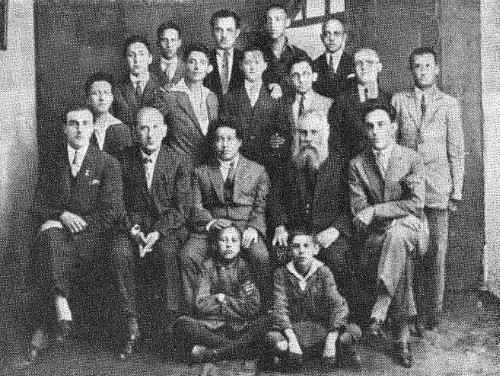
from Western Galicia and Silesia
Seated from right to left: Chaim Naiger, Avraham Hopfstetter, Dr. Joshua Thon, Dr. Shmuel Szpan, Dr. Yitzchak Schwarzbard, and Dr. Grinstein
Standing from right: Dr. Ornstein and Dr. Frand
|
|
[Page 382]
8. The Struggle for National Autonomy and Leadership of the Communities
Autumn 1918 heralded the end of the war. The German military machine was already shattered; the Austro-Hungarian monarchy was shaken to its foundations. The people who lived in the lands of the dead Habsburg Dynasty, prepared to tear away any threads binding them to Vienna. In Galicia, the mood for independence grew. There was no longer any doubt that tremendous changes were about to begin in the political life of the nations of the former Austro-Hungarian Empire.
Although most of the leaders of the Zionist Movement in Galicia were still serving in the army, the strengthened Zionist Movement Council of Galicia convened on August 18, 1918. There were delegates from Lemberg, Kraków, and other Galician cities. Dr. Leon Reich, a member of the Central Committee, discussed the national-political demands in relation to the possibility of a revision of the constitution in Austria and the establishment of independent states in the East, which were densely populated by Jews. The Party Council, under the chairmanship of Dr. Kornheiser of Jasło (Eng. Leichter's father-in-law) and Dr. Hoizmann of Lemberg, after listening to the lectures by Dr. Waldmann, Dr. Emil Schmorak and Dr. A. Korkis, adopted the following important decisions:
“The Zionist Party Council declares that in accordance with the Basel program, it recognizes the national unity of all Jews in the world. In order to resolve the Jewish Problem completely, it strives to achieve the publicly guaranteed right to a national home for the Jewish People in the Land of Israel. However, taking into account that Jews in the countries of the Diaspora form a society with their own political and cultural interests, distinguishing themselves from other peoples, striving to maintain and strengthen Judaism even in the Diaspora, the party council has adopted the following resolution:
The Zionist Movement's leadership in Galicia decided to declare October 14, 1918 as a demonstration of
[Page 384]
Galician Judaism, “in order to bring to expression their resolve that when the fate of nations is decided, the Jewish People should loudly demand their right of national existence in Austria” (according to the text of the declaration). On this day, the executive of the Zionist Party proposed to the assembly to approve Jewish pamphlets detailing the plan for rebuilding the Austrian monarchy, according to the Zionist Party Council's decision on August 18, 1918.
Events moved forward quickly. The armies of the Central Powers (Axis) capitulated. The Austro-Hungarian monarchy's decaying monument crumbled into dust. By October 1918, an independent, united Poland had already formed. According to the decisions by the Zionist Party executive, large demonstrations by the Jewish population were to be held all over Galicia on October 14, 1918. Such a gathering took place in Kraków on that day. Dr. J. Schiffer from Tarnów, who was then in military service in Kraków appeared as a speaker at the above gathering on behalf of Poalei-Zion, which was active in the city throughout all of World War I.
We continue with the report on the Kraków meeting as described in the Nowy Dziennik. We do this because of the participation of Dr. Schiffer, our townsman, at the meeting, as well as because of the adopted resolutions, which served as a basic premise for Zionist activity in Western Galicia during that transitional period:
“On October 14, 1918, masses of Jewish citizens gathered at the Zion Hall. The meeting was opened by the chairman of the local committee in Kraków, Dr. Warhaftig, and Dr. Zimmermann, who described the current situation of Judaism and the demands of the Jewish People, gave speeches. Then the representative of Poalei-Zion, Dr. Y. Schiffer called for the creation of a Jewish National Council. Dr. Max Lezer gave a review of developments in the Land of Israel over the last few years. At the end, Poalei-Zion representatives Mifelev, Friedberg and Dr. Pleshovsky spoke. The following resolutions were adopted:
“This assembly welcomes the establishment of an independent, united Poland and demands the recognition of the Jewish nationality as a lawful public corporation, and especially, a national-personal autonomy, having the possibility of self-determination of our national-cultural entity with a social life, and having the possibility of protecting these rights. This assembly appeals to the entire civilized population, and also to the Polish people, to recognize the Jewish People's inalienable rights to the historic Jewish homeland in the Land of Israel, where the Jewish People want to create for themselves a center
[Page 385]
of national life and national development, as well as to recognize their rights as a national minority there, where Jewish masses live, and also on Polish soil.”
At the end, the resolution stated:
“We demand the democratization of internal Jewish life, and the Jewish People's representation externally. We demand the creation of a Jewish National Council, which should include representatives of Jewish national parties, as well as a Congress of Polish Jewry. At a time when nations are forced to rise from humiliation, all the Jews shall unite around the national flag. We swear not to cease in our efforts until we will become a free and equal people among the nations.”
Similar demonstration meetings were held in all the Galician cities, including Tarnów. Here, however, the assembly did not take place on the announced date, about which is shared with us in the Nowy Dziennik issue of October 22, 1918, in a correspondence from Tarnów:
“Our announcement regarding the demonstration of Jewish national demands to be held on October 14, was not actualized, because of the intrigues and denunciations by some Moscow-affiliated politicians, although the superintendent had issued a permit to carry out the assembly. Without any external preparation, at the mere echo about the assembly, which apparently now had to take place illegally, Jews from all walks of life gathered on the evening of October 15, 1918, at one of the largest synagogues in the city, to express their demands now. Thousands filled the synagogue while hundreds, who could not get in, overflowed into and before the entranceway. At the meeting, David, a Poalei-Zion delegate from Kraków, spoke. Afterward, relevant resolutions were adopted.”
But this period of high spirits and hopes, with which the new era of freedom and rights for all the oppressed peoples was welcomed, was temporary, and quickly cooled off. Throughout the country, a wave of riots and attacks on the peaceful Jewish population began. There were not only robberies, but the very physical existence of the Jewish masses was threatened. The Polish-Ukrainian conflicts in Eastern Galicia, brought on an appalling situation for the Jews there. This led to the establishment of a Jewish National Council for that area. On November 5, 1918, the Jewish National Council for Western Galicia was established in Kraków. It included representatives of three Jewish parties that worked in the Jewish environment; i.e., the Zionists, Poalei-Zion, and the Jewish Socialists Zh.F.S. (JPS). Additionally, each party warned the other parties that they would have free rein in conducting their independent
[Page 386]
politics regarding their institutions, where there was a lack of programmatic unity between the united parties.
The establishment of the Jewish National Council in Kraków was very enthusiastically welcomed by the entire Jewish population in Western Galicia. On November 6, 1918, a powerful demonstration took place in Kraków, which was deeply etched in the memory of everyone who joined it. This author served in the army in Kraków at the time, and participated in the procession of thousands of Jews. Soldiers and civilians, old and young, all marched through the streets of the city. Radiant faces looked out of the windows. This was not only a demonstration of Kraków's Jews, because it was attended by thousands of Jewish soldiers from all over Galicia, who were serving in Kraków at the time, or were in the city after returning from the frontlines.
Nowy Dziennik (dated November 6, 1918) describes this great Jewish demonstration as follows:
“The whole Jewish community of Kraków is out in the street, at least 20,000 Jews. The Jewish population in Kraków has not shown such a united front, such harmony, such dedication, such enthusiasm, for a long time. 24 speakers appeared at five assembly places. Speaking at the Ezra Hall were Dr. Warhaftig, Dr. Feldblum, Leistner, and Benjamin Kohn (Poalei-Zion). At the Jewish theater: Mifelev, Halpern, Shalom Freund (Poalei-Zion), Markovitch, Dr. Krengel, and Friedberg. At the Community [Center]: Dr. Bulva, Dr. Pilzer, Dr. Lezer, Dr. Hilfstein, Dr. Schwartz, and Hochdorf. The following resolutions were adopted at the meetings: “The assembly condemns the policies of the current Kraków [Jewish] Community, which are harmful to the Jewish population, and renounces the right of the current Israelite Community Council in Kraków to represent the will of the Jewish population, and demands that the current council resign and hold elections within 4 weeks based on a five-way electoral system. Until the elections are held, all community agendas must be shown to the delegates of all Jewish parties, in a matter of days.”
On the spot, a delegation of Zionists and Poalei-Zion members was chosen, and followed by several thousand Jews, left for the community's Presidium. As the Nowy Dziennik reports, they did not meet with Dr. Tilles, then chairman of the Kraków community, but conferred with his representative, Dr. Raphael Landau. In the meantime, on the street, at the entrance to the Community [Center], the “Israelite Community” sign was torn down and broken up, and while singing Yiddish songs, the blue and white flag was put in its place.
[Page 387]
The following spoke to the crowd on an improvised platform: Dr. Pilzer, Dr. Krengel, Dr. Schwartz, and Dr. Henrik Lezer. When Dr. Tilles telephoned that he was resigning from his office, a procession was formed, at the head of which were Jewish officers and soldiers carrying the blue and white flag, through Krakowska and Stradom Streets. When the parade approached the corner of St. Gertrude Street, the last rows were the first to march out from in front of the Community Center. At random, the parade left for Yasne Street, to where the leader of the Zionist Movement and chairman of the Jewish National Council, Rabbi Dr. Thon, worked and lived. Dr. Thon spoke to the assembled crowd in Hebrew, Yiddish, and Polish. He called the Jewish People to action, to fight for the Jewish homeland in the Land of Israel, and declared that for full national rights in Poland, Polish Jews are ready to bear all their obligations. The parade left for Dietla Street, and after Dr. Feldblum's speech, they quietly dispersed.
The Jewish National Council was composed of 45 members, including 15 representatives of the three united national Jewish parties. The executive committee had 5 representatives from each party. The Zionists: Dr. Thon, Dr. Feldblum, Dr. Warhaftik, Shmuel Shapiro, and Dr. Schwarzbart. As representatives: Doctor Zimmermann and Leistner. From Poalei-Zion: Dr. Y. Margolies, Dr. Schiffer, Dr. Schwartz, Halpern, and Birenhawk. As representatives: Mifelev and Nussbaum. From the Zh.F.S. (JPS Jewish Socialists): Dr. Schuldenfrei, Dr. Guttmann, Papier, Dr. Feiner, and Dr. Schreiber. As representatives: Neker and Blum. The Presidium of the Jewish National Council included: Doctor Thon (Zionists), Dr. Margolies (Poalei-Zion), Dr. Schreiber (Zh.F.S. (JPS)). As representatives: Dr. Warhaftig and Papier.
We more widely described the euphoric moments of the establishment and development of the Jewish National Council in Kraków, which stimulated the creation of similar nationalist bodies in the larger Galician cities. In Tarnów as well, at the initiative of the local Zionist committee, a Jewish National Council was formed, with representatives from all the Jewish circles in the city. The leadership of the National Council is in the hands of energetic Zionist activists such as: Chaim Naiger, Dr. Shmuel Szpan, Joseph Heimann, Dr. W. Schenkel, Wolf Getzler, Leopold Schinagel, Henech Tisch, and Daniel Laibel (the last two were from Poalei-Zion).
The Jewish National Council in Kraków, as in other cities, was first of all put in charge of the urgent task of protecting the property of the Jewish population, which in the first years of Poland's independence was exposed to heavy raids and anti-Jewish outbreaks. In order to just take on the protection of Jewish property,
[Page 388]
the Presidium of the Jewish National Council in Kraków, in agreement with Polish contemporary authority, the A. G., the Polish Liquidation Commission also published the following summons:
“In agreement with the Polish Liquidation Commission, the Jewish military committee will take over the organization of a voluntary reserve of Jewish officers and soldiers to protect the lives and property of the Jewish population in Kraków and the province. This reserve will be under Polish military command in Kraków. We call on all Jewish officers and soldiers, as well as all those who have the benefit of the Jewish cause at heart, to immediately go to the Jewish volunteer reserve's barracks on Wolnica Street. The recruitment takes place from 8 a.m. to 8 p.m. By permission of the PLK {Polish Liquidation Committee}, entry of reserve officers and soldiers, who are currently in active military service was allowed. For the Jewish Military Committee: Engineer Maurycy Freindlich, Lieutenant; Engineer Tuvia Wechsner, Lieutenant, and Joseph Schebberg, Lieutenant. For the Jewish National Council: Dr. Joshua Thon, Dr. Henrik Schreiber, and Dr. Joseph Margolies. For the Polish Liquidation Committee: Count Lasotsky: head of the administrative department; Vladimir Tetmeier: head of the military department.
For a certain period, the voluntary Jewish reserve, which consisted of about 1,000 Jewish soldiers and officers had maintained order and public peace in Kraków and in the province, very often leading serious battles with city-dwellers and village looters who attacked Jews and their property. Among others who joined the reserve, were two soldiers, Dr. J. Schiffer and Dr. A. Chomet from Tarnów, who also served in Kraków at the time.
Also, in Tarnów, following Kraków's example, a special Jewish detachment of soldiers and officers was formed and led by Jacob Solomon, popular and beloved by the Jewish soldiers of the 57th Infantry Regiment, whose detachment kept at bay a wild mob from the periphery and nearby villages, who were ready at any minute to kill Jews and loot their property. Officer Dr. Emil Adler (now in Israel) distinguished himself in the battle against the gangs in Tarnów.
In order to counter the spread of antisemitism in Tarnów (as in the whole of Poland); which had taken on forms of a bestial hatred of Jews, a Polish language weekly magazine was published from time to time: the Życia Tarnowskie {Tarnów Life, Polish}, edited by A. Chomet and David Eichenholz.
The Jewish National Council in Tarnów was dissolved when the situation in Poland became more or less stabilized and
[Page 389]
a normal governmental power was in place. Tarnów Zionists understood that the community was called upon to organize Jewish life, to defend Jewish interests, which were now governed by the Zionists, as Herzl demanded in the first years of the Zionist Organization's establishment. The Jewish community in Tarnów, as in communities in other cities, was under the thumb of magisterial-communal cliques who led them as if their own business, which did not at all address the interests of the wide Jewish masses. Therefore, Tarnów's Zionists stormed against this moldy Jewish institution.[27]
9. The Zionist Organization in Tarnów After World War I
When the security situation in Poland began to normalize, and the political-economic life settled down, the Zionist Organization's executive for Western Galicia and Silesia stepped in to rebuild the Zionist Movement in cities and towns, which had become disorganized because of the war. This task was undertaken by the Executive's General Secretary in Kraków, Dr. J. Schwarzbard, who carried out an all-around successful propaganda campaign, leading to the development and advancement of the Zionist Organization in a very short time. The Zionist Organization in Tarnów, led by Dr. Shmuel Szpan, returned to normal work immediately after the war. At that time, the local committee included, apart from Chaim Naiger, who had returned from Bochnia, where he served in the army during the war: Ignatz Leon, Dr. E. Merz, Dr. Berkelhammer, Chaim Weiss {typo in source}, Raphael Gzashiv, Shmuel Szpannauf, Rand, Shimon Leiner, Eng. Leichter, Dr. Goldberg, Dr. Schenkel, and Shlomo Rein. The Zionist associations, Miriam and Bar-Kochba, became very active in cultural activities. The first proof of increased Zionist determination and fighting ability of the renewed Zionist Organization was in the election campaign for the Polish Sejm legislature. The local Zionist committee was put in charge of the important task of leading Tarnów Jewry to the ballot box under the Jewish national banner. In Tarnów's electoral district, the candidacy of
[Page 390 ]
Dr. Joshua Thon was submitted. The election campaign helped to consolidate and expand the Zionist circle to an even larger extent. The campaigning for Dr. Thon's candidacy was transformed into a powerful demonstration for Zionist ideals. Thousands of Jewish voters came to the election rallies at the Great Synagogue or in the Community Center courtyard for Dr. Thon's visit to Tarnów. His appearance in the city with his programmatic speech, became a powerful demonstration of Tarnów's Jewry support for Zionist resolutions. Tarnów's Jews dragged Dr. Yehoshua Thon's carriage from the railroad station, through Krakowska, Wałowa, and Nova Streets to the New Synagogue.
On election day, Dr. Thon, the Zionist candidate, received the largest number of votes of all the lists in Tarnów. However, because the electoral district was gerrymandered in such a manner that a number of the entire district's deciding votes were lost, and Tarnów's voters could not vote in their candidate.
The Sejm legislature elections' significant effect on the Zionist Movement was in fashioning a broader and more permanent active base, which after the elections committed itself to actual Zionist work, by concentrating first on Hebrew schooling.
In another section, we will tell the story of the establishment of the Safah Berurah school in Tarnów. It must be emphasized, however, that the Safah Berurah school in Tarnów, opened in 1919, was first of all the result of the initiative taken by then chairman of the local Zionist Committee, Dr. Shmuel Szpan, whose extraordinary energy and unparalleled dedication enabled the purchase of the one-story building, and in later years, the construction of its second floor.
This building on 1 St. Anny Street was not only where the Hebrew school was located, but also where the city's entire Zionist life was concentrated. Zionist and public gatherings used to take place in a special large hall. Every year, the Yiddish theater, directed by Hart, would perform there. Immediately after World War I, the local Zionist committee used to meet there. The Jewish National Fund's office was also located there. Wolf Kahana, the school secretary, used to sit there all day long, in a small room of the Safah Berurah building. His name was linked with the history of the Zionist Movement in Tarnów during the first years after the World War I. All threads of various Zionist activities and institutions were held together in Kahana's hands. Formally, he was only the secretary of the Safah Berurah school, but he carried out all the Zionist work in the city. His room was actually a Zionist reading room. He brought in the most important Jewish periodicals from
[Page 391]
Poland and abroad. Since at the time the Zionist Organization did not have its own premises, younger Zionists gathered daily in Kahana's room to have a conversation about current Zionist problems, to read Zionist newspapers, which Kahana proudly used to provide in a friendly manner, which thanks to his efforts the Yiddish Der Tag[28] and the Yiddish Forwarts[29] newspapers from New York used to arrive at the school. Wolf Kahana distributed Shekels, badges, and boxes for the JNF-KKL. One could often find him in Dr. Szpan's bureau because he did not recognize any other authority. Dr. Szpan also showed unlimited trust in Wolf Kahana and most of all, both understood when it was necessary to take action without much discussion and debate. In the following years, when the Safah Berurah school grew and a great public library was located there, Wolf Kahana was beaming with joy, because his school, his library, which he nurtured despite any opposition, was now on the way to becoming a magnificent development. He always dreamed of emigrating to the Land of Israel. He was especially drawn to his beloved brother, the well-known Mizrahi activist and Hebrew intellectual Avraham Kahana. His cruel death at the hands of the Hitlerite murderers put an end to the calm, quiet and humble life of this Tarnów Zionist activist. Honor his memory!
The leadership of the local Zionist committee came under Dr. Shmuel Szpan's management. He led the Zionist operations during ten years of the most difficult times for Jewry. Secretary of the local committee in the years 1919-1920, was Dr. Chaim Weiss. The committee also included: Chaim Naiger, Dr. Goldberg, Dr. Schenkel, Eng. Leichter, Edward Schwager, Leopold Schinagel, Shmuel Szpannauf, Shimon Leiner, Spindler, Chaim Ehrlich, Dr. E. Merz, Raphael Gzashiv.
After Dr. Szpan became president, he took over from Dr. W. Berkelhammer, who resigned in 1923 from his office, placing himself at the head of the newly formed Zionist Organization, the “Hitachdut.” Chaim Naiger was elected as president of the local committee. At the same time, young Zionists, Yosef Zilbermann, Yitzchak Grinstein, and Y. Leon, were elected to the committee.
With his oratorical talent, Chaim Naiger enthralled Jewish masses at Zionist gatherings, attracting large audiences wherever he appeared. The struggle to win over the Tarnów Jewish community for Zionism began. The Chassidim accused the Zionists of taking their children from their homes and sending them away to the Land of Israel, and joined the campaign against Zionism, along with the assimilationists and Bundists,
[Page 392]
who were influential among Tarnów's Jewish workers. Tarnów's Zionists were successful in this fight thanks to those indefatigable activists. Chaim Naiger and Dr. Szpan, who both really complemented each other and worked with enthusiasm in explaining Zionism's fundamentals to Tarnów's Jews. The Jewish community, with Chaim Naiger as chairman of the council, and Isaiah Zilberpfenig, Dr. Shmuel Szpan on the administration's presidium, became a model organization of Jewish national representatives. The energetic Zionist activists in Tarnów were committed to community work, such as: Chaim Naiger, Dr. Shmuel Szpan, Joseph Heimann, Shimon Leiner, Gabriel Durscht, Henrik Hollander, Leopold Schinagel, Avraham Schpilmann. So too were Tarnów's Mizrahi members: Wolf Getzler, Yechiel Kurtz, along with Dr. Feig, the Hitachdut activist.
The Zionist committee paid a lot of attention to cultural activity. One of its biggest achievements of this committee in Tarnów was the creation of the Jewish Public Library, the Sifriya Amamit.[30] The other Zionist groups had libraries with a small circle of readers. Finally, an understanding was reached between the administrations of all the Zionist libraries, and a general library was created, accessible to the widest Jewish masses. Chaim Naiger was president of the library for many years. The library contained books in Hebrew, Yiddish, Polish, and German languages. In 1939, the library contained some 20,000 books. The library was destroyed during the World War II. Not a trace remained of it. Only after the liberation one could find solitary volumes stamped with: “The Jewish Public Library of Tarnów,” sold by street vendors in Kraków, who dealt in old things.[31]
10. “Jewish Weekly”
Zionist influence in the Tarnów's Jewish community continuously increased. There weren't any Jewish institutions where Zionists did not collaborate with and had decisive influence there. Even outside of Tarnów, the Zionist Movement was visible and wielded influence. Chaim Naiger was not only a delegate to every Zionist Congress, but also a member or representative in the Zionist Action Committee. Dr. Shmuel Szpan was elected several times to membership in the Court of the Zionist Congress. Both of them
[Page 393]
were the pride of Galician Zionism, and were renown in Poland for their devotion to Zionist undertakings.
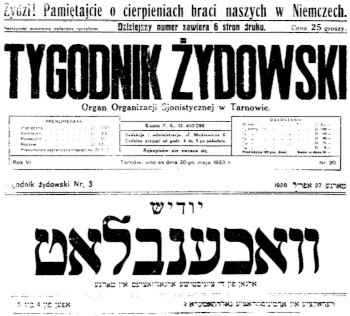
Very soon the need arose to create a permanent connection with the Jewish population in Tarnów, and for this purpose the local committee of the Zionist Organization decided to publish its own periodical. On April 4, 1928, the first issue of Tigodnik Żydowskie was published along with a Yiddish supplement, the Yiddeshe Wochenblat.[32] The editorial board was headed by Dr. Shlomo Goldberg and Dr. Avraham Chomet, then secretary of the Zionist Organization in the city. Chaim Naiger, Dr. Scheinfeld, and Mgr.[33] Henrik Schpilmann were also members of the editorial board.
The Tigodnik Żydowskie set important tasks for itself. In the first issue's editorial titled, “We will Stand Guard for Jewish Honor, we read: “We will stamp out all those who trade with general Jewish interests and end up in bringing disgrace and damage to Jewish society.”
This task was faithfully carried out by the weekly newspaper for 11 years, guarding Jewish interests, exposing the cliques that ran rampant in the Jewish community. The newspaper quickly became the forum for General Zionism, far surpassing its local significance. The fact that during the entire period of its existence it was self-sufficient, and was perhaps one of the few similar periodicals, which did not run at a deficit, testifies to the newspaper's distribution. This is, first of all, thanks to
|
|
from Western Galicia and Silesia Seated from right to left: Chaim Naiger, Avraham Hopfstetter, Dr. Joshua Thon, Dr. Shmuel Szpan, Dr. Yitzchak Schwarzbard, and Dr. Grinstein Standing from right: Dr. Ornstein and Dr. Frand |
[Page 394]
the tireless and devoted work of its efficient administrator Chaim Friedman (killed in the Tarnów Ghetto).
The Tarnów organization always took the lead in all the Zionist activities that the central authorities proclaimed. Whether elections for the Jewish Community [Administration], for the Sejm, or for the city council, the Zionists were always there in place. Toxic people and politicians were also removed from the Jewish scene in Tarnów. If Tarnów was slandered as an outspoken Zionist city, it was to a large extent thanks to the Tigodnik Żydowskie, which was published without interruption from April 4, 1928 until August 1939.
During Chaim Naiger's presidency, the Zionist Organization gained another great success during the 1929 elections for the city council. The Zionists then received 10 mandates: Chaim Naiger, Joseph Heimann, Leopold Schinagel (died in Israel), Wolf Getzler, Dr. W. Schenkel, Dr. M. Menderer, Henrik Hollander, Avraham Schpilmann, Dr. S. Goldberg, and Dr. Shmuel Szpan. Thereby Joseph Heimann and Dr. W. Schenkel were selected as a magistrate-clerks/jurors.[34] The activity of the Zionist councillors in the city council and in the magistrates bureau resulted in the fact that large parts of the Polish population had the opportunity to become acquainted with a new type of Jew. A Jew who was conscious of his duties toward the government as a citizen,
|
[Page 395]
and demanded whatever was due to the Jewish population such as the constitutionally guaranteed right to life and work, and the right to satisfy its religious and national-cultural needs.
11. General Zionism on the Offensive
The establishment and growth of various factions within the Zionist Movement placed new demands upon the Zionist organizations in Tarnów. General Zionism, which identified itself with Herzl's Zionism and supported the entire Zionist Movement, now had to begin ideological crystallization; to go on the offensive, to win over the Zionist youth, who were to realize Zionism through pioneer activity. Zionism, on a world scale, as well as on a national scale, was led by Dr. Yitzchak Schwartzbard, who under the most difficult conditions faced the struggle of integrating General Zionism, creating the World Association of General Zionists, and supporting the Zionist Organization in Eastern and Western Galicia. Dr. Schwartzbard's speeches spoke about the necessity for independent economic and social activity in Land of Israel. He called for the creation of the General Zionist Pioneer, and demanded introducing party discipline in the Zionist ranks. He encountered a particularly favorable ground in Tarnów.
Before the General Assembly of the General Zionists in Tarnów that convened at the end of December 1928, the then secretary of the Zionist Organization in Tarnów, Dr. Avraham Chomet, wrote in the Tigodnik Żydowskie issue of December 21, 1928 (№ 37):
”Let us be honest with ourselves and admit: Our work here in the Diaspora to rebuild Palestine is in no way comparable with the heroic efforts made by our pioneers in the Land. The pennies we throw into the JNF-KKL charity box are nothing compared to the sacrifices and work done by the pioneers. Thanks to them, the world has begun to respect our work and our efforts in Palestine. A change in direction must be made. Being an organized Zionist, belonging to the Zionist vanguard, means standing among the leading ranks of the Jewish People's great liberation movement. A far greater goal; a loftier and more difficult one. Therefore, expect that the obligations and tasks will be greater. We cannot remain just an election committee, which comes to life only during an election campaign. Currently, monumental tasks await the Zionist Organization. The development of the Land of Israel
[Page 396]
Funds requires intensive work, at the very least on the same scale as our colleagues had developed during the last elections to the city council. All Zionists have to put themselves to work, while the leadership of the General Zionists are responsible for the entire Zionist Movement.”
At that time, a group of young men, affiliated with the Zionist Organization in Tarnów, was especially active: Dr. Chomet, Dr. Joseph Zilbermann, Mgr. Henrik Schpilmann, Isaac Wallach, Aaron Rheinhold, Chaim Ehrlich, and others. The General Zionists' youth was concentrated around this group, which gradually bound them to the movement, and had a decisive influence on the entire Zionist Organization in Tarnów. in addition to the delegation of older Zionists to the tenth Zionist assembly of Western Galicia and Silesia, which took place on November 1, 1928, in Kraków, there were also delegates from the younger generation of Zionists. The following people from Tarnów traveled together to the assembly: Chaim Naiger, Dr. S. Szpan, Dr. Scheinfeld, Dr. W. Schenkel, Leopold Schinagel, Zelig Lerner, Dr. Chomet, Henrik Flor, Chaim Ehrlich, and Moshe Rubin. As representatives: Dr. J. Zilbermann, Shimon Leiner (now in Israel) and Dr. B. Speiser.
After the conference, it was decided to reorganize and expand the local committee with the purpose of carrying out a broad propaganda campaign among the Jewish youth and activating the Zionist masses. This occurred immediately after returning from the Kraków conference, whose central theme was increased activity to support Palestine. In mid-November 1928, a regional consultation of JNF-KKL activists was convened with the participation of an envoy from Palestine, poet N. Bistritzky, Dr. Yehuda Zimmermann, President of the Central Committee in Kraków, and delegates from Tarnów, Bobowa, Briegel, Dombrowa, Dembitz, Mielec, Muszyna, Nay Sants, Pilsen, Radłów, and Ropshitz. Chaim Naiger was the conference chairman. When it was established at the conference that the tasks assigned by the Central Committee for the above-mentioned places were not achieved, it was decided to elect a regional committee, to whom the leadership and control over the Fund's work in Tarnów and the surrounding area was entrusted. Nathan Bistritsky's visit contributed a lot toward reviving Zionist activity. Especially so among the Zionist youth, with whom Bistritzky used to spend every evening while he was in Tarnów, who then enthusiastically took on working in the Zionist organizations.
This was during the period after the elections to the Sejm and the Community Administration. This political activity required a lot of work and funds, and the most active Zionists were engaged in the election campaign. In Tigodnik Żydowskie:
[Page 397]
(№ 33, November 23, 1928), An article has been published by Dr. Chomet who called for active work for the benefit of the national funds. The article was titled, “After Greeting Nathan Bistritsky.” We read there among others:
“After all the election campaigns, the work for the Land of Israel Funds must now have first priority. All factions must unite in this work. We certainly have the same enthusiasm for working purely for the Land of Israel, which we showed during the elections to the Sejm and the community administration. Our comrades are probably capable of making the same sacrifices as they made during the election campaigns. Let the work for the Land of Israel be a touchstone, to determine who is a full Zionist and who works, because the soil of the Land of Israel cannot wait.”
In the same month of November 1928, Mrs. Pevzner, who led the educational work among Tarnów's Jewish women, was elected as the JNF-KKL delegate in Tarnów.
It was also a notable revival of organizational work. On December 23, 1928, the General Assembly of the General Zionists was held under the chairmanship of Chaim Naiger. President Naiger spoke at the assembly about the situation of Zionism. Dr. Szpan lectured on the
|
|
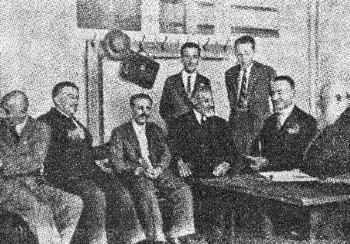
Seated from right to left: Doctor David Naiger, Chaim Naiger, Nathan Bistritzky, Dr. Y Feig and Beck |
[Page 398]
activity in Palestine, and spoke about “Our Additional Tasks.” Joseph Heimann lectured on “The Economic Situation of the Jews in Poland and the Tasks and Duties Required of the Zionist Party;” Dr. Schenkel lectured on “Our political Activity.” And Mgr. H. Schpilmann spoke on “Our Work with the Youth.” Dr. A. Chomet spoke on behalf of a group of younger Zionists. A new local committee was elected at the meeting, which included the following people: J. Bienenstock (now in Israel), Dr. A. Chomet (now in Israel), Chaim Ehrlich, Dr. Fisch, Henrik Flor, Dr. Shlomo Goldberg, Dr. Henrik Greenberg (now in Israel), Joseph Heimann, H. Hollander, Wolf Kahana, Eva Kosher (now in Israel), Moshe Klapholtz (now in Israel), Zelig Lerner, Chaim Naiger, Novotni Moshe, Bronka Perlberg, Dr. Rein (now in a Soviet prison), Wolf Rappaport, Aaron Rheinhold, Dr. Shmuel Szpan (now in Israel), Dr. Wolf Schenkel, Leopold Schinagel, Dr. Joseph Zilbermann, Moshe Schweber, Henrik Schpilmann, and Isaac Wallach.
The following were selected at the first meeting of the newly elected committee: President: Chaim Naiger; Vice-Presidents: Dr. Szpan, Dr. Schenkel; Secretaries: H. Schpilmann (Polish), Moshe Klapholz (Hebrew); Political and Organizational Lecturer: Dr. Schenkel; Palestine Lecturer: Dr. Szpan; Economic Lecturer: Dr. Goldberg; Youth Lecturer - Dr. Chomet; Press Lecturer: Dr. Rein; Administration of the Newspaper: Dr. Zilbermann and Henrik Flor; Women's Lecturer: Mrs. Kosher; Shekel Commission: Isaac Wallach.
In a short period, thanks to the efforts of Dr. Szpan, larger premises became available for Tarnów's Zionist Organization on Mickiewicz Street. From then on, Zionist work in the city developed on a larger scale and influenced many more of the elderly and youth.
The election results for the sixteenth Zionist Congress testify to the significant growth of Zionist influence in Tarnów. The elections took place on June 30, 1929. Some 912 voters voted; i.e., 63 percent of the Shekel owners. Compared to the elections two years before, there was an increase in the number of votes. The General Zionists received 311 votes; Revisionists, who still formally belonged to the Zionist Organization: 148 votes; Mizrahi: 236 votes; Hitachdut: 145 votes; Poalei-Zion Right: 71 votes.
Chaim Naiger, who was elected as a member of the Zionist Action Committee, and thus was also a member of the Jewish Agency, left Tarnów for the Congress in Zürich. Dr. Shmuel Szpan was elected as a member of the Congress's Court.
[Page 399]
12. After the Tragic Events in Palestine in 1929
The raids by the Arab gangs, inspired by the Mufti, on the Jewish settlements in Palestine in August 1929, disturbed Jews in all the countries of the Diaspora. Protest meetings and demonstrations took place in every Jewish community across the world. Tarnów's Jewry was also deeply shaken by the bloody events of August 1929, in Palestine.
The Zionist youth in Tarnów began a protest. On August 31, 1929, thanks to the Zionist Youth League, large gatherings of young people took place, at which speeches were made: Lerner (Revisionists), Fleischer Jacob (Land of Israel Workers), Strom (Zeirei Mizrahi), Henrik Schpilmann (General Zionists). The adopted resolution was also signed by “Achdut,” the Zionist academic association; “Brit Trumpeldor; “Zeirei Mizrahi,” “Freiheit,” “Gordonya,” “Hanoar Ha-Ivri,” “Hashomer Hatzair,” and “Hechalutz.”
After President Chaim Naiger's speech, the community protested against the events in Palestine at this solemn meeting. The Council and the administration, together with the rabbinate, decided to allocate the sum of 500 złoty from the communal treasury for the sufferers in the Land of Israel.
The community also held memorial prayer services in the Great (New) Synagogue. Along with the demonstration that took place on September 1, 1929, it brought together many thousands of Tarnów's Jews. After the prayers, Chaim Naiger, chairman of the Zionist Organization in Tarnów, spoke to the gathered crowd. The convocation ended with the singing of the “Hatikvah,” and the adoption of a protest resolution.
In addition to the 500 złoty that the community donated to the victims of the events in Palestine, a collection campaign was also carried out in the city. In order to coordinate this activity, the Community Administration convened a conference of the most important citizens of the city in order to create a unified rescue committee for Palestine. The committee issued an appeal to the Jewish population, signed by the chairman of the Community Administration, Dr. Henrik Ehrenfreund, and by Chaim Naiger, the chairman of the Community Council. The committee decided to carry out an energetic fundraising campaign and send all the collected money immediately to the National Committee, because the municipality decided to take on the expenses of the fundraising campaign. On September 5, the committee was formed, and on September 20, a report of the first collections was published in Tigodnik Żydowskie, which had brought in the amount of 3,644 złoty, 19 groschen, and 31 effective dollars.
[Page 400]
At the administration meeting held on September 1, 1929, the Society of Pall Bearers and Menachem Aveilim[35] accepted the proposal made by Mr. Maurer to write in the Book of Eternity the names of those who died in the Land of Israel, to inscribe their names on a commemorative tablet, to have candle lit for a year long, say Kaddish after them, and to recite the El malei rachamim prayer in their memory on all the holidays.
On September 4, 1929, the Rabbinate proclaimed a fast.
The Zionist women's organization “WIZO” set up an academy in memory of the fallen victims. Cantor Kaminetsky and the choir of the New Synagogue performed El malei rachamim prayer in their memory. At the launching of the academy, Mrs. Emilia Mondschein, Mrs. Weinberg (now in Israel), spoke in Hebrew, and Dr. Schenkel spoke about these events.
This is how Tarnów Jewry reacted to the tragic events of August 1929, in Palestine.
13. Enhanced Organizational Activity
The specter of the August events in Palestine hovered over the eleventh country-wide conference of the Zionist Organization of Western Galicia and Silesia, which took place on January 5-6, 1930. The conference had a particularly festive character because of the presence of Nahum Sokolów, then president of the World Zionist Organization. His two lectures at the conference focused everyone's attention on his person and on the problems he placed before them. In any case, the problems regarding the current issues of the national organization now took second place. For this reason, the conference decided to convene four regional councils in Tarnów, Bielsko-Biała, Auschwitz, and Nay-Targ at the end of March 1930, in order to complement the above-mentioned issues alone, and to give an opportunity to the representatives of several dozen local Zionist organizations to speak out and decide on concrete practical issues.
On Sunday, March 9, 1930, the district meeting of the Zionist organizations took place in Tarnów, with the participation of 24 delegates from 13 towns: Bobowa, Bochnia, Brzesko, Dembitz, Gdów, Mała Hłusza, Mielec, Radłów, Greater Straja, Radomyśl nad Sanem, Wieliczka, and Zakliczyn. Chaim Naiger, chairman of the Tarnów Zionist Organization, opened the assembly. The following were elected to the presidium: Dr. Atlas (Mielec): chairman. Edward Schwager (Tarnów) and J. Hollander (Bobowa): vice-
[Page 401]
chairmen; Mrs. Weinberg (Tarnów) and Dr. Zilbermann (Tarnów): secretaries. Dr. Szpan welcomed the gathering on behalf of the Jewish community. Y. Heimann for the Merchants' Association; Mrs. Dr. Weiss: WIZO; Dr. Merz: Hitachdut; Wolf Getzler: Mizrahi; Lezer: Tarbut; Beck: JNF-KKL. Dr. Shimon Feldblum (now in Israel), lectured on the current situation in the Zionist Organization; Mgr. Leon Salpeter spoke on the “Ideology and Organization of the Zionist Youth”; Chaim Naiger reported on “Organizational Problems in the Region.” Afterward, the delegates from the different towns gave reports. Among others, Dr. Schenkel (Tarnów), Apfel (Zakliczyn), Hollander (Bobowa), Kaan (Struzshe), Dr. Atlas (Mielec), who also reported that the “Tel Aviv” society founded by Dr. Szpan in Mielec had 140 members, and that during the last city council elections in Mielec, the Zionists received eight mandates. In the discussion, the following came forward: Schweber on behalf of a group of Revisionists, who still belonged to the Zionist Organization at the time, and Horowitz, also a Revisionist. Hake from Dembitz, and finally Eng. Rosenblatt (a Revisionist from Tarnów) spoke on behalf of Hanoar Ha'Ivri. After adopting a number of decisions and resolutions, the assembly appointed directors over the places where it was necessary to strengthen the Zionist activity. This was how it was determined that: Dr. Szpan: for Shetchutchin; Dr. Schenkel: for Tukhov; Chaim Naiger: for Dombrowa; H. Schpilmann: for Pilsen; and Dr. Atlas: for Baranów.
The district assembly proposed a resolution to consolidate the General Zionism, include it in appropriate organizational frameworks, and most of all, give more importance to bonding the youth together. There has long been a large active group of older Zionist youth in the Zionist Organization in Tarnów, on which the local committee turned to for assistance. One of the most loyal activists in the group was Isaac Wallach, whose premature death (April 1930) was a crushing blow to the entire Zionist Movement in Tarnów. At the General Assembly of Tarnów's Zionist Organization, held on April 15, 1930, Chaim Naiger spoke about the great significance the deceased held for the organization, emphasizing his character traits in his private as well as his public life. “Yitzchak Wallach was successful in every activity that he took part in. He awesomely devoted himself entirely to the Zionist Movement. The heart aches at the thought that Isaac Wallach; young in years and spirit, energetic and enthusiastic, intelligent and wise friend is no longer with us.
[Page 402]
His name will be written in bold letters in the history of the Zionist Movement in Tarnów” (Tigodnik Żydowskie April 18, 1930, № 16). The Tarnów Committee of the Jewish National Fund, under the leadership of Dr. Scheinfeld, continued its work with ceaseless energy. In the year 1930, the income for JNF-KKL grew significantly. In the reporting year of 1929/30 the following sums were collected:
First Half Year September 1929 1,231 złoty, 55 groschen [pennies] October " 1,462 " 23 " November " 1,187 " 89 " December " 955 " 19 January 1930 1,347 " 93 " February " 1,170 " 28 " 7,355 " 07 " Second Half Year March 1930 1,690 " 02 groschen [pennies] April " 1,302 " 10 " May " 739 " 64 " June " 531 " 56 " July " 1,981 " 14 " August " 561 " 92 " 6,806 " 38 "
Altogether, in the above reporting year, the amount of 14,161 złoty, 45 groschen was collected, as compared to 12,553 złoty, 40 groschen in the previous reporting year (1928/29).
In October 1930, the British government published the Simpson Report and issued the White Paper, which affected the vital and fundamental rights that the Balfour Declaration festively guaranteed to the Jewish People, and was later confirmed by the League of Nations. Throughout the Jewish world, there was a storm of protests against the White Paper. Zionists in Tarnów held a general protest gathering of all the Zionist groups in the city on November 2, 1930. However, the assembly was banned by the supervisory authority, under the pretext of protecting public peace and order associated with the elections to the Sejm. Therefore, on the November 8, 1930, at the initiative of “Achdut,” the academic Zionist youth organization, a large gathering of Zionist youth took place, with the participation of 800 people from Brit Trumpeldor, Zeirei Mizrahi, Gordonia, Hanoar Ha'Ivri, Hashomer Hadati, Hashomer Hatzair, Hechalutz, Menorah, and WIZO Youth. Among the speakers
[Page 403]
were: Mr. Schpilmann, Aaron Fuss, A. Lichtinger, Y. Kaitch, and M. Schweber. One of the resolutions adopted at the above meeting reads: “The Zionist youth of Tarnów, having assembled here in Tarnów on November 8, 1930, hereby swear that until their last breath, they will defend the right of the Jewish People to Palestine, and even at the cost of their lives, they will not retreat from the realization of their ideals.”
After the tough election campaign for the Sejm and Senate, which ended with the victory of the Zionist idea in Tarnów, and though it internally merged all the General Zionist forces, it now became necessary to unite them into a single framework. The election of representatives to the Zionist Congress, along with specific local conditions, all influenced the local committee to convene the annual General Zionist meeting. A lively discussion began in the columns of the Tigodnik Żydowskie regarding the tasks of this upcoming committee. Mr. Schpilmann, an activist among the young Zionist men, wrote in an article published in the Tigodnik Żydowskie, on December 19, 1930:
“Without a doubt, the cadres actively working for our movement have grown significantly as compared to the previous year. The mood among the youth and among the older generation justifies our asserting that our organization has not only lost none of its strength and determination, but has gained many conscientious and disciplined members among the youth, and many sympathizers among the older generation. Our task is therefore to use these forces, which are drawn to us, for organizational and ideological work. For this purpose, we will have to radically revise and change the current tactics and put through the needed reforms.”
After indicating the most important tasks before the General Assembly, the author comes to the following conclusions: “With these conditions, the question of choosing a new leader becomes an extremely important and serious one, so that our movement and organization can be led decisively and cohesively during this difficult period. We need to establish our party on newer and firmer foundations, which will gain for our organization greater growth and the greatest influence over the city's Jewish population. The great reservoir of strength and boundless motivation with which our organization operates is a guarantee of our expansion. The Zionist Movement therefore demands that the General Assembly create a firm leadership, one that is united and able to complete these difficult but important tasks. The General Assembly will pass this test if it achieves this goal.”
[Page 404]
The General Assembly of the Zionist Organization took place on December 28, 1930. Its proceedings were described as follows in the Tigodnik Żydowskie of January 2, 1931:
“On Sunday, the 28th of last month, the General Assembly of the General Zionists was held with the mass participation of its members. Because of family issues, C. Naiger, the organization's president, did not attend this assembly. As his representative, Dr. Szpan opened the assembly with a few words in memory of the late Lord Melchett, followed by a heartfelt tribute to Yitzchak Wallach, whose passing was a significant loss to the Zionist Organization. After these introductory words, Dr. Szpan gave a lecture titled, ‘The Current Situation of Zionism.’ The speaker described the situation in Palestine, the problems facing the Zionist Congress, and the work being carried out in the Diaspora. C. Henrik Shpilmann, whose lecture was titled, ‘The Paths and Goals of the Zionist Youth,’ was the second speaker. The lecturer mentioned Mila Pfennig, a member of the Hanoar Ha'Ivri organization, who prematurely passed away at age 17.
The speaker then reported on the work of Hanoar Ha'Ivri, Brit Trumpeldor, and Menorah. He discussed the relationship of the regular Zionist youth to Young-WIZO and other youth organizations, and finally touched on the question of evaluating the local committee's activity. Mr. Sigmund Fenichel gave an accurate cash report. During the lectures, a longer discussion ensued regarding local and general Zionist problems. The following took part in the discussion: Dr. Schenkel, Dr. Chomet, Y. Bienenstock, M. Schweber, H. Zeichner, Eng. Rosenblatt, Dr. Zilbermann, H. Schpilmann, Koltow, as well as others. Comrade Szpan answered all the debaters, and then everyone voted in an election. In recognition of his great service to the Movement, Chaim Naiger was elected unanimously and with applause as honorary president of the Zionist Organization in Tarnów.
After a brief discussion, the following persons was unanimously elected to the local committee:
Honorary president: Chaim Naiger, along with members: Y. Binenstock, C. Brown, Dr. A. Chomet, Engelberg, Ehrlich, Fast, Fenichel, H. Flor, Dr. Goldberg, Dr. Greenberg, Y. Heimann, H. Hollander, Mrs. H. Kosher, Miss A. Keller, Kleppel, S. Leiner, M. Lezer, Rheinhold, W. Rappaport, Eng. Rosenblatt, Reich, Dr. Szpan, Dr. Schenkel, Dr. Scheinfeld, M. Schweber, Dr. Zilbermann, H. Schpilmann, Dr. B. Speiser, M. Schpilmann, Miss Schtelzer, Folkmann, Mrs. Weinberg, Weil, and Zeichner.“
[Page 405]
The committee was constituted as follows: Chaim Naiger: President; Dr. Szpan and Dr. Schenkel: Vice-Presidents; Henrik Schpilmann and Dr. Y. Zilbermann: Secretaries, and Z. Fenichel as Treasurer.
14. The Jubilee Celebration in Honor of Doctor Shmuel Szpan
A memorable day for the Zionist movement in Tarnów was the jubilee celebration marking Dr. Shmuel Szpan's fiftieth birthday, which took place at the end of December 1930. A Jubilee Committee was appointed led by Chaim Naiger. The committee published a special issue of the Tigodnik Żydowskie, dedicated to the jubilee, and also decided to inscribe Dr. Szpan in the “Golden Book” of the Jewish National Fund. The jubilee celebration in honor of Dr. Szpan resonated across the Zionist Movement in Western Galicia and Silesia. Many congratulatory letters and telegrams arrived from various places and from prominent local Zionist leaders.
The jubilee celebration took place in Tarnów on December 27, 1930, with the participation of the celebrant's many colleagues, friends, and representatives of various Zionist associations and organizations. A special delegation from the Zionist Executive in Kraków came to the banquet in the persons of Dr. Schwarzbard, President of the Executive, and Secretary A. Hopfstetter. Toasts were made by Chaim Naiger and Edward Schwarzbard. The many welcoming speeches given in his honor at this banquet testified to Dr. Szpan's great popularity. Dr. Schenkel (Zionist Organization of Tarnów), Wolf Getzler (Mizrahi), Dr. Merz (Hitachdut), Mrs. Perlberg (WIZO), Dr. Speiser (Revisionists), Director Lieblich (Safah Berurah School), Dr. Zilberpfenig (Safah Berurah High School), Miss Taubenfeld (Young-WIZO), Schweber (Brit Trumpeldor), Prof. Zwecher (Tarbut), Glass (Zeirei Mizrahi), H. Flor (Samson), I. Binenstock (Hanoar Ha'Ivri), Gabriel Oster-Weil (“Agniska” and Achdut), Greenberg (League for the Working Land of Israel), and Y. Frisch (Yad Haruzim).
Issue № 48 of Tigodnik Żydowskie, dedicated to the celebrant, contained articles by Dr. Schwarzbard, J. Naiger, Isaac Lieblich, H. Schpilmann, and Dr. A. Chomet. In the article, “Dr. Szpan – Semper Fidelis” (“Always Faithful”), Dr. Y. Schwarzbard wrote among others: “At the leading edge of our great encampment for a better dignified future for the nation, on the front where you have been working over the past decades, engaged by the holy Zionist enterprise, you were and are a shining example. You were and are both a servant and a guardian of the movement, and at the same
[Page 406]
time, its conscience and its leader. Pure as a rain-drop, devoted to the last, without a trace of selfishness or egoism.”
J. Naiger characterized the celebrant in the following manner: “A clear and open mind, flexible, unbiased. That is his name. That is his character. Szpan for Tarnów is not a word, not a name, but a concept, a class, an orientation. Our beloved Jubilee celebrant belongs among the leading personalities who, thanks to their character traits, cast their influence on the environs in which they live and influence, and inspire the thinking of entire groups of people.
H. Schpilmann, representative of the Zionist youth of Tarnów, described Dr. Szpan's relationship to the youth in his article “Our Jubilee Celebrant: The Zionist youth wholeheartedly bound themselves to their leader. They loved him for his unparalleled and fiery love for the Jewish People, for his tireless service to Zionist ideals, for the purity of his spirit, and the purity of his character. Shmuel Szpan is a model for us, an example, of what kind of dedication one must have to realize our ideals.”
And the celebrant himself, is true to himself, to his principles and life's ideals, had one answer to the expressed recognition and honor of this jubilee: “The honor and recognition placed upon me, are not a result of my personal virtues, they belong to an ideal. Whatever I do, I will do so faithfully, as long as my strength will last me.”
Translator's Footnotes
|
|
JewishGen, Inc. makes no representations regarding the accuracy of
the translation. The reader may wish to refer to the original material
for verification.
JewishGen is not responsible for inaccuracies or omissions in the original work and cannot rewrite or edit the text to correct inaccuracies and/or omissions.
Our mission is to produce a translation of the original work and we cannot verify the accuracy of statements or alter facts cited.
 Tarnow,Poland
 Yizkor Book Project
 JewishGen Home Page
Copyright © 1999-2026 by JewishGen, Inc.
Updated 26 Oct 2026 by JH