General Zionism
1. The Eve of the Zionist Spring
What did Jewish life look like in Galicia during the second half of the nineteenth century? Galician Jews lived in economic hardship, characteristic of the harsh conditions of life in Galicia. Mass emigration of Jews was mostly from Galicia, along with Czarist Russia and Romania. What pushed the emigration of so many Jews was, first of all, the abnormal economic conditions in which they had to live. People even tried to seek salvation through assimilation, which was supposed to ease the distress of the impoverished Jewish masses. There then began the masquerade of “Poles of Mosaic belief,” often accompanied by changing family names, which ultimately led to conversion–if not in the first generation, then surely by the second. These attempts to solve the Jewish Problem through complete emancipation did not provide the needed results, even in Western countries. Moshe Hess's book, Rome and Jerusalem, published in 1862, pointed out the senselessness in all the current efforts of assimilation and emancipation. Hess, a democrat and a socialist, approached the Jewish Problem from a nationalist point of view. He considered Jewry as an entire national entity, for the constitution of which political concessions were necessary, and these were decisive for the existence of any people. Perhaps Hess's work would have been forgotten and of no consequence, since even before him there was no lack of people who were looking for ways and means to eliminate the Jewish anomaly, again, through assimilation. But in the years 1860-1880, the first voices were heard calling for the reconstruction of the Land of Israel. Rabbis Eliyahu Guttmacher, Hirsch Kalischer from Toruń, Poland, Yehuda Alkalai and Dr. Chaim Lurie of Frankfurt an der Oder,[1] were the first
[Page 352]
to publicize this idea. The chief motive for coming out publicly was their desire to save the Jewish religion. They believed that the Jewish religion would only survive in the Land of Israel. In 1860, Kalischer convened a conference of Jewish personalities and rabbis in Toruń to discuss the possibilities of establishing settlements in the Land of Israel. This conference resulted in the founding of the first colonization association in Frankfurt (Main) in 1862.
In the meantime, other plans for rebuilding the Land of Israel were also advanced: by Lord Shaftesbury and Sir Laurence Oliphant, high-level English officials and diplomats. In 1870, when modern Hebrew literature began developing, David Gordon published a series of articles in which he called on Jews to found settlements in the Land of Israel, as the only condition for their national rebirth. In 1879, Eliezer Ben-Yehuda wrote in the same spirit, in Hashachar, “The Dawn,” published by Peretz Smolenskin. The idea of the return of Jews to the Land of Israel was finding more and more followers. At the “Berlin Congress,” which took place in 1878, a group of Jews presented a memorandum in which they called for the renewal of a Jewish state in the Land of Israel. Bismarck, Chairman of the Congress, rejected the memorial, giving the reason that it came from madmen…
In Eastern Europe, where bloody anti-Jewish pogroms used to take place on Russian soil, it was the Russified Jewish youth who found their way back to Judaism not through slogans, but through concrete actions. Jewish students, under the influence of these pogroms, immigrated to the Land of Israel as the first colonists. They were known later under the name Bilu'yim from the initials of the verse, Beit Ya'akov Lechu Venelcha: Bilu (translated as O' House of Jacob, come and let us walk… Isaiah 2:5). It was they who magically created the first colony of Rishon Lezion from the sands and barren soil of the Land of Israel. The day of the founding of this colony (15 Av, 5652 – 1882), marked the end of an era of fantasy. The seed, thrown into fertile ground, rises. The ranks of Chovevei-Zion[2] increased. In several cities in Russia, groups of supporters of the Zionist ideal, Chovevei-Zion, was formed. In 1882, Leon Pinsker's Auto-emancipation appeared. The main idea of this work is the assumption that the cause of all the anomalies of Jewish life is its extraterritoriality, and that the solution of the Jewish question can only be found through colonizing the Land of Israel. Just as in the years 1882-1884 there were Zionist groups already existing in Russia, Romania and Galicia, so too in 1883, a national Jewish student organization “Kadima” had even been established in Vienna. Leo Pinsker convened a conference in Katowice from November 6 to 12, 1884, in order to coordinate the colonization work in the Land of Israel, which at the time was being
[Page 353]
conducted by various groups in several countries. At the conference, Pinsker presented Chovevei-Zion movement's program and proposed the creation of a unified organization for supporting Jewish colonization in the Land of Israel.
After the coalition of societies for the colonization of the Land of Israel, with its seat in Odessa, was confirmed in 1890, the Zionist Movement passed from the abstract philanthropic stage to that of concrete reality, with a national scope. This is the eve of the Zionist Spring, which was later elevated by national leader Theodor Herzl to the significance of a national revolution.
2. “Plain Zionism”
The Jews of Tarnów played an important role in the development of Zionism. They helped shape the movement's early ideas; participated in the first efforts of Jewish colonization, and contributed to the pioneering work and sacrifices that helped bring the Zionist vision to life.
In Tarnów, just like in other cities of Galicia, the German-Polish assimilation during the second half of the last century was revealed to be a material and alienated expression of Jewish values. Here, in the polluted atmosphere, some young people, just out of the schools, yeshivas and cheders, have grouped themselves around the blue and white Zionist flag, and begun their rebellion against the moral gangrene that has spread over the Jewish body. Tarnów's Jewish students who belonged to the first Jewish national student organization, “Kadima,” which was founded in Vienna in 1883 under the leadership of Hebrew writer Peretz Smolenskin: Avraham Saltz, S. Bromberg, Ausubel, Aupfner, and Flugeisen. In the summer of 1884, three Jewish youths in Tarnów allowed themselves to be captivated and convinced by Technician Ausubel, a “Kadima” member from Tarnów, with descriptions regarding the historical goals of the new Zionist Movement. They left the assimilationist and enthusiastically moved to the Zionist belief. These were the Tarnów graduates: Avraham Saltz, Sigmund Bromberg (later Bitkowski), and student Edward Schwager. All three immediately joined in campaigning for Zionism. However, only Edward Schwager in Tarnów faced great difficulties in his efforts to instill Zionist ideals in the city. In a letter dated December 2, 1884,[3] E. Schwager wrote to his Tarnów friend Avraham Saltz, who was then in Vienna:
[Page 354]
“As for our reading room, from the first of January there will be about eight Jewish newspapers in it, besides the Hebrew yearbook Hama'asef, which was brought by a member. There are about 80 members, but financially, the situation is not great. Regarding your idea of starting a correspondence with Kadima, I can tell you this much; in principle I am also a supporter, but for the time being it won't be realized, because the librarian is Taubenfeld, a passionate supporter of assimilation. Moreover, because of local conditions, I cannot think of a way to suddenly come out against assimilation and not wanting to simply erase the reading room's stated goal. On this, I have very different plans, which I will lay them out for you in good time.”
And actually, in June 1885, Schwager wrote to Saltz that his Zionist appeal was already hanging in a prominent place in the reading room. It was published in Vienna in honor of the founding of the national Jewish youth society, Zukunft.[4]
Regular correspondence and ongoing contact concerning further Zionist activity were established between Vienna and Tarnów. Initially, it was led by the only one left in Tarnów, Edward Schwager, and consisted of conducting one-on-one campaigning and propaganda. When Saltz and Bromberg came back to Tarnów for the holidays, they took an active part in this educational work. They unleashed the first storm on those involved in Tarnów's organizations: The “Association of Old Believer (Jewish) Trade Youth,” under the chairmanship of Dr. Ringelheim, and the “Self-Education Club” of Jewish high school students. Their educational work in the associations had the effect that both of them donated their book collections and brochures to Kadimah in Vienna.
Avraham Saltz worked in Vienna together with Nathan Birnbaum in setting up the first national Jewish weekly, Zelbstemancipation[5] in Austria, where they wrote articles and correspondence on issues of particular interest to Galician Jews. He used to send these magazines, appeals, and propaganda brochures to Tarnów and other cities in Galicia. Edward Schwager wanted to spread Zionist ideology among Kraków academics and Tarnów youth with this propaganda material.
When Avraham Saltz returned to Tarnów in 1887, he found fertile ground already prepared for the growth of Zionist activity. The “Association of Jewish Trade Youth,” which at the time had suffered from assimilation, changed its ideological position, and called itself “The Trade Youth Reading Room.” Under its
[Page 355]
auspices, it enabled Saltz to organize the first Maccabi event in Galicia. This celebration, attended by a great crowd, took place in Tarnów on December 18, 1887, in the ballroom of the then Lemberger Hotel on 2 Lwowska Street.
In Pogoń, a Polish weekly which was published in Tarnów, the following was reported about the celebration:
“The introductory speech was given by Dr. Ringelheim, who peppered his speech with compliments on the location of the Polish Society, and then pointed out in detail the civilizing work of the Jewish tribe not only in ancient times (monotheism, the Bible, prophets), but also during the Middle Ages and at present. Afterward, a student, Juri Avraham Saltz enthusiastically and ardently presented to the gathering the historical banner and significance of the Maccabean struggle with the current situation of the Jewish People. The gathering was impressed by the performance of Miss R. (Beethoven's sonata on piano) and by the Über Brothers (duet). The beautiful celebration ended with entertainment and dancing until morning.”
This Maccabi event was a turning point in the development of the Zionist idea not only in Tarnów but also in all of Galicia. So many new followers arrived in Tarnów from the young intelligentsia and Orthodox circles that Avraham Saltz founded a society, called Hatechiyah,[6] which had its own place, where meetings and discussions would take place in the evenings. Following Tarnów's example, Lemberg's Jewish students, Avraham Korkis, Adolf Stand, M. Mansch and others, founded the “Zion” society there. They contacted A. Saltz who helped them organize Maccabi events. At the same time, Gershon Zipper founded the Admat Yisrael {Soil of Israel, Hebrew} society in Stary, cooperating with Saltz for the further development of plans for the Zionist Movement in Galicia. Saltz traveled around Galician cities and gave speeches at Maccabi events. At that time, they were a symbol of a renaissance but also served as a propaganda tool for Zionism. There were youth organizations and Zionist associations in several Galician cities, which already had a Zionist character in their very name: Admat Zion,[7] Admat Yisrael,[8] and Admat Yeshurun.[9] Their goal was the rebirth of the Jewish People and the Hebrew language, and rebuilding the fatherland by settling Jews in the Land of Israel. Saltz drew up relevant rules for the societies, while the Hatechiyah association in Tarnów was renamed “Zion” in order to bring it in line with the other societies in Galicia, and combine them all into a single association of Zionist groups.
[Page 356]
Around this time, the Zionist Movement in Galicia began to expand and deepen, and more and more people spoke about the need to centralize this movement and give it permanent organizational forms. Tarnów became this center, which brought together the individual groups in Galician cities. Even the Zionist Organization in Vienna (Admat Yeshurun), and the organization in Berlin (Young Israel), founded there by Dr. Joshua Thon, turned to Tarnów for instructions.
In 1891, Zionist conferences took place in Lemberg and Tarnów, with the participation of Adolf Stand and Avraham Korkis, in order to work out appropriate organizational forms for the emerging Zionist Party in Galicia. At the same time, Dr. Nathan Birnbaum conferred with Dr. Saltz about creating an all-Austrian national Jewish party.
Preparations began for the conference of all the Zionist associations in Galicia. However, the preparations did not move forward. Only two of the thirteen Zionist associations in Galicia replied to the questionnaire sent out by Avraham Saltz regarding participation in the conference: the Viennese “Kadima” and Tarnów's association. Lemberg's “Zion” organization did not have the funds to send a delegate. We read the following in a letter by Korkis to Saltz on September 11, 1891:[10]
“Convening the conference in December or even January is illusory. There is no other choice but to wait a whole year while carrying out vigorous preparations.” Meanwhile, Zionist periodicals and promotional brochures are being published. On July 8, 1892, the publication, Zukunft [The Future]. was published under the editorship of Adolf Stand, while Dr. Saltz wrote a brochure, “What Kind of Relationship Should Jews have with Poles?” Eight hundred copies of the brochure were printed and distributed in Galicia. The first funds to cover the expenses for the above publications were brought in by the “Zion” associations in Tarnów and Lemberg. Thanks to the educational work, it was already possible in 1893 to organize a Galician Zionist Party. In a letter dated January 6, 1893, A. Korkis wrote to Saltz: “I am now undertaking the preparation for the assembly, and I therefore ask the distinguished doctor to be so kind and give me advice and instructions, how and when should this assembly take place? To whom should invitations be sent to, especially in Kraków? Who from Kraków could take part in the assembly;
[Page 357]
i.e., so as to create a larger movement there and establish our association there?”
The preparatory work for the assembly was pushed forward. On April 23, 24, and 25, 1893, the “first conference of delegates of Jewish nationalists in Galicia” took place in Lemberg, as the invitation said. The conference chairman was Dr. Avraham Saltz, who also gave the main lecture on organizing the movement. He was elected as president the new party's central executive committee, whose program, which was adopted at the conference, was: The renaissance of the Jewish People, struggling against assimilation, spreading the knowledge of history, Hebrew literature and language and creating a Jewish society in the Land of Israel. Taking part from Tarnów were Dr. Saltz, Bromberg, and Edward Schwager.
Dr. Saltz convened the second assembly of the Galician National Jewish Party in Lemberg on September 2, 1894. He lectured there on the topic, “Gaining Influence Over the Communities.” After Mordechai Ehrenpreis, Dr. Joshua Thon, then a philosophy student, lectured, “On Jewish Education in Galicia,” Dr. Nathan Birnbaum, “On the Situation of the Zionist Movement.” L. M. Landau lectured about “Establishing a Galician Colony in the Land of Israel.”
At the above assembly, it was also decided to conduct an independent Jewish policy during the elections to the Austrian Parliament, and to work toward self-government in Galicia. As for the colonization of the Land of Israel, it was decided to establish a Galician coalition of colonization societies with its seat in Tarnów. The purpose of the association was to establish Galician colonies in the Land of Israel. Working out the colonization plan and determining its statutes was entrusted to Dr. Saltz.
After the publication of Dr. Herzl's Judenstadt (1895)[11], the Viennese “Kadima” appealed to the Tarnów Zionists, requesting them to gather signatures in a petition to Herzl demanded him to place himself at the head of the entire Zionist Movement. Within a short period, hundreds of signatures were gathered for this petition. In Tarnów, the first two who signed the petition were Dr. Joseph Aupfner, Advocate, and Dr. Adolf Ringelheim, then second Vice-Marshal of Tarnów County.
In 1896, the Austrian supervisory authority in Lemberg confirmed the status of the colonization society named Ahavat Zion {Love of Zion, Hebrew}, with its headquarters in Tarnów. The Executive Committee was composed of members from the Central Committee, whose permanent residence was in Tarnów. For its principal goal,
[Page 358]
“Ahavat Zion” set it as the “Establishment of new plantations in the Land of Israel, and colonize them, as much as possible with Jews from Galicia.” The major efforts went toward winning those circles, which were distant from Zionism. The society's Hebrew secretary, Zachariah Mendel Shapiro of Tarnów (who a few years later emigrated to Land of Israel; to the colony of Mahanayim. He died in 1933 as an admirable teacher in Tel Aviv), attracted twenty rabbis from various cities. They sent him “Appeals,” calling on every Jew to support the movement for the settlement of Jews in the Land of Israel. Shapiro published these appeals and treatises in two brochures named Shivat Zion[12] and Chibat Zion.[13]
Many Jews from Orthodox circles attended the appeals made by the Ahavat Zion association in Tarnów. All the Zionist groups and associations in Galicia and Bukovina joined the movement. Many of Tarnów's prominent residents took part in this stirring up outside the city, especially Pinchas Basler, the religion teacher in the public schools. Thanks to the personal efforts by Dr. Saltz and Tarnów homeowners L. Spitz and David Fast, they succeeded in winning over Rabbi Friedman, the Chortkover Tzadik. He joined the Ahavat Zion association, and allowed the press to write about it. On January 10, 1897, Dr. Theodor Herzl and other leading members of the Vienna Colonization Association in Austria, such as Dr. Kokesch, joined Ahavat Zion.
The constituting General Assembly of Ahavat Zion in Tarnów took place on the 19th and 20th of May, 1897. The oldest Galician rabbi, 80-year-old Rev. Feivish Schreier from Bohorodchany, came to the meeting. In honor of his coming to Tarnów, the windows of the Jewish houses on the Grabowka, where Ahavat Zion was located, were lit up. Besides him, 48 delegates from various cities in Galicia then came to Tarnów: a special delegate of Dr. Herzl from the Vienna association, the writer H. York-Steiner, and many members from Tarnów and the surrounding area.
Rabbi F. Schreier was elected honorary president of the assembly, and Dr. A. Saltz as chairman. From the submitted report, it seems that within four months, 2,082 Guilders, 22 Kroner, were collected, and 470 Guilders were spent. By this time, 600 new members had arrived from Galicia, Bukovina and abroad. The most important item on the meeting's agenda was the question of purchasing a bath complex in the Land of Israel to establish a colony there for Galician Jews. The General Assembly authorized the Central
[Page 359]
Committee to purchase the baths in the Land of Israel. At the same time, an appeal was issued to the Jewish population in Tarnów, signed by Dr. A. Saltz, Bromberg, Edward Schwager, M. D. Brandstetter, Adv. Dr. Joseph Rost, (father of Dr. B. Rost in Kraków, the son-in-law of Joshua Thon). The following persons from Tarnów were elected to the temporary administration: Dr. Anselm Oder, Emile Broch, Leib Spitz, David Fast, Meir Hollander, Ichel Lezer (died in Israel in 1952), Chaim Hersch Lichtblau, Chaim Maschler, and W. Tennenbaum.
The first General Assembly of Ahavat Zion, elected a board comprising the following people: B. A. Weiss, chief rabbi of Chernowich, as president; Dr. Avraham Saltz, then a lawyer in Tarnów, as acting president. In the Central Committee: Leib Spitz, David Fast, Dr. J. Rost, Edward Schwager, Meir Hollander, Pinchas Basler, Sigmund Bromberg (Secretary), Z. M. Shapiro (Hebrew Secretary); all of them from Tarnów. J. Hochfeld (Lemberg), A. Apfelbaum (Reiche), Aharon Markus (Podguzhe), N. Neifeld (Jaworzno), E. H. Zhupnik (editor from Drohobych), Ch. Engelberg (Tarnobsheg), S. S. Fuchs (editor of Hamagid), Mendel Frenkel (Kraków), S. Meltzer, E. Sternhell, A. Weidman (Rohatyn), M. Aschheim (Mielec), M. Schreiber (Seret), m. Pomerantz (Boryslav), L. Taubem (Kolomea). As representatives: Emil Broch, Ch. H. Lichtblau, M. Binnenstock (all from Tarnów), Dr. Gabel (Lemberg), L. Koretz (Ropshitz, Ropczyce), A. Rosemary (Łańcut), and M. Ashkenazi (Zbarazh).
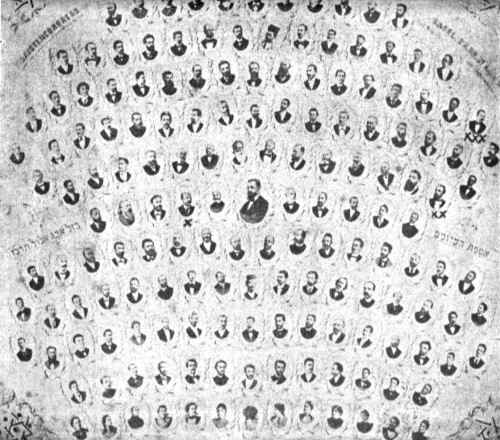
At Dr. Herzl's request, the administration of Ahavat Zion in Tarnów collected ten thousand signatures of Galician Jews in a petition to the First Zionist Congress in Basel, where the signatories expressed their willingness to settle in the Land of Israel at the call of Dr. Theodor Herzl, which he mentioned in passing, in his ceremonial opening speech at the first Zionist Congress in 1897. Ahavat Zion sent three delegates from Tarnów to the first Congress in Basel: Dr. Saltz, Dr. Sigmund Bromberg, and Edward Schwager. Dr. Saltz was elected as the second vice-chairman of the Congress.
In the year 1897, Ahavat Zion in Tarnów began carrying out preparatory work toward establishing the first Galician colony in the Land of Israel. In order to purchase a suitable bath complex in the Land of Israel, Dr. Saltz got in touch with Baron Edmund Rothschild in Paris and especially with the “Central Committee of Chovevei-Zion in Paris, whose president was Narcisse Leven. Afterward with the chief administrator of all the Rothschild colonies in Israel, Elie Scheid (from Zichron Ya'akov); then with the chief rabbi in France, Zadoc Kahn; with the president of JCA in Paris; with Ezra's Central Committee of its colonization society in Berlin; with Chovevei-Zion in London, and
[Page 360]
|
|
Delegates from Tarnów: x – Dr. Avraham Saltz, xx – Dr. Sigmund Bromberg, xxx – Edward Schwager |
[Page 361]
with the Odessa Executive Committee of the Russian Colonization Society in Odessa.
Immediately after the Congress, Dr. Saltz left for Paris, summoned by Baron Edmund Rothschild. On September 9, 1897, an agreement was signed in the “Senhaner” Palace on Rue Fabourg 41, according to which Ahavat Zion purchases, as its property, from Baron Rothschild an area of 10,000 dunams {2500 acres} in the Galilee, between the colonies of Rosh Pina and Mishmar Hayarden, for a sum of 100,000 French Francs, payable in five installments of 20,000 Francs. Baron Rothschild undertakes to give the association ownership of the entire bath after payment of the first installment.
The new colony received the name Mahanayim. Sigmund Bromberg was appointed its administrator. On June 12, 1898, he left for the Land of Israel to prepare the baths and erect buildings for the colonists. In honor of his departure, the then “Agniska” Club in Tarnów organized a festive banquet. Bromberg's friend and colleague, Dr. Leon Schitzer, stepped up to give a farewell speech.
In the fall of 1898, eleven colonists left Tarnów for Mahanayim, at the beginning of 1899, another five. At the end of 1898, Ahavat Zion had 597 members, 208 of whom were from Tarnów. Because of its colonization activity, there were often a number of misunderstandings between Ahavat Zion and Dr. Herzl, who took the point of view that no colonies should be established in the Land of Israel at the moment, even opposing any kind of colonization work, until they succeeded in obtaining the necessary political guarantees from the Turkish government, which indeed he did get involved with. In order to deal more precisely with the issues and find ways to mitigate the conflict, Dr. Saltz convened a public meeting in Tarnów (at the end of September 1897), where a resolution was adopted, which expressed trust and support for Herzl's Zionist activity, but at the same time declared the impossibility of backing off from the work begun in establishing a new colony in the Land of Israel. The assembly's presidium, Dr. A. Saltz, S. Bromberg, and Edward Schwager, forwarded the resolution to Dr. Herzl with an attached request to support Tarnów's Ahavat Zion aspirations, or at least to tolerate them. Thanks to the interventions and efforts of Dr. Leon Kellner, a concession was obtained from Dr. Herzl. He approved the Mahanayim project, but only as a trial station. Herzl writes about this incident in his memoirs, dated April 11, 1898:
“The Tarnówers are agitating against political Zionism, because they think that it will be resolved by Edmund Rothschild and their Ahavat Zion; through their small bath-sales association. Dr. Saltz, as vice-president of Congress, went
[Page 362]
to Paris and did something there that was against the acknowledged Basel principles.”
However, disagreements broke out between Administrator Bromberg and the colonists in the “Mahanayim” settlement. Funds for the colony just barely trickled, and the colony's financial foundation was shaken. After a few years, in October 1902, Mahanayim was handed over to the “ICA” {JCA} association, which managed all the Rothschild colonies. Despite this, Mahanayim was a breakthrough in Zionist work at the time. While, truthfully, this was only an experiment, but it was a necessary one for further colonization activity in the Land of Israel.
The first Zionist Congress in 1897 proclaimed the creation of a Zionist world organization. From then on, Ahavat Zion's executive committee in Tarnów also fulfilled the tasks of a local committee of the World Zionist Organization. When Herzl's political concept held back victory over amateur Zionism of the time, Ahavat Zion in Tarnów lost its right to exist. All Zionist work was taken over by the local committee of the Zionist World Organization, which from now on was elected annually at meetings of Shekel[14] owners. Gatherings were arranged in reading rooms; Shekels and bought shares in the bank for colonization work, and money was collected for JNF-KKL. The number of Shekel payers in Tarnów generally exceeded the usual number of members, entitling them to elect a special delegate. At that time there weren't any factions and separate Zionist parties.
The era of the Eve of the Zionist Spring, which spread so widely in Tarnów, did not go without an impact on that generation of Tarnów's Jews. The Mahanayim colony in the Land of Israel, established by Ahavat Zion was an enterprise by Galician Jews, which testified to their initiative and contribution in rebuilding the Land of Israel. Therefore, we honorably mention the first builders of the colony, which testifies to the significant participation of Tarnów's Jews in the development of the Zionist Movement. Avraham Kahana (now in Israel, one of the Mizrahi leaders in Western Galicia) wrote about this in the Jubilee Book of the Tarnów Zionist Organization, which was published in 1934:
“When we left behind the study hall benches, our interests concentrated in another, much broader field, Tarnów already had a great Zionist tradition behind it. Because Tarnów was the work center for Mahanayim, the first Galician colony, to which much effort was devoted. This
[Page 363]
attempt was unfortunately not carried out, despite the offer of several idealists. Among them, the educated and Zionist fanatic Mordechai Laibel and his family, A. Neimark, and several Jews from Tarnobsheg {AKA Dzików}. But this experiment was a breakthrough in Zionist activity at the time. Without such experiments, without such beginnings, further colonization activity and its current results would not be conceivable.” The local committee of the Zionist Organization, then led by Dr. Avraham Saltz, did not stop with just propaganda activity. The work was hard. On one hand, Zionism was fought against by the Orthodox masses. On the other hand, it was fought against by JPS (Jewish Socialist Party), which had organized many of Tarnów's Jewish workers from among the tailors and hat makers. The major struggle of the Zionists, however, was against assimilation, which was deeply rooted among the Jewish intelligentsia. Orthodoxy was indeed uncompromising in its struggle, but in the study halls the Zionist idea had already begun to flourish, and many Zionist pioneering groups emerged from them.
It was more difficult to win over the professional intelligentsia and the student youth, who were mostly socializing in Tarnów's “Adam [Bernard] Mickiewicz Literary Society.” In the years 1900/1, thanks to the intense educational work by Max Bienenstock (a seventh-grade high school student, an exceptionally capable and intelligent young man, later on becoming a Zionist leader, who in 1903 in Vienna was the main lecture source in student Zionist circles), Zionist thought finally touched the student youth in Tarnów. A “Judaism Club” was secretly formed in the Tarnów High School to which the students from the higher grades in the middle schools belonged: Yitzchak Schiffer, P. Basler, J. Rabinovich, S. Mennasse, S. Scheinfeld, M. Bloch, Shlomo Goldberg and others.
The main goal of the Judaism Club was to spread knowledge of Jewish history and literature among Jewish student youth, and to acquaint them with the Zionist Movement. Almost all the Jewish students of that time, who were involved in socio-cultural work among the Jewish population (and there were very few others), belonged to the Judaism Club, except for Karol Sobelson (Radek), who belonged to the “Promień” Club[15] and preached socialist slogans. Nevertheless, the relations between the two secret clubs were extremely good and cordial.
It was in this atmosphere of exaltation and idealism,
[Page 364]
which the later Zionist leaders, who took over leading positions in the early Zionist movement in the country and abroad, were raised.
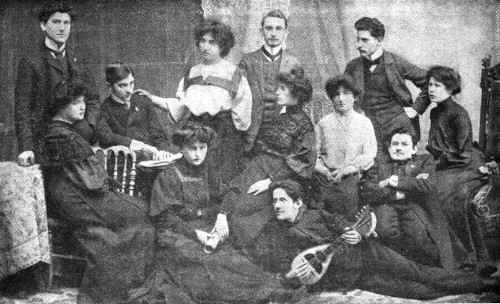
This atmosphere of “Storm and Stress” of the Zionist youth in Tarnów is beautifully described by Dr. Yitzchak Schiffer in a dedication in honor of his friend and classmate, Dr. Max Bienenstock, who died in 1923. In a special collection dedicated to the memory of the deceased, which was published in Lemberg in 1924, Dr. Schiffer wrote his reminiscences named “Max.” We present here a larger part of the article, referring to the student club whose members were from higher classes of Tarnów's middle schools, founded in 1901 by Dr. Max Bienenstock:
“I forget hundreds of details; sounded serious and sometimes sad, but a silver thread of joy streaks through them. I see him, the ‘Maxio’ with his circle of youthful friends, carrying his ‘Moshe Rabbeinu Staff’ (that's what we used to call that stick, which he always took with him, our affectionate ‘Rod’). I see him as he appeared to us, the young high school students from Tarnów's High School, sermonizing us because we were all into boyish frivolities and not serious-minded… We would burst out laughing, and not understanding what he wanted from us…
“I see him in a small cheap hotel-room that we rented; preaching all night long about Herzl's Zionism, to youth organizations and to invited groups of students… Although it should have been serious, but it couldn't be, because ‘Maxio’ poured wise-cracks and jokes into the middle of it all…
“You want to be serious, but you can't, because who needed serious faces, since we were all convinced, we were all fully believing! And we believed in each other: Max in us and we in him.
“We created playful, cheerful cliques and got together and rejoiced, we now realize, more with ourselves, with our youthful freshness and excited energy, than within the organizations where we heard lectures and so forth. It turns out that way, because at the very least, we felt like we were at home, in our ‘Salon.’
“This was usually at a friend's house: We all used to gather there, many young men and women (mostly those who escaped being ‘grounded’ by fanatical parents). We used to talk and discuss various topics, about Zionism, literature (mostly about Polish and German, because at that time we knew nothing about Yiddish literature), and other nice things. The main thing, however, was that the ‘Salon’ was an alliance of the ‘White Society[16],’ which was steeped
[Page 365]
|
|
In the top first row, from left to right: Shlomo Goldberg, Yitzchak Schiffer, Miss M. Rosenzweig, M. Sapir, and Joseph Pearlberg Second row (seated), from left to right: Sarah Bonnat, Frania Bienenstock, Dara Gleicher, R. Birrer Below, from left to right: Ida Sapir-Ringel, A. Bienenstock, Max Bienenstock |
[Page 366]
with affection, looking at each other romantically, becoming confounded in love affairs.
“The ‘Salon’ was separate from our weekday affairs; we treated it like a Sabbath. We always laughed, although not infrequently it was with hidden tears…
“And even a play, even a romantic one, was also serious ideological work, which the companions of the ‘Salon’ simultaneously proved to be creative outside the four walls of the ‘Salon.’
“Our poverty could not affect our Romanticism or pull us down from the happy heights we had now climbed to.
“‘Maxio’; always used to show us the trick of how one can ‘make a living,’ even if we only had a few tarnished pennies in our pocket.
“The more poverty, the more the inventions; the greater our humor; the more our love and lectures, and the hotter our Zionist zeal.
I see him, our ‘Maxio,’ traveling in borrowed shoes and trousers to the first assembly of Zionist students in Vienna… I remember how we were all jealous of him, that he would be privileged to meet Herzl face-to-face. And he relates to us later, after his return from the assembly, he speaks to us cubs, about the Zionist miracles and wonders he experienced in Vienna. Swallowing his words, we decided to convince the academic world with a… new cycle of lectures about Zionism.
“Things were coming to a boil at the Pzhedshvit, in Kraków's Jewish Academic Union: After his return from Vienna, ‘Maxio’ canceled a lecture on Zionism after calculating that together with the discussion, the lecture would last for a whole week… We slept during the day, and talked all night long at the Pzhedshvit until daybreak…
“That's how we lived, turbulently and furiously, but before one looked around, our hands were holding our doctorates, and we now needed to get seriously active… We lose the ‘Salon:’ It's all falling apart, as if the world has ended, no ‘Maxio,’ no Vadovitz, who's now at some teaching position, here or there. And so, our youthful affection also fades away (although without anger).
“The ‘Salon’ now became extraterritorial. All of its members were now scattered to various cities and countries. We were creative in many areas, and our work was appreciated in various ways.
“We, the former members of the onetime ‘Salon,’ now have our own criteria: We keep ourselves preoccupied by our creativity, much like a sprout rooted in some spiritual atmosphere, which our young enthusiastic souls once sowed in the ‘Salon.’ The meetings used to take place in Tarnów in the homes of some of the
[Page 367]
students. The Judaica library was located in a student's private apartment.”
Eventually, such small clubs also appeared in other Galician cities. A center was set up in Lemberg, where instructions and reports were drawn up, which were sent to all the existing clubs in Galicia and Bukovina. Among others, the center produced an excellent lecture called “The Ideological Foundations of Zionism.” It was written by a student from Tarnów, Simcha Scheinfeld, later Dr. Scheinfeld; a devoted Zionist activist and long-time chairman of Keren Kayemet (JNF-KKL) in Tarnów. He died in the ghetto during the Hitlerite occupation.
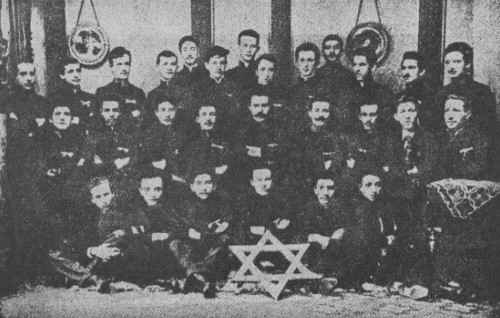
The first delegates from Zionist clubs in Galicia, and Bukovina assembled in Lemberg in 1902. The delegates from Tarnów were: Student Rabbinovich (later, Dr. Rabbinovich, lay president of the Zionist Organization in Jarosław, died in 1940 on the way to Russia), and Shlomo Goldberg (later, Dr. Shlomo Goldberg, prominent Zionist activist in Tarnów, murdered in Auschwitz by the Nazis). At this assembly (in which student Sommerstein also took part, later
|
|
[Page 368]
Dr. Emil Sommerstein, a Zionist leader and member of the Sejm), it was decided to publish the Moriah, a journal for the youth. Its coworkers were mainly high school students, who later became prominent major Zionist activists in Galicia and in the whole of Poland.
From small contributions, the members of the Judaism Club in Tarnów formed a Judaica library, which later on became the basis for the large Public Library[17] in Tarnów (on the eve of the outbreak of the World War II, it had about 10,000 volumes).
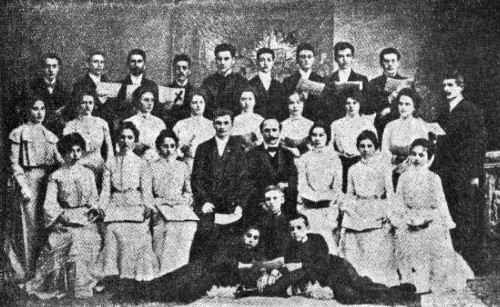
With the participation of student Shmuel Szpan (later on, a long-time Zionist leader in Tarnów, respected and popular social activist in the city), a choir was formed and led by students Daniel and Mennasse. The choir sang on the holidays in the synagogue with Cantor Heller, and in this manner earned money to buy books for the Judaica library.
In the same year (1902), several members of the Judaism Club in Tarnów passed their matura[18] and immediately founded the Bar-Kochba academic association, the first openly Zionist academic organization in the city, led by Max Bienenstock, Yitzchak Schiffer, Basler, and Menderer. This group of enthusiasts gained the greatest possible influence among the Jewish population in Tarnów. Not a single opportunity was missed in order to
|
|
(Shmuel Szpan is in the first row above [in back row, marked x]) |
[Page 369]
display a dignified, courageous, and national Jewish outlook on all issues. Whether this had to do with the struggle against assimilation, whose members had a hang-out at the Towazhiski Club; or whether this was a protest against the pro-Austrian statements by the then officiating rabbi of Tarnów. People demanded him to organize aid for the refugees who arrived in Tarnów between 1904/5 caused by the pogroms and persecutions, instead of praising the Habsburg Dynasty to the heavens; or whether there were stormy discussions with Jewish socialists at meetings and lectures, everywhere Bar-Kochba members fought for Zionist resolutions.
And as much as Bar-Kochba was an association of academics, organizationally it was like the academic associations in university cities. Such academics, who received a university diploma and spent their years in a Zionist academic association, also received the title of “Old Man,” a kind of elder or guardian. Bar-Kochba also had such distinguished members, among whom it is worth mentioning Dr. Elhanan David, a son of pious, Orthodox parents, who studied in the Tarnów Klaus. Through self-education, and thanks to his abilities, he received a doctorate from the University of Vienna, where he became familiar with Zionist principles. As a steadfast member of Tarnów's Bar-Kochba club, he became the first “Old Man” of the association in 1904. In 1934, Dr. Elhanan David left for the Land of Israel and today lives in Haifa. His wife was a granddaughter of R. Mordechai David Brandstetter, RIP.
Dr. Simcha Scheinfeld, an active member of Bar-Kochba, describes this Zionist era in Tarnów of 1905, as a “don quixotic,” as follows:[19]
“Not a week went by that we wouldn't be actively taking part in meetings or lectures called by us or by our political opponents. There were then the predecessors of Bund, the Zh.F.S. (JPS). This was a fairly strong organized workers' party, led by the workers. There were some prominent individuals among them. From time to time, an intellectual, imported from Kraków, used to visit them. The already active Sabelzon-Radek hardly ever got involved in Jewish affairs. Every meeting was turned into a battle between two bullies: one on the defense and the other on the attack, depending on who was the landlord and who wanted to throw him into the street. It was done by one of them ripping down the other in front of the assembly,
[Page 370]
whether by fighting in front of the assembly site or during elections for the assembly chairman. When neither the first nor the second attempt was successful, the voting on the resolution only began after a heated and completely unparliamentary discussion. And a ‘resolution’ is no small thing! People fought for it with a tenacity that suited the most serious and important life issues. The winners of such a resolution left the battlefield as if they were now the winners of an international football event. No cynics were missing, nor were there signs of cohesion, as having a lasting effect of these Homeric battles.”
Already by 1905, the best people belonged to “Bar-Kochba;” Tarnów's towering Jewish intellectuals, later becoming Zionist leaders, who rose from youngsters to become leaders of Zionist activity; first in Austria, later on in independent Poland. So, for example, historian Yitzchak Schiffer, who in 1905 was only 21 years old, but had already published his work The Beginning of Capitalism among the Western Jews in the Middle Ages,…
|
|
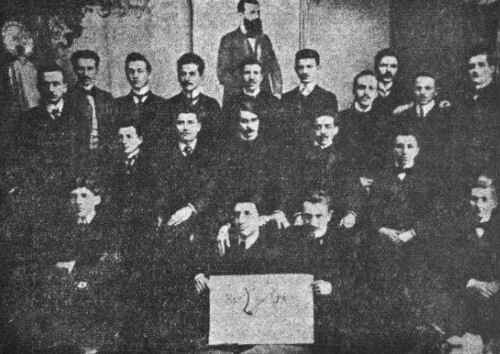
First row (standing), from left to right: Bau, Kasler, Solomon, Monderer, Kyle, Dr. Borgenicht, Pravin, Westreich, Menderer, Scheinfeld Second row (seated), from left to right: Ovida, S. Goldberg, Yitzchak Schiffer, Shmuel Szpan, Elend Third row (seated), from left to right: Henrik Greenberg, Wassermann, Laschkowitz, and Schiff |
[Page 371]
to which the scientific world responded to. Besides him, Dr. Shmuel Szpan, Dr. Shlomo Goldberg, Dr. H. Greenberg, Dr. Simcha Scheinfeld, Bau, Basler, Solomon, Menderer, Kyle, Dr. Borgenicht, Pravin, Westreich, M. Ovida, Elend, Dr. Wasserman, Eng. Lashkovitch, Eng. Schiff and in the later years Dr. Chaim Arnold, Dr. Y. Feig, Dr. Berkelhammer, Dr. Merz, Isaac Leon, and others. Bau, Dr. Borgenicht and Pravin died of natural causes before World War II. Dr. Menderer with his family, Dr. Simcha Scheinfeld and his wife, a Tarnów WIZO activist, assistant professor in Tarnów, Dr. Shlomo Goldberg, Dr. Y. Schiffer and his family, Dr. Wasserman and family, Eng. Schiff and Ovida, were all murdered by the German butchers. Dr. Shmuel Szpan emigrated to Palestine in 1934, and realized his ideal. He lives now in Haifa. Also, Dr. Feig, Hitachdut activist in Tarnów, is now in Haifa. Immediately after World War II broke out, Dr. Greenberg (long-time vice-chairman of the local Zionist Organization) and his wife (chairwoman and patron of Hashomer Hatzair) finally came to Palestine after years of wandering.
3. Hashachar[20]
From very early on, Zionism reached out to the youth in the Bet-Midrash.[21] Moshe Wiesenfeld, the last prewar director of the Jewish National Fund in Kraków, even as early as 1905, won over many study hall boys in various Galician cities to the Zionist idea. To this end he set up the organization Hashachar. This movement developed especially in Tarnów, where the strongest and best group was found (as M. Wiesenfeld himself tells), to which the following belonged at the time: Avraham Kahana, Geldzeiler, the brothers Joshua and Ezekiel Brandstetter. They developed widespread cultural activity and won over groups of Orthodox youth, thus strengthening the Zionist position in Tarnów. Thanks to the Hashachar, the first Tarnów pioneers left for Land of Israel about then were: Aharon Hoffmeister, the Brandstetter brothers, Leib Lichtinger (Aryeh Nahor of Mapam, member of the Zionist Action Committee), Nathaniel Damast, and Pinchas Wolf. The example set by this group was followed by Hashachar members from other cities, who later held important offices in the Land of Israel: Berish Meller from Jasło: a well-known Israeli literati, known as Dov Kimchi; Yitzchak Laufbahn, labor leader in Land of Israel and editor of Hapoel Hatzair; Zvi Klein from Chrzanów {Kshonev [Yid]}, chief accountant of the JNF-KKL central offices in Jerusalem. Avraham Kahana of Tarnów from among the well-known Hebrew literati in Israel today.
[Page 372]
Many members of the then Hashachar belonged to the most significant Zionist groups in the country and abroad.
As M. Wiesenfeld relates in his memoirs,[22] Tarnów's Hashachar youth set the tone for the city's entire Zionist Movement. As an expression of appreciation for Hashachar, he was included in the Jewish National Fund's “Golden Book” by the local committee of the Zionist Organization headed by Dr. Saltz. The editors of Hashachar's journal were then also located in Tarnów (together with the well-known Hebrew writer Zvi Rumeld).
The Hashachar held two assemblies. The first was in Dembitz; the second in Reiche. Until the second gathering (1908), the movement's leadership was in Reiche, where M. Wiesenfeld was living. As soon as he left the leadership during the second assembly, the Central Committee was moved back to Tarnów. David Geldzeiler (killed on the front during the World War I) of Tarnów was placed as head of Hashachar. Working with him were Avraham Kahana, Brandstetter, Laibel, and others. Some of the young Orthodox Zionists (such as A. Kahana) left Hashachar in 1906, and joined the newly formed Mizrahi faction in Tarnów.
4. Tarnów Zionism After Herzl's Death
The news about Theodore Herzl's death (in 1904) caused great grief in Tarnów, and shocked everyone. A memorial gathering was held in the Merz Synagogue, at which Max Bienenstock and Dr. Yitzchak Schiffer spoke. The large synagogue could not accommodate the numerous Jews who assembled to mourn the death of a great leader.
The death of Dr. Theodore Herzl ended Zionism's era of great heroic plans. There is still the Romanticism of the Zionists of that time, which lived on in discussions, Maccabi events, and collections for the Jewish National Fund. As for the mood of the Zionist Organization in the Tarnów Zionist at that time (1906), Dr. Shimon Feldblum, who was then in Tarnów as a practicing lawyer (now in Israel), relates in the above-mentioned Jubilee Book (page 37):
“Tarnów, 1906. A meeting of the local committee held at the ‘Miriam’ premises. The representative of the Jewish National Fund reports that in one month, people in
[Page 373]
|
|
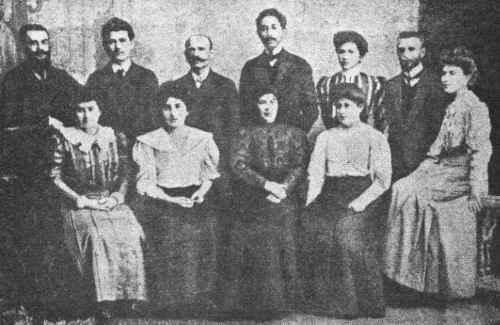
First row (standing), from left to right: Dr. Waschitz. Dr. Goldberg, Dr. Saltz, Dr. Feldblum, Miss Kerner, Engineer Leichter Second row (seated), from left to right: Miss Troim, Miss Rosenzweig, Mrs. Saltz, Miss Bonnat, Mrs. Mondschein |
[Page 374]
Tarnów collected 36 Kroner. There was a storm of applause. Shouting. Kissing. Several months later, a complaint was raised, for some purpose, by a subscriber of Der Yid,[23] a newspaper published in Kraków, such a one that was never brought home. A general storm. Answers. With great effort, the chairman put down the upheaval : with a Maccabee event. The entire organization was in action for weeks on end. In a holiday mood. People didn't talk about anything else; only about the event. The ‘festive’ speaker was simply worshipped. The ‘Hatikvah’ was sung with tears of joy.”
Apart from the Zionist Organization, in the years 1902-1906, there were active in Tarnów the Jewish women's organization, Miriam; the Jewish academic association Bar-Kochba; a civic association Hatechiyah, and Poalei-Zion. In 1904, the following were on the local committee of the Zionist Organization: Dr. Avraham Saltz, President; Dr. Waschitz, Dr. M. Goldberg, Dr. Feldblum, Miss Kerner, Eng. Leichter, Miss Traum, Miss Rosenzweig, Mrs. Saltz, Fr. Bonnat, and Mrs. Mondschein.
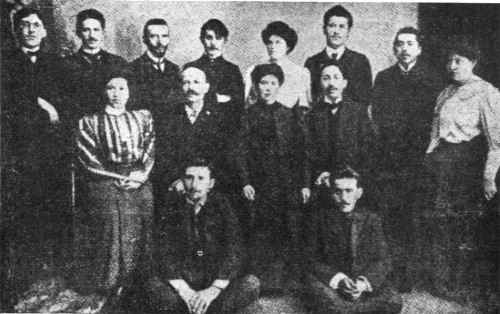
In 1905-1906, the following were on the committee: Dr. Saltz, president; Dr. Szpan, Dr. Greenberg, Gottlieb, Engineer Leichter, Dr. Y. Schiffer, Mrs.
|
|
First row (standing), from left to right: Dr. Greenberg, Gottlieb, Engineer Leichter, Dr. Schiffer, Mrs. Rauchwerg, Dr. S. Goldberg, and Jacob Ovida Second row (seated), from left to right: Miss Kerner, Dr. Saltz, Mrs. Saltz, Dr. Feldblum, and Mrs. Gruder Third row (seated), from left to right: Dr. Daniel and Dr. Szpan |
[Page 375]
Rauchwerg, Dr. S. Goldberg, Jacob Ovida, Miss Kerner, Mrs. Saltz, Dr. Feldblum, Mrs. Gruder, and Dr. Daniel.
5. On the Threshold of Jewish National Politics
Tarnów Zionists' diligence was not limited to organizing Maccabi events. When it was decided at the Kraków Conference of Galician Zionists (in July 1906) to participate in the elections to the Austrian Parliament as a separate national Jewish party, on the basis of universal suffrage. In the fifth general ballot, the Tarnów Jewish scene boiled over. A broader election committee was formed, which zealously got to work. This was the first demonstration of Jewish national strength, organized around the blue and white flag. This was a struggle with political indifference of the Jewish community; with assimilation, which was prevalent among the Jewish intelligentsia and Jewish socialists. It was also a challenge to the Austrian government, which did not recognize any Jewish nationality, and fought against all Jewish political movements. The Zionist candidate as Tarnów's candidate for deputy, was the brilliant speaker and already then, a well-known Zionist activist, Dr. David Maltz (originally from Lemberg). All his appearances and speeches became a powerful demonstration of Zionist ideals and political independence of the Jewish masses. The election campaign was not an easy one, because there was the socialist candidate, Dr. Drobner, a rousing speaker and well-known socialist activist from Kraków, who was supported by the Jewish socialists of Zh.F.S. (JPS). Then there were the Jewish circles, which did not look favorably on a Jewish national candidate, but supported any candidate fronted by governmental circles in an uncritical manner. So, they supported someone recommended by Tarnów's “District Authority.” Who of that generation does not remember this election campaign? At the mass gatherings held at the “Pig Square” (later known as “Freedom Square,” during the Hitlerite occupation became Magdeburg Square, where the mass slaughter of Jews occurred and selections sending them to death camps took place), masses of Jews gathered, and there Dr. David Maltz, the brilliant speaker, used to enthrall his audience. The election campaign was conducted on a large scale and with dedication. On all the walls, sidewalks, telegraph and telephone poles, there were signs: “Jews! Vote for Dr. David Maltz.” These inscriptions remained long after the elections and bore witness
[Page 376]
to this election campaign. The then president of the Zionist Organization in Tarnów, Dr. Avraham Saltz, ran in the Stry-Kalush electoral district. Running against him were: Assimilationist Ashkenazi and Moraczewski from the socialists. Dr. Saltz received the largest number of votes: 2,900; Moraczewski 2,500 votes, and Ashkenazi only 600 votes. In a run-off election between Dr. Saltz and Moraczewski, the Poles and the assimilationists voted for Moraczewski, who was elected as a deputy. In general, the Zionists received three mandates, gathering 30,000 votes in 20 constituencies. The following were elected to the Parliament: A. Stand, Dr. H. Gabel, and Dr. A. Mahler. In Tarnów, Dr. David Maltz received a large number of votes, but not enough for a mandate. The Zionist-led election campaign in Tarnów, strengthened the Zionist ranks and was the beginning of a national Jewish politics in the Jewish community. The Zionists left behind the narrow framework of an association, taking the first step toward being the party of the Jewish masses.
The Zionist Organization in Tarnów now held a very important position in Western Galicia. On November 1, 1908, Western Galician Zionists held a District Day in Tarnów. More than 30 associations were represented at the conference. According to the report, the Zionists in Western Galicia collected 1,200 Kroner for Shekels, and over 5,000 Kroner for the Jewish National Fund in the reporting year. At the conference, Dr. Shimon Feldblum, who resigned from the Poalei-Zion Party for political reasons, lectured on “The Current Situation and Our Immediate Tasks.”
All phenomena in Jewish life now became an object of interest to the Zionists. When a census was held in Galicia in 1910, Galician Zionists proposed a resolution that the questionnaires should include in the question about language: Yiddish or Hebrew. This resolution had a warm response in Tarnów, where the Zionists formed a special action committee, which led an intensive campaign to enlighten the Jewish population on the importance of declaring their allegiance to the Jewish People, for which the Austrian authorities later punished them.
This was the image of the Zionist Movement in Tarnów since the first thought about Zionism arose in the city. Dr. Shmuel Szpan, educator of an entire Zionist generation in Tarnów, writes in the above-mentioned Jubilee Book that the first twenty years of Zionism in Tarnów should be boldly described as the movement's romantic era, because during this time, first of all, efforts were made to acquaint the broadest strata of the Jewish population
[Page 377]
with the Zionist ideals, and interest them in the issues of the Zionist movement.
6. Tarnów Zionism After the Romantic Era
When the Central Zionist Congress was held in Vienna, in 1913, it is described by Dr. Szpan in the Jubilee Book as “the beginning of the second era of Tarnów Zionism.” “This period,” writes the author, “can be called a period of practical work in realizing the Zionist idea, because in the last twenty years Tarnów's Zionists have devoted all their attention and energy to the creation of an infrastructure for institutions that had a practical significance and a close connection to the building of the Land of Israel.”
They started by agitating that Zionists should first of all settle in the Land of Israel. Some time ago, there was a larger group of Tarnów youth who devoted themselves entirely to working the soil there. Among them were Wolf, Joseph Perlberg, Moshe Laibel, Aharon Hoffmeister, Lichtinger, and the Brandstetters. Older Zionists, such as Moshe Reich, Edward Schwager and Dr. Szpan, visited the Land of Israel in 1913 as tourists, which at that time was a big event for Tarnów Zionists. A lively attachment to the Land of Israel was established, and interest and love for the Land also increased with it. From 1909, Dr. Shmuel Szpan headed the Zionist Organization in Tarnów. He was a dedicated and tireless worker, who demanded courage and activity from other Zionists, and in this he was uncompromising. Dr. Szpan did not want to make any distinction between theory and practice. He often used to openly criticize his closest party members because they couldn't or wouldn't want to adjust their lives to the resolutions they themselves preached.
In the year 1913, the Haifa Technikum Committee, which consisted of a majority of German Jews, organized in the “Aid Association of German Jews,” decided to introduce the German language as the language of instruction for the newly built Technikum.[24] The Zionist World Organization protested against this decision by the German Jews, demanding that Hebrew should be the language of instruction in the Haifa Technikum. In all the countries where there were
[Page 378]
larger Zionist organizations, large protest meetings took place, and the prominent Zionist leaders carried out extensive information work to this end in the press and at meetings. Among others, Nahum Sokolów came to Galicia because of this matter. In relation to his coming, the Endecja then decided to consider designating the already famous Zionist leader, as an enemy of Polishness,[25] although Sokolów only wanted to protest against the introduction of the German language at the Haifa Technikum. The Polish weekly Pogoń, which was published in Tarnów, in its issue of February 1, 1914, published a notice under the headline: “The Renown Polish Press Conference of the Warsaw Litvak, Nahum Sokolów.” In the notice, Sokolów was prohibited , because he had expressed himself negatively and with contempt about Poland. This antisemitic propaganda had sad results, because fights broke out between incited Polish youth and Jews.
Nevertheless, Nahum Sokolów came to Tarnów, but the administrative power, out of fear of unrest, banned Sokolów from participating in the public assembly. The local Zionist committee was therefore forced to organize a private banquet in honor of Sokolów at the Hotel Weiss on Wałowa Street. The banquet took place at the beginning of February 1914, and attended by Tarnów Jewry's most significant representatives. While Dr. Y. Schiffer was welcoming the distinguished guest, a group of Polish “Steczeltzes” (later on became Piłsudski's legionaries), gathered in front of the hotel building and wanted to break into the premises where the banquet was held. Stones were being thrown into the windows, but the Jewish youth stood up to defend themselves. Only after great effort was this unpleasant event brought under control. The banquet ended with Sokolów's beautiful and outstanding speech.
After this event, the Zionist Organization in Tarnów published an appeal, in which it condemned the incitement, and clarified the position of the Zionists and of Sokolów regarding the Polish government, quoting Sokolów's words at the Eleventh Zionist Congress in Vienna about the Polish people: “The Polish nation is itself an oppressed one, which fights for its existence working hard under unfavorable conditions. All our sympathies are on the side of the oppressed, and also on the side of the Poles. We are sure that the Polish nation would have created completely different conditions for itself and for the Jews, if it could have determined its own fate.”
Nahum Sokolów was received quite differently when he was in
[Page 379]
independent Poland, as president of the World Zionist Organization, as he was passing through Tarnów on November 20, 1929, on his way to Romania. He then traveled to start the campaign for the “Keren Hayesod.”[26] In the Tigodnik Żydowskie issue of November 22, 1929, we read the following:
“Delegations from Zionist parties, youth cooperatives and masses of Jews completely filled the railroad station to welcome the distinguished guest. The moment that Nahum Sokolów appeared in the car window, they shouted: ‘Viva, long live!’ On behalf of the Zionist Organization, Sokolów was greeted by the vice-president of the local committee, Dr. Shmuel Szpan; on behalf of the Hitachdut, Dr. Feig; on behalf of the Hechalutz, Kaitch; on behalf of the Safah Berurah Hebrew high school, by student Unger; and on behalf of ‘WIZO,’ Miss Mala Grinstein presented the guest with a bouquet of flowers. With a few words in Hebrew, President Sokolów expressed his heartfelt thanks for the, as he put it, reception. At the departure of the train, the assembled crowd said goodbye to Sokolów by singing the Hatikvah.”
The World War (WWI) and the occupation of Tarnów by the Russian army in the autumn of 1914, caused a discontinuity of Zionist activity, because many of the very active Zionists were mobilized by the army and served outside of Tarnów, while another portion completely left Tarnów, moving to other parts of Austria during the Russian occupation.
7. Zionist Activity in Tarnów During World War I
After the Russian army left Tarnów in the spring of 1915, Dr. Szpan, Zionist Organization's chairman of the local committee, along with several other Zionist activists, began to promote Zionist activity with zeal and energy, limiting himself only to collections for the Jewish National Fund, and arranging occasional national celebrations. At the same time, philanthropic social activity was conducted by the Zionist Organization: Wolf Getzler, Leopold Schinagel, Edward Schwager, and members of “Miriam,” the Zionist Women's Organization.
Because of war conditions, the needs of the Jewish community had grown tremendously. There were a great many war victims among the Jews; many widows and orphans of fallen Jewish soldiers. Jewish poverty in Tarnów was at the edge of the abyss. The Community Center at that time did not have any understanding of those who were left
[Page 380]
without means of livelihood. Tarnów Zionists joined the aid work and did everything they could to alleviate the appalling need. In the above-mentioned Jubilee Book (p. 72), Dr. Szpan related that “thanks to this work and boundless dedication by some of our colleagues, it was possible during difficult wartime, to set up and maintain a Jewish public kitchen, which served approximately 2,000 meals daily to the largest Jewish civilian and military population of our city, some without charge, the rest for just a minimal fee. In addition, our colleagues worked very diligently in various committees. Their task was to help the many widows and orphans who came to Tarnów, whose husbands and fathers died on the frontlines.”
If one takes into account the difficult supply situation during World War I, the difficulties and limitations in supplying food, which was required mainly for the military, with the introduction of the card system for the civilian population for the most important food items, one can begin to appreciate how it impacted on the poverty-stricken Jews in Tarnów when they set up a public kitchen run by the Zionists. Many members of Miriam, the Zionist women's organization, worked in the kitchen without any recompense. It is worth mentioning those women: Feige Blauner, Tonke Berkelhammer, Mina Hodess, Manye Miller, Helle Greenfeld, along with many other quiet, modest coworkers.
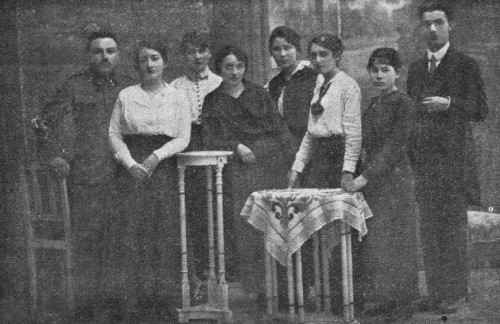
Thanks to Miriam's members, it was also possible, albeit in a limited form, to conduct Zionist cultural activity. In Miriam's humble little office on Wałowa Street (in the Margolies home) was the Judaic library run by Tonke Berkelhammer (later the wife of Dr. Jekel from Tarnów). The older Zionist youth, who were still free from military service, or served in the military in the Tarnów garrison, also gathered there. Intensive cultural activity among the younger Zionist generation was led for a certain period, by Eliezer Rieger (later, professor at the Hebrew University of Jerusalem, who was then serving with the Austrian army in Tarnów, ended as director of the Ministry of Education, and passed away in April 1954 in Jerusalem). The brothers David and Leon Kohn were still active in youth circles. In January 1917, Reuben Rosenblit, who was also serving in the military in Tarnów, helped a lot in reviving Zionist activity there. But this was an operation that took advantage of an opportunity. However, there was no contact with the Land of Israel; nor with Zionist agents from abroad, and there wasn't any Zionist press.
[Page 381]
|
|
From left to right: Reuben Rosenblit, Hela Greenfeld, Dola Laibel, Tauvke Welch, Feige Blauner, Bronia Perlberger, Zoshye Feirstein, and Eliezer Rieger |
|
fulfilling our mission of disseminating information about the Holocaust and destroyed Jewish communities.
This material may not be copied, sold or bartered without JewishGen, Inc.'s permission. Rights may be reserved by the copyright holder.
JewishGen, Inc. makes no representations regarding the accuracy of
the translation. The reader may wish to refer to the original material
for verification.
JewishGen is not responsible for inaccuracies or omissions in the original work and cannot rewrite or edit the text to correct inaccuracies and/or omissions.
Our mission is to produce a translation of the original work and we cannot verify the accuracy of statements or alter facts cited.
 Tarnow,Poland
 Yizkor Book Project
 JewishGen Home Page
Yizkor Book Director, Lance Ackerfeld
This web page created by Jason Hallgarten
Copyright © 1999-2026 by JewishGen, Inc.
Updated 26 Oct 2026 by JH