 |
|
|
[Page 718]
by Gad Zaklukovski
Translated by Tina Lunson
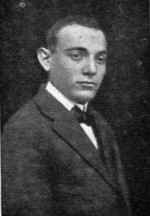
Hershl Grinberg never had any time, he was always teaching and cultivating himself. There was no one to learn from - the only teacher, Berl Meter, knew quite good Russian but Hershl managed to learn it without him. And he did not admire Berl Meter's grammar, so he, besides his kheyder knowledge, learned Hebrew well enough for reading TaNaKh.
|
As a son of poor parents, he did not have opportunities to study. So, he necessarily studied without teachers, and by the age of seventeen or eighteen he knew perfect Russian, Polish, German and bookkeeping, and besides that he had a strong penchant for music. He also familiarized himself with the violin and taught himself to play. His tender feel helped him in that and, not yet knowing any musical notation, adapted melodies to his somewhat folkish poems. Thus, he found favor in the eyes of the town youth. And when a bride-to-be or a future groom was too shy to go study with Berl Meter, they
[Page 719]
came to Hershl. They also went to him to learn playing and Hershl became a teacher of languages, music, and bookkeeping.
Hershl, Secretary to the mayor during the First World War, was the actual mayor since the German mayor was a party-goer who took no time to lead the town, and left everything to him. Hershl was the actual head of the town, and he was not put there by any political party or society. He began as an ordinary office worker, and by his many kinds of knowledge and language abilities, served city hall very well.
Nonetheless he ruled the town, and no one ruled him. We considered this a great morale strength and saw in him a power for our people. His calmness was a marvel, in all his speech and relations with people and all his activities, everything was calm and measured. Such unheard-of calm in life is only possible when deeply rooted in a person's soul.
I want to add Hershl's tirelessness, private saintliness, and good deeds for justice. (A large part of the monies was his own.) He saw to it that town funds were used for the food banks and distributed to the needy in that era of hunger and starvation. He also, on his own initiative, began to rebuild the buildings that were destroyed in the big fire in the 1910s and fill in the long, deep pits from Ali Shteper's houses by the river as well the so-called sand pits. But the crowning achievement was the restoration of the shul, in particular the new, beautiful, fine Torah ark - which Khane Peske's and her women's group also had a hand in - and the eye-catching painting of the shul, completed by a famous painter from Mezritsh, an artist in his craft (recommended by Meyshe the Rov's). The painted animals and birds looked alive. The large plaza around the shul was illuminated and given a paved sidewalk. Finally, Hershl surprised everyone with his fine, expensive gift, a large lamp hanging from the ceiling over the Torah-reading table. When one walked into the shul one could not pull one's eyes away from the painting and the hanging lamp.
In 1919 Hershl and his family moved to Warsaw where he
[Page 720]
became a publisher of books and journals and founded a printing company. He soon earned great loyalty among the printers and publishers there, as well as the family of writers. There were times when his house and printery were a literary union in miniature, with editors, writers and publishers meeting there.
Hershl Grinberg's house was also the meeting-point for people from Sokolov who came to ask his advice about their concerns. Thus, the great Warsaw also benefitted from Hershl's good qualities.
Hershl, his wife Rokhl and their children Khayele and Motele were murdered during the Warsaw Ghetto Uprising in 1943, may God avenge their blood. Their son Ayzik survived in Russia, and the eldest daughter Hela with her husband Meyshe Zayonts (son of Rov Aron Asher of blessed memory), who are in Israel.
Hershl was killed at the age of fifty-five. And that was his unassuming tombstone, as unassuming as his life.
by Gad Zaklukovski
Translated by Tina Lunson
|
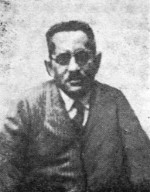
Alter Shuster was never stubborn; he was a conveyor of immediacy, of “I defer to you”; but in matters of social ideas he firmly stood his ground, and like a strong
[Page 721]
soldier standing guard he would not move one step. And he took those same good qualities into the Poale-tsion Party and into his communal activities.
When someone would ask him where he got such a drive to be a party leader, he would answer “If there is an empty place, I go into it: In a place without a person there is a herring.”
Imagine if it had not been as he so modestly expressed it. His ability only helped to take in everything around him and adapt it to this or that frame of social ideology. Alter could conceive an idea down to its foundation. Having been in Bialystok for all of a year and a half, he was elected a member of the local Jewish Council; in his thirties he [a line of type appears twice] had a firm base, where the artisan could became a member for a small contribution and receive merchandise on credit and on installment payout.
And indeed the artisans and the Right Poale-tsion Party sent him to the Jewish Council, also electing him as secretary of the artisans.
People saw Alter's organizational abilities and his idealistic devotion and delegated him to the Central Committee of the Right Poale-tsion Party as a provincial representative; and as Avrom Bialopolski was head of the Right Poale-tsion in Warsaw and was also on the committee of the “Keren-hakimas” in Poland, he asked Alter to better organize the work of the local Keren-hakimas. And once again Alter was in “a space without a person”, and he reorganized that work.
Thus he sacrificed himself on four altars: Party, artisans, elected official and finance (in the “Keren hayesod” work). Here he abandoned his workshop and went from being an official until a livelihood was a further stage. Then Khave, Alter's wife, a businesslike woman, took a package of leather at wholesale price (perhaps even underpriced) from Shmuelke Khaym's (Shnayder) the leather merchant to her brother Shimeon in Bialystok, sold it at retail to the artisans, and saved the family from disgrace. She was a devoted Party member, but “man cannot live by bread alone” and Khave could barely earn enough for bread. After that Alter was designated as an instructor for “Keren-hakimas” in the Bialystok region, with a salary.
[Page 722]
This began a whole new public service for Alter. He traveled out to Bialystok province for the affairs of the community, and also concerned himself with strengthening his Zionist work, thereby improving his public-speaking abilities. He then founded the “Ha'oved” in that region; his wife Khave helped him in that as well.
Alter Shuster was born about 1898. After the death of his father (Yenkl Shteper) the eleven year-old Alter learned leather cutting for shoes. But he also began reading all kinds of literature very early and was considered knowledgeable about Borokhov-ism while still quite young.
He made aliya to Erets-yisroel in 1925.
His wife Khave and their child arrived in 1926, and both became sick. The doctors told her and the child to go home immediately. Alter remained in Erets-yisroel and earned a living, saving up money to bring Khave and the child back to the land. In 1932 he traveled back to Bialystok, where Khave's family had lived earlier.
In 1937 Alter was ready to make aliya with his family and again encountered obstacles, but in spring of 1939, though he was completely prepared, their aliya was dragged out until the outbreak of the war.
Alter was arrested in June of 1941 in Bialystok and soon the next day Khave and the children were shipped off to Russia. When the Germans began the war with Russia the gates to Russia were opened. Then the Germans came in, and shut the local Jews up in a ghetto. Alter Shuster was killed along with them.
by Gad Zaklukovski
Translated by Tina Lunson
I was still a child when we lived in Yom-tov's houses, before Ali Shteper bought them up, and Berl Meter lived in one of the rooms. We khumesh boys would stand outside someone's window and never tire of listening to his clear translations of khumesh, and the differences from our rebi's half-word and un-clear translations mixed with RaShI's exegetical explanations. We were surprised even more by the order and the calm of the teacher.
[Page 723]
When Berl Meter finished the week's parshe in the khumesh and the children began to repeat it, it was like an organized choir. And one always wanted to shout out above the others, so he told him to be completely quiet and the “choir” went on learning.
|
We children talked among ourselves that that was surely the way Moses, our Teacher, studied Torah with the Jews in the wilderness. He took me into his and taught me. Mostly craftsmen's children were sent to study with him, and a small number of children from half-maskilik [“enlightened”] parents and of the two or three
“pashelenshtshike” parents. And if any of the pious hasidic children studied with him it was only for Russian.
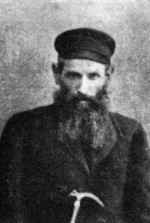
Berl Meter did not go about dressed in short clothing. His long kapote looked a little shorter because of the long trousers over his short boots. The only modification was his exterior smoothly-straight shirt collar. His long, broad beard never had one hair out of place. But he could not bear to be called “rebi” , like the elementary teachers, but Teacher; or to let anyone make use of his whip.
Berl Meter's kheyder - although without any school furniture - was a little like a school because of the pupils always sitting in one place, of our calling him Teacher, of the cleanliness of the table and bench and of the room around it, and the special TaNaKh lessons, which in the other khedarim were not so
[Page 724]
clearly explained. And if he brought just a little RaShI into his lecture it was always in pure Yiddish. And if a child had a hard head and required a little extra labor to comprehend, Berl would take of tiny sheet of silk paper from his cigarette-paper folder, sprinkle in a little “Vishe-Srednye” tobacco to make a very thin cigarette, smoke, and without any impatience find an easier interpretation.
Suddenly a decree from the tsar was issued to teach in Russian in the khedarim and there was a rush by elementary teachers and community activists to the “authorities” to annul the decree. One late afternoon Elieyzer Shakhnes Rozentsvayg, a member of the council, met Berl Meter in the Bialer shtibl and discussed how to ease the decree if they could not rescind it. Then, next thing they decided to go to the old council member Velvl Tsibulie and later let Nakhman Dovid, the third council member, know, and he and Zalberfert went to see the Rov Binyumin Alin who also spoke good Russian. And it remained as Berl Meter had proposed - that since he was an officially- recognized teacher of Russian, he would travel to the inspector in Shedlets and sign up to take on the teaching of Russian in the khedarim. So he did go there and return with an official “certificate” that he was appointed as a supervisor over Russian lessons in the khedarim. In addition, the opening of a kheyder must be under the signature of Berl Meter. He also related that the decree would be annulled because the Poles were also strongly against it too. Soon there was almost no decree and we got away with just teaching the titles of the tsar's family.
From then on, the “razrashenye” hung beside the tsar's portrait and Berl Meter received a weekly stipend from the teachers, and that saved the quiet teacher Berl Meter from dishonor.
Berl Meter would come once a week (sometimes once in two weeks) to teach the titles by heart. The children had to repeat them in one chorus, then each individually recite the Russian Tsar's family titles.
Berl Meter was a teacher with a strong pedagogic talent and a deep knowledge of Hebrew and Russian. He had an influence on his pupils, in whom he planted a desire for knowledge and science. He also studied with children for half tuition
[Page 725]
and with some children for free (something not seen in any other teacher in town). He was also the best Torah-reader in town, and when they wanted to hire him for a paid position, he did not want it.
It seems that no one remains of his family in Poland. Dvore died in America in 1943 and her husband in 1948; he used to study with a group on Shabes for no fee. They left children, grandchildren and great-grandchildren who are all good Jews.
Translated by Tina Lunson
Reb Yisroel Itsikh'l Soyfer
Reb Yisroel Itsikh'l the Soyfer [scribe] used to sit in the long, dark room of the Khay-Adom prayer room, only not with the others around the table, but separately, behind the big brick oven.
Himself, a dark-skinned man with a black beard, wrapped in his black kapote, melted into the heavy darkness of the room and sat there, preoccupied with ponderings about the insignificance of man as against God and the world.
This large and deep humility pushed him away from the table, and he generally sought out a corner behind the oven. He held his head bowed down and his eyes lowered even more, to the ground. His thoughts were sunken in the holy work which he carried out as a scribe of scrolls, t'filin and mezuzes.
He never pressed himself to the table and did not merit the honor of being asked to pray. So they sometimes remembered him when they needed to send someone to the cantor's stand to lead the evening prayers. When the gabay asked him to go to the cantor's stand, he promptly went and mumbled out “V'yehi rakhum…”.
When Reb Yisroel Itsikh'l Soyfer came home from prayers at the end of the Sabbath and stepped over the threshold of his small house, he quietly mumbled “a good week” to his wife, who had just finished the prayer “Got fun Avrom, Itsik v'Yankev”.
He always just thought that for a while, he could hold onto a little of the holy Sabbath, as he sought two candles in the dark to make havdole. In a quiet, hoarse voice he recited the prayers for separating the Sabbath from the week and invoked the prayers for the week in a plain, toneless voice without any melody or real enthusiasm. His whole being was as still as water and lower than grass. His soul could not burst into song, because he was always in a condition of awe and reverence, trembling and fluttering before the Godly greatness. He almost never raised his eyes, being afraid to glance onto the Godly shine of the world around him.
When the world was yet enveloped in darkness,
[Page 727]
Reb Yisroel Itsikh'l Soyfer would wake from sleep in order to come to the study-house to the first minyen, naturally, as his preparations to eat and to pray lasted longer that the eating itself – a piece of old bread and an onion.
The writing of a Torah scroll was for him not a craft, but a holy service. As he wrote the scroll, he felt, with his whole being, that an angel was created with each letter. In writing, he was completely enveloped in holiness and trembled at any flaw, heaven forbid. So, no word came out of his mouth. Day in, day out, angels fluttered around the letters, looking out from the length of parchment. The Torah scrolls were installed in the holy ark, adorned with silks and velvet, accompanied by music and dancing. Then, he also remained in his little room, quiet and locked in himself, in a corner there behind the brick oven.
No one ever knew who Reb Yisroel Itsikh'l Soyfer was: A scribe of Torah scrolls, t'filin and mezuzes – or a much larger, incognito holy man accompanied by angels and seraphim.
A few years before the outbreak of the Second World War he died, and with him went a very rare personality.
Alter Khayim Kapavi of Blessed Memory
The opposite appearance of the Jews with pale, sunken cheeks and hunched, bowed shoulders, he appeared with his upright figure and proud head held high. Reared in the environment of a small town (Vengrov) between the walls of the hasidic prayer room and study-house; he threw himself with youthful passion and energy into the current of the rising Zionism and began to affect and work in the Mizrakhi Party, which had just been established in Sokolow. In his involvement, he often rose up over all parties and took the lead in almost all the action in town.
His frequent appearances at the forum of the town council, where the majority was Polish, were brave and commanded respect from the Poles.
He fought for and won subsidies for
[Page 728]
purely Jewish nationalistic goals like Keren-Kayemet, Keren Ha'yesod, the Talmud Torah, the mikve, shul, and others.
He often sacrificed his private interests for the general good. Burdened with a large family, for which he had to work hard for a livelihood, he did not stint his time for community work; in the middle of the day, he would leave his business and workshop to attend a long meeting at the town council or the Jewish council.
He took part in all the delegations and interventions of the local and central governments, often intervening against the decrees or unease that were frequent events.
He was far from an apologist in his demands of the government as his demands were based on the principals of rights. Not long before the Second World War, he moved to Warsaw, and set himself up anew; but in the dark times of Hitlerism he came back to Sokolow, where he was murdered along with his family. Only one daughter survived being killed and lives in Israel.
Reb Yankev Leyb Blumberg May His Memory be for a Blessing
Yankev Leyb the Melamed [teacher of children] was one of the scholars in and masters of pilpul Talmud study in Sokolow.
People in town called him Yankev Leyb Mendl Mayer Opotshner's. Everyone was quite clear that he was an outsider. His wife, Mindl, took the one-ruble tuition fees and already knew how to distribute it to make it last out the week: 10 groshen for sugar, 10 kopeks for small khale loaves for Shabes, 5 kopeks for a little millet and some oil, and 5 kopeks for a loaf of bread.
Yankev Leyb had other things on his mind. Repetitions of a difficult MeHaR”Sha commentary with his pupils, preparing a casuistic explication of a complex verse in the Talmud.
He was pacing around his house in his old raggedy housecoat, whose color was not to be determined, his hands held together. He walked up and down in his small house, not feeling whether it was hot or cold. His head was always busy with interpreting some difficult Talmud issue,
[Page 729]
so much so that he did not even notice if the children were already in the room with him.
In his later years, he went blind and even then, being an expert in Talmud and its commentators, he went around his house and taught a page of Talmud from memory. Various young men and boys came to him in order to receive elucidation of some hard passages of Talmud and that was, for him, the greatest satisfaction. He died in Sokolow a few years before the Second World War. With him was lost special scholar.
Hershl Reyzman
The only person who immortalized himself with his signatures in the thick mortgage books was Hershl Reyzman, may he rest in peace. For about 60 years, Hershl Reyzman was the regular witness for interested Jews in the mayor's office. He assembled the various birth certificates, death certificates, and wedding contracts, as well as all other documents. The work necessitated his knowing the origins of all the residents and, in reality, was a walking book of heritages of the Jewish population of Sokolow. It was enough to ask Hershl Reyzman what was the name of someone's family member and the right name and dates popped out from his memory. He
[Page 730]
was the uncrowned, highest authority of identification for almost all the residents of the town. When he took his customary daily stroll along the streets and lanes of Sokolow, a dozen people would soon surround him, those waiting for some kind of receipt from the mayor's or some other office. Hershl Reyzman remembered by heart where the paper was and offered it with great dignity. Some went away from him with a satisfied expression on their faces, and some with a worried face. His appearance on the street caused hearts to beat faster, from their curiosity to know what he carried there in his two large volumes.
Thanks to his assistance and advice, many people, even in their deep old age, managed to recover their birth documents which had not yet been in order and had disturbed the normal course of their life. His help in that area was of particular help to the ranks of the poor.
Hershl Lopate the Expediter
Hershl the expediter did not have at his disposal any cart, bicycle, and certainly no motor vehicle. He sufficed with his feet, with which he ran from dawn until late into the night, striding over town in order to retrieve his orders: for someone a little face-powder, a little bottle of cologne water, tresses for Devore Pinye's to finish a wig, a talis for a groom for a call to the Torah, a black shawl for a mother-in-law for the wedding, a matse tablecloth, a pair of storybooks for Osher the book-seller, and another dozen things which are impossible to calculate. He would hand-carry merchandise to Warsaw and back with the ordered packages, and also a letter from a groom or a bride who works in Warsaw.
A big smile always poured over his face; it was impossible to anger or unnerve him.
In Warsaw, Hershl also hurried through the same. He strode among the shops and high floors and, with dozens of packages hanging from every side, he returned to the train or bus.
In his calculation of assignments, he, of course, did not reckon in any food or any rest. He was well-acquainted with the train conductor, with or without a ticket. And the same with the
[Page 731]
food – yes food, no food – the point was to earn a few groshen for the wife and children for Shabes.
And then Shabes, instead of resting himself from running around all week, he took a few baskets, and with other Jews, went around town collecting khales and loaves of bread, which he carried to the homes of the poor people. That's how Hershl the expediter operated.
Golde the Laundress
Golde the laundress, a small, thin woman, for many years a widow, lived with her poor son the cripple in a small, narrow house that she had whitewashed green with her own hands. In her work, she served hundreds of families; some by washing the floors, or doing laundry at the stream (“the Strige”), and some by whitewashing their houses.
She began her work at dawn, when it was still dark outdoors and ended it late at night. Her earnings consisted of groshens, with an addition of warm groats, a few pieces of khale, or a couple of cookies from the proprietresses. She wrapped the received goods in her wet apron and took them home for her cripple, poor thing, so he would have some enjoyment.
That small thin body worked for a town of Jews which in modern circumstances would need many people for that purpose. Only God knows how she got the strength for it.
In her work, she was a body with a soul. The hard work could not get done without Golde the laundress, and she could not live without hard work.
As we are mentioning the saints of Sokolow, we must not forget the honest laborer Golde, the laundress.
Khayim Borekh the Water-carrier
A tall Jew with a long coat bound around with some kind of belt or some kind of rope, and with two yokes with buckets on his shoulders; he was the water-carrier for the town. That was Khayim Borekh, the water-carrier. No one knew where he lived, where he ate, where he prayed, or how old he was.
Khayim Borekh was always harnessed to his yokes of water from
[Page 732]
“zdroy” or from the town's iron pump, with full pails of water that he poured into the barrels – for some soft water for 2 groshen, or hard water for one groshen. Then, Khayim Borekh got from the householder, one time or another, to “support his heart”, a bowl of warm food which he ate by the door or by the water barrel. Khayim Borekh made timely deliveries to the prayer houses and minyonim on the holidays, and for the priestly blessings he stood roaring, shaking with his long, wet beard.
For weddings and circumcisions, Khayim Borekh the water-carrier was one of the important figures. He was sitting by the water-barrel in the kitchen and waiting for his roll and plate of food.
Shmuel Fasmanter the Dead
Who knew how to call him, his name was known as “Shmuel the Dead”. That does not mean that he was a dead being; he was surely a lively, touching, smiling person who carried on his shoulders the yoke of poverty.
Although of small stature, with a dark face and an even blacker beard and eyes, one always saw him at meetings, gatherings, conferences – and why not? He was the first to offer his services, hands and feet, to go do some work for the community. Plaster the walls with announcements or distribute flyers and any running around to make a pair of groshen for a poor man. He was also the first to share his bit of bread with a poor man and his couple of groshen for any purpose. For his party, the “Tseirey Mizrakhi”, he served in any way he could: sweep out the offices, call for the members' dues, give out receipts; and carry out various missions. That last was a livelihood for him, barely, as he sold and lent out newspapers.
Honor his memory.
|
|
JewishGen, Inc. makes no representations regarding the accuracy of
the translation. The reader may wish to refer to the original material
for verification.
JewishGen is not responsible for inaccuracies or omissions in the original work and cannot rewrite or edit the text to correct inaccuracies and/or omissions.
Our mission is to produce a translation of the original work and we cannot verify the accuracy of statements or alter facts cited.
 Sokołów Podlaski, Poland
 Yizkor Book Project
 JewishGen Home Page
Copyright © 1999-2026 by JewishGen, Inc.
Updated 14 Jan 2026 by JH