 |
|
|
[Page 187]
by Natan (Noske) Vigoda), Petakh-Tikva
Translated by Tina Lunson
|
It is difficult to ascertain when the Left Poaley-Tsien was founded in Rozhan. But it is clear that in 1917 there was already a large group of members who called themselves Poaley-Tsien. They were Motl Zamek (Armoni), Yosl-Mayer Shmetsibovski, Shaye Bezshoze, Borekh Zshepke, Yitskhak Bender, Mordkhe Laske and others.
The first Poaley-Tsien Conference took place in 1918 in Warsaw and Motl Zamek traveled there as the delegate for Rozhan. He met the member Shaul Amsterdam there and decided to make aliye to Erets-Yisroel. That was a living signal of where our party was headed.
The conference gave us a push ahead. It broadened and intensified our activity. Many new members joined. The activity grew. Such activist members were Nosn Zshepke, Yekhezkel Geltshinski, Leyzer Beylis, Alter Prots, Etke Bender, Shmuel Bezshoze, Tsipke Malakh, Fayvl Vapniazsh, the brothers Grale, Libe Bezshoze and others.
Now the local club took up an entire floor at Mendl Rushniak's. With the establishment of the library a broad cultural and political program was operated. This did not please the Polish regime and as soon as a new police chief came, he found some justification that there was no better residence [than ours] and confiscated the space for his use. Our protests did not help nor did the intervention of our member the Sejm Deputy Yitskhak Shifer. We were left without a venue. Our fruitful community activity was interrupted for a time, until we went over to a space for the young people and had to continue our work in a small cellar room.
In 1920, when the Poaley-Tsien parties of the world split, in Rozhan there was no split. All the members went with the Left Poaley-Tsien. Some younger members came into that party: Mashke Shultser, Naftali and Eliahu Vilgovitsh, Meyshe Bezshoze, Hilke Vigoda, Berl Kersh, Sh. Nagl, Rivke Malakh, Nakhman Yazshombek, Shleyme Shmietshibovski, Meyshe Frenkel, Brokhe Platke and Velvl Feldmark. The youth organization grew further and with that were reckoned among the party circles of the region.
We founded the drama circle in the same year. It became an important
[Page 188]
deepening and clarifying organ. Through the drama circle we acquainted people from the town, ordinary people, with Polish literary themes and with human societal problems. Members played in the theater. Taking part in the circle were Alter Loyfer, Mayer Rozen, Monia Mozes, Nosn Zshepke, Khatskel Geltshinski, Etke Bender, Fulke Levande and others,
At the close of almost every holiday, every half-year, we presented a new play, of which I remember “Motke ganev”, “Der dorfs yung”, “For undzer gleybn”, “Mishke Tsiganiak”, “Di zibn gehongene” and so on.
In 1925 Zerubavl ” with the beard” came to us. Jews came to hear him and also to see a Jew with a beard and without a hat. His lectures made a mighty impression and gave a push forward to our own activities. Every Friday evening there were lectures on political-literary themes. The most important members from the Central gave reports. Our members Yitskhak Bender and Nosn Zshepke also presented talks. The lectures drew crowds of sympathizers.
Our youth group grew in 1926. Relative to Rozhan it was a mass-movement for young workers. It created three circles of activity. Naftali Vilgovitsh taught political economy, Leyzer Beylis taught Borokhov's class interests
|
|
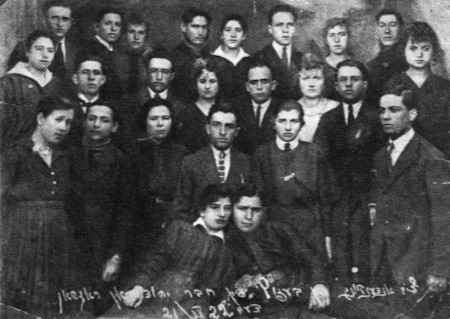
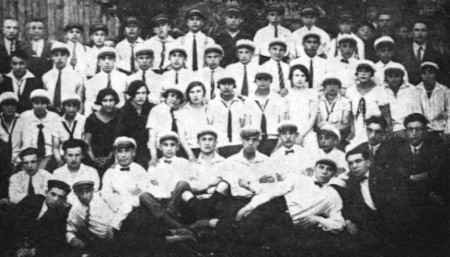
[from left] Malka Zshelavne, Alter Smolinski; Etke Bender, Yitskhak Bender, Elke Bezshoza, Simeon Shtok, Khane Rokhl Zshepko, Nosn Zshepko, Leyzer Beylis; Alter Prots, Shmuel Bezshoza, Khaye Sore Shteyfman, Yehude Tiberg (from Warsaw), Itke Marmlshteyn, Yisroel Mordkhe Laske, Khatskel Geltshinski, Tsipe Malakh; Khane-Sore Berman, Shaye Bezshoza, Mania Mozes, Yisroel Shultser, Khane Rogoza; Khatskel Zilberberg, Libe Bezshoza |
[Page 189]
|
|
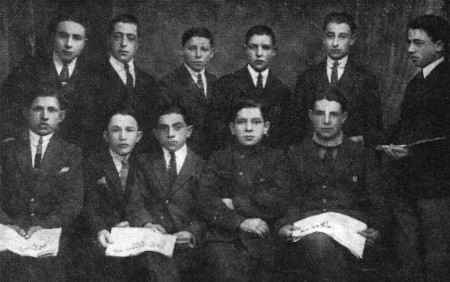
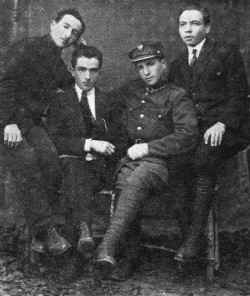
Shmile Bezshoza, Eliahu Vilgovitsh, Lipser, Berl Vegoda, Yisroel Sheluntshik, Shleyme Dobzshelovski; Berl Kersh, Berl Fizman, Meyshe Bezshoza, Hilke Vigoda, Velvl Feldmark |
and national problems, Feyge Posishtskike taught historical materialism. Hershl Grinshpan came every week from Dlugosziadle and taught the youth about Marx's Kapital.
The youth made excursions and met with organizations from other towns. The between-towns activity broadened horizons and awoke in the youth the urge for newness, for more color in society and for problematics.
In 1928 we began evening courses. The program had to be registered with the government and we gave as responsible parties the members Meyshe Frenkl and Avrom Geltshinski, The opening of the evening courses was celebrated with the participation of the Central office and the presence of Dr. Ayzenshtat. The evening gave the day a special worth and a holiday. Borekh Ring, the director of the Jewish Polish Folks-shule in Rozhan, committed himself completely to our goal. He offered the school as a site for the courses and paid dearly for it later. The teachers were Ring, Zemel, Rotblat, our medical doctor Dr. Opnos, Hershl Grinshpan and the teacher Dinovitsh who was brought in specially from Zambrove.
We took pains in eradicating illiteracy. The young people took part in the courses with deep interest. We did not take any fees. Our small budget would be covered with the revenues from the drama circles.
The evening courses worked for two years, and more than one youth in Rozhan
[Page 190]
thanked them for the bit of culture that he had enjoyed from them, and sometimes also something more. But again, the Polish-Fascist regime could not bear the light and consciousness that we brought in among the masses, and the courses were declared illegal in all of Poland. Our beloved and important member Dr. Ayzenshtat was deported from Poland and later wasted away in Russian prisons.
Just in time, the library grew. Young people who could not read now began to read and they devoured books. More than 100 readers borrowed books. Our library numbered over 1,000 books.
A help here was the director of the shule, Borekh Ring. He was not a member of our party, but he valued our work and devoted himself to it.
In 1930 there was a large public discussion after a lecture by Nosn Boksboym, and friend Ring stepped out with a defense of Communism. The next morning, he was arrested and removed from his post along with his wife. Arrested the same day for dangerous enlightening work were Shmuel Rogoze, Mayer Rozenberg and myself, as I had led the discussion evening.
They began to interrogate us at two o'clock in the morning. That went on until late morning. Mayer Rosenberg was interrogated for a long time and when they
|
|
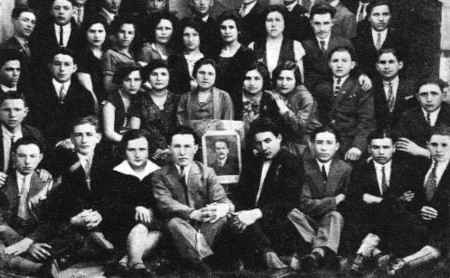
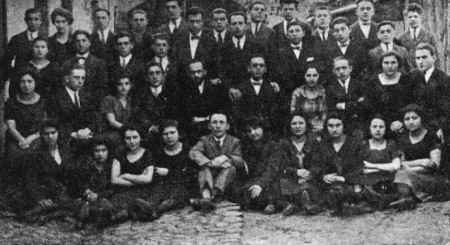
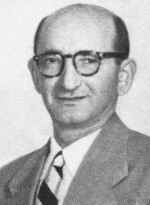
Leybke Zshepka, Meyshe Burshtin, Folke Sheluntshik, Leyzer Beylis, Meyshe Neyman, Yudl Yazshombek, Meyshe Yazshombek, Khane-Sore Laske, Sheyne-Rivke Zshepko, Sheyne Zshepko, Devore Vigoda, Libe Vigoda, Sore Finkelshteyn, Zalman-Dovid Zshepko, Leybke Zshepko, Dovid Prots, Nosn Vigoda, Feyge Malakh, Sore Gruzshka, Meyshe Malakh, Mozes-Mayer Buda, Meyshe Neyman, Yekhiel Baron, Fien Khayim Burshtin, Khilke Vigoda, Khintshe Kredo, Zelig Sheluntshik, Sender Malakh, Yosl Fien |
[Page 191]
|
|
with the participation of Dr. Borekh Ayzenshtat from Warsaw |
brought him back into the room he was badly beaten. We did not believe that he would still be alive.
During the time we were sitting in jail Mrs. Ring, who had been a teacher in the shule, organized a demonstration of the students with placards demanding that the government free Mr. Ring, because the children were not able to study without him.
Then a terrible fire started. The Endekes screamed, “They are using children, innocent future citizens, to protest and for political goals, for provocation against the government! The Jews won't shut up!” and the like. But the same day, after 36 hours of arrest, they freed us. A few days later the village elder ordered the dismissal of the Ring couple from their posts.
Poaley-Tsien in Rozhan was active for the Sejm elections. Our successful agitation in the homes always got us several hundred votes. Our public meetings also brought out sympathizers. That success also affected the town council election. Our list received 216 votes and Borekh Zshepke, the active Poaley-Tsien member, was elected to the town council. We only lacked a few dozen votes of getting in another representative who appeared after him, the member Yisroel (Srulke) Shultser.
For the eight years that the Left Poaley-Tsien was represented in the town council and took part in the work of various committees, we always kept in mind and defended, the interests of the laborers and Jewish folk population.
In 1928 the Left Poaley-Tsien Party in Rozhan decided to impel
[Page 192]
its members to make aliye to Erets-Yisroel. About ten members filled out declarations the way it should be done, to the Palestine Office. Among them were Naftali Vilgovitsh, Meyshe Frenkel, Velvel Feldmark, Meyshe Malakh, Khayim Burshtin, the writer of these lines and others.
Unfortunately, the Palestine Office denied us our certificates. The Party in Poland had decided to strike at the Office in Warsaw and six Rozhan members took part in the sit-in strike.
At the beginning of 1930 the first pro-Palestine Party conference took place in Warsaw. The Party in Rozhan ran a successful propaganda and received 150 votes, which gave us three delegates: Nosn Zshepke, Leybke Zshepke and myself. (Interestingly the conference was held in the building of the Warsaw City Council.)
In the 1930s, when the wild antisemitism was raging, with the pogroms in Pshitik and Brisk, Rozhan was not left out. On a certain Tuesday, on a market day, known antisemites hung a placard with large letters, “Don't Buy From Jews!”
Our local venue was then in the center of the market square, at Miedzshanovski's house. At the initiative of Avrom Geltshinski we organized a few members – among them Shmile Neymark, Berl Kersh, the Dan brothers – and we tore down the provocative placard in the sight of the enemies of Yisroel. That stopped the Endekes' activity in the shtetl for a long time.
This outspoken Jewish national act of ours caused
|
|
[Page 193]
|
|
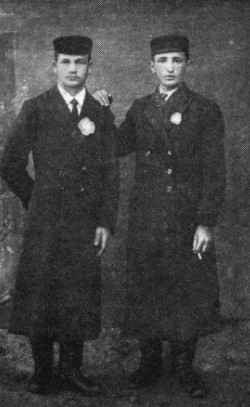
Yitskhak Bender, Shleyme Plantshak, Shaye Bezshoze, Mordkhe Laske |
Mrs. Miedzshanovski, our landlady for the venue, herself a great antisemite, to demand that we leave her residence.
Then our Party decided to build our own venue. We soon acquired a site on Potsht Street and carried out our decision. Members from the shtetl and members from Makow, Krasnoszelc, Goworowo and Pultusk contributed with labor and cash expenses and the venue was built: with a room for a theater with 200 seats, with a stage and a room for the library and a separate section for meetings.
It took more than a year to build the so-called Borokhov Center in Rozhan. That was a year of toil, meaning and the joy of creation. And it was worth the effort! The site was a home for the youth and members. The Jewish mentsh in Rozhan came there and found content for his dreams and a point of support for his heavy national doubts. Also, dreams appeared closer to their realization.
Our Left Poaley-Tsien Party in Rozhan in those days was a carrier
[Page 194]
of culture and hope for the Rozhan folks-mentsh and a support point for the dreaming working young in the town. It was a Party that is worth remembering.
In 1934, when I finished my military service, I decided that I must make aliye to Erets-Yisroel. And I realized my dream.
Thousands of kilometers from my home I received with joy every report about the triumphs of the activity in our shtetl in all areas. Until Hitler came and exterminated everything that we had built with so much effort.
by Shmuel Rozenberg of blessed memory, Canada
Translated by Tina Lunson
|
I spent very time in Rozhan, but the few years that I experienced there were years of intensive community activity that for years have nourished my intellect and added content to my life.
Until 1918, I wandered in the yeshives of Radzymin, Noworedok, Kharkow and Czernigow. I studied to find the mentsh in my own self, or, as it is called in Noworedok, to learn to bring out of the depths of the self all the spiritual worlds that are hidden inside. I mention this because through Noworedok Mussar I wandered in a labyrinth of human and Jewish pain and became infected with worldly woes and Jewish suffering. So that coming to Rozhan I did not find any peace until I was in the middle of a political-societal struggle and became completely absorbed in it.
When I came back home, my town was in ferment. From one side the Jewish community went on with its traditional life – prayer, shabes, study-house; from the other side the youth were tearing off to new horizons and wanted to avoid the deep chasm that, according to their deep and correct intuition, awaited the Jewish people including Rozhan.
[Page 195]
In the beginning I still thought that I would lock myself into the narrow space of study and that Mussar would save me or relieve my struggles. I studied further, by myself, in a study-house, immersed in the depths of Bakhya ben Yosef ibn Paquda's Duties of the Heart and Maimonides' Guide to the Perplexed but did not find my tranquility. Until I was in the Tseirey-tsien and took off in a completely different direction.
It is interesting to underscore that for two years before the official split of the Poaley-tsien Party, Rozhan had already undergone that themselves, a fact that gives witness to the intensive idealistic depth of the Rozhan youth. With the establishment of the Tseirey-tsien Party we filled the vacuum that was created with the a-Zionistic movement of the Left Poaley-tsien. With their weakening of Zionism they abandoned the working men, who sought a synthesis of national Jewishness and a workers' real-politic. We turned them back onto their beliefs. We also gave them back urgency and gusto for their weakened, pale Zionist activity in the town, because the Zionist movement was then in a deep crisis.
We, Tseirey-tsien, carried out the first flower-day for Keren-kayemet. Tseirey-tsien was the first to bring in outside speakers. Our enlightening work grew broader, and we had to call on outside strengths. Besides that which we gleaned from the content-rich lectures, we
|
|
Shmuel Rozenberg, Ruven Domb |
[Page 196]
found new content and support in the town. It became literally a necessity to hear a speaker from time to time and know that the folk sought new ways of redemption and that there was more than the traditional way of the Faith of Yisroel and the study-house.
We helped to enrich the library and to spread culture. We bought new books, provided a direction in the assortment of books and sought ways to broaden circles of readers.
Through the library we awoke the will to spread the literature itself and the problems that it awoke. That is how we began to occupy ourselves with theater. As in every town where it took a prominent place, it also involved unusual difficulties here. The actors were we ourselves. We rehearsed the roles for long weeks, held rehearsals, worried about the appropriateness of the type. And when everything was finally ready, we realized that there was no place to play. Rozhan had no large hall. It had no accommodation for such a plague as a theater performance. It took a lot of work before we came up with a “hall” to play our “piece” – but we played it!
In 1922 when I left for Cuba, Rozhan had good cultural activity with fine, thinking youth. Taking leave of the shtetl did not come easily for me. And even harder for me was the tearing myself away from the effervescent youth activities in Rozhan.
In 1924, when I came back to Rozhan, I got special satisfaction in finding the youth full of hope, joy and content. By then there was a strong “Ha'shomer ha'tsair” movement and other youth organizations. There was also a war between the generations going on, between fathers and children. I recall a preacher who came once from the Agudas-Yisroel and gave a horrible, inciteful lecture against Zionism. He based this on citations from the Talmud, as was their usual style. That really riled me. I realized that I in particular, as a former yeshive-bokher, must reply to him. I went up to the lectern and threw out all his interpretations (this took place during the elections to the national Sejm). My father came up to me and before the eyes of all gave me a slap in the face. I knew that he actually enjoyed my performance, but he had to deliver the slap because it was required of him in the father-son battle.
The Tseirey-Tsien Movement in Rozhan counted about fifty members. In the first administration were Khayim Gerver, Avrom Rozenberg, Gershon Rozenblum and others.
I am certain that it was not only we, the Tseirey-tsien, who felt a warm connection to Rozhan, but all the youth who were born or grew up in the shtetl. We teemed in her streets, in her lovely meadows; we walked out behind the barracks, dreamed and shared the sweetness of young life. And now, as we mention them every year, the poor little houses with their sweet family warmth stand before our eyes with special
[Page 197]
love. That is the beloved, dear background for the activities of the Tseirey-tsien and other movements and parties in Rozhan.
|
|
JewishGen, Inc. makes no representations regarding the accuracy of
the translation. The reader may wish to refer to the original material
for verification.
JewishGen is not responsible for inaccuracies or omissions in the original work and cannot rewrite or edit the text to correct inaccuracies and/or omissions.
Our mission is to produce a translation of the original work and we cannot verify the accuracy of statements or alter facts cited.
 Różan, Poland
 Yizkor Book Project
 JewishGen Home Page
Copyright © 1999-2026 by JewishGen, Inc.
Updated 02 Nov 2026 by JH