 |
|
|
by Mendl Burshtin, Petakh Tikva
Translated by Tina Lunson
|
It is hard to remember all that is important, all that took place in our shtetl Rozhan. Especially as one could not imagine that one would have to write after such a decimation, and that all the memories would have to be gathered together from such a small collection, from leftover remnants. It is understood that this cannot be a completely-realized work, but small, piecemeal, non-continuous memories about events. If not for the Holocaust, but rather in a normal time, this would have been a task for historians. journalists and poets. But since everything is destroyed and we want to eternalize the great worth that we had – which we did not even comprehend at the time – and create from that a monument for the effervescent Jewish life in the towns and shtetlekh of Poland, what stands before me is not light assignment.
Today, when we recall that life and its ways – which were and are no more – only now do we know how to evaluate it. Every cultural movement, every professional or political organization on the Jewish street, every kheyder, yeshive, beys-medresh, shtibl, elementary school like the “Tarbus” and the “Yavne” schools, all were very dedicated in those times to the larger collective that was called Jewish life in Poland.
In such a small town as Rozhan, where about six hundred families lived, there was no living space for the Jewish youth. The only salvation was
[Page 163]
to go across the sea, and those who remained in the shtetl were forced to continue the ancient customs of their fathers and grandfathers. And yet, over time, a little fresh air could be brought in, a beam from outside. Revolts began even among the young religious generation against their elders.
It is worth relating a curiosity about the shtetl. When the young religious men gradually began to cut their beards and to trim them with scissors, it caused a great confusion among the elder generation. They sought means of how to stop the satan, God forbid, and turn back the wheel of history. Finally, their decision was that the young men who cut their beards could not be allowed to come up for an aliye. That produced a rebellion by the youth and as a protest, all the young men left the hasidic shtiblekh and went to pray in the beys-medresh along with the craftsmen. And one time, on a cold winter Shabes early morning, when the Ger Hasidim were coming to pray, they found the shtibl open and its windows removed.
I remember how the news spread as fast as lightning around the whole shtetl. Along with all the other children, I ran to see the destruction in the Ger shtibl. It was a pity to see how the hasidim sat by the open windows in the bone-chilling cold and studied, trembling and rubbing their hands together without stopping. No one knew where the windows had disappeared to.
The responsibility for the Rozhan Jewish community regarding governance was borne by the kehile, the organized Jewish town council, or gemine as it was called. The Ger shtibl had the greatest representation in the council. There were also representatives from other hasidic shtiblekh and also other levels of society, but all were under the influence of “Agudas Yisroel”, which was outstanding in its stubborn opposition against Zionism and reconstruction work in Erets Yisroel: Those were Exile types who meaning to delay the time before Moshiakh would come.
Only in 1934, in the last kehile election, did the Erets Yisroel bloc barely get one representative onto the council. That was the Zionist activist Meyshe-Aron Frizant.
The chief occupation of the council was the quarreling over the election of a new rov, a ritual slaughterer, a cantor, a trustee.
The ritual bath requires a whole chapter. The main complaint came when the town police chief was changed. The sanitary situation of the mikve was well known by everyone in Rozhan. Every one had to visit it because there were no bathrooms in the houses. Everyone had to wash themselves clean there. As everyone remembers, the mikve was an antique fortress. It looked like Bialek's shtetl “Lishtina” where a mountain of garbage had piled up from generation to
[Page 164]
generation. But the powers-that-be had put off modernizing the mikve, and there was no money in the gemile treasury. There were always worries about what would happen until they became accustomed to the new chief and he was content with a time-to-time Jew. But God made it so that he would not accept time-to-time Jews and demanded that either the mikve be locked shut or be renovated. Then it became a joke in the town. People traveled to rebis to ask for advice (exactly as in Sholem Aleykhem's story which depicts how the ruler did not want to take any bribe and people moved heaven and earth, traveling to the rebis). So it was, stirred up and confused for generations, until Rozhan was completely destroyed, but the mikve remained right in its place.
Now the positive side of the kehile. As in other towns and shtetlekh, the kehile in Rozhan took great tasks upon itself. It had to concern itself with the needy of the shtetl. However much the financial means were measly, for providing matse to the poor and other religious necessities, the kehile always took care of it. Beyond that, they also had to take care of maintaining the religious functionaries of the town.
It is worth mentioning a detail about a dispute in the burial society. It would seem that here, where death dominates, that it must be peaceful and calm. But – no. Even here there flickers a fight between Ger and Aleksander. But while a quarrel about electing a rov, a ritual slaughterer, a community head and the like will finally end with a compromise, here, in the burial society, no one would relinquish their claim. In the end they created two burial societies that most often disgraced the dead.
Around the institutions of education that must form the soul of the rising generation there was always a fire flickering in Rozhan, especially during the interim days of holidays when the community was a little rested and had more time. In that instance, not only the Ger and Aleksander Hasidim participated, but the entire Jewish community of Rozhan.
There were some who would intentionally halt the penetration of light and knowledge into the minds of the kheyder pupils. They moved worlds so that heaven forbid a seven-year-old boy could not be pulled away from kheyder for a few hours so that he could study secular subjects in a school with his head uncovered may God help us…
Every holiday interim they called for meetings in the study-house and discussed how to abolish the order about sending the children to the school. And they were not allowed to move against the authorities. One time the school inspector issued an order, and each pupil received a note that the father had to present himself at the magistrate. Then there was no exit and they had to send all the children to school.
After several holiday interim meetings, they finally decided to establish a Talmud-
[Page 165]
Torah – not as before, at the rebi's house, but in a special building, with the approval of the government. A teacher used to come there for one hour a day and teach secular subjects. I recall that when three o'clock in the afternoon came around, when the children saw through the window that the teacher was arriving, joy spread over the little childish faces. But the rebi grumbled, “That satan is coming to destroy Torah”. And indeed, he gave him a wink that he should not take it seriously, he was only doing his duty in respect to God.
Then it came the turn of the parents, who sent their children to the Polish school. The kehile council issued a paper to the parents, that they should withdraw their children from the Polish school and suffice with one hour a day of secular studies in the kheyder. Whoever did not accept the invitation from the religious functionaries felt their rath in the shtibl or study-house.
|
|
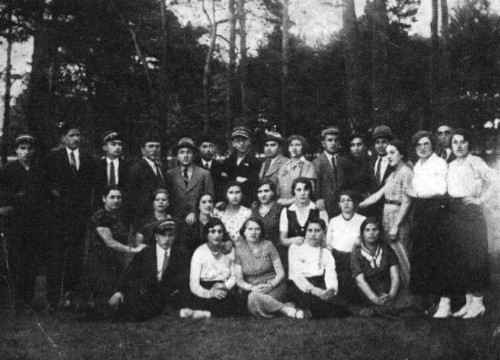
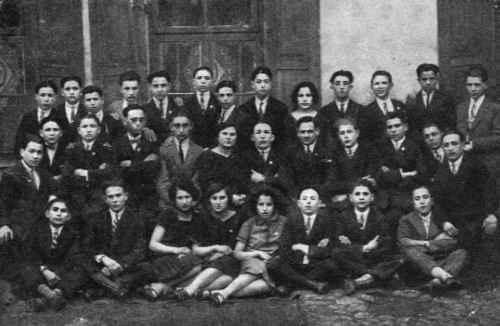
Among them: Tsvi Grinshpan, Meyshe Levkovits, Elimelech Lipshits, Kalman Rukhvits, Kh. Burshtin |
When they had finished off the Polish school they started another chapter, a plague that was even worse than the Polish school – that was the “Yavne” School, where one did not study the old Hebrew holy language but Ivrit, you shouldn't know from it. Who were the founders of the “Yavne” School? Of course, religious Jews, whom it was hard to get rid of; as an example, the family Levkovitsh from Makow, who had laid the foundation of the “Yavne” School and thus received the support of a large number of religious Jews. True, Ger rejected them. But for the whole
[Page 166]
population they could not explain it to the non-Jews. Tsvi Grinshpan did not help much by building the “Yavne” School, into which he planned to bring over a large number of children from the “Talmud Torah”.
There was disorder in the hasidic shtiblekh and in the study-house. They spoke to the conscience of the parents: they should not send their children to the “Yavne” School. Thanks to the unbendable position of the ordinary Jews and the neutrality of the Aleksander Hasidim, they were successful in halting the Yavne” School, and the children merited the enjoyment of a little light and Zionism.
The handworkers' union occupies an honorable chapter in community life of Rozhan. Outstanding with its activity was their gemiles khesed [free-loan society], which was founded by the initiative of Yosef Beshozsha. As in all the community institutions there was friction, especially at the free-loan society, in distributing the loans. But yet a friendly feeling dominated.
There was much to accomplish in other areas as well. The handworkers' union was concerned for all the craftsmen who were properly organized. On Shabes they all prayed together in the small study-house.
The handworkers' union, which included all the craftsmen in the shtetl, was a living testimony to the productivity of the broader Jewish working classes who lived from their own labor. At the time we did not know how to evaluate it, but today, when all that unfortunately belongs to the past, we can better understand it.
If I would quickly depict the Jewish organizations, I must – for personal motives – begin with “Mizrakhi”, especially “He'khaluts ha'mizrakhi - Ha'shomer ha'tsair”, although the movement was founded in the last years.
With the founding of “Mizrakhi” a large number of young and older people left Agudas Yisroel and joined the newly-founded party. That caused a great deal of agitation in Agudas Yisroel which had the largest influence among the religious population.
Agudas Yisroel was the continuation of the earlier lifeways, of the previous generations, locking in all the classes of the Jewish population. Even among the working class the influence of Agudas Yisroel was huge. That party was a continuation of generations of religious Jewry with a politically anti-Zionist veil.
[Page 167]
|
|
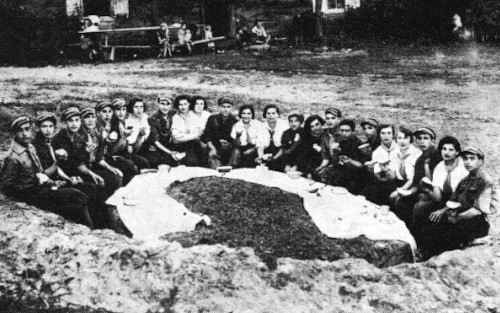
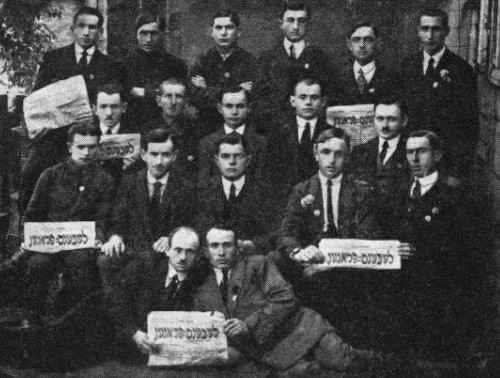
N. Reytshik, Dvore Gurman, Ester Dobshilovski, Devore Blum, Mendl Burshtin, Motl from Wonsowa, Shlezinger, Kopetits, Leye Beylis, Neshe Naymark, Meyshe Burshtin, Mordkhe Pultusker |
In no other party did the Agudas Yisroel find such competition as in Mizrakhi, because there was a great distance in the world view between it and the other parties. There was danger and fear from the side of Mizrakhi, with its exclusive religious coloring. The struggle between them was very serious indeed.
Before that there had been no other way out for the religious youth except staying between the walls of the old style in the hasidim shtibl or in the yeshive and living an unproductive life.
Many parents did not allow their children to visit the Mizrakhi movement. but they were not successful in preventing them. As soon as the new movement was founded, the old walls of the Jewish backwardness were broken through and the Zionist thought permeated into the ranks of religious youth. Thanks to that many young people joined the Zionist movement and some of those also merited making aliye to Erets Yisroel.
An important movement that had a huge influence on the Jewish youth was the Ha'shomer ha'tsair. That movement brought in light and hope
[Page 168]
among the youth who sought a purpose in a sad and pointless life in the small shtetl. At first glance, Ha'shomer ha'tsair was only an educational movement that busied itself with transport; yet at the same time the youth received a nationalist and free education there. And the result of that was aliye to Erets Yisroel, the creation of new kibutsim and outliving desolation. And the people of Rozhan took part in the kibuts movement that that was made by the youth who had left their homes and the school-bench in order to realize the idea of Ha'shomer ha'tsair.
The cell of Ha'shomer ha'tsair in Rozhan , in the center of the shtetl, was a bright, warm home for the local youth.
He'khaluts was the movement that demonstrated special activity in sending young adults to agricultural training settlements in order to broaden them physically and ideally for making aliye to Erets Yisroel. It was not a movement for its own educational work. It took in the educated youth from the Zionist youth organizations and directed them to a path of consequential realization. He'khaluts was very active in Rozhan too, and Rozhan was honored as an idyllic life among the youth movement when the moment came to go on aliye.
|
|
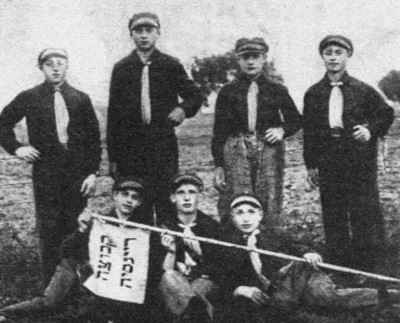
Shraga Melnik, Mendl Burshtin, Yosef Lekh, Dovid Shultser, Yosef Gradubits, Shleyme Pultusker, Mordkhe Plotka. |
[Page 169]
|
|
The Revisionist organization in Rozhan was not a large one. Only after the murder of [Khayim] Arlozorov did it take on a larger influence. During [accused murderer] Stavski's trial the BeTaR became stronger; then members joined it from other organizations. There was an era when it seemed, thanks to the tragic fall, that BeTaR would profit and would grow further, but it happened otherwise: In leaving the Zionist movement the Revisionists lost their influence in Rozhan.
A Communist group existed in Rozhan too, that ran an illegal operation. Because of the illegality of the Communist party it was not noticeable in the open. Its presence was felt only when a group from another party joined it.
A brilliant chapter of the workers' movement is to describe the account of the Left Poaley-Tsien in Rozhan. Anyone who recalls that era in our shtetl must admit that the Left Poaley-Tsien brought light and knowledge among the working youth and folk-classes in Rozhan. The names are not important – it may be called the Perets Library or the Society for Evening courses –
[Page 170]
for under those names, they organized evening courses to teach reading and writing to those who were deficient in those. But everyone knew that this was thanks to the initiative of the Left Poaley-Tsien. Such service is invaluable.
|
|
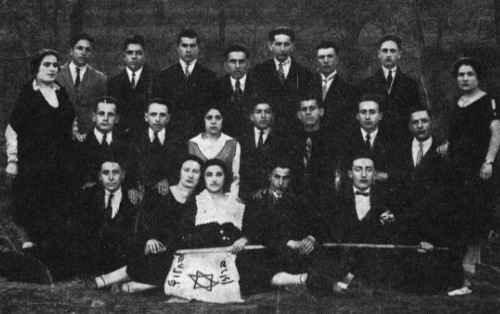
Leybke Zshapko, Yidl Yazshombek, Sender Malakh, Leybl Skola, Hofman, Shleyme-Zalman Mozes, Zalman-Dovid Zshapko, Khayim Burshtin, Meyshe Yazshombek, Meyshe Baron, Mayer Bieda, Yekhiel Fien, Yenkl Skurnik, Khatskel Segal, Khane Stolnits, Yekhiel Vigoda, Feyge Porzshitski, Naftali Vilgovitsh, Yankev Berman, Nosn Vigoda, Meyshe Nayman, Meyshe Yazshombek, Yosef Fien, Libe Vigoda, Masha Malovan, Sheyne Zshapko, Dovid Prats |
No less important was the activity of the dramatic circles in the shtetl. One of them was founded by the Left Poaley-Tsien. In that time there was no cinema in Rozhan, and no traveling shows played there. With the presentations by the dramatic circles one could easily feel an uplift in the shtetl. From time to time a performance took place that drew a large audience, and only then did outside artists begin to visit Rozhan.
At the same time the performances also lent a material use for the various community institutions. If it happened that a certain sum of money was needed for some community goal, then they turned to the Left Poaley-Tsien, that they may arrange a performance and donate the revenues to the needy goal.
No Bundist organization existed in Rozhan recently. But there were Bundists there from the 5th year. [1905?]
[Page 171]
|
|
At that time the Bund played a large role on the Jewish workers' street. In Rozhan too, as in other towns in Poland, the Bund ran a lively activity, a political and cultural one. One must establish that the first Jewish library in Rozhan was founded by the Bund. The Bund also organized summer camps for children, distributed the “Folks-tsaytung” newspaper and conducted other useful work.
All that was carried out until about 1920, until the Zionist parties were founded in Rozhan. Then the influence of the Bund became ever weaker and weaker. Most of the active members of the Bund went overseas to America. Some went off to the revolutionary stream to the Soviet Union. The remainder of the Bundists occupied themselves selling the “Folks-tsaytung”. There were also active in the Sejm elections under the leadership of Note Rogoze.
This is my short overview of Jewish community life in Rozhan and the influence of the parties on the youth. It warms the heart, the recollection of the 24 hours of Shabes on the four-cornered market square, where the songs rang out from various party clubs – from the Ha'shomer-ha'tsair cell in Bukhner's house echoed Zionist songs; from the Ha'shomer-ha'dati, religious songs; and from the club of the Left Poeley-tsien in Miedzshanovski's house, proletariat Zionist songs. In the shtibl of the Ger Hasidim, in Burshtin's house, they sang zmiros around the third meal.
[Page 171]
How many of our relatives and friends hoped to continue their singing in Erets Yisroel but –unfortunately – did not live to do so. The Jewish community of Rozhan has disappeared along with that entire murdered part of the Jewish people in Poland.
|
|
JewishGen, Inc. makes no representations regarding the accuracy of
the translation. The reader may wish to refer to the original material
for verification.
JewishGen is not responsible for inaccuracies or omissions in the original work and cannot rewrite or edit the text to correct inaccuracies and/or omissions.
Our mission is to produce a translation of the original work and we cannot verify the accuracy of statements or alter facts cited.
 Różan, Poland
 Yizkor Book Project
 JewishGen Home Page
Copyright © 1999-2026 by JewishGen, Inc.
Updated 09 Oct 2026 by JH