|
by Shlomo Heftler
Translated by Sara Mages
|
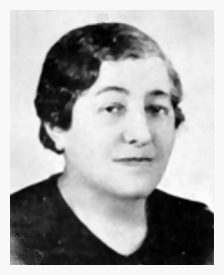
| Ludwika Wajntraub |
Mrs. Ludwika Wajntraub, director and owner of the Jewish Gymnasium [secondary school], perished in the Holocaust together with thousands of Jews of the Radomsk community. She was born in Piotrków (1890), where she was educated, and graduated from the Municipal Gymnasium. After graduating from the University of Geneva (Switzerland), she returned to Poland as a certified German language teacher. In the first years after the First World War she lived in Radomsk, and with the help of the city's wealthy residents she founded the first gymnasium in the city for boys and girls. In the beginning, the institution was at the Blumsztajn's house (8 Strzalkowska Street) where there were only six classes. However, when the gymnasium was moved to Krakowska Street, to Sobinski's house, eight full classes were opened there. In 1933, L. Wajntraub's gymnasium was moved to the building of the Polish Gymnasium of Stanislaw Najmic, which was closed for various reasons.
From the beginning of the founding of the gymnasium, L. Wajntraub had enormous financial difficulties. Most of the students paid half the price of the tuition fee, and there were some who paid less than that, the minimum. But despite this, L. Wajntraub, with her teaching staff, overcame the difficulties. In the 1930s, the Jewish Gymnasium was at the highest level of education, it even passed the two Christian gymnasiums and received praise from the authorities of teaching and education.
It is also necessary to mention the gymnasium's teaching staff, who over the years stood by Ludwika Wajntraub and helped her to achieve her lofty goal, to provide a high school education for the Jewish youth. Among the aforementioned were Dr. Prof. Yakov Polisiuk, Dr. Prof. Elza Polisiuk, Prof. Shimon Bir, Prof. Yisroel Bromberg, Prof. Yosef Berbeg, Mrs. S. Rozencwaig, Mrs. Adela Wochtel and Dovid Erlichman a native of Radomsk, who was the Hebrew teacher. There was also a small circle of supporters who helped in various ways.
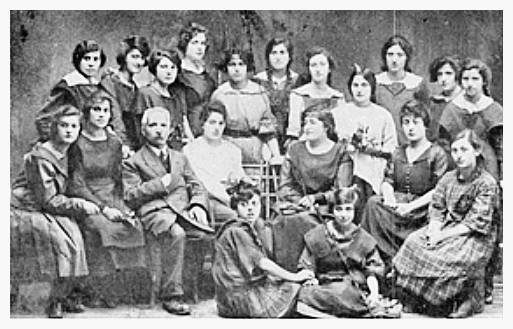 |
| The fifth level class
and the gymnasium teaching staff in the1919/1920 school year Standing (from the right): Rachel Rubin, the Rzechter sisters, A. Zabicki, R. Gliksman, T. Wajnberg, R. Zaks, S. Tiger, B. Rozenbaum, M. Slomnicki Second Row: G. Grosman, the principle, L. Wajntraub, Zalcman, Altman, H. Aronowicz Third Row: Z. Gworz, B. Luria |
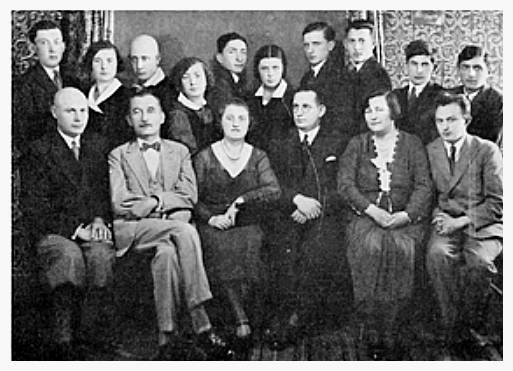 |
| The gymnasium's graduates in1932
Standing (from the right): Y. Lichtensztajn, Horowicz, Moshe Gelbard, Moshe Hartman, Arna Rodel, Yissachar Minski, –, Optman, Dabszic, Dobszinska, Yakov Brocki The teaching staff: Prof. Yisroel Bromberg, Mrs. Groskop, Prof. Prof. Yakov Polisiuk (the gymnasium principal), Mrs. Polisiuk, Prof. Wabun, Prof. Anzelhajm |
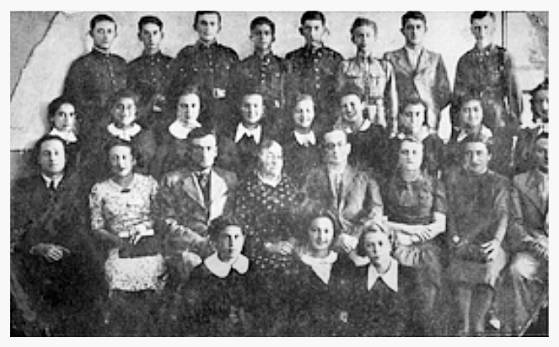 |
| The last graduating class and the teaching staff of
Ludwika Wajntraub's Jewish Gymnasium (1939) |
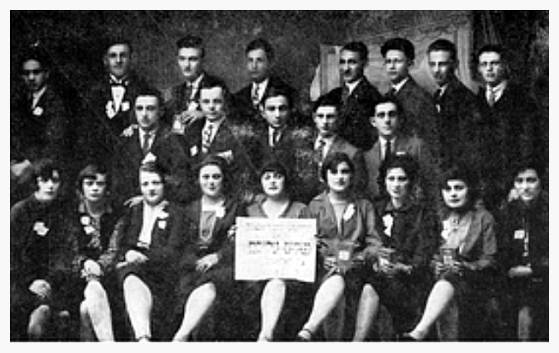 |
| Committee members and active workers
of the Sholem Aleichem Library (1926)
Standing (from the right): Y. Sh. Moszkowicz, Ahron Fiszlewicz, Chaim Goldberg, Benim Birnbaum, Shmuel Najman, Yitzhak Blum, Shlomo Brener, Yehuda Liberman Second row: Eliezer Mendel, L. Winter, Hershl Gliksman, B. Turner, Dovid Waksman Sitting: Ruchl Tobiasz-Sztajn, Sura Dawner, Adl Ofman, R. Dawner, R. Zionckowski, H, Winer, Malka Szmulowicz, Grosberg |
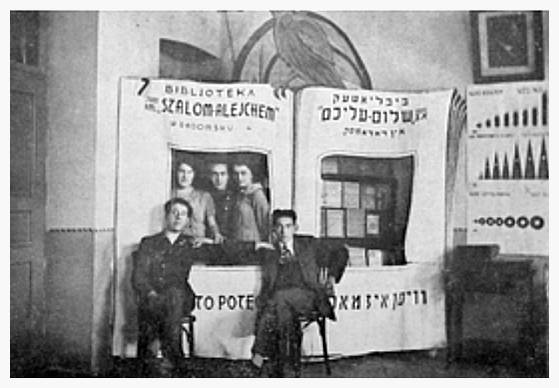 |
| The display stand of the library during the bazaar for the K.K.L. [Keren Kayement LeYisrael – the Jewish National Fund] in 1934 |
by Yechezkel Grossman
Translated by Sara Mages
R' Michael melamed[1]
A boy, not yet five years old, sat on his first day of his studies, hunched over a page on which were printed vowelized letters of the Hebrew alphabet. Next to him sat his teacher, R' Michael melamed with the pointer in his hand. Suddenly, several shiny and colorful candies appeared on the page. The boy looked surprised and happy at the melamed's face and at his father's face, who was standing behind him, and they informed him: this is the Pimper-Angel who throws candy to the boy who learns Kamatz aleph oh[2], Kamatz bet bo.
In fact, the boy understood that the candies were thrown by his father, but he accepted the explanation about the Pimper-Angel. This is how the boy, immediately after starting his studies in the cheder[3], was brought into the secret of Malachei Elyon [angels of the Most High]. His spiritual contact with them expanded when he encountered the images of the angels on the first page of the Chumash[4], in the verses of the blowing of the shofar on Rosh Hashanah, and the study of the first chapter of Ezekiel the prophet. They appeared in his dreams, and he told them at length to his mother and friends if they were willing to listen to him.
At the cheder of R' Michael melamed, the boys sat in the room in the winter and outside in the summer on long low benches under the trees. These trees stood at the edge of the orchard in Gonszrowicz's yard on Czestochower Street.
R'Michael melamed was also a medic, almost a doctor, and generally a man of virtues.
R' Moshe melamed (Garcarski)
Another educator was Moshe melamed on Krokower Street. At Moshe melamed was regime and order. Every day the boys washed their hands and sang together Modeh Ani [“I give thanks”], Seh-oo Yadeichem [“Lift up your hands”] etc. The punishments were determined according to degrees and carried out in a special ceremony. The studies continued from morning until evening, and during breaks the boys went home to eat. On winter days, when the evening fell between three and four in the afternoon, the boy left the cheder with a square kerosene lamp attached to his coat button.
R' Dan melamed
R' Moshe melamed had an only son named Dan who was also engaged in teaching. R' Dan led his cheder in a modern system. He did not punish the boys
[Page 249]
with a whip nor did he burden them with too much work. His method was by explanation. The teachers in his cheder taught secular studies and Hebrew. R' Dan was very popular with students, and the boys eagerly enthusiastically went to the cheder every morning.
R' Shlomo melamed (Yudkewicz)
For a certain period of time, Moshe melamed and Shlomo melamed were partners and both ran the same school. A child who completed his studies under Moshe melamed continued his studies under Shlomo melamed. Moshe melamed taught the Chumash with Rashi[5], and Shlomo taught the Gemara[6] and Tosafot[7]. After a while, their partnership ended and each continued to teach alone. Nevertheless, they remained friends and each recommended his friend.
R' Yekhezkel melamed (Szimkewicz)
R' Yekhezkel was the son-in-law of R' Yehoshua melamed, husband to his daughter Sara'le, He was one of the sharpest yeshiva students of the Gerre Hasidim house in Radomsk. He was a great God-fearing. Even though he was very popular with the Gerrer people in the city, they still did not let him teach their sons. Apparently, he did not do well as a teacher. His wife died after his three children were born and he married Frimpt, the daughter of Gershon the melamed. His fate was the fate of all the melamdim, and he was poor all his life.
R' Yitzchak Silver melamed (Rozenfarb)
R' Yitzchak Silver, as he was called, had his own teaching method that neither the parents nor the students understood. He never explained the Gemara or Rashi to his students but rather translated the sentences into Yiddish and they had to repeat after him and memorize the lesson by heart. He never captivated the boy with a story or legend, nor did he engage in conversation with him outside of matters in the Gemara or Tosafot. He forbade the boy to take his eyes off his book for a moment as long as he was in the cheder. He caught the student who was not looking at the rabbi, or at the book, during class and threatened him with the punishment of hell and also whipped him or beat him properly. Yet, R' Yitzchak was among the important Hasidim in the Gerre Hasidim house in Radomsk and accepted as a cheerful man. On a holiday, or on the joy of a mitzvah, he shared his joy with others, and everyone loved and respected him. He was truly a God-fearing man and a learned scholar, and he devoted all his time to Torah and piety.
There were two state elementary schools for Jewish children in the city. One, on Stezalkowska Street, was named after the well-known Jewish-Polish hero Berek Joselewicz, with a Jewish teaching staff under the management of Chaim Kreindler. The second, on Stazia Street, was named after the well-known Polish poet Adam Mickiewicz and had a Polish teaching staff (except for one teacher).
The writer of these lines studied at the second school, in which the only Jewish subject was Dat Moshe [“the law of Moses”]. This subject did not have any importance, since the main focus of the studies was to instill love for the Polish homeland, for its history, its heroes and its land. When the Jewish student found the location of Eretz Yisrael on the world map, his eyes were opened to see the condition of his people among the nations and the lowest rung of the Jew among the gentiles. When the teacher sat with the children and she told them stories about the glorious past of their Polish homeland, the boy enviously looked for similar comparisons in the past to the history of his own people. During the magnificent celebrations, on May 3rd [Polish Constitution Day] and November 11th [Polish National Independence Day], the Jewish boy prayed in his heart, with tears choking his throat, that he would be granted similar celebrations by his people in his own country. With all this, it is worth noting the faithful work of the teachers, as Polish Jews, who were, for the most part, imbued with goodwill and educated the children to the best of their ability.
There was a Jewish high school in the city. In each of the three general high schools, there were few Jewish students. Even in the secondary school for commerce, there was a minority of Jewish boys and girls. The Polish-nationalist movement continued, of course, also in this school. I remember a lesson in literature in which the teacher described the talents of a Polish writer who translated the poems. It was strange to hear the praise of the translation and to learn it through the memory of studying the original, which belongs to us.
The religion classes were held for Christians. I remember once the teachers announced at the beginning of the religion class: “the members the commercial religion, get out.” The Jewish students left mechanically, except for one who stayed to sit. To the teacher's question, the student replied: “There is no commercial religion.” The teacher repeated the instructions in a change of style: “the members of Dat Moshe get out!” Then the student left the classroom.
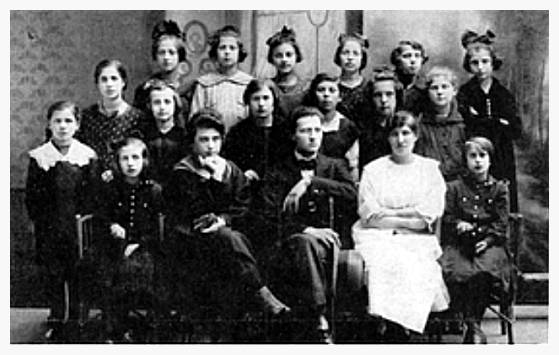 |
| A class at the Jewish elementary school named for Berek Joselewicz
The teachers (from the right): Mrs. Tanenboim, Chaim Krajndler (the principle), Mrs. Bogdanska |
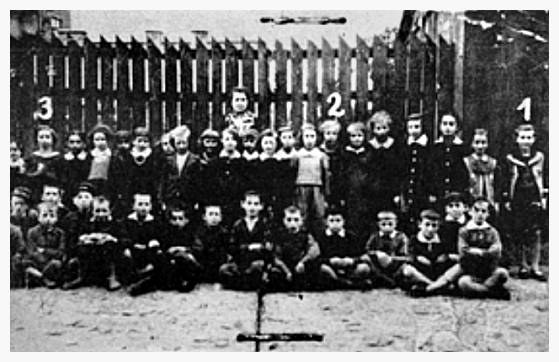 |
| The Jewish-Polish Public School, named for Adam Mickiewicz. The government elementary school for Jewish children (the teachers – Polish). Of all the children photographed here, only the three marked survived. 1 Helinka Priz (in Buenos Aires); 2 Genia Fajgelman-Bradac (in the USA); 3 Sara Gelsztajn-Lion (in Israel). |
by Dr. Michal Gonszerowicz
Translated by Sara Mages
With the commemoration of the path of suffering, the names and memory of the
Jews of Radomsk, who were brutally murdered and buried in unknown mass graves,
it is also necessary to mention the Jewish sports activists of HaKoach [The
Strength], Hapoel [The Worker] and the Bund movement, who managed
to gather around their organizations the most active youth circles and fought
on the sports fields for the Jewish honor and in the name of human and national
values.
The most vibrant organization was HaKoach. The first members of this organization were young boys who secretly began to exercise and to organize out of a desire to reject the concept of “inferiority feeling,” which pulsed among the Jewish youth. On their own, without any financial help from the public, the young men of HaKoach left for the sports fields dressed in blue and white to compete with the Polish teams. Who among our townspeople does not remember the strong and proud young men, members of HaKoach – Dudek Sandomirski, Moshe Goldberg, Koniecpolski, Wilman, Fishel Heftler, Moshe Pzyrowski and others. Moshe Goldberg and Dudek Sandomirski were the permanent representatives of HaKoach on the city's sports team.
The heyday of HaKoach was in the years 1930-1938. The organization's chairman at the time was the dentist Yosef Gil, a man of extraordinary energy who managed to attract most of the youth to him and served as a popular teacher-educator in the sports fields. Mr. Gil also managed to expand the circle of activists around him. He added Dr. Wajnapel to the organization's leadership and broadly formed the organizing committee, which included: Ignatz Goldberg, Okrent, Henrik Cukerman, Eduard Lofer, Michael Gonszerowicz (secretary), Leib Bugajski and others. In addition to the football section, which existed before, there are also teams for tennis, table tennis, athletics, football and hockey (ball on the ice).
The Jewish public as a whole was often moved when the HaKoach soccer team won first place in the city championship, in the finals held at the stadium in CzĠstochowa. Our HaKoach was one of the outstanding Jewish teams in Poland and the names of its footballers were well known to the Jewish and Polish public in many cities. I still remember well several important victories of HaKoach, such as the CzĠstochowa team Korona (2:1); against the Piotrków champion team Concordia (3:1); against the Tomaszów champion team Lech, and more. Our team also played against Polish premier league teams Wisla and Grabarnia (from Krakow), Polania (from Warsaw) and also participated in international matches against Vac from Vienna and against Hapoel from Eretz Yisroel (7:4). HaKoach was the basis for the Radomsk municipal team. It caused a pleasant surprise to the Polish Jewish public by beating the Polish garrison group in CzĠstochowa. led by the goalkeeper of the Polish national team - Czyk (2:1).
The following members of HaKoach played regularly on the municipal team: Max Rodal (Motek), Klajnerman (Pitel), Lewkowicz (Marek), Michalow Gonszerowicz (Kwak), Herc Hirsh (Kovel). Among the brave and good players of HaKoach, the following should be mentioned: Heptel, Szwarc, Mandele, Lipszic, Koziol, Fiszman Shlomo, Leiba Lulu, Avraham Berliner, Yankaleh Dawidowicz, Shaya Koyntski, Yosef Goldberg, Rodal Machek, Bruno Rodal, Berek Gotlib. During his service in the Polish army in CzĠstochowa, Klajnman (Pistek), the successful player of HaKoach, was in addition to the goalkeeper Keszik (from the national team) a very important factor in the well-known military team. He was very dangerous for the best goalkeepers in Poland and participated in the second national team of Poland.
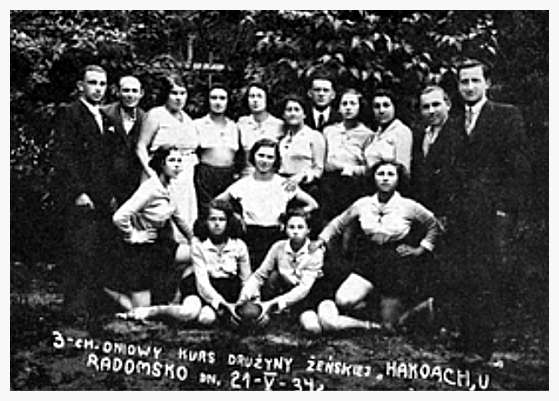 |
| The women's section of HaKoach in 1934.
The women's team next to HaKoach during a three-day course (1934).
The women's team next to HaKoach during a three-day course (1934). The teachers (from the right): Mrs. Tanenboim, Chaim Krajndler (the principle), Mrs. Bogdanska Together with the sports organization's activists. Standing (from the right): Yitzhak Goldberg, Hershel Cukerman, Medzia Wigodski, Kopel Bialystok, Mania Bugajski, Zorski, – , P. Ler, Mila Goldberg, Dorfman, Tajchner Second row: Gliksman, Najmark, Roma Warszawski Below: Gliksman, Ruszka Zajdman |
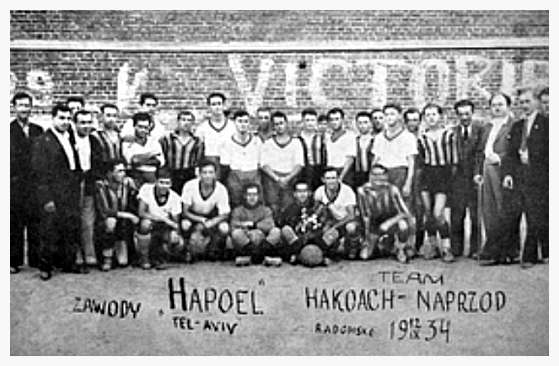 |
| HaKoach Radomsk vs. Hapoel Tel Aviv, 12 September 1934 |
Honor to the memory of the young men of HaKoach and the Jewish athletes from all the sports organizations that existed in our city before the Holocaust who were not allowed to continue doing so in the liberated and independent Eretz Yisroel.
|
JewishGen, Inc. makes no representations regarding the accuracy of
the translation. The reader may wish to refer to the original material
for verification.
JewishGen is not responsible for inaccuracies or omissions in the original work and cannot rewrite or edit the text to correct inaccuracies and/or omissions.
Our mission is to produce a translation of the original work and we cannot verify the accuracy of statements or alter facts cited.
 Radomsko, Poland
 Yizkor Book Project
 JewishGen Home Page
Copyright © 1999-2026 by JewishGen, Inc.
Updated 19 Jan 2026 by LA