 |
|
|
[Page 195]
by Eliezer Eliner
Translated by Moshe Kutten
Edited by Barbara Beaton
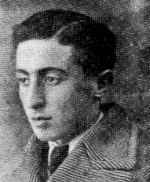
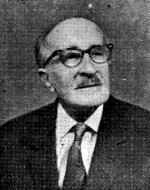
Among the survivors of the German extermination camps in World War II, there were many who were worn down and crushed, broken and shattered, with no strength or spirit left to do anything for themselves, let alone for the community with which they were bound and the companions to whom they had clung. Like a gleaming pearl amid the worn dust, Avraham Bernholz stood out in the “Torah and Labor” group in Abbiate (Abbiategrasso near Milan, Italy). Despite his bereaved and widowed fate, like the fate of all members of the “Surviving Remnants,”[1] he raised his spiritual stature, put to use the knowledge acquired in his earliest years and the thoughts formed over the course of his life, and became the cultural guide of his group, without needing that title to be conferred by appointment from above or by election from below.
He conducted lessons in Hebrew, teaching Dinim, Mishna, and Gemara to each student according to their needs and abilities. He inspired those around him to think deeply, clarify problems, and plan for the future. His role as a stimulating force within his group may have delayed his Aliyah to Eretz Israel for some time. When many of his friends were sent to Cyprus after being caught by the British on “illegal immigrant” ships, he joined them there and once again became a central and galvanizing figure in his new community.
When he was fortunate enough to finally make Aliyah after the establishment of the State of Israel, he was elated, walking as if in a dream.
He and the family he established in Israel faced many hardships, which eventually forced him to leave work earlier than planned and settle down in a nursing home with his wife, may she live long. Even there, his remarkable personality and spirituality stood out, profoundly influencing those around him. On the 11th of Adar, 5735 (1975), he passed away, and all who knew him mourned deeply.
Translator's Footnote:
by Ben-Zion Friedman
Translated by Moshe Kutten
Edited by Barbara Beaton
|
I was born in the town of Łopatyn on January 14, 1891. I have a deep understanding of the past 150 years of my town's Jewish history, drawn from reliable sources and my own experiences living there. Historically, a small Jewish community was present in Łopatyn even earlier than that. The Jewish residents engaged primarily in trade and acted as intermediaries between the Jewish community and the court officials of Graf Zamoyski or the town's non-Jewish population. My great-grandfather Itshele Friedman served as a loyal treasurer to Graf Zamoyski. He was fluent in both German and Polish and was therefore considered an educated man with a broad range of knowledge.
Several key institutions existed in the town, including a court, jail, post office, pharmacy, and elementary school. Following the initiative and guidance of Reb Itshele, the Graf constructed about 30 tiny houses and shops for the Jewish residents. Over time, these buildings became the city center along with the state government, court, and customs house. In addition to the town itself, the jail also served neighboring towns such as Toporów, Stanisławczyk, Shtervitz [Szczurowice], Strzemilcze, and dozens of surrounding villages. Every Wednesday, a large market day or fair was held in town. Gentile farmers from the area would bring their agricultural produce to sell while the Jews purchased everything they could lay their hands on and sold their own products to the farmers. A few Jews, primarily merchants and some farmers, resided in nearby villages. These Jewish tenants leased estates including liquor distilleries and wineries from Gentile landowners. The Gesthalter, Kardiman, Rappoport, and Shatz families were among the notable leasees. Many Jews were employed at these estates working as treasurers, business managers, and skilled artisans.
[Page 197]
During that period, the Graf also constructed several industrial facilities, including a flour mill, a sawmill, and other factories. These plants were managed by Jewish professionals, some of whom were described by the writer and Łopatyn native, Asher Barash, in his book Pictures from a Brewery and in other articles. At that time, there was neither a rabbi nor a ritual slaughterer in the nearby town of Stanisławczyk. The area's rabbi was our relative, Rabbi Yitzchak Leshchower, who also served as the rabbi in Łopatyn. For some time, the rabbinical judge was the grandfather of Avraham Bernholtz, Rabbi Yehuda Bernholtz. After his passing, the question of who would serve as the next rabbi arose.
During this time, the town continued to grow. The Jewish population became divided into two sects: the Belz Chassidim and the Husiatyn Chassidim. Each sect held separate prayers. As the community expanded further, the need arose to end its reliance on the nearby Stanisławczyk community and hire its own rabbi and ritual slaughterer to serve the town. They appointed Rabbi Mendel Leshchower, the son of the Rabbi from Stanisławczyk, as the town's rabbi and my maternal grandfather, known by the name Reb Yosel Shochet (Yosef Wilder), as the ritual slaughterer. The community also established a cemetery in the town. Previously, Łopatyn's residents had to transport their deceased to Stanisławczyk, approximately nine kilometers away for burial. This journey was not an easy endeavor in those days. To capture the challenges they faced, they used the Yiddish saying “Stanislavchik bagrabet Łopatyn” meaning “Stanisławczyk buries Łopatyn”. In 1914, Rabbi Leshschower left Łopatyn to move to Lwów, and Łopatyn was left with only one rabbi: Rabbi Chaim Leibish Hemerling, a Belz Chassid.
When the community brought Rabbi Leshchower from Stanisławczyk to Łopatyn, the Belz Chassidim disapproved. They were unwilling to accept a Husiatyn Chassid serving as their rabbi and wanted to appoint an additional rabbi who was a Belz Chassid. However, the community could not afford to support two paid rabbis. The earnings of a rabbi and a ritual slaughterer were modest to begin with. Approximately 40 percent of their earnings came from ritual slaughtering and selling Shabbat candles, raisins and yeast for challah. Nevertheless, the Belz Chassidim would not back down. A sharp and prolonged conflict ensued, sadly ending with the death of a local resident. This tumultuous period in Łopatyn became known as the “Period of Controversy” and I prefer not to dwell on it in detail. Eventually a compromise was reached: the Belz Chassidim would be allowed to bring their own rabbi, but the community would not be financially responsible for him. My grandfather, Reb Yosel, continued to serve both factions. The Belz Chassidim appointed Rabbi Chaim Leibish Hemerling from Shtervitz as their rabbi. He was a clever individual and a learned Torah scholar. Many years later, when my grandfather, Reb Yosel Shochet, passed away, the possibility of conflict over a successor arose anew. Fortunately, my grandfather designated his son, Reb Elazar, my maternal uncle, to succeed him. He was a good-hearted man and well respected by the entire town. Only thanks to his character did the matter end well. Two arbitrators were chosen to help resolve the situation: Reb Wolfzi Kaufman represented the Belz Chassidim, while my father, Reb Shalom Shechna Friedman, represented the Husiatyn Chassidim. An additional review of this matter took place in Brody ultimately resulting in the confirmation of Reb Elazar Wilder as the town's slaughterer and kosher inspector.
[Page 198]
Over time, passions calmed down, and a certain understanding between the two factions was established. A new generation arose, for whom the Chassidim's quarrels were contrary to their nature. More modern-thinking individuals with broader perspectives found a common language, and the town's conflicts subsided.
In this town of Łopatyn, Asher Barash, the famous author and poet, was born. He was two years older than me, and his home was close to mine. We studied together at the cheder of Reb Shechna. Asher excelled in his studies, possessing a phenomenal memory and impressive learning ability. However, outside of the cheder, he often behaved wildly and mischievously. One Shabbat when we were playing near a house that was under construction, he lost his footing and broke his leg. The local physician, Dr. Rosenbaum, did his best to mend the injury, but his efforts were only partially successful. That event left a mark on Barash that would last for the rest of his life. He had to stay home for two years and could not interact with other children and people outside. Only after two years did he manage to venture outside with a walker. Asher's father, Herzl, was a respected and learned Jew who served as cantor in our kloyz. Herzl took the time to teach Asher the Torah so he would not fall behind in his studies.
At the same time–a few years before the First World War–the first Zionist association named “Hatikvah” [“The Hope”] was established in Łopatyn with Asher among its founders. The founders faced numerous challenges as Belz Chassidim did everything in their power to disrupt the formation and operation of the association. Children who dared to visit that association suffered severe consequences including physical punishment, a lack of food, and expulsion from their homes. The windows where the association was housed were frequently broken. To the Chassidim, anything associated with Zionism was considered unacceptable, and they attempted to prevent the association's existence by any means necessary.
Another notable resident was Hanoch Yalon (Hanoch Distenfeld). He is recognized as our time's leading linguist and Talmudic researcher. S. Y, Agnon referred to him as “our language's greatest linguist” in his article Mishmana Ha'aretz” [“From the oil of the Holy Land”], which is included a the book about Hanoch Yalon, “Chacham Leshonenu B'dor” [Language Expert of Our Generation]. He is known for researching the vocalization of the Mishnah, and he published many books about the science of the Hebrew language. Hanoch's parents were Reb Avraham Distenfeld and Sara (née Wilder), my mother's sister. He is a part of a large and extended family. Hanoch's brother, Dov, who passed away in Jerusalem in 1965, was also a distinguished scholar. He possessed vast knowledge of the Torah, and his understanding of the Talmud was remarkable, enabling him to tackle Talmudic halachic issues that many prominent scholars found challenging. Their nephew, Akiva Distenfeld, who also passed away in 1965, was one of the heads of the National Library in Jerusalem. Mordechai Yalon, may he live long, is another brother of Hanoch and Dov.
In Łopatyn, people recalled that the town's rabbi, Reb Chaim Leibush Hemerling, once admonished Hanoch to abandon his “childish games” and his interest in Zionism, encouraging him instead to study in the beit midrash and continue in his father's footsteps as a Belz Chassid. Hanoch responded: “When it comes to the Torah and Talmud, I am confident in my knowledge,” and he challenged the rabbi to test him. The rabbi agreed and began testing the youngster. Hanoch impressed the rabbi with his knowledge and proficiency, prompting the rabbi to remark that a learned youth like Hanoch deserved to be respected.
[Page 199]
In 1907, elections were held for the Austrian Parliament in Vienna. In our Brody district, Adolf Stand, a prominent Zionist leader, was a candidate. However, the Polish National-Democratic Party (Endeks) chose to support Marian Wohlerner, an assimilated Jew who had become estranged from his community. Despite Wohlerner's wealth, which the Poles had hoped to use to sway Jewish voters, Adolf Stand was ultimately elected. Stand received significant support from the Belz Chassidim, mainly under the influence of the local Jewish youth led by Hanoch.
Henryk Suchestów, a Jewish man with a consistently nationalistic orientation, purchased the Łopatyn estate from Graf Vishinski. His treatment of the officials and workers at the estate was consistently fair. All the officials who worked at the estate retained their positions. Overall, the entire Jewish community greatly benefited from the Suchestów family, which was known as a good and loyal Jewish family.
With the outbreak of the First World War in 1914, the entire area around Łopatyn was seized by the Russian military. I spent the war years in Hungary and managed to avoid being conscripted into the Austrian military. Upon my return to Łopatyn in 1919, I found Suchestów managing the estate on his own, and many Jews earned their living working there. The Roman Catholic priest Shafranski owned a 500 Morgens [1 Morgen= about ¼ hectare] estate. He had friendly relations with Suchestów and maintained a fair and friendly attitude toward the Jewish community. He also employed several Jewish workers.
Mr. Suchestów appointed me to manage his winery. He also requested that my younger brothers, Chaim and Yosef, learn the trade to ensure a smooth transition of the winery's management for when I would eventually leave. As a result, my brothers secured employment until the outbreak of the Second World War.
After I married, I moved to Rava Ruska but returned to Łopatyn during the Soviet regime. When the Ukrainians sensed that the Germans were likely to arrive soon, they dressed in their holiday clothing, celebrated, and waited for the Germans while holding bouquets of flowers. As soon as the Germans entered, the Ukrainians took the lead, and along with some Volksdeutsche, attacked the Jews, and the torture and troubles began. They came to our house looking for alcoholic beverages and liquor. Our cellar had been flooded with rainwater, but the Germans suspected that we had intentionally flooded the cellar to hide the liquor. They attacked my father and me, striking us with brutal blows. We were taken to a military court (Reichskriegsgericht), where we were sentenced to death. In the meantime, my sister managed to reach out to a Volksdeucher named Fitz, who had remained in the town since the First World War. He was a good friend and acquaintance of our family. My sister told him what happened to us, and he ran to the court to testify on our behalf. He told the Germans that we were a quiet and productive family and that our skills in winemaking and distilling spirits could benefit them.
[Page 200]
Thanks to him, the Germans released us the same day. When my father and I stepped out onto the street, we lost consciousness and collapsed on the pavement. I spent weeks on my deathbed because of the injuries I sustained that week.
A Gestapo officer by the name of Roth arrived in the town and took control of the fate of the Jewish population, deciding matters of life and death. He organized a Jewish militia and appointed Subotsky as its leader. The Germans also established the Judenrat, the Jewish council, and Shaul Reif was appointed its leader. Moshe Zimitsker became the commander of the Jewish police force. Horrific persecutions began. The Jewish residents–young and old alike– were forced to perform strenuous physical labor from seven in the morning till seven at night, all while being supervised by the Germans. A severe shortage of food products transpired, leading to hunger in some areas. The Jewish population resorted to bartering with the local Gentiles, trading clothing and linens for small amounts of food. Clearly, the Gentiles benefited the most from those deals. However, a few Gentile farmers who had good relations with Jewish residents continued to support some families secretly.
My wife, Reitza z”l went to visit her mother in Rava Ruska and on her way back to Łopatyn, she stopped to visit my cousin, Wolf Friedman, in Lwów, expecting to stay for a few days. Unfortunately, the war between Russia and Germany broke out just then forcing her to stay in Lwów. The city was experiencing heavy artillery bombardment. During a brief pause in the shelling, she went out with my cousin and several other residents to get water from a nearby pump. However, they could not return; the bombardment resumed, and a bomb fell nearby killing my cousin and five other residents. My wife Reitza suffered severe injuries. That incident happened on the 3rd of Tamuz, (June 28th) 1941.
My cousin's wife notified me about the disaster so I sent a Gentile from Łopatyn to bring my wife home. He managed to bring her, disguised as a Gentile, in his cart. Had she been discovered as a Jew, she would have been killed on the spot, and certainly they checked identities of the travelers several times during the trip. My wife arrived in Łopatyn in very poor condition. There was neither a physician nor medications available, and no one knew how to care for her. Additionally, we had to keep her injury a secret since the Germans murdered all the sick people that were known to them. Therefore, she suffered both physically and mentally, and we were powerless to help her.
My wife, Reitza (née Graf) from Rava Ruska, tragically passed away on Sunday morning, the 23rd of Av, [August 16th] 1941. She was the mother of my son Yentzi z”l, who was also a victim of the Holocaust. He was killed at the young age of 19. My wife was also the mother of my dear daughter Rosalie, may she live long, who survived the horrors along with me.
A Ukrainian named Nomirko managed the distillery for the Germans. He demanded that the Judenrat provide him with workers for this factory. On one occasion, he ordered eight workers
[Page 201]
to grind malt using a manual grinder. This task is one of the most strenuous possible. Even worse, he took Jewish laborers to clean canals, sewer ditches, and a small river near the distillery. The workers were forced to enter the dirty, deep stream fully clothed and to sift through the mud and filth with their bare hands while a militiaman with a whip lashed at them continually. It was not a type of work that brought respect to a worker but rather was a symbol of the worthlessness and humiliation of a Jewish individual whose life became prey for prey animals.
One day, Nomirko arrived at the distillery with a Gestapo officer to show him how he employed the Jewish workers. He opened a sack of ground malt and discovered a dead mouse inside. This triggered a furious outburst of yelling and cursing. The Jewish workers fell to their knees, pleading mercy and insisting it was not their fault. However, their pleas fell on deaf ears. The workers were brutally beaten, arrested and thrown into a cellar. As evening fell, Nomirko appeared and told the eight imprisoned workers that he would release them if they gave him 200 zlotys. The prisoners collected the money with great difficulty. Once the zlotys was handed over, the eight were released and they fled as quickly as possible.
A “sheigetz” [a Yiddish name for a Gentile youth] from the town told Gestapo officer Roth that my two brothers, Chaim and Yosef, had cursed him and called him a German pig. Roth did not fully understand what the boy had said, so he called over some Volksdeutsche for clarification. Immediately the trouble began. The Gestapo officer arrived at our house with a pistol, threatening to kill the entire family if we did not bring my brothers to him. I tried to explain to him that the accusation was nothing more than a false claim, but once again my words fell on deaf ears. The situation became dire. He gave us a deadline of four o'clock in the afternoon at which time my brothers needed to appear before him for punishment. I told him my brothers would know what awaited them and would likely run away. However, I offered to accept the punishment in their place. That's when the truth came to light. Roth said that if we gave him 100 zlotys, he would forgive them. This was predicated on the condition that the entire matter stay a secret or our lives would be at risk. I managed to gather 60 Zlotys with tremendous difficulty and handed it over to him. He was satisfied with that amount, and that was how we were saved for the second time.
Our situation worsened by the day. The Germans began to cut the beards of Jewish men. They just plucked the hair from my father's beard until he bled. We experienced a shortage of food and Jews paid a high price for a dry piece of bread or a few potatoes. Some farmers, especially the older ones, felt pity and secretly supported a Jew here and there. But the young shkotzim [plural of sheigetz] caused a lot of trouble, harassing every Jew. They threw dog and cat carcasses into the wells of the Jews to prevent us from drinking the water. Very young Gentile boys used slingshots to shoot little stones into the eyes of Jewish children, and in one instance, a Jewish boy - the son of David Satz, lost an eye.
In one instance, Gestapo officer Roth caught two Jewish boys, Frankel and Gottlieb. He beat them severally for no reason and ordered them to crawl on their hands
[Page 202]
and knees through sewer ditches and under all the small bridges, in mud and filth all the way to the cemetery–a distance of a few kilometers. With every raising of their head, they received a whipping. At the cemetery, Roth killed Gottlieb–the cousin of the Nisyahu brothers in Haifa–and Frankel was forced to crawl from the cemetery back to town. Fathers, mothers, brothers and sisters witnessed that barbaric event with sorrowful hearts and eyes weary with tears. Here and there, even some Christians shed a tear. One Pole, who lived not far from the cemetery, photographed the shot fired at Gottlieb from his window. I saw the picture when I returned to the town after my liberation from the Germans.
The cold weather began to set in as November came to a close. On Friday morning, Roth ordered all the town's Jewish residents to gather at the distillery yard. The members of the Judenrat did their best to collect Jews from every corner they could reach. Some people managed to hide; other people were kidnapped and brought to the gathering place. My brother and I had licenses as distillery workers so we were not obliged to show up to that gathering. After everybody gathered, an order was given: “All Jews must take a bath”. Under the threat of Roth's gun, the Ukrainian Police and the Jewish militia commander, Moshe Zimitsker, the Jews were forced to enter the water basin by the distillery. It was like a game. Nomirko held a pistol and yelled: “Filthy Jews to the Mikvah for Shabbat!” They kept the Jews from morning till evening on a cold day in filthy water. People began to lose consciousness. Roth gave orders to remove those people and lay them on the bridge above the water. They didn't release everyone until the evening, and the people arrived home faint, humiliated, beaten, dirty, and barely alive. Over the following days, some Jews died as a result of that Aktzia.
A fair was held in Łopatyn's market square every Wednesday. One day, after the fair ended, Gestapo officer Roth ordered Leizer Wilder, also known as Mazor, to draw water from the well and water the horses returning from the fair. Leizer complied for a while but eventually grew tired of the task. He mustered the courage to tell Roth he no longer wanted to carry water. In response, Roth slapped him across his face. Without hesitation, Leizer retaliated, striking back at Roth. The German fell to the ground, and while trying to regain his composure, Leizer took the opportunity to escape. In an unexpected turn of events, Roth, the German “hero,” stood up, turned around, and left without asking which Jew had hit him. Remarkably, the whole incident went without any further response. A deep fear gripped Leizer's family, but no harm came to them. To this day, I wonder why the German did not respond to the confrontation.
The winter of 1941/42 was particularly harsh for the Jews. Slowly and gradually, all Jewish property was transferred to the Gentiles. Desperate, the Jews were forced to trade everything they owned for a mere piece of bread. While the kidnappings of Jews for forced labor stopped, new dangers arose as Gentiles–often from the lowest strata of society–formed violent gangs. Under the cover of night, these gangs would attack, rob and beat Jews. No one intervened to stop them.
A year passed under German rule.
[Page 203]
The Jews were forbidden to leave town, and anyone caught disobeying the order faced the death sentence. To help those in need, we established a soup kitchen that benefited many. Some Jews who could still afford it supported that initiative and even some Christians secretly contributed. They brought some potatoes, peas, and beans. People in need could take the food home or eat it at the beit midrash. However, this situation did not last long, as the Aktzia began shortly afterward. It was close to Rosh Hashanah in 1942 when men, women, and children were taken to Belzec. Shortly thereafter, on the first day of Chol HaMoed of Sukkot, the final annihilation of the entire Jewish population took place. About 200 Jews from Łopatyn were taken to nearby Radekhov and from there to Belzec. Thanks to the work permits for distillery workers, my children, brothers, sisters, and I were saved from that Aktzia. After the Aktzia, members of the Judenrat came to my house and ordered us to leave because our apartment was set to become a government office. Through Mr. Fitz, we received permission from the commander to move my entire family to the house at the distillery. My parents, two children, two brothers, two sisters, and I relocated there.
After the expulsion and the extermination of the town's entire Jewish population, a German named Langen came to see me. He said he could no longer protect us. According to his information, the Germans were planning to take us in the coming days, and he advised us to do everything we could to hide. We took his advice and built three bunkers within the distillery house. One bunker was designated for my parents and two sisters, the second bunker was for my children and me, and the third bunker housed my brothers and the fiancée of one of them. A few days later, I observed, through a hatch in the bunker, that the “Volksdeutsche” Lipa and the Jewish militia policeman Sonsky were examining the yard and the field of the plant. I realized they were searching for us. They found the bunker where my parents and sisters were hiding. The rest of us managed to survive that search. That confirmed that they would continue searching for us and were likely to find us. When nobody was watching, we left the distillery and hid in a field with swamps and reeds. We could hear gunfire and the sounds of their searches, but they did not find us. Once the area became quiet, we headed toward Stanisławczyk, about nine kilometers away.
That town was part of the Brody district and had yet to become Judenrein [free of Jews]. For us, covering that distance felt as difficult as the “parting of the Red Sea”. The Styr River flowed near that town, and in order to reach the town, we needed to cross a bridge. One option was to go through a Ukrainian village, which we were afraid to do. Another option was to go through the fields, but that posed the risk of sinking into the swamps. A group of us, including one of my brothers, my children, and me, approached the river only to find out the water was too deep. Suddenly, we heard the sound of a wagon and realized that we must be close to the bridge. We crawled toward the bridge, fearing the worst, but we crossed it safely and finally arrived in the city at night. We encountered a Jewish man returning home from the synagogue on the eve of Hoshana Rabbah [a holiday on the seventh day of Sukkot]. He guided us to the local Judenrat. The character of the Judenrat in Stanisławczyk was completely
[Page 204]
different than that of Łopatyn. The man who was a member of the Judenrat brought us to his home, and there we found about 20 Jews from Łopatyn who had escaped the Aktzia. The following morning, we ate breakfast at the Judenrat member's home. He offered us encouragement, assuring us that in Stanisławczyk, we would have less fear. He mentioned that the Jewish militia was not as cruel, and he would assist us in finding a place to live. The name of that Judenrat member was Elazar Halpern.
On Shemini Atzeret [a holiday celebrated the day after Sukkot], Elazar went to pray at the beit midrash. He mentioned that he would arrange for proper apartments for us when he returned. Later, he asked if we had a young boy among us. He planned to send the boy to live with the leader of the Jewish militia, and the leader would protect him from the Germans. “We will need to give the militiaman something in return,” Elazar said. I offered to give him a good fur that I had hidden with a Gentile in a neighboring village. The militiaman's wife came to take my son and took the fur with her. My son, Yaakov, stayed at the home of the Jewish militia's commander in Stanisławczyk for several weeks. In the meantime, an Aktzia against the Jews took place in Stanisławczyk though it was not as brutal as what had occurred in Łopatyn. When the Judenrat found out about it, its members went from one house to another at night and warned the Jews about what was going to happen. Many Jews left the town that night to hide in the neighboring village of Pankova, or in the surrounding forest. The village farmers, who likely had good relations with the Jews, provided them with food and other necessities. In that forest, I encountered two Gentile farmers who later saved me from certain death. After this Aktzia, it was decided [by the Germans] that Stanisławcyk should become Judenfrei by the 30th of December of that year, and they planned to move the remaining Jews to Brody.
My parents along with one of my sisters who were moved to Radekhov, miraculously survived there and were not taken to Belzec like the rest of the Jewish community. I learned about their survival from the neighboring farmers. I asked one of them with whom I had hidden a sewing machine to bring my parents from Radekhov to Stanisławczyk. In exchange, I gave him the sewing machine. He brought my parents [and possibly my sister] on Friday just before Shabbat. The following morning, we were all transferred to the Brody ghetto.
A few days before the expulsion from Stanisławczyk, I visited Brody to search for a hiding place. During my visit, I met a boy named Froike Singer who used to work as a locksmith at the distillery in Łopatyn. His brother was a policeman in Brody. Thanks to these connections, I was able to secure a suitable apartment. Before returning to Stanisławczyk, a partial Aktzia took place in Brody. They caught Jews in the streets, including me. In total, 80 Jews were apprehended by the police. The Gestapo took us outside the city into a grove and ordered us to dig ditches. We worked all night. The following morning, they commanded us to strip naked and pack our belongings and clothes. Amidst the sound of gunfire, we jumped into the ditches. I was one of the first to leap into a ditch,
[Page 205]
and fortunately none of the bullets struck me. However, the people who were shot fell on top of me, burying me beneath them. I lost consciousness and remained unconscious throughout the entire day. I regained consciousness in the evening and wanted to get out of the ditch, but I realized I could not do it alone. Miraculously, five other people– three women and two men–had also survived. I yelled for help, and they assisted me in getting out of the ditch. In total, there were six survivors. Later, I managed to find the clothing I had previously packed.
We did not know where to turn or where to go. In the distance, we saw a fading light and decided to go in the direction of the light. We arrived at a tiny house where a lonely woman, a farmer, lived. She was afraid to let us in her home but did us a favor. She milked a cow very quickly and gave us milk to drink. The five survivors returned to Brody, while I wanted to return to my family in Stanisławczyk. With the help of the woman farmer who showed me the direction to take, I found my way there.
To avoid causing panic in Stanisławczyk, I did not tell anyone what happened to me in Brody. Later, we all moved to Brody and settled into the apartment Froike Singer had arranged for me. We were subjected to forced, hard labor and endured suffering and torture. Hunger had taken a significant toll on the people. I received some assistance from the Gentiles in Łopatyn who secretly brought us some food, even traveling the distance to Brody [about 30 kilometers]. This was possible thanks to the good relationships I had maintained with them and the property I left with them in Łopatyn.
This situation lasted until the Aktzia that took place on May 21, 1943. Rumors circulated in the ghetto that many Gestapo officers and Ukrainians had arrived in the city along with empty freight train cars. We realized that an Aktzia was imminent, and it was possible that the Germans would declare Brody Judenrein. In response, we arranged bunkers within the house and found a small cellar to hide in, settling there for protection.
The gunfire began on Friday morning, marking the start of the Aktzia. In our apartment building, there were two other bunkers, but the Germans discovered them and captured everyone hiding inside. Fortunately, the Nazis did not find our bunker, which sheltered 29 people. The Aktzia continued – day and night – from Friday till Monday morning. Our house was located on the main road, so we heard the cries and wails of the oppressed and beaten people outside being taken to their deaths. Unfortunately, two elderly individuals and a young child died in our hideout due to poor sanitary conditions and the accumulation of filth.
When calm returned to the street, I was finally able to emerge from the cellar to see what was happening outside. The street was deserted, and a deep silence enveloped the town. I returned to the cellar, bringing a pail of water with me. We had stored coal and kerosene in the cellar in advance, preparing for the possibility that the city would be declared Judenrein. If that were to happen, our fate would be sealed and we would take our own lives rather than be captured by the Germans. My daughter, who was 14 at the time, did not agree with that decision under any circumstances. As evening fell, she climbed out of the cellar with me. After that, the rest of the people slowly came out as well. Besides my daughter and me,
[Page 206]
my two sisters and one brother were also in the cellar. My son was no longer with us as he had been captured earlier and sent away. We decided to cross the barbed wire surrounding the ghetto in pairs rather than all together. My siblings headed toward the forest while my daughter and I lost our way. Suddenly, we realized we were approaching the Brody train station so we decided to turn around and head toward the forest. A vehicle loaded with German soldiers passed by, but no one stopped us. As we neared the forest, I raised my voice and began calling out my siblings' names, but my calls went unanswered. I never saw them again. I learned about their fate later on.
While we were walking in the forest, my daughter and I spotted a man walking in the distance, and he also noticed us. Although we were all afraid to approach each other, we eventually met. It turned out that he was a Jewish man from Brody named Kwachke who also escaped from the ghetto. We continued walking together throughout the night and reached the village of Berlyn at dawn. However, we were afraid to enter the village so we temporarily hid in a wheat field. The tall stalks provided cover so that we could lie down and rest without being seen. Later a farmer who owned the adjacent field arrived with two mules and a plow to plow his field. He had a dog with him. We felt powerless and unsure what to do. The farmer did not notice us, but his dog came over several times, sniffing around, and then returned to the farmer without barking. We knew that if the dog had barked, it would have undoubtedly led to our discovery, and we had no idea how the farmer would react.
We lay in the wheat field all day before continuing our journey. The Gentiles noticed us and began to shout: “Here are the Zhids running away.” Fortunately, we managed to escape and reached the vast forest that extended almost all the way to Stanisławczyk. We approached the town in the morning, but as soon as we arrived at a familiar part of town, we began to get confused. The town's appearance had changed; the Gentiles had begun to dismantle the wooden houses of the Jews for fire wood or construction. Unsure of how to reach the bridge, we decided to follow the river. As we approached, we noticed a flickering fire at the edge of the bridge. I suspected that the bridge guard lit the fire. With daylight approaching, we knew we had no choice but to cross the bridge. Indeed, a German soldier lie sleeping at the edge of the bridge with his rifle resting beside him. The bridge was 100 meters long, and when we crossed we saw a bonfire, and near it, another sleeping German soldier with his rifle by his side. My daughter, Kwachke and I quietly passed him, and from there, it was just a short distance to the Pankova Forest. Hunger was a constant torment for us. We had not eaten for several days. We wanted to drink water from the river, but the water was polluted and contaminated, teeming with vermin, worms, mosquitoes, and more. With no other options, I took off my hat, filled it with water, and the three of us drank from it as if it were a filter.
I knew the forest well. We rested a bit. First, we needed to find some food.
[Page 207]
I decided to turn to Turkowski, the farmer from the village of Pankova, who had previously brought food to us in the forest. I left my daughter and Kwachka behind and walked toward the village. I knew that Turkowski lived on the far side of the village, but I was not sure where his house was located. I had to cross the entire village and occasionally ask the locals for directions. After some searching, I finally found his house, but he did not recognize me immediately. After I introduced myself, he welcomed me warmly. He made sure to secure the house leaving only one back door open so that I could escape if necessary. I washed and shaved while in his home. I drank and ate until I was full. Before I left, he packed a large sack of food, including bread, butter, and cheese. As I was heading out, he said: “You can come to me as often as you like, just not at night.” When I returned to the forest with the generous supplies and the news about Turkowski's willingness to help us, my daughter and Kwachka were overjoyed.
After several days of suffering and hunger, and after we finally had something to eat, the question arose again: “And what next?” We were located only about 8 kilometers away from our town, Łopatyn. We had a few Gentile acquaintances whose loyalty we could rely on and one of them was Ivan Bilyk. While Kwachke remained in the forest, my daughter and I decided to head toward Bilyk's house. We first needed to pass through the small village of Vyrki[?]. In the evening as we approached the village, we were surrounded by the village's shepherds. They decided to take us to the village and turn us over to the militia and the village leader. In the meantime, a few of them ran into the village to announce that they had captured Jews. Fortunately the village leader arrived, and he turned out to be Lisek, a friend from my youth who recognized me from our school days. He dismissed the farmers who had surrounded us and assured them he would turn us over to the militia, asking them not to intervene. Lisek guided us to the forest's edge and said: “Friedman, you are lucky to have found me. I cannot help you directly, but I can suggest you take another route to reach Bilyk. This trail here will lead you to his home.”
We returned to the forest and headed toward Bilyk's house the following day. It was quite a distance, and we did not arrive until nightfall. Not wanting to be let in at that hour, we slept on the ground outside and waited until daybreak to knock on the window. Bilyk's wife opened the window and told me my brother and sisters had been with them. She explained that Bilyk had taken them to his cousin's house because it was too dangerous for them to stay; the neighbors were malicious and could easily deliver them to anybody interested. I asked her for some food, and she handed me a loaf of bread. She warned us that we needed to leave immediately if we wanted to survive. After that, we returned to the forest and decided to come out only in the evenings. While staying in the forest, I heard gunshots not too far away. Shortly afterwards, I heard footsteps approaching. Upon closer inspection, I recognized Polni Stokl, the jail director's son who lived in our town. He informed me that my brother and sisters had been captured and were taken to Radekhov. He later confirmed my bitter suspicion about the reason for the gunfire.
[Page 208]
I suspected that the gunfire was connected to the deaths of my relatives, and Stokl confirmed my suspicion. He mentioned that he was headed to Golitski where he owned a windmill and that he would try to bring us bread. Later, he indeed brought us bread and a jug of water. After we parted ways, I returned to the forest with my daughter and returned to my neighbor, Kwachke.
Throughout our time in the forest, Kwachke held a package. I had no idea what was inside; I only assumed it contained something valuable. However, he lost the package and came up with a crazy idea. He blamed me for taking the package and hiding it with my Gentile acquaintances in the area so I could hide with them and leave him behind. My counterclaims were in vain. He refused to back down and, with knife in hand, threatened me. He demanded that I return the package or he would kill me. My daughter began to beg and cry until he relented and agreed to wait until the following morning. The next day, we searched in the daylight for the package and found it by a nearby tree. Kwachke broke down in tears and begged for forgiveness for his wild behavior. We understood his distress and forgave him.
We lived in a bunker that we built in the forest. We prepared meals using vegetables and potatoes that we gathered from the fields. We cooked those potatoes by lighting a fire, even in the winter snow. During the day, the fire was hard to see from a distance because of the fog in the forest. However, we were careful not to light a fire at night.
The liberation was approaching. My daughter, Kwachke and I, along with Leizer and another girl [who had previously joined us in the forest], lived in the bunker. One day, we felt that someone was moving above us. My daughter, who was very courageous and agile, poked her head out of the bunker to see who had just passed by. She saw two armed men, one of whom was carrying a tin suitcase. Fearing that these men or their comrades, who also might be armed, would return, Kwachke and Leizer, two healthy and strong men, took axes and hoes to search for a suitable location for a new bunker. I stayed behind with my daughter and the other girl. About half an hour later, we suddenly heard a command in Polish: “Get out of the bunker, we will throw bombs inside!” These men positioned the three of us, each by a different tree. They aimed their rifles at us and began to interrogate us. They asked for our names, where we came from, and other similar questions. We described our experiences to them. Afterwards, they ordered us to return to the bunker. One of the men stayed to guard us while the other two went to search for Kwachke and Leizer, as we had told them the whole truth. Immediately after that, we heard gunfire coming from the forest. It was so close that we thought the shots were directed at us. We were sure that our end was near, and each of us began to pray heartful prayers customary for such situations. The two men who went to search for Kwachke and Leizer returned in the evening. They pulled us out of the bunker and positioned us near trees again. However, this time they did not threaten us with their rifles. They said they were from the Russian “Rozviadka” [?].
[Page 209]
They also said they shot and killed two Jews in the forest. However, they blamed it on the Jews who began to run away when they were ordered to stop. If they had obeyed the order, they would still be alive. They made us promise not to tell anyone what happened. They instructed us to go back to the bunker because the Germans had surrounded the forest. We parted ways with a handshake, and they asked us to forgive them for killing two of our people. When we asked them for some food, they replied: “We eat snow. You should do the same. You can survive for a few days; liberation is near. Perhaps you will survive.” And then they left.
Late at night, we heard footsteps; it was Leizer. He explained that he and Kwachke had run away in different directions when they saw the armed men. Leizer did not know what happened to Kwachke, but he managed to survive the ordeal. When the gunfire erupted, he fainted and fell to the ground, lying in the snow until he regained consciousness. By that time, the two armed strangers were no longer in sight.
In the morning, we set out to look for Kwachke. We didn't find him and he didn't return either. It turned out that he died and we didn't discover him because he was covered by snow. All of that happened on Monday. Beginning on Tuesday and continuing through Friday, there was horrific and terrifying gunfire and bombardments between the Germans and the Russians. That marked the battle for control of Brody. The intensity of the battle sounds increased day to day. Trees in the forest fell due to the force of the air blasts. At night, the sky was horrifically Illuminated. We heard a tremendous explosion on Friday evening and the ground trembled beneath our feet. After that there was an unsettling calm and silence which was difficult to explain. We could hear voices in the distance, but we did not understand what was being said. On Saturday evening, Leizer and I decided to go see Turkowski or Mischko in order to find out what had happened. We were hungry and tired, and the walk was challenging, but we managed to drag our feet while bullets whistled overhead. Miraculously, we eventually arrived at Turkowski's house. We knocked twice on the right side of the window, our agreed-upon sign. Turkowski opened the window and said that he had nothing for us. “I ran out of everything, but I will give you some coals to keep you warm,” he said. He suggested we visit another Gentile named Kamitz, where we might find something we needed. So, we decided to follow his advice. We opened the gate to the yard and went inside. Suddenly, armed men rose up against us, yelling, “Raise your hands!” We became frightened, thinking these were the Banderovites”[1] who harassed and killed Jews. However, we quickly learned that these armed men belonged to the regular Russian army. The soldiers asked us who we were. When we answered that we were Jews from the forest, they invited us to enter the house. Noticing that we were tired and hungry, they offered us bread, water, and sugar and let us lie down on the hay in the corner of the house. I informed the commander that my daughter and another girl were waiting for us in a bunker in the forest, and I wanted to bring them to the house. He stated that the journey was dangerous at night and advised me to try to get them in the morning.
[Page 210]
He also mentioned that he would provide us with an escort. He said he would send us off after the girls arrived. The following day, accompanied by two officers, we arrived at the bunker. The joy of reuniting with the girls was immense. They had been worried about our safety and were afraid something terrible had happened to us. It was Shabbat evening, April 4, 1944.
We spent two days at the Russian headquarters. On Tuesday, I learned several officers were leaving for my town, Łopatyn. I requested permission to travel with them, and it was granted. Upon arriving in town, I visited a farmer who had stored some of our clothing for us. Suddenly, a rumor spread that the Germans were coming back. My daughter ran away without waiting for me. She left a note with one of our farmer acquaintances, explaining how she escaped and how to find her. Fortunately, the Germans–may their names be blotted out–did not return, and I reunited with my daughter a few hours later. The Russians sent me to Równe [Rivne], where I was appointed to manage a wine distillery. They returned me to Łopatyn three months later to fulfill the same role.
At the end of my story, I want to describe several additional experiences I had previously forgotten, and which I did not include in the previous chapters.
Many Jews took their own lives in the forests. The reasons varied: hunger, fear, losing the strength to continue suffering, a lice plague that wreaked havoc among these people, and more. For example, a man named Yehoshua Rawer and his wife hid in the forest. Their son now resides in Israel. Yehoshua was a wealthy Jew who surrendered his entire property to a Gentile so he could hide with him until the war was over. The Gentile held him for a certain period of time, but after acquiring all of Yehoshua's property, he did what many other Gentiles did. When winter came, he expelled the Jew, leaving him at the mercy of the Nazis. That was the grim fate of many Jews during that period. Tortured, hungry, and humiliated, many felt hopeless and chose to end their own lives. Rawer was a devout and God-fearing Jew. He wandered into the forest carrying his tallit and tefillin, and his wife brought along a “Korban Mincha” Siddur. One day, they walked to the cemetery in Stanisławczyk and dug a grave for themselves. They approached the local militia and asked to be shot in the grave because they were disgusted with their lives. Of course the militiamen granted them this tragic “favor.” Reb Yhoshua Rawer, covered with his tallit and tefillin along with his wife, lay down in the grave as a militiaman shot them. A Gentile named Shishka, an honest and kind-hearted man who saved many Jews on various occasions recounted the story to me. Moshe Waldbaum from Dymytrów, who also hid in the forest, confirmed that account.
When we were in the forest, we worried more about food in the summer than in the winter. In the winter, we ate potatoes, but during the summer when the days were long, we saw farmers working in the fields the whole day. Our fear of encountering them kept us from going out to gather potatoes. We hardly had any bread, and even the Gentiles sometimes suffered from occasional shortages. Once, while I was near a wheat field and was very hungry, I picked wheat seeds from the stalks and chewed on them. At the time, I did not feel a seed get stuck in my throat.
[Page 211]
Later on, two days before Yom Kippur, I started experiencing a choking sensation along with severe pain in my throat. My face swelled up, making drinking, eating, and talking difficult. The pain was so intense that I felt as if my end was near. My daughter brought several Jewish acquaintances to the forest to comfort me. If I were to die, God forbid, being that it was after the liberation, they assured me they would take my body to Łopatyn for burial. After receiving such “comfort,” I realized I needed to take action to prevent my death. I sent my daughter to Kamitz, the good-hearted Gentile who had helped us on occasion, to bring me a sewing sack needle. I then asked her to heat and sterilize the needle over the fire and then give it to me. Since I could not talk, I communicated all of this in writing. I inserted the needle into the swollen area several times until the abscess broke. Pus and blood came out of my mouth and I was saved. My eyes lit up. The following day was Yom Kippur, and I fasted along with everyone else.
After the liberation, I remained in Łopatyn for a year, where I worked as the manager of a spirit factory. My financial situation was stable, but we did not want to stay there. We registered for a transfer to Poland[2]. After the war, only a few Jews remained in Łopatyn, however, we were the only Łopatyn natives. We left Łopatyn on July 6, 1945 and settled in Poland, in the city of Bytom [near Katowice]. I was elected as the head of the local Jewish community and later served as a judge. I presided over many court cases involving Nazi criminals. I had a job at the textile center in Bytom and earned a living inspecting warehouses.
During the German occupation of Łopatyn, the local militia was comprised of Ukrainians and Volksdeutsche. One member of this militia was Aloisi Lipa, whose name deserves to be forgotten. He was notably skilled at capturing Jews and uncovering their hiding places. When the Germans withdrew, they took Lipa with them. The Russians searched for him but were unable to find him. In 1945, I spotted Lipa walking down the street and immediately notified the police. They subsequently arrested him. I was called as the sole witness to testify against him in court. However, during the trial, the priest from Łopatyn, a known anti-Semite, appeared alongside 20 other Gentiles. They claimed to know Lipa well and insisted that he was a Volksdeutsche who had never harmed any Jew. As a result, my testimony was dismissed, and he was set free. I was distraught and demanded that the prosecutor charge me instead since I had sworn to tell the truth, and by dismissing my claim, the judge claimed I lied. By seeking to become a defendant, I aimed to invigorate the discussion of the issue. Unfortunately, all of my efforts were in vain. Although I had the right to appeal to the Polish Supreme Court in Warsaw, other considerations led me to forgo that option. Ultimately, I abandoned the entire matter.
I stayed in Poland until 1948. After falling ill, I underwent surgery in Vienna. On December 31, 1950, I arrived in Israel and settled in Gedera, where I worked as a bookkeeper. My daughter is employed at the Weizmann Institute in Rehovot, and her husband works in the IDF as a warehouseman. I have two grandchildren. My granddaughter, who is the eldest, serves in the IDF, and my grandson is a student.
[Page 212]
|
|
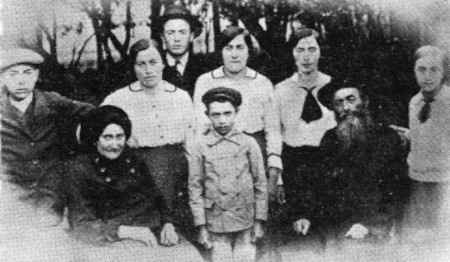
| Sitting: R. Shalom Shechna and his wife, and between them, the son Yosef Standing from right: Daughters Sara, Rivka, Chava, Hodel, and brothers Chaim and Eliezer |
|
|
|||
Translator's Footnotes:
|
|
JewishGen, Inc. makes no representations regarding the accuracy of
the translation. The reader may wish to refer to the original material
for verification.
JewishGen is not responsible for inaccuracies or omissions in the original work and cannot rewrite or edit the text to correct inaccuracies and/or omissions.
Our mission is to produce a translation of the original work and we cannot verify the accuracy of statements or alter facts cited.
 Radekhiv, Ukraine
 Yizkor Book Project
 JewishGen Home Page
Copyright © 1999-2026 by JewishGen, Inc.
Updated 1 Feb 2026 by LA