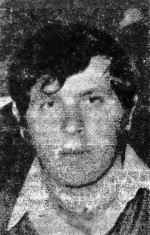
 |
|
|
[Page 267]
Translated by Monica Devens
[Page 268]
[Page 269]
Who Fought and Died for the Freedom of the People and the Homeland
Eternal Praise!
R' Yaakov-Fischel Feldenkrais z”l
|
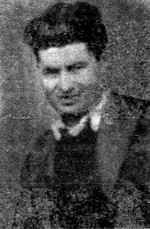
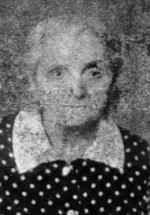
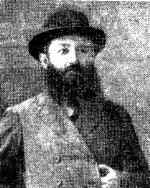
R' Yaakov-Fischel Feldenkrais was one of the heroes and holy ones of the riots of 1921. He was born in Ostroh in 1876 to wealthy and devout parents and received a Torah education as was the custom at the time. He married Dvora, daughter of R' Avrahame'le, one of the grandsons of “R' Yona the Good” [Yiddish]. She was a woman of valor who knew how to manage matters ably and the married Yeshiva student, R' Yaakov-Fischel, would study and occupy himself with the office of synagogue manager and charitable deeds.
Days passed and years flew by and suddenly (it was 1906), Yaakov-Fischel announced to his wife and his father that he had a strong desire to immigrate to Israel, to see the holy city of Jerusalem and the rest of the holy places. At first, they opposed this out of fear that, God forbid, some obstacle would happen to him along the way because he was not used to travel, but since he held strongly to his stance, they were forced to agree.
When he arrived in Israel, he happened upon a group of people who had come to see not only Jerusalem, but also the new farming communities. And he joined them. Through contact with the Jewish farming communities, a special connection to the project of renewal was awakened in him and, when he returned home after a few months, he was full of appreciation for the people of the soil and advocated for the love of Zion and the settlement of the Land of Israel.
Over time, he began to become interested in business transactions, too. But not to increase them, rather to decrease them. Clearly there was no lack of opposition in the house to matters like this. But he was firm in his opinion and went in this direction. In the meantime, the First World War broke out. With it came new worries and his father died. Then the members of the family agreed to Yaakov-Fischel's strong wish. The Balfour Declaration and San Remo encouraged him and strengthened Zionist consciousness in him. He then sold his home for almost nothing. He cut off his affairs right and left. So there would be nothing holding back the realization of his plans. And when he was told in the spring of 1920 about the possibility of immigrating by way of Warsaw - he began to rain letters down on the Zionist center and asked for pity to permit him immediate immigration.
[Page 270]
Every minute seemed like an hour to R' Yaakov-Fischel who sat and waited for answers from the Zionist center, which were late in coming due to the disruptions of the roads at that time. So he set out for Warsaw on foot and there received immigration permission on the spot. His way was full of obstacles and only after adventures and wanderings did he, along with the members of his household, manage to get to the place of his desire at the end of Tishrei 5681 [=October 1920]. He felt that he was among his people in Israel and his happiness knew no bounds. Friends in Tel Aviv suggested arrangements in the city to him, but he didn't listen and went to Petah Tikva where he began to work at the farm of Yaakov Kroll and for other farmers in fruit-picking, plowing, and other jobs. Despite his age (he was then 45), he worked quickly and with religious enthusiasm, and in the settlement they saw in him a pioneer-worker, doing his work through “the joy of mitzvah” and great love for the land.
This is how Yaakov-Fischel's first winter in Israel passed and, then, the rumor about the riots against the Jews of Jaffa and the danger to Tel Aviv came to Petah Tikva. Yaakov-Fischel went out to the road to find people who would go with him to Tel Aviv to help. His wife opposed the matter, but he stood firm that it was his obligation to go and he went with another five young men, intellectuals and practical men. Rappaport, one of this group who was wounded on the way, recounts in “Ha-Po'el Ha-Tza'ir,” No. 15, Sivan 5681 [=June 1921]:
“We marched quickly from Petah Tikva to Jaffa and Feldenkrais urged us from time to time to pick up the pace while he himself marched the entire way in front of us. After we passed the bridge by Sharona, we saw from afar Arabs with sticks and knives coming towards us. We continued to walk towards them at our regular pace so as not to show any cowardice. Feldenkrais began to wave his thick stick and to hit right and left, defending ourselves as much as we could. In the meantime, the number of Arabs continued to grow and it was hard to stand before them. Zaks and I were wounded, our blood running down incessantly and we only managed to see the remaining four of our group running between the eucalyptus trees by Sharona and defending themselves with the mob after them. We didn't know what happened to them after that. We escaped to the home of some German and then they drove us by car to Tel Aviv. Three of those who went out were wounded and the rest killed. A gentile woman from among the gentile women who were buried in a mass grave in the old cemetery was identified by her clothing as the gentile woman of R' Yaakov-Fischel Feldenkrais.”
Thus, there are people walking as a unit and they and their actions seem strange until something shines light on their lives and their aspirations. One of these was R' Yaakov-Fischel Feldenkrais who lived a pure life and died a sanctified death for love of the people and the land.
May his memory be blessed!
Yitzhak Gur-Arye
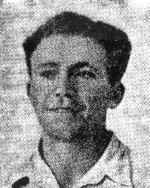
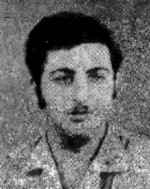
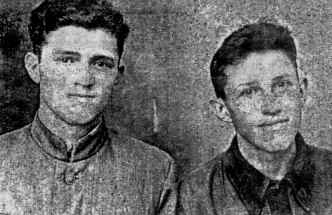
Baruch Lipa Steinkritzer grew up and was educated in the city where he was born, Ostroh. He was the son of a teacher who had a reputation as a quiet man, modest and honest.
When the Russians captured the city in 1939, he was drafted into the Red Army and participated in the Second World War as a brave fighter against the German murderers. At the end of the war, he returned to Poland and from then wandered among the displaced persons camps. His hope was to immigrate to Israel and to start a new life and, indeed, he managed to reach the shores of the homeland in 1946.
He worked in construction, but he wanted to continue studying and prepared for exams in order to begin his studies. But the situation in Israel pushed him to stop his studies and to join the ranks of the “Haganah.” From the “Haganah,” he continued on to the IDF [=Israel Defense Forces]. He took part in many battles and excelled as a faithful and fearless soldier.
He was wounded by enemy fire during an attack by our forces on the Egyptian army near Ashdod and he fell on Iyar 25, 5708 (June 3, 1948).
Honor to his memory!
|
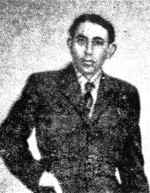
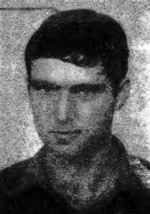
Avraham Zaltzman (Avraham'el) was born in Ostroh in 1921 where he grew up and was educated in a warm home environment in a lively popular area of the Volhynian style. He was swept up in the movement of national revival, joined a core group of “Ha-No'ar Ha-Tziyoni” and, through that, enriched his life and his experiences. But for his active soul the framework of the core group in Ostroh was narrow and he went to Chenstochov [=Częstochowa] to an agricultural farm of the movement and he was still young, around 17. But he was physically strong and mentally stable and he had power in his muscles and his hands.
The Second World War found him in the kibbutz struggling with the events of the day, in a war of survival and continuation - on a road leading to Israel. A handful of stubborn pioneers fought for the future through wandering and hardships, resistance, and among them also young Avraham'el. They were not all saved, but he was lucky with fate and emerged living and whole, healthy and invigorated, in 1941 after his widespread family was exterminated in the diaspora.
He was among the first of the students at the agricultural educational institution in Magdiel. He amazed the administrators and teachers with his diligence and ability. He was a good worker, even progressed and acquired useful knowledge. In this atmosphere of Torah and work, his consciousness deepened and he became a faithful member of the group of Nitzanim from its beginning. The days of El Alamein came, the enemy threatened Israel, from Vichy Syria in the north and from Egypt in the south. The best of the Jewish youth in Israel volunteered for conscription and Avraham'el was among them. Avraham'el served for three years in a defense unit with faithfulness and excellence and earned the great love of his comrades-in-arms, who became completely attached to him. After he returned home to his group, he quickly became a serious force in the life of the farm. He had a hand in everything, had overflowing energy, and he went through his life with an eternal smile on his lips …
On Heshvan 12, 5708 [=October 26, 1947], when he went out at night to meet some comrades-in-arms, he was killed by a treacherous bullet that was fired from the ambush on the southern road. During his lifetime, he fought the enemy on various fronts and made a name for himself with bravery and honor, but he dedicated himself to his farm and his land. There are many memorials to Avraham'el in Nitzanim - the woods where he invested much energy, the beautiful gardens which he tended with great love, he was even a great friend to the children of the group. Surely his farm was important to him, but also the land was: every mountain and valley, every trail and path, he wandered and toured them far and wide. He was always aware to protect its security. Vigilant to every instruction and ready for every action.
Avraham heard the beat of the Messiah, but he was not privileged to see the day of the realization of the dream, which came only a short time later. This is like the soldier who fell at the front from the last bullet before the declaration of peace. But the many who enjoy peace and freedom - it is because of him.
Praise to his memory!
|
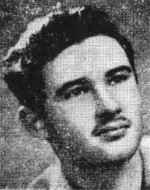
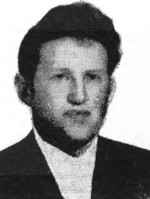
At the time when the cruel enemy stood at the gates of Ostroh, Dov decided to leave the city together with the fleeing Russian army. He quickly separated from his crying parents and on June 26, 1941, he went to meet his unknown fate.
The way was long and hard. More on foot than in a vehicle due to the Nazi airplanes that rained bombs, strewing death along the retreat lines of the Russians. After wanderings and hardships over many months, he arrived tired and broken to the Caucasus and from there to Uzbekistan, suffering from hunger and disease until he could once again grab a weapon.
|
|
|
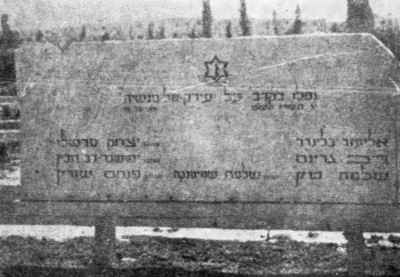
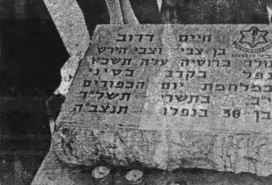
A monument to the fallen of the IDF who fell in the battle at Iraq-al-Manshiyya, among them Dov Grines |
[Page 273]
With the cessation of the fire of the war, he managed to return to Poland and there he felt himself like an abandoned orphan in a huge cemetery. With scathing pain, he left the ruins of Poland and wandered to Germany, perhaps he would find one of his family in the displaced persons camps. But, unfortunately, his parents, his sister and brother-in-law with their two children, were already among the holy ones lost in Ostroh. Because he was trained in the use of weapons, he served as a policeman in the refugee camps and, the entire time, never stopped longing for his family.
Since he already had travel papers to go to his brother in Argentina, he changed his mind, did not want to “stretch out exile,” and decided to join the Jewish army. He went to a military school in Munich to complete his training and, on August 15, 1948, he arrived in Israel as an excellent soldier. He was very happy that he had left cursed Europe and was now in the land of the Jews. But his happiness didn't last long. He immediately joined the IDF and was sent to the Negev front and, in the battle at Iraq-al-Manshiyya, he died a hero's death on Tishrei 13, 5709 (October 16, 1948).
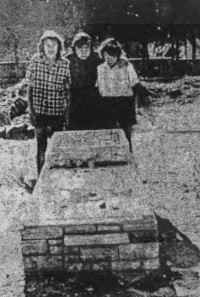
His bones were interred in the military cemetery next to Tel Aviv under a joint headstone with seven heroes. Dov Grines was one of the holy heroes who sacrificed his young life on the altar of the nation and the homeland.
May these columns serve as a shining memorial flame.
Son of a family of workers and laborers - porters and movers of flour (from the Caucasus) for generations, who worked hard and bitterly to bring bread to their home. The elder of the family, Isaac Tzimbal of Mezhyrichi, next to Ostroh, left a cart and horses and the nickname, “Grizata,” to his sons after him and they continued as their ancestors had in Ostroh.
Shalom Tzimbal, a grandson of this widespread family - “little Grizata” was 12 or 13 when the Second World War broke out and he grew up and was educated as a wanderer among others on the endless Russian roads. During his wanderings, he reached every place where there was a collection of Ostroh natives to whom he was drawn with a hidden internal strength, but quickly the power of wandering grew in him and he left as suddenly as he had come.
In the summer of 1946, Shalom came to the Hochland camp (next to Föhrenwald) where he tried “to settle” and to immigrate to Israel with one of the kibbutzes under the program of “Aliya Bet” [=illegal immigration]. But for some reason, he dropped out along the way and returned to a camp in Germany where he served as a camp policeman. In this capacity, he was more useful due to his unusual strength and bravery. One day he grabbed two Germans by the neck at the gate of the camp and knocked their heads together until blood flowed.
In 1948, permission to enlist in the Jewish army was announced in the Jewish camps in Germany. Despite his concerns that, with his possible death, the memory of his family that was lost in the Holocaust would be forgotten, he presented himself for enlistment to hit the Arab invaders hard. He was sent to the Negev to fight the Egyptian enemy together with two other young men from Ostroh, Baruch Arbetman and Berel Grines. During one of the attacks at the Iraq-al-Manshiyya front, a hailstorm of deadly fire rained down upon them. Berel Grines fell first. Then Shalom Tzimbal was wounded. But he didn't pause, like the rule of a soldier who had already fulfilled his duty. The strength of the true that surged in him did not permit him to surrender to the “Arabitshkes” and, wounded and bleeding, he continued to fight like a lion until a deadly bomb tore both his legs and put an end to his life.
At the end of the battle storm, the two heroes, Berel Grines and Shalom Tzimbal, were gathered up and brought to the military cemetery near Tel Aviv for burial among the rest of the mightily praised heroes of Israel.
In truth, his concern was not for nothing, a small lead ball was stronger than his two fists, strong as sledgehammers. May these lines serve as a memorial to a young hero from the natives of Ostroh, the last remnant of a widespread family, who sacrificed his life on the battlefield for the freedom of Israel.
May his memory be blessed!
Musia Soroca
|
David Fisher was born in Israel on August 25, 1939 to his parents, Shmuel and Bronya Fischer, who had immigrated to Israel from Ostroh in 1936.
The father, Shmuel, was a member of the youth movement in Ostroh and received “training” for immigration at the “Ha-Shomer Ha-Tza'ir” kibbutz in Dombrovitsa [=Dubrovytsia]. Following an instruction from the principal leadership of “Ha-Shomer Ha-Tza'ir,” he chose a practical profession - driving, to which his lengthy time in the Polish army added expertise. With the rise in antisemitism in Poland, he decided to move up his immigration to Israel and so he did.
Heavy absorption burdens befell the Fisher couple until their troubles came to an end and they reached tranquility. They built a household and had a son, David, an only son, and tender to his father and mother. From then on, all their focus was on raising and educating their son. At age 6, he entered the “Ge'ula” secondary school, where he studied for 12 years until receiving his graduation certificate in July 1957. David inherited from his father an excessive love for the land and, as a student, he wandered the length and breadth of the country, whether out of love for the homeland or as a hiking guide under the auspices of the school and also of the “Scouts” of which he was the captain. And from all this, he developed well, both physically and ethically, was a healthy young man, tall and good-looking, the best athlete in the secondary school, and a dedicated and faithful son to both home and country - a source of joy and satisfaction to his parents.
As someone educated and a good athlete, mentoring in the Gadna [=military youth battalion] was suggested to him, but he saw in this a shirking of his military responsibility and declined and, on August 11, 1957, he was drafted into regular service in the IDF. Right after being accepted, he was sent to basic training and his strong hope was to complete training and go to an officers' course suitable for his education and ability. With exemplary patience, he went through the difficulties of training, but a tragedy befell him and, unforeseeably, turned the basin of good hopes for the future on its head. In short, two weeks after his enlistment, he suddenly fell seriously ill, was sent to the hospital, and passed away two days later, Elul 5, 5717 (1957).
With military honors, an only son, precious to his bereaved parents and respected friend of his many friends and acquaintances, was laid to rest.
May his memory be blessed
|
Born February 8, 1952 in Afula.
Died October 17, 1976 in Sinai.
Yigal was born to his parents, Rivka and Dov Fishman, Holocaust refugees, who, following their immigration in 1949 from the refugee camps in Germany, settled in Afula and built their home there.
Yigal was educated in the “Yizre'el” primary school in Afula and, when he finished, attended the regional secondary school in Afula under the leadership of Mr. Yisrael Matzner.
He excelled in his studies already from his childhood. He was an enthusiastic and lively youth and his principal abilities were in practical occupations. In secondary school, he got high grades in physics and mathematics and graduated with distinction.
Throughout his studies, he was revealed as a responsible and ethical youth, liked by his classmates and always ready to lend a helping hand to classmates who struggled with their studies.
As a lover of basketball, he was active in games and organized basketball games at school and earned a certificate of excellence in the organization of a basketball championship at the schools in the city.
After graduation, Yigal was accepted as a regular student at the Technion in Haifa and began his studies in 1970 in the academic student soldier program of the Faculty of Aeronautical Engineering and studied there until the end of 1974.
After he completed his studies at the Technion, he was drafted into the IDF and sent as a student soldier to an officers' course, which he completed in April 1975.
To his great disappointment, with the completion of the officers' course, he was not placed in the Air Force to serve in his occupation, as was promised to all his fellow student soldier graduates of the Faculty, but was sent to a professional course for armament officers, but he did not give up easily on service in the Air Force and he worked hard to get a transfer and, when he didn't succeed, he accepted the judgment in accordance with the answer of Captain A. K. A. “only the IDF sets its order of priorities concerning the professional placement of captains in regular service” …
After he was certified as an armament officer, Yigal was assigned to an armored unit in Sinai where he served for almost two years. On Simchat Torah, which was on Shabbat that year, he was on leave at home and, as was his habit, he met with his friends and hung out. His connections to his classmates from secondary school were still strong and tight. When he arrived home, the first question was: “Who from the group called me?”
On the morning of Sunday, October 17, 1976, he left the house at first light, trying to get the first flight to Sinai before noon. On Thursday, the bitter news hit us like lightning on a clear day: “Yigal is gone!!!”
Despite the fact that the heart and the mind did not want to accept the hugeness of the tragedy, the bitter truth is - Yigal will not be coming home again.
We will guard his memory forever
His father, Dov Fishman
|
Nachum, son of Sarah and Baruch, was born on September 30, 1954 in Kiryat Tivon. He completed his studies at the elementary school there and continued on to secondary school and finished there in accordance with the law.
Already from a young age, Nachum was involved in all manner of activities where he lived and principally in social and sports activities. He was a youth who stood out for his abilities. He did everything with completeness and devotion to the delight of his teachers, his educators, and his friends. His teachers said that he was an outstanding student, that every teacher longs to see many like him in class. He was a central axis in the lives of his classmates. He was a diligent, honest, kind student, hungry for knowledge.
He dedicated most of his free time and great energy to sports, in particular to tennis. Already at age 13, he came in first in the national youth tennis championship and, from then on, was consistently part of the national youth top team in this sport.
Nachum enlisted in the IDF on November 1, 1972 and volunteered to serve in the paratrooper corps. Although he was not a fighter by nature, he chose this difficult and dangerous service because “someone has to do this.” He saw himself as this “someone” and was proud to serve with the paratroopers.
In the Yom Kippur War, he served with regiment 890, company 7, and took part in the defensive battles against the Egyptians on the Sinai front. On Tishrei 21, 5734 (October 17, 1973), he took part in one of the hard battles that took place at “the Sinai farm.” He was wounded and fell right there. He was buried in the cemetery in Kiryat Tivon. After his death, he was promoted to the rank of corporal.
In the condolence letter to the bereaved family, Minister of Defense Moshe Dayan wrote, among other things: “Nachum was a dedicated soldier and an outstanding friend. All who knew him loved him.”
Ruth Lazrovsky of the Tennis Organization in Israel wrote to the bereaved family:
“I knew Nachum from the age of 10 when he first participated in the activities of the tennis organization. I knew him as a diligent and disciplined fellow, talented and dedicated, and principally - as an outstanding athlete.”
His former teacher in the secondary school in Kiryat Tivon, Malka, wrote to the family after he fell:
“I loved Nachum, I loved him for his nobility of spirit, for the pleasantness of his ways, for his great curiosity to expand and deepen his knowledge, for his modesty in his relations with others, I loved Nachum, the good and honest man.”
The Israel Tennis Organization together with the “Ha-Po'el” Sports Association in Kiryat Tivon conducted a national tennis competition named after him, which takes place annually in Kiryat Tivon.
A few days before his death, he wrote his last letter to his family:
[Page 277]
| “Dear Mom, Dad, and Ella!
…The burning afternoon sun just set and only now is it possible to really breathe. In the meantime, the only enemy against which there is to fight - it's the afternoon sun, which almost leaves no shade at all. We, apparently, are waiting for the IDF to reach Damascus and then … In the morning, I still thought that the road is long, but not difficult. Now, after less than 24 hours, my evaluation has changed and I truly hope that next Shabbat will be in truth a Shabbat Shalom [=a Sabbath of peace] … … The Friday night moon has already begun to rise and there are no candles. The Yom Kippur War has completely obliterated any thought of Sukkot, but one shouldn't be sorry - a new holiday in the process of creation.” |
| Nachum |
Age 19 at his death.
May his memory be blessed
During his youth, a special love for the homeland developed in Yisrael. A love of greater proportion than that of his friends. “One must love the homeland and, sometimes, with love comes sacrifices,” he once said to a friend, without knowing how accurate his words were. This love of homeland drove him to take part in the huge struggle of the young country that was fighting for its life.
During the 1948 war, with breaking through the Egyptian lines in the south, when IDF forces attacked the fortress at Iraq-al-Manshiyya, many intense battles took place. The company in which Yisrael served began to move forward across the military zone. The Egyptians identified the movement of forces and fired heavy mortars on them. Many were wounded already with the first explosions. Shrapnel struck Yisrael in the chest and wounded him mortally.
On Kislev 26, 5709 - December 28, 1948, Yisrael fell and was buried with his company and his body was later transferred for burial in the military section of the cemetery in Nahalat-Yitzhak.
May his memory be blessed
Sender (Zindel) was born on February 17, 1929 in Ostroh to his parents, Yaakov and Etel Greenberg.
When he was still very young, he experienced all the suffering of the World War and of the Holocaust of the Jews, by a miracle being among the few survivors. After liberation, he left the place of calamity with the remnant of his family with their goal of the Land of Israel. In Salzburg, Austria, he graduated from the “ORT” professional school and received training for immigration.
During his wanderings, he ended up in Italy where he joined the “Haganah,” which operated among the young refugees and from there he progressed to Israel. Under the emergency conditions of the time, he was caught on the way and transferred to Cyprus where he was held in a transfer camp for an extended period of time and freed with the last internees at the beginning of the War of Independence. In Israel, he immediately enlisted in the Palmach and joined “Ha-Hayil” of the Gedud Ha-Portzim [=Breaching Battalion].
He participated in the actions of the Palmach in which he proved his outstanding fighting spirit and came out peacefully. However, in the daring crushing action of his battalion in the battle of Abu Ghosh, he was wounded severely and transferred to the hospital in Jerusalem in critical condition. The efforts of the doctors to save his life were of no avail and he died on September 29, 1948 and was taken for burial to Kiryat Anavim.
May his memory be blessed!
|
The son of Michael and Shaindel, he was born in 1921 in Ukraine. While he was still a small boy, his parents moved to Poland and settled in Ostroh. He studied at the primary school and then continued his studies at the secondary school. He knew several languages and was competent in Hebrew. For a time, he worked as a driver.
When the USSR-Germany War broke out on June 22, 1941 and the Germans approached Ostroh, he left the city with a group of young people in order to not fall into the hands of the Germans. Hard times befell him in the USSR, he managed to complete a course in clerical work, and then enlisted in the Red Army and participated in the war against the Nazis on various fronts.
During the war, he was sent to an officers' course and, after completing the course, he received the rank of an officer and was appointed as the commander of a section of one of the regiments that was sent to the front. He excelled in many battles and received ribbons of excellence from the military command.
When he returned to Poland with the Red Army and learned that his parents and all the members of his family were lost, he decided to find a way to immigrate to Israel. He deserted from the Red Army and joined the activities of “Ha-Bricha.” Since he was an officer in the army, he served as a military guide in the “Haganah” in the refugee camps in Italy. Together with the other survivors, he reached Israel through illegal immigration, was caught by the British, and sent to the camps in Cyprus. He continued to train in the camps in Cyprus, too, and to guide members who prepared to immigrate to Israel.
Along with a group of friends, he fled the camp in Cyprus in the summer of 5708 [=1948] and managed to get to Israel on a boat that was sent under the auspices of the “Haganah.” This was July 17, 1948.
He immediately joined the IDF, was merged into a fighting unit, got the task of sabotage officer, and participated in opening up the route to the Negev. He died a hero's death on October 18, 1948 in one of the battles for Hulikat. His body was brought to the Mount Herzl cemetery in Jerusalem for burial.
Honor to his memory
In memory of Shmuel Konin z”l
I met Shmulik in Ostroh at the end of the Second World War where he had come in the hopes of finding survivors of his family. It was a destroyed city, without any Jews, the streets were quiet and in ruins and silence reigned in the city as if in a cemetery. None of the members of his family had escaped and he was dumbfounded.
After any hope of finding someone from his family came
[Page 279]
to naught and he was orphaned, the decision to find a way to come to Israel solidified.
In June 1946, the three of us left Ostroh: Shmuel, Mulke Geller z”l, and I for a wandering journey full of adventures. We got to Poland and from there to Czechoslovakia, Austria, Italy, and finally to the shores of Israel in May 1947 on the illegal immigration ship, “Ha-Tikvah.” We were immediately caught by the British and sent to Cyprus.
Shmulik met Batya (today Batya Strak) in the camps in Cyprus and hoped to establish a family when the time came.
Shmulik was an active member and dedicated and part of the “Haganah” leadership in Cyprus. He tried several times to flee from the camp, but his attempts came to naught.
After much effort, he did indeed succeed in escaping the camp with another 12 members and made it to Israel on a boat sent under the auspices of the “Haganah.”
His fiancée, Batya, waited for him in Israel. They married and went to settle.
On July 17, 1948, he enlisted in the IDF, participated in battles as the sabotage officer in the operation opening the route to the Negev, and died a hero's death on October 18, 1948 at the battle for Hulikat. He was buried in the military section on Mount Herzl in Jerusalem.
Due to the efforts of Batya and her family, a memorial to Shmulik Konin is held every year by his grave in the cemetery on Mount Herzl in Jerusalem.
May his memory be blessed
Y. Blecher
|
Corporal Drob Chaim z”l Son of Hersch (Zvi) and Tzvia Born in Russia, 1935 Immigrated to Israel in 1966 Fell at Maoz Hezyon By the Suez Canal Left a wife - Vita And two sons - Zvi and Arye |
|
[Page 280]
|
|
|||
|
|
|
|||
on Mount Herzl in Jerusalem |
Zvi and Arye by his grave on Mount Herzl in Jerusalem |
|||
|
In the family, he was called Buma (a nickname), when he was 10 years old, his parents immigrated to Israel and settled in Ashkelon. He was a talented boy. He learned the new language of Hebrew quickly and integrated well with his classmates at school. At a later age, we were neighbors and then became closer.
Avraham grew up in a family in which everyone had gone through the horrors of the Holocaust and who were saved from death by a miracle. In Israel, they suffered from the difficulties of absorption, as did many of the new immigrants who came to Israel during those years.
After he finished his studies in elementary school, he continued on at the city secondary school and from there went on to study the profession of electrician. He visited us often and loved to play with the children who were very attached to him.
During his service in the IDF, he completed a course as a tank commander and was assigned to an armored unit in the reserves. After his discharge from the IDF, he worked as an electrician in Eilat in order to improve his economic situation and help his family. He worked as an electrician and saved money to travel to Europe. He loved his new country with all his heart and, when he was abroad, he hastened to return to Israel before the planned date.
When the Yom Kippur War broke out, he was immediately called to the army. He didn't manage to say good-bye to us and we didn't know where he was and didn't hear anything from him either. Finally, the bitter news came that he had fallen on October 7, 1973 in the Golan Heights.
My memories of Buma are very much tied to his personality. He was very friendly with everyone, always in a good mood, smiling and optimistic. He intended to make a family in the near future, but that didn't materialize.
The army officers who paid a sympathy visit to his family after his death told how much they loved him. He was friendly, sociable, and always ready to help his friend, body and soul.
I remember my last visit with my group of friends. We sat and talked. None of us imagined that this would be his last visit. It's hard to believe that a young man like our Buma is no longer alive.
His memory will not depart from us
Dalia Gilat - cousin
Ashkelon
Shlomo Ashkenazi:
I met Avraham during my required service in the IDF. Our acquaintance especially deepened when we attended the course for tank commanders together. At the end of the course, they left him as a counselor in the same tank commander course and later he joined my regiment in regular army service. This was an operational regiment of which a part engaged in instruction.
Avraham immediately joined the operational company and from then on, we went through all the stages together: operational actions, instructional courses, etc. After we were released from the army, we were placed together in the same company in the reserves.
Immediately after the outbreak of the Yom Kippur War, I got to our base before him. When I was on my way to the base in the morning, I met him and this was, unfortunately, also our last meeting. It became clear to me later that, in fact, we had fought on the same section of the northern front the Golan Heights.
I came, along with my squad, to the “Nefah” camp the Golan Heights. We passed a few hours and, in the afternoon hours, we heard shooting from the direction of the camp. In the evening, we continued to move in the direction of the base. At the command it was decided that we had to hold on to the “Nefah” camp at any price.
When we got there, we saw for the first time our burned tanks. I understood that there had been a hard battle here between our tanks and the tanks of the Syrian enemy. I didn't know who had been in these tanks, which company they were or to which regiment they belonged. Only on the next day in the evening did I learn from one of the other fighters that Avraham had fallen at the “Nefah” camp. I found it very hard to accept the bitter reality, to accept the fact that my good friend was no longer alive.
In all the time that I was together with him, he encouraged all the soldiers in our unit. He stood out, both from a physical perspective and from the qualities of his personality. He was modest, didn't want to stand out as a commander, but his natural qualities made him like that. He was very friendly, always loved to help people and, as a tank commander, was, in my opinion, the best in the regiment, whether from a professional perspective or from a human perspective. He always served as a model and good example in the hard hours of battle and of warm connections in times of rest. Avraham was an outstanding tank commander, of those that the IDF is proud.
During his service before the war, he took his task as a tank commander very seriously. He took care that all the fittings of the tank should be in good condition. He always stressed that one had to prepare the tanks for war and to be concerned that this instrument would serve as an outstanding weapon in war at the front. This is our task as IDF fighters and as armored fighters.
Avraham was one of the team and not an arrogant commander. He worked hard and did everything in the most successful fashion. He loved to fulfill his task as tank commander as required. His connection to us was very friendly. Everyone in our unit knew him very well. I was never worried about getting in a tank with him, even though he was not our permanent tank commander. I always trusted him.
He took no joy in battle nor in war, but rather confidence, that a string of seriousness was drawn deep in him. “The unavoidable war” - he would always say - I don't know what the price will be - but we must be prepared for any price” … Victory took the price from Avraham until his death. The Yom Kippur War cut the string of his life.
It is hard for me to accept the idea that my good friend, Avraham, is no longer alive and always, when I remember him, his figure stands before my eyes, the figure of a brave fighter, a good friend, and a wonderful buddy.
May his memory be eternal
Immediately with the outbreak of the Yom Kippur War, we arrived at our staging base - Camp Naftali. When I got to the base, Avraham Getman was already there. It was 7 in the morning on Sunday, October 7, 1973. All the members of my team were already waiting there. We waited for orders. Our tank commander had not yet arrived at the base and so we looked for another tank commander so we could start out. We found Avraham whose own team had not yet arrived and he agreed to our request to be our tank commander.
Immediately after accepting the command of the tank crew, he organized all the preparations for our starting out, including the tank, the weaponry, and the ammunition. He continued to organize things and ran around to find equipment. In truth, we had not yet grasped the great seriousness of the situation, but we still wanted to be equipped as we should. We didn't find binoculars and that bothered Avraham who claimed that his sight was weakened.
On our way north, we joked around a lot and we got a detailed explanation from Avraham about the area in which we were going to be fighting the Syrian enemy. We crossed the B'not Yaakov bridge before noon and continued on our way. Suddenly, we saw the slope of a burning mountain and we thought it was fire that the heat had caused. We never considered that these were Syrian shells that had fallen there.
As we continued on our way in the direction of the “Nefah” camp, we saw a destroyed half-track and only then did we become convinced that the matter was serious. We quickly got into the tank cabin and began to look for enemy forces. Our tank was the only force in the area. We had gone up under our own initiative without getting instructions from the command. Avraham asked the deputy battalion commander where we should head and where we had to fight. His answer was: “Go up, you will already find them there …”
The main force of the brigade went up by the Rosh Pina road - Quneitra. The consideration was that the Syrians would flood the height from the east to west, but we were wrong, they broke through on the southern end and moved from south to north.
The commander of the brigade went in the direction of Quneitra and the Syrians came after him. When we reached the “Nefah” camp (along the oil pipeline from south to north), the Syrians had also already gotten there. They finished with taking over the oil pipeline. We saw one Syrian tank in the area and we immediately attacked it, without knowing how serious the situation was.
At the same time we were told through connection to the brigade commander to enter the camp, but the Syrians were already inside. We entered the base with the goal of clearing out the Syrian forces inside. While entering the camp, we saw that the entire base was full of Syrian soldiers and we understood that our entrance there was an impossible goal, it would be suicide. There wasn't a single Israeli tank in the entire surroundings. We hesitated and considered what to do? To go in or not.
Avraham said unhesitatingly that the battle would be suicidal for us, the Syrians were far more numerous than we were. But we entered 30-40 meters into the base anyway, we were completely exposed.
Once we got the command from Avraham to open fire, we fired immediately. I heard him tell me that the attack was good. But a second later, without my having been able to understand what was happening, I suddenly heard him shout: “Oy!” … I understood that he had been hit and that he was no longer alive.
This is one of the stories of bravery from the war that many do not know. This is also the story of Avraham's bravery, he entered the base with his tank with the clear knowledge that there was no chance of getting out of there alive. I remember that he told us: “I don't believe that we will come out of there, but we must go in and try to fight the Syrian enemy, perhaps we will succeed” …
[Page 284]
The base was partially taken over by the Syrians, they did not advance, our tank closed off their route forward. They came exactly to the point where our tank stood and did not advance any further. That was their last position. Apparently they feared an ambush by our tanks.
I remember how Avraham thought and planned how to deceive the Syrians. He gave us the command to fire unceasingly on all sides, so that the Syrians would get the impression that a serious Israeli force was approaching the heights and that they were in danger of encirclement.
Our tank in the area had both a tactical and a psychological effect on the Syrians. They were very confused and hesitated in starting a battle in that sector. That gave us a good opportunity to enter the base and we immediately destroyed three Syrian tanks. The Syrians were confused and they came to where we were. Half of the area of the base was in their hands and the other half was guarded by our tank.
That same day in the afternoon, a serious attack by our forces began in the heights, which began with an assault on the enemy forces. Our forces had the upper hand and the serious push against the Syrians began. They were in a great panic. The shells of our tanks and artillery hit the bullseye. They left and retreated from the camp from the exact place where we had stopped them.
The shelling from the tanks and the artillery in addition to the bombing from the air, which was very intensive and designed to stun the Syrians, succeeded and caused them serious losses and brought about the defeat of the enemy and the beginning of their making their escape from the heights.
Thus the part of Avraham Getman as tank and team commander, under whose command was the push of the Syrians from The Golan Heights, was very important. But sadly he paid for this with his life.
This is the story of the bravery of Avraham Getman, fighter, whom we will remember as a wonder and as one of the figures of courage of the fighters of Israel.
May his member be blessed!
A lot of time has passed since that day when we parted and it's hard for me to accept the bitter reality that Avraham is no longer, that I won't see him again. I have lost a friend and comrade.
I always see in front of me the image of how Avraham came to my house the first time: a tall young man, broad-shouldered, bright blond hair, and big, dreamy eyes, but within his erect body was a delicate and concerned soul. If I was in a down mood, he always knew to comfort and encourage me and when I hit some problem, he always tried to help me at any time of the day.
The whole group would meet at my house nightly and every meeting was filled with emotion and expectation. We loved to tell stories from our time in the army and Avraham would describe his tank and even his exact position in the tank.
At the end of the school year, we were going to be apart for two months. I went to travel in Europe and Avraham went to serve the homeland in the north of the country. The parting was very difficult, even though we knew that we would come back and meet.
At the beginning of the school year, we met again and there was great joy, though unfortunately short. Upon hearing the siren on Yom Kippur, I experienced a strong trembling and I felt that something bad was going to happen to Avraham. I immediately remembered his stories and descriptions as a tank commander. I wasn't relaxed knowing what his job was as a member of an armored unit in war. My girlfriends tried to calm me, that everything would be fine and he would certainly return, full of new stories from the war, but unfortunately, the bitter news of his death was not long in coming.
Avraham fell in the holding action on the Golan Heights.
May his memory be blessed!
Ruti Mizrahi
|
|
JewishGen, Inc. makes no representations regarding the accuracy of
the translation. The reader may wish to refer to the original material
for verification.
JewishGen is not responsible for inaccuracies or omissions in the original work and cannot rewrite or edit the text to correct inaccuracies and/or omissions.
Our mission is to produce a translation of the original work and we cannot verify the accuracy of statements or alter facts cited.
 Ostroh, Ukraine
 Yizkor Book Project
 JewishGen Home Page
Copyright © 1999-2026 by JewishGen, Inc.
Updated 09 Mar 2026 by JH