 |
“Emigrants of Ostroh in Argentina”
|
|
[Page 49]
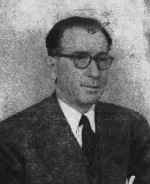
by Michoel Grines
Translated by Pamela Russ
|
My thoughts are waving before me, blindly The wind is carrying me back home And the memories are floating Of the beautiful life in Ostroh. Always beautiful pictures: Tatte-Mameh, the old “cheder” Young children – They are playing in the sand, the beautiful ones…
Older and younger ones fill the streets,
The more I remember them with joy,
Oh, let my prayers already be heard. |
The city of Ostroh, or Ostrog, in the Volhyn region, is one of the oldest cities in Poland. Even though the exact date of its founding is not known, it is more than certain that it existed for over a thousand years.
There is no known exact date of when the Jews settled in Ostroh because all the historical documents were destroyed as a result of all the wars, pogroms, and fires that happened almost every forty years. Even the old city Pinkas, that had a reputation across the entire Poland, and which was the roadmap of directions and traditions for many of the Jewish communities, that too was destroyed.
The first Jews who settled in Ostroh were the refugees from Germany, those fleeing from the decrees and persecutions of that time. In the year 893, the underground Jews from Germany went to the King of Poland requesting permission to settle in the land. In 894, many Jews already immigrated to Poland, and then in 905,
[Page 50]
they received official permission to buy the land that they wanted, begin working, trading, and even received autonomous, judicial rights, according to the Jewish ways.
From the gathered information from various sources, it was confirmed that there were already Jews in Ostroh in the year 900, and among the residents there were many Jews from the Caucasus.
According to the memories of the older generation, they said that there were tombstones in the cemetery that were more than 1,000 years old. From many ages in the past, and without any inscriptions on the gravesites, the tombstones had fallen down, broken, and were forgotten. No more were remembered, such as the tombstones of the Tuczyner Cohen, of blessed memory, of the year 5372 (1612), and of the MaHarsha, of blessed memory, of the year 5392 (1632), who were considered the eldest and most prominent.
The city of Ostroh, or as the scholars called it “Os Torah” [a letter of the Torah], was the symbol of the Jewish spirit of those times. The greatest scholars were from that city, which had the greatest community in the entire Volhyn.
Ostroh was considered to be the main city of Volhynia and was one of the four main sectors of the Polish parliament (Va'ad Arba Artzos; Council of Four Lands), which existed from the mid-16th century until
|
|
“Emigrants of Ostroh in Argentina” |
[Page 51]
the end of the 18th century, when the Jews were satisfied with their organized autonomy, as all questions about their Jewish life were resolved there, and all Jewish concerns were addressed there as well.
The chief rabbi had full religious authority, as he addressed all religious issues over the entire Volhyn region. One of the more renowned chief rabbis was Reb Shlomo Luria (MaHarshal). Along with the administration for Jewish issues, there was a Parness Hachodesh [monthly sponsorship] that was the official Jewish representative for the dukes, and legal representative for the government. There was also an urban writer, who wrote contracts, wedding contracts, business contracts, and at the same time he was the clerk for the community.
In the year 1690, through a hereditary procedure, the city was taken over, then belonging to two princes. A great portion of the city, along with the main streets, belonged to the duke with the great shul included, and the second part of the city went to the side of the military commander, with Krasnegor Street, Tatarsko, and behind the palace. From that time on, the Krasnegor shul was being built.
The influx of religious issues was great in the big shul, and particularly in the Krasnegor shul. According to the rabbinic regulations, every year, on Hoshana Rabba, the entire city assembled. This was an occasion that required the duke's permission. At this assembly, there was a report about finances, and the new community officials were elected as well.
There were many events that happened in the city from which the Jews suffered for hundreds of years.
According to the findings of those times, a great city fire took place almost every forty years, that completely destroyed the city from one edge to the other. In the year 1766 (5526) there was a terrible fire. In the year 1809 (5569) 500 people died in a fire. In the year 1848 (5608) there was another fire. The biggest fire happened in the year 1888 (5648), and it destroyed the entire city. At that time, the famous Ostroh Pinkas was also destroyed. Even the tombstones were broken and destroyed. The only thing that remained whole was the great MaHarsha shul.
The events of the years 1648-1649 are described in an especially sad chapter called – Gezeiros Tach ve'Tat [“Evil Decrees of 1648-1649, 5408-5409”].
In the year 1648, the city was assaulted by the famous murderer Chmielnicki and his Cossacks, as they killed the most prominent persons of those times. They committed many horrors on the Jewish streets, and turned the great shul into a stall for horses and animals. When they encountered a Jew in the street, they immediately chopped him up with their swords. They hanged parents with their children from trees.
The next year, when the slaughter calmed down, some of the Jews who were hiding in the forest returned to the city. When the Cossacks found out, they invaded the city and killed everyone, ripped apart the Jewish homes and then ignited them. Less than five Jewish houses remained, and the great shul, an honored place, fortunately, was not destroyed.
There were so many victims that four common graves had to be dug out in various corners of the city, which, until this day,
[Page 52]
the religious Jews would visit on Tisha b'Av, exactly as they would have done at the gravesites of their own family.
From this great tragedy, special lamentations were composed which express the anguish and pain of spilled Jewish blood. This is what it says in the writings:
“Accursed evil doers came into our city in the year 5408. They surrounded the city, stole everything, raped girls and wives, and killed 7,000 souls – men, women, and children. In the year 5409, these thugs returned and increased the blood bath even more so. Jewish blood flowed like water. The dead bodies were food for the birds. Thousands of Cossacks attacked at night, and they killed all 300 Jews in their beds, those who had returned to the city from the forests. Only three people of those who returned were able to save their lives.
In the Lutzk Pinkas of 1661, the great destruction by Chmielnicki's thugs is described, a horrific event that overtook the Jews of Ostroh.
Another event that is considered an Ostroh miracle is called Megillas Tammuz [the story of Tammuz (Hebrew month of June)].
In the year 1792 (5552), when Russia was empowered and annexed part of the Polish country, the Cossacks came to the city with their commandant Suvarov, and then began to attack. The Polish military, which had already evacuated the city, ripped up the bridges that united the new and old city before they left. The Russian military could not cross over the river. They thought that maybe the Polish military had empowered itself in the city. They began to shoot mercilessly, shot bombs from cannons. Then they noticed the shul, which was very tall, so they went to occupy it as one of their strongholds. All those who were in there, the thousands of souls, were hiding from the shootings. The Russian military continued the bombing directly onto the shul without stopping. One bomb landed inside but did not explode. Another remained stuck in the wall and remained there as a memory for many years.
As the attacking military prepared itself to attack and destroy the city, the Jews in the shul were very worried and cried because of the great tragedy that was going on. Early in the morning, at dawn, one Jew crossed the river to the Russian military and, with tears in his eyes, he assured them that the enemy was no longer in the city, and the bombing was pointless. What they thought was a stronghold, was really simply a shul. The commandant listened to this and assigned this Jew as one who could show the way to cross the river. On the seventh day of Tammuz, they entered the city, were welcomed with great respect by the population, and the Jews did not suffer from the newly arrived military.
The elders of that generation described that miraculous event in a Megillah [scroll], and with the consent of all the leaders of the community, it was decided to set the date of the sixth of Tammuz as a fast day, and then on the seventh, to celebrate with joy, literally like Purim. They read the “Megillas Tammuz” where all the events were described, and then stipulated that on the seventh of Tammuz there was to be no sadness or mourning. It must be a yom tov on the Jewish street. No one was allowed to break the tradition,
[Page 53]
and all those from Ostroh who would remain in the city or go to other cities, must safeguard this special day for generations.
The original copy of the Megillah stayed in the great shul and a copy was put in the Krasnegor shul.
The Ostroh genius, the MaHarsha, was born in Krakow. He established a yeshiva in Poznan (or Posen) which was completely supported by his mother-in-law Eidel, for twenty years. For that reason, he was actually called Reb Shmuel Eideles. From his mother's side, the MaHarsha was a great-grandchild of the MaHaral of Prague, the famous Rav who was connected to the Golem legend [Golem of Prague].
The MaHarsha came to Ostroh in the year 1605 (5365), and he became the Rosh Yeshiva [head of the yeshiva]. In Ostroh, he attained the highest level of Torah learning, where he became a noteworthy, unique historical figure who was so integrated into Jewish Torah knowledge, and became known as the MaHarsha. There are many legends about the MaHarsha, but this is not the place to relate them.
He was greatly loved by all with his popular appeal, and as one of the greatest geniuses he wrote many sefarim [Torah books, analyses]. Among them, one is considered in the world a very important work, his writings of – “Chidushei Halachos ve'Chidushei Agudos” [“Commentaries on the Jewish Laws and Commentaries on the Non-Legal Portions” of the Talmud].
In line with his characteristic of popular appeal, which can support this fact, there was a sign etched in stone in front of his house, with the following words:
“The stranger should not sleep outside,
I open my door for the needy!”
The MaHarsha died on Motzei Shabbos [the end of Shabbath] on the fifth day of Kislev, in the year 1632 (5392). In the year 1888 (5648), the great fire took place, which ruined the MaHarsha's house, and the words were erased from the stones. They were unrecognized. By chance, forty years ago, some of the stones were found. They were given to the great shul as a possession and memory.
Their great impression and majesty were recognized in the act of the 300th yahrzeit of the MaHarsha, which was held in Ostroh in the year 1932. This was not simply a local event, but a people's celebration in every sense of the word. All the stores were closed, all the people and illustrious rabbis and personalities from all of Poland – attended the spirited gathering in Ostroh.
In the cemetery, at the gravesite of the MaHarsha, and also in the great MaHarsha shul, there were speeches given by many scholars, and there were also those who came to express what they acquired from the genius, who was the last and maybe the greatest representative of the sharpness in “learning” [the Talmud] and in analyses, one of the souls of the entire Jewish spiritual structure.
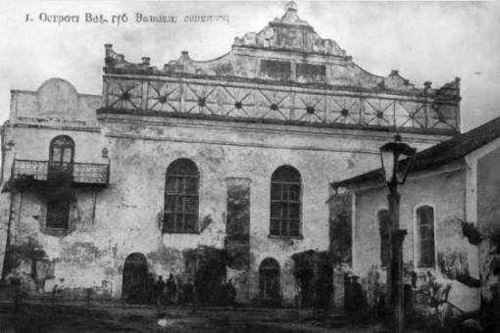
The great shul in Ostroh has its own history which cannot be related in this particular article. The entire street was called by its name – “the shul street.”
The construction of the shul always attracted the attention of many scholars, educated ones, and tourists. The extraordinary appearance of the shul – its tall, thick walls, and the four columns inside its center – left an impression on everyone. The galleries of the women's section of the shul were divided into two levels. On the west side was the third level, with
[Page 54]
the shul for the vesikin minyan [prayer group at sunrise]. On the highest level was the shul for the butchers. At the entrance, on the left side, was the chevra kedusha shul [shul for those who worked with burials]. The great shul, with all its units, could hold about 10,000 people.
In the treasure warehouse of the shul, which was located on the right side of the entrance, all the valuable items were kept, such as the ornaments for the holy books, among which were very artistic antiques made of gold and silver.
When a person with feelings would step over the threshold of the shul, he would remain at a standstill, in thought, and feel God's voice talking to him, saying:
“Stand still, person, don't take any further steps.
First, toss off your weekday senses,
Because this place, where you are standing, is holy.”
The greatest scholars used to daven in the great shul, those such as the Maharsha, and even his students, the Maharsha, and others. The shul is called the Maharsha shul, even though it was built many years before him, and some would say that the Maharsha himself built the galleries for the women's section. But since all the years the Maharsha davened in that shul, with which legendary events of the Maharsha were connected – the name of the shul remained as such.
It is worth noting that the Aron Hakodesh [Holy Ark] in the shul was built with three levels, each filled with sefarim [holy books]. On Simchas Torah [holiday, last day of Sukkos], for the hakafos [dancing with the Torah], when they used a ladder to remove the “purities,” they calculated that there were about 500 Torah scrolls. There were also endless covers and drapes for the Aron Hakodesh from at least 300 years prior.
It was not determined when the shul was built. Through its years, the walls absorbed much humidity, which never caused the color to fade.
|
|
[Page 55]
About forty years ago, Zalman Mullyer, the gabbai [sexton] at that time, fixed the entire front, and with added milk to the materials, he was able to color the front of the shul in the most beautiful manner.
During the times of the revolution, when authorities changed from day to day, Ostroh was not respected.
In the year 1918, there was a pogrom that caused many tragedies in Jewish homes. Other than that, many possessions were stolen, there were also violent and inhumane actions against the victims. At night, the entire marketplace was set on fire, along with all the Jewish stores.
The author of these lines was there when the soldiers, with the assistance of the local civilian peasants in soldiers' cloaks, ignited the merchandise on one side of the shelves in order to see how the merchandise on the other side would also burn.
Under the Polish government, life in the city quickly normalized.
The existing Jewish institutions grew and became even stronger in cultural and social activities. Commerce advanced, there was no shortage of work, and Jews had livelihoods. That was until the ordinance from the Polish government was issued – to move all the government institutions to Zdolbuniv, and the city, as a border point with Russia, quickly turned into a provincial town and decreased its value of industry and business.
As a result, the Jewish population suffered materially. In the last years, the community in Ostroh had a very difficult task in taking care of lives of the needy, because the poverty grew from day to day. But not looking at the terrible poverty, the shine and growth of Jewish life still reached all areas of socio-cultural character.
June 22, 1941.
A terrible tragedy struck human history in general, and specifically Jewish history. The Nazi beasts overtook Poland at lightning speed.
|
|
[Page 56]
There was no time nor opportunity to save the lives of our brothers and sisters in Ostroh. Only a few individuals left the town, escaping with the Russian military, or fleeing into the forests as partisans.
The Jewish people suffered a real hell at the hands of the German inquisitors who had prepared their destruction in a horrific manner.
The liquidation of the Jewish population of Ostroh happened with three Aktzias.
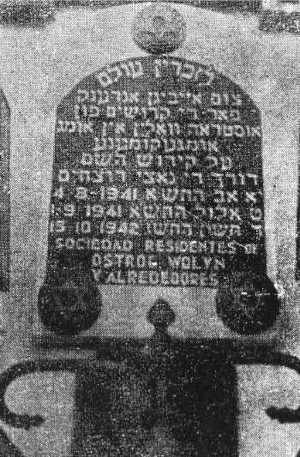
The first slaughter happened on 11th day of Av (August 4, 1941), in the mass grave in the forest of the new town. There were 3,000 martyrs at that time.
The second slaughter, with more than 2,500 martyrs, took place on 9th of Elul 5701 (September 1, 1941). This grave is in the Nitysende forest.
And the third and final slaughter took all the rest of the Jews on 7th of Cheshvan 5702 (October 15, 1942). The grave is in the forest, in the new city.
The destruction was tremendous. Total blocks of houses were completely destroyed. There was no recognizable sign of any populated area. Of the great MaHarsha shul, only the four walls remained. There were 900 Jewish residents who were able to save their lives, of which several are found in Ostroh itself. Another 400 are found in Israel, and the rest are in places all over the world.
Of the compatriots, some have taken an active part in the establishment of the country of Israel, and some fell as holy heroes for our nation.
The old historical city of Ostroh, with its Jewish environment, which lived, created, and struggled in the pre-war times, was destroyed along with the closest and dearest ones.
|
|
[Page 57]
|
|
|||
|
|
|||
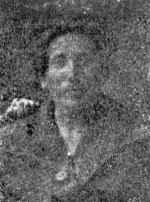
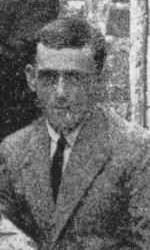
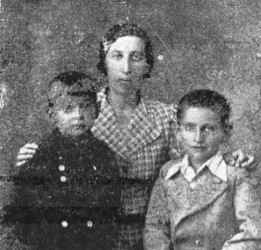
| Martyrs of family Michoel Grines: Shlomo and Rivka Grines – parents, sister Ettel Grines-Oksengoren; Her children: Moshe'le, Avreme'le; Brother-in-law – Shlomo Oksengoren | ||||
Translator's footnotes:
by Dr. Zvi Kaminski
Translated by Pamela Russ
The Ostroh shul celebrated its 400th year. In conjunction with that, let us discuss the one who was the great Tzaddik [righteous one], and the MaHarsha who was the great scholar. He knew several global languages. He was born in Kracow on the eve of Rosh Hashana in the year 1563, and passed away on 15 Shevat, 1632. For forty plus years, he held the seat of the rabbinic leader of the city of Ostroh, Volhyn region.
In the old sources, the city was called “Ostroh.” Every time that I visited the city, I was drawn to visit the gravesite of the MaHarsha, of blessed memory. In those times, there were many Jews in the city, some who became great scholars and influential people. Among them, was an exceptional doctor who was a great expert in his field, and he was a religious Jew.
When this doctor died, the entire city attended the funeral. The MaHarsha delivered the eulogy and asked of all the Jews that when it would be his own time to go to the Garden of Eden, then they should bury him next to the doctor. And they fulfilled his request.
With time, a tall tree grew between the two gravesites.
In the middle, the tree split in half, and underneath, there was a well with crystal clear, pure water. The well was deep, about half a meter. The water was cold in the summer and winter, and in the greatest heat the water in the well did not evaporate. And in the frosty weather, the water did not freeze. Even the Christians, who used the water, held it as a healer for all kinds of ailments.
At that time, Ostroh was famous as a city of great earnings. Jews from near and far would come to Ostroh for the fairs that took place several times of the year. They made businesses that brought major profit to the city. The MaHarsha thought that he would leave a monument after his own passing. Within a few years, he had amassed some money and completed the construction of the great shul that bore his name. It took about three years to complete. They used rocks and bricks. The best builders and other professionals, brought over from a distance, were the ones who worked there. The shul became an example of Jewish synagogue architecture. Inside the shul, from the floor to the ceiling, was a height of 15 meters. In the great MaHarsha shul, at a regular time, there could be about 5,000 people.
[Page 59]
In a difficult time, even more people could be there. The doors and windows were made of steel and iron.
The front of the shul was protected by a fortress which no one could enter.
At the time when the Renaissance shone its glow onto Western Europe, and the winds of liberation were wafting, a darkness ruled over Eastern Europe, and the wild vandals were dancing their demonic dance. The murderer, Bogdan Chmielnicki, and his wild hordes of Ukrainians, demolished the Jews and vandalized their possessions. That was in the years 1648-49. In Jewish history, those pogroms are called “Gezeiros Tach ve'Tat” [evil decrees of 1648-49].
Bogdan Chmielnicki, may his name be erased, made the horrific march across the “Pale of Settlement” [western-most region of Russian Empire], drawing closer to the city of Ostroh. The entire Jewish population crammed into the shul. It was not easy to find one's wife, children, older or younger people, among whom there were also those who were ill, but the community leaders decided that whatever was going to happen would happen, and if no miracle would happen then at least being in the shul would extend their lives for a few days.
Unfortunately, no miracle happened. The hooligans began to shoot with cannons. One of the cannon balls fell through the ceiling and killed several people. From that bomb, a hand-washing cup was made. That same cup was in Polisz in the shul, when I went to visit there. The second bomb was left hanging on the ceiling, and the third is wedged into the shul's wall. In the end, the Jews surrendered, and they opened the doors to the murderers. They quickly began their “work.” They separated the elderly and the children. The others were dragged out, and a rumor circulated that they were sold as slaves.
In the Soviet Ukraine, they proclaimed Bogdan Chmielnicki, may his name be erased, as a grand national hero. In some cities, they even put up monuments for him.
|
|
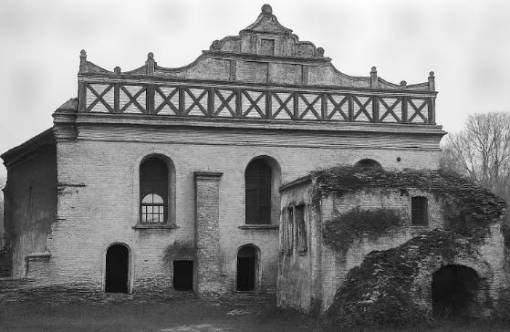
The great shul with the name HaMarsha in its destruction, after the Shoah, in the year 1945 |
by Betty Eisenstein-Kashev
Translated by Pamela Russ
Volhyn (or the Volhyn administrative governance), a section of the Polish eastern borders in the years 1921-1939.
According to the numbers of the general population count of the year 1932, in this region of Volhyn, the population was 2,085,574. Of that, there were:
Poles – 346,640
Ukrainians – 1,418,324
Ruthenians – 8,548
Jews – 207,792
The rest of the population was comprised of Germans, Czechs, Russians, and others.
The population statistics of the year 1932 were not compiled according to the nationality principle, but according to the criteria of the mother tongue and religious denomination. This modality was designed by the Polish government with the political goal of reducing the numbers of the population in a creative manner, that is the population that belonged to the national minorities.
The Polish administration, for example, divided the Ruthenian language [Middle Russian or East Slavic] and the Ukrainian language, that are essentially synonymous – almost the same language. For the Jews, the numbers of the population according to the above details, were 174,157 people, and only 1,975 declared themselves as Poles with “Jewish beliefs.”
Before September 1, 1939
In the last few years, before the German-Polish outbreak of September 1, 1939, the Polish government declared war on its Jewish citizens. At first glance, this war was not to blame, because it was basically an economic war, associated with the then government head, General Slawoj Skladkowski, and it became known in Poland and beyond its borders by the name “Owszem” [yes, indeed!]. That means to say: Pogrom the Jews, crush them physically? No. But fight them economically? Why not, on the contrary
In that period the Polish prime minister put out an ordinance to the municipal administration to improve the external appearance of the city and towns. That meant: to modernize, uniform the appearance, and to plant trees and grass around the houses. At first glance, these orders had nothing to do with the Jews. But according to its format, it was a general ordinance for all the residents of the city. But factually, and especially in Volhyn,
[Page 61]
it hit particularly the Jewish population. The Jews considered this new ordinance as an addition to the premier's program of the “Owszem.” As was known, in Volhyn, there was an entire row of towns that were densely populated mainly with Jews. And in the old, narrow streets of these towns, there were very old houses, bent over with age. The magistrate and municipal administration of smaller places took great effort to modernize the oldest and ugliest parts of the towns – the Jewish, poor quarters.
Other than that, in the Jewish cities and towns, there were rows of houses which, in their time, were set up without any particular plan. Often, these types of houses were actually in the middle of a street, and honestly, blocked movement in the roads. All kinds of rumors circulated about these houses, such as they were put up in their time without the permission of the Czarist authorities, on the basis of a bribe which the local satraps [pejorative term for local leaders] took, as representatives of the Czar's government.
The municipal representatives took over the plans of the city and the houses. All the houses that were in a bad state and were not on the city map were decidedly going to be overrun, regardless of the state they were in. Other than that, the municipality ordered that an entire row of houses that were in bad shape or close to collapsing be removed. Also, the municipalities ordered extensive renovation in an entire row of other houses, enclosing them with strong gates and encircling them with trees and greenery.
In the Summer of 1938, the municipal representatives prepared to destroy an entire row of houses. The residents remained without a roof over their heads. For a little bit of time, they lived in the debris, but later they went into the women's sections of the shuls.
The majority of the people who were forced to undertake the renovations were no longer obligated to do the work. So, the renovations never actually took place. But they lived in constant fear. People feared the arrival of the special committee that had the rights to destroy the houses that had not undergone the renovations, or, in the best case, to impose great punishments.
Because of the anti-Jewish economic politics of the government, which, with all means – taxes, credits, and so on – favored the non-Jewish business at the cost of compressing the Jewish business, the economic situation of the Jews in Volhyn was becoming increasingly worse.
The Jewish population consisted primarily of small shop owners, village peddlers, and craftsmen, who, understandably and as was known, made their living from trade and workshops, that they presented to the non-Jewish population: the peasants and officials. In many instances the Jews could not withstand the competition of the new, elegant, non-Jewish stores, both private and cooperative, that drew non-Jewish customers with their cheaper prices, to which they went, thanks to the government's advanced politics and anti-Jewish permits. The new stores were decorated with signs: “A Christian Store”; “A Polish Shop”; “A Slovenian Enterprise”; “Do Not Buy from a Jew”; “The Jew Will Trick You”;
[Page 62]
“Go Only to Your Own”; “Svoye Do Svego” [Ukrainian: “Go to your own”], and so on.
Across this entire economic battle there was a sense of regular, brutal, pogrom anti-Semitism, which, for many years past, had not been felt so strongly. The pogroms in the towns (Przitik and Minsk-Mazowiecki), the anti-Semitic expressions of the Polish students, the university ghettos, the anti-Jewish Sejm [Polish parliament] debates, the law against Jewish animal slaughter, ruled everywhere, and every Jew and non-Jew was under all this pressure. In such an atmosphere of hatred and heavy fear, the Jews lived in the last years before the outbreak of World War II, until September 1, 1939.
The three weeks of the German/Polish war evolved into a long chain of unsettlement and suffering for the Jews. They lived in fear of pogroms that were hanging in the air. In the days of their defeat on the front, the Poles could not tolerate the sight of any Jew. At each opportunity, and very often, they openly showed their hatred towards the Jew. In the area that the Polish army ceded at the eastern part of the country, the civilian population along with the Jewish population evacuated.
There was frequent talk about pogroms. All kinds of rumors were circulating about pogroms that would happen every day. They said that the pogroms would be started by the Polish semi-military organization “Strzelec” (“shooters”), who were just waiting for the organizations to come from the west. Others said that the pogroms would be started by the railway workers, the “Kolejarz” who were in the east in large numbers. Other rumors said that the pogroms would be started by the “Osadnikes” (colonists who were army veterans), Polish settlers who were brought from the western regions by the Polish government during peace time. For now, the Jews lived in a state of panicked apprehension.
And suddenly, on September 17, 1939, the Red Army crossed over the eastern borders of Poland. For the Jewish population, this actually meant salvation. No wonder that the Jews welcomed the Red Army with joy, which they did not even try to hide.
The Incoming of the Soviets
The announcer of the new regime naturally was the Red Army. For the entire population, Jewish and Christian, they actually were exotic creations. People were curious to hear from their mouths details about the land of the Soviets that, for a total of twenty years, had been hermetically sealed shut for the entire world.
The Jew, also the Ukrainians and the Poles, with their own curiosity, for the first time, allowed themselves to speak to the Red Army. They were tactful, polite, remembering to praise them to the seventh heaven as “our government” [“nashe provitelstvo”), and the “the friend Stalin.” Anything that had a connection to the Soviet country, they spoke about in superlatives. All the answers given by the Red Army to these posed questions, left an impression of being clichéd, as if completely memorized by heart.
[Page 63]
But it was only after a short time when the people began to realize that all the talk that they heard from the Red Army was absolutely similar to theirs. In spite of the similarities and in spite of the reassurance of the Soviet people who had come to Volhyn, strong differences soon appeared between that which they had said and that which they actually did.
For example, they praised to the sky the prosperity of their country, and they were terrifically greedy about everything that their eyes saw: the food that was in all the industrial workplaces, even the food of the worst type. They would buy anything that they could.
The local population quickly oriented themselves to these differences and quickly understood their source. So, they used to make fun of them and would question them with pretended naivete asking if in their country certain items were available to buy or to sell. All kinds of anecdotes began to circulate with these themes, especially since the Soviets would always answer these questions with stereotypical replies: “Everything is available for us” (U nas vsyo yest). This soon became a common phrase.
Just a few short weeks later people stopped having conversations with the Red Army people and with the civilians who had come from the east in large numbers. Very quickly, there was a reckoning from that, as to what it means in the Soviet Union to have conversations. Some were instinctive, some actually tried to follow the ways of the Soviet realities. They wore masks of happy people who were fascinated with all that was Soviet. They also learned how to be silent.
After the Red Army, some of the assigned people from the Secret Service arrived, those from the NKVD [Russian secret police, Narodnyi komissariat vnutrennikh del; The People's Commissariat for Internal Affairs], and activists from the Communist Party. They took to the task of establishing the new order. To the general amazement, they set up the new order carefully and very slowly, with the foundation of the policies that Volhyn had with the Bolsheviks in the year 1917, when the administration was run by them. They decided that right after the Soviets came, they would immediately open all their stores and manufacturers, and allow the people to have whatever their hearts desired.
The peasants were so confident with this that just as the Red Army entered, they began to go to the towns and cities with empty bags. Sometimes, they waited for some days to be able to rob the stores and camps. But the Soviets dealt with this completely differently. Not only did they not open the stores and take whatever they wanted, but they summoned the owners of the stores and ordered them to manage the stores as they had until now, so that the owners remained the bosses as they had been before. The stores reopened, and the owners sold their inventory according to the former prices. That meant, according to the exchange that the Soviets fixed: one Polish zloty equaled one Soviet ruble.
In each large store, there was generally a Soviet supervisor, but there were many incidents when the supervisor was not there, and the owner
[Page 64]
was the boss, managing just as he used to in normal times. The smaller stores had no supervision at all from the new government.
During the first few weeks, people would stand in line in the shops, and would buy everything that they found in the shops. They bought – whatever was being sold. They actually were buying out of fear that soon they would not be able to get anything.
After a short time, the stores were not able to acquire new products, so with their own decision, they closed up. But not all the products that the shops actually had were truthfully sold. In spite of the control that the government had, the store owners tried to hide some of their merchandise, especially some of the better items.
These hidden items gave the owners an opportunity for a better existence during the two tight years of Soviet rule. And in the times of the German occupation, these hidden materials switched to a reserve in order to soothe the raging appetites of the Germans in these places.
The larger private operations: sawing wood, mills, trellises, these from the beginning, when the Bolsheviks first arrived, were nationalized. In the cities and towns, municipal administrations were set up [gorsovet; city council], and in the villages there were village administrations set up [sielsoviet; rural administration]. Bank offices were formed from the government Soviet bank [gosbank], and financial departments, and actual taxation offices [finotdel], health offices [zdrovotdel], all kinds of business projects, cooperative institutions, and a whole list of other offices and institutions.
In a few incidents, the management – that is the managing offices in the Soviet administration – in various instances, lay in the hands of the people who came from the east [Vostochniki; Easterners], the second level positions were generally given to local individuals.
In the newly populated areas in eastern Poland, and among them also in Volhyn, within two short years of the Soviet rule, from September 1939 to June 1941, the freedom of religion was untouched. The cathedrals, churches, and shuls, remained legal and were always filled with people – more than in regular times.
The gatherings in the religious institutions were the only possible form of legal, national life. The cathedrals for the Poles, the churches for the Ukrainians, and the shuls for the Jews, began to provide a specific function. The information about them, that the cathedrals were open and the servants of God were permitted entry into the newly occupied regions, spread very quickly in the Soviet Ukraine.
The Soviet peasant, who for twenty years had suffered and felt aimless in his religious feelings and yearnings, now suddenly had the opportunity to live a religious life. Mass movements began from the eastern regions to the western regions. Hordes of people came to the cathedrals and fervently prayed to God, confessed to the priest, and most importantly, undertook the immersion into the holy water. From the Soviet side, they brought not only children and young ones,
[Page 65]
but also those who were middle aged, young, and even Komsomol [communist] young men and women came to immerse in the holy water…
Other than for religious reasons, people from the western Ukraine also came for worldly, material interests. They came to buy basic life products, primarily for sustenance, and grains. In the majority of situations, it was not only about buying products in order to make food for one's own needs. The customers negotiated for merchandise to be resold, for “speculation,” as it was called in the official Soviet language.
The wanderings of the eastern people in the western regions lasted for several months. Later, they suddenly stopped. From that time onwards, you could only go to the western regions with special permission. The people in the west were very puzzled. How could it be that on the grounds of one command suddenly all the movement was stopped? And this was to such an extent that a peasant from a neighboring area, that was even close to the border, did not warrant being connected for a few hundred meters to the town on the other side of the border. This made such an impression that the border was once again hermetically sealed, as before the war.
At the same time, arrests began right after the Soviets entered. At first, rich people were arrested, as were social and political (among them were Zionists), and the wealthier “Osadnikes” [Polish army veterans]. And with time, the groups of those arrested expanded. They also started arresting people from the general masses, without distinctions of nationality, and they could not always know why they were arrested nor what category of people was going to be next.
At first, they filled up the prisons with those who were arrested. After some time, they were taken away. Then the prisons were once again filled with new victims. After sending away the arrested men, they usually also sent away the women and children.
The people were terrified. No one could be sure whether or not the NKVD would come after them, and tear them away from their families, and then later tear the families away from their homes and send them to distant areas of the Soviet Union.
They could not know from which side any of these tragedies would come; how could they protect themselves, and could they ever prevent any of these happenings. They did not know whom or what to fear, or from whom to be careful. They feared everyone: a neighbor, an acquaintance, an unknown person, and even a close person – a brother, or even one's child. They knew that there were spies at every step – secret agents, members of the NKVD. It was known that the NKVD secretly called people out for them and took them to
[Page 66]
assign responsibilities to spy on the people in their areas and reveal those who were unhappy with the Soviet government. But they did not know who, from those who were solicited, in a weak moment, had actually signed to undertake such a responsibility.
And someone who had once signed [undertaken] such a responsibility sometimes had to add material, even something that was just thought up. If not, then he himself was likely to be caught up in a net of curses upon himself. People were afraid that they would be called out on a random day and they were close to going crazy.
There were incidents that those summoned into the NKVD acted as lunatics and idiots, so that they would prevent themselves from being caught up in the planted net of becoming a secret agent against their own will. With sarcasm and role-playing love for the new government, they sang the Russian song in which the composer praises the freedom in the Soviet country with these words: “I don't know of any other such country where a person can breathe so freely.”
Understandably, in the area of economics, the people were also not the boss over their own life. For the person who had once been engaged in whatever type of work, there was now no way out. He had no right to leave it.
Regardless of the fact that every type of work with the Soviets made the worker obligated either to take on political and financial activities, there was also a moral muddy puddle involved. Whoever even just gently stepped into the puddle was never able to leave it. He had to continue stepping into the swamp, and mostly against his own will.
Work in the Soviet Union did not allow for the opportunity to feed oneself. Every person had to have some sort of work, meaning: even those who had no means to work but still had to live; even those who secretly took on some business, which was strictly forbidden by the authorities.
The person who did not work had attention drawn to him, aroused a suspicion that he was against the government, was occupying himself with inappropriate things, was a former capitalist, and so on. In most instances, official work was simply a means of maintaining life.
A phrase circulated: “Stalin provides work, and you have to raise your livelihood by yourself.” And “livelihood” meant “combining” things at the workplace, that is working alone or with partners – primarily with people from the east, who were the directors of the projects and offices – all kinds of useless things.
They had to give bribes to the elders, to the directors of the projects and government offices. They had to work alongside them, and they took partners from the lower ones, from those who were on the lower levels of work, and they earned money from their “businesses.”
The local people, at first, did not orient themselves to these situations, and did not even imagine that those “easterners” were following through with these obligations for the good of the country in such a way that without any left-wing businesses there could be no existence. It was only the arrival of those from the Soviet side, leaders, and high-up officials, that finally opened their eyes. Then the locals took on the behaviors that the new bosses brought with them. In each undertaking the lower official tried to please his boss, the higher up, and so it went to the highest hierarchy. You could hear the Russian phrase everywhere:
[Page 67]
“ruka ruku moyet,” “one hand washes the other.
Even those who were involved in innocent institutions – from an economic business perspective – such as schools, hospitals, and the like, had to lie and give false reports. If they did not do so because of theft, Khabar did this to them for other reasons. Since society was now building a socialist country, the official behavior was that this was done voluntarily.
If this was done voluntarily, then each job had to be completed in the best manner, totally 100%. Everything that was done had to be perfect. If not, then the set voluntarism would be broken up. The trains had to be perfectly on schedule (but truthfully, they were often late, sometimes even for hours).
Students had to study well and move up from grade to grade. Since the higher officials often required them to provide the reports of the completed work, and giving bad reports meant undermining the secrets of the government and of the voluntarism, they fabricated fitting reports, not taking into consideration the factual situation, and this was sent to the higher ups.
Other than that, there was one more thing that led to living life with lies. The various institutions, offices, and projects had to pass among themselves the so-called “sotzorev-nowonye”: societal competitions. One institution assumed the responsibility of outdoing the other in work production and outdoing the other in larger production. And every official and worker competed with his friend to see who would succeed. Demonstrating more initiative, energy, work capacity, etc., understandably, no one took any of that seriously. But everyone had to play the role, pretending that this troubled them.
In every step of the way, they fabricated so-called “pathological reports”: the reports from the top or the author of reports (that means to say that the reports came from the numbers that they took from the earnings). These reports were compiled in a natural way and were received in the higher offices as good information.
A very difficult labor system was set up in the country. There was no talk allowed about who would be leaving his workplace. This was strongly implemented by law. And on the contrary, being absent for a day's work, or even being late for a few minutes was considered sabotage for which you were placed in front of a judge and determined to have committed truancy.
Depending on the reason of committing such “truancy” for any number of times, the offender was considered to have committed a “huge” crime, and so on, and he was given an appropriate judgment. The lightest verdict was: For a certain time, 25% of his salary (the money went to the NKVD) was retained, but it also happened that for being twenty minutes late people were also sent to prison.
In the short time of the Soviet system, the deepest possession that people had were taken away. That was basic personal freedom and intellectual freedom. People had to do and say things that they did not want to do or say, but they had to do and say what they were told to do. No possibility existed at that time to withdraw into a quiet corner and live calmly,
[Page 68]
far from politics and societal areas. Everyone was held responsible in a larger or smaller way, to be active, join in happily, dance around and always be in agreement, go to gatherings and applaud loudly, and most important, follow all the orders. They lived under such pressure that terror crept into even the small cracks of intimate life: of thoughts and feelings. People began to fear even their own thoughts and feelings. After a short time, people began to feel miserable – their fear became a constant companion.
This tragic and immoral atmosphere in which people lived, to which the fragile, human soul, which thirsted for life, acclimated itself, affected all spheres of the population, without exception, and all nationalities. But, in spite of that, the national resistance did not falter. The opposite: They became stronger and deeper.
The Jews and the Soviets
The relationship between the Jews and the Soviets should be explained from two different aspects: first the personal aspect, and second, the general national aspect. The other nationalities in Ukraine – Poles and Ukrainians – found themselves in an entirely different situation than the Jews. The material existence of the other nationalities (with few exceptions), with the settling of Volhyn, was hardly touched. Truthfully, people were afraid of the collectivism, which they understood and felt they had to take on. But for now, everybody retained his own business, worked wherever he worked previously, and did not become materially poorer – and certainly was not ruined.
On the other hand, the Jews became socially uprooted, as if they were left hanging in midair. The Jewish population was comprised of three areas: merchants, craftsmen, and professionals.
When the Soviets took over, all the sources of Jewish existence were eliminated in one fell swoop. This touched not only merchants, who understandably could not access fresh merchandise for their businesses, but who were able to sell only their old products.
There was no liberty for craftsmen nor opportunity for private practice. Even workers in the area of free professionals (doctors, for example), who still at that time were still able to work on their own, knew that this was just a question of a very short time, and that soon they would be left without a livelihood, if the government would not prepare work for them.
The first thing that the Jews did, even before they tried to orient themselves to their situation, was to set a strong foundation under foot. The Jewish merchants tried quickly to take on whatever job they could in the government machine. The desire for this came not only from the fear of what tomorrow would bring, but from a totally different source.
Jewish merchants were looking for a means to restore themselves with the communists in their own former business. They did not know that in spite of the liberal education received from the government for the merchants until now, the income did not belong to the respected earners in Russia, and they also did not know what sort of fate met the former merchants in the Soviet Union.
The former merchants, people with long
[Page 69]
practical, detailed initiatives and energy, were very useful as employees, officials, bookkeepers, planners, organizers, and more, in the merchant industry, business administration, and financial offices and administrations.
Also, the Jewish intelligence, understandably, occupied positions in the responsible government institutions. Not all craftsmen and workers (Jewish, understandably), remained in their former businesses. A portion of the craftsmen were actually taken into the newly established cooperatives, the so-called “artel” [workmen's association], but a large portion of them felt that the time had come for them to elevate themselves, meaning that their profession and their devoted “good” social commitment enabled them to take a serious position in the government machine, or at least to serve in the military.
Among those people who came from the east, in order, in Volhyn, to take on responsible positions, to work with the government machine and to establish the new organization, there was no shortage of Jews. There was a situation that Jews occupied a large percentage of the Soviet administration (even in leadership roles). That was how they received, in larger numbers, the rage and hatred of the non-Jewish population who, for many generations, were known and remembered to be Jew haters.
Among the non-Jewish population there was the opinion that everyone who worked with the Soviet government did that under coercion, and really that he was an enemy of the regime. There was only an exception made in reference to the Jews – towards the non-Jews. They were certain that the Jews revered the Soviet government out of good will, and even with joy since it was in their interest that the Bolsheviks remain in the country.
In a certain manner, this was true – a tragic truth. In the uncertain surrounding, in life among the people who placed a fear into the Jews, he had only one satisfaction – that was, that this time he was not the only victim as a Jew, that everyone else was suffering as he was, that their pain was no less than his. The fear and the unrest under the Soviet rule were not the fate of the Jew because he was a Jew. Despite all the difficulties and pain that they had to sustain, the Jews did not want anything to change. There was a fear that any change, whatever it might be, could only cause one thing for the Jews: an outbreak of hatred from the regime. An exception was made with the pogroms.
The Soviet Jews were filled with this fear even though, as it seemed, there was almost no specific anti-Jewish targeting, and they were completely assimilated and parallel to the Soviet non-Jewish person. The fear of the outbreak of hatred from the population, which was compressed by the Soviets, united the Soviet Jews and the western Jews, and brought them closer to each other. In general, however, they believed that Stalin was friendly to the Jews, or at least he was neutral towards the Jewish issue, and with his iron fist he would not allow any anti-Jewish outbreak.
This above-mentioned situation, which placed the Jews in a situation where, in the Volhyn regions, they had never been before: in one situation with non-Jews using the protection of the government, there really was satisfaction. But this gave only a few sweet drops in a large ocean of problems.
The Jews of Volhyn were their own nationality, had their cultural, political
[Page 70]
and social organizations and institutions. In the year 1932, only a few presented themselves as “Poles with Moses's beliefs.” Others actually presented themselves as Jews, with Yiddish or Hebrew as their native tongue.
Right after the Soviets took over Volhyn in September of 1939, the Jews worked this out as saying that their national existence was being controlled. People who all their lives had breathed the atmosphere of Jewish national resurgence, were not in the situation of crawling out of their skin – and that would be with one gesture. So, it was no surprise that even though the Jews saw their saviors in the Red Army, on the other hand, they accepted the saviors with great caution. The arrival of their saviors was accepted with a great bang, a great tragedy.
In national hindsight, the Jews actually found themselves in a worse position than all the other nationalities in the country. The politics of the Soviet government, in the several Soviet regions from before 1939, made itself exceptional with a few zigzags and messes regarding the recognition of Jews as a nationality. In the newly established areas, the geo-politics placed themselves in opposition in every format against the Jewish collective life, and were exceptionally opposed to the Jews settling in the new regions.
All the Jewish institutions, social and philanthropic, were, as mentioned above, liquidated. The hospitals, senior residences, orphan homes, all became nationalized. The locations and inventories of the institutions, which for many years the Jews had compiled with great effort and then set up, were confiscated.
The elderly and the children were placed in the general residences and orphanages, and were mixed with the other nationalities. Truthfully, the Soviets did not do anything wrong for the elderly or the children. Their situations did not change for the worse when they were moved to the general institutions. Also, all the Ukrainian and Polish institutions of these types – as many such existed separately for the Poles and Ukrainians – became nationalized and then the same fate was placed on their Jewish colleagues – but the strike upon the Jews was very hard, especially since they had had fewer opportunities – because of their religion – to live nationally, and the little that they did have, was also taken from them.
But the main strike that the Soviets gave to the Jewish nationalist feelings, was felt in the education areas. The Hebrew schooling in Volhyn was liquidated in the actual first days when the Soviets took over the region. This work was done by the local Jewish communists, who had the full support of the Soviet “politrukes” [“political instructors”], who were of Jewish origin.
Later, it became apparent that the people who had come from the east to organize their lives in Volhyn, also, in terms of the education, had the same calling in all other areas of their lives: that was, for now, to leave everything as before. And honestly, in the non-Hebrew schools, for about two months, there were the same conditions as there were before they took over the regions. And that is how it was also supposed to be in the area of the Hebrew schools.
The Soviet non-Jewish “politurkes” and military staff had absolutely no idea about the existence of the Hebrew language. But at the very end of the 1939-1940 school year, when
[Page 71]
the non-Jewish “politurkes” and military staff visited the Jewish schools in order to spread Bolshevik propaganda, they would always, after completing their mission, ask the Jewish children to sing Jewish national songs and to dance the Jewish national dances. If, among the guest, understandably, there were no Jews, then the children would do as the guest requested: sing songs from Israel, dance the Hora, and even sing Hatikva. It would often happen that the guest would very much enjoy the enthusiasm and temperament of the Jewish children, or even just the national dances, and they would ask the children to repeat their performances once again.
But all this only happened when there was no local communist among the guests. The local Jewish communists, just after they were settled in these areas through the communists, took to threatening the Hebrew teachers with consequences for continuing to maintain the Hebrew schools as they were doing, until the installation of the new Soviet government. And that was, in spite of the fact that the Soviet government had meanwhile not put out any ordinances to change things in the education system.
The Jewish communists argued that the Hebrew teachers were using the naivete of the eastern non-Jewish communists, who did not orient themselves into the situation so that for the time being, they could maintain their “destructive Zionist” work.
As the Hebrew teachers found themselves in this situation, the Hebrew teachers had no alternative but to willingly persuade, even before it became officially ordered, to change from Hebrew to Yiddish. So, all the Hebrew schools in Volhyn, at the very beginning of school in the year 1939-1940, were changed to Yiddish schools, with Yiddish as the language of instruction.
Only one fact is known, that a teacher from a Hebrew school officially in writing declined working in the school for obvious reasons. In March 1941, the former teacher of the Tarbut school in Ostrow, Yosef Ferlok, sent a letter to the school inspector saying that he was quitting the job because he was a Zionist and a religious person and so he could not lie to the children nor to himself, by raising them to be communist idealists.
After some time, the schools were sent learning programs with instruction books. These programs were identical to the ones in the other schools. The instruction books were a verbatim translation of the Ukrainian instruction books. There was not even the slightest underlining in them or the smallest accentuation of any Yiddish differences, which would allude even slightly to any Jewish national characteristic. It was all written in Soviet-Yiddish orthography.
At the beginning of the 1940-1941 school year, the second school year under Soviet rule, all the Jewish schools were turned into Russian schools. But in certain larger places, where there were few Jewish schools, for now, the former Talmud Torah schools, which, understandably were also changed to Jewish schools, were allowed to remain as such, with Yiddish as the main language.
The change of the Jewish school to a Russian school happened in the following manner: The director of the Jewish school, who generally was of the Communist Party from the eastern regions, called together a meeting of the parents. In the presidium of the meeting were people of the school inspectors and from the “partkom”
[Page 72]
(Party Committee), whose presence alone evoked fear from those gathered there. One after the other, each of the people in the presidium delivered a few words. First, they praised the Soviet government to the sky, as a friend of the people, and as a friend of the nations, and so they knew all the languages of the world – and among them was also the Yiddish.
But the children who are studying in Jewish schools were learning the native languages very poorly. That was Ukrainian, and governing language of Russian. After completing the Jewish people's schools, they had a lot of difficulty to get into the higher-level schools where, understandably, the language was either Russian or Ukrainian. Therefore, in the interest of the parents, who wanted to ensure that their children would not have difficulties later on in finding employment, and for the good of the fatherland, they put forth public speakers to change the schools to Russian ones. “This will enable your children to become doctors, engineers, scientists, anything that this land will need.”
Afterwards, they were told to vote by raising their hands after hearing the speech. After putting down their hands, they were asked: “Who is opposed to this?” Understandably, no one came forward in opposition and it became a protocol announcement that no one was in opposition, it was all unanimous, and at the request of the parents the Jewish school was changed over to a Russian one.
To the new Russian schools they began to send over non-Jews students and non-Jewish teachers. The situation for the Jewish teachers became tragic. At the time of the Polish governance, they infused a Jewish nationalist spirit – Jewish nationalist ideals. Now, suddenly, the same teachers, who a short time ago were praising one government, now they had to dismiss everything that they had taught just the previous day, and now change everything to hatred of the things the children had been taught to love and believe in. The teachers had to tell lies, implant hatred and foreign ideas.
There was no possible means of leaving the teaching jobs. The strong labor regime tightly tied each Soviet person to his workplace. Because of the teachers' situation, the regime was even stronger in the schooling situation. Practically speaking, it was entirely impossible to leave the school.
A foreign teacher, who was not from the place where he worked, and was therefore a free person, sometimes had the opportunity to flee from his place of work and disappear. But teachers, family members, had to replace his work. He had nowhere to go. And he did not have the slightest opportunity to decline his work and not to attract the rage of the authorities and the consequences that were connected to that.
In the first school year under the Soviets, 1939-1940, when the schools were still Jewish, and the teachers still worked in their tight circle, with the children from their own schools, there was a sizable number who did not have to become major Soviet patriots. But in other and more recent Soviet schools, 1940-1941, when the students already were comprised of a mixed element, the school job became a long chain of pain, as they lived in a circle of dishonesty. The teachers fell into depression, and did not have a strong desire, nor energy or will to tear away from the lies into which they had sunk.
The liquidation of the Jewish schools, and of all the social and philanthropic institutions, and the absolute absence of a Jewish newspaper, let alone
[Page 73]
a Jewish book, and the total disregard for the Jewish minority. This was all boldly visible in the politics that the central institutions conducted in relation to the Jews and in the objectives of the current politics. The goal was to mix up the Jews into the strange surrounding sea of foreign nations.
Many Volhyn Jews, and not only the nationalist teachers, could not agree to their fate and take on the decrees. For many Jews, the prospect of a national decline became the reason for many sleepless nights, for a great unrest. So, many Jews tried to arm themselves against these perspectives, arming with awareness and instinct. Not easily and not too quickly did the Volhyn Jews resign from their nationalist ideas and habits, even though this was connected to great responsibilities and bitter consequences.
The Zionist activities in Volhyn went underground. They set up two goals: 1) to get out Jews, particularly young ones, from under the barrier of Soviet influence, and then later to bring them to the Land of Israel; 2) with the influence of possibility, to fight the assimilation that was thrown onto the Jews from the top – of the Soviet politics. This second goal meant to foster the young school-age souls with nationalist impressions and experiences. The road to this type of goal was to implant into these souls a deep, national unrest, so that they would not be able to easily decline from Jewish feelings and not be able to quickly make peace with the living reality.
In the first few months, after settling in Volhyn, people were still able to move from one place to another. Also, the borders between the settled regions and the neighboring countries such as Romania, Lithuania, Latvia, and the German occupied parts of Poland, were not yet strong. To cross them did not yet entail risking one's life. Jewish refugees from Congress Poland would cross the border daily onto the Soviet side. Some would return to western Poland to their families who had remained with the Germans.
Others were deeply preoccupied with trying to live a calm life under Soviet rule until the war passed, and in their efforts they decided that whatever would be – they would stay where they belonged – in their homes. Poles went from the left side of the Bug River to the right side, to the Russians.
Each of the wanderers had a prepared excuse for the Soviet militia and the NKVD people [People's Commissariat for Internal Affairs]: that the war's storm had ripped him out of his house, so now he was going back, and his home was really there – where he was going now. In the general surroundings of the wanderer and the return wanderer, the Zionists had many extended opportunities for tasks. They used to send their people to Vilna (at that time Vilna was still part of the Lithuanian Republic, before the republic was annexed by Russia), and on the south, through Lemberg, to Romania. From Lithuania and Romania, the people worked their way to Israel. This Zionist activity was filled with dangers for the Zionists in the areas which, in 1939, had been transferred to the Soviets on the basis of the Molotov-Ribbentrop Pact that was signed on August 23, 1939, but until now had not yet been exactly followed, and many details and in many instances, it was completely forgotten.
[Page 74]
Mordechai Tenenboim Tamarov, the commander of the uprising in the Bialystok ghetto, expressed in his letter to his sister in Israel his unrest and concern, and wrote:
“With her death (Tamara's, b.a.) we all died. Who will know about our difficulties during our hard times, the real heroic struggles during the time of the Soviets.” (From the pages of the fire, page 143 – Mordechai Tenenboim – Tamarov, published from kibbutz hame'uchad [the United Kibbutz], 1947).
The second work area of the Zionists was more complicated. The children and the school youth were organized in groups of no more than five. In these groups, they learned and analyzed Jewish resistance according to a program that was secretly brought over by an unknown center.
The above-mentioned groups gathered in private homes and were active in outright conspiracies. Members of one group absolutely did not know of the existence of another. In the beginning, the children and the youth were so overtaken by their conspiracies, that on their way home from school, with hatred and disgust, they would stamp on their red “Pioneer ties” (every student had to belong to the “Pioneer” organization, and later, when the student had grown up, to the “Komsomol” [communist youth organization]), and then with enthusiasm, they would get together in their groups.
After a few months, the borders were closed in a Soviet manner: hermetically, so that going from one side to the other was practically impossible. Also, in one and the same region, there arose great difficulties just going from one place to another.
In principle, at the train station, you had to present a “kommandirovka,” an official document, that you were travelling for official matters. But factually, people also travelled without the documents, but this, understandably, was already connected to many unpleasant events and with “costs,” bribes that you had to give to the cashier or the train conductor, or even sometimes both of them.
The undercover people, who would come in earlier times to give the Jews strength, and empower them with hope, began coming less and less frequently. The lonely people, who remained alone on their own choice, without any outside support, and the children and youth, left alone without contact with the active Jewish world – became apathetic and more apathetic, and every underground activity slowly began to die out.
Only the religion remained the point where Jews sustained themselves. They did not touch the shul. That was the only place where Jews were still able to gather. So the shuls were filled, more so than in normal times. Also, non-religious people came to the shuls. Even the youth would gather there as well.
Original footnote:
|
|
JewishGen, Inc. makes no representations regarding the accuracy of
the translation. The reader may wish to refer to the original material
for verification.
JewishGen is not responsible for inaccuracies or omissions in the original work and cannot rewrite or edit the text to correct inaccuracies and/or omissions.
Our mission is to produce a translation of the original work and we cannot verify the accuracy of statements or alter facts cited.
 Ostroh, Ukraine
 Yizkor Book Project
 JewishGen Home Page
Copyright © 1999-2026 by JewishGen, Inc.
Updated 29 Jul 2026 by JH