 |
|
|
[Pages 5-6]
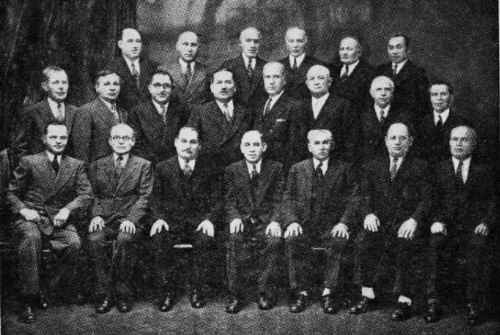
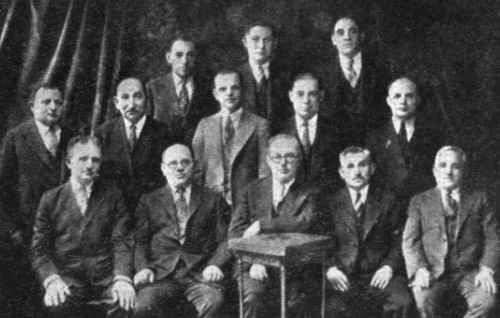
M. Tiktinski, S. Reznik, Natan Gardi, M. Reuweni, Nissan Gardi, Sh. Margolin,
Bruria Rosenblum, Elieser Breslin, Dov Resnik (Berechke), M. Kreinowitz, Moshe Yorshan
Printed in Israel, 1962
[Pages 7-8]
|
|
[Pages 9-10]
|
|
[Pages 11-12]
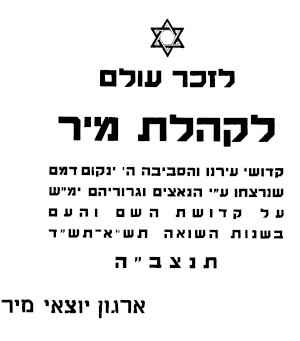
With an awe of sanctity, we decided to publish a book of remembrance for the Jewish community of Mir, in performance of our duty towards the memory of our little town and as a permanent memorial to her martyrs; a town adorned by praise and glory, abounding with rabbis, personalities, organisations and societies, serving as a world theological centre for the Diaspora, suddenly destroyed on a gloomy day.
In order to perpetuate the precious memory of our martyrs, we shall relate in this book:
Great difficulties were encountered on the road to the realisation of our sacred mission to publish this book.
Apart from financial hardships, the principal obstacles were found in the problem of the collection of material, the edition and the publication of it. Finally, we found the solution in handing the matter of the publication of the book over to the management of the “Encyclopaedia of the Diaspora”, widely experienced in the publication of Memorial Books. In fact, the difficulties were not obviated until we overcame them. At this juncture, we wish to point out the devoted and wholehearted cooperation of the editors who, during the past years, sacrificed time and energy towards the compilation of this book.
We thank the Almighty for giving us the privilege of completing our undertaking. The book, as published, was printed in a manner affording respect to our little town.
Indeed, we know that the work is not perfect, and certainly there are defects as well; difficult to avoid in the publication of such a work. Details concerning the times, organisations and various personalities, are also missing. Nevertheless, all the members of the Committee and the editors
[Pages 15-16]
did everything in their power towards obtaining the literary material for publication.
We thank also those who furnished us with articles and records, and all those who assisted with the printing of the book and, in particular, the members of the Editorial Committee.
We express our gratitude to our friends in Israel and overseas for the financial help tendered us, which enabled us to publish the book.
We also give our thanks to the management of the “Encyclopaedia of the Diaspora” Publishing Company, and the editor, Mr. N. Blumenthal, for their unsparing work and effort towards the publication of this book.
May the memory of our little town and of its martyrs be eternally linked with our new life in the land of our fathers, the State of Israel, which is renewing its life and comforting us for our great catastrophe, being a source of hope and solace to our brethren in the dispersions of the diaspora.
by M. Tiktinski
Mir is one of the oldest cities of Lithuania and was mentioned in historical records as having existed as far back as the 14th century. A register of land property and a system of administration were established in the 15th century, also a palace and a perfect fortress were built. In the 16th century, Mir came under the ownership of the Radziwill family, who ruled it until the beginning of the 19th century, when the dominion over the town passed to the Mirski family. It is not known since when Jews began to settle in the town. It is known, however, that in the 2nd half of the 17th century, there was already a large Jewish community.
Bernhard Tanner mentions in his book called “The Journey on a Mission from Moscow to Poland” that as far back as 1678, there was a large Jewish settlement in the town. Evidently, the Jewish settlement served as a contributing factor in the grown and development of the town. According to the information available, from the end of the 17th century, merchants used to frequent the fairs held in Mir, coming not only from surrounding settlements, but also from far distant places, and trade was conducted on a large scale, while nearly all the trade concentrated in Jewish hands. Economic development reached such a stage that Mir became one of the main commercial centres of Lithuania and Poland.
Mir occupied a place of honour during the epoch of the “Congresses of the Four Countries ”, (occurring throughout the 17th century, until the middle of the 18th century). At the bi-annual Mir fairs, representatives of large cities for consultations, used to meet and there they would decide on matters of importance, spiritual or material. Mir was also one of the centres for the payment of taxes.
The rabbis who ministered in Mir were “gaonim”, renowned and revered for their knowledge of the Law. The first well-known rabbi was the great scholar, Rabbi Moshe Eisenstadt, of blessed memory, who ministered in Mir at the beginning of the 18th century. He was the brother of that famous scholar of that period, Rabbi Meir Eisenstadt, of blessed memory, author of “Panim Meiroth”. Rabbi Moshe was also known was a great scholar of the Law. He was mentioned in the writings of the rabbis of that period, that they used to turn to him with questions, and took cognisance of his opinion.
Towards the end of the18th century, the famous and ingenious rabbi, Shlomo Mirkish, of blessed memory, presided over the rabbinate in Mir. He was the author of the treatise “Shulchan Shlomo”. He went from Mir to Koenigsberg to minister there.
The great scholar, Rabbi Yosef David Eisenstadt, of blessed memory, increased in particular the fame and glory of the rabbinate of Mir. He was known by the name of Rabbi David of Mir, and ministered in the rabbinate
[Pages 19-20]
of Mir for fifty years, from 1796 to 1846. He was one of the greatest and most famous scholars of his time. Many of the “gaonim” of the period used to turn to him with vexed problems in which they found it difficult to arrive at a judgment.
His son, Rabbi Moshe Avraham, of blessed memory, followed him. Likewise, he was one of the famed rabbis of his generation.
Towards the end of the 19th century, headed the Mir rabbinate for about twenty years, one of the great personalities of his generation, the famed and celebrated scholar, Rabbi Yom-Tov Lipman Hacohen Waslavski, of blessed memory, author of the treatise “Malhushe Yom-Tov”.
After him, the Mir rabbinate, the famous scholar, Rabbi Eliyahu David Rabinovits-Teomim, served. However, the time of his ministration only lasted for eight years, when he was invited to minister as Chief Rabbi of Jerusalem (his son-in-law was the great and revered scholar, Rabbi Avraham Itzhak Hacohen Kook, of blessed memory, Chief Rabbi of Eretz Israel).
After him, the rabbinate of Mir was chaired by one of the great men of the generation, the famous scholar, Rabbi Eliyahu Baruch Kamai, of blessed memory.
Upon his death, his son was appointed to minister in the Mir rabbinate, the great scholar and righteous man, Rabbi Avraham Zevi-Hirsh Kamai, of blessed memory. Together with the Jews of the town, he was murdered by the German Nazi in the first slaughter which they performed in Mir.
Our town became particularly famous through the great Yeshiva Academy, founded in the year 1815, which existed all the time until the occupation of the town by the Nazi.
The Mir Yeshiva was second in fame after the famous Yeshiva of Volozin. Its founder was a resident of Mir, a Jewish erudite and man of substance, Rabbi Shmuel Tiktinski, of blessed memory. At the initial stage of its existence, all the expenses of the Yeshiva were defrayed by him. The Head of the Yeshiva was his son, Rabbi Avraham, of blessed memory, who was an authority in the knowledge of the Law. When established, the Yeshiva immediately acquired fame. Rabbi Avraham, the Yead of the Yeshiva, died while still a young man, 21yrs of age, after the opening of the Yeshiva. At that time, there were already 120 students;
On the death of the first Head of the Yeshiva, Rabbi Moshe Avraham Eisenstadt, of blessed memory, (son of rabbi Yosef David, of blessed memory) was appointed in his place. After the death of his father, Rabbi Moshe Avraham performed two functions for the townsmen elected him also Rabbi of the town. Since the burden of two functions was too heavy for him, he appointed Rabbi Chaim Yehuda Leib Tiktinski, of blessed memory (the younger brother of the head of the Yeshiva) to function as Head of the Yeshiva and continued to expound his lectures at the Yeshiva.
Upon the death of Rabbi Moshe Avraham, Rabbi Chaim co-opted his older son, Rabbi Shmuel, of blessed memory, as lecturer at the Yeshiva. He, however, did not continue for long and his father called for his younger son (who resided in the town of Zeti) Rabbi Avraham, of blessed memory, and appointed him Head of the Yeshiva, jointly with himself. Rabbi Chaim Leib ministered as Head of the Yeshiva for 49yrs.
During his tenure of the office, the Yeshiva grew and became famous throughout the whole Jewish world. Students from distant cities streamed into it in the hundreds,
[Pages 21-22]
|
|
|||
|
|
|||
[Pages 23-24]
|
|
|||
|
|
|||
[Pages 25-26]
arriving also from places beyond the borders of Russia.
After Rabbi Chaim Leib, the next appointee as head of the Yeshiva, was the famous scholar, Rabbi Eliyahu Baruch Kamai, of blessed memory, jointly with Rabbi Avraham. Subsequently, he was also appointed Rabbi of the town.
However, at the beginning of the 20th century, when Yeshivoth were opened into which the system of “mussar” had been introduced, the grandeur of the two ancient Yeshivoth, Volozin and Mir, descended as most of the students frequented the new Yeshivoth. Rabbi Avraham discontinued his lectures at the Yeshiva, owing to the bad state of his health. Rabbi Eliyahu Baruch then appointed his son-in-law, Rabbi Eliezer Yehuda Frankel, may he live long and happily, Amen, Head of the Yeshiva, jointly with himself. Rabbi Eliezer Yehuda is the son of Rabbi Nate-Zevi Hirsch, of blessed memory, one of the main propagators of the ethical system in the Yeshivoth. He brought back the grandeur of the Mir Yeshiva, when he introduced into it, the system of ethics. He selected Rabbi Zalman Radin as spiritual leader, blessed be his memory. When owing to his state of health he was forced to resign his position, the important function was filled by one of the great exponents of ethics, Rabbi Yeruham Laibovitz, of blessed memory, who was revered by all the members of the Yeshiva.
In our time, two Yeshivoth named “Yeshiva of Mir” are in existence; one in Jerusalem and another one in America.
The Yeshiva exercised a great influence on the development of the spiritual life of the residents of Mir. A stranger who arrived in Mir, immediately felt that the town surpassed every other one in the district. The writers, Mendel Tabacznik and Noah Miszkowski, emphasized this in their articles appearing in this book.
For a number of decades, still another institute for learning the Law existed in Mir: the “Talmud Torah”, where many youths attended from the residents and the district. “Talmud Torah” was a preparatory school for pupils desirous to be accepted into the Yeshiva.
The large library, which existed in Mir, is particularly worth mentioning. It was considered second in prominence after the one in Minsk. A group of enlightened young men, most energetically devoted their efforts towards the task of its development, and did succeed. During the whole time of its existence for many decades, young men were found devotedly working for it, voluntarily. The influence of the Yeshiva stimulated them towards the performance of that work.
The Loan and Savings Bank, “Halva'ah Vechisachon” was established in Mir a few years prior to the outbreak of World War I. This bank immediately, with its opening, gained public confidence, and all the residents of the town deposited their savings there. It was an important institution, assisting craftsmen and merchants of the town.
Still another institution existed in Mir, called “Gemilut Chessed”, established with the funds originating from a bequest of a member of the Schwarz family.
In Mir, as in other towns of Lithuania, also various other provident societies existed. Particular mention should be made of “Linath Hatzedek”, in which many townsmen were active and which gave food and sustenance to the ones not materially well-off, living in the town.
by Natan Gardi
Mir was a small township, but just the same people originating from Mir distinguished themselves prominently, relative to the small number of her residents, as high- grade personalities, prominent lawyers, social workers, builders of Israel and writers. Here are some of them:
1. Personalities in Israel
Altschuler, Rabbi Ezra
Born in Mir in 5619, studied in the Yeshiva of Mir and in other Yeshvoth; was a Rabbi in Vienoti, emigrated to Israel in 5695, died on 8th of Iyar 5698.Breslau, Ben-Zion
Born in Mir, distinguished himself as an accomplished industrialist and businessman. Built the first Jewish factory of clothing materials in Israel.Gorodciski, Shmuel
Born in Mir, was one of the founders of Rehovoth, engaged in various agricultural experiments. He and his sons contributed extensively towards the development of Rehovoth.Grinberg, Rabbi Shimon
Born in Mir. Emigrated to Israel at the age of 16 direct from the Yeshiva – to agriculture in Israel. Was well versed in the Law. For many years, every day, lectured “ a page of the Talmud” in the Rehovoth Synagogue.Melzer, Rabbi Isser Zalman
Born in Mir. Learnt in the Yeshivoth of Mir and Volozin. He was one of the brilliant men of the generation. For many years, was the Rabbi of Sluck and the head of the Yeshiva there. Arriving in Israel, he was soon appointed Head of Yeshiva “Etz Haim” (“The Tree of Life”). Wrote the book “ Even Haezel”. Died in Jerusalem in the month of Kislev 5714.Pogorelski, Rabbi Itzhak Yaakov
One of the greatest scholars of Mir. Emigrated to Israel in his old age in the year 5667. Settled in Jerusalem, died in the year 5671.Pistzaner-Harkavi, brothers
The three sons of Rabbi Yehoshua, the “Shochet” in Mir: Rabbi Zalman, Rabbi Zevi and Rabbi Meir, emigrated to Israel before World War I. Rabbi Meir was a ritual slaughterer in Bat-Shlomo and Yavniel. Later on, he settled in Haifa and was one of the founders of the district of Bat-Galim. His son was the famous judge, Tzidkiyahu Harkavi. Rabbi Zalman settled in Petah-Tikvah, and was one of the well-known orange growers in the land. His son was the composer, Imanuel Zamir.Finkel, Rabbi Eliezer Yehuda
The Head of the Mir Yeshiva. Emigrated to Israel after the catastrophe of the Diaspora and re-established the Mir Yeshiva in Jerusalem.Rabinovitz, Rabbi Michal-Yitzhak
Born in Mir in 5639. Lived a long time in Minsk and was one of the Zionist leaders in Russia. The social worker, writer, journalist and bibliographer, emigrated to Israel in 5685 and settled in Jerusalem. He died in the month of Heshan 5709.
[Pages 29-30]
Shazar (Rubashov) S.Z.
Zalman Shazar was born in Mir in the month of Kislev, 5650. The grandson of one of the important residents of Mir, Rabbi Moshe Ginsberg, of blessed memory, Shazar is famous as a leader, scholar, writer and journalist. One of the leaders of the Zionist Workers' movement overseas. On his arrival in Israel, he was elected a member of the Executive of the Histadrut (Trade Unions). For many years, he was editor of “Davar”. The first Minister of Education in the Government of Israel, and Chairman of the Executive of the Jewish Agency.Shachor, Rabbi Alexander-Ziskind
Son of Rabbi Haim-Leib Shahor. One of the great scholars of Mir. Emigrated in 5636 and settled in Jerusalem.Shachor, Rabbi Zeev
Emigrated to Israel together with his father, Alexander-Ziskind. A scholar in Jerusalem, social worker, very active in the development of the “Yishuv” in Israel. One of the founders of the pharmaceutical industry and trade in Israel.
Margolin, Rabbi Baruch
Born in Mir. Learnt in Yeshivoth. Was Rabbi in Ontshin. In the year 5674, arrived in America and was appointed Rabbi of the Brooklyn Synagogue. Famous as a brilliant lecturer and speaker. Towards the end of his days, he emigrated to Israel and died in Jerusalem.
2. Personalities Overseas
Iskolski, Rabbi Yaakov
Born in Mir in the year 5636. Ministered as a rabbi in various townships of Russia. In the year 5667, emigrated to the United States of America. He was rabbi in Scartuyn (Pennsylvania) in the synagogue of Sluck emigrants, and later on of the Synagogue of emigrants from Bialystok. The founder of “Ezrat Torah”for the support of Yeshivoth and Rabbis in Israel and the diaspora. Edited a month magazine on the religious topics, and was very active for the benefit of the “Mizrahi” party in America. He died in the month of Adar, 5692.Izakson, Rabbi Israel
Born in the year 5601 in a village near Mir. Educated in Mir in elementary religious schools and in the Yeshiva. Ministered as Rabbi in various towns of Lithuania. Emigrated to America in 5667. Was Rabbi of the great Synagogue “Kol Israel Anshei Polin” in New York. Ministered also as Head of Yeshiva in the Yeshivoth of Rabbi Yitzhak Elhanan and of Rabbi Chaim Berlin. Was secretary to the Association of orthodox Rabbis of the United States of America. Died in 5693.Hacohen, Rabbi Jaakov Meir
Born in Mir in 5620. Was Rabbi in Plongian. During World War I, he was delivering sermons in Vilna. In the year 5684 he arrived in America and became one of the leaders of the Association of Orthodox Rabbis. Died in the month of Tishre in 5695.Zilman, Rabbi Avraham
Born in Mir, the son of Rabbi Herzl “Hadayan”, one of the heads of the Nawardok Yeshivoth. He was famed as a just man and one of the leaders of the “Mussar” movement.Lesser, Rabbi Avraham Yaakov
native of Mir. Was accepted in his youth into the Yeshiva owing to his extraordinary capability. Ministered as Rabbi in a number of towns in Russia. Emigrated to the United States and ministered as a Rabbi in Chicago. Subsequently was appointed as
[Pages 31-32]
chief rabbi in Cincinnati, and elected as head of the Association of Rabbis in America. Died in 5688.Maimon, Shlomo
Born in one of the villages near Mir in 5613, and educated in Mir. Known as one of the great philosophers of his time and in opposition to the philosopher Kant. Author of various books, also autobiography under the title: “The Life of Maimon”, in which he describes the education in Mir.Rabbi Gershon Tanhum
Born in Mir. Settled in Minsk as one of the town rabbis and head of the Yeshiva. Considered to be one of the great scholars of his time. Author of the book: “Ilona d'Chaye” (Tree of Life”).Yoselivitch Zalman (Zame)
Born in Mir, the son of Rabbi Yaakov Meir, “der Leinventhendler” (dealer in linen). Known as a “Ilui” – an unusually capable scholar and extremely well versed in learning a wonderful speaker. For many years, headed the “Bund” in Mir. Occupied also a very high place in the Central Office of “Bund” in Poland. Went to Russia and was killed there by members of the Soviet Regime.Haimovitz. M.I.
Born in Mir in 1881. Learnt in preliminary schools and in the Yeshiva. At the age of 20, emigrated to America. Wrote for various newspapers, also was the author of various belle-truistical books. Died in New York in 1960.Yosef Rolnik
Born in a village near Mir. Learnt in preliminary schools and Yeshiva. Emigrated to America. A famous author. Died in America.
|
|
by Simha Reznik
House opposite house, a house next to a house, and behind each house, a small vegetable garden, at times also a shed made of boards. Thus appear the streets in the small town of Mir without street lights or pavements, curving and then straightening, with the market in the middle consisting of two lines of shops of all types of goods, from clothing material to pitch-paint for vehicle wheels of peasants and vehicle owners, from shoe laces to pink or green sweets for “sweets-licking” children.
And every storekeeper kept on yapping one thing: “come to me, customers”. Craftsmen actively competitive, shoemakers, tailors, carpenters, blacksmiths, seamsters and strap-makers, and no work to be found.
Scripture-scribes and parchment makers were something out of the ordinary amongst craftsmen, the “nobility” of Mir workers. And when orders were received from America for Pentateuch and mezuzahs, tefillin and megillahs, the whole little town felt the benefit, and when there were no orders, all the little town felt their lack. Congestion, poverty and destitution. One could have counted the “wealthy citizens” on the fingers of one hand.
The children, starting with the fourth or fifth year of their life, were stuck in a “cheder” morning to evening. In winter, they return home at night, a lantern in hand made from a square can glazed with windows, and inside, a burning candle stuck on to light the road for them. At times, the “shkotzim”, children of neighbouring gentiles, used to attack these children and break their lanterns.
The aged, bearded teacher, to threaten the idlers amongst the children, holds a whip in his hand. Between the school semesters, a happy rejoicing. Jewish children roaming about everywhere, but at home, casting off the burden of a half-year.
The town rabbi and those sitting around his table, the synagogue secretaries and communal leaders of Mir, those are deciding the Yea-and-nay in the township, and the public confirm everything.
Indeed, they have heard of progress (“Haskalah”),Zion, socialism, and revolutionary underground, but hush! One dare not mention that.
As a thunder on a bright day, something shook the calm of the township, the lethargy of the public. On 9th of Ab. 1914, a declaration of war, conscription and interruption of communications with the outside world, in particular with America, whereto many of the heads of families emigrated with the purpose of bringing over their families. Fathers of families were conscripted into the army, and the township remained in destitution, in addition to the constantly prevailing poverty. The battle front neared, and now deportations
[Pages 35-36]
and hunger is imminent. Cossacks and antisemites roam the front bringing with them fear of pogroms, rape and threat of death.
Out of that gloom shone forth the revolution in 1917. The Czar from the dynasty of Romanov was removed from the throne, and the Jewish public breathed with relief.
The cessation of the policy of discrimination against the oppressed public, the Balfour Declaration in favour of a National Home for the downcast nation, raised it out of its humiliation. Parties sprang up like mushrooms; a product of freedom of speech and thought. Youth marches at the head of the community,
|
|
and its aspiration – progress. A modern school was opened, and its official teaching language – Yiddish. The majority of the boys and girls attended there, learnt Jewish literature, history, Hebrew and various other subjects, and it seemed that a standing course of life had arrived when suddenly, civil war broke out in Russia and in our district, war of the Poles against the Bolsheviks.
Battle front threatens again. The Poles are worse than the Cossacks: the regiment of general Haller from Poznan, infamous because of its attitude towards the Jews. Regimes come and go one after the other. Russians, Poles, every retreat is accompanied by pogroms and pillage, robbery, rape, the cutting off of beards and acts of wantonness.
With the establishment of the Polish regimes, came antisemitism, and an economic, political and cultural depression, which was the ill-fortune of the Jews. Laws were published denouncing the Jewish nation and its culture. The economic position of the Jews in the township was hanging by a thread. Scripture-scribes, with their livelihood dependent on America, trade and work dependent on a hostile gentile environment.
Once a week was market day, when peasants
[Pages 37-38]
of the neighbourhood come to trade and sell. Antisemitic propagandists arrived, representing parties of the Polish regime: not in order to trade with the Jews. They incite and the government is silent. Not satisfied with just propaganda, they open Polish stores, the so-called “co-operatives”; demand and force to buy in them and not from the Jews. The Jewish economy in the township declines, and gradually dies out.
The youth give up the hope of building the future of their lives in the township and emigrates to America, Argentina, Cuba, South Africa and so on.
Like a morning-star on the horizon, appears the “Halutz” pioneer movement which declares: “we have had enough of grazing in alien fields, the time has come to build our Jewish Home”. The pioneer kindled a flame in the hearts of youth and showed the way
|
|
to preparation for physical work and towards the return of respect for work, considered as common throughout generations.
The essence or it being “Aliya”immigration to the Land of Israel.
The Yeshiva of Mir, famous for its spiritual and administrative leaders, and almost all scholars of the Yeshiva who assembled in Mir from the vicinity to learn there, opposed the revolutionary innovation introduced by the “Halutz” and Socialist Zionism into the lives of Jews and of the youth in particular.
The controversy flamed up most angrily because of the national school they established, demand for democratic elections to institutions and to the Councils of the Jewish community according to the law, and because of a visit by an emissary of the Jewish National Fund and the Keren Hayessod. Indeed, not all the Yeshiva scholars were unanimous. Some of them secretly and also frankly supported the youth of the township, and a controversy burst out amongst them which spread beyond the walls of the Yeshiva.
The Youth was active and did not tire. Linat Zedek, Keren Kayemet, school and library, trade union, dramatic circle, sports and cultural life, took place in the clubhouses of
[Pages 39-40]
Poalei Zion” – Socialist Zionists and Bund. “Hehalutz” and “Hashomer Hazair”, the going to “Hachshara” preparation, and the emigrants to the Land of Israel, were accompanied by songs and dancing of the “Horah” till daylight. Most of the townsmen, who are now in Israel are the product of the movement, which instilled in them the idea of productive life, and demand that they emigrate, as there is no alternative. They came across difficulties of a general nature and particularly touching immigration. The mandatory power, barred and blocked immigration. Nevertheless, the pioneer always managed to circumvent and penetrate the blockade.
The movement weakened with every wave of emigration as the more active ones would emigrate. In spite of that, the “Hechalutz” remained the living pulse and educator of the little town, and served as a virtual link between the friends in the Land of Israel and those in the little town, and it was the pioneers that gave no respite to the remaining, and kept on calling out: “go to our Land” ! ! !
Until the cannons again began to thunder, after an interval of 18 years, and the steel sirens raged in the air and caused the agitated life in the township to tremble, the German two-legged monster worked in partnership with the neighbouring gentiles to cut down and uproot the tree.
|
|
by Miriam Swirnowski-Lieder
The 22nd June, 1941, the day Germany attacked Russia. On that day, our fate was sealed.
The Red Army retreats in great disorder. The offices are evacuated in a great panic. All is hurried off eastwards. A few from the local Jewish population joined the run but most of the people stay. It is hard to believe all the gruelling stories related about the German bestiality. It is hard to abandon a settled place and follow into the undetermined. So, one stays behind.
Friday 27th June. In the early hours of the morning appear the first German detachments. The fury of their arrival is all-frightening. The first thing they do is burn down the little town. They go from house-to-house, setting them aflame. In a few hours, a heap of ashes remains from our homes. That is already an evil start.
Most of the military passed through our little town mir – it being situated on the Baranovitz – Munich track. They were military formations not aimed at us. They used to pass through, often staying overnight, but leaving us unharmed. So, we thought that perhaps the devil is not as terrible as described. We wait in fear, not knowing for what; meanwhile, there are already 2 victims, so we search for a reason.
The gentile underworld raised its head immediately with the arrival of the Germans. One day, a mass of hooligans went to enjoy themselves at the expense of the Jews. They started with breaking windows in Jewish homes. We have no one to turn to for help. We did not yet realise that we were unprotected. We did, however, convince ourselves of that in the following days. After that episode, arrived S.S. men from Steibitz. They immediately ordered the arrest of the hooligans, not for attacking us, but because they had acted on their own accord, while such an act is allowed only with the approval of the German authorities. The S.S. men threatened to shoot them but, instead, they got along together without difficulty as they may be useful to the Germans. Soon, the occasion was apparent.
On 19th July, another section of S.S. men arrived from Steibitz, called on all Jewish homes and chased out everyone from the age of 15 to 60 years, into the market place. There they demanded goods which were hard to find due to the fires, nevertheless, we took pains to deliver everything. After a few hours of fear, they fired shots into the air, ordered all to disperse and to come tomorrow with yellow patches on the chest and back. We did not sleep that night. We realised that trouble had commenced, and who could tell how it would end. The next morning, 20th July, again
[Pages 43-44]
they chased the Jews into the market. Meeting the priest of Mir, Mackiewicz, they asked him: “where do the wealthy Jews live?” He answered that he was only the catholic clergyman and did not know anyone. In the market, 190 Jews had gathered. Then the S.S. ordered the same hooligans to choose victims from the ranks. Then, 19 men, 10% of those present, were taken out and buried alive in the Yablonovchina forest. This was the hooligans' expression of gratitude to the Germans, and our first heavy harvest of blood.
The same day, the S.S. men decided on the “Jewish Committee”, whose function it was to act as a go-between the Germans and the Jewish population. A very unpleasant job, but our Jewish Committee members, who often performed their duties with devotion and self-sacrifice, were truly pure and saintly men.
We now had our first glimpse of the true character of the German authorities. Suddenly, we were heavily burdened with various decrees, one more frightening than the other. Big placards announced in heavy letters communications concerning Jews only. Firstly, it was forbidden to us to come in contact with the gentil population and, should we contravene that prohibition, we would be seriously punished. So, we understood the meaning of that. Such an order was, to us, a forerunner of hunger. Jews, as an inferior race, were not to walk on pavements, not permitted to own property, and so on. Thus began a life of fear and chicanery.
There was not, as yet, a stable German government. So, we were ruled by those types of White Russians who placed their services at the disposal of the Germans. They were the scum of the White Russians' population. The youths were drawn into the police or “self-defence”. After their first time shooting, a Jew, they got their first taste of Jewish blood, and as time went by, shooting Jews became a matter of sport. They were permitted to do things which were even beyond their own imagination. The feeling of being temporary rulers, even with such beastly authorities, gave them self-importance in their own eyes.
While “temporary?” Everyone had the feeling that the Germans were here only temporarily. No one looked at things from the point of view of the great, might the Germans represent. So, Jews thought thus, though they were in the foremost danger. The gentiles thought thus, because they had a taste of those times lawlessness. The temporary rulers and blood-thirsty heroes used to make a bit of fun for themselves in Jewish houses. They used to come down in the late evening hours, and after long tormenting of the inhabitants, they would say that when the authorities would change, “you will get even with us”. They, therefore, demanded their revenge in advance.
The S.S. men used to be seen only occasionally, but that was quite enough for our shocked feelings. They would come to place orders or receive the goods. When rid of them, we could breathe with greater ease. On the morning of November 9th, a number of cars with Germans arrived accompanied by the police of Mir and gentiles at random, who were ready to murder Jews. They surrounded the little town from all sides and a slaughter began lasting a day. That day young and old, little children and adults were murdered, the major part of the Jewish population.
After the slaughter, some 800 Jews were left, partly those whom the Germans selected as tradesmen and the remainder being those who managed to hide on the day of the slaughter.
[Pages 45-46]
Later on, a German guard arrived with “boss” Hein in charge. Then, also arrived, Oswald Rufelsen, a Jew from the province of Krakow, disguised as a German interpreter in the gendarmery, whom we owe our being alive. There came an order to concentrate all of us in one place. All Jews between the ages of 15 and 60 years had to work and for that, they received 125gr of bread daily. One had to work very hard, at times in a quite unproductive job, as for instance, in dismantling brick walls and then levelling the ground. The main intention was that we should be tired, hungry and exhausted so that it shall be impossible for us to think of revolting. The Germans established a ghetto, a quadrangle consisting of a number of small side-streets with peasant huts into which, in great congestion, were packed in the few hundred meanwhile surviving Jews. It is simply impossible to relate about the then horrible state of hygiene.
The peasants were compensated for their houses with the Jewish homes remained intact after the fire. Not with the nice Jewish houses in the centre of town, but with old houses unsuitable for peasant household. So, they missed their huts. Incidentally, a thought had stolen its way into their minds that actually, they did not have to fear the Jews, who still existed, but would not remain in existence for long. So, they approached the district commissioner in Baranowitz on the matter of returning to their huts, and in fact, reached their target.
The last days of the Mir Ghetto:
In May, 1942, we were transferred from the Jewish quarter in the ghetto into a middle-age type of castle of the nobleman Mirski. The caste consisted of five 5-storied towers, joined by thick stone-walls. Below were deep cellars where no hum foot dared tread, infested with swarms of various reptiles. Each of us was allotted a bit of space, narrow and congested. The new conditions created new problems, and one of them was that of water. There was only one well in the ghetto, containing insufficient water for all of us. It was closed during certain hours of the day. Gradually, other difficulties were also overcome and life went on “normally”. We used to go to work, again Jews were being shot, and the living went on hoping. We heard what was read between the lines in the German newspapers, and commented in our own fashion, also what the gentiles were telling in deepest secrecy about the partisans.
Naftall Reisen worked out that the war would end on the 9th May. Actually, it ended on the 9th of May but 2 years belated. Instead of the 9th May, 1942 it ended on the 9th May, 1944. After various actions, out of the 800 alive, only a tiny group survived by escaping into the forests. The liquidation of the ghettos commenced. All the surrounding small towns, except for Steibitz, had already been “cleaned of Jews”. Our Mir ghetto looked like the last home left after a great fire, incapable of being saved, so it also had to be burnt down. So, we prepare for the fire.
Oswald Rufeisen, our Jewish young man from the district of Krakow, disguised as a German interpreter in the gendarmery, to whom we owe our survival, used to tell us about forthcoming decrees against us. Thus, we found out that our turn had come. The young people are revolting; they will not be burn in the pits; they are going off into the forest though there, as well, the chances of survival are slender. Thus, the armed group formed: young people whom Oswald gave a few guns, grenades and bullets from the German munitions store. They made plans and
[Pages 47-48]
Consultations. It was all kept a great secret as otherwise it could reach the authorities, fall through and cost a lot of lives. Nevertheless, the news gets through and we watch them jealously. In a gun we see a symbol of life. Some also unarmed are preparing to leave, who maintain that while we can stay here, we just sit around and once they get moving, they will try their own luck. Thus, the few Jews left are automatically divisible into “runners”, “runners-after”, and “non-runners”. The runners are young and health. They will to live is strong. They want to fight and look for a change of revenge. The runners-after are single people with nothing to hold them back, having lost everyone. It annoys them at times that they have stayed alive. They say they would be glad if death came unexpectedly. Death, however, does not come when one wants it to come, and one goes on living in the meantime. So, the last moment will decide. The non-runners, people physically unable, or with families with small children who, throughout all the actions against them, have succeeded to rescue themselves, now stand helplessly. How can the little children endure life in a forest? They will doubtlessly die of starvation and thirst and that indeed is a very exhausting death. And how will they, the parents, be able to watch this? Heartbroken, discouraged, they conclude that it is preferable to remain here.
Alas, it is predestined that their lives should come to an end in this way. Preparations are made for the journey. With what is there to be got ready? Have they ever lived in a forest in circumstances of a pursued beast? They sew knapsacks, buy high boots, summer is at an end. The high boots are a real problem. The Jewish shoemakers and repairers have been dead for a long time now, and not all the gentiles can be confided in. So, one goes to Amelka, the shoemaker. He, himself, is in danger as a past activist, and he is very compassionate. For a good price, he gives a pair of boots and, with a suggestive look, he wishes us good luck. Bot Jews and gentiles are aware that the end is nearing. The gentiles are awaiting it. Unhindered, they will be able to adorn themselves and dress up in Jewish possessions and goods. They fear, however, that in the last moment, the Jews, who in any case have already nothing to lose, can square off an account of blood with them. They, the gentiles, know that they rightly deserve that reckoning. At night they are also disquiet and guard their barns of wheat. It is questionable; however, whose anxiety is greater – ours or theirs? Long ago we lost our desire for collecting and rejoicing over collections, but they wait for the moment to rejoice over robberies.
The day approaches: we can now even count the house we have left to live. We know already where the graves will be. The ghetto is feverish. In the round yard of the castle, waves of people. They all speak; they all bustle and shout; they are all right . . . Life and death are in the balances: hearts shiver. The Germans want to stupefy our consciousness, so they place orders with the Jewish Community Committee for long distant dates. The “non-runners” run to the Jewish Committee with the complaint that as soon as some of us will leave at the right time, the remaining people will doubtless be shot to pieces. So, why play with fire? Certainly, for the time being, nothing will happen, and here is p roof of it: the Germans are, nevertheless, ordering all the time for later delivery! Had those people had the mental strength to think logically, they would have realised that the
[Pages 49-50]
ground was burning right under their feet and ours, that almost everyone going away leaves behind a father, a mother, and in very unlikely cases, both, and did not want to abandon them. The mayor also runs to the Jewish Committee. He demands his monthly bribe! 25000 roubles, so as to at least make sure of that. His loss is already sufficiently heavy for he could have drained the Jews on, and for that reason, he would have let them go on living. What is he to do in the Jewish Committee? He knows but too well the whole horrifying truth! Has he then any standing? His functions continue only just as long as the ghetto continues to exist.
Sunday, 9th August. All already know that we are to be sent away because the ghetto is being liquidated.
I can see the ghetto clearly, as if it were in front of me now, and all are below on the yard. The gate, always guarded by the police of the ghetto, is closed. The guard is off. People are creeping through the holes in the walls. Parting good-byes are said. People behold each other, surely for the last time. Some cry quietly, others in loud voices. Is there anything one can say to the other? Wish something? The best wish is that of an easy death which has always been a blessing, and particularly now. When our president, Rabbi Eli Baruch Shulman, of blessed memory, went to the chief of the gendarmery during the last days of the Mir ghetto, the chief, “boss” Hein, answered that the decree could not be cancelled, as it was irrevocable. His last request then was for an easy death.
The next early morning, Monday 10th August. The ones left still stand below in the yard. What for should they go up? The large, emptied castle frightens. All the same, it is already the end. But no, in spite of that, it is not yet the end. The ghetto is not yet surrounded. One can still get away! Why do they stand about, losing the last chance? But they do not move from the place. There stands Wallach with his family; four grown up children. When I ask why he does not leave, he answers that his wife has sick legs and it is hard for her to walk. Here sits Godel Troiewitzki with his family. The looks of a madman, his head moves right and left. There says good-bye to family Gonishchiner. The mother cries very loud. The children can neither take her along, nor can they leave her behind. So, they all stay in the ghetto. There cries bitterly the wife of Zerach Zeliwianski. She pities not herself, but her sick son. Had he been well, he would have no doubt also tried to rescue himself.
Only two benefitted from German protection; that is: Pesach Zuchowicki, the tailor whom they left behind as a good tradesman and Chaya Chaimovicz, a pharmaceutical chemist who was requested to be left by the White Russian population.
Szepsel Gavze organizes a group to commit suicide by drowning. Is there need to drown in an organised manner? He did not fulfil that. He could not do anything in order to stay alive, so he wanted to do something in order to die, and neither that could he do. Nobody can understand the condition of a man who has spent a year in the shadow of death, in the last days of the ghetto, who knows for what he is getting ready.
On Monday, at 16hr after lunch, the ghetto is encircled by a heavy cordon of police and German with machine-guns. Now, single attempts to break through the cordon are being made. Very few succeed.
We start liquidating everything. We crush
[Pages 51-52]
and burn remnants of food, clothing and leather. We pour kerosene over it all and burn it so that the enemy should not profit by it. Others even now carry food down into the cellars: perhaps they will succeed in lasting out the action, and then run away to some place? Even the police had no desire to go on searching the cellars, thanks to which 9 young girls saved their own lives. In spite of the encirclement, they managed, one night, to get out of the ghetto.
Suicides begin. Liba-Gitel and Szaul-Razowski, dentist Nemzar, Dr. Julian Miller with his wife and child, take poison. His wife stays awake another 24 hours. Today, she is in Israel. Natan Braun, an escapee from Lodz, hangs himself. Simon Szklut, Icke, the Rabbi's, also poison themselves. Not with everyone, does the poison take effect. So, they walk about like poisoned creatures, neither dead nor alive! One young man committed double suicide: he cut his veins and swallowed the poison, but by neither means, did he attain his object. How deeply tragic it was when his father, an old Jew, ran into the street, crying and begging; “Jews have mercy and help my son die. He has already done everything to die and despite that, is unable to die”.
Josef Schneider, with his family, hid in an attic of a tower. They were found by the Germans and hurled down from the 5th story. Together with them was also Kraina Kagan.
Quite differently, the religious react. They have self-control, externally look calm, engrossed in their deep belief that they are passing into a better world. So, a few tens of them sit around up top in an unfinished part of the castle, which has all the time served them as a prayer room. They pray, learn and say psalms. On the last day, they wash, dress, put on clean underwear and prepare themselves for the great moment of dying the death of religious martyrs.
Eszke Longin gathers together all homeless children; gives them food and provides them with a feeling of a caring mother, in the last days of their lives.
Tuesday, 13th August, at 4 a.m. the cars drive in with Germans and police in front of the ghetto. Resigned, descend the last martyrs of Mir to make their last journey to the forest by the little stream.
The ghetto still remains encircled for a full three weeks. The hangmen know that they have not yet finished with all the Jews of Mir. So, they search all the rooms, knock with their heels on the floors and listen to the sound. Incidentally, they are aware that bread is being stolen and certainly the Jews will hand themselves over to them. The police are still looking for something to plunder. The Germans take for themselves every better thing they can find and that evokes a deep feeling of jealousy in the police. If a peasant happens to sneak in to take something from the Jewish leftovers, he is met by a German bullet. “We started with the Jews and shall finish with you” say the Germans.
Now we spread who and wherever, nearly all into the forests, single ones to gentiles. Not all hidden with the gentiles had the good fortune to survive. I ran away with my son on the 10th of August, to Jozef Stelmaszyk, a peasant in Mir. The Stelmaszyk family, husband and wife, middle aged, have earned being mentioned here. In the ghetto, he used to be referred to as “ the righteous gentile”. Their hands were unstained by plunder. Seldom, in those days, did a peasant distinguish himself in this manner. The following fact can serve as evidence: At one time, the Germans
[Pages 53-54]
seized a number of animals grazing in the fields. One of them had belonged to Stelmaszyk. So, instead of his own, was returned to him a Jewish cow which had belonged to Abram Gerszowicz. The animal was however the only source of food for the family in those days of hunger. Stelmaszyk came to them immediately and suggested to own the animal jointly. This is one of the rarest cases of those times when every human feeling was obliterated and brutally prevailed. During the last days of the Mir ghetto, Jews came to him, suggesting that he take their belonging as a gift. He refused, as he would not take advantage of their desperate situation. In hiding at the home of the Stelmaszyks, at times we lived through dangerous moments, like being detected by the Germans and the police, but also moments of joy and hope.
Once, we noticed through a crack in our hideout, caravans and trucks proceeding in the direction of Baranovitz. We explained that as meaning that the Germans were withdrawing. There was no limit to our great joy! Our imagination became so fanciful that we almost saw our Mir partisans triumphantly driving into Mir on tanks. How dismal was our disappointment when we found out that the cars were being sent for repair.
We stayed with the Stelmaszyks from 13th August until 23rd December, 1942, when we went into the forest, because our presence with them robbed them of the last traces of peace, and those good, honest people did not deserve that. Their attitude towards us in those gruelling days was so tender, so cordial, as if towards two virtual children of theirs. How very much they would have liked to compensate us for the great disaster which befell us from strangers and through their brothers.
We arrive in the forest towards the end of 1942, where, together with other Jews from Mir, we start the epoch of the forest.
The first prerequisite of a forest life is a fire. The woodfire burns as long as we are awake. When going to sleep, we put the hot cinders under the ashes, to have something to start off the day with. Amongst all the grown-ups, there was one solitary little child. That was my brother's 3-year-old little girl, Miryam'l, who is now a returned Zahal army service girl in Israel. Since there were no other children in the forest with whom she should get to know her world of childhood, she kept company with all the grown-ups, and naturally, spoke as they did. So, she also spoke about salvation. Once, when I asked her what was the meaning of salvation, without any reflection and in her childish little voice, she answered that then there will not be any Germans and shooting of Jews. She dreamt of being a gentile child because a Jewish little girl should be shot. The gentiles from the village used to send her food. Just the same, she was badly starved. When hearing at night someone chewing, half-sleepily she would enquire: “is it something cooked that you are eating?” This little Miryam'l understood and deeply lived through fear of death. More than once did her little eyes express that, more than her little mouth.
The nights turned cool so we built bunkers underground where it is always dark by day and by night. With caves to sleep in and a clay plate to cook on, if ever we obtained something we could cook in the evening, as by day, the smoke could be recognised by a plane. We are not short of wood. After all, we are in a forest with sufficient trees. A bucket, or a German helmet, serve as cooking utensils.
[Pages 55-56]
We are not fastidious. In the same utensil we boil a lousy shirt.
Water? In summer time it is not so terrible. When a rain happens to pass, we drink ourselves full in the first best puddle, or we dig deep enough to find water. It is worse in the winter when the ground is frozen. So, we shake the snow off the trees, which is cleaner than snow on the ground. The taste is sickening, nevertheless moist.
Every morning, we go to the village, looking for food. The day commences with a silent prayer that there be no Germans; that the gentiles give something and that all those going to the village come back in peace. Alas, this our last wish, is not always granted. The gentiles are praise-worthy for keeping us supplied with everything, to an extent to which their facilities permitted. We were a hungry poorly-clad camp, in need of everything and daily, we used to call on their doorsteps.
Thus, we got over the pains of winter, tore out one more winter from the angel of death . . . The winter lasts longer in the forest than in town, but spring is already in the air. The early mornings are brighter; the daytime sun is a bit warmer. If only the shadow of death did not hang over us; we could have been able to live here as neither have we a home, nor someone to go to.
They are talking about a search. In actual fact, we, a group of Jews, are sitting in the forest without any means of defence whatsoever. Should a few armed policemen happen to arrive, they could seize us all alive. Still, we have no alternative. The gentiles advise us to leave.
Dawn out of the bunkers. It is the month of February. The dawns are very cold. It is simply impossible to come out so early. We stay watchful, straining our brains. Dawn of the 15th of March. Thick machine-gun shooting on the side where we, Mir people, sit (machine-guns are a sure sign of police and Germans). In spite of that, we run into the forest. From afar, we hear their voices: “Halt!” Four were killed that day. We stay on the ice, under the sky. The bunkers have already been informed about.
The days become longer still. For us, a new source of danger. On such days, the Germans have enough time for searches. They do not perform them willingly as also; their lives are at stake. Not because of the hungry Jews. They may come across armed partisans. In such a situation, no one is safe and that danger exactly, they do not want to face. There were cases where on the spot, a few Germans were left dead. A letter to his parents was found on one of them saying that he was in a dangerous place, where shots were being fired from everywhere. Every partisan could boast that it was his heroic act. About their losses, they did not speak.
The closer the evening, the smaller is the tension. It is best a night when there is deep darkness. Then the Germans do not travel and the partisans loiter drunkenly somewhere in the villages. When sober, they are a greater danger for us than the Germans because the forest is the partisan's home. More Jews fell by the hands of partisans than of Germans.
Fortune did not play our way. If partisans lost their lives, then their friends could attribute the guilt to us. So that was a chapter of “our” and “your”: that your Jews kill our
[Pages 57-58]
Partisans. They always had the upper hand over us and used it to cause us trouble. There came an order from the “higher authorities to choose all the Jews for the partisan's camps. One had to know who was who! (Who knows, who are the higher authorities?). Then their representatives approached us – the hungry and bare - . At the price of money for buying munitions for the forces, they can take us along. When we answer that we have no money, they cannot imagine this. It is unbelievable that Jews should have no money! And, meanwhile, another search, starting on the side of the Niemen where we sit, and goes on deep into the wild forest. A section of the partisans gets so shot about that they do not look better that we do.
As time goes by, they again form themselves into groups and we arrive in the “Otriad” of Tuvia Belski. That was not a fighting unit, but a family camp, which occupied itself with economic operations and where all types of workshops were to be found, servicing all the neighbouring “Otriads”. The family camp of Tuvia Belski number 1200 souls, starting with infants, up to old people in deep senility. Here, in actual fact, we lived to see salvation.
|
|
[Pages 59-60]
|
|
[Pages 61-62]
|
|
|
|
|
|
JewishGen, Inc. makes no representations regarding the accuracy of
the translation. The reader may wish to refer to the original material
for verification.
JewishGen is not responsible for inaccuracies or omissions in the original work and cannot rewrite or edit the text to correct inaccuracies and/or omissions.
Our mission is to produce a translation of the original work and we cannot verify the accuracy of statements or alter facts cited.
 Mir, Belarus
 Yizkor Book Project
 JewishGen Home Page
Copyright © 1999-2026 by JewishGen, Inc.
Updated 29 Jun 2026 by LA