 |
|
[Pages 521-522]
by Noach Mishkowski[1]
Translated by Anton Avdeev
In 1898 I came from Warsaw to my shtetl Mir, near Novogrudok, Minsk province. According to my convictions, I was then a Jewish nationalist and at the same time a socialist. Although all my friends and acquaintances thought it was illogical and wild. I hated the Russian government for decrees against my people, according to which Jews were not allowed to live in large parts of the Russian Empire, and for generally unequal rights laws directed against Jews.
Zionism and the Bund first appeared on the Jewish street, but their influence was not felt in our shtetl. There were some Zionists whose entire activity was limited to agitation. At that time we had a very good intelligentsia from students of the Mir Yeshiva[2] and from students of gymnasiums and even high schools. Yeshiva boys read books and newspapers in Hebrew, schoolchildren read Russian classics or magazines. The state of Yiddish was deplorable. Our language didn't even have a name; it was called “jargon”. An intellectual was considered the one who read Hebrew or Russian, but God forbid the one who read Yiddish. But everyone spoke Yiddish, and at the same time, intellectuals treated it as if it were an inferior language that was not a language at all.
I also did not have a definite opinion about our language, but I understood that the majority of our people spoke this language, that the language was popular among our masses, that it was easier to teach and enlighten our poor brothers in Yiddish. And when the issue of our youth was discussed in the city, it was personally clear to me that education should be in Yiddish.
Then, at my father's desk (he was a lawyer), I began teaching Russian to Jewish children. I gave free lessons to children of poor parents. Then the idea came to me to create a modern Jewish school with classes for poor children and attract more qualified teachers. I decided that the school should be Jewish: all subjects, such as arithmetic, Jewish history, geography, should be taught in the language of our Jews – in local Yiddish, in Russian they should be able to write an address.
My fellow teachers saw it very differently. My sister Shifra was taught modern Russian culture. High school student Levin[3] and high school student Anyuta Yaselevskaya[4] could not imagine raising the young Jewish generation without using the Russian language. All we had to do was teach both Yiddish and Russian. I was supposed to become a Yiddish teacher, and she was supposed to become a Russian teacher. As for the spirit of our school, we understood that it should be secular, not religious. We didn't have any well-thought-out program. We decided to go with the children through the Russian daily course of
[Pages 523-524]
primary school (city school).
Textbooks were the most difficult problem. They, teachers of the Russian language, had their own textbooks, introductory books on the Russian language and even anthologies. However, we did not have a single book in Yiddish available to children, not to mention textbooks. I decided to use the old method: teach the kids the alphabet, show them how to read Yiddish, and then move on to stories. We already had some literary collections in Yiddish, classic works of Jewish writers, poems by Y. L. Peretz[5], Frug[6] and others. To learn how to write, write dictations and do homework, we had to resort to the old manual of letter-writing. I learned arithmetic in Yiddish according to Yevtushevsky[7], geography according to Smirnov[8], and Jewish history according to Dubnov[9]. All books were in Russian. Every day I had to work hard to prepare lessons in according to Yiddish, and I taught all this to the children. We took in children from very poor families, and each child we took in received a slate board and slate pencil, manual of letter-writing, and also a Russian book (apparently “Russian Speech” of Wolper[10]).
When we four teachers finished all the preparations, we began practical work. We rented a large room from a sand carrier on Zhukhovichskaya Street, hung notices in the synagogue and at the entrance to the Beit Midrash that we were opening a school for poor children, in which Yiddish and Russian would be taught, and on the appointed day, we began to register the children. As I already said, we had poor children whose parents had gone to America or somewhere else, orphans or children of very poor parents who could not pay even ten kopecks a week for education, and we had a lot of such children. We got to work. The room, in which fifteen children were supposed to study at the same time, was completely unsuitable for a school premises. It served as a bedroom, for “Azalea”, a dining room, and what not. The whole house consisted of this room with a curtain, and what better could we get for two gold pieces a week? The room contained a large table, a couple of long benches, a couple of stools and a couple of beds.
We never even dreamed of school furniture. Of course, there were no tuition fees, teachers maintained the school, paid rent, bought necessary things and even – just between you and me – often bought clothes and shoes for children who needed it most and could not attend school without it. Teacher Anyuta Yaselevskaya was especially successful in this. The children were divided into groups, and we taught them from morning until three o'clock in the afternoon.
During my nine months at the school, the children achieved incomparably greater success in all areas that I taught in Yiddish than with the three other teachers who taught in Russian. My children learned to read well, write in Yiddish, understood a little Jewish history, geography, arithmetic and fractions, and could sing 10-15 folk songs. At the same time, they did not read and write Russian well.
Every Saturday after the chants, I had conversations with the children about the globe, rivers, lakes, fields, about the lives of people and animals, peoples, fire, water... It was Saturday, the children sat on benches, stools, beds and mostly on the floor. Many parents often came to listen to wonderful stories.
[Pages 525-526]
I don't remember how many children attended the school, there were probably about fifty of them.
After nine months of teaching and running the school, I left town and never returned. The remaining three teachers also disappeared: the school was handed over to a group of young girls: as far as I remember, the teachers were Hinde Smerkovic, Tsipka Rakova, Sara Slonimskaya and Alte Asnes.
Then, about sixty years ago, I did not think about the significance of the founding of the first modern Yiddish school in the world. I could hardly have foreseen that fifteen to twenty years later the Jewish school system would become such a prominent, important and vital factor in cultural Jewish life in Poland, Russia and America. I could not have foreseen that so many school organizations with textbooks and children's magazines would spring up in the Jewish world.
Of those four teachers, Aaron Levin is no longer with us. He studied medicine, became a military doctor in the Russian army and died a martyr. This happened in Astrakhan[11] in Russia during the first period of the Russian Revolution. The counter-revolutionaries attacked the Jews and carried out a pogrom. He entered their ranks and made a speech. So he was simply torn to pieces. Only the next day, his wife Anyuta Yaselevskaya went to look for his corpse, collected the remains of his body and buried them.
My sister Shifra Myszkowska, today Mrs. Shrier, has spent the last twenty-five years in Los Angeles.
Original footnote:
Translator's footnotes:
by Chaim Semiatitski[i]
Translated by Chanan Zakheim and Eileen Zakheim Fridman
A quiet holiday atmosphere encompassed the village, from every window the Shabbat candles were glowing, and with their modest glow they spread the holiday atmosphere right throughout the streets. Jews are proudly walking to prayers and holding their children's hands.
In the large building of the yeshiva the lamps have already been lit; the yeshiva is still empty, but it feels as if the walls of the yeshiva are waiting expectantly for this particular evening. Nevertheless, from some corner one hears the voice from a student, chanting, “What is his duty in His world.” He is teaching morality, he gives an account of all these sleepless nights. Shavuot night for him is not only a time of the receiving of the Torah, but also the receiving of the tradition to be a continuous student.
Individually the students creep into the yeshiva, dressed festively with serious and happy faces, resembling the appearance of the important family at a wedding. Who are more important than they are at this happy event! These who devote their youth to the Torah, they feel that this festival has been especially created for them and they very proudly express this feeling. They are now studying morality, and this is the preparation for receiving the Torah.
The never-ending moral song which the passers-by normally hear through the open windows, today sounds happier. A joyous gloomy feeling overtook him; today it is Shavuot and the “happiness of the festival” penetrates even this sad and moral melody.
[Pages 527-528]
Suddenly one hears a bang on the lectern of the cantor, and there is complete silence in the yeshiva, as if no-one was present. The students remain seated with an expression on their faces which ask the question; where are we? Previously they were in the desert, preparing for the receiving of the Torah, and here they appear amongst the walls of the yeshiva and a happy expression now appears on their faces. They are not impressed with the cantor who, with one bang on the lectern, destroyed their illusion of standing next to Mount Sinai.
People are praying the evening service. Today the evening service is different from the usual service. The sound is similar to the tunes of the High Holy Days, but in a happier mood compared those evening services. The evening service is more serious than the rest of the year, but nevertheless one can sense the words “serve the Lord joyously”.
After the evening service, the choir of the yeshiva gathers around the head cantor, and they sing the tradition “Adon Olam” tune of the yeshiva.
As the tune progresses, dancing around the benches begins. One by one hands are joined, shoulder to shoulder, and the dance begins quietly and thus it proceeds from level to level, until it reaches its highest point. The students are in a trance from the dance, bodies become entwined, hand in hand, and everyone starts singing. Even those who during the year did not chant more than the Gomorra tune, now feel completely at home with the holiday tunes. The dance is transformed into a gallop but not of hundreds of students, but as one body with one loud voice, with great excitement and ecstatic longing for the Lord. The tune tears itself through the windows and spreads itself over the silence of the village. Householders, during the meal, become entranced by the singing, lay down the cutlery and join in from a distance with the yeshiva with their tunes. And thus, the whole village is united with the tune which emanates from the yeshiva.
When the students disperse for a meal, they hear how their tune is drawn like a silk thread into every house in the village.
The yeshiva is quiet but the echoes of the tunes are heard in the building.
The lecterns are in disarray as after a battle, and on the prayer stand the candles are still alight, the reflections of the flames are visible in all the areas, as if they wanted the dancing to continue without the students. The quiet in the yeshiva is the silence before a story. The night watch of the whole yeshiva is about to arrive.
Later in the evening, the voice of the persistent student is once again heard in the building. He is the announcer that the night of Shavuot learning is about to begin. Nearby students hear his voice and rush towards the yeshiva. Slowly the students arrive and occupy their places and begin to learn, as if it would not be late at night, but the beginning of a new day. A joyous quietness surrounds the village, but the Gomorra tunes heard throughout the village, awakens the quiet. The tunes announce to the winds that tonight is Shavuot, and the wind carries it throughout the village. A Jew awakens and is in awe of the sweet sounds, which are carried through the solitude of the village and reminds himself that today is “Shavuot”, he becomes enchanted from the pleasant tunes, gets dressed and runs towards the yeshiva.
A new day dawns. The east rubs its eyes and a pale light enters the yeshiva, together with the chirping of a bird, but who see this? Now, one gathers a thread of a difficult explanation of the rules of the counting of the Omer, which are being studied in honor of Shavuot, and suddenly this explanation slips his mind and with a greater desire, the mind tries to grasp this thread. Nevertheless, the banging of the prayer leader announces that it is now day and prayers must begin.
After the prayers there is a Kiddush in the yeshiva. In the corner groups of choristers practice the new tune which precedes the dancing. Gradually groups of students start an enthusiastic dance, and it seems as if the walls,
[Pages 529-530]
the lecterns and the benches are joining the dance. They also play a part in the joy of today. Dancing continues until everyone is exhausted and with the new tune on their lips they go home to rest.
Original footnote:
Information about the author added by Reeva Kimble:
Chaim Semiatitski (1908-1943)
Born in 1908 near Bialystock to a rabbinical family, Semiatitski began writing poetry while a yeshiva student. He was ordained as a rabbi but worked as a Hebrew teacher. He was widely published in Yiddish newspapers, journals and two books Oisgeshtrekte Hent, (“Outstretched Hands”), Warsaw 1935 and Tropns Toi, (“Drops of Dew”), Warsaw, 1938. In 1939 he won the Y. L. Peretz prize from the Yiddish Pen Club in Poland. When the Nazis occupied Warsaw, he returned to Bialystock under Russian occupation. He did not join the writer's club and refused to write in Soviet sponsored press. In 1941 he went to Vilna and worked in the underground. He was killed in Ponar in September, 1943. https://poetryinhell.org/appendix-b-brief-biographies-of-authors/khayim-semiatitski-1908-1943/
Translated by Chanan Zakheim and Eileen Zakheim Fridman
In America one often hears about restless youngsters, who get up one bright sunny day and wander away to foreign places. They grew tired of their daily routine in their former place. Their young blood beckons to new shores, to unknown societies.
Where does their road lead them? Many become sailors on ships which cross over the wide ocean; many wander off to the wilderness of South America and so forth.
Amongst all these restless youngsters, there are also many young Jewish people. Recently a lot of these young people can also be found in such places, places where you never would have imagined meeting them.
Nowadays you can meet young Jewish men from New York, Cleveland, Pennsylvania and Kansas and all parts of America in places where one would never imagine meeting them: in the old Jewish villages of Poland and Lithuania far removed from public transport and big cities, where there are still melodies of Gemorrah-learning.
Nowadays when one first enters the yeshivot of “Mir”, “Slobodka”, “Volozhin” and “Telz”, one sees wooden lecterns and open Gemorrahs, tens of “boys” with yarmulkes (skullcaps) on their heads, who left their very comfortable homes in America and crossed the Atlantic, in order to study Torah in the scattered villages and towns of our grandfathers and great-grandfathers.
American university graduates became the young yeshiva students in Poland and Lithuania – this is a real novelty.
The Jews in those villages shrug their shoulders and simply cannot understand; they have seen Americans who visit their families and return soon afterwards, but young and lively young men, between the ages of eighteen to twenty, who do not have any friends or acquaintances would arrive from four thousand miles away and settle down to learn twelve or thirteen hours a day, such an occurrence has never happened before.
The largest colony of American yeshiva students is today located in the little village of “Mir”. The village is situated only twenty kilometers from the Soviet border. One can only arrive in Mir by bus, as the train station is fifteen kilometers away.
In this far out corner (of the world), forty eight “boys” from New York, Brooklyn, Illinois, Kansas, Texas and even as far as Winnipeg in Canada have settled down.
If you think that studying in such a yeshiva is a simple task, you are really mistaken. At seven o'clock in the morning, one must already be present in the yeshiva, and ready for prayers, and the studying ends at ten o'clock in the evening. One rests during breakfast, lunchtime and in the evening a short stroll in the nearby woods. The rest of the time one is totally engrossed in studying.
The student from Baranovich is paired off with the boy from New York, and the chassid from Lublin sways back and forth together with the doctor from Harvard University, over the old and dusty Gomorrah pages, which were used by many generations before them
[Pages 531-532]
As understood, the Americans are from well established homes, besides there are a few sons of local rabbis. They did not lack anything of the best in America, however, arriving in “Mir” – a place that does not even appear on the map – they had to completely change their way of life. The warm bath, the sports ground and the motor vehicles, as well as the smart suits and the theatre; these were not known in Mir.
In fact, at the beginning it was difficult for them to settle in there. Their main discomfort was that they could not find any clean bathrooms.
In fact a certain young man wrote a letter to his mother in New York – not from Mir Yeshiva but from the Telz Yeshiva – that for three days he could not attend to his natural ablutions, as that environment was so strange …..
However, in “Mir” they realized that the Americans cannot live like this, and the yeshiva was the leader in introducing ablution facilities. The funds for this operation came from America. A wealthy Jewish man from Buffalo, who visited his sons in the yeshiva, found that the sanitary conditions were very primitive and he thus donated half of the amount which was required to create the ablution facilities. The second donation came from the “Joint” (Joint Distribution Committee), and thus the yeshiva became the only building in the town that the sanitary conditions were modern.
Once again, a Jewish man from Chicago, introduced electric lighting in the yeshiva, which today possesses its own generator and seventy electric lamps.
However, when it came to food no changes could be made because the Mirrer housewives cook for the “Ämerikantses”, the same recipes as for the Polish yeshiva students. In fact, certain young yeshiva students complained in letters to their parents, as no ice-cream was available, and oranges are as scarce as golden coins, and no figs were available as a remedy. The devoted Yiddishe Mothers, being concerned about their children send from America packages of oranges and figs to Mir for breakfast for their children.
In one matter, there occurred a small battle between the management of the yeshiva and the American “boys”. This was about playing football. The previous Harvard University student, knows that one can study all sort of scientific subjects, and in between each lecture of the professor and the next lecture, it was possible to grab a moment in a sweater and shoot a rubber ball up into the air. However, in Mir, this was not acknowledged. Such an incident occurred: five or six Americans wished to grab a bit of fresh air in the middle of the afternoon and took the opportunity to play football in front of the yeshiva. Their Polish friends and the townspeople stood aghast. This is the first time they saw a combination of students and also footballers.
The management of the yeshiva informed the Americans that they had “gone too far” and after some minor protest these students surrendered.
However an exception was made in the summer when the yeshiva students would go on holiday in the nearby forests in order to rest, and the Americans grab the opportunity with fervor and play football exactly as in America.
Original footnote:
by Mendel Tabachnik
Translated by Chanan Zakheim and Eileen Zakheim Fridman
In spite of the fact that in ‘Der Mir’ which was known as a centre of Torah, with its very large and world famous yeshiva as well as junior torah study schools, and in spite of all this, in our town the progressive thought was very strong compared to the surrounding towns.
There existed a group of young people who thought in a liberal way and were opposed to being ‘swallowed up’ by the existing orthodox movements. Thus it was not unexpected that soon after the Kerensky-Revolution[a] and when the first fresh breezes of liberty reached our town, a Yiddish elementary school was established where Jewish children would acquire their education in their mother-tongue.
My memory does not go as far back in order to remember the names of the group that had the initiative to create the school. I only remember that when I was attracted to the formation of the school, the school was then already up and running; Yiddish was studied – reading and writing; Hebrew – reading and writing; as well as Russian and arithmetic.
The first teachers, if I am not mistaken, were the following: Rivka Margolin and Rivka Zundelevich taught Hebrew. Sonya Horovitz (Kletsk) taught Yiddish, and Sonya Harlap (Nieswiez) taught Russian and arithmetic.
The school was not influenced by any political parties. The committee members held various political views that were common at the time. One could say that it was a girls-school, because boys were not entrusted to this kind of education, and they were sent to the Talmud Torah.
The goals of the school were quite straightforward: the provision of elementary knowledge to our girls, who had until then were studying with “Malka, the writer”.
After the October Revolution[b], when people's lives and thoughts were enveloped with the freedom movements, the school began to proclaim its new direction; it was no longer sufficient to teach a child to write a letter to their Bobba (grandmother).
The school's committee took upon itself to become acquainted with the latest pedagogical developments. For the first time in the history of our town did the teachers and the committee of the school identify the Yiddish speaking scholar.
Our goal – preparing the child for its future, and creating the future Jew and human being.
Parents began to notice complete new details in the education of their children.
We became renewed; how did this occur? They noticed that children ran happily and were keen to go to school. Jewish homes became full of contented children singing Yiddish songs.
There was now cohesion of school and home, as well as teachers and parents. Children related to the teacher as a trusted and devoted older friend. More and more fathers took the first step and started sending their boys (to the school). In the educational system of the town of the Torah, a revolution occurred.
The civil war came to an end. Our town was handed over to Poland in accordance with the peace treaty.
The Central Yiddish School Organization (CYSHO) in Poland already existed and it expanded its network
[Pages 535-536]
of Yiddish schools. After short negotiations our school passed the test and we became affiliated with the Central Yiddish School Organization in Warsaw (CYSHO).
A new epoch began in our school. We began to receive financial assistance from Warsaw, and therefore we had to obey the instructions of the Central Yiddish School Organization Warsaw (CYSHO).
The CYSHO sent new teachers to join the existing staff, and there was an increase in the number of children. There were now six grades in the school, and the following were the teachers; Berta Demshik (now the wife of Dr Fogelman, a contributor to The Forward, New York), Itzhak Demshik, Sonya Gelmanovsky as well as her brother, Lazer Slotzki as well as his wife Sonya, Manya and Sonya Zablodovsky, Berniker, Berel Ficus,etc., the writer of this article was also involved and was also the singing and gymnastic teacher.
The school from day to day. With time it became so popular in the town that the only Talmud Torah, under the supervision, of our rabbi, may his memory be a blessing, and at a certain time closed down. The Yiddisher Folk School attracted all the boys from the Talmud Torah.
There was an uproar in the town: reading (the Torah in the synagogue) was not allowed on Shabbat, meetings were called, until an administrator from Warsaw was appointed, a person with pedagogic abilities and once again the Talmud Torah renewed its status.
This was the greatest triumph for us, the leaders of the Folk-school (elementary school). We won the struggle for the Jewish child. The largest proportion of school going age children was under our supervision. Indirectly, we also influenced the Talmud Torah, which introduced new pedagogic methods.
The Polish reactionary government at that time saw that the Yiddish school movement in Poland was an institution with progressive ideas, and they became fearful of the situation. The results of the political situation at that time resulted in discrimination:
They began to harass the entire Jewish school system in Poland. They would not allow new schools to open and they also began to interfere in the school curriculum. Every school was required to have a Polish administrator and every teacher had to pass an exam in Polish.
Each teacher was investigated in order to know how “kosher” (proper) he was in his personal conduct. The situation became unpleasant and unbearable but the activists did not surrender. The more that the authorities pressured, the school administration and the pedagogic council worked. We, the teachers, shouldered the responsibility and repelled all censures which befell this, both those from without and from within.
We were constantly struggling against the Polish authorities and with the Jewish opposition in the town; nevertheless we were successful.
Our school became one of the most important institutions in the town, and it was taken into account, not only by the local Jewish population, but also the Polish-school authorities. The Polish teachers took an interest in our school system, and with our pedagogic methods, and from time to time, representatives of the Polish school would attend our classes, and would leave, having been amazed by our achievements.
This is the opportunity, to present the following important episode which occurred in our town in 1924. As mentioned previously, the teachers of the Polish school were amazed by our achievements; however, at the same time, they were bitter anti-Semites and great enemies of our school.
In 1924 school celebrations took place throughout the country. Our town was designated as a meeting point for the region.
[Pages 537-538]
The gathering was scheduled to take place in the forest, and every Polish school had to participate with a public performance.
The Polish schools prepared for several months: they were preparing for the important visitors: government officials, priests, etc. The principal of the Polish school criticized our Yiddish Folk School. None of us expected that our Jewish school would be invited to the above mentioned celebrations, but three days before the celebrations, we received an official invitation from the school authorities. This was done on purpose in order that we would not have an opportunity to prepare ourselves properly.
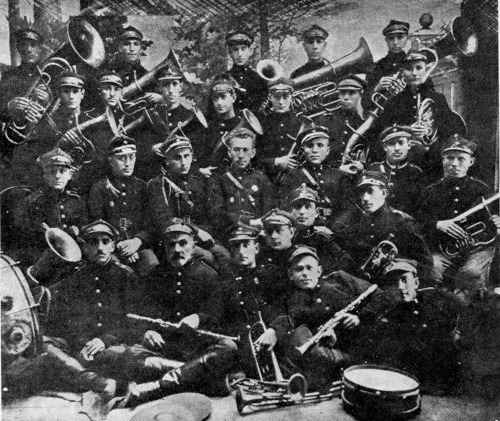
The writer of these lines, was fated to manage this situation. I chose the sixteen youngest children – all between the ages six and seven – and we practiced gymnastic performances with songs together with the orchestra of Mir (Tzolke, the klezmer with his group, they should all rest in peace). They were at my service twenty four hours a day, and we were fully prepared to join the celebrations.
They day of the celebrations arrived:
|
|
There was a procession of children from various Polish schools, walking to the forest, together with sounds of music. The whole town followed the children to the forest and everyone took up their positions. The master of ceremonies inaugurated the celebrations.
[Pages 530-540]
We were the first to take part in the celebrations. It was obvious what their intentions were: the first failure of the program, in order to embarrass the Jews. I was prepared. A whistle, sixteen Jewish children aged between six and seven, surround me, and all is quiet. Hundreds of people are waiting expectantly and hundreds of Jews are holding their breath.
With one wink, the forest becomes filled with sweet melodies sung by Jewish children. The children performed various gymnastic exercises with their little bodies.
Little children's voices blend together with the music, performing different acts.
After thirty minutes of silence and tension, adults and children broke out in thunderous applause. The forest had never heard such a thing. The remaining performances of the program were performed by the Polish schools and appeared very awkward and very weak. Thus the Polish administrators declared a success following the Jewish performances and a complete failure for the Polish schools
The organizers of the event, against their will, had to award the first prize to the Jewish school, and this they were unable to execute.
Financially, the school was always in difficulties. Although the tuition fee was very insignificant, a large number of children studied without payment. The financial support of the Central Yiddish School Organization Warsaw (CYSHO) was minimal, and we, the staff, also worked for a pittance. Very often, the staff was hungry, in old torn shoes and dressed in the cheapest clothing. Nevertheless, they stood on duty, and worked with devotion and there was never any talk of resignation.
Our school was recognized by the Central Yiddish School Organization Warsaw (CYSHO) in Warsaw as one of their successful schools, and the administrators would often visit from Warsaw and they would leave our school enthusiastically.
However, the financial situation of the middle class in Poland deteriorated daily due to the economic policies of Wladyslaw Grabski[c] as well as the financial conditions of tradesman. For whoever it was possible they began emigrating from Poland; towards the land of Israel, toward South America, as well as Africa. When the writer of these lines, bade farewell to our village at the beginning of 1927, the school was closed.
The Mirrer youth who were a product of our school, and who were educated in our Folk-school, could not accept the closure of the school, that other children should be educated without a worldly atmosphere, and their prayer was that the school should be re-opened.
Nevertheless, in whichever direction they turned, they faced difficulties. The premises of the former school were already occupied. The school furniture was strewn around. The suitable premises to open a new school was located in a building of the former hospital, but this was a communal building and our gentile leaders, were delighted that the school was closed and under no circumstances would allow the premises to be occupied by the Yiddish Folk school.
A bitter struggle continued. Both sides utilized the worst methods. The previous teachers of the Yiddish Folk school continued the struggle with the leaders of the Yeshiva and the Talmud Torah, until one dark night, our youth occupied the premises by force.
In the middle of the night, the school furniture and school equipment was moved
[Pages 541-542]
The benches served as beds to sleep at night, and became school benches during the day. The school was forcefully opened, and the bright sun once again shone for our children.
Until the outbreak of the Second World, the school was supported by the Johannesburg Mirrer Society. They regarded this as the most important place that required financial assistance.
With the collapse of our village by Germans, also our young “little flowers” were murderously stamped out.
Note: Jewish history was studied in the school as well as Tanach, in the form of “stories of the Bible” as well as Hebrew.
Notes relating to English translation compiled by Reeva Jacobson Kimble:
Kerensky's government, formed after the February Revolution, constantly struggled to maintain authority between the rising socialist soviets and conservative military elements. Kerensky's fatal mistakes ultimately paved the way for the Bolshevik seizure of power. back
|
JewishGen, Inc. makes no representations regarding the accuracy of
the translation. The reader may wish to refer to the original material
for verification.
JewishGen is not responsible for inaccuracies or omissions in the original work and cannot rewrite or edit the text to correct inaccuracies and/or omissions.
Our mission is to produce a translation of the original work and we cannot verify the accuracy of statements or alter facts cited.
 Mir, Belarus
 Yizkor Book Project
 JewishGen Home Page
Copyright © 1999-2026 by JewishGen, Inc.
Updated 21 Aug 2026 by JH