 |
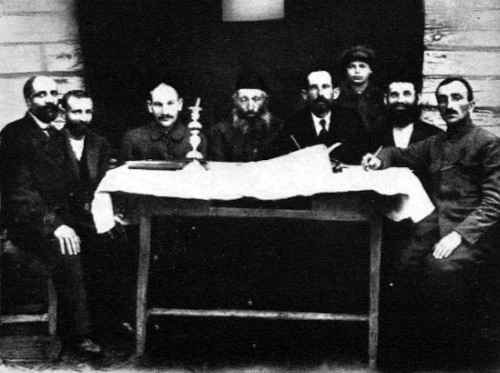
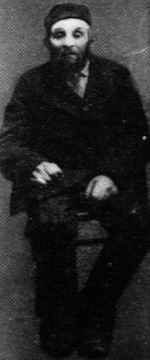
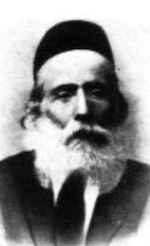
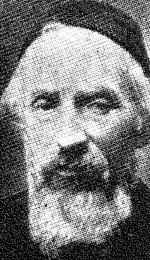
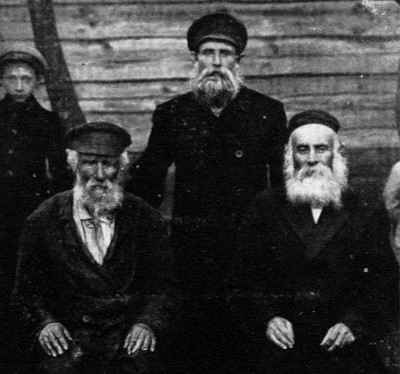
From the right: Kalman Ritterman, Zerach Shteinberg and Dovid Katzman
|
[Pages 207]
As remembered by Max Shneiderman, Los Angeles
Translated by Fanny Pere
I came to America in the year between 1904-1905. I was nineteen years old at the time, but memories of my shtetl have remained deeply imbedded in my heart.
As meager as was our way of life living in Kazanhorodok, I know only one thing for sure – that Kazanhorodok was a poor, beautiful shtetl, with its river, water mill and wonderful woods, scented by its young, tall pine and oak trees.
The older folk used to tell about plans for a much desired railroad that would cut through Kazanhorodok to enable more productivity. But they needed to bribe a certain person of authority there, and unfortunately the sum needed for the bribe was so large, that no way could the entire shtetl come up with it.
That is how Kazanhorodok was left without a train, and so the shoemakers, tailors and carpenters had to go to Luninetz – the neighboring town that was fortunate to have the railroad – to look for work to sustain themselves. This led to a rift that festered between the two towns. But the poor inhabitants of Kazanhorodok made a living from each other, and from the Gentiles who occupied the small villages that were close by.
There were fairs four times a year, twice in winter and twice in summer. These fairs were called Nicaul and Troyze. This is how life was, and we managed to get by. Certainly there were no great wage-earners and the whole salary frequently went for just bread and potatoes. There were many ways of preparing potatoes, many variations, some quite ingenious. I remember that they used to cook fish-potatoes. That meant there was no fish in the pot, but the housewives used to chop onions and use pepper, etc., mixed into the potatoes, and this was called fish-potatoes (Kartufles).
There were two rabbis and two shochtim (ritual slaughterers) in Kazanhorodok – the Horoduk rabbi's shochet and the Staliner rabbi's schochet. The number of non-chasidic people (mitnagdim) was small, but they had their own non-chasidic rabbi – Reb Itchi, the son of the rabbi from Lachver, who was a very learned and intelligent rabbi. Reb Itchi didn't earn a living merely by being a rabbi, but also had a store where he sold materials for tailors.
With a schochet, the non-chasidic Jews were not particular – they ate from any of the shochetim. Altogether, they didn't flaunt their differences with the Chasidim, but when it came to davening (saying prayers) in the same Bet Midrash (House of Study), they sometimes came to blows.
The respected teachers of the shtetl were Kalman (Shlomi's) and David Katzman. Kalman was a grain handler in the little village of Tzna, which was near Kazanhorodok. David Katzman was a saddler and harness maker. He used to leave Kazanhorodok for a couple of weeks at a time, going over to the larger towns to work for the Gentiles, getting their reins and harnesses back to shape. Katzman and Kalman used to teach the modest and simple folk in the shul on Saturday. They would sit around large tables and tell beautiful, heart-warming stories about the great
[Page 208]
rabbis. Their stories were educational, and at the same time moralizing, and they touched the hearts of the poor, toiling Jews.
There was not too much love from the Kazanhorodoks for the Luninetzer Jews, because they were envious of them. But one thing the Kazanhorodok Jews had over the Luninetzer – that they could be certain of – that after one hundred years the Luninetzers would have to depend upon them and come to them. The cemetery was in Kazanhorodok, and the Kazanhorodok Jews never caused any difficulty with the burial of the dead.
In the cold shul there were various paintings on the ceiling and walls. Also a cut-out Holy Ark, about fifty Bibles – large, middle-sized and quite small. For Simchot (celebrations) the musicians would play in shul at evening time. The shul looked like a fortress, with a high dome.
My great-grandfather, Hankel the musician, used to sit there in a corner by the eastern wall and pray. Since I was his first great-grandchild, I would always go with him to daven. He was a relative of the rabbi from David-Horodok, Chernavilar Magid. Since he was a young boy, of respected and proper parents, he taught himself music and “felsich”. As an orphan,
|
|
|
Kozanhorodoker Elders
From the right: Kalman Ritterman, Zerach Shteinberg and Dovid Katzman |
he chose music as a profession. He was a special mentch, very charitable. He died in 1896. Also my Bubbe Basha was a very charitable person and took care of the poor. Every Thursday she would go all over the shtetl, gathering food for the poor. She also organized other women to help with this and to also donate, not only to gather from others in the shtetl. She would parcel out much from her own food. This is how she conducted herself and after leaving for Luninetz did the same mitzvoth there. Understand that portioning out the challah for Shabbat was done quietly and discreetly, to make sure that the poor Jews would not feel ashamed. A small shtetl with Jewish hearts!
by B. Silverstein (New York)
Translated by Fanny Pere and M. David Isaak
Welcoming the Sabbath in Kozanhorodok actually began on Thursday morning. That's when they began worrying how they were going to provide for Shabbat.
Kozanhorodok had very few families that didn't need to borrow in order to get food for Shabbat. Kozanhorodok Jews didn't have much money to spare. With God's help, every woman would buy a few pounds of flour, a piece of calf's meat (or other parts derived from the calf). Some would buy part of a carp, a calf's foot for Cholent (meat and beans stew); our butchers would take the red meat to the wealthier Luninyets. On a special Shabbat there was usually fish. From the few pounds of flour our Kazanhorodok women would first of all bake a few pletzlach (round crackers) to eat Friday morning. Also pierogis (small dumplings) filled with blackberries or other preserves, three large challahs and small ones for the young children. Of course there was also a tin sheet of kichlach (semi sweet crackers) for the special day of Shabbat.
Our women did not forget the poor of the village and each one would bake two extra challahs for them. They felt very good about doing the mitzvah (good deed) of bringing the challahs to the poor and for helping them honor the Sabbath. Chopping, filling and cooking the fish, getting the Cholent ready to be put into the oven, kept them very busy. Of course there also had to be a kugel (potato pudding) for Shabbat!
For our Kozanhorodok women, nothing was too much work for honoring the Sabbath – cooking and baking, washing the floor, polishing the candlesticks, hanging a clean covering over the hearth and spreading yellow sand around the outside of the house – that too was part of the preparation. The women shared the job of picking up the challahs for the poor for the Sabbath, asking for donations for the poor, the Talmud Torah, the Book of Psalms, and other various needs. How good the house smelled on the Sabbath! Of course the heads of the householders stopped working and all of the shops were closed.
[Page 210]
Those who work and trade in the outside villages and nearby Luninyets also come home for Shabbat. Some go to the baths; in summertime they bathe in the river, then put on their Shabbat clothes. The sun goes down, the Mamas light and bless candles, kiss the children on their heads and say “Goot Shabbos” (greeting: “Good Sabbath”).
Mark'l calls out and shouts: “All into Shul (synagogue)!” The Shul has been swept clean, all the lamps are lit, the tables covered with clean cloths and the lamps at the omud (podium) are lit as well. Mincha (afternoon prayer) is completed. It's still too early for the Shabbat service, so a few congregants read the “Song of Songs”, the younger ones gather to hear news from those who had returned from Luninyets. Finally, the Shabbat is “greeted” (special prayers) and the shames (beadle) makes the kiddush (blessing over wine). After the kiddush, congregants mill about, seeking guests to invite to their Shabbat table. After the meal, younger ones go out for a stroll. The fathers will open a sefer (holy book) or go over the weekly Torah portion; the Mamas generally read the translation of the weekly Torah portion.
Very early on Shabbat morning, a gentile comes to milk the cow; in winter he will heat up the stove and take the candlesticks off the table – all for a piece of Challah (Shabbat bread) – which is very appreciated.
In Kozanhorodok synagogues, the prayers generally follow the Sephardi tradition, but there were times when disputes arose over which tradition should be followed, Sephardi or Ashkenazi. As it turns out, the Sephardi tradition was adopted.
|
|
|
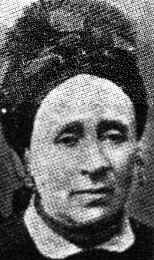
From the right: Menashe Drabski, Hershel Lichtenstein, Yisroel Balahovski,
|
[Page 211]
After the Shabbat meal the older people tend to take a snooze. Others go outside to the porch, sit on a bench or on the tiles for a chat. The younger ones go for a walk to the grove called “Bobroina” and the water-mill. Others claim that for them things at Bobroina are too boisterous, so they stroll on the street to the quiet orchard.
After their naps, the elders customarily recite Perek (“Ethics of the Fathers”) or Tehillim (Psalms). Women complete reading the week's Torah portion in their translated Chumash (Pentateuch). The men go to synagogue again; sometimes, someone teaches Torah with Rashi commentary to the gathered group. It gets dark, but it's still too early for Ma'ariv (evening prayer), since three stars in the sky are not yet visible. In the meantime, a few jokers lose no moment. At the entrance of the synagogue there is a bowl of water with a few hand towels – they dip a towel in the water and throw it at someone; things get a little boisterous. Until a voice cries out “There are three stars in the sky and we can daven (pray) Ma'ariv.” Kalman Sholom, the synagogue's gabbai (beadle) gives the sign and they daven Maariv, the weekday Ma'ariv. The Shames chants the Havdolah (separation prayer), his voice rings out “Hamavdil beyn kodesh lechol” (He who differentiates between the Holy and mundane). The congregants stir and begin to renew their concerns about the travails of the coming week.
After Havdolah one begins to get ready to get going and seek parnosoh (livelihood). It's really no wonder that our Kozondokers do not appreciate the Ma'ariv and Havdolah at Sabbath's end. They prefer when the sequence of the days is Yom Tov (religious Holiday) followed by Shabbat, or Shabbat followed by Yom Tov, when Havdolah and Kiddush come together, it is more enjoyable for them; at least then they have another respite from the workday, and the next morning, Sunday, is a Yom Tov.
by B. Silverstein, New York
Translated by M. David Isaak
Our Synagogues, our holy places, the cemetery, our upstanding householders, our elderly men and women, our little children and their little wagons – we loved all these, precious and holy – all was upended and destroyed by a murderous hand.
They no longer exist: the big native synagogue, the Chassidic synagogue of the Stoliner sect, the Kozanhorodoker sect's synagogue, the new beit-midrash where the Rebbe davened (prayed) and learned with the yeshiva boys. Where is the high, big synagogue – the Cold Shul, to which was attached the smaller beit-midrash? In that beit-midrash was the talmud-torah (Hebrew school). The Rabbi there was named Rabbi Latkes, and why did they called him that? I don't know. Many strange names like that existed in Kozanhorodok, such as The Hyena, God's Messiah, the Shadow, the Cheek, and the Barren.
[Page 212]
The high Synagogue (The Cold Shul) was constructed by a great artist. It is said that in his lifetime he built three synagogues, and our town merited to have one of the three. The Synagogue was wonderful and beautiful. The magnificent Aron-Kodesh (Holy Ark) had, in stark relief, beautiful carvings and fabulous colors and artistic paintings. To this day, in front of my eyes, I still see those lifelike creatures, the images and the cherubs.
In Kozanhorodok there was a hilly elevation called The Soul Mountain. It was not far from the cemetery; that's why it was called that name from generation to generation. In town it was often said that under that mountain used to be a cemetery.
Everything was destroyed, and the entire town was transformed into a large cemetery.
by D'vorah Kutnik, Detroit
Translated by M. David Isaak
An Event that Happened…
At that time, when Russian youths rebelled against the Tsar, the Jewish youths of Kozanhorodok organized themselves under the “Bund.” they included Nachman Itzik Tsiperstein, Chaim the-tall-one's son and Asher Chana-Beiless. Nachman Itzik was educated in the Katerinaslav school, and he customarily spoke Russian. The first task undertaken by the youths was to organize the workers and try to establish an 8-hour workday. Itchie Kaufman was also one of the leaders and party organizers.
Nachman Itzik was the one who went to his uncle Moishe Yehudah (a damask tailor) and took all the maidens away from the workplace. That shocked the townspeople and they began to fear these youths. When Chaim the-tall-one wanted to punish his son and take him home, Itchie Kaufman confronted Chaim with an iron fist. This frightened the Jews of Kozanhorodok even more, to the extent that my Mama even withheld my Father's potato-stew meal when he wanted to go to one of their meetings.
In nearby D'voretz (Belarus), that town's government administration had an official bureaucrat who knew and appreciated Meir Lutzki and relied on his advice and all his undertakings. He liked Meir very much and favored him. This angered Prakoypn, a co-worker, the manager of the administration, who was very jealous of Meir. When they were both alone, Prakoypn murdered Meir. The Bund members went into hiding, but were seen as they were making their way to their hiding place. Prakoypn noticed Asher Chana-Beiless among them,
[Page 213]
right after the killing. It immediately occurred to him to blame Asher and two other Jewish youths for the murder, to lie and simply state they had demanded money from Meir Lutzki, and when he refused, Asher, with the two others killed him. Asher and the two boys were arrested. Gentiles in D'voretz claimed they had witnessed Asher killing Meir.
The Jews of Kozanhorodok and Luninyets collected money and hired a good lawyer, but due to their revolutionary tactics, Asher and the boys were sent to prison. Nachman Itzik arranged to disguise Asher's father as a woman and with the help of his friend Wolf Chaya-Sarah Tzviyes, managed to get him over the border. He wound up in Montreal, Canada, and became a rich pharmacist.
Many others escaped to various countries. Itchie Kaufman was arrested, but then they had him released. In between the two world wars he lived in Luninyets, but he remained true to his ideals. With the outbreak of the Russian revolution in 1917, Asher Chana-Beiless was freed in Kosanhorodok; his hand was lame from the many sufferings and tortures he had endured. The leaders of the new revolution did not appreciate Asher because of his leftist leanings. Furthermore, he did not get along with his one-time friends, so he joined with the many communists and left with them when they abandoned Luninyets. The family never heard from him again.
Years passed and Prakoypn from D'voretz started to regret what he had done, propagating the lie that impacted Asher so severely. He confessed the truth to the gentiles, but by now it was too late. Asher's father had died; his brother had escaped and was in America, and the Jews of Kosanhorodok were engrossed in dealing with the abundant concerns and problems of the times.
by Yosef Zeevi
Translated by M. David Isaak
Kozanhorodok was a small town of working people. Their small piece of bread was earned with toil and sweat. A majority of them would leave their homes at dawn on Sunday mornings for nearby villages, almost always on foot, where they worked for the peasants as saddlers, tailors, shoemakers and so on. Their week was spent at the gentile's house; in summer they would sleep in the barn stalls, daily rewarded, as it were, with a piece of dry bread and vegetables. On Fridays they would return home to their families. The situation was somewhat better for those who worked in villages where a Jew had settled, for there they could receive a cooked meal.
[Page 214]
There were also a few who were involved with fishermen, working on the Pripyat river with their fishing nets. The main river fishermen were from Babruysk (Belarus). Most of the workers were drawn to Luninyets, and among them were carpenters who built houses. In fact, the largest and finest houses in Luninyets were built by Kozanhorodok workers. Two of the best known workers at that time were Leib Wolf Patechnik and Yaakov Kashtan – they too would return home on Fridays.
Two types remain deep in my memory: One was Yossel Zakelman, or Yossel “Can Do”, as he was called in Kozanhorodok. A small adult with a small beard, his whole working life was dedicated to the Basni (Belarus) village as a saddler (harness maker). Each Sunday he'd set out on foot to repair things for the farmers – horse-collars, leashes, bags and other such things. Yossel could not go around without a sack or a package on his shoulders. I once heard my Father, may he rest in peace, say: “Why be so stingy to deny yourself for a few groshen (pennies) and go with a carriage; and if your'e on foot, why do you need to shlep (drag) a package on your shoulders?” And he answered, believe me, “It's much easier and better for me to walk rather than travel on a cart – the path then belongs to me, I have walked it with my own feet; I can, with eyes shut, reach Basni, and believe me I cannot be without a peckel (package) on my shoulders. Without that peckel I feel I'm missing something and things aren't right.”
Yossel had a good and wonderful attitude: He was always funny and happy, a sworn optimist. My Father used to ask him “How long are you going to wander around with your Basni gentiles?” And his answer was: “What do I lack – things are good for me, let us hope it never gets worse.” In his whole life, the only villages he'd been in were Luninyets and Basni. His Shabbes Kapote (Sabbath coat) and hat were yellow and green with age. Once, his son came to visit as a guest for the holidays and brought his father a new coat and hat. This angered his father who said “Have you nothing else on which to waste money? My Kapote and hat are still serviceable, I don't need new ones!”
As he grew older, his four sons in St. Louis, America, started sending him money each month, urging him to stop working and enjoy life. “Father should enjoy a quiet life and stop working.” He declined their proposal. “What's wrong with simply going here and there? I can't live any other way. As long as a man still has the strength he should work.” His children once sent him money specifically for him to be photographed and asked that he send them his picture. Yossel took his wife, Mama Sprintze, and they went to Luninyets dressed in Shabbat fineries, announcing “We're going to be photographed.” The townspeople feared he would, God forbid, lose the 3 rubles he had taken with him,
[Page 215]
that he'd been holding in his hand all this time. Sure enough, the photograph showed him stiffly holding three banknotes in his hand.
A second type of worker accounted for, one who also was happy with his lot, was Leibe Latuche, or, as my Mother, may she rest in peace, called him, Leibe the Uncle Mensch. Leibe was a silent, peaceful man – one never heard him raise his voice, not at home, not at work and not even in the Beis Hamidrash (Learning Hall). All the years he worked hard, but was never bitter. He enjoyed kneading the clay and laying bricks for Motche Parapelotchik – the main masonry contractor for building houses in Luninyets. Leibe was a small man with a long yellow beard. He too would leave at dawn every Sunday and return home every Friday for Shabbat. Leibe had a pair of large, heavy boots that he would smear with polish in honor of the Sabbath. But he even spared the boots – going to work, he would carry them on his shoulder and walk entirely barefoot. When commented by others that he could ruin his feet, he answered “It's easier for me to walk this way.” And besides, “Who says I should run when I can walk slowly, and what about my eyes?”
The entire year he worked with mortar and bricks – just like the Jews in Egypt, and he was very happy with his lot. At work, the bricklayers would shout “Leibe, we need bricks, get more clay!” He was not upset – “Right away, immediately,” was his answer. Their shouting didn't help, he continued working as always, without interruption, slowly, methodically and quietly. Working from dawn to sunset, his shirt and face were wet with sweat, but Leibe never complained.
Once I heard my Mother complain to him, saying “Leibe!, Leibe!, how long are you going to shlep bricks and knead clay? Learn to be a bricklayer! What's going to become of you?” And Leibe answered “What's wrong with what I'm doing now?”
Leibe Latuche was a calm person. He prayed in the Zemdisher synagogue where often disputes and quarrels arose over the honor of an Aliyah (calling to the Torah). Leibe was never asked to lead the prayer service, nor was he included in matters concerning other beit-midrash matters; he would always stand in his own corner, silently reciting psalms. At home he was also calm and quiet, deferring always to his wife and children. At work he never relaxed – he would fence the yard, chop wood for the week and help wherever he could, always in silence. And I know of no other man who enjoyed the truly joyous rest on Shabbat as much as Leibe. His Sabbath was literally “Shabbat” (ceasing work), embodying the words in the prayer “Shabbat-Vayinofash” (“– on the seventh day the Lord ceased work and rested”).
Here is an episode concerning Leibe: It's well known that every Jew had a cholent and a kugel (meat-beans stew and potato pudding) for Shabbat,
[Page 216]
each with their characteristic taste and aroma; additionally there was usually stuffed kishke (derma) – without these Shabbat would simply not be Shabbat. One Friday, Leibe came home and saw that the cholent pot was still on the shelf. He suspected his wife did not make any cholent or kugel, and the Sabbath would be shamed. But he said nothing his wife. Friday night, after Kiddush, at dinner, his wife noticed that Leibe looked very sad – “Leibe, what's wrong with you? Are you ill? Does anything hurt?” “No, nothing!” Leibe answered. But as she walked over to him he realized he had to tell her the truth, so he said: “You probably didn't have enough money for Sabbath and didn't buy any kishke and didn't make a cholent to honor the Sabbath. Well, never mind, God will forgive us “ – Oy, you silly fool,” she cried out happily, “It's exactly the opposite, for this Sabbath.” I put together a cholent and a kishke the likes of which we haven't had for years! “So why is the pot still on the shelf?” asked Leibe. “What don't you understand; our pot is too small for the large kishke I got, so I had to borrow Chanah Bashkis' large pot – you'll see it tomorrow!” And Liebe's higher Sabbath spirit found its correct way and afforded him a truly meaningful and enjoyable Shabbat .
|
|
| Liebe Latuche |
by Yosef Ze'evi
Dedicated to my brother David – Argentina
Translated by M. David Isaak
|
Kozhanhorodok with its hard workers was legendary, a household word. A whole week the men worked hard, most of them away from home in Luninyets and in the surrounding villages. But on the eve of Shabbat, all the craftsmen returned home, exhausted and worn out, to rest a little and gather strength for the new week. They also strived for spirituality, and that was found in praying and reciting Tehillim [Psalms]. There was a special group of Psalm-reciters in Kozhanhorodok. Right before dawn, regardless of whether it was raining or a frost had formed, the worker would wake up from his sleep and immediately follow the voice calling him to recite Psalms, running from his house to join his group of “Psalm-reciters.”
The “cultivator” of this society of “Psalm-reciters” in Kozhanhorodok was my grandfather, Reb Shlomo Leizer, the blacksmith, who was known by the name “The Psalm-Waker.”
Reb Shlomo Leizer was a blacksmith by trade. All week long in his forge he hammered with a large or a small hammer on the anvil. He was a simple Jew who did not even understand the meaning of the words of the prayers, but he possessed a warm Jewish heart, full of faith in Yiddishkeit [Jewishness]. And so, Reb Shlomo Leizer took upon himself the mission of being the Psalm-waker of the group. For decades he fulfilled his holy duty with great joy and self-sacrifice. Even on rainy and dark nights, he walked all around Kozhanhorodok to gather people to recite Psalms. It didn't matter even if not a single star was visible, the wind howled, or it was autumn-time – it rained, but Reb Shlomo Leizer was not stopped by anything, he was not afraid. With a staff in hand, he went from house to house, over mud and puddles of water, and called out: “Wake up, please, arise, holy people! Rise for the service of the Creator, rise to say Psalms!” And his voice, though not loud, penetrated the wooden walls of the old huts with the straw roofs. Every member of the Psalm-reciters woke up, especially during the month of Elul and the Days of Repentance, and answered: “Reb Shlomo Leizer, I hear you, I am coming.”
[Page 218]
My Zeide [grandfather] was a passionate Horodoker Chasid, and he used to travel–or better said, mostly walk by foot–to the Rabbi. And here are a few stories about the Rabbi and my grandfather:
Once, during a winter, when the rivers were frozen over, the old Rabbi, Reb Yossele, was sitting with the Chasidim and chatting. Suddenly, the Rabbi asked the Chasidim: “What do you think of Shlomo Leizer from Kozhanhorodok?” “Reb Shlomo Leizer,” the Chasidim answered, “is a very decent Jew, and even in the greatest frost, he goes to wake people up to recite Psalms.” “If God is willing then that is very good”–answered the Rabbi. Within half an hour, Reb Shlomo Leizer walked into the house where the Chasidim were sitting, and he said: “I need to Bench Goymel [make a blessing of thanks for surviving danger].” He then recounted that while riding with a gentile over the frozen river, the ice suddenly cracked, and the sled with the horse and the gentile fell into the water, but by a miracle he survived. Now the Chasidim understood why the Rabbi had previously asked about Shlomo Leizer. From then on, he became famous among the Chasidim.
My grandfather also used to work as a laborer at the estate of the Poritz [nobleman/landowner] Stashit. The Poritz had great trust in my grandfather. He would assign him real work, always at the right time. Once on a Friday, while working at the Poritz's estate, several noble guests were visiting Stashit. Walking across the courtyard, they saw a Jew with a white beard working for the Poritz. Being great anti-Semites, they said to Stashit: “You employ a Zhid [derogatory term for Jew]? He surely cheats you!” “No,” answered Stashit, “this is an honest Jew, his piety has no equal.” “Yes,” said one, “he may be religious, but for a kopeck, he will also sell out his piety.” But Stashit held his ground: “No, Shlomke would not do that.” And they made a wager. Since today was Friday, and Shlomke usually finishes his work earlier than usual in order to go home for Shabbat, let the Poritz demand of him today that he finish the entire workload, even after candle-lighting. The Poritz, with his guests, went straight to my grandfather and told him strictly that he must finish the entire job tonight. “Jasne Wielmożny Pan [Your Illustrious Highness],” my grandfather said, “you have forgotten that today is Friday, and I must be home by 12 noon to prepare for Shabbat.” “It won't help you, Shlomke, you must do what I tell you and nothing else.” The Poritz walked away in a great fury. My grandfather continued his work, but in his heart he said: “I will not allow them to make me desecrate the Shabbat.” Exactly at noon, Stashit arrived with his friends to see what would happen with Shlomke the blacksmith. Shlomo Leizer took a look at the sun and saw–oh, it's already time to pack up the tools and go home.
[Page 219]
“Your Illustrious Highness, I must go now. But God willing, after Shabbat, I will come back to finish,” my grandfather turned to the Poritz. “No,” said the Poritz, “you must finish today. For that, you will receive from me a whole Katerinka [a three-ruble bill], because I have to leave with the carriage tomorrow early in the morning.” “No, Poritz, for me Shabbes is Shabbes, and I am a Jew, I am not allowed to do this.” When the Poritz began to threaten him that he would no longer employ him, my grandfather stood up to him with courage: “You are indeed a ‘Jasne Wielmożny Pan,’ but there is still a greater Poritz than you, and that is God in Heaven. He is dearer and greater to me than you. You can even kill me – I will not work anymore.”
My grandfather packed up his tools and set off on his way. The noblemen no longer dared to bother him and let him go. After Shabbat, my grandfather no longer considered going to work for the Poritz, but two days later, when Stashit saw that his blacksmith was not coming, he understood the reason and sent his coachman with a special wagon to bring him back to work. Along the way, the coachman told him the whole story of how the Poritz had won the wager with his friends. Stashit gave him a friendly slap on the shoulder and said: “Ask something of me and I will give it to you.” “I ask that for the winter, you supply six bundles of wood for the Batei Midrashim [study houses].” “Good,” said the Poritz, and that winter all the study houses in Kozhanhorodok were supplied with wood.
My grandfather would always supply the study houses with blacksmith work and whatever was needed there. On his way home from Luninyets, he would always bring a gift for the Horodoker synagogue: thus he brought a scraper to clean the mud from one's feet, hangers for the hand-towels, simple candlesticks and so on.
Reb Shlomo Leizer became a widower back in his fifties, but he did not want to remarry a second time because he could not do that to her memory. My mother used to tell us that Grandma Chava was very beautiful. My grandfather mourned over her for a long time. Around 12 weddings took place in our family, and they were all beautiful. He had four daughters but not a son, and this caused him great sorrow. In order to ensure he would have someone to say Kaddish for him, he raised his beloved nephew Moshe, who was named after his father. He taught him his trade and gave him half a house. Until 1912, he lived together with his daughter Masha and Boruch Derevsky, but when they moved to Luninyets, he moved in with us in Luninyets. We loved him very much. In Luninyets, too, the people from Kozhanhorodok did not forget him, and at every celebration, especially at a celebration among the Horodoker Chasidim, he was always at the head. Like all Chasidim,
[Page 220]
he too would make a L'chaim [toast], and no matter how much the Chasidim tried to make him drunk with the toasts, they did not succeed. His was a blessing from the Rabbi–so the Chasidim said–that he would never become a drunkard.
I also want to record an episode that happened with grandfather in Luninyets and which characterizes him. Grandfather always smoked a pipe with tobacco and a flint. Once, coming home from the Beis Medrash, holding the tallis [prayer shawl] and tefillin under his arm, some sparks from the pipe fell onto the tallis and started to smolder. Grandfather did not notice it because of the smoke from his pipe, but others soon saw it and put out the little fires. Upon coming into the house, when grandfather took off and folded the tallis he saw there were four large burned holes in the tallis, he broke out weeping like a child: “Woe is me, I will have to lie in the grave with a blemished tallis.” Inconsolable, no one was able to calm him, even when they told him he'd get another tallis. Out of great distress, he threw his pipe on the ground, grabbed a hammer, and smashed it to pieces. A day or two passed, and we saw that grandfather was a changed person; we understood that he wanted to smoke and had nothing to smoke with, and he was ashamed to admit it. We brought him a new pipe with several packets of tobacco, placed it under his pillow; he relented and started smoking again.
The death of his first grandson–his Shaye'le–who fell at the beginning of the Great World War and left behind a wife with five children, impacted him so hard that he became ill. He always used to recount how many Tzars he had outlived and had prayed to God to outlive Tzar Nikolai as well, but his prayer was not fulfilled.
At the end of December 1916, just two months before the [February] Russian Revolution, he died and was brought to burial in Luninyets.
Translator's footnote
by Yosef Ze'evi
Translated by M. David Isaak
|
|
The musicians or “Klezmer” as they were called, to this day have a similar sounding family name, Muzikant. This was the only family in Luninyets and in Kozhanhorodok that engaged in music. The klezmer musicians were a large and multi-branched family, all born in Kozhanhorodok that later moved over to Luninyets. The head of the family was Reb Yaakov, who died in 1896. As a poor
[Page 221]
orphan, he taught himself how to play. When he married and was blessed with children, he established his own band of musicians, who played at all weddings and celebrations in Kozhanhorodok, such as Simchat Beit HaShoevah, a Siyum HaTorah [the completion of a Torah scroll] and so on.
Bashke, Reb Yaakov's wife, was well known in Kozhanhorodok as a community activist of the old style. Above all, she dedicated herself to furthering the mitzvah of tzitzis [the wearing of ritual fringes]. She took care that Jewish children, Cheder boys, should not, God forbid, wear any invalid tzitzis. She would approach every boy and check whether he was wearing “kosher” tzitzis, and if she found a thread torn or missing, she would take him home and weave him a new, kosher tzitzis.
In Luninyets, too, the “Klezmer” were the only Jewish musicians available at weddings and celebrations. Their leader was Reb Shepsel Elia, who, for many years led with his bow and violin. However, the music was a side income for them; they were lovers of music and wanted to continue the artistic heritage of their father and grandfather. Their main livelihood came from cutting hair. Several barbershops in Luninyets were entirely in the hands of the Muzikant family, a monopoly. And since the musicians, as well as the barbers, did not welcome or apprentice strangers, they kept it in their family. To avoid competition among the family musicians, they governed themselves in distributing event assignments, maintaining a family-loyal goal of helping one another. Some of them were gifted with abilities, and the largest portion were energetic people with initiative.
The musicians did not chase after honor. None of them sought community leadership, with the exception of Alter Moshe Muzikant, who was the permanent Gabbai Sheyni [Second Beadle] in the Horodoker synagogue.
At that time, many of the town-people's emigration to America impacted the Klezmer musicians as well. Even before the First World War, many of them emigrated to America. Thus Nachman Muzikant emigrated, as did Shifra Beila with her large family, Zeidel, and others. But there still remained in Luninyets, together with Reb Shepsel Elia, those who worked all the time, even into their older years. Day in and day out, Reb Shepsel walked to work, step by step; summer in his boots and winter in warm galoshes with a scarf around his neck. With glasses on his nose, he worked with scissors and a razor on his clients. He used to say: “As long as the hands serve – one must work.” Only once did a Jew want to have his beard shaved off [in defiance of pious restrictions], but Reb Shepsel refused. “No!” he said, “no Jewish beard will I shave off,” and indeed he did not shave it.
Translator's footnote
by Yosef Zeevi
Translated by M. David Isaak
When the Almighty created the world he gave gifts to every city and to every village.
Kozanhorodok, in addition to its gifts of nature, a river, a hill (“The Souls' Hill”), a forest (“Babrina”), was also gifted with a Baron. And you needn't wonder how it happens that a poor village like this has a Baron – our sages declared: “Who is wealthy? Who is content with his lot.” According to this maxim, our Baron, known by the name of Yankel Baron was very rich, even more so than Rothschild, because Rothschild, besides his wealth had other worries, but our Yankel Baron, always happy with his lot, never had any worries. My first acquaintance with Yankel took place in Luninyets, forty years ago.
One nice summer day, after I came home from Cheder and sat down to eat something warm, I heard my Mother suddenly get up and knock on the window, calling out: “Oy, Yankel 'Barontschik' is walking by.” Yankel, it seems, either did not hear or didn't understand that he was being called, and continued walking past our home, so my Mother, of blessed memory, ran outside and led the guest into our home, complaining: “What's the meaning of this! You pass our home and don't even want to come in?” And he, Yankel, answers: “Yiddele (endearment: “little Jew”), as you know I seldomly come to Luninyets and I didn't know you live here.” The guest didn't need encouragement; he obeyed my Mother and went to wash his hands before sitting down to eat.
I then had the opportunity to get to know the “Kozanhorodoker Baron”: A short Yidd'l with a black beard, dressed in old trousers, a wrinkled shirt and a moldy looking jacket with wide, long buttons; no shoes but a pair of sandals with torn red socks on his feet, an old knitted hat on his head.
At the table we had a home-spun discussion about Kozanhorodok: What's “this one” doing, what about “that one,” how is Marisha?, what about Riba Basha's Mordechai? how is Bubba Reitze's Chana Ruchel? and so on. After the meal I gave him a nice donation of 10 kopeks and bade him a friendly goodbye. Yankel asked that we give his greetings to everyone.
A few years later, on a Chol Hamoed (interim days of week-long Holiday), the season in which families get together with relatives, finding myself in Kozanhorodok, I got to know more about Baron and his way of life. Yankel was born a Kozanhorodoker. His mother was known as Sascha the Yenta. He had no single vocation,
[Page 223]
but rather a variety of occupations; a fisherman, a letter-carrier, a tehillim (psalms) sayer; none of which provided enough for his livelihood, but Kozanhorodoker Jews knew their fellow villager; when Yankel would enter their homes they would, with kind hearts and open hands, give him a few potatoes, burekas, a head of cabbage and so on. There was a time when Yankel was the official letter-carrier. He would get the letters from Volost (near Pinsk) and go about distributing them. His inability to read Russian was not a deterrent. In the beginning one would read the address for him, later he learned by himself to read even handwriting and knew to whom to deliver the letter. Everyone would give him a groshen. For a letter from America, a kopek, and for a money order from America, 5 kopeks. And thus he managed to get by.
In the summer he'd go out early with his knapsack and a tin of worms to the river to fish – this afforded him great pleasure for he loved fishing. Yankel was an avid patriot of his Kozanhorodok. Only very seldom would he leave the village. To the question “Why don't you visit Luninyets more often?” He'd answer: “To tell you the truth, in Kozanhorodok I feel very much at home; why should I come to you (fancy) Luninyets nobles?” And so it was. In his own town he was like a fish in water.
It is told that when he decided to get married he was asked, “Yankel, what will you do for livelihood? – A wife has to be supported!” To that he answered: “That's really a small worry for me, thank God, there are enough fish in the river, and bread is available from all of our people.”
by Moshe Tziperstein
Translated by M. David Isaak
The World War (WWII) started on September 1, 1939. On September 17, the police abandoned the city and the Russians entered.
Jewish faces were clear and bright, everyone was self-assured. They took to their studies; they all had jobs with the administration. It was rumored that a glass factory was going to be built, which, it should be understood, would quickly raise the living standard in Kozanhorodok. But the German beast had already sharpened its teeth. The first reports from the war in 1941 greatly impacted everyone. Everyone realized, with open eyes, the seriousness of the times. By the second day, the young folk bade farewell to their closest ones and left for the front.
[Page 224]
The news from the front was bad. The Germans were busy making changes every day. Every day, and perhaps every hour new sounds were being spread. The Germans had taken Pinsk, Hancewicze… After each bad report a dead silence fell upon the village. Some thought one should immediately escape deep into Russia, but it was difficult to leave one's own little corner where one was born, where one got used to everything, where one was lovingly tied to everything there.
I'll never forget the 5th of July, 1941, when I left Kozanhorodok, abandoning my beloved village, forever. It was not very graceful… Through the Farband Council I worked in the Harkov and Kuybishev (Ukraine) fields. I lived for 3 years in Samarkand (Middle Asia) where one would hope (waiting) for a safe victory and perhaps also, an opportunity to meet someone in the home – this gave me strength to endure and overcome all the difficulties.
By the end of 1944 I knew the sad truth about the Jewish devastation. I decided then to go to Poland; but how could I go to Poland without seeing Kozanhorodok again?
I arrived at Kozanhorodok on the 15th of January, 1946. Many Jewish houses had completely disappeared, others stood, half destroyed. There wasn't a Jewish face to be seen or a Yiddish word to be heard. On the site of the big synagogue there was only a large heap of rubble, other areas were grown over with grass and weeds. Places where Jewish houses once stood were now planted, growing rows of corn. No one would even recognize that Jewish homes once existed there.
I know every corner; every place I walk reminded me of something in the past. My Jewish heart knotted and whispered with pain, I don't know how I was able to stand it when I saw the large area of the Brother-(mass) Graves… A man has to be stronger than iron…
From the Kozanhorodok Ghetto there remained only one Jew, Herschel Wilk, who was overlooked because he had been in the army, and I met him. He told me that a few had tried to escape, but they were detected and caught.
The Germans wanted to keep the blacksmith Meyer Krupshtein (who was called “the Long One”) alive so he could work for them, but he tore out of their hands and jumped into the grave with the still living.
Translated by M. David Isaak
This book, in memory of our holy, martyred communities that were maliciously sacrificed and, with abject cruelty, completely destroyed by the wild-beast Nazis and their followers in 1941 and 1942, bears witness for our generation and future generations to the lives of our fathers and forefathers in the diaspora. There were Jewish communities in Luninyets / Kozanhorodok whose names have been erased from the Jewish map. These two communities are now but a legacy of the past. With one sweep of the hand, the pulsating community lives were lost in the abyss of what happened. May this book stand as a memorial to these absent communities that will sadly never rise again.
In this and future generations, all current survivors from these communities, wherever they are, as they page through and study this Yizkor Book, will be looking into a mirror that accurately displays aspects of daily life during one or two past generations, in all the colors and shades of their Jewish experience. They will see close and semi-close faces pass by that embody generations of Jews that knew not only suffering but also how to create and master a Jewish, modest, nationalistic style in a unique island surrounded by a sea of gentiles, strangers, and hatred. From this book they will learn about the warmth and spiritual feeling of celebrating a Yom Tov (Holiday) in the village, the spirituality of Chasidism and plain Yiddishkeit (Jewishness) that served them in times of need, loneliness, harsh decrees and uprisings. They will also learn how our brothers held on to their Jewish nationality and socialist ideas, the return to Zion, and the rebuilding of the Jewish people–and thus this book will be an inheritance from generation to generation.
The basis of this book were the bulletins, notifications, leaflets and daily sheets that were produced at the time by the Organization of Descendants of Luninyets / Kozanhorodok in Israel, under the direction of our member Yosef Ze'evi (Wilk). The materials he wrote and kept without publishing are now added to the large volume of diverse writings, the fruit of the pens of descendants of our communities, that you the reader will see in the large and accurate descriptions in the contents of this book. They embody the goal of the organizers and “doers” of this work. Noted also is the working partnership executed with warmth by our survivors who planned this book and brought it to fruition. With this they accomplished a holy undertaking for which they will forever be merited.
We acknowledge with reverence the fully dedicated and faithful efforts of these writers to create an everlasting historical document. They are: The above mentioned Yosef Ze'evi, Chaim Robinrot and Asher Plotnik who were "harnessed" to the Organization's burden, who wrote many of the articles. The gatherings and the writings, without limits of their time and energies are: The Secretary of the Organization of Descendants of Luninyets / Kozanhorodok in Israel, Moshe Dravski, who added much material of his own, Chaya and Zvi Dannenberg, Meir Kargolin, Michael Lutzki, Joe Goldman, Joe Feldman – all from New York, who aided us in the acquisition of the paper needed and thereby enabled the printing of the Book, Shmuel Blovaski, Chaya Drabski-Yuzshic, Sonya Drucker-Rojanski, Moshe Drabski, and the brothers Itzl and Bolek Ditalovitski – all from Brazil, who helped with money for the cause.
May their participating efforts and contributions be praised for future generations with glory and honor.
Lastly to be mentioned are those who joined our efforts that are not descendants of our communities: Nachum Chinitz, and workers at the “Achdut” Press that performed their duties with faith and loving devotion to this task.
|
JewishGen, Inc. makes no representations regarding the accuracy of
the translation. The reader may wish to refer to the original material
for verification.
JewishGen is not responsible for inaccuracies or omissions in the original work and cannot rewrite or edit the text to correct inaccuracies and/or omissions.
Our mission is to produce a translation of the original work and we cannot verify the accuracy of statements or alter facts cited.
 Luninyets, Belarus
 Yizkor Book Project
 JewishGen Home Page
Copyright © 1999-2026 by JewishGen, Inc.
Updated 10 Jul 2026 by JH