[Page 176]
The Ruin of Luninyets
The Annihilation
by Lipe Yasielovsky
Translated by M. David Isaak
In the year 1939, with the outbreak of the Second World War, our town and its
Jewish population lived through difficult moments. A general chaos prevailed;
the Germans were advancing and the Polish government was collapsing. On the
evening of September 17th, near the cemetery, barricades were built by the last
Polish military units, who were trying to hold back the arrival of the Red Army
from the Mikashevitch side.
On the morning of September 18th, almost the entire population of the town,
including the Jews, stood and watched as the Red Army took up positions near
the new building of the Starosta (the building is located at the corner of
Sadova Street, not far from the Russian cemetery). Before the arrival of the
Red Army, the town remained without a governing authority; peasants from the
villages of Bastyn and Lunin had prepared to carry out pogroms. As a
countermeasure, a general self-defense force was immediately established, in
which the representatives of the Jewish population were: Yankev Bauman, Leibel
Eisenberg, Dan Grinstein, and Chaim Rubinraut. Though it existed for a short
time – approximately two days – it accomplished a great deal. Despite
the fact that peasants had appeared in town, no pogroms took place, and in
general, the peasants behaved quietly.
With the arrival of Soviet power, the Jewish political prisoners were also
released, and soon a so-called “Vremmenye Ispolnitelny Komitet,”
(Temporary Executive Committee), was created, whose task was to oversee order
in the town. The committee consisted of Mordechai-Yosef Plaxman, Isaac Slutsky,
and Noah Senderiuk, who had come from Warsaw; and also a Christian named
Bochtik, who later, by the way, with the retreat of the Russian power, remained
with the Germans and he surely still lives somewhere today. Representing the
committee was Arkasha Spiridanov, as well as several individuals from the
military power, who were the leaders of the Executive Committee. Soon, many
former Polish military personnel were arrested, including the deputy Starosta
[district governor] and the politically referred Bartnitshik.
The first task of the committee was to provide the population with housing and
wood for the winter. Many received 1 or 2 meters of wood.
[Page 177]
The arriving Poles from the so-called “Bezhentses” [refugees] were
provided with housing. The committee existed for 3 weeks, and then a normal
Soviet government was established, which began to introduce a Soviet order.
Goods were requisitioned from the textile merchant Avraham Myasnik and handed
over to a tailors' cooperative, which had promptly been created with Hershel
Frumkin as chairman; a shoemakers' cooperative was also created, which was
located at Moshe-Wolf Diatlovitsky's house. Other Cooperatives also began to
form – all in the Soviet style. Despite everything, the Jewish population
lived quietly. The former merchants and shopkeepers were afraid they would be
sent to Siberia, which did indeed happen later. Thus, both brothers Avraham and
Tuvia Myasnik left for Volyn; Galavoy (the wood merchant) left for Sarny;
Leibel Eisenberg (the former Rosh-Kahal [community leader] in Luninyets) left
for Bialystok.
Life supposedly began to normalize: some worked in government posts, some in a
cooperative, and some still worked as artisans, i.e., for themselves (as
independent laborers). A portion of the Jews again engaged in speculation; they
used to travel to Lemberg [Lviv], bringing and earning Russian
“Chervonets” [gold coins]. A strong trade was also conducted in
currency (gold and dollars).
About 3 months after the arrival of the Red Army, general assemblies took
place, where it was proposed by a representative of the Byelorussian Soviet
power that the occupied territories should be incorporated into the
Byelorussian Soviet Republic. The proposal was accepted unanimously, and then
preparations for elections began: elections for the Executive Committee, i.e.,
local elections, and elections for the “Verkhovni Soviet” [Supreme
Soviet] of the U.S.S.R. and the “Soviet Nationalnosti” [Soviet of
Nationalities]. Luninyets was declared a Raion [district/region], and 17
electoral districts were created, in which a portion of the Jewish population
took an active part. In the electoral districts, daily lectures were held;
people studied the Soviet Constitution and read newspapers and journals. A
certain man, Anisimov, was put forward as a candidate for the position of
representative to the Supreme Soviet, and for the “Soviet of
Nationalities.” Anisimov was a Luninyets railway worker, a Christian, who
lived on Bradilovka Street.
After the elections, a series of evacuations begin, Russian “style.”
The first so-called “victim,” as it was called at that time, was Dr.
Axelrod, who is arrested and sent away to far-off Siberia. After that, the turn
comes for the Gerzulin family (the ironmonger); the wood merchant Feivel
Dechtiar is arrested (he alone, without his family)
[Page 178]
and also Yakov Gluberman (the watchmaker), Shlomo Epshtein (the pharmacist)
with his family. And just before the war, about two days before the outbreak of
the Russo-German war, the Rubinchik family is arrested: Chaim, Hershel, the
mother, and the sisters. All the aforementioned had only one hour to pack and
depart. This took place until June 22, 1941. With that date begins a new era in
the young Jewish kibbutz in the provincial town of Luninyets.
On the 23rd of the month, a terrible panic prevails in Luninyets. The first two
German planes appear over the town, but they do not bomb. That same night, the
bridge over the Pripyat River is lit up by flares from the planes, but it is
also not bombed.
On the 24th, military units begin arriving from the direction of Pinsk and from
Baranowicze in full disorder, heading toward Mikashevichy; many trucks also
travel in the same direction.
On the 25th, the Jewish population wants to evacuate. But the station is
blocked by the military; one needs special permits from the Executive Committee
and the military commander to be able to travel. Many of the Jewish population
set out on foot toward Mikashevichy and Lenin to continue the journey and not
fall into German hands.
In Lenin, about 6,000 Jews gathered from Pinsk, Gantsevichy, Luninyets,
Kozhan-Horodok, Lakhva, and surrounding villages, who wanted to cross the river
and move further. However, the river was guarded by Russian border guards under
the command of a certain Sabarov (a lieutenant), who under no circumstances
allowed the crossing of the river. Thus, almost 95% of those fleeing had to
turn back. Only a few individuals managed to sneak across the river, and thanks
to that, they actually survived.
On the 28th, the first German bombs dropped from their planes. There are
several victims from the Russian population. Everyone wants to leave, but no
one knows to where or even how. They try every means in an attempt to somehow
get onto a train, but almost none is successful.
On the 30th, the government authorities leave Luninyets, and a few days later,
the German military enters Luninyets. The “invincible, civilized”
German army establish “order” on the Jewish street. The first to be
hit are people from the Jewish intelligentsia. Thanks to a certain Panin from
Zalesye, Yemach Shemo (may his name be erased), all Jewish doctors are
murdered: Dr. L. Gurevich, Dr. Itzhak Gringstein, Dr. Pinye Zaretsky, Dr. Yosef
Trishkalnik (Shamai the butcher's son), and several other Warsaw doctors who
had fled here from Warsaw. This was the first “reception.”
[Page 179]
According to a decree from the German military authority, a Judenrat was
established, which included: Moshe Shapiro, Avraham Radman, Leibl Holtzman, and
David Bradnitzky. The Germans demanded chairs. Several pairs of chairs were
made. The work of the Jewish craftsmen – Benzi Taptshik, Yochanan
Grinstein, five Ukrainians, and two Poles – surprised the Germans. The
Judenrat made sure that none of the workers failed to show up.
Soon after, the Germans summoned all Jewish men, age of 14 and up, and ordered
them to assemble near the burned-down synagogue by the Grinstein wall. The
Judenrat gathered and used all means to ensure everyone arrived at the
designated place. The “excuse” – they were going to attend a
course about hospital work. From there, they were taken on the Pinsker road,
after the second railway booth, about 2 kilometers from the village of
Mielnica, and there, in several large pits, they found their eternal rest.
A typical episode from that time was told: Meir Schwartzman (Yankel-Mordechai
the shoemaker's oldest son, as he was usually called) was going to work and had
not taken any food with him. His wife was so distressed that she hadn't given
him anything to eat that she begged her son, a well-behaved child about 10
years old, to take food to his father. The child went and never returned. He is
at rest with all the adult Jews together.
Most women still desperately believed their men were alive, but a few were
indifferent. 36 men, by some miracle were saved, temporarily. Among them: David
Bradnitzky, Moshe Grinstein, Moshe-Beruch Kahn, Benzi Taptshik, Yochanan
Grinstein (the shoemaker), Yaakov-Leib Rozenkrantz (the tinsmith), Gershon
Pinchasowitz (the postmaster), Yaakov Levin (Shmuel's son) from Bradelivka.
(His father had been killed by the Bolsheviks in the Kaziyenem forest), and
some “outsiders” were also saved because they had not been lined up
with all the Jews in the so-called “labor” of the Germans. Benzi
Taptshik and Yochanan Grinstein were taken out of the line by a German for whom
they had made chairs. They also called out to five Ukrainians to come with
them, but it was already too late for them; they went along with everyone else
to their eternal rest.
Then came the “Ghetto” decree. The Germans could not tolerate Jewish
women living as neighbors with the Christians. A place was designated for the
remaining women, where they could live, temporarily. The border started from
the corner of Sokolovsky's mill until Yehoshuale's house, including Pinchas
Winitzky's house and Mishke Bradnitzky's house, and also Sarah the
[Page 180]
Rebbitzin's home and then back to Sokolovsky's mill. This is the left side,
going from the town toward the river. This was the Jewish “Ghetto,”
where the remaining Jews from the villages were gathered: Lunin, Kholsk,
Bastyn, Diatlovitsh, and others. Of the four schools in these villages, only
the Ziemitsh school had the merit of being in the ghetto. Here, Jews were found
living in groups of 4,5 and 6 families per room – some in a stable, some
in a “Ziemlianke” (a dugout or cellar), and some in the cellar of a
Jewish house. The ghetto was fenced with barbed wire, guarded 24 hours a day by
local Christians. From the moment it was established, the Germans were in
charge. When moving from the town into the ghetto, people were allowed to take
some things and food, but no furniture.
Yaakov Muzikant's wife (Shmaya, the Klezmer's daughter-in-law), while moving,
lost a 5 ruble gold piece at the ghetto gate. This was noticed by a German, and
a death sentence was carried out on the spot. The woman was laid out for 24
hours. All the Jews had to look at her as an example of what happens to a Jew
for holding gold.
New decrees then began for the Jews: Establishing a Judenrat,
“contributions” [forced payments], giving their furs to the Germans,
and going to work. For this, the German authorities “privileged” the
Jews by giving each person 100 grams of bread a day, and that is how they were
tortured, how they lived and worked for a bleak year in the ghetto, until the
arrival of the bitter hour and the end of the Jewish community in Luninyets.
On the 5th day of Elul, 5702 [August 18, 1942], all the remaining Jews were
gathered and taken away. Unfortunately, not a single living soul remained from
them to bear witness to the tragedy. All were taken on the Pinsker road; not to
the little Green Bridge, but on the right side under it. There they found their
eternal rest – our martyrs: children, women, and those previously
remaining men.
The length of the mass grave is approximately 80 meters.
Luninyets was “cleansed” of Jews. The town itself was also destroyed.
No more Jewish houses. No more Jewish schools. No more Jewish library.
Being in Luninyets for the second time, I went again looking for a Jew. Right
before reaching Bradilovka Street, I heard a loud banging in Selig Kushtshiev's
house. A gentile was standing there and banging with a large hammer. He had
“inherited” Selig the Blacksmith's property. My heart cramped. With
great pain and despair I left. I could not be any longer in my Luninyets.
I met some gentile acquaintances. Each of them dutifully expressed their
“sorrow” over the Jewish destruction. Except for Saniukovitch, the
former mail carrier, who met me with sincere tears in his eyes.
[Page 181]
The Bitter End
by Yaakov Bauman
Translated by M. David Isaak
In the first days of July 1941, the Germans occupied Luninyets. Immediately
after the occupation of the town, all Jewish men from the age of 14 and up were
mobilized for work. They were allegedly sent to work, but they were all shot
and buried in a mass grave. Only a few craftsmen – tailors and shoemakers
– were left behind. The remaining women and children did not know the fate
of their men and fathers.
Shortly thereafter, the remaining Jewish population – women and children
– were imprisoned in a ghetto on the outskirts of town. They endured the
most terrible suffering: hunger, cold, and hard labor. The death penalty loomed
for even the slightest transgression. Many women and children died and were
buried in the ghetto gardens. The commandant of the ghetto was a Ukrainian
named Skobly, who had lived for many years in Luninyets among the Jews.
In 1942, on the 4th of Elul [5702], the Jews learned in the evening that a
large pit had been dug near the new “Banya” [bathhouse]. They
understood it was being prepared for them, but could do nothing to help
themselves. They didn't even think about resistance because there were only
women, children, and a few sick and weakened men.
On the morning of the 5th of Elul, at 5 o'clock in the morning, the ghetto was
liquidated. All Jews were led out to the pit. There, they were ordered to
undress naked and were shot in groups and thrown into the pit. Small children
up to 2 years old were murdered on the spot: the murderers took them by their
little feet and smashed their heads against a post. Regardless of whether the
child was still alive, they were thrown into the pit. Christians from the town
stood and watched with cold blood as they grabbed the Jews' clothing for
themselves. The town remained “Judenrein” [cleansed of Jews]…
After 3 years of German rule, on July 7, 1944, the Germans were driven out of
Luninyets by the Red Army. Before fleeing, the Germans burned the town,
including the largest buildings. Only about 14 or 15 men returned to Luninyets.
They searched for the mass graves of the men, women, and children among the
graves which were surrounded by barbed wire, cement posts and overgrown weeds
that lay in the field.
When the Christian neighbors were asked what they had seen, they answered they
had seen nothing and heard nothing, and they had nothing to tell. However, in
every Christian home in the village, one could see Jewish furniture and
bedding. The local Christians – the permanent residents – clearly played a
large part in the Jewish tragedy in Luninyets.
The spilled Jewish blood cries out for vengeance!
[Page 182]
On the Grave of the Martyrs
by Zvi Zamodiak
Translated by M. David Isaak
|
|
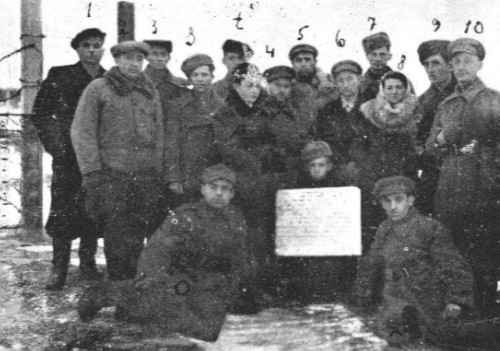
Standing [Back row]: 1) Leibl Dannenberg 2) Hershel Holtzman 3) Michal Koplik
4) Yitzchok Blaushtein 5) Motl Gottlieb 6) Yitzchok Mutchnik 7) Chai Lichtshtein
8) Fish-Golman–Pinchasevitsh 9) Chanoch Pinchasevitsh 10) Zelig Fialkov
Standing [Middle row]: 1) A Staliner youth s) A Lachvar youth and Yasha Golman from Lunin
Seated from left: Zvi Zamodiak, A Mikashvitcher person, Asher Resnik |
The morning after the outbreak of the German-Russian war on June 23, 1941, I was mobilized, and on July 8, 1941, I was already at the front. I was severely wounded on September 12, 1944, in Grochow near Warsaw, and my friend Tzvi Beilin died on February 8, after being severely wounded near Berlin.
After spending a short time in the hospital, I arrived in Luninyets on Friday, March 1, 1946, in the evening. I was met by a Christian woman, a neighbor, Korichunicka from Bradilover Street, and she told me everything from A to Z. She also told me who from the town of the “She'erit Hapletah” (the Surviving Remnant) was there and where they were. I began to walk through the town: there are no Jewish houses, no houses of study; the Torah scrolls are burned, the letters flying in the air. And the Jews who wrote the Torah scrolls, believed in the Torah, studied it, and supported those who studied Torah–there they all lie in several pits behind the town–shamefully murdered and buried half-alive. Is this the Torah and its reward?
It is Friday evening; there is no memory of what was once a Jewish town. I drag myself through the former Jewish streets; The destruction of our home looks horrific!
[Page 183]
I meet Yitzhak Motshnik; he tells me everything. I also meet with Chaim Lichtenstein, Asher Zelig Reznik, Yitzhak Blaushteyn, Hershel Yisroel Peretz's, and Zelig Fialkov the shoemaker. They had thought I was already dead, and suddenly, here I am…
On Shabbes [Shabbat] we went to daven [pray] at Henoch Gershon Pinchasovitch's son's place. There, there was a minyan [prayer quorum], a Torah, and a few taleisim [prayer shawls]. Once in a while, people had to daven in several minyanim, because it was too overcrowded in the four Batei Midrashim [Houses of Study]. Sadly, today the entire remaining Jews in town can fit in a single minyan. Henoch was wounded in the left foot, and his brother-in-law, Benno Goldman (Moshe's son) – in the right foot. They remain cripples.
On Sunday, we went to the cemetery to the mass grave of our holy martyrs, which is about 40 meters wide and 100 meters long, and was fenced in with barbed wire by the first arriving Jews who felt it their holy duty. Here lie mothers with their children and elderly Jews who had remained in the ghetto until its final liquidation in 1942. All the men had been shot earlier in 1941. We wept there and took photographs. The inscription on the grave was written by Moshe Plashnik, who had lived near the Horodoker synagogue.
I visited Christian neighbors, and they told me with “tears” in their eyes, how Hitler, with the help of the local peasants, finished off the Luninyets Jews. Every peasant's house was packed with Jewish furniture, Jewish vessels, and Jewish antiques. The goyim [gentiles] live in the remaining Jewish houses and shout “there are still many Jews left!”
I left Luninyets, and after many months of wandering, I arrived in Eretz- Yisroel.
What I Went Through
by Shmuel Gershtein, z”l
Translated by M. David Isaak
My father, Moshe, had a small blacksmith shop in Luninyets and used to work very hard, from dawn until dusk. He sent his children to Cheder to learn. I, his eldest son Shmuel, “learned” with the melamed [teacher] Reb Yisroel Peretz Holtzman. But while still a child, at the age of 13, I had to leave the Cheder and go to work to help my poor father, so that the younger children would have something to eat and be able to “learn.” In a short time, the situation became worse and worse. Since my father no longer had any work, I decided to go to Pinsk to find work and send my earnings to my father with my two brothers and two sisters. My Pinsk employer, Yosef Tsherinski, was a very good person;
[Page 184]
I worked for him until 1939, when the Russians liberated White Russia (Belarus) and Ukraine. Orders were issued that no one may work for others, that everyone must work for themselves. I soon received an order that within 24 hours I must leave Pinsk; I returned to my poor father. I set myself up to work as a Gorsovyet (City Soviet), a town blacksmith. But it didn't last long before the war with the cursed Germans began. Sunday morning, June 22, 1941, the radio announced that the entire country was in a state of war. People began to gather in the courtyards because German planes were photographing the city. In a few days, all the young men were taken into the army, but I, as a blacksmith for the Gorsovyet, was left to continue my work.
Friday, June 27, 1941, the Germans were encamped not far from Pinsk. All the officials from Pinsk came running to Luninyets. And when the last train was supposed to leave for Russia, there was a commotion and a crying of women and children in the city. Friday morning, my father told me: “Go, my son, and get the horse and the wagon ready, so that we can leave for Russia.” I left the house not knowing that this was the last time I would see my parents and brothers. When I came to the Soviet office, I saw that all the officials were hurrying to the train; I also ran and got on the train. I was happy that I was escaping from Hitler's bandits. But the joy was in vain. Everyone from Luninyets, including me, was forced off the train.
Not knowing what to do, I ran back to the Soviet office to find my horses to leave. Then I saw, to my misfortune–there were no horses and no wagon. I thought my parents had left without me. I took my friend Asher Shertok, Dina's grandson, and Aba Kudman, and we started running after the parents. All day Friday, June 27, we ran until we arrived in Zhitkovichi, a town on the Russian side. With my two friends, Asher Shertok and Aba Kudman, we decided it was better to die from a Russian bullet than from a German one. When it turned dark, we managed to get onto a train with mobilized men who were traveling to the Gomel region. In Gomel, we met Leizer Miasnik, Ahrel Blacher from Bradilkovke, and several other Luninyets boys. We stuck together like brothers. This was the first transport that was evacuated to Stalingrad. I stayed there for two months and met Yaakov Goldshmidt and both Bromberg boys. In October 1941, I was mobilized into the army, where I fought until the liberation. In 1944, totally
[Page 185]
by chance, I was released from the army and had the opportunity to be the first one to travel and return to Luninyets. Traveling with me was a girl, Faygl Lutzki, from the second group. Arriving in Luninyets, I did not recognize the city: it was destroyed, broken, and a deathly silence pervaded all around. Not a person, not a house–just soot and desert. Of the Jewish houses, there was no sign left… Walking on our street, near the church, I tried to control myself so as not to be overcome by my emotions. Walking on Tsarkovne Street, the street approaching my father's house, I did not recognize the place; it was overgrown with weeds and thorns. In the house lived an old Gentile who was smoking a pipe. When he saw me, it was as if he saw the Angel of Death. I went away into the city to search for a memory, even of a single Jew. I met one family who had been with the partisans and were the first back in the town. They themselves were from the town of Lenin–their family name was Shuster: Yudel, Bashe, and children. They had saved themselves by joining the partisans. From them, I learned many things about Luninyets and the surrounding towns. As the first to arrive in Luninyets, I managed to take back some things from the peasants that belonged to our house. It wasn't long before I was mobilized to dig coal in the mine shafts of Rostov near the river. This settled things for me because I wanted to drive that Gentile out of my father's house. It occurred to me that I should register under another name so that I could escape, but escaping did not work for me. I became acquainted with a military doctor (a Jew) and he registered me as an invalid of the second group. I bought glasses with large diopter lenses so I would be released because of eye deficiencies. In short, I was released from the shafts, but only under a second name, under which I was registered: Alexander Gershvinski, Motveievitch. To Luninyets I came back as an invalid (2nd group). There I met Senderyuk, the son of the Shamash (beadle), Gulman, and Asher Shertok, Berl Kudman, and a few other friends. Now I have settled accounts with the Gentile from my house and moved him out.
First of all, I, Asher Shertok, and the two girls, Terekhov and Asher Shertok's Uncle David, set out. We went around looking for the mass grave. In the process, I worked for 6 weeks, during which we fenced in all the graves where the women lie–on the road toward Pinsk, 2 kilometers from Luninyets, not far from the Polish cemetery. There we had to gather the remains from three sides because the grave was one meter from the railway. Afterward, I fenced in the mass grave–100 meters in length and 50 meters in width. For an entire day, we dug until 2 meters deep, until we found the
[Page 186]
place. Then we fenced it in with cement posts and barbed wire, so that animals or cattle should not step on the holy site. We also fenced in the graves at the old holy place (the cemetery) where the fences had been broken.
Afterward, I decided to leave the town–to go wherever my feet would carry me, but not to remain on this bloody earth that was a grave for our parents, children, and brothers. Before my departure from Luninyets for Poland as a Polish citizen, I met Rivka Yasielevski from Pohost, the widow of Leibl Berovitz's son. She had been in Pohost visiting her parents when they were led to the slaughter along with her parents and children. She told me that her parents were shot before her eyes, and her small child as well. She was shot in the head but only wounded. In the pit, she was thrown in like everyone else, and other bodies were thrown on top of her. At the end of the shooting, they fired an automatic burst along the length of the pit. Then she was wounded in the hand. Because it was late, the Germans did not rush to fill the pit with earth. Meanwhile, she gathered her strength from the murdered ones. At night, she came to her senses a bit, crawled out of the pit naked, and ran across the fields. A whole night until dawn she ran, until she encountered a small shepherd, who hid her for five days in a haystack. He brought her food and drink. Afterward, he took clothes from his mother and brought them to her until a policeman arrived and captured her. She begged him to just shoot her and not take her to the Gestapo. He said to her with chutzpah: “For you, I will get a medal, because for a captured Jew, one gets a lot of money.” He brought her to the village and locked her in a stable and boasted to his friends: “Tomorrow I will get a lot of money for her, and we will watch how they shoot her.” She heard all of this in the stable. That night, she decided to escape. She climbed up, tore off a board from the roof, and escaped into the forest. There, she met Jewish partisans and was with them until the liberation.
With thoughts of the Land of Israel, I also made my way to Poland. And from Poland, as a refugee, I arrived in Austria, in the American zone–Linz. There I spent two years. Alone and away from my entire family, living like a stone. There I found a companion for life–my wife, a Vilna native from Lipovka. She too had endured a great deal in the bunkers. And thanks to the fact that I worked very hard for two years for the Land of Israel, I arrived easily in the country. I went to Tel Aviv to look for work. In the streets of Tel Aviv, I met
[Page 187]
a person from Luninyets, who brought me into the Irgun. They enthusiastically received me and could not do enough to comfort me. They settled me in an apartment and helped me get a job.
* * *
Note: The writer of these experiences was killed in a tragic work accident while working in Haifa.
From My Wanderings
by Ze'ev Goldschmidt
Translated by M. David Isaak
With the outbreak of the German-Russian war, because I worked as an instructor for the air-defense brigade in our region, I was able to move around freely in the city, both day and night. No one slept, expecting that at any moment the murderous planes could attack again, and once more we would have to grab the frightened children and run with them into the cellars.
On June 25th, the panic grew even greater when suddenly, the Jewish administrators of Pinsk, having vacated Pinsk, arrived in our city. From them, we learned that the enemy was already 10 kilometers from Pinsk. In the city, it became like Tisha B'Av [a day of mourning]. The women wailed; and the Jews fasted and recited Psalms. All, young and old, wept. Things calmed down a bit when it became known that the Germans were still much further from Pinsk, about 60–70 kilometers, and that only some paratroopers had dropped down near Pinsk. Everyone became a little calmer and quieted down.
But the silence did not last long; it was interrupted when an order arrived to evacuate the families of the government officials. Many Jewish families quickly packed and went to the specially prepared wagons. But unfortunately, all of them–heavily burdened–had to return, not having been able to get a space on the train. The religious Jews of the city decided not to move from their place, fearing the probable physical and moral suffering on the long, difficult road.
June 29, 1941, remains in my memory as the saddest day of my life. On that day, the last train left Luninyets, which had been prepared for the fighters of the region. Despite the fact that I had “protection” and was guaranteed a place on the train, I nonetheless decided to remain together with my parents and family. Who knows what my end would have been, were it not for the pressure from my father and the weeping of my dear mother, O”H, who then begged me to leave. A few hours before leaving Luninyets, I was
[Page 188]
fortunate to be able to see my brother Jacob, who had been in military service together with more boys from the town. He and Yashke Gendler (Noach Gendler's son) had managed to escape from the Germans and set out on foot from Brisk, over fields and through forests, until they arrived in Luninyets.
In Russia, I arrived in the Stalingrad region, where I met the following Luninyetsers, who had managed to leave the city: Noach Plakhtman and his wife, Chatzkel and Yosel Bramberg, Leizer Myasnik, Bliakhar's two boys, Abale Kudman (Berel the butcher's son), Moshe-Yehuda Krikin, and Zolatnik's boy Itzhak-Aryeh, along with some relatives from Zikovitch.
After working for 3 months in a Kolkhoz [Soviet collective farm], I was mobilized and sent to the Stalingrad front. There I went through all the battles, from which, miraculously, I emerged unscathed. The further advances of the military were already easier, but my soul found no rest, being constantly worried and troubled about the fate of my family who remained under Hitler's rule.
Finally, the great day arrived when my devastated town was liberated from the German murderers in 1944. I immediately turned to my captain, who happened to be a Jew, and received leave to visit Luninyets. I felt that no greater pleasure would I ever have than this leave. I could never have imagined the great destruction that I encountered upon coming to my home town. Immediately upon arrival, I was met by a deathly silence that pervaded the destroyed Luninyets streets, which now had the profound appearance of a giant, shattered cemetery. The first Jew I met in the town was Berel Kudman (the butcher) and later Meyer Senderuk (the Shamash's son) and Mrs. Rishke Gelman from Lenin; she was the only woman who survived the Luninyets Ghetto.
The woman told the following: After the men were murdered, a ghetto was created for the women, and they were allowed to take a portion of their household goods, which was later taken away in exchange for bread and potatoes. Mrs. Gelman saved herself thanks to the fact that on the day of the liquidation of the ghetto, she hid in an oven, covered with a damper, and from there she went away into the forest.
The Jewish wealth and property were looted and destroyed by the gentiles of the town.
When the war ended in 1945, I firmly decided to leave the cursed lands of exile, where every span of earth is soaked with the blood of our nearest and dearest.
I set out on a difficult and long journey, across borders and seas, and after long wanderings, I passed through Cyprus and arrived in our old Jewish home [Israel].
This material is made available by JewishGen, Inc.
and the Yizkor Book Project for the purpose of
fulfilling our
mission of disseminating information about the Holocaust and
destroyed Jewish communities.
This material may not be copied,
sold or bartered without JewishGen, Inc.'s permission. Rights may be
reserved by the copyright holder.
JewishGen, Inc. makes no representations regarding the accuracy of
the translation. The reader may wish to refer to the original material
for verification.
JewishGen is not responsible for inaccuracies or omissions in the original work and cannot rewrite or edit the text to correct inaccuracies and/or omissions.
Our mission is to produce a translation of the original work and we cannot verify the accuracy of statements or alter facts cited.
 Luninyets, Belarus
 Yizkor Book Project
 JewishGen Home Page
Yizkor Book Director, Lance Ackerfeld
This web page created by Osnat Ramaty
Copyright © 1999-2026 by JewishGen, Inc.
Updated 25 Jun 2026 LA