|
by Rabbi Yitshak Yedidyah Frenkel
Translated by Mira Eckhaus
When the first news of the destruction of Poland was received, the heart sank and a shiver ran through the bones: had ancient Łęczyca also fallen? Had it also drunk the poisoned cup? And indeed, the horrifying truth was revealed: Łęczyca was no longer exist. Its beloved Jews, part of our nation, were brutally destroyed in the crematorium of Chełmno. No longer would the voice of the Torah be heard in its Beit Midrash houses, the voice of children playing in its streets, and the voice of the awake and lively youth, rejoicing at every news coming from Zion and its cities. – All was silent.
Then the idea was born that a memorial monument should be established for our Łęczyca. Ordinarily, orphan Kaddish is said after the parents, children, and youth. However, these were destroyed by the modern Amalek. Therefore, we are obligated to say Kaddish after those who no longer able to say Kaddish. And this book, placed before the surviving members of the Jewish community of Łęczyca, serves as an orphan Kaddish for the city and the ancient community, which has been destroyed and no longer exist, and it will always serve as an eternal flame for a holy community, which gave its life for Kiddush Hashem.
My heart told me that it is a sacred duty to erect a tombstone on the grave of our city, so that the remnants of our community and the future generations, grandchildren and great-grandchildren, would know the source of their roots, the treasures of innocence and honesty that were hidden in the souls of their fathers and forefathers. The nobility and “purity” of the soul that were infused on their faces and in their actions.
I approached the work alone. And here I encountered an impenetrable wall: there was no possibility of visiting the museums in Poland, nor was it possible to examine the community's archives and records, which would be destroyed along with the community. And, of course, I did not have any material means to carry out the great thing that I had undertaken. – However, I finally overcame all the difficulties and set to work with vigor – I rummaged through various libraries: the National Library and the Maimonides Library, various public libraries and private libraries. I consulted encyclopedias and lexicons in various languages; I collected various documents from individuals. I listened to conversations of old and young people. I strained my mind to refreshing my memory and putting on paper those excerpts from the Łęczyca Synagogue's books, which belong to the history of the community and its glorious past and which I had been interested in since childhood. After special efforts, I managed to obtain photographs of several of the rabbis of Łęczyca. I obtained photographs of the gaon Rabbi Avraham Tiktin, the author of “Petach Habait” (the gate of the house), of Rabbi Chaim Orbach, and of the “Malbim”. I also managed to obtain photographs of the city and its antiquities. In “HaLevanon” house (owned by Mr. Z. Pevzner) in Tel Aviv I found the first newsletters of “HaLevanon” from the year 5626 (1866), in which
[Page 8]
the “Malbim” appears as a regular participant and talks about his life in Łęczyca. This participation of the “Malbim” in the “HaLevanon” adds a new line in the character of the “Malbim”, which was unknown until now. And indeed, all those who dealt with the history of the life of the “Malbim” have not been able to unfold the entire life story of this original personality.
|
When I wanted to describe the life of the Jews in the period before the Second World War, I did not receive the necessary help from those who had the opportunity to put the story of the Łęczyca youth and their longing for Zion on paper. Despite all my appeals to those who were involved in the life of the youth, I was not answered, and therefore this chapter will be incomplete. Nevertheless, I managed to gather material that reflects – to some extent – the various youth movements of the recent period, and in this I express my gratitude to Mr. B. Elitzedek, who in the days before the First World War served as a Hebrew teacher in Łęczyca and was one of the founders of the Chibat Zion movement in our city, for responding to my request to put his memories of that period on paper.
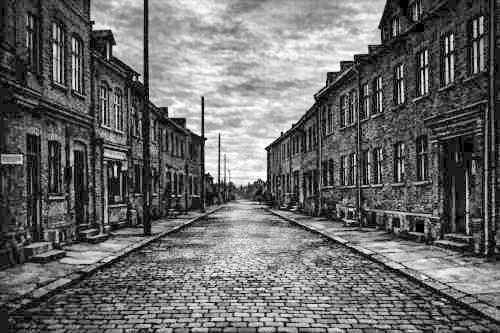
And regarding the destruction story, we did our best and recorded from the few survivors all the details pertaining to the community's liquidation. Mr. Moshe Zwang has provided us with all the photographs from the period between 1939-1944 (5700-5704) – silent photos, which speak louder than any oral or written story. There are photos of the Jewish street after the destruction, horrifying in its silence and the absence of any living thing. This terrible silence screams louder than the loudest voices and shouts. Mr. Zwang also brought hundreds of photographs of the Jews of Łęczyca,
[Page 9]
old and young, photos taken from passports, found in the basements of the Łęczyca municipality. All of this adds up to one shocking and horrifying affair: the destruction of Łęczyca.
For four years I have invested my strength, labor and toil in order to give a complete and comprehensive description of the city and its people. Unfortunately, however, the names of many of the Łęczyca people were not mentioned because the help given to me in this regard was not at all adequate. Also, the limited financial means prevented me from printing a large part of the photos that are in our possession.
I received only a limited help from our townspeople. Unfortunately, I must note that our townspeople overseas did not respond to the extent necessary for the project.
Blessed will be the city members of Łęczyca who live in Tel Aviv and the surrounding colonies, in Jerusalem and Haifa, as well as individuals in Australia and South Africa, who assisted us in our endeavor. Also blessed will be the following: Mr. Bezalel Elitzedek, the brother of Prof. Yosef Klausner, who in terms of style and language tried to follow in his brother's footsteps and thanks to this gave the book a nice literary finish; Mr. Avraham Knopf, who was kind enough to give us a series of special types from our city; my son Rabbi Issar, a scholar and writer, who invested a lot of effort so that the book could be published. And I especially express my great gratitude to our city member Mr. Yaakov Rosenkranz from Paris, who was kind enough to donate the paper for printing the book and also participated in a significant part of the printing expenses of the book.
The Hebrew language is the only language of our nation, which connects us with
our children and grandchildren, who only hear Hebrew. It also connects us with
many of our townspeople in the Diaspora who also need it (such as the Riesman
family in Australia and the Frankenthal family in South Africa, and more).
Therefore, this book was written in our language, and the time in which it will
be known and spoken by Jews in all countries of the Diaspora, is not far off.
|
24th of Nissan, 5713
Memorial Day for the Łęczyca Community |
by Issar Frenkel
Translated by Mira Eckhaus
I didn't know Łęczyca, a town of fifteen hundred Jewish families, for a long time. But I absorbed its atmosphere into my very bones, while I was wandering as a child through the streets of the old city, surveying in amazement those standing around me. Perhaps it is because I was so enthusiastic about this important work called “The History of the Łęczyca Community”, and that is why I begged my father and urged him to begin writing the book – and once he began, he had the duty and the commandment to finish it. And here is the book before us, and these lines have been privileged to be included among its pages. As an assistant to my father, the Rabbi, in editing the book and as secretary of the committee for publishing the book and all that is involved administratively and technically, I would like to tell the reader a little about the Łęczyca Émigrés' Organization (or as it is commonly called in American-Yiddish slang, “Landsmenshaft”), about the remnants who survived the inferno and their lives in those terrible days, as well as about the difficulties of absorption and holding on to the homeland of those remnants. With that, I would ask the reader to be patient enough to read even the crumbs of reflection on the exterminated exile and for whom we are commanded to raise our hands every day and say: “If I forget you, exile…”
These were truly times of trial and testing for our people. The tragic news came from the great slaughterhouse in Poland, from the same place that Jews dreamed of and where they lived peacefully and prayed: Po Lin.
Names we had never heard before, such as Majdanek, Treblinka, Auschwitz, and Chełmno, suddenly became known and infamous to us. That day, September 1, 1939, when the declaration of war came from the mouth of Satan, a few days before Rosh Hashanah, the Holy Day of Judgment became a day of judgment for anyone whose name was Jewish… Like the sons of Maron, the innocent sheep passed before the German shepherd, and on all of them was affixed a yellow badge with a Star of David in the middle. Indeed, if anyone was ashamed of this symbol, it was not the Jews of Poland who were proud of their Judaism. By noon, Warsaw, the Polish capital, had already been bombed, and the gentile Polish people were already standing – perhaps by order from above – helpless, pretending to be pious and willing to help the downtrodden and persecuted. Suddenly, there were those who, when we walked down the street, would throw the anti-Semitic “Zhid” call towards the “innocent Jewish righteous”. Alas for such benevolence…
[Page 12]
Because why was this place chosen precisely for the great and terrible slaughterhouse? … It is not surprising that the Poles collaborated with the Germans, that they welcomed them with open arms, since they were of the same species, both were similar, had the same way of thinking and mindset: to destroy the excess burden, to shake off the contaminated Jews.
I picture our beloved brothers and sisters marching to the slaughter, like that herd of bulls that I saw marching towards death to the Tel Aviv slaughterhouse for cattle on a sunny winter day. Here they are getting out of the truck, someone is hurrying them with the scourge in his hand to get them off, and they are running hurriedly and panicked, one inconsiderate of the other and wanting only to protect himself and not consider others. They get out of the car. A short hour of rest passes, the slaughterers sharpen the cleaver, their assistants sort the cattle and decide which will be slaughtered and which will live. The zero hour is approaching… The slaughterer approaches the chained animals, their eyes begging for mercy and expressing fear. They are silent, but it seems that they sense their approaching end. A moment of restrained silence falls. The slaughterer, who wants to shorten the end, ends their life story quickly. One of the bulls awaiting his sentence does not look with equanimity at what is being done to his friend and tries to break the chains, which of course he cannot do. I doubt if many would have witnessed this description, especially those who today benefit from the austerity policy and eat meat imported from abroad–And me too would not have depicted it with such compassion if I had not seen in my mind the Jews, living human beings marching to the slaughter… if I had not at that moment recalled in my memory the old debate in the Polish Sejm and the German House of Representatives and in other countries about the “cruel Jewish slaughter”. Indeed, those who pitied animals and beasts, whose end was slaughter, were skilled at marching people to slaughter, just like this detailed description.
Even the Jews of the adorned Łęczyca flock to the slaughterhouse; those dear Jews0020are also marching the death march, their fate is the same as their brothers', and no trace of them will remain… Until the last moment, it will not occur to them what the barbarians with silk gloves are capable of doing it… Those dear Jews, among whom were most of our relatives and whose portrait I see at this moment through the picture of my grandfather Reb Getzil Koenig z”l, who I see in my mind in the stream of my writing, and whose bright eyes express innocence, wisdom and intelligence, and who have been praised by others so much. In the last years before World War II, he wanted to immigrate to Israel, but the British prevented him from carrying out his plan, just as they prevented many others from doing so. If he had immigrated to Israel, he would certainly have lived longer, because he was a man of great desire for life. But since he was not privileged to do so, he was blessed that at least he died in his bed in his city of Łęczyca and the Jews of the city accompanied him in masses to his resting place. When at the age of one I was wandering with my black eyes, in the eyes of the blacks, with great pleasure he was throwing me
[Page 13]
Into the large bread basket and Leibel Koenig, my father's uncle, was holding the edges of the basket and they would play with me like this. Wow, how much he would enjoy it if he got to see all of us in our adulthood. He would have accumulated a lot of memories with him! The editor of this book will discuss later on the person called “Reb Getzil Mohel”, since he knew him closely and accompanied him on cold and snowy nights to the outskirts of the city to cure a poor woman who was sick, or to circumcise newborn babies whom he circumcised without taking payment, or when he stood over him and looked at him during a sharp game of chess, as no one mastered this game better than him.
He was at least privileged to be buried in a Jewish burial, but he died when the Jews of Łęczyca were already in the hands of the cruel occupier. My friend A. Ziegler will describe in his story the last days of the glorious Łęczyca Jewry, as he personally experienced it, and will tell how the predatory beast appeared, how they were put into the ghetto, how they tamed them, and how they believed that no evil would befall them, and so they were able to take them with all their belongings to Poddębice, where they were gathered into a church, and a few days later they were taken to the slaughterhouse in Chełmno, from which no one ever returned. On the advice of the Rabbi of Univ, Avraham Ziegler and his dear friend Yaakov Rosenkrantz hid in the bell tower of the church and thus were saved when the Rabbi's words rang in their ears: “The world must know what is happening here, hide”… The Rabbi thought to himself that this was the end of this matter. He did not imagine that there was a bathtub into which people enter with a bar of soap and a towel on their shoulder and when they turn on the tap, a stream of gas and poison flows… and from there – into the furnace, and human ashes are scattered everywhere.
|
|
|
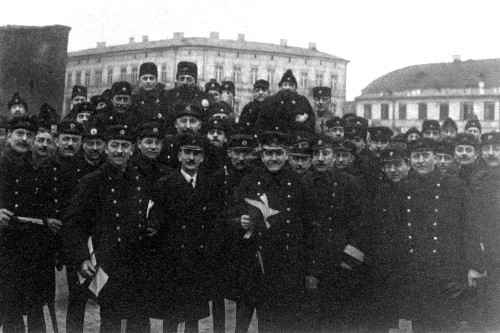
The Judenrat, headed by “Muchnik” and an SS representative, go over the list before the shipment |
[Page 14]
A letter, inserted between two machine cylinders and found when the machine was started and transferred to the Central Jewish Archive in Łódź, and signed by several of Łęczyca's Jews, reveals a glimpse of what was happening in the city of horrors: Chełmno (I emphasized this at the time in “HaTzofe”, in which I copied the letter, and I was outraged that the material on the Holocaust was not being transferred to Israel so that it could serve as a cemetery on a small scale for their pure souls, and I repeat it on this occasion). The letter states:
|
[Page 15]
Mr. Eliezer Benedik also has something to say about the last days of Łęczyca, and it is connected to the history of the city's last rabbi, Rabbi Eliezer Auerbach, a descendant of a great lineage, zt”l. As will be told at the end of the first part of this book, the rabbi died in the Łódź ghetto, but before he left Łęczyca, he was forced to trim and shave his beard and sideburns, for camouflage purpose, since bearded men were the first to be condemned to death. Eliezer stood and shaved his beard. The Rabbi cried like a baby at the cruelty of fate, which forced him to shave his beard. When Eliezer finished the haircut, the rabbi told him: “I don't know what would happen to me, however, you will be saved in any case. But remember what Amalek has done to you!”. And it was as if words of prophecy came out of the rabbi's mouth. The vicissitudes of fate befell Eliezer. At the end of the war, he was appointed a Polish inspection officer. The Jews, who were in a state of constant danger even after the liberation, remembering the Kaltzi pogrom, looked with an evil eye on every inspection officer. And once he encountered a Jew – in Upper Silesia – and since he feared that a bad thing would happen to him, he threatened to kill him. Then Eliezer introduced himself to this Jew and said to him: I am a Jew… And indeed, at that moment a turning point occurred in his life. He remembered the words of the rabbi's prophecy: “You will be saved in any case”. And now he received demands from Australia to emigrate there, but he refused. On a rickety illegal immigrant ship, he arrived in Israel during the days of the siege and distress, volunteered for the defense forces and was among the defenders of the “HaTikva” neighborhood from the rioters of Kfar Salame. After that, he was transferred to Tirat Zvi, where he got to know the integration of life of the kibbutz with the Judaism and tradition. And he, who was far from tradition once he lived in Łęczyca, was enchanted by the beauty of life on the kibbutz. And then, when he saw how the kibbutz stood in the battle against Kaukji and defeated him decisively, he decided to return to his roots. And so, with tefillin on his head and a rifle in his arm, he entered with the liberation forces into Zar'in, the ancient Izrael. After dozens of villages in the area had been conquered, he approached Jenin with his battalion. Here, an enemy slingshot hit him and wounded him in the leg, but it wasn't long before he returned to the battalion and went with his comrades to Nazareth. After the occupation, he was stationed near the city checkpoint and checked entry permits… When he fully recovered, he moved to the distant Negev and was among the operators of operations “eye” and “ten plagues”. When the War of Independence ended, he returned home to his family. Now he participates with the rest of the country's citizens in the building of our young state.
In order for every person from Łęczyca to receive help and assistance in their first days in Israel, an Organization of Łęczyca Émigré in the Land of Israel was established. How and for what reasons was this organization created? This is also an interesting story; it was born out of a conversation between friends in a taxi which traveled between Tel Aviv and Bat Yam–
A daughter of good people from our city needed help. A number of people with initiative volunteered to collect donations from the people from our city. And the days were the end of the war. And during the travel between Tel Aviv and Bat Yam, to which the editor of this book traveled with one man, the editor expressed his opinion that it was necessary to establish an organization of people from Łęczyca. Later, he expressed this idea in writing, in the first newspaper edition of
[Page 16]
“Yedioth”, the bulletin of Łęczyca residents in the country (by the way, the importance of the newspapers edition will be discussed later, and only one copy of the first newspaper edition remained).
We did not come to imitate anyone and join the fashion of the “Landsmenshafts”. As long as there was no necessity for it, we could exist without a framework. Only necessity compelled us to establish this organization. Soon the horrible news from the slaughterhouse will begin to appear, soon we will hear about the few remnants who survived the inferno and remained destitute, soon they will appear at the gates of our country, who will take care of them? Who will guide them on their first step in the new homeland? Who will prepare for them a place to sleep and a chance to find some food? Who will take care of directing those who are looking for relatives to the right address? And who will perpetuate our glorious community and gather the rich material scattered in hundreds of books and files and written in different languages? All of this led to the establishment of the aforementioned organization… We have great roles, willingness and a prayer that we would succeed. And if. indeed, we succeed, it will be a great spiritual satisfaction. These were the thoughts during the conversation on the road leading to the beautiful colony of Bat Yam and which were published in the first newspaper edition of the aforementioned “Yediot”. In order to realize the idea, a meeting was called in which a large audience of people from our city, who came from all over the country, took part. The first bulletin of the organization was presented to the meeting, in which outlines of the Jewish community in Łęczyca appeared for the first time. This newspaper edition was sent to all institutions and to Rabbi Maimon, Minister of Religions, author of “The Ministers of the Century”. The first newspaper edition was not very interesting, and indeed what could it convey to its readers when the window to the world was still sealed? But already in the second newspaper edition, which appeared about a month later, horrifying news appeared: The word of horrors Chełmno was first known in our country from a letter received by one of our city's residents. The writer of the letter, who served in the Red Army, said that he visited Łęczyca on March 14, 1945. He met a Jew who told him that the city's Jews had been deported to Chełmno and were exterminated there, and that now in Łęczyca there are six young Jews from those who had begun returning… A soldier who returned from captivity and visited Łódź brought a number of greetings. Is this really the summary of the entire glorious past? – This matter has been bugging us restlessly.
In view of the announcements that began to arrive, the assembly decided to do everything in its power to expedite aid to the survivors and to do everything possible to search for relatives of those émigré. The assembly decided to continue publishing the newsletter. Issue number 3, which appeared a few weeks later, guided those who had left our city in what concerned searching for relatives. A series of greetings that had reached us through the contact we had established with the agency were passed on to the members of the organization. Letters began to arrive from émigré of our city, and the first aid packages were sent. Yaakov Koenig, the grandson of Reb Getzil Koenig, arrived in Israel among the first and he announced us about the death of Grandpa Getzil and the deportation to Poddębice. In his memoirs published in the bulletin, he told how the German army entered Łódź and how it began to show its power towards the Jews. These are all the news that were published in issue number 3. And our hearts were anxious and predicted evil. However, in issue number 4 we were already able to publish fifteen names of survivors, whom we found in issues of “To the near and far”.
[Page 17]
which were issued by the agency's relatives search section. And then was received a letter from Łódź from the Zagarski brothers, asking about us and the situation in Israel… (Indeed, we enjoyed our visit to Yitzhak Zvi Zagarski in Tel-Arish, and we take great pleasure in seeing how he diligently cultivates the garden near his house and in the chicken coop. And this is the man whose heart burned with the fire of love for Zion on a foreign land. When Jabotinsky arrived in Łódź – who was welcoming him? – a pale-faced boy, whose heart was captivated by the vision of the resurrection of Israel in his land. This boy's name was Yitzhak Hersh (Zvi). The night before Jabotinsky's arrival, he went out into the streets of Łódź with a bucket of paint and a brush in his hand and sticked an enthusiastic announcement across the entire width of the road about the arrival of the leader, the same leader who, a few years before the war, demanded of the Jews to eliminate the Diaspora, because if we do not eliminate it, it will eliminate us… The next day, this boy welcomed the leader with true happiness at the gates of Łódź. When the days of nightmare and terror have passed with the end of the war and Yitzhak Hersh Returned to Łódź, he dealt with the transfer of illegal immigrants to our country and organized for them Aliyah B tickets to immigrate to the Land of Israel. When he finished his service, he immigrated to Israel himself and here he became an Israeli citizen who earns his living from cultivating the land faithfully without any boasting, and he also distances himself from partisanship.
The editor wrote in the same issue:
“The heart aches and the hand trembles to write about our dear townspeople as missing people. Did the sound of prayer in the old Beit Midrash really fallen silent? Has the voice of Reb Asher Kotik fallen silent? Has the voice of Reb Israel Michalik reciting blessings in his appealing melody during the Minyan in the morning fallen silent? Has the voice of the young men climbing on the shelves laden with books, which have been accumulated and piled up since the days of Reb Chaim? And even the idle conversations by the stove of Reb Hershel Briganda about the war between the Japanese and the Pones (Russians) and the like had something appealing about them. – Thus, the editor begins his article and continues: Where are you, dear Jews of Łęczyca, who are only now realizing how dear you were to us? How much good taste and pleasant manners were imprinted on your faces! Is it possible that we will not see you again? But, let us direct our warm feelings towards the remnants of these dear Jews, and in their wills, they hoped that if we will take care of their remnants and help them settle in the Land of Israel, it would serve as a memorial for their souls.”
At the end of Shevat 5706, news reached us from the ruins of Łęczyca. We received a letter from there with the following content:
On behalf of all the Jews of Łęczyca, I give you bad news. Only a few people remained from the Jews of Łęczyca. The rest were murdered by the Nazis. Those who are here are: M. Zwang. A. Scheinrack, Avraham Wysgrodzki, David Ring, A. Neuhaus, Yaakov Barish, S. Weiderman, Yehuda Zerach, Dr. Holzer (died in Australia – may his memory be blessed) and his wife, A. Pick, Y. Horyinski. Besides them, several people from our city serve in the Polish army: Povdowski, Piasik, Pacznowski, S. Engel. I don't have time to write more as I received a series of letters, in which I am asked to answer about relatives. Next time I will write in detail.”
| M. C. |
[Page 18]
|
Where are you, dear Jews of Łęczyca? |
|
|
|
| “The Jewish street” after the “Aussiedlung” (expulsion/resettlement) |
That same day, a second letter arrived from a woman, the one who had distanced herself from her people and now longings for her people has awakened and she wrote in her letter as follows:
Thus writes a woman who was once far from Judaism, the enemy did not distinguish between one Jew and another: he decided that every Jew, no matter who he was, was destined for destruction.“Now I have returned from the camp and I am among those few Jews who remained alive. I no longer have parents, no family, no relatives or acquaintances. They were all destroyed by the Hitlerite murderers. I was saved and I don't know for what purpose and for whom.”
After we received the letters, we called our city's expatriates for consultation. The bulletin printed the letter of twenty-seven residents of Łęczyca who had returned from Russia. The letter stated:
[Page 19]“After returning from Russia after being absent for six years from Łęczyca, we did not find anyone from our large family. We remained alive thanks to our presence in Soviet Russia. We appeal to you with a great and warm request: come to our aid and try to help us immigrating to the Land of Israel. We have no future here because every inch of the earth and every wall of any house are soaked with Jewish blood. We hope that you will pay attention to our request and honor it with your answer. Know this! We have no one who can take care of us except you.”
At the end of the letter, the editor approached the readers of the bulletin with the following question:
At that time, it was learned that Rabbi Akiva Asher Gottfried, the teacher and rabbi of my father, had been hanged while going to get some food for his family. Regarding this terrible news, the editor of the bulletin wrote:Will you pay attention to there their cry? Will we, the people of Łęczyca, be worse off than all those who came from other cities that suffered as our city did? All Jews from different cities feel that by helping their brothers and sisters, they are repaying a debt they owe to these saints. Inner closeness and brotherhood push them to action, and why have we changed? Where is the family approach? Perhaps all those who read the letters that touch the soul will finally be awakened and understand that they must keep their word and repay their holy debt. Will the voice of the letter writers truly be like a voice crying in the wilderness?
“Among the news received, it was brought to our attention that in 1940 Rabbi Akiva Asher went to Prentszew to get some food for his family. On the way, the Nazis attacked him and accused him of being a spy. Thus, the barbarian Germans barbarians hanged him in the town square of Łęczyca. Indeed, fate was cruel to the man. His life was bitter and difficult, both in ordinary times and in times of emergency.
|
|
|
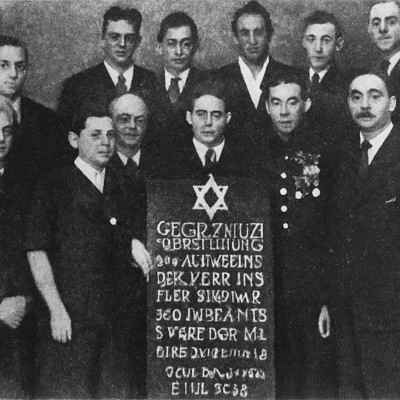
On the fourth anniversary of the murder of our parents, our brothers and sisters by the Hitlerite murderers, April 10, 1946 |
[Page 20]
He risked his life trying to bring food to his family. He did not know that this walk to bring a slice of bread to his family would end his life. Like Rabbi Akiva in his time, he taught Torah to many students. He was great in Torah, and yet he was also well-versed in Haskalah, and in his drawers one could find the “HaLevanon” of the Land of Israel and “HaMelitz”. He would spend many hours with me and would say: “I know that you will remain a man of Torah and excel in its knowledge, and therefore I want to have a share in your Torah”. That's how this wonderful man lived and died.”
Indeed, the “overall” was already known and the extra issue revealed that the day of remembrance for the Jews of Łęczyca is the 24th of the month of Nisan. A picture that came from Łęczyca revealed to us that the survivors had erected a memorial stone for the exterminated and engraved on the stone: “On the fourth anniversary of the murder of our parents, brothers and sisters by the Hitlerite murderers – Łęczyca 10.4.46”. In the meantime, we welcomed two residents of Łęczyca. The first was Avraham Ziegler. He entered with quiet, small steps and greeted me with “Shalom” in fluent Hebrew. In the liberation time, he was in the Buchenwald camp, where he joined the training, whose members immigrated to the Land of Israel in the illegal ship “Yagur”. Here he entered Kibbutz Afikim and stood out in all the cultural activities of the kibbutz. He wrote sketches, poems and plays, which were published in the kibbutz newsletters. Due to passive resistance on June 29, when the British laid siege to Afikim and searched for weapons, he was arrested and sent to Rafah. Some time after being released from Rafah, he left the kibbutz and moved to Tel Aviv. He also participated in the War of Independence.
The second one came straight from Poland, from our town of Łęczyca, and his name was David Ring. After he returned from the camp, he gave a pack of cigarettes to the local council guard, who allowed him and several other Jews to search the council's archives, from which five hundred photographs were taken. He brought with him several documents, one of which was a photograph of the Jews of Poddębice and Łęczyca near the ashes of the saints in Chełmno. He too has a long history behind him, and here too he managed to make history when he camped 90 kilometers deep in Lebanon, was seriously wounded and required prolonged medical treatment.
On the 27th of Tevet 5707, a large gathering was called at which a report was given on the activities of the organization. At the gathering, Avraham told of the heroic deeds of the Jews of our city. The editor's father, Rabbi Aharon Frankel, spoke excitedly about the urgent need to extend help. The existence of the organization in Israel was known to all the isolated residents of Łęczyca who stayed in the camps. Letters arrived from all over the world, from Poland, Germany, Russia, and America, to Rabbi Frankel's house, the seat of the organization's management. According to the address at the top of the letter from America, it appears that there also exists an organization of émigré of Łęczyca and its members meet from time to time. Also, a letter came from Mr. Reisman, which stated:
On behalf of the Łęczyca organization in Melbourne, I express my gratitude for the letter with the bulletins we received. We read all the material before our committee and some of them literally jumped with amazement when they heard that among the survivors were their friends from the days of
[Page 21]
their childhood. We are all happy about the activities that your organization has carried out so far. We participate with the sacred work you perform and will try to do everything possible to help the people of our city. Please continue to send us the issues.” – – –
For now, new émigré of Łęczyca continue to arrive: Yaakov Frida, the son of Reb Avraham Frida, Lotek Benedik, Yechiel Ring and Pinchas Frida.
Who encouraged them? Who supported them in taking their first steps of absorption in the Land of Israel? – The organization of Łęczyca survivors in Israel did this, and with almost no financial resources. One needs work tools – who provides them? Who provides a place to work for the survivors of Łęczyca? Who takes care of a place to sleep for them? Who takes care of getting them married? The remnants of the inferno consider our house to this day as a place of gathering and having intimate conversation. Here is Lemel Ornbach and his brother David. Here is Israel Przanczewski, who arrived on the ship “Shabtai Lozanski”, and when he was transferred to Cyprus with 350 people, the British determined with their sharp eyes that Israel was a “Tsabar”. Hence, he was freed. After a six-month stay in Ma'ale HaHamisha, he returned to our house, and here they made sure he would have a place to sleep and also tried to find him a job. During the War of Independence, he volunteered for the IDF and took an active part in the various battles. He was among the conquerors of Tiberias, Tzemach, Nazareth, he was active on the Jezreel front, and from there he moved to the Negev. He told me in the letter he was writing to me while sitting in a trench that hid him from the sight of the Egyptian tanks near Uja al-Hafir. This was typical to the residents of Łęczyca. And here is another resident of our city, Eliezer Becker, who entered Berlin with the Red Army. He says: “As soon as I heard that my brothers were fighting for their lives, I stood up and I made myself available to them. I joined the tank corps and walked in the fields and overcame obstacles and won…” Indeed, the émigré of our city have nothing to be ashamed of before their people. They have fully repaid their debt to their nation.
The 24th of Nisan is approaching and the editor addressed in a letter to the Łęczyca émigré in an article:
“How Heroes Have Fallen” – “The hand trembles… the heart shrinks… the eye is watering non-stop… and I cannot help but cry out a great and bitter cry: Where are you, dear people of Łęczyca? Your leaders and elders, your children and women, from your woodcutters to your water carriers, how all of them fallen? And even their burial place is unknown! Where is the monument and where is the tombstone that will give us the opportunity to unload the heavy burden that oppresses us? How can we calm down and the earth has not covered your blood that cries out to heaven? – But I promise you, holy souls, that I will not give rest to the complacent within us, I will stir up and raise a commotion until the last of the wanderers comes to his place safely: your sons are our sons and your grandchildren – - our grandchildren! And you rest in peace forever. Your memory will never be erased from our midst” –
The rabbi concluded his emotional words, which he repeated and expanded upon at the mourning gathering in the synagogue, which left an indelible impression. The wailing and crying disturbed the silence that prevailed in the holy place.
[Page 22]
In the last issue, issue number 10, a report was given, the essence of which is worth quoting here:
Dozens of letters were received from émigré from our city, reaching two hundred or more, together with the letters, which were received from the agency that cooperates with us, as well as from the Yad Vashem enterprise, which also cooperated with us. Several general meetings were held, dozens of issues of the bulletin were printed, which the people from Łęczyca gladly accepted. The immigrants from our city were sorted into various professions in the country. The editor published an article with a picture about the synagogue of Łęczyca, which appeared in the issues of the “Great Synagogue”. The bulletin was sent to those interested, and various other actions were also taken.
However, the crowning glory of our organization's work is the book that lies before us as a monument for the sacred memory of our city's citizens. This book went through quite a few labor pains before it was able to publish it. But its appearance on the bookshelf of every expat of Łęczyca will not allow us to forget or remove our precious community from our hearts. Our children, our children's children, and the generations that will come after them will read these books, reminding them of the horrors that befell their ancestors in their exiled lands, and that they withstood this terrible test so that their descendants may live a life of freedom in their historic homeland.
|
JewishGen, Inc. makes no representations regarding the accuracy of
the translation. The reader may wish to refer to the original material
for verification.
JewishGen is not responsible for inaccuracies or omissions in the original work and cannot rewrite or edit the text to correct inaccuracies and/or omissions.
Our mission is to produce a translation of the original work and we cannot verify the accuracy of statements or alter facts cited.
 Łęczyca, Poland
 Yizkor Book Project
 JewishGen Home Page
Copyright © 1999-2026 by JewishGen, Inc.
Updated 11 Mar 2026 by OR