 |
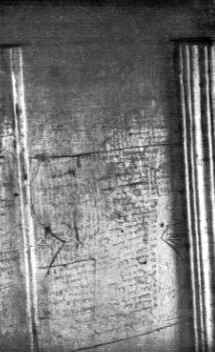
with the signatures of the murdered
|
[Page 310]
By Regina Kaninska
Translated by Janie Respitz
A. After Despair
Warsaw, 1942.
We are talking here about the difficult months before the liquidation. A few of the escapees who stayed in the ghetto, individually gave away the last of their saved money and valuables. There was nothing to sell, they were threatened with starvation.
To my great disappointment, a new tragedy arrived: my sister got sick with typhus. What can one do to avoid a new grave?
From all the plans and prospects only the old recourse remained: look for a loan. Maybe it will bring salvation. I went out into the street and to my great astonishment I quickly met Sinai Brukshteyn's son, the doctor. He smiled at me, as if he wanted to tell me some good news. Before I was able to cry out my heart to him, he said to me:
“Yoshe Kaninsky's wife sent you 500 zlotys”.
“This is salvation from heaven!” I cried out, “wonder of wonders”.
There was no time to ask him about my friends.
I returned home full of hope and with pride looked at everyone. One thing was clear to me: we prolonged the expiration date of our extermination.
B. To Majdanek
On May 1st 1943, I found myself in a bunker at Mila 13. With me in hiding were: Khaim Lipke and his wife, Lola Kaninska and her child, Esther Shmulerska and Jews from Warsaw as well as refugees from the province.
The bunker had small windows and through them we observed what was happening outside. We spent almost all day inside.
[Page 311]
At night we snuck into the dwellings because the Nazis were afraid to carry out deportations in the dark. How I got to this bunker is a chapter unto itself. On one of the critical days, when I went to take care of a matter in the small ghetto (on Prost Street) I met the young Khanakhovitch. He slipped a letter from my sister into my hand. The content was a warning: “don't go to Paniatov, come to us, we have a good bunker”.
I snuck into the large ghetto and arrived safely. On the above-mentioned day, we saw, through the small window, the boots of a Gestapo gendarme and well as the boots of a civilian who was suspicious. For sure this was not a Jew!
It was clear to us all they were looking for disguised hide-outs. The will to live was so strong, we placed hope in the pile of feathers which blocked the entrance. It gave the impression of a ransacked place, a hovel.
From outside we heard the call:
“Jews get out. We're setting the houses on fire! Give yourselves up!”
No one responded.
Suddenly we heard a celebratory outcry:
“It is here!”
We fell into the hands of the murderers and like thousands of other Jews we were sent in sealed trucks to Majdanek.
Almost all the people from Koło that were in this transport arrived in the death camp alive. The only one missing was Mrs. Esther Shmulerska, who was arrested on the way during a selection.
C. The Epilogue
In Majdanek I was allocated to work in the women's camp. My work was keeping the place clean.
One day, through the barbed wire fence I saw Yitzkhak Vrone. He indicated through gesturing that his leg was wounded and he did not have any rags to use as a bandage. By chance, there was no Kapo in the area. I tore
[Page 312]
off a piece of an old blanket and threw it to him. It was successful. Had someone noticed, I would have paid for this favour with my life.
Through the barb wired fence I also saw Avrom Hekht. During the selection in Majdanek the following were killed: Ruta Brukshteyn, Guta Strikovska, Khaim and Lola Lipke.
|
|
|
with the signatures of the murdered |
By Fishl Rauf
Translated by Janie Respitz
Two days before the war-mobilization, I sent my family from Poznan, where the Endek hooligans were raging, to Koło. I remained in the city and assumed the situation would end well. On September 2nd, I ran away from Poznan, because I was active in the anti – Hitler movement and the Volksdeutche (Poles of German origin) were raising their heads. I returned to my hometown on a freight train.
I did not find the members of my household. I was told they left for Lentshitz. Given that there were no cars I began to walk. What was happening by then on the roads is well known. Walking over bodies and corpses people looked for a hiding place. Luckily, I arrived in Lentshitz. This is where we decided to walk further in various directions. Wherever we went, we were warned the Germans were close by. After wandering for a long time, we returned to Koło. On September 12th, 1939 the mood in town was terrible. No one wanted to believe the rumours that were reaching us. We closed ourselves into our homes and were afraid to go out on the street.
The news of the Nazi acts of terror were confirmed, we saw them every day. The worst of all was expulsions to unknown places, tearing deep rooted families away from their homes.
I also met the fate of expulsion: me and my family were taken to the building of the “Ochranka” (secret police) and from there transported further away. When I arrived at the abovementioned place, there were already a few hundred people there.
We sat at the “Ochranka” for three days and heard a lot of various things about the “future” and “concentration camps”. I knew, that in the evening, the Nazis would carry out an investigation,
[Page 314]
in order to determine everyone's riches. They would confiscate everyone's money and jewelry and those in possession would be punished.
I immediately shared this information with my friends. We began our own checks. People threw packs of zlotys and dollars into the burning ovens. Those who did not possess 50 zlotys (the amount we were permitted to take with us) became “rich” during the fire. A few people hid their goods in hiding places.
The searches lasted all night. When the gendarmes left the arguing began: those who hid their “treasures” could not find them and became suspicious. A commission was formed by those interned began to investigate. Everything ended peacefully without the Gendarmes getting involved.
On the morning of September 8th, we received a notice that we will be transported that day. The gendarmes did not mention the name of the place but encouraged us: in your new home you will receive jobs, workbenches, and the opportunity to begin a new life. After this promise came a warning: whoever runs from the train or leaves the line will be shot.
Our march to the train looked like Hirshberg's picture “Exile”. We went into a few dozen train cars, freight cars. The lawyer Nayman and I, had to make sure that the orders were carried out precisely. Forty people per train car. If one of the transportees was missing, we would pay with our lives.
Before the train moved, condensed milk arrived, a gift from the Jewish community, a supplement to the food they had sent. The mayor of Koło turned to me and Nayman, since we were in charge, and told us that we and our families could ride in passenger cars. We refused not wanting benefit from pull or influence.
The train dragged on for two days and three nights from station to station. On the third day they opened the train cars and we knew the we were in Demblin. After stopping for a few hours, the train moved from its place. For some time, the train maneuvered over a bridge, going back and forth. People were panicking. After an hour we arrived at the destination.
[Page 315]
They gave us five minutes to leave the train. The gendarmes pushed us and beat us with whatever they had in their hands and kicked us with their feet. This was our warm welcome on this frosty day.
We arrived at Izbica -Lubelska. The local Jews did everything possible to ease our exile. We felt compassion from our fellow Jews. This was not an easy task for them: A few days before we arrived, a transport of 1,500 Jews from Lodz had arrived. The amount of people in the town doubled. The over crowdedness was unbearable. The transport from Koło numbered 1,300 souls.
In Izbica I did not see any paved streets and in winter the town was swimming in mud. The Nazis decided we would clean the streets and forced the local Judenrat to mobilize the refugees for forced labour.
I will not describe the event, drenched with blood and tears. This made the work of the burial society more difficult. This was not the worst. We received information that every day a locked train passes going from Lublin to Zamosc. Gentiles told us about a secret camp in the region of Belzhetz. Every day we heard horrifying cries and then suddenly, silent. Like at a cemetery. It was dark in town. The stormtrooper Engels had to have his victim every day. One day, as I was walking in town, I saw the abovementioned murderer stop a Jew. He tortured and beat him with brutal strength. All the Jews ran away. Suddenly I heard three shots, and then a shout from an S.S. man: “Jews, you will all be shot if you don't remove the… (and then came offensive words). Since no one appeared, he entered the first house, dragged out an old Jew and two women and ordered them to clear away the victim who was lying in a pool of blood. I emerged from my hiding place and rushed to help. I shuddered when I saw, the murdered man was my young friend Yakov Kaninsky. All plans of revenge faded away.
Groups of arrested Jews were deported and we never heard from them again. One day, we found the elderly Khaim Nayman and his wife in a pool of blood. Their sin: at night they turned on a light in their dwelling.
[Page 316]
The hellish suffering lasted until Purim 1942.
Shimon Shvartz from Koło came to me one evening and told me the Judenrat received information that the next day the town will be surrounded and the S.S will liquidate everything. Whoever can save himself should, perhaps a few individuals will remain alive. Shimon said goodbye to us as his dark face said: tomorrow may be the end!…
After he left, I suggested to my friends and relatives that they hide. Everyone should do what's right for them. There was no remedy for the collective, 2-3 in each hiding place and each group would be responsible for on its own fate.
At night we set to work. We built double walls, dug bunkers under the floors. We lived at the end of town and our row was the last.
Lying in hiding we heard: Jews, get out! Who ever gets caught will pay with his life! A child's cry revealed a hiding place. A victorious celebratory shout told us they found their victim.
The next day we were still afraid to stick out our heads. This is how we spent 2 days and 1 night. As the second night fell, I decided to go into town to get some news. I had to fight with my family. Three families agreed I should crawl out of the hole. Among them was my brother Simkha. After consultation we decided to take a chance and someone should go to town. The task fell upon my brother Simkha.
Before he went, we visited our house and saw we had been robbed. The Poles exploited the situation and took the last of our poverty.
It is difficult to recount my brother's mission and the suspense. In the darkness, he snuck through the forest into town and luckily returned unharmed. This is where a new chapter begins.
Eight days passed after the first annihilation campaign. Those who survived began, one by one, to go out into the street. A few dozen souls from Koło remained.
[Page 317]
New transports of Jews arrived in town from Holland, Czechoslovakia, Belgium, Germany and other occupied countries.
A new edict emerged: The Jews must deliver the following to the authorities: warm underwear, pelts, clothing. Everyone was allowed to have one suit and 2 pairs of underwear. They took everything from us, even leather valises. Disobeying the command was punishable by death.
On the second of the interim days of Passover, the Nazis, with the help of the local fire fighters, surrounded the entire town and led everyone to the new “transport”. The fire fighters discovered all the hiding places. This time, mine as well.
My wife and daughter were saved. They found arm bands on the street and pretended to be Aryans. They left town for a nearby village.
At 10 o'clock in the morning the “transport” left for an extermination camp in Belzhetz. My brother Simkha and I decided to run away. Our plan was as follows: we would unscrew the grate on the window of the train car, and at the first opportunity, jump out. When the train slowed down due to bent tracks, we jumped out, as did others.
The train guards saw us and began to shoot at the escapees. My son who was with us was killed. I cannot even describe my situation at that time…
Those who survived wandered for three days. A Gentile took pity on us and gave us a place to hide.
With the help of a peasant who was an acquaintance, I contacted my wife and daughter.
We spent three weeks in hiding, until it was no longer possible to remain in that region. The Nazis decided to exterminate every Polish Jew. In the new selection they killed Shimon Shvartz, his wife and family. The lawyer Nayman died a brutal death.
From Izbia – Lubelska we went to Kielce. Here begins another chapter of wandering.
[Page 318]
A short time ago they announced that Hitler's murderer Dr. Engels was arrested and they were looking for witnesses to bring a lawsuit against him. Obviously, I presented myself. I now have the opportunity through the Foreign Ministry with which I am in contact, to appear as one of the main witnesses.
My wish was to reveal the murderer and after so many years, it was fulfilled.
|
|
|
|
By Yitzkhak Sultz
Translated by Janie Respitz
I would like to briefly record my torment and struggles in the death – camps, because what happened to me happened to the majority of the youth from Koło.
I was among the first three Jews from Koło who were captured by the S.S in order to cover up their brutal acts. They took us to Nelken's house, in the dwelling of the elderly Yosef Rozen, and murdered him in cold blood. We had to bury him in the courtyard and after clean the room, so there would not be any of blood stains.
“This event must remain a secret” they threatened us, “otherwise, you will be shot like dogs!”
What can one say about the deportations that has not already been told?
Perhaps my lines will perpetuate the memory of a few names of young lives from Koło who did not have the good fortune to be with us. In 1941 I worked in the Poznan camps Buchenwald and Remo, together with Moishe Yudkevitch, Hillel Levkovitch, Avrom Poznansky, Pinkhas Nashelsky, Shloyme Tarzhan and Moishe Levin. None of them survived. Epidemics, hunger, death sentences, destroyed the lives of thousands, with those mentioned among them.
Little is known about the employment of the inmates, although so much has been written about it. A group of Jews from Koło were forced to liquidate a Christian cemetery in Poznan and take the coffins to another place. The uncleanliness of the putrefied coffins stuck to our bodies, however, we thought this was easy work. The inmates faced death in the eye every day: if you do not want a bullet in your head, become a grave digger!
[Page 320]
My life often stood under a question mark; however, death came very close when I wanted to conceal a loaf of bread and bring it to my friends.
This is what happened. After a long illness they ordered me to work in the camp laundry. I had contact with the outside world and bought a bread. In order not to get caught with this “non-Kosher” contraband, I hid the bread in a pack of laundry and…was incited to sin. The camp overseer, a Pole, noticed it. My life hung on a thread. My request that he not tell the S.S commander, against my doubt and disbelief, helped. I was destined to live more years of suffering and torture.
The year was 1943. Valshteyn, Auschwitz. My luck was, that while standing in a row as they chose who will live and who will die, I was ordered to go “Right!”.
With me were: Gehrman and Brukshteyn and a few others from Koło. We thought this was the last fire drill.
The large inscription in the camp: “Work Brings Freedom!” promised life. Could we believe the Nazis who fooled us every day? After a bath they gave us work clothes: winter clothes and shoes with wooden soles. This was in the hot days of summer when it was very hot. We waited all day and night for a number, the stamp on our arms, the stamp of slavery.
When this was achieved (not all made it) they sent us to hard labour. Very few withstood this.
When I remember the last year of the last World War, a shiver crawls over my skin. So close to the goal yet so far from life. It is not true that apathy repressed and people were indifferent: life or death, its all the same.
The road to Mauthausen, also a sort of crematorium… the train was bombed and hundreds of lives were ended: burnt from the ignition and explosion of bombs.
Dresden. We walk barefoot in the March rains. People dropping like flies. Food – the lucky ones received potato peel, an addition to a scant amount of food, his starvation ration. We are captivated by the attacks on Germany. While sleeping we heard the steps of Allied forces coming to save us.
When the Nazis were defeated and we were freed from hell, after years of staring the angel of death in the face, we were free. There was enough food but our stomachs could not handle it.
While in Dresden, in the days following liberation, I found the Lipnavsky brothers and Kenig's daughter.
We decided to go to Koło: perhaps we will find a close one, a remnant from a house, a hint of our home.
We found… graves.
By Katriel son of Zev Szaladowski z”l
Translated by Mira Eckhaus
|
For behold, your enemies will plot a secret against your people.
Treat them with an iron tribe, so they will rise no more. Our Lord, wake up! Do not be forsaken us forever, Your people, O Lord, is oppressed and murdered They said: We will destroy them and their name will not be remembered! Why do you hide your face from your servant, innocent Yaakov?
Do not forget, Lord, our affliction and our oppression!
The bad people have burned and massacred,
|
Patelnia – Katarinka – Gazavaniai[1]
By Rabbi Joshua Moshe Ahronson z”l
Translated by Mira Eckhaus
| I long to be one of those people who die by your hand in their bed – of those who die of old age – and their place in the next world! |
| (Psalm 17 verse 14) |
In the winter of 5702, when we were still at our home, we heard a rumor that melted every heart, and it was that entire Hebrew communities, Jewish men, women and children, are being led in a very terrible way to be killed, led like sheep to the slaughter, every day in a different city. Previously, they received an order to pay a certain number of marks (in one place it was eight marks and even more) as a poll tax from every Jewish soul, in one place they said it was for the expenses of the journey, and in another place they gave it another name (for the purpose of Impfungen[2]and the like) and after several weeks, trucks accompanied by members of the Gestapo arrived and put all the Jews in them and traveled with them to an unknown place, and since then we have not heard anything from them. In every city there was great mourning among the Jews, fasting and weeping. They observed a fast of prayer and charity; many people abstained from forbidden foods that they had become accustomed to during the two wars and were treated as if they were allowed to be eaten. Many fled to other places such as Warsaw. The situation on Jewish Street was terrible, valley of death, nothing was clear. In the middle of January (styczeń) 1942, we already learned the meaning of it from a Jew named Michał Podchlebnik from Koło (now Warthebrücken). Recently, he lived in the village of Bugaj near Koło. He told us this (I am only writing the content and summary of the things here, and if we can, Mr. Avraham Zaif[3] will write in detail, explaining all the details well, and everything he knows about this matter): On January 9, 1942, Gestapo members came to Bugaj and demanded fifteen brave and strong men for a several days work (they also took about 15 people from Izbica), and Podchlebnik was taken with them. The next day, they drove them by car to the Chełmno court, now called Kulmhof, which is between the cities of Koło and Dąbie. There they put them in a basement on a Shabbat day, and they immediately realized that a bad future awaited them because they saw various rhymes written on the basement walls, such as: “yuden, vist das keyner kumt fun de nisht aroys lebedig”[4], and more. They also had a conversation behind the curtain, because in the second room of the basement
[Page 323]
there were also a group of other Jews, who told them with great detail what was happening in this house.
On the first day of the week, there was a strike, so they sat all day in their terrible grief in their basement. On the second morning, twenty Jews were taken from them and sent to the forest, and ten remained in the basement. He too – Podchlebnik – was among the ten who remained. From time to time, we heard a loud noise with terrible and strange shouts, each time the sound of a truck was heard, followed by the calls of the soldiers: “Hurry, hurry!”. The sound of barefoot people's footsteps and the sound of terrible shouts (“Shema Israel!” and so on) reached our ears, breaking our hearts to pieces. Within ten minutes, the sound of shouts and sighs died down until there was a complete silent. Then, each time, after the noise, the members of the “Sonderkommando” of the Gestapo took them upstairs with great speed and they saw before them a terrible sight: in a large room, various upper and lower clothes of men, women and children were scattered, they were ordered to take everything as it is – in a great hurry – and place them in a second large hall. There, various clothes were already laid out, from trousers to corsets and shoes – with great disorder. When they had finished this work – to empty and clean the first room of the clothes that were scattered there in every corner – they were returned them to their basement. And so, it was several times every day.
The next day, on Tuesday, other people remained and he was taken and sent to the forest in a truck under heavy guard. They drove about 10 minutes from Chełmno to the nearby forest, where they dug very large graves. The pits were sloping, wide at the top and narrow at the bottom. A truck came about every half hour. There were special groups of Jews who opened the door and a little black smoke came out, so they moved away from there and when the smoke stopped coming out, they took from the truck warm naked bodies (men – only in underwear, and women in shirts) and threw them to the ground. Then the Gestapo members approached with pliers in hand and walked between the rows of the dead, and checked the hidden places on the bodies to see if they had hidden some kind of treasure, silver, gold and precious stones. They took everything they found; they even took and tore out the gold teeth that were in the mouths of these saints. After the search, they took another group of those Jews and threw them into the pit. Other Jews were already standing there and burying them (he, Michał Podchlebnik, was in the first group, but since he saw that if one of the Jews was weak, they would beat him and then kill him, he chose to stand in the pit so that he would not be seen so much). Meanwhile, the truck drove to Chełmno, and came back again, and so on and on. Among the dead, he also recognized his wife and children. In the evening, they covered the pit with dirt a little, and they drove to Chełmno.
According to the story of Podchlebnik (and Padechmielnir, mentioned above), approximately 700-800 people were killed in this way in Chełmno in one day. The saints were placed in the pit like salted fish, that is, one's head next to the other's feet and their faces downwards. Each grave was approximately eight meters wide, six meters deep, and the length of a man's body. The bodies of three hundred saints were placed from the bottom of the pit to its edge. The overall length of the grave was very big
[Page 324]
(Podchlebnik could not say the exact measures because after it was covered, the pit had no shape of a grave). His heart was then as still as a stone, and he worked like a machine, and in general all the work there was like a factory of mass slaughter. The Jewish gravediggers, who could not continue to do their terrible work with the necessary vigor, were ordered by the tyrannical guards to rest next to the grave and they were shot. When the number of gravediggers dwindled, new gravediggers were brought from the city of Łódź. It is worth noting that the aforementioned Podchlebnik heard there that several thousand of gypsies (Zigeuner) were brought to Chełmno in December 1941 and killed in the same manner.
There, in Chełmno-Kulmhof, about 70-80 meters from the Koło-Dąbie road, stood a beer house with a fence around it. Of course, the security there was very tight, no one in the world was allowed to enter or even just to look inside.
When a group of Jews was brought in, they were told that they are being taken for forced labor, and first they have to clean their clothes, wash their bodies, and dry their clothes, and for this purpose they were brought here. When entering the corridor, there was a sign on the door of the room “Badeanstalt”,[5] the Sonderkommando rushed them to take off their clothes very quickly, and then a door on the other side was opened, where a truck was already standing. Anyone who did not want to enter into the truck was immediately killed with brutal blows, and pushed into the truck. The door was closed, there was no room for air there at all, the unfortunate Jews began to shout bitterly until within ten minutes the voices ceased, because they were all choking on Kiddush Hashem, because they were of the seed of Israel.
This process repeated every day. It was very difficult in the evening, at the end of the day. When they returned the gravediggers to the basement, they tore up the money they had, one of them was a dentist from Izbica, who had five thousand marks in his pocket, tore up his money and broke his gold watch. The youngest of the Kashevtsky brothers from Kłodawa, a healthy, tall brilliant young man, committed suicide (he hung himself) and his friends – among them the aforementioned Podchlebnik – helped him and pulled his legs to shorten his dying. After that, they wanted to light a fire and burn down the house of the murder, but to their regret, the house was a walled house. They were very sorry about it. They had no chance to escape, but once, when they were traveling in a truck, Podchlebnik saw the opportunity to escape. He made a hole in the lid of the van truck and escaped through there, while the truck was driving. Several moments later, they chased him, but he managed to hide himself until the Gestapo disappeared. He came to Grabówa and then to Skierniewice, but since there were already “Steckbrief”[6] after him, he fled to Gostynin and from there to Warsaw. Two more gravediggers, his friends in this trouble, fled from there to Warsaw that same day.
We heard all this during the terrible winter of 5702. Our heads were pounding and our eyes were darkened. And yet, there were believers and most of the people doubted their words. But now there is no
[Page 325]
doubt about the truth of the matter, because besides the testimony of Podchlebnik, Engineer Bornstein of Koło, Wallrach of Kłodawa, and other reliable people, many Poles told us details like these: Every day large groups of Jews came. The Sonderkommando of the Gestapo took them from Koło station to the Beit Midrash in Koło, where they stayed all night, and over time they were taken away. From time to time there are many dead on the site (in addition to children who died in the winter due to the terrible cold which was there).
Terrible stories were told about Chełmno, but I do not believe everything. So far, the things I mentioned were clear things, and from here on in this chapter they are only doubtful reports and the researcher should investigate their truth, and it is: In the winter of 5703, it was told to us that since there were already too many people buried – in the forest near Chełmno – and the stench and mold in the air were already strong, the graves were opened and clear lime was thrown on the bodies. Then they began to burn the bodies of the new saints. They no longer brought them through the city to the synagogue; they brought them only straight from the station to the “Kleinbahn”[7] Chełmno. It was also said that a “bagger”, a machine for digging the ground, worked there in order to avoid eyewitness testimony from the gravediggers. It was said that the manner of death was simple: the truck was closed on all sides, there was no place for air to enter, when it started driving, the smoke pipe that should go out – went in and the smoke suffocated the souls of the unfortunate people sitting closed inside. It been said that recently, since there was no longer any place to bury them, they dug up the ground and planted trees there. In this way, there is now only a young forest there, in Chełmno. No one knows what is under the dirt – “earth, don't cover my blood”!!!
It is said that the entire area of the Kazimierz Forest near here is full of victims from the saints' people of Israel, according to the Poles, these are the Jews of Zagrod (this was before the Koło incident).
Wieselfisch from Żychlin, who was here, said that he himself was among those sent from Zychlin in Purim 5702, and when they reached the market in Skierniewice (the Koło road), he managed to escape.
Several Polish farmers from the Kanin area brought us banknotes (banknatin) of one hundred and fifty marks, many glued together from four different pieces of money banknotes in different values. When we asked where they got this from, they said that all along the road to Koło, there were many torn banknotes that the Jews on the trucks tore up as they traveled because they saw what was ahead of them, where they were traveling, and threw through the holes torn money, various objects and broken utensils, and they glued some of the torn banknotes together.
Original footnotes
By Esther Nashleska-Bendler
Translated by Mira Eckhaus
A. Is there still a Jew alive from our city?
In February 1945, immediately after the liberation of Kolo by the Red Army, I entered my city on foot. I came from the forests, from one of the partisan companies. Here one of my dreams came true: to return to Kolo despite the boasting of the murderers, who said with great proud that no Jew would, after the deportations to the extermination camps, ever see the city again. My attraction to the city was not to gain possessions that had been abandoned, but to show: “We are still here!”
In the middle of the streets of the Warsaw suburbs lay the bodies of German soldiers. They were the last sign of Nazi rule. This time the leeches were wallowing in their own blood. The sight of the dead shattered the entire theory of the invincible army. Next to the carcass of a cat, I saw the body of an S.S. officer, who was lying with his hands folded. He had apparently fallen the moment he raised his hands in surrender. The Soviet vanguard that captured the city did not believe the last of the Nazis. They suspected them of plotting and setting a trap, and anyone who came across them was sentenced to death.
Upon my arrival in the city, I found most of the streets empty. Gangs of mob suddenly appeared. Judging by the sacks in their hands, one could guess that they had come to plunder. This time they had laid hands on the property of the Nazi bureaucracy. They had come to rob from the plundered. Some of the mob decided to take over the furnished apartments, which were filled with plenty of food.
My feet took me to May 3rd Street. I approached the agricultural machinery factory, and even here the mob had already arrived. I saw them taking everything they could get their hands on.
– “Stop it!” – I raised my voice.
The mob was astonished to see a woman dressed as a partisan: a rural headscarf wrapped around her head, her feet bare, and she was wearing a khaki shirt and men's pants. They panicked and ran out of the courtyard and scattered in all directions.
The gates were closed.
From the factory I made my way to the town hall. The chief clerk, Mrs. Buchikevich, greeted me with astonishment:
– Are you Jewish? And are you alive?
– Do you alone have a monopoly on life? – I gritted my teeth.
My reaction startled her. She hid her anger and changed her intonation:
[Page 327]
– What does the lady ask us to do? – She asked with interest.
– I demand my property back! I demand bread, because I deserve it!
– Thanks to what?
– I fought; I brought freedom with the partisan companies!
The mood changed with the entrance of the mayor, Mr. Ostrovsky. He was more
courteous. After I addressed him, he sank into thought and replied
indifferently to things that had dual meaning.
I left in a state of despair.
The first Minyan
Not as strangers but as people returning from a long journey home, the few remnants of the Jews of Kolo began to return to the city. They returned to search and wait for those who would come. Perhaps a miracle had occurred and relatives, who were said to have been killed, remained alive. It was impossible, said the believing heart, that one day the survivors would not appear.
Among the first to return to Kolo were: the writer of these lines, Elias Markowski, Yehudit Markowska, Regina Koninska, Moniek Mochorowsky, Lotek Engelman, Schwartz, Shlomo Podchlebnik, Menke, Ezra Izvitsky and his mother, Danilewicz Kaliska, Adela Brand, Yona Fuchs, Wilczynska, David Levin, Handola, Adzia Fogel and her son, Henk Zalkind, Michał Podchlebnik, Wissman, Warszewski's granddaughter, Avraham Hecht, E. Reichert, Motek Podchlebnik, the three Chmeylnik brothers, Chaim, the shoemaker, the hatter Utszynowski, Zygmunt Stupej, Adek Izvitsky, Mordechai Kempinski, Pipot Weiswol and Heiman Tempelhof.
The house where I lived became a place of first refuge, a hostel. We spread mattresses on the floors. Between each mattress was a suitcase, a backpack, or just a bundle. We ate together. We spent the first few days sitting like mourners, telling each other everything that had happened to us since that terrible day. As more and more people joined, the residence of Fox and Zelkind (the Podchlebnik house) became a second hostel.
The apartments that were not destroyed during the war were returned to anyone who asked for them and to any heir; but it was difficult to start a normal life again.
Every person carried a cemetery in his heart and needed advice and guidance. A committee of survivors was elected. And the work was extensive: we began to investigate who remained alive and where they were, we treated the sick, who were brought to the hospital. We answered dozens of letters that came from all corners of the world, from the Diaspora of the people of Israel. Packages of clothes were sent to us from America.
The committee was the present need. Each one felt that the wave of contempt and hatred for Jews was still flooding the city. The Poles who occupied the Jewish shops and moved into their homes –
[Page 328]
did not want to leave the occupied land. In any case in which the looters refused to return the loot – the committee intervened and demanded justice from the authorities.
These days, a new grave was dug in the lands of Kolo, in which the body of one of the returnees, who went through all the stages of hell, was buried. He was a native of our city, Mordechai, the son of Leah Schwartz. The municipality gave the remnants a plot of land for a new cemetery, near the village of Rozhkov.
Last testimony from the destruction
Several weeks passed and the returnees began to engage in trade and crafts. One of them dug in the soil of his yard to discover a “treasure” that his parents had hidden from the Nazis, but the police forbade him from doing so. Several Jews managed to get back the furniture that was found at their neighbors.
The return to normal life was difficult. The sight of the Jewish streets, which had been completely destroyed, depressed the spirit. The whole city resembled a large cemetery, although there were no visible tombstones. Not even in the Jewish cemetery were there any memorial tombstones left. The tombstones were taken to pave the way, from the cemetery to the avenue. The heart was torn at the sight of this disgrace. In vain we searched for the graves of parents and relatives who had died before the Holocaust. The entire area had become a pasture.
The Beit Midrash remained standing. We went inside and found on the floor a large pile of children's shoes, tefillin and “siddurim”. The Ark of the Covenant remained intact. We transferred everything we found to Lodz, to the “Yiddisher institute”.
One day, Adek Gorsky, the son-in-law of the Lipki family, arrived in town. He was a soldier in the Russian army and headed for Berlin. He asked about his wife and son, but there was not a word of condolence on our lips.
The “Landsmannschaft” in America sent us a letter: “How much money is needed for your rehabilitation?” We answered them: We are leaving the city that is filled with blood, every stone in the wall will cry out. The loneliness is great and the foreignness is oppressive. We came to see the graves of our relatives, and we headed for the Land of Israel.
Conversations with Poles
We groped as if in the dark; we asked to know what the public felt for us. Sometimes it seemed to us that they were beginning to accept our return. We talked with them about the past and the future. Some of them showed great remorse, apologizing for not doing everything to save their friends. Most of them said that hatred is fleeting, and they would do everything to correct what happened.
– We too suffered; our sons and parents also fell in this war! –
Tears flowed.
– Maybe you lack something and we will give it to you! – They asked
to be kind to us.
Few Poles kept their word and extended a helping hand.
[Page 329]
In the market, in a place of bargaining, we heard the Poles gossiping:
– Once again, the Jews are buying the best goose!
– May they disappear like in previous years!
– Hitler should be praised for his good work!
There were also Poles who became “mourners”:
– We said we wouldn't see them after the war, and here they are…
Every day has its own taste. There were days when we felt openly hostile, and even friends avoided from meeting with us, lest they say: “Here they are making friends with…”
Out of respect for true friends, we rarely visited their homes.
We left the city and swore: We will never return there! Never!
We cried over the destruction of the community and wept again over the loss of faith in humanity, in people who had lost their human form.
|
|
|
|
By Yakov Valdman
Translated by Janie Respitz
…the neighbouring districts, for example Koło and Sampolno were “cleansed of Jews”. Almost every day trains and trucks arrived overflowing with Jews from all over Europe. I myself spoke with Jews from Paris at the train station in Koło where I worked with coal. They arrived in “Pulman” cars with their large suitcases. When I told them they should escape to the forests because the Gendarmes would soon arrive and they would be lost forever, they laughed at me and said: “We are going to the Jewish colony “Heydemile””[[b]]. That's what they told us in Paris.
A few minutes later they were convinced of the veracity of my words.
A few Gendarmes units arrived and they were seated in cattle cars. Now, many of them wanted to be saved but it was too late. Many died at that spot.
The Lodz ghetto also supplied the Chelmo victims. Every day we saw on Tarunska Street in Koło, poor mothers with packs on their backs, being pushed
[Page 331]
by the brutal filthy hands of Hitler's soldiers. The civilian population was not permitted to look out their windows when they were taking people from the large train to the small cattle train, where they were falling from weakness and exhaustion, where they whipped children with rifle butts for so long until they had to lifted, however, they were already stiffened corpses.
In order for Hitler's hangmen not to get bored, they shot the marching columns. The wagons traveling behind them, picked up the dead.
Original footnotes:
Yakov Valdman, of blessed memory, was born in Uniev near Turek, and survived
all the tortures of the occupation until the deportation. Later, he escaped to
the Partisans. After liberation he was active in the work of the Central Jewish
Historical Commission in Poland. He organized an inquiry commission in Chelmno.
Valdman was killed by an A.K. (Armia Krajowa – Armed Resistance) bullet in
Turek, in September 1956.
Return
By Dr. A. Brand-Urban
Translated by Janie Respitz
|
You asked me, my friends, innumerable times
A word about Koyl, our cradle, What can I tell you after the flood of steel, After years of death and war?
The page has already yellowed, time has passed
|
[Page 332]
| The forests rustle, the river still mummers,
The morning gives me a ray of sun, The moon spills silver into the night, The early morning grasses caress the dew. My father walks boldly on the path; Storms seethe over water and land; A fire radiates in my breast: show me the way to Zion, “If I forget thee” – is engraved on the wall. My mother is sad when the Sabbath disappears As she mumbles “God of Abraham”. Her child lays his head on her knee, The weekday can be heard in her embittered voice. Now everything is burnt, the destruction, unending, I shout out my troubles, the victims are unjustified – The month of Elul is here and I don't see the graves of our forefathers.
Jerusalem, the Holy City, 5171 (1956)
|
|
|
|
|
By H. Hirshbeyn
Translated by Janie Respitz
Scenes and images of an exuberant social life, with which our town was blessed until the outbreak of the second World War swim in my memory.
The Jewish community in Koło was not among the largest, however, it was well developed. Every one of the communal groups wanted to surpass the others, by creating more economic and cultural institutions. All the institutions ran animated activities and this resulted in almost all the youth being involved in communal life.
The representatives from the parties were aware of the present and helped forge the future. I will tell you about them although each one spoke its own language and went its chosen way.
…During of the outbreak of the second World War, October 1st 1939. The Jewish population of Koło tried to place the protection of Jews in their own hands. They created a civil militia and the leaders were: Fiernikazh, Tempelhoyf, Brukshteyn, Hirshbeyn, Barkovsky, Frankovsky, Izhbitsky and others, almost all the communal activists.
The chaotic escape of the Polish military and the quick entry of the Nazis devasted life in general and particularly the Jewish community. On the first day of the occupation, Hitler's men announced through large posters the Jews were beyond the law. The anti – Semitic elements of the Polish population waited for this edict. They robbed the businesses of Rotberg, Brudovsky, Valter, Shaladovsky and others. We were not permitted to complain about the Pogromists.
In the early days we heard the call in the courtyards: “Jews, get out!”. With shots from revolvers and death threats the Jewish population was pushed into one place. The old man Reb Yosef, of blessed memory,
[Page 334]
was sick, could not get out of bed and a Hitlerite shot him on the spot. That same day, Shloyme Biezvinsky, the chairman of the Jewish municipal library was also shot. He was killed on the steps of his father's house. The murderer then went to the unfortunate father and his paralyzed son and made them take away the victim and clean the spilled blood. These were the first victims in our town.
The Jewish men were sent to the Kalish and Warsaw bridges which had been blown up by the Polish military. The order was: pull the stones and pieces of the bridge out of the water. Those forced to do this stood in water up to their necks while the wild beasts beat them with long whips on their heads and shouted: “Faster Jews, faster!” High ranking officers photographed this scene and laughed.
Older residents stood beside me: Shtayer, Biezhvisnky, Vinter, Brener, Danilevitch, Tsorndorf, Volkovitch and others. Suddenly the S.S beasts attacked Nunek Vinter and beat him to death since his sick feet could no longer budge. At the same time the beasts occupied themselves with another group of Jews, who had to lie face down and sing prayers. The old man Reb Shloyme Vaserman, of blessed memory, picked up his head for a moment. A sadist ran to him and stomped his head to the ground.
This is how the acts of terror of the Nazi hell began in our town. During the occupation, almost the entire Jewish community was killed. Its fate was the same as all the Jewish communities in Poland.
Registered by A. D.
Translated by Mira Eckhaus
|
|
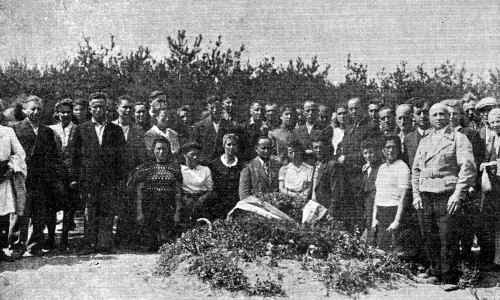
Translated by Janie Respitz On the 20th day in the month of Kislev, 5702, December 19th 1941, the remainder of Jews from Koło were exterminated in the gas chambers of Chelmno. On the anniversary of these deaths, which falls this year on the 20th of Kislev, December 11th, 1949, all the survivors from Koło and the surrounding region will meet at the New Cemetery in Haifa. We will bury the bones of those murdered which were brought from the mass graves in Chelmno. The burial will take place at 3 o'clock p.m. Please inform your fellow Koło townsmen. The organizing committee.
|
|
JewishGen, Inc. makes no representations regarding the accuracy of
the translation. The reader may wish to refer to the original material
for verification.
JewishGen is not responsible for inaccuracies or omissions in the original work and cannot rewrite or edit the text to correct inaccuracies and/or omissions.
Our mission is to produce a translation of the original work and we cannot verify the accuracy of statements or alter facts cited.
 Koło, Poland
 Yizkor Book Project
 JewishGen Home Page
Copyright © 1999-2026 by JewishGen, Inc.
Updated 11 Jun 2026 by JH