 |
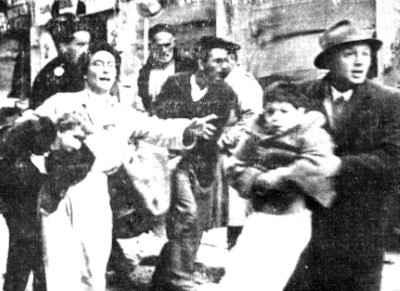
in the evacuation of children wounded in a terrorist attack in a
house on Ben-Yehuda Street in Jerusalem in February 1948.
|
[Page 119]
by Tamar Menaker-Kasher
Translated by Moshe Kutten
Edited by Barbara Beaton
From Childhood to 1939 (World War II)
My father, Yosef Menaker, was born on August 14, 1911 in the town of Radekhov to his mother, Mindel, and his father, Avraham. Their house, a nice two-story brick house, was located in a narrow alley. Four families lived in the four apartments in that building, all members of one extended family. My parents' apartment was spacious and pleasant. My paternal grandparents belonged to the town's middle class and made a decent living.
The father, the household's central figure, raised his children according to his own principles and capabilities. Although he was unable to provide them with higher education, he remained unwavering in his commitment to their moral upbringing. His primary aim was to instill strong values, considering formal education secondary. He placed special emphasis on good manners at home, respect for elders, and observance of the fourth commandment: “Honor your father and your mother.” Above all, he valued truth and honesty. He often said, “The harshest truth is better than a lie.”
|
|
|
Yosef Menaker, as a member of the “People's Guard,” takes part
in the evacuation of children wounded in a terrorist attack in a house on Ben-Yehuda Street in Jerusalem in February 1948. |
When World War I broke out in 1914, the father, Avraham, was recruited into the army. The mother was caring for four children and was pregnant with a fifth. The mother was worried about her husband's fate and could not bring herself to part from him, so she just followed him. Since he was not a fighting soldier on the front, she was able to do so. The battalion moved around, and the mother with her children followed them.
[Page 120]
Thanks to this arrangement, the parents were able to meet occasionally, and the mother could prepare Kosher meals for the father. When the front lines advanced, the family was sent to Austria, where the children attended school while waiting for the war to end. After a long separation, the family reunited in Poland. Despite the horrors of the war, the possessions hidden in the cellar of the house remained unharmed, and the parents tried to rebuild their lives from scratch.
The older child, Rivka, was the first to leave home. She married the tree expert, Leon Schwarzwald, and moved to Lvov [Lviv]. There, she gave birth to two daughters, Dina and Hela, and was very happy. On the eve of the Second World War, she decided to make Aliyah to Eretz Israel. She carefully examined the prospects for absorption and earning a livelihood, but while she was still deliberating over her final decision, the war broke out. The family returned to Radekhov to rejoin their relatives, where they ultimately met their tragic fate.
Pesia (Pepa, Pesha), the second child of the Menaker family, married Zevulun Kardasz at a young age. The couple remained in Radekhov, where they raised two sons, Yaakov and Avraham. Zevulun, a committed Zionist, was actively involved in public affairs and supported the family through his work in the flour trade. When the war began, the family, along with many others, was forced into the ghetto.
Miriam received her elementary education in Radekhov. From a young age, she was captivated by the Zionist ideal and soon joined the Zionist youth movement. At 20, she left home to participate in a Zionist Hachshara [an agricultural or industrial pioneering training camp] alongside a group of young men and women in Goriltza (Gorlice), and later in Beilsko. Two years later, she returned home to bid farewell to her family before her Aliyah to Eretz Israel. Upon her arrival, she faced the realities of the time: young women engaged in the same demanding work as young men. After a season of packing oranges, her friends encouraged her to learn vegetable cultivation at Ayanot, an agricultural school. In 1935, she married Kuba Kaniuk. The couple lived in Kibbutz Kiryat Anavim while awaiting the outcome of negotiations with Arab landowners for land in the Judea Hills. They belonged to a group that wanted to settle on that land. After many delays, the group abandoned hopes of purchasing land in the mountains and instead founded a new kibbutz in the Zevulun Valley – Usha. Their first son, Zevulun, was born there followed a few years later by their daughter, Gila. During World War II, Miriam remained in Usha, tending the vegetable garden and worrying about her family left behind in Poland.
Yosef was the most beloved child in the family. In addition to his parents, his three older sisters cared for him with great love. He remembered the war only vaguely, because he was a three-year-old child then. After acquiring a traditional Jewish education and attending a cheder like any other Jewish boy, he went on to the state school for boys. There was no opportunity to continue his studies and acquire a profession in town so he left home at the age of 13 and moved to Lvov. He lived at his sister Rivka's house and enjoyed special warm treatment and dedicated motherly care there. In Lvov, he attended a trade school and excelled in his studies. Although his sister was wealthy, he did not want to be supported by her and went to work at every opportunity. Upon completing his studies, he began working as an accountant at a store and would return home during the holidays. Throughout this entire period, his sister educated
[Page 121]
and encouraged him in every stage of his progress. She also made sure to save his money and spared him unnecessary expenses by providing for all his needs. My father, Yosef, never forgot Rivka throughout his life. He always spoke of her with great love and saw her as a model for a loving and devoted sister. During this period, Yosef met other young workers who, like him, were motivated by Zionist ideals. Together, they joined Gordonia, a pioneering youth movement dedicated to preparing its members for a life of labor in Eretz Israel. Yosef underwent Hachshara [practical training] at the Bielsko training center for Zionist youth, preparing him for his future.
Eretz Israel's gates were then closed to Zionist pioneers. They had to wait a long time until they could obtain the desired immigration permits. The young people decided to outwit the British authorities and double the number of immigrants. When a long-awaited permit arrived, people married one another in fictitious marriages, and two people immigrated in place of one. In this way, my father managed to advance his arrival in the land of his dreams.
His farewell to his family was very emotional, but it never occurred to him that he would never see his family again. Yosef disembarked from the ship in Jaffa, and a few hours later, he reached Kiryat Anavim. After three long years, the brother and sister, Miriam, finally met again. For many hours, they tirelessly told each other about the events they had experienced in recent years.
His first actions in Eretz Israel were joining the Histadrut [Israel's largest labor union], Mapa”i, the Workers Party of the Land of Israel, and the Haganah [Zionist paramilitary organization in British Mandate Palestine]. He immediately began a life of work. In Kfar Etzion, his group prepared the land before the members of the settlement arrived. They cleared the area of stones. Yosef used to work there during the week, returning home to Kiryat Anavim on Shabbat. By nature, he was a diligent person and easy to get along with. He took care of all his own needs and did not want to trouble Miriam with requests. Miriam, as a good sister, outwitted him, and at night she would check his clothes and belongings. Whatever needed mending she repaired, and she also washed whatever was necessary. When her actions were discovered in the morning, he would regret all the trouble and effort she had gone to for his sake, instead of resting and sleeping. After completing the planting work in the Gush Etzion area, he joined a group of laborers working in a quarry and later moved to a permanent residence in Jerusalem.
Eretz Israel was home to many young workers, and unemployment remained a central challenge. Each day, workers gathered at the Histadrut Building, waiting for employers to offer them jobs. Over time, these gatherings evolved into vibrant social centers and forums for ideological debates. Yosef was prepared to accept any available work because of the harsh economic realities and widespread suffering, particularly during days of financial difficulties. He joined a team laying sewer pipes in the city, which provided him with a steady wage. During this time, Joseph chose to marry his childhood friend, Leah Hai. They had a modest wedding ceremony at the rabbinical office that was attended by a minyan of friends and fellow workers.
After the sewer workers' group disbanded, Yosef transitioned to construction work. He began by hauling concrete bins, then progressed to building walls and pouring concrete roofs. When the building was finished, he shifted to road paving, but soon enough,
[Page 122]
days of unemployment followed. The situation was bleak, and in addition, during those days, he received news from home that his father had died at the age of 57 (in 1937). It was sad news, and one of the last messages that arrived from Poland – the outbreak of the Second World War followed.
Chaim was a gentle and compassionate boy, born in 1916. Throughout his childhood in the interwar period, the family had modest means. After spending his childhood in his hometown, Chaim moved to the bustling city of Lvov to study carpentry at a vocational school. He quickly mastered the material and excelled in his studies, leading the school to invite him to stay on as a teacher and instructor after graduation. Concerned about his health, his mother persuaded him to pursue a career in accounting instead. When his brother Yosef made Aliyah, Chaim took over his position as an accountant at a large store, continuing to follow in his older brother's footsteps in other areas, too. He also joined Gordonia and resolved to make Aliyah to Eretz Israel. When he received his immigration certificate, tragedy struck – their father passed away. Out of devotion to his family, Chaim postponed his Aliyah to comfort and support his grieving mother in her time of loss.
Yafa (meaning beautiful in Hebrew), as her name suggests, became a byword in town. Yet her most remarkable quality was her unwavering loyalty and devotion to her parents. From a young age, she became active in the Zionist youth movement, aspiring to immigrate to Eretz Israel. However, obtaining an immigration certificate grew increasingly difficult. Her sister Miriam, already in Eretz Israel, fought desperately to secure the necessary permit. Finally, on August 30, 1939, after many delays, success was achieved and she received approval for a permit for Aliyah. Tragically, it was too late – the war broke out, and the immigration certificate never reached Yafa.
Shimon, born in 1922, was the youngest son in the Menaker family. When his sister Miriam left home to join a Hachshara group, he was about eight years old and felt especially close to his mother. At the outbreak of the war, Shimon was still a young boy who had not yet finished his studies or begun to forge his own path in life.
The War, the Holocaust, the Jewish Remnant, and the Rebirth of Israel
The connection between Yosef and Miriam in Eretz Israel and the rest of the family in Poland was severed at the outbreak of the war. The happenings of those harrowing days were obscured by the fog of the horrors of the Holocaust. Only faint echoes of the tragedy reached them after the war, when the full extent of the devastation finally became clear.
As previously mentioned, the father, Reb Avraham, died of natural causes. He was given a proper Jewish burial, and Kaddish was recited for him during the year before the outbreak of the war. When the German armies invaded Poland, the entire Menaker family gathered around their mother in Radekhov. In the early days in the ghetto, they stayed together and faced their hardships with resilience. However, the situation deteriorated. The “Aktions” – operations aimed at the total liquidation of Jews – became increasingly frequent. To avoid a collective tragedy, the family decided to separate and hide in different places. At times, they hid in underground bunkers and cellars or fled to the forest. Some members ventured out in search of food and never returned.
[Page 123]
During one of the “Aktions”, Rivka and her family were discovered in their hiding place and were never seen again. Pesha's husband and son left to find food but never returned. The second son, who stayed with his grandmother, did not survive either. Pesha was left alone and spent most of the war in the forest – wandering, escaping, enduring inhuman conditions, and feeling constantly like a hunted animal. After years of unimaginable suffering, she witnessed the defeat of Nazi Germany and began to rebuild her life. Today, she lives in Brazil with her second husband, Moshe Hochman, also a Holocaust survivor. Their son, Tzvi (Herman) Hochman, was born there, and Pesha finally became a grandmother.
Chaim stayed with the rest of the family at the beginning of the war. As the danger intensified, he separated from them for safety. After the war, it was discovered that he had managed to survive until the final days of World War II. I will never forget the day we learned what happened to him. My father, Yosef, was attending a conference in Kfar Saba when a man he did not recognize suddenly approached him, stopped in his tracks, and stared at him with deep emotion, saying nothing. My father, confused, asked, “What is it? Why are you staring at me like that?” The agitated man said tremblingly, “Chaim?” At that moment, my father turned pale and said, “What? How could that be? My name is Yosef, but I had a brother who looked very much like me, and his name was Chaim.” “Menaker?” the man asked. “Indeed,” Father replied. And then the two of them burst into tears.
The man explained that he had met Chaim in the forest, where they formed a deep friendship. As the liberating armies approached Poland, they decided to split up and go in different directions, agreeing to meet in the city at a future date. When the liberating armies arrived, the friend reached the city and waited for Chaim. He waited and searched, but Chaim was nowhere to be found. Where was he and what happened to him? Was it possible that he was still alive in some corner behind the Iron Curtain? These were questions that never let go of my father, and he never received a clear answer to any of them.
Yafa, gentle and gracious, worked as a maid and nanny for a German officer. The officer was among the few Germans in whom a spark of humanity and compassion had not been extinguished. He would warn her before every “Aktion” and ensure she remained in his house during the manhunts for Jews. One day, after a manhunt ended, Yafa went to her mother's hideout, only to find her gone. Overcome with fear, she rushed to the train station, desperate to find her mother and be with her during such perilous times. Fortunately, her mother had changed hiding places on the advice of friends and escaped that particular roundup. Tragically, she was later captured with her youngest child and sent to be annihilated. At the train station, Yafa found a large crowd of Jews being organized for transport to a concentration camp, and she was captured. There, she encountered her sister Pesha, who had been captured earlier. Upon hearing Yafa's story, Pesha became angry that Yafa had come to the station, risking her life. Determined to save her sister, Pesha daringly escaped and hurried to the German officer's home to tell him about Yafa's predicament. The officer immediately set out to rescue Yafa, but arrived at the train station too late. The train was already sealed and departing. Thus, Yafa paid the price of her life for her devotion to her mother.
[Page 124]
Most of the large Menaker family perished along with the millions of Jews murdered by the Nazis. Only a few survived, eventually reuniting in the newly established state of Israel after enduring unimaginable suffering. Today, Miriam and Yosef live in Israel. Miriam raised a son and a daughter on Kibbutz Usha. Her daughter stayed on the kibbutz, and here in Israel, Yafa has been blessed to be grandmother to four wonderful grandchildren – may their numbers continue to grow.
World War II found Yosef in Jerusalem, residing in a one-bedroom apartment that had communal toilets and was lit by a kerosene lamp. He had his family with him, including his older daughter, Tamar, in that apartment. The Yishuv [Jewish population in Eretz Israel] was organized to face the future. Many enlisted in the British Jewish Brigade to fight the Nazis, and others were active in other local groups. My father, Yosef, joined a group of workers who set out to construct army camps and airports for the British Army. In the first step, the group traveled to the Syrian town of Quneitra [in the Golan Heights]. Yosef worked in that area for many weeks, rarely seeing his family. Later, the British army was constructing buildings in the Acre area, and Yosef was transferred there. World War II was in full swing, and as a result, deep concern was felt for the safety of families in the Diaspora. Yet only the faintest echoes reached the Land, and no one imagined the magnitude of the tragedy unfolding across war-ravaged Europe.
In the meantime, several months passed and Father was moved, yet again, to another location, the Jericho region, to construct an army camp. It was not long before my father was stricken with malaria. The attacks began with terrible chills, followed alternately by burning fever and heavy sweating. During this period, he was incapable of any work or exertion and spent most of his time confined to his bed. The recurring attacks exhausted him completely. A year passed, and he became very weak and extremely thin. Yet reality dictated its course, and as soon as he recovered sufficiently, he returned to work. Thus began the Dead Sea period.
I was a little girl then, but I remember vividly the ache of missing my father, who was gone all week. Each Friday, he returned home for Shabbat, having endured a six-day work week at the bromine plant. His arrival turned our home into a place of celebration – brief, but cherished. I also remember the painful goodbyes on those dark, silent Sunday mornings. The distant rumble of a heavy truck signaled his departure. There would be a quick farewell, hurried kiss, and then Father – thin, sunburnt, his side satchel slung over his shoulder – would disappear down the corridor. I would watch him below from the fourth-floor window. He would wave his hand, and then the heavy truck would pull away, leaving us facing another week without him.
After a severe bout of malaria, my father faced far from ideal conditions for recovery. His health continued to decline until the doctor issued a firm directive: “You must stop performing strenuous manual labor and change your lifestyle.” With those words, an important chapter in my father's life closed. He left his work as a laborer and became a clerk. Father returned home to Mother and their two daughters, as a new daughter, Varda, was born. These events took place in the years before the establishment of the State of Israel. Father was
[Page 125]
active in the Histadrut, Mapa”i [Eretz Israel's Workers' Party], and the Haganah. He devoted most of his free time and energy to these activities.
In those days, we lived on Shmuel HaNavi Street. The British frequently conducted raids to capture underground members and confiscate weapons. These actions caused many disruptions to daily life, but Father was optimistic by nature and content with his lot. He always used to say, “It will be all right. In the end, we will have an independent state, and the British will leave here. Deeply involved in the lives of the workers in the capital, he dedicated himself to every cause he considered important. During the height of the campaign for Hebrew (local Jewish) products, he worked alongside road-paving crews to promote their use. His efforts were later recognized in a letter of thanks from the Association for the Promotion of Domestic Produce, dated July 20, 1940: “Please accept our heartfelt thanks for this activity, with the hope that you will continue to assist in the future for the benefit of the Hebrew economy and Hebrew labor.”
The Days of 1948
As the decisive campaign to establish the State of Israel approached, Jerusalem faced serious security problems. On September 15, 1947, it was decided that the People's Guard Corps would be established. This corps recruited from all segments of the Hebrew population in Jerusalem and was tasked with preparing the Yishuv for any potential calamity and with carrying out auxiliary duties in defense of the community. Naturally, my father was among the first to volunteer for this important cause.
On November 29, 1947, news of the United Nations' decision to establish a Jewish state spread quickly.[1] My father's excitement was immense; he immediately woke the neighbors with shouts of, “Wine, wine – to life!” As dawn approached, we all gathered at the Jewish Agency buildings and spent the night dancing in celebration. Meanwhile, the British evacuation proceeded slowly, and Arabs attacked the Jewish Yishuv in every possible way.
In the early morning hours of February 22, 1948, despicable British soldiers planted car bombs on Ben Yehuda Street, resulting in widespread destruction and numerous casualties. Father, who had been on guard duty that night, was on his way home when the explosions occurred. Hearing a blast, he rushed to the scene and, alongside many volunteers, helped evacuate the wounded. The traumatic sights from that day haunted him for a long time, and he remained deeply shaken by the tragedy that struck the street's residents.
March 1948. Jerusalem was already suffering from shortages of food, kerosene, and water, and its residents were forced to endure a siege, shelling, and gunfire. Most of the time, Father was occupied with various duties and came home only for a few hours to see his family. During these brief visits, he tried to help organize provisions. Once, he built a primitive stove on the terrace from a canister. Then, he disappeared again.
When the State of Israel was established, my father, Yosef, was privileged to see the realization of his childhood dream and to take part in one of the state's first endeavors – he was recruited to conduct the census of the population of the capital. When the War of Independence fighting began in May, he was assigned to guard duty at the Notre Dame building. I saw him for the first time, during a brief leave,
[Page 126]
with a rifle slung over his shoulder. He was not young and did not possess a soldier's temperament. Many in this people's army defended the city not by choice, but by necessity. Family concerns weighed on him constantly, and during his brief visits home, he always brought gifts for his daughters – biscuits from the soldiers' rations at Notre Dame. During the capture of Katamon,[2] he would stop by for only a few minutes, bringing sandwiches he had received but saved for his daughters, who often went hungry in those days.
In 1968–5,728, he received the right to wear the State Fighters' Decoration (SD”F) from the Ministry of Defense. After the War of Independence, he continued his public work. He wished to strengthen his knowledge of clerical work, and in 1950, he deepened his command of Hebrew. He also studied at a school for commerce and clerical studies and passed the examinations with great success.
In 1950, Israel experienced a significant influx of immigrants, creating urgent challenges in housing and employment. The Jerusalem Workers' Council invited my father to join the employment committee, and he accepted their call to service. He devoted himself to addressing the needs of both newcomers and long-standing residents, working tirelessly to help them find suitable jobs. His role involved engaging with people from diverse backgrounds who had gathered in Israel from all corners of the world. The work was entirely voluntary, often demanding, and at times risky. When needs went unmet, some people resorted to violence, intensifying the pressure. Despite these challenges, my father remained active in party affairs, leaving him little time to rest.
Then came the request from Mapa”i: “You are being asked to leave your place of work in Keren HaYesod and engage in work for the party.” My father did not hesitate much. The call of conscience and party loyalty outweighed every other consideration, and he immediately complied with the request. At Mapa”i in Jerusalem, he organized the membership and dues department and headed this department for many years. In 1951, his youngest daughter, Nitza, was born. He especially loved her, and she was a source of joy for him throughout the years that followed. The years passed, and he remained busy and preoccupied with public affairs. In May 1957, he completed a course for section commanders in the Civil Defense (Hag”ah) and was appointed section commander in the Jerusalem area. Being meticulous about order and deeply responsible, he often worked far beyond his defined role, extending his working hours and exerting himself greatly through constant effort. Despite the heavy burden, he never neglected his family. He was a devoted and loving father, and his warmth touched us all. To their three daughters, the parents provided a warm home, education, and many human values.
The time came for the daughters to marry and leave home. Tamar married Arye Kasher, a member of Kfar Vitkin (now a high school teacher and a lecturer at Tel Aviv University). Varda married Zohar Lubarsky, a member of Kibbutz Afikim (now a technician in a metal factory). Their father's joy knew no bounds; he embraced his sons-in-law as if they were his own. Naturally quiet and modest, he was not one to speak much. However, from the moment he became a grandfather to four grandchildren, he changed. His friends
[Page 127]
said that nobody was prouder than him then. His delight was great, his heart overflowing with happiness, and he shared his every experience as a grandfather with his acquaintances and friends.
He consistently made time to visit his daughters, even after they moved away from Jerusalem. I recall in 1962 when he was appointed to improve operations in a parallel department in Tel Aviv. For months, he commuted daily between Jerusalem and Tel Aviv. Though the constant travel was tiring, he took pride in the results achieved under his guidance. From time to time, he would come to rest for an hour among his grandchildren before returning to work. Despite the relentless pace, he never voiced a complaint. His dedication was acknowledged in a humble thank-you letter that commended his significant contributions, wise leadership, and the warmth and support he brought to the department.
Work-related problems followed him even during his rest hours at home in Jerusalem or while visiting his daughters. He openly shared his concerns with the family. We repeatedly warned him about his relentless dedication, but he never heeded our advice, believing it was essential to persevere as a public servant with a strong work ethic. In 1965, an audit committee visited his department and, after a thorough review, issued a letter stating that the Jerusalem branch was a model for membership, dues, organization, and order. Yet, my father did not see this as praise; to him, it was only natural – simply the way work should be done. He was very modest; he did not seek grandeur and was content with little even in his private life. He always had a smile on his face, ready to help anyone, near or far. After several years, he took on an additional role – treasurer of Mapa”i – and once again assumed an added burden, yet he persisted with a warm smile. His kindness became well known, and when he was unable to help in a practical way, he would offer comfort with a kind and reassuring word, born of an optimistic outlook on life.
Being deeply involved in Jerusalem's public life, he had many acquaintances and friends from all walks of life and neighborhoods, and he was often called upon as a man of compromise – to reconcile, mediate, and make peace between rivals and disputants. He felt great sorrow when Raf”i split from Mapa”i.[3] David Ben-Gurion was a figure he greatly admired, and even when the split had already become a fait accompli, he still could not come to terms with it and refused to take Ben-Gurion's portrait down from the wall of his office.
1967 – Six-Day War. My father had already been released from his service in Hag”ah – but offered to serve as a volunteer. When his request was not approved, he was forced to go down to the house's bomb shelter. When soldiers who camped in the area arrived at Azza Street (the current residence), he organized the residents to serve them food and drinks. The height of excitement came with the news of the capture of the Old City of Jerusalem. During those days, we kept in close contact by telephone between Jerusalem and Netanya, where I lived. One afternoon, when the phone rang, I rushed anxiously to my
[Page 128]
apartment. That conversation is forever etched in my memory. My father, his voice trembling with emotion, shouted: “Tamar, Jerusalem has been captured! The Western Wall is in our hands – do you understand? The Old City of Jerusalem is in our hands.” He then broke down in tears of joy. He invited all his neighbors to his house for a celebratory toast (“l'chaim”). As soon as passing through the barbed-wire checkpoints was permitted, he was among the first civilians to arrive at the Western Wall. From that day until his last, he visited the Wall every week. Simultaneously, a religious spark was awakened within him, and out of gratitude and faith, he began praying at the synagogue on Fridays and Saturdays.
In recent years, his health steadily declined, but he refused to lighten his workload. He frequently visited the hospital for checkups, and, at first glance, appeared to regain his strength and resume his energetic pace. As the 1969 election approached, he ignored basic health guidelines and dismissed the importance of rest. He often skipped meals and spent long hours traveling or in meetings. About a week before the election, completely exhausted, he was rushed to Bikur Cholim Hospital.
We refused to give in to worry. His vitality was remarkable, and we remained hopeful about his recovery. At the time, a strike by the X-ray technicians prevented any imaging, making a precise diagnosis impossible. After a two-week hospital stay, his condition improved, leading to the decision to send him home. Arrangements were made for him to return for further examinations and imaging studies once the strike ended. The day he came home became a holiday. Cakes and flowers flooded the house. Friends came to congratulate him, and the phone did not stop ringing. His excitement was great, and his happiness profound at once again being in the bosom of his family and within the walls of the home he loved. However, this joy was very short-lived. On Friday night, he felt unwell again. A doctor diagnosed a thrombosis in the heart, and he was immediately transferred to Shaare Zedek Hospital.
At this stage, it became painfully clear that sending him home had been a grave mistake, and the family's concern deepened. Even during his most trying hours in the hospital – connected to oxygen and suffering from pain – he managed to smile at every moment of relief. The nurses and caregivers grew deeply fond of him. Though his heart weakened, his thoughts remained with his family's well-being and work. On Friday, his condition appeared to improve, and he spent time reminiscing with his roommate about their town and his childhood home. A nurse from the United States cared for him in the hour before Shabbat began. His final words to her were: “You are a new immigrant, and I am happy you are here. I am 58 years old, have lived in Israel for many years, and have always dreamed of a State of Israel. I was fortunate to witness it, and now many new immigrants like you are coming here.” The nurse later reflected, “I sat quietly by his side and listened to his words. I didn't realize they would be his last, a reflection on his life.” As she left, he offered a final smile, and his eyes closed forever. It was on the 11th of Kislev, 5730, November 21, 1969, Torah portion of Vayetzei. The suffering and pain experienced by his family and many friends was indescribable. His radiant, smiling image will forever remain in everyone's memory. Shocked by his untimely passing, countless people gathered to pay their respects.
[Page 129]
All who cherished him filed past the flower-covered coffin, placed in the party headquarters to which he had devoted so much of his life.
Many friends and acquaintances came to comfort the family during the days of mourning. Through these visits, the family discovered stories from his life they had never heard before. Many spoke of the great help he had offered, his extraordinary generosity, and his warmth of heart. One longtime colleague who supervised him for many years, shared, “Yosef was a modest man who never pursued honor or power. He was among the rare people I have known whose goodness protected him in his position and never corrupted his character. He always remained humble, approachable, and full of smiles and kindness.”
Many repeated and confirmed these stories. Among the eulogizers was Knesset member, Moshe Baram, who said of him: “Yosef was one of the anonymous pioneers among Jerusalem's veterans. One by one, they are disappearing from among us, and with them, a beautiful era of devoted workers and pioneers who rebuilt this city is coming to an end. He was not among the foremost speakers, but in his own way, he did much for his city and his country, which he was privileged to see being established, growing, and flourishing.”
In our family's hearts, a cherished place remains for Father's memory. We find some comfort in knowing that he passed away in the State of Israel. At the very least, he was granted the honor of being laid to rest on Mount of Rest, overlooking Jerusalem – the eternal capital of the Jewish people – while so many of his relatives and our people were persecuted, murdered, and burned by the Nazis, their burial places forever unknown.
The national poet, Ch.N. Bialik aptly described in his poetry the state of orphanhood – the feeling of bereavement, the sorrow and gloom that weigh upon a family struck by disaster. From the lines of the poem, we chose words that are engraved on the tombstone:
His heart could not endure, for it was broken,
He fell where he stood, cut down in his days.
On one Kislev day, his weary bones found rest,
A simple stone above him gently lies,
To bear witness through the passing years –
Here lies a man, virtuous and just.
Translator's footnotes
by Bluma Kriger
Translated by Moshe Kutten
Edited by Barbara Beaton
My grandfather, Reb Meir HaCohen Barak, was born in Radekhov and grew up and lived there. He established a household that was very well-regarded in Radekhov and was counted among the town's prominent families. He was devout and deeply observant of the commandments, a man of integrity and the living embodiment of kindness in his relations with others in general, and in a fatherly role with his family in particular. His father, Reb Eliezer, was a musician who wrote musical notation and composed melodies, and he passed on this blessed gift to his sons. His sister, Basha Feige Melman, was the town's only midwife.
As was customary at the time, Reb Meir ran a grocery store that provided a comfortable living. He devoted himself to raising his sons in the ways of Torah and wisdom. Inheriting a refined musical sensibility from his father – a gift he passed on to his sons – Reb Meir played the violin, while his sons accompanied him on other instruments, forming a vibrant family orchestra that filled their home with a warm and pleasant atmosphere. His talent as a musician became well known throughout the town and neighboring areas, leading to frequent invitations to perform at Zionist gatherings and weddings. During intermissions, he often played solo pieces, delighting true connoisseurs of music. He passed away peacefully at a ripe old age, before the outbreak of the Second World War.
Grandmother Chana, Reb Meir's devoted life companion, excelled as a Jewish homemaker. She was a woman of valor; she supported the store, managed the household with grace, and helped raise and educate the children.
Four sons and one daughter were raised in the home of Reb Meir and Chana Barak. The eldest, my father Berl, owned a photography studio. Sigmund and Ben-Zion both became dentists. David, who graduated from high school in Lvov [Lviv], worked as an accountant. The only daughter was Sheindel Fremd.
The two brothers, Berl and Sigmund, and the daughter, Sheindel, married and started families, while Ben-Zion and David did not live to marry, and all of them perished in the Holocaust. I, the author of these lines, am the lone survivor of this large family. After enduring the ordeals and suffering of the Holocaust, I married Avraham Kriger in Lvov, also a survivor of the Holocaust. For a certain period of time, we endured bitter disappointments due to the treacherous conduct of gentiles toward Jewish Holocaust survivors. Weary from suffering and constant wandering, we made Aliyah to our homeland in 1949. There, in the newly independent State of Israel, we found a safe haven and finally established a home.
My father served in the Austrian Army in Vienna, where he learned photography. Upon returning from his service, he opened a photography studio in Radekhov. It was the only studio in the entire area, and customers arrived from near and far
[Page 131]
to use his services. I should especially note that all the photographs published in this memorial book are his own handiwork, which is a source of great pride. He married Sara Zesler from Brody, who came from a wealthy family that owned a flour mill. Together, they had three children: Feiga'le, Yitzkhak, and me, Bluma. My father was a committed Zionist and was well-integrated into the town's public and social life. He served on the public government committee on matters related to the moratorium, participated in the community council, and more. As noted, he was musical, playing both the violin and mandolin, as befitted the son of Reb Meir Barak.
Feiga'le, the daughter, was exceptionally talented and excelled in her studies. She was an active member of the Zionist youth movement Gordonia, an amateur actress in the city's drama club, and a dedicated helper in her father's studio.
The son, Yitzchak, was also endowed with remarkable talents. Each year, a school pamphlet highlighted his achievements, consistently listing him as an outstanding student. Despite the prevailing antisemitism, the gentile students held Yitzchak in high regard, often saying: “Precz z Żydami ale Izio z nami,” meaning “Jews out – only Yitzhak stays with us.” After graduating from high school in Radekhov, he began studying medicine in Lvov during the Russian occupation. Tragically, the Holocaust arrived before he had the chance to complete his studies, and his promising life was abruptly ended. Feiga'le and Yitzchak, together with their mother, were taken to Belzec, where they were annihilated. My father, devastated by loss, endured his grief until the bitter end. After the third “Aktion” in Radekhov, he was transferred to Brody, where he too was murdered.
I escaped to Lvov after the third “Aktion”, where I wandered around for two years under the protection of Aryan papers. I resided in a Christian family's home and worked in a printing house, where I earned my living. However, I encountered many dangers, from which I emerged unharmed only by sheer miracle. In my masked status, I often overheard conversations among gentiles who spoke openly about their attitudes toward Jews. Not only did they express no remorse for their actions against Jews, but on the contrary, they lamented that any Jews had survived. Despite my Aryan appearance and forged papers, I sometimes found myself in extremely dangerous situations. I recall a typical incident in that respect. One day, when I was walking down the street with a Christian friend, we encountered six Gestapo soldiers who asked for our papers. When I did not have the papers on me, they agreed to accompany me home to get the certificate. While I stood there at a loss, a German officer of higher rank than theirs appeared and rebuked them for harassing people in the street. As they argued among themselves, I managed to slip from their grasp and escape. This incident left a deep impression on me and strengthened my belief in Divine Providence.
In 1944, I met my future husband in Lvov, where he was a member of the Jewish rescue committee. Through our work with the committee, we became acquainted, and before long, our relationship blossomed into marriage. Afterward, we moved to Kraków and stayed there for a year. The Polish pogrom in Kielce[1] served as a warning, prompting us to leave and aim toward
[Page 132]
immigration to Israel. We crossed the Czech border with Israeli guides and reached Germany. From there, we were picked up by organizers of Aliyah Bet[2] and they arranged for our flight to the Land of Israel.
At the beginning of our journey in Israel, we enjoyed the hospitality of my husband's family in Haifa. During this time, we purchased an apartment in Givatayim, where our two sons were born and raised in the spirit of Jewish tradition. In this way, I fully honored my vow. After graduating from a religious high school, they continued their academic pursuits. One son completed his studies as an electronics engineer, while the other is studying medicine in Italy. Both fulfilled their duty to the IDF – the elder during the Six-Day War and the younger in the Yom Kippur War.
Unfortunately, my husband passed away at the age of 60.
|
|
|
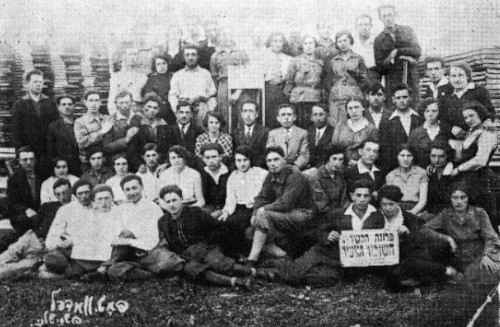
From the right, top row: Menashe Czop, Scheindel Wasser, Yehuda Kratz, Chaya Friedman,
Baruch Ecker, Tolci Kurcer, Golde Laszczower, Faki Floh, Hinda Lewit, Shimon Barij Second row: Moshe Lewit, Michael Schrage, and others |
Translator's footnotes:
by Batya Weinberg
Translated by Moshe Kutten
Edited by Barbara Beaton
Reb Nachman Kleiner, my maternal grandfather, passed away when I was very young, and therefore I do not remember many details about him. In contrast, my maternal grandmother, Yenta Kleiner, outlived him by many years and became renowned in our town for her righteousness and generous spirit. She was a devoted public activist who consistently prioritized the needs of the community, extending charity and kindness to everyone in need.
In her youth, Yenta Kleiner worked at the courthouse as a typist and was known in the town as “di Advokatin” [“the lawyer”]. In actuality, it was not just a nickname; Yenta served as a kind of legal advisor. Many small merchants and artisans were burdened by tax issues, administrative problems, and the like. Being well acquainted with the authorities, she would extend a helping hand to anyone, free of charge – whether by offering advice or by drafting petitions. Moreover, owing to her natural shrewdness, for which she became widely renowned, people brought any financial dispute before her, and she knew how to smooth over differences and restore peace between the parties.
Mrs. Yenta Kleiner devoted her time and bubbly and enterprising energy to the benefit of the town as a whole. She founded the essential public institutions in the town, such as “Bikur Cholim” and “Gemilut Chasadim,” whose purpose was to provide medical and financial assistance to all who needed it. She herself served as an example to others by visiting the homes of the poor to hear the troubles of their hearts, and she also instructed the members of the association on how to care for a poor patient until the doctor arrived and afterward as well.
Many good deeds, such as these and countless others, are credited to her and are preserved in the hearts of the town's survivors. They serve as a living monument to one who devoted herself faithfully to public needs – one of those upon whom the Jewish communities of the past were founded, communities that once were and are no more.
My parents, Yosef and Etil Kelner, lived in Radekhov, where they raised four sons and two daughters: Leib, Nachman, Moshe, Chana, Israel, and me – Batya. In 1930, they moved to Lvov, where they engaged in trade and earned an honorable living. Deeply rooted in their Jewish heritage and inspired by their ancestors, they provided their children with a strong Jewish education and instilled in us the importance of observing mitzvot and performing good deeds, and upholding the spirit of Israel through the generations. Life for Jews under hostile Polish rule
[Page 134]
was far from easy, but they lived their lives with hope for better days to come.
Five months before the outbreak of World War II, I made Aliyah to Eretz Israel by “illegal” means,[1] leaving behind my parents and their children, all of whom were young and still in school. I hoped I would be able to bring them to join me over time. Tragically, fate had other plans, and all were annihilated in the Holocaust at the defiled hands of the Nazis and their Ukrainian and Polish collaborators. I managed to receive a few letters from home and from Grandma Yenta, both expressing anxiety about the future as dark clouds gathered on the horizon. Despite their fears, they were at least comforted knowing that I had found a safe haven. My father, a devout follower of the Husiatyn Chassidim who encouraged Aliyah to Eretz Israel, wrote asking me to visit the Husiatyn Rebbe in Eretz Israel and to beg him to pray for mercy for all Jews, and especially for his own family, who were in great distress. But by then, their fate was already sealed. When the Lvov Ghetto was liquidated, my parents and their family moved to Radekhov, hoping to find shelter and refuge. Sadly, they were exterminated there along with all the Jews of the town. May God avenge their blood.
Being a member of the Mizrachi “HeChalutz,” I met my future husband at the Hachshara kibbutz [pioneering training camp], where we tied our fate and made Aliyah together through Aliyah Bet. It is worth noting that we were among the happy ones, reaching our destination in eight days without experiencing the hardships, upheavals, and dangers that were the lot of the immigrants who came after us. We landed on the shore of Kfar Avihayil, near Netanya, in an extraordinarily dramatic rescue operation, in the very midst of the days of Passover – it was like our private Exodus and personal crossing of the Red Sea.
Our journey of acclimation and naturalization in Israel progressed smoothly overall, though not without the initial challenges of absorption. Above all, we carried a lingering ache in our hearts for the precious souls who never had the chance to immigrate. Our greatest comfort – and our hope for the unbroken continuation of the family chain – are the two accomplished children we raised in this land: a son, a physician serving in the IDF, and a daughter, a software developer, both now married.
Translator's Footnote:
by Tzipora Grinberg-Ben Khur
Translated by Barbara Beaton
Edited by Moshe Kutten
My father, the late Yosef Grinberg, arrived in Radekhov from Russia in his youth and made his home here.
He was a scholar in the full sense of the word, a yeshiva student and a follower of the Rabbi of Belz. At the head of a group of students, he would complete a tractate in the Shas every year. He was also a progressive and educated man steeped in Western and Jewish culture and he was an ardent Zionist. Of course, he could not publicly express his opinions since the townspeople at that time were primarily ultra-Orthodox Chassids.
I remember when the happy news of the Balfour Declaration was published, my father found the courage to wear a blue and white ribbon around his chest and give a speech in the Great Synagogue on this subject. And indeed, as punishment for this act, he was removed from the Belzer shtiebel. I still remember winter evenings when my father would read from our classic literature: Bialik, Gordon, and others. The atmosphere at home also influenced the children. My eldest brother Hersh Leib Grinberg headed the Zionist branch in our town, and he was involved in distributing Zionist shekels, organizing arts evenings, shows, etc. I was also influenced and as a result I made aliyah to Israel. Sadly, I am the only one who was fortunate enough to do so.
My entire family perished at the hands of the German oppressors.
|
[Page 136]
by Miryam Menaker-Kaniuk
Translated by Moshe Kutten
Our town, Radekhov, near Lvov [Lviv] in eastern Galicia, was a typical, small Jewish shtetl. Most residents made their living through small businesses, trade, and frequent trips to fairs and markets. The closely clustered houses fostered a strong sense of community and belonging.
The Pelz family lived just a few meters away and were also relatives on my mother's side – her maiden name was Pelz. Until my Aliyah, we were very close, and I knew Ben-Zion well until he was 14 or 15 years old.
He attended a state-run Polish elementary school before traveling to Lvov to study at a trade school. The Pelz family had many children – four sons and one daughter – and needed a substantial income to make ends meet. The eldest daughter emigrated to the United States to support the family financially and, perhaps, to eventually help bring the other children over. With this in mind, Ben-Zion's parents prepared him for immigration as well. However, his aspirations differed; he joined a Hachshara camp [training program for pioneers], and from there his journey led him to Eretz Israel.
When Ben-Zion arrived in Petah Tikva, I eagerly sought news from home. True to his cool, reserved nature, he shared only a few brief updates about our old home.
His path in Israel and within the kibbutz is well known to the members of Kibbutz Usha.
by Yisrael Inbari
Translated by Moshe Kutten
This is how we remembered Benzion in those distant days: thoughtful and introspective, sparing with his words, and shouldering a burden – both within and beyond his strength.
We were a group of young men, aged 20 and younger, members of the youth movement “HaNoar HaTzioni” [“The Zionist Youth”], who were going through a Hachshara [pioneer training] on a farm in the village of Bystra in the Polish Silesia region.
Most of the group were studious youths from cities in Galicia, who had left their school desks behind to train themselves in physical labor, preparing for their Aliyah to Eretz Israel. There was little work on the farm itself due to limited acreage and scarce agricultural implements, so most found employment in the nearby town of Bielitz (or Bielsko, as it was known to the Poles).
It was not easy for the youths to find work – most of them were refined and literally “clean-handed.” Only through the efforts and intercession of the Zionist patrons in Bielsko did a few Jewish industrialists agree to employ the “young pioneers” in unskilled labor.
Of all the workplaces, the most difficult was the enamel factory, where operations ran around the clock in three daily shifts. Benzion, of blessed memory, volunteered for this demanding job.
I remember one evening when a few friends and I paid a surprise visit to the factory where Benzion was working the night shift. As we entered the factory gates and were led inside, we stood in stunned, open-mouthed amazement. Nearly 40 years have passed since that night, yet it feels as vivid as if it happened yesterday. I can still picture the terrifying blaze of the furnace devouring the pottery before it. I was amazed to see our friend Benzion, bent beside the kiln, his face illuminated by the fire, straining every muscle of his young body to meet the demanding quota imposed by the hostile, stern master craftsman.
It is important to note that in every plant where we worked, we were the only Jewish workers among a large group of Polish gentiles, who openly expressed their hostility towards us and seized every opportunity to pick on us. There is no doubt that Benzion endured the harsh treatment firsthand from the Polish supervisor assigned to him. Despite this, he persevered, enduring both the physical demands and the ongoing mental strain of the job. This persistence was a defining trait of his character.
[Page 138]
Benzion also stood apart from his friends in the Hachshara, in his spiritual pursuits: he read a great deal and immersed himself in study (in the Jewish sense of “iyyun” – intensive, analytical engagement with texts). I often wandered with the late Benzion amid the pastoral fields near the Carpathian foothills, beside the clear waters of the Bystra River discussing the profound concerns of humanity and the world – Eretz Israel, the longed-for homeland, and the enduring values of Judaism. He was one of the few in the group with a solid Jewish education. His speech and manner were distinct: never hot-tempered or argumentative, but instead thoughtful, hesitant, and often burdened by doubts. It felt as if the joys of childhood and the warmth of youth had eluded him, and he had matured before his time.
After decades of fleeting meetings in Israel, the same traits of his character and spirit reemerged – only more fully formed and deepened. Always thoughtful and inwardly withdrawn, always burdened and weary with cares, and always bound to a single task that allowed him no rest.
I recall one particular meeting that took place during a time of tension and fear – periods that were, unfortunately, not uncommon in Israel. On the eve of the Six-Day War, a nationwide conference of poultry farmers was held at the Exhibition Gardens in Tel Aviv. Unsurprisingly, only a handful attended, given the circumstances, yet Benzion was among them. When I asked, “Why did you come?” he replied in his usual laconic manner: “We need to continue living under all conditions.” This response was characteristic of Benzion's persistence.
He continued this way throughout his life, enduring all kinds of conditions – facing both mental and physical struggles, waging an inner battle invisible to others – until, at last, his heart gave out and his persistence ended…
by Ben-Tzion Pelz z”l
Translated by Moshe Kutten
| I will climb the ridges, ascend the hill,
With a hoe and pick-axe slung firm on my shoulders still. My feet will find their path through the forest's floor, No longer a stranger, I wander no more.
From the break of light until the stars are seen,
Upon the clearing, the wind will still sweep,
Across the rocky slopes the shadow too shall spread,
|
|
by Yehudit Grinberg née Schwarzenberg
Translated by Barbara Beaton
Edited by Moshe Kutten
My brother Yossi was born in Herzliya on the 4th of Adar, 5705 (February 17, 1945), to our parents Sara and Meir Schwarzenberg. His childhood was distinguished by his strong desire to help our parents, and his entire life was characterized by his boundless devotion and close bonds with his family.
In elementary school, Yossi was a quiet and disciplined youngster. He was often a participant in sports, including swimming and soccer, and yet found enough time to pursue another hobby, one which he chose as his profession: electronics. Upon completing his studies at elementary school, his attraction to this technical branch led him to enroll in the “Max Fein” vocational high school. Yossi graduated from this school with honors and then planned to study at the Technion for the next stage of his life. However, before that, he had to complete his military service.
As a graduate of a vocational high school, he was presented with various options for his military future. Yossi, who never shied away from difficult challenges, chose the most difficult and dangerous option of all: he volunteered for the paratroopers.
He served in the paratrooper unit as a communications technician, and when he was released from service, he worked tirelessly and saved every penny to finance his future studies at the Technion.
Tragically, Yossi was killed in the Six-Day War in the incursion into the Old City of Jerusalem. In his role as a communications technician, he was sent to repair a broken device. The street leading to the Rockefeller Museum was exposed to enemy fire, and bullets whistled, and shells exploded around him. Yet he did not flinch, and he leaped for the device to repair it. As he jumped, he was hit and fell while holding the repair tool in his hand. He was 22 years old when he died; may his memory be blessed.
by Getzel Kressel
Translated by Moshe Kutten
“May the Creator be blessed and praised, who endows man with knowledge, for He has granted us life, sustained us, and brought us to this moment – to complete the first decade of “Torah VaDa'at”[1] and to embark on the second decade of this sacred mission: to study and teach Torah, wisdom, understanding, and knowledge, and to quench every soul thirsty for the word of God, drawing from the pure and pristine sources that remain alive at their origins.” So spoke our friend and teacher, Reb Yaakov Dov Ra'anan, in the decennial issue of the weekly. He beautifully captured both the spirit of the journal and, incidentally, his own contribution, for each issue seemed to “reflect” the image of its editor – spreading Torah and knowledge to the public with grace and refinement.
There are endless facets to the Torah. Reb Dov Ra'anan chose his own path, selecting the finest treasures from our rich heritage accumulated through the generations down to the present time. And greater still was his achievement, as Reb E. Wilder described it: “He takes care to weave in current events and the realities of our days, teaching us how these treasures can also nourish and sustain those of the present generation, who have, for the most part, distanced themselves from these springs.”
This persistence of Reb Dov Ra'anan – a rare trait in our time – is remarkable. It is not that his love of Torah “drives” him; rather, it is the deep-rooted attachment he absorbed from his earliest days in the diaspora, which brought him here. And the wondrous thing is that the changes of time have not diminished this attachment in the least; on the contrary, it shines with even greater radiance, especially in these fateful days for our people in Eretz Israel and in the State of Israel.
May Reb Dov Ra'anan continue to swim in the vast sea of Torah and knowledge, and continue to “draw in” colleagues and partners in his endeavor. We, who partake week after week in the radiance of the weekly journal, bless him with long life and with the continuation of his work for many days and years to come. The spark that was kindled in Radekhov has here in our land become an everlasting light – fortunate are those who walk in its glow.
Translator's Footnote
by Eliezer Wilder
Translated by Moshe Kutten
Edited by Barbara Beaton
My days of acquaintance with Reb Yaakov Ra'anan, a native of Radekhov, editor and publisher of the weekly “Torah VaDa'at” [“Torah and Knowledge”], now in its twelfth year, have been brief and few. They number only the days during which we have been jointly engaged in preparing our book in memory of the holy communities upon which the axe fell in the time of the Holocaust. Even after we delved deeper into our shared work, I did not yet know the man sufficiently, nor was I aware of the full scope of his work. It is not in my nature to take a particular interest in a person's discourse and pursuits unless necessity compels me to do so. So then, one day, I was utterly surprised when I received a weekly journal titled “Torah VaDa'at,” edited by my colleague Yaakov Ra'anan and devoted to matters of the eternal life of the world. The contents are pleasing: they have both flavor and fragrance, and they are words well suited to its name, “Torah and Knowledge.”
And if today I include in our book the finest of the deeds of a man from our own area, Reb Yaakov Ra'anan, it is because something has been revealed to me that merits serious consideration. In the towns of our region, individuals of blessed talent and deeds were born and raised, and we have recorded their names and achievements in this book. And now I see before us Reb Yaakov Ra'anan as well – one of our own, from Radekhov – who harnessed himself under the yoke of Torah, studied Gemara and Poskin in the beit midrash together with others, and then withdrew to join the [youth movement of] “Bnei Akiva” and [the settlement movement of] “HaPoel HaMizrachi.” He immigrated to Eretz Israel, setting his sights neither on continuing in the yeshiva nor on clerical work, but rather on arduous pioneering labor. He tasted the bitterness of unemployment and, no doubt, also the lack of bread in those days, yet he fulfilled national pioneering roles with faith and devotion. And now he stands before us without academic or rabbinic titles; nevertheless, his teachings are well ordered and firmly in place, and his work, ”Torah VaDa'at,” lies before us. He publishes and disseminates his weekly journal, week after week, devoted to the weekly Torah portion and to verses of Scripture as interpreted by our Rishonim and Acharonim [early and later sages]. He presents us with precious gems and strings them into a single necklace so as to enlighten the many, adding his own insights on contemporary questions and matters of the day – seeking parallels, moral lessons, and practical conclusions for our present circumstances: issues of what is permitted and forbidden, of ethics and the moral purity that a Jew is called upon to uphold, and the like. And if that were not enough, there are also the sections, “Paths of Language” and “Torah Tidbits” – rabbinic witticisms and light remarks of Torah scholars that merit study.
[Page 142]
It is therefore no surprise that the following statement appeared in the weekly journal of the Hebrew Federation of America, “HaDoar” [“The Post”]: "The content of this weekly magazine (“Torah VaDa'at”) is both instructive and heartwarming, etc.
Avraham Moshe Naphtali, the renowned Talmud commentator and author of “The Talmud and its Creators,” wrote to Yaakov Ra'anan: “I was most pleased to receive the pages of your important weekly. I studied them with seriousness and great enjoyment. Well done – everything is arranged in fine order and with good taste.” Rabbi Moshe-Zvi Neria wrote to Yaakov Ra'anan: “Thank you for sending me the fine 'pages' of your weekly anthology. This selection is truly a blessing, crafted with discernment and good taste.”
And who am I to add: “I bless Yaakov that he may continue to enrich others with Torah vada'at, for the benefit of many, as is his way – without seeking reward. He does not earn his livelihood from this work; he does it without outside assistance and he is tireless. May his strength be affirmed, and may his vigor increase.
|
|
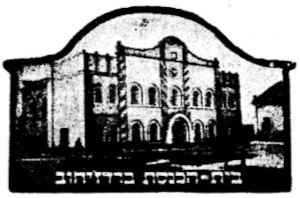
| Words in the graphic: Synagogue in Radekhov |
|
JewishGen, Inc. makes no representations regarding the accuracy of
the translation. The reader may wish to refer to the original material
for verification.
JewishGen is not responsible for inaccuracies or omissions in the original work and cannot rewrite or edit the text to correct inaccuracies and/or omissions.
Our mission is to produce a translation of the original work and we cannot verify the accuracy of statements or alter facts cited.
 Radekhiv, Ukraine
 Yizkor Book Project
 JewishGen Home Page
Copyright © 1999-2026 by JewishGen, Inc.
Updated 27 Feb 2026 by LA