 |
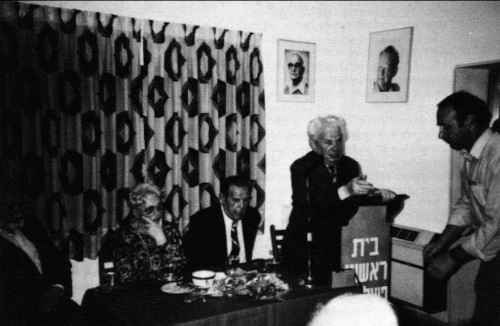
and his book at the “Peretz Publishing House.”
Participating were: Moshe Belinki, Avraham Lis, Shlomo Schweitzer, Maya (Miriam) Rozen
Standing to the right is Feyvel–Berl Rozen's son
|
by Meir Veinberg
Translated by Theodore Steinberg
On August 12, 1987, we gathered at the cemetery in Czernowitz to mark the first yahrzeit of our important member Berl Royzen, who was the victim of an automobile accident in Kishinev.
We always read with great interest his articles in the Polish newspaper “Voice of the People” about Jewish themes in Russian classics and artists. He also often paid attention to Jewish writers. We remember his articles about Eliezer Shtaynbarg as well as his visits to the writer's grave when we would assemble to mark his yahrzeit with a memorial service. With warm words Berl would speak about our talented Czernowitz actress Sarah'le Birkental, known under her pseudonym Sidi Tal.
Not long before his death, he wrote his last work about the writer Isaac Babel, who too early in his productive years disappeared without a trace in the era of the Stalin cult. Royzen did not merit seeing it in printed form.
His articles and translations in the journal “Soviet Homeland” always stood out with their rich language.
Berl Royzen was a highly educated man who could be compared to scholars and wise men. He had a wonderful knowledge of world literature. He was adept at Talmud, an investigator in Rambam's “Guide for the Perplexed,” and in addition knew Marxism-Leninism and world literature. Altogether a man with broad general knowledge of the fruitful garden of cultures.
by Meir Kharatz
Translated by Theodore Steinberg
August 12, 1986, when in Eretz Yisroel is observed the 34th yahrzeit of the murdered Yiddish writers in Russia and the widows of the murdered Duvid Hoffshteyn and Peretz Markish–Feyge and Esther, who came to Tel Aviv from Jerusalem with their children and grandchildren to the “Garden of 5712 [1952]” to the symbolic gravestone of the murdered, whose actual graves are unknown–on that very same day in Kishinev was killed, in an automobile accident, Berl Royzen, newly arrived from Czernowitz, a “praiseworthy worker in the field of Yiddish literary research and in translations into Yiddish from other languages,” as he was described in Moscow's “Soviet Homeland.”
It could be a coincidence that he was killed, except that those who knew the knotty, realistic, careful Berl Royzen see his death in an automobile accident in Kishinev, a city with wide streets and even lanes, as mysterious, especially since such cases with automobiles are well known.
Berl Royzen was born in 1913 in the family of a shochet in the Bessarabian Jewish shtetl of Ataki. He was young when he came to Czernowitz. Some years before 1940 he became a Hebrew teacher in private lessons–and in Yiddish literature and language he was a beloved leftist intellectual. In the 1940-1941 school year he worked in one of the Jewish schools in Soviet Czernowitz. In the war years he was at the front, “and there (he once told me) when I wanted to read a Yiddish book, I combined in my memory the poems of Moyshe-Leib, Manger, H. Leivick, the fables of Eliezer Shtaynbarg, and everything that I could remember, and I read them.” After the war he was again a teacher in a Jewish school, in the last Jewish school, number 18, in Czernowitz. He worked until it closed and sometimes taught at Czernowitz University in the department of foreign languages, specializing in English. He became one of the best English teachers in the city. His work was so good that after a certain time he was accused of planting a love for the English language in his Soviet students. Such a sin! He laughed at that, but what did he experience from that? And here is Royzen's bibliography according to “Soviet Homeland”: “In 1936, Berl made his debut with a study of Yiddish language issues in the Warsaw journal ‘Yiddish for Everyone.’ He was the author of a group of literary research studies on the works of L. Tolstoy, A. Chekhov, V. Korolenko, M. Gorky, and articles about Sholem Aleichem, E. Shtaynbarg, Ber Halpern, and others.” Permit me to add some details to this list
[Page 291]
that will illuminate the character of Royzen's work:
About Jewish themes in the works of S. Pushkin (Voices of the People, Warsaw).
“The Power of the Fable,” a poem marking 100 years since the birth of Eliezer Shtaynbarg (“Yiddish Culture,” New York, March-April, 1980, number 2). This poem was also translated into Hebrew by Mordechai Sabar and published in “Moznayim.”
“Eliezer Shtaynbarg in the Mirror of his Time and his Milieu,” written with Yosef Burg (“Voice of the People,” Warsaw).
“Maxim Gorky on Bialik's Poetry” (“Voice of the People,” Warsaw), and others.
|
|
and his book at the “Peretz Publishing House.” Participating were: Moshe Belinki, Avraham Lis, Shlomo Schweitzer, Maya (Miriam) Rozen Standing to the right is Feyvel–Berl Rozen's son |
Original footnote:
Yehoshua Gurevitsh / A Biographical Sketch[a]
by the Publisher
Translated by Theodore Steinberg
The author of the following collection of stories, Yehoshua Gurevitsh from Ramat Eliyahu, Rishon, Israel, was born in Ataki, a well-known and picturesque Bessarabian shtetl. In his early childhood, his father understandably sent him to cheder to study Chumash and Rashi; but his tastes drew him to music… Luckily, his father, Tzalik Gurevitsh, who, thanks to his learning was called “Russian Gurevitsh,” was a maskil. He was skilled in Russian literature and even read Byron in English, so he understood his son, bought him a violin, and agreed to the idea that his son would grow to be a musician (which at that time was probably not seen as a good thing).
At fifteen, Yehoshua Gurevitsh went to Odesa to study music; some years later, young Gurevitsh – at the request of the well-known theater director Ziegler – wrote an operetta, “Shmuelik,” in which a leading role was sung by the well-known artist Sevilla Foster. In 1928, Gurevitsh settled in Bucharest and was active in various musical ventures: he wrote songs, composed music for Yiddish theater, directed a well-known military orchestra that played in the government palace in honor of guests at official opportunities, adapted folkloristic themes, wrote music for theatrical pieces (like, for example, for “The Shoemaker's Daughter” by Emiuk Ellenbogen with Tzilia Podelsky in the leading role) and so on. When he was sent to forced labor under the fascist regime, Gurevitsh wrote his big hit, “The Orphan,” which had an echo of consolation and gave strength to the Jewish masses in their need…
But Gurevitsh was also a writer: at that time he worked with the Zionist weekly “Renashterra” [“Reborn”]. His sketches of Jewish life were very highly regarded.
Arriving in Israel in 1964, already in his later years, he continued his musical activities in Yiddish theater: his music for the piece “With Open Eyes” (sung by Ina Toffer, Lea Shlanger), his numbers in “Chicana at Night” (sung by Savitch Goldreich and Lola Yakabovitch) drew attention, It is therefore understandable that Israeli recording companies were interested in his works. “Had Artzi,” for example, released his songs sung by Marika Vine; “Mekolit” released a record of songs sung by Lea Bloch and Ina Toffer. Gur also composed melodies for works by Jewish poets such as Itzik Manger and others.
Gurevitsh created using words, sounds, and… colors. The Histadrut in Rishon LeTzion, where he lived, organized an exhibition of over thirty of his paintings in oil and gouache (March, 1970); finally, he participated with six fine paintings in a collective exhibition in the Histadrut Culture Hall in Rishon LeTzion.
With the publication of this first collection of typical shtetl stories, he clearly reveals the many-sidedness of his creations as musician, painter, and writer, and all in the authentic voice of the Jewish people.
Original footnote
by Yehoshyua Gurevitsh
Translated by Theodore Steinberg
It was a hot summer day. The streets of the shtetl Ataki were empty. The fair had ended and the Gentiles had left, so why should people sit in their shops and roast? People shut their businesses and went home to rest, to catch a nap after eating. They wouldn't open the stores, not for anyone. Everyone had sold what they had to at the fair, and there would be no more customers except at Meir's little shop, where he sold bread, herring, vinegar, and other such things; and Moyshe Zvidiniak kept his tavern open, because someone might buy bread, or a Gentile would come for a whiskey, and if he weren't open, they might break down the door.
It was quiet outside. Not a leaf stirred. The Tammuz sun burned like fire. Its beams danced on the rooftops, jumped on the walls, and tried to enter the windows of the houses, stymied by the shutters; they rolled over the ground and took out their anger on the grass, the flowers, the thorns, drawing from them the last drops of moisture that remained from the previous night's dampness.
The tree stood in the shul courtyard. Although it seemed to be an old oak tree, a victim of the elements, no storm or blizzard could break it. It stood there, poor thing, worn out, its bark dried up, peeling, and its thin branches with sparse, withered leaves looked like the willow branches that had been beaten on Hoshana Rabba.
The sun blazed…Out on the street was “Shmendrik with the bells.” This was Hersh Starasta's dog. People called him “Shmendrik with the bells” because burrs always hung from his fur. His tongue hung a mile out of his mouth and went from side to side; he squinted his eyes from the light, scratched his belly with his back leg, and looked around to see what was going on. Seeing nothing new, he yawned and ran off.
[Page 295]
Near a stone, by a little pile of sand, ants have made a camp and do their daily chores: they run around, they scurry, they hurry! One has grabbed a piece of straw twenty times bigger than itself. He carries his heavy load to a little pile of mud and struggles with all his strength to get his treasure into the hole…
Suddenly there's a breeze that raises dust from the ground. It turns in the wind and – gone. In the blue sky a dark cloud appears. It moves quickly, quickly, and after it come some small, scattered clouds. The sun disappears. The air trembles. The branches shake. There's lightning, then thunder, then more lightning and more thunder and it's dark and the rain starts – a deluge!
The water comes up to Duvidl the shochet's coal bin and washes the blood and feathers and carries them off to the narrow street. There the water meets with the raging stream, in which float pieces of debris, rags, eggshells, filth – it gets near the shore and slap! – the whole mess goes into the Dniester!
On the square, the rain has soaked the horse hair that remained from the fair and scattered it on all sides. That was not a bad thing; when it is nice outside, the homeowners will come out, collect the horse hair, and mix it with lime to plaster their ovens.
The downpour didn't last long. Soon the rain stopped. In the sky there was a bright red streak going down to the ground. The sun began to shine again. It was bright – a joy for the soul! The air is fresh, cool, and from the now upright grass hang clear drops. They mix with the zooming streams that flow cheerfully over the cleanly washed rocks…
The street has awakened. It's beginning to be noisy, to buzz. The first to come running out from Chaya's yard is a gander with a heartfelt cry, followed by the geese and the ducks, running to the holes that have filled with rainwater, jumping in, rinsing their heads, and swimming back and forth with great pride.
People come out of their homes with brooms and shovels to clean the mud from their thresholds and to clear their porches of water.
[Page 296]
Today he has prepared no kvas, only “ice cream!” which he has kept until now in a cool place so it will be well frozen. In one hand he holds a small covered dish, and in the other a spoon with he portions out the ice cream and offers a taste “for a trial.” He calls out his wares in three languages: Yiddish, Romanian, and Russian: “Jews! Make your heart happy and cool your throat!”
From Tzigeyner Street comes Sosolia the fruit woman with a bowl of stewed apples. Summer and winter Sosolia wears undergarments and a wool shawl with which she covers the bowl and the apples. When she sells some, she reaches under the shawl, pulls out an apple, and immediately covers the bowl so that no one can steal an apple “from under her hands.”
Next is heard a song in a kind of squeaky voice. Here comes “Vasilitsheche,” an old Gentile woman who works for Jews. She had already had a drink and was pretty happy. Vasilitsheche, when she was young, was a mother and she nursed many Jewish children whose mothers lacked milk. There were now in the shtetl Jews with beards whom she had suckled. At every Jewish wedding Vasilitsheche acted like an in-law. People honored her, and after she had a glass of whiskey she would go over to the band and dance every dance until early into the morning. At Jewish funerals she would go out, beat on her head with her hands, and cry and wail out loud with bitter tears. If a child provoked her in the streets, she would not speak to his parents but would go right to the cheder and complain to the rabbi…
“Fish, fresh fish! Buy fish for Shabbos.” So comes Yossel the Assistant with his basket of fish. Yossel teaches little children, but in the early morning he sells fish. He was once an assistant, and although he now has a cheder with students and he has a beard, he is still known as “Yossel the Assistant.”
The first to buy fish from him is Shaya Ikivate, “the Eater.” So he is called in the shtetl, because he loves to boast about his eating. He lifts into the air the fish he has bought, several kilos worth, and says to everyone,
“You s-s-see this c-c-carp? Tomorrow y-y-you can make k-k-kiddush over him.”
Shaya Ikivate was actually an attorney, wrote legal petitions, hustled around in the district for the judge, and in trials would not allow his clients to say a word. He “spoke” for them.
It happened that the thug Yokel “the Bantam” had fought with other thugs and had
[Page 297]
knocked out one's tooth. He was taken to court. When it came to the trial, Yokel “the Bantam” chose as his representative the advocate Shaya Ikivate. At the trial, Shaya maintained that he had lost patience, banged on the table with his fist, and cried out, “What kind of nuisance is this? I'll go crazy! Enough!” And he wiped out the whole trial…Yokel “the Bantam” danced for joy and told everyone, “Now that's a lawyer! He didn't finish a word, but everyone knew what he meant!”
On the square, things turned happier.
Young men and women went out walking. People laughed and told jokes and flirted. The young people were divided into two classes: the intellectuals and the common people. The intellectuals consisted of students from the gymnasium and a student from college, the wealthy Mottl Vasilkovsky's son – Liosia. “The commoners” are clerks, watchmakers, technicians, shopkeepers, but not “learned.” The intellectuals speak Romanian or Russian (the older ones) among themselves and won't be seen on the street with a “commoner.”
Suddenly there's a squeal from a speaker, the snap of a whip, and an exasperated voice: “Giddy-up, horse!” And there, coming from the train station, is Leyzer the wagoneer with his “chariot.” Although he's a wagoneer, he lives on the square among the important homeowners and makes a fuss over the intellectuals. He gives a turn to his chariot and there he is among the strolling “intellectuals,” and he yells:
“Hey, stuck up students. You don't speak Yiddish? The devilo – your mother-in-law's old grandmother's husband on the bride's side, giddy-up. Be quiet or you'll get the whip from Leyzer the wagoneer and feel it for a while…”
The evening moves on. The sun has set and the blue sky has darkened. The air smells of greenness, of wormwood and corn mush. People are making dinner in their homes. The last streams flow from the ground and over the thick, sticky mud.
The homeowners gather in small groups to discuss “a little politics.” Here comes Duvid Shprintz. He's a Jew with “style,” always dressed up, brushed off, boots shining. Duvid Shprintz is an arbitrator, a bit of a philosopher. When someone talks to him, he listens
[Page 298]
to the end, doesn't interrupt, and doesn't respond at first. He shakes his head and mumbles, “Nu, what else”…and he moves on…
Entering the conversation is the “country matchmaker,” Mottl Kalrich. He makes major matches, corresponds with Buenos Aires, Amsterdam, Paris, hold “brilliant parties,” gets rich husbands for girls, and himself does not look like a matchmaker but more like a groom who should soon be under the chuppah. His little beard is rounded, he wears a little fedora with a colored tie, a pressed suit, and holds a walking stick. The women, when they meet him, lower their eyes and blush. He himself says nothing flirtatious and is an expert in women's matters.
And now joining the conversation is Charny Sofer, a dominating woman. She wears a “mannish” hat. She's tall and thin, with a twisted face and a protruding lower lip. That lip, people say, she uses to drink tea “as a snack.” She takes a piece of sugar, bites it, puts it in a hidden spot in that lip so that she can drink ten glasses of tea while the piece of sugar remains intact…Charny Sofer reads, understands politics, and is knowledgeable about historical events. She goes between two men, whom she calls by the familiar “du,” and she doesn't speak like a woman.
“Oy, Yankl, you're a jerk! You speak of humanitarianism! A Pole should be a humanitarian? When Kosciuszko wanted to show the Poles that the Jews served faithfully even in France in 1789 in the National Guard, did he succeed? If Napoleon Bonaparte created a Warsaw dukedom under the Saxon king Frederick Augustus III, were the Jews better off in Poland?…”
Yossele Feigis had a little shop for yeast. He was a Chassid, a fine person – and very poor. He was happy with whatever he had. He needed no more. But he was dismayed when the local Jews did not uphold all the mitzvos, when they acted like heretics, and delayed the coming of the Messiah.
One day he went around screaming in the whole shtetl. He went through the streets wringing his hands. His face was pale and he could barely speak:'
[Page 299]
“Jews, a misfortune. Woe is me! A great misfortune!…”
People came running out their houses, frightened.
“What is it, Reb Yosssele? What happened?”
“A misfortune. Gevald! Such sorrows!!!…”
“What is it? A fire? Someone died?”
“Worse!…That pig Yasop Mozila got drunk and immersed himself in the women's mikveh! Gevald!!! Don't let the women purify themselves in the mikveh. That would bring, God forbid, an evil decree on the shtetl!…”
When Yossele Feigis comes to the conversation, Chaim-Aharon, the jokester, tries to look religious and says, “Oy, Reb Yossele, how long will we be in Exile? When will we have our own piece of land?”
Yossele Feigis gives him a solemn look:
“You want God to give you a country? Heretic! Ignoramus! Did you say motzi today? Did you look in a holy book? Did you say a Psalm? And you want Eretz Yisroel? A fig!”
“What, Reb Yossele, in Eretz Yisroel will we have to be religious?”
“What a question. Every Jew will be religious there!”
Chaim-Aharon looks confused:
“Vey iz mir, Reb Yossele! If all Jews will be righteous there, how can an actor be righteous when he plays the role of a lover, when he embraces a woman on the stage in front of everyone and gives her a kiss? Can he do that?
“He certainly must not do so!”
“Then there can be no theaters in Eretz Yisroel!”
“And without comedy will you die, you pig? Listen, Jews, to what bothers him, that he won't have comedy in Eretz Yisroel. Scoundrels, why are you standing here?” Yossele Feigis turns to the rest of the crowd. “Let's go say the evening prayers!…”
|
JewishGen, Inc. makes no representations regarding the accuracy of
the translation. The reader may wish to refer to the original material
for verification.
JewishGen is not responsible for inaccuracies or omissions in the original work and cannot rewrite or edit the text to correct inaccuracies and/or omissions.
Our mission is to produce a translation of the original work and we cannot verify the accuracy of statements or alter facts cited.
 Otaci, Moldova
 Yizkor Book Project
 JewishGen Home Page
Copyright © 1999-2026 by JewishGen, Inc.
Updated 08 Jul 2026 by JH