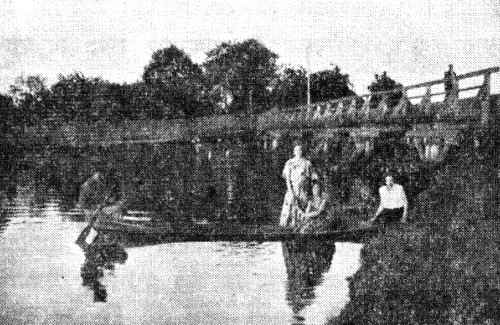
 |
|
|
[Column 69]
by Chaim A. Michaeli
Translated by Jerrold Landau
The preparation for the open uprising in Lakhva was not in the realm of final desperation.
From realizing what was coming sooner or later, the idea of an uprising was accompanied by a basic, underlying plan. Even the harsh and dangerous conditions of the underground did not for a moment prevent the careful weighing of every low–probability possibility that could be discerned, to intensify the tension of the battle when the hour of annihilation arrived.
The idea of an open uprising was hatched in the heart of Yitzchak Rochczyn. His eyes tirelessly followed the chain of atrocities. In his soul he joined detail to detail, and came to the conclusion alone that the continuous and deliberate weakening of the tormented Jews was leading unfailingly to the valley of slaughter. So long as he had not yet set the day's grim sight before his eyes, he revealed to no one what lay in his heart.
Yitzchak, who was the first one to think of the idea of an uprising, saw from the outset what was awaiting, with a very cruel perspective, without ever letting himself be taken in by the delusions that were shared by the majority of the ghetto population.
He considered and meticulously joined together the “small” and great atrocities that were perpetrated on his people, and saw the intentions of the enemy with wondrous clarity.
He saw the darkest of visions, as one who bore the community's great hope – a hope awaited in fear and trembling by the masses of Jews bereft of recourse.
When he concluded the structure of his cruel deductions to the end, he began to search for a cadre of faithful assistance to contribute to the yoke of action, in advance preparations at the twilight of the lives of the Jews of Lakhva – to ignite the fire of revolt and heroism.
His revolutionary plans fused with his strong will:
The clandestine cell that consolidated after that under the command of Yitzchak Rochczyn included a restricted number of active members.
Each new member was examined sevenfold until it was decided to take them into the clandestine organization. All of them as one were unflinching in spirit and soul, with a deep national understanding of the sacred purpose of their mission.
After a day of backbreaking work, accompanied by abuse of body and soul, the cell would enter one of the dark cellars in the ghetto, to the light of a flickering candle, and plan the methodologies of the mass uprising when the bitter, impetuous day would arrive.
The vital tasks for the organization were:
Even that was not a deterrent for continuing the precise planning of the uprising. Making use of the few crude tools available, including out-of-date work tools, was also a very serious problem in the ghetto that had been emptied of everything.
The plans for the revolt were, therefore, adapted to the limited possibilities that were available to the organization. In the absence of
[Column 71]
redeeming weapons, they concentrated primarily on raising the morale of the fighters.
In the preparation for action, they also took into account the prevention of letting property fall into the hands of the local hooligans. For that purpose, a few members of the organization were given the task of setting the ghetto houses on fire from several directions – an action that one could see from the outset would increase the panic in the ranks of the executioners, and would render useless “organized action” as they were used to.
Much thought was given to the element of surprise; the creation of “organized panic” that would serve as the first deterrent to the band of murderers who were carrying out the annihilation aktion.
The aim was “to keep them busy” – even for a brief time – in calming the spirits while the attack force of the organization would take advantage of the fortuitous time to break through one of the killing places to enable a mass escape of the inmates.
On the other hand, internal consultations and discussions specified an alternative course of action, should it prove impossible to implement the main plan: to provoke a fracas, to initiate a provocation, and to enter into “local skirmishes” with the murderers at pre-designated points along the barbed wire fences surrounding the ghetto.
In the general disarray that would arise in the enemy camp, there would be an organized storming of the masses upon the gates of the ghetto, and an escape to the marshes of the Pripyat.
The primary aim of the underground organization was to prevent the hauling of the Jews of Lakhva to be slaughtered like sheep, and to pave a path for escape for the ghetto inmates through battle with the murderous enemy.
Every member of the underground organization knew that the fate of the lives of hundreds of ghetto inmates depended on their strong behavior during the decisive confrontation with the gang of murderers, and it is nothing other than voluntary sacrifice so that others who come after can live.
The terrible straits that grew more severe from day to day as the time of annihilation drew near, and the incessant tortures by the German murderers and their drunken assistants from among the local gentiles, made the idea of an organized uprising into a decision that permitted no second thoughts. Yitzchak Rochczyn gave this a clear ideological basis: “The death of heroes, face to face in battle with the murderers, would scour away the terrible degradation in which we had wallowed during that life–that–was–no–life. In this way our national
[Column 72]
human pride will find expression, for its proud strength will not have been broken. On the contrary: in the crucible of those inhuman torments, we forged ourselves sevenfold.”
Today, from the perspective of fourteen years, it is possible to state with complete certainty that the Jewish uprising in Lakhva did not receive any support from even one of the partisan bodies that operated in the area. Despite this, the uprising could have become a mighty, sweeping operation for the rescue of the Jews of Lakhva – and even beyond it.
|
|
To our dismay, no help came (not even symbolic moral support) to the revolutionaries from the outside. The partisan groups in the surrounding area were not directly moved by the terrible tragedy of the Jews imprisoned in the ghetto. The dramatic events in the starved, despair ridden ghetto were seen merely as another “episode” in the chain of barbarities committed by the German murderers; a local tragedy that was insufficient to influence or determine things in a small or large amount within the partisan organization, whose operations were conditioned by the immediate needs of the active fighting front to whose command it was subordinate.
There is certainly no reason to reawaken the fateful question, “What would the fate of the Jewish uprising in Lakhva have been had active help come from one of the partisan brigades that were camped in the nearby area during the critical moments of the final battle?!”
It was easy for the partisan commanders to soothe their troubled conscience, in order to preserve their good name during that period. However, they do not have the power to obscure the tragic truth that, by refusing to offer assistance to the fighters lacking in arms, they indirectly had a role in reducing the number of survivors from the fighting ghetto, caught up in flames and blood.
Even the “good ones” from among the gentiles were not shaken by the terror of the tragedy. Myriads of gentiles, pious on the outside yet hypocritical, waited
[Column 73]
with Satanic eagerness for the day of our final annihilation so that they could inherit the money of the unfortunates.
Like beasts of prey, they hovered on all sides of the burning ghetto, youths and elderly, to pillage the loot, and to ensure their share in the booty after the mass murder.
Those who stood at the helm of the local council saw from the outset the problems of collaboration between the two partners in the aim of annihilating us from the land of the living.
The handful of fighters stood in a battle that stretched along two lines of the front, with forces coming from two opposite directions and striking like waves – separate in theory, yet coordinated in practice – in carrying out the terrible crime of our annihilation.
The primary wave consisted of the units of executioners of the S.S. army, well armed with weapons of annihilation; and the second wave, a hundredfold worse, the gentiles of the place and the area, who were mobilized to offer their help to the German “masters” in carrying out the mass slaughter of the ghetto inmates.
The recognition of the grim reality, confirming it as the true state of affairs, cast fearful weight upon the tendencies of the combat planning, and within them it prevented any further hesitation in the final battle with the enemy.
The commander of the uprising, Yitzchak, fell as the first victim in the killing field. However, not only did his death, the death of a hero, not arouse any disarray in the ranks of the fighters; rather the spirit of battle increased sevenfold.
The aim was achieved. Complete panic was aroused within the two flanks of the enemy. The gates of the ghetto were broken open in the storm of the battle, and the inmates began to escape for their lives to the marshes of the Pripyat.
By the time the executioners had recovered from the force of the blow, the vast majority of the ghetto inmates had already moved on routes that were not real routes with the anchor of salvation that appeared in their imaginations.
However, then something worse than anything took place. The success of the escape from the burning ghetto did not yet assure the chances of surviving.
Hundreds of frustrated gentiles from whom the opportunity to satisfy their cravings
[Column 74]
with deeds of pillage and cruelty had been thwarted because of the sudden resistance from the brave fighters pursued the weakened people, sealed off the routes of escape, and murdered them in cold blood.
That which the Satan himself did not do was done by his faithful emissaries…
From among the hundreds who had succeeded in breaking through the region of death, approximately six hundred people gathered in the marshes of the Pripyat. However, most of them as well were hunted down with the cunning acts and wickedness of the local thieves, and met their tragic deaths before they succeeded in reaching “secure” places or being accepted into the partisan brigades.
The revolt of the Jews of Lakhva, in its ideological essence and in its brilliant combat execution, went beyond the bounds of being merely a local phenomenon. From the scale of the battle and from the lofty acts of valor revealed by the members of the organization in their war against the enemy – there emerged a path for the tormented survivors through the death traps of the murderous foe. In this glorious uprising, there was a form of historical lesson that changed the foundations of the paths of the spirit within the ranks of the survivors who were persecuted up to their necks, and a form of strong warning to the enemy in the face of the surges of hatred and revenge that would, sooner or later, shake up their steps and drown them in their impure blood.
Might and self-sacrifice are not material that can be weighed on a scale. Their value is embedded in the coins of the future, over which time and its changes have no rule.
Yitzchak Rochczyn, the brothers Asher and Moshe Leib Cheifetz, Dov Lopatin, and many, many others have united with eternity through their heroic deeds.
Their deaths reignited the flame of life in the hearts of the desperate ones. In the light of their personal, wonderful example, brothers in arms went to battle with songs on their lips, broke through the ranks of the enemy with the fire of revenge, and actualized with their bodies and souls the last command of the martyrs, “Revenge”!
Yitgadal Veyitkadash [magnified and sanctified] shall be the names of the heroes of the uprising, and may their memories endure forever in the memory of the nation.
[Column 75]
by Yehoshua Lichtstein
Translated by Jerrold Landau
The account of the uprising in the Lakhva ghetto was written in full detail in this book. We need to emphasize the military factors of this battle, which were: the military power of the Nazis, its strategic errors, its military advantages, and the aims of the ghetto fighters.
The annihilation of Jewish settlements by the Nazis throughout the occupied areas and the rampaging in the ghettos without actual opposition became usual for the murderers, with nothing to disturb them. During the period of the autumn of 1942, European Jewry was stricken with shock, and it was before there was an uprising in any place. In Lakhva, we also preceded the Warsaw Ghetto uprising and the revolts in other cities where Jews rebelled and did not go like sheep to the slaughter.
Therefore, there was no basis for the Nazis to use strong force and security measures when they came to liquidate us. It seems that they felt that the Jews of Lakhva had not yet lost heart, and that something might erupt here; or they simply followed their usual tradition and prepared as though for a battle against an actual military force. The Nazi assault force in Lakhva included about one hundred men of the S.D. (the S.S. military police), the Wehrmacht garrison force, soldiers of the Todt – a guard corps stationed at the railway station, the Gebietskomissar of Pinsk and those who guarded him, as well as hundreds of White Russian and Ukrainian police who arrived from far away and near police stations within about a hundred-kilometer range of Lakhva. The Nazi forces were armed with the best Nazi technology, and numbered more than five hundred people. In addition, there were the local riffraff, bloodthirsty and coveting booty. Everything was prepared for the liquidation aktion of the defenceless and helpless group of Jews.
I saw them as they were taking their positions in the full military sense of the term. Three heavy machine guns were stationed across the river, at the border of the ghetto. One was next to Simcha Zeltzer's house on Szkolna Street in the ghetto. The second was next to the “Rodkins”. The third was next to the home of Yisrael Lichtsein, which faced Rinkowa street, where most of the residents of the ghetto
[Column 76]
were concentrated, as well as all the youth. That is where the uprising took place. Light Spandau machine guns were stationed around the ghetto gates. For the most part, the Germans and police were armed with automatic weapons. The command center was in the house of Shlomo Zalman Moravchik – the Wehrmacht house – where the Gebietskomissar of Pinsk stood in the yard and oversaw the aktion.
After the masses retreated from breaking through the fence near the dairy business on Malinowa Street, the S.D. soldiers entered the ghetto and attempted to arrange its residents in rows to march them off to slaughter. The uprising was no longer a surprise for the murderers. The tongues of flames that were bursting forth from the ghetto houses, and the attack by our lads upon the Germans in the area, found the Nazis in a state of preparedness. A rain of shots from every type of weapon of destruction rained upon the ghetto from all sides. The machine guns operated incessantly along the road and hit the masses, without considering the fact that there were Germans among us. After the first shots of our lads from the weapons that were seized from the Germans in the ghetto, they began to retreat in confusion from the ghetto to the other side of the market, or find a defensive stand in the corners of the houses. From the house of Zelig Dolgopiti, which was set on fire after burning the house of Zalman Cheifetz, smoke rose and covered the entire street forming a screen for the machine-gun shooters across the river.
We did not have an operations command. Everyone acted through their own decisions. We did not have the aim of fighting a defensive or offensive war against the Nazis. Our one and only aim was to avoid going like sheep to slaughter, to destroy and break through the fences and ghetto gates, to go outside the area of reach of the bullets of the murderers, or to fall like heroes. In an instinctive manner, we searched for shelter in the houses before they were overtaken by fire, and we advanced into the yards between the houses; from the house of Shlomo Moravchik to the house of Shalom Romanovski, and from there to the house of Shlomo Mordechai Moravchik, through the windows and doors of the rooms. Hundreds of us advanced to the gate that had been breached
[Column 77]
in the interim. We passed through it until the market, and then outside of the town.
The Nazis were surprised and perplexed without any basis, given their superior power. The flames of fire that overtook the houses outside the ghetto area due to the destructive actions of our lads, drove them into confusion, and they shot without pause and without aim.
As has been noted, the breakout was in the direction of the market, the place where the Nazis were at least anticipating such a possibility. Reinforcements reached them, and they organized along the length of the houses of Yitzchak and Aryeh Cheifetz, Yaakov Rabinowitz, and Aba Sogenski on one side, and Yaakov Levin, inside the house of Aharon Moravchik, and Yehuda Moravchik from the second side. Hundreds of escapees literally passed before their eyes in the directions of Kozangorodok and Davydgorodok streets. They shot while standing and many victims fell. Young lads, children and youth
[Column 78]
between the ages of five and twenty were the majority of those who succeeded in getting away by running and escaping. It is difficult to determine the number of Jews who succeeded in exiting the ghetto. We can estimate that they numbered between six hundred and seven hundred men, women, and children. The rest fell as heroes. They did not go to the mass graves.
In summing up the battleground, we held the upper hand in that battle. We overcame the enemy through the strength of spirit and military abilities of our youth, to whom fighting methodology was not a foreign thing. At every opportunity, they had learned to use weapons: when they served in the Polish Army (POW) in Lakhva, in the Zionist youth movements, and in Beitar. Indeed, most of them fell as they were resisting the Nazis, but they delivered a heavy blow to the feelings of the murderers, against whom a group of Jews fought and even prevailed.
[Column 79]
by Yeshayahu Milman
Translated by Jerrold Landau
The S.S. unit stationed itself in the new public school in Lakhva. It was headed by Obersturmführer Schmidt. He was a wild beast of a man. When he entered the areas of the school, no Jew was allowed to appear there. Notices and proclamations appeared in the city: for Jews to affix a yellow patch to their clothes; for the Jews to bring furs, to give over all their vehicles and bicycles; a prohibition for the Jews to leave their houses from evening until morning; that it was forbidden to greet a Jew and respond to his greeting. Every morning, the S.S. soldiers would capture Jews for work, cleaning, and servicing the horses. I, my father and about twenty other men worked in the school in cleaning the area, in which not a match or a piece of paper were allowed to be found. We brought water to the kitchen, washed the dishes, and polished the shoes. Every task had to be done quickly and accurately. If a soldier was not happy with a pot of food, he would use it to beat the chief cleaner. If shoes were not polished properly, he would kick the face of the cleaner.
One morning, I was commanded, along with Yaakov Chertok, to bring water to the kitchen. We worked in a row, each of us brought two pails of water. We placed the pails and sat down for a moment. When the Nazi saw that there was no water in one of the pails, he took us to the barn, and, along with the fat cook, beat me. I stifled my scream, because I did not want Father to hear from outside. This continued until someone opened up the door by chance, and took us out.
Once, an S.S. man finished his meal, did not take advantage of the Schlufstunde [rest period], and went out for a stroll. He found me, Teibl Korovocka, Fania Gozenpod, Yaakov Chinitz, and Chaim Slutsky. The question was, “Why are you sitting?” We responded that, “We were free during the afternoon until you would finish your meal.” He immediately stood us in a row and ordered us to run. At his command, we brought ladders. We were commanded to ascend them and sing. Other than Chaim, we fulfilled his command. He was stubborn, and did not
[Column 80]
want to sing. He suffered beatings until he fell. After the singing and the running, he made us lie on the ground and ordered us to do exercises: to stand up and raise our hands one hundred times. One of them, Otropchik, saved us by reducing the exercise to twenty. At the end of the performance, we returned to our usual work.
In order to make it easier for the murderers to draft workers, they commanded [us] to select a committee of five Jews who would be responsible for carrying out all orders. Dov Lopatin was the chairman, and the rest were Yaakov Mester, Eliyahu Shechtman, Yosef Gozowitz, and Yisrael Drebski. The rabbis, Rabbi Eliezer Arye Lichtstein and Rabbi Avraham Zalman Osherovitz served as advisors.
The S.S. murderers spent about two weeks in Lakhva. We breathed easily when they left the city. However, they were followed by the engineering corps and the Wehrmacht. The committee would receive orders every day to send workers to work. They began to set up the railway bridges in Darfsk [Darevsk] and Lakhva. The work was gruelling. We had to work from 7:00 a.m. until 8:00 p.m. with short breaks, and we endured beatings from every side. When the building of the bridge was completed, they made a holiday, but for us, that was the difficult and terrible day. We were ordered to decorate the bridge with trees. We uprooted trees, and a group of eight or ten people had to drag the tree with its foliage, while running. A Nazi followed us on a bicycle and beat us with his stick. The work ended after the first locomotive crossed the bridge. They organized us all into one line, and told us that we must escape by the time they count to three, and anyone who remains and cannot run would be shot with a machine gun. We ran with all our might without looking backwards.
We worked at unloading coal in Luninets and at leveling roads, and in a farm. It was all backbreaking work. After work, the person responsible for the work would bring a report on the behavior of the responsible Nazi or local police to the committee. In the event of excess cruelty
[Column 81]
the committee would appease the oppressor with a gift, and he “behaved” better the next day. The work of the committee was not easy. Arranging hungry and barefoot people for work was an extremely difficult task. The relationship between the residents and the committee was generally proper. They attempted to be fair, and not to take opportunities to evade responsibility. Whether the matter involved work or taxes (contributions), the committee, for its part, did everything to make it easier for the residents. There was not one case where a Jew was left to spend the night in prison, since it was known what his fate would be during the night. One case occurred where a gentile slandered Aharon Mitvoch, stating that he said, “The Germans will lose the war.” He was imprisoned in Lakhva for three days, and his fate was almost sealed. Through the intercession of Lopatin, who did not close his eyes during those three days, Aharon Mitvoch was returned to his house.
The food situation in the city declined from day to day. The portion allocated by the authorities was two hundred grams of bread per person. During the first period, when not all residents required portions, they would distribute the bread to the workers and the needy. Every worker who went out to a day of work would receive a loaf or two of bread. The refugees who were in Lakhva at the time the Russians entered especially suffered. They did not have anything to barter for bread. The situation was not too bad as long as we were free to go into the city. Every group that returned from work brought in hundreds of kilograms of food. The police conducted searches in the sacks at times and would confiscate the food, but the next day, the police officer would behave more properly after receiving his usual gift from the committee. The relations between the Kommandantur [commandant headquarters] and the committee were proper, and more than one edict issued by the civic authorities would be annulled by the German Wehrmacht. Every undisciplined police officer would receive serious beatings from the commandant if requests and gifts were not effective.
The tool of bribery helped greatly to annul provisional decrees. The collection of merchandise and money was conducted by the committee through the imposition of “taxes” on people of means, and by a “collection drive”. The local authorities imposed a large financial contribution, which was collected with precision by the Jewish residents. After a time, the murderers ordered that all the gold and furs be brought to them. They decreed that searches would take place after a certain date, and if anybody is found with gold or a fur, they would be killed. The murderers took the rabbis and honorable people of the city as
[Column 82]
human guarantees for the success of the effort. On the designated day, jewelry and gold were collected and given over to the murderers. It seems that the weight was 1.5 kilograms.
Many Jews gave over gold, silver, and furs, which remained with them after the deaths of their husbands, to local residents for safekeeping. Each day brought new atrocities, and each night was a sleepless night. Fear fell upon all the Jews when they found out that the Commissar in Pinsk was expected to arrive. That murderer never came without a reason. The visit was costly in gold and gifts of valuables.
There were no cases of killing in Lakhva yet, other than the murder of a Jew from Kozangorodok who came to Lakhva on the eve of Rosh Hashanah to have a fowl slaughtered by the shochet. When the committee found out about this, it was already too late. The Jew was murdered because it was forbidden for Jews to be found outside the city without a permit.
On the eve of Passover of 1942, the Gebietskommissar and his assistants came to Lakhva. Their visit was for the purpose of determining the location of the ghetto. The designated place was the streets of the synagogue, except for the synagogue and the house of Shlomo-Zalman which were expropriated by the Germans – Rinkowa Street until the middle of Malinowa Street. The movement to the ghetto lasted for two days. The police were drafted to maintain order. Despite the restrictions on goods, they brought everything into the ghetto due to the bribes paid to the council of murderers. The goods were greatly beneficial during the period of our existence in the ghetto. We bartered clothing and utensils for bread, and we could have maintained ourselves for an entire year, were it not for the summer of the bitter end.
The police chief at that time was the father-in-law of the Pravoslavic priest. He would take out elderly Jews in the middle of the night, bring them to the police station, and order them to dance with trash cans on their heads. However, the Ortkommandant put an end to his brutality through the influence of Lopatin, who was present when a serious beating was administered to the police chief.
The food situation in the ghetto declined drastically. When contact with gentiles was forbidden, hunger would await a family that could not exchange the rest of their belongings. The rations of the authorities shrank from day to day. Slowly, we began to see people bloated from hunger. The situation of the refugees who came from Poland was even worse. Every family wanted to ensure that their sons or daughters would go out to work to be able to earn their daily kilo of bread. There were also people of means who permitted themselves to hire workers to go to work in their stead, while they received the emissary of the committee,
[Column 83]
as well as the half kilogram of bread from the emissary. There were also incidents between the director of the work division of the committee, my father of blessed memory, and those who had to go out to work. His policy was to send out healthy people or hired workers rather than the hungry or barefoot. This policy caused my father of blessed memory to receive a proper slap on the cheek by Dov Katz (Eshke's). His family's urging, and the crying of my mother and sister to leave his position had no effect. He responded to the urging of the rabbis and committee who threatened to resign were he to leave them. None of us could imagine the leadership of the committee without Lopatin and several of his assistants. It was unclear whether we would be able to survive were it not
[Column 84]
for Lopatin. Work continued without upheavals until October 27.[1 ] Then we found out about five people who were murdered, Chaya Shulman among them, on Luban Road, while carrying a bit of food to their families. When Lopatin asked the police, they told him that this was a portent of bad things. A few days later, news reached us that they were digging pits next to the railway lines. The committee began to bustle about to find out the meaning of the pits. We wanted to believe the response, that this was a defense against the partisans. However, on the third day of the digging, we felt that the police were roaming around next to the ghetto. Then it became clear to us that the end of the Jews of Lakhva was at hand.
Translator's footnote
[Column 85]
by Penina Drobski-Levin
Translated by Jerrold Landau
The author was ten years old when she escaped from the ghetto.
During the summer vacation, the days of summer and sunshine, I played with my friends next to our house on Kozangorodok Street. This was the play of children who were happy with life in the homes of dear parents, who were struggling with the education of their children despite the difficulties of livelihood caused by the change of regime.
Suddenly, we heard the noise of armed vehicles and motorcycles. Our parents explained the war to us, and told us that the Germans were approaching the city. Refugee girls of my age who had escaped from Poland and already knew the Germans from 1939 explained to us that they murder people and torment Jews. A fear fell upon us, and we closed ourselves into our homes.
The main entrance to the city was on Kozangorodok Street, the street on which we lived. I saw how the gentile residents of the town went out to greet the Germans with floral wreaths, bread, and salt in their hands. Their joy had no bounds: the German army had come to free them from the yoke of the Jews and Communists. Our parents and entire family sat in the house overtaken by fear, and they talked quietly so that we would not hear their voices.
The first day passed quietly. In the evening, the Germans began to knock on the doors of the Jews. I lay in bed and trembled from fear. Several Germans entered our house and asked my mother if there were any young women or men at home? Mother responded firmly that there were none, aside from two young girls. (Father and my other sister hid that night, as well as during the following days and nights.)
I will not recount life during the period of German rule, because I was a [young] girl and my parents tried to give us their last morsel of bread, so we would not know want and distress. But I will never forget the day when the police and the Germans drove us out of the homes in which we were born and educated. Within a few minutes we left
[Column 86]
our houses, and did not have time to take any of our belongings. With beatings, they prodded us, and tens of other families, to the bounds of the ghetto with their meager belongings. On that tragic day, we too, the young children, understood and felt the magnitude of the tragedy which was falling upon us and upon the entire Jewish community of the city.
We lived in the home of Alter Dologpiati in the ghetto. There were about twenty other families there. The place was cramped, and there was a lack of fresh air. The food situation was very bad, and everyone began to look for ways to save morsels of bread. Many people were bloated from hunger. I would always go out of the ghetto through some hole in the fence, so that they would not notice me, and go to the nearby villages to beg for a morsel of bread, for they would not recognize that I was a Jewish girl.
We had to go to work every day. I would dress in Mother's dresses so that I would appear older, and go out to work instead of my father, for the men would receive beatings during work. I worked with my remaining young but weakening energy, half starved, on roads and railway lines, and I attempted to fill the quota assigned to me.
One evening, as we were going to sleep as usual and dreaming about liberation from the ghetto, we suddenly heard knocking on the door. This was my uncle Yisrael Drobski who was a member of the Judenrat. He came to bring us the tidings of Job that we were surrounded on all sides, and the Germans were going to take us out to be murdered the next day.
All the residents of the ghetto were already on their feet. I saw how Mother was looking at her children, prepared to defend with her body her little ones, who were going to greet death without anyone to save them, before they saw good in their lives.
In the morning, we wandered around as whole families, arm in arm, so as to die together. The street was full of people weeping, praying, and begging that a miracle would come down from Heaven. No miracle from Heaven took place. The Germans were already among us and chasing us to line up in rows. I saw Basha-Lea Cheifetz jumping
[Column 87]
into the river, and then my uncle Yisrael Drobski went out from the house of Zelig Dologpiati, which had been set on fire. He was called out by a local police officer who stood him next to the river and shot him in the back. The Jews began to fight with the Germans. The fire grew stronger from minute to minute, and I do not know how I left the hands of my mother and sister. I began to run and jumped into the Bochkin's yard, as I saw heaps of bodies and bullets flying from the windows. I went out again and continued to run with all of them to the marketplace, to Kozangorodok Street. Next to the police, in the house of Chasia-Perl Slutsky, I saw my sister Tzipora lying dead. From there, I ran to the yard of Wolochinski and to the field. I saw before me masses of dead people and hundreds of people still continuing to escape from the ghetto. Along the route, I saw my sister Gitel, two years older than me. She was injured from a bullet in her right hand and in the back, and she was bleeding heavily. I told her that I no longer have the energy to run. She encouraged me to continue running, and to try with all my might to advance and continue the journey. I continued to run. I cast off my excess clothing, until I reached the Pripyat River. However, I did not find my sister there. Thus, two years passed, until the liberation. We sisters did not know of each other.
My sister Gitel told me that she reached the Pripyat and met Lea Romanowski, who made her first bandage from her shirt that was ripped to pieces. She advanced with a group of people from Lakhva to the Chobot area, a place where the ghetto survivors gathered. There, a partisan doctor made her a bandage at the request of Ivon Skripka, a gentile who was a friend of our father. Gitel continued to suffer greatly until her wounds healed. She reached an eastward area along with several Lakhva people, and entered a partisan brigade named after the brigade commander (Nikolaevich), which was camped near Lyuban. She remained there until the liberation of the area by the Red Army.
2. In the Paths of the Partisans
We, a group of about one hundred people, sat there on the banks of the Pripyat, hungry and wounded. Most of us were young women and children. We met Moshe Fishman, who was in a boat on the way to Lakhva. We told him about everything that had taken place in the city. He transferred us to the other bank of the Pripyat. We sat down to rest among the willow trees. The men began to talk among themselves, and wanted to leave the young women and children. In the middle of the debate, I saw a gentile, as I was told his name was Polin, standing on a heap of fodder with a machine gun, and he opened fire on the group.
[Column 88]
I jumped into deep mud and sat there until the shooting quieted. As I tried to get out of the mud, I could not remove my shoe. With difficulty I got out barefoot. We, the rest of the survivors of Polin the murderer, about thirty people, gathered together. The rest had been murdered by him. Shivering from cold, we lay down in the water and slept a bit. When we woke up, we found that the men, Sima Kaplanski, and several of the older young women had left us to our own devices, and escaped. We, the remaining ones, were fifteen children, and several men who had young children, including: Moshe-Zeev Romanowski, Sender and Bila Shklar, and Zelig Cheifetz. We hid among the shrubs toward morning. We saw Germans and police passing by us, and local gentiles leading them in the tracks of people. To our good fortune, they did not notice us. They saw footprints going in the other direction, and turned there.
We remained for about four days without food or water. We drank the mud water. On the fifth day, we went out to the Pripyat River to ask for directions. We sensed a gentile on the riverbank. Moshe-Zeev Romanowski cloaked himself with bravery and called out, “Who is there?” The gentile responded to us, approached us, and recognized Romanowski. He had mercy on us, and took us close to his house. He gave us bread to eat, and rags with which to bandage our wounds. He promised to find us a guide who would bring us to the partisans. He came to us every night, brought us food, and told us about Germans scurrying through the area searching for Jews on the banks of the Pripyat.
Several days later, he came with a guide and gave us sticks. He instructed the gentile to be good to us, and we set out on the journey. We walked in water and mud all night. We crossed the railway tracks quietly. In the morning, we arrived at the partisan area in Sitnitser-hof, the estate of the former poretz [landowner]. We met several Jews, and this made us happier. We scattered among the houses to beg for bread, and marched into the partisan camp toward evening. Several people came out of the camp and ordered us to leave the area. They directed us to Bostok (eastern White Russia).
We set out on our journey. In the village of Ininchich [Inince], we met an additional group, including Dov Gitelman, Moshe Yaakov Dologpiati, and others. We walked through forests, marshes, and dangerous paths for about a month. We entered villages to beg for bread, and were responded to generously. Winter was coming, and we were barefoot and naked. We slept in forests until we reached the village of Sonovitz [Sosnovichi], near Kozmichi-Sardibir. A German garrison and police officers were stationed there. This was the most dangerous spot on our route to the partisans. The gentiles told us that, every day, they murdered Jews who were passing through those places.
[Column 89]
We knew that they were people who had escaped from the Lakhva ghetto. We sat in the forest and decided to divide into several groups. The first to go out was a group of girls, including Sima Katz and Dina Wiener, Leibman's sister. After they went out we heard shots, and a gentile came and told us that the Germans captured the Jewish women, stood them on their knees, and murdered them on the road. We decided to escape to the forest and return westward, to the Lakhva area. The cold was very great. We were all sick. We lay on the snow and could not move at all for about a week. I do not know at all how we managed to remain alive.
We continued on our route after we recovered a bit. We reached the village of Breznik [Brezniki], where the Mishka brigade was stationed. We erected tents from tree branches and remained there until the German attack against the brigade. The partisans dispersed in all directions, and did not want to take us young girls along with them. We wandered around for a month. We were four girls: Sara Friedland (daughter of Truchki the smith), Sima Kravchik, nine-year-old Esterke who was a daughter of one of the refugees, and I. We did not meet Jews the entire time, and suffered from hunger and cold. We wanted to go to the Sluch River to drown ourselves, until suddenly we met a group of Jews, including Romanowski, Leibel Slutsky, and Sara Shlipak. They took us with them, and we were happy about this. We remained in the forest
[Column 90]
and began to dig to make ourselves a place to live. We would go out at night to steal potatoes from the pits of the gentiles. We would go from tree to tree so as not to leave footprints.
Later, a Jew from Lenin, Yisrael Slutsky took me with him. He worked as a shoemaker in the Voroshilov brigade. Our fate was bitter during the German attacks: the partisans would leave the place, and we would be left to our fate. We sat on the trees or in hiding places with mud up to our necks. Once, we saw Germans who spoke Russian to us, telling us that they were partisans. We escaped from them, but they murdered Hershel Migdalovich and Moshe Fishman. Dov Lopatin came to visit us and encourage us.
In that manner, with tribulations and troubles, we waited for the arrival of the Red Army. We left the forest and went to Lakhva on foot. We did not recognize our town. It was almost completely burnt down during the ghetto uprising. After a week, I found out that my sister Gitel had also survived. She too came to Lakhva, and our joy was boundless.
We traveled from Lakhva to Poland. We crossed to Germany with the Bricha. We joined the Habonim Kibbutz, and I made aliyah with eight hundred children on the Champollion ship during the Youth Aliyah.
I reached the Land after so much suffering. I was on Kibbutz Usha. I studied there and felt good. I moved to Tel Aviv. Today, I have two lovely daughters.
[Column 91]
by Kopel Kolpanitzki
Translated by Jerrold Landau
It was the summer of 1941. The Jews of Lakhva were living in calm. Life went along its normal path. A workday passed, and people returned home from work. Families were waiting for them at home. The children went to the riverfront to bathe, sunbathe, and play, without any worry for the next day. Fishing lovers were busy with their work, for the river was indeed large.
Life began as usual on the Sabbath of June 21, 1941. The youth were busy with their games and excursions, and the adults enjoyed rest and visit. The town seemed to be unaware about what the next day would bring.
The next day brought astonishment upon all the Jews of Lakhva. That day, the German army crossed the borders of the Soviet Union and started war.
Bedlam broke out in the town. Work stopped, and we found out from the radio about the lightning-like advance of the Germans. Hundreds of Lakhva Jews appeared on the roads, turning eastward. Transport trucks with thousands of refugees from the west began to gather, adding to the bedlam. The youth began to prepare their packs and belongings, as they prepared to leave the town. Mothers wept, fathers wandered around at wit's end at the news of the conquest of Lvov and Minsk. Comrades of the Communist youth organization, the Komsomol, left Lakhva. News spread that the borders at Lenin and Mikshovitz were closed, and crossing was not permitted. The news met an attentive ear, and the youth took down their sacks and gave up hope.
German airplanes bombarded Luninets. Pro-German units from among the local residents organized in the wheat fields and shot from the ambush upon the retreating Soviet soldiers. The last Russian soldier left Lakhva on August 5, 1941. The institutions were closed and the town was left without any authority for three days. During that time, the non-Jews pillaged and perpetrated acts of
[Column 92]
theft, rape and violence upon the Jews. Each hooligan claimed his own Jewish house that he would inherit with the entry of the “redeemer”. Nearby non-Jews came straight to the house and demanded that they give them things, for in any case, everything would be lost. Friendly non-Jews came to the Jews and comforted them, but the intention of everyone was to steal from and inherit from the Jews.
Three days passed, days of darkness and the shadow of death, days of fear, day and night. Jewish houses were closed, and their shutters did not open. On the other hand, the non-Jews wandered on the streets, abandoning the work of the harvest. Those who lived in the suburbs of the town stood next to the community center, waiting on the route to Luninets, to see if the “liberating” army could be seen.
On Tuesday, July 8, 1941, in the afternoon the troops arrived. The advance troops first arrived on motorcycles, along with tanks and artillery trucks. After making the rounds and scouting the streets, they stopped in the market square and camped there. Curious Jews began to go out to the roads, looking at the faces of the hated Nazis. After a few hours, the main Wehrmacht units began to arrive.
A local police force was set up immediately upon the arrival of the Germans. It consisted of citizens of the town and the area, headed by the German Hoch, who had lived in Lakhva for many years. The Jews were ordered to set up a Judenrat the next day.
This was carried out. Mr. Lopatin was placed at the head of the Judenrat, and two work directors were appointed. They began to capture Jews for work on the second day after their arrival, with the salary of two hundred grams of bread per day. (Those who did not work received one hundred grams of bread daily.)
The first job with which the Jews of Lakhva were “honored” was to repair the roads to help the advance of the Nazis
[Column 93]
eastward. At first, this did not seem so bad. Even though the army was moving along the way, when they saw the Jews at work, they began to insult, curse, and even beat them. As the week went on, more workplaces were added: on the crossing of the Pripyat and the manufacture of bricks.
The Judenrat was immediately asked to supply the police with fabric for clothing. All the silk kapotes that the Jews wore when they went to the synagogue on festivals were collected and given over to the police. The Jewish tailors were busy with sewing those uniforms. The radio receivers owned by the Jews were taken from them. The police would go out in the morning and beat the Jews who were seen on the roads without working. The loudspeakers that were set up in the center of the market on Aryeh Cheifetz's porch denigrated the Jews throughout all the hours of the day. The farmers would stand and listen, and enjoy the pleasure. At all times, new demands from the authorities would reach the Judenrat, to provide them with clothes, gold, money, and valuables.
An edict was issued that every Jew from the age of fourteen was obligated to wear a white band with a yellow Star of David in the center on his left sleeve. Many households began to feel hunger. Jews who had all they needed helped others who were dying of hunger.
The first S.S. units reached the town after about three or four weeks, and a contribution was imposed immediately. The sum was collected and given to the army, the units of which filled the entire town. Jews were captured on the streets and taken to work without their families knowing. At work, a Jew would receive beatings, and return home tottering and broken. On Sunday, September 4, 1941[1], a notice was posted that all Jewish men between the ages of fourteen to sixty had to present themselves in the morning at the estate yard of the landowner, next to the church, equipped with clothing, bread, and bricks. The notice stated that the men would be going out to work. Having no choice, they came to terms with the idea. Everyone packed their belongings and arranged their bundle through the evening, in preparation for the “trip”. Indeed, it was as if the heart was predicting bad things. Slowly, the men began to gather in the place. There, the S.S. men waited to greet their arrivals “in a polite fashion”. From time to time, sick, elderly, and handicapped people were brought by the police. Automatic weapons were seen cocked in every corner of the yard. Then, the Jews began to understand that they had fallen into the S.S. trap, the intention of which was to annihilate the men. The elderly people recited Psalms. Sons comforted and encouraged their fathers. People bid farewell and wept, but nobody knew what to do. At the end, an S.S. commander came out, with a list of
[Column 94]
men in his hands, and he began to read out names. At first, it was the tradesmen, tailors, and shoemakers, and then men who worked for the government, in the new school, etc. Along the path to the workplaces, they were greeted by policemen who stood in narrow passageways armed with sticks, raining beatings from the right and left. As the masses neared the marketplace, women were seen waiting for their husbands and sons, with the joy of that encounter on their faces.
They tormented and beat the Jews in all the workplaces. They told Yaakov Chinitz to climb a ladder and call out loudly. Others were commanded to sing Hebrew songs. They loaded heavy wooden boards on their shoulders, and made them run in the yard. Russian prisoners who were present, working on the repair of machinery, wept at what they saw with their eyes.
The S.S. men camped on Lubchin Street, and the Jews were responsible for cleaning the horses. They were cruelly beaten for every failure.
The Germans and the police rampaged on the streets in a different manner: they captured Jews, cut their beards, and forced them to walk on the streets singing songs. The image was shocking. Rabbi Chaim-Zalman was among them. Leib “The Lyubaner”, an old man around eighty years old, was placed atop a horse that began to gallop in the middle of the street. He fell and was badly injured.
In the evening, the Jews found out that the Germans were preparing to murder the Jewish men and bury them in pits that had been dug two days previously near the cemetery.
The Germans issued a command to give them all the gold and valuables. The Jews began to bring to the Judenrat all the wealth that they had amassed for generation upon generation. They gave over the property, as the important thing was to survive. The S.S. units remained in Lakhva for one month. Units of the Russian army that had dug into the marshes of Turow and organized themselves into partisan groups impeded the movement of the Germans over the front. S.S. units that had camped in Lakhva were sent to suppress the partisans. The S.S. men left many corpses in the Turow marshes during the process of liquidating the partisan unit. Those who returned to rest in Lakhva took out their anger upon the Jews.
It was a month of torture. Constant suffering and fear passed over the Jews. They awaited the disaster of the Holocaust day by day. Day by day, the Judenrat received new orders that they had to fill. A rumor spread that more S.S. men would come riding on
[Column 95]
white horses, and they would be the ones to carry out the “work of annihilation”. Indeed, S.S. units arrived in the town on white horses, and they behaved toward the Jews in the cruelest fashion. A month passed, the German army left, and the Jews of Lakhva breathed a sigh of relief and believed that the danger had passed. Gestapo men arrived in Luninets, but the authority in Lakhva was in the hands of the mayor (Burgermeister) and the militia.
Regular work began in Lakhva. Luninets was one of the worst places. (When the S.S. entered Luninets and Davyd-Gorodok, they murdered all the men. They deported the women from the city, and several of them arrived in Lakhva.) The work in Luninets was the fixing of the railway interchange within a fixed period of time. The German engineers and work foremen utilized their sticks, and beat all the workers. They forced them to drag railway ties fifteen to twenty meters in length, as they were hungry for bread. Their energy was exhausted and they fell down without being able to drag the load or withstand the beatings, but the work was carried out.
There was worse work than this in Luninets – loading wagons of coal with spades.
The Germans claimed that the spades were not full of coal as they had been thrown into the wagon, and they beat the Jews harshly as they were carrying out that work.
An armored train reached Lakhva at the end of December 1941, with its guns shooting in the direction of the forest. It then returned to Luninets. Rumors spread about partisan units that were in Grichin, not far from Lakhva. Every day, news increased regarding the partisan activities, about the possibilities of liberation, and about the advance of the Red Army.
Winter arrived. The Jews did not have enough wood for heating, and there was barely any connection with the area. It was cold at home. They wore the fur coats that remained, but this did not last long. An order came from the authorities to give over all clothes made of hides or furs, even if the fur was on the sleeves or the collars. The Jews fulfilled that command and gave everything to the Germans. Most of the work during the winter involved clearing the snow from the routes to enable the movement of the Germans. It was cold and there was no food. Many people had frozen hands and feet, but that was not a reason to evade the work. The darkness was complete at night. Neighbors would gather in the homes and discuss the news that they had heard through the day. They began to believe the rumors and the hunches.
[Column 96]
There were family gatherings in our home: Milman, Katz, Meister, Moshe Fishman. We would place our hands on the small table, which had been constructed without nails, only with glue. We would wait until the table moved from its place, and then the “director” would set the condition: if the response was positive, we would knock, and if negative, it would remain standing. Then the “director” would begin with the questions.
Is the end of Hitler approaching? Will the Jews of Lakhva survive? For how many months will the Germans be with us? And [the table] would rise a certain number of times.
Of course, the answers were always according to the will of those sitting in the room, who would be unwinding in an uplifted mood. In the morning, however, the reality would be worse than the previous day.
There was a Wehrmacht unit in the barracks of Lakhva next to the railway station, which held the kerosene and benzene for airplanes, and was among the remaining tanks left by the Russians. Several Jews also worked there, giving them the possibility of bringing some kerosene home, a commodity that was equal to bread. From among the workers, I recall Ben-Zion Lichtstein and Baruch Chlez. The work was not difficult, and the Germans barely came out to see us. One day, one of them came out to see how we were working, and he was not satisfied. First, he began to beat us all with his baton. He captured Ben-Zion Lichtstein and told him to ascend the pile of wood, 2.5 meters high, and jump down from it ten times. Ben-Zion received beatings, got tired, and received an additional “portion”. He lay down ill for about one month.
At that time, members of the Org-Todt engineering corps arrived, accompanied by members of the Hitler Youth. They started to build the iron bridge in Lakhva to enable the orderly movement of trains eastward to the front. Approximately two to three hundred people went out to work each day. Once again, there were beatings and curses, but the work got done.
During the building of the bridge, we worked in a group of twelve people in Feinberg's sawmill preparing wood, planks, and boards. Our overseer, a senior German from the Org-Todt, issued us evening permits because of the curfew that was in place from 6:00 p.m. However, he also “made sure” that his baton was not sitting still.
All the engineers and work foremen of the Org-Todt lodged in the barracks of the railway station, and the Wehrmacht people moved to the home of Yudel Moravchik. We endured the winter of 1941-1942 in hunger, cold and forced labor.
[Column 97]
The Jews of Lakhva used all means to make contact with the “non-Jews”, to give them clothes and shoes and the like in exchange for bread. The cost of bread was inflated. It was difficult to obtain it, and most families no longer had anything to sell for it. However, there was understanding and mutual aid among the Jews. One helped the other. The number of Jews begging at the doors increased. Every time, new names were added to those who were forced to beg at the doors.
At times, Germans came and summoned one hundred Jews to Luninets to load the coal wagons. A “people hunt” immediately began on the roads and in the houses. They captured men, loaded them on open wagons of the train, and transported them to Luninets for work in temperatures of 25-30 degrees below zero.
Winter passed. The Jews of Lakhva impatiently awaited spring. Many worries were removed from the hearts. Fewer expenses, less firewood, and the main thing – news of partisan units active in the area. Many lads thought about going “there” to take revenge for the blood of the Jews of the area, but nobody was so daring as to let their families and the rest of the Jews of the town remain unprotected, since the results were anticipated from the outset.
Instead of spring, the Jews were given the taste of the ghetto. On the eve of Passover, April 1, 1942, the Jews of Lakhva, numbering about 2,000, were ordered to crowd into forty-three houses, set aside and fenced off.
The Germans took twelve men as guarantors, including Rabbi Ch. Z. Asherowitz, promising to free them after all the Jews of Lakhva entered the ghetto.
The ghetto was ready to take in the Jews on the designated day. Everyone knew exactly where they were going, where and into what room they would live. In the morning, a squad of local militia entered every house, issued a command to leave, and the house had to be emptied of its residents within ten minutes. Only a hand-bundle of belongings was allowed to be taken to the ghetto.
The image was terrifying. Jews carrying sacks appeared on the streets. Groups of escorts from the militia paced along all the roads of the town. In many places, the militia did not set the exact time for the departure, so people went as they were, without anything. Slowly the ghetto filled up. The local population made a holiday. They stood and observed the “interesting” scene, and laughed heartily at the unfortunate Jews. They immediately
[Column 98]
began to pillage the houses, and to purchase houses for pennies, entering rooms into which they had never thought of treading.
Kitzura entered our house. He was not embarrassed to also ask for the key and the papers, and he asked that we sign that the house was given to him voluntarily.
The Jews of Lakhva remained behind barbed wire. The streets of the town were emptied. The German “operation” was successful. The Jews of Lakhva celebrated Passover in the ghetto. They went out to work with the accompaniment of the militia. A Jewish militia (Ordnungsdienst) was set up, consisting of the choicest lads of Lakhva, headed by Iza Lichtenberg. Life outside was bad, but things worsened day by day in the ghetto. Diseases spread because of the crowding. There were people bloated with hunger. Who does not remember Avraham Zaretsky, who was completely swollen from hunger? There was no possibility of assistance in the ghetto, since most of the Jews did not have food. However, there were cases of bringing food into the ghetto through various means. At first, the workers at Feinberg's flourmill brought in small portions of flour. However, that possibility later disappeared. Yosef Moravchik and Moshe Fishman worked in fishing in the Pripyat for the Germans, and at times, they returned to Lakhva in a boat that was tied to the Rochczyn bridge.
My brother Moshe and Asher the son of Shmuel Cheifetz would amass significant quantities of flour in an area behind the bridge. At night, they would go out in a boat on a journey that was fraught with mortal danger, with tens of eyes following after the boat, remaining riveted until the boat returned to the shore full of sacks of flour and oil. They would carry out several trips through the night. The ghetto was happy with this work, and many people benefited from it.
However, this did not last for long. The Germans decided to liquidate the Jews of the town. On September 3, 1942, they carried out their plans with the assistance of the local and regional militia. However, Lakhva Jewry was not liquidated completely. The Jews who succeeded in escaping from the ghetto during the time of liquidation knew how to take revenge on the Germans as partisans and from within the Red Army. Their revenge on the enemy was great.
On September 2, 1942, we went out as a group of about fifty people to work in Mikshovitz. The work involved loading wood onto
[Column 99]
wagons. We worked in the evening, but there were no wagons with which to return home, so we had to wait until very late at night, when the train left for Lakhva. It was impossible to sleep due to the cold. The nerves were taut. The Lenin ghetto had been liquidated two weeks previously, and the Mikshovitz ghetto had been liquidated a month previously. Only a few ghettos remained, in Lakhva, Kozan-Gorodok, and Luninets. It was known that pits had been dug next to the railway tracks in the forest in Lakhva. However, when my brother Moshe went to Kitzura, one of the servants of the Germans in Lakhva, he was told that the pits had been dug solely for military purposes. This response quieted the spirits to some degree. Everyone in the wagon thought for himself, but everyone's thought was the same: what will be? Many youths wanted to escape to the partisans, but they did not dare to leave their families and the ghetto unprotected and open for all. Thus, we all remained to work, to be tormented, and to await the end.
The train arrived in Lakhva in the middle of the night. That time, an enhanced militia guard waited for us near the station. They arranged us in threes, surrounded us, and herded us along the route to the ghetto. The guard was heavier than usual. The weapons were at the ready. Before we reached the ghetto gates, we saw many armed policemen next to the police station, but we did not react to that, since we were used to seeing them going out to action against the partisans who operated in the area. We entered the ghetto. Everyone went to their cramped space, to the bosom of their family. We lived in grandfather's house. I had not yet fallen asleep when my brother Moshe entered the house, awakened the entire family and announced, “Do not panic. The militia has surrounded the ghetto.” After several minutes he added, “Apparently this is the end. Now you must all get dressed and be prepared for instructions.” My brother went to Zalman Cheifetz, where the lads had gathered and where they would decide what to do. He sent me to wake up all the lads who had gathered at Zalman Cheifetz's. However, every decision was not accepted. The entire ghetto woke up from its sleep. Everyone asked, “What to do?” They asked Lopatin, “Should we break out?” He said, “No. It is still too early, and it makes no sense to lead the Jews of Lakhva to liquidation.” The youths did not want to listen to these excuses. At 6:00 a.m. approximately twelve men gathered in our house. From among them, I recall: Yitzchak Rochczyn, Asher the son of Zalman Cheifetz, Aharon Ashman, Yehuda Gozevitz, Moshe Leib Cheifetz. They called for Lopatin in the middle of the meeting and asked for his agreement, but he did not give his agreement, and stood by his claims. The lads decided against him. Moshe and Aharon Ashman
[Column 100]
went out into the yard to search an appropriate place for escape. The policeman Chamara, who stood next to the fence, asked Aharon for his boots, for he would not take them to the grave. This was another proof that the end of the ghetto was at hand. Day dawned, and the Jews began to wander around the ghetto with no idea what to do. It was announced that Yaakov Rabinovitz died of a heart attack. Rabbi Chaim Zalman, who lived with Bochkin, shouted out in his sleep, “Blood! Blood has been spilled outside of Lakhva.” Shots were heard from Kozan-Gorodok, where they were liquidating the ghetto. In Lakhva, attempts were made to break out of the ghetto, but the efforts ended in failure. The fire from the Germans and the militia overpowered the unarmed Jews.
Vehicles filled with Germans and the militia were seen outside the ghetto, in the direction of Kozan-Gorodok. About 150 Wehrmacht men who lived in the center of the town appeared armed. Lopatin returned from the police and announced that they proposed to leave a set number of people alive, and the rest would be liquidated. Then he gave his agreement to break out, but it was already late. The Germans surrounded both sides of ghetto with their full strength. Some of them entered the ghetto and began to expel the Jews from the houses.
All the family gathered at our place and began to bid farewell to each other. I saw my grandfather and grandmother for the last time. They were Jews who had toiled hard all their lives in order to educate and raise their large family, and they had contentment. I saw my aunt Munia Broder and Yosef Moravchik, my aunts Reizel, Levia, and Leah, and my aunt Nechama from Davyd-Gorodok with her two daughters Peshka and Eta for the last time, along with all the children, my cousins.
I saw my only sister Ida for the last time. She grew up like a flower in the spring. I saw Avraham Elchanan, a lad who was considered as “intelligent” in the family. He had studied in the Hebrew gymnasiums in Pinsk and Luninets. His parents invested great effort in him to give him the education that he desired. I saw my older brother Moshe for the last time. He took upon himself the burden of supporting the family after Father was deported to Russia. He was the one who stood up to all the difficulties to obtain bread for the family during the dire straits in the ghetto, for us and also for others.
Finally, I saw my mother for the last time. Her whole heart was dedicated to us children and the entire family. When we were in the room, Mother took out Father's clock and said to me, “Take it, Kopele, it seems to me that you will remain alive.” Then I took
[Column 101]
the clock. She asked me to give a greeting to Father who was somewhere in Russia, and to take precautions at all times, for I must meet up with Father. Then, at that moment, I began to think: Why specifically me?
A German entered the house and began to chase us all out. We went out, and the entire family stood near the Ruchczyn bridge. However, the crowding was great, and we separated quickly. The entire crowd began to run in the direction of the gate, to Gozevitz' street, but the attempt to break through did not succeed. The Germans opened fire, and we retreated.
When we arrived at the riverbank, I no longer saw my family. My eyes were riveted on the contemptible Germans, who took Drobski out of the crowd and shot him to instill fear. Then they shot Avraham the mute. However, then something unprecedented took place. Yitzchak Rochczyn came out of the crowd, raised an axe, and lowered it over the head of the Gestapo captain. The German fell immediately. The Germans opened fire on Yitzchak, who jumped into the river, succeeded in swimming a bit, and sunk into the depths of the river.
I saw that Zelig Dolgopiati's house began to burn. I peered backwards, and Zalman Cheifetz's house was burning with fire. Running began. Everyone ran in the direction of the market. I had not succeeded in reaching Bokchin's house when shooting broke out from across the river, and from the market in the direction of the ghetto. All the people entered the houses. The street was almost emptied. The houses of the Cheifetz brothers, of Shlomo Moravchik, of Rochczyn, of Bokchin were all burning. I began to run. Then I saw my brother Moshe fighting with a German, and he smashed his head with the axe he was holding. My brother got up and began to run in the direction of the market. I lost him and did not see him again. I was the last one to leave the ghetto. Dead bodies were lying all over. I had to jump over them to forge my way. The market was full of corpses. I turned to Yaakov Levin's yard, and from there to Eliyahu Fishman's yard. I saw people stuck at the door of the gate leading to the street, unable to leave. I did not know where to turn. I went to the yard of Zeev Rimer, and from there to the street. There, I encountered a German with a pistol drawn in his hands. He shot at me but missed. I continued to run. I entered the yard of Shmerl Rimer, and there I encountered the high fence of Podovni. I crossed it with difficulty, and reached the house of Yosef Cheifetz. There I found a group of about twenty-five Jews. Bella and Drezna Bokchin, Shlomo Moravchik were among them. The Germans and the militia were roving about, and we were unable to continue further.
[Column 102]
Michael Ashman and the young son of Moshe-Leib Gitelman [were there]. From the street, we entered the cellar and lay there for about a quarter of an hour. Then, a matron came, a neighbor of the school who was known to all the students, and said that she could transfer us through the street, but she demanded payment. Bella Bokchin removed her gold watch and boots and gave them to the matron. We exited the cellar. She led us through her yard to the street, and said, “Run!” We ran across the street and entered the yard of Mendel Wlochinski. We went out to the street of the post office, and ran in the direction of the river. I was first; Shlomo Moravchik, Abale Gitelman, Bella and Drezna Bokchin were behind me. I passed through the door of one of the yards, and saw that the homeowner came out in a fury with an axe in his hand. Abale Gitelman shouted to me, “Kopel, look!” I looked back and saw a terrifying picture: the non-Jew murdered Drezna and Bella Bokchin with his axe. Bella was still able to shout, “Avenge our blood!” and she slunk to the ground. We continued to run in the direction of the river. As soon as we reached the riverbank, we saw policemen on the other bank. We remained on the bank between the trees. Shlomo Moravchik was lightly injured on his head. I moistened a rag in the river and placed it on his head. Abale Gitelman was lightly injured on the foot. I suddenly saw two Gestapo men approaching us. I shouted, “Escape!” and began to run. The Germans opened fire but did not hit me. I saw a barn. I entered it and found a place next to a large, fat pig. As I was lying there, I heard how the Germans murdered Shlomo Moravchik and Abale Gitelman, and began to advance toward the barn in which I was lying.
I heard one of them say, “The youth must be here.” The door opened and the two Germans who had shot at me entered. They began to search, but did not see me as I was lying next to the pig. They lit cigarettes, smoked a bit, said several compliments regarding the fat pig that was lying quietly in a dark corner, and left. I felt that I was not alive, but rather dead, for the entire time that they were in the barn. However, once they left, I felt alive again. I remained lying in the place, when I heard some women shouting, “There is a zhyd with you in the barn. Chase him out, and turn him over to the Germans so that they will finish him off.” The woman entered the barn and began to search for me. I saw her, but she did not see me. She gave up and left, acknowledging to the neighbors that there was nobody with her. I looked at the watch. After about half an hour, the homeowner with whom I was “being hosted” returned from the forest
[Column 103]
bringing a wagon full of wood. As I was lying in the barn, I heard the non-Jew saying to his wife, “I was in the forest, and there I met people who told me that today they are killing the Jews. Therefore, I hurried home, perhaps something from them remains for me.” The woman told her husband about the two Jews who had been murdered next to the river, and about the third who was apparently hiding with them, but she does not know where.
The householder approached the riverbank with the wagon, loaded Shlomo Moravchik and Abale Gitelman, searched their pockets, and called the name of Shlomo aloud, apparently from the documents that he found in his pocket. He then called out to his wife that he was going to bury them across the river, and then he would hop over to the town to see what the situation was. It was quiet around. The homeowner went, and his wife entered the house. I remained in my place. The echoes of shots stung my ears. As I was listening to what was going on outside, I was immersed in my thoughts and plans. Behold, I was in a partisan unit, taking revenge for the spilled blood of my nation. I forgot the reality, and suddenly woke up and saw myself beside my friend the pig who was protecting me from all bad things. Time passed. I decided to continue to lie down, and the time would do what it does. Outside, I heard the neighbors discussing with the mistress of the house about the Jew who was on her property. She attempted to convince them that she had searched, and did not find anyone. After a quarter of an hour, the door opened, and the mistress entered. She again began to search in every place. My patience ran out. I lifted myself up a bit so she would sense me. She screamed, “Oy!” and left the barn. I rose up, removed my yellow patches, opened the door, and went outside. I saw an axe next to the threshold of the barn. I took it, and began to advance toward the Pripyat. I left Lakhva, and saw two policemen sitting at the riverbank. I was astounded, but a thought went through my head, “What can happen aside from death?” I continued to advance, with the policemen following me with their stares, without saying a word. Apparently, they thought I was a local non-Jew. After a few kilometers, I stopped and looked back for the first time. Lakhva was engulfed in flames. I recalled the Jews who had entered the burning houses. I fixed the axe to my shoulder and continued to go. I was convinced that I was the only Jew from the Lakhva ghetto and the areas who “for the time being” remained alive. I met non-Jewish neighbors from Lakhva in front of the Pripyat. They were very happy to meet me. They gave me food and told me that several tens of Jews from Lakhva had passed by there. I immediately asked about my family, but they had nothing to tell me. One of them
[Column 104]
took me and walked me to a bush. When I peered inside, I saw six Jews from Lakhva lying there and chatting. My joy was boundless. I joined them, and united with them. Yaakov Yulevich was the head of the group. I do not recall the others. I advised them to go out to a place that was not known to the non-Jews. We traveled at night, and, in the morning, I began to search for partisans in the areas. We crossed the Smirt [Smyerdz'] River and the Lakhva-Davyd-Gorodok road, and continued on. We did not get very far before we heard a shout in Yiddish “Jews!” We stopped. It was Leibel Slutski from Sinkewich. We approached him. He warned us not to go in the daylight. In addition, he told us that other Jews had arrived, and that he remained in the place due to his wounds. He was with non-Jews in the area. He gathered food from them and treated us. We remained sitting with him until the evening, and then set out on our way. We passed the Lakhva estates, crossed the railway tracks, and went out in the direction of Sinkevich. We crossed the Lana [Lan'] River and continued in the direction of Sitnicha. We were lacking food along the way, and we ate raw potatoes that we found in the fields. The farmers that we met did not inform us of the place where the partisans were. One of them advised us to go to Grichin. Along the way, we received a report from the farmers about what had transpired in Lakhva. They told us that the non-Jews had brought home clothing sullied in Jewish blood, and other things. We walked in a rearward line, about twelve people, through the forests of Polesye. Yaakov Yulevich marched at the head. An armed lad wearing civilian clothes came out of the forest, stopped us with a smile on his face, asked who we were, and said that many Jews had already come by. He told us to wait, and he will send the commander to us. After a few minutes, a young man, about twenty-five years old, armed with a submachine gun, a pair of binoculars were hanging on his shoulder, wearing the uniform of the Red Army, came out to us. He began to recite his speech to us: “Who are you? Zhids? You gave over your gold and furs to the Germans. Do not walk on our routes. Do not disturb our scouts. Go away!” He motioned with his hand to the area across the river, where there is no forest. Having no choice, we crossed the river and continued to walk along the path parallel to the forest.
We saw campfires at a distance. We decided that these were the survivors of Lakhva. When we arrived there, our suspicion was confirmed. There were about one hundred Jews of Lakhva there. Everyone began to search for relatives. I did not find even one. Chaya Cheifetz, who was also there, told me that my brother Moshe had been injured. He had been lying in the middle of the market, with his fiancée, her sister,
[Column 105]
Rivka-Sheindel Cheifetz. I did not ask about my mother and my sister. I already knew, I imagined for myself, what had happened to them. Then I was informed that my brother Avraham Elchanan was alive and was supposed to come there. However, I did not see him. As I was informed, he was murdered in cold blood by the partisans for being a Jew. Asher the son of Shmerl Cheifetz was together with him, and both of them had died together.
After long, tiring wandering, with encounters with Germans, with hunger and without a roof over our heads, without clothing and without shoes, with constant refusals from the partisan groups to accept us, without weapons, or because of my age, I finally succeeded in being accepted
[Column 106]
to the large, combat partisan group called Kovpak. Yosef-Meir Feldman was still together with me. We advanced in battle day and night, with constant movement. I continued my war against the Germans when I enlisted in the Red Army, and I ended in the Nazi nest, Berlin.
My thought was directed to something new, to something toward which I was educated in Lakhva until the year 1939: to continue the battle that my older friends had started before the war: to establish a Jewish State in the Land of Israel.
Translator's footnote
|
|
JewishGen, Inc. makes no representations regarding the accuracy of
the translation. The reader may wish to refer to the original material
for verification.
JewishGen is not responsible for inaccuracies or omissions in the original work and cannot rewrite or edit the text to correct inaccuracies and/or omissions.
Our mission is to produce a translation of the original work and we cannot verify the accuracy of statements or alter facts cited.
 Lakhva, Belarus
 Yizkor Book Project
 JewishGen Home Page
Copyright © 1999-2026 by JewishGen, Inc.
Updated 25 Oct 2026 by JH