 |
|
|
[Columns 29-30]
[Column 31]
by Aryeh Slutsky
Translated by Jerrold Landau
Thousands of Jewish soldiers fought in the allied forces against the Nazis. They participated in the war on behalf of their countries. The Jewish nation did not have any army of its own to protect itself. The Jewish population of Europe fell into the hands of the murderous conquerors without any chance for self-defence. The Jews had no military power to defend themselves, nor did they have any form of government. They also were lacking territory from which to mount resistance. The Nazis declared war against the Jewish population of large and small cities, towns and villages, isolated points whose fortification was the barbed wire with which the enemy had surrounded them. They did not use open means in their war against the Jews. Rather, they carried out their schemes with lies and deceit, with falsehood, and boundless cruelty. The chief concern of the government of a nation of tens of millions of Germans was – a war to death against the Jews, against the elderly and the aged, women and children, without giving them any opportunity to save themselves. A born Jew must die.
The plan and the decrees came in stages according to the known pattern: Moral degradation – the linen belts[1], the yellow patch. From afar, one could see a Jew as he passed by, and distinguish him by the yellow sign on his back. There was backbreaking labor and degradation, accompanied by insults, curses, and blows. Contact was cut off between Jewish settlements, and they were concentrated in a ghetto. Anyone violating the regulation would be put to death. Through the help of distributing Jewish property, the Nazis wanted to attract the native population to their side, to attract gangs of criminals and murderers to the army that was called the police force, so that they would help them in carrying out the theft of Jewish property and contributions that extorted the last coin. People gave over their property thinking “give me the people, and take the property for yourself.” [Genesis 14:21]. The Jews bore their pain and degradation in order to save their families and children. After everything came the final verdict, which was written and sealed from the time that the Nazi government offices arose – to destroy, to kill, and to annihilate all the Jews [Esther 3:13]
[Column 32]
The Jewish centers were closed in and shut tight. The Nazis spread false rumors that they did not kill the Jews at all, but rather that they were working in different places. At first, the Jews did not believe the news about the annihilation of innocent people. When a refugee who escaped from a transport to a death camp came and talked about what was taking place, they did not believe him. Every Jewish center was like a fortress whose walls had been breached and was open to the enemy, but closed off for the prisoners. Outside, and even within, the sword took its toll; inside, there was famine [cf. Deuteronomy 32:25, the tochacha]. The entire Jewish ghetto was a gigantic prison, cut off from the entire world. Its prisoners were taken to be killed, at first without knowing about it, and later without knowing who is next in line.
It was difficult to maintain oneself under such conditions. What could a community of a thousand, thousands, or even twenty thousand individuals do? Fight against the German army without weapons in one's hands? The Germans liquidated camps with myriads of war captives, former Soviet soldiers, and they too did not maintain themselves. Tens of villages in White Russia were burnt, and their residents, Russian farmers connected to the soil and the surroundings, were taken out to be killed without resisting. Only those who escaped to the nearby forests and remained alive bound their fate to the fate of the partisans.
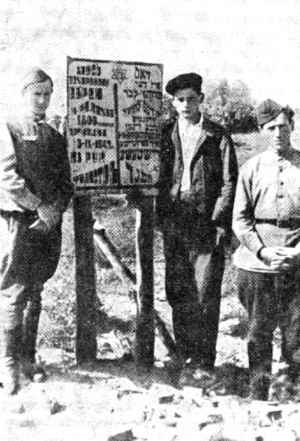
Despite all the difficulties, there were fierce and determined incidents of resistance against the Nazis even in the small towns of Jews. This was prior to the large uprising in Warsaw. The town of Lakhva, a distance of 72 kilometers east of the city of Pinsk, served as such an example of the resistance of the weak and oppressed against the mighty power of modern murderers.
All the decrees of the evil ones arrived in the order standard to other towns. The linen belts, signs and yellow Magen Davids, the degradation of the rabbis and important communal figures, backbreaking work accompanied by curses and beatings, contributions, ghetto, famine.
The town council, the Judenrat, was completely composed of good Jews, dedicated to their brethren, people of initiative, Jews who attempted
[Column 33]
to protect not only themselves, but also their brethren, as long as they still had the possibility of doing so. Due to their dedication and trustworthiness, no liquidation took place in the town when the Germans invaded, as happened in other towns. On one occasion, the Gebietskommissar [District Commissar] came and demanded from Lopatin, the chairman of the community, one hundred Jews to be killed. He responded, “Kill me first. I have no permission at all to give over other people to your hands.” Lopatin received two slaps on the cheek, but not one person was killed.
Then news started to arrive from towns of the area in which they had killed the Jewish residents. Local youths set up a secret organization to resist the German aktion. The organization along with the communal council decided to not fall into the hands of the murderers. Yitzchak Rochczyn stood at the head of the organization. Asher the son of Zalman Cheifetz, and Asher Cheifetz, nicknamed “Gandhi” were among the first organizers. “Let thirty people from Lakhva remain,” Ashman shouted on the last night, which was a night of vigil. “But these would be able to tell that the Jews of Lakhva found the strength in their spirit to stand up for themselves.” The sole defensive action was to cause turmoil through fire. The only weapons were axes and knives. Even more primitive nations had better weapons: bows and arrows, shields and spears – even these we did not have.
Some people from Lakhva managed to escape from the ghetto several days before the pogrom, but nobody wanted to endanger the lives of their fellow, to give a pretext to the Nazis to say that because of the absence of several people from the ghetto, they would kill the rest.
[Column 34]
Therefore, they all remained in place until the final moment. Their hearts did not melt, and their spirits did not falter, and they girded themselves to resist the murderers with the last of their weak forces.
On September 3, 1942, the murderers broke into the Jewish ghetto in the form of an organized army to carry out their work – the annihilation of the small Jewish settlement of two thousand souls. The settlement, lacking any military power, decided to defend itself, to defend the honor of the Jewish community and the Nation of Israel, and to “prove” to the gentiles that not every community of a Jewish town can be considered as sheep led to the slaughter. This was the first and last pogrom in the town. Individuals did not search for ways to save their own lives. The small community declared that it was prepared in its entirety to stand up for itself and to fight with its meager means against the strong, cruel enemy.
The first to attack the Nazis knew that they would fall victim, for an axe, a knife, or stones do not have the power to fight against machine guns. But they knew that through their deaths, others would be able to save themselves, perhaps remain alive, and fight against the enemy in the ranks of the partisans or the army; and to relate to future generations that the residents of the small town of Lakhva girded their strength to resist the cruel, Nazi monster that destroyed our nation, and also to witness its downfall.
The revolt in the Lakhva ghetto was the mighty protest of a small, weak community against the greatest and most cruel evil in history – Nazi Germany.
Translator's footnote
[Column 35]
by Ch. A. Michaeli
Translated by Jerrold Landau
1. Under the Protection of the Red Star
On September 1, 1939, with the outbreak of the war and the entry of German troops to Poland, the fate of the large, firmly rooted Jewry was determined – for destruction.
In every place where the occupier trod, they immediately began to torment the lives of the Jews, to pillage their property, and to torture them by degrading their honor and desecrating their holy items.
Myriads fled for their lives from fear of the oppressor. They wandered, helpless and aimless, along paths that were not paths, from city to city and from village to village. When they could not find a place, they returned from whence they came, to continue to crowd together in the suffocating filth of the ghettos, with their brethren in captivity and destruction.
Many of the Jews of the districts of central and western Poland fled and progressed eastward, with the intention of crossing borders and reaching Russia, which sought peace and respected the human life of the persecuted.
Even Polesye Jewry, to whom the enemy had yet to reach, asked what would happen in the future. Would their lot also be the bitter, methodical destruction? Every day could tip the scales toward doom or mercy.
Among the thousands of refugees who had already succeeded in reaching the cities of Polesye, there were many who camped in Lakhva, with the tidings of Job on their mouths.
A terrifying darkness fell upon the House of Israel in Poland – the nightmare of annihilation threatening everyone, young and old alike, children and women – leaving neither survivor nor escapee.
On the evening of September 17, 1939, the concerns disappeared and the fear abated. The Soviet army entered Lakhva and continued to advance until Brest-Litovsk.
That day turned into a day of joy and thanksgiving for Polesye Jewry, who were saved from the talons of the Nazi beast. However, the days of festivity quickly passed, and dark days began.
Everyone felt that the new regime was bound to bring about a fundamental change in the life of the community. Patterns of life stamped with the seal of generations would not be sustainable under a strict regime whose eye watched over everything.
[Column 36]
The Zionist youth movements ceased their activities and went underground. The Yavne Hebrew school, through which hundreds of youths had been educated, closed down. The large Tarbut library, which contained about 3,000 Hebrew and Yiddish books (including books on Jewish wisdom that are hard to find), was “sealed” by order of the government. Only a few Hebrew books were removed in the darkness of the night at the risk of one's life and hidden in secret hiding places.
They began to conduct surveillance upon and search all communal activities in its cultural and Zionist life.
Some of the youth wandered to nearby cities where they were not known, and joined the work circles. Another portion of them went to Vilna – the center of Ha'apala [clandestine aliya] with the hope of reaching the Land of Israel. Not all succeeded in sneaking across the borders. Some were captured and deported to Siberia, where they wasted away in prison camps for many years.
Those who remained in the town continued to maintain connections within the narrowed circle. They would gather during their free time in a dark corner of an isolated house, around a Hebrew book, and would delve longingly into the vision whose actualization had been interrupted in the middle.
From time to time information would filter in via the “travelers” on the Lvov-Brisk lines and the Lithuanian border on the Land of Israel and the Ha'apala movement. Without researching and knowing the truth of the information, we were at the mercy of their impression.
Small-scale commerce, through which a considerable proportion of the population earned their livelihoods, stopped definitively, and the source of livelihood of tens of families whose breadwinner could not arrange work was broken. Even the tradespeople hungered for bread, since they did not have the necessary raw materials to continue with their work. They refrained from joining the cooperatives that were established on the order of the central authorities. The tradespeople were in a state of complete melancholy of spirit and powerlessness. Every one of them chose to stand on the side and see how the matters would work out. The fear of collectivization, “the equalizer of the small and the great”, threatened
[Column 37]
the tradespeople who were commanded to pool their work implements in the cooperatives and become “officials”.
Indeed, with the passage of time, when all deadlines had passed, they began to organize in the cooperatives, which the authorities regarded positively and helped to establish.
The Soviet regime continued to entrench itself steadily in the conquered areas. The town shed one form and took on another. The stores and workshops disappeared, and in their place, the consumer cooperative popped up in the middle of the town, providing the small quantity of foodstuffs, which became more limited on a continual basis. The “lineup” that we had not known turned into an inseparable part of daily life.
The cultural state of the community was even worse than this. The tombstone was sealed on every cultural-national activity. Instead of the Hebrew school, there was the “Smiltka” (people's school)[1] with its definitive anti-national and anti-Hebrew education.
The Hebrew language was persecuted to the point of obliteration, and the educational theories that were adopted regarding young students were clear and intentional – to uproot all memory of national independence, to cause the past to be forgotten, and to denigrate it.
However, they did not succeed. The youth did not fold the flag of their faith, and they added a “double life” with faith strong and going toward the destiny of the vision of the nation. There is a story of a child (Yitzchak Itshele the son of Eliyahu Fishman), who, when he was a member of the local Hashomer chapter and having joined the Bnei-Yehuda movement, took an oath to speak only Hebrew to anyone he saw. He stood by his oath steadfastly during the period of Soviet occupation, as well as during the Nazi rampage.
The only cultural corner that remained and was not completely uprooted was the synagogues. However, the number of attendees declined drastically, from fear of the authorities who regarded the young attendees as a reactionary element unworthy of trust. Nevertheless, they continued to serve as the sole ray of light for the older generation, whose livelihood had been taken away, and whose entire yearning was for the youth who were pushed one by one into work for the government and its institutions.
At twilight, between Mincha and Maariv, the two shtibels of the Beis Midrash and the Cold Synagogue (Kalte Shul) served as podiums for sharp debates on the ways of the regime and its prospects, and especially over its influence on the ways of life of the community, which shrunk continuously, to the point where they were left with no remnant and no unifying spiritual foothold, except for the illusory freedom of a wistful and pure prayer that had not yet been banned by decree. Many sharp statements were
[Column 38]
coined in the shtibels, and spread to the public from there, and became known in all the occupation areas.
We will mention several of them here:
a) The actualization of the slogan “collectivization of the village” directly affected the farmers of the area, who rejected this step. Even the Jews, however, saw in this command an indirect impact on their weakened economic status. (Until the proclamation of the kolkhoz edict, they would still smuggle a bit of food to the city.) Therefore, they became partners in the debate for and against the “collectivization”. The supporters and rejecters of the edict would deliberate on this topic during the break between Mincha and Maariv.
One of the frequenters of the Beis Midrash, Reb Yaakov Zaltzman, who spent all his days within the four ells of halacha, was asked for his opinion. He responded: “It is explicit in the verse that the kolkhozes will make our situation more serious, for the word kol is a harbinger of ill tidings. On Yom Kippur we begin with Kol Nidrei, which means sitting all day without bread. The kol chamira declaration before destroying the chametz signals a full week without bread. From here, [we can derive] that kol-khoz is nothing other than a hint of breadlessness – for months and years.
b) The enthusiasm that overtook the town with the entry of the Red Army also searched and found the faces of Jewish soldiers. In every case, the hearts “opened” and embraced with pride and affection the strong soldiers who were poised for battle. They would surround the soldiers and attempt to glean information from them about our brethren and the ways of life in Russia.
A dignified Jew approached one of them and asked innocently, “Are there Jewish newspapers in Russia?” The soldier chuckled with pride, stuck his hands into the pocket of his rubashka [Russian tunic], took out the Minsk HaOktober, and gave it to him. The reader was not able to easily read the distorted Yiddish that was customary in Russia. The Jew questioned the quality of the writing, and hurried to return the newspaper to its owner. He sighed and said, “It has ha-emes [האמת] – written עמעס in Soviet Yiddish, without an aleph – and tzaros [צרות] as צאָרעס, without a tav. I don't believe anything good can come of that.”
Even after the government established itself in the annexed areas, we remained with no contact to greater Russia. Travel to the interior of the country required a special permit from the central government, and only a few special people who were trusted by the government were permitted such a visit.
There were Jews who were among those who carried out the “Sovietization”
[Column 39]
in the annexed areas, but for the most part, they were under orders to remain anonymous and refrain from becoming friendly with the local Jews, who were still suspect in the eyes of the authorities.
Perforce, the spiritual ghetto[2] separating the two camps continued to exist: one camp watching with searing pain the terrors of annihilation, powerless to save; the other – rising along the path of total domination over the life of the individual and the community.
With the first wave of nationalization and the first prisoners labeled “destructive elements” being deported to far-off incarceration places in the interior of Russia – fear and dread took hold of the Jewish community, which was entirely Zionist.
For there is nothing more oppressive in life than living with the fear of arrest that could descend on you at any day and any hour.
In those days we were bowed to the dust, and a single prayer beat in all our hearts: that no contemptible informer arise from within our ranks who might aid in carrying out the edicts of the authorities.
Indeed, Lakhva preserved its honor and traditions. Its banner was taken down by the force of the government, but did not slip away from the hands of its faithful dreamers, who wandered to where they wandered, and guarded it faithfully with love and longing through all the upheavals of the times and the paths of fate. Its honor was diminished, its voice was silenced, but its spirit remained for it like a firm rock. With the power of its spirit, it was not overtaken by spiritual despair. It did not deviate from the path of its faith – its great hope that the day would come when the gates of redemption will be opened wide for it. The Land of Israel was the pinnacle of the hopes of every resident of the town, as a rock drawing hope and trust.
The connection with the Land was not severed even though the authorities did not look positively upon this. Correspondence by mail with the Land was accompanied by innuendoes, and required significant effort to interpret. Such innuendoes included a complete treasure of folklore, spiritual stirrings, hopes, and prayers.
Even the few letters that arrived from the Lakhva[3] to relatives in the Land had a great deal of this language of innuendo. A unique style was created that, with its innocence, did not arouse the suspicions of the strict censor, and served as a tenuous bridge with the designated Land.
In addition, from Meiters[4], occasional reports filtered in from the Nazi-occupied zone about the masses of the House of Israel held in captivity and distress, about pogroms, about annihilation in the ghettos, about yellow patches, and the theft of property.
All restraints were removed for the Jew haters wherever they were. The gentiles
[Column 40]
filled with hatred cast their darkness and thrust their trampling talons upon the body of the bleeding nation.
The heart contracted from pain from hearing every piece of news that came from there – but we were unable to help, for an iron wall separated us. Even publicizing in writing or orally the news that came from there was forbidden by order of the Soviet government, apparently for fear of harming the peaceful relations between the two nations.
In Russia, the world ran as normal – the slogans from above that directed thoughts and deeds, the firm separation from anything that happened on the other side of the border.
The small railway station of Lakhva served as an important transit route for the military force that streamed in the direction of Brest Litovsk. The military transports grew stronger and more numerous, making it clear to the masses that the war between the two nations was coming.
The fear of the Jews as to what was to come had unclear reactions. They believed that in the event of a war with Russia, Germany would break apart in a number of weeks in the face of the strength of the Red Army. They fully believed that the upcoming war would take place on enemy soil, and would take the form of a blitzkrieg that would finish and remove the Nazi nightmare from the world.
With the outbreak of the great war between Russia and Germany on the evening of June 22, 1941, we who were under the protection of the Soviet regime were calm and secure.
Not only did we see ourselves secure in the face of the enemy, but we were comforted by the hope that the sun of redemption and freedom of the entire house of Israel who were facing the hour of their destruction with trepidation would shine.
Our faith in “immunity” and our hope to free our brethren wasting away in ghettos throughout the entire expanse of Europe were quickly shattered. On the first day of the cruel war, the fortification line along the dividing borders were broken through, and the masses of the Nazi armies began to pour into the areas of Russia and advance at dizzying speed.
In the afternoon of the first day after the outbreak of the war, masses of refugees who escaped from the dread of the executioners while they were still alive streamed into Lakhva and the neighboring towns.
The panic and astonishment that spread over everyone was especially serious regarding the disorderly escape of those faithful to the government and their families in various vehicles and machines, who fled
[Column 40]
to the interior of Russia, the strong people of the government whose fate had been sealed just yesterday, and who appeared wandering wearily along the roads leading to the interior of Russia – the secure refuge from a cruel death.
A hurried draft began in Lakhva and its area. Jewish lads who received the draft summons hurried to present themselves in the ranks of the army, whereas the gentiles of the area chose to exempt themselves and remain in their homes, “until the wrath passed”.
Even the few who enlisted out of fear of the news that heavy punishments would be imposed upon the families of evaders did not spend long in the bunkers of Sinkivich, and tens of deserters disappeared daily. Time was pressing, and the army command did not have the time, mindset, or freedom to organize searches for the deserters and their families.
|
|
[Column 42]
2. My Escape
My luck was favorable, and I was among the draftees. We remained in the area for only eight days. We crossed the border near Mikshovitz. We boarded the train and reached the banks of the Dnieper near Zlovin, a city in White Russia. The Sinkevich barracks were a distance of ten kilometers from my parents' house – and my parents and family members would come to visit me every day.
In the middle of the day prior to our transfer to Russia, my mother, may G-d avenge her blood, visited me and whispered to me with a trembling voice before our final parting: “Now my son, not like the pattern of the gentiles and simple minded of our brethren of the house of Israel, do not desert the army. Go with them wherever they will call you, and may G-d be your help…”
I bore in my heart in love and holiness, in all
[Column 43]
times and circumstances of the murderous war, the command of my mother, the command of a mother in Israel for life, illuminating my paths during the dark, blood-filled days.
The enemy continued to approach. Behold even Pinsk, the capital of Polesye, fell into the hands of the enemy. The last of the government loyalists packed their suitcases in haste and snuck across the border.
The last of the Russians left Lakhva on Saturday, July 3, 1941. Despite their nervousness that was evident to all, as if they were standing upon burning coals, their presence served as a shield against all possible outbreaks of bloodthirsty gangs eager for pillage.
That moment, tentative feelers were sent out by groups of youth for an organized escape across the old border. However, the attempts did not bear fruit. The time was no longer workable for such an activity.
The situation in Mikshovitz and Lenin, where tens of Jewish families crowded together in an open field and found it impossible to enter Russia, discouraged others from trying to cross. Only a few of the Komsomol youth wandered in the final footsteps of the government officials of the Soviet regime. They succeeded in distancing themselves from the area of danger to the extent possible. From there came the answer to the question of many, “How did it happen that the Jews living in the Soviet border towns who witnessed that which was awaiting them from the bloody Nazi regime did not escape for their lives to far-off areas of Russia?”… This was the decisive response: the ban against crossing the old border! Even the strong connection to the corners of life with the majesty of generations hovering over it pushed off the desire to leave the place. However dismal was the wooden house and the old, shedding, straw roof, it was completely full of love of life and the toil of generations.
The third deterrent was the fear of going out to an unknown country, and the concern of the difficulties of starting everything anew.
An evil spirit also spread across the Jews of Polesye, who regarded the impossibility of crossing the border as a sign and portent that the impending decisive blow would fall upon the heads of the executioners, and those closest to the border would be the first to be liberated…
The perplexity and oppression increased with the final exit of the Russians. Without any government and protection, the Jews were closed into their homes and were
[Column 44]
fearfully awaiting the gathering of the gentiles of the area who streamed in with joy as they awaited the coming of the “savior”.
3. Under Nazi Occupation
On the following day, a Sunday, after the last of the Russians left Lakhva, the tension increased between the gentiles who poured in from all areas and the residents of the Jewish areas. Gangs of drunken hooligans pillaged outside and shouted, “Death to the Jews!” “Hitler the savior is approaching,” “Judgment will be passed upon you,” etc.
They remained in fear among their family circles. Perplexed eyes peered out through the cracks in the shutters facing the street, where pillagers were swarming around, waiting for a sign to storm the unfortunate, helpless people, to destroy them. The pogrom did not take place, for at the last moment, some daring people succeeded in bribing some of the heads of the inciters to influence the masses to refrain from taking out their wrath. From that time on, bribery became a tried and true means of appeasing any wrongdoer who wished to afflict the lives of the Jews of the town.
Bribery and pillage became the usual fashion of every murderer to extort money from the unfortunate community. The next morning, disguised firefighting trucks from the nearby town of Luninets appeared in the marketplace and the roads of the town. They were filled with gentile firefighters. The pretext of their arrival aroused rumors, until it became known that the firefighters arrived on a mission from the first row of the Nazi army, with the mission of spying and reconnaissance – to determine the situation in the town prior to their entry. Indeed, one hour later, after the firefighting trucks returned to their journey, bands of bloodthirsty hooligans entered the town, the first of the Nazi army, with sounds of mirth and joy.
On August 8, [1941], the swastika was raised over the communal buildings in Lakhva, and the bloody Nazi regime began to pillage in the city. On the first day of the entry of the Nazis to the town, a special edict was proclaimed that the Jewish residents must remain imprisoned in their homes. Nobody could go out and nobody could enter!
A brief time later, an edict was issued commanding the Jewish residents, men and women from age fourteen to sixty, to present themselves the next morning for work related to the needs of the front. The work was – cleaning the military equipment of the soldiers; emptying the benzene pools that were built by the Russians in the dense earth near the railway station and were abandoned without damaging the thousands of tons of fuel that were stored in them; preparing the
[Column 45]
soil for the movement of German vehicles; strengthening and repairing the embankments on the Pripyat River, etc.
After a week of backbreaking work, bread cards were distributed to the workers, giving them the rights to purchase two hundred grams of bread daily. In practice, the allotment dwindled from week to week. The abuse of the Jews began in full strength. The lives of the Jews became unprotected. They were given beatings at every opportunity that came to hand, simply for sadistic benefit, in order to break their spirit and to increase their fear in the face of any scoundrel or simple wrongdoer, and to degrade their human honor in the eyes of the surrounding gentiles.
To increase the disgrace, they were ordered to wear a yellow star of David on a white band on their left arm, a sign of “shame” that later on turned into a symbol of strength and honor that was worn with pride. That sign of recognition underwent three incarnations: first, a yellow star of David; after a certain time they were ordered to exchange it for round, yellow patches without any special mark, worn over the heart and the back; and, during the later period, they were ordered to wear a yellow star of David on the heart and back.
The arrows of degradation and abuse were primarily directed to the elderly people and rabbis of the city. During the first days of occupation, the Germans captured the holy rabbis of the city, Rabbi Avraham-Chaim-Zalman and Rabbi Leizerke, may G-d avenge their blood, and forced them to dance while enwrapped in their tallises in the middle of the marketplace until they ran out of energy, to the sounds of exultation of the farmers and Germans who were drunk with victory. The local hooligans “accompanied” them in a whirlwind with their blood-drenched dancing that was suffused with despair.
The public dances of the rabbis and elders of the city were repeated innumerable times, “accompanied” by the cruel blows of the blood-thirsty riffraff, and the cruel plucking of the hair of the head and beard.
The Red Army that retreated from Lakhva continued to fight the ranks of Nazi soldiers who advanced in the region of Sinkivich and the banks of the Pripyat. The echoes of fierce battles that continued for about two weeks were heard very well in the city and the area. Thousands of Jewish hearts that were left open to the hands of the vile humiliators bore a pure prayer for the peace of the Soviet Army and its victory over the murderous enemy.
And G-d did not turn away and did not withhold the cries of aged fathers, broken in strength, who rose early to His doorway on weekdays and Sabbaths to pour out their supplication and to magnify His glory with the psalms of David son of Jesse and with a page of Mishnah … but a wondrous miracle did not occur to restore the captivity of His denigrated children from the tribulations of hell. Isolated from G-d and man,
[Column 46]
simple and innocent Jews were crushed, seven in a day, with the bitterness of death stalking them from every corner.
The Soviet Army was forced to abandon its stand and retreat, and the Nazi death machine came in its wake. The Nazis began immediately to set up the civilian government institutions. First, a “volunteer” police force was set up, in which were numbered all the dark forces known for their brutality. A veteran Jew-hater, an arch-bandit from the infamous Lakhva gang, was placed as head of the police, Grechko, may his name and memory be blotted out. A German Christian, Hoch, who was a driver in the local estate, was appointed as head of the local council. The work of the Nazi executioners was done by others. These were the heads of the local government who earned their positions without any special effort. Like found like.
Supervision of the forced labor of the Jewish population was the task of the civilian commander of the city. He displayed the force of his arm at any opportunity.
The labor imposed on the Jews turned into a hell, abuse of the body and spirit, continuing from beginning to end. They appointed criminal thugs to oversee Jewish workers. Being an expert in his field was of no help to a Jewish worker. Everyone was equal in the eyes of the enemy troops and their collaborators with regard to persecution. There were many cases where a professional was sent to professional work so to speak, but it turned out to be simple, backbreaking work interspersed with an abundance of afflictions. In his first days of service as “civilian commander”, he informed the carpenters “who want to work in their profession” to present themselves at the military engineering corps which was working on building a bridge in the nearby village of Mokrova. The next day, all the carpenters went out to their designated workplace. German soldiers met them and began to torture them. After they all suffered beatings, they were ordered to go to the nearby village of Sinkevich, the place of the “bridge”. When they got there, the scene ended by lifting wooden planks that caused their bearers to buckle under their weight. This served as a pretext to beat them with heavy whips until blood flowed. They returned home late at night, weakened, while they still had some life left in them.
At that time, the first case of people being sent “to an unknown destination” took place. A German transport truck specially arrived from Pinsk and took Chaim Pinchasovich, Meir Berl Yulevich, and Rosenberg – a refugee from Moldova who had found temporary refuge with us – and Pialkov from Luninets,
[Column 47]
bound in chains, with their faces pressed to the ground. The vehicle drove in an unknown direction, and to this day, it is not known what happened to them. Various theories arose regarding their imprisonment, but the most logical one was that their “crime” was that they had served as police officers during the time of Soviet occupation, and their children were members of Komsomol.
On one of those harrowing days, several of the veteran activists of the town gathered to deliberate over the situation. They decided, based on a veiled innuendo from the captains of the military command center, to establish a local committee to lead the activity of calming the stormy, perplexed spirits, and to negotiate with the Nazi authorities on issues related to the lives of the Jews and the conditions of their existence in the state of oppression and terror[5]. The following were chosen for the committee: Dov Lopatin as chairman, Yosef Gozevitz, Manus Bruder, Eliyahu Shechtman (son-in-law of Yeshayahu of blessed memory), Yaakov Mester, and Yisrael Drobski. Nachum Milman was appointed to the task of organizing the labor protocols. Zalman Cheifetz, Rabbi Avraham Chaim Zalman, and Rabbi Leizerke were appointed as standing advisors. Rabbi Mintzberg, may G-d avenge his blood, one of the heads of the Chachmei Lublin Yeshiva and one of the Torah greats in pre-war Poland, was among the many refugees who reached Lakhva during the course of their wandering due to oppression. The committee would turn to him for advice. He served for them as a guide and spokesperson for their activities through the power of his wisdom and wonderful devotion.
Not one of those chosen for the committee knew the future course of action of the authorities, and their level of effectiveness for the benefit of the community. The committee made many mistakes at the beginning of its activities until they found the way to the callous hearts of the bloodthirsty haters who were out for their own gain.
From that time, the town no longer faced the threat of pillage and murder. The committee concerned itself with regular payments to all the thieves in the authorities, and they, from their perspectives, made sure that no “competitors” arose from among the wild masses of inciters.
The burial of those murdered was added to the tasks in which the Jewish residents worked. Tens of lads, accompanied by armed soldiers, with their guns aimed at us, worked for many days at the burial of the bodies of men, women and children, who had been piled up in heaps in various parts of the area. Only a small portion of those murdered were identified, and many were buried anonymously. The victims were prisoners of war and officials of the Soviet government and their families who had not succeeded in fleeing for their lives, and were caught by the Nazis. The bodies of the murdered were not brought to a single burial spot, but rather were each buried
[Column 48]
in the place where they were found, in order to obscure the worst of the criminals.
One of the refugees brought the news that all Jews of the nearby town of Hantchevich were loaded on vehicles and trains and transported to an unknown location. With all the fear that enveloped the Jews of Lakhva when they heard the terrifying news, they did not believe that the unfortunate people were being taken to death; they imagined that they were being transported to forced labors in the quarries, military equipment factories, building and paving roads near the front, etc. Nobody could imagine that the Jews of Hantchevich were going on their final journey. Indeed, we suspected pillage, looting, and pogroms, but the possibility of planned mass extermination did not enter our minds.
After a few days, women from the town of Davyd Gorodok reached Lakhva in a state of complete weakness. They bore the news that all the men were “taken to an unknown place” whereas the women and children were commanded to leave the town.
One of those who survived, Zeev Shvorin, tells that he was sent on that day by order of the Germans to operate the barge over the Pripyat River to transport men and packages from one side to the other. The transport was minimal, and he spent most of the hours of the day in the company of groups of gentile fishermen who fished in the region. Suddenly, a woman laden with bundles, coming from the direction of Davyd Gorodok, appeared on the southern bank. She gestured to them with her hand to take her to the other bank, leading to Lakhva. They came to meet her with fishing boats and began to take her to her desired destination. As the boat approached the shore, a heavy groan burst forth from her throat, and she asked, “Do you not recognize me?” Only then did they realize that she was Chava Kanchik, from our town. Now she had a young daughter with swollen legs, and she was carrying her on her back.
Chava Kanchik, and in her wake, several women who escaped from Davyd Gorodok to Lakhva, confirmed the news that filtered through regarding the fate of our brethren there.
However, even after that event, which was in the presence of witnesses, the Jews of our town were not affected by the fear of the shadow of death knocking at the gate. They continued to believe that the shipment “to an unknown destination” was nothing other than for the needs of strategic labor. The fact that women and children were not included in the threatening journey – rather men only – increased the delusion that those sentenced to death were alive and working somewhere.
[Column 49]
Jews clung to the hiding place of fear and hope. They awaited the advent of the redeemer every day, and did not give up hope from him. Like everyone who continued to dwell in the depths of troubles and despair, as the struggle with the bitter death that awaited them increased, they saw the redeemer even more clearly in their visions.
Wehrmacht groups left, and S.S. soldiers came in their stead. First the command came, and then the soldiers of the brigade. Their first step was to demand ransom from the Jewish community. After tiring negotiations, they were satisfied with the thirty watches that were promised to them. That day, the watches were taken and given over to the murderers.
Immediately after their arrival, the S.S. soldiers began to capture Jews for labor. The captured people suffered from beatings, and were forced to work wherever they were commanded at work for which they were experienced.
The torment of the Jewish workers increased from day to day. The only language with which they were approached was the butt of the gun, the boatmen's pole, and the hobnailed boot. The murderers utilized all sorts of means to oppress and torment, as the survivors testify:
The oppressors who “tired” of supervising the workers would leave them alone for a brief period and call their comrades in murder from a different place. They would burst forth with stormy wrath against the group of workers, and wreak judgment upon them. At times, they would repeat the deed several times a day.
There were cases of “snatching” from one work to another. During one such snatching, three lads were brought to the yard of Lea the daughter of the rabbi, may G-d avenge their blood, and were forced to clean the horses, accompanied by incessant curses and beatings. At the end of the cleaning job, one of the executioners brought them to the railway station as he was prodding them along with a whip. Along the way, they met a farmer who was transporting a wagon of straw. The murderer commanded the gentile to unhitch the horses from the wagon. In their place, he hitched the lads who were dripping with blood, as he sat and whipped them incessantly with the whip in his hand. A group of “regular” workers worked in the S.S. command center. Their work began at 6:00 a.m. with the polishing of the boots of the murderers.
[Column 50]
fetching water and cutting firewood for heat. Every morning, one of the murderers would beat the workers with his hobnailed boots, with the pretext that they did not polish properly.
After breakfast, they waited for the work command from the “masters”. However, the murderers raised an outcry that “the Jews are lazy” and one of them would volunteer to make them run back and forth, throw them down to the ground, torment them by forcing them to crawl on their stomachs for a long time, to wallow in the dirt, etc. Once, they were commanded to fetch four ladders while running, climb up to the top rung, and sing songs. Three of the lads did what they were ordered. However, fifteen-year-old Chaim Slutsky was stubborn and did not sing. The tyrant got angry, ordered him to descend from the ladder, and began to beat him. Beaten until he was bleeding, he was ordered to go up to the head of the ladder and sing once again, but that time too, he was daring, and did not fulfil the order…
Special companies called “OT”[6] stood at the head of the engineering work. Workers who paved roads, erected and repaired bridges, took care of embankments on the river, etc. stood at their service all day. The work, under the supervision of the soldiers, was accompanied, as usual, by harassment and abuse.
In the morning hours, the Jewish workers were obligated to present themselves at the railway station to be harnessed to the special transport wagons to the railway line and to transport the “masters” to the workplace at the bridge in the village of Baderbesk, a distance of six kilometers from the station. Those who were harnessed to the wagons suffered endless beatings until they reached the workplace wounded, bleeding, and depleted of energy.
These are several incidents of oppression and degradation that were heaped upon the heads of the Jewish community during the days of the reign of terror and destruction. These are a few of the thousands of what was wrathfully heaped morning and evening upon the tortured and isolated community, which silently bore its terrible suffering without anyone to save them. On the first Sabbath after the arrival of the S.S. officers, August 16, 1941, approximately ten local Jews were snatched for work, among them Meir Moravchik, Moshe Zeev Romanovski, and Yehoshua Lichtenstein, and were taken in the direction of the Jewish cemetery and ordered to dig three pits on the slope of the “Hill of the Priest”, opposite the grave of the rabbi and gaon Rabbi Itzele, may the memory of the righteous be a blessing. The pits were twenty meters long and about a meter and a half deep. They were ordered to toss the soil to one side. The S.S. men who supervised the work did not administer beatings this time. They said that the pits were being dug for defensive purposes for their army.
[Column 51]
After two days, on Monday, August 18, 1941, an edict was issued from the headquarters that all men between the ages of fourteen and sixty-five must present themselves in the field at 4:30 a.m. equipped with food for three days and spades for digging. The command stirred up the spirits, and rumors spread in the houses of the Jews that the hour of annihilation was fast approaching. Someone uttered a terrifying statement that the matter of provisioning with spades was for the purpose of digging burial pits for the victims. The rumor bore wings among the masses of perplexed people within the bereft, despairing camp.
Those who were late in presenting themselves or who took cover to hide until the wrath would subside, and were discovered by the S.S. who searched every house, were tortured with satanic cruelty. Even though the command was explicit that the edict to appear applied only until the age of sixty-five, they did not show mercy upon the elderly people who were captured in their houses. The enemy soldiers brought Gershon Shklar, Pinchas Chernomoretz, and Litman Blobstein, who died the next day, in a state of complete weakness, as they were dripping with blood. Pinchas Chernomoretz as well did not rise from his sickbed again, and died after a brief time. A deathly terror overwhelmed the crowds at the sight of the elderly people, abused and in a faint. At the field, everyone was told to sit on the ground with their legs crossed beneath them – the older ones at the front, and the younger ones behind them. This tortured sitting lasted for many hours, and the people had no recourse, having been left open to those who were murdering their souls.
In the middle of the day, the crowd was permitted to stand up. The enumeration began, and they were sent to work under a strong guard of police and soldiers.
The committee succeeded in entering into negotiations with the S.S. general, Schmidt, one of the chiefs of the murderers, and succeeded in removing the edict of killing in return for a ransom of one and a half kilograms of gold and an antique watch decorated with diamonds that was given over by one of the refugees of Wlodawa.
The executioners promised that they would not harm the Jews of Lakhva, and what had taken place in the nearby towns would not happen to us… In the committee office, a letter of confirmation was displayed, signed by the head of the S.S., who was responsible for the murder of the Jews of the neighboring towns: “Since the Jews of Lakhva welcomed the conquering soldiers politely, they are granted a reprieve, and no further harm will befall them.” Once again, a spark of hope arose in the recesses of the hearts of the residents of the town at the sight of the treacherous “amulet” of the head of the murderers.
Even though a proper gift had the power to defer the time of the actualization of the mass murder, it was no protection from the events of hooliganism and torment, which did not stop even for a moment.
[Column 52]
Any rogue and swindler who was appointed by the Nazi authorities to monitor what was taking place in the Jewish quarter plundered and tormented without any interference.
Furthermore, the chiefs of the executioners made sure to instill in their subordinates a methodical system of abuse. The aim was to subdue any feelings of human honor, to suppress morality and to reduce our power to maintain ourselves.
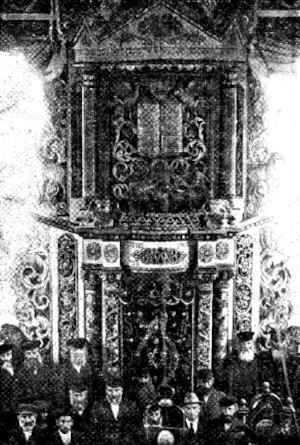
Along with the wave of physical attacks, there was also the attack on that which the nation holds sacred, and the moral values of the individual. The large synagogue and the Beis Midrash were expropriated. At first, they served as a prison for the war criminals who were liquidated with the passage of time, and later as food storehouses and warehouses for pillaged furniture that was distributed amongst the gentiles. The Torah scrolls and books of the Talmud were torn to shreds and desecrated in public. The rare holy objects that had been guarded for generations were pillaged by the murderers.
The synagogue of the Stolin Hasidim was an exception. It was included within the bounds of the ghetto and served as the house of worship for the tormented community until the end. There, the flame of prayer and faith was not extinguished until the lives of its worshipers were extinguished. There, the Jews dared to raise their voices, to demand a return of their violated honor and the defeat of the enemy and adversary.
Among the many edicts that were proclaimed at that time by the headquarters of the murderers, the Jews were prohibited from walking on the sidewalks at the sides of the streets. The Jews were obligated to walk only in the middle of the street.
The ring of siege continued to advance around the body and soul of the Jewish community.
At the height of the winter of 1942, initial reports infiltrated about the preparations made in the government offices to confine the Jewish community in a small, dark ghetto. It was not long before this matter was no longer a secret. Later, a veiled announcement was even given over to the community council regarding what was about to take place. The murderers attempted to act as if they were seeking the good, and they repeated to us daily that the ghetto would bring a reduction in the crowding that currently existed. A few weeks before the establishment of the ghetto, an official from the council was ordered to come before the “planning committee” to hear details about its boundaries, its internal structure, and the protocols needed to ensure order and obedience within its bounds.
The area that was designated for the plan allowed for no more than seventy-five centimeters per person. It was clear that the planned crowding was for the purpose of disrupting the internal relations of the community on the one hand, and to ensure conditions of sanitation that allowed for no possibility of preventing
[Column 53]
the spread of disease on the other hand. The committee started work, and after a strong effort, they succeeded in expanding the designate area to one square meter per person. The ghetto boundaries extended from the house of Moshe Neiman, through the length of the river, until the house of Leibel Moravchik; in the synagogue yard and in a parallel line until the well opposite the house of Shlomo Mordechai Moravchik. The ghetto incorporated a total of forty-one houses, in which more than 2,500 individuals lived during that period. The crowding was terrible, and many families lived in attics, cellars, and barns. Three small rooms in the ghetto were designated for the committee, the doctor, and his assistant nurse.
Despite the terrible crowding, the cadre of murderers did not succeed in actualizing their plot and arousing discord amongst the residents. On the contrary, the more the tribulations increased and strengthened, the feelings of brotherhood and mutual assistance grew sevenfold. That was the silent response to the gang of criminals.
A solid, tall fence served the boundary between the ghetto and the outside word. The committee was obligated to maintain it. There was barbed wire atop the fence to prevent any possibility of passage. The fence was built of wooden boards and planks that were collected in the yards, and from dismantled fences around their abandoned houses.
There were gates for entry and exit at two remote places in the ghetto. The anguish in the hearts grew as the erection of the fences reached its conclusion. A new spirit began to blow in the camp. There were no longer any delusions that their situation would lighten. All of them were united with the feeling that the purpose of the ghetto was to pressurize the lives of the unfortunate people, and who can foresee the end.
Many families who still were guarding property hurried to distribute it amongst their “good gentiles”, believing that they will remember them positively in the future, when the barbed wire gate of the ghetto will come down.
Indeed, there was not one from among the thousands who had been regular visitors in the homes of the Jews of the town who offered any assistance. Not one of them gave us a word of support. All of them plotted together and ganged up against us in unison to hasten our destruction.
The “best” among those to whom our belongings fell turned into enemies of the soul, and hatched pretexts to hasten the end, so that they could acquire the stolen goods that came to them without compunction. There are many stories
[Column 54]
from the mouths of our survivors about the ambushes set up by their “good friends”.
On the “holy” Sunday, the “gentiles” would go out to stroll, all wearing the festive clothes that they received as a deposit from Jews.
Two days before Passover of 5702 [1942], an edict was issued to the Jews of the town that they next day, on the eve of the festival, they must be locked into the ghetto. That day, they were commanded to be present in their houses and to pack up the most necessary objects that they would be permitted to bring into the ghetto. All movable property and valuables were forbidden, under strict ban from being taken into the ghetto. Their owners were ordered to leave them in their place. Winter clothing, leather satchels, blankets, etc. had already been gathered up earlier and sent to the soldiers on the Russian front…
On the eve of Passover, the festival of freedom, April 4, 14 Nissan, 5702 [1942], hundreds of murderers in the garb of S.S. soldiers and soldiers went out, driven and in urgent haste, to storm the houses of the Jews and take them out to bring them to the ghetto. When the murderers appeared at the doors of the houses, the residents were given three minutes to leave. With the perplexity and panic that pervaded in every Jewish home at the sound of the murderous edict, many did not succeed in even taking with them the meager bundles that they had prepared while there was still time. Rather, they ran for their lives to the ghetto in panic.
The abandoned houses were secured in the face of the local pillagers who had gathered to loot in the most fundamental manner. They closed the windows and doors with nails, and a moving guard supervised “order”.
Those who had escaped from far-off places with their meager bundles had them pillaged by the wild masses, and they reached the ghetto naked and lacking everything.
The deportation to the ghetto came abruptly, and it was impossible to ensure a just allocation in the narrow lodging area while there was still time. The lodgings were arranged by family closeness or good friendship. Only after a few days did the committee take control over the new situation, and organized the issue of lodging in a conclusive, just manner.
The era of the so-called “relative freedom” came to an end with the enclosure into the ghetto. The festival of freedom became the time of the humiliation of bondage. The last sparks of light and hope that flickered in the hearts were slowly extinguished.
News of the advance of the Germans on the front with the Soviet Union penetrated through the barbed-wire grid of the isolated ghetto, and blew away all illusions of a day of deliverance that might suddenly come. The Nazis ruled firmly over the occupied areas, and opposition from underground forces
[Column 55]
that were in the organization stage was still in its faint beginnings in the Polesye districts. Only after the first armed conflicts took place in the nearby town of Turow between the Russian partisan units and the occupying army, which received a decisive blow, did a renewed ray of hope light up in the hearts with the new factor, which took shape in their imaginations as a liberator from the talons of the Nazi beast.
Soldiers of the garrison force in Lakhva also participated in the famous clashes, and beat a disorderly retreat in the face of the partisans, who inflicted damage upon them. In their hasty retreat, they returned to the town barefoot and bareheaded, with plucked hair and tattered garments, attracting the hearts of those imprisoned in the ghetto…
To free themselves from the feelings of discouragement and to overcome, as befits “heroes”, from the disgrace that fell into their lot, they broke into the ghetto and perpetrated acts of harassment. Then it became evident to those imprisoned in the ghetto how great was the fear rooted in the hearts of the strongmen who put on the face of “heroes”.
From that time and on, the partisans threatened them. The more they feared them, the more frequent and stronger were their cruel deeds toward those imprisoned in the ghetto. To them, the persecution and attacks were a means of covering up their feelings of fear that disrupted their calm. Therefore, they displayed “blameless heroism” in the eyes of the gentiles who were astonished to see them in that situation. The “new life” of those imprisoned in the ghetto was marked by extortion and abuse. The work that had stopped for several days due to the transfer to the ghetto was renewed in full force. They would exit the ghetto to go out to work in groups, with armed guards accompanying the prisoners from the beginning of the work until the end. The entry into the ghetto was also according to the groups of workers. Near the gate of the ghetto, stringent searches of the tools of those returning from work were carried out. Jews found with remnants of food in their sack that they managed to obtain by barter with the farmers were caught for their crime and tormented by the murderers with hellish torments.
The small quantities of foodstuffs brought in when they entered the ghetto were used up with surprising speed, and tens of families began to knock on the doors of the committee asking for help. It is no wonder that, despite the mortal danger that awaited anyone caught smuggling food, almost all of them risked their lives and engaged in such activity.
Famine in all its fearfulness appeared in many houses, and the entire committee involved itself in activities to ease the distress. Baked goods made from low-grade flour and millet became the daily bread of most families. Many parents who had lost
[Column 56]
all hope to escape from the ghetto and to sustain their families sent young children to sneak out of the ghetto at night and beg door to door from the gentiles in far-off villages to collect food leftovers from anywhere they could, and then sneak back to their homes in the darkness of night. During one of the searches conducted by the murderers to prevent the smuggling of food into the bounds of the ghetto, seven girls were captured by the local police in the vicinity of the village of Prinova near the town and murdered. The children were Chayale Shuman (daughter of Yaakov) and six refugee girls whose average age was around fifteen. The young bodies, mangled by the bullets of the executioners, were brought to the ghetto, and a heavy mourning fell upon the tortured community, who were shaken to the depths of their souls.
These were the first victims whose death-horrors the entire community witnessed. The sight of the flowing and clotted blood of the seven holy tender bodies horrified the entire populace.
The bereaved community took leave of its murdered children in stifled weeping that choked in hearts with blood coursing through them, and prayed a whispered outcry that a faithful hand of vengeance would yet reach the criminals and repay them according to their deeds.
However, the horrific murder was not sufficient to deter the ghetto prisoners from searching all sorts of stratagems and continue to smuggle a bit of food to sustain their souls. In order to sustain their wretched, degraded lives, every individual had to struggle strongly against their enemies who were seeking their lives, and to trick them with all sorts of means and stratagems. The fear of dying of hunger was greater than the fear of death by bullet. In the ghetto, the ancient maxim was held fast: “Better off are the slain of the sword than the victims of hunger.” [Lamentations 4:9]. No more incidents of murder took place after the murder of the children, but the torture of those captured smuggling food grew sevenfold. Barely a day passed in which someone was not captured attempting smuggling. The committee appointed a special official whose task was to arrange the release of those who were captured. The freeing of any prisoner was accompanied, of course, by a proper bribe of money or objects of monetary value.
With regard to those who were caught, various methods of abuse were employed, including public floggings, which always ended in prolonged physical injury. We will note here two typical cases of flogging arising from attempts to smuggle food supplies.
Meir Sviz, the son-in-law of Yehuda Katz, who worked at unloading potatoes at the railway station, put some of them in his pocket. The watchful eyes of the S.S. guard noticed this, and immediately issued a verdict of forty lashes. They gathered all the workers
[Column 57]
who were working at the railway station at that time to witness the flogging. When the murderers concluded the flogging, he fainted and he almost died from the suffering. He writhed on his sickbed for many weeks.
Baruch the son of Chaim Vlochinski hid in his sack a loaf of bread that he found while working in the army barracks – and was caught. They immediately issued a verdict of twenty lashes. He was released from the hands of the executioners barely alive.
Many people who were beaten in such a manner did not recover until they passed away. The German criminals knew no mercy. Even young children who were caught under “suspicious” circumstances with crumbs of food in their hands were cruelly flogged.
During the period of pernicious starvation and murderous floggings, the S.S. command ordered the Jewish committee to set up a volunteer guard unit within the bounds of the ghetto. The tasks imposed upon this guard are not known to us to this day, but it is a fact that the volunteer guard served as a faithful emissary to the committee who struggled tirelessly to ease the material straits that left their mark on the life of the ghetto.
The volunteer guard unit concerned itself with: 1) improving the sanitary conditions; 2) internal protocols in each house and in the general community; 3) fair division of labor; 4) helping people who succeeded in contacting the gentiles of the area to obtain food. The members of the guard unit had certain connections with the outside police and guards of the ghetto, and they succeeded in bribing many of them to “avert their eyes” from acts of smuggling that took place during the nights.
The committee saw it necessary to centralize the full supervision of the sources of food in the ghetto, so as to enable the giving of aid to those in need. They would add to the miniscule amount of the most inferior flour that they would receive each week an additional amount of flour or grain that they made sure to obtain through smuggling and barter.
Three lists were maintained in the office of the committee, according to which the weekly division of bread was carried out. In the absence of sufficient bread, they would distribute other foodstuffs. The elderly, sick, and workers would receive a set allotment according to the lists. Each person of these three groups was included in a list after rigorous screening by the committee to determine the level of need of assistance when there was no other source of livelihood. Anyone who was able to help himself in any fashion was not included on the list of those who received aid.
[Column 58]
The work organizer, Nachum Milman was the committee official in charge of food distribution.
However, even the effective protocol of the committee was insufficient to provide an actual solution of the problem hunger that grew from day to day, for “a handful does not satisfy a lion.” In the oppressive atmosphere the first people bloated from starvation began to appear, and their numbers grew steadily. In the wake of the hunger, the first illnesses appeared, which hastened the end of the weakened elderly people. A person who became ill in the ghetto was dependent on the mercy of Heaven. The doctor had no medicine at his disposal, and he was left helpless against any incident of illness.
The agony and despair grew from day to day. Every day brought a new decree that was harsher than the previous ones. All of them had one clear objective: to extort the few meager belongings that the ghetto residents still possessed, and to completely break their spirits. In the acts of the pillage and through the edicts, all of those who still had tableware, plates, spoons, forks, and knives were commanded to give them over to the kitchen of the murderers. Joy ceased from the House of Israel. No smile crossed the lips. The elderly and children went about gloomily, fearing for the next day.
Nevertheless, there were still lads who announced their weddings. This was a form of silent protest of the will to live against the winds of destruction. The weddings were very sad, without the traditional honors and without the mitzvah dance. Within the sadness, there was a great outcry of the generation immersed in the vale of death, with the vision of human life on earth fluttering with its final energy.
The Jews of nearby Mikshovitz were liquidated in August 1942. Due to the lack of Jews in the workplace, the murderers ordered the Jewish committee of Lakhva to send a “quota” of workers to Mikshovitz in place of the murdered Jews. The returning workers brought with them tidings of Job regarding the murder of the Jews of Mikshovitz.
When the executioners found out about the “disquiet” passing over the ghetto prisoners upon hearing the frightening news, they hurried to inform them that the liquidation of the Jews of Mikshovitz came to them because they helped the partisans, and there even was a chase of one of the prisoners fleeing to them… A few days later, the Gebietskommissar himself came in person, went to the committee, and told them the story again, albeit with the note that such a fate would await the Jews of Lakhva if “acts of treason” take place among them. However, if the Jews of Lakhva do not become involved in “provocations” they have nothing to worry about, and their lives are assured… The cynical words of reassurance of the chief of the butchers had the opposite effect. The call came from the youth:
[Column 59]
“Jews, do not let your feelings slumber!” “Our fate is sealed, and the moment of our annihilation is approaching.” “We cannot stop the slaughter – we will work to die with honor and with our full national and human pride!”
5. The Revolt[7]
The slender hopes were shattered. The illusions of a sudden deliverance were smashed to pieces. Every day of that life-that-was-no-life added another layer of terror, as the impending catastrophe seemed ready to unfold at any day, any hour, any moment.
The zealous Yitzchak Rochczyn stood at the head of the groups of youths, the most notable being: Moshe Leib and his brother Asher the son of Zalman Cheifetz, David Feinberg, Moshe Kolpanitzki, Izik Lichtenberg (son-in-law of Eliezer Portnoy), Yehuda Gozevitz, and Aharon the son of Ovadya Ashman. They began to prepare, with feverish planning, for organizing a revolt – a mass resistance against the murderers when the day of destruction would come.
The main concern was to obtain a number of firearms. However, all means and stratagems to obtain such came to naught. Since they did not succeed in this, it was decided to collect whatever blunt implements they could get hold of – axes, cleavers, hammers, pitchforks, and even wooden beams to serve in their stead – anything that could equip a large number of young men for the final confrontation with the band of executioners on the day of the ghetto's liquidation.
Time was pressing, and serious organizational and publicity activity was required amongst the groups of youth who were no longer sunken into the depths of despair and helplessness in the face of the moment of annihilation that was knocking at the gate.
Yitzchak Rochczyn, modest and resolute externally, and revolutionary inside, with dreams, and a fighter who does not miss the mark, put the best of his deliberations and thoughts into the matter of the revolt. He gave over the moments of his brief life with love, dedication, and burning faith. He convinced and roused tens of youths who organized the chapter of bravery and revenge in dark cellars and attics, the vision of superhuman bravery clad in glory and awe, which found its expression in the final bloody battle on the day of the liquidation of the Lakhva ghetto.
On Thursday, 14 Elul 5702 [August 27, 1942], groups of gentiles were drafted to dig gigantic pits around the railway line in the forest near the town. Through a confluence of strange events, the matter became known in the ghetto, and aroused a ferment of panic. Then the executioners hastened to announce “That there are no bears and no forest”…
[Column 60]
The pits that the gentiles were hastily digging were part of the strategic plan for the war against “the criminal partisans”… At that time, a group of gentile builders was working at repairing the three tottering bridges that crossed the branches of the local river and bridged the route that led to the forest in the direction of the pits… They prepared tall supports on both sides of the bridges that connected to slanted fences to remove the possibility of jumping into the water during the death procession…
In the executioners' lairs nothing could touch a person anymore; at the ghetto's foot a chasm of death had opened, and human shadows drifted in exhaustion, gripped and bound to the death that rumbled! During the nights, in the stifling air of the houses, mothers bent low, the springs of their tears dried up, over the bed of a pale child, and upon him they let fall their final kisses. Fathers sat with alert eyes fixed to the window, peering into the darkness of the night, looking fruitlessly for a ray of light to illuminate the darkness before death.
On such dark nights, a group of youths attempted to arouse a movement to escape from the ghetto while there was still time, but due to the lack of time and the increased guard by the executioners outside, this did not come to fruition.
The committee saw the need to organize a night guard inside the ghetto, who, together with the existing guard group, would be able to repel and foil every attempt by criminal bands to break into its boundaries. These night-watch groups were also obligated to track every suspicious movement on the part of the policemen outside.
During the hours of the night of the 20-21 Elul 5702 (Sept 2-3, 1942), the guards sensed that the ghetto was being surrounded on all sides by units of the local police, and their numbers were growing. The news spread quick as lightning among the prisoners who began to stream in in the direction of the area around the gate leading to the market.
From Kozan Horodok, a Jewish town six kilometers from Lakhva, the echoes of unceasing shooting reached the ears of the community bereft of recourse. The murderers were spending that hour liquidating the prisoners of that ghetto. The echoes of the shots slowly quieted, and post-death silence pervaded around. The inmates of the Kozan Horodok ghetto were designated to death down to the last one. Those murderous units began to stream to Lakhva to continue the task of murder there. The ring of siege around the ghetto grew stronger, and the units of murderers took their stand in strategic corners next to the fences and gates. Tens of rifles were set up one after the other,
[Column 61]
with their muzzles of death ready to open fire into the crowd. Every attempt of daring people to approach the fences and see from up close what was taken place was answered with the cocking of rifles prepared to fire.
Stormy debates began in the despairing community over the form of resistance toward the gang of criminals.
The vast majority of the youths decided in their souls to charge the murderers en masse while there was still time, to break through the gates and barbed wire and to escape to the marshes of the Pripyat River. The decision was not actualized due to misgivings regarding abandoning elderly parents, women, and children, who did not have the energy to join the groups of stormers and escapees. Family feelings overcame the fear of death. The connection between fate and family overtook the logic of the matters. The nightmare of abandoning the dear family to the talons of the Nazi beast overcame the charm of the chance of saving the life of the individual.
In these decisive moments, the committee was seized by the delusion that it could once again bribe the chief murderers and postpone the bitter end. By a successful stratagem, a few of them managed to slip through the chain of murderers and reach the local police headquarters, where the officers of the murderous platoon had entrenched themselves. To the question, “What are the special preparations” today around the ghetto, the murderers answered “In view of a mission of special importance, they are ordered to mobilize all the ghetto inmates, from the smallest to the largest, to carry out urgent labor…” At that moment, the physician who had a certificate for free passage attempted to exit the ghetto, but they stopped him.
The final debates before the murderous death continued in the stormy community. At 8:00 a.m. the final reinforcement of the murderous gang arrived: five transport trucks laden with S.S. murderers, the dregs of humanity, announcing the end of the Jews of Lakhva. This was the same murderous extermination unit that presided over the frightful deaths of myriads of Jews of Polesye. The smell of blood screaming for revenge wafted from them from afar. They got off their vehicles nonchalantly and went for a meal. No food had entered their guts during the six hours that they were “busy” liquidating the Jews of Kozan Horodok and Luninets… Some of the captains, the chief of the executioners who came with them, approached the fence. Members of the committee who had succeeded in the meantime in returning from the police headquarters were dumbstruck at the Satanic response that they had received. They approached the executioners and asked them for the reason of their visit. They did not hesitate, and responded coolly that they had come to liquidate the prisoners of the Lakhva ghetto, but
[Column 62]
they continued in the manner of “noble souls” – “We have decided to leave alive thirty people, among them will be the members of the committee: Dov Lopatin, Yaakov Mester, Eliyahu Shechtman, Yisrael Drobski, the physician Dr. Igelnik, and three or four people from every needed profession. Now ‘be so good’ as to instruct those gathered to go to their homes and wait until we come to take them…”
Lopatin declared in the ears of the executioners, “You will not murder us in stages! Either we will all remain alive, or we will all be murdered!” At that point, the executioners supervising the job returned and began to approach the fences of the ghetto. Some of them even pushed their way inside. At that point, Yaakov Rabinovitz suffered a heart attack and died. His children were able to bring him to the synagogue of the Hasidim, but he remained there as it was impossible to bring him to burial.
The adults and the youth gathered in the section of the ghetto near the house of Zeev Rochczyn. The committee issued a command to set the houses of the ghetto on fire and toss the remaining property into the fire. Some of the youth broke into the houses to fulfil the command, and the murderers began to storm against the crowded mass and sought to lock them into the houses. The masses did not accede to them. At that moment, Dov Lopatin entered the house of Zalman Cheifetz and set it on fire. Pillars of thick smoke covered the ghetto. This was the sign to set the rest of the houses on fire as well. Yisrael Drobski entered the house of Zelig Dolgopiti, may G-d avenge his blood, and ignited it from the inside. He left the house and tongues of fire began to burst forth from it toward the outside. Two thieves – a local policeman and a German – were standing nearby and recognized him as he was leaving the house. The German immediately pointed a gun at his heart and shot him on the spot. The bullet that went through his lung continued on, hit Avraham Slutsky the mute (Chasha Perl's) and killed him as well. A panic broke out in the community. Then Yitzchak Rochczyn jumped on the German and split his head with an axe. He was able to continue on to jump into the water, but a bullet shot by a policeman struck his temple and caused him to drown. The calm river water turned red… The community turned into a large, solid mass of people fluttering in their final death throes.
Rabbi Leizerke Lichtenstein, Rabbi Avraham Chaim Zaltsman, and Rabbi Mintzberg stood out at the head of the mass of people. They were wrapped in their tallises, and shouted Shema Yisrael out into the terror-filled and blood-soaked expanse. Their voices added to the frightful terror of annihilation. Jews whispered and mumbled the deathbed confession.
During one of the moments of terror, Asher the son of Zalman Cheifetz attacked a second German who hurried to pass through the mass of people, and split his skull
[Column 63]
with an axe. The tyrant, whose finger was on the trigger of the gun, shot a bullet as he was falling down, which hit him in the back and killed him. Moshe Leib Cheifetz, the brother of the murdered person, hurried to the place, took the gun from the hand of the German, and began to fire in the direction of the murderers who had gathered around the fence. Chaim Chefetz, the nineteen-year-old son of the teacher Yosef Cheifetz, attacked a German who was standing next to the gate and killed him. The gates of the ghetto were then opened wide. The “heroes” started to escape at the sound of the shooting. Then the mass of people regained their composure and began to storm the fence near the gate, break into the marketplace, and flee for their lives. The Germans who were stationed on the balconies and rooftops opened with murderous fire upon those who were fleeing. Hundreds of bodies were piled up in the marketplace and the nearby alleyways. A sizable number succeeded in escaping and, through tortuous routes, reaching
[Column 64]
the marshes of the Pripyat. A group of Jews hid in the cellar of one of the houses of the ghetto, intending to wait until night and then go to a secret place. The flames of the burning ghetto reached them in their hiding place, and they were burnt alive. Dr. Igelnik, the proud Jew, was called to treat the wounded Germans, and refused. One of the murderers fell upon him with wrath and fury, and killed him.
Only one case of cowardice was displayed during the moments of the frightful murder. Chaya Moravnik (daughter of Hershel Topala) turned to the executioners with a request for clemency for her and her daughter Chana. In return, she was obligated to show them the gold and a stash of fine wine that were hidden in the ground in the yard of their house. The murderers jumped upon the find. They took the gold, drank the wine, and murdered them two days later…
|
|
[Column 65]
Only several tens of elderly fathers, weak mothers, and children who had not tasted the taste of life were hauled to the death pits.
For those who escaped – the vast majority of the youth and some of the adults and children – the path was lit up by flares of fire from the ghetto that was engulfed in flames. The muffled shots of the Germans shooting at the bodies of our dearest tortured martyrs echoed in their ears. In the ghetto, seized by flames, there were piled up tight, clinging heaps – hundreds of precious bodies with crushed limbs; hundreds of live people still pulsing and pure. Blood touched blood, forming streams of the blood of martyrs, left without redeemers from the hands of their murderers.
Layers of dirt were piled up on the pit of death, and it was as if it never existed. The blood that was flowing and screaming out overcame the cover of dirt and rose up, shooting to the Above…
The light of Jewish life was extinguished in Lakhva forever. The dear noble souls of the simple folk, who had in them a concealed treasury of wisdom and modesty, of life-wisdom and human purity, are bound in the bounds of eternal life. These were figures whose innocent and simple love for their people embodied an unbounded faith and exalted stirrings of reverence for G-d and for man. They were great Jews who lived for generations in their anonymity; very impoverished materially but high in spirit and morality, characteristics that blended and merged in the unique Jewish reality and became one – from which the town was forged with its qualities and aspirations.
The laughter of the slaughtered Jewish children was silenced. The songs of prayer and thanksgiving will no longer burst forth from the Beis Midrashes and synagogues that were burnt. Fathers who feared the word of G-d will no longer recline in the shtibels over a page of Mishnah, or Chumash and Aggadah. The silent Leizer Neiman will no longer knock on the window shutters of the members of Chevra Tehillim on snowy Sabbath evenings to summon them for the service of the Creator. Shalom Romanovski, whose heart was open to mitzvot and prayers; Lipa Moravchik, who entertained the celebrating congregation on Simchas Torah with his sharp verses; Asher Muzikant, who shook the hearts with the chords of his violin at the weddings of Jewish girls; Netzel Pinchasovich and Binyamin Tzelenchok, laden down with their concerns for livelihood – have all passed on to their [eternal] world. All of them once were and are no more. The world that generations nurtured with tenderness and love has been destroyed for eternity. Refined Misnagdim from the Beis Midrash of the Gr'a of Vilna, and Hasidim who were attached to their Rebbe with all the fire of their soul, and their pure faith. All of them lifted their souls toward a greater refinement in both their personal and communal lives. The Jews of Lakhva lived without self-appointed leaders ruling over the community of trustees and administrators from one side, and those of low
[Column 66]
rank from the other side. The good of the issue [at hand] and the good of the public were decisive in all activities of the small community. A traditional communal norm existed in the community of Lakhva, that someone chosen by the authority of the community does not have the right to refuse to accept upon himself the yoke placed upon him. The community's authority amounted to an appointment that no one could contest.
Lakhva was one of the few towns where the candles of Torah and wisdom were lit in its tents in unison. The bookcases of the holy books in the Beis Midrashes were open day and night for the studies, and the shelves overflowing with secular books in the local library were available to the generation of young readings infused with love of the nation and the desire for redemption.
In Lakhva, Hebrew became the daily language in the mouths of its children who were dreaming and fighting, for the faithful brigades of Bnei Yehuda who instilled Hebrew into their family homes, for the Yavneh Hebrew school – a sanctuary of education in the spirit of Israel whose illustrious teachers disseminated the foundations of wisdom and knowledge to the younger generation.
And above all, Zionist Lakhva with its youth and elderly people. In it were the first people who answered with heart and soul to the movement, and did not deviate from the great path of their faith. In it were gathered the echoes of the Hechalutz movement, and from its ranks rose people of deeds to actualize the vision.
The youth movements were a continuation of the school and the home education. Tens of members made aliya to the Land and called on their friends to follow in their path.
From them arose the woven threads of revenge and war against the enemy. On the sudden, bitter day, they actualized the command of war for life and death against the gang of murderers, and they succeeded in saving survivors and remnants of pillaged Lakhva.
With the soul's fullness and its conscience emptied, our great martyrs went on their final path. There was not one person who broke ranks in the town. The murderers did not succeed in raising up from among the ghetto's inmates a band of wreckers and destroyers – despite all their attempts at deceit, trickery, and bribery – a kind of “Judenrat”[8] that would undermine the community's moral foundations from within.
We will not forget the drunken pillagers, “our friends” who, with terrifying wildness, pursued the weakened escapees – school children and parents emaciated from hunger – captured them and gave them over to the hands of the murderers for a measure of liquor that was given to faithful collaborators; the human beasts who, on the day after the slaughter, scavenged among the isles of ruins and near the common pit of death, and picked up the sock of a tortured girl, the knitted shoe of a baby, a tallis stained in blood, and the strap of desecrated tefillin; the peasant women, driven by unbridled urges, who pursued a
[Column 67]
Jewish mother in her desperate flight to wrench a gold tooth from her mouth. The bloodthirsty eyes that blessed the slaughter in the name of the merciful saviour Jesus and holy Mary.
We will not forget the youth who bore the storm of the uprising and the fierce momentum of resistance against the annihilating enemy, their burning love for all that was Jewish and Zionist enduring until the final moments of their lives; the comrades who were braver than us from their shoulders and upward, and we did not know! With their acts of heroism, they imbued with a spirit of strength and courage the entire camp, which rose up as one against the bitter, rash enemy. The brave comrades who stormed against machine guns with rusty axes, who laid down their lives and met their deaths in a desperate battle for the honor of Israel, who were being hauled like sheep to slaughter.
The brave sons of Lakhva, the remote small town,
[Column 68]
inscribed with their blood, with their very hearts and souls, one of the bright chapters in the heroic struggle of Holocaust Jewry. It is an eternal certificate of honor for us – the few survivors from the glorious tree – the heroism of the comrade brethren who rose up against the cruel Satan and thwarted their plans.
We will not forget the death procession of the few who did not succeed in escaping for their lives, the rows of elderly and children – the calls of Shema Yisrael that pierced the air of death, as their echoes were borne afar, the death throes and farewell torments of a dying mother clinging to a child with an instinctive grasp.
No! We will not forget that which Amalek, the German nation, perpetrated upon us. The fire of hatred will not be extinguished! We will not forget the holy command that our dearest ones commanded us: “Revenge!”
Translator's footnotes
|
|
JewishGen, Inc. makes no representations regarding the accuracy of
the translation. The reader may wish to refer to the original material
for verification.
JewishGen is not responsible for inaccuracies or omissions in the original work and cannot rewrite or edit the text to correct inaccuracies and/or omissions.
Our mission is to produce a translation of the original work and we cannot verify the accuracy of statements or alter facts cited.
 Lakhva, Belarus
 Yizkor Book Project
 JewishGen Home Page
Copyright © 1999-2026 by JewishGen, Inc.
Updated 18 Jul 2026 by JH