 |
(The Book of Lamentations 1:12)
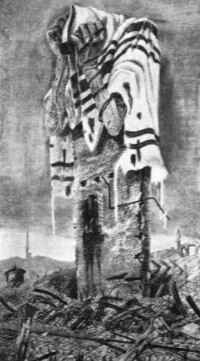
A picture by B. Linka, El Maleh Rachamim [God, full of mercy]
|
|
Published by
Edited by
Publishing House: “HaMenora”, 24 Zangwill St., Tel Aviv
Printer: “Arazi” Ltd. , 4 Ayelet HaShakhar St., Tel Aviv
[Page 1]
|
|
(The Book of Lamentations 1:12) A picture by B. Linka, El Maleh Rachamim [God, full of mercy] |
[Page 2]
[Page 3]
|
|
[Page 4]
[Pages 5-6]
by G. Kressel
Translated by Moshe Kutten
A new volume is now added to the series of “Yizkor” memorial books, which commemorate the Jewish communities of Eastern Europe–cities and towns destroyed by the Nazis and their Ukrainian collaborators, may their names and memory be erased. This particular book is dedicated to the long-established Jewish community of Kosov [Kosiv].
I confess that only a very slight remnant of direct familiarity with the town has remained with me, as one born in a nearby place connected to Kosov by bonds of friendship on the one hand and by family ties on the other. In truth, I visited Kosov only twice: once in my youth, and once again on a single-day tour during a visit to Galicia after I had already settled in Eretz Israel. On both occasions–now it may be said–emotions were stirred within me that are difficult to define, yet none so much as to awaken questions about the longing I had carried since childhood for Eretz Israel.
On our first visit, we were a group of boys and girls who made a trip to Kosov, on one of the summer days. In front of me was Eretz Israel, the one in my imagination and aspiration, and the one reflected from the letters I received from my sister in Eretz Israel, the first pioneer from my town, and one of the first pioneers of the Third Aliyah. Before me hovered an image of a rural, agrarian Eretz Israel–Hebrew in its daily life and Hebrew at its very foundation.
In youthful exuberance, we shouted with joy and even indulged in playful mischief through the streets of the town and its mountainous surroundings. I continually measured what I saw before my eyes against another landscape–human and natural–that beckoned to me from afar; no pen could describe its charms, especially for teenagers youths like ourselves. An entire day we struggled with parallels and comparisons between reality and imagination, and in my heart, I resolved: surely in Eretz Israel everything must be more beautiful and more splendid–above all because, in place of the “gentile” peasants, there would walk its fields our own pioneer-farmers, speaking Hebrew as the language of life and culture. For someone like me, Hebrew was a kind of holy madness, whose force tipped the scales decisively in favor of “there.”
About ten years later, I visited Kosov once more, again with a group of young people, but this time from my hometown in Eretz Israel–Petah Tikva. From an entirely different perspective, however, the town of Kosov in general–and its Jewish community in particular–revealed itself to me. Somewhere in my possession, there remains a photograph from that visit in 1936: a group of people, among them Neta Felix, our neighbor from Zabolotov, reclining on the grass
[Page 8]
on one of the slopes of the Horod. I arrived at the height of summer, and only two weeks earlier, I had felt on my own body a day's labor in the orchards of Petah Tikva during the month of Tammuz, when any trace of green is a miracle and a wonder. The greenery and the mountain plains, rich with trees and forests–stretching out before me in vastness to the point of cruelty–forced upon me a comparison with our arid landscape in the Eretz Israel, and my heart filled with boundless envy, as endless as the scenery itself.
For a brief moment, I reflected: here sit Jews who somehow earn their livelihood, and among them–even members of my own family in Kosov–there are those who had attained considerable prosperity. Indeed, they were Zionists, veterans of Zionist activity, active also in Hebrew culture and literature, and yet they did not want to move. My modest attempt to persuade members of my family to immigrate ended in utter failure, overwhelmed by the dazzling reality–so it seemed; mark this well.
Even we, the Eretz Israelis, could not have imagined–despite all our rejection of the Diaspora, the terrible dimensions of the Holocaust that was about to fall suddenly upon the House of Israel in the East, and in Kosov. And my sin I confess: from the depths of my soul there glimmered a thought of self-justification, a thought that took firm hold of me in the face of all I saw around me–a thought I shall not forget until my final moments. The greenery and the surrounding landscape were unmatched in gratifying an eye thirsting for such beautiful sights.
I returned to Petah Tikva, yet the image of “Kosov of the grass field” has never left my heart. For indeed, this landscape was far more than natural beauty–it was alive with memory and meaning. Even today, echoes of the Baal Shem Tov's presence are said to linger among the Hutsuls[1], with enduring legends–shared by both Jews and non-Jews–about the time of his activities in these breathtaking surroundings, a fitting stage for his spiritual blossoming. From the schoolhouse, the songs of the polonynas[2]–the vast mountain pastures–and the Hutsuls themselves still seem to resonate, forming the region's unique human landscape. But then came the Holocaust, which obliterated every trace of Jewish life; now, it is impossible to recall that environment without a sense of sorrow and curse, for it became the site of unimaginable horror.
Kosov enriched the surrounding region–including my own town–by providing both Admo”rs from the Hasidic Hager family and skilled Hebrew teachers, from the early figures like Finster to my own teacher and mentor, Sheps-Noah Heisler–the watchmaker from Kosov and our neighbor in Zabolotov. In Heisler's home, I discovered “Kol Aggadot Yisrael” by Levaner and received my first guidance in reading Hebrew from him.
[Page 9]
Caught between a heart's longing for Kosov and the curse invoked by the cruelty that extinguished its Jewish vitality–so deep-rooted and rich in tradition–the hearts of all are ensnared: whether natives of the town or mere passing visitors. The townspeople have each contributed, in their own way, to documenting its life–following their individual paths and personal experiences, whether on a grand scale or through a single, unique perspective. Throughout these pages, the unique character of this deeply rooted Jewish existence emerges, even though most contributors to this volume left Kosov while it was still vibrant with Jewish life.
Jewish Kosov still lives on in the memories of many–primarily among the last Jewish generation of the town. Future generations, particularly the distant descendants of its natives, may never fully comprehend or appreciate the unique and vibrant Jewish way of life that once flourished here. The wisdom of writers and the talents of artists seem modest when compared to the richness distilled within this humble, and often remote, shtetl. Readers of this book should keep this in mind and draw upon their own imagination. Yet, no embellishment can rival the genuine reality–seemingly plain, yet deeply infused with Jewish splendor and beauty.
Translator's footnotes:
by Avraham Tzvi Stein
Translated by Moshe Kutten
With the first reports of the Holocaust, the world was plunged into darkness for us. Was it possible that no Jews remained in Kosov? Our brothers, sisters, parents, and friends–all gone, perished, and vanished. Could it truly be, to the very last one? Yet, the world carried on as before. Here we are, living as usual, absorbed in our daily lives. How could this be? Is it possible that everything remained unchanged–the slaughterer slaughtered, the destroyer destroyed–and nothing was different? And all this in the heart of the twentieth century, an era that prides itself on its achievements in science and technology, and boasts of advanced social institutions, the overturning of old systems, and the reshaping of values in education, society, and philosophy. All this after decades of Socialism and international guarantees of human rights! After it had seemed we were progressing toward our own redemption, and that of all humanity.
Indeed, a horrific and unimaginable tragedy occurred–one beyond expression or comprehension. All Jewish communities across most European Diaspora countries, including the one in Kosov, were annihilated.
Before we knew whether anyone had survived who could tell us about the horrific tragedy that took place in our city, we received a written note signed Y.G.–our landsman, Yehoshua Gertner–in which he described the Holocaust events in Kosov. Later, we received word about the She'erit HaPletah[1], the few surviving dear friends–to our sorrow, too few–brands plucked from the German–Ukrainian–Polish hell.
We agreed then that it was essential to gather, unite, and organize–centered around a clear address–so newcomers would know where to turn. At our first meeting, held at the beginning of 1944, the following people participated: Dr. Yosef Meir z”l [of blessed memory], and, may they live long, A. Tz. Keren, Y. Gertner, M. Milboyer, Z. Toi, and A. Tz. Stein. It was decided to establish the Organization of the Natives of Kosov and its Surroundings, led by a temporary committee composed of those present. Dr. Meir z”l agreed–though not without hesitation–to serve as the committee's head, a role he held until the end of his days. A. Tz. Stein was appointed as secretary.
The first memorial ceremony took place on 24 Tishrei, 5,724 (12 October 1944). The event was deeply moving and emotional, with many attendees moved to tears. Nearly all of Kosov's natives
[Page 13]
residing in Eretz Israel participated.
Following the memorial ceremony, the existing committee membership was approved. Over time, the committee expanded, welcoming new members such as Dr. M. Simkha, who became chairman after the passing of Dr. Yosef Meir z”l–Dr. Y. Bertler and Khana Rosenbaum. Other members, including Sh. Drezner, B. Engler, M. Heisler, and Y. Shpigel also joined. Additional members were added in subsequent years. Initially, the committee decided not to collect membership fees and to focus solely on Holocaust-related matters in our town. The organization maintained free membership until Nisan 5721 [March 1961], when, in response to growing needs, it was decided to introduce membership fees. At that meeting, the following members joined the committee: Y. Winter, M. Zemora, M. Milboyer, M. Kaufman, Sh. Kalman, A. Krizel-Sdomi, and Y. Rikher. Ongoing expenses were covered by income from memorial ceremonies. When members required assistance, funds were raised through special collections among the membership. It is worth noting that requests for organizational assistance were rarely financial; most involved advocacy on behalf of the requester. In such cases, the committee relied primarily on its chairman, Dr. Meir Yosef z”l, whose influence extended to various institutions of the Yishuv.
|
|
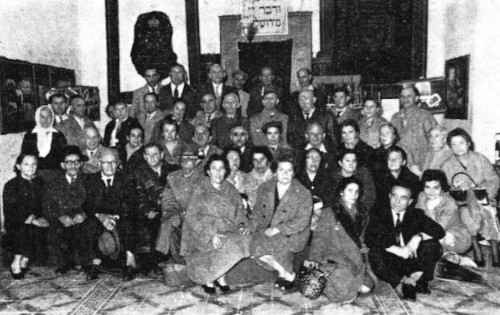
Kosov's natives in Israel, on the occasion of the unveiling of the memorial plaque to the martyrs of our city, on Mount Zion in Jerusalem
[Page 14]
The organization did not achieve extraordinary results. Its operational capacity was limited; however, it is important to note–without the fear of exaggeration–that the organization met expectations and fulfilled its intended role faithfully and efficiently.
In the earliest meetings–before any national conversation about Holocaust remembrance and before the establishment of “Yad Vashem”–two noteworthy proposals emerged. The first suggestion was to publish a book featuring photographs of individuals from our town, many of whom had dedicated their lives to public service. Would no memory of these remarkable individuals remain? The second proposal called for compiling a list of the martyrs and their properties, with the hope that a dedicated institution might eventually seek the return of stolen possessions from the perpetrators. Questionnaires were distributed to document the martyrs, their families, and their belongings. Unfortunately, neither proposal received the necessary attention, and neither led to concrete action. Meanwhile, various proposals for commemorating the destruction emerged within organizations of other communities, such as the establishment of cultural institutions and synagogues, and the writing of Torah scrolls. Thus, a synagogue in Kfar Saba was named after the Admo”r Rabbi Chaim of Kosov z.tz”l (may the memory of the Tzadik be blessed).
In the meantime, the idea of planting a “Forest of the Martyrs” was raised at Keren Kayemet LeIsrael-Jewish National Fund (KKL-JNF).
|
|
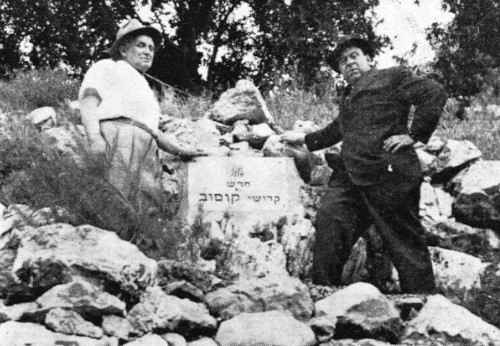
on the mountains of Jerusalem |
[Page 15]
We, the remnants of the Kosov community, for whom the KKL has been sacred since its founding, joined this commemorative project with all our hearts and souls. We managed to collect donations among our people in the country to plant a grove–approximately 1,100 trees–in which the émigrés from our city (Landsmanshaft) in America also participated, contributing about 20 percent.
And on the way to Jerusalem, between Tzora and Eshtaol, if you turn off the main road and make your way to the “Forest of the Martyrs,” you will find, among the other Jewish communities commemorated in this way, the name of our community: “Kosov Holy Community,” engraved on a marble plaque. The name of our community is also etched on a memorial plaque in the Chamber of the Holocaust on Zion Mountain.
Despite these memorials, we did not abandon the idea of creating a memorial book, though it ultimately took a form different from what we had first imagined. What began as an effort to memorialize individuals grew into a broader project: honoring the memory of the entire community–both its sacred and mundane aspects–within a single volume. We reached out to our members, inviting them to contribute material for the book. Sadly, only a small minority responded. Even those among us renowned for their writing skills did not answer our repeated requests until our esteemed colleague, Yeshayahu Horowitz z”l, stepped forward. He contributed his own recollections, inspiring others to follow his example, and at last, we were able to move ahead with the publication.
We recognize that this book does not fulfill all the requirements expected of a work of its kind. We are well aware that we have not fully reached the standard such a book should attain, nor the goal we set for ourselves. Ideally, the book would faithfully reflect the life of the community–its material and spiritual pursuits, its hardships and successes, the individuals who shaped it, and the creative energy present in its economic and cultural activities–if not for every period, then at least for recent times. While we have not entirely achieved this, we have made every effort possible.
All who read this book will catch only a glimpse of a Jewish community–vibrant with life, fiercely struggling for daily existence, actively participating in national revival movements, contributing to the survival of the Jewish people in the Diaspora, and ultimately sharing in its tragic fate.
Why do we do all of this? So that future generations will remember what we have lost, ensuring that the memory of our community remains alive in our hearts and those of our descendants. This book will stand proudly on the bookshelves in our homes and in the homes of those who follow. In years to come, it will be read, and they will know and remember what was done to us.
This is why this memorial book and all other commemorative endeavors are so important–they help us remember and ensure we never forget.
[Page 16]
For the same reason, it is necessary to preserve over the years the practice of holding memorial ceremonies from year to year, and of visiting the “Forest of the Martyrs” and the Chamber of the Holocaust on Mount Zion.
We must mention a big and important work carried out by two of our members, Yehoshua Gertner and Barukh Engler, filing Pages of Testimony in Yad VaShem for almost all of our city's martyrs, and by compiling the list of martyrs at the end of this book.
May all those who assisted in the publication of this book–whether materially or spiritually–be remembered for good, and may they all be blessed.
[Page 17]
Translator's footnote:
|
|
JewishGen, Inc. makes no representations regarding the accuracy of
the translation. The reader may wish to refer to the original material
for verification.
JewishGen is not responsible for inaccuracies or omissions in the original work and cannot rewrite or edit the text to correct inaccuracies and/or omissions.
Our mission is to produce a translation of the original work and we cannot verify the accuracy of statements or alter facts cited.
 Kosiv, Ukraine
 Yizkor Book Project
 JewishGen Home Page
Copyright © 1999-2026 by JewishGen, Inc.
Updated 12 Apr 2026 by JH