 |
| Akiva Laufer[a] |
|
[Page 345]
Translations by Seth Morgulas
[Page 346]
[Page 347]
|
|
|
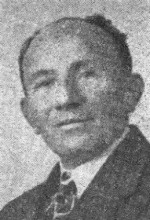
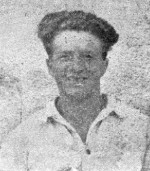
Our fellow townsman Akiva Laufer has always distinguished himself with his unyielding stubbornness and exemplary courage.
When the German hordes expelled the Gritze Jews from the town and sent them to the Warsaw Ghetto, Akiva Laufer fled into the forests. He joined a partisan group and fought the Hitlerite enemy until the end of the war.
Going through all seven circles of hell, Akiva Laufer understands that his only way is to immigrate to Israel. He indeed realizes his plan, just when he learns that all Arab armies have attacked our newly proclaimed State of Israel.
As we know, Akiva Laufer is mobilized into the IDF as soon as he sets foot on Israeli soil upon disembarking from the ship. He also fights heroically against the Arabs. Akiva Laufer took part in 28 military actions, and in the 29th action he fell as a hero, defending our fatherland.
Honor to his memory.
Original footnote
|
|
One of the most interesting and noble figures in Yiddish Gritz was Moshe Nisel Teitelbaum (Israel Stolar's son and Shlomo Essigmacher's grandson).
He distinguished himself with humility, a heartfelt and respectful attitude towards people in general, and especially towards relatives and friends. Whenever the situation arose where someone needed help or money had to be collected for charitable purposes, Moshe Nisel was among the first to donate, and often the chief organizer of many relief efforts. After the Second World War, when the Gritz compatriots in New York collected money to help the miraculously rescued Jews from Gritz, he was the first to give $500. This influenced other compatriots to participate in this very important campaign.
Anyone who knew him knows that Moshe Nisel was a warm-hearted Jew who hated honor. He gave many donations in secret. No one should know how much he donated and whom he helped.
Throughout his life, he participated in various aid institutions. Everywhere he became well known and everywhere he was appreciated as a good-natured and fine man.
On August 18, 1953, Moshe Nisel Teitelbaum died in New York. With his untimely death, the eternally dear and beloved friend, whom I knew from birth to death, passed away.
He left behind a wife, Rivka, and a daughter, Mindl.
On behalf of a group of close friends, Gritz compatriots, I express my deep sorrow and grief over the untimely death of Moshe Nisel Teitelbaum.
| May his memorial be honored |
|
Chairman of the Gritz Landsmanshaft
Yudel Pasternak Committee in America |
|
| Ester Bina Kaiser-Rochfeld |
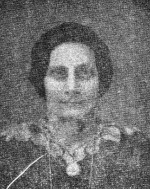
One of the most interesting female figures from the former Jewish shtetl of Mogielnica, near Gritze was the well-known Esther Bina Kaiser-Rochfeld (born in Gritze in 1876), or as some called her: Esther Bina Abraham Yidis.
Even while young, she already distinguished herself with wisdom and composure. Because of these two qualities, she soon became known in Mogielnica as soon as she arrived there. She was often asked for advice on various complicated family and business matters. And thanks to her good advice, she was given the name: “The wise Esther Bina.”
Her husband, Yosef Rochfeld, was also well known in the shtetl, where he played a significant role in social life: a devoted Mizrachi activist, a long-time chairman of the artisans' organization, a councilman, and a community overseer in Mogielnica. Their house in the shtetl, where they lived for 30 years, was well known as a meeting place for the most active Zionist activists. Almost all the most important decisions of the local Zionist organization were debated and dealt with in their home.
Their three children, receiving a national Jewish education, were
[Page 350]
also active in the Zionist organization, actively participating in all fundraising and political actions.
In 1932, the Rochfeld couple decided to immigrate to Palestine. They then sold their homes in Mogelnice and Gritze and departed for Palestine. In the early years, they lived in Haifa. However, imbued with a pioneering spirit and disregarding their age, they decided to go to a village and become farmers. Yosef Rochfeld quickly realized his plan: he, his son ltche Ber, and a few other initiators were the first builders – in 1936 – and founders of the village of Havatzelet HaSharon, near Netanya, where the Rochfeld family settled.
Esther Bina was privileged to raise three generations of Jewish farmers. She gave all her children a pioneering education. She instilled in them love for the Jewish people, love for Palestine, and, above all, love for working the land. She always taught them that we must break with the Diaspora life and become a normal, productive people who must independently sustain themselves from agriculture and their own industry. Imbued with this spirit, all her children followed the example of their parents: (even her daughters became farmers and cultivated the Land of Israel) SeriI Chaimovitz in Ein Zaytun, Itche Ber and Shurka in Havatzelet HaSharon.
It is also worth mentioning her sixteen-year-old grandson Mordechai (the eldest son of Itche Ber) who, in 1941, mobilized into the English army at the call of the Agency and served in the British Air Force until the end of the Second World War. He made good use of his military training and experience when the Arab armies attacked our young state, and he joined the Palmach, where he served wholeheartedly.
Mordechai displayed great heroism while participating in the “Breakers” battalion in military operations, on various front sections, and especially during the liberation of the Katamon neighborhood in Jerusalem. After the battles, the Jerusalem city president awarded him a military decoration for his courageous fight against the Arab Legion.
[Page 351]
The temperamental, combative, 27-year-old Mordechai Rochfeld tragically died in their orchard. He left behind a wife and child. This tragic event severely affected Esther Bina's already weakened health, making her even more broken. I used to visit her often to hear her interesting memories of the former Jewish life in Gritze. The last time I spoke to her was a few months before her death. Despite her already weakened health, she hoped to live many more years. She always used to ask me when the memorial book would be published – she was impatiently waiting to see the book. And suddenly, on Gedaliah 1954, we learned a sad piece of news: Esther Bina had passed away. She was buried in Chavatzelet HaSharon. At her burial, Israel Zander and Moshe Margalit eulogized her in the name of the Mogielnitzer compatriots in Israel; in the name of the family – her son-in-law Chaimovich and S. M. Ketler in the name of the “Organization of Gritze Descendants in Israel”.
| Honor her memory |
|
S. M. Ketler |
| Israel Diamant |
Israel Diamant, born in Gritze (Poland), the last survivor of a large Jewish
family, which was cut down by the Nazi oppressor. He went through the torment
during the Holocaust and immigrated to Israel. He joined the War of
Independence (Macha!) and was among the conquerors of Lod and Ramla and among
those who broke through the road to Jerusalem. And when the battles subsided,
he sought a way to take root in the country through honest labor. He rebuilt
his house that was destroyed by the Nazi Satan. Full of initiative, energy and
joy that finally his fate had improved, until – he contracted the flu and
consequently a severe heart disease. He wandered from his home to the hospital
and back again. He was full of pain and suffering, and he bore them with
courage, as he had since then. And one evening, when he returned as usual from
his work – which was permitted to him under severe restrictions – an
attack he did not rise from again.
With a look of gratitude, Israel parted from his beloved wife and neighbors, and that was it! As a man of tradition, he ended his life's story with the 'Shema Yisrael' prayer!
|
|
| Gershon Klein with the wife |
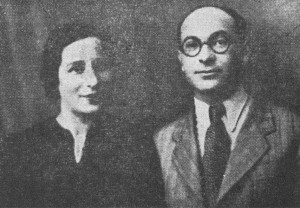
Gershon Klein was known in the town as a simple, humble folk-Jew, who was always ready to do a favor for everyone.
During the time of Hitler's reign, he managed to become acquainted with some higher-ranking German officials, and even with the head of the local Land Council. He only utilized these acquaintances for the benefit of the persecuted Jews. If a new decree against Jews became known, he had
[Page 353]
Gershon had no peace. He intervened, sparing no financial means or gifts, until he managed to alleviate the harsh decree somewhat, and sometimes to revoke it entirely.
He always resigned himself from his personal affairs and endeavored to help each and every one of the many wealthy Jews who found themselves in severe distress and turned to him for help.
After the resettlement of the wealthy Jews in the Warsaw Ghetto, Gershon Klein also remained in the town among the 83 Jews.
During that time, Jews who had roamed the Gritze area were arrested daily. Whenever Gershon learned of such an arrest, he put his life on the line until he managed to free the arrested. Once, the Germans caught a Jew with his three children. The arrested faced the death penalty. Gershon then put in a great effort until the father and the children were released and sent to the Warsaw Ghetto.
As we know, Gershon Klein also did a lot in the famous Passover campaign in Gritze in 1942.
The then specially established committee (Eliyahu Wasserman, Chaim Shael Gramman, Sh. M. Rozental, and Getzel Rotblatt) encountered enormous difficulties. It threatened that Gritze Jews would be left without matzah for Passover. They then turned to Gershon Klein to use his acquaintance in the Land Council.
Gershon indeed used all his energy and life experience until he obtained permission from the local supply manager, Nastayiske, who, of course, took bribes – gifts and money – to bake matzah. In addition, Gershon received 150 sacks of flour for the then official government price: 60 groszy per kilo. From this flour, matzah was baked, which was sold at low prices. The proceeds from the matzah were distributed to poor people, who also received matzah without money. Of the 150 sacks of flour, eleven sacks remained. The Passover Committee decided to hand over the flour to the city's 'Joint' kitchen, which distributed fifteen hundred lunches every day.
[Page 354]
It is worth mentioning that the “Joint” kitchen in Gritze was founded by the Joint activist Dr. Shlomo and was run by the following people: Yechiel Margolis – Chairman, V. A. Rapaport – Magazine keeper, Zechariah Zilberberg, Joseph Bramberg, Mendel Grintzweig, Sh. M. Rosenthal – Business Manager and P. L. Rosenthal as supervisor. The Joint, which supported the kitchen, also established a medical department there and sent clothes, laundry, coats and shoes. All this has contributed greatly to alleviating the plight of the poor Jews. Many achievements are still told about Gershon Klein. In general, the simple folk Jew has done a lot for a significant number of needy Jews.
May his memory be a blessing.
|
|
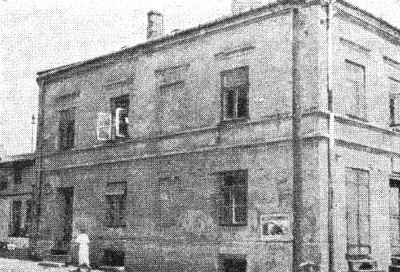
| The Ghetto House on the corner of Koshtchelne-Rinek |
[Page 355]
|
|
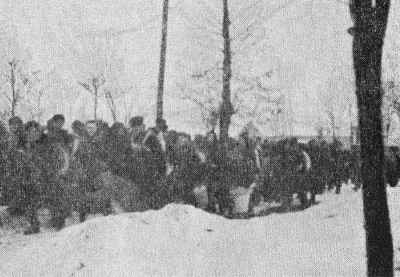
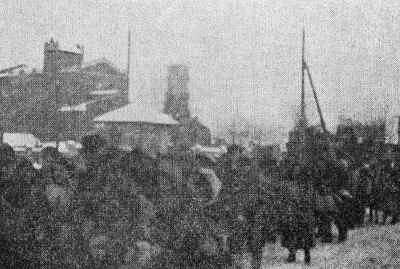
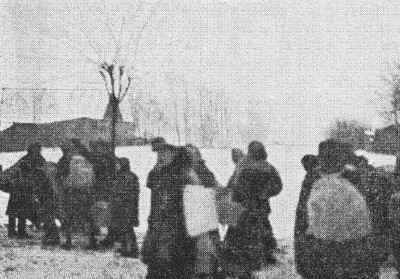
| Evacuation of Gritze Jews |
|
|
| Evacuation of Gritze Jews |
[Page 356]
|
|
| Resettlement of Jews from Gritze |
|
|
| Resettlement of Jews from Gritze |
[Page 357]
|
|
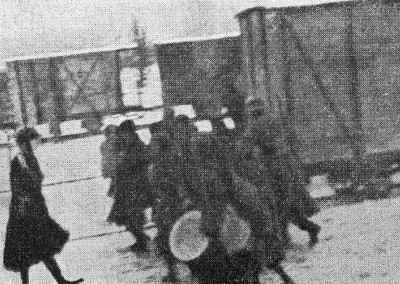
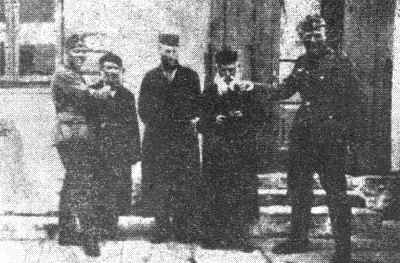
| German sadists mock the Jews |
|
|
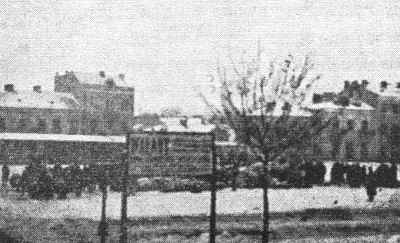
| The Gritze market |
|
JewishGen, Inc. makes no representations regarding the accuracy of
the translation. The reader may wish to refer to the original material
for verification.
JewishGen is not responsible for inaccuracies or omissions in the original work and cannot rewrite or edit the text to correct inaccuracies and/or omissions.
Our mission is to produce a translation of the original work and we cannot verify the accuracy of statements or alter facts cited.
 Grójec, Poland
 Yizkor Book Project
 JewishGen Home Page
Copyright © 1999-2026 by JewishGen, Inc.
Updated 24 Apr 2026 by OR