 |
|
[Page 313]
by Goldfarb, Paris
Translated by Seth Morgulas
The emigration of Gritzer Jews to France took place in three periods: before the First World War, and in the years after the Second World War.
In the first period, the general emigration flow from Poland to America and to the Western European countries was quite small. Despite the fact that the Jews suffered from frequent persecutions and the majority lived in poverty, they preferred to remain in the old homes rather than take the wanderer's staff and try to seek new fortunes in foreign, unknown lands.
Among those who decided to emigrate, however, there were many who dreamed of becoming rich quickly, and also those whom political and personal reasons forced to leave their homes quickly. During this period, a total of only a few families left Gritze for France.
In the second period, 1918-39, especially until the year 1930, the emigration of Gritzer Jews to France increased many times over. For various reasons, the Jewish youth at that time sought new homes. It was difficult for them to live in antisemitic Poland, where the Pilsudski regime prevailed and Jews were persecuted. Later, when the notorious “numerus clausus” was introduced in the universities, it was very difficult for the Jewish student to continue his studies. The Jewish worker also suffered a lot. The economic boycott caused unemployment. These and other decrees also affected the Gritzer Jewish youth, who emigrated to other countries and also to France.
The largest number of Jewish emigrants from Gritze arrived in France in the last years before the Second World War.
At that time, the Polish anti-Semites became very brazen. Hitler's rule in neighboring Germany encouraged the Poles-
[Page 314]
Jews then constantly lived in fear. At the same time, Jews in France enjoyed all democratic laws. Also, the living conditions of the working class were significantly better than in Poland. Nothing was known about Jewish persecution in that country at the time.
During this period, 34 Jewish families from Gritze came to France.
As soon as the Second World War began in Poland, the Jews of Gritze in France understood that their fate was closely linked to the fate of all Jews and to the fate of the entire country.
Indeed, many Gritze Jews voluntarily joined the French army, which initially fought so heroically against the Hitlerite forces. Even after France's capitulation, Gritze Jews actively participated in the underground movement and also took part in the partisan battles against the German occupier.
Many of the Gritze Jews who were then deported to various places were murdered by the Nazis. The Gritze Jews who survived owed it to the friendly and humanitarian assistance of the French population.
After Germany's capitulation, the surviving Gritze Jews began to live again. The deported also came back home. came.
At that time, some newly established Jews from Gritze appeared in France. Among the new immigrants were those who could not stay in post-war Poland, where every span of land was soaked with Jewish blood. Some Gritzers came to France to look for a family member or to reunite with the family.
Today there are approximately 45 Jewish families from our former Gritze in France.
by L. Kulia
Translated by Seth Morgulas
After the final destruction sad greetings reached us from our destroyed home,Gritze. On December 2, 1945, the Gritze compatriots gathered.
[Page 315]
A board of the Polish association was elected, consisting of the following members: W. Kukulka – Chairman, Zalman Messinger – Vice-Chairman, Leibel Kulia – Secretary, Rafael Braun, Chaim Feiertag – Treasurer, and board members: L. Boxer, Chaim Goldberg, N. Artman, M. Schultz, A. Friedman, and Ch. L. Bromberg. The board undertook to carry out two tasks: to find the rescued Gritzer Jews and to help all those in need of financial support. We then turned to various Jewish institutions, asking them to send us lists of the rescued Jews. We received the first list from the “Joint”. It turned out that some Gritzer Jews lived in Sweden and were rescued thanks to the International Red Cross.
We immediately sent them one hundred dollars, food and clothing packages. In
March 1946, we received the first letter from Poland. The Gritzer Jews
described to us the destruction of Gritze and enclosed a list of 200 surviving
compatriots. After receiving the letter, we immediately sent them sixty
kilograms of food. After receiving a confirmation and thank-you letter from
them, we began to regularly send packages of food, clothing and laundry to
Gritze. Afterwards, we learned that the surviving Gritzer Jews lived in various
Polish towns. Wanting to have individual written contact with each one, we advertised in the
Yiddish newspaper “Das Neue Leben”, which appeared in Łódź.
In the advertisement, we asked all Gritzers, wherever they were, to contact our
As soon as the announcement was published in the newspaper, many Gritzers turned to us, asking for help with money, food, clothing, and also to create emigration possibilities to leave Poland, where the surviving remnant Jews rescued by the skin of their teeth were still being murdered daily on the Polish roads, trains, and in homes. Packages were sent to all those who asked for support. Our committee tried to obtain entry permits for our compatriots. To our great regret, we encountered very great difficulties. The immigration law thwarted all our plans. We were only successful in receiving entry-visas to Paraguay for two families.
[Page 316]
This also cost us a considerable sum.
When we received a letter from Łódź that the Gritzer Jews wanted to carry out the exhumation of the two hundred Jewish martyrs who were buried alive by the Nazi beasts in the village of Chinov, near Ger, we sent them $200.
After the proclamation of the State of Israel, we learned that many Gritzer Jews from the DP camps in Germany and Poland had immigrated to Israel. Our committee found out their addresses, and everyone who asked for help (even those compatriots who had lived in the country for many years) was sent food packages. The Gritzer Landsmanschaft Committee also received 200 pounds to distribute to the needy Jews of Gritze.
Our L. L. Association also collected significant sums of money from Gritzer Jews in Argentina, which were distributed to various social, cultural, and aid institutions: Jewish schools, for the memorial book of the printers in Poland, for the Ghetto Monument in Warsaw, for the Seven Million Campaign, for the “Ya'ar Herzl”, “Magen David Adom” and other institutions.
Every year we organize a memorial evening at the monument that our community built in the cemetery in memory of the six million martyrs. In 1948, our committee published a bulletin in which the Gritzer compatriots published their memories.
We also organize artistic evenings, excursions (to the place where our compatriots, the Freitag brothers and sisters, live), collective visits to the theater and cinema. All this is done in order to carry out the fundraising campaigns, which aim to help our compatriots.
In 1945, we collected 8000 pesos on New Year's Eve. In 1947, 10,000 pesos were collected. In the year 1950, 10,000 pesos. In 1954 we went on an excursion to the farm. Of the Gritzer Jews: the Feiertag brothers and sisters. At that time, ten thousand pesos were collected. We also collected new and old clothes and laundry. Receiving the first greeting from our L. L. in Israel, that they had decided to publish a memorial book, the news pleasantly surprised us all. We immediately greeted them and founded a special committee,
[Page 317]
which immediately printed an appeal and sent it to all countrymen. Our committee contributed to the book with the significant sum of one thousand pounds.
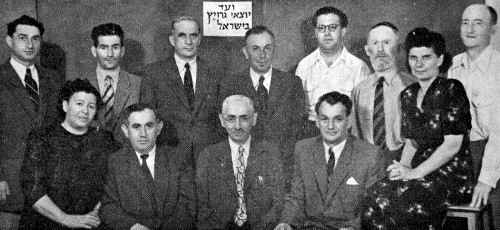
The following persons belong to the management of the Gritzer
|
|
| Gritzer countrymen in Buenos Aires at the symbolic grave of the six million Jews |
by Shaul Maltz
Translated by Seth Morgulas
The “Gritzer Landsleit Society,” as it is called in America, was organized in 1921 with 15 founding members. In that year, our countryman Yankel Goldberg traveled to Gritze for a visit. When he returned to New York, he invited some Gritzer countrymen to a restaurant, for whom he described the great distress and poverty of the Jews in Gritze. He emphasized that the Gritzer Jews needed an address to turn to for support. There should be an organization to whom one can write. An organization can accomplish more than individuals.
One must know that there was a great inflation in Poland at that time. It was shortly after the Soviet-Polish war. The marks were devalued. The money had little value. The need and hardship among the Gritzer Jews was very great. The city committees in Gritze, such as the “Linat Tzedek,” “Maot Chitim,” “Beit Lechem” and others, did not even have an address to turn to for help. The 15 “Gritzer Landsleit” decided to found the “Gritzer Society.”
At that time, Mr. Cronenberg was still alive, who helped with great dedication in the organization of the society.
The aims of the society were: to create an emergency fund in order to support the Jews in Gritze and also Jewish institutions in America, to hold regular meetings twice a month.
From the first days, from the founding until today, many world events have taken place. During the period of the Second World War, almost all the Jews of Gritze perished. The “Gritzer Society” became and remained an address for the surviving Gritzer in all countries. Members of the second generation of Gritzer, who were born in America, join the organization, as well as refugees from the concentration camps who were rescued and came to America. Therefore, a great revival began to be noticed in the work of the Gritzer Landsleit.
[Page 319]
In all these years that the Gritzer Society has existed, it has responded to all requests from the Gritzer Relief Committees.
Before me now lies the archive of all the letters that the Gritzer Relief Committees wrote over all these years until 1939. Jacob Maltz, the long-time secretary of the Gritzer Society, collected and maintained the archive.
The archive can be divided into the following categories:
These documents may be nothing more than names of people and dry numbers for the strict historical researcher. But for us, this means a lot more. Every name of an aid recipient reminded us of a person with a pained heart, with tearful eyes. And receiving free medical treatment and prescriptions from Linath Zedek for every patient was like a bright ray in their days bereft of hope. The same is true of the lists from Bethlehem. Every name that was recorded as having received 50 pounds of potatoes and several pounds of matzah screams at us with the mournful cries of need and poverty. And all the letters appealing for help shout out the writers' great, mournful cries of need and pain…
Here is an excerpt from such a letter, sent out from Gritzer Linath Zedek on 5.1.37 and signed by the following: (on Linath Zedek printed paper and accompanied by the Linath Zedek stamp).
President: Meir Yirchmiel Moller
Secretary: Aharon Yudel Friedman (murdered by the Nazis).
Treasurer: Berl Ambaras.
President of the Revision Committee: Shlomo Hammer.
And this is the text:
[Page 320]
…are you the good Messiah who, with your hard-earned money, will become the Angel Raphael and heal fifty Jewish poor, sick children. May our fervent prayer for the poor, sick children enter your ears.
In 1935, a women's division was organized within the Society, which helped raise significant sums of money. This relief campaign lasted throughout the war years. Everyone who needed help received it.
In the years 1938-39, the requests for support became even more heartbreaking, and the reasons are known to all. It was the rise of Hitlerism, and Poland was also strongly influenced by this bloodthirsty antisemitism. The result was that the Jews in Poland became very impoverished.
The Gritzer Society responded to all these appeals. The Gritzer doctor, who settled in America at the beginning of the war years, also helped a lot.
It should also be mentioned that in the early thirties, the esteemed Gritzer Rabbi, may his memory be a blessing, visited America. The Gritzer countrymen received him as befits such a distinguished guest.
How did the Gritzer countrymen react to all these requests? Until 1938, i.e., until Moshe Kleinman's death, the Gritzer Society supported all the committees with a sum of 3 to 4 hundred dollars annually.
When Moshe Kleinman was on his deathbed, he asked Meir Rubin for a commitment that the Gritzer Society would continue its relief work. Meir Rubin solemnly promised him this, and the Society fulfilled Moshe Kleinman's will and collected money for the needy in Gritzer. There are letters in the archive until mid-1939, and after that, it became silent… everything was so terribly cut off.
The majority of the Gritzer countrymen in America are workers. Despite this, they collected huge sums at that time. The Gritzer Society used the following means to raise the money:
In 1945, at the end of the war, relief activities were renewed.
[Page 321]
On a very large scale. It was necessary to help the suffering compatriots in the camps and in the transit countries. Packages of food and clothing were sent to everyone who requested it.
With Dr. Zomerstein at the head. Our fellow citizen Mark Bitter from Gritze also belonged to the committee.
The Gritze Society then called several special meetings, at which a sum of around 16 hundred dollars was raised. The money was sent with Mark Bitter to Gritze, so that he could help settle the rescued Jews who had returned to Gritze after the Holocaust. But unfortunately, according to the latest reports, it was not possible to settle our compatriots in Gritze, where the murderers killed our beloved Gritze Jews. May the book “Megilat Gritze” be the monument to our dear Gritze Jews who were martyred for God. May their names be mentioned with holiness. May God avenge their blood.
In 1946, there was in America the Committee of Polish Jews
|
|
|
The administration of the Gritze L. L. Association in Argentina
Seated from right to left: Batya and A. Grinfarb, Sh. M. Ketler (chairman),
Genia Rinkevitch, Y. B. Alterman (editor)
Standing from right to left: Y. Dresner, Y. Hammer, A. Lenga, A. Rechtman, Y. Rinktuvitch Missing: Engineer M. Kelmanzon, M. Ostvind |
[Page 322]
|
|
|
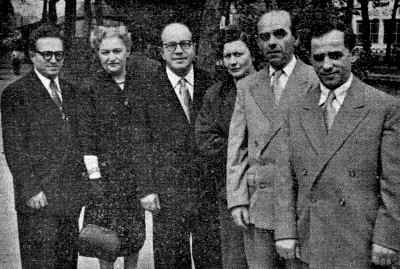
From left to right: Abraham Goldfarb, Rachel Lenga, Joshua Rachfeld, Pearl
Pint, David Miller, Shlomo Goldberg
|
|
|
|
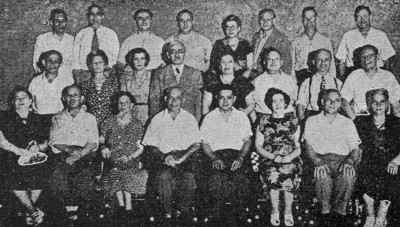
Seated from right to left: Mr. and Mrs. Ben Becker, Chaya Bittner, Jacob
Lerner, Abraham Merker, Mrs. and Mr. Louis Weintraub, Mrs. Sam Weintraub
2nd row from left to right: Izzy Becker, Samuel Schwartz, Berl Bittner, Taube Lerner, Peretz Lerner, Esther Lerner, Mrs. Y. Fitel, Sam Weintraub 3rd row from right to left: Mr. Skolky, Jacob Stalower, Mr. and Mrs. Morris Kurtz, Ben Lerner, Moshe Lerner, Jacob Fitel, Mr. Abrams |
(Association of Grójec Compatriots in Israel) – Aid Campaigns for War Refugees from Grójec
Before the official establishment of our association, some compatriots collected small sums of money from time to time for Grójec Jews who arrived in the country.
During the war years 1942-1943, a group of compatriots in Israel received letters from Grójec residents who lived in the Soviet Union at the time. The letters described the situation of the Grójec refugees and requested help for them. This was the first reason for us to come together and address the sad situation of the Grójec refugees, who are in different countries and also in Russia. At the first meeting, it was decided to establish an official organization and organize a wide-ranging aid campaign within the framework of the then-prevailing conditions.
This decision was immediately recognized by almost all Grójec residents in the country as very necessary, and several social and Zionist activists from Grójec even actively participated in the realization of the plan.
A few weeks after the aforementioned meeting, on October 2, 1943, the first official founding meeting of our Landsmannschaft took place in the premises of “Hitachdut Olei Poland”. The following Grójec compatriots participated in the meeting:
A. Grinfarb, Grinfarb Batia, Sh. M. Ketler, Y. Lenga, D. Yakub, A. Rechtman, Sh. Bran, W. Kula, D. Freidenberg, L. Hershberg, M. Hershberg, Yaakov Rinkevich, his wife Genia Rinkevich, A. Rappaport, Sh. Goedberg, A. Lenga, H. Tzadok, A. Shulzinger, M. Eisenberg, Rosenblum-Sashkovich, and others.
After discussing some current issues, and mainly the situation of the Grójec survivors who are abroad, we decided to establish an official “Organization of Former Residents of Grójec” with the aim of primarily supporting all needy Grójec compatriots who are in various countries and even poor Grójec residents who live in Israel. In order to realize this action, it was decided that every Israeli
[Page 324]
member of the Landsmanchaft must contribute a larger donation. Every organization member must also commit to a certain monthly fee for the organization.
At the meeting, an administration of five people was elected: A. Grinfarb, V. Kula, G. Rinkevich, A. Lenga, and Sh. M. Ketler. The following were elected to the Auditing Committee: Sh. Brown, A. Rechtman, and D. Freidenberg.
The newly elected administration successfully carried out several aid campaigns. During that time, the administration decided to establish branches of the “Organization of Former Residents of Gritze” in Jerusalem and Haifa. In order to realize this decision, Mr. Y. Rinkevich was delegated to go to Jerusalem, and Mrs. Genia Rinkevich, together with Mr. Sh. M. Ketler and Batia Grinfarb, committed to organizing the branch in Haifa. The Gritzer compatriots in Haifa indeed received the proposal positively, and 15 pounds were collected at the founding meeting. In addition, everyone committed to paying the monthly membership fee.
After the establishment of the branches, the organization leadership further intensified its work. It was then decided to connect with the Gritzer Jews abroad. Despite the terrible war raging and encountering enormous difficulties, no time and effort was spared to learn about the fate of the Gritzer Jews who, due to the war and the German persecutions, had fled to various countries, especially to Russia. Not all of our efforts were unsuccessful, however: on February 15, 1943, the administration sent a telegram to the editor of the Yiddish newspaper “Eynikayt” (Unity), which was published in Moscow. Through the newspaper, we appealed to all Gritzer refugees living in the Soviet Union to write to us about what they needed. Being convinced that all the answers would be that they needed help, we started collecting money and continued the daily organizational work in the meantime. The diversity of the work demanded that the administration officially constitute itself: on November 20, 1943, it was decided at an administrative meeting that the organization's chairman would be Mr. V. Kula, the treasurer – A. Grinfarb, and Mr. Sh. M. Ketler took over the secretarial work.
[Page 325]
At the beginning of 1949, many letters began to arrive from Gritze Jews who, in 1939, had fled from Gritze to Russia. Becoming more or less acquainted with each person's particular situation, we answered each one with a letter of comfort and sent a food package. More than a hundred packages of food, clothing, shoes and other items were sent out at that time. This action was not an easy one, the members worked with extraordinary dedication. Special mention should be made here of the administration member Genia Rinkewitsch, who took a particularly active part in the campaign and collected products, money and clothes. Almost all Gritze Jews sent us back thank-you telegrams and heartfelt thank-you letters for the support and even more for our interest in their situation. This encouraged them, strengthened them, awakened hopes that somewhere there are their relatives who are concerned about their situation and are ready to help them.
After the Second World War, we learned about the great disaster: the Jewish community in Gritze was completely liquidated and all the Jews of the town, except for a small handful, were tortured and gassed by the Germans in various camps. The ever-increasing news of the Jewish catastrophe completely shocked us. Together with the entire community, we mourned our tortured parents, relatives and friends and we decided to activate all our forces in order to help those who had been saved alive from the Hitler murderers. We immediately set out, first of all, to find the surviving remnants of the Gritze Jews. The organization secretariat sent letters to Gritze compatriots in various countries and asked them to help search for the surviving Gritze Jews who had gone through the Hitlerist hell and also those who had returned from Russia. We constantly searched for names of Gritze Jews in the lists that were published in the newspaper of the Jewish Agency and listened to the radio communications of “Kol Yerushalayim.” An appeal was also sent to the Gritze Magistrate and letters to ordinary known Poles, from whom we asked to send us information about surviving Gritze Jews.
We received the first greeting from our town's Jews from several Gritze Jews themselves, who lived in Gritze. Receiving
[Page 326]
from them, the first letter, we immediately sent them eight valuable packages (no money was allowed to be sent at that time). As soon as we received a response that they had received the support in the best order, we steadily helped them.
At that time, a warm greeting was also received from the Gritze Jew, our countryman Koppel Zanger – Israel Zanger's son – who served in the volunteer Jewish brigade of Israel, returned to Israel. Being in Germany, he traveled specifically to Gritze to see what the shtetel looks like without Jews: From Zanger, we heard for the first time an exact description of our destruction in Gritze, where he met a total of a few Jews.
We received more and more letters and written requests for help from the Gritze Jews. Also, immigrants begin to arrive in the country, who immediately needed urgent financial support. This required colossal efforts. It was decided to activate more countrymen who should participate in raising funds, and in general it became necessary to reorganize the entire main work once again, which should be adapted for larger tasks.
In January 1946, a general meeting was arranged with the participation of a significant number of countrymen. After hearing the financial and general activity reports, a new board was elected from the following members:
L. Rechtman – Chairman, Sh. M. Ketler – Vice-Chairman, L. Greenfarb – Treasurer, Moshe Astwind – Secretary, David Freidenberg and Hammer – Auditing Committee, Shlomo Braun and Genia Rinkewitsch – Committee Member.
The new administration energetically set out to activate the entire organization work. One of the most important tasks at that time was to get in touch with Gritze Jews in all countries and answer all received letters.
Lists with 150 names of miraculously rescued Gritze Jews were sent to all Gritze countrymen's committees in various countries. We asked the committees to also participate in helping our countrymen. We were increasingly faced with ever greater tasks:
[Page 327]
Larger groups of Jews from Gritze began to arrive in the country. In a very short time, over a hundred families had immigrated.
Their economic situation and the need to help settle the immigrants demanded immediate, energetic actions from us. The administration then decided that Mr. S. M. Kettler should take over the leadership of the organization. After tremendous efforts, significant sums of money were collected, which were lent out and partially donated to new immigrants who needed to settle in. Great was the effort. But we carried out all actions successfully.
Yizkor Book “Megilat Gritze”
When Y. B. Alterman arrived in the country in September 1949, he, in a conversation with Comrade S. M. Kettler, related that while still in the Jewish D.P. camps after the war, he had begun collecting testimonies from Gritze Jews who lived in Stuttgart, Mittenwald, and Feldafing. He expressed his wish to continue this work in Israel, so that the once vibrant life and the tragic destruction of the Jews in Gritze would be immortalized for generations. At the same time, he asked Mr. Kettler that the committee take over the initiative to publish the Yizkor Book.
Mr. S. M. Kettler discussed the proposal at an administrative meeting. The committee members reacted negatively to the entire “fantastic” plan and did not believe that it could ever be realized. The only one who reacted positively to the matter was Mr. S. M. Kettler, who in 1950, on a certain autumn evening, convened a special meeting of the administration in the “Rambam” cafe (Tel Aviv), at which the question of publishing a Yizkor Book was discussed.
The following compatriots participated: A. Rechtman, S. M. Kettler, Hammer, A. Lenga, A. Grunfarb, S. Brown, J. Dresner, S. Zilberstein, Y. B. Alterman, and others.
Mr. S. M. Kettler reported on the necessity of publishing a book that would remain for generations as an eternal monument to our destroyed Jewish community in Gritze.
Then a very interesting discussion developed in which
[Page 328]
almost all the management members participated, who spoke positively for the proposal, despite the fact that they also foresaw the enormous difficulties. The proposal to publish a memorial book was accepted by a majority vote.
After we committed ourselves to publishing a book and, also, the day-to-day work, which at times demanded ever greater efforts, it became necessary again to reorganize our organization.
On 30.10.50, a new board was elected at a general meeting: Sh. M. Ketler – Chairman, A. Grinfarb – Treasurer, Hammer – Secretary and Board Members: M. Himelfarb, A. Freed and Lenerman from Haifa, Genia Rinkewitz and Shlomo Braun from Tel Aviv, and from Jerusalem, the compatriot Brumer joined the board.
The Board, at its meeting, decided to organize a fundraising campaign, which would have the double purpose: to immortalize the Gritzer Jews who perished at the hands of the Nazis and also to give constructive help (loans) to all those Gritzer who will need it.
This decision was supported by almost all Gritzer Jews in the country and abroad.
At that time, H. Peretz Lerner, may he rest in peace, who was from Magelnitze (a town near Gritze) and was then living in Kansas City, was living in Israel. After H. Peretz Lerner became acquainted with our aid activities and plans, he donated 333 pounds to the Qrganization, which was collected from Gritzer compatriots in Kansas City. His visit greatly encouraged and strengthened us to realize all the plans. A short time later, however, we received very sad news from America: Peretz Lerner had died. His sudden death caused sadness and pain to all of us. We knew that a devoted friend, a precious Jewish heart, had been taken away from us, may his memory be blessed!
We later received very devoted friends from abroad who encouraged us in our work.”
The Hill family from America visited us at that time. Getting acquainted with our relief work, they contributed a lot to ensure that our campaigns would be crowned with success. We have also been visited by a very
[Page 329]
Honored guest: The chairman of the Gritzer Landsmanshaft Association in Argentina, Mr. Zalman Messinger, and his wife.
Becoming acquainted with our beneficial aid activities and with the plan to memorialize the Jewish community in Gritze, he promised to help us. The Gritzer Landsmanshaft Association in Argentina was indeed the first organization to send materials and money for the book. In 1951, the organization officially joined in to realize the publication of the book. At a board meeting, a book committee was elected from the following persons: Sh. M. Ketler, Genia Rinkevitch, Jacob Rinkevitch, A. Grinfarb, A. Lenga, Rechtman, Y. Hammer, Sh. Zilberstein, Y. Dresner, engineer M. Kelmanzon of Haifa, and the editor of “Megillat Gritze,” Y. B. Alterman. In order to popularize the importance of publishing
|
|
|
The administration of the Gritze L. L. Association in Argentina
Seated from right to left: Batya and A. Grinfarb, Sh. M. Ketler (chairman),
Genia Rinkevitch, Y. B. Alterman (editor)
Standing from right: Chaim Leizer Bromberg, Rafael Bran, Leizer Boxer, David Shmeter Missing: Chaim Goldberg Standing from right to left: Y. Dresner, Y. Hammer, A. Lenga, A. Rechtman, Y. Rinktuvitch Missing: Engineer M. Kelmanzon, M. Ostvind |
the book, the committee organized an impressive cultural evening, which took place on 8.4.51 in Tel Aviv, at 21 Sheinkin Street in the cafe “Asher”. The very solemn evening was opened by Mr. Sh. M. Keller who
[Page 330]
greeted the esteemed guest from America, the young talented painter David Hammer (son of Abraham Moshe Hammer) and Genie Rinkewitsch, who returned from a visit to America and conveyed a lively greeting from the Gritze residents.
After reading Y. B. Alterman's reportage A. N., “Early Morning on the Danube,” a special appeal was distributed with a request to send more materials for the memorial book.
The cultural evening made a good impression on all participants, and immediately afterwards the book committee decided that Y. B. Alterman and Abraham Lenga should travel to the Gritze residents and collect testimonies for the book.
|
|
| Y. B. Alterman reads his reportage “Early Morning on the Danube” |
As the testimony collectors recounted at the time, there were some who simply did not want to, some could not, tell anything about that sad period. For this reason, it should be noted to their credit that the first compatriots who warmly and cordially welcomed our messengers were the brothers Yosef and Abraham Yaakov Ha-mer and Hendel Weigensberg from Tel Aviv-Jaffa. From them – Y. B. Alterman then recounted – I learned very important facts about how the Gritze Jews lived under Hitler, after I left the town at the end of November 1939.”
Afterwards, H. Y. Bitter was visited, who retold
[Page 331]
based on the aforementioned facts and also conveying his experiences from the first roundup, which took place while the Jews of Gritze were being driven out of the town, on Wednesday, September 13, 1939, and they were driven in groups and transported to Germany. Very important episodes and experiences were recounted by the countrymen: Y. Dresner and Israel Diamant, may his memory be a blessing.
Based on personal experiences and testimonies, Y. B. Alterman wrote the “Holocaust” section of the memorial book “Megillat Gritze.” After completing the work, Y. B. Alterman requested the book committee to convene an official meeting of the book committee and all the countrymen who had recounted facts and experiences. The reason for Alterman's request was: since some countrymen doubted the accuracy of certain facts, it was necessary for all the material to be read out in order to establish every fact and event described in the chapters of “Holocaust” in everyone's presence.
The committee agreed to the proposal, and on Shabbos, December 13, 1952, the first “study day” was organized in the apartment of Yosef Hammer in Jaffa, in which the following participated: some representatives of the committee “Organization of Emigrants from Gritze,” the book committee, and persons who had lived in Gritze during the period when the Nazi regime reigned, and at the same time recounted their experiences. For those assembled, Y. B. Alterman read the chapters that he had written based on testimonies and his own experiences while he was in Gritze. The sad chronicles of how the Germans desecrated, tortured, and expelled our parents, relatives, and close ones from the town were listened to with great attention. Every fact or event that was suspected of being incorrect was questioned of everyone, and in the end, an official confirmation protocol was written, stating that all facts, experiences, and descriptions were authentic.
The protocol was signed by the following Gritze countrymen: Israel Diamant, may his memory be a blessing, Yosef Hammer, Yaakov Hammer, and Yehoshua Blanke. After the study day, the book committee decided to print the book. However, we encountered great difficulties. The main thing is
[Page 332]
it was difficult in Israel to raise the necessary sum that such a publication would cost. We had to temporarily restrain ourselves and wait. From then until the actual publication of the book, many important documents, materials, and pictures were obtained, which reflect Jewish life in Gritze during the time of the First and Second World Wars.
|
|
|
First row from the right: D. Friedenberg, Sh. M. Kettler, A. Grinfarb,
G. Rinkevitch,
V. Kulia, A. Rechtman, Sh. Brown |
|
|
|
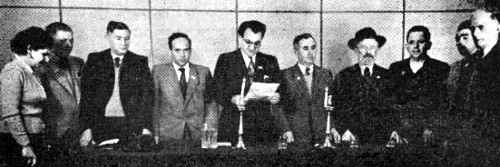
Presidium of the memorial gathering in Tel Aviv
The chairman reads the names of the deceased Gritze Jews in Smolensk.
From right to left: A. Rechtman, Y. Dresner, Y. Hammer, Sh. Brown, A. Grinfarb,
Sh. M. Kettler, Y. B. Alterman, H. Cincinnatus (representative of the JNF), Sh.
Zilberstein, Genia Rinkevitch
|
[Page 333]
Memorial Gatherings
Our organization was one of the first Landsmanshaft organizations in the country to introduce the custom of arranging annual memorial gatherings. We have maintained this tradition since 1945. Every year, we organize such gatherings where the surviving remnants of the Jewish community in Gritze gather and mourn the martyred victims of Gritze. These gatherings also serve to remind us of the past youth life. We meet former friends, acquaintances, and generally reminisce about the Jewish life that the German murderers so brutally liquidated.
General Relief Work
Since the “Organization of Emigrants from Gritze” existed, the administration has constantly been involved in helping needy Gritzer compatriots. Of course, we have not always had the financial means to satisfy all the wishes, which were sometimes a bit exaggerated. But we have always made the maximum effort not to refuse anyone, even those who fought our activity. We would certainly have given more details, which would reflect our wide-ranging relief work. Unfortunately, this is a bit difficult. The framework of this report does not allow it. However, it is worth emphasizing that since the “Organization of Emigrants from Gritze in Israel” has been active, we have given out aid and loans, in addition to the packages to Russia, of more than three thousand pounds. Recently, since we decided to use all our income for the memorial book, we are trying to help our compatriots with loans in various banks. We hope that after completing this book, the relief work of the secretariat will be strengthened again.
[Page 334]
|
|
|
[Page 335]
|
|
|
Sitting from right to left: Genia Rinkevich, S. M. Kettler, Peretz Lerner, may his memory be a blessing, Arieh and Batya Greenfarb Standing: Y. Rinkevich, Brown, M. Ostoynd, A. Lenga, A. Rechtman, Y. Dresner, P. Hammer |
[Page 336]
|
|
|
Seminar held on August 15, 1953
From left to right: A. Hershberg, Miriam Schlamberg-Margalit, A. Greenfarb, Sh.
M. Ketler, Y. B. Alterman, Yosef Hamer, A. Rechtman, Y. Drenner, Weinberg, Mrs.
Alterman, David and Mrs. Freidenberg, Mrs. Finkelstein, A. Lenga, Rama
Lipshitz-Alberg
Missing: Meir Himmelfarb and Y. Diamant, of blessed memory |
[Page 337]
|
|
|
A meeting of Gritzer countrymen in Haifa for the benefit of the book
Participants from the right: Joshua Fried, Pinchas Wiskott, Aryeh Rothauser,
unknown, Zvi Fried, Meir Offenberg, Himmelstein, Zehava Stern, S. M. Ketler, A.
Fried, A. Gruenfarb, Miya Vierushbitzke (Baruch) Berl Naftali, Chana
Himmelstein, Chana Greenbaum and Yair Himmelstein
|
[Page 338]
|
|
|
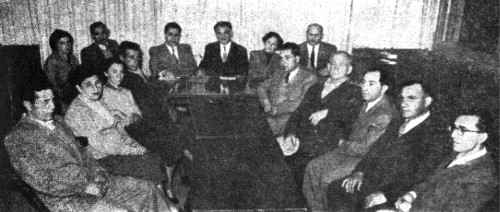
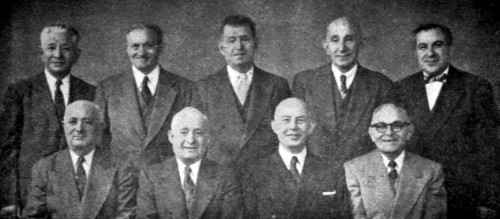
Gritzer Society (Landsmanshaft) Committee in New York
Standing from the left: Abe Goldberg, Sam Golombek, Joseph Schatz,
Abe Bernstein, and Ray Rothman
Sitting from the left: Harry Silver – Financial Secretary; Izzy Berger – President, Meyer Rubin – Secretary, and Sam Hiller |
[Page 339]
|
|
|
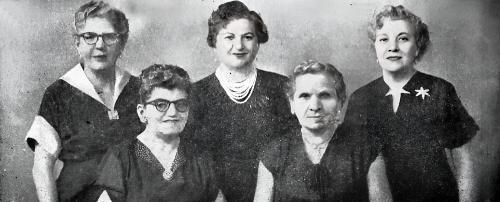
Women's Committee at the Landsmanshaft Organization in New York
Standing from the left: Ruth Goldberg, Blanche Rothman, secretary, and Paula Berger
Sitting from left: Becky Silver and Lena Kleinman, chairperson
|
[Page 340]
|
|
|
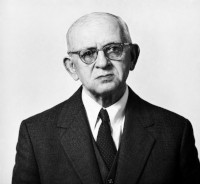
Protagonist of the
Gritzer (Society) Committee in America, Yudel Pasternak. Longtime activist and devoted communal worker. |
|
|
|
Shaul Maltz, Gritzer compatriot, author of several books of poems, accomplished cultural worker in America. He has done much for the benefit of the book. |
[Page 341]
|
|
|
A group of school activists
Standing from the right: Matcher, Moshe Gelbardt, Ruzha Dryer, Rivka Zeifman,
Tepper, Zlatagurska, and Miriam Alterman
Second row from the right: Devorah Dryer-Bramberg, Dr. Natan Baum, Yosef Tepper, Berel Zilberstein Sitting: First row from the right: Chaim Mordechai Neiman, Yosef Bramburg, Zechariah Zilberstein, Yaakov Opatovsky, and Hershel Finkelstein |
[Page 342]
|
|
|
A group of Zionist activists
First row from the right – standing: Shmuel Leib Hilszon; sitting: Shlomo
Rotbard, Natan Zuckerman, Becker, Jacob Lenga, Rebecca Bitter, Herschel Becker,
and Joshua Rotman
Second row: Sitting from the right: Sheindel Ostwind, Moshe Ostwind, Sarah Brewtman, Zvi Fried, Dvora Fried, Joshua Fried, Eliezer Brown First smiling from the right: Zvi Shomtak, Joseph Opatovsky, Issachar Braun, Vanchatzka, Aaron Weissman, Zakharovich, Eliezer Rotman, Abba Klein Second row standing from the right: Kirschenbaum, Pinchas Rechtman, Chaim Rosenblum, Joseph Breitman, Akiva Breitman and Kalman Spitzman |
[Page 343]
|
|
| The management of the free loan fund the year 1939 |
[Page 344]
|
|
|
Bazaar of the Jewish National Fund, in the year 1935
From right: Esther Ketler, Chaya Wierzbicka (Baruch) Chava Elk, Eisenberg and Sarah Stern |
|
JewishGen, Inc. makes no representations regarding the accuracy of
the translation. The reader may wish to refer to the original material
for verification.
JewishGen is not responsible for inaccuracies or omissions in the original work and cannot rewrite or edit the text to correct inaccuracies and/or omissions.
Our mission is to produce a translation of the original work and we cannot verify the accuracy of statements or alter facts cited.
 Grójec, Poland
 Yizkor Book Project
 JewishGen Home Page
Copyright © 1999-2026 by JewishGen, Inc.
Updated 24 Apr 2026 by OR