 |
|
|
[Page 303]
|
[Page 304]
by The Editor
Tremendous strength and courage were needed, in order to delve into the pain and the blood that are the grave of Grabowiec. We relived the agony and death, and heard the deathbed prayer Sh'ma Yisra'el that was voiced by fathers and mothers, and all the martyrs of Grabowiec, as they faced the worst horror in our history. Unfortunately, the horror still has much to relate to us, to our children, and to future generations about the savage period, without precedent in the long, blood-drenched history of the Jewish people. The annihilation of the Grabowiec community is but a single page in the present-day martyrology of the Jewish people. But anyone leafing through this book and all its sections – including everyday life and its characters, social, spiritual, and material aspects of life, and the struggles during the time of destruction, as described by Fink, Rosenzweig, Kaplan-Shisler, Rosenfeld-Boym, and others – will be able to reconstruct life before the annihilation, the gradual extinction of community life, and the persecutions and murders carried out in cold blood, using highly sophisticated technical methods that touched on every detail.
It is therefore understandable that the survivors found it difficult to write. We can sense that each word is written in blood. These words can only be written in blood, not ink. The words in this book represent only a tiny part of actual events, which constituted an ocean of problems and torture that beset each individual Jew of Grabowiec solely because of their identity. As they took their last steps, they recited the Sh'ma.
We shall always cherish the memory of our town's martyrs, as long as we can draw breath. May God Avenge Their Deaths!
Translator's footnote:
by Ben-Zion Fink (Bentshe)
The last few weeks and days before the outbreak of war between Germany and Poland in 1939 were nightmarish for the Jews of Grabowiec. They were all aware that Jews, the people that Hitler had vowed to exterminate, would be the first to suffer if and when war broke out. Word of German actions towards the Jews of Germany terrified every Jew in town. This was true of every Jew in Poland. Naturally, there were also Jews who were not intimidated. “Jewish history is rich in such tragedies,” they said. However, the political situation grew graver and the danger of war increased. In the study house, in homes, and on the streets, conversations were gloomy, anticipating imminent disaster. “Hard times are coming,” sighed the Jews.
The disaster unfolded without warning. Germany attacked Poland one morning in early September.[1] Its planes bombed the cities and towns, while German armies crossed the border and moved virtually freely along the Polish roads, taking one city after the other. The news of German cruelty towards Jews in all occupied locations spread to Grabowiec in the very first days of the war. We thought of the legal and bodily persecutions of the Jews of Austria immediately after Germany annexed that country, and everyone was seized by fear of the “brown devils”.[2] All this was before German soldiers had arrived in town. The Poles maintained regular relations with the local Jews, who had been their neighbors for many generations. There was no food shortage during the first few days of war, thanks to the continued connections with the local villagers. However, the Jews began to live under a heavy cloud of worry and fear from the outset of the German attack. We were also certain that the Ukrainian and Polish antisemites would react.
Jewish refugees from near and far began arriving in Grabowiec. Their tales of outrageous acts perpetrated by the Germans filled all hearts with fear of what lay in store.
[Page 306]
The continued presence of four Polish policeman in town did not deter hooligans from breaking into Kalman Yoshle's shop in the center of town and robbing it of all the goods. Black gangs were preparing for riots.[3] It was a lawless time.
However, I need to mention the priest, who was brave enough to stand in church and warn his flock not to rob Jews or harm them, explaining that it was counter to Christianity and to humanity. Much courage was then needed for such a declaration.
One morning, the Russians marched in. We were overjoyed to finally have some form of rule. The new Soviet authorities organized a mixed militia, consisting of Jews and Poles, to guard against rioters and criminals. We were all very excited, and could only praise the Russian soldiers. Naturally, the Polish Communists were overjoyed as well. The Russians left town a few weeks later, and many Jews left with them. The Red Army officers called an assembly announcing their retreat, and said that anyone who wanted to leave town could join them.
The First Casualties
Those who stayed behind were worried. We felt as though we were sitting on hot coals, but leaving our homes and wandering in search of the unknown seemed to be the worst possible disaster.
The first months following the departure of the Russians passed with no special events. SS headquarters was in Hrubieszow, and the SS commanders slowly began to issue orders and decrees. They would drive through town occasionally, leaving casualties behind each time. Once, they saw Shmuel Alter's daughter walking with one of the refugees, and shot them both without questioning. Those were the first fatalities. Later, they would stop Jews on the street at random and choose victims. This capriciousness was worse than all the decrees.
Forced Labor
That was the worst of all the decrees, and a powerful blow to the daily lives of the town's Jews.
The Germans designated an area about ten kilometers from Grabowiec as a forced-labor camp, in which they assembled Jews from various towns and cities. The daily quota from Grabowiec was thirty laborers. One of the first was Leah, the daughter of Nachumcha's son Pinye. She escaped from the camp the same day, and was detained at her home by Ukrainian policemen. They took her to
[Page 307]
the center of town, shot her and left her bleeding. The local Jews rushed to help, saw that she had survived, and took her in. She lost vision in both eyes permanently.
Each day in town was agony, yet the will to live was great. People simply refused to surrender to death. Those who were able to evade forced labor continued to trade and make the rounds of the villages. Some brave souls even traveled to Lublin. People felt that it was a time of transition, and began hoping that “normal” life would resume and all would be as it was before. It was a time of change, of expectation. The past was over. The present was unbearable. What did the future hold? As the season wore on, the days grew shorter, and the nights colder. People were gloomy during rainstorms, and consumed by gnawing anxiety. Letters from those who had gone to Russia described their miserable conditions. The nights in town were dead silent; people didn't venture out of their homes but spent time reminiscing about bygone days and expressing their fear about the future. Terrible tales were recounted in whispers.
Each day brought its own set of worries, and each night – its fears. Some people were simply too frightened to think about the future. Refugees arrived from places where life had become unbearable, and felt relief when they came to Grabowiec. Local residents who had fled to Lublin and Warsaw began returning, saying that life here was easier, compared with the ghettos elsewhere. The Grabowiec Jewish community organized a free soup kitchen for the refugees.
Matters worsened at the end of 1941. Gestapo headquarters in Hrubieszow ordered the establishment of a Judenrat in Grabowiec, consisting of seven members.[4] It was tasked with supplying the authorities with furs, gold, silver, and with laborers who were sent to a forced-labor camp where they worked from sunrise to sundown.
The First Aktzia[5]
The first aktzia took place in the summer of 1941. All the Jews of the town were assembled in the main square. Refugees who had come from areas annexed to the German Reich were removed from the rows and taken to the bridge near Pavlitz's house, where they were shot. One-third of the Jewish population was transported to the Bełżec camp that day.[6] The remaining Jews were taken out to work every day. They watched and listened. Many mourned their wives and children who had been taken to the camp, or murdered on the spot by the beasts.
It was quiet for a few months, with no further aktzias. But the quiet did not last long. Soon afterwards, the Germans began systematically exterminating the town's Jews. SS personnel
[Page 308]
|
|
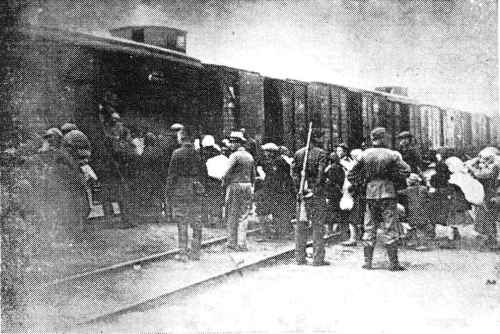
| Germans herding Jews from Grabowiec to the train station in Miączyn, where they were loaded onto train cars bound for Sobibor death camp |
occasionally raided Jewish homes and removed people on the pretext that they were suspected of Communist activity. Shlomo Klein, David Abish's brother-in-law, was arrested in this way. At the same time, the Jews were assaulted by a deluge of economic decrees meant to impoverish and starve them, and reduce them to helplessness.
The Second Aktzia
As in the first aktzia, everyone was removed from their homes and taken to the marketplace, where they were kept until morning. At dawn, the Germans brought in Polish wagon-drivers, and loaded the elderly and women onto the wagons. The men were marched on foot. They ended up at the Miączyn train station, 10 kilometers from Grabowiec. A ‘selektion’ took place at the station, and several hundred young people were sent back to Grabowiec.[7] The others were crammed into rail cars. They were transported like livestock, as ordinary cars could not contain such large numbers.
I was one of the young people who were sent back. My father had died in 1940. My mother and brother Simcha were among those now transported in the rail cars. Life in the town was unbearable. Jews were forbidden to live in the town center. The Jewish quarter extended from Noteh, the tailor's, to the bath-house. We were taken daily to do forced labor on the properties of landowners
[Page 309]
and for the Germans. It was difficult and dangerous to go to the villages, but the peasants would occasionally come and purchase the remaining wares that the Jews were able to hide. Many sold their last clothes for a loaf of bread.
The Third Aktzia
Some time later, we were again ordered to assemble in the marketplace, and driven to Hrubieszow. As we climbed off the wagons, we felt the nightmarish atmosphere of a large aktzia. The very next day, in fact, the aktzia in Hrubieszow took place, rounding up about ten thousand Jews.
How was it possible that the Jews, who knew what the Germans were planning, nevertheless obeyed their instructions? How did the Germans impose their will on the Jews, most of whom assembled of their own free will? That will forever be one of the mysteries of the devil. I would like to describe the aktzias so vividly that each reader would be able to experience the ordeals that people underwent, but I know that is impossible. I cannot find
|
|
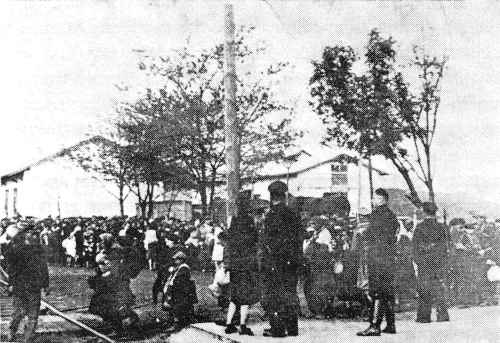
| The Germans ordered the Jews assembled in the marketplace to form rows and march to Miączyn. Sporadic shots rang out, as the murderers aimed at people's heads, never in the air. People fall, and brain tissue leaks from shattered skulls; blood flows, and the soil – the soil of Grabowiec–soaks up the blood of its Jews. |
[Page 310]
|
|
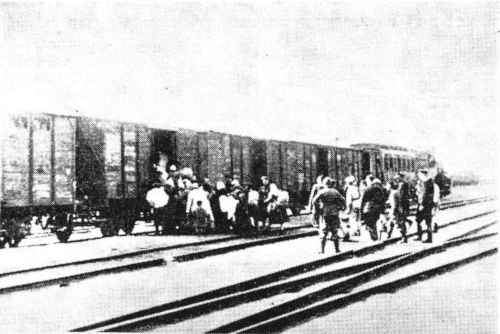
| There was no compassion for the Jews of Grabowiec during the last aktzia. The remaining Jews entered the rail cars. Grabowiec was now emptied of its Jews. Only the mute walls of houses sounded the wails of desolation and mourning of an age-old Jewish town bereft of its sons and daughters. |
the words. Is it at all possible to describe the horrors? Can one express the boundless pain? Will there ever be a writer who can describe the annihilation of the Jewish people?
Oh, you cursed Germans. How clever you are, to turn us into obedient marionettes so quickly. We scurry into the rail cars that will take us to the Valley of Death, Sobibor. People become automatons, foolish, lifeless marionettes. Shots ring out constantly, and people fall dead. Thought is impossible. The only sounds are the whistles of the police and SS; they stand in their helmets, like demigods above the submissive crowd of paupers carrying knapsacks, their hearts overflowing with terror. The policemen beat the Jews and lead them into the marketplace. They are all marching obediently, yet Jews are murdered in the streets. The crowd nears the plaza, which is large enough to accommodate all the rail cars and people.
Here we are, in the crammed, padlocked cars. There is no air. The jam-packed Jews are indifferent, apathetic. They cannot think. What would they think about?
[Page 311]
Finally, at 9 p.m., the train starts to move. It is taking us to the place where we are destined to die, and be incinerated.
The Escape
It is incredibly crowded, hot, and stifling. I stand, looking into the dark, thinking about the invisible forces that control our lives. But conversely, life can control the unseen forces. Destiny comes to meet those who go forth to meet it. I did not know my destiny. But why shouldn't I try to escape certain death?
Shmuel, Refael Leybl's son, was standing next to me. When I started talking to him again, I felt my robust senses working against extreme anxiety. When the train entered a curve and slowed down, I pushed my body out of the window and jumped into the dark, away from the tracks.
“I'm saved!” was my first thought when I felt the cold earth underneath and the pain from the impact. It was pitch-dark, and I could see only a foot or two ahead. I heard shots, but they missed their mark in the darkness. Meanwhile, the train was moving away.
I got to my feet and tried to penetrate the gloom. Surely I wasn't the only one who had jumped from the train, but there was no one around. I breathed more easily, though the terror wasn't gone.
Well, the die is cast. What next?
I began walking towards Grabowiec, by way of Warkowice. As I passed the village train station, a young peasant came toward me. I had no time to run. He stopped me and threatened me, shouting. I thought, ‘The terrible devil is actually just this wicked, despicable scoundrel. I escaped the German murderers, and here is the angel of death with his searching eyes, who is taking me first to the head of the village and then to the police.’
At the police station, I met five Jews from Hrubieszow who had escaped from the train. We were miserable beyond words. These policemen are merciless, and incapable of compromise. Our situation is hopeless.
After two days in jail, Alex, a Gestapo soldier, came in and took us out for forced labor: collecting and sorting objects from abandoned homes. Any money we found had to be turned over to the Gestapo.
In town, we saw a large group of people who had escaped from the train. Another of our tasks was burial of the bodies of those who had been shot as they were on the way to the train. Our powerful will to live gave us the superhuman strength to obey orders, in spite of our weakness and revulsion.
[Page 312]
We worked on construction of Gestapo headquarters for about two weeks, and then transferred to the Budzyń camp.[8] At first, this camp served to incarcerate Jews who had been brought from Russia. It was located in a forest, and consisted of barns as barracks for Jews. The Jews built their own bunk-beds, four stories high; on average, each story held four people.
The first inmates of Budzyń told us about the individual and mass murders that took place, as well as the cruelties and torture perpetrated. Throughout their lives, the eyewitnesses were haunted by what they had seen. The worst torturer was Adolf Pajkes, a Sudeten German, who was a barber by trade.[9] Under him, there were daily fatalities. It was a regime of torture, cruel abuse, terror, and dread. His schemes and torture methods were endless, as was his lust for murder. He carried out all the outrages personally, with a smile and dimpled cheeks that made him seem happy and satisfied.
The camp was officially known as a forced-labor camp, but in actual fact it was a torture and murder camp, that included starvation and the absence of basic living conditions. There was only hopelessness and despair. The prevailing atmosphere when we arrived at Budzyń was a pervasive fear of death, without a spark of hope for survival.
After six months in Budzyń, I was transferred, along with a large group of prisoners, to the Płaszów labor camp, near Krakow. This camp was divided into two sections, one for Jews and another fenced area for Poles. Originally, there had not been separate sections; Jews and Poles had been together in a detention camp, taken to forced labor under the same overseers, and were in constant danger of their lives, dependent on the whims of Commandant Amon Göth and his underlings.
Secondary sections were marked off by a barbed-wire fence, which was electrified in some places. One special fenced area was designated for Germans, and another – for workshops and industrial facilities. Camps for men and women were separated by fences and a special gate, guarded by Jewish Ghetto Police who had been transferred from the Krakow Ghetto. Officially, men were forbidden entry into the women's section after 9:00 p.m. The infirmary consisted of several numbered wooden barracks. Entry was usually prohibited, and was granted only by special permission.
There were various wooden structures in the camp. The latrines were between the living quarters.
[Page 313]
The latrines were the hub of the camp's cultural and spiritual life. It was the place where you could exchange a few words while sitting with a comrade in the same boat. Personal and social matters were discussed, and gossip as well as news was shared. It was also where the camp songs were crafted. As long as the latrines were used by both men and women and separated only by a wooden partition, it was possible to talk with the women as well; there were many gaps between the boards. News from the latrines were always attributed to one gap or another, lending it a stamp of authenticity.
Like all other Nazi camps, the Płaszów camp was separated from the rest of the world by high-voltage electrified barbed wire. However, unlike other camps, where the single barbed wire of the fence was electrified, at Płaszów there were 12-13 horizontal rows of electrified wires, 2 mm in diameter, that ran the full height – 2.5 m – of the fence. For greater deterrence, vertical rows of electrified barbed wire were installed at distances of 20 cm. Tangles of crossed barbed wire also ran along the outside of the fence, so that any prisoner who managed to jump over the fence would fall into the tangles, be held fast, and sustain severe injuries. A special electrified barbed wire fence separated the prisoners' living quarters from the rest of the camp. The muscles of anyone who carelessly touched those wires went into spasm and the person could not break loose. The touch also shorted the wires, signaling the nearest guard post that something had happened at the fence. Such incidents did not always lead to death. Often, the victim sustained only a burn, while at other times they were electrocuted.
Besides the daily murders that were part of camp life, there were public executions attended by all the inmates, as examples. Such murders were justified as punishment for supposed acts of sabotage or escape attempts, and were carried out by shooting or hanging. Groups as well as individuals were murdered in this way. Each such event cast a pall over the prisoners, who were forced to be part of the ceremony.
The first commandant of the Płaszów camp was Unterscharführer Horst Pilarzik, who wreaked havoc among the camp's builders. He was followed by Oberscharfűhrer Műller, and later Hauptsturmfűhrer Amon Göth. Göth was athletically built. He participated in the creation of concentration camps at Belzec, Treblinka, and Sobibor, and later headed the annihilation of the ghettos of Krakow, Tarnów, Rzeszów, and Przemyśl. He was certainly responsible for the deaths of several thousands of Jews. Göth remained at Płaszów almost to the end. The “camp-elder” was Chilowitz, who knew too much about Göth's embezzling and thefts. Fearing that Chilowitz would be investigated and implicate Göth, the latter staged Chilowitz's escape.
[Page 314]
This led to his execution, along with his wife and friends. All the camp inmates were forced to walk by the bodies; their blood ran cold, and it was a long time before they could calm down.
When evacuations from Plaszów began, I was sent, with many others, to the Flossenbűrg camp, and then to Theresienstadt, from which we were liberated by the Russian army.[10] I was ill and frail, and was taken to a hospital. Some were so excited by liberation that their hearts stopped forever. They were plunged into darkness only moments after the light had appeared.
When I was a bit stronger, I hurried to return to Poland, to Grabowiec, thinking that some of my family members might also have been saved. But when I returned to Hrubieszow, I met a few survivors who had come back from Russia. They told me about their visit to Grabowiec and the attitude of the local Poles to the returning Jews. I did not visit Grabowiec, my home town, where not a single Jew was left. A few months later I traveled to Germany, and reached Israel in 1949 by way of France.
Ever since then, down the years, I've been constantly surrounded by the shadows of the victims and the echoes of the atrocities. I will never be free of the noble figures of my parents, brothers and sisters, family members, aunts and uncles, and fellow townspeople who were tortured and cut down by the Nazi monsters. These things must not be forgotten. They must be remembered and mentioned, always.
My Testimony at the Trial of the Hangmen of Hrubieszow and the Surrounding Area
Assembled judges, prosecutors, and defense attorneys listened to the testimony of survivors against Gestapo forces that were active in Hrubieszow and the surrounding towns, including our hometown Grabowiec. I was among those who, in 1969, testified at the Hanover trial of the murderer Diamant.[11] “Don't ask me for specific dates,” I responded to the provocative, painful questions of the attorneys. “There was no calendar then. But I do remember the images of those days – they are forever engraved in my memory.”
Of the night of horror, I remember the masses assembled at the platform. Men, women, the elderly, and children were crowded among bundles. There were shouts and cries, and above all – the screaming of the Germans: hulking, red-faced, their shirtsleeves rolled up, constantly wielding their whips and trampling everything. The day was bright and sunny.
I see the young men in traditional kapotes, hurried along by a huge German with a murderous face. I see the men's faces and confused eyes. Shovels are thrust into their hands, and they dig pits, spurred on by the whip. Four shots ring out several minutes later, and the whips strike the backs of those who fill in the pits.
[Page 315]
Freight cars are waiting at the train station. This is the “special” train to Belzec. The last Jews of Hrubieszow and our town, Grabowiec, pile into the cars.
Pain and fury wrench my heart as I remember the maelstrom of death. Oh, how I longed to witness the day of revenge, and see the Nazi hangmen squirm in mortal terror. I looked at them in the courtroom. They were smiling. They were on trial for mass murder and theft – and they were smiling.
Only the faces of the attorneys and the judges were grave, as they continued to ask me questions about precise dates, trying to confuse me. I repeated, “I don't remember dates, but I will never forget the faces of the murderers.”
I said the same words in 1971, when I was called to testify at the trial of Ebner, the head of the Gestapo in Hrubieszow, and again in 1973 at the trial of Heibműller.[12] They were torturers and murderers throughout our area. I recounted the abuse, blows, indignities, and murders I suffered and witnessed, the faces of the terrified victims, and the sadistic cackling of their tormentors. I saw Diamant shooting a child as it clung to its mother, and then murdering its parents as their child writhed in death throes. The German judges did not want to hear the descriptions of SS soldiers beating mothers who did not surrender their children and men parting from their families, and raining blows down on people as they embraced in farewell. The judges, prosecutors, and defense attorneys wanted to hear only facts. I described the annihilation of Grabowiec, as the accused men beat and shot children and old people, snatched children from the arms of their mothers, flung them on the ground and kicked them to death with their boots. The cries of the injured mothers and children haunted me as I remembered the road to the train, which was soaked in blood and the brain tissue of children. My throat contracted, and I could barely utter a word.
I will never forget the terrible images of the horrific annihilation.
Never forget, never forgive!
Translator's footnotes:
by Itta Kaplan-Shisler
Before the war broke out, the Jews of Grabowiec believed that Poland was strong enough to resist conquest, and that the world would not permit Hitler to swallow it up completely. They were certain that the world would not stand by helplessly and watch the Nazi armies attack a country, doing whatever they wished. Nonetheless, Jewish hearts trembled in fear that the Nazis would march into Poland. Perhaps they did not realize the full horror of the impending tragedy, but they sensed its inexorable approach. People groaned, and tried to console themselves with the thought that the world was orderly. Even the greatest pessimists did not go so far as to think that the world could so suddenly run amok, and people would become more ferocious than animals.
From the earliest days of the war, before the Germans had entered our remote town – which was far from any highway – people already felt that trouble was coming. Poland had lost its independence overnight. A few policemen remained in town, and Polish army units were roaming the forest. News came of shots. A physician was killed. The roads were risky, and peasants were no longer coming to town. Yet Jews traveled to the villages along side roads and obtained some food. Refugees from other towns, who began to arrive, needed assistance. They talked of the Germans' horrific deeds, and everyone's heart was filled with fear.
[Page 317]
The Russians Arrive
There was therefore great joy when word came that the Russians were coming. Waving a red flag, the young people in town greeted the Russians. They hugged and kissed the soldiers, and the town breathed freely.
However, this did not last long. It soon became clear that the Russians would retreat, and would be replaced by the Germans. Russian officers and soldiers themselves came to the Jews and told them, also announcing that anyone wanting to leave the town could join them. Many did so, especially young people. The majority, though, stayed. They saw no future in wandering in unknown territory with no clear goal, and homeless, without a roof over their heads, or resources to feed their children. Some young folks did not want to leave their elderly parents to fend for themselves, with no means of survival. Taking the families along was no simple matter. Where would they go? What were their prospects?
Once again, the town became lawless. One dark autumn night, before the Germans arrived, Poles attacked the Jews, shooting at random, throwing hand grenades into Jewish homes, and robbing their places of businesses.
The Good Priest
My father, Mattes Shisler, went to the priest and asked him to make sure that Jewish lives would not be up for grabs. The priest was amenable. He ordered the church bells to be rung, and for all the Christians to assemble. He then spoke to them and called for brotherly behavior towards the Jews, because any enemy of the Jews was also an enemy of the Poles, and would attack them both mercilessly.[1] Spirits became a bit calmer, but the attacks on Jews continued. Cultural and social life came to a standstill. Fear of tomorrow hung over the town like a nightmare.
After several quiet days, about ten German soldiers came into town. They occupied the synagogue building
[Page 318]
and began using it for their headquarters. The Jews were immediately required to form a Judenrat. This institution consisted of Moshe Grah, Shlomo Papir, and Ya'akov Meir. The chairman was Yankel Shlayer. They convened in the home of Shek, near the Radzyn Hasids' synagogue. The Judenrat was tasked with collecting “contributions” – gold, furs, and linens – as well as with supplying laborers.
Refugees
Refugees from other towns, where the situation was even worse, continued to come to Grabowiec. There were also Jewish refugees from Germany, one of whom was the bookkeeper for the Judenrat. It was hard for them to accommodate to the poor conditions. They had abandoned comfortable, well-appointed homes in Germany. Now they all lived in crowded, poor conditions, although the Grabowiec Jews worked hard to help them. A free kitchen was set up, and the refugees were supported in all possible ways; they were comforted, encouraged, and efforts were made to lift their heavy spirits. However, in the last analysis, we were all helpless. The mood was gloomy. The news from other towns did not bode well. Businesses and shops were closed. Some people continued to do business in secret. Others sold off the remnants of their goods, either at their homes, or by handing them over to a peasant acquaintance in a village.
White Bands with Stars of David
A new announcement required Jews to wear white armbands bearing a Star of David. The armbands were 10 centimeters wide, and the Star of David – 8 centimeters wide. Venturing out on the street, or going to work, without an armband was out of the question. Most people were sent to work on landowners' properties. The Judenrat selected a daily contingent of workers, which consisted of men between the ages of twelve and advanced old age. Anyone too weak could be represented by someone else – I often represented my father.
The Jews were forced to do all types of hard labor, including messy jobs such as cleaning streets and toilets. There was no compensation for these tasks. Jews sold everything they had in order to feed their families.
[Page 319]
Each bit of food was venerated. Everyone wanted to ensure that they would not die of starvation. Even those artisans who were employed barely earned enough to live on. Any offense on the part of the Jews of Grabowiec was punished by additional severe levies that the Judenrat had to supply by a deadline. Fear reigned. The Jews had to hand over their last resources in order to complete the sums demanded by the Nazis, and hope they would be left in peace. But the Germans had no intention of leaving the Jews alone. SS troops would come into the town periodically, seize Jews, beat or shoot them, and then leave. They would go into Jewish homes, take bed-linens, dishes, and everything with the slightest value. Even worse were the assaults in the night, when young people were dragged from their beds and taken to forced labor, such as pit-digging, road-building, etc. The Jews believed that the Germans weren't really in need of these tasks but were using them as a means of torture. Some jobs involved standing in knee-high water and mud. The work was supplemented by sadistic beatings on the part of the German and Ukrainian overseers. The Judenrat had trouble fulfilling the quota of levies. In spite of SS threats, people did anything to evade labor, which was often extremely exhausting; people came home half-dead. Every effort was made to bribe the Germans. Judenrat delegations visited the camps around Grabowiec, trying to pay the Germans off and bring the Jews home.
Each day brought new torture and suffering, and extinguished any spark of hope. And yet, people strove for life and refused to give in to despair.
Sad Celebrations
After the outbreak of the war in 1939, there was a constant influx of Jews from nearby and far away, as already noted. Some were physically sick or nervous wrecks – people who had lost everything. However, there were also healthy young men and women who
[Page 320]
gradually rallied. They all enjoyed the warmth and hospitality of Grabowiec. Sometimes, a young man and woman would fall in love and be married, regardless of the miserable situation. Though it was a celebration, it was sad, with a sparse meal. Families and neighbors gathered behind locked doors and windows. Bride, groom, and guests wore the remnants of their finery left over from better times, which were now rarely worn. The wedding was far from a joyous occasion. Anyone who forgot reality for a moment was reminded by the melancholy faces all around, and immediately resumed worrying about the next day. Sorrow gnawed at everyone, and was mixed with the joy of the event. Thoughts of loved ones who were absent, had been murdered, or were lost without a trace threatened to overwhelm the assembly. The couple's parents also wept and mourned, fearing their children's fate on the next day, when daily life would be resumed with all its misery. There was pervasive fear of the police, and of the Poles and Ukrainians who threatened Jewish lives day and night, and used every moment to torture and murder.
Such were the celebrations during those dark days of rage: isolated sparks of joy that were extinguished by darkness and sudden death.
Prayers
Despite the deluge of troubles and pain, the observant Jews of Grabowiec carried on their lives. They observed Shabbat as well as they could, as well as kashrut, and gathered in private homes in minyans for communal prayer.[2] Their prayers were heartrending, expressing the hope that the troubles would end. Wails came through the locked doors. The Jews prayed for Hitler's defeat, for a miracle from heaven. In spite of the problems, a spark of hope flickered in everyone's heart: they hoped to survive, and save themselves from the destroyers. People still could not imagine that the Hitlerite murderers had completed their plan for the total extermination of the Jews wherever they controlled Jewish lives.
And people clung to life, although the catastrophe
[Page 321]
was all too clear. Time did not stand still. Every day brought new decrees and new fears of the future. Some young people were not ready to sit passively and wait to be murdered. They sought out contact with the forces in the forest.[3] This was quite dangerous, yet it sometimes seemed that contact with them had been made. However, we soon found that this impossible. We were isolated, and surrounded by enemies who followed our every movement.
Black Wednesday
One day rumor came that the partisans in our area had killed a German general. A black cloud of fear spread over the Grabowiec sky. No lamps were lit in homes at night. The next day, Wednesday, the Jewish police announced that everyone had to assemble in the marketplace, carrying no belongings. There were still no signs of an imminent liquidation of the Jewish population, but terror hung in the air, like a slowly descending sword.
At the marketplace, the SS men stood all the Jews in rows and selected twenty men who were taken out of town. The others were instructed to scatter. We heard distant sounds of shots. Later, the Judenrat was ordered to send men to bury the shooting victims.
The Jews of Nearby Villages are Herded into Grabowiec
Decrees, persecution, and demands for money were ceaseless. The Judenrat continued to try and persuade the Germans to ease the situation a bit. But the German orders became more and more demanding. In July, 1942, the order came for all the Jews in the villages to move to Grabowiec. Once again,
[Page 322]
the crowding conditions intensified, along with an increase in the number of the needy. Anyone who had saved a few pennies had to give them up, because people needed to eat.
Life was chaotic. Jews were afraid to go on extended trips. Bad news kept coming about assaults and shootings. The fields were the sole, mute witnesses of helpless screams, that were stilled only by death. Rumors began to spread: all the Jews were to be driven out of Grabowiec, but no one knew where they would go. According to one rumor, they would be sent to Hungary, because laborers were needed there. Dread was a constant, oppressive companion. Finally the order came: all were to assemble the next morning in the marketplace.
The First Deportation
The order was to take all one's belongings along, especially clothing. People sensed the tragedy that was befalling the town, and the world seemed bizarre. Some people, individuals with no families, started to run at random.
The scenes at the marketplace were terrible. The Germans assaulted the elderly and sick, who could barely move. Some were shot on the spot. Among them were my uncle, the husband of my father's sister Soreh Dvoyre. There were many fatalities. The worst were their assaults on children. Not wanting to waste bullets, the Germans beat their small heads against the cobblestones. The sky-splitting cries and wails were audible for miles. The ground was littered with corpses sprawled in pools of blood.
When the cars were full, the train moved. The Jews of Grabowiec embarked on their last road – the road to hell on earth that was known as Sobibor.
Before the Jews were loaded onto freight cars, in the midst of the horrendous wails, a few landowners from the area came to the market, and were allowed to remove their workers, whom they
[Page 323]
needed for work in the potato fields. One of these was Aharon Zisman, the caretaker of the properties belonging to the largest landowner properties in Siedlice. Zisman took me along with his group.
When the rail cars were full, the train began to move. The Jews of Grabowiec began their last journey – the journey to hell on earth: Sobibor.[4]
A small number of Jews remained in Grabowiec. The Judenrat was still functioning, but depression overtook the town. Not a single child remained. The adults were mostly individuals, the remnants of families that were sent to Sobibor.
Sobibor was the least well known of the death camps. The Germans had begun to build it in 1941, shortly after they attacked the Soviet Union. The small rail station at Sobibor was in a forest; the camp consisted of two large structures and a row of barracks. Living quarters for officers were built later, as well as workshops for tailors, shoemakers, and carpenters. The prisoners of Sobibor were subjected to indescribable torture and agony before their deaths. From 1942 on, the transport cars were hermetically sealed, with windows and doors nailed shut. They contained Jews from Poland, Germany, and the USSR, who arrived exhausted from hunger, thirst, and cold. They were piled into the rail cars in layers, like planks of wood. The Jews of Grabowiec were similarly transported.
The camp was divided into three areas. The first contained craftsmen and artisans. The second housed the sorting barracks, where the unfortunate new arrivals were undressed, their heads shaved, and their clothes sorted. The third area was devoted to the gas chambers and the oven.
The Grabowiec Jews who arrived in Sobibor went through all seven circles of hell. The camp also contained Jews from Włodawa, Hrubieszow, Chelm, Zamość, and dozens of other Jewish communities from Poland and almost all the other European countries. A nation went up in smoke from the oven chimneys.
I provide all this detail, because that is what I heard about Sobibor. Peasant women from the area
[Page 324]
recounted the sky-splitting wails that filled the night air.
An uprising took place at Sobibor. The rebels staged a sudden attack on the Germans, and killed many of them. Many Jews from Grabowiec were among the rebels. Some of them succeeded in escaping from the camp, breaking through the barbed-wire fences and fleeing to the forest. However, most were killed by gunfire and minefields. Very few of those who escaped to the forest survived.
After the uprising, the Germans destroyed the barracks and all the camp facilities.
The Last Jews
After the deportation, the Jewish streets looked war-ravaged. The Jewish homes were open, and all their cabinets and closets were wide open. Before long, the Poles had robbed the homes of all their contents. The remaining Jews were under no illusions. They realized that they wouldn't be left in peace for long, and that another deportation would remove the very last Jews of Grabowiec. Indeed, the bloody month of October soon arrived. The surviving Jews were loaded into rail cars.
We few Jews who miraculously stayed alive were all orphans alone in the world. Our fathers, mothers, sisters, brothers, children, comrades, and teachers were all killed by various means. It is our responsibility, as survivors of the inferno, to relate what we went through. We must remember, and bear eternal witness to, the martyrdom of the Grabowiec Jews.
Translator's footnotes:
by Sara Rosenfeld-Boym
I am one of the very few Jews of Grabowiec still alive after that horrific period of murder. Those days of misery are forever engraved upon my memory. Anyone who lived through those experiences remembers them for the rest of his life. But where can you find the strength to describe the anguish of someone who has been tortured, witnessed the murders of his nearest and dearest, and himself looks death in the face daily? Whatever I might tell you pales into insignificance compared with my actual experiences. But I know that it is my responsibility, as a Jewish native of Grabowiec, to provide a monument in the form of a volume, as a memorial to our destroyed Jewish community. I will try to describe at least a bit of my experiences during that horrific period.
During the first days of the war, after the Germans had taken Poland, we in Grabowiec did not really feel the extent of the disaster. It was quiet, compared to reports from other small towns [we were told] by refugees passing through Grabowiec on their flight from towns where the Germans had already set fires and murdered Jews. Once the Germans came into our town, their harassment was not directed towards the entire population. True, they beat Jews, or shot a Jew somewhere at the edge of town, but people tried to discover reasons for each event. Some even maintained that “the devil wasn't that bad.” Of course, the pessimists won out – those who refused to calm down and believed that things were bad. We began to be inundated with harsh decrees,
[Page 326]
and people began saying that the Germans had perpetrated acts of cruelty. Many searched for connections with the fighters in the forest, as they wanted to wage armed battle. They were sure that the sentence was final. This became even clearer when Jews began to be evacuated from their towns and sent to Grabowiec. Once they arrived, they observed shiva for their relatives, and very soon were ordered to assemble in the marketplace.[1] Later, they were all taken to Miaczyn, where empty rail cars awaited them. At the time, there were thousands of refugees in Grabowiec who had come from different towns in Poland as well as from Germany. People said that five thousand Jews had been sent to Miaczyn, leaving only about five hundred Jews in the town.
At the Rail Cars
Heartrending scenes unfolded while the rail cars were being loaded. The road was strewn with corpses. Elderly or sick people who stopped walking were shot dead on the spot. People were savagely beaten and shot as they were being crammed into the cars. Once the transport had left, the remaining Jews of Grabowiec gathered up the bodies and buried them, in the place where they had been shot. The bodies were dug up later and reburied in the Jewish cemetery.
We were sent to a landowner's estate, where we did manual labor and were assigned to the hardest jobs. This continued until November, when we returned to Hrubieszow. Those were days with many horrific scenes. Each time a transport of Jews took place, there were widespread raids searching for Jews in hiding. Jews in the villages were snatched and shot on the spot.
We left town, and returned to the same estate as before. My uncle was also sent there. His wife had already been deported to Sobibor, and he knew she was no longer alive.
[Page 327]
We couldn't stay there for long, and went to the fields once again, where we wandered aimlessly, not knowing where to go. My husband said, “Let's go to Wojsławice.” I was fearful, and persuaded my husband to send a Christian there first, to see the situation and judge whether it was a good place to go to. We paid him fifty zlotys. It wasn't long before he returned and reported that deportations from Wojsławice were taking place as well.
In Hiding
Having no choice, we resigned ourselves, and entered a barn owned by a Christian, where we stayed for eight days and nights. We found four Jews already hiding there. One of them, the youngest of three brothers – Moshe Glazer – convinced us to leave; he said that we would die of hunger and thirst, and needed to find a place with a peasant who would hide us and give us food.
We went to Mańczak's place, where we spent three days in the attic, under terrible conditions. He then took us to a pit that was very crowded. We lay in layers, and nearly suffocated. After several hours, we heard furtive steps. My husband, Berl, was terrified, and said, “Mańczak is going to kill us.”
I jumped out of the pit first. It was indeed Mańczak, who said as soon as he saw me that we had to leave immediately. He was afraid that we'd be seen by his neighbors, who would inform the Germans that he was hiding Jews.
Once again, we were out of doors, and began walking to the property of the farmer where we had been previously, with the four other Jews. They had been killed. We quickly realized that the murderers were lying in wait for us. I managed to hide, and overheard Mańczak saying to his accomplices, “There were Jews here. It's too bad that they disappeared on me. But I'll catch that Moshkeh yet – he'll fall right into my hands.” Hearing this, we left in terror.
[Page 328]
One day, we came to a peasant acquaintance, to ask him to bake us some fresh bread. He greeted us pleasantly. After some conversation, he agreed to hide us in return for the monthly sum of 5,000 zlotys. He led us to a pit in the stable where he kept two cows and a horse. We stayed in that pit for seventeen months, through heat and cold, and in constant darkness. We could not move during the day.
One day, the Germans carried out an inspection. They entered the stable and took up positions right over our pit. I could feel a German boot on my head, and expected the board covering us to break any minute. The German would drop into the pit, on top of us. Those were indelible minutes of deathly terror. They finally left, but we were still afraid. My husband began thinking of leaving the pit and never returning. He was overcome by total panic. I barely managed to calm him by explaining that if we left the pit the Germans would be sure to capture us. By hiding here, we had at least a chance of survival.
That evening, the peasants came and demanded that we leave. After the German inspection, they, too were very fearful. However, I was strongly opposed to the idea, and flatly refused to leave. The food situation became serious. All we had to eat was the scraps the elderly woman – the couple's mother-in-law – secretly brought us in the pit.
As the front came near, I began begging my husband [for us] to leave. I felt that we would be in serious danger. After seventeen months in the pit, we had become able to sense any change in the village. However, my husband was opposed to the idea. He was afraid of the light, but I was adamant. Eventually, he did me a favor, and we left. After talking with the elderly peasant woman, she promised to stash some potatoes in a pit in the forest, to provide us with a bit of food. When I returned the next morning, I saw clear signs that the murderers had carried out a search, intending to find and kill us.
[Page 329]
After an entire week of roaming between hideouts, I was lucky enough to encounter the old peasant woman. When she noticed me, she stood stock still in astonishment. Apparently, she was sure we were no longer alive; she knew about the plan to kill us. This time, I was afraid to tell her where we were. I said only that we were staying in the Arshev forest.[2]
Hunger was a constant companion. My husband and I began thinking of ways to obtain food from peasants. Fortunately, I found a grain mill and brought it into the bunker where we lying. We collected some ears of grain in the field, crushed them in the mill, and obtained a bit of flour. However, we had no starter and no yeast. I remembered that when my mother had no yeast, she mixed in some potatoes. I roasted a few potatoes, and mashed them into a kind of dough. After a few days, it began to ferment. We were overjoyed when we baked it into bread.
Liberation
Finally, we awaited the arrival of the Soviet soldiers that marched in. Once they came, we emerged from the pit, and went to the liberated town of Hrubieszow; we met no one. It was dangerous to go to Grabowiec, and we went to Lublin instead. That is where we met the first group of thirty Jews who had come out of the forest.
After some time, I decided to go to Grabowiec. Near my family's house, there was a gigantic pit. I stood there, surprised. A Christian acquaintance stopped next to me. When I asked about the new pit, he said that they had searched for gold in our cellar, and thrown all the bricks into the pit. Dejected, I left the spot where our house had once been; it was gone without a trace. Perhaps thirty Jewish houses remained intact in the town. The destruction in the town, which had been the home of such beautiful Jewish life, weighed heavily on me, and has never left me.
Translator's footnotes:
|
|
JewishGen, Inc. makes no representations regarding the accuracy of
the translation. The reader may wish to refer to the original material
for verification.
JewishGen is not responsible for inaccuracies or omissions in the original work and cannot rewrite or edit the text to correct inaccuracies and/or omissions.
Our mission is to produce a translation of the original work and we cannot verify the accuracy of statements or alter facts cited.
 Grabowiec, Poland
 Yizkor Book Project
 JewishGen Home Page
Copyright © 1999-2026 by JewishGen, Inc.
Updated 07 Aug 2026 by JH