 |
|
|
[Page 234]
by Chayim Pinches Blaf
|
It has been over five decades since I left Grabowiec, yet I have not forgotten about the town with its beloved people, fine young friends, with whom we strolled outside town and enjoyed the library, the Zionist gatherings and meetings, discussions, and “box-evenings.” I still long for the town of those days, for the honest, decent Hasids as well as ordinary people. They were kind to their nearest and dearest, as well as towards the whole Jewish community of the town and the entire Jewish people.
My father, Hirsh the hatter, was a Turisk Hasid. Naturally, I absorbed the Hasidic atmosphere, particularly that of Turisk Hasidism. I clearly remember the reception for the Turisk Rabbi, the Hasidic leader, on his visit to Grabowiec. Four young Hasidic men on horseback came out of town to greet the approaching Rabbi. The riders made an indelible impression on me, and stimulated my imagination as I imagined the exalted the Rabbi as a king.
That Friday evening in the Turisk synagogue was especially lively, as the Rabbi gave the blessing over the wine. Hundreds of Jews – young, old, and children –
[Page 235]
crowded in and stood on tables and benches, wanting to be closer to the Rabbi. Anyone who was able to partake of the wine in his goblet felt he was in seventh heaven.
I was especially fortunate to taste a bit of the wine in the Rabbi's goblet, handed to me by one of the Hasids. But I started to feel dizzy. Father immediately noticed that I was a bit tipsy, and sent me home. I was barely able to stay upright and kept falling down on the wooden sidewalk. When I arrived home, Mother was alarmed and angry at Father for allowing me to become drunk. So, my first experience of drunkenness was at the Turisk Rabbi's tish.
One Turisk Hasid I remember is Yehoshua Lerer, who was actually a teacher in Grabowiec.[1] He was a devoted Turisk Hasid who often led prayers in our synagogue with his mellow voice and engaging melodies. My brother Yechezkel and I helped our uncle Sholem.
My memories of our synagogue, that had been consumed by fire, are very scary. I was afraid of passing by the site at night, because the children said that it was a meeting place for the dead. No one had ever seen them, or the demon that frequented the house of Royze, the female butcher, next to the bridge. Yet there were terrifying stories of demons that perpetrated robberies and damage at other houses near the bridge. Water demons lay in wait on moonlit nights among the window-grates, and use their green eyes to trap lone unwary wanderers who did not wear a tallit-katan. One story was about a man who had to cross the bridge unexpectedly. The “green creatures” enticed him into their nets with music that caused his mind to stop functioning normally. He was almost lost, until he was saved with God's help.
Meadows with wooden crosses lay on the other side of the bridge; images of a shamelessly naked Jesus were nailed onto the crosses. As we passed these crude crosses, we shouted “You shall abhor it!” and expected Jesus to fall from the cross and never rise again.[2]
[Page 236]
Righteous Women
One of the women in town, Tchipeh (Ben-Tziyon's wife) was a remarkable person, kind-hearted, who always sought people she could help. The cellar of her house was full of potatoes; when a poor man came to see her, she let him go into the cellar and take as many potatoes as he wanted, and also slipped some money into his pocket.
She was one of the good women who was greatly respected and loved in the town. I was always profoundly thankful to her, because I knew she had helped my mother through a difficult time. We were actually related, but her kindness extended to all the impoverished people in Grabowiec, who considered her their mother. She was busy in her tavern all week, and worked hard from early morning until night. Gentiles from the town and the surrounding villages came in for a drink and a bite to eat. I liked to go into the tavern and watch Auntie Tchipeh wait on customers and serve the drinks. It was usually the scene of comical incidents, with an occasional tragic event. Thieves would also come in, after they had stolen from naïve peasants and shopkeepers during fairs and religious holidays. Sometimes, after a peasant had a drink, he was shocked to discover that he had been pickpocketed. Auntie Tchipeh had no choice but to take pity on him and add another drink to his account. Now the only surviving member of her large family is her daughter Rokhl, with her husband Moshe and daughter Tovaleh.
[Page 237]
My own family suffered the same fate. My sister Rivka with her husband and children, my brother Yechezkel with his wife and children, my brother David with his wife and children – all were brutally murdered.
Naturally, I wanted to mention my nearest and dearest who were so tragically killed. But this was also the fate of all the other Jews of Grabowiec – beloved, fine men, and their wives and children. We remember them all with profound sorrow and heartache. I wish I was able to mention them all, describe their admirable qualities and kind hearts, and mourn for their gruesome deaths.
The town had two cemeteries – an old one and a new one. Each had an atmosphere of death, combined with the respect that the living offered the dead. Although I am a Kohen, I was always very curious to visit the old cemetery and read the inscriptions on the old headstones and their tales of bygone Jewish life.[3] Some headstones had fallen, and their inscriptions were indecipherable. It was impossible to make out the age of those buried in the spot. I grieve when I hear that domestic animals graze between the graves of our ancestors and desecrate them.
In the Study House
More than to any other place, I was drawn to the study house, to hear White Itshe intoning holiday prayers and singing along with his choir. I thought then that he was the best cantor in the world.
The Preacher with the Fiddle
The study house was where various itinerant preachers came when they did the rounds of cities and towns. The study house was packed during their visits; even the women's section was full of eager listeners.
One such preacher whom I remember
[Page 238]
followed his fine sermon with a fiddle performance. Such beautiful, moving melodies had never before been heard in Grabowiec. It was on a Saturday evening, after Havdalah.[4] It was so enchanting that he had to come the next day after the evening prayer as well, to give a sermon and play his fiddle.
Commandments and Good Deeds
Mankeh the melamed, who was my teacher, an old man by then, was really dedicated to the students he wanted to imbue with Torah. He very much wanted them to be good students and grow up to be good, decent Jews. He was a real catch for the town, not only for his scholarship but for his memory, which retained the death dates of all the deceased. He would remind both men and women of their parents' death dates and refused payment for the service, though he barely made a living as a melamed. His life, like that of other teachers in Grabowiec, was hard, yet he considered reminding people of their parents' death dates was a great good deed. Sholem Mezgy was another melamed. He taught his students Yiddish literacy as well as a bit of Polish and Russian.
We owe our teachers many thanks. They taught us important Jewish ethics and inculcated the love of all that is beautiful and noble in Jewish life; love for the Torah and the Jewish people, respect for our parents; and respect for the elderly and their life experience and wisdom.
It is deeply painful to remember that all this was cut off so gruesomely. We will never forget them, and never cease to wonder at their dynamic Judaism and profound decency.
Our Memorial Book expresses our boundless sorrow and piercing nostalgia for the destroyed world of our small town. But along with mourning, these pages arouse feelings of the pride and dignity that characterized our parents and ancestors, pure
[Page 239]
Jews – not only on Shabbat but in daily life as well. Genuine Jews, simple folks, yet they were noble souls.
The image of our town will remain engraved in our hearts and souls for as long as we live. That is where we were born, where we passed the happiest days of our youth, and where our nearest and dearest were murdered.
I am one of the few who were able to save themselves by emigrating to America in 1921, long before the devastation; this was possible because my father had already been living there for several years. On the other hand, my brothers Yechezkel and David and my sister Rivka, and their families had stayed in Grabowiec. My heart weeps when I think of them. Why didn't they leave with me? Why did all the other decent, beloved Jews of Grabowiec stay in the town until the catastrophe took place? Why did they deserve such gruesome deaths?
The nightmare haunts me day and night; sometimes I think it is really just a nightmarish dream. The mind cannot grasp the enormous disaster. No, it is no dream; it is tragic reality. That is how the millions of Jews of Europe were incinerated, buried alive. Men, women, and children were tortured and subjected to the worst possible suffering.
Grabowiec, the destroyed Jewish town, where no trace of Jewish life remains, continues to live in my heart. I lie awake and think of my home town, of my childhood and youthful years spent there. I see a Shabbat morning, when we go for a walk on Fortress Hill, play games, run up and down the hill. Finally, when we tire, we sit down on the hilltop, look at the entire town, and tell stories.
[Page 240]
Tales of the Cheyder
Our cheyder teacher told us lovely, captivating stories about righteous leaders and rich Jews. The stories were followed by riddles that could be solved by clever minds. There were always geniuses who solved the most difficult riddles.
At twilight, we had to rush back to town, whether to the study house or Hasidic synagogue, for evening prayers; woe to anyone who came late! He was likely to be punished in this world, as well as the next.
Weddings in Town
Memories of weddings in Grabowiec are indelible. Family members drove in from Hrubieszow and other cities and towns, homes of the bride or the groom. Wedding music was supplied by klezmer groups from Hrubieszow or Tyszowce. Weddings in town were some of the best experiences, in which young and old participated.
I can still see Chana, Motl's daughter, coming out with a mantle lamp that illuminated her face with angelic beauty, as she lit the way for bride and groom. At times like this, we forgot the darkness in the town, the deep mud-pits that we splashed through. People were happy, and felt good. A wedding in town!
The First Firestorm
I remember the first firestorm that broke out in our town. I was studying in Berl's cheyder, and ran home once the commotion began. Basha, the hatter, ran in the opposite direction, wailing, “Where is my child?” I had no answer. I hadn't seen him. Her tragedy was inconceivable. The entire town wept with her. Her son had died while hiding on top of the oven.
Full of dread, I ran with the other children towards the village of Danczypol.[5] From a distance, we watched the flames and thick smoke
[Page 241]
plumes rising to the sky. An ember fell next to us; luckily, we weren't hurt. It was evening by the time we came home; our parents were ecstatic when they saw us. The children who survived were their only source of happiness in the wake of the catastrophe.
The town was rebuilt. Businesses sprang up again in the marketplace. I was helping workers prepare metal sheets to cover roofs, and cut my finger. Mother ran with me to Mekhl the doctor, shouting that I was at death's door. He calmed her down with soft words, bandaged my finger, and told me that I had been saved. But I bear the scar of that cut to this day.
The fairs in Grabowiec merit special description. The entire town derived its livelihood from the fairs. There was no industry in town; there were only artisans and shop-keepers who depended on the fairs and shops.
The First Zionist Organization
At that time, two organizations of Zionism and Bundism were formed in our town. Both attempted to attract young people and make them active. I was drawn to the Zionist organization, and felt that it held the future of the Jewish people. The sad situation of Jews in Poland was already clear to me, especially of the Jews of the small towns. The dream of a return to Zion gave rise to great hopes in our young hearts.
I was one of the first in town to join the Zionist organization. I remember our first meetings, and our voices raised in Zionist songs, songs full of hope and anticipation of salvation.
The Drama Club
Our activities grew more lively by the day. We created a school, where the town children learned
[Page 242]
Hebrew and Jewish history. We also formed a drama club and performed at Tova Rishe's inn. The actors were Meir Shek, the son of ‘Short Shlomele’, and a daughter of the lease-holder of the Prov mill. I think her name was Chaya Alter. We played Mirele Efros and Chasye, the Orphan.[6] I remember the performances to this day. I was immersed in this work, in all the responsibilities, and became the theater prompter.
Each performance was a holiday for the town, which radiated to the surrounding towns. People came from Uchanye, Wojslawice, and farther afield, to watch the performances. Sometimes the audience was too large for the relatively small hall. People then stood behind the windows and doors, peered inside and drank in every word from the stage. Although they were a bit disturbing, we didn't have the heart to turn the overflow audience away. Our young actors managed the situation and weren't bothered by the noise from outside; they continued acting with the enthusiasm of amateur players.
The First Library
I remember how we organized the first library in our town and obtained the first books, to which our young people, thirsty for knowledge, flocked. They came to the library every evening, to return books they had borrowed and get new ones. They loved to talk and hold discussions about the books they had read, wondering what the writer had meant by this or that character.
Grabowiec was rich in daily social activities all year round. We were the envy of the young people in the surrounding towns. Yearning for knowledge and new experiences, they came from Uchanye and Wojslawice to our town, where there was always something new, and where they could be enthusiastic
[Page 243]
about enriching themselves with information and a better understanding of the ideals they were ready to fight for.
I should write about political activities in Grabowiec. I regret that I am unable to write about this rich topic comprehensively. Allow me to present one episode that actually happened after I left Grabowiec, but later heard about from Moshe Vaynshtrukh. It is worth recounting, as it reflects our town's atmosphere.
An Unsuccessful Interruption
Leyzer Feivl (Dobtshe's son) was supposed to hold a lecture on a Zionist topic. The local Bundists decided to disrupt his lecture. The task was delegated to Shiyeh Menashe; he was supposed to be the first heckler who would set off a disturbance and prevent Leyzer-Feivl from speaking.
However, when Shiyeh Menashe came into the hall and heard Leyzer speaking, he stood for a moment, started to listen, and prepare his interruption, he became more and more entranced by the speaker and could not take his eyes off Leyzer. He was silent the whole time, absorbed every word, and did not attempt to heckle. He was later quoted as saying, “I listened to his excellent, sincere talk, and thought that an uneducated boor like me shouldn't be so insolent as to heckle Leyzer.” He stood there to the end of the lecture, not daring to open his mouth. That was how the Bundists' plan to disrupt a Zionist speech failed.
That was the beginning of activity by political parties among our young people. It was already clear that they were intelligent, and ready to sacrifice themselves for lofty ideals. Later, though I was distant from Grabowiec, I constantly received news and reports from Grabowiec about the work that our young people carried out so vigorously in the town.
[Page 244]
Ethical Deterioration of the Poles
So the years passed, until the 1930s arrived, with their problems. Those were years of economic crisis and social deterioration among the Polish population, which became more and more pervaded with poisonous antisemitism. However, even during the worst periods, it was impossible to imagine the catastrophe that would wipe off the earth such a marvelous Jewish community, with so many fine, decent people.
When the terrible news began coming, people still didn't want to believe that human beings were capable of perpetrating such murderous deeds. Now, I think about the number of Jews that would have been saved, had the State of Israel then existed.
Traveling from Grabowiec to Hrubieszow
Father, after all, was in America, and Mother was the breadwinner. She labored to provide for her four children; this was especially difficult in a small town such as Grabowiec, that had few sources of livelihood. However, she found ways. She purchased on account, took charity, and did some business. Sometimes a child would be sent to stay with grandparents for a while, to ease the difficulties at home by having to provide for one person less.
I was the oldest, and thus the first to go to live with my grandparents who lived in Hrubieszow. I found it hard to part with my home, and was very fearful of going to a place I didn't know. I cried, reluctant to go away. Mother tried to talk me into it, and promised to buy me a new pair of tall galoshes – the dream of every poor child in Grabowiec. I was convinced, and finally agreed to go.
One evening, the same cart that had brought the doctor from Hrubieszow to see a sick woman in Grabowiec left Abish's inn on its way back to Hrubieszow.
[Page 245]
It was decided that I would ride back with the doctor. The third passenger was the daughter of Shimon the healer.[7] I was obsessed with my new galoshes and gazed at them lovingly, my heart overflowing, and never took my eyes off them once I was in the cart. By the time we left Grabowiec, it was 11:00 p.m. A fine rain was falling, and the chill permeated my body. The mire in Grabowiec was deep. It was the same outside the town. When we began climbing the hill, all the passengers had to dismount and help push the cart, until we finally made it to the top.
As I pushed the cart in the dark, I couldn't stop looking at my high-top galoshes, and enjoying them with childish enthusiasm. Besides being so beautiful, they were practical and protected my shoes from being soaked. I couldn't care less about the mud.
Once we were down the hill and back in the cart, we breathed more easily. The swaying motion gradually made everyone sleepy; we nodded off as we made our way to Nieledew[8]. The mire was even deeper than that in Grabowiec, and the horses were barely able to drag the cart through the marshy patches.
As the horses were making another of their turns, the cart suddenly tipped over, and we were all flung into the mud. The doctor and Shimon the healer's daughter grabbed the cart and mounted it as we made our way downhill. I was afraid to risk it; if the cart should overturn again, I might be trapped underneath it in the mire. I started trudging through the marsh towards the cart, which was some distance away. Only when I was finally near my fellow passengers, did I notice the disaster… While I had been focusing on extricating myself from the deep mire, I didn't notice that one galosh had slipped off.
In my sleep-deprived state, I thought I was about to pass out. But what could I do? I couldn't go back in the dark to search for my lost galosh. The darkness
[Page 246]
seemed even more threatening as the constant rain soaked through my clothes.
I felt miserable and desolate. The cold and damp seeped into my bones. Apparently, the others were also suffering from the cold and wet. We came to a peasant hut, knocked on the door and asked the owner to let us in so that we could warm up and clean ourselves off. The peasant wasn't enthusiastic about it; he said that it was late and he was alone in the hut. He refused to even open the door.
However, when he was told that there was a doctor among the passengers, he changed his tune and opened the door immediately. Apparently, his wife was ill, and the doctor's arrival was like a gift from the heavens. As we entered, a welcome warmth enveloped us. I forgot my terrible mishap, scraped off the mud, and appreciated the pleasure of being in a warm house. Meanwhile, the doctor observed the sick woman and wrote her a prescription. Only then did he sit down for a brief rest.
However, we couldn't enjoy our good luck and the warm house for long. We had to go on. In return for the doctor's help, the peasant helped right the cart, and we climbed in. The horses had had a rest, too, and we dragged ourselves slowly along the marshy road. I grew colder and colder as dawn neared, and my teeth chattered as I shivered non-stop. The doctor noticed my condition and instructed that I be covered, to prevent my coming down with a cold. The daughter of Shimon the healer wrapped me in some kind of blanket. My eyelids began to droop, and I fell asleep.
I dreamed about strolling around Hrubieszow in new galoshes, as all the boys followed me with their eyes enviously. This was one of my most wonderful childhood dreams. I don't know how long I slept. A strong poke from the cart-driver
[Page 247]
woke me up. It was full daylight. I realized that I was in Hrubieszow, and immediately remembered that I had only one galosh.
Leibish Tauber
He was orphaned from his mother at an early age, and experienced the inevitable suffering of an orphan in our small town. Leibish roamed the area frequented by the cart-drivers, helping them with the horses in return for a crust of bread. His father, Ben Tziyon, was my mother's brother, and he was often a guest in our home. Mother always gave him gifts – food, or an article of clothing. I remember regarding him as an older brother; he always stood up for me when the other boys wanted to beat me up. He seemed big and strong, but Mother took pity on him, and raised him as though he was her own.
He was naturally kind, always ready to share any money he earned with anyone who put on a sad face. Mother scolded him for this habit and taught him that the money he earned by hard work was valuable. When he was older and had a regular job working for the Grabowiec cart-drivers, he had enough money to make a living, felt independent and confident in his strengths, and was not as lonely. That was when he began to visit us less often. It did not last long. Before too long, he went off to serve in the czarist army. I missed him very much and longed for him as though he were a kind, beloved older brother. A few years later, he reappeared in Grabowiec as a strong, healthy young man. His homecoming was a great occasion for me. I was proud of him, no longer as an older brother but as a good friend and a comrade.
[Page 248]
He told many tales of his experiences during World War I. Everything he recounted seemed to reveal worlds that were new to me. My young heart fluttered with new ideas, and my affection for him grew even stronger.
|
|
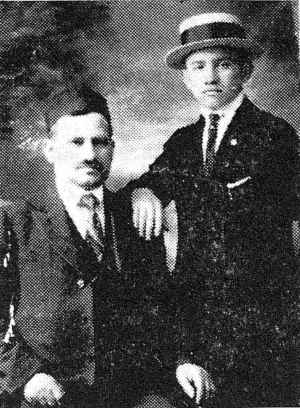
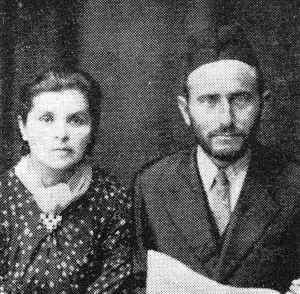
| From left: Hersh Blaf and his son Chayim Pinches, during their first years of their life in the ‘Golden Land’ – but they always felt connected with the old home, Grabowiec.[9] |
Father was already in America, and our family had a difficult time. Leibish would accompany me to the villages, to obtain some potatoes. Over time, he began trying to find a more practical way of life, and we met less often. The days I didn't meet him were sad, and I missed him very much.
Time crawled on until I left for America. After I moved, I was always interested in his doings in Grabowiec. I heard that he had gotten married in Zamosc to a fine woman and created a good life and livelihood for himself. Eventually, I contacted him and we stayed in touch, occasionally sending him a few dollars or gifts. Mother always mentioned Leibish and reminded me to write to him. When things in Poland became worse, his letters, too, were far from cheerful. Conditions in America weren't good, and I couldn't always help him as I would have liked to. This caused me great pain. I thought of him constantly. To this day, I sometimes see him in a dream, as alive as on the day he returned from his army service. In my dream, we hug, and weep. As I write these words now, he stands before my eyes,
[Page 249]
as kind and sincere as he was in my dream last night.
|
|
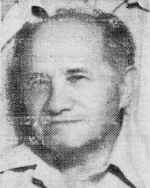
| My first wife, the daughter of David Eynes and a granddaughter of Feivl Dovidtshe Eynes. She was also very active in the Grabowiec Jewish community and was constantly enthusiastic about the State of Israel. The photo was taken a few weeks before she died following surgery. |
Leibish and his family survived World War II in Russia. I don't know the details, but I heard that he had had a rough time there. After the war, he emigrated to Israel. Life was not easy for him there, either. He was not fated to enjoy the pleasure he might have derived from his children and grandchildren, who live in Israel. They are fine, kind people, like their father and grandfather.
Translator's footnotes:
by Yisrael Hustik
My Father's House
I've been connected to our town, Grabowiec, since my earliest years. That is where my cradle stood and where I spoke my first words: “Mama, Papa.” I can only imagine how happy they were to hear these words. My parents began to live in Grabowiec immediately after they were married. They rented a place not far from my grandfather's shop, and where he also resided. Grandfather Moshe Zinger was the chief cantor of Grabowiec's large synagogue. Although he was a fervent follower of the Husiatyn Hasids, he led prayers in the large synagogue on Shabbat and holidays. People loved to hear his voice and his sweet style of prayer.
After they married, my parents were in difficult material circumstances. After my birth, my mother, Esther (may her memory be for a blessing) had to work for her parents, and we moved in with them. We lived in the two-room apartment with Mother's parents, their daughter Gitel and her child, as well as another grandchild, Sarah. Mother helped her parents in their grocery and baked goods shop.
[Page 251]
My memories of my parents' early years as a family have them worried and rushing about to make a living, but not despairing. They never doubted that better times would come. Father, along with his brother Shlomo (Simcha's father), Yantshe Boym, and his brother Gershon, began to deal in lumber. Their financial situation seemed to improve, and Father began to build a house of his own, near his parents' house; I vaguely remember his father, Yosef Mordechai. I have clearer memories of his wife, Grandmother Golda, who continued to live in the family house with her daughter Sarah for years after Grandfather's death. It was also the home of Uncle Feivl and his family. The only survivors of that family are the two daughters, Reyzl and Pesse, who live in Russia. Father's sister Chantshi and her children also lived there. Only one son survived: Leyzer Hustik, who lives in Israel, as do Shlomo and his family.
|
|
Like Grandfather and Grandmother, my parents loved the town and its residents. They were always proud of their lineage and told their children about the great qualities of their grandparents. Their love was engraved in my heart and constantly accompanied me. My life as an adult was often difficult and grim, but my home in Grabowiec always shone like a clear dawn that portends a fine day, full of hope.
In the Cheyder
The blessed day finally came: time to start attending cheyder. Father wrapped me in a tallit and carried me in his arms. Chayim, the melamed's helper, was already waiting at our home. He carried me into the cheyder,
[Page 252]
which was a small, dark room. Boards nailed to logs served as benches, where the children sat and repeated the names of the alphabet letters after the melamed: alef, beys, gimmel.
Although I was very young, the experience was indelible. I remember the silence when we came into the room. However, it was short-lived. Father started to hand out candy, and it soon became very lively. I was handed over to the teacher, and became his student, with all the rights and responsibilities of a very young child of the time. The helper came to our house every day, led me by the hand to the cheyder, and later back home. When I grew older and attended a different cheyder, I was more independent and walked by myself.
I went through different phases when I changed cheyders, until I arrived at Sholem Mezgy's school. Here, studies were geared toward mastery of the Torah and Talmud. However, my parents wanted me to become literate in Polish and Yiddish too. I was one of the few children in town who, besides cheyder, studied with a private tutor as well as in the Polish school. My teacher was Baruch Eynes, to whom I am very grateful. On the other hand, my time in the Polish school was not easy. I was beaten by the Gentile children from the very beginning. I soon realized that I was weaker than the numerous Gentile boys, and “swallowed” the blows and insults. However, when I entered third grade I felt stronger, and wouldn't let them spoil my life; I opposed them forcefully. They also had to reckon with the fact that I was one of the best students, a fact that increased my courage and confidence.
Torah and Hasidism
By then, our house was one of the wealthiest in town. The atmosphere at home was Hasidic. My father,
[Page 253]
an adherent of the Husiatyn Hasidic group, often invited people from that group's synagogue for kiddush on Shabbat and holidays. They sang Hasidic melodies and told stories and proverbs they had heard from the leaders of the Rizhin and Sadigora Hasidic dynasties.
There were other Hasidic synagogues in our town, each one a world of its own. I remember well the warmth and enthusiasm of the Husiatyn synagogue, where rich and poor came together. The synagogue functioned as a second home for the Hasids. When they came, they shook off all their troubles and cares. They found a home-like atmosphere and help, as well as solace for their constant worries. One vivid memory is that of the stairs leading up from the street to the women's section. That was where local and visiting poor folks sat holding plates, into which the passing congregations of the Hasidic synagogues and the study house dropped charity. I recall the first time my father gave me a few coins, saying, “Listen, my child. This is what I saw, and learned from my parents. You too, my son, need to do it. Take the money and place it in the plates and collection boxes…”
|
|
Here in Israel, we are in the habit of calling a neighborhood comprising a few houses a town (kirya), such as Kiryat Ha-Melacha, Kiryat Vizhnits, etc.[1] That should also have been the name of the street where the study house and Hasidic synagogues of Grabowiec were located: the “holy compound.” The large study house, with the steps leading up from the street to the women's section, the anteroom and corridor, and a cozy, familiar prayer area, was always full of worshippers. Many distinguished members of the community would come, some to study
[Page 254]
their daily page of Talmud or a random page of Mishna.[2] Unmarried men sat and studied a page of Talmud on their own, while older men leafed through old sacred books; many books of rabbinic literature were available. It was a “university” for young scholars, who would sit late into the night debating difficult passages. It could be said that the sound of study and prayer was heard day and night. For older men, as well, the study house was the best, and perhaps the only, place for intellectual and spiritual activity.
The street was also the location of the Kuzmir and Radzyn Hasidic synagogues. The Belz Hasidic synagogue was located nearby, not far from our house. These small synagogues, too, were open all day and until late at night. The voices of young men studying, using the familiar Talmudic melody, were a constant accompaniment. Scholars would begin their Talmud study at dawn.
Friday nights and Shabbat days were unforgettable. I have been away for many years and have traveled through many countries and towns, but I often return in my memory to the small synagogue where I spent my childhood years.
The weekday mood in the town began to shift as early as Friday afternoon. Father came home early and took me to the ritual bath, which was already full of Jews. The steam bath was shrouded in thick vapor, and there were shouts of “More steam… another bucket of water for the heater…” Wearing fresh linens, we would go home, where Shabbat was already noticeable in every corner. The table was covered in the white tablecloth, and the silver candlesticks were ready for Mother to say the blessing, her hands covering her face as she whispered “… Blessed are you, our God… who commands us to light the Shabbat candles.”
Dressed in our Shabbat best, we went to prayers. The alleys were filled with people on their way to the study house, with its anteroom and small Hasidic synagogues. All the spaces were bright with the gleam of lamps and large candles, as the congregation sang the liturgical poem welcoming Shabbat, “Lecha dodi likrat kallah”.[3] I can still hear the sweet voice of my grandfather, Moshe Zinger, welcoming Shabbat with joy and sanctity.
The memory of Shabbat afternoons fills me with longing. Jews were singing ritual Shabbat poems,
[Page 255]
and clinging to the day's sanctity with all their might, unwilling to part with Shabbat. We boys crept into corners, telling stories, and wanting to remain within the world of dreams.
The congregation of the small synagogue was small in number, yet incredibly fine in quality – it comprised many fine, marvelous Jews. Those who could, did their best to make the synagogue pleasant and warm, both externally and internally. There was plenty of firewood all winter, because Father's old business partners in the lumber business prayed here – Uncle Shlomo, Gershon, and Yantshe Boym – and, together with Father, they made sure that the synagogue would be heated.
Grabowiec was renowned for its hospitality. We hosted a guest almost every Shabbat. As many as twenty impoverished Jews who tramped from one town to the next to collect charity would spend the sacred Shabbat in our town. Anyone in the congregations of the study house and the Hasidic synagogue who could host a guest for Shabbat did so.
A Trip to the Hasidic Leader, the Rebbe
Father, like the other Husiatyn Hasids, lived and breathed learning and Hasidism. Traveling to the Rebbe was considered a sacred obligation. The Husiatyn Rebbe, however, lived far away, and only a few Hasids could afford such a long trip. He would therefore visit Lemberg once a year, in early summer.[4] Hasids from the entire region would make that trip. I remember our local Hasids gathering in one spot in town, hiring a cart, and going to Lemberg to spend Shabbat with the Rebbe. By then, I was in Sholem Mezgy's cheyder. Father announced that we were traveling to the Rebbe in Lemberg. I was prepared and outfitted like a bridegroom on the eve of his wedding: my hair was cut, except for the long peyes which were retained, and I was given a Hasidic cap.[5] It was Thursday when we rode the cart to Miaczyn, in order to catch the train to Lemberg. Father and I were accompanied by his brother Feivl, who used this opportunity to purchase some fabrics. When we arrived in Lemberg, we were taken to an inn that was already full of Hasids, and
[Page 256]
started off to see the Rebbe. It was very crowded when we arrived, as people were massing to receive the Rebbe's blessing.
He emerged from his quarters on Friday evening and chanted the blessing over the wine. To this day, I can hear his sweet voice, and see before me his impressive presence, with his handsome white beard and gleaming silk kapote.[6] He gave off an aura of great stature in learning and wisdom, leadership and qualities, intelligence and spiritual power.
Those days are now distant. It's difficult to remember the precise details, but the enthusiasm of the Husiatyn Hasids for their leader, his greatness, and his character as a Hasidic Rebbe still fills my heart.
When I returned to the inn, I saw the Grabowiec Hasidim again. I can still see the faces of Elkanah, my future teacher Shaulke, his son Mendele - the town prodigy - and others who were singing Shabbat songs. Father and I sat next to them at the large table. Though I was young, I felt that they were dealing with great ideas and their thoughts were ranging beyond mundane concerns. I believe that such elevated thoughts had become natural to these Hasids. They were enveloped in a kind of nobility, which gave them the strength to trudge with their carts along the rough roads of Grabowiec. Sadly, the joy with which they undertook the way to the Rebbe and back is long gone.
In Grabowiec, the Husiatyn Hasids were known as the drinkers. Almost every day had its reason to down a glass. It could be the anniversary of someone's death, the occasion of signing a marriage engagement agreement, or a wedding. But it would be wrong to think that drinking was their only source of pleasure. They enjoyed learned conversation, and sang Hasidic songs. There were also good prayer-leaders, such as Avraham Rapoport, Elkanah, and others. They told stories of the Rebbe, or read a letter the Rebbe had sent his followers.
I remember a period when the Rebbe moved to Vienna, and his court was short of funds. Grabowiec was considered a center of Husiatyn Hasidism, and Lipeh, one of the court's chief managers, came to town, and stayed
[Page 257]
with us for about ten days. It was very lively. A bottle of brandy and other treats were always on the table, as people came and went. Visitors from other towns and surrounding villages came with requests and gifts of money for the Rebbe. The requests asked the Rebbe to intercede with heaven on the behalf of the writers. Virtually everyone needed some kind of help. Once Lipeh had left, each request was actually answered by a letter of good wishes and blessings. The Rebbe visited a nearby town on each day of his stay in Grabowiec; these places included Uchanie, Wojsławice, and other towns. He collected funds and took written requests. The tinsmiths of Grabowiec manufactured special large metal boxes for him, so that he could transport special shmaltz, kosher for Pesach, back to his court.[7]
Life in town continued in this manner I first studied with Sholem Melamed, then with Shaulke, where I learned Talmud and commentaries. Our house was always full of guests and relatives from Lódz, where Father's brother Berl lived, or Chelm, the home of cousins on Father's side of the family. There was a constant feeling of family warmth in the house.
The First Mizrachi Members[8]
The life of a boy in Grabowiec consisted of more than his own home. Hasidic synagogues also played a major role. We children knew about everything that happened there, enjoyed the festive holidays, and were fascinated by the large and small disputes, and conflicts between older and younger generations. These intensified after the establishment of a branch of Mizrachi in town. My uncle Feivl was the branch chairman.
Although Father was very busy with his lumber business, he was interested in community affairs as well. He also headed the town's commercial bank; he was the chairman, and assisted the bank with his own money.
[Page 258]
A New Jewish World
The intensive work and experiences apparently affected Father's health; he suffered from heart disease. Mother, too, was not well. They went to Krenits and other places in search of a cure, taking me along with them; it gave me a glimpse into a new world.[9] Dozens of rabbis and Hasidic leaders would come from all over Poland as well as from other countries. They were accompanied by their followers, who clustered around them, or created their own courts. I can still see the impressive Rebbes on a walk, followed by rows of Hasids. They often stopped for the afternoon or evening prayer, and the trees seemed to sway in unison with them, whispering the prayers in hushed tones. It was definitely a Jewish world. At the beginning of Shabbat they seemed to be enveloped in an aura of sanctity, with their silk kapotes and shtreimels. Rebbe and Hasids all blended together.
In the early 1930s, the economic crisis began and the lumber business was among those affected. My parents lost a great deal of money. They had to move to Kryłów, in the Hrubieszow area, where they had purchased a mill, together with Father's brother Shlomo, and Yantshe Boym. I graduated from the Polish state school in Kryłów, as one of only two Jewish students in that school; the other was Yantshe Boym's son Hershel. He was a fine boy, and we soon became close friends. We suffered together from the Gentile boys at school and had fights with them. Hershel's sister Manya also attended that school. No members of that family survive today.
When I was older, I became active in the Zionist youth organization in Kryłów. Hershel and I became devoted to the ideals of Zionism.
When we lived in Kryłów, our home followed the Grabowiec
[Page 259]
customs. Visitors came from Grabowiec, on business or for pleasure, and stayed with us. My cousin Hindeh spent time with us for years, until she married Shmuel (who died in Russia).
The End
The connection with the Rebbe's court was active in our home for many years, until I came to Israel; the Rebbe was then living in Tel Aviv. This was after the horrendous war in which the Jewish community was murdered. I went to visit the old Rebbe, who asked me to tell him everything about the war, and our experiences in Russia. He listened with profound attention, and told me that I was one of the first Hasids to tell him about the gruesome events in Poland.
My connection to Grabowiec continued to be deeply rooted, and I thought of it every single day. When we lived in Kryłów, Mother would visit her family in Hrubieszow several times a year. Father did the same. When we lived in Ludmir, we maintained our link with the Grabowiec residents who had gone across the border to Russia. We met many of our family members, such as Simcha and his family and Hindeh and her husband Shmuel.
However, times grew harder and harder. Tens of thousands of Jews were sent deep into the vastness of Russia. We were able to stay in the small village of Ivanychi, near Ludmir, but later had to move to Warkowice, one hundred kilometers from the border.[10] Our living conditions were very cramped: six people in one small room. Many wealthy Jews lived in Warkowice, among them Father's brother Feivl Hustik and his family. By then, Feivl had been able to return from the distant parts of Russia, as did my cousin Simcha and family, and Uncle Shlomo's two daughters Esther and Henya. Uncle Shlomo and his wife, as well as Feivl, stayed in Grabowiec.
The parents of Shmuel Farki, the baker, also lived in Warkowice, where they had a bakery. Shmuel and Hindeh were transported to Russia.
[Page 260]
We obtained work in a forest with the Polish manager. Father announced that he wanted to be hired as woodsman, but he was rejected as a “capitalist.” We stayed with the forest manager, hewing beams and being paid in lumber, which we sold and managed to scrape a living.
Everyday life was a struggle. Father and I started working. I was mobilized into the Soviet Labor Army.[11] Hostilities between the Soviet and German armies broke out two months later. The horrible murders took place soon afterwards, including those of my parents, my sister Dvoyre, and my little brother Moshe. My sister was able to escape from the Warkowice ghetto before it was liquidated, but was captured in the forest along with a few other girls. They were murdered in a gruesome fashion.
We were later told about the terrible suffering of my parents in the ghetto, which included hunger and torture. They sold everything they had, down to their last remaining garments, for a crust of bread. Father suffered the most, as he could not watch others going hungry while not able to help them himself.
The victims on Mother's side of the family were her sister Bluma and husband Yitzchak Brikman and their daughter Dvoyre. Their other daughter, Soreh, was killed in Ludmir. Gitl Markovitch was murdered along with my parents in Warkowice. Those who were killed on Father's side of the family were his sister Soreh, her husband Chayim-Yosl, and their son Itshe, his sister Khantsheleh and all her children except Leyzer, and his brother Shloyme with his wife Rochl and son Feivl. Both daughters, Henya and Esther, were killed in Zdołbunow; Feivl and his wife Freyde were murdered in Warkowice.
|
|
[Page 261]
In this savage manner, our nearest and dearest were murdered. They had lived modestly in the small town, and bore in their hearts the sufferings of generations as well as the millennia-old faith, and the unbroken golden chain of their ancestors' tradition. Regardless of the troubles they endured, they never stopped dreaming about a bright tomorrow. There were those who waited patiently for Messiah to come and redeem the nation, while others were not interested in miraculous redemption but sought redemption through the establishment of an independent Jewish state by their own power. I see before me the fine, luminous Jews of Grabowiec, and immerse myself in the memories of their spiritual glory; and my soul is in shreds over the town and its residents who were cut down.
We traveled a road of misery during the war years. This in itself is a rich tale of inhuman suffering, the kind that many of us endured, until the war ended and we were blessed to make aliyah to Israel in 1947. Our contribution is a small part of that which must be told about the life and death of our bygone town, Grabowiec. Each of us detailed only part of our experiences. We, who were miraculously saved, must assume the eternal responsibility of preserving the memories in this Memorial Book. May it help to ensure that ghettos and Sobibor death camps will never happen again, and to assist the development and existence of our nation and our land of Israel.
Translator's footnotes:
by Yisrael Hustik
|
Not only today Do I remember my hometown. Decades later, My town and its past Continue to live in my memory, Hill, stream, and pine forest.
Storms will not wash away
Grabowiec, you are
Four hundred Jewish families,
Enveloped in eternal sorrow |
Translator's footnote:
by Yosef Boym
Decades have passed since the time we lived in Grabowiec. As I write these words today, I feel as though the souls of our parents, grandfathers, and grandmothers, along with those of our nearest and dearest, have gathered and now rest in us, demanding their place in history – even by way of a few words that recount and retell their lives, their deep roots and their branching into large families, their days and nights, their longings for salvation, and the total beauty of their harsh lives. Oh, how hard the Jews of our town worked to make a living: shopkeepers, village peddlers, and other laborers who lived by the sweat of their brow; quiet souls who never missed an afternoon or evening prayer, ignoring persecution and evil decrees while always hoping for better times.
My father Yisro'el David was one such person. He was a Radzyn Hasid, and often led prayers and Torah readings in the synagogue. When he led prayers, his feelings overwhelmed him, and he wasn't aware of the lyricism of his voice. The congregation, however, sensed the sweet, noble sound, which seemed to break through the walls and carry through the streets of Grabowiec; streets that grew hushed during Shabbat and holidays, as though they were listening to the prayers.
I am still haunted by Father's Hasidic melodies, especially the ones he sang during the concluding meal of Shabbat, when the synagogue was shadowed, and the mood was affected by the imminent approach of the new week. The congregation then sang with profound spiritual feeling.
[Page 264]
|
|
Father was an old-style Hasid, who feared heaven and feared sin. His day began at dawn, when he went to the study house and read a sacred book until the requisite minyan assembled and prayers began. His prayers were prolonged, as he prayed not only for his family but also for the entire Jewish community and all the Jewish people. After prayers, people came to him for advice on various private as well as community matters. Father recounted religious insights and tales told by the Radzyn Rebbe, and believed that those who did not travel to visit the Rebbe were not true Hasids. He always admonished us children. His sole wish was to see us studying, and for us to be decent Jewish children.
My ears constantly ring with those melodies. Sometimes I think that they hum from deep inside me. They may float away, but come back, like the sounds and odors of summer twilights in the town. They reappear together with the voices of the decimated Jews of Grabowiec, especially of those whose sweet voices were said to be capable of bringing Messiah down from heaven. On Shabbat mornings, Father would go to pray with the tailors' minyan, which gathered at Noteh Reichman's home. Father led the prayers and read out the week's Torah portion. The congregation marveled at Father's praying and Torah reading with the precise cantillation, and had boundless appreciation for his voice. My childish heart swelled with pride.
[Page 265]
On Purim, groups of worshipers would gather at different homes, and Father would come and read the Purim megillah out loud, so that the holiday could be felt everywhere.[1] If someone in the community was ill on the High Holy Days and unable to attend synagogue services, Father visited their homes and sounded the shofar. He considered this a great good deed, and the sick were very thankful.
The High Holy Days in Grabowiec were wondrous and holy. This had been the community's way of life for generations, and been sanctified by martyrs and their sufferings over generations of persecution and decrees. Only now are we better able to grasp the fine qualities of the Jews in our town, and their faith in higher powers. When a mother brought her sick child to Father so that he would exorcise an evil spell, Father was so certain of the power of the verse he murmured that the mother was convinced her sick child was saved.
In those days, there was no doctor in Grabowiec, but only two medical practitioners: Shimon the Healer and Mekhl the Healer. They were definitely very capable, with a highly developed capacity to understand illness, yet there were many cases when the source of the illness was hard to understand. That was when Yisro'el David, my father, was consulted.
As a young boy, I often saw a mother come to us with a sick child, her eyes full of tears, and beg Father to save the child. Father's face then radiated solemnity. He rose to his feet and asked for the child's name. He quietly chanted the Yehi Ratson prayer, and followed it by several verses I did not understand. yet I was overcome by terror, as though I had heard the rustling of demonic wings, which Father was driving out by chanting the holy text.[2]
Oceans full of blood and tears have flowed since then. Now, as we are setting up this
[Page 266]
memorial to our martyrs, the treasures of our traditions, rules, regulations, and customs are revealed. The more we ponder them, the more we discover fine human traits as well as a lofty moral ethos that influenced the spiritual atmosphere of our town.
A beautiful and sacred world has been destroyed, tragically cut down; and we few are left to mourn the horrible destruction and recount the lives and deaths of our nearest and dearest. We tell of their pure, holy lives, as well as their gruesome martyrdoms. There, on the wretched soil of Grabowiec, we grew up among Gentiles who profited from our honesty. When the Nazi murderers arrived, the neighbors helped them chase the last remaining Jews, and destroy their homes.
We witness the ruins, and chant the ancient Jewish lament: “How solitary sits the city…”[3]
Translator's footnotes:
|
|
JewishGen, Inc. makes no representations regarding the accuracy of
the translation. The reader may wish to refer to the original material
for verification.
JewishGen is not responsible for inaccuracies or omissions in the original work and cannot rewrite or edit the text to correct inaccuracies and/or omissions.
Our mission is to produce a translation of the original work and we cannot verify the accuracy of statements or alter facts cited.
 Grabowiec, Poland
 Yizkor Book Project
 JewishGen Home Page
Copyright © 1999-2026 by JewishGen, Inc.
Updated 23 Jun 2026 by JH