|
[Page 172]
|
|
by Chayim Pinchas Blaff
Grabowiec lagged in development behind other Polish towns, perhaps due to its geographical location. The railroad station was far from town, the poor roads rendered trade with the wide world difficult, and the lack of electricity and a dependable supply of water hampered the creation of workplaces. The town's economy was mainly based on retail, and on the fairs in Grabowiec and nearby towns. The merchandise was brought in by wagon from Chelm, Zamość, and Lublin, for sale to the peasants in the area. There were local tailors, shoemakers, carpenters, and other artisans. Peasants would bring wagonfuls of grain, fowl, eggs, potatoes, fruit and vegetables for sale to shopkeepers, and would buy the goods they needed.
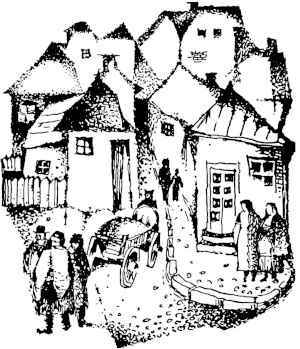
The marketplace is the hub of the town. It is round and spacious, and surrounded by shops like links in a chain that are punctuated by paths and alleys connecting to the town. People come to the marketplace, not only to shop when the fair is held, but for entertainment as well. All year round, when they are bored with sitting at home, people head to the marketplace, where something interesting is always happening. It is expansive, and full of people strolling randomly, regardless of the time of day.
Tables and shelves, operated by women, are set up in front of the ring of houses and shops. Here, in front of the shops, is where all the commerce of the town takes place. Clothes, fabric, skins, perfumes, shoes, hats, fruit, vegetables, fowl, meat, metal (products and scrap), felt fabric and overcoats, sweets, and cereals[1] ground on the spot. The local tavern advertises itself by the noise it emits.
The constant buzzing of the marketplace echoes through the chinks in the ring
[Page 175]
of alleys, and carries down the streets and pathways. They all connect to the marketplace organically; every turn leads there. Even if you have no plans to go there, hundreds of eyes seem to force you to go, and so, you meander helplessly into the marketplace. The sun, once it rises from beyond the forest and reaches the marketplace, sends waves of light and heat into the plaza. The alleys and streets leading into the marketplace are alert for the sounds of the market, as though their lives depend on it. The excitement eases only at dusk, when the blazing sunset disappears into the thick green forest, and everything relaxes. The pale, beautiful moon reveals itself over the marketplace late on spring nights. A silver, secretive silence envelops the thatched roofs. The alleys shimmer as they gaze at the market through the openings in the fences. The only visitors to the square are stray goats, cats, and dogs that rummage through the leftovers under the market stables. Somewhere, cats yowl pitifully, like suffering infants. The children sleeping in their bed snuggle under their covers in fear and repeat the prayer “I pray for God's salvation” seven times, as a sure remedy against demons, and the yowling dies down.[2] The alleys are quiet once again, napping until the peasant bringing milk from his village appears with his creaking wagon in the pre-dawn hours. The water-carrier starts to work the rusty pump at the well; it emits a series of squeals and moans, until a stream of fresh water finally emerges.
The market wakes up, as do the alleys, with quick, ringing footsteps. A faint light brightens the dormant houses and shops. A new day comes to Grabowiec, and Jews hurry to bless the newcomer. On some days, Berl, the shammes, wields his hammer and pounds on windowsills, as his voice pleads. “Wake up, come to worship the Creator! Wake up, Jews, the study house awaits you. Hurry to chant Psalms!” It is a fresh day. Gates, doors, and windows open wide, and the town's Jews resume their lives. Some walk slowly, as though counting each step, breathing heavily and sighing audibly until they stop and rest near the study house. Others are in a hurry, murmuring a quick prayer as they leave for the villages.
That was the life of the town's Jews, the unique lives of Jews who existed
[Page 176]
from one Shabbat to the next, and all the while awaited the arrival of Messiah. They spoke Yiddish, mixing in Hebrew words from prayers and Talmud, as well as Polish and Ukrainian words. This mélange lent special charm to their conversations. Jews who were Talmudic scholars used Talmudic terms in their everyday speech, such as mashma (in other words), lemai nafke minna (what difference does it make), kayma-lan (the standing rule is), kal va-homer (an argument a fortiori; what applies in a lesser case will certainly apply in a stronger case), sevora (the reasoning is).[3]
After the Zionist movement was founded, new ideas began to ferment in our town as well. Some young people sought new solutions to their troubles and problems, and new ways to connect with the Jewish world in the effort to achieve those solutions. After the war between Russia and Poland ended, Zionist activity in Grabowiec increased.[4] Small groups formed, which included yeshiva students and young people from well-to-do homes, all of whom had been educated in the traditional cheyder and study house. Although they were a minority in the Jewish population, they were extremely active. The lives of most Grabowiec Jews continued to center on the synagogue and the study house, but lively debates developed between the supporters of each ideal. The minority was not isolated from the outside world. They gradually came in touch with the broader Jewish world, and joined conventions and conferences, actions that echoed throughout the local Jewish population.
The Zionist organization directed its efforts into two main channels.[5] The primary one was to deepen the notion that the Land of Israel was the future home of the Jewish people; second was the realization that more cultural activity was needed in the town in order to break the self-imposed isolation of Jewish youth. Those years, in which we took our first steps in the Zionist movement, were the best of our lives. We considered ourselves the vanguard of a mass movement that was destined to wake the nation from its dormancy.
There was normal, ongoing conflict between older and younger generations. The young Zionists were alert and active, and aspired to achieve change in their lives. Some young men who ostensibly studied Talmud in the synagogues also hoped for change. Using the Talmudic singsong chant, they secretly studied the grammar of the Hebrew they would eventually need.[6] They left furtively at dawn for Castle Hill, where they welcomed the sunrise. Later, after breakfast, they resumed their places at the worn tables with their patches of melted tallow and wax, and pored over the Talmudic tractates with their yellowish leather bindings. By the light of the tiny oil lamps suspended over their heads, they chanted as they studied the true meaning of the phrases ‘tanu rabanna’(our rabbis taught), and ‘amar Abaye’ (Abaye – a Talmudic sage of the fourth century in Mesopotamia – said).[7] The argument filled the air, and
[Page 177]
the fragrance of the Land of Israel rose from the large-format pages. Eventually, some of the young men left for the city, hoping to make a living there. The others considered their situation and became aware of the change in their lives. They continued to study Talmud, but new themes mixed with the ancient words. The combination was jarring. Many realized that the way to the Holy Land was not exclusively through religious study, but also through enlightenment and education. The latter were an end in their own right, crucial to the development of a well-rounded person. The young men began studying these new books until late into the night. The Tze'irey Tziyon library resounded with song and dance extolling immigration and settlement in the Land of Israel: “We will be the first, we'll rebuild and revive our country!”[8] The streets and alleys were a silent audience.
They continued to live in this way until the modern Amalek destroyed the Grabowiec Jewish community and sent everyone, old and young, to their deaths.[9]
The passage of time may dim and erase personal sorrow, and heal private
wounds, but we refuse to be consoled for the tragedy and the bereavement. As we grow distant from that terrible time, we are commanded to remember and forever preserve the memory of our disaster by educating our young people about the Shoah, if only to pass the awareness down to future generations, as the Torah teaches us: “And you shall tell your son…”[10]
We will never forget them. We will recount their lives and the life in our town, so deeply engraved on our hearts, and tell our sons and all our later descendants, down the generations to come.
Translator's footnotes:
by Chana Zilberzweig-Borinsky
|
The image of the town looms before my eyes, as though I'd seen it yesterday. I wasn't familiar with other, similar towns, but I think it was unique, for good and for bad. Its location and surrounding landscapes were a gift of nature – all was beautiful and calm. Those who grew up there will never forget the setting. Grabowiec lay in a valley in the midst of hills that were the domain of Gentiles. The highest hill, which overlooked the entire town, was called “the Grabowiec Hill.”[1] In ancient times, it was the site of Tatar sieges and battles, due to its strategic advantage. The fortress that had capped it was destroyed, and was replaced by crosses. In our time, it was the scene of lovers' trysts during spring and summer, and a favorite site for skiing and sleigh-riding in winter.
Architecturally, and as far as sanitation was concerned, the town belonged to medieval times rather than to the first half of the 20th century. It centered on the market square, which was bustling on the days of fairs, when farmers brought their produce-filled wagons and livestock from the surrounding villages; at all other times, it was deserted. The center of the marketplace was occupied by a square building that housed the Jewish shops, and the all-important water pump, which was rusted, and sat in a mud patch all year round. Jews lived in the houses around the square. That was also the location of the church, and, across the square, the home and orchard of the priest, which were surrounded by tall trees and a high fence. The cross that rose high above the church seemed to threaten the Jewish neighborhood; that was where the priest's sermons reinforced hatred of Jews. On Sundays
[Page 179]
and Christian holidays, the Gentiles going to church would encounter silent Jews dressed in black. The blank faces of the Gentiles expressed hostility, as they pretended to ignore the Jews from whom they regularly bought goods on credit.
The Jewish shops were all similar [selling]: groceries, fabric, shoes, and soft drinks. Many shelves in the shops were virtually empty. A barrel of salted herring usually occupied one corner. The proprietors' faces were as gloomy as their existence.
The Jewish houses were located behind their shops. The wooden houses were supported by each other – otherwise, many of them would have collapsed. A single dirt and gravel street separated the Jewish homes from the Christian houses, their dogs, gardens, and fields. A stream surrounded the town like a moat; beyond it lay the fields that extended to the hills. There bubbled the freshwater spring, where on summer days we children were often sent to bring cool, clear water. We loved to run to the meadows and splash in the stream, despite our fear of the Gentile children and their dogs; the stream, fields, and forests, were theirs.
The poorly illuminated streets lacked paving and sidewalks. In autumn, when rain began to fall, as well as in spring during snowmelt, the streets turned into deep sludge. The Grabowiec swamp was renowned in the area; horses and wagons would sink halfway into the mud, whereas pigs reveled in it. When winter came, however, the mud looked clean, as it was covered in white frost and snow.
Most of the Jews were very poor and despondent. Few sources of livelihood were available to them: commerce, artisanship, tailoring, shoemaking, or carpentry. Fathers passed down their trades to their sons. Those who had nothing to bequeath their sons saw the younger generation leave the sheltering town and try their luck in the larger cities. Life was hopeless.
Yet the town's Jews kept to their age-old traditions, with all their beautiful features. Only now, when all trace of them is gone, am I able to admire the values of tradition and the love that our parents had for these values. They were the foundation of the Jewish nation and of each individual Jewish life.
At the onset of Shabbat, the weekdays – with all their worries and groans – disappeared as by a magic wand. The sanctity of the sacred day, the beauty of the holidays, the fragrance of the dishes special to each holiday, the dawn call to prayers by the shammes, the awe during the High Holy Days and the nights of repentance prayers, made each person feel that they were standing before the Creator to give an account of their deeds. These features were woven into a strong, magnificent tapestry created by generations that longed for salvation and messianic times. At the same time, they accepted the reality of their lives in exile; they had been born into it and were incapable of changing it. They therefore clung to the few bright aspects of that reality
[Page 180]
that gave them the strength to continue, day by day and year by year, as they continued to hope for better times, and believed that their descendants, if not they themselves, would enjoy them. They certainly knew moments of transcendence in their daily practice; they seemed transformed when they returned from prayers on Shabbat or holidays, as though they felt closer to God.
The peak of Jewish life in the town came when the writing of a Torah scroll, financed by every Jewish resident, was completed. The scribe dedicated a letter to each person. I remember the occasion as very festive, with many participants. Guests came from the surrounding towns, including rabbis and Hasids. In the evening, the scroll was borne to the synagogue under a velvet canopy, accompanied by musicians. The Jews danced and sang alongside, under the canopy, all the way to the synagogue. The Gentiles who watched the event along the parade route probably couldn't understand the reason for the celebration. At such times, the Jews forgot that they were living in exile, among Gentiles. Though living among strangers was not secure, they were secure in their Jewish faith.
Last names were not used in our town. Most people had nicknames, whether whimsical or hostile. The nicknames were passed down the generations. The derogatory or grotesque nicknames were part of the town's life. I remember the wonderful figure of Chiel, Mendel's son.[2] He was powerfully built and had a fine beard. Chiel carried flour sacks from the mill to the shopkeepers all week long. As he bore the heavy flour sacks on his back, he seemed on a mission. On Fridays, though, he was different. People waited for his call, “Jews, to the synagogue!” that announced the approaching Shabbat. He had a lovely custom every year at Simchat Torah. He would gather the children who studied at the nearby cheyder and walk with them from house to house, singing as they went. The singing was wordless, except for the recurring phrase, “sacred flock.”[3] The children would respond by bleating ‘meh, meh’. The sound of the happy children drew housewives out of their homes, bringing bowls of treats for the children.
True, the holidays were beautiful; but daily life was gray and gloomy. Young people searching for an alternative completely negated the old way of life, with all its positive and negative aspects. We knew that the route to a different, beautiful life did not permit compromise, but were too young to understand that the old ways had formed us as Jews and given us the moral and mental strength
[Page 181]
to withstand the terrible humiliations, we regularly endured and not deny our past and our identity. The basic layers of Jewish education became overlaid by the Zionist pioneering education we received in the youth movement. Together, they formed our future national awareness and world view.
The Youth Movement
The HeChalutz youth movement was a challenge to the day-to-day existence of the town, as well as to Jewish exilic life.[4] It called on the young people to make the Jewish dream of salvation a reality. It led us toward changing our value system, personally and as a nation, by our own action: training, immigration to the Land of Israel, and rebuilding it in the most literal way. The idea of personal transformation attracted young people, and seemed very realistic, although immigration to the Land of Israel sounded like a distant dream.
HeChalutz wasn't the only movement in town that offered a solution. Each of the many political parties had its own ideology. As far as I recall, there was no shortage of the political parties and movements found in many Jewish communities.[5] They ran the full gamut from HeChalutz, Freiheit, Poaley-Tziyon, Communists, Revisionists, and Mizrachi to the Bund. Party activities in the community, especially among young people, were a source of attractive social and political life. Arguing with an opponent necessitated familiarity with his views, and was thus an incentive to read the relevant literature. In general, there was much political activity that manifested itself through political parties; this was true of the adult community as well as the young people. Ordinary Jews would ask about events in Europe and the Land of Israel, and settle international politics as they spoke. It's worth noting that HeChalutz and everything connected to the Land of Israel was very popular. Many adults became Zionists thanks to their children's activity in the movement. I remember the grief in the town when Chayim Arlosoroff was murdered.[6] I'm sure that most people in town (besides the members of our group and activists in other movements) first heard about the murder from the account in the newspapers. Everyone joined in the commemorative meeting organized by members of HeChalutz.
Our membership in Freiheit (known in Hebrew as Dror) enriched our lives with experiences, content, and interests.[7] Conversations about the movement and the Land of Israel, as well as about international issues, broadened our horizons. We were young, and avid for knowledge, which was transmitted by persons we admired. One of the older members, who considered educating the younger generation a duty and a responsibility, was Yideleh Shapira (may his memory be for a blessing), later known as Yehuda Gilboa. Yehuda's personality was unusual, but his spirit was stronger than his body. He was his mother's provider and only son. However, the shop he managed
[Page 182]
was, as his mother said, the least of his interests. He was completely devoted to the movement and the young members. He was always talking with friends as he walked, and was fond of debating with his opponents. In the evenings he'd show up at the clubhouse and lecture, or simply talk with us. We loved and admired him for his wide-ranging knowledge.
Meeting with our older peers, who were in the settlement training programs, was enriching. Whenever they came home, they seemed different than their friends in town. We considered them world-wise, as they had gone “far away” and now lived a different life than we. They seemed to have much in common with each other, and their conversations were always interesting. We envied them, for their different ways of behavior and their experiences, and wanted to emulate them.
They were envied not only by us younger members, but also by people their own age who for various reasons couldn't leave home. I would like to mention one of these members: Avraham Ayzen (may his memory be for a blessing). He was a ‘pioneer’ through and through, even though he did not follow the movement's directive to join a training camp and then immigrate to the Land of Israel. Avraham was devoted heart and soul to the movement and to the Land of Israel. He would repeat his lifelong dream: “To be a street-cleaner near the Jewish parliament in a State of Israel.” It was an amazingly simple dream. Who imagined, at that time, a Jewish state in such concrete terms? Only someone who was consumed by love for the country yet did not make flowery speeches.
One of the greatest experiences of our youth was going to the movement's summer camp. The experience began with the journey to camp with our friends, everyone in high spirits. At camp, we met young people from other places, lived surrounded by nature, and had conversations on new topics. Nothing was as usual, and everything was so interesting! The two weeks we spent at camp were a period of youthful joy and fun, so different from the lives we led at home. In later years, we participated in the movement's educational seminars and met emissaries from the movement in the Land of Israel. These events made us feel that we were part of a great movement. Life took on new meaning!
However, we were connected to the Land of Israel in other ways as well, such as though the Arlosoroff “Shul-Kult” school, which we attended after completing our studies in the governmental Polish school.[8] Our studies in that school acquainted us with Jewish values that we had not been familiar with. Baruch Eynes was the only teacher in the school, which was his own personal project. Thanks to him, we learned Hebrew language, literature (including poetry) and especially the Bible. In fact, our Bible classes created an emotional connection with the distant Land of Israel, its landscapes and places with magical names.[9] The figures of the Patriarchs and the prophets took on the aura of giants, so different from the Jews I saw around me daily. Our Jewish History classes
[Page 183]
crystallized our national consciousness. The heroic wars and the zeal for political freedom were things I had never heard of before. While studying in the Polish school, I admired the history and literature of Poland. I never knew that we, too, had had a land and a kingdom, and a glorious historical past.
Although our movement was generally liked, our parents were none too happy that we were members. They knew in their hearts that we would leave home one day, and they would never see us again. Though they understood that immigration to the Land of Israel was the only solution for Jews, they disapproved of participation in the training program, and did their best to change our minds.
I remember one indelible childhood experience related to immigration to the Land of Israel. In 1924, when the first immigrants left our town in wagons. Men, women, and children accompanied them on their way out of town. Did the locals think it was a charm that would ensure salvation, or perhaps they thought it was a mitzvah? The adults wept as they walked, but I couldn't understand why. Mother told me that they were moving to a faraway place, the Holy Land. The parade stopped at the edge of town, and the townspeople stood and watched the wagons disappear into the distance. I thought that the Holy Land was right there, where they had disappeared. I couldn't understand how they would make their way through the “dark mountains” and the stormy Sambation River, and how they would vanquish the “giants” in order to enter the Holy Land. I knew about these obstacles from the stories my grandmother (may her memory be for a blessing) told me, after reading about them in her copy of Tsene-Rene.[10]
There was indeed something prophetic about the tales that Grandmother quoted. About twenty years later, we passed, not only through the Sambation River, but through all the horrors of hell as well, on our way to the Land of Israel. I believe that the desire to reach the Land of Israel, a dream that flickered in our hearts throughout those terrible years, gave us the strength of will to stay alive, and preserved our sanity as well as our humanity.
Translator's footnotes:
by Yitzchak Neri-Lichtash
It was early in 1938 when I came to Grabowiec to serve as principal and teacher at the Yavneh school. The wagon I rode in arrived at the town center, and I had a good look at the dilapidated wooden buildings and the sidewalks of boards laid end to end in the mud. The town seemed isolated and impoverished, nothing but a filthy labyrinth. Although I had come from a small town myself, and had already visited many small towns in Poland, I was very disappointed, and addressed God: “My God, where have I landed? Will I be able to live in such a godforsaken place, and educate children there?” I nearly turned tail and left.
But it was not long before I understood the wisdom of the Mishnaic phrase, “Don't look at the jug, but at what's in it.”[1] By the time I reached the home of Michal Stein, about twenty young people had gathered there, young men and women who were very friendly and welcomed me warmly. The conversation was lively, and included witty jokes. As I was following the conversation, I noticed many different types of people in the group; the group as a whole had its own character. This meeting immediately changed my gloomy first impression of the town. I felt that these were my people, and that I would come to appreciate them. I stayed in Grabowiec until the war broke out, and my expectations were indeed borne out. It wasn't long before I felt at home, and began to participate in the town's rich social and cultural life.
During the interwar period, most small towns in Poland contained lively young Jews who were idealistic, aspiring, and visionary. The young people of Grabowiec were no different, and even above average in many respects. They made themselves heard in every community issue. During the selection of a new town rabbi, all the young people – including those who were secular – were busy campaigning throughout town, with each side presenting the advantages of its candidate.
Whenever a fair was held, its community aspects were augmented by
[Page 185]
social and cultural activities. They offered a chance to collect money for the charitable loan society; collections were done at a cultural event. For example, a mock trial was held of young people's attitude towards Jewish culture. Judges, prosecutors, and defenders were designated, witnesses were called, and the works of such cultural luminaries as S. Y. Abramowitz (Mendele Mocher Seforim), Y. L. Peretz, Sholem Rabinovitch (Sholem Aleichem), and Sholem Asch, were on trial. Everyone in town continued to discuss the trial and its results long after its conclusion.
The Jews of Grabowiec worked hard to make a living. Commerce was enabled by short-term, weekly loans from the loan society. The artisans labored from morning till night to make ends meet. When the fruit in the orchards began to ripen, dozens of families moved into the temporary tents that were set up in the orchards, leased from their Gentile neighbors for the summer. On Shabbat, groups of young people would flock to the orchards, to enjoy the fragrance and the fresh fruit. Another point of attraction for young people was the hill behind the town. Young and old went there, where courting took place, romantic love affairs were conducted, and disappointments happened. Young people could express their feelings on the hill, in group singing and conversation, relaxing their tensions and emotions. These meetings also stimulated feelings of strength, security, and faith, and sometimes called for rebellion rather than submissiveness.
Our pastimes on winter evenings at the various clubs and social events were similar in tone. Conversations at Moshe Vaynshtruch's soda stand supplied new topics for discussion and searching. News would come, and rays of light from afar penetrated the town's normal drab existence. The Land of Israel beckoned from a distance; the very name had a magical glowing power. What was the Land of Israel? What was daily life there like? Not everyone had answers, but everyone was prepared to go there. The settler training camp beckoned, and our hearts roamed farther afield, along the roads to a life of labor in the fields.
I often witnessed the mutual aid in the town. I will never forget the devotion of the townspeople during the great conflagration, just before the war broke out. The flames destroyed half the town and threatened the other half. People spared no effort, and continued their rescue work for hours.
While in Grabowiec, I lived in the home of Yisra'el Papir. The family graciously accepted me into their home, and showered me with affection and devotion. My impressions of living in that house still move me. The school I taught in wasn't the only one in town. It was founded by the Torah Va-Avodah movement.[2] The other school, headed by my friend Baruch Eynes, was founded under the auspices of the Po'aley Tziyon movement. Initially, the two schools were not on friendly terms,
[Page 186]
because of political differences. However, as we became more familiar with each other, the estrangement decreased, and we often met as friends at various cultural events. During our period in Siberia, Perl and Baruch shared their food with me and with Moshe Vald. We also shared the suffering, fear, humiliation, and hunger in those dark days when the lights had been extinguished, and Man was no longer created in God's image.
Working at the school was extremely satisfying. More classes were opened, and the students were diligent. I loved hearing the sound of Hebrew as spoken by the children. It was hard work, but I enjoyed the sense of creativity, as I witnessed the students' interest and efforts to learn, along with the devotion of the community members in the Parents' committee, headed by Feivl Hustik, who spared no effort to help the school to make progress.
May these lines be another row of stones in this structure, meant to immortalize the Grabowiec community. Its young people dreamed about a better future, until the Nazi beasts came and sank their claws into their bodies and spirits; until they, along with all the other Jewish communities of Europe, were annihilated.
Translator's footnotes:
by G. Yosef
I would like to offer some memories of my childhood and youth, for the book that commemorates our dear martyrs. Let me go back to the days of childhood and innocence, as well as the days of ardent youthful beliefs. Is there anyone who doesn't remember their days of youth? They were difficult, but in hindsight they glow. All the trials and tribulations pale in comparison with the overall memories of the town, which are etched so deeply into our hearts.
Entering the town, you crossed the old, gray, narrow bridge that spans a tiny stream, consisting of more mud than water. On hot summer days, though, there was no choice but to bathe and swim in that brook. We called the area around it “the grove,” though none of us knew the actual meaning of that word. In any case, we weren't concerned. The only important thing was that we could cool off and bathe there at the end of a sultry summer day. However, it wasn't simple. The land around the stream was owned by a Gentile resident of the town, who pastured his cows there and didn't want his meadow trampled. He would occasionally show up and drive the bathers away, denying us that pleasure.
I think of the hill above the bridge, which we called “Castle Hill.” It was the site of youthful rambles, which took place in the late afternoons and evenings, on Shabbat afternoons, where groups and couples walked until late night. I was told that during the immediate years before World War II, as antisemitism increased, it became dangerous for Jews to be there at night; Polish hoodlums would attack them.
The town had a town council, though the chairman of the council had limited powers. Most of his orders came from the county. The council included a representative of the Jewish population.
[Page 188]
Naturally, the Jewish community's own leadership committee consisted exclusively of Jews. The topics it discussed focused on community events and relationships between religious functionaries in the town. However, the selection of a new rabbi always involved taking sides, which sharpened differences.
While I was living in Grabowiec, the community's leadership committee was not very active. It became more active during the 1930s, and included support for the rabbi, ritual slaughterers, synagogue managers, study house, and cemetery. As far as I know, no minutes were ever taken, nor was there a written report. As I write about my family, my personal reminiscences mingle with my surroundings and daily life in the town.
Yashi Cossack
I don't know, nor did I ever ask, how a Jew acquired the nickname of “Cossack.” He seems to have been a resolute person who ruled his peers, and had more property than others. He married his daughters to Talmudic scholars. Among his sons-in-law were my great-great-grandfather, Aharon-David, and Moshe Vaynshtrukh's grandfather, Eliezer (Moshe now lives in the USA). Aharon-David became renowned as a Talmudic prodigy and peerless person. He had two daughters and a son – my grandfather, Mordechai-Aharon (known as David's son), who had six children with his first wife, and a son with his second wife.
His oldest son was Menashe Erlich, an imposing man of fine character, and a community activist. Before the war, he was the vice-mayor of Izbica. When the German arrived, their first victims were the better-educated among the population; he and his sons were among these victims. The second daughter was my mother, Chaya-Sara.
The only survivors of my family were me (I immigrated to the Land of Israel in 1935), and my young sister, who, with her niece Shifra survived the Shoah. They hid in secret refuges, barns, haystacks, and in the forest. Another son died of illness and left three children, all of whom survived. One, David, lives in Israel, and the other two live in Canada. Another son, Yehoshua, died during World War I. This gifted man was a universally beloved community activist. The entire town mourned his death, and all the shops were closed during his funeral. The other daughters and their families were all murdered in the Shoah.
[Page 189]
The Bentshelekh Family
As I recall my childhood years, I remember my father's side of the family. Great-grandfather Bentsheleh Reiss held the lease for the flour mill and owned an estate in Siedlice. His wife was a short woman, who ran the family. They had four sons and four daughters, all of whom gathered on Shabbat afternoons, including grandchildren and great-grandchildren. We anxiously waited for Grandmother to decide the time was right to hand out the sweet treats. She had trouble remembering the names of the great-grandchildren, and would ask each child their name while giving the treat.
Only a few members of this large family survived the war. They now live in France and the United States, thanks to their older sister Chana who took them away from Poland before the outbreak of war. Although the catastrophe struck France as well, most of them survived. The brothers Yehuda and Ben Zion Tenenboym, as well as Shmuel and Hanina Knobel, are descended from Bentshele's son Avraham Reiss.
Yosef Nudel is the sole survivor of Yisro'el Reiss's family. Moti Reiss inherited the flour mill after Bentshele's death. His wife Sheyndl survived, and now lives far from her son and daughters, who also survived the Shoah.
The only survivor of my father's family is my uncle, Abish Goldfarb, who was able to leave Poland before the war and hoped to be joined by the rest of the family. They were not able to leave in time, and were murdered in the terrible Shoah.
Two other families from that branch live in Israel: the families of the brothers Moshe and Aharon Tzuker. The Shiller family emigrated to Colombia, where they raised families. Family members are slowly immigrating to Israel, understanding that they belong there.
The Shisler Family
They numbered five brothers and sisters. I was Matis's stepson. He functioned as my father in every way. He witnessed the beginning of the Shoah as war broke out, and sensed the scope of the imminent disaster, but died a natural death and was buried in a Jewish cemetery.
My sister Itta struggled to stay alive, though she and my niece Shifra were constantly on the brink of disaster. They survived, and were able to reach Israel. A few other descendants of Shiyeh-Mekhl survived, and created families in Israel.
The family of Itsheh Hurshiver was large and successful. He was an egg merchant, and would send wagons full of eggs to the train station; his merchandise eventually reached the largest cities near the border with Germany. The entire family was in this business, which provided them with a good living, according to the local standards of the time.
Motl, Itsheh Hurshiver's brother, had a textile shop, and was famous for
[Page 190]
his honesty and integrity.
|
|
|||
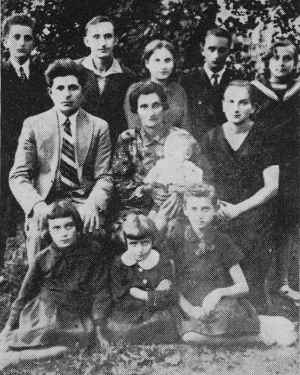
Sitting in the middle is their mother Sarah, née Erlich |
Once, a local peasant came into his shop and purchased some goods. Motl's wife Gittel overcharged him. Motl rose from his seat and said, “No, that's too high… you need to pay less.” He scolded his wife in the peasant's presence, telling her that she needed to be careful not to cheat the customers… They were all killed during the Shoah.
So perished an entire generation of illustrious families, that were completely erased. The remnants of their descendants are now scattered over four continents, from Israel to the U.S., from France to Latin America.
by Lisa Hurwitz
Although many years have passed, with their wars and new ideas, my hometown of Grabowiec has remained in my memory, lovely and unforgettable forever. As in a dream, I see the small town before me, with its modest, quiet, and friendly way of life. Relations between people were more immediate, without social divisions – as though all were members of the same family.
I see the amazing young people, who were involved in political life, with varying ideologies. Many young folks were members of youth clubs organized by the different political parties; they were also devoted students – first, in the official schools, and then of Hebrew, taught privately by Baruch Eynes.
I can see our house, in the center of town, where I was born and raised by my wonderful parents. My late father (may his memory be for a blessing) was pleasant, sincere, and honest. He was always ready to help others and hated no one. His needs were modest, and he was devoted to his family, home, and neighborhood. He loved to talk about various topics, especially politics. Many people came to unburden themselves to him and to ask for his advice. My late mother (may her memory be for a blessing) was an exemplary wife and mother. She was gentle, sensitive to injustice and deceit, and very wise. Her life revolved around her home and her children, and ensuring that they were properly educated, in spite of the problems. Thanks to her, I continued my studies throughout the war, despite the difficulties; I always knew that my family supported my studies.
Suddenly, we were plunged into World War II, the cruelest of wars, that exterminated generations of young and old innocents, leaving very few families and people alive thanks to miracles. My father died at a very young age, in July 1942, and my mother managed to preserve the family for many years through changes of place, until we were able to reach Israel in 1949, to our great joy: we were finally at home… Another disaster happened on October 29, 1966, when my mother died after a prolonged serious illness. I cherish their memories to this day.
by Yosef Nudel
His life as a young person in Grabowiec was a long series of Zionist initiatives and projects. Yidl was active in all aspects of social and cultural life in town.[1] He was one of the organizers and activists of the Socialist Zionism party as well as of the HeChalutz Socialist-Zionist youth movement, to which he was devoted heart and soul. He was indefatigable and deeply dedicated to all his projects. His devotion led him to constant action on these initiatives, and his opinions were widely appreciated.
He had studied in Yeshiva, where he was a prodigy, and had absorbed many of the finest features of Judaism. After his exposure to the Jewish Enlightenment and Zionism, he highlighted the beauty of Judaism. He was a natural youth educator who encouraged every spark of interest in the new cultural atmosphere that was permeating the town.
His favorite occasions were the “box-evenings,” during which questions were posed in writing and answered in community conversation. All the young people enjoyed these events. Experts were needed to respond to questions from all fields. Yidl volunteered to answer the questions that did not require expert responses, in the areas of Hebrew and world literature, as well as political and social issues. His answers, which were eagerly awaited, swayed many listeners toward Zionism.
He derived his living from the fabric shop that he owned. Yet he was one of the left-wingers in the Socialist-Zionist party, and deplored the fact that most of the members of the Freiheit youth movement were not workers, whereas the working youths were members of the Communist party.[2] He sought different ways to attract working youth to Freiheit, and asked me to help; I was a member of the professional union that was run by Communists. After much effort, I was able to organize a group of working youth.
He was very sociable and able to start conversations with anyone, regardless of economic standing. It was pleasant to be in his company and enjoy his witty small talk. At the same time, he was a born educator and encouraged people to become active Zionists.
He arrived in the Land of Israel with General Anders' army, and became a member of Kibbutz Bet Ha-Shita. He died of a heart attack in the prime of life.
Translator's footnotes:
|
JewishGen, Inc. makes no representations regarding the accuracy of
the translation. The reader may wish to refer to the original material
for verification.
JewishGen is not responsible for inaccuracies or omissions in the original work and cannot rewrite or edit the text to correct inaccuracies and/or omissions.
Our mission is to produce a translation of the original work and we cannot verify the accuracy of statements or alter facts cited.
 Grabowiec, Poland
 Yizkor Book Project
 JewishGen Home Page
Copyright © 1999-2026 by JewishGen, Inc.
Updated 06 Apr 2026 by JH