 |
|
|
[Page 152]
by Yeshayahu Heeter (of blessed memory)
I was born and raised in Grabowiec, our small town, where I experienced all the joys and sorrows, and lost my parents, sisters and brothers, who were martyred as Jews, tortured and massacred by Hitler's murderers. The memories of the martyrs will forever remain in our hearts, and it is our duty to recount to our children and grandchildren the lives and deaths of our parents and grandparents to future generations, as well as the ethics that guided all their affairs, and the beauty of the Jewish traditions that were preserved in our town.
My father, Ben Zion Heeter, was known in town as Bentshe-Avrahamtshe, Yitzchak's son. My dear mother, Etel, was called Bentshe's Etel. My brother was Ya'akov-Meir, and my sisters were Itta-Leah and Chana-Gitl. These names are part and parcel of my life; their souls are forever engraved deep in my heart, and I will honor their memory as long as I live. I think of them and the many-faceted life of our town, day and night. I constantly see the young people, who were inspired by ideals, spent time together, longed for a finer, better life, far from the deep mud and dark winter nights, when the stifling small-town conditions grew oppressive and their dreams gave them wings.
Our summer twilight walks to Castle Hill, near the cemetery, are unforgettable, as are those days and nights. We don't want to part with them, because they hold
[Page 153]
all the beauty, dreams, and longings of the youthful years we passed in our town.
I lived in Grabowiec until 1934, when I was married in Zamość. But I was always connected to our town and was unable to relinquish my nearest and dearest, family and friends. My last visit to Grabowiec was in 1939, the year the war broke out. It was the last Sukkot holiday that I spent with my parents. We felt intimations that a terrible catastrophe that would overtake the Jews, but certainly did not imagine the gruesome ending that lay in store. When I returned to Zamość after the first day of the holiday, we saw images that presented destruction and ruin. We immediately fled to Lemberg, from which we were forced to go to Siberia.[1]
In Siberia, I received two more letters from my brother Ya'akov-Meir. He made efforts to write about their situation calmly, writing that they were healthy, but had to walk three kilometers to the bakery; every bit of food necessitated a long walk. Though it was difficult to get a clear picture, I was able to imagine the seriousness of their situation. We in Siberia were also struggling; our lives were very difficult. Yet we still had a spark of hope.
All our hopes turned to ashes. Of my entire family, I was the sole survivor, except for my brother, who escaped to Cuba, where he lived until times improved. Nowadays we both live in Israel.
Translator's footnote:
by Moshe Shek
Ramat HaSharon, Israel
|
|
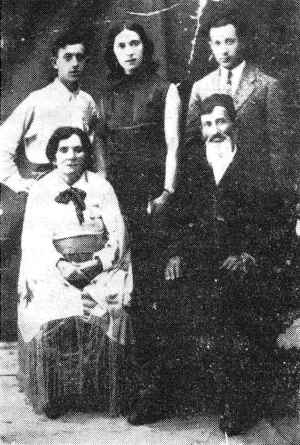
| The Shek family |
I love the memory of Grabowiec, my town, and hold it dear. It lay next to the Kalinówka River, surrounded by hills, fields, and forests, and was always teeming with life. Jewish men, women, and children filled the narrow streets. Children went to cheyder, and played in the street. Women were busy with their affairs – looking after their homes and shops, carrying on conversations through the open doors of homes and shops. Men who were idle argued over politics and community topics. Others roamed the streets, trying to earn some money.
Shabbat Eve
I recall one frosty Friday, at dawn, when the town was still enveloped in darkness, and a hoarse voice disturbed the profound stillness, calling out:
[Page 155]
“Get up, get up for prayers!” The voice repeated the call every few minutes as it grew more distant along the streets, but its echo lingered. It was Mendele's son, Yechiel, summoning the Jews of the town to start preparing for Shabbat – particularly the women, who were responsible for preparing everything ahead of time, so as not to desecrate the holy day. Yechiel was broad-shouldered, with strong hands. He constantly worked hard in order to make a living; serving as shammes in Grabowiec, he did not earn enough. The town was rich only in mud…
My home began to stir. Mother was the first to rise, and immediately began to knead and roll out dough for challahs, noodles, flat rolls, or cookies. The house soon filled with pleasant aromas that roused the family. I would get up and climb off the bench that served as my bed. In Grabowiec, bench-beds were a kind of sofa: a broad bench was covered and used during the day for seating. The cloth cover was removed at night, and the bench became a bed.
The first thing that greeted me when I got up was the tempting fragrance of the babashkes, pancakes that were fried inside the oven on a special metal sheet by a process known as “at the flame.” The flame itself looked like a huge red tongue that extended right into the black chimney. Moshe the chimney-sweep would clean it from time to time, but long periods often passed without a cleaning.
Another bell would ring around 12 noon: “To the bath-house!” Some people immediately hurried away, but most went later in the afternoon. The bath-house was an old, part-brick structure, constantly damp from the steam on Fridays. Coming into the building, your exhaustion and everyday worries were instantly wiped away. You cleansed yourself of the grime, along with the week's burdens. Bodies warmed up in the bustle. People sweated, soaped and rinsed themselves, and donned fresh shirts. These Jews, who had labored all week to make a living, now suddenly felt clean and elevated, freed of their mundane
[Page 156]
needs, purified, and renewed. Their bodies hummed with the approach of Shabbat. They left the bath-house refreshed and relaxed, and stopped talking; they began to think about sanctity and prayers. Their hearts filled with joy at the thought of the oncoming luminous Shabbat.
Still standing at the river were blind Shlomo and Chayim-Ber, catching fish for Shabbat. Chayim-Ber would agitate the water with a rod, and Shlomo held out a net, or a small sack, to catch the fish, all the while shouting, “Chayim-Brrr, I don't see a single fish.”
By dusk, the homes of Grabowiec had been scrubbed. The table was covered with a white tablecloth and adorned by the silver candlesticks that had been scoured with sand until they shone. Two beautiful challahs were covered by a napkin. Mother bent over the lit candles, her lips murmuring the candle-lighting blessing. She prayed for her husband and children, asking for health, long life, consolation, security, and salvation. Mother's eyes were as holy as her sorrow, as the candles that had been blessed, as the joy with which she welcomed the Shabbat Queen. Her white hands, like the sheltering wings of the Shechina, hovered over the Shabbat candles.
Now another cry was heard from outside. Mendele's son Yechiel called hoarsely, “To the synagogue, to the synagogue!” Soon, fathers and sons would be going to the Shabbat-welcoming service. Inside the study house, the community of worshippers was bathed in the light of all the lamps. The leader, or cantor, sang out, “Lecha Dodi Likrat Kallah”, inviting the Shabbat bride in with music praising her beauty[1]. Hearts grew warm with joy in community. Shabbat arrived, not only like a beautiful bride, but
[Page 157]
also like the loving parents who transformed the meager homes into palaces full of beauty and song.
Although I left Grabowiec early, these memories arouse my love and sorrow for those who are gone, those who were hideously murdered.
Translator's footnote:
by Esther Shteinberg-Zamuster
I tremble all over when I remember our town, and see before me the martyrs who were so gruesomely killed by the Nazi murderers. They were holy when they lived, and even holier after their deaths. They observed Shabbat and holidays strictly, according to their individual means. They worked hard all week, in order to welcome Shabbat properly, to prepare Shabbat dishes and clothes for themselves and their children.
During the week, the Jews of our town made do somehow. Some families lived on crusts of dry bread and potatoes. Some pasta and potatoes with bits of onion and chicken fat were cause for rejoicing. But they prepared fresh challah and fish, wine, and some meat for Shabbat. There were certainly some people who couldn't afford to buy everything; they were helped by others who made sure they were fully supplied and would be able to welcome Shabbat suitably.
[Page 158]
In all Jewish homes, Friday evenings were beautiful. The children were especially conscious of the change. Mother would be unusually attentive, washing their hair and laying out fresh clothing.
The entire town took on a different appearance on Fridays. People's expressions, feelings, and thoughts were transformed. After all, Shabbat was at hand. The home changed; it was cleaner and brighter. A white cloth gleamed on the table, reflecting the shine of the silver candlesticks and the egg-washed challah.
Preparations actually began on Thursday. Mother was up until midnight, kneading dough for challahs and baking bread for the entire week. The oven had two sections, one for bread and the other for flat rolls, small knishes with cheese and other fillings. When the firewood was consumed, Mother would scrape out the coals and bring them to the kitchen, where cooking was done on weekdays. She would start a stew over the coals, and we ate fresh flat rolls with meat on Fridays. That was the main meal, which we ate between noon and one.
Jewish homes were bright and merry on Friday nights – moments that remain sacred and beloved in our memories.
I remember, when I was already a member of the local Scout section, and our counselors were Yidl Shapira, Ya'akov Becher, and Yosef Nudel, who led us in conversations about many topics, mainly pertaining to Zionist ideology.
Early on Shabbat mornings, we would go to Castle Hill, carrying books to read and later discuss. Sometimes, we would meet at Malka Geist's home. Her father had died, and her mother would travel to all the fairs and sell candy. This barely provided her and her three children with a living.
[Page 159]
They were three sisters: Malka, Soreh, and Hindeh. All were extraordinarily pretty, although they lived in cramped conditions: one small room, three by five meters in size. We held our meetings there. The Jewish Scouts had already become active in Grabowiec. We loved that small space, where we had festive meals accompanied by songs. We felt connected by a lofty ideal and profound friendship.
My parents, Yerucham and Gitl Shteinberg, had seven children, three daughters and four sons. My oldest brother Shabtai was killed in France, with his wife Beyle and their two children. The second oldest, Yisro'el, was murdered in Grabowiec, with his wife Eydl and their two children. My third brother, Hersh-Leyb, was also killed, together with his wife and our parents. The fourth brother, Binyomin, was killed in Warsaw.
My sister Rokhl-Leah and her husband Berish Druker suffered the same fate. They were killed in Świdnik, shortly before Liberation. They had hidden in that town throughout the war, until Gentiles tracked them down and beat them to death with sticks. My other sister lived in Zamość, where she was murdered together with her husband and two children.
I am the only survivor of my large, widespread family. I mourn their tragic deaths constantly.
by Sarah Zatz
With profound sorrow, I sit down to write about the small town that is so deeply engraved in our hearts. I would like to employ the simile of a fine wine sipped from an earthenware pitcher. Our town was small and nondescript, but full of great contents, people who were familiar and dear.
Let me mention the shammes, Itshe Leybeleh, who called the faithful to chant Psalms in the predawn hours every Friday. His drawn-out call rings in my ears to this day, sounded in a distinctive voice: “Awake, awake, to serve God.” Men would rise and immediately go to the study house to chant Psalms, and the women would start preparing challah for Shabbat.
The Husiatyn Hasids were especially exuberant. They were good-naturedly nicknamed “the Soused-yatin Tipplers.” Not, God forbid, because they were actual drunkards, but because they were always happy, and fulfilled the Hasidic maxim to constantly serve God through joy.
Such were my father Yosef, my brother Yitzchak-David, Uncle Sha'ulkeh, Elkanah Kahn, Avraham Rapaport, and many other Hasids. They labored all week to make a living, but on Shabbat and holidays they became transformed into joyous, celebratory Jews.
A fair was held in town every Monday, attracting peasants from all the surrounding villages. They brought chickens and geese, as well as fruit and vegetables; there were also horse and cow traders. Jews from other towns came to trade, buy, and sell the animals.
[Page 161]
The large weekly fair had to supply income for the entire week. There were many impoverished families in town that had once been wealthy, but had come down in the world. They were ashamed of their poverty, and endured hunger in silence, hiding their situation. My mother would care for such families, and give charity anonymously.
One of the Jews in town, Shmulikl Smolazh, had a son and a daughter. He was desperately poor, but would not agree to being helped or receiving charity. So, my mother always took extra pains to provide his wife, Yenteh, who had a radish stall in the market and earned some money by plucking feathers. Mother always bought her radishes, and overpaid her.
When the war broke out, we fled to Ludmir, and were sent to Siberia. A year later, we were able to go to Frunze, where we exchanged terrible cold for searing heat.[1] Naturally, we also suffered from the ordinary difficulties of wartime refugees in Soviet Russia. When the war was over, we resumed our wanderings, and eventually came to America with our bundles by way of ships, trains, and carriages.
We must recount everything in the Yizkor Book, and preserve it for posterity. Let future generations know the truth about the great catastrophe, the worst ruination in Jewish history.
 |
by Fishl, Beinishe's son
One of the most horrific incidents that happened in Grabowiec is indelibly inscribed in my memory. Pinches Karnis, the carriage-driver, was traveling with his rig, carrying passengers from Grabowiec to Hrubieszów by way of Mołodiatycze. When he came to the Mołodiatycze meadows, he climbed off his seat, leaving the horses and passengers on their own, without telling the passengers of his plan. He went to the field, where sheaves of clover were laid out, picked up two sheaves, heaved them on top of the carriage, and began driving away quickly, whipping the horses, which galloped away with all their might.
They had gone about 300 meters when they encountered a guard, a farmhand from the Mołodiatycze estate, who noticed that the driver had stolen the clover sheaves. The guard began to chase the carriage, shouting for it to stop, but the driver refused to do so and continued the wild gallop. The guard shot into the air, but the driver wasn't fazed and went on his way. The guard, however, continued shooting, this time into the carriage, at the passengers. A bullet immediately hit the head of one of the finest Jews of the town, a scholar who was renowned for his charity.
The passengers were terrified, and wanted to save the injured man, but had no means at their disposal. The tore up their shirts and bandaged the wounded man's head. We were afraid to stop, because the guard continued to
[Page 163]
shoot, while the wound bled heavily into the wagon.[1] We went on in this way, to Brzeszcze, which lies four km from Grabowiec. There, we hired a fresh carriage with strong horses, as the original ones were exhausted after the difficult drive. We arrived in Grabowiec before dawn, and immediately went to Dr. Stankow, who immediately confirmed the death. Naturally, we then needed to inform the family without delay. They were living on the upper floor at Shayeh Zatz's, the old-clothes dealer, in the marketplace.
The unfortunate family – a wife and three children – began rushing down the streets and alleys with dreadful cries and laments. The town woke up, and ran with the bereaved family to the doctor's, where the corpse was still located. The uproar was unearthly. Men, women, and children filled the streets. In those days, sixty years ago, the entire small town mourned such tragedies. The widow and orphans were wrapped in warmth by the community. This incident was indeed unheard of. No one, not even the elderly, could remember such an incident in Grabowiec.
Next, the affair of the autopsy began. The body was not brought home, as the deceased had lived on an upper floor, in one room, with three children. It was taken to Abish Shvartzenberg, who had an inn with a restaurant. It also had a long, empty area that was covered by a roof but had no walls. The body was laid there, and people gathered from the entire town to weep and mourn the terrible tragedy.
Preparations for the autopsy were complicated. Grabowiec had no telephones or telegraph at that time. Orders were sent by horseback riders, who rode back and forth between Grabowiec and Hrubieszów all morning.
[Page 164]
It was afternoon by the time all the authorities and the doctors came, and prepared to carry out the autopsy. The entire town watched, emitting piercing cries and moans that lasted throughout the procedure.[2]
Tanslator's footnotes:
by Tuvia Kratman, New York
The memories and experiences of my small home town, Grabowiec, are unforgettable. I remember the roads to Hrubieszów, Chelm, and Zamość, and the paths that stretched between the hills that we looked up at. Highest of all was Castle Hill, the most famous spot in town, which left us with sweet recollections and profound experiences. Who can forget the pleasant rambles down these paths on Shabbat and holidays, the excursions organized by political organizations, and sporting events?
We remember, with love, the cheyders and melameds, the large synagogues and small Hasidic synagogues, the clubs and libraries. All of these embodied Jewish life in our young-old town. People said that our town was four hundred years old, yet I often thought that Jewish life had thrived there for about one thousand years.
We remember, with longing, the landscape that surrounded our town – fields, orchards, the Kalinówka river that flowed to the village of Grabowczyk, near Tyszowce and Wojsławice. We would breathe the delicious fragrances that filled the air,
[Page 165]
carried by the mild breeze from the fields of wheat and rye, near and far; from the green meadows; and from the high mountains that called to us. Once we scaled them, a breathtaking view opened up, with fields and mountains. So many memories.
Though daily life was difficult, and there was antisemitism on the part of our Polish neighbors, the exuberance of Jewish life was expressed in many different ways, including Hasidism and modern Jewish culture.
There were also events that cast a dark cloud over Jewish life in Grabowiec, such as the great conflagration that started at Noach Pitnevitser's house when a candle was lit in the attic, where chickens were kept. Many Jewish residents were seriously affected by the fire, but Jewish compassion impelled many to do as much as they could to help others to recover and resume normal life.
Naturally, the young people were liveliest. The two libraries in town were stocked with the newest books in Yiddish, Hebrew, and Polish. The vast majority of young folks visited the libraries frequently. There was also a professional association, whose activists were motivated by class awareness and lofty ideals to fight for better conditions and higher wages for workers. The presence of political parties increased, and heated discussions were held. There were clashes with the older generation of pious Jews, who feared that their children would depart from piety and Judaism. However, in general, each of us felt that life in the town was quiet and calm, almost idyllic.
I loved the various small synagogues of the Hasidic groups. Each synagogue followed its own group's rabbi. My father, Moteh, was a member of the Kuzmir Hasids. But, regardless of the differences between the Hasidic leaders, there was a general sense of brotherliness. This was also true of ordinary Jews who frequented the study house and its hallway, where Zisheh, the water carrier, and Zelik sang the “May God give you” prayer on Saturday evenings.[1]
[Page 166]
The gravestones in the old cemetery exhaled old Jewish history. Their worn inscriptions announced the centuries-old presence of Jews. I recall the Gentile who boasted that he would kill all the Jews of the town. We young folks did not fear his threat, yet we believed that he had to be taught a lesson. One night, Sha'ulkeh Fayer, Eli Pitnevitser and I waited for him in a dark alley and gave him a proper beating. The police came at the sound of his screams, but found no one besides him. We had escaped earlier. That was the last time anyone dared to speak of killing Jews. The townspeople knew who was responsible, but no one said a word.
The young folks of Grabowiec worked and studied. Those who devoted their youth to religious study spent their time in the study houses and the Hasidic synagogues. Others, who had to work, thirsted for knowledge and education and visited the halls of the youth organizations in the evenings.
Shabbat was beautiful. After the midday meal, the older generation lay down for naps, but we young folks scattered to the surrounding forests, not grasping how anyone could lie in bed when the sun spread such warmth and the world was so wide open. At twilight, older, middle-class Jews also took walks, careful not to go beyond the eruv.[2] Yeshiva students were often so deep in discussion that they walked too far, and hurried back to town the moment they realized their misstep.
Dozens of tales and anecdotes circulated among the townspeople. I'd love to recount them all, to commemorate the wonderful personalities of our fathers and grandfathers: how they utilized every free moment for study, and how they would stand in the corners of the study houses and argue with God, leaving for home feeling cleansed of all sin.
[Page 167]
I would love to sit once again on a bench in the study house and overhear the Jews at their books, swaying in prayer, or engrossing themselves in a sacred book, and absorb the spirit of calm that enveloped them.
We learned much in our town, from books and from life. We knew that harebrained ventures did not promise prosperity, and thought that every person needed a trade in order to make a living. We saw our parents' difficulties as shop-owners, and recognized their pain when they couldn't bring money home. The worst was when people had marriageable daughters, for whom they could provide no dowry. Standing silently at prayer, they praised God but beseeched him for a match for a daughter who was nearing thirty; someone who would spare her from living as a spinster. Jews were prepared to host sons-in-law in their own meager homes and support them. If the young men did not want to live with their in-laws, the parents would leave their home and sleep somewhere, even on the oven bench in the synagogue, so that their daughter wouldn't be a spinster. The girls in our town were decent Jewish girls, fine seamstresses who often spent days and nights at the sewing machine. They'd sew peasant blouses, jackets, and worked hard to keep their homes tidy. Time crawled at a snail's pace until the match was found. But the town helped to prevent spinsterhood. Yet people always envied families that had sons, and did not have to worry about dowries.
The town was gloomy and despondent at harvest time, when the rains began and the mud grew deep. That was when life in the town seemed even harder. People suddenly realized that they had wasted their lives, and began longing for the wider world.
Translator's footnotes:
by David Erlich
Fairs took place in the town every Monday. This age-old practice provided a living for most of the residents. People would prepare for the fair the day before, and sometimes even during the entire preceding week. The old-clothes dealers had their regular spots in the marketplace, along the paved road. Others would go to the market square Sunday nights and lay down a wooden board, indicating that the spot was taken.
The fragrance of fresh-baked goods wafted from Beyle Giteles's house as early as Sunday, as she prepared deworming cookies and mixed breads.[1] The deworming cookies helped against intestinal worms that would appear every month. Both Jews and Christians bought these cookies for children who suffered from worms; the cookies immediately had a positive effect…:
The market began to be set up at dawn on Monday mornings. The stalls were placed on both sides of the road, from Kafraski's to Itshe Harshever's. Some stalls were covered with tarpaulins, while others were open to the sky. Trading began, with townspeople selling to or buying from the peasants. Everything was available, from shoelaces to caps and hats, grains and vegetables, chickens and farm animals. Traders from Tyszowce and other nearby towns would come and stand in the market hoping to sell their merchandise, which included clothes and boots. Virtually the entire town participated in the fair. It seethed with commerce. David Abishe's “inn” was very busy on market days; one could get marinated herring and a glass of hot tea there.
[Page 169]
Widows who had lost their providers took up stalls in the market, where they sold candy and baked goods on fair days, to make a living for their children. Among them were Chana the “spirit of Untovitch,” Relya, and others.[2] Entire families – parents and children together – operated fabric and notions shops, buying and selling.
From dawn onward, wagons filled to capacity with male and female peasants packed the roads. They had come from the surrounding villages and hamlets, and parked their wagons throughout the town. The urgency of making a living filled the town. Making a few pennies involved struggle; there were inevitable quarrels over competition. When Itshe Harshever paid six groszy per egg, it was considered a stiff price, and could cause friction, cursing, and possibly blows.[3]
We children actually loved the bustle. An argument such as the one over the price of eggs drew our attention and could provide us with a conversation topic for a week. Another attraction was the organ-grinder, who had a parrot that pulled out a rolled-up bit of paper hiding a small ring or some other toy. That cost twenty groszy. We loved to watch a peasant trying on a jacket, and stretched it in all directions for a perfect fit.
The sounds and shouts coming from the market resounded in the air. Prospective patrons were hailed and dragged into shops and promised bargains. There was also no shortage of thieves. Pickpockets from Zamość exploited the crowded conditions and often emptied a peasant's pocket right after he had sold a cow. The open-air market where cows, horses, and pigs were sold was a special attraction for children. Jews would trade in horses, slap palms, lay down fivers and slap palms again. We enjoying watching how a peasant who was adamant about a price
[Page 170]
and stubbornly refused to reduce it even by a single groszy would be “rewarded” by cuts on his hand, as an identifying mark.
In the afternoon, when the market grew quieter, the peasants had sold their merchandise and made the purchases they needed for their households, they would go to Avraham, Malia's son, where they could buy a drink. The establishment would become rowdy; Rozhanskeleh would get drunk and start breaking glasses.[4]
At dusk, the peasants began scattering to their villages. The marketplace was now empty, and the town resumed its normal everyday appearance. Earnings were counted in every home, and calculations were made whether they would be sufficient for the coming week, until the next fair. Jokesters would recount their experiences. A father and son who – naturally – were observant Jews bought chickens for wealthy householders. They tapped the chicken's rear end and checked whether it was fatty. The father asked the son whether the chicken was good, and they conversed in a mixture of Yiddish and Hebrew, the sacred language: “Toyv me'oyd…: be-loy federn” – “Very good…: without feathers…:”.[5]
Arguments about the blue fringes[6]
The small Hasidic synagogues were all clustered in the same part of town. Walking past the synagogue of the Husiatyn group, the town's study house would be on the left. Broken boardwalks led past Ziskind Glomb's house, then to a track that went through a suburb and finally joined the Skerbishov road towards the stream and the meadows. The lone building at the edge of the town was the synagogue of the Radzyn Hasids.
This synagogue was a bit smaller than the Husiatyn and Belz Hasidic synagogues, yet it was very comfortable inside. There were about sixty people in the congregation. The nearby women's synagogue always seemed too small during the High Holidays, but was quite ample for year-round prayers. People attended the Radzyn synagogue only on Friday and Shabbat. Yosef Lozer was entrusted to lead the prayers welcoming Shabbat on Friday evenings, and the congregants felt comfortable with him.
[Page 171]
Once, the older Hasids, including David Varshaver, Yosl Bornstein, Yerachmiel Bornstein, Hersh Krashniker, and other prominent Hasids, decided that all prayer leaders had to be full-bearded and wear the small tallit undergarment with blue strands in its fringes. The clean-shaven, less observant Jews were very annoyed: who had authorized the older Hasids to issue such decrees? They resolved to oppose the decree, come what may…:
As the Radzyn Hasids performed the morning prayer a bit later than other groups, the younger Hasids decided to arrive earlier and take the prayer leader's spot. That, in fact, was what happened. Aharon Lindboym immediately agreed to be the leader. Along with the Bund activists David Zinger, Shlomo Erlich, Aharon Zisman, and others, he began the prayer very enthusiastically, and the “Hodu” (“Let us give thanks”) section resounded throughout the quiet Shabbat in the town.
The stricter, more observant members of the congregation quickly arrived, but found the leader's spot occupied. They began praying loudly alongside the Torah Ark, trying to drown out the others. Things became lively; there were arguments, but no blows. The Radzyn Hasids were fine people who could curse as well as be witty, but knew their boundaries. The incident ended with a general Kiddush, tasty noodles and a kugel, and recitation of the Rebbe's wise words.[7]
The Radzyn Hasids liked to talk about the good old days, when their synagogue was built thanks to the efforts of Aharon David Erlich. Other favorite topics were other prominent Hasids such as the Zinger family, Avraham Yosef Tenenboym, and the joyful installation of a new Torah scroll into the synagogue. Calm was eventually restored, as they all agreed that the Jewish customs must be followed, and the undergarment fringes must include blue strands.
That was life in our town: quiet, gray days alternating with festive events, and the ecstatic chanting by Mendl the slaughterer during Shabbat prayers.[8] Young and old enjoyed his fervent singing, which rang through the town's quiet alleys on Friday nights.
Translator's footnotes:
|
JewishGen, Inc. makes no representations regarding the accuracy of
the translation. The reader may wish to refer to the original material
for verification.
JewishGen is not responsible for inaccuracies or omissions in the original work and cannot rewrite or edit the text to correct inaccuracies and/or omissions.
Our mission is to produce a translation of the original work and we cannot verify the accuracy of statements or alter facts cited.
 Grabowiec, Poland
 Yizkor Book Project
 JewishGen Home Page
Copyright © 1999-2026 by JewishGen, Inc.
Updated 29 Jun 2026 by LA