 |
Bielsk – General Appearance
|
[Page 59]
by Bracha Zefira[1]
Translated by Nancy Schoenburg
In 1930 I visited Bielsk on my tour in Poland, and to this day it is etched in my memory as a unique city. The impression it made on me cannot be erased.
I was at that time a 15-16 year old student at Max Reinhardt's Institute of Theatre and Music in Berlin. As an orphan from infancy and independent in my decisions, I reacted to the impressions as an adult in every respect. As it is now, so it was then, that people from The Land of Israel would travel outside of the country, going, looking for a rest from the tension of pioneering and the intensity of life in The Land, assembling and sticking together with each other at gathering points just for them in the place where they landed.
In Berlin there was a community center where we would assemble and yearn together for our country and for our pure names. And here one evening a peppery Jew approached me, one of the immigrants from Romania. His name was Shafan.[2] He had just returned from an appearance tour that was arranged for Jabotinsky, and after that for Bialek in Europe. He tried to convince me to appear in Europe under his promotion. He convinced Nachum Nardi[3] and that influenced me, and I left.
That is how I ended up in Bielsk as well.
From the beginning it was understood that Shafan arranged appearances for me and for Nardi in the capital city Warsaw, my performance being in the Conservatory. There I met Isa Kremer[4] and Rina Nikova [5] and other prominent theater people in the Jewish world. It can be assumed that Warsaw was astounding. It aroused excited admiration and made an impression and so forth. In any event, my heart remained frozen to her [Warsaw] and she impressed me very poorly, except for one incident which stirred in me great excitement. The agitation, which expanded and grew to mystical proportions, was in the face of the Shoah [Holocaust], of which the Book of Bielsk is also tragic fruit. At this event I had a chance meeting with Elchanan Zeitlin, son of the great Hillel Zeitlan.[6] I myself sang at that time what I breathed and my soul had absorbed in the awakened [Land of] Israel. This I brought in sound and in vision to the listening audience in the diaspora. I sang “Yafim HaLailot” [“Beautiful Are the Nights”] and “Mi Yivne Bayit” [“Who Will Build a House”]; from the popular poems of Bialik and songs of the mizrach [East; oriental, especially Yemenite] that were part of my soul and my spirit. The younger Zeitlin approached me. He wanted to say something but could not manage it. He was too emotionally moved by this literary and musical greeting that I brought them from the land of the azure skies. As a profound Hebrew poet, his interest in it was deepened. He tried to express this but was not able. Over the years, with the ending of the Shoah, one of the survivors of the Warsaw Ghetto told me that during their days inside the ghetto there was no song and no poetry. The late Zeitlin z”l wrote a poem that everyone was longing for our small homeland, and above the lines of that poem was a dedication blessing to Bracha Zefira, who “On her visit to Warsaw showered me with dew of longing and vision and brought with her the taste of the homeland. The singing motherland and the awakening nation.”
That is everything connected to my visit in Warsaw. It remained a routine visit and were it not for this retroactive memory, it is likely that it would also be reverberating to the depths of things to be forgotten because it was created to be forgotten.
After Warsaw we came to smokey and smoggy Lodz with its dry Judaism sealed off from poetry and other spiritual affairs. Buttoned-up Bialystok, all of which was hidden and was not in the shadow
[Page 60]
of its Hebrew gymnasia. The impression that this school made on me was so strong that it alone remained with me as a memory of that city.
In general this tour in Poland was one with great depression in it, with gloomy cities whose inhabitants were gloomy with dejected souls, cities whose outward appearance was grey, matching their sad Jews, depressed to dust with nothing in themselves to hold onto.
|
|
|
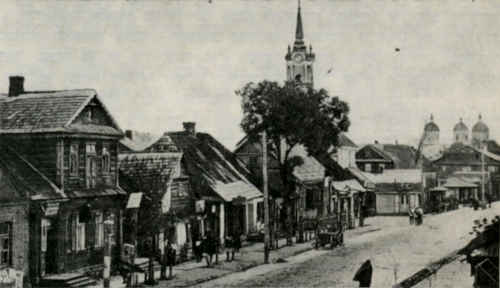
Bielsk – General Appearance |
I remember silent Vilkovisk, suddenly waking up from its stillness on market day where everyone is selling horses and trading with each other. The next day in Branovich [in western Belarus], a mother-city in a district with houses too small for its size; houses that are really tiny and its residents stoop and enter their gates, but it is all a company of singing and joyful music. Its streets are humming from groups that were born to sing. Nevertheless, it was a gloomy city.
And Grodno of Cherno[7] dared to establish a seminary for teachers and kindergarten teachers in foreign lands and to establish kederim[8] for teaching biblical studies and the language from the past [Hebrew]. And the impression was strong. Really strong. That was the impression of this seminary.
But all these passing impressions are joined with one general impression of cities and towns that are all dreary, and there is nothing to gladden the heart of a singer, still a child, whose soul is open to something new and different and surprising, and that is not in them.
Until I came to Bielsk.
Suddenly it was like I fell onto a different planet. After the dirt roads in the Jewish towns of Poland and their dusty houses with vestiges of a rainy winter and an autumn that casts its drops of mud on everything that it happens upon on its street. I suddenly found here an amazingly clean city. Its streets are polished, and its homes are white with their cleanliness. And every window in them with thousands of suns reflected in their shiny windowpanes, whose curtains flutter with much charm and are ironed and proud to receive, as it were, an important guest from the Holy Land.
[Page 61]
The entire way to the place where I was staying in Bielsk seemed to me like a bright path leading to the festival and sacred attribute. There was something about the streets of Bielsk, which was not in any other city which I had previously visited. Everything here was white and clean. Sometimes it seemed to me that all of Bielsk was a city of pampered people, who even in their poverty could not stand dirt, gloom and dreariness. It was as if they were always occupied with polishing their city and cleaning their courtyards and the alleyways of their neighborhood.
I remember how difficult it was for me to endure the feeling of sadness that enveloped me when I would enter a Jewish city in Poland and when I would leave it. At the entrance before the action of their markets, I felt a full spasm of despair for the Jews chasing after a livelihood and being disappointed. The dark alleyways filled me with depression and disgust, and it all grew stronger as I left there. The children followed me with their eyes through the car window, their eyes mysterious and yearning for something far away and hidden which was forbidden to them, as it were, by the dictates of their fate. In those towns, standing before my eyes was the spirit of my little Tel Aviv, with its azure sky. The joy of its whitened streets and the singing of merry children and my heart was enwrapped and pulling me away from here.
Not so Bielsk: here it was as if I returned to one of the quarters of a clean, German town, as all were then, with a culture of cleanliness and order.
I recall my entering into the auditorium in Bielsk. The chairs sparkled from lacquer that the people of Bielsk remembered to rub them with for each event that seemed to them honorable and special. The floor was scrubbed and polished, the walls glistened with their clarity, and the space was filled with silence. A festive quiet of the expectation of something big that was about to happen. In a little while the stillness would be pushed outside, and in its place would be a symphony of sounds and voices, all waiting with impatience.
That is the impression I got of the auditorium in Bielsk, where the people of Bielsk were imbued with the joyous spirit of the occasion.
If every place in Poland and in Israel where I performed my songs and illustrated their contents with facial expressions and motion, as is proper with folk songs, then here in Bielsk a different spirit was in me. In light of the celebration that poured out into every corner here and on every face, I also was filled with that festivity. I cleaned myself up and I got myself ready, not just for singing, but for a concert. The evening in Bielsk was truly a concert with the audience dressed for a holiday. They were polished, clean and tense. I also stood there tense, serious, without the movements and grimaces; the back was not bent nor were my eyes winking as I would have had them accompanying my folk songs. Here I stood, tense, listening to myself, meticulous in every note, every variety of melody delivered here in trustworthiness for the concert, for the celebratory audience at this concert.
And if I ever wanted to clarify it for myself, upon turning the pages of my travel diary - where did this relationship to Bielsk come to me from and why was I impressed thusly. I explain it to myself that this is something that I call culture of man. In Bielsk they had a tradition of culture that made it forbidden to desecrate with a lack of culture, that is to say, if people get together for different occasions, everyone must leave their personal weaknesses and must all be attentive to the general wishes of those gathered. They must not be a burden on other people or on the “performer” in listening. Everyone must contribute a personal contribution with self-control and silence for the sake of the general quiet.
[Page 62]
Because we are not speaking here about a passing thing; here is about to take place the culture itself to add a link to the chain of the advancement of man. First of all, it is a culture of silence and sound, of attentiveness and a celebration raising the spirit.
All this explanation came to me from the festive impression I got in Bielsk during my first contact with her. I received its approval afterward, after my concert. When I finished my program and hinted to the Bielsk community that the program was over, an amazing, powerful song broke out in the hall. There was total enthusiasm of the audience in its entirety. I have only seen such a thing a very few times in my life and only in my country. But first I tended to think that all the silence that accompanied my appearance in Bielsk, beforehand and during it was a kind of an expression of coldness of character and lack of enthusiasm. But after this burst of passion following the concert, it was clear proof that the people of Bielsk were blessed with self-restraint and with great spiritual concentration. When something is spoken related to the art of singing, the intelligence of attentiveness is the right definition that was shared by all the people of Bielsk, the kind of listening that has in it a deep expression of their spiritual aspirations and transcendence. The wonderful people of Bielsk.
And especially the youth, the wonderful youth of Bielsk.
In most of the towns on my tour, as mentioned, there was a sadness extending from every event. Everything was carried out by adults, while the youth were serving as messengers and doing what they were told. The gloomy indifference that the adults were not always able to overcome at the time of the program and that almost infected the youth as well. But in Bielsk everything was different. The youth were seen in everything, and I would almost say that the young people were in control of everything that happened around me. The adults would listen to them and would behave accordingly for a festive event where the people were assembled. And this also is a measure of culture of a high nation, a mutual obedience of generations, of fathers and sons.
The young people of Bielsk were truthfully something rare in Poland. They all had smiles, joy, a sense of duty. They were enthusiastic yet restrained. They were heard without voices, understood and profoundly important, without an after-taste of despair and helplessness which usually accompanies people of thought. This was an elegant youth, fine and likable and unable to be forgotten.
All that evening I felt the excitement in the activity of the youth. I saw that these young people were literally jumping out of their skin, to do things, to add something, and to break out and run. Despite that, there was some kind of discipline that was invisible but very much felt as when one person obeys another. And the activity is done according to the wishes and satisfaction of everyone.
I write down words in art, and my regard for Bielsk is of course as the regard of an artist for his listening audience. But not only as an artist; I was also filled with enthusiasm and affection for Bielsk as a young Jew, a native of The Land [of Israel], absorbing the culture of the nations and human beings on her tour. I saw in this city many special and superb things.
As an artist I was not able to escape from the discovery of the high folk-education that the people of Bielsk had absorbed from some source unknown to me that was revealed to me that same evening of the performance. I saw before my eyes an audience that knew the tradition of a concert and of song to create a framework for success. The doors were closed on time, with the entire audience already seated in the hall; no one was late. The opening time was held to the exact moment, and intermission took place at the appointed time and no one
[Page 63]
burst in toward the artists, neither to Nahum Nardi[9] nor to me to disturb us. They knew that this recess was designated for us to rest and to be together, to let go and to focus. They did not have permission to disturb us. Behind the scenes, we heard a noise of the assemblage during the intermission. We were surprised to see the audience all sitting quietly in their places when we entered the hall.
Where can such an audience be found today? And where was it then?
A wonderful city of Bielsk remains in my memory, and it is difficult for me to forget her. The hardest to forget is the marvelous youth that was there. I am reminded of the excitement of these young people standing there to receive our autographs, expressing their yearning for The Land [of Israel], its artists, and the culture that it was forming. Their eyes sparkled with hope, that soon, in just a little while, they also would be participants in creating the wonderful nation. It hurts me deeply that they were not given this opportunity. And the pain is very great.
Translator's footnotes
by Yakov Baileys
Translated by Sara Mages
Bielsk – rabbis and personalities
A new world opened before me when I came to the city of Bielsk, a district city in the Gordno region. A beautiful city that has ceased to be a small town and has not yet reached the status of a large city, and therefore it is pleasant to the core. The city was full of greenery, and the people were much more intelligent than in the small towns in its district. In the small towns lived the tailors, shoemakers and other craftsmen. Simple people and good Jews who behaved in the spirit of old tradition. They were far from what was happening in the world, and the news of the world was far from them. Newspapers only reached a few, in one word, amcha [common people] in the full sense of the word. But Bielsk was the opposite of that. The city had a train station, and newspapers were in most of the city's homes. There were four Batei Midrash there. In “Beit HaMidrash” Street were the old Beit Midrash, the old new, and Beit HaMidrash Hachnaast Orchim. The Hasidim Shtiebel was located nearby, and the worshippers there were Hasidim of all kinds of rabbis. The most beautiful Beit Midrash was Beit HaMidrash Yefeh Einayim, named after Rabbi Aryeh Leib Yellin, author of the commentary Yefeh Einayim. At that time another Beit Midrash was built and added, and its name was Ichel's Beit Midrash.
The community rabbi was the elderly genius rabbi, Rabbi Ben Zion Sternfeld, and next to him was his son-in-law, R' Moshe Aharon Bendes, the husband of his only daughter Alte. The elderly rabbi prayed on the eastern side of Beit HaMidrash Yefeh Einayim to the right of the Holy Ark, and R' Moshe Aharon, his son-in-law, to the left of the Holy Ark. The second to the side of the elderly rabbi was R' Yitzchak Mizkin, the Commissioner of the Royal Court in Bialowieza. Near him was R' Yakov Abramovich and after him R' Yechezkel Levitan, the family members of R' Eliezer Sofer, and the last one was R' Mendel Rozpinski.
The latter was a carpenter. A tall lean Jew, a scholar whose white beard reached down to his clothes. He taught a lesson in the Mishnah and was the most important mohel [circumciser] not for the sake of receiving a personal gain. He was proud of it and was always taken with respect everywhere, even to distant settlements.
I am returning here to the men of the eastern wall in our Beit Midrash. Of course, I can't go back and describe all those who came to Beit HaMidrash, but I will settle for the most interesting among them.
The shamash at that time was R' Michel Kaplanski and his helper was R' Isar Alpert. I emphasize the “Rabbi” of R' Isar, who was a scholar and a polite man. I don't know for what reason he was the shamash helper. He was a Hasid and was always happy, and as they say about beautiful Jewish girls, “poverty makes them ugly,” that's how it was with him. Poverty oppressed him. And what did this Jew do? At every wedding, when they served roasted meat with all the trimmings, R' Isar asked for a glass of milk for himself since he had not tasted any of these good things. And from all his
[Page 65]
crafts he lacked success. And there were also good, beautiful and talented Jews there who served as cantors on the Shabbat, on festivals and also on the High Days. There were those who held the position of Baal Shacharit[1] and Baal Musaf[2]. Every man according to his worth. My father-in-law z”l was Baal Shacharit for many years, and R' Moshe Leib Daniz was Baal Musaf, and no one dared to ask in words, please add me to one of these positions. Nothing helped. R' Yoel Landau the gabbai was a hundred percent conservative and the dignitaries followed him. For example, there was a custom there. On the day they finished the Hallel[3], or recited Hatzi Hallel, the cantor began with the first blessing and the worshipers repeated after him until the Hodu[4]. Some years later, I prayed in his place and served as a cantor. I started to finish after every kapitel[5] and R' Yiztchak Minkin shouted at me, “who are you to violate the customs established by the sages,” and also R' Yoel joined him. Still, I won, because the audience found it more beautiful. I don't know where this custom, which was preserved in Bielsk, came from. I had done the same in Yafo, at the synagogue of R' Zerah Barbet, and an old man, Mr. Savitsky, shouted at me: who are you who wants to abolish an ancient Jerusalem custom? This man, Savitsky, who originated from Slonim, was known as a veteran in Eretz Yisrael. Here too, common sense prevailed in matters that were customary among them, in term of, it is forbidden to make changes to Jewish tradition.
I will not try to describe all the worshippers of our synagogue, but I will not continue without describing the trio: Baruch Semiotsky, R' Yosef Guterman and Baruch Tzvi Kaplanski. That trio was the first of the activists of Linat Tzedek[6] not only in spirit but also in practice. They were the first to come to a patient, and you saw them in every disaster or every out-of-order situation. They were the first in such cases and their actions were beneficial everywhere and at all times. Later, Mr. Guterman was also among the helpful members of Chevra Kadisha with his advice and actions. I mentioned Linat Tzedek society, which was very active in providing medical aid and financial support. The society also sent members to stay overnight at a patient's home because there was almost no hospital. I emphasized “almost,” because there was a small hospital, but Chaim Leib the madman was locked up there because he was among the madmen who endangered the public safely. When madness attacked him, he went wild and was able to kill a man because his strength was equal to ten men.
There was a Zionist association in Bielsk, but not according to the format of the Zionist association in Horodok whose members were factory workers. In Bielsk, the association was made up of all types of residents. The chairman was Mr. S. Sirkin and among the activists were M. Kopilovitz, Aviezer Klemantinovski, S. Stopnitzki and others. I was invited as a new member. The main work was in the selling the Zionist Shekel[7], Colonial Bank shares, and listening to speeches of various speakers who visited our city from time to time.
At this time, M. N. Sirkin, son of Z. Sirkin, continued his studies at the Warsaw Polytechnic. There, he showed his talent as an activist, and in 1907 he was nominated for election to the Russian Duma. His competitor was Mr. Ostrogorski, a native of Siemiatycze, the Bielsk district. M. N. Sirkin came as a native of Bielsk and was
[Page 66]
the candidate of the city's Zionists. Mr. Ostrogorski was the candidate of the Jewish circles, whose slogan was to obtain rights for the Jews in Russia in accordance with the spirit of the times. Both excelled as orators, but the electorate thought at the time: “We don't know Sirkin or Ostrogorski, as long as the chosen one is Jewish.” M. N. Sirkin had an advantage because Warsaw also supported him. In the end Jews failed. Neither this nor that was elected, but a simple farmer from the village of Nowe-Ber who barely knew how to sign his name. By chance, this elected farmer came to my store to dress in clothes worthy of a delegate to the Russian Duma in St. Petersburg. And when I dressed him to his satisfaction, he invited me to visit his house in Petersburg and also promised to get me a ticket to the Duma meetings. Of course, I didn't even think about it, but if I didn't get it, the two members of Bielsk Bank management, the lawyer Muzicant and Tzvi Magid, received it.
And with that I will start to describe the 1907 elections to the Russian Duma. According to the government law it was necessary to elect voters, and the voters will elect from them the representatives to the Duma. And as I described before, the candidates from the Bielsk region were Dr. Ostrogorski, the candidate of the “Achievers” whose slogan was to achieve equal rights for the Jews. This man, as was mentioned, was a native of Siemiatycze the Bielsk region. There were two other candidates, M. N. Sirkin on the Zionists side under the consent of Warsaw, and Tzvi Magid on the non-partisans side. I will not fulfil my obligation if will not describe the personality of Mr. Tzvi Magid, son-in-law of R' Eliyahu Krongold of the veterans of Bielsk. He managed the estate of Pulkownik [Colonel] Smulensky “Golobesk,” was handsome and educated, knew the Russian language fluently and also to give a beautiful speech in it. At the beginning of the election periods the candidates started to give speeches, and then Mr. Magid gave up in favor of M. N. Sirkin because he had a stronger support among the Zionists. One Saturday evening, as we were sitting and eating at my house, there was a knock on the door. When I opened the door, I saw my friend Mr. Daniel Marcus from Grodno. We were very happy to meet my important friend, and he told me his story. He lives in Grodno as a manager in the snuff tobacco department of Mr. Szereszewski and his partners. His situation is solid because his uncle, Mr. Roswata, was Mr. Szereszewski's partner, and he is already known as one of the young leaders of the Zionist Organization in Grodno. He told me that on Friday, when he was walking on the street Mr. Betzalel Yefe, the Zionist leader in Grodno, met him and said to him. Daniel we must travel to Bielsk in matters of the elections to the Russian Duma for M. N. Sirkin. And he, like a loyal soldier, sent a note to his wife to calm her, traveled to Bielsk and arrived there at six in the evening.
Of course, when we finished our meal, we walked to Sirkin's house which was full of people arguing loudly. I introduced him to the audience, and he gave them a short speech. The next day he spoke to large audiences in Beit HaMidrash and prepared the electorate to cast their votes in favor of their townsman M. N. Sirkin. The next day, the two candidates came to speak before the audience, and almost all the votes were cast in favor of M. N., their townsman. But, as I informed earlier, a farmer with a cross in his hand was elected. A simple uneducated villager.
[Page 67]
A simple story
In those days, the Russian government began to build of the Siedlce- Bogoria railroad. And this involves a story I heard from Mr. K. B., a simple Jew from a small town, and from this we learn many things about the life of the Jews at that time. And this is his story word for word.
One day I woke up early in the morning, went out into the street and saw a man who looked like an official wandering around. It was still dark on the street. At that time I had a grocery store in the city of Kleszczele, which was also the name of the train station Joga-Zapapdnaya Zaleszany Daroga. When I asked the man what I could serve him, he replied that he would like a cup of tea. I invited him to my house and gave him food and drink. During his stay at my house, he told me that he was a government engineer and was sent on behalf of the Ministry of Roads. They want to build a railroad named Siedlce- Bogoria, and they need gravel to build the track with this material. He was sent to find this material and found a mountain near the city from which they could obtain this material for building the railway. He told this story in good faith, ate and drank, paid, and went on his way. Since I knew the farmer who owned this mountain, I asked him to sell me the mountain, telling him that I wanted to build a factory on it. That's how we talked. He offered his price, I offered a little less, until we agreed on a price of three hundred rubles. I gave him the price, we traveled to Bielsk, the district city, to register the mountain with the notary and parted ways peacefully. It wasn't long before I received an invitation from the District Minister in Bielsk, to appear before him. I came and he said to me:
– You have such and such a mountain that the government needs it. We ask you to sell the mountain to us for a full money and therefore offer us the price.
I answered him that I don't want to sell the mountain, I bought it to build a house on it. He started to take to me in harsh words - we can take him from you free of charge, after all it is for the benefit of the country and more. Then I answered him, if you can take it for free, take it, why did you call me? I don't want to sell it.
Months passed and I was called to Grodno and there they started talking to me in harsh tones, everything about the mountain. “We can take it for free, and yet, we want to buy it without infringing on your privacy rights.” They started offering me different prices, and I repeated, I have no intention of selling it. I left and returned home. Special messengers from the Ministry of Roads started coming to my home offering a price of thousands of rubles, not hundreds, and I repeated, I don't want to sell it.
Once, they called me to the train station where a special train stood with the Minister of Roads in person and he offered me a very decent price. Even though I didn't want to agree, I still understood that there was no need to exaggerate too much. The minister told me, I will give the price that we will compromise on, and a free first-class ticket on the Russian trains. You will be registered as a first-class merchant in Russia
[Page 68]
and you will be able to do the biggest business. I agreed to the price of thirty thousand rubles, along with the free travel card that he promised me.
So I sold my house in Kleszczele. My intention at the time was to move to a big city, but before I could sell my house, disaster struck. One night, robbers attacked me and robbed me. When I resisted them, they beat and wounded me, and then I was a candidate for the next world.
With great difficulty they brought me to Bialystok, where I spent more than six months in the hospital and I remained disabled.
I read the verse about him: “An inheritance may be acquired hastily in the beginning, but its end will not be blessed” – Proverbs 20:21.
I heard this story from Mr. Kalman Bazeritzky from Kleszczele at his house in Bialystok. He had a daughter whom he managed to educate and marry off during his days of wealth. And I end his story that he spent his last days in the municipal Hekdesh [8] in Bialystok as a sick invalid.
Translator's footnotes:
Translated by Nancy Schoenburg
My pen will be weary from describing even a little of how we went through three years of war. And here the dove of peace was just beginning to come up on the horizon, and the wrath of Bolshevism was already jumping out at the world. The Briskite [probably Brest-Litovsk] Peace Treaty [March 1918] came to nothing, and the Poles began to emerge brazenly out of their hiding places when the world tossed out the slogan “Put the Lithuanians on their feet.” The Poles began to show their nationalism, ignoring the distress of other oppressed peoples and stressing the joy of their independence. Every now and then we were privileged to see on Sundays and on their holidays their little daughters along with the older ones going in song and music around the streets of the city.
We knew our Poles, their virtues and deficiencies. More than once, Poles from the surrounding area, my friends, came to me and held conversations with me. Of course, I received their conversations as “silence means consent,” which none of us could in his heart agree with. And here is an incident that happened before the arrival of the Poles. After the Brahms house where I lived burned down, I moved temporarily to the S. Sirkin house. However, it was my intention that if Mrs. Chaya Sirkin returned, I would have to request another apartment and store which would not be easy to find. I rented the house of the Topilyansky Family, which had migrated to the interior of the country and only their young son remained. He was the landlord. He himself was a secret agent for the Germans and was beloved by his boss. They used him to seek and get to know Russian prisoners of war who were swarming in the forests of Białowieża, Gynevka [Hajnówka Forest District][1] and environs. And the Germans knew that there were some Russian prisoners in Bransk [Yiddish: Brainsk, about 25 minutes west of Bielsk] on the second floor of a house. They sent the young man named Topilyansky to say to the Russians [in Russian] “Brothers, go over to the enemy's [the German's] side.”[2] But when he climbed the stairs and before he had time to say these words, a single shot pierced his temple, and he fell down dead.
This saddened the entire city as well as the Germans themselves, and they found no rest from this event because he had been loved very much by them. Of course, they arranged a funeral for him on behalf of the government. Bielsk had not seen such a funeral for a long time, and the Germans very, very much resented it that the rabbi did not take part in the funeral and did not give a eulogy. But what is done cannot be undone, and after this incident they invited me as a “synagoguen farshtier” [a synagogue representative] and also as a neighbor living in the house of the deceased to hand over the possessions left by him. I took my neighbor, Reb Yosef Guterman, with me and we went there together. The head of the secret police eulogized him before us and spoke to us of his sorrow from the day of this event and this disaster and handed me the things that he had left – a little cash and a wristwatch and pictures from his home.
By the way, he asked us to answer his public questions, but without any fear. And the questions were - what was the opinion of the Jewish community regarding those who would be coming in after them. Do you prefer the Poles or the Lithuanians? Although it was not nice for us to have to answer political questions, still, without answering we could not part company. He also led us to understand that the masses know and feel the difference between a large and powerful government, where life is more pleasant and is cheaper, and a small government that is always more expensive and the necessities of life are always more
[Page 80]
expensive. To this we answered that the Jewish people know and recognize all this. And the Lithuanians, even though they would be a small government, they were more sympathetic to the Jews than the Poles. Our intention with this answer was simple: The Lithuanians were an ignorant people and a large part of them were illiterate, and the Jews were intelligent, and of course we would be better off with them than with the Poles. And that is how we parted.
One day we heard that an agent from the intended Lithuanian government was coming. The former Russian officials, who were few in number, came to the gathering at the house of the former Russian mayor. We also felt like we wanted to be among the people who would see and hear what each one wanted. We saw and we heard that, of course, the Russians also wanted the Lithuanians to come and rule over them. We heard a little and then went home. But the Poles, in their audacity, took the matter strongly into their own hands and brought it into action.
I forgot that Reb Kalman Maza had returned from Russia that year. He came back broken and crushed and, despite that, as one of the important homeowners who found that his house on the main street had been burnt, he entered the building of the bank which held his obligation or mortgage on the house. And he began to intervene a little in the affairs of the city. The governor of the city (“Der Stadthalter”)[3] was a German. And Mr. Sperling was the Jewish adviser, and Mordechai Warukawitsky Ben Natan was the secretary, and Jacob Appelboim was the clerk of property matters for the city. Apart from that, it seems to me there were three Christian clerks. One day the city's distinguished landlords from all of its communities were called to an assembly to gather and vote on a council to administer the affairs of the city. About five Poles gathered; among them was the son of Senator Gortkiewicz, one Russian, Reb Kalman Maza and myself. They started to consult and argue about the matter – who will be the boss? Gortkiewicz answered: “It is not known.” Then the one Russian answered: “No, it is not known.” The senator's son jumped up and knocked forcefully on the table: “How is it not known? I saw on a map showing where the city of Bielsk is located in the Polish section.”
Of course, from his knocking on the table, we saw that he was drunk [lit. drunk as Lot], and there was no interest at all in arguing with a drunkard. The Poles agreed with him even if in secret. We of course kept silent. In our opinion the educated person at that time would be still. And intellect guarantees that this will be the case. After that, it was decided by the assembly to reconvene once again the next day.
In this short period of time, a very unpleasant incident occurred on the part of the Poles:
In the city of Bransk, the acting governor, a German sergeant, was in place, and next to him were just two soldiers. One evening here, Poles wearing German uniforms entered the sergeant's house, and when he went out into the courtyard, the Poles shot him, and he fell dead. The two German soldiers [imposters] ran away. Of course, such an act could not have happened without any action on the part of the Germans. The next day the governor of Bielsk came to city hall and drove out all the people who had gathered and sent them home. This act angered the Germans, who were almost ready to leave the place and hand over the administration of the city to the residents. The incident resulted in the Germans putting one head person over them and returning to their place. And they sent a penal battalion to Bransk, and they began to investigate. Then they were shown that in the Jewish mill there were these Polish rebels.
And they came and closed the mill with the people inside and set fire to the mill, and the house with its people
[Page 81]
went up in flames. By chance, there was one unclosed window and from that one boy saved himself from the fire and went to call for help. When the penal expedition came to assist, they were informed that rebels were also in the Polish pharmacy. And they brought the pharmacist along with the Polish cleric of the city and whipped them. For a long time, they could hardly get up from where they had been badly beaten. And so, the German forces triumphed once more. And they would begin to rule with force. For this reason, the governor of Bielsk came back again and expelled the dignitaries of the city from the municipality. I would like to say here that this was at the time when the German Workers' government[4] was taking the affairs of the government into their own hands there in Germany. During those days I was sitting shiva, the seven days of mourning, after my father's death. On Friday morning, Mr. Doxin, the photographer who was a customer of mine, came to me and told me that he had heard from another German soldier, apparently an honest man, who told him that he'd heard from soldiers that they were intending to visit my house and store in the morning to rob and take the spoils. He therefore advised me to do something to prepare. But what could be done? We ran to the governor of the city in the government building. There was a soldier there who was a Socialist with the rank of sergeant, apparently a very honest man. He answered me saying: “I will do what I can, but truthfully what power do I have?” I ran to the elected advocacy, and they answered me: “Truly, what is our power? Sticks?” But the sergeant indeed did what was in his power and in his hands to do.
When he gave an order to the guards, they answered him as well: “We guard with guns in our hands, but they have bombs and explosives. Are we able to resist them?” I ran home in anger [lit. bitterness of soul] and took my two sons and my neighbor Reb Moshe Zimmerman, and we made room up on the roof and put a lot of goods there. We put as much merchandise as we could put in one place. We almost cleared out the store. We were satisfied that we had taken the majority of the goods from the store, and then we went to sleep.
Early in the morning when we got up, we learned that one of the shoe stores and some other shops had been robbed, and my store was still intact. We prepared ourselves for prayers in my house, the house of mourning. We had just started to pray when there was a shout out in the street. The Brecht brothers were no longer textile merchants since much of their merchandise burned up in Orla [Yiddish: Orly], to where they had fled from the Bielsk front and were already trading wholesale in groceries and cigarettes. As Yisrael Brecht told me, the brothers stood guard duty outside every erev Shabbat [Sabbath eve] and handed out cigarettes to anyone who asked. This way they kept the soldiers quiet and not going wild with pogroms. On Saturday morning when we heard voices, we went outside and there were armed soldiers coming. They demanded that he open a large box of cigarettes for them to steal. And here by chance the sergeant I mentioned from yesterday passed by and demanded forcefully that they leave. He took out his pistol and warned them to leave and said “if not I will shoot you like dogs.” And they left. Apparently, the arrangement that they had gotten used to had not yet expired, and they left. They closed the store.
And this Shabbat day we again had to guard until Sunday at 8 a.m. Then there would be a change of shifts by the Poles instead of the Germans. The Poles stood all day and night across from the cemetery on the road to Bransk, and the reverberation from the explosives could be heard day and night. Anyone who did not hear and see such a change of the guards, I am sure that he would not be able to imagine such sights and feelings. The day passed and the night arrived. We
[Page 82]
sat in the house with the shutters closed and the gate to the house was closed as well. And now soldiers began to visit us with the flag of “Spartacus Rising”[5] and began to ask for money and then with explosives in their hands also for merchandise. I emptied out my money for them and after that the drawers, and their head person led me to understand that there wouldn't be anything to argue about.
“Don't you see that we have bombs in our hands, and if just the fastener will be opened, then the house with the goods and the people will blow up to the heavens.” I answered him:
“I understand, but I have nothing more that I can help you with.”
It seems they just wanted money, and they left. And then a second group came, even with a wagon but also with the “Spartacus Rising” flag, and they took as much merchandise as they could. My neighbor's two sons were in my house, and they said to me: “They take. So you take also. And we will take as well.” And that is what we did. We took merchandise and hid it in different places in our house and in the neighbor's house and in truth for me it was like an escape because that night 11 members visited me with the slogan of “Spartacus Rising” and they robbed. And as it turns out, some of the thieves of the city had a hand in this, and they took a significant part in these societies. But with the help of God [Hebrew: B” H, B'ezrat Hashem ], we stayed alive.
The next day at exactly 8 o'clock in the morning, the German calvary and artillery left the city. Bielsk remained Polish.
Translator's and Editor's footnotes:
by A. Grodnai
Translated by Sara Mages
In the period after 1905, that is, in the revolution period, there were already workers' parties in Bielsk. The most noticeable was the Zionist Socialist Workers Party, whose main activity was underground cultural activity. All their activities were underground, in an attempt to protect the worker, his rights and his working conditions. I remember that a young man named Moshe Niles worked at our house and he declared a strike over a pay increase. Declaring a strike in such a city, and a strike in general at that time, was unacceptable. Either you work or you leave, and my father really fired him. When he was fired, my father was invited to appear before the party's tribunal, I don't remember exactly which party. I think that they were the members of a Zionist-Socialist movement, but I am not sure of that. One of the judges was Ephraim Klemantonovski, son-in-law of a Poalei Zion member. When my father returned from court, he couldn't grasp that the young man, who works for our neighbor in delivering beer, would be his judge. That he will decide how much he should pay his worker. But, in the end, he gave in for fear that they would do to him as they had promised in their threatening letters.
Klemantonovski, who worked nearby, told him that it was not a good idea to get into arguments with them. The same thing happened when they came to my father to take a donation for a movement he didn't belong to. I remember the picture: ten gentiles were sitting in our house at that time. Three young men entered and told my father that they had come to receive his share in the support of the movement. My father took out five rubles and gave them. One of them said – we don't take such an amount. My father was surprised, a donation of five rubles is not enough for you, after all I am giving you a donation of my own free will. Well, if you want, don't call it a “donation” but a “support” of five rubles. Then they said – we don't take support. We want our share. What? What share? This is the workers' share. Then he said, if you know the size of your share – then take it. Why do you need to ask me. One of them took out a pistol and aimed it at him. All the gentiles started to flee, only my father was not frightened. He stayed. He grabbed a chair and raised it on them, and then they ran away. In the evening, the same Ephraim Klemantonovski came again to my father and said to him: R' David, don't mess with them. They will catch you, and you won't get out of this alive. Finish it. My father told him: you Finish it and come and tell me. In short, they settled for ten rubles.
With the revolution and counter-revolution, and the beginning of the pogroms, this movement also fell asleep, but something of the radical unrest remained in the town ever since, both among Jews and non-Jews.
Then, a general public library was founded in Bielski, headed by the notary whose name I had forgotten. He was lame, Russian., meaning, a gentile, and one of the people who devoted themselves to this cause was Moshe Yugerman. In fact, the library was the content of his life. The library was not strictly Jewish. It was public and there were subscriptions. There was a fee for joining and
[Page 84]
|
|
|
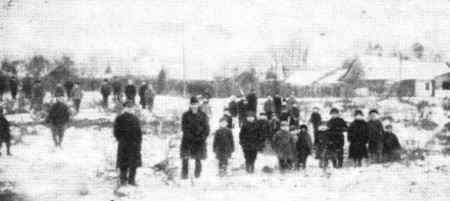
The lot on which stood: the old Beit Midrash, the New-Old Beit Midrash and Beit HaMidrash of Hachnasat Orchim after the fire of 15 August 1920 |
membership, and the library was maintained by them and by payments for reading. It was a large library in Yiddish, Hebrew and most of the books were in Russian. It was natural, even though almost everyone in the city spoke Yiddish, outside of two or three intelligentsia houses, Russian was the official language. In general. they spoke Yiddish, but in comparison to other cities it was much more developed. First of all, the city was known for its desire to study secular studies, to provide general knowledge to the children and not to immerse them only in the Talmud. There were also schools in our city, two schools, one Hebrew that I only remember one of its teachers named Sharir, and there was another one, a man who was sick with tuberculosis. Hundreds of children attended this school. There was a Talmud Torah where only Torah subjects were taught, but it was only for the children of the poor. And there was Cheder Metukan[1] at the municipality expense. There was an elementary school for gentiles whose principal was a convert from Judaism, his name was the like mine. Only gentiles studied at that school. Jews were accepted according to a certain percentage, up to about ten percent in a class. Being accepted to this school was a very complex task, and the curriculum was like four grades of a high school. Besides it, there was another high school that was established later and was different in its program. It provided general education and had religion classes. The Jews went out to play during the religion class. There were also two middle schools for girls in Bielsk, one of Bobilov which was considered the intelligent school, and one of Mardonovsky. These private schools worked hard to gain state authority, and it was not that easy even though the supervisor came during the exams. After graduating from this school, a certificate of education of four grades of high school was given. There was also a school, Bobilov, with four classes, but only for boys. His two schools were separate, boys and girls separately. Both met after school, in private homes or on the Bielsk promenade that we called “Bielsk Prospect.” This was the street parallel to the Russian Church on the main street.
[Page 85]
There were also students who studied outside the city, who were sent from home to be educated outside the city. The youth of Bielsk could not find a place for themselves in their city. They wandered around. In my time, before the First World War, the direction was – Lodz. It was in the period between 1905-1906 until 1919, the year of the Polish occupation. They left the city and worked mostly as clerks or, more accurately, as apprentices in shops in Lodz, mainly in weaving factories. For the holidays they returned dressed nicely and made an impression. They also aroused quite a bit of jealousy, maybe more envy than the students who graduated the middle school and traveled to study elsewhere, in Brest, Bialystok, Wolin, Vawkavysk and Slonim. There was another school that played a very large role in the development of the youth in Bielsk. It was the Yungerman's cheder. Yungerman's cheder was for parents who were traditionalists and culture lovers. Those who didn't hope that their sons would become rabbis and wanted them to be Jews who were connected to Jewish life and advanced in general intelligence. And indeed, his school gave a boost to self-development and became a general education for most students. Even though it was a cheder, modern methods of education were implemented in it. It was not only about learning, but also about education, and we were greatly influenced by Yungerman. I, for example, imitated Yungerman, my teacher, not only in the way he spoke, but also in the way he drank tea and read a book. Such was his influence on me.
My mother always got mad at me when I twirled and pulled my hair while I was reading. That too was under his influence. Its strength was that you could be sincere with a teacher and talk to him about everything. Once, when I was a boy, I dared to ask the rabbi who created God. He didn't slap me, but told me, when you grow up you will understand it, if I tell you now you won't understand it. That was a huge advance at that time.
The press that was widespread in Bielsk was the Yidishes Tageblatt [Jewish Daily News], the Haynt [Today] and Der Moment which was published later. The Yidishes Tagebla?? was the first newspaper to appear immediately after the revolution of 1905, later its editors edited the Haynt. The Yidishes Tageblatt cost one kopeck, it was equal for every Jew. Later, the Haynt and the Der Moment started to appear. There was another newspaper before these newspapers, it was Der Fraynd [“The Friend”], which was published in St. Petersburg, but it was too serious for such a city. Only a few people read it. The majority of the population received the Haynt and Gazeta-Kopeika [“The Kopeck Newspaper”]. It was a Russian newspaper that really cost one kopeck and was called that way in Russian. A radical, non-socialist civic newspaper was especially popular among us. I have forgotten its name, but I think it appeared in St. Petersburg. It arrived in a few copies. Generally, not many people read Russian newspapers, the masses mostly read newspapers in Yiddish.
There was also little industry in Bielsk. There was a factory for tobacco and cigarettes, two factories for beer and flour mills of all kinds. They were powered by steam, water, and wind. There were also two workshops for roof tile and porcelain. One belonged to Vollman and the other to Yanai. That is all the industry that was owned by Jews. There were bakeries, but they were not that big
[Page 86]
and they didn't employ many workers. There were also tailors who employed apprentices. There were also tailors who sewed ready-made clothing, a kind of mass production of clothes, and sold it on their own. Most of the breadwinners were small merchants.
At that time, there were already the first buds of the Zionist movement in our city. Every Yom Kippur eve a bowl was placed in the synagogues [for donations] for the settlement of Israel. We were students and anti-Semitism was well felt, especially among the studying youth. We also had gentile friends, but anti-Semitism was felt everywhere, we felt it as tzav mil'mala[2]. For this reason we dreamed of a university in Israel and raised funds for it. On Yom Kippur, we also placed a bowl for the benefit of the Hebrew University that would be established in Jerusalem. Later, we sent the money we collected through Radilevsky, who was the trustee of Keren Kayemet in our city, to Jerusalem. Sometime later, we received a reply: we usually do not accept such donations, we are not interested in such donations, but as an exception and in appreciation of the initiative of the young people that we discovered on our own without outside guidance, they agreed to accept the forty-seven rubles we had collected at that time.
This is how life continued until the outbreak of war. With the outbreak of the First World War there was a major change in the lives of the Jews of Bielsk. During the First World War, there was the fear of conscription, and the Jews devised all kinds of plans in order to release themselves from the army. But the main concern was the war itself and its consequences for the city. Together with that, the war also brought economic prosperity. The army, which was concentrated in the vicinity of our city, passed through it on its way to its destinations and left its proceeds there. The army also began to prepare the roads for transferring the troops to the front or for a possible withdrawal. They built three bridges on the road between Bielsk and Bialystok, and as we know, the construction of the bridges required the supply of wood, building materials, and all sorts of other things. Naturally, this also raised the economic situation and the livelihood to a certain extent. But, together with that, persecution against the Jews began at that time, and Jews, who had been expelled from their places of residence due to preparations for the front or because of anti-Semitism, began to arrive to us.
I don't know what factors brought the refugees to us, but the fact is that refugees arrived to us from Minsk, Kuritz and towns in the vicinity of Minsk. I remember well the time when the refugees arrived, and it was necessary to house them. Jews, who knew the life of nomads, came with the whole family and the first place was the synagogue. Then, they began to look for places to live and also to take care of the family's livelihood. They were mostly non-wealthy Jews. The rich wandered further from the front and settled in large cities. It was not easy to take care of all these Jews who remained with us. Despite this, the whole city rallied around the mission, and this was my first revelation of significant Jewish volunteerism. This occupied all the homeowners and all the wealthy people. Here, the Jewish heart immediately began to beat warmly for brothers in the Diaspora.
Later, the period of withdrawal also began in Bielsk, and preparations had
[Page 87]
|
|
|
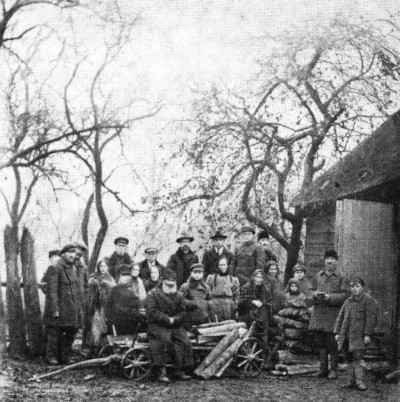
The distribution of wood to Bielsk's poor |
to be made to leave the city. The withdrawal period lasted about a week, ten days and no more. Ten days before the city was occupied by the Germans, we began to feel the pressure of the approaching front and the fear of the front. Everyone was looking for a way to get their families out and escape. A mass escape from Bielsk began, of both Jews and gentiles, but the Jewish escape was more massive. The gentiles fled from the city to the villages and their surroundings. There were also a few who fled further away. The Jews began to wander. Anyone who could afford it bought a cart with horses, harnessed them and became a carter. Everyone loaded up what little property they could. They mainly took clothes and bedding, which is the first thing in wandering, and then a few belongings in addition to money, nobody left money. The wandering was on a huge scale. Almost everyone left, only those who were afraid they would have to enlist in the army along the way remained. They feared that the Germans would capture them and send them to a labor camp as prisoners of war. And there were those who didn't want to leave for the opposite reason, that they would be drafted into the army in Russia. They stayed
[Page 88]
on the assumption that it was better to be in a German camp and stay alive than to be a Russian soldier on the front. People didn't yet know what the Germans were. They thought the Germans were civilized people, enlightened people, and it was better to be under German occupation than on the Russian front.
At that time, about eighty families remained in Bielsk out of the entire population of about 6,500 Jews who lived in Bielsk. Of the families who remained were also respectable families, one paid dearly, he lost his wife and daughter. The Alter, Geller and Silberstein families remained and also a few people who had no choice. They were unable to escape, and they also had no place to escape.
The period of transition from power to power was very difficult, because the war front around our town lasted about ten days or two weeks, until the Germans occupied the city. The strategists said that the Russians held the front here in order to evacuate the Bielsk fortress. They feared they would be attacked there, but in the meantime the Germans had come from another direction, and they had to withdraw. The Russians, as mentioned, employed them to get the besieged army out of the encirclement. That's why so many of them were killed.
At that time the houses in our town were empty. The entire remaining population was concentrated in three locations. One in the area of Yefeh 'Enayim synagogue, the second at the Geller's house from which they saw the entire front, and the third at the Silberstein's house in the city center where he had a hotel. I fled. Then came the occupation, and even in this occupation the Germans' face began to be revealed as rulers of enemy subjects. First of all, they began to seize teenagers for forced labor withing the city, to dig trenches for the army and transporting army supplies, but that was in the early days when front was still deserted. When the front existed there was no problem with food, it was possible to receive food from the Germans, and every Jew had a stock at home. There was no supervision, it was possible to manage. The Jews baked their own bread and survived. It is clear that there was no livelihood then. The entire rural population was outside the villages, and almost all the villages remained empty. Their farms were completely shut down. They took the inventory with them and sold their livestock inventory when they left. Almost every Jew in the city had one or two cows at home.
When the front moved a little further, we also began to take care of the spiritual and social life of the youth. In 1915, before the war, we, a group of teenagers, were a kind of committee for the administration of the library. With the occupation of the city the entire administration dispersed, and no one remained. We turned to the wife of Zucker, the banker, who returned to Bielsk. Since she knew German, we asked her to help us with the authorities reopen the library. The library remained intact. We also asked to allow us to collect the books from the vacant homes because the Germans used them for heating. After her visit to the military governor, he gave an order to put horses and carts at our disposal
[Page 89]
to collect the books. So we visited all the villages and the city itself and collected about ten thousand books. We compiled a list of every place we took the books from so we could return them, and in the meantime, we kept them and opened the library.
It was an act of collecting books for a library that had existed for many years. In turbulent, vague and uncertain days, the Jewish youth in Bielsk knew how to return to the book as our eternal means of existence, and this should be emphasized while drawing the image of Bielsk.
During the occupation, the government appointed a Jew named Gurevitz as the city's chief inspector. He established for himself a semi-military police force to oversee the internal order. Later, he was given permission to organize a local unarmed militia. On behalf of the city governor, according to the powers, Gurevitz was the head of the militia, that is, he was actually the mayor because there was no mayor at that time. He dealt with all the city's affairs, both social and housing problems. The mayor was German, but in order to gain the residents' trust he appointed a Jew to ran the city according to the governor's instructions.
At that time the Jews began to return. The rumor that life in Bielsk was back to normal quickly spread among the far-flung residents of Bielsk and they slowly began to gather. The population grew and the Germans also began to care for the education of Jewish children. They established a school and appointed Yugerman, who was in charge of the library, its principal. He was actually the principal of a German school, because the language of instruction was German with lessons in Hebrew and Judaism. It was a compulsory schooling and school-age children had to attend it. All the teachers were locals. The school superintendent was a German who visited the school often. From this school grew a municipal school that existed for a long period under various regimes.
This indicates the relationship that existed at that time between Jews and the Germans, which was also reflected in their economic concern for the Jewish residents. The Germans knew that there was not enough food for the population, so they introduced food cards according to which they distributed the food. There was also supervision of all transfers of food, medicine and fodder for livestock. Everyone, who had cows, was required to provide a daily certain amount of milk to the Germans. The Germans hardly contributed to the supply of the city's population; they took what they could take from the immediate area. For example, they gave an order to go out into the empty fields and sow potatoes and gave the seeds. In the first winter, this really saved the Jews who remained, because potatoes were always considered the main item in the food supply. The population in the villages was almost nonexistent. Few farmers remained in the immediate vicinity, and those who wanted to cultivate the fields were given the opportunity, but the Jews were hardly used to it. On the other hand, when someone cultivated fields, he was forced to hand over part of the crop to the community. and if that was not enough, a kind of a Jewish supply company was established. The supply company conducted a barter trade, when a ton of grain or wheat was supplied, a certain amount of sugar was given in return. Maybe the sugar should have been distributed for free to the population, but since it was only possible to obtain the grain from them
[Page 90]
it was necessary to buy it. But Jewish merchants, as they usually do, excided the limit of what is allowed and speculation and hidden hoarding began. They sold the food they had accumulated in other districts in exchange for saccharin, sugar, salt and oil. Then, it turned out that all purchases were actually for smuggling. They smuggled everything. They smuggled grain, smuggled products, smuggled items for the army and received very expensive goods in return.
With the German occupation, the cholera epidemic also began in our city. To eliminate it in its early stages, the Germans began an operation of disinfection and cleansing. They had done them with terrible cruelty. They forced the Jews to undergo disinfecting and washing in a bathhouse almost naked, and to leave the bathhouse naked because others were already waiting in line. This caused additional illnesses, cold, flu and all kinds of troubles.
At that time a very thin stratum of Jews had a very good life, but the community as a whole was in a difficult situation. To provide the Jews with means of subsistence, or perhaps to prevent an uprising, they gave the Jews the possibility of making a living from proactive work in the paving the road from Bielsk to Bialystok. The Russians started paving this road, but they didn't have the time to finish it. When they retreated, they destroyed everything they had managed to pave and burned the bridges. Now only Jews worked on it. The gentiles, who remained with us, worked their lands. It should be remembered that our population, which was Belarusian, fled for fear of the enemy. Only a few Poles remained, and they worked in their agriculture. Not only Jews from Bielsk worked on the road, but also Jews from Bialystok. Once livelihoods were available within this population, a longing for public life began to arise in them. For some kind of partnership of fate. Then, the first nucleus of the Bund in the area began to form among these road workers. It was around 1916. Among the road workers were also Bund activists, intelligent people, including our late friend Potocki who was a foreman, and they gave the impetus to renew party life, especially of the Bund. They were also joined by other activists who contributed to the development of the Bund, and the odd one among them was Yugerman, the school principal. He was a simple man who didn't believe in Zionism, even though he was a Jew who loved Eretz Yisrael. I worked with him and knew him. He was impressed and enthusiastic about the Zionist congresses as a political stand of the Jewish people, but he didn't believe that Eretz Yisrael would solve the Jewish problem. For this reason he opposed the political Zionist movement even though he was a Hebrew teacher, and the Hebrew that I know, I only know from him. He was a Yiddishist. There were contradictions between emotion and logic in him. He was a Jew emotionally connected to everything that was happening in Jewish life. He also connected to Eretz Yisrael, loved Eretz Yisrael, but from a politically logical point of view he opposed any hint of Zionist action because it was not in the best interest of Judaism. Back then there were many like him. He was a Folkist[3] with socialist tendencies, his tendencies were not based on Marxists they came to him from the Bible. The prophets were for him a foundation of honesty and justice. That was his conceptual background. He could have been a Jew who loved Yiddish, and Yiddish literature, and wanted to develop it, and yet he was inclined towards the prophetic vision of human redemption. He wanted to remain a Jew but a Yiddishist Jew. There were many such Jews. To everyone's surprise,
[Page 91]
he spoke in Russian and not in Yiddish to everyone, both on the street and at meetings.
During the Russian period, even before the outbreak of the war, there was the beginning of a Zionist movement in Bielsk, but to attract the youth to this movement they started to organize courses. On Sabbath eve, parties were held for readings and lectures and most of the topics were about Zionism. I remember that I myself, under the influence of my teacher, who was anti-Zionist, was the leader of those who debated with the Zionists, and I brought examples and arguments from those I had acquired from my teacher. I said that this country will not succeed in either industry or agriculture, it is a small country with many problems, and above them all is the problem of the Arabs, etc. In these parties I repeated what I had heard from the members of the Bund. The leaders of this group were Radilbesky and Slutzitzky the slaughterer's son, who was also one of the wonderful readers of Sholem Aleichem's books. Everyone came when it was announced that he would read from Sholem Aleichem. He was Berezovsky's son-in-law. And there were also Bekerman, Melamdovitz, Apelboim and Stopnitzki. Even though I was under the influence of the teacher Yugerman, I cannot say that I was consciously far from Zionism. In my feelings, for example, I leaned towards Yiddish, I loved the language, I only read in Yiddish, at home we spoke Yiddish and the whole environment was Yiddish. But I also loved Hebrew. I remember that at Melamdovitz's Hebrew school, which was a modern school, we organized Hebrew enthusiast groups, we met every Saturday evening and spoke only in Hebrew. All this was before the war. After the war, during the German occupation, there wasn't much room for cultural or public activity outside of the library During the German period, we received a special license and organized plays for the benefit of the library. All the actors were local amateurs. Among the famous were Luba Zokoldky, Yosef Sinai and Yudka Sinai, and their leader and organizer was Tzvi Sinai. There was another Jew who greatly devoted himself to this. The photographer, Doksin, was the stage manager. We performed various plays, mostly plays and skits by Gorky and sometimes also an operetta by Goldfaden. I remember that once we performed his play Hamachshefa [The Witch] and it gave a boost to the cultural life in the city. Before that, there was a private, non-municipal theater in the city, where plays were staged. By the way, it is worth noting that the road workers occasionally issued a handwritten pamphlet, which was intended primarily to discover literary powers among these people. One of them edited the pamphlet. He was a Jew named Guterman from Bialystok who spent most of his time in Bielsk. He was close to Guterman of Bielsk and a member of his family.
With the outbreak of revolutions in 1917, the Russian Revolution followed by the German Revolution, political unrest also began in our city and parties began to organize. As mentioned, the first to organize was the Bund, which attracted the road workers and the poor. Some of the youth begone organizing into Tzeirei Zion already during the German occupation. They constituted an operational instrument for Zionist activities in the hands of the General Zionist leaders, Biluvsky, Melamdovitz and Appelboim. Some of the youth, who remained loyal to Zion and at the same time saw the difference in status in life and the suffering of the masses of people, aspired to something else. And I must mention to the credit of our revered acquaintance, Stopnitzki, that he was the first to bring to our city a
[Page 92]
socialist lecturer, a socialist Zionist as a counterweight to the Bund. The first lecture took place in a hiding place, in secret, at the Eisenberg home. This was the first lecture that I've heard about Zionism and work. Our townsman, Yakov Bronstein[4], who was in Warsaw all the time, appeared in our city. He was among the employees of the Jewish newspaper in Warsaw which was published with the government's approval. I don't remember the newspaper's name. He was very talented. In our youth we were very close as peers. Eventually, he developed communist tendencies and was later executed by the Russians. He was a literary critic in Russia.
He spent several weeks with us and Poalei Zion party, neither right nor left, just Poalei Zion, began to organize. Already during the German rule, we began to receive propaganda material from Warsaw published by Poalei Zion. Interesting material, booklets by Kaplinsky, Rubashov, Ben-Zion Dinur, Nir-Rafalkes and Zorobabel. Later we received booklets from Uris and from Rosenfeld who was a delegate to the first Polish Sejm and passed away. We also received the Arbeiter-Zeitung [“Workers' Newspaper”] which was published at that time in Vienna. Political life and public unrest began, and the time had come to organize the Jews in an overall organization. We began to prepare for democratic Jewish public institutions. The first community committee was elected before the Germans left. The first democratic elections in Bielsk were held in 1917, and later the residents of Bielsk began to organize themselves into public political institutions. The first elected community committee was represented by wo Bund, two from Poalei Zion, two from Tzeirei Zion, two from the Orthodox. Surprisingly, Yugerman was one of them and I don't remember the second. member. Two or three represented the General Zionists.
I tried to bring up memories from distant days, the years 1905-1918 of our city, Bielsk. And before my eyes appeared a small city, whose residents are lively and aware of what is happening around them. They demonstrate an extraordinary intellectual intensity and orientation to the changes of the times, all from Jewish intuition self-initiative. Before my eyes rose the youth, for whom the most important thing is literature and thought. Even during difficult times they take care of the library and the theater, and in their contribution to the establishment of a Hebrew university in Israel, they preceded many of the university's visionaries and founders. And so the city is dear to me, and its sons inspire awe and admiration. Such were my brothers, the people of Bielsk, and upon them reaper raised his defiled axe.
Honor to its memory.
Translator's footnotes
|
JewishGen, Inc. makes no representations regarding the accuracy of
the translation. The reader may wish to refer to the original material
for verification.
JewishGen is not responsible for inaccuracies or omissions in the original work and cannot rewrite or edit the text to correct inaccuracies and/or omissions.
Our mission is to produce a translation of the original work and we cannot verify the accuracy of statements or alter facts cited.
 Bielsk-Podlaski, Poland
 Yizkor Book Project
 JewishGen Home Page
Copyright © 1999-2026 by JewishGen, Inc.
Updated 30 May 2026 by OR