|
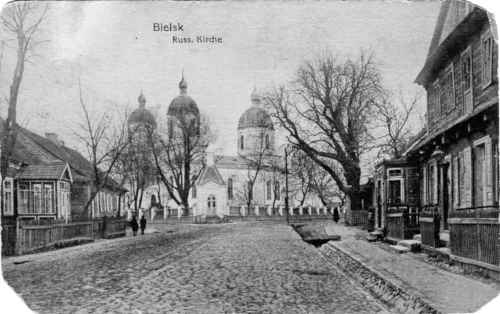
Hindenburg Street in Bielsk
|
[Page 33]
by Aharon Shtaynberg
Translated by Sara Mages
My father, Yechiel Shtaynberg, was a sworn Hovev Zion [“Lover of Zion”]. For him, Zion was not a subject of passive affection, but a matter to engaged in, to do for it. To put it at the center of interest and life, and to not let go of it until it comes to fruition and until it is a dream come true.
Therefore, our home was a home where everything focused on Zion, and the children seemed to educate themselves in the spirit of Zionism. In terms of “educating walls,” “educating house,” and the very fact of living in it obliges and imposes its spirit on you. At the age of eight we already belonged to Pirhcei Zion [“Flowers of Zion”] movement, and we knew that in doing so we bring joy to our father z“l, just as we brought joy to him by knowing the lesson in the Chumash that we studied or other lessons.
Every Shabbat, the two Zionist circles in our city and their prominent activists, Melamdovich and Stopnizki, came to us, and the atmosphere of Zion prevailed throughout the house. The conversations were about the awakening of Eretz Yisrael, its important leaders, and the redemption that will come if we only enlist for it. All the adults in the house participated in the conversation as responders and listeners, and engaged us, the children, in Zionism in a different way. The two Zionist personalities read us stories from Zikronot le-bet David [“Memories from David's house”], Perachim [“Flowers”] and Zelalim [“Shadows”]. And just as these stories captured the street and the Jewish heart, they became our main occupation during the hours of Neshama Yeterah[1] of Shabbat in the company of our father, Melamdovich and Stopnizki. When we grew up, there was no longer any doubt that we must be Tzeirei Zion[2].
When Herzl died my father closed the store and wore mourning clothes. He was sad, shocked and confused as if a torrential rain had fallen on him on a bright sunny day. Nevertheless, he recovered and began running along the city's sidewalks to influence Jews to close their stores. He didn't calm down until he saw all of Bielsk mourning the death of the great visionary and commune with his memory.
It was not easy. At that time the language war was raging in the city, as it was throughout Poland. The Jews were divided in their opinions, whether to return to the language of the past that we long for and are drawn to and speak Hebrew, or we must not betray the Yiddish language that saved us from assimilation. Therefore, it should be left as the language of the people and not as a “servant who gives way to her Hebrew matron.”
The war was difficult. There were those who, out of loyalty to the Yiddish language and its sweetness, its literature, its heart-warming poems, jokes and wit, remained loyal to its homeland. They began to oblige the Diaspora and boycott the Zionism and its leaders, so that they would not come to expel them to Zion where every stone in the wall will speak in Hebrew to them. My father, a Zionist at heart and soul, also enlisted in this war. He saw in the narrowing of the Yiddishists[3] influence a salvation for the people, their language and future in Zion. For him, the Hebrew language was
[Page 34]
the beginning of preparing the people for their independence in their homeland, in Zion, as a nation united by its language and the heritage of its values.
At that time, we were under Russian rule, and with the liberalization of Russian tsarism we were allowed to elect Jewish delegates to the “Duma,” to the Russian parliament. Each district was allowed to elect only one representative, and in our district, Nachman Sirkin the Zionist was nominated for election on behalf of the Zionists, and a lawyer from Siemiatycze on behalf of the Yiddishists. My father could not accept the doubt that the Yiddishist would be elected. When he learned that on Thursday, fair day in Bielsk, that the Yiddishists would conduct a propaganda campaign in nearby Orlik, he stood up and closed the store. He gave up the only day of great profit in the week and went down to Orlik, ready and willing to thwart the success of the fanatical propagandists. In Orlik he learned that the situation was critical. The Zionists had no counterweight in the city. The only synagogue suitable for a propaganda gathering was in the hands and under control of the Yiddishists, and the campaign in Orlik must be seen as a failure. Their power will increase and it may be that everything will be theirs. My father's despair was too deep. He was broken and shattered. Meanwhile, Hirshke the shoemaker, Orlik's powerful man, who was called, der groyser gibur aundzerer [our great hero], with special pride in the city, met him. When my father told him the reason for his depression, Hirshke's heart filled with great sorrow for his friend Reb Yechiel. He remembered one act of kindness my father once gave him in his time of need, and he said:
- Reb Yechiel, go back home. They will not talk.
And they didn't talk, and my father returned to his store.
When the first shares of the National Bank were issued, my father was the first in Bielsk to buy them and he played with them as with an expensive toy. They were precious to him not because of their monetary value, but because of their form, because of the Hebrew in the text.
The Hebrew letter, which was used only in religious ceremonies for centuries and was never revived, oppressed every Jew who read it. The Hebrew was like Latin, or Cyrillic that everyone had come to terms with their death, with their old age, their passing from everyday life, and did not believe at all in their resurrection. Therefore, when my father saw a Hebrew letter printed on everyday item, or on everyday necessities, he beamed with happiness, as if he had received real confirmation of our faith in the revival of the people and their language.
Once, I remember, margarine made in Eretz Yisrael was brought to the city. It was wrapped in paper and its name, “Tamar,” was printed on it in Hebrew. He immediately ordered to buy it and use at home. My mother objected because the margarine was not to her taste and, “who knows how many days it had been on the road and it is clear that it is not fresh,”, but my father insisted:
- How is it possible that something came from Eretz Yisrael and we will boycott it?
To him, everything that came from Zion was sacred. My mother bought the margarine.
When my father was a boy, he studied in a yeshiva in Mariupol and ate tag, yamim[4] in Hebrew. One night he dreamed that his father died and woke up. He immediately dressed, took his bundle, woke his landlady, and said to her:
[Page 35]
- I am going home, something with my father…
That night, his father died, and the next day he attended his funeral.
He was blessed with the ability to dream about an existing and distant reality, with the power of deep feeling, with the power of dreams. Therefore, he believed in Zion and its existence for our sake, because his dreams didn't speak in vain.
His sense of seeing things in the future was a sense that everyone attributed to him and talked about.
Once, a gentile entered the store, and before he could say what he wanted, my father said to him:
- Your face looks worried, for some reason, as if you lost the trial your son led against you.
The gentile was frightened and crossed himself:
- Where did you get it from, how do you know, after all, it only just happened and no one knows about it?
My father didn't reveal to him where it came from, but said:
- Don't worry. I will give you some advice, follow it the second time and you will win the trial.
Six months later, the gentile came with his cart loaded with potatoes and flour and said:
- This is for you, Chilio, I had done as you advised me and I won the trial. You deserve it. My thanks to you.
And I am not saying this, only to confirm that there is a nation blessed with sons, who, while maintaining their faith in their people, develop hidden, deep, subconscious senses within themselves. Knowledge of the future, exploration of the distant past. The dream then becomes a stronger reality than the reality perceives by your normal bodily senses. Suddenly you see what others don't see, and you believe in your dream.
Such was my father's generation. Such was my father z”l.
My way to Bielsk
The year of 1914-1915 was a year of abundance in Bielsk, The army that swept through the city left behind revenues that were previously unknown, and in Bielsk there was an abundance of prosperity, affection and loyalty to the Russian army. But suddenly the situation changed. After Rennenkampf's fall Bielsk was captured by the German army. The Jews were accused of solidarity to the Russians, and ninety percent of the city's Jewish residents were forced to leave for fear of the approaching occupier. Most fled to Russia. We also left Bielsk. My father bought a horse and a cart and we set off. We got as far as Szereszów near Pruzhany and got stuck. The Austrian army surrounded the Russians and we could not continue. Several weeks passed and my father decided to return to his city.
And again we are in the cart, and again we wander. We didn't have time to move away and here the German army all around us. The soldiers were ordered to throw everything out of the cart and to confiscate the horse for military purposes. They released the “old people” and the children. They only took me to be their carter, and I was thrown to the front with the horse and the cart. A thirteen-year-old cartman in a fighting camp deep inside the front.
Every now and then they loaded my cart with different things and unloaded them in
[Page 36]
different location. I directed the horse to these places, and the front was around me. I arrived via Brisk [Brest] to the vicinity of Pinsk in a convoy of one hundred and fifty carts. Among them were one hundred and twenty gentiles, and I am a boy, a Jewish boy among the gentiles, and I missed home. I approached a gendarme and asked him to release me. To “let me go home.” Simple. And that simplicity pleased him. He was inclined to release me. Maybe he had another reason for letting me go.
- In your cart, he said, there is a crate with vodka. Take out a few bottles for me and I will allow you to go back. Drive, he said, slowly slowly, until you are the last one in line, sort it out and you are free.
Suddenly I was last one, and he was next to me. All the way. When I was far behind the convoy, we stopped. He gave me his dagger, and I broke the crate's lid open and gave him what I gave him. We closed the crate, he burst forward running, stopped several carters and shouted:
- We can't keep up with this brat's pace. Unload his cargo to you and continue without him.
I was free. But I didn't know the way home. Before me stretched fields crisscrossed by dirt roads, roads that were paved by the farmers for their needs and I didn't know where to go, which path to take. I arrived in a small city named Liskova. I stood in the middle of the city, in its square, the town was full of an army and something festive was going on in the streets around me. I knew that today was the Sunday of the new year. I didn't know what to decide, how to desecrate this terrible day and continue outside the limit. This is no joke, I was confused, hopeless and desperate. And here, he appeared like in the legends of Elijah the Prophet. A very tall Jew dressed in a simple and very long caftan approached me and said:
- Yingela [little boy], what are you doing, do you know that today is the first day of the new year? Come with me, be with me, don't worry about the army. Follow me and thanks to the holy day we will be protected and whatever will be will be.
His house was a tiny house with one room. He took the horse to the orchard next to the house and I entered his home.
All that we ate, the three of us, the wife, the husband and me, was “dry” borscht. Borscht that was not cooked with meat or fat, and a few slices of bread. A holiday meal that I remembered for many years. He was the village tailor, a poor, destitute man. I learned this over the many days I spent with him.
I was with them for about thirty days, sleeping on a bed of straw, and not knowing how or when I would be able to continue home.
The roads were congested with army units, and bandits all around. The road was through the forests, and he was a simple Jew who was not an expert in complex situations like mine. And most importantly, there was no food in his house, and I was a burden on them and on myself. I couldn't take it anymore. I went to the city officer and told him everything. There is nothing to eat. I want to go home but I don't know the way. I will leave, but I am afraid that they will catch me on the way and recruit me again. I've been separated from my parents, from my home for several months.
My words convinced him, he gave me a note and said:
[Page 37]
- I don't have a rubber stamp, you will find it at the military headquarters, at the general himself. Go to them, they will stamp it, and you will be able to travel without being delayed again.
At the headquarters they chased me away like a puppy. Aroys [out], and that's all. But I didn't give up. The clerk shouted aroys from behind his big desk, and I kept on coming back. In the end, we both got tired of the game. The door slammed in my face and I was outside. But my longing was so strong that I didn't move from the door. I sat on the threshold and didn't move from there.” Two or three hours have passed. The general himself came out of the office and I followed him. He wondered what I was clinging to him. I told him my story and the note in my hand. He returned, ordered to stamp the note and I was free.
How do I travel home? In which direction? And how, when everything is full of army. Several days passed and I was still in my confusion. One day, soldiers in two civilian wagons full of belongings for the front. I noticed that the carters were Jews. They came from Pruzhany and I knew the direct way from there to my home. I returned with them to Pruzhany. I stayed with them overnight and left for the road, home, home.
It took me a day and a night to travel through the dangerous Bialowieza steppes. Deserters from both armies roamed the forests, they hid and lay in waiting for prey. I knew that the situation was very dangerous, but the power of longing overcame the fear.
On the way I shouted, talked to myself, I encouraged myself. I went through a journey of agony and fear. I encouraged myself and in way I arrived in Bielsk, to my home.
I am not talking here about my personal details. I am telling here about periods in the life of the people, about what happened to a Jewish boy and what Bielsk was for him.
The atmosphere in the schools
In the city there were two progymnasiums [secondary schools], and one municipal school whose four-year curriculum was equivalent to five years of study. Later, it was changed to what was called High School, and out of its two hundred students only eight Jews were accepted. They simply didn't want to allow the Jews to advance. When we first studied at this school in its first format we didn't write on the Shabbat. Neither our parents, nor our teachers, incited us to this act of sabotage at school. It was our own work. We, the students, on our own initiative and our standing, opposed writing on the Shabbat in principle, and we didn't write. The matter cost us many difficulties and a relentless, nerve-wracking and depressing war. What did the management do? It outsmarted us and made a plan that required us to drew on the Shabbat. Their intention was to get us used to using paper and pencil and when we get used to it, they will continue to force us to write on the Shabbat, because what is writing if not pencil drawings on paper.
The school principal was a gentile named Davidowitz. We influenced him, and he shelved the drawing program on the Shabbat. However, when he informed us of this, he told us:
- I know that you write on the Shabbat and you are not careful about it. This time I gave in to you, but soon we will renew our plan, and you will be forced to write on the Shabbat.
I don't know why we didn't feel the anti-Semitism at school. In my memory is a quite clear picture, and it is of an atmosphere free of anti-Semitism. In spite of it:
A) Once, on Yom Kippur eve, the art teacher informed us that he knew
[Page 38]
what holiday we have today. This terrible day, as he expressed himself, is taking place tonight, and if it is possible, maybe he will receive permission to come and be at the synagogue in the evening.
We brought his request to our parents, who were the ones making the decisions in the synagogue.
Our parents consulted about the matter and allowed him to be in the synagogue during the Kol Nidrei prayer, in everything that took place before and after it.
The day after Yom Kippur, when we returned to school, he was still under the impression of that impressive evening and he asked us:
- Didn't the devil take you on this day of terror and suffering? What kind of people are you who create such terror and horror situations for themselves? Just like the primitive people trapped in the devil's thicket
B) Apart from all the accepted subjects at the schools we also studied the Old Russian language, Staroslovenski Jezik. The teacher of this language was the priest. He was a pleasant and acceptable gentile to us. We called him Papochka, meaning: daddy, and we felt his liberal attitude towards us. The Beilis affair happened at that time. That dark and last blood libel in the world, which shocked the entire Jewish world and the liberal part of the gentile world. We wanted to know what Papochka had to say about it. My classmate, Bronstein, stood up and asked him if he believed that Jews needed the blood of Christian children for matzot, and if Jews need blood at all. The priest didn't hesitate for a moment:
- No, he answered, “I don't believe. Fabrication and that's all. Nonsense that must be denied. Just denied.”
We were at ease and the joy was in our abode. Soon we will return home and tell about this miracle. But at that moment, another student from the class, a Pole, a member of a nation persecuted in Russia, stood up and responded:
Papochka, how can you doubt this. Afterall it is written in the newspaper that the Jews do this, they use Christians' blood for their matzot.
The liberal Papochka immediately changed his mind:
- It is written in the newspaper, yes, yes, meaning, if it is in the newspaper, then it is a fact and must be believed.
A native of Bielsk whose ashes were scattered on the heights of Masada/anti-Semitism and Jewish heroism in Bielsk
Whoever says, that Bielsk was a city of merchants, like all Jewish cities, and adds that like all Jewish cities it also sunk into darkness, opposed progress and believed that its salvation was only in religion, is exaggerating or presenting an incomplete picture of Bielsk. I remember it differently.
In my memory, there were a lot of working people in Bielsk, shoemakers, tailors, carpenters, locksmiths, glaziers and other professionals. They lived by their labor and found their social peace of mind in reciting Psalms, the study of Mishnayot and Ein Yaakov. They didn't do it for religious reasons. They simply needed social frameworks in which they could alleviate their social class loneliness and their national belonging. The Psalms, Mishnayot, Ein Yaakov and others created the frameworks they needed.
[Page 39]
Among these laborers were many who were blessed with a sense of progress, and with this sense they also determined that it could be achieved not only through a confrontation between it and religion. In this way, they created a very profound separation between religion and progress. They made religion mandatory and aspired to progress. In this way, they proved that reality does not contradict progress. And why does it have to contradict it? After all, religion itself is the result of continuous progress.
Quite a few of these craftsmen sent their sons to study in places of education and advancement outside the city. The shoemaker, Fishel's, sent his son to study at a high school far from Bielsk, because, as had been told earlier, there was still no high school in Bielsk. Almost all butchers sent their children to study advanced studies, and Hillel Herblowski's son even reached the highest level in his studies and made a very great progress. He later became famous as a renowned psychiatrist in the USA.
I would like to tell you about him what I promised in the title. Herblowski's son arrived in America. He studied, acquired knowledge and rose higher and higher in his fame. When he fell in love with a non-Jewish girl he married her without hesitations. This didn't hinder his understanding of Judaism, and he didn't see it a step in progress. He always saw his path to education as a path ascending to the light, to the heights of man. He continued his advance in two directions. He volunteered and fought in the Spanish War against the dark fascism, which was represented by General Franko, and dreamed of his ties with Israel in very concrete terms. He wanted to celebrate his son's Bar Mitzvah here next to the Western Wall and was not able to. He wanted to live the rest of his life here, but he didn't live long. What he couldn't fix in his life, he fixed after his death. He ordered his body to be cremated, and his ashes scattered over the heights of Masada.
His request was granted even though he was married to a gentile.
This is a line of thought that is also known to us. Complete progress with a connection to the people, their fates and their culture, without forgetting that the purpose of our progress is first and foremost the unification of the ethnic culture of our people and the vision of our national problem within the framework of the general progress of the world.
What links his last ashes to Masada testifies for itself, because his entire path in life was a path of ascension to Masada, to the peak of the Jewish people's extreme loyalty to their physical homeland. The path of loyalty of individual Jews has a common denominator, love of Israel and Jewish brotherhood.
The workers in Bielsk were most blessed with such nationalism.
I happen to remember the tailors, who were for reasons not emphasized, were forced to establish their own Beit Midrash. They probably didn't feel comfortable in the company of those who claimed to be a selected class in Judaism by virtue of a “scholar,” which was never tested. By the way, they never chose to separate themselves from their unity, in order to be far from these arrogant brothers. These tailors and other workers, who were truly discriminated against by their conservative brothers. When they sensed trouble for the Jews of Bielsk, including the aforementioned alienated brothers, they immediately came out in their bodies, that is, with all their might, to defend the people, from this trinity of perfection of labor, progress, and love of the Jews.
[Page 40]
You probably remember the year 1906. The sounds of hatred and horror of the pogrom in Bialystok still echo in Bielsk. The Jews here are in fear, and the rumor is growing that the gentiles in the surrounding area are planning a similar holiday for themselves in Bielsk. As is customary in Bialystok. Farmers from the surrounding area gather. Preparing for a pogrom in Bielsk. The Hasidic Jewry is paralyzed in its anxiety, who will rise for Bielsk Jewry because it is small and paralyzed by fear. The city's carters went out of town to forestall the pogrom. They placed their carts' ladders across the road as a barrier against the intruders, pulled out the wheels' axles, waved them with their hands and all the gentiles scattered and disappeared. Bielsk was saved. The distinguished Jews in the city breathed a sigh of relief, and who knows if they admitted that they were sheltered by the love of the Jews of their despised brothers.
And the 1911 incident
There was a fair in the city and thousands of gentiles, and the days were their holiday eve. In their houses of worships, priests incited pogroms against the Jews to the sound of the ringing of the bells of holiness. The Jews saw that a pogrom was about to come upon them, the gentiles were already inside and who would disperse them? Four butchers and two carters went and came to the village of Widawa and set fire to several barns in the village. When the gentiles saw that there were no men in the village and their property was abandoned, they left Bielsk and rushed to their homes to save themselves from the Jews' revenge.
This case ended in a trial, which clearly proved the connection between the two cases, and three Jews were sentenced to three years in prison in Grondo for an act of revenge that preceded the crime. And they sat. Jewish prisoners of Bielsk from among the working class.
And it is mitzvah to complete this wonderful picture with the additional act, because somehow Yanek the gentile, the cobbler's son, was judged together with them and also served the three years in prison with them. To teach us that in Bielsk was also a bud of brotherhood of people that began to develop from the working class.
Who knows the ways of memory? These are the things I remembered and about which I told, and if these stories somehow complete the description of our hometown z”l - that would be my satisfaction.
Translator's footnotes
by Motos Kaplanski
Translated by Nancy Schoenburg
I arrived in Bielsk in 1922. In truth I was born in Bielsk but during the 1st World War I left for Russian Ukraine. I returned to Bielsk-Podlaski, my birthplace, as an 8-year-old boy.
Actually, my background was as a member of the proletariat, since I managed to start working at a factory at the age of 6. Besides that, we spent the entire War with hunger and constant changes of government rule in Ukraine, and with every change it meant starting all over again from scratch. There were the Bolsheviks and Kerensky, and after that the Germans came in, and after that Hetman and Makhno the murderer and after that Petlyura's followers who were Ukrainian nationals full of anti-Semitism. At the time I was used to suffering and distress. But then I also had to absorb the most difficult of Jewish experiences. One time I happened to be present when two men entered with a gun and set it up opposite my father and threatened him until he gave them what they wanted before they would leave. A second time I was present when a pogrom was taking place in town. Everyone was fleeing or hiding inside the cellars. We children went outside and saw what was happening. We saw a large procession of enflamed murderers gathering at the road, taking Jews prisoner and beating them cruelly.
|
|
|
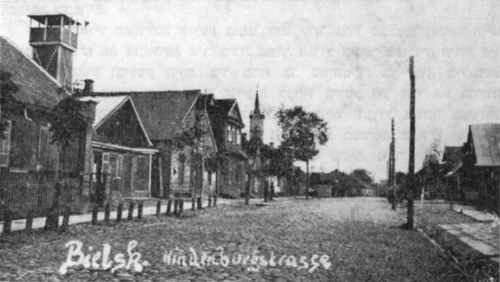
Hindenburg Street in Bielsk |
Usually before a regime change, its soldiers were commanded to blow up existing facilities in the town. It is difficult to say that these facilities were for all intents and purposes military installations, but they thought it was right to bomb the train station and other “fortresses” and such as a means of gaining victory. Between one rule and another we would all just lie in our beds or under the beds.
Within
[Page 42]
the cellars and other secure places, we trembled at every sound of voices, of firing and bombardment. And with the next morning's light, a new wave of fear flowed through us as a new authority began to appear. I remember that my mother walked out one morning to get water and some riders came upon her. She was walking with empty pails, which was not a good sign, and for that they were ready to beat her – to kill her, because she was going toward them with empty pails as if to bring down upon them some kind of disaster. There were also some ridiculous situations at a time like this, with one group on the way out and others already pursuing them from the other side of the road. Very slowly yesterday's ruling group began tossing out the booty that they had snatched by force just the day before. This was to lighten the load for their horses. They would toss out furs and pitchers and all kinds of valuable items, everything that was making the wagon heavier. After that the road would be littered with all kinds of things left from the brief battle that had been brewing. There were piles of trash and dirt all around. All of this was set on fire and we children would throw bullets into the bonfire and hide so we could watch the bullets explode. That this did not result in a disaster is only a matter of luck and a miracle.
Basically, I remember Bielsk as a clean and pretty town whose leaders took an interest in its appearance. From time to time, they would put a fresh coat of paint on all the fences out front –white or blue-white paint – and this made it a beautiful, colorful place. The main street and the side streets where the Jews lived were clean and lovely. The Jews on the Council had an influence in matters relating to the efficiency of services in the town and its economy. As for the economic life there, it was the central place for all the surrounding villages in the area.
The province that Bielsk belonged to at the time was bigger than Belgium and sometimes we would wonder at how it was that the capital of the largest region in Poland was a city like Białystok and Bielsk was the District City. Towns such as Siemictycze, Brjansk [Bransk, Poland], Białowieża and Haluvka[1] belonged to the District of Bielsk. They were about the same size or even larger than she was. Białowieża Forest, the biggest forest in Europe, was also a part of this region. There was a famous place whose size was just 1 kilometer by 1 kilometer where about 40 different types of trees were growing. It was known to be a special place, and indeed it was. It was chosen in its day to be the summer residence of the Russian Czar.
Bielsk in this regard served as an important transit location when the Czar would go through there. In fact, that might have been what influenced them to choose it as the District City. It was a transit point between Bialystok and Brisk to Warsaw. You could go on the Brisk road or on the Bialystok road to Warsaw. Bielsk was situated between these two large cities and the overall area surrounding Bielsk was similar in size to Belgium. Many towns could be found around that area, and every one of them had a considerable number of Jews. This included Orla and Hinsika[2] and Kleszczele and other spots. In Hinsika, which was connected to the forest, there were large sawmills processing the wood. Jews were in this industry but not as workers. They were sawmill owners. I did not know any who were laborers, not one.
It was at the center of the Polish proletariat. Other places were filled with farmers, and laborers were almost nonexistent.
[Page 43]
In Bielsk itself there were no factories. It had a workshop for felt boots which employed not more than 10 – 15 workers. That was Bider and there also was Michalchik. I worked at one of them for a time. At Michalchik they processed the felt boots, and I was the only Jewish person in the entire shop. All the others were gentiles. Jewish workshop owners thus were in Bielsk, even in “heavy” trades. There were carpenters, cart owners and porters. I also worked in a store as a porter and transporter. It was there that I saw an interesting occurrence. There was a young woman, daughter of a grain salesman in one of the towns. She was about 18 years old. She lifted up onto herself a 100-kilo sack of sugar. The community of working people doing physical labor was very interesting. They were not cultured people, not the cartmen nor the porters. But they were good, devoted Jews, and they did their work faithfully. They lived their lives with honesty and family values.
Translator's footnotes
by Fanya Greenberg
Translated by Nancy Schoenburg
I was a refugee in Bielsk before my parents were. I completed gymnasia [secondary school] in Volodymyr-Volynsk [in NW Ukraine]. I traveled to visit there, and I became a refugee from the Austrian Front before my parents became refugees of the German Front [during WWI]. We met in Kiev in 1915. In any event, this was a small chapter of my life, yet my connection to Bielsk is very strong indeed. I thought about this. It is very possible that this is an idealization and perhaps I am not being objective. I thought – why is that? It goes without saying – it is because these were the best years of my life. Without any doubt it was connected to my good childhood. We traveled to Kharkov. My father was killed in 1919 in Kharkov, and we did not return. I left here [Israel at the time of writing] in the year 1937 to go to Bielsk, and of course, I found a different city. I thought a lot about what characterizes this city and why my connection to it is so strong.
Bielsk has a nickname “Zeydene Tarbes [Yiddish meaning Silk Rucksack].[1] I searched for an exact translation of “turbes” [sic] but did not find one. A “tarmeel” [satchel] is a “turba.” In Yiddish it is also a symbol of poverty. When I tell people the nickname of the town, they say: “How fitting that is!” Bielsk was in general a poor city. Of course, there were some [people] less poor and some poorer and some richer. But every concern for the city, its local public service, was limited by the framework of poverty. This was a city without industry and without sources of livelihood. The youth did not have an opportunity to go away to study and would really just deteriorate. If they wanted to survive, they had to leave and go to study in Lodz or Bialystok. The city by itself was not able to support the next generations. I recall that it was a normal occurrence for people to be both poor and well-respected. They were poor but not down-and-out. Despite not being able to even buy themselves salt-herring, they did not feel that they were poor.
|
|
|
Bialystok Street in Bielsk |
[Page 45]
So they would eat potatoes and dip them in lyag ( zamit in Hebrew) [brine]. In addition to that, people taught their own children. We had a woman butcher, who would bring meat to my mother, from what I remember. She had two daughters, and she made an effort to educate them outside the city. Bielsk did not have a gymnasia (secondary school); they only had a pro-gymnasia.[2] We would study for four years and then continue in another city. The daughters of the butcher also studied in Kobryn. The difference in their ages was small, and they were both in the same class. They would buy black bread and hold it, so the bread would dry out and it would last longer. They would bring 25 kopecks per week. But – they were studying at the gymnasia.
The people of Bielsk were blessed with a sense of aesthetics, cleanliness and strictness in dress. One of the things that was characteristic of the city was that I almost never saw someone in Bielsk who was not neatly dressed. This was all connected to that idea of “Zeydene Tarbes.”
I do not recall a difference by class. Not everyone was wretchedly poor. We, for example, had an affluent home. Some families were snobs who did not mix with others, but that depended more on the nature of the individual than on his standing. There were also several families that kept away from the affairs of the city, and some were almost indifferent to the city. My friends were all girls my age, beginning with Sirkin, lord of the city, and ending with Malka the butcher. All these, who were from one age group, were friends. It was hard to say that this was all one family, but I did not know the difference.
My mother was born in a village not far from Bielsk. At that time it was forbidden for Jews to be farmers and landowners. They were tenants of large farms and worked there. Our farm belonged to Rozen Einkovsky, and he was a Socialist. My mother was the eldest daughter of my grandfather who was a tenant farmer on the arid land mentioned above. All the Polish nobility was then rebelling within a nationalist sentiment. They would take my mother into the courtyard, and there she was given a socialistic influence. We received a “non-Jewish” education. At the age of ten I had to do my wash, or we had to work in the garden and water it. These things were unusual in the small Jewish community. However, it also set the atmosphere in the home. And I think that it was a common atmosphere for everyone's home.
I am always surprised about why my friend does not tell me even one time about the city where she was born, while I go on and on telling stories about Bielsk. It cannot be anything except that Bielsk was so different.
At the time that I was living there, Bielsk had 8,000 residents and of those 7,000 were Jews. It had only one chazirnik [pig farmer], and naturally not one Jew would go there. In any event, we had many non-Jewish friends, and I did not feel that I was a Jewess – as if there was something unusual in that. Besides, in general it had a Jewish spirit. We were very patriotic. We did not have very Orthodox people around us. Bendas' mother, the elderly rebbetzin, was the only one who wore a wig. In order to say what Bielsk was like, I always give as an example the home of our rabbi. All of Bendas' children were friendly to us, both because they lived next to us in the courtyard and also because they were our relatives going way back. They had a grown daughter, Rachela, whom I had brought here from Belgium with four children. Another one of the rabbi's daughters is a member of a moshav. One son is a Communist. One son lived on a kibbutz, and another son was a chemist. It is true that Rachela married a rabbi, but she was a very progressive woman. She gave the children a very nationalist Jewish education.[3]
[Page 46]
That was pretty characteristic of Bielsk; there was no rigidity – with religion or otherwise. In Bielsk there were no payot [sidelocks worn by some religious Jews], as I had seen in Volodymyr-Volynsk, where I had studied.
Everything in Bielsk was organized, clean and pretty. Even the streets were clean. I do not recall any particular people that cleaned the streets. I do remember that prisoners would prepare wood for the winter. My father used to spend time with the prisoners all day, and I do not remember whether the prisoners were involved in cleaning.
Homes did not have running water. We had a copper barrel. My father gave it away as a contribution at the time of the War. A barrel could hold 40 pails of water. There was a mikvah [ritual bath] and a bathhouse. I remember going with Mother to the bathhouse. She would disappear for a minute and go to the mikvah. At home we also had a bathtub that they would fill with water. We did not have indoor plumbing. Transportation was by cart. We were very good friends with the carter when I was studying in Volodymyr-Volynsk. When I would come back as a surprise or when the train came early, he would tell me everything, who had died, who had gotten married. Transportation between cities was by train.
When I returned to Bielsk in the year 1937, I was disappointed to a certain extent. Usually if you have memories of a particular place, don't go back to it again. But the main thing that I said was: “You have ruined the city for me.”
Bielsk had female students who studied outside of the country because in Russia they would not be accepted to the university. One girl, Roza Bermes, was a Bundist. She brought home expropriators[4] who robbed her father. One of the men was hung. He was an anarchist. I recall that there was a pogrom [a massacre of Jews] in Bialystok and the refugees slept at our house on the floor.
The Jews lived by helping one another, and from trade with the gentiles around the area. In Bielsk there was a fair once a week, and it was a big event. They would bring in farm products, and people would make purchases for the entire week. On the day of the fair in the winter, in the cold, the men and women who were sellers would have standing between their legs a pot of charcoal with burning embers. We the children really loved the fair. That day was a social event. In the year 1937, I came to Bielsk and waited for it to be Thursday. They did not let me go out because the Polish were beating Jews. In my time there I do not recall any gentile store.
The very first time I read a Yiddish book was after I completed gymnasia [secondary school]. I came to Bielsk and people were speaking about Jewish literature. I knew nothing about it. I was so embarrassed, so I started to read. My very first book was “Yosele Solovy” by Dinnezohn.[5] Afterwards, I became a Yiddish teacher in Tiflis [i.e. Tblisi, capital city of the Georgian Soviet Socialist Republic].
In Bielsk the internal social administration among the Jews was socialistic. For example, a needy widow was being supported and at the time there were monopolies making distributions to needy people like her and helping them make a living. One example of that was Etti the butcher who sold them black bread. They also told her to make the porridge. So, they did not buy any porridge at the makolet [food store]. They would go specially to her because she was a widow.
In 1926, I was sent to Siberia. From there I got to Eretz Yisrael [Land of Israel] in 1927. At the time, I did not think about looking for people from Bielsk. One bright day a person appeared before me, a Jew, tall and handsome. He was tall and erect wearing a wide-brimmed hat; he had a splendid beard, and looked like Yeshu.[6] He approached me, but I had no idea who he was. He asked: “Don't you recognize me?” I felt terrible. Then he said:
[Page 47]
“I am Mashkeh of Isser the Shamash.[7] Beware! I will steal some more oranges in the park.” This was a joke that was reminiscent of a scene of an ongoing Bielsk desire. He was Moshe Alpert, a friend of ours from Bielsk, and he brought with him the aroma of Bielsk here in Eretz Yisrael. And this was the year 1927 – a year of great crisis in The Land [of Israel]. To speak about [finding] work was like our saying here now that I want a private airplane. He invited me to the Bar Mitzvah of his son Yitzchak. There I again met Bielskim [people from Bielsk], and that re-started my romance with Bielsk. My girlfriend asked me: “What do you see in these Bielskim?” I said: “Come with me to Mashkeh's to eat chamin[8] and you will know.” We went, and the house was not closed. Everyone greeted me. Finally, Mashke raised a cup and said: “We will drink to good health with you. I make a request that you write to your mother and say that you ate chamin {cholent] at the home of Mashkeh, the son of Isser the Shamash.” My friend was so touched and said that now she understood why I ran there. Whenever my mother would write to me from Russia, at the end of the letter she always added – “Give my best wishes to all the Bielskim.” That is to say, that also in her soul Bielsk was engraved, engraved with an affection for and a connection to Bielsk.
Translator's footnotes
|
JewishGen, Inc. makes no representations regarding the accuracy of
the translation. The reader may wish to refer to the original material
for verification.
JewishGen is not responsible for inaccuracies or omissions in the original work and cannot rewrite or edit the text to correct inaccuracies and/or omissions.
Our mission is to produce a translation of the original work and we cannot verify the accuracy of statements or alter facts cited.
 Bielsk-Podlaski, Poland
 Yizkor Book Project
 JewishGen Home Page
Copyright © 1999-2026 by JewishGen, Inc.
Updated 08 May 2026 by JH