 |
|
|
[Page 167]
by Dr. Shimen Datner
Translated by Beate Schützmann-Krebs
English Proofreading by Dr. Susan Kingsley Pasquariella
On 29 June 1942, a year after the Nazis entered Białystok, a festive gathering was convened. Invited were not only the members of the Judenrat, but also the directors of the ghetto institutions, enterprises, and factories, as well as a number of distinguished former and current community functionaries. Those who felt entitled to take part in the celebration but had not received an invitation felt offended and resentful.
At modestly set tables the “notables of the ghetto” took their seats, and the most responsible among them shared with those present their feelings and thoughts about the past and the future. Understandably, at the center of general interest stood the figure of Barash and his “exposition”.
According to established custom, the celebration was opened by the official chairman of the Judenrat, Rabbi Rozenman, who offered a brief overview of the formation of the Judenrat and praised the merits of the individual personalities, above all those of Barash. The importance of the ghetto industry, he said, found its clearest expression in the fact that the Judenrat had entrusted its leadership personally to Engineer Barash. And this, he added, had brought them respect and recognition in the eyes of the authorities. He concluded his introductory remarks:
”Today, when a year of difficult but blessed work has passed, and a new year begins, on this Rosh Hashanah we pray: zokhreynu l'khayim[3]. May the Holy One, blessed be He, not abandon us, and may we be able to fulfill our tasks for the benefit and well-being of the entire population.”
After him, Barash speaks, explaining why one could not simply pass over the date of the anniversary in silence and had to speak about it, at least among the closest people.
”There is no descriptive power, no artist, no writer or painter capable of conveying what we have lived through in these 365 days. We ourselves can hardly believe it, and no one, it seems, will believe us in the future about what happened to us during this time. It is a blessing that one cannot foresee the future, for we ourselves would not have survived the sight of it.
If I were to give a list of the troubles, merely naming them, without describing them, it would take long, very long.”
And indeed he gives a list of twenty such troubles – the saddest, the most unexpected. And there were still countless smaller ones. In a word, there was not a single quiet day that did not carry the smell of danger.
And he emphasizes that these decrees were annulled thanks to the actions of the Judenrat, which, he says, has to its credit many positive achievements. Barash enumerates them:
”There are various opinions about the activity of our Judenrat. One must, however, take into account the position of the Judenrat. We are, after all, the zakladnikes [hostages], the guarantors, for everything that happens in the ghetto. And what that means, you know well enough from other cities. The members of the presidium have turned gray in this time. The self-sacrificing work of the presidium cannot be conveyed in words. If we survive, entire books will have to be written about it.
Later, a cardinal change occurred in our situation, one that distinguishes us from all the occupied regions and ghettos. It is nothing new when the weak flatter the strong – that is the well-known khnife [toadying]. But here we, the weakest, are being complimented by the strongest, by those who hold power. This change has come about thanks to our positive work.
I admire the firm harmony among the members of the Judenrat. There are simply no cases of opposing opinions. All our decisions and actions are unanimous.
True, there is no place for optimism in the ghetto, but looking at the road we have traveled and at the baggage we carry, I am certain that we will lead the Białystoker ghetto to a fortunate end.”
The recorder notes at this point: “Great applause.”
After Barash, the presidium member Subotnik speaks. What is interesting in his speech is the point that concerns the formation of the Judenrat:
[Page 168]
”None of us wanted to accept a position in the Judenrat. I held back for several days until I was persuaded that one must set oneself aside for the sake of the common good, when the life of such a Jewish community is at stake. Today, when the situation has already become clearer, there are wise men who would perhaps now relish the thought of joining the Judenrat.”
From his further words it becomes clear that it was Barash who “urged us to take upon ourselves these great and heavy responsibilities, because he understood the demands of the moment.”
He also enumerates all the troubles and dangers of ghetto life and delivers a sort of laudatory tribute to the esteemed engineer Barash, who is our government – prime minister, minister of the interior, minister of industry – thanks to whom “everything is being managed in the best possible way.”
He offers a rather dubious compliment to the “official chairman,” Rabbi Dr. Rozenman, saying that “his greatest merit was that he nominated the esteemed engineer Barash, because it was beyond the rabbi's strength to carry out everything that was necessary.”
|
|
He recalls that in the former Jewish communities the principle of compromise prevailed. In today's ghetto reality, one must govern with a strong hand “if we wish to remain alive.” And the means to this is: “the ghetto must present itself as a useful element.”
And he continues:
”Of all the khayims in our prayers – khayim shel tovah [a life of goodness], khayim shel parnasah [a life with livelihood], khayim she'ein bahem busha u'kelimah [a life without shame or humiliation], and so on – today we content ourselves with only khayim, mere life, thanks to רב [rav] – a pun meaning both “greatly” and the initials RB of Rozenman and Barash. We merely assist, while they – especially Engineer Barash – act on our behalf.”
At the end of his speech one hears the tragic chord of the recent past and of the surrounding reality:
“We remember the Białystoker victims, we remember the communities that were wiped out – we had to read Eikhah[5]… But taking into account that the Judenrat has succeeded in saving the 35,000 inhabitants… it was the proposal of the esteemed Engineer Barash that we should recall the past and give an accounting of everything that has happened.”
He concludes with a wish that we continue in the same direction as until now; he wishes Barash that “his energy should not fail,” and, “if only, that we might one day read the protocol of today's celebration and rejoice that we have lived to see it.”
As with Barash, the recorder notes that these words were received with great applause.
The presidium member Yakov Goldberg emphasizes that we are living in a time in which there is no place for personal interests. There is only one goal: to survive and to save the community. He warns, however, that there are people who wish to exploit the tragic ghetto reality for their private interests “and who desire all the ta'anugim ha-olam ha-zeh [the pleasures of this world].” Our duty, he says, “is to ensure that honesty and precision prevail in our ranks, and then, hopefully, we will live to see better times.”
Peysekh [Pesach] Melnitski recalls the terror acts of the “early period” and how the building of the ghetto industry began – without machines, without raw materials – and how, nevertheless, “our actions overcame all obstacles.”
In this way, the creator of the ghetto industry, who had been pushed aside by Barash, reminded the assembly of his own contributions to the ghetto.
After him, the Judenrat member Yakov Lifshits speaks (“the ghetto must be permeated with the awareness that all Jews must contribute”).
Mishe Berman of the Ordnungsdienst [the Jewish ghetto police] recites a humorous piece about the Judenrat.
A short speech follows, delivered by the presidium member Limon:
“We have lived through a difficult year of persecutions, robberies, and bestial mass murders in all Jewish communities. Here in Białystok, too, we have had a year of fires – Donershtikdike, Shabesdike – the ghetto, the evacuation, and so on. We have done everything that that lay within our power. Thanks to this, we have averted many decrees and troubles from Białystok. Let us hope that, thanks to the tactics of the Judenrat, tikhleh shanah u-kelaloteha, ve-takhel shanah u-berakhoteha [may the year end with its curses, and may a new year begin with its blessings], and that we will all remain above the surface.” (Applause)
This document, unearthed from beneath the (Białystoker) ground, concerning the first celebration, concludes:
”Rabbi Dr. Rozenman closes the session with a blessing for Białystok and for the people of Israel.”
The blessing was not fulfilled.
The new (second) year of the Judenrat's existence brought no blessings with it. On June 29, 1943, they still met together – just as Yakov Goldberg had wished in his speech. But six weeks later, everyone was gone.
Translator's notes:
by Dr. Shimen Datner
Translated by Beate Schützmann-Krebs
English Proofreading by Dr. Susan Kingsley Pasquariella
When the Jewish province of Białystok was wiped out on the tragically infamous day of 2 November 1942, when the surrounding towns and townlets that had once teemed with Jewish life were made judenrein, Białystok itself escaped only with terror. Yet beyond this, there were other grievous consequences. Several streets were taken away from the Białystoker ghetto: Zamenhof, Żydowska, part of Biała and Polna, and later also Psheyazd [Przejazd].
The housing problem became extremely acute, for the residential area had been reduced by 25,000 square meters. Jews wandered about with their bundles on their shoulders. Driven out of the confiscated streets, these homeless men, women, and children sought a corner with acquaintances, any tiny space where they might at least put down a bed. In this situation, the Housing Department of the Judenrat also stepped in, doing what it could to secure lodgings for the homeless.
Another change for the worse was the strict closing of the ghetto gates, which took place on 2 November. Armed patrols stood guard around the perimeter, and nearly 8,000 workers who had been employed outside-the-ghetto were no longer permitted to reach their workplaces. This decree was announced by the Judenrat on the orders of the German occupation authorities and read as follows:
Strict Warning!
According to the order of the authorities, it is forbidden to leave the ghetto from today on, Monday, 2 November, until the prohibition is revoked. Leaving the ghetto is punishable by death.
Judenrat,
Białystok, 2 November 1942.
The fact that the ghetto gates were sealed brought not only painful psychological and political consequences, but also very bitter economic ones. Amid the general misfortune, Białystok had one small mercy: the Jewish workers employed outside-the-ghetto had still been able to smuggle in substantial quantities of food from the outside, which they bought from the Polish population or bartered for clothing and other valuable items. This had alleviated hunger in the ghetto.
Because the ghetto gates were now closed to Jewish workers, this lifeline – the rescue aid of these “food importers” – ceased at once, and a severe shortage of basic necessities quickly set in: a scarcity of bread, oil, and potatoes, which had been the principal foodstuffs in the ghetto.
The Judenrat took measures to provide employment inside the ghetto for the dismissed outside workers, placing them in the industrial enterprises run by the Judenrat. Three shifts of workers were put into operation. As usual, the first priority was to find skilled laborers, and already the next morning, after the gates were closed on 3 November, a notice appeared from the Judenrat calling for carpenters, blacksmiths, and bricklayers who had previously been employed outside-the-ghetto.
In general, there were plans to expand the Judenrat's tailoring workshops, which worked for the Wehrmacht.
On 11 November 1942, a notice appeared from the Judenrat demanding that the population provide sewing machines. It promised that all those who voluntarily supplied such machines would be employed according to a work quota of “two persons per sewing machine.”
The Judenrat's slogan – “only work can save us” – found, in view of the destruction of the province, a wide resonance among all those who had not been working. People sought to obtain a work certificate, which was also a life certificate. They made use of their acquaintances among the members of the Judenrat and the directors of the enterprises; they sought protection and influence. At the same time, rumors spread throughout the city that the German murderers were not satisfied with the destruction of the province, and that they were demanding the handing over of the non-working elements of Białystok. People spoke of twelve thousand souls.
On 8 November, a final strict warning was issued by the Judenrat, stating that “all those who did not report for work when summoned by the Labor Office would be evacuated from Białystok together with their families.”
In the same spirit, two days later another Judenrat announcement (No. 360) appeared under the heading “Strict Warning”, which read as follows: Anyone caught dismantling or stealing boards, wooden fences, latrines, refuse boxes, etc., will be evacuated together with his family.
By that time, Białystok already knew the truth about Treblinka – what “evacuation” meant – and it mourned the recently “evacuated” Jews of the province. It is true that no case is known in which the Judenrat actually handed anyone over to the Germans for “evacuation,” but the mood in the ghetto was heavy and oppressive.
In general, however, the broad masses did not think about tomorrow. They were preoccupied with how to survive today.
[Page 170]
The homeless from the confiscated ghetto streets searched for places to live. The mothers and fathers of the 350 Jewish girls from Białystok who had been sent to Wołkowysk for labor – and who, in the meantime, had been caught up in the province-wide murder Aktion – wept and lamented the fate of their children. They burst down the doors of the Judenrat and raised a tremendous uproar in their efforts to tear their children from the claws of death.
The Judenrat could indeed record a success in the matter of the Wołkowysk girls. At the end of November they returned to Białystok – exhausted, starved, but still alive, torn from the claws of death in the Wołkowysk barracks. The prestige of the Judenrat was strengthened even further when it took up the popular outrage against the disgraceful abuses committed by the female “brigadier” of the Wołkowysk girls, who had, in the very midst of this sea of suffering, made capital out of Jewish misfortune.
On 19 November, a Judenrat announcement (No. 368) appeared, stating that all women who had given money or valuables in Wołkowysk to the female brigadier, Rite Knishinski [Knyszynski], were to report this to the Judenrat. They would have their money returned.
Three weeks after the closing of the ghetto, the gates were finally reopened. On 18 November, a Judenrat notice was issued calling on all Jewish workers employed in the railway industry (the Railway Operations Office) to report to their former work. Already the next day, Jewish workers streamed back to the German firms – “Moritz Tsidarn,” “Jungblut,” “Madriker,” “Tshebinski [Czebiński],” “Galin” – to their workplaces outside-the-ghetto.
The number of German enterprises taking back their ghetto workers increased from day to day. Food once again appeared in the ghetto: the prices of bread fell, and Jews could breathe a little more freely.
In truth, the ghetto was shaken by the triple hanging on New Year's Eve (31 December 1942) in front of the Judenrat building; by the liquidation of the last Jewish settlements in Yashinovke [Jasionówka]; and by the fear that the same fate awaited the Jews of Pruzhany.
Yet in general, until the final days of January 1943, a certain easing of nerves prevailed. People felt the danger lurking, but the public believed that, for the moment, it was still at some distance from them…
The Debate in the Judenrat
Already on 2 November 1942, on the very first day of the destruction of the province, a mass meeting of all Judenrat officials together with the Judenrat itself was convened in the hall of Lines-Hatsedek [Linas Hatzedek]. The Germans demanded five million rubles – not a “contribution,” not ransom money to avert the fate of the province, but a “head tax,” or “housing tax,” an extraordinary levy.
The officials were to be informed of this and then influence the population so that it would pay voluntarily, especially since the “German friends” were being so “kind” as to allow payment in installments – every three days, 700,000 to 800,000 rubles.
But it had to be made clear that if the deadlines were missed, they would have to deal with the harsh measures of the Gestapo. Barash, who reported on the matter, knew well the effect that even the sound of the word “Gestapo” had on the public, especially on such a tragic day as 2 November 1942.
It is noteworthy that no one mentioned the liquidation of the province that had taken place that very day; no one eulogized the 150,000 murdered Jews. That would have been “horror propaganda,” and someone might have dared to ask the question: Where are the guarantees that the decree carried out in Łomża, Grodno, Bielsk – where they too had been promised that they would not be “touched,” and yet were murdered – where is the assurance that the same decree will not also be carried out against the Jews of Białystok?
Rabbi Rozenman merely hinted, in a single allusion: “A time of trouble for Israel, and from it shall come deliverance” – meaning that disaster had befallen the Jews and they had to save themselves. Barash maintained that the contribution was a means of rescue, for if they fulfilled the demands for labor and taxes, the life of the ghetto would be secure; if not, “we remove the responsibility from ourselves.” He added: “May we all meet here a second time, and may none of us be missing.”
These last words were both an encouragement to bring the money voluntarily and a reflection of the situation of that moment, when the negotiations over the fate of the ghetto had not yet been concluded. The Judenrat member Khmyelnik [Chmielnik] resigned because of the situation that had arisen.
A hint of the looming danger can be found in the closing words of Rabbi Rozenman, in which he appealed (in connection with the contribution) to the Jewish women, “who had more than once, in times of danger, saved the Jewish people.”
Characteristic, too, were the words of the old pre-war communal activist, Yakov Lifshits: “Until now, over the course of twenty years, it has been my task to defend Jewish property. Now one must defend Jewish life. We must put an end to all superfluous possessions. All the money must be given. In this war it is enough to save life. We must renounce everything, so long as life may be saved.”
Berl Subotnik demanded the strictest sanctions – arrest and excommunication – against those who refused to pay the taxes. Yankl Goldberg emphasized that, in response to the first appeal to pay, only poor people had come forward.
[Page 171]
In his words one sees reflected the class contradictions that existed in the ghetto, and the all-too-familiar tendency – even in a time of general catastrophe – of the wealthy to shift the burden onto the shoulders of the poorer.
The uncertain situation of the ghetto, the struggle that took place during the first ten days of November over the future fate of the ghetto, found clear expression at the Judenrat meeting of 8 November.
”Let us hope that the last three nightmare days will not repeat themselves. These were the worst three days of the ghetto period… It was a matter of many Jewish lives in Białystok.” (Barash)
A deeply pessimistic assessment of the prevailing situation and the outlook for the future is found in the closing words of Berl Subotnik, Barash's right hand and financial director of the ghetto. He rebuked the Jews of Białystok who believed they belonged to the “ato-bekhartonu'nikes” – those who believed themselves to [be specially chosen and] protected from the disasters that had engulfed the entire land…
“Not only do they fail to report for work when summoned by the Labor Office,” he said, “but they come with demands to the Judenrat.” He concluded with the alarming words: “It is time to understand that the Aktion is underway, and we have not yet reached the shore.”
During this same meeting, light was also shed on the reasons that had led to the shrinking of the ghetto through the removal of several streets. Among the general population, the prevailing view was that this had been one of the prices the Germans demanded in exchange for not “touching“ the ghetto during those terrifying November days. But something else emerged.
Barash explained it as follows: “The Germans did not intend to keep their promise not to disturb the Białystok ghetto. On the contrary – they wanted to take many Jewish lives.”
An opportunity had arisen to settle five thousand Aryans in Białystok. Space was needed for them. And where does one find space? Naturally, in the ghetto. “They will liquidate Jews – and there will be room for Aryans.”
Proceeding from the standpoint that “it is better to lose streets than to lose people,” a “counter-proposal” was put forward by the Judenrat: that “we will give up space.”
In order to further justify the correctness of his decision to accept the loss of streets, Barash drew a comparison between the (good) conditions in the reduced ghetto and the (horrifying) conditions in the collection camp located in the barracks of the 10th Regiment in Białystok, where thousands of deported provincial Jews had spent their last days, waiting under inhuman conditions for their transport to Treblinka. “Whoever had seen that camp,” he said, “would only then understand how right our action is – that we remain here, in a reduced ghetto.”
Surely no one can condemn Barash for his action of “giving up” streets. It is only regrettable that he himself was also short-sighted and did not understand that the days of the Białystoker ghetto, too, were numbered – that this ghetto as well would have only a very brief existence…
The Ghetto Flooded with Provincial Jews
The second and third weeks of November 1942 were marked by a stabilization of the situation: a kind of so-to-speak “normalization” set in, expressed in the fact that there was no immediate threat to life. The most important events of this period were the gradual return of the outside-the-ghetto workers to their workplaces, and the efforts of the Judenrat to rescue the “Wolkowysker girls” – efforts that, at the end of the month, were crowned with success.
Under the sign of this temporary normalization and these achievements, the meeting of the Judenrat took place on 29 November. At the center of the debates stood a matter that echoed the recently experienced crisis – a matter that reminded those present that the tragic process of annihilating the provincial Jews was in full progress. The meeting of the Białystoker Judenrat took place at a time when, from the transit camps in Kelbashin [Kołbasin], Zambrów, the 10th Regiment, Wołkowysk, and Bogusze, transports of Jews were departing daily, and it was already almost certain that they were being sent to their deaths.
A few individuals managed to tear themselves out of these death-collection camps. There were – unfortunately – just a few daring people who jumped from the death trains. There were hundreds who had managed to hide during the November days and thus avoided their “evacuation” to the collection camps; wandering about in the rain, frost, and hunger, they strove to reach a mokem-menukhe [place of rest]. This “place of rest,” they saw – sadly – only in the Białystoker ghetto (and to some extent also in the Jasionówka and Pruzhany ghettos), which had emerged unharmed from the November catastrophe. Hunger and cold drove the majority to seek immediate solutions to their tragic situation.
They strove, for the most part, to smuggle themselves into the Białystok ghetto. To their surprise, they succeeded without great difficulty. The ghetto guard was, in this respect, leniently inclined, and the Fourth Police Precinct (the German one), which supervised the ghetto, also created no obstacles; the same was true of the Gestapo, the new master of the ghetto. Jews were allowed into the… prison; at most, such a smuggler would get away with a few blows. But this applied only to Jews who had already managed to slip into the city of Białystok and were discovered at the gates of the ghetto.
A few kilometers farther out, however, a different rule applied to a captured Jew:
[Page 172]
Akhat dato lehamit – “there is but one law: death.” They shot on the spot, without lengthy investigations or judgments.
This unexpected liberalism aroused great astonishment in the Białystoker ghetto, and great concern within the Judenrat. Barash feared an enlargement of the ghetto. He was afraid that the Germans might interpret the expansion of the ghetto as an act of sabotage.
We present here an excerpt from the protocol concerning this matter:
Barash reported on the matter of the non-local Jews who, because of the threatening situation in their own towns, were coming to Białystok or striving to reach it. This posed a danger for Białystok: the authorities who wished to reduce the Jewish population here might take notice of the significant increase in numbers. Engineer Barash therefore proposed that the Council express its position on how the Judenrat should respond to this issue.
Rabbi Rozenman said that from a Jewish, from a moral standpoint, there could be no question at all about the matter. Such a time had never existed before in history. The rabbi maintained that it was not frightening at all, even if a few thousand people were to arrive. The Germans, for their part, are taking the times into account and are now holding back voluntary emigration from Białystok.
“So how could we possibly refuse to admit into Białystok these unfortunate refugees? We have no choice but to allow this new emigration. We, too, are accountable before history.”
Petsiner: “We must decide whether we are to close the gates of the ghetto. Jews are being annihilated, and we would close the gates to them. Our own lives are worth nothing at all; therefore we may pay this price in order to save Jews. We must act as Jews have acted in all times.”
After a lengthy exchange of opinions among Lifshits, Limon, Shvets, and Punyanski, Mr. Subotnik declared that the presidium indeed held the view that Jews seeking to save themselves must not be hindered. But since this immigration was connected with a danger for the entire population, the whole Council had to be informed of it and consciously assume the responsibility.
At the same meeting, a number of other, smaller matters were also considered. Whereas at other meetings one hears almost like a leitmotif the complaints directed at the ghetto population – that they do not properly fulfill their duties toward the German authorities, especially in the matter of not going to forced labor, of frequently arriving late to work, of often not showing up at work in German enterprises, and so on – this time Barash complained about the lack of punctuality within various departments of the Judenrat itself, which were not carrying out the assignments for the Germans as they should.
“We are building a truck,” he said, “and it has no lights, no brakes, no wheels – and the senior inspector, who was scheduled to take the vehicle at ten o'clock, had to wait until eleven.” The economic department had provided the authorities with three sleeping rooms, “with almost not a single mattress matching the beds…”
From the protocol it is evident that the Judenrat was making efforts to obtain permission to open a postal department in the ghetto, and that the decision on this matter was to be made by “the Schloss“ [the City Administration] in the coming days. As is known, however, the Białystoker ghetto did not have the good fortune, until the end of its existence, to possess its own postal office – while a small town like Pruzhany did indeed have one.
From Barash's report we also learn that our appearance in the eyes of the City Commissar had improved so much that the Commissar had placed, under glass in his office, the products manufactured in the ghetto… It is difficult to say, on the basis of this laconic report, whether these changes were influenced by the punctual payment of the contribution, or whether there had occurred an inner transformation in the City Commissar's attitude toward the Jews – something that was much discussed in the Białystoker ghetto.
At the same meeting, a number of other, smaller matters were also considered. We quote, according to the protocol, one characteristic example: Goldberg read the letter from Mr. Kavalevski to all members of the Council, requesting that the matter of his dismissal from his post on grounds of misconduct be reconsidered. He wrote that he had not even been summoned for a hearing, despite his demand for one. After a lengthy discussion, the following resolution, proposed by Mr. Lifshits, was adopted: relying on the Council's decision that the presidium is the final instance, the Council resolves that the ruling of the presidium is without appeal.
P. Kaplan remarked that the presidium should not decide in matters in which it is itself the accuser: “the prosecutor cannot be the judge.”[3]
With this characteristic remark of the great Białystoker Jew, the matter came to an end. These are the last recorded statements of P. Kaplan during a Judenrat meeting that have been preserved to our time.
The affair with Kavalevski, however, reveals another important point: it exposes for us the prominent and decisive position that the presidium of the Council occupied in the life of the ghetto. They bore the chief responsibility for the “victories” of pulling people back from destruction and alleviating the sufferings of daily ghetto life – but they also carried the principal burden of responsibility for the fate of the ghetto.
Translator's notes:

by Dr. Shimen Datner
Translated by Beate Schützmann-Krebs
English Proofreading by Dr. Susan Kingsley Pasquariella
Thanks to Barash's intercession and his good relations with the local German authorities, Białystok had the “privilege” (in contrast to many provincial towns) that the ghetto inhabitants were employed on the spot – that is, either inside the ghetto itself or in the city outside-the-ghetto. There were only a few exceptions. Thus, a men's and women's brigade, together about 400 people, worked in Staroselts [Starosielce] – a small town 3 kilometers from Białystok– in the workshops and in loading and unloading railway wagons.
A second workplace was on the Baranovitsher [Baranowicze] highway, one kilometer beyond the city, in the German firm the city, in the German (road construction) firm “Kirchhoff”, which was considered one of the worst work sites in Białystok and where people went only under compulsion and in great fear. The labor there had the character of penal servitude, and the German civilian overseers were outright sadists who beat the workers mercilessly.
The third workplace outside the city was at the sawmills in Zelyone [Zielone?] – one and a half kilometers from the city – where the work was also heavy, and where people were sent with special summonses as forced labor. Jews also worked for military institutions in the barracks of the former 10th Uhlan Regiment (Ignatker highway) and in the barracks of the 42nd Infantry Regiment (Wasilkówer highway). But because of their proximity, these can be counted among the city work sites.
A few months before the destruction of Białystok, a new workplace outside the city (an agricultural one) was also established in Markovtsizne [Markowizna?], 17 kilometers from Białystok. People were sent there for forced labor, which was considered among the hardest.
We see that only a few work sites were located outside the city. The Jews of Białystok were (unfortunately!) satisfied with this situation; one felt more at home, closer to one's own people. The Białystoker ghetto Jew had grown accustomed to working, more or less quietly, either inside the ghetto or in the city – and then suddenly, after almost a year and a half of this accustomed routine, a bombshell!
In October 1942, the confused and shaken Jews of Białystok read the following announcement from the Judenrat:
Announcement No. 344
In connection with the digging up of potatoes in the fields, the German Labor Office demands that women be supplied for this work. The work is not strenuous and takes place in Białystok or in the nearby surroundings. Throughout the entire country women are being drawn into the potato work, without exception, and the Białystoker ghetto must not remain behind. Women should register en masse in the reserve brigade. Only in this way will we avoid reprisals from the authorities. Registration takes place all day in the districts of the Ordnungsdienst.
Judenrat, Białystok, 10 October 1942.
It seemed like an innocent announcement – they needed women for work, so what of it? Yet the city was thrown into turmoil, and the anxiety was great. To understand this unrest, one must know the circumstances of the time. It was the period when it had become known that in Warsaw – which had been regarded as the safest refuge for Jews – evacuations from the ghetto had begun on a mass scale. For a long time no one knew where the evacuated people were being taken. And then, like a thunderbolt, the name Treblinka fell – revealed to the Białystoker ghetto through a leaflet from an underground Polish organization.
The entire month of October was a time of unrest for the Białystok ghetto. From somewhere the rumor spread that the black clouds over Warsaw were now also moving toward Białystok. Sadly, this proved all too justified on the first day of November 1942, when the entire Białystoker province fell victim to the Hitlerite Moloch.
And there was something else. It was suspicious: the authorities had been focusing far too much on the women lately. We already know that a general labor obligation had been introduced, which included women as well. Three weeks before the potato decree, the Jews of Białystok had read the following announcement:
Announcement No. 336
For hiding their daughters and preventing them from reporting for work, the parents listed below have been punished with imprisonment in a penal camp for an extended period:
Judenrat, Białystok, 20 September 1942.
The minds of the unfortunate, “law-breaking” parents were still not calmed when, six days later, another announcement was issued (in the original):
[Page 174]
Announcement No. 338
The authorities order the Judenrat to inform the ghetto population of the following: men of working age from 16 to 60, and women from 16 to 50, who hide from work demanded by the authorities will be shot.
Judenrat, Białystok, 26 September 1942.
It is no wonder that all these circumstances aroused fear and mistrust among the Białystoker population. Mothers and fathers did not hurry to send their daughters anywhere outside the surroundings of Białystok, instinctively wanting to remain together in good times and in bad. This mistrust and unwillingness to separate caused the voluntary Aktion of women registering for work to yield poor results. Most work-capable women were already employed in any case. Mothers could not leave Białystok even if they had wished to, for they were bound by their duties as providers for their families. Only young girls came into consideration – and these they did not want to send into the unknown.
Most of the girls, moreover, were already employed in the factories or were studying in the various vocational courses on Kupiecka 49. Many women were also alarmed by the announcement published three days after the “potato” announcement, in which two hundred women were demanded for work in the tobacco factory (outside-the-ghetto). The list was closed on the very same day.
The list of women who had registered for the potato digging, however, was meager. There had to be threats and warnings from the Germans. By that time, the tragically well-known negotiations between Barash and the Germans were surely already underway – negotiations about allowing Białystok and other larger cities to remain alive (for the time being) and evacuating only the small provincial settlements.
Barash wanted to strengthen the “good Germans” (with large sums of money and handsome gifts) in their struggle against the “ordinary Germans,” and to prove that Białystok was necessary to them: that it was a major production center and a supplier of cheap labor. He certainly did not want to have conflicts with the powerful German Labor Office. All of this was surely the case.
Be that as it may, during those days (the exact date is missing, probably 24–25 September), a disgraceful act took place in the ghetto – a direct consequence of Barash's policy of “iron consistency.” The Jewish Ordnungsdienst surrounded the school on Kupiecka 49 early one morning and dragged young girls out from behind the vocational workshop. Even earlier, during the nights, mass searches had been carried out, looking for women who were hiding. There was wailing and crying.
But it did not help. The seized and the voluntary – altogether more than three hundred girls – were placed into wagons and sent off to dig potatoes in Wołkowysk (which is very far from the Białystok area).
The disgrace of Jewish police seizing Jewish girls weighed heavily on the conscience of the Judenrat, and it was an introduction to further “consequential” steps: the cooperation of the Jewish militia with the Germans in seizing thousands of Jews for death during the First Aktion in Białystok (5–12 February 1943).
Hardly had the “Wołkowysker girls” (as the women sent to Wołkowysk to dig potatoes were called – most of them were young girls) departed, and hardly had the tears of the weeping parents dried, when a heavy black cloud covered the Białystoker sky. It became known that a struggle was underway concerning a death sentence that had been issued for all Jews in the Białystok District.
On Friday, 30 October 1942 – a “Black Friday” – when the insecurity reached its highest point, and so too the despair of the people, hundreds of mothers who had any sort of connections outside-the-ghetto took their children to Christian acquaintances. A rumor had spread that the Germans were demanding that the ghetto hand over its “unproductive” element (that is, the non-working elderly and small children).
On Saturday night, 31 October, the news spread with lightning speed that Białystok, together with several other larger cities – Grodno, Łomża, Wołkowysk, Zambrów, Krynki, Yashinovki [sic], and Pruzhany had been “saved,” but that it was the province that would “go.”
On Monday, 2 November 1942, the dramatic announcement appeared in Białystok:
Announcement No. 357
According to the order of the authorities, it is forbidden to leave the ghetto from today on, Monday, the second of November, until revoked. For leaving the ghetto – death by shooting is threatened!
Judenrat, Białystok, 2 November 1942.
Together with the announcement, an unknown archivist, who carried out his work in secret (probably Pesach Kaplan), placed into the secret archive a note (we quote in the original): Note of the conservator of the documents: “Second of November – beginning of the Aktion in the entire district.”
From the province, alarming reports began to arrive about entire settlements, one after another, being taken out within a few counted hours to designated collection points, and then taken away “for labor” in an unknown direction. It was known that this meant Treblinka.
[Page 175]
Białystok had also “merited” becoming a collection point for 10–12 thousand Jews from the surrounding settlements.
Białystok itself, which had not yet been touched, was shaken by the news that even in the above–mentioned towns – which had been promised to be spared – Aktionen were nevertheless taking place (except for Yashinovke and Pruzhany).
This meant that such a day could also come for Białystok.
When the people of Białystok learned that Wołkowysk too had come under an Aktion, and that the Białystoker girls who had been sent there were seized for death, an uproar erupted.
Stormy demonstrations broke out in the building of the Judenrat as desperate parents demanded of Barash, “Give us back our daughters!”
In vain did Barash assure the demonstrators that he was doing everything to save them. In vain – as an official written announcement soon made clear:
Announcement No. 364
The Judenrat is taking every step to bring back to their parents the children who were sent to Wołkowysk for labor. The parents must calmly and with discipline await the results.
Judenrat, Białystok, 14 November 1942.
The demonstrations, each time more violent and more stormy, did not cease. The scenes were reminiscent of the time when the “Shabesdike” stormed the building.
At last, Barash's efforts were crowned with success!
Announcement No. 367
The Judenrat informs the parents and relatives that all the women who were sent out to Wołkowysk will be brought back to Białystok in the coming days.
Judenrat, Białystok, 26 November 1942.
And so it was. A day or two after the announcement, the “Wołkowysker girls,” exhausted, starved, and terrified, arrived in the Białystoker ghetto. They had been torn out from among the masses of thousands who were locked up under inhuman conditions in the underground dwellings (zemlyankes) in Wołkowysk, from which large transports were sent daily to the death ovens of Treblinka. This time they were saved – the “fortunate” Białystoker girls.
The Three Hangings
There were “only” three victims, and yet the murder shook the entire ghetto at the time. It was a stark lesson in how Jews could lose their lives in a “legal” manner. Perhaps it shook people so deeply because the murder did not take place somewhere far away, but in the very heart of the ghetto, near the building of the Judenrat, and the public was ordered to watch the execution. The three gallows were set up on 3 December 1942. Under an ill star, the year 1943 began.
According to the report of the Nazi murderer Friedl, the tragic event unfolded as follows:
In the oil factory outside-the-ghetto, where many Jews worked, frequent thefts had occurred, according to the reports of the factory's chief. The German guard at the entrance to the ghetto received an order to tighten supervision over the Jewish workers returning from labor outside-the-ghetto. The guard established that many Jews were bringing in syemotshkes [sunflower seeds].
Heimbach, the head of the Białystoker Gestapo, ordered Barash to warn the Jews about the dangerous consequences of these thefts. At the next incident, when a group of Jews was found with sunflower seeds, three of them – those in whose possession a larger quantity was found – were detained and handed over to Barash to be locked up in the ghetto prison.
In the Gestapo building, a summary court was held under the chairmanship of Dr. Altenloh, in the absence of the accused. The court ruled: death by hanging.
The sentence was carried out in a public place, under the direction of Altenloh. Present were Friedl, Ribus, a certain Plauman, and others. A Jewish policeman smeared the rope with soap – a “remedy” to ensure that the hanged would not suffer long.
All three were placed on a bench, and a noose was thrown around each of their necks. Altenloh delivered a short speech to them: because, although warned, they had again committed theft, they were being sentenced to death for sabotage. Then the sentence was carried out.
According to Friedl's report, the confiscated sunflower seeds amounted to 25 pounds.
Here is how the case appears in the reportage The Destruction of Białystok (February 1943), probably written by Pesach Kaplan and unearthed after the war together with the ghetto archive:
“Once, in the middle of the day, the Gestapo telephoned the Judenrat and ordered that a gallows be prepared opposite the Judenrat for an execution that would be carried out shortly – in about half an hour.
The order was, of course, carried out, and a gallows was set up near the bridge over the Biała. German personnel came down and brought ten Jews on a wagon, accused of stealing yondres [nut kernels] in the oil factory where they worked. Three of the ten were, according to one version, hanged by a Jewish policeman. The remaining seven stood there, watching, waiting for their turn – but the leader of the execution released them and told them to go home.”
[Page 176]
Characteristic is the echo this “legal” murder left among the ghetto Jews. In the author's description we read:
“This execution made a horrifying impression on the Jews, for it showed how cheap a Jewish life was – three hangings for a handful of yondres, and if not a hanging, then their lives counted for nothing at all. The Jews took it as a bad omen for what was to come.”
The masses of Jews who had been driven together from the neighboring streets and forced to watch the execution “for pedagogical reasons” experienced one bright moment during this macabre scene: one of the condemned men, before his death, asked to be allowed to speak. The murderers granted it.
“You man-eaters, you Germans, a cultured people – you are robbers, beasts in human form. You will pay for your crimes; you will lose the war.” And the Jew spat in the direction of the murderers.
The enraged killers ordered the Jewish policemen to beat the condemned with palkes [walking sticks], and then hastily carried out the execution.
The execution was directed by the murderer Friedl. He was also – according to some testimonies – the one who pushed the bench out from under the feet of the unfortunate victims. A short time before the execution, the Judenrat had received a telephone order from the Gestapo to set up a gallows.
The Judenrat passed the matter on to the construction department, headed by Engineer Mikhl Zabludovski, Engineer Pape, and N. Goldfarb. The brigade of construction workers, headed by Zalmen Kaleshnik, scattered when they learned what kind of “job” they were being ordered to prepare, unwilling to become accomplices in the murder of innocent Jews. The gallows were prepared in time, but only with great difficulty.
The real reason for the drama of New Year's Eve 1942 was well known in the ghetto. Three innocent victims were needed in order to erase the traces of other people's crimes. The numerous Jewish workers of the oil factory had reported colossal abuses committed by the German supervisors of the plant. When the end of the year approached and an audit was expected any day, they hit upon the devilish idea of shifting the blame onto Jews. They took advantage of the fact that hungry slaves had taken a few pounds of yondres, in order to cover up their own thefts, which were being carried off in the wagons. The willing accomplice – the Gestapo – gave the entire affair the stamp of “legality,” and the hangings created a proper “alibi” for the real criminals.
On the morning after the execution, a German-inspired announcement appeared from the Judenrat:
Announcement No. 375
According to an order of the authorities, the following persons were hanged yesterday in the ghetto for stealing from the oil factory (oleyarnye):
Lipe Shtshedrovski, Eli Dvorski, Yakov Yablonski.
The same punishment awaits anyone who steals either outside-the-ghetto or in the Wehrmacht enterprises within the ghetto.
The Judenrat, Białystok, January 1, 1943.
On New Year's Eve the Germans welcomed the New Year in their own fashion – with drunkenness and a dense barrage of pistol and rifle fire. With sorrow in their hearts, the Jews of the Białystoker ghetto crossed the threshold into the year 1943, the last year of its existence.
|
|
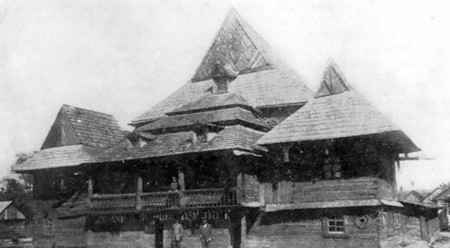
| Among the beloved ancient Jewish treasures of Poland was the Zabłudów synagogue, which, according to tradition, was about six hundred years old. It was a wonderfully beautiful building, with multicolored wall paintings and prayers on its walls. The synagogue was made entirely of wood, with sections artistically carved and cut, and it was one of the most remarkable phenomena in the history of Jewish architecture. The bimah and the Ark were considered among the finest works of art in all of Poland. Zabłudów, two miles from Białystok, had a Jewish population of about three thousand, all of whom were murdered by the Nazi killers. |
Translator's notes:
|
|
JewishGen, Inc. makes no representations regarding the accuracy of
the translation. The reader may wish to refer to the original material
for verification.
JewishGen is not responsible for inaccuracies or omissions in the original work and cannot rewrite or edit the text to correct inaccuracies and/or omissions.
Our mission is to produce a translation of the original work and we cannot verify the accuracy of statements or alter facts cited.
 Białystok, Poland
 Yizkor Book Project
 JewishGen Home Page
Copyright © 1999-2026 by JewishGen, Inc.
Updated 16 Apr 2026 by LA