 |
|
|
[Page 150]
Translated by Beate Schützmann-Krebs
English Proofreading by Dr. Susan Kingsley Pasquariella
|
Friday, the 4th of Tammuz, 5701 – June 27, 1941 The Nazi vandals entered Białystok, and on that very same day they herded 2,000 Jews into the Great [Wielka] Synagogue and burned them alive there, together with the mokem-kodesh [synagogue] of the city. In the chronicle of the destruction of Białystok, the victims of that tragic day are known as the Freytogdige [Friday ones].
Thursday, the 8th of Tammuz, 5701 – July 3, 1941
Shabbat, the 17th of Tammuz, 5701 – July 12, 1941
Friday, the 8th of Av, 5701 – August 1, 1941
Tishrei, 5701 – September–October 1941
Kislev, 5703 – November 1942
30 Shevat, 5703 – February 5, 1943
15 Av, 5703 – from August 16 to August 23, 1943 |
This, then, is the tragic fate of a flourishing city and its Jews – a community that once existed and then disappeared into the abyss of the greatest evil and crime in the history of humankind. Only a cold stone above a mass grave remains to tell – in mute language – of the great and terrible tragedy.
Yet the memory of our beloved Białystok and its holy martyrs is not erased from our remembrance and from our hearts. We will recall them forever, with pride and with reverence.
Let this gallery of images, then, be our monument to the physical remains and the memory of our hometown and our landsleit, who – in destruction and in death – entrusted to us the inheritance of life. Their testament: to continue drawing forth the golden chain of Białystok in every Jewish community throughout the great, wide world.
Honor to their name; glory to their memory.
Translator's note:
Translated by Beate Schützmann-Krebs
English Proofreading by Dr. Susan Kingsley Pasquariella
From the beginning, when life in the ghetto had “normalized” somewhat, it seemed as though the hard times might perhaps pass without any special decrees against the Jews. People convinced themselves that because the Nazis needed the production that Jews were forced to carry out, both inside and outside-the-ghetto, they would therefore leave the Jews more or less in peace, at least for the time being.
During that period, however, messages were already arriving from the area around Białystok – sorrowful messages from fleeing Jews – reporting not only severe decrees against Jews throughout the region, but also that Jews from the smaller towns were being taken away.
It is true that at first no one knew where the Nazis were taking the Jews from the surrounding towns and villages. Yet people whispered among themselves that the path of those who were taken away led to death.
The Jews of Białystok already had earlier experience of this, for thousands had previously been taken away – and were never seen again.
Yet, as mentioned, the Jews in the ghetto did not want to believe, from the very beginning, that anything similar would happen to them – that is, to the Jews of Białystok. It must be said that the Judenrat, which had been created three weeks before the establishment of the ghetto, also made efforts to ward off various decrees. As later became clear, the leaders of the Judenrat – at least some of them – knew that the Nazis were preparing to deport Jews.
From the outset, the Judenrat leaders even tried, through various channels, to prevent such actions. But none of this helped to thwart the Nazi plans, as they had been laid out by Hitler himself – the demonic plan to annihilate the Jews, including even those from whom every last bit of strength and health had been squeezed, who worked for the Hitlerite war machine and who had brought great benefit to the population of Hitler's Germany.
Suddenly, rumors began to spread that the Nazis were preparing to take a certain number of Jews from the Białystoker ghetto in an unknown direction. It was added that the Hitlerites intended to justify this by claiming that the ghetto was overcrowded – that too many people were pressed together there, which could lead to illness and epidemics. Shortly after these rumors spread, they indeed became a tragic reality. Before Rosh Hashanah in 1941, the Judenrat received an order from the Gestapo that around twelve thousand Jews would have to leave the ghetto.
It was stated that these Jews would be taken away by buses, and that the Judenrat would have to pay for this as well. It was also added that those who were taken away would be allowed to take their belongings with them.
Regarding this new and severe decree – as Rafael Rayzner [Raphael Reizner] later recounted in his book The Destruction of Białystoker Jewry – a special meeting of the Judenrat was immediately convened. The meeting was long and painful, because they had to decide who would be included among the twelve thousand Jews who were to leave the ghetto. The Judenrat and its officials, it was noted, did not shrink from the demand placed upon them.
Those Jews who worked outside-the-ghetto were also not among those who had to leave Białystok at that time. Only the Jews inside the ghetto who did not work were considered in this plan. For the leaders of the Judenrat, it was not easy to solve the problem of selecting the first twelve thousand Jews whom the Nazis intended to deport from Białystok.
In the end, the Judenrat leaders found a solution: among the first to be sent out – within the twelve thousand – should be the poor. After them would come those in the ghetto who lived together in the communal dwellings, known as the kolkhozn. And for the remaining number needed to reach the total of twelve thousand, lists would be compiled in alphabetical order.
As soon as this decision became public, Rayzner continues, the non-working Jews began seeking ways to be included among those – that is, the workers – who were not slated to be deported. Certain Jewish leaders of the labor groups, who had the ability to obtain work certificates from outside-the-ghetto for small sums of money from their German foremen – sometimes even for no payment at all – took large sums of money for such “certificates,” even from the poorest Jews. For such a certificate they would demand between ten and twenty-five dollars, which at that time was a great fortune for the poor.
There were also individual and irresponsible officials of the Judenrat who sold certificates issued by the Judenrat itself and likewise took large sums of money for them. Not everyone – and in fact most of the truly poor people in the ghetto – knew how, from whom, or through whom such certificates could be obtained. And above all, such people did not have the necessary money to pay for them.
“One must remember that thirty percent of the Jews of Białystok, because of the enormous fire during the Nazi invasion, had been left with nothing but the shirts on their backs. So how could they possibly have managed to raise twenty-five dollars?
[Page 152]
These unfortunate people were indeed deeply embittered against those Jews who sought to enrich themselves at the expense of others' misfortune. But it helped nothing, and most of them became the victims of the first deportation from Białystok. The women and children of the Shabesdike – helpless and in great need – also made up a very large portion of those who were sent away.”
On the eve of Rosh Hashanah in 1941, a large number of Jews in the Białystoker ghetto received summonses from the Judenrat instructing them to appear the next morning, at eight o'clock sharp, with their bundles in hand, at the Vizvolenye [Wyzwoleńie] Square – the place where the Russian church stood – from where they would be sent to Pruzhene [Pruzhany]. People did not believe that the Nazis would deport the Jews alive. And even if the Jews did arrive at the square, it was already feared that they were condemned to die of hunger.
The Jews who had been summoned gathered at the designated place and at the appointed time, with the little they possessed in their hands. The grief among those Jewish families who had received these summonses from the Judenrat – each one delivered by the Ordnungsdienst [Jewish Police] – was immense. The news about those who had been called up spread immediately throughout the entire ghetto. It made a terrifying impression; it cast fear and panic over young and old alike.
One suddenly felt that this was the beginning of the end.
Translator's note:
Translated by Beate Schützmann-Krebs
English Proofreading by Dr. Susan Kingsley Pasquariella
At the end of October 1942, when the Jews of Białystok were locked inside the ghetto and surrounded by suffering and torment, something extraordinary occurred. A Jewish woman managed to tear herself out of the ghetto and, after many wanderings, eventually made her way to the Land of Israel. Upon her arrival in Tel Aviv, she was immediately surrounded by local Jews from Białystok who wanted to hear a living message from their hometown. They wanted to know what had become of their relatives and of the other Jews imprisoned in the ghetto.
When the woman had calmed herself somewhat after her extraordinary journey, and after she had been helped to settle in Tel Aviv, she began to speak. She conveyed a vivid and tragic message from the Jews of Białystok, who were then living under the yoke of the Hitlerite murderers.
Everything that this woman related was later described in an article by the Forverts correspondent in Palestine (Eretz Yisrael), Menakhem Treyster. All of it was reprinted, in the very midst of the war, in the Białystoker Stimme (No.219, February 1943) in New York. It was the first time that the Jewish world learned of the fate and suffering of the Jews of Białystok.
In the account that the Białystoker Stimme published under the heading “Between Life and Death under the Nazis in the Białystok Ghetto,” the following, among other things, was reported:
Little by little, the picture of Białystok comes into view. No longer is there that industrial center where Jews – workers and factory owners – once lived the lives of dignified and free people. No longer is there the Jewish Białystok with its institutions, professional organizations, libraries, and schools. Jewish Białystok is working, it seems, even more than before the war – in three shifts, without pause, with the greatest exertion, with its last breath.
But this is the labor of forty thousand Jewish slaves, who keep all the looms and all the machines in motion for the price of a piece of bread, a bowl of soup, and the right to cling to their impoverished, dark existence. Only to live!… And the harder life becomes, and the harsher the persecutions grow, the stronger becomes the will to hold on to life… And the specter of deportation does not retreat, while Hitler's slaves work on and swallow their terror of the dreadful morning to come.
Regarding the burning of the Great [Wielka] Synagogue on June 27, 1941 – which the Nazis carried out immediately upon entering Białystok, and in which around two thousand Jews perished – the woman who had reached the Land of Israel related the following: when the houses around the synagogue courtyard were burning, Jews began running out of their homes in order to save themselves. But they encountered Hitlerite soldiers, who shut the Jews in within the surrounding small alleyways. People waited in mortal terror to see what would happen.
Then the Hitlerites drove the Jews into the synagogue. The murderers told them: “It was the Bolsheviks who set your houses on fire, but we will save you. Go into the Great Synagogue and thank God there for this great miracle.”
As is known, the approximately two thousand Jews perished in the flames that raged inside the synagogue. The great gebets-hoyz [house of prayer] was also destroyed.
In describing the life of the Jews in the ghetto, the woman who had come from Białystok to Tel Aviv related the following:
[Page 153]
A Criminal as Overseer of Order
One of the Jews of Białystok – a certain Z., who had been tried and sentenced to several years in prison for criminal offenses even before the Polish period – became quite an important figure with the Gestapo, which appointed him, of all people, as the superintendent of the Jewish ghetto. He ingratiated himself with the head of the Białystoker Gestapo, Shimanski. This man was able to avert the worst decrees. He acquired a reputation as someone who had open doors and access to the Germans. This so-called meylets-yoysher [advocate] drained the Jews of their money and their health.
But “When you need someone, you'll even pull a thief down from the gallows” …
He enjoyed the privilege of not having to wear the ghetto badge. He used to ride around in a taxi. These were privileges that no one else could have. The greatest sensation was that this Jew received permission to travel to Switzerland for rest and recuperation… He understood how to exploit the opportunity and extracted from the Jews their valuables – jewelry, gold, and other precious objects – which he buried in the ground in a special storage place. But this “gold pit” was eventually discovered…
It happened by chance. A certain butcher had received from the Gestapo chief Shimanski the right to bring a cow into the ghetto for slaughter. No one knew how the Jew had managed to obtain this permission. But the overseer of the ghetto also demanded a “payment” from the butcher. The butcher refused. Then the overseer informed on him to the Gestapo. Shimanski was angered by this and had the overseer arrested. They beat him severely in the Gestapo, and as an additional punishment they paraded him through the Jewish streets and forced him to shout loudly: “I am the greatest criminal!”
Afterward, the overseer and his entire family were arrested. During the search of his apartment, they found – walled up within the walls and hidden beneath the floorboards, as well as in one of his storage places – many gold objects, diamonds, and other valuable items that he had extorted from the unfortunate Jews. He spent three months in the Gestapo prison, and afterward he was sent back into the ghetto, removed from every position and all influence… but the Jews of Białystok breathed a sigh of relief.
In his place, Mr. Markus was appointed.
When a German Dies of a Heart Attack
It happened that a Hitlerite walked into a Jewish restaurant and ordered a little brandy, and as soon as he had a drink, he collapsed to the floor and did not get up again. They tried to revive him, but he died of a heart attack. What does one do? Panic broke out in the ghetto, to put it mildly. The Judenrat was immediately alerted to the incident, and the German authorities were notified at once. The entire Gestapo was put on its feet. The ghetto was surrounded, and terror fell upon all the Jews.
Ten Jewish hostages were immediately taken, among them some of the most prominent people in the ghetto – such as Mielnik, the head of the textile industry, Lavski, the head of social welfare, and others. The investigation dragged on. At their own expense, the Jews brought in two professors – Germans from Königsberg – who established that the Gestapo man had died of a heart attack and not from any unnatural cause. Moreover, the Nazi's wife, who had lived with him in Białystok, testified that her husband had always suffered from heart disease and that she waived any claim to compensation.
Naturally, this cost the Jews a fortune… but then the great miracle occurred: the danger of German revenge disappeared – all because of the death of a Gestapo man. And in the ghetto it was considered a true miracle, like Purim or Chanukkah, and the Jews breathed a little easier…
The Slaves from Fourteen to Sixty Years Old
To this day there are no longer any Jewish restaurants in the ghetto, nor any places of leisure or cultural institutions. All Jews between the ages of fourteen and sixty have become slaves of the Germans, and this is still considered a great piece of good fortune, thanks to which the date of the deportation has been postponed. This is due to the textile industry, which works in three shifts, twenty-four hours a day. Several thousand Jews have found employment there.
A Work Wage of 1 Mark and 20 Pfennigs a Day
As mentioned, the Jews worked both inside the ghetto and outside the city. Some of them worked in the towns of Łapy, Starosielce, and Wołkowysk. They received tickets to travel there by train. In the more distant small towns, Jewish girls were employed working in the fields. A worker in a factory received a daily wage of one mark and twenty pfennigs, in addition to a little coal and food according to various categories.
But despite the terrible exploitation and the meager food rations that drained their strength, the Jews were nevertheless content, because at least the persecutions had diminished somewhat – the seizing of Jews in the streets, the beatings, the robberies. One must remember that human life had been reduced to the lowest form of concern: how to obtain a little food and how to get through the day, merely to draw breath, in order to survive the worst… Trade, in the sense in which we understand it, no longer existed at all.
[Page 154]
People sold off whatever they had, simply in order to buy another piece of bread… Trade consisted only of smuggling, of zak-handl [petty smuggling]. The only shops that still existed belonged to the Judenrat, where everything was sold in exchange for ration cards. Whatever remained was disposed of on the so-called “black market.”
Naturally, the prices differed enormously between the goods sold for ration cards and those on the black market. With a card, bread cost 30 pfennigs per kilo; without a card – 2.75 [marks] per kilo. Meat, with a card, cost 1 mark; on the black market – 16 marks per kilo. One must add that there were a number of items that could be obtained only on the black market: milk, 3.50 a quart; butter, 4 marks; an egg, 1 mark and ten pfennigs; sugar, 440 marks a kilo; a suit, 700 marks; a pair of shoes, 200 marks.
Now do the calculation and you will see that a worker had to labor for three years in order to afford a suit and a pair of shoes.
Under such circumstances, it is no wonder that Białystok suffered from hunger and need. People went about ragged and worn-out. They fell victim to illness and epidemics. The clatter of wooden soles on the streets of the Jewish ghetto echoed everywhere. Everyone was emaciated and pale. People kept selling off whatever they still had – their last lifeline against death by starvation.
Despite all the suffering and pain, the will to live among the Jews of Białystok was not broken. Cases of suicide were very rare. On the contrary, the will to live was so strong that Jews continued to marry and have children, and births did not cease. The Judenrat also arranged for an alley where mothers with their infants could get fresh air. Even the wives of German officers or higher officials ordered clothing from the well-known milliner and dressmaker.
The Overcrowding in the Ghetto and the Epidemics
Since the establishment of the ghetto in Białystok, the overcrowding has been so extreme that, officially, Jews were permitted to occupy only three square meters per person. In reality, however, one person did not have more than two square meters. It is enough to recall that forty thousand Jews had to squeeze themselves into a single city district. And from time to time, refugees from the surrounding area were added to this number. Epidemics began to spread – dysentery, typhus, and other diseases that struck the children especially hard.
All Jews had to pay rent, even homeowners. Everyone paid into the treasury of the Jewish community twenty pfennigs for every square meter they occupied, with an additional twenty percent housing tax.
The Jewish hilfs-politsey [auxiliary police] numbered three hundred men. Recently, its head was Markus, who has already been mentioned above. The task of the police was to ensure that cleanliness and order prevailed in the city, and above all, that the gates of the ghetto were strictly guarded.
Naturally, the Gestapo always had the final word in all matters, and its orders carried the force of law. The Jewish defense consisted of nothing but a stick … The fire brigade also functioned well. The Jewish firefighters were even called to serve outside-the-ghetto.
The Jewish Institutions
As we have already noted from the beginning, almost all Jewish social, professional, and cultural institutions – built with the greatest effort – were liquidated. Still functioning were: the large hospital, which had been transferred from its building on Varshavska [Warszawska] Street into the TOZ [Society for the Protection of Health] building, together with all its furnishings and equipment. In addition, a second hospital for non-contagious illnesses existed in the former Ezras Yesoymim orphanage building on Jurawiecka Street. The orphanage itself had been liquidated.
The Home for the Aged handed its building over to the Judenrat, which established there its large offices and the entire administrative apparatus, numbering around 6,000 employees. The Home for the Aged was now located in a private house at 25 Jurowiecka Street. The three remaining Jewish pharmacies also belonged to the Judenrat.
The entire school system was reduced to two Jewish elementary schools, where the languages of instruction were Yiddish and Hebrew. German was forbidden to teach. In these schools, classes were held in three shifts – if one may draw the comparison – just like the factories: from 8 in the morning to 12 noon, from 12 to 2 in the afternoon, and from 2 to 6 in the evening.
The Jewish gymnasiums, the large network of Jewish elementary schools, the two Jewish public libraries – including the Sholem Aleichem Library with its forty thousand books, one of the largest in Poland, and the second, the scholarly library named for Yehoyesh at the kehile [Jewish congregation] – all of this no longer existed. The Gestapo liquidated it.
The press disappeared, and even the official German newspapers were later forbidden in the ghetto. There were no theaters, no movies, no clubs, no youth organizations – not a trace of any of it remained. The large, far-reaching professional movement of the Bund and of the other parties was also wiped from the surface. This is not the place to examine what became of those who had been connected with these movements, or whether they remained in the Białystoker ghetto at all.
Białystok was cut off from all cultural life. But it would be a mistake to believe that Jews did not find ways to manage. No newspapers arrived? A daring Jew set up, in his cellar, a place where one could listen to the London radio and learn what was happening in the world.
[Page 155]
One only had to risk one's life and pay ten marks for a single admission. The business flourished brilliantly until the Gestapo discovered it. The radio set was confiscated, and the Jew bought himself out of certain death for the price of half a million marks.
When textbooks were missing – because all of them had been confiscated – several teachers sat down and rewrote schoolbooks from memory… From such improvised textbooks the children learned. These books passed from hand to hand.
Besides burning down the Great Synagogue, the Nazis later destroyed all the other houses of prayer, under various pretexts. The Hitlerite vandals did not even forget to burn the Shmoys [Exodus] volumes, so that Jews would have nothing from which to study or pray. All the bote-medroshim [study houses] were destroyed, and it was forbidden to repair them. But the Jews found ways to manage: secret prayer quorums were organized, even in attics and in cellars.
When the Hitlerites burned down the Great Synagogue in Białystok, and the news was reported on the London radio, a Gestapo man immediately came to Rabbi Dr. Rozenman, the chairman of the Judenrat. The rabbi was taken to Gestapo headquarters, where other members of the Judenrat were already present. They were all forced by the Nazis to sign a protocol stating that it had been the Soviets who set fire to the synagogue before leaving Białystok.
The Fast in the Ghetto
Despite all the torments and suffering endured by the Jews in the ghetto, none of this drove them to despair. They went hungry – as the woman who had come from to Land of Israel continued to recount – but they still hoped that they would survive it all, and that they would also outlive Hitler.
When, in the month of September 1942, rumors began to spread about a deportation from the ghetto, the pious Jews decreed a fast; they proclaimed a day of fasting. At that time it was being said that the Shvartser Korpus [Black Corps] – as the Nazi extermination brigade was called – had sent its representatives to Białystok in order to carry out there as well the Hitlerite, devilish plan to annihilate the Jews.
According to reports, the Hitlerite military authorities had ordered that the plan to carry out the extermination of the Jews in Białystok be postponed until 1 January 1943, because the Jews there were needed to fulfill military orders in the local industries, where Jews were employed in slave labor.
The surrounding Poles reported that in Tiktin [Tykocin], Brisk, and other places, the Nazis had already put an end to the Jews. The details of what was heard were horrifying.
In Białystok, Jews live in mortal terror – the woman who had come to the Land of Israel concluded – it is a trembling on the edge between life and death. The members of the Judenrat continually tried to calm the agitated and restless Jews, assuring them that thanks to their labor it would be possible to postpone, for a while longer, the sentence of annihilation that hung over everyone.
When the Jews in the Białystoker ghetto learned that one of them was departing for the Land of Israel, such a crowd rushed to him that the police had to maintain order. One after another, Jews came in to send greetings to their relatives and loved ones in Palestine. From everyone's mouths and hearts came the same plea: “Tell the great world about our sorrowful fate and our dark life.”
The Remarkable Journey of the Jewish Woman
As the chronicle of that time relates, the woman mentioned in the above description was Yente Leizerson. This woman, who lived at 27 Kupiecka Street, had had her husband in the Land of Israel already before the war. The permission granted to Mrs. Leizerson to travel to the Land of Israel, with proper papers issued by the Gestapo, was the result of an exchange of prisoners of war and also of civilians between Hitler's Germany and England.
According to an order from the Gestapo in Białystok to the Judenrat, Mrs. Yente Leizerson and her children were to be dressed in their best clothing before leaving the Białystok ghetto. They traveled by train to Vienna, where they were taken to a special assembly camp in which there were also other similar Jewish people from various cities in Poland. The entire group of exchanged Jews left Vienna several days later for Turkey. Throughout the journey they were accompanied by a Nazi officer as well as two nurses.
From Turkey (Istanbul) the group traveled on to Syria, and from there they arrived in the Land of Israel in mid-November 1942. Until the end of the Białystok ghetto and of the war in general, the Jews there did not know for certain whether the woman and her children had indeed reached the Land of Israel.
Translator's note:
by Dr. Shimen Datner
Translated by Beate Schützmann-Krebs
English Proofreading by Dr. Susan Kingsley Pasquariella
Dr. Shimen Datner, an esteemed scholar, researcher, and historian, the author of a number of important works on the annihilation of the Jews under Hitler, was also, throughout all the years after the war, the chronicler of the suffering and annihilation of the Jews of Białystok. Dr. Datner, who was the first Jew from Białystok to return to the ruined hometown shortly after the war, and who also served as the chairman of the First Jewish Voivodship Committee in Białystok, rendered great service in researching, documenting, and preserving the record of the suffering and destruction of Białystoker Jewry.
Dr. Shimen Datner wrote and published a considerable number of articles in the New York Bialystoker Shtime about that sorrowful period. At the end of 1979, the Białystoker Center in New York even brought Dr. Datner specially from Warsaw, where he lived, so that he could supplement and revise his accounts of the Jewish khurbn [destruction] of Białystok.
Here, in this section, we present a number of Dr. Datner's research-based and written works, with brief introductions – concerning the Jews of the Białystoker ghetto, their suffering, their destruction, and their resistance.
The Evacuation to Pruzhany
The month of August 1941 passed almost entirely quietly in the ghetto. But this quiet was not destined to last for the Jews. In October, panic broke out in the Białystoker ghetto in connection with the evacuation to Pruzhene [Pruzhany]. In the midst of this panic came the terrifying reports of the gruesome slaughter in Słonim on 14 November 1941, in which ten thousand souls were murdered. The first refugees from Vilna arrived, bringing with them the shocking news of the unbelievable massacres carried out in Ponar [Ponary] by the Germans together with their Lithuanian collaborators.
The panic in Białystok became indescribable. Many were convinced that this was already the end. And although the official explanations of the Judenrat stated that the Germans demanded the removal from Białystok to Pruzhany only of families in which no one worked – in order to ease the burden of provisioning the ghetto – most Jews did not trust these assurances and insisted that “evacuation” meant annihilation.
The Judenrat therefore began to struggle and to intercede with whatever means it had at its disposal (the tried-and-tested method of bribery). At the same time, it obeyed the order and had a large staff of officials, under the strict leadership of Y. Goldberg, compile lists of the families exempt from evacuation – that is, families in which at least one person was employed somewhere.
The officials of the Judenrat enjoyed a private privilege: their own families were not listed at all.
The evacuation was carried out by the German authorities with merciless harshness. In the middle of the night, in the bitter cold, the families who had been summoned stood with their few belongings at the special gate on Fabrik Street, where they were loaded into trucks and sent off to Pruzhany.
In this manner, about a thousand people were sent out each day – sometimes several hundred, sometimes more than a thousand. Under the terror of the authorities, most of those summoned by the Jewish police came of their own accord. Others hid, and in their place the Germans took other people according to the alphabetical lists. The panic in the city was beyond description. At first people said that the whole affair was a lie, that those taken away were simply being transported somewhere else. Later it was established that the evacuees were indeed arriving “safely” in Pruzhany, where the Jewish population received them. However, before entering the town, they were searched, and money, gold, valuables, and currency were taken from them – and blows were not spared.
The Judenrat did not cease its struggle, and gradually the terrible Aktion began to slow down. At times there were no transport vehicles; at times there were Jewish holidays. (The Aktion lasted three weeks – around the time of the High Holy Days and Sukkot.)
At other times there were additional delays. In the end, after going through the entire alphabet of the lists, barely about 5,000 people were obtained for the evacuation, and at that point the Aktion stopped.
The optimists said that this had been achieved through the strength of the Judenrat – with the methods of our forefather Yakov…
Characteristic, too, were the after-effects of the Pruzhany evacuation. Soon a delegation from the Pruzhany Judenrat arrived with the demand that Białystok support its colony in Pruzhany, which was living in great poverty and hardship. The Judenrat allocated from its treasury a one-time sum of 100,000 rubles and, thereafter, a monthly sum of 50,000 rubles, or 5,000 marks. From that time on, a member of the Pruzhany Judenrat would come every month, stay in Białystok for a couple of weeks, collect the money from the Judenrat, and at the same time carry letters back and forth, as well as private funds sent from there to relatives.
Thus the Pruzhany delegate continued to come each month, until the dark November cloud of late 1942, when he stopped coming. During the sorrowful and bloody Aktion in the province, beginning in November, it was said here that Pruzhany had remained untouched, just like Białystok. All other reports were dismissed.
[Page 157]
Only recently, however – after the turmoil in Białystok itself (February 1943) – people were saying that the storm had already passed over Pruzhany as well (Pruzhany had been liquidated at the end of January), and there was reason to believe that the Jewish ghetto there had already been completely wiped out.
Very tragic, too, were the later consequences for others after the Pruzhany evacuation. Those who had hidden themselves and had not presented themselves for the transport were struck from the food lists, received no bread, and for a long time dragged themselves about like dead shadows – without an apartment, without work – taking shelter wherever they could with relatives or acquaintances, out of sheer pity. Their only point of support was that they could obtain work outside-the-ghetto, where no personal documents were required. Some of them threw themselves into such work and also engaged in smuggling and petty trade, living illegally; their number was not small.
And when spring came in 1942, several of the evacuees from Pruzhany tried to travel back to Białystok. It was quite a stroke of luck – through the gate they were admitted quite easily, and on the roads there was no control at all. Later a new evacuation action began (in fact, a re-evacuation). Most often, in Pruzhany they would issue a pass permit to a small town near Białystok – for example, to Michałowo – and from there slipping back into Białystok was already a small matter.
The Judenrat had several times publicly warned people to refrain from traveling back to Białystok, because the consequences would be terrible. The warning had a partial effect, and the return journey was somewhat reduced. Yet it is estimated that roughly 1,500 people from Pruzhany came back. Their situation at first was extremely difficult. At every moment they were exposed to mortal danger. Later, however, the authorities – apparently not without the intervention of the Judenrat – changed their view of the matter. The people from Pruzhany began to settle into life in Białystok. And when the great, heavy November cloud descended, it enveloped everything in its dense darkness, and the distinction between locals, those from Pruzhany, or other provincial newcomers disappeared.
Five thousand Jews from Białystok were torn from their home city and thrown into a foreign place. The Jews were taken to Pruzhany in open trucks; the autumn of 1941 was very cold, and they arrived half-frozen. A kilometer before Pruzhany the entire transport was stopped, and a thorough personal inspection was carried out. They searched for gold, money, and valuables. Men, women, and children were stripped completely naked, and the search was conducted with German thoroughness for whole hours. They cared neither about the shame and humiliation inflicted on the people nor about the suffering of those freezing in the cold. Woe to the person on whom they found any valuable object that he had not handed over. He was beaten and tortured murderously until he collapsed in faintness.
At last the moral and physical torments came to an end, and the Jews – grateful simply to have survived – arrived in Pruzhany, where the mobilized Jewish medical orderlies were already waiting for them, giving first aid to the bloodied and injured. The Judenrat officials provided them with a warm meal, and then they were taken to the empty apartments.
The systematic and methodical German drove the Belarusians out of Pruzhany to Germany and enslaved them there with forced labor; their houses he assigned to the expelled Jews from Białystok. However great the care and brotherliness of the Jews of Pruzhany toward their severely tried brethren from Białystok may have been, the living conditions for the newly arrived were nevertheless very difficult, and the longing for their old home was great. At the first opportunity, when it became a little warmer, enterprising Białystokers tore themselves away and set out back to their native city, risking their lives in doing so. Yet the great majority remained in Pruzhany and, together with the Jewish community there, went through the last stage of the bitter road.
The Pruzhany evacuation, which had been a very painful experience for the deported Jews of Białystok, did not, however, mean a tragedy for the great majority. When, after a few days of uncertainty following the beginning of the evacuation, news reached Białystok that the evacuees had indeed been taken to the Pruzhany ghetto, everyone breathed more easily. True, the evacuees had been robbed of their property, beaten, and tormented. Yes, this was sorrowful – but the most important thing was that they were alive; the German had kept his word. One had already become accustomed to blows and to poverty, and as long as one was left alive, one would somehow endure.
And the longing and the will to live already then filled the entire soul of the ghetto Jew, pushing everything else into the background. People clung desperately to every sign that strengthened their faith in survival, and from this they drew the strength to endure the indescribably harsh living conditions and the soul-shaking torments.
Enslavement Before Destruction
One of the factors that strongly influenced the Jews of Białystok to seek work in the ghetto factories, or to look for employment outside-the-ghetto, was the decree of the Pruzhany evacuation in the midst of the High Holy Days of September 1941.
[Page 158]
|
|
The evacuation was at first meant to be total; later it was transformed into an evacuation of the non-working population. During the three weeks of the evacuation, Jews feverishly tried to obtain work positions inside and outside-the-ghetto. A chase after work permits began, and private Germans profited from it, making huge business out of the scramble for permits.
What interests us at this moment, however, is the fact that thousands of Jews then registered for new work positions. And this process – though at a slower pace – continued even after the evacuation decree had been halted.
Even before the first of August 1941 – that is, before the Jews were locked into the ghetto – wild Germans hunted Jews in the streets of the city for forced labor. This caused the Jews to begin seeking stable positions and employment, in order to protect themselves from this brutal game. One or two Germans would drive around in a truck; noticing a Jew on the street, they would stop the vehicle, order the Jew to get in, and continue cruising through the streets until the truck was full.
Then they would take them to work sites, usually for clearing-up work, and after a day's labor they were released. Beaten and starving (they were given no food), such Jews would thereafter avoid walking around the streets during the daytime. I myself once went through such a roundup, and it is hard to free oneself from the nightmare of that moment.
|
|
For the Germans it was a sport, this hunt for Jews in the streets. Barash truly tried – in long conferences with the Germans and through valuable gifts – to change the situation so that the Judenrat itself would supply the required labor force, as long as the street hunts would cease. He succeeded partially. But real calm came only when the Jews were locked into the ghetto, and the gates of the ghetto prison protected them from the raids of individual Germans.
|
|
Another important factor was the danger of hunger, which compelled thousands of Jews in Białystok to seek a way out by finding work – either for the Germans or in the enterprises of the Judenrat. One of the aims of creating a ghetto – in the early period – was, besides robbing the Jews of their personal freedom and isolating them from the surrounding world, also the intention to destroy them physically through brutal means. That is, to weaken them through hunger and deprivation to such an extent that their increased mortality would bring about the annihilation of the entire population.
It is true that the death rate increased, but in Białystok there was no mass death from hunger. And in time the German authorities also realized that by this method they would have to wait too long for their goal, and they turned to simpler and more effective means…
All these factors and circumstances caused that, with time, the majority of the Jewish population was already employed even before German decrees were issued that amounted to a kind of total mobilization of all labor forces.
[Page 159]
These mobilization decrees, therefore, brought no major changes in the actual situation and were not even regarded as gzeyres [unpleasant orders]. We present here such an early order in the original:
Meldung [Announcement] No.126
According to the order of the German authorities, all men in the ghetto between the ages of 18 and 55 must be employed in labor. We call upon all men, without exception, from 18 to 55 years of age who until now have not been employed, to present themselves tomorrow, the 16th of October, at 6 o'clock in the morning, in the courtyard of the Judenrat. We warn that anyone who fails to report may face very severe consequences, and those unemployed who do not appear will receive harsh punishments, up to and including evacuation from Białystok.
The Judenrat
Białystok, 15 October 1941.
|
|
With the continuation of the war, ever larger contingents of German workers were sent to the front, and in their place came the enslaved peoples of Europe, whom the German military leadership conscripted – in violation of binding international law – into the great machinery of the occupier. On the first of April 1942, the decree of the oyberpresident [Chief President] of the Bia³ystok District, [Erich] Koch, was published in the Bia³ystoker ghetto. It introduced a general obligation to work for all inhabitants of the Bia³ystok District between the ages of 15 and 60 (that is, also for women).
This decree, which applied to the entire population and not only to Jews, and which prescribed severe penalties – up to the death penalty – for violating it, made no particular impression in the ghetto. Women in the ghetto had already been drawn into labor much earlier. We have already mentioned the labor of children. Men of advanced age, such as those around sixty, driven by need and compulsion, also stood in line at the workshops.
|
|
The decree concerning Jewish laborers was extraordinarily far-reaching. A law is a law – but out in the open, in their own homes, the Polish and Belarusian peasants and townspeople had in most cases managed to evade this compulsory labor.
Here, however, locked inside the ghetto prison, sat tens of thousands of Jewish slaves, whose freedom of movement was bound and who were regarded as foreigners and as dogs even by the neighbors among whom they had lived for hundreds of years. They could not evade the obligation to work, for slaves they were – and they were governed by slaves, who had no path of deliverance for them, neither through resistance nor through escape.
Well then, when it came to supplying unskilled laborers, one could still find a solution. But what was to be done when the demand grew ever greater also for highly qualified workers and specialists?
|
|
With his constant great energy and organizational abilities, Barash solved the problem. The Judenrat undertook to organize mass training. Courses in all kinds of trades were set up, in which older, experienced masters or workers trained dozens and hundreds of qualified laborers within a short time.
[Page 160]
The center of the vocational-training school was at first located in the first ghetto elementary school on 39 Fabritsne [Fabryczna Street]. Later, however, the activity branched out so widely that the center was moved to Kupyetske [Kupiecka] 49, in the building of the former Civic Gymnasium, and the various workshops were scattered and spread across the entire area of the ghetto. Many of the training workshops were, in time, transformed into independent factories, which delivered their production to the Germans. At times, however, the ghetto population also received a “taste” of the surplus.
The Judenrat organized the following training courses: house painters, bricklayers, saddlers, leather-workers, carpenters, men's and women's tailors, shoemakers, electrical installers, joiners, furriers, tanners, knitwear workers, and so on. We see how widely ramified the productive activity of the Judenrat had become.
The Jewish workers in Białystok can be divided into two large groups: those employed in the enterprises of the Judenrat within the ghetto, and the outside-the-ghetto workers employed in German workplaces (military and civilian). Within the ghetto area there were also three large textile combines (on Jurowiecka Street, on Polna, and on Białostoczańska), which belonged to a German trust under state control, as well as a number of private German enterprises such as Stefene's tailoring shop and mechanical carpentry workshop on Kupiecka Street, and Linder's factory on Jurowiecka Street.
The number of Jewish workers employed outside-the-ghetto reached seven thousand men and women. Until November 1942 they would leave the ghetto freely, on individual work permits of that period, under guard and in columns. The earnings of an outside-the-ghetto worker amounted to 1 mark to 1 mark 20 pfennigs for 11–12 hours of work a day. A Jewish worker received half (or less) of the wages of a Polish worker, and a Polish worker received 70 percent of the wages of a German worker. For orientation it should be noted that the “wage” of a Jewish worker sufficed to buy half a kilo of bread.
Every morning one could see these workers in poor, worn-out clothing as they walked toward the ghetto gate – gaunt figures, dried-out, pale faces, with a small bag tucked under the arm, hoping to catch some bargain, that is, a piece of bread, a handful of peas, and so on.
These seven thousand outside-the-ghetto workers were the main providers of food for the ghetto. Despite strict official prohibitions and repeated warnings not to buy any products outside-the-ghetto, and despite the ban on bringing them in through the ghetto gates, life itself – and the danger of starvation – proved stronger. Every evening thousands of workers streamed through the ghetto gates with sacks of potatoes or wood on their backs, with finer pgorim [פּגרים] hidden in their pockets or elsewhere.
In the Białystok ghetto, a peyger was the term used for any food item or merchandise that had been smuggled through the gate into the ghetto. These pgorim, once brought inside, prevented excessive price inflation on foodstuffs and thus also a hunger catastrophe. And the German guards at the gate, who had orders to confiscate all food products brought into the ghetto, often behaved quite liberally toward the returning workers and did not take the goods away. People in the ghetto knew well which guards were “good” and which were “bad.” If a “bad” one was on duty, people would take a detour.
Often, however, the reason for a guard's “liberality” was not pure human compassion. The Germans were, almost without exception, great lovers of money – even of small coins. One could buy them off, give a bribe, and then pass through undisturbed. Professional smugglers, Jewish wagon-drivers from the ghetto, carried out smuggling on a large scale with their carts, and the bribed Germans would close their eyes and open the gates for whole columns of wagons.
As a curiosity, one may note that very often these wagons were the very barrels used to remove refuse from the ghetto – and the reader can imagine under what sanitary conditions foodstuffs were smuggled in. That no typhus epidemic broke out in the ghetto was a miracle from heaven.
It is clear that thanks to this mass smuggling, hunger did not reign in the ghetto.
But there was no lack, at the ghetto gate, of Nazi sadists who, with unrestrained cruelty, confiscated even the smallest quantity of food – a few potatoes, even a crust of bread – and at the same time brutally beat the “caught criminal.” These same sadists also carried out brutal personal searches on women and vilely humiliated their dignity.
These Germans, as it sadly became clear in the end, were the true representatives of the Nazi regime, which in the first stage of its bestial assault on the Jews had sought to kill them by starvation and, when that did not succeed, killed them by more effective methods. Unfortunately, people placed their hopes in the idea of “good” Germans and did not understand the warning.
But the outside-the-ghetto workers were not only the direct providers of food for the ghetto. They also served as intermediaries, selling Jewish possessions to Poles and to Germans. The ghetto, wanting to maintain a minimal level of nourishment, sold off clothing, valuables, and all sorts of belongings on a mass scale. The intermediary was the outside-the-ghetto worker, who received a commission from the purchase sum, and into the ghetto there came either money or food products.
[Page 161]
For the most part these transactions were barter deals: the ghetto supplied goods (belongings), and the outside-the-ghetto workers brought back, for the most part, foodstuffs. In this way almost the entire ghetto engaged in barter trade. It was indeed thanks to this that people did not starve – but they threw themselves into this commerce with such burning intensity, because it guaranteed moment-to-moment survival (and to some extent it even fascinated people like a kind of sport), that they forgot where they stood and that this could not be the ultimate purpose.
There was also a small number of entrepreneurial outside-the-ghetto workers, and especially professional smugglers, who made quite a good living from their trade. The great majority, however, earned through their “services” – with such goods as potatoes and wood – barely enough to survive the great hardship. The confiscations at the gate often destroyed these “services.” The weight of the products bought secretly was often not accurate. A pud of potatoes – nominally 16 kilograms – often weighed only 11–12.
The German foremen frequently imposed private “contributions” on their Jewish workers; in exchange for this payment they would close an eye to the forbidden dealings of their Jewish laborers. It should also be mentioned that, in addition to his wage of 1 – 1.20 mark, the outside-the-ghetto worker received from the Judenrat 23 dekagrams of bread per day at the price of 45 pfennigs per kilo.
Besides the regular workplaces outside the ghetto, there were sudden demands for short term or one-time jobs, and refusal was impossible – no excuse such as “there are no people available” or “everyone is already employed” could be accepted. Failure to supply the required number of workers always carried dangers for the Judenrat in the ghetto.
The labor department of the Judenrat solved this problem by organizing a paid labor brigade “to regulate the urgent work demands of the German authorities” (Judenrat announcement no.159 of 20 November 1941). This was a reserve brigade at the disposal of the Judenrat. The brigade accepted men aged 17 to 45 and gave them special compensation. On workdays they received one kilogram of bread, which under ghetto conditions was a great deal. Ten months later a women's reserve brigade was also created, and here is the announcement in the original:
Announcement No. 328
A reserve brigade of one hundred women is being created under the following conditions: The women who are assigned to work on a given day will receive half a kilogram of bread daily and cash payment according to the wage rates. The women who are not assigned to work on that day and remain in reserve will receive 38 dekagrams of bread per day.
Białystok, 1 September 1942.
In August 1942 a special “Sunday brigade” was also created, to unload railway wagons on Sundays. Those who worked on Sunday received three marks per day and a bread ration, and those who remained in reserve received 1.50 marks.
With the approach of winter, special snow brigades of men and women were created to clear snow outside-the-ghetto. Often very large demands for labor came suddenly from the Germans, and then Jewish Białystok would witness announcements such as the following, in the original:
Announcement No. 187
According to the order of the German Labor Office, on December 27 at 7:30 in the morning, 200 women must present themselves with buckets, rags, brooms, or brushes for cleaning work in the premises, which will last five days.
We call upon women aged 17 to 55 to present themselves on Saturday morning at 7 o'clock at the Labor Department of the Judenrat. The women employed “at the bricks” are exempt from the above-mentioned work.
Registration in advance is possible at the Labor Department (left of the gate) between 1 and 4 in the afternoon.
Labor Department of the Judenrat
Białystok, 24 December 1941.
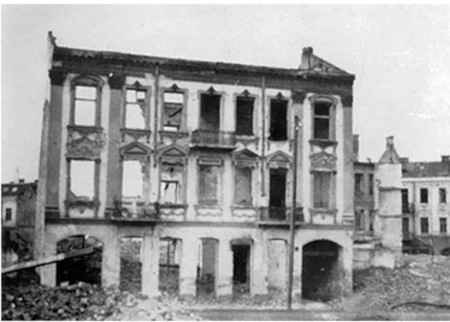
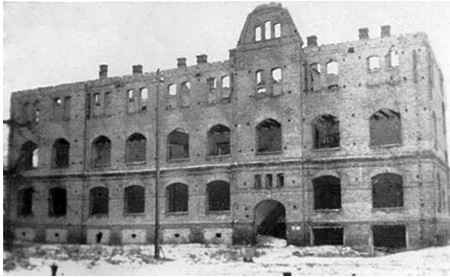
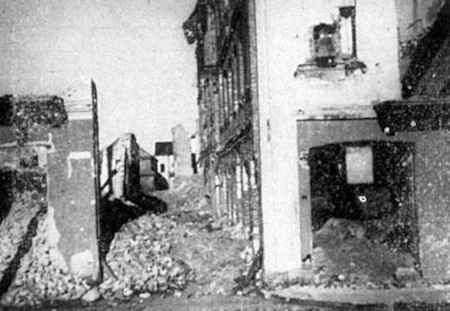
The above-mentioned women employed “at the bricks” were Jewish women who had been working for a long time clearing away and removing the bricks from the ruins of the burned-down houses on shul-hoyf [synagogue courtyard] and Nadrzhetsne [Nadrożna] Street, destroyed on the tragic “Red Friday” (27 June 1941).
It goes without saying that the outside-the-ghetto workers had no satisfaction whatsoever – neither at their workplaces nor on their way to and from work. Walking in the middle of the paved roadway, marked with the yellow patch, the constant fear of a uniformed German, the unfriendly looks of passers-by – all this caused many Jews in the ghetto to give up the so-called “golden” opportunities of outside-the-ghetto work and to prefer working inside the ghetto, poorer but calmer. Thousands of Jews never left the ghetto at all until the day they were taken to their deaths.
How humiliated the Jew was outside-the-ghetto, and how unbearable the gaze of the “hernfolk” [master race] could be for him, is shown by the following announcement (in the original):
Announcement No. 302
The authorities warn that the Jews who work outside-the-ghetto should not make excessive use of the main streets, especially when they return from work with sacks, wood, and other loads. We call upon the workers to avoid the main streets and not to use Varshever [Warszawska] Street but Starobojarska, not Vashlikover but Kashtselz. In general, one should make greater use of the gate on Tshiste [Czysta] Street and avoid the gate on Jurowiecka Street.
Judenrat,
Białystok, 13 July 1942.
[Page 162]
Working at certain workplaces outside-the-ghetto was one long chain of tortures, physical and moral torments, and more than once outright forced, crushing labor. No wonder that Jews often avoided coming to such places and tried to exchange their work assignments. But then the pitiless German organizational machine came and, through the Judenrat, placed its bestial veto in true German manner. As an illustration – a Judenrat announcement (in the original):
Announcement No. 235
The German Labor Office announces: It has been firmly established that the labor discipline among the Jewish workers is very weak. Therefore, in all enterprises precise weekly lists have been introduced, showing how many work-hours the Jews give there each day. It turns out that on various days some Jews do not come to work at all, or work only a scant number of hours per day. No precise reasons for these offenses exist. The Labor Office has already, in many cases, had these loafing Jews subjected to punishments by the Gestapo. From now on, all those who do not fully fulfill their work-obligation, on the basis of the received list, will be handed over to the Gestapo to be punished most severely.
The Judenrat,
Białystok, the 14th of March 1942
To be handed over to the Gestapo – that meant tortures and murderous beatings in the cellars of Astrovski's stone house on Vashlikover 15 (Sienkiewicza Street), and imprisonment for a shorter or longer time in the dreadful Gestapo labor camps. And these were not empty threats. From the dust of the Judenrat archive rise tormented human figures, who today have already turned to dust, and they tell and accuse (original documents):
Warning Announcement No. 157
The Judenrat warns! Report punctually to work! Do not leave the workplaces on your own! For leaving the workplace without permission and for not obeying the authority, the following have received severe corporal punishments: Novokolski Moyshe, Lev Josef, Ratzki Yakov, Stupnik Moyshe, Lipnik Ben-Zion, Talinski Khayim, Halpern Benyamin, Glas Khaykel. The direct danger of the death penalty threatens anyone who will transgress the above-indicated regulations. We warn you!
Judenrat,
Białystok, 18 November 1941
Guard your life!
Announcement No. 166
Again, the following have received severe corporal punishments for evading forced labor: Kagan Yisrael, Sapirshteyn Moyshe, Kravits, Grokhovski Hirsch, Feder Shiye, Melamed Yitskhok, Novik Nakhum, Schwekher Shimen. We warn hereby once again! Guard your life! Come punctually to work! Do not leave and do not exchange the workplace.
Judenrat,
Białystok, the 25th of November 1941.
Announcement No. 173
For not presenting themselves punctually to work and for missing workdays without sufficient reasons, the following persons have been severely punished with penal labor: Korn Yosef, Galant Mordekhay, Ridak Moyshe, Bernshteyn [Bernstein] Aharon, Galant Leyb, Berezovski Hirsch, Furman Khilel, Vaynshteyn [Weinstein] Leib, Weinstein Fayvel. We warn! Keep the obligation of work! Do not leave the workplaces! Avoid severe punishment!
Judenrat,
Białystok, the 3rd of December 1941.
Warning!
Announcement No. 225
For not presenting themselves punctually to work, the following have received corporal punishments and have been drawn into the penal brigades: Gnyazde Mates, Sokolski Leyzer, Kaplan Anshl, Bereslovski David, Kleynshteyn [Kleinstein] Gedalya, Rudeler Khilel, Makher Leyzer. The Judenrat warns: Report punctually to work! Do not leave the workplaces on your own! Guard your life!
Judenrat,
Białystok, the 21st of February 1942.
To all workers outside-the-ghetto!
Announcement No. 383
The Labor Office announces that, by order of the authorities, the following have been beaten for violating the three following laws:
Labor Department at the Judenrat,
Białystok, the 18th of January 1943.
The documents speak in a clear, human language: I see them, the people, the “criminals” – I recognize many. Many of them were, after all, my pupils from the Hebrew gymnasium. And perhaps the reader will stumble upon a familiar name, a friend, a relative, and give a shudder, clench their fists, and give themselves a thought – and perhaps even something more than a thought.
[Page 163]
The Workers in the Ghetto
The number of employees of the Judenrat (including the police, house-administrators, etc.) amounted in July 1942 to 2,200 persons; nearly 9,000 workers were employed in the ghetto industry and other ghetto enterprises. The large number of those employed directly through the Judenrat also determined its important role in the economy of the ghetto as employer and bread-giver.
The basic wage for all employees and workers in the Judenrat enterprises consisted of half a kilo of bread daily. In the summer months of 1942 the bread ration was reduced to 37 decagrams. Directors and officials in responsible positions received a double portion of bread. In the hard November days of 1942 the double portions were abolished and the ration was reduced to 30 decagrams of bread per day. In the spring of 1943 the bread ration was again increased – to two and a half kilos per week.
Besides this bread, all Judenrat officials and workers used to receive, irregularly, other food products at cheap prices: marmalade, rutabaga, more rarely offal, sausage or head-meat and feet, kashe (porridge), groats, soap substitute (Rif)[3], and often washing soda. From time to time potatoes were also distributed in larger quantities. For the winter, half a meter of wood and 100–150 kilos of coal. A money wage, in principle, did not exist.
From the above one can form a picture of the low standard of living that the average Białystoker ghetto inhabitant led.
He had too little to live and too much to die: there prevailed a condition of undernourishment, physical weakening. A fat person was very rarely seen in the ghetto, and if so, he belonged to the “newly-risen.” For the most part these were risk-takers from the formerly culturally and socially lowest strata. Carters, carriers, and garbage haulers, risking the dangers of smuggling, made fat profits, built thriving businesses, and carved out a living. They also generated earnings for the ghetto by breaking the Germans' hunger blockade.
Aside from the work-ration bread received for labor, the entire ghetto population – that is, also the non-working elderly and small children – received bread on ration cards. At the beginning, 20 decagrams of bread per day, then 10 decagrams, and in the end 7 and a half decagrams of bread per day! Had the children and the elderly, who officially received no other allocations, been forced to live on this alone, they would long since have perished from hunger. Whether that would have been better than being dragged off to the gas chambers – that is something an ordinary person cannot take upon himself to answer.
Translator's notes:
by Dr. Shimen Datner
Translated by Beate Schützmann-Krebs
English Proofreading by Dr. Susan Kingsley Pasquariella
The end of the year 1941 was approaching. The life of the enslaved Jews in the Białystok ghetto-prison had “normalized.” Neither in Białystok nor in the Białystok District did any further bloody, anti-Jewish Aktionen occur.
Jewish men, women, and children – with yellow patches sewn onto their garments on the left breast and the right shoulder – walked quietly through the ghetto streets, unmolested by anyone.
The Judenrat worked diligently. Its entire machinery, in its many departments and divisions, functioned smoothly under the leadership of the energetic, honest, and first-rate organizer, Engineer Efraim Barash.
It became noticeable that the number of factories in the ghetto was rising. With each passing month, the number of Jews working outside-the-ghetto – in German, military, and civilian institutions – grew larger.
Gradually, all of Jewish Białystok was transformed into one great factory, and the former merchants, manufacturers, and intellectuals became a vast army of workers.
Białystok's streets, at the hours when the factory shifts ended their work (around midday, in the evening, and – in those places where there was night work – also early in the morning), were black with Jews – young and old, men and women, dressed in work overalls or worn-out clothing. The wealthy city, once inhabited by an elegant Jewish population, now gave the impression of a poor factory settlement with impoverished worker-residents. The ladies' and men's fedora hats had disappeared. Women with kerchiefs on their heads and men in work caps had, in their outward appearance, quickly adapted to the new style of their life in bondage.
Jewish militiamen stood at the corners, regulating the movement of passers-by and ordering them to keep to the right. Small children went in the mornings and afternoons to the two schools that had been organized by the Judenrat.
In front of the Judenrat building at Kupiecka 32, people gathered who were looking for work. They read the announcements of the Judenrat, and there were new announcements almost every day.
[Page 164]
The war had moved hundreds of kilometers eastward. Newspapers were no longer officially permitted in the ghetto. But the workers who came from outside-the-ghetto were a rich source of information. Autumn arrived, and then the first month of the harsh winter of 1941, and the news spread with lightning speed that the Germans had been pushed back from Moscow. When, in that same month, the great American democracy entered the war, a ray of hope shone through the darkened sky over the Białystoker ghetto. With each passing day, the hope spread further, becoming almost a certainty, that the blood-enemy of humanity and of Jewry – the German fascist – had lost the war.
For the Jews of Białystok, however, this joy was overshadowed by the sight of their own inhuman ghetto reality and by their ever-present question: but what will happen to us before the downfall of this Haman, Hitler, arrives?
In those winter months we still did not know. No one, even in the most pessimistic forecasts, could imagine that the beast within human form could become many times more bloodthirsty and would not leave behind even a trace of a people.
On December 31, 1941, the last day of the first year of mourning, the Jews in the Białystoker ghetto read two announcements posted on the building of the Judenrat at Kupiecka 32. And here are those two announcements in the original:
Announcement No.194
Fifth and sixth grades will be opened in School No. 1, at Fabryczna 39. Enrollment of pupils for these classes takes place every day from 9 in the morning until 5 in the afternoon. Additional pupils will also be accepted into available places in the first, third, and fourth grades of the school at Fabryczna Street 39.
Cultural Department of the Judenrat
Białystok, December 31, 1941.
Announcement No. 195
Regarding the regulation of the foreign-currency law in the Białystok District (excerpt).
The people living in the Białystok District must, under the prevailing winter weather conditions, by February 15, 1942, present to a state credit office or a state bank, and, upon request, sell or transfer:
The obligations resting upon the owner of such assets, which must be sold or presented, must be carried out in the same manner, whether by the actual owner or by his representative. Women who violate this regulation are also subject to punishment. If someone commits this offense through negligence, he receives a monetary fine, and if he cannot pay it – imprisonment.
This regulation is valid as of January 1, 1942.
Judenrat,
Białystok, December 31, 1941.
Not being even a follower of mysticism, it is hard not to see the striking contrast between the two announcements, whether accidental or not, issued on the same day. Two announcements – two symbols, two programmatic statements for the year 1942. The Jewish side declared that it wished to teach its children Torah and secular learning, to entrust to them the achievements of the human spirit and intellect. The German side revealed a part of its plan for the plunder of the enslaved peoples, a plan carried out in the Jewish sector with unparalleled barbarity, with German systematic precision and consistency, according to the principle: first drain the life-forces of the victim, and then annihilate him.
A few illustrative facts:
A few weeks after the Jews of Białystok had been locked into the ghetto, steps were taken to organize Jewish schools. On August 29, 1941, an announcement (No. 40) of the Judenrat was published, in which the organization of schools for Jewish children was proclaimed. The registration of school-age children took place in the building of the former Commercial School at Fabryczna 39, and in that same building the lessons were given.
At the head of the school stood the long-time teacher of the Hebrew Gymnasium, Aronowitsh. Working there were the teachers of the Hebrew Gymnasium – Chazanowicz, Gutke Gutman, Mrs. Rubin-Salman – and other teachers from Jewish and Hebrew schools. The language of instruction was both Hebrew and Yiddish. Some classes were conducted in Hebrew and some in Yiddish.
In the face of the bloody events of July 1941 in Białystok, in the mournful reality of the ghetto and sensing the dangers still to come, the old conflict between Yiddishists and Hebraists found its resolution in the Białystoker ghetto: the equal status of both languages, the recognition of Hebrew and Yiddish as the two national languages of the Jew in exile.
[Page 165]
The Judenrat announcement No.195, which represents a fragment of a program of plunder, does not stand alone in the history of the ghetto. Robbery was always accompanied by murder – one of the aims and methods of German warfare. Does not the German word Krieg itself mean: to take, to rob, to seize?
Every city and town in the territories occupied by the Germans experienced, already in the first days, the horror of mass executions, which were intended to spread terror and paralyze any attempt at resistance. And together with this came everywhere the imposition of enormous contributions, accompanied by the threat that failure to pay on time would result in further mass executions, or the shooting of prominent citizens, or of members of the Judenrat, who were arrested as hostages.
Białystok lived through this fate of contributions several times during the first month of the occupation. How serious the danger was is shown by the fact that the city's rabbi, Rabbi Rozenman, in July 1941 – when a huge contribution was imposed on the Jews of Białystok (on Jews alone) – issued a fervent appeal, calling on everyone to respond warmly when the collectors together with the Judenrat would come to them. But he also warned that he would place under kheyrem [ban] all those who failed to contribute according to their ability, in order to avert the danger of destruction that in such a case threatened the entire community.
No one was placed under kheyrem: all, both those with means and those without, responded in order to avert the danger.
As mentioned, document No. 195 of December 31, 1941 was only one of the many proofs of German robbery and murder of the Jews. There exist other surviving documents that illustrate the situation and its aspects most clearly. And here is one of them:
Judenrat Announcement No. 92,
The Judenrat received the following order from the German civil administration:
Białystok, September 9, 1941
The Chief President of the Civil Administration
for the Białystok District,
the Civil Commissioner.
You are hereby instructed to provide for the government casino the following items by Wednesday, September 10, 1941, six o'clock in the evening (underlined by the Germans):
30 tablecloths of identical shape and size; 20 good curtains with cornices and drapes; 10 large carpets; 10 runners; 10 chandeliers; 10 wall pictures; 100 flat plates; 100 deep plates (for soup); 100 small plates; 100 mugs; 100 small trays; 100 simple beer glasses; 100 cut beer glasses; 100 compote dishes; 100 wine glasses; 100 liqueur glasses; 50 champagne glasses; 50 coffee pots; 15 sugar bowls; 15 milk jugs; 20 ashtrays; 100 spoons; 100 forks; 100 knives; 100 fish forks and knives; 50 tea glasses; 5 samovars; 15 meat platters; 15 tart plates; 14 sauce bowls.
By Monday, November 5, at ten in the morning:
15 tables for four persons each; 60 chairs; three buffets.
By Thursday, six in the evening:
one piano; one billiard table (with equipment); one table and table-tennis set; one chess table with pieces; three secure [lockable] tables.
By Friday, twelve noon:
12 chairs with leather upholstery; one large, round or oval table; 12 large armchairs; 12 soft chairs or chairs without armrests.
By Friday, five in the afternoon:
two book cabinets; two bookshelves; three kitchen cupboards for utensils; three kitchen tables for washing dishes; 20 hand towels; 20 dishcloths; five brooms; five buckets; five scrub brushes with handles; 20 scrubbing cloths; 19 wiping cloths.
All items must be of the best material. The tables, as well as the tablecloths and chairs, must be of uniform type and size. Any item deemed unsuitable will be destroyed immediately and must be replaced with another.
For every item that is missing, a fine will be imposed.
All items delivered will be appraised by the Judenrat, and the amount will be deducted from each person's tax or rent payment. No item may be handed over without a receipt bearing the round stamp of the Judenrat. The Judenrat warns: if the required items are not delivered on time, the Judenrat declines responsibility for the severe consequences that may result for the entire Jewish population of the ghetto.
Judenrat,
Białystok, September 10, 1941.
Such demands – written or oral (communicated through the Judenrat telephone, the only telephone in the ghetto) – literally flooded the Judenrat. No one was allowed to refuse. Anyone could cause harm. The Judenrat mobilized a special staff of people who collected, purchased, or simply confiscated the finest material possessions that the ghetto – once the wealthy Białystok – still owned.
Great care was taken, personally by Barash, to ensure that the Judenrat warehouses were always full, so that they could meet any sudden demand. In this way Jewish Białystok was emptied of furniture, clothing, books, gold, valuables, and so on – things that generations of Białystoker Jews had worked for and accumulated.
For this price, Barash and many others believed that they would survive. So people gave and sighed: if only to live through it. Gold – the old weapon of Jewish exile – was supposed to save them…
[Page 166]
It turned out to be a broken reed to lean on[3] – support resting on a shattered stick.
Beginning in August 1941, every household had to pay a monthly dwelling tax of 20 rubles (2 marks). In October 1941, the Germans imposed on every Jew a so-called head tax in the amount of 60 rubles per person, thereby reviving a medieval practice.
That this involved enormous sums is shown by a Judenrat announcement (No. 146) of October 2, 1941, in which the total amount of the head tax, together with the dwelling tax (for August–October), is estimated at nearly five million rubles. The Germans demanded that this sum be paid in short-term installments (and it was indeed paid) between September 6 and 21.
Revealing for the German mentality is the fact that the Jews of Białystok had to pay the head tax also for those who had “left” Białystok. Under this innocent and official-sounding word fell the thousands of murdered Białystoker Jews (“Royter Freytik,” “Donershtike,” “Shabesdike,” etc.), as well as the thousands who had been forcibly deported to Pruzhany.
And thus reads the fragment from
Announcement No. 146:
“The taxes were calculated by the German authorities on the basis of 40,000 inhabitants – that is, also for those who had left Białystok. The population must therefore pay, immediately and without any delay, the full tax amounts owed by each person according to the above calculation, and the more capable must also pay an additional tax for the thousands of absent inhabitants.
Jews who work outside-the-ghetto must also pay the taxes, because the Judenrat has not received their wages from the authorities and therefore cannot pay on their behalf. Failure to pay the installments precisely and on time places the lives of the Jews in the ghetto in danger.
The Judenrat will provide the authorities with a list of those who do not pay, and against them the most merciless measures will be taken. The authorities have handed the matter over to the Gestapo.”
Short and sharp, clear and merciless – genuinely German! The Judenrat in the role of intermediary and executive organ. With this method, the Białystok Judenrat, like all the others, believed that they were serving the interests of the people in the best possible way.
And concerning one of the methods of this German “bearer of culture,” aimed at forcing people to show “proper respect” for his orders, the following announcement bears witness:
Announcement No. 140:
The Civil Commissioner has ordered that Jews who do not wish to pay the state taxes within the prescribed time will be publicly punished with flogging. Therefore, everyone is strictly urged to pay the taxes immediately into the Judenrat treasury (dwelling tax – 2 marks, head tax – 6 marks for water and electricity).
Judenrat,
Białystok October 25, 1941
|
|
As far as I remember, no public flogging execution ever took place in the ghetto. This noble piece of work, however, was often carried out in the Gestapo building (Sienkiewicza 15) and in the building of the criminal police (the so-called “Kripo”) at 50 Warszawska Street.
Bleeding and humiliated, living under constant fear of torture and death, yet declaring the readiness of its children to remain on the path of human dignity and Torah – in this way the Jews of Białystok crossed the threshold into the year 1942.
The German nation, which had always pretended to hold a leading place among civilized peoples, cast off with a light heart the thin garment of culture and stripped itself of humanity as if of an unnecessary burden.
The beast threw off its mask. It was certain of victory.
The beast was defeated – at a high price. But the Jews paid the highest price.
One of the bloodiest prices was the 50,000 Jews of Białystok.

Translator's notes:
|
|
JewishGen, Inc. makes no representations regarding the accuracy of
the translation. The reader may wish to refer to the original material
for verification.
JewishGen is not responsible for inaccuracies or omissions in the original work and cannot rewrite or edit the text to correct inaccuracies and/or omissions.
Our mission is to produce a translation of the original work and we cannot verify the accuracy of statements or alter facts cited.
 Białystok, Poland
 Yizkor Book Project
 JewishGen Home Page
Copyright © 1999-2026 by JewishGen, Inc.
Updated 16 Apr 2026 by LA