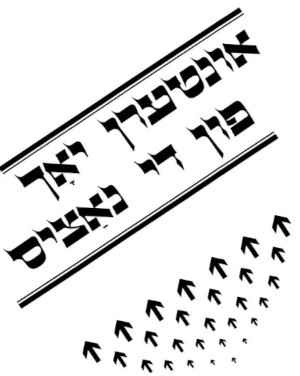
 |
|
|
[Page 121]
|
[Page 122]
[Page 123]
Translated by Beate Schützmann-Krebs
English Proofreading by Dr. Susan Kingsley Pasquariella
For the Jews of Białystok, just as for others everywhere, Hitler's unexpected attack on Soviet Russia, early Sunday morning, June 22, 1941, came like a terrible storm from a clear sky. That night, from Shabbat to Sunday, the Jews of Białystok slept peacefully; no one expected anything extraordinary.
Around four o'clock in the morning on that Sunday, one suddenly heard the roar of airplanes. At first, people thought it was Soviet Air Force exercises. But suddenly there was a tearing sound—bombs exploded, and it seemed as if the entire city was being bombarded. When people looked up to see what was happening in the sky, it became clear that a battle was taking place between Soviet and Hitlerite fighter planes.
Some bombs fell on the Soviet military base on Vaiskover Street; a number of bombs also fell in the streets of the Jewish quarter. There were dead and wounded. When people turned on the radio and listened to the news from Berlin, the sorrowful truth immediately became clear: war had broken out between Hitler's Germany and Soviet Russia—the very thing people had silently feared all along.
Among the first victims, killed by the Hitlerite bombs, were the longtime cashier of the magistrate, Zalmen Vaynreykh [Weinreich], together with his only daughter, the baker Goldberg, and many others. The former newspaper agent and bookseller Y.Y. Inditski was also severely wounded by the bombs; he later died of his injuries. His wife was killed on the spot.
Although it was already clear to everyone that the terrible war between the two former good friends had broken out—those same friends who had confirmed their friendship through an agreement that had, in fact, led to the Second World War—the Soviet officers in Białystok insisted that these were merely maneuvers. It was obvious that for the Soviet military personnel and others from Soviet Russia this was a dreadful blow. A little later, when the Soviet military leadership understood what was actually happening, a terrible chaos broke out in their ranks. People began to flee, trying to get as far away from the enemy as possible. The Soviet officers and other military men hastily packed their military vehicles with their wives and children, as well as with various belongings they were reluctant to leave behind, and set off on the road.
At the same time, in the late morning hours, Molotov's sorrowfully famous historic speech became known. It became clear that Hitler had deceived Stalin, that a terrible new war had begun—one that would bring with it dreadful consequences. In Jewish life one felt that we were heading toward heavy and tragic times for our people.
Shock and Despair
The Jews of Białystok, just as was the case in other places in those days, were immediately thrown into shock and despair. A mood of panic arose, and no one knew what to do. People ran to relatives and friends; everyone asked one another for advice, and panic spread. Seeing that the Soviet military units were abandoning Białystok and the entire surrounding region, the fear among the Jews grew even greater. One felt abandoned, left to fate, sensing that at any moment the Nazi murderers would enter—something that meant suffering and pain, robbery and death, for it was already known from earlier what the Hitlerite killers were doing to Jews in Poland.
Many Jews in Białystok, especially young people, began fleeing the city in panic. The roads leading out of Białystok soon became flooded with newly-made refugees from among the Jewish population, running in terror. People tried to reach deep into Russia as quickly as possible, to get as far away as they could from the Hitlerite attackers. On the roads where the terrified Jews were running, long columns of cars, tanks, Soviet military personnel, entire units—fleeing as if from a terrible plague—were also moving. It was practically impossible to move in that dense mass of people, but the fear of what was soon to come was stronger and overcame all obstacles on the way.
Throughout that entire Sunday, Białystok was like a restless, storming volcano. It boiled and churned from all sides, as on the eve of a terrible eruption. And throughout that whole night—on that Sunday, the first day of the war between Hitler's Germany and Soviet Russia—no one slept. People stayed awake and on guard, waiting for what was coming, waiting in a state of despair.
Early Monday morning, June 23, it became apparent that the guards had abandoned the large prison. The more than two thousand prisoners who had been held in the cells —locked up there earlier by the Soviets—were now out in the open. Shortly afterward, the prison was also set on fire. When the prison stood in flames, visible from near and far, groups of the freed prisoners ran through the streets and looted from the shops, warehouses, and any other places where it was possible
[Page 124]
One saw prisoners carrying and dragging bundles of goods—clothing, household items, pieces of furniture, and more. The Soviet guard posts that still remained in certain places tried to stop the looting by the freed prisoners; weapons were used for this purpose, and even that resulted in victims.
Among the Jews previously arrested by the Soviets, who were freed when the prison was opened, were—according to what Rafael Reyzner reports in his book—also the Zionist activist Yakov Goldberg; the leader of the Białystoker Agudas Yisroel, Bunem Farbshteyn; the Left Poale-Zion activist Mikhal Kantsepolski; the Right Poale-Zion activist Hersh Shvets; and the former workers and members of the cooperative “Unzer Lebn,” Aharon Brezinski, Yosef Rubinlikht, and others. All of them had been arrested and taken to prison on Thursday, June 19, 1941, as politically unreliable elements.
The Right Poale-Zion activist, Mordekhay Khemlnik, later also arrived from Brisk, where he had been imprisoned for more than a year in the local jail. He too was freed in the same way as the former prisoners in Białystok.
From the Minsker prison as well, several dozen Białystokers returned—people whom the Soviet authorities had earlier arrested and sent there. Among them was the former textile manufacturer Shmuel Finkel, together with his son, and Tsibulkin, the longtime chairman of the Payen Bank [a Jewish cooperative savings institution]. Finkel died shortly after his return from Minsk.
The youngest son of the well-known Białystoker textile manufacturer, Oswald Triling, whom the Soviets had also arrested and deported, died in the Minsker prison.
Everywhere along the roads and highways on which the Jews of Białystok were running toward deep Russia, they were met by Nazi fighter planes. The murderers dropped incendiary bombs and fired on the fleeing people with machine guns. There were many victims. A number of people who returned to Białystok told what had been happening on the roads. It was reported that there were dead and wounded Jews lying along the way, and among the victims were Soviet soldiers as well. One also saw destroyed and overturned tanks and vehicles. People warned that it was dangerous to set out on the road.
Despite all this, the Jews of Białystok—mostly young people—continued to run. They did not stop for any danger, wanting only to get as quickly and as far away as possible from the great Nazi threat that was approaching Białystok.
Most of the Jews in Białystok, however, remained where they were; they did not leave. On the one hand, the news of what was happening on the roads on the way to deep Russia caused real fear. At the same time, some Jews still held the hope that perhaps, perhaps the Soviets would succeed in repelling Hitler's brutal attack. Unfortunately, this hope brought bitter disappointment.
The situation of the Jews in Białystok was desperate. The more clear-sighted among them knew and felt very well what was approaching. They knew that the Nazis would soon enter, that a terrible time was coming—one whose consequences no one could yet imagine.
The heavy mood among the Jews of Białystok grew even darker because they saw how the last Soviet military units, as well as civilian state officials, were hastily abandoning the city. The same was true in the surrounding towns where Jews still lived. It was clear that even the few remaining Soviet soldiers did not know what to do; there was confusion and chaos among them. It was no secret that these last remaining Soviet military groups were also looking for a way to retreat as quickly as possible, to flee from Białystok, where—once the Nazis entered—certain death awaited them.
On that last Thursday evening, June 26, one day before the Hitlerites entered, no Soviet soldiers were to be seen anymore on the streets of Białystok. Everyone understood that they too had hurried away before it became too late.
On Friday morning, Białystok was quiet—a strange quiet, the kind that usually precedes a great storm. The Jews understood very well what all this meant in those sorrowful days.
The Arrival of the Murderers
Early Friday morning, June 27, 1941, with the entry of the Nazi murderers into Białystok, a life of hell began for the Jews of the city. The Hitlerite killers entered through Mazowiecka Street. Soon they also reached the densely populated Jewish streets—Broad and Small Pyaskes, Senders, Surazer [Suraska], Sukhe, Fish-Market, and others. A number of the Hitlerite murderers immediately threw incendiary bombs and explosives into Jewish houses. As a result, there were, of course, victims immediately.
Other Nazis, with sadistic brutality, dragged Jewish men out of their homes, beating and striking them as they drove them into the Great [Wielka] Synagogue. When the synagogue was already packed full of Jews, the holy house of prayer was surrounded by Nazi vandals. Armed from head to toe, the Hitlerites threw incendiary bombs into the synagogue, which was soon engulfed in raging flames. The Great Synagogue, in which two thousand Jews were locked inside, burned for about twenty-four hours, until early Shabbat morning. Only then did an order come to extinguish the fire.
[Page 125]
In doing so, the Nazis seized Jews, beat them, drove them out of their houses, and forced them to extinguish the fire.
During the inferno of the fire in the Great Synagogue, wrote Rafael Reyzner later, heartbreaking tragedies unfolded there. Unable any longer to endure the suffocating gas and smoke, a son—at his father's request—hanged him with his trouser belt from a menorah. There were many cases in which one person cut another's veins, thus shortening the end of unbearable suffering.
A daring young man, who had not yet been severely gassed, climbed up to a window, smashed several panes, and delivered a sharp speech against the Nazi murderers. The Hitlerites shot at the young man, who immediately fell down.
Because of the intense fire and smoke coming from the Great Synagogue, the Nazis themselves had to pull back somewhat from their positions. At that moment, the Polish synagogue guard, Bartoshka [Józef Bartoszko], risking his life, jumped forward and opened a small side door of the synagogue. At once several Jews escaped through the side passage—among them the young man who had earlier delivered the speech.
At the same time that the synagogue was in flames and the Jews inside were perishing, the Hitlerite murderers were roaming through the courtyards of the Jewish neighborhoods. The murderers dragged men out from there and shot them before the eyes of their wives and children.
Among the martyrs of the synagogue were also:
At that time, there were sixty Jewish children in the orphanage on Vesole Street (formerly Flaker's). Despite the great danger that already existed in those days for any Jew to appear on the Christian streets, the longtime orphanage educator, Mrs. Gitl Khaykovski Plats, risked her life and forced her way to the institution.
|
|
[Page 126]
When the Nazi murderers set fire to the neighboring Jewish houses, burning people alive and murdering thousands of Jews, Mrs. Khaykovski did not leave the children; she remained with them during those hours of deadly terror. When she realized that the institution's guard, a Pole, had run off to inform the Nazi murderers that there were children of Communists in the orphanage, the devoted mother of the sixty Jewish little ones hid them in a cellar, standing with them in water up to their necks, and saved them from certain death.
In those dangerous days, Mrs. Gitl Khaykovski-Plats did not leave the orphans. Her self-sacrificing devotion deserves to be sanctified among the finest deeds of human responsibility.
The First Two Days of Nazi Rule
The inferno of fire in the Jewish quarter lasted until Shabbat morning. In the blaze, about two thousand Jews perished, and more than thirty streets — which made up roughly one third of the Jewish dwellings in Białystok — were leveled to the ground.
The following streets were engulfed by the bestial arson attacks: Surazer [Suraska]; Rynek Kosciuszki up to Barukh Gvin's stone house; Senders almost up to the Catholic church; the entire synagogue courtyard with its surrounding streets and alleys; and the Fish Market district almost up to the edge of the forest — so that, standing after the fire on the site of the former town clock, one could see the forest.
Despite the fact that the burning houses were surrounded by dense cordons of heavily armed Nazi plunderers, many Jews managed to break through and save themselves.
Because of the resistance put up by a group of Red Army soldiers on Nadzhetshne Street, the Nazi murderers threw incendiary bombs into all the houses on that street. Within about an hour, the entire street — together with the Polkovoye Bes-Medresh and the former Manishewitsh's bathhouse — was a mountain of ash. The enormous blaze also engulfed the post office and the former Real Gymnasium.
Such was the sorrowful sum of the first two days of Nazi rule in Białystok. This was the Białystoker beginning of the heavy misfortunes that would continually accompany the Jews of the city throughout the dreadful years of brutal Nazi domination.
Translator's notes:
by Yaakov Pat
Translated by Beate Schützmann-Krebs
English Proofreading by Dr. Susan Kingsley Pasquariella
On Sunday, June 29, 1941, two days after the Hitlerites entered Białystok, their commandant summoned Rabbi Dr. Gedaliah Rozenman and the former director of the Jewish community, Engineer Rafael Barash. The Nazi commandant ordered them to create a Judenrat, through which the local Nazi authorities could issue directives concerning everything related to the Jews of the area.
Rabbi Rozenman and Engineer Barash immediately communicated this new decree to other prominent Jewish communal leaders. A larger assembly was quickly convened, at which the Judenrat demanded by the Hitlerite murderers was selected. The Judenrat consisted of twenty-four persons, including two women. Among them were many well-known Jewish social, political, and cultural figures:
Rafael Gutman was appointed secretary of the body. The official chairman of the Judenrat was Rabbi Dr. Rozenman. But the actual leader of the Council throughout the entire period was Engineer Barash.
Even before the Judenrat had organized itself and begun its activity, the Nazi authorities were already demanding that thousands of Jewish men and women be supplied for forced labor. The Jews had to work under extremely harsh conditions, where they were beaten and tortured. At the same time, Jews were also required to provide the Nazis with clothing, fur goods, leather, silk quilts, feather pillows, and similar items. Every demand of the Nazi rulers had to be fulfilled precisely within forty-eight hours, under threat of severe punishment.
In addition to the demands made to the Judenrat for supplying Jews for labor and for contributions, the Gestapo men themselves regularly seized Jews in the streets. They claimed that the Jews were being sent to work. In reality, however, such Jews were tortured by the Hitlerite murderers.
The Nazis also plundered Jewish homes, taking everything that had any value.
[Page 127]
The Hitlerite murderers would cordon off entire streets—where large trucks were waiting—in the Jewish neighborhoods, and from there they removed Jewish property and possessions, the achievements and savings of many years of hard labor.
Among a large part of the Jewish population of Białystok—especially among the impoverished classes and among those whose belongings had been burned or destroyed during the Nazi arson attacks and looting—hunger and poverty began to take hold. It became truly difficult to get through the day. People searched for various ways to keep themselves alive until a better time would come, which everyone still hoped for.
All this meant that, despite knowing about the severe tortures and hardships that Jews suffered in the various kinds of labor to which the Nazis sent them, more than two thousand Jewish men and women volunteered at that time to work for the Nazis. In this way, the unfortunate and desperate people had at least some possibility of surviving the day, of getting through the hard times a little, receiving in return for their labor something to eat.
From time to time, they also managed to obtain a bit of food that remained from the former Soviet food warehouses, which they took home with them. In Stein's warehouses, for example, where several hundred Jews worked and were paid in food for their labor, it was decided that all the workers there would give up one day's food each week for the hundreds of starving Jewish orphans. In this way, the lonely, unfortunate children were sustained for a longer period.
One must remember that in those days, under such terrible conditions, giving up even a bite from one's own mouth—especially while doing exhausting physical labor—was truly an act of self-sacrifice.
|
|
The “Donershtike” Victims
The first large-scale slaughter of Jews in Białystok carried out by the Nazi murderers took place on Thursday, July 3, 1941. In the chronology of the Jewish destruction in Białystok, these victims are referred to as the “Donershtike”.
Dr. Shimen Datner, a well-known scholar and historian, who was an eyewitness to the Nazi crimes in Białystok and later also took part in the resistance, recounts this slaughter (in Bialystoker Shtime, November–December 1946) as follows:
On Thursday, July 3, 1941, at four in the afternoon, the following streets were sealed off: Pzheyazd [Przejazd], Grokhove, Krakovska, Dambrovski, Kupiecka, Zamenhof, Białostoczańska, Ruzhanski [Różańska], Zhidovske [Żydowska], Bronska, Geldove [Giełdowa], and Lipowa. From the houses on these streets, the Nazis dragged out men between the ages of sixteen and sixty. Many Jews understood what was happening, and some managed to hide themselves in time.
Approximately one thousand of the captured men were driven through the marketplace and Koœciuszko Square to 60 Warszawska Street. There a kind of selection took place. Workers and craftsmen, after it was confirmed that they had calluses on their hands, were separated and released. The others—members of the intelligentsia, merchants, and similar groups—were held back. They were tortured throughout the entire night and also into the next morning.
In the end, about two hundred of them were taken away in trucks in the direction of the Volkovisker [Wołkowysk] highway. From that moment on, every trace of these Jews disappeared.
|
|
It was later reported that these more than two hundred Jews were shot by the Nazis at Pietrasze, about two kilometers outside the city in the direction of Vashilkove [Wasilków].
[Page 128]
Among those murdered at that time were:
The “Black Shabbat”
About a week later, on Shabbat, July 12, 1941, a second and even greater slaughter of Jews took place in Białystok. The Jews murdered on that day—several thousand in number—came to be known by the sorrowful name “the Shabesdike.”
On that Shabbat, wild Gestapo men, Hitlerite gendarmes, and ordinary Nazi murderers stormed into the streets of the Jewish quarter. They seized Jews from all sides, drove them, mocked them, and forced them to run quickly. Some of the Jews were eventually loaded onto trucks that had been prepared beforehand and were taken away in an unknown direction. Other Jews were driven under a hail of Nazi blows.
Among the Jews were also many who had been beaten earlier and brought together on the Zvyezhinyets sports field. Poles later reported that they had seen the unfortunate Jews being led, chased, and driven along the roads. The Jews were terrified and pale, and they were driven in the direction of the Vashlikover highway.
The number of Jews taken away and driven off—beaten and tortured by the Nazis—was between four and five thousand. The Hitlerites claimed that the Jews had been taken out for labor. But they never returned.
This caused indescribable panic and unrest among the women and children of the Jews who had been taken away and had disappeared. Shortly after committing this crime against the thousands of Jewish men, the commandant of the local Hitlerite authorities informed the leaders of the Judenrat that the detained and deported Jews—supposedly “for labor”—could be freed and brought back once the Jews of Białystok, through the Judenrat, provided without delay a contribution of five kilograms of gold, two million Soviet rubles, one hundred kilograms of silver, and other similar valuables.
The Judenrat immediately convened an urgent meeting at which the entire painful matter was discussed with great anguish and concern. As was typical in those days, no lengthy debates were held; there was nothing to argue about. There was only one possible course of action. It was therefore decided to begin collecting at once and to assemble as quickly as possible the contribution demanded by the Hitlerites, in the hope that the several thousand Jews who had been taken away would indeed return.
But this, as in other cases, turned out to be yet another Nazi deception meant to mislead the unfortunate Jews.
In collecting the demanded items for the contribution, the women, mothers, and children of the seized and deported Jews played an especially large role. They gave away all their jewelry, large sums of money, and everything they possessed in order to help free and rescue their loved ones from the hands of the Nazis.
The Judenrat appointed special collection committees, which went tirelessly from one Białystok Jew to another over the course of three days. Everyone gave whatever they could, showing great warmth and heartfelt devotion, as if they were rescuing their own closest family members.
When the required items for the contribution had been assembled, a group of representatives of the Judenrat, headed by Engineer Barash, went to the Hitlerite commandant. But the murderer refused to receive them immediately; he ordered that they be kept waiting in the corridor for a long time.
Finally, when the Judenrat delegation was admitted to the commandant, he declared—with a cold, cynical smile on his face—that the detained Jews could not and would not be freed. They were no longer there; they had already been taken away “for labor” to Germany.
The several representatives of the Judenrat, hearing the cold-blooded words of the Hitlerite commandant, left in silence and with heavy, constricted hearts; none of them could even bring words to their lips. As soon as they returned to the Judenrat offices—located in the building that had formerly housed the Home for the Aged, at 32 Kupiecka Street—a plenary meeting of the entire Judenrat was convened.
When the members of the Judenrat heard the detailed report about the visit to the Hitlerite commandant and what he had said, it made a painful impression on everyone present. There was complete silence; no one uttered a word. At first, no one knew what to do. Soon, however, a lively debate began. Those present expressed their various opinions.
In the end, it was decided that the commandant's response should not be made public, but that the already widespread belief should continue to be upheld—that the detained Jews would soon be freed and would return to their loved ones.
[Page 129]
The Desperate Women
Such things, however, were difficult to keep hidden for long in those days. There were already some—even among the members of the Judenrat—who quietly revealed the truth to the local Jews. In this way, the information also reached the women and mothers of the several thousand Jews who had disappeared.
Moreover, these desperate women felt that the Judenrat was not telling them the truth, that something was being concealed from them. The women and mothers of the deported Jews held loud demonstrations and made demands almost every day in front of the Judenrat building. Out of agitation and bitterness, and seeing that they were being deceived, some of these women even threw themselves at members of the Judenrat and beat them.
Their accusation was that, besides misleading them by saying that their husbands and sons had been taken away for labor and would soon return, the Judenrat had also taken from them—these women and mothers of the vanished Jews—everything they possessed.
After some time, when the women and mothers of the “Shabesdike” realized that the Judenrat's answers were merely a way of stalling for time and were bringing no results, they formed a special committee for this purpose. Its chairman became the well-known community activist Moyshe Kuryanski.
This committee collected a considerable sum of money in various ways, hoping—through different channels and by all possible means—to bring back the disappeared. Unfortunately, however, all the efforts and exertions, which went far beyond their strength, did not bring the expected results.
Such was the dreadful time for the Jews, when all illusions and hopes for anything good melted away like snow on a warm day. After some time, when no results were achieved, the committee dissolved itself. The collected money was returned to the donors.
All this—occurring at what was only the beginning of life under the Nazi yoke—made a heavy impression on the Jews of Białystok. Through it, they already sensed, at least a little, what awaited them, what would come with time.
None of the Jews in Białystok ever again saw the so-called “Shabesdike,” who had completely disappeared. In connection with this terrible slaughter carried out by the Nazi murderers against the several thousand victims, the well-known writer, cultural activist, and ultimately chronicler of the Białystoker ghetto, Pesach Kaplan, wrote the heartbreaking song Rivkele, di Shabesdike.
This mournful song was later sung endlessly in the Białystoker ghetto. The tragic song about that Black Shabbat continues to be sung wherever Białystoker Jews are found. The song has become like a symbolic Kaddish for the thousands of Jews murdered by the Nazi beasts—on the road and in Pietrasze, where the earth is forever soaked with Jewish blood.
Among the “Shabesdike” were also the following well-known Jews of Białystok:
The Decree of the Yellow Badges
One day before the “Black Shabbat,” on Friday, July 11, 1941, a new order arrived from the Nazi authorities in Białystok. The Gestapo delivered a demand to the Judenrat stating that all Jews, without exception, from the age of ten and up, had to immediately put yellow badges on their clothing. This applied to everyone — men and women, youth and adults, even older children.
According to the instructions of the Gestapo officials, the yellow badges had to be in the shape of a Star of David, and every Jew was required to wear them on their garments: on the front, over the left side of the chest, and on the back, on the shoulder. The Jews, of course, had to carry out this new decree at once, a decree that brought humiliation and shame, imposed upon them by the murderous sons of the German nation.
Before all the Jews in Białystok had even managed to attach this badge of disgrace — created by the Hitlerite murderers — a new, unsettling rumor began to spread. People said that, according to a new law of the German killers, all Jews would soon be forced to move into a fenced-in ghetto. This meant that all Jews would be driven out of their homes, separated from everyone around them. Although this was spoken about openly and with great certainty, many Jews still did not want to believe that it would truly come to pass. But it did not take long — only a short time after the bitter news began to circulate — until the rumors turned into a sorrowful reality.
Translator's notes:
by Pesach Kaplan
Translated by Beate Schützmann-Krebs
English Proofreading by Dr. Susan Kingsley Pasquariella
|
Rivkele di Shabesdike Arbet in fabrik Dreyt tsunoyf a fodem Flekht tsunoyf a shtrik. Oy, di geto fintstere, Doyert shoyn tsu lang Un dos harts azoy farklemt Tut mir azoy bang.
Ir getrayer Hershele
Vu iz er, mayn libinker, |
Rivkele, the Shabesdike, Works in a factory. Twisting a thread into a cord, Braiding it into a rope. Oy, the ghetto's darkness Has lasted far too long. And her heart is so constricted, That it makes my fear go strong.
Her faithful Hershele
Where is he, my dearest one, |
Translator's note:
Translated by Beate Schützmann-Krebs
English Proofreading by Dr. Susan Kingsley Pasquariella
Just a few weeks after the Nazis entered Białystok, on August 1, 1941 (Friday, 8 Av 5701), a ghetto was established for the Jews of the city. Around the same time, similar measures were taken in other, smaller towns near Białystok. In many of these small places, however, no ghettos were created — simply because no Jews were left there. Many local Jews had managed to flee in time to larger towns or retreat with the withdrawing Red Army; others were murdered on the spot by the Nazi killers as soon as they entered those towns. All this happened shortly after Hitler's attack on Soviet Russia on June 22, 1941.
From that sorrowful Friday, June 27, 1941, when the Hitlerite army occupied Białystok, the Jews of the city had to endure hardship after hardship. People slowly grew accustomed to suffering, holding on to the hope that perhaps they might survive these terrible times and that a better day would come. But this hope steadily dissolved. Every day brought new decrees; each time, the Nazi authorities issued fresh orders that weighed on their sorrowful lives. Then suddenly, without warning, news arrived that struck the Jews of Białystok like thunder accompanied by a terrifying storm and lightning from a clear sky.
This time the bitter news was that a ghetto would be created — a fenced-off area of the city in which all Jews would be confined.
This sorrowful news — that the Jews of Białystok would have to live in a fenced-off abyss,
[Page 131]
pressed together in unbearable confinement – caused fear in everyone. Many Jews did not want to believe it; people even whispered among themselves that it was only a rumor, just like other reports that had circulated at that time. But sadly, it was true – a bitter truth that soon turned into a painful reality.
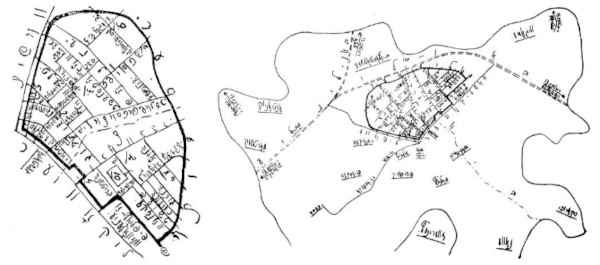
From the very beginning, the Hitlerites intended to assign to the Jews a ghetto only in the area of the Pyaskes, Khanaykes, and the surrounding small streets – the former center of dense Jewish communal life, which had been burned down immediately when the Nazis entered the city. They set that district on fire, murdered Jews there, and plundered whatever they could.
But after the Judenrat intervened – and after the Nazi leaders were presented with a substantial Jewish “contribution,” including money, jewelry, and other valuables – the Nazis designated a different quarter for the ghetto. This area included the streets Tshenstokhovska [Częstochowska], Polna, Kupiecka, Lipowa, Tshepla [Ciepła], Yurovitska [Jurowiecka], Fabryczna, Białostoczañska, Nowy Świat, and all the surrounding lanes. The Jews were given three days to move into the ghetto. This again caused panic, because people simply had nothing with which to transport their belongings from their homes into the district that had now been marked off as the ghetto.
|
|
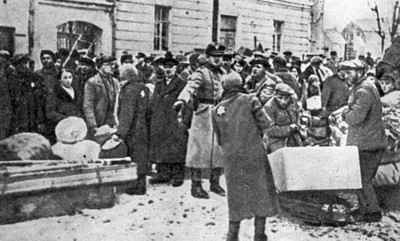
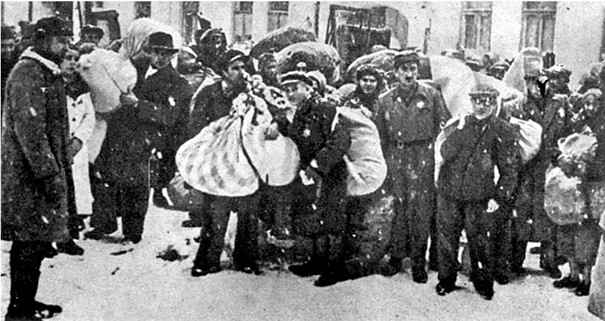
At that time it was a tragic sight to see how the Jews — among them elderly people, women, and even children — dragged their belongings or pushed them on little carts, exhausted and suffering. Word of this quickly reached the peasants from the surrounding villages, who immediately sensed in it a good opportunity for income. They came into the city with their wagons and horses and helped transport the Jews' possessions from their former homes into the new ghetto.
The peasants refused to take money, which they considered worthless at that time. Instead, they demanded — and received — clothing, furniture, household goods, jewelry, and similar items. In this way, much Jewish property and the hard-earned possessions of many years passed into the hands of the peasants.
It should be noted that the hurried move into the ghetto was carried out mostly by Jewish women and children. This was because most of the men — especially the younger and stronger ones — were regularly taken away by the Nazis for various forms of forced labor.
Those three days in Białystok — as someone later recalled — when the Jews moved from their former homes into the new ghetto resembled a true migration of an entire people. It was almost impossible to make one's way through the streets; one had to push through the crowds with force. The streets were black with people…
This difficult situation of the Jews was also exploited by various riffraff — non-Jewish hooligans. Such people attacked the already desperate Jews, beating and robbing them. Nearby stood the Hitlerite murderers, laughing and mocking the Jews. The killers of the “master race” even took photographs of these tragic scenes, intending to send them to their families and friends in Germany as proof of their “great victory” over the Jewish people.
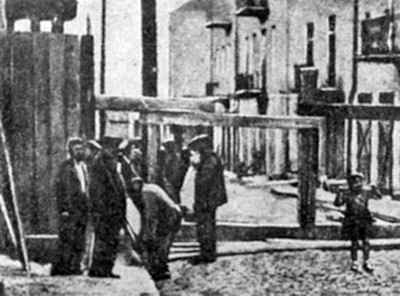
According to an order issued by the Nazi authorities, the ghetto in Białystok had to be completely sealed by a fixed date — Friday, August 1, 1941. The Jews themselves were required to procure the necessary materials and everything else needed to build the fence around the ghetto, and they had to construct it themselves as well. One could see Jews of that quarter digging, chopping, sawing wood, and doing whatever else was needed to erect the enclosure as quickly as possible.
It was a dark and sorrowful sight to witness these tragic scenes — how the Jews of Białystok, a city that before the war had been home to a deeply rooted and vibrant Jewish population, were now forced to build, in great haste, what amounted to their own prison. And indeed, the ghetto — into which nearly sixty thousand Jews were driven — became, from the very beginning, one vast prison.
Beginning on Friday, August 1, 1941, the Białystoker ghetto had three separate gates. The main gate was on Jurowiecka Street, at the end of Sienkiewicza. A second gate stood on Kupiecka Street, at the end of the marketplace. The third gate was on Tshiste [Czysta] Street.
From the outside, the ghetto was immediately guarded by Nazi gendarmes and their local helpers. From the inside, the gates were guarded by the Jewish police, known as the Ordnungsdienst [Order Service].
[Page 132]
The Jewish policemen did not wear special uniforms. On their heads they wore a round cap with a German inscription identifying them as members of the Jüdischer Ordnungsdienst [Jewish Order Service]. They carried a special stick or a rubber truncheon.
As was later recounted, the first hours after the ghetto was enclosed with the fence — when everything outside was suddenly sealed off from the Jews — were terrifying. The Jews inside felt so beaten down, so humiliated and degraded, that they were ashamed to show their faces to one another. It felt as if they had suddenly found themselves in a prison, each person as though guilty of some grave crime, and each one ashamed before the other.
Many women in the ghetto broke into spasms of weeping. Especially heartbreaking was the weeping of the children. One could also see tears in the eyes of certain elderly people, who in their hearts mourned the heavy fate that had befallen the Jews. And, as is sadly the way in such circumstances, people gradually began to calm themselves. Little by little they grew accustomed to the suffering, though it came with great effort and deep anguish. Each person tried to comfort themselves, and also to comfort others.
Even in those harsh days, the eternal Jewish sense of confidence was not lost. People believed that this tragic time would eventually pass, that a day of peace and quiet would come. The Jews held on to the belief — even as they witnessed the murders committed by the Nazi killers — that it would not last long, and that Hitler's downfall would come.
From the very beginning, once the Jews of Białystok were enclosed within the ghetto, heartbreaking scenes unfolded there. Many families lay in the streets, having nowhere to settle. There was no place to wash, no place to lay one's head to sleep, and nothing with which to satisfy one's hunger. After several days of lying under the open sky, such families were eventually placed in a number of synagogues and in several empty factory buildings. In these cramped spaces, many families were crowded together. The whole situation presented a dreadful sight. It was painful to see formerly wealthy Jewish families — people who had once lived comfortably — suddenly reduced to such conditions.
“It is hard to imagine,” recalled Rafael Reyzner later, “what it was like to be forced to live together in those places. Noise, shouting, and quarrels filled the air constantly. Even over small matters, fights would break out. There were no stoves in the communal rooms, so the residents were forced to cook their thin soup out on the street. When one passed by the 'kolkhozn,' as the ghetto later called them, the sight of dozens of open fires, the filth lying all around, and the cries that carried from there left a heavy and painful impression. During the first half-year, these 'kolkhozn' were the first to bear the weight of the harsh decrees that descended upon the ghetto. ”
Later, toward the end of the first year in the ghetto, almost no one remained in the so-called “kolkhozn.” The residents of these places were among the first to be taken out of the ghetto and sent on the tragic “evacuation” to Pruzhane [Prożany]. Only a small number of those from the “kolkhozn” managed to obtain better living quarters inside the ghetto.
Already in the first days of the ghetto, a special area was set aside for a cemetery. It was called the “Zhabyer Cemetery,” located on Polna Street, behind Katok's mill.
Every morning, thousands of Jews — men, women, and young people as well— were taken out of the ghetto to work in various enterprises in the city, as well as at labor sites of the Nazi army. In the early morning, when they left the ghetto for work, and again at night, when they returned from work to the ghetto, all of them were strictly searched by the Nazi guards at the ghetto gate to ensure they were not carrying anything out or bringing anything back in. The Nazi murderers paid particular attention to prevent those returning from their slave labor from bringing food into the ghetto.
Yet the Jews found ways to smuggle food inside, despite the great danger, simply in order to survive those harsh times. Smuggling food into the Białystoker ghetto — as in other ghettos — became one of the most essential means by which many suffering Jews managed to stay alive.
Do not forget to keep alive the memory of our martyrs. |
Translator's notes:
|
|
JewishGen, Inc. makes no representations regarding the accuracy of
the translation. The reader may wish to refer to the original material
for verification.
JewishGen is not responsible for inaccuracies or omissions in the original work and cannot rewrite or edit the text to correct inaccuracies and/or omissions.
Our mission is to produce a translation of the original work and we cannot verify the accuracy of statements or alter facts cited.
 Białystok, Poland
 Yizkor Book Project
 JewishGen Home Page
Copyright © 1999-2026 by JewishGen, Inc.
Updated 16 Apr 2026 by LA