 |
|
|
[Page 107]
|
[Page 108]
[Page 109]
English Proofreading by Dr. Susan Kingsley Pasquariella
|
|
Translator's note:
by Yaakov Pat
Translated by Beate Schützmann-Krebs
English Proofreading by Dr. Susan Kingsley Pasquariella
The author wrote this article in New York, on the day when the war broke out, September 1, 1939.
I wanted to write about our Białystok in recent times, to tell of the bravery and courage of the simple Jews of Białystok in those difficult months of struggle against antisemitism. I wanted to tell about the Jewish workers of Białystok, about our weavers and tailors, our honest craftsmen, who build their wonderful folk institutions. I wanted to tell how relief work is carried out in our Białystok – but I must set all this aside.
I write these words in the hour when the borders of Poland are already burning, when Hitler's bombs are already falling on Warsaw and Vilna, on Katowice and Kraków, on Częstochowa and Łódź.
A wild, desolate horde of millions of cannibals has attacked Poland. Today the poison-mixer, the dreadful world incendiary Hitler, shouted in his shklafn-hoyz [slave-house, here: Reichstag]: – “I want to spare women and children, but if they resist, we will make them feel it!”[3]
This means: the shkhite [massacre] is already prepared. Hitler is going to turn Poland into a dreadful bloodbath.
You shudder, darkness falls before your eyes, you clench your teeth, and your fingers curl into fists.
This very blood-hound, who years ago, in the dark September night, drove sixteen thousand Jews toward the Polish border. Here is the one who murdered and desecrated in the streets of Hanover and Düsseldorf, of Berlin and Bremen, the Jews of Germany. And now he lets himself loose with fire and sword upon the Jewish towns of Poland.
To us, across the sea, there now reaches the horror and dread, the hatred and fury, that flares in Poland, that flares in all Polish towns, that flares in our heartfelt Białystok.
Now, as I write these words, it is still the first hour of the catastrophe. It is still difficult to think calmly and to write calmly. Yet to do this – to see the situation with composure, to consider with a cool head what we must do – this is our duty.
We can and must do one thing: Go and help… help, help, and help. We will now have to provide, in far greater measure, both moral and material assistance.
Let us take our Białystok. In this hour the fifty thousand Jews of Białystok must know that the thousands of Białystoker Jews in America have become their brotherly partners.
The Jews of Białystok must now know that they are not alone, that they have not been left abandoned among the cannons, alone beneath the bombs of war. Across the sea, brothers and sisters sit, their hearts beating together, their feelings as one.
First of all, the moral support. The awareness that one is not alone. This must be made known on the other side of the sea as clearly, as firmly, as possible.
And together with this, the material support. I do not mean material support from person to person – that is the matter of each yokhid [individual], from friend to friend – but rather the support for the most important institutions.
If bombs do not destroy them, if swords do not strike them down, they must not be left to perish from want or deprivation.
The social institutions are, in this very moment, also trenches in the war for existence; they are armor for the klal [the collective], for the folks-kolektiv [the people's community].
Let us take our Białystok, let us take the institutions for the children and the orphans, let us take the schools and the children's homes, let us take the kitchens – they are now gathering points of folk energy, for mass comfort, for nekhome [consolation].
Until now all these institutions have been sustained through the self-sacrifice of the Białystok population, through the devotion of the people, through the poor, clean pennies of the masses. A very small part has been taken up by help from abroad – from the Joint [American Jewish Joint Distribution Committee] in various forms. In the greatest and most important measure they have been sustained in Białystok by the Jews of Białystok themselves.
Białystoker weavers tore pieces of bread from the mouths of their own half starved children, and with that wage paid a voluntary tax for the people's institutions. Now this becomes impossible. And it is self-evident: now American Białystok must speak its word, must do its deed.
Surely, as with every national catastrophe, there will soon appear uninvited benefactors, charlatan attendants, exploiters of the people's troubles, gaboyim [communal treasurers, here used ironically as exploiters], presidents, committees… One must keep watch, one must see to avoid all these plagues and dragged in diseases. This is a clear, a self-understood matter.
But the main thing in the present moment,
[Page 111]
in this burning hour, is that in everyone the conscience should be awakened, the heart should be opened. Each one must be deeply convinced that with body and soul he is responsible for the life and existence of those who are on the other side of the sea – in Poland.
Translator's notes:
by Yitzchak Haber
Translated by Beate Schützmann-Krebs
English Proofreading by Dr. Susan Kingsley Pasquariella
The terrible suffering and pain of the Jews of Białystok under the cruel Hitlerite rule did not come unexpectedly, just as it did not for the Jews throughout Poland. Although it came gradually, step by step, one felt that a dreadful time was approaching for the Jews. Yet no one imagined that the Jewish suffering and pain, the destruction and khurbn [catastrophe, ruin], would be of such a monstrous scope as it later tragically became reality.
The uneasy moods among the Jews in Białystok, as also among Jews in other places in Poland, were especially filled with deep anxiety in the late summer of 1939. It was felt clearly, almost tangible in the air, that something unusual was approaching; the sky was drawn with heavy black clouds, which foretold nothing good…
It soon became evident that this unrest was entirely justified. At the very same time that the Polish government mobilized the army, and in the country there was a sense of insecurity and unease that continued with unbroken tension, there suddenly came news that shook everyone. The radio at once brought the almost unbelievable report that Hitler's Germany and Soviet Russia had concluded a friendship pact.
From that moment there was no longer any doubt that a terrible storm was about to break. The Jews especially were frightened by this. They felt keenly, even in advance, that a tragic time was drawing near particularly for them, for Hitler had all along preached and foretold the special war he was preparing against the Jewish people – most of all in Europe, which for him was close at hand.
On Friday, September 1, 1939, very early in the morning, before Hitler's unexpected attack on Poland was yet officially announced, Hitlerite airplanes were already flying over Polish cities and dropping bombs.
Białystok, which before the war was located in the region of East Prussia, did not at first suffer from these bombardments. This was because Hitler's blitzkrieg [“lightning war”] began chiefly with a major assault on Poland's western territories.
During the first two weeks of the war, when the Hitlerite armies broke into various regions of Poland, Białystok too suffered greatly from the bombardments. In that area the Hitlerites chiefly bombarded railway lines, stations, key military and industrial sites, and the like. From this, of course, the civilian population also suffered.
At that time, masses of Jewish refugees from various places in Poland began arriving in Białystok. To a large extent this was because people intended to make their way, through Białystok, into the territories across the border under Soviet control. A second reason many Jewish refugees came to Białystok from different parts of Poland was the rumors – although not yet officially confirmed – that the Soviet army would march into Białystok and occupy the entire region, which would presumably remain under Soviet control according to the agreement between Hitler's Germany and Moscow.
Meanwhile events unfolded with great speed, although no one knew what awaited the Jews – and others as well – in Białystok and in that whole region. For two weeks, from the beginning of the war, Białystok was almost hefker [left abandoned], without any governmental leadership.
But this did not last long. Suddenly the unexpected came, casting fear and unrest over everything: the tragic beginning had arrived.
[Page 112]
The Beginning of the Path of Suffering
It was Friday, the second day of Rosh Hashanah [Jewish New Year], which that year fell on September 15, 1939. Among most of the Jews in the city, who at that time were at prayer in the shuln [synagogues], in the streets, in their homes, and in other various places, the news suddenly spread that units of the Hitlerite army were already at the gates of Białystok.
Immediately panic broke out. Jews ran to different places to hide from the approaching murderers. By midday, the first groups of Hitlerite soldiers had already entered Białystok. They came into the city through Mazovetser [Mazowiecka] and Dombravskego [Dąbrowska] Streets.
Soon after, when the streets of the city were almost emptied of people, the Hitlerite military spread everywhere with their war machines. Finding no passersby in the streets, the Hitlerites began shooting from their rifles into the windows of houses.
This was the bloody turning point, a kind of introduction to the later horrors. From the shooting of the Hitlerite soldiers into the windows of houses at the inhabitants, there were immediately a large number of victims. Most among them were Jews.
At the same time, the new Hitlerite authorities declared a state of emergency in Białystok: people were permitted to go out into the streets only from five in the morning until eight in the evening.
Soon afterward, the Nazis in the city also began robbing Jewish homes. A number of Jewish women were shot for refusing to remove rings from their fingers. In general, the Hitlerite murderers beat and shot anyone who did not allow himself to be robbed.
In the city one saw few Jews, even during the hours when it was permitted to walk. People were afraid of the murderers.
At the same time there was a rumor among the Jews in Białystok that the Hitlerite murderers would not remain long in the city. The soldiers of the Wehrmacht themselves, after being several days in the city, spread a rumor that the Hitlerite army would soon depart, and that in their place the Soviets would come to take over the rule of Białystok. Even higher officers of the Hitlerite army spoke openly about this.
This rumor grew ever stronger among the Jews. They also already knew the news that had come from the official Soviet radio, that on September 17 the Soviet army would occupy all the territories of former Poland lying in the regions of Western Ukraine and Western White Russia. For the Jews in Białystok, and in that region in general, this news was clearly a great relief.
Although at that time people did not yet know what awaited them under Soviet power, they did know that it would be good to be rid of the Hitlerite murderers, who from the very beginning had shown their brutality.
It did not take long, and the widespread news about the coming changes became reality.
On Thursday, September 21, during the day, three Soviet airplanes flew over Białystok and dropped leaflets in the White Russian language. In these it was announced that the Soviets were indeed coming soon to take over power.
The next morning, Friday – which was then Erev Yom Kippur [the eve of the Day of Atonement] – people saw the Hitlerite military units packing their belongings and moving off in the direction of Warsaw. For the Jews of Białystok this was a great relief. They felt that a new time was coming, which perhaps would be much better than what had been until now.
At the very moment when the Hitlerites withdrew from Białystok, a special committee of Jews and non-Jews was quickly formed in the city to prepare festivities for receiving the approaching Soviet army. For this purpose the organizing committee also established contact with the Soviet military units marching toward Białystok.
After the committee had received all necessary details, it was announced to the population that on that same day in the afternoon – Friday, Erev Yom Kippur [the eve of the Day of Atonement] – the Soviet army would arrive in the city.
In most organizations feverish preparations were quickly made, with flags and flowers, suitable inscriptions and the like, in order to welcome the Red Army in fitting fashion. All this was understandable, for the brief presence of the Nazi soldiers in Białystok had revealed their hideous face. It was clearly felt what could come later, if they were to remain in place.
It was reckoned at that time that the single week of the Hitlerites in Białystok and the surrounding region had already brought several hundred Jewish victims. At the same time, in that short period, the Nazi murderers had managed to rob and seize property and goods from hundreds of Jewish shops and houses, as well as simply from people they encountered.
Although the Hitlerites were in Białystok only a short time, the Jews there felt it deeply – and remembered it.
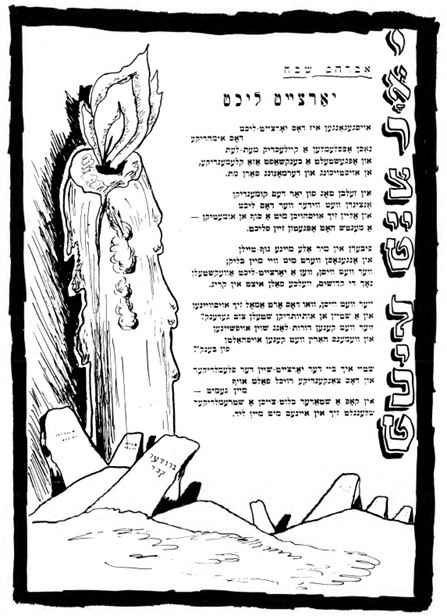
| Do not forget to preserve the memory of our martyrs. |
Translator's note:
by Yitzchak Haber
Translated by Beate Schützmann-Krebs
English Proofreading by Dr. Susan Kingsley Pasquariella
On the eve of Yom Kippur, at night, after the Hitlerite soldiers had disappeared from Białystok, the first Soviet soldiers entered. People who were then in the streets received the arriving Red Army men with great warmth.
The professional associations and political organizations in the city came out into the streets with red flags and flowers. The encounter was heartfelt and friendly. The Jewish youth, who at that time no longer went to Kol Nidre in the shuln and bote-medroshim [synagogues and study houses], surrounded themselves with the Red Army men, who also showed great friendliness.
The Soviet soldiers, in turn, immediately spoke about the way of life in their fatherland and emphasized that only in the Soviet Union could everyone live as free people.
Thus Rafael Reizner described the entry of the Soviet army into Białystok on Friday, September 22, 1939, at the beginning of his book Der umkum fun Białystoker yidntum 1939–1945 [The Destruction of Białystok Jewry, 1939–1945]. About the beginning of Soviet rule in Białystok, as well as what happened somewhat later, he tells further in the same book.
Soon in the morning, after the entry of the Red Army into Białystok, the local Soviet commandant issued an order abolishing the state of emergency that had existed the whole time since the beginning of the war. Thanks to this, the city was again illuminated after about three weeks of darkness. The movement of people in the city returned to normal, and the Jews of Białystok also breathed freely because of all this.
With the arrival of the new Soviet rulers in Białystok, a new economic and social order was established, entirely different from what had been before. These changes also made life more difficult for the inhabitants.
Thus, from the very beginning it was hard to obtain even basic necessities. At that time, when it was precisely a harsh winter, one had to rise early in the morning and stand in line in order to get bread and other essential foodstuffs. Very often one stood in line for a whole mesles [literally “a full day and night”], in the great cold, with frost biting from all sides.
In the end, when one finally reached the door of such a shop, the seller announced that everything was already sold out, there was nothing left. People would go back from such shops frozen, hungry, and also embittered, because life had become harder than it had been before the war.
Because life in the city was suddenly placed on new economic foundations, in the first months of Soviet rule there also arose great unemployment. People went about without occupation, and life became harder from day to day.
Later, however, by the end of the winter of 1939 and the beginning of 1940, there were already fewer unemployed. Life also slowly began to normalize, and by the end of that winter it had already become easier to obtain products of daily necessity.
The oylem [the people, the community] also began to accustom themselves to this new way of life, and they hoped for better times.
That winter, at the beginning of the new Soviet rule, there were also many other difficulties. One of these difficulties was the great shortage of housing. This arose suddenly then in Białystok for various reasons.
From the very beginning, many dwellings were converted into new factories, work collectives, cooperative enterprises, and the like. At the same time thousands of people from Russia – Soviet officials, military men, commissars, and many others – came to Białystok. Most arrived with their wives and children, whole families, who occupied a great number of apartments.
At that time tens of thousands of Jewish war refugees also came to Białystok from various parts of Poland. It is well-known that most of these Jewish refugees – men, women, and children – trudged and wandered long distances on foot while fleeing from the Hitlerites. They considered it a great fortune to escape the Nazi hell and reach the territories already occupied by the Soviets.
Before the war, Białystok had only about one hundred thousand inhabitants. But suddenly, in the first months of Soviet occupation, because of the above-mentioned reasons, there were nearly two hundred thousand people in Białystok. The overcrowding in the dwellings was therefore severe everywhere.
From the very beginning, once life under Soviet rule had become somewhat normalized, the new authorities also began a “cleansing” among the local population, including many Jews. At the same time that Jewish refugees were expelled for not wishing to accept Soviet citizenship (about the Jewish refugees more is told later), several thousand Jews and non-Jews of Białystok were also arrested and deported to Siberia.
The excuse of the Soviet rulers was that these people were not permitted to live in Białystok
[Page 114]
because it was too close to the border; they were “harmful elements” who must not reside near a frontier. Among those deported to Siberia were former factory owners and merchants, leaders of various political parties, leaders and activists of Jewish institutions from before the war, clergy of all faiths, former Polish officials, and simply people whom the authorities considered “unreliable.”
These great “cleansings,” in which many Jewish inhabitants of Białystok were deported, as well as newly arrived refugees, made a heavy impression on everyone. For a long time people did not even know where the deported had been taken. Only months later letters arrived from many of them to their relatives and friends. They wrote that they were simply perishing from hunger and in urgent need of help.
Proper measures were taken to assist the deported; food parcels were sent, thanks to which their situation became somewhat better.
The New Life of the Jews
With the passage of time, as always under any conditions, life in Białystok gradually took on a normal character. All the factories in the city then worked at full capacity, and new enterprises were also established. Everything was, of course, under the supervision of Soviet power. The number of state shops increased from day to day, and it also became easier to buy necessary things. Local Jews were employed in various positions; many were suddenly transferred to other trades, occupations, offices, commerce, and so forth.
The social institutions of Jewish life were also immediately reorganized and set up according to a new order. The elderly Jews who had been in the hekdesh [communal poorhouse] were provided for in a proper manner. For a certain time the old people still received food from a kosher kitchen. Later, however, the elderly were placed in a fine, clean facility in Supraśl, together with the local elderly Christian inhabitants.
Most of the Jewish elders, however, were not satisfied with this. They knew well that besides the fact that the environment would not be their own and familiar, they would have to eat food that was not kosher. Most of the old people, who were religiously inclined, left from there. They arranged themselves, as was necessary, with relatives, friends, and in other similar ways.
Changes also occurred with the Jewish orphanages. The three well-known orphanages, located at Yurovtser [Jurowiecka] Street 7, Częstochower Street 7, and Polna Street 13, were united into one large orphan institution. All this was arranged in a fine building on Vesola [Wesoła] Street.
The local Soviet authorities appointed as director of the new large orphan institution Shimen Broyde, who had previously been secretary of the Society for Orphan Care. Under Broyde's diligent leadership it was ensured that the orphans were provided with everything necessary.
Also in the sphere of education and culture, great changes took place. In the city's active schools, because of the large number of pupils, it was necessary to teach in two shifts, and in some even three. A number of new schools were also opened.
New Jewish newspapers also began to appear, which was made possible with the help of Jewish writer-refugees who had come from Warsaw, Łódź, and other places in Poland. At the same time, a Jewish state dramatic theater was established under the direction of the famous artist Avraham Morevski. In addition, a fine Jewish kleinkunst [cabaret/artistic variety] theater was organized, with the participation of the famous artist-duo Shimen [Szymon] Dzigan and Yisroel [Israel] Shumacher, under the artistic leadership of the well-known poet and theatrical figure Moshe Broderzon.
In these two theaters a number of the best Jewish artists of Poland appeared, who at that time were refugees in Białystok. In addition, in those days Jewish as well as other theater ensembles and concert groups from Soviet Russia also gave guest performances in Białystok.
In Białystok a fine choir was also created, led by the well-known Warsaw choir conductor M. Shneor. At that time Białystok was also the main center of Eddie Rosner's Warsaw jazz orchestra, which toured widely.
Artistic activities and exhibitions also began, along with singing and musical concerts; the cinemas played, and other places of entertainment were active. Everywhere was full of people.
Amid the great changes that took place in Białystok under the new Soviet rule, the Jewish religious circles also had to adapt – insofar as this was possible – to the new conditions. Because almost the entire Jewish population, adults and able-bodied, were employed in factories or in various government enterprises, where one had to work also on Shabbes and the work often began while it was still dark outside, the pious Jews had no possibility to go and pray in the early mornings in the bote-medroshim [houses of study].
And since such prayer houses remained without worshippers, and at the same time there was a great shortage of dwellings, the local Soviet authorities made use of
[Page 115]
these bote-medroshim for various purposes needed by them. In the masonry Pyaskover Bes-Medresh, for example, a new sports club was established. In the Pulkovoyer and Bes Shmuel Bote-Medroshim, military staffs were quartered. Other Bote-Medroshim were transformed into storehouses and the like.
The worshippers of the Great Synagogue, in turn, had to pay the highest rent to the Soviet authorities.The charge was five rubles per square meter, amounting to four thousand rubles a month. It was the same in other places. The religious institutions also had to pay the highest rate for electricity. At a time when the normal price for everyone else was 35 kopeks per kilowatt, Jewish religious institutions had to pay a full five rubles per kilowatt.
Because of this, the few remaining bote-medroshim and synagogues were forced to be very sparing in their use of electric light, and these places were indeed dark. Only on festival days did they permit themselves to use a little more electricity. Even so, these sacred Jewish places had an appearance of gloom.
Under those new and difficult conditions imposed by the new rulers, it nevertheless proved possible to create a special Jewish stolyar [carpentry] cooperative, where no work was done on Shabbes or Jewish holidays. Around this cooperative gathered mostly very religious Jews, who also ate exclusively kosher meat from their own shkhite [ritual slaughter]. This group of Jews also became the main providers of all religious needs for those Białystok Jews who likewise wished to preserve Jewish religiosity even under the new Soviet rule.
As soon as the new order was established, the large municipal bath in Białystok also passed into state ownership. With this, the mikveh that had been in the municipal bath was liquidated. Since there was no longer any suitable place for the religious Jews and pious Jewish women to immerse themselves, the members of the religious stolyar cooperative came to the rescue. These Jews collected a considerable sum of money among themselves, and in the apartment of one of their members they built a mikveh. This place was later visited not only by many pious Jews in Białystok, but also by people from the surrounding area and even from distant provinces.
It must be mentioned that, despite the great changes in Białystok under the new Soviet rule, the religious Jews did everything possible to maintain their customs, traditions, to uphold the dinim [religious laws], and to preserve Jewish religiosity. The pious Jews, for example, would not accept any position, even under favorable conditions, where one had to work on Shabbes. Although in such positions one could earn several hundred rubles a month, the pious Jews preferred to take smaller, less important jobs, where they earned only about one hundred rubles a month or a little more. Such Jews would most often accept positions as watchmen in state shops.
When one passed by the closed shops in the early morning hours, where the watchmen were pious Jews, one could see them inside, wrapped in tallis and tefillin, praying with deep Jewish devotion.
“ Displaced” Jews Under the New Rulers
The well-known publisher, writer, and translator from Warsaw, Mark Rakowski, was also a refugee in Białystok at the beginning of the war. In a letter to the Bialystoker Shtime in New York (April 1941), he wrote as follows about the religious Jews in Białystok under Soviet rule:
I would like to give you a vivid picture of how the yeshiva students and the pious Jews in general lived here under Soviet rule, how they felt as if in their father's vineyard. For a long time Białystok had not seen Jews walking so openly and freely in the streets, with long peyes [sidelocks] and small skullcaps. These people had previously not been able to show themselves in the streets, not daring to risk being beaten by some hooligan or struck on the head with a stone. Such incidents were a daily occurrence in Poland.
Now you could encounter scenes where a yeshiva student stood in the street and conversed calmly with a Red Army soldier, who was not at all amazed by his unusual appearance.
Or take such an incident, which happened in Białystok and about which all the bote-medroshim kept talking. You know the cemetery, which lies several kilometers outside the city. Things had gone so far under the Polyaken [non-Jewish Poles] that a Jewish funeral faced the greatest dangers. It had gone so far that people feared, risking their very lives, to accompany a deceased. Hooligans living outside the city would throw stones at Jewish funerals, and more than one person was struck on the head and injured.
When the Red Army arrived, those hooligans tried to continue their work. Then one Jew from the cemetery had the idea to call the militsye [Soviet police]. Naturally, a detachment of militsye immediately came with a car and arrested eight hooligans. Within a few days they were brought before a court and sentenced to five to ten years in prison. Everyone, young and old, spoke about it…
Naturally, the sources of income for certain elements dried up,
[Page 116]
since trade was no longer possible – one had to work. Yet many Jews found positions and went to work.
A new livelihood arose for those Jews who could no longer learn a craft. Thousands of elderly Jews received employment as night watchmen. On winter nights you could encounter them, wrapped in warm peltsn [fur coats] and valinkes [felt boots], with a staff in hand. The peltsn and valinkes they did not have to buy; they were given free – this special spets-bakleydung [work clothing], as it was called in the factories.
Older rabbis, who had simply said “nivlah ba-chutz ve'al titztarekh labriyot” [“better to eat carrion in the street than to depend on others”], girded their loins, put on a pelts, and patrolled a shop. “Behold, He that keeps Israel neither slumbers nor sleeps” [Psalm 121:4], someone once said to me.
Once, passing before dawn on the way to the train, I heard singing from afar. Coming closer, I saw how in a shop under construction, a night watchman walked among the boards, wrapped in a tallis and praying aloud. It did not matter to him that the sidewalk was swarming with people passing by. He felt himself to be a state watchman, a free man – free also with his davening.
Thousands of such cases, facts, and stories could be told here about these displaced Jews who found a livelihood in Białystok.
Translator's note:
by Yitzchak Haber
Translated by Beate Schützmann-Krebs
English Proofreading by Dr. Susan Kingsley Pasquariella
Immediately after the outbreak of the war, in early September 1939, many Jewish refugees from various parts of Poland began to arrive in Białystok. At that time Jewish war refugees also came to other areas near the border with Soviet Russia. Already then it was clear that these regions would be occupied – according to the Stalin-Hitler pact. Yet a particularly large stream of Jewish refugees at that time flowed into Białystok. There were a number of objective reasons for this.
To a great extent this was because reaching Białystok by smuggling oneself across – as most refugees then had to do – was somewhat easier than elsewhere. Most of the Jewish refugees from Poland arrived in Białystok through Malkin. Constantly and without interruption, many refugees came there, whose sole aspiration was to cross to the other side, to Zarembi Koscielne, the first Soviet town on the other side. The peasants of that border region did good business by helping to bring the steadily arriving refugees to the border and leading them across.
In the beginning, in the first days of the war, it was easy to cross the border and make one's way to Białystok. Later it became difficult, as the Soviet border guards pushed the refugees back to the Polish side, under Hitlerite occupation. In many cases Jewish refugees who returned to the Polish side – men and women, as well as children – were beaten and brutalized by the Hitlerites.
When Białystok was fully occupied by Soviet power, on September 17, 1939, the stream of refugees from Poland became even greater. Jews fled from the Hitlerite murderers, who immediately began to inflict suffering upon them. They also ran to Białystok because they knew that from there one could reach further into the wider free world.
To a large extent, many Jews from Poland fled to Białystok also because, by the end of 1939, it was already being said among Jews in Poland that in Białystok – which before the outbreak of the war had been an important Jewish center – a new Jewish life had been established with various branches of activity, even though the new Soviet conditions were already present there.
This also explains why many of the Jewish writers from Poland, actors, artists, musicians, and others, when they fled from the Hitlerites in Poland, sought to make their way specifically to Białystok. Indeed, Białystok at that time became a center for many Jewish writers and actors. In addition, well-known Jewish writers and actors, as well as other culture creating figures, came from Soviet Russia for visits and performances.
Since the situation with housing and food for the refugees was at that time difficult – as it was also for the local inhabitants – many refugees registered to travel deep into Russia for work. After a short time, however, a number returned, disappointed and embittered. They told of the harsh life in Soviet Russia, which discouraged and deterred others from going there.
At that time Jews who had come from Warsaw to Białystok also told of the suffering and torment that Jews had to endure under the Hitlerites. Yet despite this, a number of Jewish men and women among the refugees once again – even in the severe winter – smuggled themselves across the border to make their way back to Poland.
[Page 117]
It was then a truly tragic sight at the border point in Malkin: on the one hand Jews striving at any price to cross from the Polish side into Białystok, and at the same time Jewish refugees from Białystok pulling back into Poland, where Hitler had spread his crimes against the Jews.
In the end the Soviet authorities issued a decree in Białystok – as in other places occupied by the Soviets – that all refugees must take out Soviet passports and become citizens of the Soviet land. Those who carried out this decision were dispatched and sent deep into Russia. The others, however, who did not wish to submit to the gzeyre [decree], were arrested and deported to Siberia.
Pairs among the Jewish refugees were deported to certain distant places ( poshyolkes), specifically designated for couples and entire families. Individual refugees were sent to camps in various places in the far Soviet north, where masses of deportees from among the Soviet population were also held.
For the most part, the refugees did not want to accept Soviet citizenship and the passports offered to them, because with such passports it was not permitted to live near the border.And Białystok, according to the Soviet arrangement, was considered close to the border.
This happened at the end of April 1940, almost in a single night, when the Soviet secret police surrounded all the places where refugees were staying. Among these were also the bote-medroshim and social institutions. Almost all the refugees were then arrested, taken to the vokzal [railway station], where large freight wagons had already been prepared. They were all then deported to distant Siberian and other cold regions of Soviet Russia.
On that same night many thousands of Jews of Białystok, as well as non-Jews, were also arrested and deported. Even for these, although they already had Soviet passports and were citizens, the law still applied that one was not permitted to live near the border.
In Białystok there still remained a certain number of refugees, after others had been sent deep into Russia. Some of them lived there the entire time virtually illegally. But this too came to an end. This was already very close to Hitler's attack on Soviet Russia, which the local government leaders in Białystok must have already sensed. Wishing, it seems, to ensure that Białystok should no longer have so called “unsafe elements,” the Soviet secret police carried out, on the night of Thursday, June 19, 1941, a swift raid on Jews and non-Jews.
Most of those arrested were remaining leaders and activists of various organizations – Zionists, Bundists, Revisionists, Poale-Zion, of the P.P.S. [Polish Socialist Party], clergy, former wealthy persons, factory owners, house proprietors, aristocrats, rich peasants, and many others upon whom the Soviet authorities had suspicion. Most of the men among those arrested were taken off to prison. Their wives and children were brought to the vokzal, from where they were deported in freight wagons deep into Russia.
Most of the men imprisoned were later released, when the Nazis were already in Białystok. They were subsequently murdered by the rotskhim [villains], just as happened with other Jews in Białystok.
A Temporary Home for Jewish Writers and Artists
With the great stream of Jewish refugees from Poland, there also came to Białystok, shortly after the outbreak of the war, a large number of Jewish writers, actors, musicians, artists, and others. The refugee writers stayed in the special Shrayber Hoyz [Writers' House] on Sienkiewicza Street. A number of them were at first employed in the new newspaper Białystoker Shtern, which was directed by specially dispatched Jewish Soviet writers from Russia or by locally communist-oriented writers.
Later, however, those refugee writers from Poland – who had previously in Warsaw and Łódź been connected with Zionist, Bundist, and similar circles – were dismissed from their positions. The refugee artists fared somewhat better. A number of them, such as the Dzigan-Shumakher Theater and others, mostly toured with guest performances in Russia itself. Many Jewish actors also went straight to Russia from the very beginning.
The Jewish writers and party activists who came from Soviet Russia to Białystok continually argued to the refugee writers from Poland that they must adapt to the Soviet “reality”. Only then, they taught, would they be able to be full-fledged creators for life in Soviet Russia.
Although the majority of inhabitants in Białystok were Jews, daily newspapers appeared there in Belarusian, Russian, and later also in Polish. The Jewish Białystoker Shtern appeared only three times a week.
Because most of the Jewish refugee writers from Poland lived in constant fear of being arrested for their former Zionist, Bundist, and religious affiliations, and since they were not permitted to take on regular work many of them eventually registered to travel deep into Russia. A number also managed to
[Page 118]
travel from Białystok to Vilna, from where they later made their way out into the free world.
Among the Jews in Białystok – especially among the great number of refugees from Poland, where the Nazi murderers were raging – there arose bitter resentment that in the Białystoker Shtern nothing at all reflected the sufferings and troubles of the Jews in Poland. In Białystok Jews spoke among themselves, but only quietly, about the dreadful time Jews were living through in Poland. From the arriving refugees, as well as from direct and indirect reports, it was well-known that the Hitlerite rotskhim in Poland were beating, tormenting, robbing, humiliating, and driving the Jews there.
But in Białystok one was not permitted to speak aloud of any of this; it was silenced, and people were afraid to utter it. This was, of course, because at that time between Soviet Russia and Hitler's Germany there was the “friendship pact.” For this reason the Białystoker Shtern never once mentioned anything of it. All of this was, as the Jews in Białystok then understood, the result of that utterly incomprehensible pact between the two opposing regimes, which also brought on the terrible Second World War.
For at that time the Nazis were close allies of the Soviets, and they shared a common goal in the war. So how could one speak or write, in Soviet-occupied Białystok, about the terrible crimes of a supposed partner? Indeed, in Białystok – as in other places at that time – one had to remain silent; people did not even dare to mention or write about the Hitlerite crimes already underway in Poland.
The renowned Jewish writer, poet, and theater creator Moyshe Broderzon, from Łódź, who at that time was also a refugee in Białystok, then said with deep bitterness: “Here a newspaper comes out in a Jewish city, only a few dozen kilometers from the German hell of murder. Yet not a single line, not a single word, mentions the horrific experiences of the Jews on the other side of the border, in that part of Poland where Jewish blood flows in streams.”
The Jewish refugee writers who came from Warsaw, Łódź, and other places to Białystok immediately came face to face with the reality of Soviet life. Yet they were not permitted to speak or write about this at that time. So it was also later, when most of them were in Moscow and in other places in Soviet Russia.
They had to suppress it within themselves the whole time, because everywhere “the walls had ears.”
Only after the war, when the writers entered the free world, did they reveal in their works many things they had been compelled to conceal while in Soviet Russia.
About the beginning of the war in Białystok, and how daily life then looked – especially the life of Jewish refugee writers, actors, artists, and others from Poland – Jewish refugee writers and artists wrote and told much after the war. Countless books exist about all this, as well as hundreds of descriptions and portrayals printed in various Jewish newspapers, journals, and other publications.
On this subject the well-known poet Yosef Rubinshteyn [Rubinstein] also created a powerful poem. This special poem about Białystok in the first weeks and months after the outbreak of the Second World War, as well as his personal moods as a war refugee in Białystok, Rubinshteyn later published in his great work Megiles Rusland [Scroll of Russia], in a special section titled Białystok.
Here we bring an excerpt from the beginning of that poem.
|
I still see you, Białystok, in those storm days, In those days when I, a refugee, was your guest. I still see the town clock on the fire tower, Already set to Moscow time, telling the street in silence:
You are no longer master here! In your shops, your houses,
That “new time” lined itself up in rows before the shops,
And though the street tried to breathe in its old rhythm,
In those days I came to you, dust-covered, |
Translator's notes:
by Khayim-Leyb [Chaim-Leib] Fuks
Translated by Beate Schützmann-Krebs
English Proofreading by Dr. Susan Kingsley Pasquariella
The well-known writer Khayim-Leyb Fuks, originally from Łódź, was also among that great stream of Jewish refugees who, from the very beginning of the war, fled from Hitlerites in Poland.
Fuks, as was the case with many others, eventually made his way to Białystok, where at that time, in those early days of the war, there were many Jewish refugees from various parts of Poland.
In detailed fashion, in his account of wanderings and journeys along different paths (“Bialystoker Shtime,” September 1955), Khayim-Leyb Fuks further describes how the Jews of Białystok received and assisted those refugees who had arrived there.
Kh.- L. Fuks wrote in the mentioned article:
But could Białystok really take in such a great stream of hundreds of thousands of Jews? We know that the Białystoker Jews did not have large apartments and did not possess enough public spaces to admit the great numbers who, with each passing day, more and more flooded the streets of Białystok.
And yet, when we look back at this sad chapter, we must, with great reverence, recall all those who did not stop before any hardship, but did everything to ease the need.
First must be mentioned the great help of the Białystoker Jewish kehile [community], which, besides the dozens of opened folks-kikhen [public kitchens] that distributed food free of charge for all refugees and gave special aid for small children, also gave over all its premises (even the great locale of the kehile itself) overnight as sleeping quarters for hundreds of Jews…
Special mention must also be made of all the shuln and bote-medroshim, which gave up being prayer houses and instead turned their spaces into sleeping places for the refugees, who thanks to this were able to stay alive.
Much was also done by Jewish factory owners and artisans, who, even without the permission of the Russian authorities – which had ordered all factories and workplaces to be registered – nevertheless, despite the risk of punishment, opened their factories and other places to aid the refugees.
A separate chapter is the Jewish poor, which literally with their last spoon of food, with their beds, and even with a board and a small piece of covering, shared with the unfortunate people.
When I recall the help from the poor little streets of the Khanaykes, Pyaskes, from Surazer and others, I am filled with a pride that uplifts me.
And not for nothing could the Jews take upon themselves to mount an armed resistance, which found its expression in the well-known ghetto uprising of the Białystoker Jews…
Also Jewish merchants, who under the pressure of Soviet power had to give up their warehouses, tried by every means to evade this and instead willingly placed their warehouses at the disposal of the refugees – even though it could cost them both their goods and something more…
Freedom itself indeed cost many Białystoker Jews dearly. They were arrested and deported to the Siberian forests for not carrying out the orders of the authorities – orders that in truth were nothing more than a pretext to seize the apartments for the Enkavede people [NKVD, Soviet secret police, precursor of the KGB].
A very great help was shown by the Białystoker Jewish intelligentsia, who themselves lived under difficult conditions because of their political “non-kosherness.”
The Jewish intelligentsia of Białystok, which until the khurbn [Holocaust] had been a model of Jewish national and cultural independence – the Jewish teachers, writers, and communal activists – did not shrink before the communist terror that then ruled the city. They hid the most sought-after ones, such as the Zionists and Bundists, who were seeking ways further on, toward Vilna.
Some, even at the risk of their personal fate, befriended the unfortunate cultural workers and writers from their own ranks, and some even paid with their lives (our dear friend, the writer Aharon Brezinski, who paid with his freedom, which cost him his life).
Pesach Kaplan, the editor of Unzer Lebn [Our Life], took in and with fatherly warmth sheltered the Jewish writers who found no favor with the Jewish communists.
The heartfelt Truzhanovitsh, editor of Białystoker Express, who had to give up working in a newspaper, even writing reportages, and had to do the work of an upravdam [Soviet house administrator], nevertheless, within his modest means, helped some Jewish writers and teachers with whatever he could…
I still vividly see the old Jewish writer [Jacob] Shatsky, whom the Jewish communists degraded by making him a “candidate,” which meant he no longer had the possibility to earn even a crust of bread…
I also wish to recall the poet Zisha Bagish, who in the very first period of the Soviet occupation
[Page 120]
of Białystok served as secretary of the Jewish Writers' Association. He became so deeply disappointed that he not only broke with the communists, but turned religious and a national Jew, and thus met his end as a kodesh [martyr].
All this took place in the first two months after the Soviet army occupied the city. Later, life gradually settled into a kind of “normal.” Artlen [cooperatives] were opened, and the larger community, those who were able, went off to work. The greater part, however, registered for work in the Russian factories, where special verbirungs-byuros [recruitment bureaus] promised kol ha-glikn [all the benefits]. Some of them were later saved from German destruction.
It is therefore clear that, had it not been for the help of the Białystoker Jews in those first months, thousands who had survived the khurbn [catastrophe] would surely not have lived to see the present days. And this is the greatest chapter of help that the Białystoker Jews could and did accomplish, before the dark goyrl [fate] erased their lives and their beloved Jewish city.
May their souls shine in Gan-Eden. Amen.
Translator's notes:
English Proofreading by Dr. Susan Kingsley Pasquariella
|
We Shall Not Forget!
by Chana Bushel-Solov
Night is falling,
They knock on doors
And flocks of women
In every home, |
by Mordechai Pogorelski
Translated by Beate Schützmann-Krebs
English Proofreading by Dr. Susan Kingsley Pasquariella
I remember Jurowiecka Street since 1887, when the neighboring Strokovski Lane had not yet been paved. In summer I played there in the sand together with my cousin, my aunt Khantshe's eldest daughter, Sorele. Most of the houses on Jurowiecka Street were wooden, as were the sidewalks and the lanterns. A typical street of the 19th century.
Jurowiecka Street was not wide, but very long, stretching from the aristocratic Vashlikover Street to the high, specially heaped-up Wool Hill for the railway line, with a masoned gate that led to the village of Białystoczek, on the way to the village of Jurowce. Along that railway line ran the Polyeser train to the Białystok Warsaw station.
Only at the beginning of the 1890s did Jurowiecka Street undergo a transformation, beginning to turn into a modern street of the 20th century.
On both sides of our wooden house, opposite Strokovski Lane, the fruit trees of Pyotshe's Orchard were torn out, and in their place a large two-story brick building with spacious apartments was erected. On the other side of the street, the manufacturer Lichtenstein built an even larger building with an apartment and shops, and with a weaving mill on the second floor.
At the corner of Strokovski Lane and Jurowiecka Street, Lapidus put up a three-story building with shops and large apartments. More than a dozen such buildings were erected at that time on Jurowiecka Street.
At the same time, two-and three-story factories were also built for spinning mills, mechanical weaving looms, textile tearing workshops, and finishing shops which, thanks to the parovkes [steam boilers], drove the transmission shafts that set in motion the spinning machines, the looms, and the finishing equipment. Hundreds of workers, the majority of them Christians, labored in these factories.
At 6:30 in the morning the mechanical whistles shrieked with a terrible cry: “Time to come to work!”
On the street appeared half-asleep men and women, in ragged clothes stained with oil, hurrying to their jobs, carrying a small jug of chicory water [coffee substitute] and a few pieces of bread wrapped in a bundle.
At noon and again at four in the afternoon, the work was stopped for half an hour for a meager meal. Thus it went, six days a week, twelve hours a day.
The Jewish weavers worked on hand looms in wooden houses, which were called budes.
Most of the small workshops belonged to loynketnikes [contractors]. Part of the factory grounds was fenced off, with apartments for the owners of the weaving mills.
Translator's note:
|
|
JewishGen, Inc. makes no representations regarding the accuracy of
the translation. The reader may wish to refer to the original material
for verification.
JewishGen is not responsible for inaccuracies or omissions in the original work and cannot rewrite or edit the text to correct inaccuracies and/or omissions.
Our mission is to produce a translation of the original work and we cannot verify the accuracy of statements or alter facts cited.
 Białystok, Poland
 Yizkor Book Project
 JewishGen Home Page
Copyright © 1999-2026 by JewishGen, Inc.
Updated 16 Apr 2026 by LA