 |
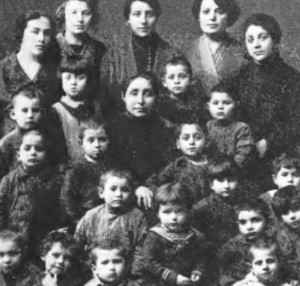
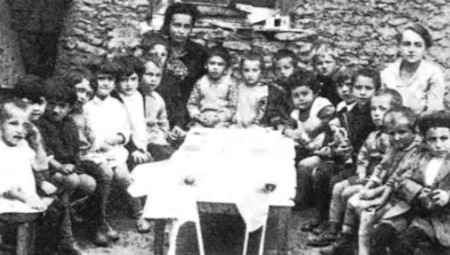
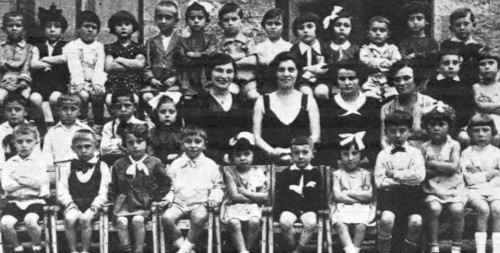
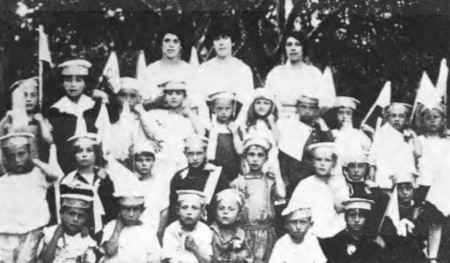
From right to left: 1. Principal Malta Tzeinker (Spector), 2. unidentified, 3. aide Rachel Tzeinker
|
|
[Page 552a]
Translated by Ala Gamulka
Edited by Karen Leon
|
|
From right to left: 1. Principal Malta Tzeinker (Spector), 2. unidentified, 3. aide Rachel Tzeinker |
|
|
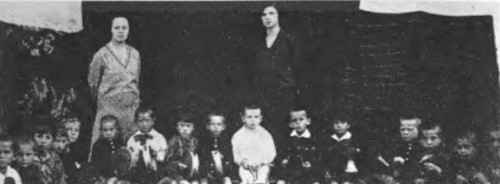
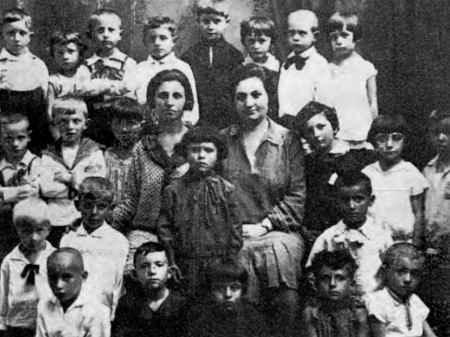
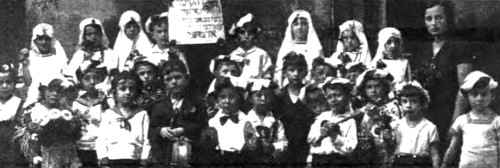
In the middle: Principal Viara Kratchevskaya; student teachers. From left to right: Bluma Schneerson, Bluma Shpan, Rivka Friedman, unidentified, Malca Newhouse |
|
|
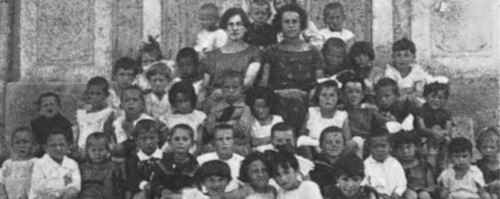
From right to left in the center: 1. Principal Sonia Feinstein (Bronfman), 2. aide Chana Yaroshvitch |
[Page 552b]
|
|
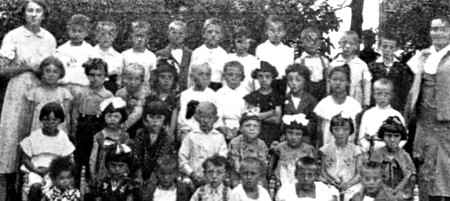
Far left: kindergarten teacher Yael Drachlis (Yaakobi) |
|
|
In the center: kindergarten teacher Khinka Sobelman |
|
|
From right to left: 1. teacher Dasha Posk, 2. principal Sheindl Gorenshteyn (Vinitsky) |
[Page 552c]
|
|
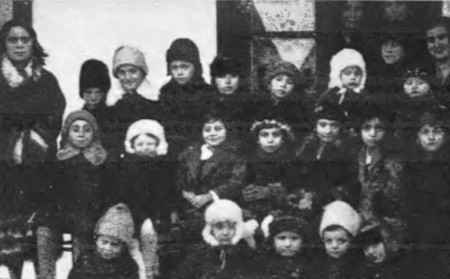
From right to left: 1. teacher Sheyntza Shweid, 2. principal Rivka Shlafman |
|
|
Right to left in the center: 1. Principal Frida Friedman (Schwartz), 2. aide Lerner |
|
|
Extreme right: principal Haya Rekhter; extreme left: aide(?) |
[Page 552d]
|
|
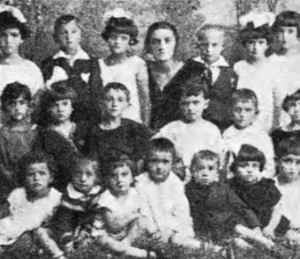
Right to left, in center, seated: 1. pianist, 2. teacher Rachel Vinitzky, |
|
|
On right: teacher Sheindl Gorenshteyn (Nava Vinitzky) |
|
|
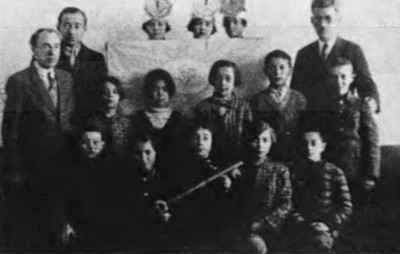
Teachers: David Berman, Zvi Weisman, principal David Muzhulyan |
[Page 553]
They were taught useful subjects like agriculture and various crafts. The center made special efforts to prepare materials in advance for general subjects, needed for the elementary school.
|
|
[Page 554]
These were published. The members of the council were committed to support all efforts by the center to carry out the tasks. The continued existence of the school depended on it.
Publication of the regulation during the 1927/28 academic year increased fears about the new restrictions on our rights. In response to the situation a council of directors met on 20 November 1927, to decide what steps to take. They wanted to publicly denounce the orders of the authorities. The council again chose Tarbut to lead this effort and appointed a delegation to Bucharest to coordinate actions with Jewish parliamentarians. The delegation members included legal counsel Sh. Rozenhaupt, I. Tomarkin, principal of the high school in Beltz, and Dr. Halner, principal of the high school in Markolesht. The delegation presented a detailed memorandum to the government listing the many contradictions in the regulation. It also included a clear statement that the representatives of the Jewish schools were prepared to fight for their existence. These points were also sent to the sympathetic newspapers in the capital.
In the meantime, the Hebrew school continued to exist under unfavorable conditions and worked carefully to avoid being shut down. The struggle between Tarbut and the government did not weaken, even for a minute. At every opportunity, Tarbut pressed for the legal changes required by law. The first real opening came when the chief rabbi, I.L. Tzirelson was re-elected to the Senate in the summer 1926, on the government slate led by General Avarescu.
The rabbi devoted his entire speech, delivered at the first session during the debate on the reply to the throne, to the situation of the national school. He reviewed at length, the history of minority schools, in general, and of the Jews, in particular. He began with the annexation of Bessarabia by Romania and ended with the period of Minister Angelescu, who had suspended all the rights of these schools, in violation of existing laws and of Romania's obligation under the peace treaty it had signed. The rabbi listed, one by one, the amendments needed to add to Angelescu's latest law. He also stated that it was necessary to act justly toward the minorities and to improve Romania's image in the eyes of the cultural world.[36]
Even though Professor Nagulescu, the new Minister of Education, was more accommodating than his predecessor and was ready to compromise, the actual leader shaping opinion was the Minister of the Interior at the time, the well-known Jew hater, the poet Octavian Goga! Goga was one of the first to encourage the antisemitic student movement.
[Page 555]
The movement was defined as an “organic movement of the Romanian peoples.” At the time there were many acts of interference directed against the Jews. As a result of these actions, the Jewish student Falik was murdered in the courthouse in Czernowicz.[37] The accused was found not guilty. Another trial was held in February 1927, against eighteen Jews who dared to defend themselves against two antisemitic students and ended up beating them. For this daring deed, the Jews were sentenced to six months to two years in prison, and fined around 3 million Lei.
At the second session of the Senate in December 1926, Rabbi Tzirelson dared to denounce the government representatives who had supported the rioters. After a deciding vote in the Senate, his speech was set aside and never officially published.[38] As a result of this contemptuous attitude and insult, Rabbi Tzirelson left the Senate. In such a hateful atmosphere, it was not possible for Jews to expect any cultural initiatives or support.
Disappointment by the politics of National-Tzarnists
The National-Tsarnist party (the National Farmers) came to power at the end of 1928. This was the first time tradition was broken in the political life of the state. The Liberal party was no longer the only one in charge. The Liberal party had withdrawn for a brief time, and handed power to their shadow party, the Avoaraskans. This was only a disguise, meant to create the appearance of a two-party system.
The National-Tzarnists presented themselves as a progressive party that cared about the people. They claimed that their radical democratic program defended the needs of minorities. That is why the Jewish community supported them while they were in the opposition, especially in the annexed provinces. They even formed an electoral alliance with the three Zionist organizations in Bessarabia, Bukovina, and Transylvania. The following were successful In the elections: attorney Michael Landau from Kishinev, Dr. Meir Abner from Czernowicz, Dr. Theodore Fisher and Dr. Yosef Fisher from Transylvania. According to the agreement, these representatives were free to work in Parliament on all matters concerning the rights of Jews as a minority.
[Page 556]
Tarbut allowed itself to hope that this time there would be a solution to the painful matter of national education. Perhaps some of the injustices from the earlier administration could be corrected. A special council of principals of Hebrew schools was called on 17 November 1928, to outline the course of action in light of the new political situation. The council approved two plans, one for the near future and one for the more distant future. Two memorandums were prepared to send to the government. In the first, the government was asked to fulfill its duties towards the Jewish minority as stated in the present law, which the earlier administration had ignored. These included: a. Opening government schools with the national language of instruction in areas with a considerable Jewish population, starting with the schools that had been closed. b. Opening a government teachers' college in Hebrew. In the second memorandum, there were several demands concerning public schools: a. To insist on enforcing section 36 of the law and to increase the number of Jewish examiners in the schools. b. To simplify the process for obtaining permanent teaching certificates. c. To grant a temporary permit to all teachers until the law is amended.
The council was pleased with Tarbut's new initiatives and chose a delegation of three to go to Bucharest and present its decisions to the government. The delegation members included Tarbut's legal counsel, Sh. Rozenhaupt; the principal of the high school in Akkerman, Yakov Berger; and the principal of the high school in Beltz, Yeshayahu Tomarkin. A special committee was also selected to prepare the proposals that would be submitted to the government.
At the end of November, the delegation presented the memorandums to the Minister of Education, Professor Kostakascu. The Minister reacted favorably to Tarbut's demands and promised to gradually carry them out.
The three-man delegation met with the Minister again on 16 February 1929. The delegation consisted of Representative M. Landau from Kishinev, of the Jewish parliamentary club; Dr. I. Pistiner from Czernowicz, of the Socialist party in conjunction with the Bund; and attorney Sh. Rozenhaupt, Tarbut's legal counsel in Kishinev. They discussed, anew, the issues raised by Tarbut in their earlier memorandums. This time, the association of Yiddish schools in Bessarabia joined. The delegation intended to not only revisit the original demands, but also to press for a change in the broader attitude of the government toward the schools of the Jewish minority.
[Page 557]
The discussions with the Minister brought satisfactory results on the main issues. He promised to issue permanent certificates to uncertified teachers who had many years experience and to give permanent permits to the schools which had produced satisfactory results in the end-of-year exams. The requirement to hold these exams in the first three years of school would not be cancelled. A Hebrew examiner would be included in the testing committee, and the cost of the exams would be reduced.
Several months passed without progress. The Jewish representatives did not leave the minister alone. In May, during a session at Parliament, Dr. Yosef Fisher from Transylvania reminded the Minister of his promise to reopen the Jewish teachers' seminary. Without the seminary, the future of the national school could not be secured. On May 30th, a delegation came to the Minister's office for a comprehensive and insightful conversation about the public school. This joint committee of the parliamentary club and Tarbut included Senator Dr. Meir Abner (Czernowicz), member of Parliament, and attorney Michael Landau (Kishinev), Tarbut's legal counsel in Kishinev, attorney Shmuel Rozenhaupt, and Dr. Haim Berzis and Dr. Yulian Zilberbush from the Supreme Council in Bucharest.
The delegation received several promises: a teacher seminary would open in Kishinev at the start of the next school year, three government high schools would be established in Kishinev, Beltz and Czernowicz, and some government elementary schools closed by Minister Angelescu would be reopened.[39] It soon became clear that none of this would happen. The Ministry of Education reneged on all of its promises. There were some minimal changes, but the main problems remained.
In 1930, there was an attempt to take the discussion from the narrow confines of the education ministry to the upper forum of the state, in Parliament. It was thought that this would encourage the government to act and free the school from the contradictions and obstacles existing in the Angelescu regulations. The third Tarbut conference was held at the beginning of January 1930. Its decisions on the legal status of the school were based on a report submitted by Representative Landau to the education minister. Landau expanded the report about the cruel decrees thrown at the schools.
[Page 558]
He summarized the concrete demands of the conference and brought the full text to Parliament.[40] The government did not respond to this request and again postponed it. Tarbut had to try an innovative approach. It urged Parliament to amend the existing law. The central committee and the legal counsel prepared the amendment, and Landau presented it on 26 January 1931. As usual, the amendment was sent to the legislative council for its opinion, and it was returned to the parliamentary education committee on March 10.
A translation of the amendment follows. An original copy is available in the addendum section at the end of the book on page 667.
Assembly of delegates/on a quorum 1930-1931
The bill is a parliamentary initiative
Changes in regulations of private education
To the education committee, 23 March 1931
Explanation
Dear Delegates,The application of the private education law of December 1925 showed many deficiencies in practice that the present proposal could possibly eliminate. The legislator explained that the purpose of the proposed new law is to encourage private education as a support for public education. A quick look at the law shows that it was built on a lack of trust in private education and that normal development was impossible under such conditions.
When one examines the law, it is impossible to find an indication that the school has any rights. In every section one finds the words, “impossible,” “not allowed,” etc. Nowhere do we see “the school may”.
One example is sufficient to illustrate the current situation. Students in private elementary schools must pass tests at the end of the year. As a rule, students in private schools (except for schools with special rights) have no rights at all. They are not preferred over those who study at home. The fact that students must pass tests every year is an unpedagogical approach and is torture for students and parents alike. It also lowers the standing of the private school teacher in the eyes of his students.
[Page 559]
In addition, the tax on tests presents a burden on parents who do not have the means to afford it.
The law was difficult to apply to minority private education. Two examples illustrate this. The law requires the teachers to have the same qualifications as those in public education. To fulfill this requirement, there must be seminaries for minorities. This has not yet happened.
It is a fact that, under the law of public elementary education and the law for the certification of teachers, it is possible to establish a section for training minority teachers. However, this has not occurred. If the government cannot set up these institutions because of budgetary reasons, it is unfair to deny private concerns the ability to do so. This is the reason for proposing the changes in sections 7 and 8 of the law.Second example: the law does not state in which language the students should be tested. As a result, an abnormal situation has evolved in which students educated in their national language must be tested in the language of the country. The results were horrendous. The present proposal seeks to correct the situation and to award the private school, at least formally, a more honorable standing. This would also benefit public education.
(Signed by 27 members from various parties. Michael Landau, Dr. Theodore Fisher, and Dr. Yosef Fisher led the Jewish party.)
The Legislative Assembly focused on two main aspects of the proposal: a. Allowing minorities to support teacher seminaries, and, b. Clarifying the rights of students in minority schools to be tested in the language of their school. The Assembly decided upon the following: a. The Private Education Act of 1925 says that the state will continue to have the right to train teachers, since they shape the spiritual identity of the students. However, sections could be formed to train minority teachers. The new proposal negates the fundamental principles of the law. b. The law stipulates that only the government has the right to award diplomas, and only to those who know the language of the country. This cannot happen if Romanian is taught merely as a subject. The students must be tested in Romanian in all subjects.
[Page 560]
This is not meant as a slight to the minorities. They may continue to teach their national language.
As to the other proposed changes: a. Co-educational classes to be permitted in the first four years of high school, and, b. Permitting elementary school students to take tests at graduation and not every year. The assembly believes that, a. Co-educational classes were never allowed in the state as it does not suit the spirit of the people, and, b. Annual testing is necessary for pedagogical reasons, as it provides a clear and steady check of the students' knowledge.
In addition to the above, the reply by the Ministry of Education should be noted. The Assembly followed its directives. The Ministry does not usually change the laws of private education. Adjustments can always be made in the form of directives, as long as they remain in the spirit of the law.
(Original version can be seen in Addendums on page 668)
In the end, the proposal did not reach the stage of discussion due to the short life of the government. This was common in Romania and it shaped the government's attitude to the private initiative.
Despite these failures, there was some good news for the school. The brave struggle improved how the education authorities viewed the school. It was fortunate that the Romanian clerks were not consistent in their fanaticism. They were accustomed to making concessions due to the frequent changes in government. Even senior officials were mostly easy going and prepared to make temporary accommodations, often to appease Jews prior to elections. The legal status of the national school depended on the narrow limits set around it. At the same time, Tarbut and the school administration made great efforts to adjust to the new conditions and carefully follow all required formalities. In addition, the Hebrew school had a strong pedagogical reputation which earned it respect from the educational authorities. The education department inspectors noted in their official reports, the high quality of the teachers, even those without certificates, and the excellent exam results, even in Romanian subjects. This was in comparison with public schools. These remarks were a useful tool in defending the school's existence.
[Page 561]
The temporary easing of the new law that Tarbut was able to secure from various governments included: a. Students in grades I, 2 and 3 did not have to take final exams (as stated by ministers Nagulescu, Prof. Petroviitz and Dr. G. Lupu between 1926-28); b. The exam tax was reduced to a reasonable level; c. A promise to include Hebrew examiners on examination committees starting in 1929, following Prof. Kostacasku's appointment in the National Tsarist government;[41] d. Certification of previously uncertified teachers based solely on their education and teaching experience; e. Temporary approval of textbooks published abroad, beginning in 1929/30, and for the first time in the state's history, a special, although minimal, budgetary allotment for the school.
A. Lack of proper teachers
One of the most serious problems that hampered the development of national education was the lack of certified teachers at the elementary level. As is known, the law forbade establishing seminaries for teachers for the “private” sector. From time to time, the education ministry delayed, for various reasons, the opening of a special section in the Normal School, to train teachers for Jewish schools. A new campaign emerged among graduates of public schools with knowledge of Hebrew, as well as among Hebrew high schools. However, they did not all have the necessary pedagogic preparation and could only obtain a temporary permit, renewable on a yearly basis.
The practice of issuing temporary permits to teachers who had only finished high school arose from the government's decision that two thirds of the teaching staff had to be certified. This happened when the annexation of the provinces revealed there was no established educational system. This temporary practice was also applied to the national school. However, since permanent permits were not issued, it caused a difficult struggle between Tarbut and the Ministry of Education.
All of this pertained to teachers of secular subjects in Hebrew or Romanian. When it came to Hebrew studies, language, history, Tanach, etc., there was an agreement with the ministry to recognize certificates issued by chief Rabbi I.L. Tzirelson. The Rabbi granted the certificates based on Tarbut's recommendation (see the agreement on page 665), and after he verified the candidate's Hebrew knowledge.
Original footnotes:
|
|
JewishGen, Inc. makes no representations regarding the accuracy of
the translation. The reader may wish to refer to the original material
for verification.
JewishGen is not responsible for inaccuracies or omissions in the original work and cannot rewrite or edit the text to correct inaccuracies and/or omissions.
Our mission is to produce a translation of the original work and we cannot verify the accuracy of statements or alter facts cited.
 The Jews in Bessarabia
 Yizkor Book Project
 JewishGen Home Page
Copyright © 1999-2026 by JewishGen, Inc.
Updated 16 Mar 2026 by JH