 |
|
|
[Page 524]
by Yosef Leib Fiszer
Translated by Gloria Berkenstat Freund
In 1910, almost all of the young in Zawiercie were weakly developed, both culturally and physically. The boys studied in khederim [religious primary schools] and they did not take care of physical development there or even noticed it.
This I remember through an association with my last kheder which was located at Plawner's at Marszalkowska, near Pietrowa Square, which all Zawierciers remember well. It was not much better in the [secular] “schools,” for example, in Zlotnik's folks-shule [public school], which was in Grinwald's house on Marszalkowska.
Yes, not one of the educational “institutions” in Zawiercie took care of the physical development of the students, but there awoke our desire for physical activity for our bodies. We would let loose a little during our free time; we would jump over fences along the railroad. We would play various games on Pietrowa Square and so on. Thus, we would harden our muscles.
In 1914, I finished Zlotnik's Russian School and left for an apprenticeship with Yosf Meszngiser a few months before the outbreak of the First World War.
During the war, many young people left for Germany. A number worked there; others opened businesses. The ranks of the previously created sports clubs that developed well during the First World War and showed great achievements, little-by-little had fewer members. The sports organizations that were founded during the First World War were incapacitated.
In 1919-1929, in independent Poland, we again began our activity. A group of [potential] Jewish emigrants to Eretz Yisroel was created that had as its purpose to organize emigration to Eretz Yisroel . Young people from various strata took part in the group. The leaders of the group were: Leibl Dimant, Meir Iserowski, Volf Sztajnkeler and others. We wanted to work to
[Page 531]
|
|
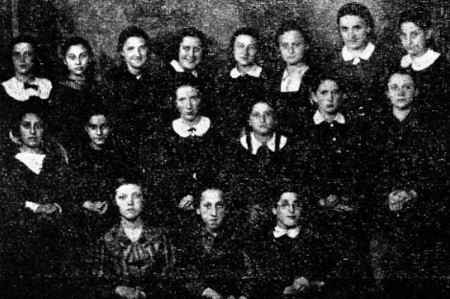
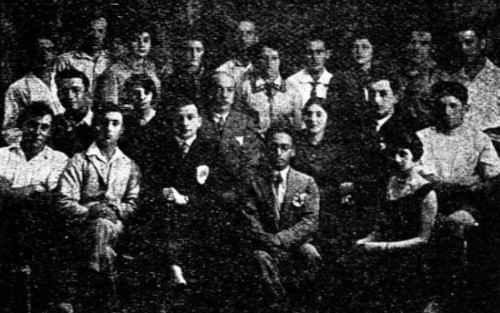
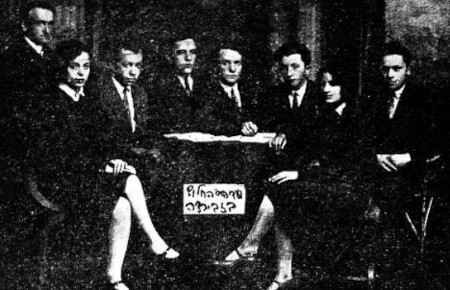
| The council of the Halutz organization in Zawiercie |
earn money for the cost of the trip to Eretz Yisroel . Alas, the entrepreneurs in Zawiercie did not support us with work and our plan to save travel money came to nothing.
Alas, Shimshon [Samson – a Jewish sports club] also split into two separate sports unions: into Makabi and Hakoakh [the Strength]. One, the Makabi Club was mostly working young people. There were mostly students and pupils in Hakoakh. The two clubs competed against each other and this led to a great deal of harm.
Various Halutz [pioneer] groups were created. We also organized small football [soccer] groups, but they did not exist for long.
In 1927, a large sports club, Shimshon , was created (under the management of Dr. Lewensztajn), with the participation of young and older people for whom a Jewish sports movement was a necessity.
We received premises at Goldminc's and threw ourselves into the work with complete fervor. We created various groups according to age and even groups for folk's shul [public school] children.
On the managing committee of Hakoakh were Tosziek Borensztajn, Volf Sztajnkeler, Perlin, Zajfman, Fiszer, Hela Krajcer, Masha Lemberg,
[Page 532]
the Grinsztajn brothers [and] Stubnicki. We also created a technical management group that consisted of Grinblat, Stubnicki, Zelkowicz, Pardes, Dora Breszinska, Zilberman, Rozenberg, Perlmuter, Granek, Sabelman and Fiszer. We could not work for long because there was a lack of the necessary material support, although Yitzhak Windman, Hershl Grinwald and others gave money to support the club. Because of the financial conditions, we found it necessary to merge both clubs. After the merger, a managing committee was elected consisting of the following members: Rotensztajn, Grinsztajn, Yachetzon, Karol Potok, Zelik Sobelman, Zelkowicz, Fiszer, Grinblat. The management group of the touring section found it necessary to arrange a large, public gymnastic spectacle in which 14 groups took part. The management was in my hands as well as in the hands of Grinblat, Fajgnblat, Drezner, and all of the girls in the technical management group. In the midst [of all of this], a dramatic group was created under the management of Yachetzon. They arranged very interesting performances with great success. The unity of the merged sports club lasted until the creation of Betar [Revisionist Zionist youth group created by Ze'ev Jabotinsky]. Betar arranged for its own sports organization. This weakened the strength of Hakoakh-Makabi , because the new organization developed well. From time to time, we took excursions with the sports clubs and with other youth organizations from the nearby cities – usually, Bedzin and Sosnowiec.
Later, we decided that we should create a children's section at the sports club and that I should do gymnastics with the folks' shul children outside of the framework of the club.
Our activity, directly or indirectly, influenced the children from the pious circles whose fathers, because of their piety, were against the sports clubs. I remember such a case with a boy, the grandson of Moshe the shoykhet [ritual slaughterer]. Doctors advised him to do gymnastics. His mother turned to me to do gymnastics with him in their residence because his father would not permit him to go to the Hakoakh club for gymnastics. I agreed to the request of the woman and gymnastics helped the boy a great deal.
There were many such indications of the indirect effect. However, there also were such cases of a direct effect. Many children
[Page 533]
with pious parents were active members of the sports club, although the pious parents had forbidden this. We had to hide the attraction of our popular and energetic society for these young people.
Our sports club and other clubs would also arrange several times a year for the Dobroczynność [Charity], at which the assimilated “Germans” such as Wajc, Mamelok, Brandes, Wajntraub and the pseudo “Germans” like Margulis, Frenk, Adelis and many others, were active. The Dobroczynność took care of many poor Jews in Zawiercie.
It is particularly worth recording that an imposing Purim ball was organized with our help. The preparation began two months before the ball (gathering food for the buffet, presents for the lottery, cash, and so on). The income from the ball was dedicated to help for Passover for the poor Jewish population.
In these actions, we saw how devoted these Jews (who in general only were in contact with Christians) were to their poor brothers. Thanks to Mamelok and Wajcen, we received the largest hall in the city, Dom Ludowy [Ice House], which not just anyone could receive, for our use.
Large masses came to the ball, not only from Zawiercie but also from the surrounding area. It was satisfying to see that all this was worth doing to help the large number of needy people in the city.
|
by David Brott
Translated by Jerrold Landau
It was 1929 – the year of the 5689 disturbances in the Land. A wave of shock swept through the Jewish youth. In the face of new problems, problems burning like fire, the Zionist, pioneering youth in all places stood up in the face of the bloodshed on the soil of the homeland. That year, the first news of the organization of a new youth movement, which began to set roots among the Jewish youth of Poland, reached our city as well.
Etched on the banner of that youth movement, which was founded by the eminent leader, Zeev Jabotinsky, similar to the entire Jabotinsky movement, was: uncompromising struggle for greater Zionism, for a large Jewish state on both sides of the Jordan, for a war against the oppressive Mandate government, for a war against defeatism, against restrictions, and against compromise with the foreign conqueror, a war of destruction against the Arab hooligans.
In this survey, we intend to describe the development and strength of Beitar in Zawiercie.
Despite the wide-branched educational activity of the pioneering youth movements in our city, strata of youth remained who were outside any organized framework. The youth were prone to the destructive influences of the street. Beitar directed its steps to those circles of youth.
|
|
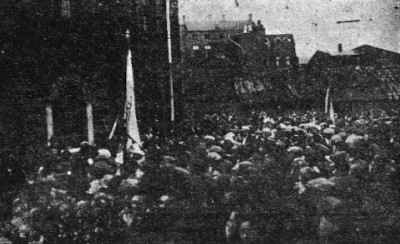
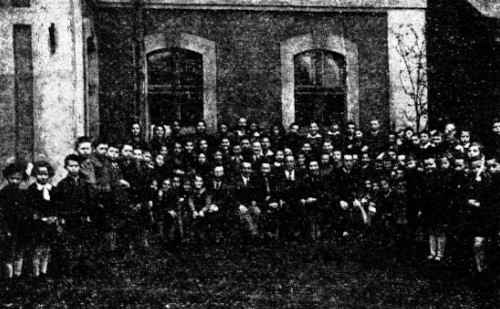
| A Beitar gathering next to the synagogue |
[Page 535]
The idea of Zionist-national education did not easily penetrate into the hearts of those who for the most part grew up in an environment of detachment from or indifference to the general Zionist idea. Quiet but wide-branched activity began: discussions on Zionist topics were conducted, courses for the study of the Hebrew language and knowledge of the Land were arranged, etc. Drop by drop, the doctrine of Herzl-Jabotinsky penetrated into the hearts of the youth who gathered around Beitar. Physical education developed alongside the development of spiritual values. The backbone of the youth who organized straightened in stages. Its spiritual image was also forged.
The first period of consolidation passed. In its wake, the Beitar chapter earned full recognition from the local Zionist organization. It was recognized as a body with equal rights and duties to other bodies. The chapter became well integrated into the wide-branched Zionist activity that was conducted in our city. We excelled in activity on behalf of the funds. Our members went out to Hachsharah places in Baranowicze, which served as preparation for Aliyah to the Land.
Yosef Chmielnicki, a known personality in Zionist activity in our city, was the driving force behind the organization of the Beitar chapter in Zawiercie. He stood at the head of the organization as its first commander. The paths of the first Beitarites in our city were not paved with roses. The circles of Zionist youth in the city related to them negatively, with denigration and mockery. There were serious doubts, but in the end, the Beitarites attained an honorable status within the local Zionist youth movements. That was thanks to their stubborn struggle for the right to exist and the educational activity that they developed amongst the youth of the city.
In Zawiercie as well, similar to other cities and towns in Poland, several personalities who broke forth from the restricted framework of a regional leader were prominent. They earned for themselves an honorable place in the leadership of the Zionist movement in Poland.
In our survey of the Revisionist movement in our town with all its branches, we do not fulfil our duty if we do not dedicate some words – and not in brief – about the life story of Yosef Chmielnicki, the founder and leader of the Zawiercie movement. Chmielnicki was from a traditional family. He absorbed the love of Zion and Israel already during his youth. Chmielnicki received his first Zionist education in the city of Herzl – Vienna. He did a great deal in Zawiercie to instill the Zionist idea into the hearts of every Jew and especially in the hearts of the youth. As a dedicated activist in the arena of the funds, he worked on their behalf with his heart and soul. He was among the founders and participants in the Hachshara groups on Dr. Lewensztajn's farm.
Indeed, he talked well and also acted well. When he joined the Revisionist movement, Chmielnicki was among the first commanders of the Beitar movement in Poland. He participated as a delegate to the world conferences of Beitar and the Revisionist movement in Danzig, Vienna, and Kraków.
Chmielnicki was a talented educator. To us, his students, he gave over the entire warmth of his heart and love of Zion. He was active and vibrant until the final moment, when the destruction came.
[Page 536]
|
|
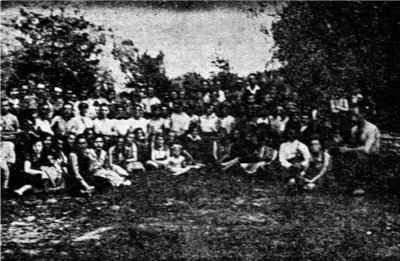
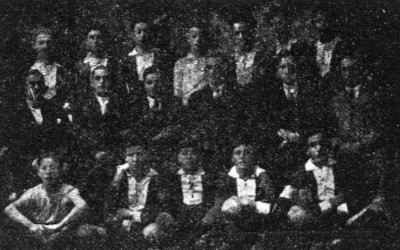
| A Beitar excursion |
The commander did not merit to bring his charges to the desired goal. He lived and worked with the love of Israel, and, for that, he fell in his line of duty.
There were many youths in Zawiercie who developed and grew up under the wings of the commander, in the spirit of the love of Zion and Israel. The evil hand of destruction also hovered over their lives. The song of their lives was cut off in the middle…
However, from among all his charges, let us highlight the second commander of the Beitar chapter, Leibel Rozenberg, who was considered to be a prodigy. In all places, he stood out with his great talents. He too fell at the hands of the Nazi foe.
Memories tinged with sorrow and grief remain in the heart regarding a lovely, vibrant, and dynamic world – a world full of aspirations and hopes, alive and invigorating, advancing and uplifting.
And now – everything has vanished like smoke. We, who have become orphaned, remain with our sacred memories in the storehouses of our hearts. With such memories, one unites and draws influence for one's future deeds.
The elders of the chapter were sent to a central course for counselors in Warsaw to train additional counselors for the purpose of absorbing new charges. A regional course for that purpose was held in Żarki.
[Page 537]
In the wake of these activities, the ongoing educational and publicity activity increased, and new blood flowed into the veins of the movement. Sister movements arose, such as Brit Hatzaha"r (Revisionists), Brit Hachayil, Massada, Brit Yeshurun, and others.
From the oblivion of the past, I draw great moments, unforgettable sublime moments, that exalt the past, even though they were heartwarming in their simplicity. The Beitar chapter had its own happy occasions, local and district conventions, the dedication of the premises of the chapter, receptions for leaders of the movement, activities on behalf of the Land of Israel. Indeed, the Beitar chapter participated prominently in all the general Zionist public events, such as protest demonstrations against the Mandate government in the Land, assemblies for the 20th of Tammuz [Herzl's yahrzeit], youth gatherings on Lag B'Omer, and meetings with emissaries from institutions from the Land of Israel. The Beitar chapter in Zawiercie played an important role in all the general events of the Zionist movement in the city.

by Sala Jakubowicz-Zilbersztajn
Translated by Gloria Berkenstat Freund
Since my youngest years in Zawiercie, I was active in Halutz [Pioneer], in P. A. F. [Polish Worker's Fund] of Histadrut [General Organization of Workers], as well as in the Zawiercie branch of the Friends of the Jerusalem University (as secretary of the branch from 1924 to 1926).
I was also active during the founding of Tzerei Zion [Youth of Zion] (founders Dovid Landau, Shabtai Klugman, the Turner brothers, Yeshaya Baumac, Yehiel Simchowicz and others).
Shabtai Klugman gave an ideological tone to Tzerei Zion. He gave lectures about current matters. Yeshaya Baumac (today Dr. Yeshaya Baumac, a well-known psychiatrist in [Israel], manager of the government's Station for Spiritual Hygiene in Jerusalem and Be'er Sheva) gave his interesting lectures on cultural themes. Dovid Landau, Dr. Potok, and Meir Iserowski (now in Magdiel) would also give lectures.
In addition, courses about Zionism, Jewish history, and the Jewish National Movement were also organized. Special attention was given to the study of Modern Hebrew in various courses. The very skilled teacher of Modern Hebrew,
[Page 538]
|
|
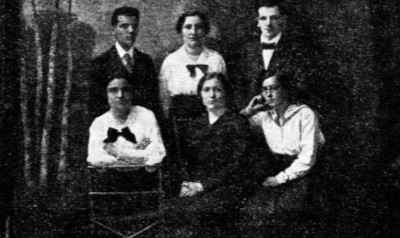
| A Group of Activists in Tzerei Zion |
Kopl Minc, excelled with the Modern Hebrew courses [and] was then very popular in the city. In the end, Dovid Werdiger, Reb Shabtai, the cantor's son-in-law, who remains in our memory as the nicest figure from Hovevei Zion [Lovers of Zion] taught us Modern Hebrew. All the Zawierciers in Israel can confirm this.
Of the various youth groups in Zawiercie I remember: Hashomer HaTsair [Youth Guard], Hahalutz Haklali [The General Pioneers], Betar [Revisionist Youth Organization], Hashomer Hadati [The Religious Guard], Tserei Mizrakhi [Mizrakhi Youth Movement] Masada [Young Men's Zionist Organization], Herzliya, HaShakhar [The Dawn] and many others.
The nicest figure in our Zionist life was Meir Frenk, who was torn away from us very suddenly during the First World War. Meir Frenk had a great influence on the development of the Zionist movement in Zawiercie thanks to his tact, political sense, unlimited self-sacrifice to the ideal of Dr. [Theodor] Herzl, whom he had the merit to hear at the Fifth Zionist Congress, to which he was delegated for the first time by the Zawiercie group.
Later, working so devotedly for Zionism, was his brother, Yisroel Frenk, who was president of Tserei Zion and Tarbut [Zionist network of educational institutions]. He won the great trust of all Zawiercie communal circles and, particularly, of the Zionist circles, for his honest and
[Page 539]
devoted concern for all problems connected with the Zionist ideal. The entire Frenk family was loyal to the Zionist ideal. Reb Leibush Frenk was one of the first [members of] Hovevei Zion [Lovers of Zion] in the city.
Essentially, my “intuition” was influenced by the reality then: we had seen the Jews who had looked for support in our region in Poland; in Upper Silesia, the Nazis had already begun to persecute the Jews and in Poland itself [Józef] Beck had begun to flirt with the Nazis. I felt that we had no other choice than to emigrate to Eretz Yisroel. Alas, not all Zionists understood this in time.
From among the many devoted co-workers for the welfare of the Zionist movement, I will record several: Yosef Khmielnicki, who was particularly devoted to the Betar movement and its leader, Ze'ev Jabotinsky. Almost the entire Khmielnicki family served this ideal. The still dedicated Moshe (Meitek) Nauman was extremely active in the youth movement, in all of its pioneer directions. Pinkhas Zilbersztajn, previously an activist in Hahalutz Haklali, later became secretary of Betar and helped immensely in the organizational construction of the movement. My brother, Shmuel Zilbersztajn, [who] perished at the hands of the Nazi, also was active in Hahalutz. They worked at Dr. Lewensztajn's farm, both in the garden and in the field work.
It is worth recording that Dr. Lewensztajn – an assimilated Jew (his wife was a Christian by origin)
|
|
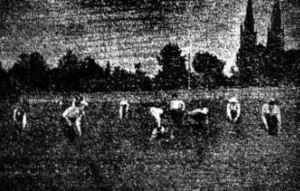
| Pioneers working Zawiercie fields – the church is in the background |
[Page 540]
|
|
| A group from Zawiercie after immigrating to Israel |
worked with us. They gave us mechanical instructions as to how to work in the field and the garden. We benefitted a great deal and had a great deal of spiritual pleasure from it.
We gave the greatest part of the profits from our efforts to the central halutz [pioneer] organization.
Under our influence, Dr. Lewensztajn deemed it worthy to donate his private library to Jerusalem University (which had then opened in 1925).
Tosziek Bornsztajn – the very talented and devoted Zionist of the younger generation – took over the sending of books to Jerusalem. He, as the Zawierciers who lived through the terrible time of Hitler in Zawiercie said, as manager, he led the food warehouse in the ghetto honestly and with honor. He fell from a Nazi bullet when the rampaging Nazis shot into the courtyard where the Kromolwer Rebbe lived on the day before the last deportation. Among others, the lawyer Teodor-Benyamin and (Tosziek) Bornsztajn fell there.
It is proper to remember his father first, the Zionist
[Page 541]
veteran, Reb Avraham Bornsztajn. He was the first and the oldest chairman of the Zionist circle (or Zionist organization) in Zawiercie. He also made himself beloved with the Christian population as a liberal and educated Jew and he was elected as vice president of Zawiercie.
I will never forget the celebration in honor of his 30 years of activity in the Zionist movement. The celebration took place in the private residence of the well-known rich man and activist, Reb Yehiel Windman. In the decorated rooms, in which there were richly decorated tables, accompanied by the sounds of music, the celebrant was carried on an armchair to the head of the main table. The celebratory part of the banquet was organized by the youth groups of every shading. The young ended the banquet with song and dance.
Reb Avraham Bornsztajn justly earned this honor. He was one of the first Hovevei Zion [Lovers of Zion] in our city and then one of the main spokesmen of the Zawiercie Zionists until his last breath.
As is said, he died in the middle of the street of a heart attack, reading about the decree of the famous English “White Paper” that was supposed to immobilize our growth in Israel.
Reb Avraham Bornsztajn and his wife raised all of their children in the Zionist spirit. Doing this, they were a model for all of the Zawiercie young people.
|
by Avraham Yosef Grinblatt
Translated by Jerrold Landau
Others have already written about the sports movement in Zawiercie. I only want to briefly supplement the surveys that had been previously written for our memorial book.
Aside from the non-organized games of the youth, there were no sporting activities until 1916. Then, the first organized excursion of Hakoach of Będzin arrived in Zawiercie (and if I am not wrong, also from Dabrowa and Sosnowiec). A sports director who had served in the German army trained the Hakoach of Będzin. From among the athletes who came to Zawiercie, I recall Artush Wiener, Zigreich, and the girls, Firstenberg and Hampel.
The progressive Zionist youth in Zawiercie were impressed by this demonstration, and they immediately began to organize. Hashomer arose, whose purpose was, among other things, to lift the Jewish youth of Zawiercie up from their state of physical atrophy. Moshe Edelis led the youth in free-form exercises. Dodek (David) S., who came to Zawiercie during that period (with his stepfather, who became the director of the old Nesher factory in Ogrodzieniec), immediately became one of the leading advocates of Jewish sport in the city. He began to organize us with vast knowledge. (He had formerly been the sports director of Maccabee in Warsaw.) It is possible to state that he was the founder of the sporting movement and its patron in our city. To our sorrow, his end was not like his beginning.
|
|
| The basketball section of Hakoach |
[Page 543]
All of this was directed under the rubric of Hashomer. However, not much time passed before the Jewish sporting movement in the city began to feel that it was too restricted within the four ells of Hashomer, which veered more to the left and reorganized as Hashomer Hatzair.
Hakoach (the organization for physical training and development) arose. Of course, its orientation was Zionist. A course for counselors, with about ten to twelve individuals, was formed, the purpose of which was to give systematic training to all those who were disseminating the principles of sport to others. The first ten to twelve who participated in the course were from among the best sportspeople in the city.
All the Zionist organizations, as well as the tradespeople's organization, were patrons of the sporting movement in the city. There were schisms and reunifications in the movement. It should be noted that the active organizations in the city (especially the Fareinikte) organized active sporting organizations. (The organizers were Chaiml Grinsztejn, Guten Bornsztajn, Itzik Rotmentch). That organization did not maintain its existence for long.
The development of the sporting movement in the city was more or less normal until 1927. With the emigration of the youth from Zawiercie in 1926-1927 (most made Aliyah to the Land of Israel) the movement was left without leadership. Our attention was turned to Leo Rotensztajn, who took interest in Jewish sport. He was chosen as the chairman of the council of the sports organization. That choice was fortunate for the sporting organization in the city. Leo Rotensztajn was a very experienced bookkeeper and administrator (for a brief time, he was the bookkeeper at the Bank Współdzielczy [Cooperative Bank]). He came to our city in 1913 and died there in 1930. An impressive funeral was conducted for him, and a large crowd accompanied him on his final journey.
Rotensztajn started the work with enthusiasm and energy. He concerned himself with settling the many debts of the organization. He made sure that meetings of the directors would take place on a regular basis (something that was not in place previously). He led gymnastics classes and structured exercises, and organized excursions and various programs, such as competitions with basketball teams from the region.
Rotensztajn's death was the death blow of the sporting organization in the city. After his death, only a very weak basketball section remained.
by Yerachmiel Zelivansky
Translated by Gloria Berkenstat Freund
In 1938, on the eve of my emigration to Israel, I came to Zawiercie to say goodbye to Zionist friends who had shown so much self-sacrifice in support of the hakshore [preparation for emigration to Eretz Yisroel] work and, particularly, the agricultural farm. The farm was created with the help of the Honorable Gentlemen: Windman, Liberman, Szwarc, on a large area with a two-story house in Borowa-Poland. The farm had a field of cattle and poultry; here about 30 halutzim [male pioneers] and halutzus [female pioneers] were prepared for emigration to Eretz Yisroel. The fine educational farm was led by the Zionist Zawiercier Patron, at the head of which stood the leader of the WIZO [Women's International Zionist Organization], Mrs. Anna Marglis, the lawyer, Tosziek (Teodor-Benyamin Zev) Bornsztajn, etc. The place, at that time, was the main attraction for the young Jews. They, the young people, drew from it spiritual and technical information. Thanks to the influence of Halutz, many left for hakshore and, from there, to Eretz Yisroel.
I, as an emissary from the Halutz center, had many, many opportunities to become more familiar with the communal Zionist work in Zawiercie; a great deal of self-sacrifice and dedication was shown by the young there in helping to build their own country and supporting [the] Hebrew [language]. This was the fulfillment for the Zionist young people and the older ones in Zawiercie.
The last theater: in 1937, a theater performance was organized by the Herzliya kibbutz [communal settlement], which took place in the municipal movie theater [and] was turned into a grandiose demonstration for Eretz Yisroel. Because of the great scarcity [of space], the Polish police had to restrain those who stormed the national celebration en masse.
|
|
JewishGen, Inc. makes no representations regarding the accuracy of
the translation. The reader may wish to refer to the original material
for verification.
JewishGen is not responsible for inaccuracies or omissions in the original work and cannot rewrite or edit the text to correct inaccuracies and/or omissions.
Our mission is to produce a translation of the original work and we cannot verify the accuracy of statements or alter facts cited.
 Zawiercie, Poland
 Yizkor Book Project
 JewishGen Home Page
Copyright © 1999-2026 by JewishGen, Inc.
Updated 19 Nov 2026 by JH