 |
|
|
[Page 483]
by Shoshana Steinberg Bar-Natan, Magdiel
Translated by Jerrold Landau
In the year 1928, when modern Hebrew education had not yet penetrated the Zaglebie district, the leaders of the Zionist organization in Zawiercie decided to include the founding of a Hebrew kindergarten among its activities. The network of Hebrew education in Poland, called Tarbut and headquartered in Warsaw, provided a kindergarten teacher and schoolteachers to the outlying towns, and I arrived in Zawiercie through them. I indeed found organizations that were connected to the Zionist idea, and also worked on its behalf, but the Hebrew language was spoken fluently by only a few – mainly men whose knowledge of Hebrew came to them through their Torah knowledge. There were attempts here and there in the youth organizations to include the Hebrew language, but these did not have great success.
The Zionist activists who invited me felt the need for foundational Hebrew education. They used every means to carry this out.
The task was not easy. The cohort of children I received was divided into two groups: the vast majority came from Polish speaking homes. Furthermore, their connection to Jewish tradition was weak. The second group, which was the minority, came from partially observant homes. The kindergarten committee was interested in developing the first institution with a Hebrew character, and worked to the best of its ability to sustain it.
Indeed, it was not easy even for them, without government support, to secure premises and equipment, and to cover all the other expenses needed for the maintenance of an educational institution. It was only thanks to dedication and goodwill that we stood up to all the various obstacles that piled up from the beginning. The following deserve favorable mention, Messrs. Frenk, Margoles, and Turner. Throughout the five years that I worked in Zawiercie, they displayed understanding and appreciation for everything connected with the kindergarten.
The first very important difficulty was the unsuitable premises. The kindergarten was housed in a room that was indeed large, but could not by any stretch meet the needs of the kindergarten. Aside from that room, we did not have any ability to use any other part of the house. It was only because of the polite relations with the Landau family (the room was part of their house) that my work conditions were eased somewhat.
Two years later, we moved to a second premises (Nowy Rynek) that was a bit more suitable,
[Page 484]
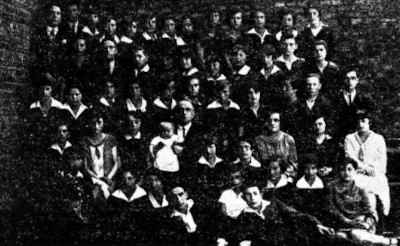
however, there too, the situation was still far from being able to respond to our modest requests. Thus, we moved for a third time. This time, we received three rooms and an anteroom in the home of Yisrael Margoles. Most important, there was a clean and orderly yard. With all this, the inadequacies of the premises did not impede the development of the kindergarten, [even though] we were unable to accommodate all of the children who knocked on our doors.
|
|
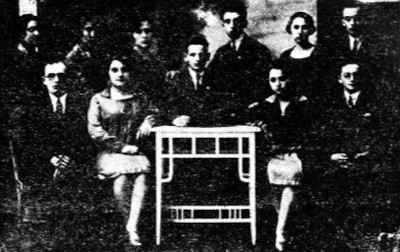
| The kindergarten committee and the kindergarten teacher Shoshana |
Indeed, it was a delightful corner, and, along with that, it instilled the basics of the Hebrew language and nurtured the Jewish spirit. Above all, it created the atmosphere of the Land of Israel in the Diaspora. More than once did I hear from the emissaries of the Zionist funds, from the Land, when they visited the kindergarten, that they felt that they had not left the Land at all, and had just by chance come to visit a kindergarten to enjoy the pleasantness and liveliness of the kindergarten students.
The Continuation – the School
The first Hebrew institution required a follow-on. When I stood up to demand the opening of a school so that the children who graduated the kindergarten would be able to continue their Hebrew education, I encountered a great deal of hesitation, “Can we maintain a school? Does it have a future in our area with the tradition of Polish and government schools?”
With strong pressure from my side, and my refusal to continue in the kindergarten if there were no continuation, the Tarbut functionaries gave in. They again mustered initiative and strength, and opened a school, which took in the graduates [of the kindergarten]. Within a brief period, the school justified its existence, and it changed the Jewish atmosphere of Zawiercie. –
by Chaya Efron Rothstein
(founder of the Tarbut School in Zawiercie)
Translated by Jerrold Landau
In 1930, I was sent to Zawiercie by the educational headquarters in Warsaw to found a Hebrew school there. After much hesitation, I agreed to accept the yoke of this task upon myself. I knew that assimilation in Zawiercie was voraciously consuming, and I was uncertain if I would find people there who would be able to collaborate with me in that area, and whether I would succeed in instilling the Hebrew language and culture.
However, I found out after a brief period that my concerns were in vain: the members of the committee – Yisrael Frenk, Y. Margoles, and Sender Turner, dedicated themselves to this matter with diligence and unusual commitment. They offered me maximal assistance in all areas. The first class, consisting of fifteen graduates of the kindergarten, was created in Margoles' house. The kindergarten had already existed in Zawiercie for two years, and was under the competent direction of Shoshana. (She later lived in Magdiel as Shoshana Spivak, the wife of Yitzchak Spivak. After the death of her husband, she married Dr. Bar-Natan, a physician in Magdiel.)
Since the income was small (the main source of income was tuition), I agreed to concentrate all the work in my hands. I served as the principal, teacher, and secretary all together. The Polish teacher was Manya Bleifer.
The work brought me great satisfaction after I realized that the parents, the committee, and the children were connected to the school with bonds of love and dedication, and were prepared to do anything to improve the conditions of its existence. The committee would often invite speakers and arrange celebrations and parties, the income of which was dedicated to the school.
How great was my happiness when I saw how the children were reading Hebrew and chatting in Hebrew. I lived their lives. I connected to their parents and felt that I was among a group of close, dear people, who knew how to appreciate and honor others.
I arranged the school's first celebration in the movie hall, in the presence of a large audience. The children performed, declaimed, and danced, carrying out the entire program with great success. At the end of the performance, the elderly Reb Avraham Bornstein approached me, clasped my hand, and recited the Shehecheyanu blessing, adding, with tears in his eyes:
“Be blessed, our dear teacher, who brought us to an era where we hear with our own ears our children – who did not know what Judaism was – speaking, singing, and performing sections of plays in Hebrew.”
[Page 486]
The number of students in the school grew from day to day. I began with fifteen children and ended with fifty-six. Mr. Y. Grynbaum inspected the school at the end of the second school year. He was present in several classes. After he observed several classes, Mr. Grynbaum expressed in a conversation his feelings of wonder at the achievements, and told me that he had not thought that he would find here, in Zawiercie, a nook so pleasant and warm, in which tens of students are being educated in the bosom of Hebrew culture. He also inscribed several words of appreciation and reverence in the guestbook (book of memories) of the school.
With a heavy heart, I left the students of the school after three years of work, when I made aliyah to the Land.
When I left, the work in the school was continued by Mr. Shapir as principal and teacher, and Malka Efron of blessed memory, who was a prominent teacher.
I did not forget my dear students even for a small moment. I hoped to see all of them in the Land after they completed their course of studies in Poland. However, to our misfortune, the Second World War broke out in the interim. Before the outbreak of the war, I still received letters from several students, and was alert to everything that was happening to them. In their letters, the students informed me of the situation of the school, which continued to flourish after I left – and achieved renown in the entire area.
Woe to us, for our bitter lot overtook also the good, charming, and warm-hearted students. Only a few of them merited to achieve their dream of making aliyah to the Land.
May the holy, pure souls of all the dear children of Zawiercie who perished in the terrible whirlwind be bound in the bonds of life.
May their memories be blessed.
[Page 487]
by Chedva Gil (Leizerowicz)
Translated by Jerrold Landau
My parents were veteran teachers in Zawiercie. Who did not know them? Cohort after cohort, generation after generation of Jewish children in Zawiercie studied with them. My parents are not to be described other than in their school, or during times when they set their footsteps on the long route from our house on Paderewski Street to the elementary school (Powszechna) on Towarowa Street.
My father had white hair from the time that I remember him. His eyes exuded goodness and faith that the world was good and its inhabitants – were friends.
My mother had penetrating, understanding green eyes. She knew – both the good and the bad.
My father was trusting, whereas my mother had understanding and perception. She was the one who knew. My parents were honest people, at times to the extreme. Their aspiration was to maintain the school, to educate their descendants, to not harm anyone – to live in peace.
Our home was a continuation of the school. The space of our home was full of stories of good and bad students, educational methodologies, the visit of the “inspector” (superintendent), and the like.
|
|
| The public school, its teachers and students In the center (with the child) is the principal Leizerowicz. Their lives were not easy – the life of a Jewish teacher in interwar Poland. |
[Page 488]
A Jewish teacher had to educate the children in the spirit of the country. That means – in the spirit of the country that inclined against the Jews in the economic war: “the economic war – on the contrary”[1] … that means: -- in the spirit of the country that set up a concentration camp in Kartuz-Bereza[2], that defended those who attacked Jews throughout the country. It was the country in which every Christian holiday shook the hearts of all the Jewish citizens with fear and worry, and that introduced – despite their economic weakness – a sophisticated network of taxes directed against the Jews, and schemed to utilize that destructive tool with frightening effectiveness.
And the country, to which it was the duty of my parents to educate the Jewish children to be faithful, put at the disposal of these children “very effective” means, from the one side – books, that were full of songs of praise for Poland and everything included with it, with the formula: “Piąkna nasza Polska cała” [Beautiful is our whole Poland]; and from the other side – premises the floor of which was creaky and the walls were moldy.
Furthermore, on the one hand – pictures of the leaders of Poland; and on the other hand – the terror of the rulers “Away with the Jews.”
The children would read the books “Pieśń o ziemi naszej” [Song of Our Land][3], whereas on the street, unstable youth would be waiting for them, waving sticks at the Jewish children. Could the Jewish children have had the ability to get to know the beauty of the country in which they grew up – given that they returned crying from the beatings they received on every excursion to places outside the boundaries?
My mother was afraid of the days when she was obligated to bring her Jewish students to the nature lab at school number 2–6. An excursion of classes of Jewish students on the streets of the city was a terrible, frightening nightmare of the barrage of stones and curses flying from every direction.
It was difficult to educate toward “love of the native land” without the conditions for that. Nevertheless, my father was the principal of the school, having received that role from my grandfather at the beginning of the 1920s.
Together with my mother, my father taught in that school almost until the liquidation of the Zawiercie ghetto. It was difficult to maintain their stand. During the time of the Polish rule, there were trends to liquidate the schools unique to Jewish children, and to force the parents to send their children to the public schools in which most of the students were Polish Christians, and there was an obligation to study on the Sabbath.
The extent to which this decree was a test – those who preferred to stand the test and came daily by train from the settlement of Lazy, can tell about, for example – as long as they didn't
[Page 489]
have to study in the Polish public school. Only those with financial means could send their children to private schools. But you should know that in a poor city such as Zawiercie – a place where the number of unemployed was greater than the number of employed – there was nobody among the many Jews whose means allowed them to give their children over to private schools.
We did not live in the Jewish quarter, for my parents hoped that, in that manner, their children would merit a more tolerant relationship among the Poles. They believed – and they erred. Their methodology was futile.
When I contemplate today the assimilationist atmosphere in our home, it seems to me that it stemmed from my father's character, from his belief that the world is good, that “the nature of man is good from his foundation.” My father had many friends throughout the city, and believed that there are many people who are concerned with the wellbeing of others. It is possible, therefore, to live in any place – even as a Jew among Poles.
When the war broke out, my parents and the teaching staff continued to maintain the school, in return for meager tuition payments. They did not search for any other source of livelihood, for they were teachers in their entire essence.
We had never been wealthy. Furthermore, our economic existence had never been secure. During the war, we tasted the taste of hunger.
My parents perished in August 1943, as I was told by Poles who were imprisoned in the Mysłowice prison. My brothers perished when the ghetto was liquidated. I was the only one from the entire family who survived.
The Jewish community of Zawiercie is no more. When I visited the large house on Paderewski Street 50 in 1945, I found all of our previous Polish neighbors. Only, on the door of our dwelling, I found the imprint of a new name, the name of a Pole. I also changed my name. Destruction overtook the Leizerowicz family, as it overtook all the Jews of Poland.
It once was. There was a Jewish community somewhere in Poland. In the holy community of Zawiercie, there lived two teachers who cleaved to their school, who educated a generation, together with their father – generations of Jewish schoolchildren.
May all their memories be blessed.
Translator's Footnotes

by Meir Isserowski, Magdiel
Translated by Jerrold Landau
Emaciated in body, squat and with a sunken face, devoid of form and splendor, but with glinting eyes darting to and fro, giving off a spark, their fire testifying to the internal riches concealed yet evident in this unimpressive-looking body. Such was the man who came to live in our city from nearby Żarki. He was the one who imparted to us the Land of Israel Shtibel, and one of the great refiners in the field of modern Hebrew literature.
I was quite young when I heard lessons from the eminent Mintz. At that time, he tried his hand at the retail hide business, but he responded to the urging of my revered father and gave some of his time to teach me a portion of Sfat-Ever and Tanach.
These were not ordinary hours of ordinary teaching with the student sitting hunched over before his teacher learning principles and structures, occupied with dry study, stale, as is the way of those who learn by rote; I drank his words with thirst, and even now, their taste has not dissipated; so expert was the man in teaching and guiding. With good taste and the pleasantness of his explanations, he instilled in the soul of his students the capacity of discernment and the esthetic sense in the hidden treasures of the language and its literature, especially the most up-to-date.
Not by chance, the most recent books on teaching and pedagogy published in the Land of Israel were found on his table. He was imbued with them with enthusiasm and youthful fire. With boundless devotion, he imparted and bestowed of his spirit upon those who heard his teaching.
Over the years, I became integrated into different educational frameworks and heard instruction from teachers and professors, some of them men of spirit and stature. But always before my eyes hovered the figure of the revered Mintz, a man of remarkable talents that were never granted the opportunity to be fully revealed and properly developed, as befits one so endowed. He did not attain what he deserved, and his destiny was warped; his portion was like that of so many gifted individuals whose promise faded in the outlying towns of Poland.
In the twilight of his life he continued to teach in our town, but a malignant illness sent him to the grave before his time.
Because his love for our language was so great, he did not hold back from the bold attempt to accustom his daughter Naomi, from her earliest steps, to a living and fluent Hebrew, even though this weighed heavily on the tender child, with the burden and confusion of bilingualism.
Above all of life's upheavals and the grinding pressures they impose, there burned within him a sacred flame and an endless loyalty to the vision of the nation and its language. His children, Naomi and Saadya, are now fully integrated into the life of the Land.
May his memory be blessed forever.

by B. Sh.
Translated by Jerrold Landau
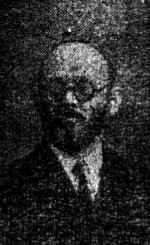
|
He was one of my teachers in the HaMizrachi school in Zawiercie (until 1921). He lost his mother at a young age, and therefore, they took his wealthy uncle, Reb Henech (Chanoch) Weksler, a city administrator and eminent Hasid, into his house. As is known, his uncle was very Orthodox, and forbade him from reading Zionist books, Haskalah books, and Hebrew literature. Therefore, he was forced to read such books in secret when nobody was looking – in the cellar, with the pretext of bringing coal to the house.
However, the aspiration of Reb Mordechai Zeev (the name Nachum was added as a good sign [segula] after the epidemic that felled his mother Kroina, his grandmother Tauba, and his younger brother) to study knowledge and general education was so strong that he overcame all obstacles and attained an appropriate education.
He was occupied with teaching already prior to the First World War, and regarded this as the content of his life. In 1921, he transferred to the Mizrachi school in Kraków, where he served until the outbreak of the war.
He was a pedagogue with all strands of his soul. He was a man of music and song. He was also full of humor. He would serve as a prayer leader and bring enjoyment to the congregation with his sweet voice. He also involved himself with the artists' pencil in brushwork style, as well as the writers' pen. He translated several of Bialik's poems into Yiddish (the translations are preserved in Beit Bialik), and received a letter of thanks from the poet.
He was an enthusiastic appreciator of music. He played the violin and mandolin. Jewish folklore was very close to his heart. He was one of the regular correspondents of the Institute of Jewish Sciences (YIVO) of Vilna, and he was a collector of national items – in the areas of humor, blessings and curses. He was one of the writers of the Di Chazanim Velt [The Cantorial World] periodical. (In his time, he also engaged in a debate regarding whether a cantor is permitted to sing secular songs.)
He was a “living encyclopedia”, a friend and a colleague, and a pure, unencumbered soul. His main character trait was: “Hard to anger, and easy to appease” [Pirkei Avot 5:11]. He had a warm, overflowing, Jewish heart. Along with this, he was pleasant and a man of friendship.

by Moshe (Mietek) Neuman
Translated by Jerrold Landau
I started my first studies (my first steps with the aleph beit) with my grandfather Reb Lozer (Elazar) Noiman.
My grandfather Reb Lozer Melamed (who lived on Hoża Street in the home of Hershel Olosz) also earned his livelihood from the hand-operated sewing machine that his second wife had, from grinding wheat for matzo shmura and baking it for Passover, for those who were exceptionally scrupulous. The grinding was carried out with a zhórna[1], which is a stone on top of a large, round, heavy stone. Reb Lozer Melamed was a teacher of young children.
The second phase of my education was Yitzchak the Melamed (the Krimelever Melamed). He was tall, with a splendid countenance, an aged, venerable man of upright character. Reb Yitzchak was known as a good teacher – not only in Zawiercie, but also in the area. His students came from Kromolów, Łazy, Poręba, Mrzyglód, Siewierz, etc. His students held him in esteem, and he influenced the customs and manners of his students through discussions imbued with his spirit – even though, from the other side, he was strict, and instilled fear in his students.
They would arrange a celebratory meal at the cheder before the end of the term. Every student would bring several kopecks from home, and the rebbetzin would prepare sweets and other fine items.
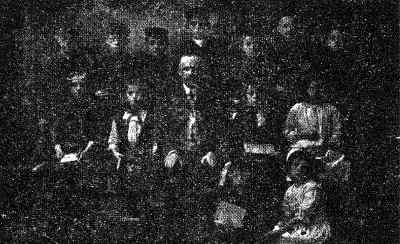
The Teacher RosenbergAs one of the students of the teacher Rosenberg (from the new marketplace, the home of Feivel Oksenhendler), I wish to dedicate the following words to him.
He was a veteran teacher in our town. He was elderly. He was the teacher of students who were beginning secular studies. During the time that I started learning with him, there was not yet an official public school. Only relatively few people were able to send their children to teachers or educational institutions that charged a relatively high rate of tuition. Children of parents of restricted means studied with teachers such as Zlotnik, Leizerowitz, and Rosenberg.
The Rosenberg couple was childless, and therefore they treated their students with palpable affection. He would teach us arithmetic (primary operations), geography, Jewish and general history, as well as reading and writing in Polish and German. (The Rosenbergs came from Russia, and they spoke Russian at home.) She would teach us to draw and to sing Polish and Russian songs.
Pictures of the great Russian writers, as well as pictures of Herzl and Peretz, were hung on the wall of the cheder.
[Page 493]
|
|
| A group of students of the teacher Rosenberg |
Rosenberg's school was restricted to fifteen students, in accordance with the government certification. However, children who studied in cheder for half a day, as well as Orthodox girls who studied with Rebbetzins, also studied there. Menashe Frenkel
I will make note of a Hebrew teacher in Zawiercie from the period of my youth: Menashe Frenkel from Wolbrom. Frenkel had already been living in the Land of Israel, but he was forced to leave the Land due to his tropical illness and lack of acclimatization from a social perspective. As a man [whose hopes had been] wounded, he made a pledge to guard the ember of the nation's liberation and its ingathering to the Land of Israel. Therefore, he dedicated himself to imparting the Hebrew language, knowledge of the Land, and anything connected to the Land of Israel. From him, we also learned the beginnings of Sephardic pronunciation, which as a strange thing to us in those days. His activities were connected to the youth group activities. Thus, the youth groups paid special attention to sports and to festive national demonstrations (Lag B'Omer, Chanukah, Purim, 20th of Tammuz, etc.). They did great things in Zawiercie in the field of culture: from human dust, they forged personalities who later distinguished themselves.
Within this framework, courses and clubs for history, Hebrew literature, and knowledge of the Land were set up. In the Socialist youth movements, they studied the history of Socialist Zionism, and other things. Thus, they complemented their knowledge that was not imparted to the youth in the schools and the cheder.
Many worked as counselors at that time, and in doing so deepened their own commitment to the very values they were responsible for imparting to their charges.
Translator's Footnote
by Reuven-Romek Rothenstein
Member of the Israel Philharmonic Orchestra
Translated by Jerrold Landau
Life in our city moved to the rhythm of the factory whistles and the ticking of the machines, humming in a steady, monotonous tone. Consequently, the city was not the most conducive spot for developing variegated cultural values – including the values of music fitting for the term.
However, we can assume that this paucity of musical creation and musical events had a greater influence on the absorption process of numerous new residents, both Jews and gentiles, who came to our young city from near and far without cultural and musical baggage from their places of origin. Jews came to Zawiercie from scattered places, especially from weaker settlements. Their entire musical baggage was some military march, some melody that had no roots in local folklore, as was the case in Hassidic Podolia and Ukraine. The only thing that had something fundamental – those were the Skórbowa melodies[1], but since they had no foundation in any local folklore, they deteriorated to the point of actual absurdity. Related to this, it is interesting to note that in Polish literature about folklore, they lament the lack of folklore in the region of Zawiercie. There were few public concerts in Zawiercie. I only recall the concert of the well-known Polish violinist Berchwitz [Mieczysław Berczyński] during the period of the war, as well as a piano concert. That concert is etched in my memory to this day.
With all this, we cannot deny that there were flashes of musical life in our city. The musical activities of the synagogue's cantor, Reb Shabtai Spivak, left a real imprint. He directed a choir – though not during the years when I myself lived in Zawiercie – in which future musicians sang, among them Leib-Leo Diamant, and the opera singer in Lwów and Kraków, Yitzchak Mann (now the cantor of a synagogue in Haifa). Many other youths [who sang under his guidance] later joined operatic and cantorial choirs in Poland, Western Europe, and the United States or became musicians in the city itself, such as Nechemya the bass player, the son of Kopel the shoemaker, and Yankel, the son of Tovia the klezmer.
Reb Shabtai's choir also attracted to the synagogue members of the circles of Jewish officials who were distant from Judaism. We can surmise that the activities of Reb Shabtai had some influence on the musical atmosphere in their homes. Several eminent Zawiercie musicians came from those homes. Some, such as Moritz Edelist – who was also one of the choir singers and the son of the town's medic, who was also a barber – together with several other barbers who lacked the means to study music properly, expressed their musical talents through the balalaika and the mandolin.
The choir of Reb Shabtai, who was also a talented composer and a fine violin player – as was told to me by older Zawiercie natives – was a phenomenon in the city. During
[Page 495]
rehearsals before the High Holidays, crowds of Jews and gentiles would gather in front of Reb Shabtai's home and listen for hour after hour to the singing of the choir during its practice. This certainly had an influence on the development of music in the city.
Even Reb Shabtai's friendship with the great cantors of the area, such as the cantor and composer A. B. Birnbaum of Częstochowa, who set up a cantorial school and published a monthly periodical for modern cantorial music – influenced the expansion of the musical horizon among the small circle of Jewish Maskilim in the city, and even to some degree upon the traditional prayer leaders such as Reb Meir Lelower; and the Hasidim such as the Gancweich and Froman families, etc. in the city. These cantors, including Cantor Sherman of Będzin, would visit his home, conduct cantorial competitions, and at times would lead the prayers in the synagogue, because of their friendship with Mr. Shabtai. This too directly or indirectly influenced the deepening of musical interest among the people of Zawiercie.

From the other side, there was a noticeable interest from the church and the factory. Had it not been for these ancillary musical institutions, Frantisek Šikora, the veteran music teacher of the city, would not have been in the city, nor would his children Stanislaw-Staszek and Ludwik (who was a high-level musician), or A. Kszak, the elderly man who directed the choir at the factory. Had it not been for these people who educated generations of Zawiercie youth to music, musical life in Zawiercie would have been even more meager. Later, he conducted the choir in the Rączka gymnasja. There were also bands in the public schools. The most popular figure in the city was Frantisek Šikora, who came to Zawiercie as the organ player in the church. He was of Czech origin. He would play music because every Czech was born as a thief or a musician[2]. He would say about himself that he was born a musician. Apparently, the income from the church was insufficient for him, so he searched for additional sources of livelihood as a teacher. The elderly Šikora also played the violin and a small hand-tuned harp, rather than the standard pedal harp tuned by foot. Šikora lived on the small Wielki Świat Street (later Narutowicza), next to Court (Sądowa) Street. In his time, many Jewish children studied music with him, I among them. I learned the foundations of violin playing from him. His lessons were accompanied by his harp. He did not know much about the theory of music. His special interest was to teach popular songs that he himself transcribed into musical notes. His two aforementioned sons were also violinists. Staszek worked along with his father in the handiwork of music. They had a calendar in which were inscribed the birthdays (of Jews), imieniny (name days of Christians), and wedding anniversaries of each
[Page 496]
person, for they knew that they would be able to get a few coins or a portion of food and drink. In the morning of the designated day, they would appear before the house of the celebrant and play tunes relevant to the occasion. In general, these two good people did not do any real performing; they would appear anywhere it was possible to eat or drink properly or get a sum of money. As the editor of our book, Mr. Sh. Spivak tells me, during a certain period, the elderly Šikora and his children were among those who visited the home of the cantor Reb Shabtai Spivak.
With everything connected to this practice, we can state that the elderly Šikora and his sons laid, in some form or another, the foundations for the development of musical life in the city, which later flourished more and more in various circles. Šikora's daughters (one of them was a hunchback) also played the harp.
Ludwik Šikora was the most developed of them in musical knowledge. He was a reasonably good violinist. In my time, he played in the Stela movie theater as an accompanist to silent movies. The pianist Kolpowicz accompanied him. He was a bachelor. He played the organ in the church and served as a teacher. He was also the conductor of the wind orchestra of the firefighters in the Huldschinsky factory. He was also a violin teacher for advanced students.
There were other musicians aside from the Šikora family – especially amateurs. One was Domagała, who was a farmer. He played every evening in front of his house with his family members accompanied by a guitar. Another was the aforementioned Kszak, and there were others; however, they did not come up to the ankles of the Šikora family.
Before his death in 1924 or 1925 at the age of seventy-five, he asked the elderly priest Zętor to bury him with his expensive Italian violin. Through the intervention of his family, the priest convinced the elderly Šikora to change his will, and the violin was bequeathed to his son Ludwik.
There were Klezmers on the Jewish street: Tovia Klezmer and the three clarinetists. Others have certainly written about them, and I will suffice myself with noting their existence.
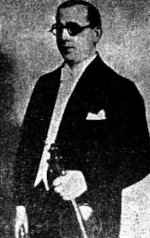
ViolinistsLeibel-Leo Diamant, the son of the honorable tailor of the city, Isser Diamant, was among the eminent musicians of the Jews of Zawiercie. He was actually an autodidact, but with a very well-developed musical sense. He had a fine bow-stroke. He played with feeling, even though he did not reach the level of Ludwik Šikora from a technical perspective. A certain misfortune overtook him, for he was a serious musician with talents, and was forced to earn his livelihood for himself and his family through the sweat of his brow in the coffeehouses and bars of Katowice, Częstochowa, Sosnowiec, and Będzin. He also played on the radio. For a certain period, he played
[Page 497]
|
|
| Leibl Diamant, may G-d avenge his blood |
in the movie theater. He took any opportunity to display his artistic talents (he was also an amateur actor and theatrical director) at artistic events for the Jewish community, in all its forms and its movements – and he did so with great dedication. Without expectations of compensation, he directed choirs that appeared at Zionist events and various general Jewish events. Prior to his marriage, he organized amateur troupes, directed them, and even acted on stage himself. He was also a visual artist – at a young age he worked in the glass factory as a glass decorator.
The son of another tailor, Lipa Frydman, from Marszalkowa Street, who was much younger than Diamant, studied violin playing with great diligence. After he graduated, he played in coffeehouses. He eventually travelled abroad (to Berlin, I believe). They say that he is now in Belgium.
As we discuss violinists, we must mention the engineer Rabinowicz, who was the partner of Mamelok in an engineering company. He was a non-professional violinist and a pedagogue who taught music on the violin without any expectation of compensation. One of his students was Mandelbaum, the grandson of Tovia Klezmer, the son of Sandler. During the period of his studies with Rabinowicz, he seemed to us young children as a rising star on the skies of music. The engineer Mamelok was also an amateur violinist.
Szliamek, the son of Reb Yeshaya Simcha Gancweich also played the violin. He played the harmonica when he was still a child. He would climb up a ladder in Yeshaya Simcha's haberdashery, take the harmonicas out of the boxes, and try them out. If the harmonica did not make a proper sound, he would declare it invalid and toss it down. He ruined tens of harmonicas in that fashion,
[Page 498]
until he found an appropriate harmonica. Young Gancweich did not involve himself in music after that. However, I was told that he appeared before the Jews in concerts in Będzin and Sosnowiec during the Holocaust period [i.e., during the ghetto period], which made a great impression.
PianistsMrs. Kalinowka on Koscielna Street was a known piano teacher. The daughter of the photographer Glater from Częstochowa, who was a good pianist, arrived in the city. There were other pianists as well: the daughter of Brandes (an official in the T.A.Z. factory), who also played with the amateur Jewish ensembles and performed at Zionist and general Jewish events in the city. Mrs. Brandes was of a high cultural level. She worked in teaching and accompaniment. She played in the Luna movie theater along with the violinist Feicht. Walteufel's waltzes (of the same period of Johann Strauss of Vienna) made a great impression on me. They played them so nicely that those tunes are etched in my memory to this day. In 1930, after the passing of my father of blessed memory, I too began my musical career in the Stela movie theater. The pianist was Fela Dzałoszicka.
The only cellist in our city was Berman, the son-in-law of Czebiner the medic and official in the Birnfeld factory. He was an amateur cellist, with intermediate musical knowledge. However, he played Schumann's Träumerei well.
We have already mentioned the daughter of Glater the photographer. Now, I must also mention Glater's house, which had a piano and was a sort of music hall. Kazio Feltyn, the son of the physician, was among those who went there. He was a bit strange in his mannerisms. For example, he would approach the stall of a produce seller, and ask, “What is the price of the grapes?” They responded, such and such. Kazio would ask for one. They asked him, “What? One Kilo?” “No,” said Kazio, “one grape.” He would come to Glater's house and play Gypsy-style salon romances. Mrs. Glater, the mother, would sing in her soprano voice, which was reasonably good, but not developed.
More and more musical circles were formed in this environment. There were several youths who began to dream of a musical career and of achieving a musical level relevant for its name.
The Young “Trio”In my time, one trio to which I will devote the following words especially excelled with its young talent: the aforementioned Mandelbaum, Zalman Diamant the nephew of Leibel-Leo Diamant, and me. My brother Olek also began to study music, and he displayed talent, but I continued on, and music became my art and my craft.
[Page 499]
My father, who appreciated music and participated in choirs in Russia, made great efforts to give his two sons musical education.
The three aforementioned youths would travel to the advanced music institute in Katowice, and later to the state conservatory. Mandelbaum, who is now in Tel Aviv, was the only one of this group who distanced himself somewhat from classical music. He plays in a coffeehouse in Tel Aviv (currently on the seashore). Zalman Diamant and I deepened our musical knowledge and achieved a certain level. Today, Zalman plays an important role in musical life in England. Previously he was first violin in the Birmingham Philharmonic Orchestra. Today, he is the first violin on B.B.C. television and radio in London.
Travels with the Philharmonic and Encounters with ZawierciansI have already served for eleven years as a viola player as a member of the Israel Philharmonic. I was accepted to the Israel Philharmonic immediately after I arrived from Russia (there too, I played in an orchestra). I met many Zawiercians as I traveled to various countries with the orchestra. My joy was great when I met with my childhood friend, Zalman Diamant. I also met Moniek Gryn, Shmerl Domb, Wolf Ring, and Shlomo Donert in London. In Paris, I met with Andzhia the daughter of Arke Paker, and Elimelech-Meilech Blat. In the United States I met with Feigenblat-Fagen, chairman of the organization of Zawiercians, Max-Meir Torgownik-Targ, members of the Kasier family (Moshe David, Yitzchak, Yocheved-Helena), Mates Zheriker, and Olek Noiman, whose wife was a Zawiercian. The joy of our meetings in a foreign country was great.
Finally, I wish to note Jerzy Helman, the son of Helman, an official in the T.A.Z factory. Later on, he was a great operatic tenor (his pseudonym was Jerzy Garda), and at the end of his life, he was the opera director in Wroclaw. In his time, he was the friend of Jan Kiepura. He converted to Christianity and did not even want anyone to know that he was of Jewish origins. He died two years ago.
I must also note the musical quartet in Ogrodzieniec, in which Zalman Diamant and I also participated. The quartet was organized by the Gebel brothers – one was an engineer, and the second was the treasurer in the cement factory in Ogrodzieniec. They would send a carriage for Zalman and me to bring us to Ogrodzieniec. In that group, we got to know the beauty of chamber music (with only a few musical instruments) that in general was not popular among the community of music lovers.
I wish to also note Avraham Broniek Yingster, who died a year and a half ago in Jerusalem. With him, I made my first steps in music after I grasped
[Page 500]
the fundamentals. I would come to their home on Wielki Świat Street. I would play the violin there, and Avraham-Broniek would accompany me with the piano.
I must also note two conductors of the Israel opera – Weiskop and Tarski-Tabaksblat (the latter, the grandson of Reb Avraham Bornstein, the son of Fela, the leader of Hashomer Hatzair). They were not born in Zawiercie and do not know it, but their parents spent a long time in Zawiercie.
The following learned to play the violin: David Janowski, later a gynecological physician; the son of Weiskop, the daughter of Weiskop, David Meir Grynblat, Meir Isserowski, Natek Lugerner, Shlomo Spivak, David Gnendelman, Yehoshua Bochner, and my brother Olek. From the pianists, I remember: Sabka Hendler, Dorka Windman, Andzhia Perlin, and Genia Mangiel.
There was not very much public musical activity in Zawiercie.
Translator's Footnotes

by Harry Wajnglik
Translated by Gloria Berkenstat Freund
I was born in 1902 in Zawiercie. My father was Alter Shamash [synagogue caretaker] and, understandably, my parents were very pious. I studied in the Zawiercie yeshiva [religious secondary school], studied with Reb Sh. A. Pardes (well-known publisher of haPardes [a monthly religious journal]). Barely 14 years old, I began drawing an “Eastern Wall picture” with watercolors, which took more than a year. The “Eastern Wall picture” was erected in one of the most beloved streets in the city. I was considered a talent and I was convinced that I should not remain in the yeshiva. My friend, the mining engineer, Leon Ajngster – Lazar Ajngster's son – taught me the most elementary principals of painting. In 1919, I was accepted by the Krakow Art Academy and I studied with Professor [Teodor] Axentowicz.
I returned to Zawiercie for a time. I actually sensed the taste of a revived Poland. At the end of 1919, on a Friday
[Page 501]
night, a pogrom took place by the Hallerczykes [General Józef Haller's soldiers], who, without reason, shot in the direction of a fully packed synagogue. Windows were broken. Many were severely wounded. Everyone ran home. The pogrom was in full swing. The only one who was missing was my father. We did not know if he was alive or if he had been killed.
We barricaded the entrance to our house. After a few hours of wild shooting and pillaging, we heard someone running to our house. Suddenly, the door was pushed open with great momentum; my father was there. He was saved.
After this horrible event, I decided not to remain in Poland anymore. I traveled to my friend, F. Bershl, who had a brother, a writer, in Copenhagen. He led me to the Art Academy, where I studied for a few years with Professors Poul [Holsøe], Sigurd [Wandel]. Later, with the help of the Herman Shaon family, then by the well-known Jewish illustrators, Y. M. Lilien and H. Struk, I was brought to the famous painter, president of the Prussian Art Academy, Max Liebermann. Liebermann asked me if I was an artist. I answered him: Not yet. But I will become an artist. The answer pleased him. He showed me many pictures from his collection of German and Dutch art. A picture by Jozef Israëls made the greatest impression on me.
Then I waited a long time until a letter of recommendation arrived for me to study for two years at the famous Berlin Art Academy, with a stipend from the Mathilde Priester Foundation for exceptional talent. I will remember the day on which I received the recommendation forever.
I studied in the Berlin Art Academy, first with Professor Wolfsfeld, and then with Max Liebermann himself. The Berlin Museum bought two of my pictures. The Nazis took them out of there and confiscated them. Now they are in the Jewish Museum in Berlin. Several of my pictures were exhibited in large Berlin exhibitions, such as the “Black-White” exhibition of the Berlin Academy, as well as at the Bellevue Berlin Artist's House and the large Berlin art exhibition. Later, I worked with [Peter Jessen] Oestergaard's Monat's Heftn [Monthly notebooks].
In June 1933, after Hitler took power, I left
[Page 502]
for Paris and was a member of the well-known Salon d'Automne (Autumn Salon) society. From 1933 on, I would exhibit in Georg Wildenstein's Galerie Beaux Art (Gallery of Beautiful Art). I became a member of the Jewish artists group in France.
When the French-German war broke out, I reported voluntarily to the French Army. Paris fell immediately. The Nazis and the Nazi collaborators rampaged through France. They deported Jewish men, women, and children with force.
July 1942 – 3a.m. – they began to knock forcefully on my door. I did not move. The house supervisor said I was an artist and that I was not at home. This was my good fortune. They would break into other residences.
Despite my escape at that time, I spent time from 1942 to 1945 in nine concentration camps in France. I was the only Jewish portrait painter and illustrator in the barracks and struggles in the French concentration camps. I also was a translator.
After the war, I returned to Paris. However, I did not find even a pin in my atelier. Germans and French collaborators dragged away 375 of my paintings, drawings and etchings. Along with my collection of ketubahs [Jewish marriage contracts] and Shir haMaalot [artistic, illustrated texts of Psalms].
Six months after my return to Paris, I finally permitted myself to buy an iron bed.
The suffering in the camps and the loss of my works [of art] on which I had worked for dozens of years led me to a deep depression. However, I finally gathered all of my energy to again lead my life as an artist and to fulfill my artistic mission.
The suffering led me closer to my Jewish people, to whom I had always felt connected. My Orthodox upbringing and my Jewish sources of inspiration were clear in many of my pictures. I paint many general motifs. However, I had a particular inclination to Jewish motifs. One of my unfulfilled aspirations is: to publish complete biographies of Jewish painters, draftsmen, sculptors, in short, all Jewish visual artists.
Translated by Gloria Berkenstat Freund
The Kultura [culture] Society, which played such a large role in Zawiercier Jewish cultural life over the course of a few years, was founded by a group of young people at the Sztajnkeler's house. Among the founders were: Altshe Kromalowski, Leibush Staszewski, Yitzhak Goldman, Itshe Kozlowski, Itshe Meir Bornsztajn, Eshtshe Lajbowicz, Chaya Erlich (now Mrs. Goldsztajn in Israel), Manya Landau, Perl Borszikowski, Ester Zakes (secretary, led the library). Among the first members, there also was a group that belonged to Hashomer Hatsair [the Youth Guard - Socialist Zionists]. The group soon left the organization.
The Kultura Society had its start thanks to the important accomplishment of Yitzhak Goldman, who was a Myszków-Żarki Hebrew teacher. There was a large library in Myszków that the well-known literary patron, A. Y. Sztibl (founder of the Sztibl publishing house), supported in the memory of his wife.[a] The number of Yiddish books was especially large. Zawiercie, at that time, did not have a good library. Yitzhak Goldman would bring books to Zawiercie from the Żarki Sztibl Library for a small circle of friends. Thus, was created an interesting circle for good books and there was a discussion about the necessity of creating a Jewish cultural society in Zawiercie. In 1925, this group called a general meeting at the Hakoakh [The Strength] sports club in Goldminc's house at Kopalnia Street. It was decided to [seek] legalization for the cultural union. An organizing committee was chosen for this purpose. After the legalization as the Kultura Society, the new dynamic cultural center developed widespread activity. Lectures, recitations, scenic presentations, literary evenings, theatrical performances were organized and very colorful informational work was carried out among the varied Jewish strata. For example: giving lectures and reading from their works were:
[Page 510]
|
|
| The managing committee of the Kultura Society in 1925 |
I.Zerubbabel, Dr. Kruk, Elkanon and Ahron Tseytlin [Zeitlin], as well as M. Rawicz, Yehoshua (Stanislaw) Wigodski and so on. Ida Kaminska, [Zugmunt] Turkow, Dodik, alone or with their theaters, gave recitations, scenic appearances. There also [appeared] Shmai Rozenblum and Elihu Goldenberg as reciters of poems.
We would also arrange performances on our own. Every Shabbos [Sabbath] afternoon or Friday night we arranged literary-communal conversations. Discipline reigned over the entire work and, particularly, with regard to the literary-communal conversations. Goldman would lock the door to those who came late to the literary-communal conversations.
Yitzhak Goldman was the living spirit of the Kultura cultural society. He was its chairman and as such, he devoted a great deal of his health and strength so that Kultura would bloom.
The young from the synagogue, working intelligentsia and workers also joined the Kultura Society. The society organized a beautiful, progressive library with a few thousand books. It collected and bought books for this purpose, as well as sold books for income. Parallel to the Kultura library was the general Jewish library (librarian – Monja Landau).
[Page 511]
The Kultura Society numbered 200-300 members. In addition to a vast program of cultural activity, Kultura would invite the intelligentsia who would come on a visit to Zawiercie to give lectures, take part in discussions and so on.
There was a buffet at the library. The society also arranged dance evenings. In time, Kultura became a leftist organization. It worked with the communist aid organization MOPR (Międzynarodowa Organizacja Pomocy Robotniczej [International Workers' Aid Organization]). This was expressed in the character of the cultural activity: the society began to arrange various progressive-leftist literary and communal events. The celebrations of [Y.L.] Peretz, in which Peretz as a socialist was stressed, were particularly successful. The Pilsudski regime began to persecute the society. Two secret agents from the political police – “the large one” and “the small one” from the Defensywa [Defense – Polish security authority] – constantly harassed the activity of the society. In the end, after three to four years of activity, the Defensywa imprisoned the main activists before the 1st of May and held them under arrest until the 3rd of May. They closed the society and took the books from the library. We had earlier [removed] some of the books because we expected harassment.
Thus was the Kultura Society suppressed in the very midst of its blossoming.
One of the effects of Kultura was that it shook up the Hasidic houses. That time in Poland had a revolutionary effect, particularly among the young Jews. A number of them searched for a way to root themselves in the Polish reality and it was believed that this would be possible only if the reality in which they lived were radically changed. This was not absent in the Hasidic houses, perhaps, because, more than others, the atmosphere that reigned in the Hasidic houses was driven by the impulse to pull themselves out, to alter their own lives and life in general. Thus, Kultura had a great influence on the children of Hasidic parents, particularly on the daughters.
I remember that we once organized an evening of entertainment at the premises
[Page 512]
of Kultura, with a buffet in honor of the Society. Several members remained at the premises for the entire night in order to create a fund. Suddenly, there was knocking on the door. We heard that Reb Itshe Erlich was standing in front of the door; we hid (I think in a closet) his daughter who was with us. We told him that she was not here. In addition, we argued with him that we were not doing anything bad; we were only trying to raise the culture of the community through a library and lectures. He left. We thought that we had convinced him and that his daughter would have no problems
Reb Itshe Erlich was a good Jew, but we were nice, earnest children.
Original footnote:
by Nakhum Drezner
Translated by Gloria Berkenstat Freund
|
In approximately 1928-1929, when Goldman resigned from his office as chairman of the cultural society, a large number of those who had organized the society left it: a number got married, some left for other cities or for abroad. Drawn into Kultura were people from the professional movement. The Polish police began particularly to frown upon the organization. They began to harass and to persecute the society and its members so much so that the [books at the] library were subject to being confiscated.
An Esperanto group, led by Klara Borzikowska and Ester Zaks, was created at Kultura.
In May 1929 or 1930, the police arrested a large number of members of Kultura and held them under arrest between the 1st and 3rd of May.
The library continued to exist for a time after the arrests. The leaders of Kultura and of the library, despite
[Page 513]
their different opinions, decided to give the library, which was threatened, to the general Jewish municipal library that was created especially for this purpose. The premises were in Shmuel Sauka's house. Manya Landau was the librarian of the Jewish municipal library.
It should be recorded that every political or politically-oriented organization or movement such as the professional unions had a small library for its members. Only the library of the cultural union was noticed in the street.
The library that was created in 1916 almost did not exist. In any case, it was not noticed.
Kultura, the cultural society, had a great societal effect on the city – it particularly influenced the young.
|
|
JewishGen, Inc. makes no representations regarding the accuracy of
the translation. The reader may wish to refer to the original material
for verification.
JewishGen is not responsible for inaccuracies or omissions in the original work and cannot rewrite or edit the text to correct inaccuracies and/or omissions.
Our mission is to produce a translation of the original work and we cannot verify the accuracy of statements or alter facts cited.
 Zawiercie, Poland
 Yizkor Book Project
 JewishGen Home Page
Copyright © 1999-2026 by JewishGen, Inc.
Updated 17 Aug 2026 by JH