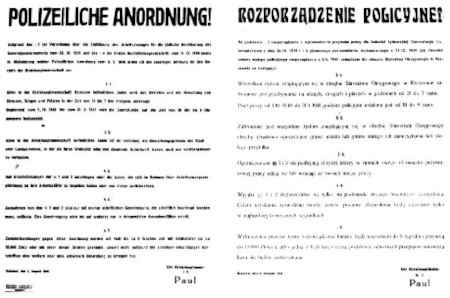
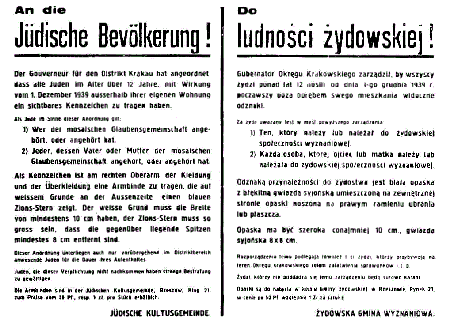
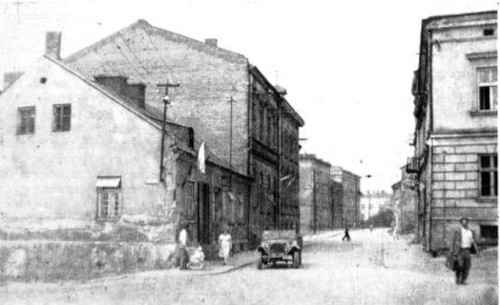
 |
|
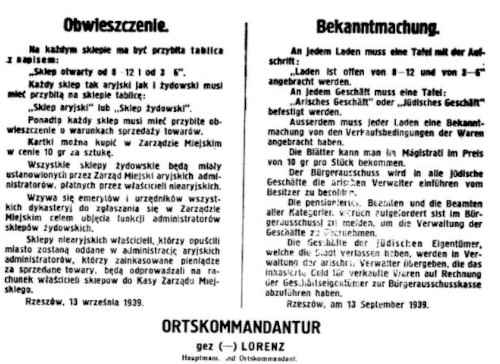
The following inscription must appear on the table of every shop:
Local Commander (signed) (-) Lorenz Captain and Local Commander |
|
[Page 513]
by Yosef Loifban, Ramat-Gan
Translated Libby Raichman
On Thursday 4th September, with the outbreak of the war, I left Reisha and travelled in an easterly direction together with almost the entire Jewish youth. We went on our way with my cousin Henech Kroitman. En route, Dr. Rozenshtok attached himself to us. We hired a horse-drawn coach and travelled until we reached Lantzut. The road was bad. We encountered overturned wagons, automobiles, horses that had been shot, severed telephone wires, and thousands of people on foot, on bicycles, and on carts. Lantzut looked like a besieged town. The shops were full of people. The local Jews received the refugees with worried expressions on their faces. It was dangerous to go on the main roads, so we took side roads through fields and forests. Saddled horses wandered around in the forests, abandoned by the Polish soldiers. From time to time, German airplanes fired into the forest because they believed that Polish soldiers were hiding there.
Ukrainians were very friendly to us, as well as the Poles. As we passed through Magerov we saw barracks with retreating Polish soldiers, in the middle of the small town. We then made our way towards Lubatshov. At night we arrived in a Ukrainian village, Butino. There we were sent to the village magistrate Vassil Reblik who received us in a very friendly manner and gave us food and a room. The room was small and Dr. Rozenshtok suggested that we sleep in the barn that was full of hay, but we soon regretted it, because mice were jumping on us from all sides. Dr. Rozenshtok switched on his pocket light, each time. Late at night, we heard shooting. We looked through a crack and saw people fleeing. Soon the home-owner appeared with a revolver in his hand. He was not afraid and told us the truth. As a Ukrainian who converted to the Catholic faith, he had many enemies among the nationalists, and more than once, they planned to assassinate him. Our arrival saved him, and the fact that we did not sleep in the house saved us, because shots were fired into the room that he gave us. He told us that there is one Jewish family in the village, across from the Ukrainian Co-operative. In the morning, we went to the Jewish family, who received us well. After a short while, we heard shooting. A Polish officer shot a sales person in the Co-operative because he demanded one zlotte[1] more for cigars, so he called out “Poland is not yet lost” and shot him. Soon, many Ukrainians gathered, and we were afraid that we would suffer for this. In the meantime, the distant sounds of automobiles were heard, and the first German patrol-tanks appeared. The soldiers stood in the tanks and threw chocolates and cigarettes to the Ukrainians, who received the Germans with enthusiasm.
The black uniforms of the Germans were an ominous sign for us, and after a brief consultation, we decided to go back to Reisha. We went to Rava-Ruska[2], and from there, the German patrol sent us to the magistrate for a permit, to go further. There I saw an elderly hunter being beaten for arriving an hour late to hand in his gun. After Rava-Ruska, we travelled a few kilometers, and there, German soldiers detained us and ordered us to level the road by filling in the holes that were made by bombs. They gave us tools, and we worked. Soon after that, German officers were passing by, and the soldiers were told to free us. Then we went to Yaroslav and were
[Page 514]
about 50 meters before the wooden bridge that the Poles had wrecked before they retreated, when we heard screaming and crying because everyone who returned had to drag the wood out of the water. I believed that this time we would not pass through uneventfully, but to our good fortune, the sergeant noticed a pelican feather in my bag. At first, he wanted to buy it, but afterwards he took it, in exchange for a permit for us to cross the water on the ferry. So, we crossed peacefully and came to a Jewish family, who received us very warmly. In the morning, we came to Pshevarsk[3]. One could sense the smell of burnt sugar, because the Germans bombed the factory. We stayed over with the Kestenberg family who had a food store. At night, the daughters covered the windows and listened to news from Warsaw on the radio. In the middle of the night, Germans came in search of weapons and took a couple of bottles of alcohol with them. The next day, we entered Reisha again, and we met the whole family.
A few days later, was the terrible, last Rosh Hashanah. People prayed at the Tochfeld's in the market-place. Heshek Friedman, Chatzkel Tochfeld and I, stood on guard. On Yom Kippur, we were taken to work in the weapons factory Tzigelsky, that had been bombed.
That was the last Yom Kippur that I experienced in Reisha. A few months later, I left the town and embarked on a path, long and vast, wandering in the Soviet Union.
|
|
Translator's Footnotes
by Dr. Asher Aleksander Heller
Translated by Libby Raichman
I completed my studies at the medical faculty in Vienna. In 1930 I settled in Reisha and accepted a position as a doctor of ear, nose, and throat conditions. When the war broke out in September 1939, I also took on an additional task as head of administration in the Jewish hospital. This hospital was established a few years earlier with the help of American Jews, who came from Reisha. At that time, a friendship between Nazi Germany and Poland became evident and winds of semitism were blowing in government circles.
Reisha was a center of military industry, and Poles from the Pozner district, who were filled with hatred towards Jews, were brought into the town Jews were afraid to go for a walk or pass by Polish neighborhoods. They avoided going to Krakowska Street.
The Jews hoped that a war would not break out, but my friend Dr. Binyamin Schlager, a researcher of Spinoza[1], an intelligent advocate in our town, and I – were steeped in doubt. The Poles were afraid of Hitler but were satisfied that Hitler was “dealing with the Jewish problem”, and that they would be rid of the Jews. The Jewish intellectuals however, consoled themselves with the hope that it was inconceivable that the Hitler regime would exterminate three and a half million Jews – men, women, and children; but when Mrs. Lifshitz was arrested and was forced to pay a million zlotys in ransom – then the carefree, the wealthy, and the intellectuals, began to speak differently. “We are lost”, we heard from everyone.
Before the Germans entered Reisha, they bombed military industrial sites. The Poles claimed that this was surely a mistake. There were victims from this bombardment, and the Jewish hospital filled with wounded people. I did not want to leave the sick, but, acting on orders from the Polish government, I left the town, travelling eastwards, together with Polish doctors. People were in shock, and thousands ran to the highways. We arrived in Przemyśl, but we did not come across any Jews there and continued to Sambor, where I was woken very early with the terrible news – the Germans had arrived.
In the first two days they did not harm anyone. On the third day, they ordered the Jews to clean the streets. Reisha Jews turned to me, requesting that I approach the German Kommandant and ask for permission for them to return to Reisha – they maintained that it was better for them to clean the streets in Reisha, than in Sambor, hoping that in their own town, they would be able to come to an arrangement with the authorities. The Kommandant told me, that we could return to Reisha without a permit, but that we could only go through the main highways.
I went together with the group of Reisha Jews. It was September 1939. On arrival in Przeworsk, we took wagons to continue our journey. En route, we met divisions of the working groups TODT[2], that ordered us down from the wagons, told us to remove our clothes, and hand over razors and money, on the pretext that the Jews slaughtered a German officer with razors. They distributed our money among the Polish workers, who were repairing the bridge. We finally arrived in Reisha.
On our arrival in Reisha, we found that the town was under German rule, and flags displaying swastikas were fluttering over communal institutions.
I did not go home, rather to Tepper Street, so that I could be in Jewish surroundings. I informed my wife of my arrival, and she told me that I was able to return home, and that there were already two officers from Vienna living with us. In the afternoon, Gestapo[3] personnel visited, demanded travel papers,
[Page 516]
inspected my home, removed all my treasured possessions, and left.
German officers liked to take up lodgings in wealthy Jewish homes, mainly, to be able to make conversation with them in German. The Gestapo did not suppress these families harshly. A few days later, the Germans began to grab Jews for forced labor.
Yet, Jews began to conduct their business in the hope that the war would end soon.
There were rumors that British airplanes had appeared in the vicinity.
At the end of October 1939, the Germans appointed Dr. Kleinman as head of the “Judenrat”[4] and Dr. Bena Kahana as his deputy.
Dr. Kahana informed me that I, and the doctor of our town, Dr. Tzinneman, (the father of the Hollywood film director Fred Tzinneman), were instructed to present ourselves at the office of the Gestapo. There we met many Jews. Each one was called in separately. When it was my turn, I approached the commissioner. He ordered me to serve as the chief medical practitioner and to manage the health issues of the Jewish population, with Dr. Tzinneman as deputy.
I had decided to extricate myself from this situation and travel to Przemyśl, that was divided into two zones – a Russian zone and a German zone. I wanted to go with my family to the Russian zone. At home, I told my family that we were travelling to Krakow. In the train I met Jews from Tarnów who wore a white armband with a green Magen David [Star of David].
Before arriving in Przemyśl, we left the train and travelled by wagon. On the way, we met Jews who had turned back from there and said: “pityful Jews, turn back, don't go there”, but we continued to Przemyśl, and reached the bridge over the San River[5] where we came across thousands of Jews and Poles. The Germans were beating, and kicking them, and using knives, carved Stars of David on the foreheads of the Jews. As we were crossing the bridge, we heard an order by a German officer, instructing us to turn back. We travelled back by train without travel documents, because there was no time to buy tickets. In Jarosław, Jews were being driven out of the wagons but my wife and I, and a couple of others, had the good luck to remain on the train. On arrival at the Reisha train station, the Gestapo detained all the men, ordered them to buy travel passes, and then allowed them to go home. There we encountered three members of the Gestapo, who verbally attacked my wife, and yelled, 'Jewish swine, where were you?' my wife answered, 'in Przemyśl, in the German zone'. For that, they called my wife, a liar. We showed them our train tickets to the German zone of Przemyśl, and they let us go.
At home, in the morning, we were woken by a sound. Germans from the Gestapo entered and wanted to confiscate our couches. When I said that a German officer was living here, they apologized and left.
The Jewish hospital that I managed, was confiscated and handed over to the German military. The task of seeing to the sanitary conditions of 16 thousand Jews who were in Reisha, was imposed upon us. Dysentery was rampant in the town. They accused me of not being concerned with the problem of this illness, and when the sickness was contained, they said that I concealed it from them.
Jews were still accepted into the Polish hospital until 1941. The director of the hospital was Dr. Hintze, and his deputy Dr. Drobniyevitsh. They were both honorable people who often willingly accepted Jewish patients free of charge.
On one of the cold winter days, in December 1939, there were 1250 Jews who had been grabbed from their homes, while still wearing shirts and pyjamas, and brought from Kalisz to us, in the town. They were placed in the synagogues and in the old barracks.
After leaving the Jewish hospital, I organized a clinic on Matejko Street, making use of instruments belonging to the doctors who had escaped, and left the town.
When the Germans occupied the town, they took hostages from the important people in the town – Dr. Jezower the dentist, Dr. Kessler the judge, and Horner a singer in the Prague opera; they were later released when the Judenrat paid their ransom.
In December 1939, I received an order from the S.S.[6] Commander of Police in Krakow, to inspect all Jews between the ages of 16 and 60, to see if they were capable of working. In great fear, and in confusion, I naively turned to the district governor Dr. Ehaus, and asked, for what work, this command was intended.
[Page 517]
|
|
[Page 518]
He asked me what I wanted and I told him that I received an order to examine the physical capability of the Jews, but without an X-Ray machine, I was unable to do this. He shouted at me: “What do you want, that I should send the Jewish mob for examination to Berlin?” When I asked for permission to send specific cases of illness to the Polish hospital, he answered: ”I carry out my orders, and you yours. If I find out that things are not in order with you, then I don't have to tell you what your end will be”. Saying that, he chased me out of the office.
I was involved in the examination of the state of health of Reisha Jews. All Jews, men and women, received an order to register in the labor bureau, and I was designated the task of examining their working capabilities. In cases of doubt, I requested permission to send them for X-Rays to the local hospital, but mostly, the answer was a negative one. My colleagues examined, and I signed. I was responsible for errors. Every Wednesday, I would submit a report to the district governor.
Once, when I was away from home for a few days, I met an S.S. officer, from the “Totenkopf”[7] military sector, on my return. I found it necessary to inform him, so that he would not be disappointed, that Dr. Aleksander Heller was a Jew, even though his name was a German one. “For everything” – he shouted – “the Jewish government in Moscow is to blame”. I asked him how he could say that, when he personally was convinced that Jewish refugees from Poland were running away from the occupied Russia region and moving to the area occupied by the Germans. What purpose would the Russian-German agreement have, one that means that a Jewish government in Moscow would be sealing a deal with Hitler, that aims to annihilate the Jews?
The name Reisha, called “Rzeszów” in Polish, was changed by the Reich's court, and the main Jewish street Kazimierz, was changed to Goethe Street. (It was named Kazimierz Street in the years when Poland was under Austrian rule, and the Polish authorities named the street of the Jews after Kaiser Kazimierz who had a good relationship with the Jews). When the district officer was asked if they could not find a more suitable street to be named after the great German poet, he answered that this name was only a temporary one, and that in the course of events, the name would be changed to Ghetto Street. This was sarcastic, macabre German humor. In this way, a German S.S. officer once expressed himself with his typical cruel humor: In the time of the civil war in Spain, two wounded patients were lying in beds alongside one another in a hospital. One was a Spaniard – a communist, and the second a Spaniard, a Franco supporter. The communist says to his friend the fascist: why is this massacre happening? We are one people of one fatherland, why the thousands of victims, the suffering and the destruction? – Right. You are right – answered the Franco supporter, this entire misfortune has happened to us because of the Jews. The communist answered: how is that possible? There are no Jews in Spain. That is the problem – answered the fascist – precisely because there are no Jews, this misfortune has happened to our people. The Jews are to blame, because if there were Jews in Spain, we would not be beating and killing each other, just the Jews.
In 1940, Jews were still living in their homes and continuing with their businesses. They were suffering mostly from restrictions that applied to their homes, and from being grabbed for forced labor. In 1941, Jews were still being accepted into the general hospital.
I was afraid that doctors appointed by the Gestapo, and even Jews, would denounce me to the authorities. Once, a group of 10 students who were working on the highway came to me with a rash, suffering from sunstroke, and I approved three days leave for them. Then the new mayor Pavlo, a German from Vienna intervened, and he ordered a Polish doctor in Reisha named Maurer, to take control of the new incident. Fortunately for me, the Polish doctor confirmed my decision, and approved five days leave for them, instead of the three days that I had previously approved.
At the end of 1940, before the ghetto was established, an epidemic of dysentery broke out, that killed many people. The Jews were afraid to go to a doctor. Those with dysentery were taken from their homes to the hospital, and their families were also forced to leave their homes because disinfections were taking place.
[Page 519]
When homes were disinfected, all the possessions of the residents were looted. The Jews still valued their possessions because they did not know about the final solution that awaited them.
It was proposed to set up barracks for the sick in the suburb of Pobitna.
At the meeting where the proposal was dealt with, the district governor Ehaus, the head doctor of the military, the mayor, and I participated. Everyone sat around the table but there was no chair for me. I had to stand throughout the meeting. The idea of transferring the Jews to Probitna was actually suggested by the local Polish doctor, Dr. Nyetz (Nieć), a well-known antisemite in the town. Considering the current cruelty of the Germans, he later changed and had a good attitude to the Jews. As much as was possible, I managed to conceal cases of the plague, thanks to the fact that we did not have a bacteriological institute to investigate the cases. The situation was dangerous, because German officers lived in the homes of the wealthy Jews, and life in the town was conducted in an atmosphere of fear. Every time, Jews were caught and sent to the labor camp in Pustków. The rich paid ransoms to be released, but the forced laborers were taken away and compelled to dig deep pits that reached their necks, while the S.S. poured dirt on their heads with waste-water.
Many Reisha residents who had reached the age of military service, fled east at the beginning of the war, in response to the intended call-up, announced on Polish radio. They concentrated mainly in Lemberg. After they learned that the Jews in Reisha were not locked into a ghetto, and were carrying on their businesses as usual, many of them began to return to Reisha from Lemberg, with the help of permits that their friends in Reisha had acquired from the Gestapo and sent on to them. Advocate Dr. Bronfeld turned back with his son-in-law and his daughter, with a permit from the German general-staff. He registered with the “Judenrat”. They murdered him the next day because the permit was not issued by the Gestapo.
Dr. Elsner, an eminent doctor in our town, died in Lemberg in 1941. He wanted to return to Reisha, but he was not given permission. His daughter was a violin teacher, and her husband worked at the “Kaiser-Wilhelm-Institute” in Berlin. He and his wife were permitted to travel abroad. On the day of their departure, their house was filled with flowers that were sent by the parents of her students.
Advocate Kleinman was the head of the “Judenrat”, and his assistants were Benny Kahana, Dr. Hirshhorn, Dr. Sapira and Landau. The members of the “Judenrat” would collect money for fines, that were imposed upon the Jews in the town and assessed the level of taxation of each wealthy Jew in the town. Whoever did not pay their fine to the authorities, was taken to the cellar and beaten, until he paid the fine.
There were heroes, who did not comply. A young man of the Heiblum family that had a brick factory, was attached to the Polish underground movement. He gave no information to the Gestapo, regardless of the torture. They broke one limb after another, and in silence, he died.
From time to time, orders were issued against the Jews: it was forbidden to walk taking moderate steps, rather, walk quickly; one could not walk in the streets on 3rd May, on Zamkowa Street (a locked street).
Once they detained me because of a conversation I had in the street with a colleague, a doctor, and fined me. It was forbidden to buy vegetables in the market before 11am.
In the years 1940 – 1944, every Jew was required to do forced labor. Those who were released from work were required to pay a ransom to the Judenrat in order to employ other workers in their place.
In 1941, it was already known, that the Germans were preparing to lock the Jews into a ghetto that was being built. At the beginning of 1941, from February onwards, processions of German military and ammunition trains, were travelling day and night – in preparation for a war against Russia.
The military sang German marches:
The Jews are advancing here and there
They are advancing through the military
They will strike
The world has peace
One two three.
[Page 520]
The Germans said that they were preparing to go in the direction of the Balkans. Whoever expressed an opinion that they were heading to Russia, was sent to the Auschwitz concentration camp.
On 21.6.41, a German captain informed me, that a war had broken out with Russia. When I told him that according to the way the war was proceeding (the success of the Germans in the west) there are chances that the Germans will soon be in Moscow. The German said: After such a success, we are doomed (“we conquer and die”). You are truly a good doctor but a bad strategist. Jews were pleased. They hoped that if Hitler would be too occupied, he would have no time to think about the Jews, and in the meantime, he would be defeated.
Even before the war broke out against Russia, the inspector of awards would come to me, and over a period of a few months, made appointments to see me. I was quiet, but he spoke the whole time. He told me that most of his acquaintances in Germany were Jews. In peace time, he was a journalist, and he was ashamed to wear the German uniform. Once he told me, that he was sent by the university to Italy and Russia to research the effect of the totalitarian system on education. In Russia he had conversations with Krupskaia, Lenin's wife. He asked her about the relationship between Lenin and Trotski. She said that their relationship was a friendly one, although, in the political arena, they have differences of opinion. One day, he came home and found that his books were in disarray. He was arrested, a swastika was attached to his clothing, and he was silenced.
Once, I remember, that on Yom Kippur, the Germans took the Jews out of the synagogue – on Rosh Hashanah they were still allowed to pray – and forced them to sing: What Rydz-Śmigły (head of the Polish general staff) did not succeed in doing, Adolf Hitler managed to do. The Poles in the vicinity, laughed, happy with the calamity. This happened in the main street on 3rd May. Old German soldiers said to the Poles: you are foolish, you have lost your fatherland, and you are laughing. The Poles understood the mockery, were fooling around, and became silent.
Among the Germans and their various agencies, strange relations were evident. Once, the chief commander, Field-Marshall von Brauchitsch, came to assess the situation. In his honor, various delegates were invited to welcome him, excluding Dr. Ehaus (the district leader). On that same day, Jews were forbidden to appear on the streets.
At the same time Dr. Ehaus began to demand that the ghetto be constructed, but the local military commander (an officer from the Reich), delayed the issue each time. He lived with a Jewish family, in the home of Mrs. Grinshpan who hailed from the Schneeweis family. Her husband, a dealer in raw silk, fled the town. When this commander went on leave, and another officer took his place, a strict order was received from the central government in Krakow, that the ghetto had to be set up. This commander's deputy also tried to delay the matter, but then Dr. . Ehaus became involved and demanded that the officer be removed from Reisha.
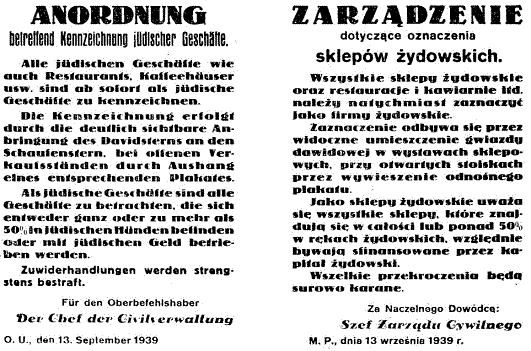
At the beginning of June 1941, Jews were ordered to leave their homes for the German officers and move into the streets that were designated for the ghetto. The area was closed in with fences, and the ghetto was walled in. Three gates were assigned to that area: 1) Mickiewicz Street 2) Gałęzowski Street at Freedom Place 3) Kazimierz Street in the Baldachówka district of Rzeszów. The Jews consoled themselves with the hope that it would be easier in the ghetto. “We will be locked in, and they will leave us alone”.
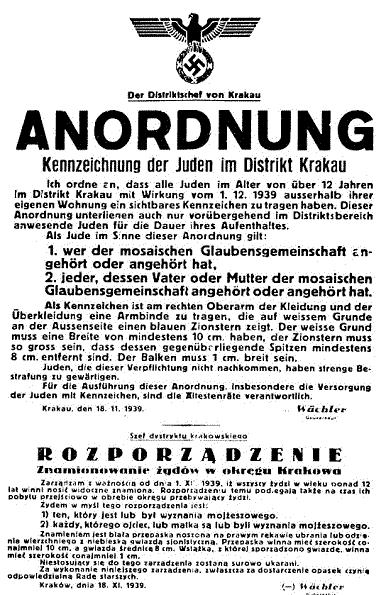
In December 1941, all the Jews left their homes and were locked into the ghetto. At the end of December, the ghetto was hermetically sealed. All Jews were ordered to attach a white armband with a Magen David to their sleeves. Whoever left the ghetto, or went out without the armband, was threatened with death.
People could only leave the ghetto for forced labor, escorted by Polish police, Germans and ushers. Shoemaking, tailoring and upholstery workshops, were opened in the ghetto. There were also work-places outside of the ghetto. Everyone preferred to work outside of the ghetto, because in this way, one could often buy food for the children (cheese, eggs etc.). When leaving or returning to the ghetto, it was forbidden to leave the line. At the entrance to the ghetto, the Germans hung a sign: Danger! Epidemic! – and they painted a dead
[Page 521]
head. Military personnel were forbidden to use this entrance. The hope of the
Jews that in the sealed ghetto, they would be left in peace, faded. Members of
the Gestapo visited the ghetto, every day. With the emergence of the ghetto,
the Jewish clinic that was outside the ghetto walls, was closed. The
“Judenrat” was ordered to prepare a private house to be used as a
hospital. We therefore moved the clinic into the ghetto area.
|
|
At that time, the district leader Dr. Ehaus, became ill. I was recommended to him as an experienced doctor. “Better to die” – he said – “than be healed by a Jew”. To our regret, he recovered, and each time he approached the gate of the ghetto that was near the hospital, he came to monitor whether food was being smuggled in. He tended to lift the dresses of the girls and beat them.
Jews from small towns in the vicinity, were also brought into the ghetto in Reisha. Jews from Kalisz who were brought to Reisha in December 1939, were taken into the ghetto and settled in the small synagogue of Reb Asher Zilber, who was the chairman of the community before the war.
There were no baths and no soap in the ghetto.
A work office was opened in the ghetto that was managed by a German. The management of the general files in the town, would bring the Jewish work cards into the ghetto.
In 1942, the Jews were obligated to pay all their taxes that had accumulated during 20 years of Polish rule, even those who had emigrated and were living abroad. The Germans gave the “Judenrat” four days to collect the money. When they were short of 4000 zlotys, the district leader Dr. Ehaus, ordered two Jewish militia men to arrest four members of the “Judenrat” who were shot together with the two militia men.
In the spring of 1942, the “Judenrat” was invited to the district leader at 6am. Panic broke out in the ghetto. The district leader read a letter from Heinrich Himmler, head of the Reich's security department, saying that all Jews must surrender their furs with the collars attached. Anyone who did not give up their furs, was threatened with death.
Even before the members of the “Judenrat” managed to return to the ghetto, the Gestapo agents broke into the premises of the fur trader in the ghetto and shot him. The better furs were sent to Krakow, and the ordinary furs remained in the warehouse and rotted.
Children who saw the actions of the Gestapo, cried. The fate of the children was dire. They suffered from hunger. They were shot in front of their mothers. When 3 year-olds saw the Gestapo personnel they would hide in holes until the danger was over.
On one occasion he called me, and gave me smuggled food for the sick, that he had confiscated from the forced laborers. It is worthwhile noting an interesting case: an officer's wife, a tenant in my house, fell in her room and broke the bone in her nose. I, as a Jewish doctor, was forbidden to treat a German. I stemmed the flow of blood and told her, that only with permission from the district leader, could I
[Page 522]
 |
|
attend to her. The leader did not allow it, and she had to travel to the German hospital in Krakow. The crowded conditions in the ghetto were indescribable. Not every family was fortunate to have one room. All the books in the town were requisitioned, as well as the religious books from the synagogues. Private books from a Jewish intellectual were sent to Nuremberg via Krakow.
There is no human language that can express the fear, the cunning and deception, the cruelty and the guile of the Germans. Even before the rise of the ghetto, there were prohibitions on movement that applied only to Jews. After 7pm, a Jew was not allowed to be in the street. Once, in December 1939, a girl rang me at midnight, requesting that I attend a birth. I told her, that as a Jew, I was not allowed to go out, without permission from the Gestapo. An hour later, there was another ring – the girl arrived escorted by a German Major from the military. When he asked me why I did not hurry to help a sick person, I told him that a prohibition from the Gestapo meant that I could not be in the streets after 7pm. I will give you a document, the Major said. He did not know that without approval from the Gestapo, his document was not valid. I went to the sick person, trembling with fear.
The crowded conditions in the ghetto worsened by the spring of 1942, because by that time, there were three families living in one room. There were people from Baszew, Glogów, Sokołów, Sędziszów and Czudec. I was shocked. I was sure that there would be an outbreak of an epidemic.
On 30.4.42, members of the Gestapo forcefully entered the ghetto, on the pretext that they were looking for communists, but mainly religious men were ushered out of the rooms, taken into the cellars, and beaten to death. They were cruelly tortured and then ordered the “Judenrat” to remove their bodies. There were terrible wounds on their bodies. We were confused and dumbfounded. Until then we did not believe that the Germans were capable of annihilating 3½ million Polish Jews. All this time, we thought that they only punished those who do not obey the laws. We could not imagine that they were so obscene that they would murder for no reason.
In 1942, the expulsion began. In the days of the first expulsion, I saw a police sergeant standing in the corridor of my house, crying. He was aggrieved by the barbarism of the Germans. “I have after all – he said – a father and a mother, a wife and children – how can one behave with such cruelty towards children? The nations of the world will be justified when they claim that the Germans are a barbaric people”.
After that, the “Judenrat” – as previously mentioned – received a command, demanding that the Jews pay all their debts arising from taxes to the state and the town administration that had accumulated over the past 20 years. Given that the members of the “Judenrat” were not able to collect
[Page 523]
the funds, four members were immediately shot, among them, one named Freilich, a learned man, an intellectual, that had been promised by Professor Einstein that he would facilitate his moving to America.
In July 1942, Dr. Tzinneman and I, were invited to meet with Dr. Ehaus, the district leader. We were given an order to prepare a list of doctors, nursing sisters, and midwives. He marked each name in either red or green. Next to each name he noted the profession. The name of Dr. Shmelkes, an orthopedic doctor, descended from eminent Rabbis, also appeared on this list. We feared the future. We fell into a state of apathy, but in the meantime, nothing happened.
At that time, there were 22 thousand residents in the ghetto, a number that included residents from other towns.
A few days later, the “Judenrat” was alerted to appear before Dr. Ehaus, the district leader. Dr. Tzinamin was among them. We stood in the corridor. Dr. Ehaus came out to us, escorted by Gestapo leaders, the Protection police (Schupo) – [short for Schutzpolizei], and policemen. He announced that the deportation of Jews in the ghetto would begin the next day, and the first deportees – would be those who do not work and need help. Each person was required to take jewellery, and food for two days. The ghetto was divided into sectors. Under threat of death, people were forbidden to go from one sector to another. The Jews who were tasked with keeping order, were to confine the people who were driven out of a sector, into the area between Baldachówka and Kopernik Streets.
The next day, at 6am, those assigned to drive out the deportees appeared. After 6am, the Gestapo inspected the sectors, searched houses, and those who were found, were shot on the spot.
Even before the expulsion, a decree was issued that all work-cards were to be handed back to the Gestapo. Those who possessed cards with the Gestapo seal, were freed from the first deportation. They were workers in ammunition factories, that was regarded as the work of the police. All of them, and their families, remained in the ghetto.
The district leader issued a command, that from that day, at 6 o'clock', sick Jews would not be sent to the hospital, and the entire building must be vacated, free of the sick. The next day, two S.S. men arrived at the hospital, investigated and checked, and found one girl, an American citizen, suffering from Tuberculosis. The parents of the girl, also American citizens, were in prison. They asked the girl if she wanted to go to her parents in prison, but she did not understand German – she spoke only English. The next day they shot her, together with her parents.
Incidentally, I am reminded of an occasion that occurred in 1940, before the proclamation of war against America. Three Gestapo men came on a visit to the hospital accompanied by two Americans. I did not know if they were news reporters, or from the “Red Cross”. They asked me about the condition of the hospital and of the sick. I lowered my head, and did not make eye contact, because I could not tell the truth.
When vacating the hospital, the remaining patients were told to dress and be ready in five minutes. One patient was paralyzed. I was overcome, and in a fit of tears, I sobbed aloud. The remaining doctors, my colleagues, poisoned their parents to avoid them being tortured by the Gestapo. The sick were taken into cars and shot in the forests of Głogów. It was my duty, as the doctor of the ghetto, to be present at the place where the victims of the deportation had been gathered. The first to be brought were old people from the home for the aged. Those who were sentenced to deportation, assembled at the site where they were forced to do gymnastics; after that each one sat on his bag. It was forbidden to turn around. I could see that fear took hold of them. I saw eyes enlarged by fear, eyes streaming tears – and I was supposed to give them first aid.
Part of the deportees were taken into rooms for body inspections and were beaten there. Two orderlies approached me and told me, that the door of the female dentist Dr. Jezower and her friend, could not be opened. A locksmith broke down the door, and we found that both drank poison. Dr. Jezower was already deceased, and her sister was still breathing. I heard her heart beating. I gave a report to Pavlo, the town's commissioner, and asked him for permission to attend to the sick lady and take her to hospital. “No” – he shouted – “she can die here”. Among others who drank poison were Yehoshua Schneeweis, the owner of the local pawn shop, and his wife.
The bags of the deportees were taken from them and loaded into separate cars. Among us, there were some who thought that they intended
[Page 524]
to ease the burden of those who were suffering so that they would not have to carry their baggage on the way, but the cars with the baggage were not sent with the deportees; instead, they were brought to the warehouses of the train workers.
At 12 o'clock, the crowd came out on foot, accompanied by S.S. groups that were mobilized from the towns in the vicinity, heading in the direction of Staroniwa. On the way an S.S. man beat a woman and when her husband rushed to protect his wife, he attacked the man who was beating her. The S.S. groups then began to shoot at the deportees – the Jewish orderlies gathered hundreds of dead bodies and had to clean the blood in the streets right away.
This happened near the “Sokól” building, opposite the new postal building where young German girls of the B.D.M. (Union of German Girls), worked as officials. Many of them witnessed this horror, fainted or burst into tears. All these German girls were immediately sent back to Germany.
The first deportation consisted of approximately 3000 Jews. The “Judenrat” was ordered to pay all the expenses for transporting the people and their baggage. The Jews did not want to pay, so the “Judenrat” took steps – they promised to get the work-cards stamped by the Gestapo that would free them from the deportation. The money was collected but the cards were not stamped, and many work-cards were lost.
The Jews were ordered to dig pits at the cemetery for the communal burial of the victims of the shooting at the Sokól building, and to clean the sidewalks with the congealed blood, with their tongues.
Instead of 40 people, 120 were put into each railroad car. Women and children were shouting “water, water”. There were Polish women who brought them water, but they could not approach the car because coming closer was forbidden. The S.S. then chased the Polish women away with sticks. I turned back to the ghetto; I did not understand why they dragged me into the role of a doctor. In my first-aid bag, they only allowed me to take valerian drops and four packets of bandages.
I remember an incident that was typical of the Hitlerites. At the assembly point of the deportees, a woman asked the police officer (a Schupo), to take pity on her mother and transfer her to the hospital. When she asked him where they were taking those assembled, the answer was: “to the kingdom of heaven” and he pointed upwards. The Neuman family was also there. The wife was a German lady from Berlin. Her husband approached a Gestapo official and said: “my wife is a German, an Aryan”. In reply, he beat him in a rage and sent the wife to the Aryan side. The wife was a fine person and did not go to the Aryan side, instead she returned to the ghetto, to suffer together with her husband's brother. She would light candles on the Sabbath. Her brother was an officer in the S.S. in Berlin, and her aunt was a winter supporter for the N.S.F. (Nationalsozialistische Frauenschaft). Her husband was not deported but sent to prison, and an order was received to transfer her and her children to the Aryan side. Her husband was sent back to the ghetto, and she and her children were ordered to leave Poland. She telephoned her brother and uncle and when they arrived, they were angry and shouted – but to no avail.
Among the first victims of the Nazi cruelty, were the Jewish intellectuals – the advocates were the first to be sent to the extermination camps. They were detained in the ghetto until December 1941 and then sent to the crematoria. I remember the Advocate Dr. Zaltzman, Dr. Leker, The lady advocate Duker, Dr. Schlager – a philosopher, a Spinoza researcher. The older doctors: Dr. Hertz, Dr. Kronenfeld, Dr. Yezover (committed suicide). Dr. Tzinman was sent to Bełżec, to the gas chambers.
Among the Polish intellectuals, there were some who expressed their feelings against the horrors committed by the Germans, and there were also some, that rejoiced in their hearts, that Hitler was solving the Jewish problem for them, that they themselves were not in a position to carry out. But they too, were afraid, in case it would be their turn, after the Jews. Even the endekkes (the National Democratic party), finally, also had enough of German rule, and awaited the success of the Russians.
There were Jews who were saved by Poles; their rescuers belonged mainly to the poorer class, among them, also some from the underworld. The priests expressed sympathy for the Jews, the judges, in their hearts felt the suffering of their Jewish friends. The chairman of the courts of justice told me that he does not sleep at night, because he sees before his eyes, the suffering of the Jews in the ghetto. Some had no pity for us. There were some that took
[Page 525]
ransom money and jewellery from Jewish people and finally handed them over to the Germans.
Other cases must be noted that exemplify the madness of the Germans, their hatred, and their split personalities. This was evident during the first deportation. At the assembly site, the district leader Dr. Ehaus, noticed a beautiful blonde Jewish girl. He ordered that she be taken for an anthropological examination to extract confirmation that she is descended from an Aryan race. He sent her parents away to be shot, and he took her as a servant to his house. After the defeat of the German army, he fled to Germany and took her with him. When Germany surrendered, Dr. Ehaus committed suicide. The Jewish girl returned to Poland and married a Polish Colonel.
At the first deportation, the Gestapo people approached Mrs. Shtorch and her disabled child who could not walk. The mother pleaded with them not to kill her child, rather her. They fulfilled her wishes and killed her, and her son.
The 250 people killed on the way to the train, were buried at the wall of the cemetery. The town's commissioner came to control the burial. When he saw an inscription on the wall “al kiddush hashem” [death for being a Jew – martyrdom}, he asked a man named Lusterman what it means. Lusterman replied that he did not know, so he shot him and pushed his body into the common grave. Among the 250 people killed, was a Rabbinic judge, a member of the rabbinical court, Rabbi Yosef Reich, who was known by the nickname “Red Yossel”.
The residents of the “old-aged home” were not brought to the train. They came without bags, wrapped in prayer shawls and phylacteries and were immediately sent to the Głogów forest and murdered.
The management of the ghetto was housed in the home of Mr. Tzuker, in Gornotzarske Street (Tepper Street). On that day of the deportation, an S.S. officer winked at me, to accompany him into the house. He gestured with his hands and said: “my God, my God, see what they (the Germans) are doing”.
In the small prayer house of the Rymanów Chasidim, was a section for incurable sick people, and the supervising doctor was Dr. Hofman, a Jewish doctor from Breslau. In the first deportation, the sick were loaded onto hand-held wagons and brought to the assembly place. On the way, they recited “Vidui” [a prayer before dying] because they knew that this was their last journey.
|
|
|
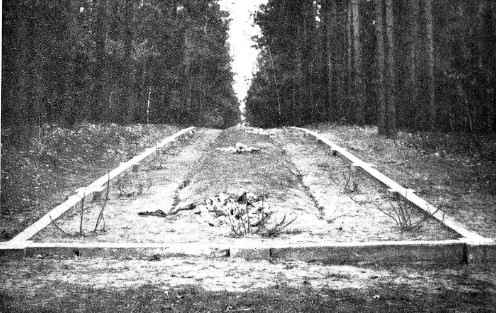
and the vicinity, in the Głogów forests. The grave was 150 meters long |
[Page 526]
Shiff brothers who were gold jewellers in Reisha. Their family was killed in Lemberg. In our town, there was a seal-maker named Zinger. He disguised himself as a Catholic Pastor to save himself. A Gestapo man recognized him in Przemyśl and brought him to Reisha where he shot him.
Every spark of hope was extinguished in the ghetto – even the optimists said: we are the living dead.
On the first day of the deportation, the district leader Dr. Ehaus, left the town for a few days. When he returned, he demanded that Dr. Beni Kahana write a real report regarding what happened in the town during the days of his absence, and that he should note that the events took place when he was absent. He was an antisemite from the darkness of his heart. In 1940, when he saw Jews in the street with armbands attached, he used to say: “I must still see, one time, the town without Jews”.
All the deportees were sent to Błżec.
In July 1942, the second, third, and fourth deportations took place. The traces that remained after the deportations were not as bloody as those of the first deportation in July 1942. The ghetto shrunk, and the Jews were forced to vacate their residences in the ghetto, one street after the other, and then repair the vacant houses. The streets that were emptied were joined to the Aryan side, and the houses were given to the Poles, except for the houses on Yagyelonska Street that were handed over to the Germans. The ghetto was divided into two. One side to the right as far as Baldachówka Street, and the second to the left. That was in Autumn 1942. The eastern side of the ghetto (Ostghetto), the ghetto of work, was under the supervision of the S.S. with the German name “Jewish Forced Labor Camp”.
The first director was an S.S. man named Bacher (troop leader), a new German, a degenerate.
Under the supervision of this man, the east ghetto, was a sealed camp, surrounded by barbed wire and lit up with search lights. The residents had to attend roll-call every day, the beds were removed from the rooms and replaced with wooden sofas. There was a partition between the men's and women's sections. The supervision of the women's camp lay in the hands of the female police. There were no particularly cruel incidents as there were in the Płaszów camp, where the residents were transferred when the ghetto was liquidated.
The commander Bacher banned the men from visiting the women and whoever did not obey this order was threatened with death. Opposite the east ghetto (Ostghetto), a west ghetto was erected (Westghetto), or as they called it, the Shmeltz ghetto. The word 'shmeltz' means, melting, solution, a name that indicated that they would be killed. Old people, children and those unable to work, were placed there. This section was surrounded by barbed wire and supervised by the Gestapo. Families were separated, parents in the east ghetto, and the children in the Shmeltz ghetto.
On 15.8.42, a decree was issued that women and children had to register at the work bureau, and even then, the Jews interpreted this with optimism. To them, this meant that the women who were burdened with children would be freed from forced labor. So a plan was put into motion, to share the children, so a woman without children would be given a child from one who had many children, similar to a benevolent deed, so that she would be freed from forced labor. When the women and children gathered at the work office, they were surrounded by a group of S.S. men and sent to the extermination camp at Bełżec. Two men were attached to this group – one of whom was Dr. Tzinneman, the assistant director of the hospital. I turned to the inspector at the labor bureau, the German, Fifer, and asked him not to take away my deputy but he refused my request with the excuse that there too, they needed doctors. At the time, we did not know where they were being sent. The Judenrat collected money, and paid the Poles to investigate, and inform us, where the transport was being sent. There were Poles who gave us false information, but one of the messengers told us that they were sent to a soap factory where they make soap from Jewish bodies. “All for soap”. (Polish – everything on soap).
I lived among Germans for many years, and I studied with them, and I was inclined to believe that the Slavic people, Ukrainians and Poles, were able to do such terrible deeds, but I was not right, and I remembered the Viennese writer, the Jew Karl Kraus, who said: “the Germans are not only a nation of poets and thinkers, but also a nation of police and hangmen”.
In the evening, when the men returned from work outside the ghetto, and they were not met
[Page 527]
by their wives – they burst into tears, and bitter despair enveloped the camp. With difficulty, they calmed down – the members of the Judenrat and the orderlies were threatened by the Gestapo, that if we rebelled, they would kill everyone. The men answered: “We are ready to die”. Finally, they were calm and their life of slavery continued until November 1942. That was the quiet before the storm, before a new fear. In November, the barbed wire fences were doubled and strengthened.
That was the 15.11.42. We were notified by the Judenrat that wounded German soldiers from the Russian front, would be brought through Baldachówka Road and that it was forbidden – under threat of death – to speak to the wounded. We felt that terrible things were coming closer.
The Judenrat announced the decree of the Gestapo, that residents of the ghetto must appear at the assembly place with their work cards where they would be counted; they added that there was no need to be alarmed about deportation, because deportation was not being considered. On the 15.11.42, when we heard about this decree, we were in a state of despair, and we did not close our eyes the entire night; we drank to dim our consciousness and dull our spirits.
At 6am we appeared at the assembly place that was situated at the entrance gate of the ghetto. Members of the Gestapo with steel hats on their heads were swarming around us. It was a terrible day. Snow mixed with rain filled the site and we stood in the mud in the penetrating cold. A raging wind shook the barbed fences, and from above, on the roofs, the crows croaked, as if they were accompanying the cry in our hearts.
My wife and I also appeared at the assembly place; she said to me, “they want to take our children away”. Lehman, the Gestapo official, ordered Dr. Kahana to see that the children were brought to the kindergarten. We trusted Lehman. We found the town commander, the Gestapo, the police, an official, and their secretaries, sitting around long tables that were set up. They called the men first. They took the children with them, thinking that their work cards would save them. The first man appeared and was asked where he worked. He answered: I work at the eastern train station. They allowed him to leave the assembly place, and they detained the boy. They asked his wife the same question: where she worked. Her answer: I work in the sewing factory, and they allowed her to leave the assembly place, and detained the girl. Many women did not want to part from their children. Even though I was the head doctor of the ghetto and the camp, and provided medicinal aid, they took my daughter too, a 12 year old. Then they called my wife and asked where she worked. She replied that she worked in the kitchens. They allowed her to leave but my daughter remained at the assembly place. In one minute, her hair turned grey. My wife turned to me and asked me to try to save our daughter. I turned to Dr. Ehaus, the district leader, and said to him: “this is my only daughter. I ask you to free her. I work as a doctor. May this be my reward for my suffering”. He turned to the head of the Gestapo, and it was decided to free the doctor's daughter. I burst into tears, but all this did not help me. I did not have the honor of saving my daughter, or my wife. I lost both, even before the war ended. My daughter was one of the last children who was saved by mothers who hid them in sacks in the cupboards.
A few hours later, two officers came and asked me the name of my daughter. People consoled us with the hope that our daughter would return to us. We were all gathered in the house of Leizer Lev, the owner of a dairy. His son Irving Law, who lives in New Jersey in America, is active in communal affairs, a philanthropist, an eminent American Jew. Through the window of the house, we saw them loading the children into cars. Mothers cried and screamed. They were hysterical, their cries reached the heavens; they beat their heads against the wall. In the presence of the mothers, driven crazy from the pain, the Germans stole the last children, and they remained without children.
All hope was lost, but we hoped for one release – death.
Those who remained continued their work in the laboratories and factories outside the ghetto, under German administration. Bacher, the commander of the “Ostghetto”, was immediately dismissed and assigned to the S.S. commander in Krakow, and not to the authority of the Reich. He had a bad relationship with the local Gestapo.
Once, he called the Jewish orderlies and commanded them not to allow any Gestapo men into the camp. When they came to the gate at the entrance,
[Page 528]
the guard showed them Bacher's decree. The matter ended with Bacher's transfer to another position, and in his place Schopke arrived, who was initially, a more personable man than Bacher. He abolished whipping as a form of punishment. When a man visited his wife in the second camp, he did not sentence him to death but ordered him to pay a fine, and for the money that he received, he bought bread for the Jews in the “Shmeltz Ghetto”. We were not afraid of him as we were of Bacher, the tyrant. The head of Ordnungsdienst[8], O.D., was Garelik, a resident of Łódź, who was a former lieutenant in the Polish military. As the Russians approached, he even recommended, that Schopke, switch his German uniform, that he would help him escape to the forest, and that nothing bad would happen to him. At the beginning, Garelik was somewhat difficult but later became trustworthy. He had a good relationship with Schopke, the commander of the camp. This Schopke, saved Jews quite often, and had a special sensitivity towards the people of Reisha.
When he left Reisha to take command of the concentration camp in Płszó, he would lighten the burden of the people from Reisha. Schopke was the commander A.Z.J. (Labor Commander) in Reisha until the liquidation in January 1944.
In the time of Commander Bacher, every Jew and his clothes were regarded as possessions of the S.S. Once, during roll-call (Appell), he came across a Jew who was dressed in two pairs of trousers. He called the Jewish orderlies and ordered them to give the man 20 lashes on the right side, and the left side of his posterior. The orderlies beat him with mercy, so he ordered the orderlies to undress and showed them how the man was to be beaten. After that, he took the man into a corridor and shot him.
One day, I was called to go to Bacher. He complained of stomach pain. “Is this a punishment from heaven for my attitude towards Jews?” he asked. Once he ordered me to take my wife to the Shmeltz Ghetto. I turned to him and asked if I could also go with my wife, because, more than once, he had told me that doctors were not necessary in the ghetto. The next morning, he reversed his decision and sent my wife to the Ostghetto to work near me in the hospital, and not in the kitchens. Bacher died in a mental home. Schopke, who replaced him, was sentenced to death by the Poles in Krakow, after the defeat of the Germans.
Lola Weiss (now in Israel), testified against him at his trial. She said that although he did favors for Jews, and also saved her life, she confirmed that she had seen him shoot 14 Jews.
I cannot relate and describe everything in sequence. I jump from one tale to another. I think about something and go back in time. The chain of the narrative is not consistent. I think of a link and attach it to the chain, even though it is not in its order.
We will return to Schopke, to the murder of the women in Szebnia[9], that was told to us by the Poles. I called upon Schopke who was with Garelik, and asked him if the information was correct. “Don't believe the nonsense and fantasies of the Poles” he told us – “I am prepared to travel and clarify if the information is correct”. He went, and when he returned, he said in typical German style: “the information is not correct; 400 women were not murdered, only 360”. The commander in Szebnia did this of his own accord, and he is responsible.
He wanted to send me to the Szebnie Camp to accompany my wife and child, to serve there as a doctor in the camp of the Ukrainian garrison.
When the Jews in the ghetto heard about the slaughter in Szebnia, they began to flee, so that they would not be sent to Szebnia. Of the group of 100 people who fled, only 42 remained. Schopke was accused, and to save himself, he one day chose 14 young men, ostensibly to unload coal from wagons. After midday, people were ordered to appear at roll-call. Gestapo men and Ukrainian police came through the gate and Schopke called the 14 names of the young men mentioned above. He took them into a room where there was a window looking out on to the Aryan side. The young men felt the shadow of the angel of death and they all fled. The gestapo men entered the room and found no one. Then Schopke ordered everyone to undress, killed 12 other young boys and sent the rest home. Fewer of us remained in the camp. When my daughter saw the blood of those that had been killed, she became hysterical. After these events Schopke went into the rooms, where those who remained had settled in one house. He came into my room too and recognized my daughter. “What are you doing Gretchen?” he asked. When she saw him, she turned her face away from him. The next morning, he came to me in the hospital to justify himself saying: “I was forced to do this, so that
[Page 529]
the Gestapo would not kill everybody. I am no longer the same old Schopke”.
This incident happened in the spring. I went to the west-ghetto (Shmeltz Ghetto) and I met Dr. Hauptman, the doctor of that ghetto. He was a devoted doctor who attended to those who were sick. He looked depressed and he told me that he had a high temperature that was weakening his body. During the night, I was called to attend to him, and I saw that he was dying. Typhus killed him. Until the last moment, he served his friends in their suffering. The epidemic spread to the east ghetto and many people perished. The family and relatives were only allowed to accompany the dead to the gate of the ghetto and were prohibited from continuing to the cemetery.
I was despondent; the residents of the west ghetto were not obligated to work. The only work they were permitted to do, was cleaning, under the supervision of the gestapo, but the east ghetto was under the supervision of the S.S., and the commander of the ghetto was under the direct supervision of the head of the S.S. police.
My responsibilities in the camp put pressure on me. I was afraid that the illness would spill over into the west ghetto. I turned to the commander of the east ghetto and suggested that he ban the use of the passage between the west ghetto and the east ghetto because among those locked into the west ghetto there were people who were sick with the flu. I was afraid, they said, that the epidemic was typhus.
In Lemberg Street, in the old barracks dating back to Austrian times, there was a disinfection against lice every two weeks, but it was of no use, because it was precisely there that one could become infected with lice. The conditions in the camp were unbearable. Three families lived in one room, in circumstances that gave rise to unclean and unhealthy conditions.
The old people in the west ghetto did not work; they knew that they had been sentenced to death.
The people in the east ghetto worked in various professions. They took pride in the fact that they worked and hoped that they could continue in this way until the end of the war. They wore a band on their arms, a “W” or a “R”, that meant Wehrmacht (protection)[10] or Rüstung (armed). Their parents lived in the west ghetto. The doctors also became ill. Only I, and one other doctor remained healthy. I was afraid of a catastrophe as a result of the epidemic.
Consequently, I chose 10 young people, healthy and strong, and took blood from them to be analyzed in the military laboratory. The analysis showed negative. Finally, I also became ill. For a few days, I lay unconscious. As soon as I became ill, I heard loud footsteps. These were the footsteps of the commander of the east ghetto, and a medical officer from the S.S.
“Are you also sick?” asked the commander. I quickly put on my white housecoat and told him that this was a flu epidemic and gave him the certificate that confirmed that the analysis proved negative. The doctor believed that this was influenza. I could not continue with further analysis due to lack of finance.
A few days later, I learned that the district leader had notified the Judenrat in the east ghetto, that he was coming to control the camp because he heard that there was an outbreak of typhus, and that there were daily cases of death. It was fortunate for us that he did not come himself. Instead the district doctor came, a Pole from Poznan, who was pleasant and well-liked. He also took three healthy people and sent their blood for analysis – and it was confirmed that they were healthy.
This doctor received a gift of a diamond from one of the Jews, from the few pieces of jewellery that he had managed to hide. The epidemic lasted about two months, and when it ended, work continued in the factories of the east ghetto. The upholsterers, the tailors, and the locksmiths worked inside the ghetto, and the groups of young people who went to work outside the ghetto, were guarded by Jewish and Polish policemen.
From one deportation to the next, people continued to work, yet they were always afraid that after the calm, a storm would break out. In the interim, they wanted to live. According to a decree from the Germans, the youth and the orderlies played soccer, and competitions between the west and east ghettos took place.
In these years of misfortune, many women were lucky to have organized themselves to live as women of Aryan descent. There were cases, where due to being denounced by an informer, Jewish women were caught with Aryan documents. The office of the gestapo assured them that if they confessed, they would not be killed, that they would only be sent to the ghetto. In this way, new families with their children continued to arrive in the ghetto.
I have already previously written that in July 1943, it was rumored in the ghetto, that soon everyone
[Page 530]
would be transferred to the notorious labor camp in Szebnia near Jasło.
In August, those who were locked into the west ghetto were ordered to appear at roll-call. The entire camp was surrounded by S.S. groups. The Jews in the west ghetto stood at the Baldachówka work camp and the Jews from the east ghetto, in the east ghetto. It is worth noting that this roll-call (Appell) was held daily. All those detained were counted and called by their names. A report regarding the number of detainees was sent to the S.S. in Krakow every day. At that time, there were 380 people in the west ghetto, instead of the prescribed 400 that were to be sent to Auschwitz, according to the demand of headquarters; so the gestapo came into the east ghetto grabbed 20 working people in order to complete the required 400 and sent them all to Auschwitz.
In Reisha, in August 1943, it was not known that gas chambers had been installed in Auschwitz, but what was known, was, that Auschwitz meant death.
Among the 20 young people that had joined the 380, were the best carpenters, so Garelik, the director of Order Service, went to the S.S. commander and complained that the most skilled workers that he needed, had been taken. The commander answered: “table making here, table making there, that is to say, why does that concern us”.
I have already mentioned that the commander of the camp, an S.S. man, whose family I took care of, wanted to transfer me to Szebnia, a labor camp near Yaslo, where I would serve as the camp doctor. My wife was against it, so I went to the commander at 11 at night and asked him to allow us to remain with the current arrangements and the evacuation group. Schopke told me that he would take my daughter in his car. The head doctor of the military camp in Szebnia, proposed that I should travel with him; “I have a little girl”, I said to him quietly, so that the gestapo men would not hear. I am authorized to deal only with medical issues, he answered, and allowed me to remain in Reisha with the current arrangements and the evacuation group. So, I remained in the east ghetto together with another 80 people. The west ghetto was liquidated.
The last deportation took place in August 1943. Only 100 young people remained of the evacuation group. Then Lotke Goldberg escaped from the Szebnia camp, near Yaslo, and returned to the ghetto. Schopke recognized her and called her by her name (he knew everyone by name). Lotke what are you doing here, you deserve the Iron Cross of the first rank, for being such an opportunist – and he took her into the ghetto again. Bacher would have killed her immediately. Lotke ran away from the women's camp in Shabnia, where they killed all the women, among them, her mother. The bullet did not hit her. She pretended to be dead, and at night she ran away and arrived at the Reisha ghetto.
The workers in the east ghetto who were supposed to be sent to Szebnia were distressed. They saw that their work tools and machines remained in the camp. They went to the commander in the camp, and he ordered that the workers' tools be loaded into the cars and taken to the train station, together with the workers.
Those who were distressed calmed down and believed that they were going out to work. It turned out, that those who worked in the east ghetto were sent to Szebnia and the people of the west ghetto – were sent to Auschwitz.
The head grave-digger at the cemetery was called Oyzerovitsh. He brought all the victims of the gestapo for burial at the Jewish cemetery, among them also Poles who were killed by the gestapo. One day, he ran away and rescued his two daughters by transporting them in a wagon meant for the dead. He managed to hide his daughters with Christians. This grave digger is now in America and is a rich man. He testified in court against the gestapo leader in Reisha – Mack.
To complete the story of the 14 people that Schopke – the leader of the camp – took into a room in Tzuker's house, from which they escaped through a window on the Aryan side – I want to note that this happened on a day in September 1943. Schopke came into the room and found no one. He then went out, and as if he was insane, he screamed: “I will destroy you all, like the dogs”.
He ordered us to undress and kneel. My wife and my little daughter were standing opposite me. My daughter screamed: “Daddy, I will not give you away”. I calmed her down. Schopke first called over the shoemaker Milmeister and shot him. A few days earlier, this shoemaker had sewn a pair of boots for Schopke's wife, Then, he called over the shoemaker's son, told him to lie next to his father, and killed him too; and before our eyes, he killed 12 Jews. Afterwards, I found out
[Page 531]
that among those that escaped from the room, a few remained alive. Some were caught in a police search on the Aryan side, among them Dr. Tonis, one of the doctors in the camp. He was killed by a Ukrainian policeman who knew him and had been cured by him. Among those rescued from the 14 escapees was Dr. Michael Schneeweis who is with us in Tel-Aviv.
After the cleansing, the clearance, and the operations, the remaining residents of Reisha, that had once numbered 22 thousand before the rise of the ghetto, were able to be housed in one house, the house of the milk dealer, Eliezer Lev. Garelik, the commander of the Order Service, received a special Argentinian passport from a member of the gestapo, who was friendly with his wife. When it became known to the gestapo, Garelik and his wife were called to an investigation, and despite being tortured, neither of them reveled the name of the man who provided them with the passport. After they had both been tortured, they were shot.
In the vicinity of Reisha, in Łysa Góra, there was a labor camp for 500 Jews from all corners of Europe. They worked in F.M.W. (Flugmotorenwerk), a venture producing engines for airplanes. A few people managed to escape from this camp with the help of Poles, among them, two acquaintances of mine, Fritz Ajzenberg and Aleksander Rozin who now lives in Tel Aviv. Those remaining from this group (clearance column), who lived in Lev's house, were transferred in part, that means, the men were taken to an arms enterprise in Stalowa Wola, and the women to the camp in Plaszów. Among them was Lola Weiss, who now lives in Tel Aviv. Not a single person from the west ghetto (Westgheto) survived.
At the beginning of 1944, not one Jew remained in Reisha. According to the German plan, and the will of Dr. Ehaus, the district leader, the town was “judenrein” [free of Jews]. The furniture in the town was sold to the Poles, and the valuable items were transferred to the warehouses in Krakow.
The P.Z.L. (Państwowe Zakłady Lotnicze) was a Jewish work camp J.Z.A. (Jewish Forced Labor Camp) and was affiliated to the concentration camp in Płaszów. This camp was regarded as a division of the central camp, the notorious abomination – Oranienburg.
This place later became a quarantine camp. A tall stone wall with three iron gates was erected around the factory. When it became a quarantine camp, the Jews were housed in barracks and worked together with the Poles in the factories. Among the 500 Jews in this undertaking, there were few residents from Reisha; most were from all the occupied places in Europe, and only about 30 from Reisha, among them, my wife, my daughter and I. Although there was a severe lack of nourishment, it was possible to buy food from the farmers, and in the halls of these factories the Jews were protected from the harsh cold weather.
The manager of this venture, a German, often said that the best workers were mostly the Jews, but he was careful not to say this in the presence of the S.S. people.
I felt the responsibility of being a doctor in the camp. The Jews suffered from skin ailments and wounds that festered due to lack of food, and there were no anti-biotic medications at my disposal. I was obliged to inform the authorities of the number of sick every day, but I was afraid to do this, in case the sick would be taken out and killed.
Those who kept order in the camp, were Jewish, and had good relationships with the German work manager, so they asked him to mark the work cards, indicating that everyone is healthy, and that only three or four people should be recorded as being sick. Among the workers there was a radio technician, Fritz Ajzenberg, from the town of Byelsko, who now lives in Tel Aviv. He would listen to the radio transmissions from foreign stations and give his friends encouraging news.
There was a barrack in the camp that housed eight women, among them, my wife and daughter, Dr. Frederika Hirshdorfer, and the wife of Dr. Dovid Cohen of Tarnów, who was one of the founders of “Hashomer Ha'tza'ír” in Vienna. The women were engaged in sewing and doing laundry.
In July 1944, the commander of the camp came to me and told me that the Russian pioneering military forces had arrived in the vicinity of Jarosław. Our joy was mixed with fear. I was afraid that the Germans would kill us even before the arrival of the Russians, but I was happy that our suffering would come to an end and that the Germans would be punished. After a few days, German officers from the demolition group (Sprengkommando), arrived. A few days later, we
[Page 532]
came together with those who kept order, as well as the Jewish service people, to discuss an escape. The camp was surrounded by a protective wall, under the control of Ukrainians. We decided amongst ourselves that the strong young men would attack the Ukrainians and disarm them. My view was, that everyone should participate in the escape because if only some escaped, the Germans would kill the remaining Jews. The young men said that they would take the sick with them. There were some who were against escaping because they were sure that when the Germans found out, they would kill everyone. They argued that there were no forests in the area and no hinterland to protect them, and that one could not rely on neighbors and the farmers. Those who were against an escape surrounded the barracks and allowed no one to leave, but Fritz Ajzenberg, the radio technician, had permission to go to work at headquarters. He later reported that the streets and highways were full of retreating military troops. We hoped to be liberated. Every day we received news, one suspenseful item of news after another… here, the Germans are burning their archives. We were nervous and worried; we did not know what our fate would be. German families were hurrying, confused, to the train; there were not enough carriages.
Once, a workman came to me at night and said that he found the iron gate to the camp, wide open, and that it was an opportunity to escape. This was 2am, and not many had begun to escape, and of them, only a few remained alive because the national Polish underground A.K. (Armia Krajowa),[11] caught them and killed them. They did not want them to fall into the hands of the Russians. That night, Poles helped Ajzenberg and Rozin (now both in Tel Aviv) to escape with the help of a ladder at the protective wall. A young man from Leipzig, the manager of the camp (Lagerälteste)[12], was forced to inform the gestapo about those who escaped. Within 10 minutes, the commander of the camp arrived, reviewed the situation and organized a raid in pursuit of the escapees. That happened in July 1944. The escapees hid in the wheat fields that had not been harvested. Only a few people escaped at that time. Most remained because they were afraid of punishment. The Ukrainian police authority was strengthened, but this time they did not take revenge, and did not punish us.
Two days later, after the people escaped, the Germans received transportation wagons from the F.M.W. (Flugmotorenwerke) and took us all – about 400 Jews – to Płszó. These Jews were more important to them than the machines of the F.M.W. The journey to Płszó, near Krakow, escorted by Ukrainian police, lasted two days. The S.S. were waiting for us at the station, with dogs. About 10 thousand people were detained in the Płszó camp that had been built on the grounds of the Jewish cemetery.
At the entrance to the camp, the commander of the camp met us, a young man from Vienna, Amon Gett, a sadistic murderer who resembled a movie star in a cinema.
Suddenly, I heard a loud voice: Dr. Heller! You have sick people, lice, where did you study? I answered that I studied in Vienna. My friends surrounded me, and out of curiosity they asked what he wanted from me. The young commander frightened me. He walked around with a small revolver in his hand and when he saw a Jew walking in the camp, and was offended by him, he shot him, like a bird. With the defeat of the Germans, the Poles caught him in Krakow and he was sentenced to death by hanging.
There were also Poles in the Płszó camp. Quite often they would be caught, detained for a few days or months, and then allowed to go free. The S.S. who kept order, conducted a search in the rooms and after confiscating all our possessions, sent us to the barracks.
There were large factories in the Płszó camp, and the Jews were in contact with a German named Schindler, a friend of the Jews, who recently visited Israel as a guest.
The Jews of Krakow who worked in the camp, behaved decently. They worked overtime to earn money for the Hungarian women, and to cover urgent needs.
In Płszó, I also met Schopke, who had been the commander of the east ghetto in Reisha. He had shown particular consideration for the Reisha detainees, after the savage murder that he committed because of the 14 young men that escaped. The commander of the camp, Amon Gett, made use of the vilest and most corrupt Jews, and with their help, tortured the detainees. Afterwards, he cunningly did everything possible to get rid of his Jewish assistants and hanged them all. He used to set his dog Rolf, against the Jews. He would turn to the dog: “listen Rolf, attack, bite the dog (the Jew)!”
[Page 533]
The doctor in the camp was Dr. Gros, a Jew from Katowice. He was hanged together with Amon Gett, the commander of the camp, based on a judgement by the Poles.
With our arrival at the work camp in Płszó, it was converted to a concentration camp. Before that, it was a forced labor camp.
In that camp, there were still a few children that the women had managed to bring in and hide in sacks. Amon Göth ordered a search for the children. The women were forced to appear naked before the leader, and then he sent them to Auschwitz. When the children were found, the gramophone played a German song loudly:
“Goodbye mother, we are travelling to the kingdom of heaven”.
The people from Reisha were in Płszó for about six weeks, but eight days after their arrival, some were sent to the camps in Germany. In Płszó, I ceased working as a doctor because the camp doctor, Dr. Gros, who was hanged together with Amon Göth – did not want to use my services as a doctor.
One Saturday afternoon, in August 1944, a roll call was conducted, with men and women separately. The roll call was held punctually. From a distance, I saw my wife, my daughter, and Dr. Hershderfer. All the women were sent to the train station, with 120 loaded into each carriage, without water. On a suffocatingly hot day they remained in the carriage and were then sent to Auschwitz. The men remained behind, and those who were taken from the arms factory in Stalowa Wola, near Reisha, joined them. Among them was Dr. Willy Kahana, an advocate from our town, and other people from Reisha.
On the Sunday following that same Sabbath, in the month of August, there was another Appell for men, who were all sent to the notorious Mauthausen[13] camp in upper Austria, escorted by S.S. guards. There were 120 of us in one carriage. The S.S, guards searched our possessions, emptied our pockets, and took everything away. Our conditions in the carriage were terrible. There was no air to breathe. Everyone pushed to stand in the passage between one carriage and the next, or on the stairs, to get a little air. The screams “water!”, cut through the air. The guards answered: “If you will be good children, you will receive water at the nearest station”. (Ger. When you are good, you will receive water).
Every day, at least four dead people were taken from the carriage. When the door was opened to remove the dead bodies, we breathed a little air. We travelled like this, for four days. There was no toilet in the carriage. We travelled through Auschwitz to Mauthausen. This camp was captured by the Russians in the First World War. On the way to the camp, we passed a small river. We bent down to drink the water with such craving, just as if it was milk.
In Mauthausen camp, there were about 80,000 detainees. Detainees from Auschwitz were also brought there because they had emptied that camp. We were taken into a barrack for disinfection, and then taken to another barrack in which there was room for only 500 people, but 2000 detainees were brought in. We lay squashed together like herring, heads opposite feet. Police came in to inspect, to see if there was a gap somewhere, to bring in another person. The people of Reisha arranged themselves together. Among us were Dr. Willy Kahana, MG (Magister)[14] Hershderfer, the dentist Feyer, and others. Suffocation and despair were our lot. At night – terrible dreams, screaming “shoot us” while dreaming, and sounds of screaming and weeping, until they were dulled. Among the detainees, there was also a soldier from the German navy who was sent to serve as supervisor of the barrack, as a punishment. More than once, he stood opposite us with his legs spread apart and shouted: “You stinking Hebrews, do you then believe that any one of you will leave the camp alive? You will be able to see your freedom through the chimney of the crematorium, that is opposite your barrack. Me too!”.
The Germans took away our clothes and for a few days we were naked. We had papers and photographs in our clothes, and everything disappeared. Afterwards, we received only a shirt.
For a few days we did not work. Then another inspection took place. They looked between our teeth and put their fingers in our anus. We were brought to an underground structure, in the mines. We thought that we were being taken to the gas chambers. There they shaved us from head to foot. In the middle of the hair on our heads, they left a gap, a sign of identification of a detainee, in case of escape. They named this gap
[Page 534]
the lice promenade. Then we were taken in a hurry to work among the mountains.
Until 1943, that place served as a prison for Germans that had been arrested. While still alive, they were thrown into an abyss. The S.S. murderers called these deaths “parachute military” (parachute troops). Few survived the hard labor. One of the Reisha people, Herman Goldshtein, who had a heart condition, approached an S.S. person and complained about pain. The S.S. man told him to go to the fence, and he shot him in the back. One was only permitted to go to the toilet between 8 and 9, and water was provided for only one hour of the day, during the daytime.
One could only drink in the cellar. Any dirt found resulted in punishment by beating. There was a garden at the first entrance gate to the camp, and in the barrack close by, were honorable detainees – a man who produced counterfeit money for the Germans, Schuschnigg, the former prime minister of Austria, and the Hungarian nobleman, Gapfonni.
A few weeks later, the Reisha group was separated. I was sent to the concentration camp called Melk, that was a branch of Mauthausen. We were assigned to erect structures to house factories in the camp, with materials that were brought from Saarbrücken in France. There we met a group of Polish women detainees that were brought from the Polish capital, Warsaw, after the oppression, arising from the uprising of Bór-Komorowski.[15] In answer to our question, they said that the Germans were still in control in Warsaw. This information suppressed us because we knew that the Russians were at the borders of Warsaw.
We arrived at a station where, for the first time, there were carriages waiting that were suitable for people, where everyone was able to sit.
Another group of Reisha people was sent to Gusen, where the pharmacist Hershderfer died, in October 1944. I worked in Melk from October 1944 until April 1945, in a building with underground warehouses.
From among the hundreds of people with whom I had been in contact, from memory, only three are still alive; they are Dr. Willy Kahana, Feyer, the dental technician, and Elowicz, who are all in America.
When we found out that the Russians had arrived in Vienna, we were afraid of a new deportation, in case the Germans would take us in a westerly direction, and during that time there would be more victims. I was sick, and one day, at midday, when I tried to eat potato soup, I heard an order to get dressed. We were all still dressed in our shirts and hurried to dress with clothes that we took from the dead. The sick, who were unable to get off their beds, were carried out in cars. We were told afterwards that they were thrown into the Danube River. An Appell was called, and we were given an order to run. Those who stumbled and fell on the way, were taken away. I do not know where. Those who were able to run were taken to a special barrack, and the next morning we were taken to a port on the Danube and loaded on to a barge sailing in the direction of Linz. There we received a quarter of a loaf of bread, marmalade and margarine, and we began our march that lasted three days, in the direction of Ebensee (Ebensee), a division of Mauthausen.
That was April 1945. We left our blankets on the way, because they were too heavy to carry. We came to the camp, into the forest in the vicinity. For two days we did not go to work because there was chaos. On the third day, we were sent to work at the train station, that had been bombed by the English and destroyed. A feeling of revenge filled our hearts when we saw the destruction. The work was difficult and we were weak and sick. We were afraid that they would send us to the Revier hospital because this hospital actually served as a base for annihilating Jews. There was a special hospital for people of other nationalities. Nevertheless, I asked to be taken into the Revier hospital because I was very tired, beaten and wounded. I turned to the doctor, a detained Jew, to take me in. I longed for treatment in a hospital and was prepared to bear the suffering.
On the way to Ebensee, those who were unable to work, were shot and thrown into the Traun River. When we arrived in Linz, we saw placards saying: “the war has not ended yet; the main criminal against the German people, Roosevelt, is dead”. The S.S. people said that the war is only now beginning. The road from Linz was difficult for me, because of
[Page 535]
the wounds on my feet. I gave up my portion of bread to two French detainees, and I continued on my way, leaning on their shoulders. I approached the Jewish doctor with a request that he take me into the hospital for treatment, and he answered; you probably do not know the significance of Revier. I have no alternative; let me just rest for a couple of days. He took me to an S.S. man, but he did not want to accept me. In the afternoon, I applied again. Another doctor warned me about the place: “do you not know what an end awaits the people in this place?”. He took me to another S.S. man and that one, accepted me. After washing myself, I was taken into a section that was only for Jews. The supervisor of the block was a Viennese criminal, the cruelest of people. He forbad everyone to talk. Anyone who opened his mouth was shot. They took away our shirts, we were naked. We were ordered to sit with outstretched legs. Then I saw a person opposite me, lying on a plank-bed, staring at me. He did not stop looking at me, and I heard in a quiet voice: “you are Doctor Heller, the doctor from Reisha?” I was afraid to answer him, so I winked, with a positive manner. The man was a Jew from Kalisz, in Poland, a carpenter, that was brought to Reisha by the Germans during the deportation of the Kalisz Jews.
He worked for the supervisor of the block, making furniture for his house. The carpenter, whose name was Engel, was truly an angel from heaven for me, and saved me from death. He was a cabinet maker, a tradesman, who was liked by the supervisor. He told the supervisor that I was a doctor. Once during the day, when soup was being served, the supervisor grabbed me in a rage and asked, shouting: who are you? Trembling, I answered that I was a doctor that studied in Vienna. He ordered me to appear before him later, in half an hour. I did not have a watch so I could not determine when the half hour would be.
It was my luck that a young German told me the exact time. I went to the supervisor's room, knocked on the door, went in, and said that I was there, according to his order. He told me to take clothes and begin working in the clinic the next day. After so many days of torment, that was my happiest day, all thanks to Engel, the cabinet maker from Kalisz.
This incident happened before the advance of the American military. We received an order to appear at Appell, including the sick, who were brought on stretchers. We were all ordered to enter the tunnel due to the closeness of the battle front. From the many French prisoners who had secret contacts, we found out that the tunnel was mined with explosive material. The French did not want to enter the tunnel; they said that they were not interested in any protective hiding place and that they were prepared to be victims, as happens in war time.
The German officers gathered to discuss the matter and finally rescinded the order to enter the tunnel. They returned us to the barracks in the camp.
A joy came over the people in the camp. In the evening, an imprisoned Pole shouted out that the S.S. guards in the towers had disappeared.
Joyous cries “the Americans have arrived”, could be heard the whole night. I calmed the masses. I was afraid of the retreat of the S.S. because the news that the Americans were coming was premature, but it was impossible to contain the excitement and the joy.
The first American tank with three soldiers appeared at 6 in the morning. It was the Sabbath.
People danced in happiness, they kissed enthusiastically, actually bit and pinched one another.
The S.S. disappeared, also those assigned to this camp, among them doctors and Slovakian Jews. The Americans asked us to return to the camp, so that they could film us. Among them were Jewish doctors of German descent, and Rabbis, who were particularly interested in the Jewish camp, whose occupants suffered more than everyone.
The officer of the American general headquarters issued a decree that all the residents of the German town Ebensee, must be brought to the site, to see with their own eyes, what the Germans did. The residents of the German town argued that they knew nothing, and the priest apologized for the fact that they had no idea about the actions of those in power. The residents of the town were ordered to
[Page 536]
clean the camp, wash the sick Jews and wash the floors.
The detainees and the prisoners took revenge on their enemies and torturers. They caught the S.S., the Kapo, the authorities in the blocks, killed them, and threw them into the crematorium. The Viennese criminal, the head of my block, also met his end.
Before leaving the camp, the S.S. managed to kill hundreds of occupants, and due to lack of time to burn them, they were buried in a common grave.
The few remaining Reisha people organized a parting reunion. Among us were Dr. Willy Kahana and his wife who managed to return from Auschwitz, and the wife of Feyer the dental technician, who also returned from Auschwitz.
Detainees of various national groups took revenge on the residents before each one of them returned to their fatherland. Every government tried to bring back their residents, but the Poles remained. The chief commander of the allied nations did not advise them to go back to their fatherland that was occupied by the communists. The Jews also bided their time and waited to emigrate to foreign countries and to Israel. I made the effort to go back to Poland, hoping that perhaps I would meet my wife and daughter.
I tried to give a report about the terrible years – as much as my memory can be relied upon – so that the residents of Reisha and the vicinity will know how fortunate they were to be abroad during the war years; and also as a reminder to those few who were lucky to remain alive, and who suffered with us in the catastrophic years of destruction. The descriptions are entirely true. I did not exaggerate and did not embellish my words literally.
There are no words in a human language to describe the diabolical cruelty of the German people in power. The memory of the cruel deeds that the Nazis committed against the Jews – sticks in my throat. Nowadays all the criminals argue that they were a small screw in a strong mechanism of the murder of people and nations. Under the protection and encouragement of the criminal regime, its agents, officers and officials, could carry out every crime without a conscience, and rule on the life and death of Jews.
The Germans were freed of every moral law, of any conscience. The Polish powers, the government, removed all the Jews from every statute. It justified and praised every crime against them.
Jews were forced to do all the hard labor for the Germans, in all circumstances – in cold weather, and hunger – and as a reward they would get a bullet in their neck or meet their death in the gas chambers. This is how the Germans, by cruel means and ways, killed six million people, and destroyed thousands of communities and their culture, that had flourished for hundreds of years. There is no equal in the history of cultured nations.
A list of the victims – citizens of the town of Reisha – who were murdered by the Germans and their accomplices and have remained in the memory of Dr. Heller
Advocates:
Mrs. Dr. Zaltzman, Unger, Rutoberg, Lecker, the two Kalter brothers, Bronfeld,
Kleinman, Lobash, Gritz, Benek Kahana, Duker-Bot, Teitelboim, Reich, Shapira,
Dr. Schlager, and Manheim.
Judges:
Dr. Kessler, Dr. Zilber, Gruss
Medical practitioners:
Hertz, Kronfeld, Kramer, Frederika Cohen, Erenreich, Beier, Jezower,
Tzinneman, Hirshhorn, Shmelkes, Tonis, Hoftman, and Cwajgenbaum.
Pharmacists:
Frenkel, Tadeusz Hershderfer.
Families:
Mendel Grob, Zinger (killed disguised as a Catholic priest), Avraham Leizer
Lev, Yitzchak Weisberg, Shapira (a merchant), Hirshhorn, Orbach (a miller),
Tuchman (seller of cigarettes), Bierman (a business of iron), Shmid (a
restaurant), Mrs. Dr. Shmelkes, Hager family, Rebhon, Tzuker, Tennenboim (tax
official), Nieder, Heiblum, Freilich (a teacher), Waks, the widow of Dr.
Wachtel, Goldberg (printer), the widow of Dr. Teller the town's doctor. Landau,
Horner (an opera singer), Fish (founder of Po'alei Tzion), Aymer (bakery),
Halbershtam, Chaim Borg (a merchant), Milmeister (a shoemaker), Eilboim,
Schneeweis (pawn broker), Shiffer (two families), Reich, the widow of Dr.
Shmuel Reich (former head of the community), the widow of Dr. Dornfest,
Kleinman (a shoe business), Bott, Shteiner (a widow).
These are the words of Dr. A. Heller that I agreed to write according to what he related in our meetings. He was not able to write himself, and until today, he has not freed himself of the terrifying pictures and suffering that he experienced during the five years of the war.
| Dr. Moshe Yaari-Wald |
[Page 537]
by Yisrael Beck, Brooklyn
Translated by Libby Raichman
My father Reb Meilech, of blessed memory, lived in Reisha and barely earned a living for his large family. As a Sofer stam[2], he was not able to earn a livelihood from his work. My mother Brachah, of blessed memory, helped as much as she could, to add to their income.
My father, a pious Jew, a Boyan chassid, died at a young age and left behind a widow with six small orphans. I was then ten years old, and the oldest of the children. I studied in the cheder for just a few hours - the rest of the time, I had to work in the dairy that my mother opened.
When the First World War broke out in 1914, I fled to Prague and remained there for two years. I returned to Reisha in 1916 and opened a grocery store. Within a short time, I was successful and became known as one of the largest wholesale merchants in Reisha, until the Second World War broke out and swallowed my assets and murdered my family. The loss of my wife and three children has forever left an open wound in my heart.
On the 7 September 1939, I fled Reisha. There were black clouds over the sky, the life of hell was beginning. I suffered for five and a half years until I lived to see liberation. I was truly free, and looked around, and I saw that I remained forlorn and alone. Of my whole family that lived in Reisha, no one remained alive. My only consolation was my brother Leibush, who was with me, and three brothers who were overseas.
In 1945, I arrived in Varotzlav [Wroclaw] as a refugee, and I met survivors from Reisha. Each one cried and all had something to cry about. I forgot my own troubles and stretched out a hand to help my brothers and
|
|
|
|
[Page 538]
sisters. I, together with Dr. Shmelkes and Volf Reichental, established a kitchen for the Reisha survivors of the Holocaust, but it soon became evident, that with our own resources, we would not be able to receive all these exhausted and hungry people that were arriving from the camps.
At that time, I moved with my brother Leibush, into a house that had been bombed. There we founded a Reisha committee together with Dr. Infeld, Dr. Rozengarten, and Volf Reichtal. Firstly, we turned to a fellow citizen of Reisha living in west New York, Mr. Yitzchak Lev, who immediately responded warmly and encouraged the committee to receive all the former Reisha residents who returned from the camps. It did not take long before the Reisha committee in Varotzlav began to receive parcels, and also the first $1000. This assistance, that was maintained by Yitzchak Lev, was then of very great importance, but the main goal of the committee, was to help the Holocaust survivors to leave Poland.
First of all, the committee began to establish a list of the Reisha survivors. Only later, it became evident how significant this list was. The names of the Reisha residents in Varotzlav, and in Poland, were sent into the free world, and through this list, many found their relatives. The committee was also successful in helping the Reisha survivors to get out of Poland. Many of them travelled various diverse routes and later arrived in America and Israel.
In 1947, my brother Leibush and I, arrived in New York. Our brothers, who were already American citizens, took up their surviving brothers with open arms.
In the Land of Israel, I found great consolation for all the suffering. In the Spring of 1965, I visited Israel together with my wife Hilda, for the second time. We hope to settle in Israel, because only in Israel can we continue Jewish life in Reisha style.
Let us also hope, that the book of Reisha will remain an eternal remembrance for the Jews of Reisha, and in this holy book, they will find consolation for the great loss that they suffered there.
Translator's Footnotes
by Dr. Chaim Shoshkes
Translated by Libby Raichman
It was already evening when our automobile left the Graf's[1] former palace in Lantzut and travelled towards the town of Reisha (Rzeszów). A joke – Reisha! While on the long, tarred road, with trees in bloom lined up on the sides, with houses in the villages now still covered with thatched roofs, I forlornly paged through the book of my memory – of Reisha. So many recollections of times near and shone through, of people, giants, wrapped in the brightness of the Divine Presence – and also of people who now live by my side, in the rescued pieces of coal from the great fire.
It is not after all, enough to bring in Jewish history into the streets of a town, that is engraved with golden, and often bloody letters, and affirm that it is now emptied of Jews, and strange that the train with my brothers went to Auschwitz, or Treblinka, or Majdanek – yet the town remained unscathed behind them, with residents, with theatres, and the bustling market-place. … .
We drove off, on to the main road of Reisha, the 3-My – that, a long time ago, in the time of Franz Josef[2], was called the “Hern” Street. It was once full of Jewish shops, cafes, and taverns. I left the chauffer with the automobile at the gas-station and entered a huge tavern with many display windows filled with bottles of alcohol – a government enterprise … The place was noisy, filled with hundreds of drinking, shouting officials, workers, many soldiers, and heavily made-up girls in white aprons, running from one table to the next, carrying bottles, glasses, snacks, laughing in loud high-pitched voices.
Although I felt that I had entered into a place that was entirely foreign to me, I took a vacant chair at a small table that was occupied and ordered black coffee. “And nothing to drink?” “No, thank you! Nothing!”
[Page 539]
The people with whom I shared the table, observed me with suspicion through sleepy, drunken, eyes. I beat them to it and said:
“I am a writer from America. I am passing through by car and want to have a look at your town”.
A youth with blond shaggy hair, shot straight out: “but you are a Jew! There are no longer any of ‘yours’, so why did you come here?”
They looked at me with hate. I realized that I made a mistake by coming here without my chauffeur, because I did not want to leave my luggage unattended. I no longer wanted the coffee that I ordered. I left a few zlottes[3] on the table and began to move off. A second youth said: If only you would at least offer us all a drink. Look at the American! He finds it beneath his dignity to sit with Christian people. Go, get off “neck breaker” (a Polish expression).
I was happy to be on the other side of the door. For a few minutes, I felt the hatred, and understood why the few Jews who returned after the war, left here so quickly, as I just did.
My chauffeur was waiting at the gas station. I asked the clerk there, if there was still a Jew in Reisha. He gave us the address of a woman who lived on the other side of the train tracks, somewhere near the former “Tepper Street”. We travelled there for quite a while, and on the way, I recognized the still attractive building of the former “Bet-Am”, that is now a club for railway employees.
I recall an incident surrounding the building of this facility. We continued to work on this project, even on the Sabbath. So, the great Reisha Rabbi, Reb Aharon Levin, may the Lord avenge his blood, said, after he was alerted to this fact a few times, that the desecration of the Sabbath for the purpose of building a Jewish social facility, should cease. He cast a prohibition that no one who would succeed him as Rabbi, should cross the threshold of “Bet-Am”. Alas, unfortunately, there were no other Rabbis in Reisha, and I do not believe that any Rabbi will now cross the threshold of the Railway club that was once a banned “Bet-Am”.
I then gave up looking for living Jews in that present day Reisha and was satisfied with filling time in the streets and seeing the houses with the shutters, of those that had left. I am now standing in the market-place of the new “yudenrein”[4] Reisha. Houses are now being built there on the far side, where the old synagogue (of the 17th century) once stood. An impressive and massive block of red-bricked buildings extends some distance. They house the new provincial government administration. Here too, at the market-place, and in the streets around the Vistula River, there are a few private shops, that belong to Poles. Some larger shops on the main street are government property.
I know that my current stroll through the Reisha streets, will evoke deep sentimental feelings for Galicians in general, and for former Reisha residents in particular.
In their ranks, one can count important figures in Jewish life in various places.
I have already mentioned my respected friend, the Rabbi, Dr. Yitzchak Levin, who is also the religious “spokesman” of special commissions in the United Nations. Who is greater to us than the sincere and talented Berish Vineshtein, the author of the poem “Reisha”, that shines as one of the first of modern Jewish poetry.
I remember my dear Berish, when I now travel across the Vistula River, with the same beautiful panorama as his – the surrounding green fields, the meadows with blossoming wild flowers, the distant shady forest.
And how strong is Berish Vineshtein's ballad that appeared in the last Sukkot edition of “Iddishe Kemfer”, where he immortalized precisely this forest, and his last walk through it with three friends.
I am becoming sad! God, do not leave me alone in such a forest. I am afraid of the monuments of Polish history. I am becoming morose at every stone idol, at every carved cross, that have eyes and do not see, ears and do not hear, and they do not feel that they are frightening me….
Friday 4th November, 1960
The Daily-Morning Journal, 7.
Translator's Footnotes
|
JewishGen, Inc. makes no representations regarding the accuracy of
the translation. The reader may wish to refer to the original material
for verification.
JewishGen is not responsible for inaccuracies or omissions in the original work and cannot rewrite or edit the text to correct inaccuracies and/or omissions.
Our mission is to produce a translation of the original work and we cannot verify the accuracy of statements or alter facts cited.
 Rzeszów, Poland
 Yizkor Book Project
 JewishGen Home Page
Copyright © 1999-2026 by JewishGen, Inc.
Updated 23 Jun 2026 by OR