 |
|
[Page 97]
[Page 98]
[Page 99]
Translation by Shmuel Winograd
| This note was probably written before the outbreak of the First World War, in the middle of the controversy over the rabbinate which engulfed Rakov for 15 years, and left its imprint on the cultural life of the town, until it ended when both rabbis left, during the Twenties. These notes give a good description of the atmosphere in town in those days. To our sorrow, we received these notes in a fragmentary form, without the front page and without the last few pages. Nor do we know the author of these notes. |
| The editor |
-- “Go to hell, Ravtschick! I'll break your head!”
-- “Get out of here Burille, I'll smash your bones!”
-- “Ravtschike”...
-- “Burilke”...
These were the shouts which could be heard in Rakov, and even far away from its boundaries.
Who are “Ravtschik” and “Burille”? -- the reader may ask.
And I will answer: What Jew in Rakov, today, does not belong to one of the two camps. Even babes in their cradles are divided.
As soon as I arrived I was welcomed by a Jew, probably a learned one judging by his use of quotes from the Bible, complaining: “Is this Naomi?” [Ruth 1:19] -- Is this Rakov? Is this the town which have not had a fire for a hundred years, both in the literal sense of the word and in its figurative sense of a heated controversy; this Rakov, whose throne of the rabbinate was occupied by the most exalted of their generation, such as R. Elazar Rokeach and R. Rephael Hamburger, R. Yitsale and his son R. Hayimke, the paragon of his generation. And later -- R. Avraham Moshe, who was maimed since birth, and who sat on the throne of the rabbinate for 53 years. During all this period of time, Rakov served as a model to other towns, without a controversy marring its life. “How has the faithful city become a harlot?” [Isaiah 1:21] ended the Jew, again quoting a Biblical verse, how has it become a boiling cauldron, full of quarrels and brotherly hate?
[Page 100]
And the reader may wonder. But the Jews of Rakov wondered too: Other towns had their heated controversies, but in Rakov everything was inflamed; in other towns Jews quarreled in a good, traditional, Jewish manner, but in Rakov -- a no-hold-barred fight, accompanied by sticks, stones, and broken windows. And some in Rakov said that they had received a full measure of the Biblical curse: a son would rise against his father, and a father would fight his son, the hand of a mother would be at her daughter's hair, and the bride would pluck the hair of her mother-in-law.
Truly, a complete and utter chaos! And in the middle of it all, people informed on each other to the authorities, fist fights broke out, and stopped only after the intervention of the police. How shameful! How disgraceful! ...
When I asked my interlocutor what made Rakov, which had not had a fire for a hundred years, be so 'lucky', he answered that it was all thanks to its rabbis. All of Rakov was convinced of that, Jews and gentiles alike.
And this is the story, as I heard it from trustworthy men: About a hundred years ago when the “She'agat Aryeh” [the Lion's Roar, a reference to Rabbi Aryeh Leib who wrote a book by that title] was driven out of town, on an oxen drawn wagon, by the Minsk community, this holy and righteous man reached Rakov. There he was received with all the honor and respect due to such an exalted person. He stayed in Rakov for a certain period of time, and before departing he blessed them that they would never suffer from a devastating fire. And his blessing was fulfilled. For a hundred years the rabbinate of Rakov was held by members of the same family, descendants of the MaHaRSh”A [Rabbi Shmuel Aidlse, a famous commentator on the Talmud, 1555 - 1631]. After R. Rephael Hamburger, R. Yitsale served as the rabbi of the community. He was succeeded by his son, R. Hayimke. R. Hayimke sat on the throne for tens of years and was much respected and beloved by all. He did not have a son, only a married daughter whose husband, the rabbi's son-in-law, was still very young, about twenty years old, missing one arm since birth, but already ordained to the rabbinate. When R. Hayimke was on his deathbed, he summoned some of the town's notables and said to them: “I know that there are men in the town who are more learned than my son-in-law, R. Avraham Moshe, but out of respect for my ancestors, I ask you to appoint him as my successor. I am sure that you would be satisfied with him, I and his father z”l, who was a very righteous man, accept responsibility. And if you do this meritorious deed, may G-d save you from fires and plagues and other catastrophes.”
And the town consented to his request, and was indeed blessed by God: R. Avraham Moshe served as a rabbi for fifty-three years, and was much honored and respected, just as his father-in-law had been, and his father-in-law's father-in-law had been before him. During all those years, Rakov did not suffer from either a fire or a heated controversy. And it happened that R. Avraham Moshe z”l did not leave a son behind, only unmarried granddaughters, the daughters of his late son who had died young. As he was dying, some members of the community asked him for his last will, his last wish for his flock. R. Avraham Moshe responded that he had no material goods to dispose of, he was poor when he entered this world, and he was poor when he was commencing his 'last journey'. Nonetheless, he had one request:
[Page 101]
If a husband could be found for his granddaughter, who was worthy of the rabbinate, that he would be given the preference [and be appointed rabbi].
This last request of the rabbi was fulfilled. After his death, a delegation of some of the town notables was sent to Slovodka, and God was with them, and they found a young man, ordained to be a rabbi, by the name of Noah Kalmanovitz, who was known as the “Prodigy of Deltshitz”. They brought him back to Rakov, and immediately wrote the “tnayim” [marriage contract] with the [old] rabbi's granddaughter, and the dowry was “the crown of the rabbinate”.
The following Sabbath, the bridegroom gave a wonderful sermon on the sin of shaving one's beard, and everybody was impressed. The wedding took place a few days later, and the rabbi was happy with his community, and the community happy with him. Everything was going smoothly, just as it had done for generations. Except... that the Devil stuck his finger in their pot, stirred it, and turned their world upside down. And Rakov was burning with the fire of a contentious dispute.
Whence did this calamity come -- the people of Rakov did not exactly know. If you wish, we can summarize the chronicles of the quarrel as follows: Suddenly, there was a group opposing the young rabbi, and it brought in its own, second, rabbi. This latter rabbi appeared in the town two days after the wedding of the young rabbi, and came to the synagogue accompanied by the police. The followers of the young rabbi did not let him even say a “mi she'berach” [a well-wishing blessing said after the reading of the Torah] (a “mi she'berach” for this dog? -- they shouted), a fight ensued, and spread like a fire into every home in the town. The verbal fight turned into a fist-fight, and windows of the Beit HaMidrash [House of Study] were smashed. The Yispravnik (officer of the District Police) was called in to make peace, and restored order in the town.
The town divided into two camps. The members of the first were recognizable by being short, quick on their feet, with narrow faces and thin beards, speaking very rapidly, and shouting: “We are going to the governor!” The members of the second camp had the same attributes, except that their beards were fuller, and they were also shouting and raising hell. One woman belonging to one party 'welcomed' the rabbi of the other party with a broomstick, a second -- with the coal shovel, and a third ran away from her house, when the rabbi came to visit them, shouting to her husband: “Sleep with the rabbi!”...
The two sides shunned each other, and made each other's life as miserable as possible. The situation even alarmed the gentile neighbors, who were afraid that a fire would break out... This is the history of the fierce fight which broke out in Rakov on account of the rabbinate. And no one could foresee how it would end...
|
|
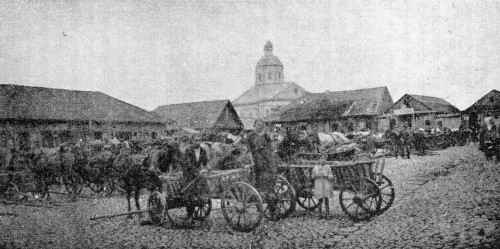
| Market Day in Rakov |
[Page 105]
And the teller ends the story: And who knows what would have been the end of these Gentiles had not the lads' mother come rushing, with a stick in her hand, and shouted: Go home, sheigets [unruly youngsters]! You may still, God forbids, bring riots upon the town with your heroics! The sons cooled off a little, dipped in the water to chill their bodies, which had gotten hot, and returned home, while their mother, Reizle, hurried after them: Home, sheigets!
| Printed in the March 7, 1925 issue of “Solmianka”. |
More on Shlomke Reizle's
I heard the following description from my wife, Rinah, and my sister-in-law, Gansia Rubin, who had known Shlomke Reizle's in his later years, until his death. He was not strong then, nor brave, but a dissolute man, wandering the streets of the town, arm in arm with his good friend Yuzshek the “Sitar” (sieve maker), both always drunk. With the passage of time, his name became synonymous with everything that was coarse, licentious, and worthless. His behavior was a disgrace to his family. Until one day, and he was already an old man, he returned home full of liquor, fell on his bed, and expired. When his good friend Yuzshek the “Sitar” heard that, he came and stood by the corpse and said: “Shlomke, Shlomke, I always entreated you: drink some and then some, but always leave some drinking for the dessert; but you drank and did not have dessert, and death overtook you...”
| H. A. |
Aba Botvinik related the following: Shlomke Reizle's would enter a tavern, stick a bottle of vodka in his mouth, drink some, chew on the empty part, spit the broken glass and continue to drink. He did this until he finished both the bottle and its content.
| Printed in “The Shayen Gasse”, 1923. |
by Feya Simcha Bunims
Translated by Shmuel Winograd
This is the story which I heard from my father, who was an official of the “Hevra Kadisha” [the Burial Society].
On the road between Gorodok and Rakov, nearer to Gorodok, there lived a simple country Jew, he and his family -- his wife and three sons. Over the years, the people of Gorodok learned to know them: they were well-to-do but coarse and miserly. They would not share their bread with a passerby, and did not donate even a penny for the needs of the community. Therefore, the people of Gorodok were waiting for the opportune moment, when that family would need the service of the community, to make them pay through the nose, to compensate for the past.
And it came to pass, that the father of the family fell sick and died. The brothers were in a quandary: Where should they bury the father? Should he be taken to Gorodok? -- but they were known there, and people were just waiting for the opportunity to 'skin them alive'. They decided, therefore, to bury their father in Rakov. There, where they were not known, it would cost them only pennies.
They decided, and they carried out the decision. They spread hay in the wagon, loaded the dead body, and brought him to Rakov. When my father heard of their coming, he sent them to the 'guests' synagogue, where the funerals of the 'out-of-towners', were usually held. As to the cost, Father told the brothers that they would have to pay 10 Rubles.
-- “What”, shouted the eldest brother, “where can we find 10 Rubles? We are but a poor family.”
-- “If you are poor”, said Father, “then it is a different matter. You will have to pay only three Rubles.”
The eldest brother paid the three Rubles, and, with a burst of joy, called to his brothers: “So, you see, I told you that we could do it here for mere pennies. And do you know what, when the time comes, we should bring Mother here to be buried.”...
Whether or not they brought their mother I do not know, since, in spite of themselves, before it was all over they had to shell out 20 Rubles for the burial, and place them on Father's desk.
| Printed in “Di Shtime fun Rakover Froyen-Klub”, January 1937. |
|
carefully. “Isn't it the howls of hungry wolves?”, he thought. And he was afraid of wolves, very much afraid.
He had heard a lot about hungry wolves who devoured humans on such wintery nights, and he did not want to come face to face with them. What should he do? “Put your trust in the Holy One, blessed be His Name”, he decided, “and whatever would be would be.” And with his last strength he started to walk towards the shining lights. But as he reached them, he saw a group of peasants walking towards him, headed by some ill-tempered dogs. As soon as the dogs saw him, they broke loose and charged at him, ready to attack, and even devour, him. It was only thanks to the goys, who intervened and calmed the dogs down, that R. M.
[Page 113]
remained alive. After they calmed him, they took him into one of the houses, frightened, frozen, and tired. After he rested a while, and the fear of the dogs went away, he told those goys who he was, what had happened to him, and how he had lost his way.
But the biggest surprise was still awaiting him. “Do you know where you are?”, asked the goys, “You are at the palace of the Graf [a title of nobility], in his Novopholya Estate.” R. M. Had heard a lot about the retired General, who received the Novopholya Estate as a gift from the Czar, and who lived there like a king, surrounded by his many servants. Only that R. M., the wandering poor carpenter from Rakov, had never dreamt that he would spend the night in the General's palace. The next morning, when he woke up, he became aware that all that he had heard of the grandeur and splendor of the General was nothing compared to what he was seeing: a splendid palace, surrounded by imposing buildings the like of which he had not seen, servants and other workers engaged in various chores in the yard and in the fields, which extended as far as the eye could see. The large stable was full of grooms, tending to the horses as if they were spoiled children. And lo, they took out three purebred horses, hitched them to an expensive sled, and the General himself came out of the house, tall and erect, with his golden epaulets on his shoulders, over the uniform, exuding majestic splendor. He sat himself in the sled, and 'sailed away' with the hunting dogs running at his heels. The General went hunting.
As the sun was setting, and the Sabbath was over, R. M. Was taken to Rakov by one of the General's men, who was going there to purchase something.
For many years afterwards, R. M. Would tell and retell of all the wonders he had seen in the General's estate, and of what happened on that wintery day when he lost his way home. And R. M. Would end, as if sharing a secret: “It was not so bad, after all I spent a Sabbath in the palace of the General.”
| Printed in “Morbanka”, published by Rakover Btentsh in America, 1928. |
|
|
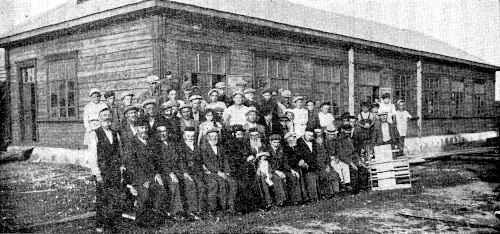
| A group of Jews from the town |
[Page 123]
R. Yehoshua of Poholanka
The road to Ivenets, a small town twenty-one kilometers from Rakov, started at Slovoda, at the end of Vilna Street, and continued along the Poholanka Forest. Not far from the road, in a tavern in the forest, lived R. Yehoshua of Poholanka. Short, skinny, with a red beard, he was known as a simple man, with modest manners and a quiet voice. He was a 'commissioner', but in addition to the buying and fetching goods he also cultivated a small piece of leased land. He had three cows, whose produce -- milk, cheese, and butter -- he would sell in the town. We, the teenagers, used to walk to his house in Poholanka on Saturday afternoons, order a jar of the rich milk and some creamy and fragrant cheese, and eat it with the rye bread which his daughter baked. That was a delicacy whose taste still remains in my mouth.
|
[Page 124]
In the same Poholanka Forest, Tanhum Popka used to make turpentine from the pine trees of the forest, as well as grease for the wagon-wheels, and wood coal.
R. Yitzhak Segalovitz. He used to manufacture machinery for chopping hay and straw. During the war between Poland and the Bolsheviks, right after the First World War, he was seized by Polish soldiers and tried as a spy. The military tribunal sentenced him to hang, and only by a miracle, after appeals for mercy, and the intercession of the leaders of the community and the local Catholic priest, his life was spared and he was released.
R. Noah of Nosvitz
He had a factory for manufacturing soap. R. Noah used to sell his product in the market places in Rakov and the neighboring towns.
Tailors
Isaac the Tailor lived on the Market Square. He was an expert in his craft, and the better-off balei batim would invite him to their houses before the Festivals, and he would sit and sew suits for all the male members of the household.
There were also older tailors whose time had passed, such as R. Ya'akov the Tailor. I heard the following story about him: He was a Jew with a majestic face, and a beard which gave the appearance of a scholar. And it happened that R. Ya'akov entered the Tailors' Synagogue, where, as usual, a group of young people were sitting and studying. When the scholarly looking Jew entered, one of the youngsters wanted to start a learned conversation with him. He mentioned a difficult passage in the Talmud that the learners had been discussing, some interpreting it one way and some another, and asked for R. Ya'akov's opinion. R. Ya'akov glanced at the Talmud's page “as a rooster when 'Bnei Adam' is recited” [an idiom which means: without any comprehension], but did not lose his composure and responded: “It so happened that you asked your question of a knowledgeable person; but what would have happened had you asked the question of someone who was ignorant of the meaning of the sayings of our sages? Wouldn't you have embarrassed him? Therefore you do not deserve an answer.” Having said that, he turned and left the synagogue...
And another tailor: The father of Pinchas and Yitzhak Ze'ev Greenholtz was a clever Jew, but his style of tailoring was old-fashioned and he turned the business over to his two sons. They started a workshop for manufacturing ready-made clothes and employed many workers.
The Pottery Industry
This industry was, by and large, in the hands of the Gentiles, but Jews were involved with it as well. For example, Re'uven the Potter who was known as 'the leader' of the Psalms recitation on Sabbath Eves.
[Page 125]
He had a 'hazakah' [claim] on this task: on the eve of the Sabbath, between Minchah [the afternoon service] and Ma'ariv [the evening service], he would stand up at the head table in the synagogue, bang on it, and read aloud: “Happy are they that walk upright” [the first verse of Psalm 119], and the congregation would repeat after him, verse by verse...
And also R. Shlomo Yidel, who was a yeshiva student until his marriage, and an ordained rabbi. He married the daughter of a Rakovian potter, received a pottery workshop as his dowry, and was nicknamed “the Potter Rabbi”.
Beryl the Brazdiyanky
He was called thus after the small village Brazdiyankivo, where his family had lived for several generations. He, just like his fathers before him, cultivated a small piece of land, as did all the Gentiles of the village, and filled his granary with grain and his cellar with other produce of the farm. He also had a cowshed with a few milking cows; and, like his Gentile neighbors, he would come to Rakov on market-days to sell his farm-produce to the Jewish merchants in town. There was one difference between him and his neighbors -- he was learned, and after a hard day work he would sit by the oil-lamp and read a newspaper or page through a book. True, the farm work made him appear coarse and unrefined, but underneath this crude outer layer was a man of culture, as even a short conversation with him made clear. He and his family were murdered during the First World War by a band of robbers, who used to roam the forest in those days.
|
|
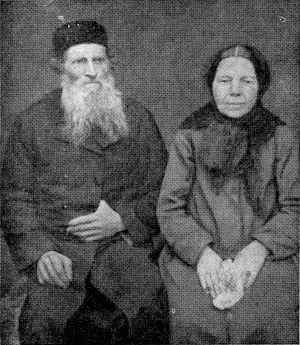
| Moni and Sara Botvinik |
[Page 126]
Smiths and Mechanics
Rakov had many blacksmiths. In Slovoda, on the road to Yivnitz, was the workshop of Hanan the Blacksmith and his son Mordechai. Their work was, mostly, the shoeing of the horses of the peasants of the neighboring villages.
Feibe Gershon the son of Noah
A tall skinny Jew, well-built and strong, with muscular arms. He worked in his blacksmith shop all week, but on Fridays he closed early in the afternoon and rushed to the bathhouse. Clean and shiny, he returned home, had a small glass of spirits, and then another one, tasted the Sabbath delicacies, and hurried to the synagogue. “The Sabbath is the Sabbath”, he would tell his wife, looking forward to the time Minchah [the afternoon service] would commence; for he had the 'claim' on leading this service. And don't you make light of this responsibility...
Binyamin the Blacksmith
His shop was on the edge of town, near the bathhouse. He was an expert in his craft, iron-smithing, and made farming implements: plows, harrows, axes, knives, and more. He was of average height. I still remember how he looked: his solid and wide body, and his long blond beard which was flowing down to his wide chest and gave him the appearance of a learned Jew. Even though he was not exactly learned, he was familiar with the “black dots” [printed letters]. He had a 'claim' on reading the Torah on the Sabbath, during the early service, which was conducted in the “Shtible” [small synagogue]. That was a source of pride for him and for his colleagues.
R. Hayim Ely Poznik
He had two lines of business: his machinery workshop, where he worked himself and employed others, and... Hasidism. He was a disciple of the Koidnov Rebbe, and the leader of the Koidnov Hasidim [followers of the Koidnov Rebbe] in the town. It was in his house that the Rebbe stayed whenever he came to town to visit his 'flock'. During these visits it was as if the Shechinah [Holy Presence] was dwelling with R. Hayim Ely and his household. The whole material-world would be forgotten; he would dress in the 'Hasidic' garb -- a black robe with a sash tied around his waist -- and he and other followers would dance around their Rebbe and make merry. On those days he absorbed the spiritual inspiration which would sustain him on all the other, common, days. He derived his Hasidic ecstasy from that ancient well -- the book of “Zohar” [a cabalistic book], which he would read at any spare moment, and whose words he would drink thirstily.
Teachers
The first teacher we must mention is R. Shlomo Rosenthal, who taught the Bible with the commentary of R”aSHI [Rabbi SHlomo Itzhaki, a famous Eleventh Century Biblical and Talmudic commentator]. He was a born teacher, and his approach to the subject matter and its teaching was based on a deep love. The students returned his love, and the memory of his lessons remained with them to the end of their lives.
[Page 127]
R. Israel Hayim of Telitzky
He taught Gmara to boys who were already twelve - thirteen years old. Having learned with him, the students could turn to a page of the Talmud and study it by themselves.
And after him, it was but a short step to the famous yeshivas: Volozhin, Mir, Slovodka, Telz, Radin, Vilna, and Minsk. Indeed, many of his students traveled to these yeshivas and 'filled their bellies' with the study of Torah, and some of them were crowned as rabbis [were ordained].
Shmuel Yitzhak Ruventzik
He studied in the Rakov yeshiva for several years, married a local girl, and established the “progressive heder” where he taught the Hebrew language in Hebrew. He was the chairman of the Rakov branch of the Zionist Organization when it was at its infancy and numbered no more than ten members. In 1912 he migrated to Eretz Israel, changed his name to Re'uveni, and taught in the “Tahkemoni” school [in Tel Aviv]. He passed away in 1938, and left an extensive family, which was much involved with the life of the Jewish community in Palestine.
Teachers of Russian
The town had two teachers of the Russian language: Solovitzky and Ya'akov Zvols.
Solovitzky possessed both learning and intelligence, and had a great influence on his students.
Ya'akov Zvols was an excellent teacher. His students acquired a good command of the language, and one could hear Russian spoken on the streets of the town. In those days, speaking Russian was a sign of intelligence, especially in the eyes of the girls...
The “Skolka” The town had another educational institution -- the “Skolka”. (That was how we referred to the government's elementary school.) It was established for the Christian children in Rakov and in the neighboring villages, but they did not deprive Jewish students of the right to attend it. And indeed, some parents took advantage of this 'right', and sent their children, especially their daughters, to the “Skolka”.
Two Images
And leaving the best for last -- two figures as they are engraved in my childhood memories: Velvel the Caretaker and his wife Havah. In the town they were called “Adam and Eve”. Velvel had no distinguished characteristics; he would carry out his chores faithfully: lighting up the stove in the winter, sweeping the floors of the Great Synagogue and keeping it clean, polishing the candlesticks, lanterns, and lamps, fetching the canopy for weddings, handing the rabbi the cup of wine for the blessings under the hupa [wedding canopy], and so on. But, since this work was not sufficient for him to make a living -- he also cleaned chimneys. All week long he would walk with a thick sackcloth around his waist, blackened all over with soot, climb the roofs dragging the ladder after him, and clean the chimneys. And thus he worked until Friday morning. On Friday mornings he would hurry to the bathhouse, wash and scrub himself very well, until he looked like 'a human being', change his clothes, and go to the
[Page 128]
synagogue to perform his 'sacred chores'. As the day was coming to a close and the sun was setting, he would go outside, stand on a corner of the Market Square, and as was customary in those idyllic days he would shout: “ein schul arein!” [come to the synagogue]. The Gentiles in the market would be the first to heed his call. “Schul -- arein”, they would say to each other, “it is time to go home.” The noise of the market would subside, and the Gentiles would leave the town one by one; the stores of the Jews would be shut with a bang; and the Sabbath candles would be lit and shine their lights through the windows of the Jewish homes. Sabbath the Queen was descending on the town with all her glory.
His wife Havah was an energetic woman, the like of which you never saw. She proudly carried out the tasks of the caretaker's wife. No joyous occasion in the town would take place without her. When a male was born, Havah would be the first to visit the mother and wish her a 'Mazal Tov'; and from that moment until the “Brit” [circumcision ceremony] she would be busy: washing the baby, instructing the young mother, and preparing the list of close friends of the mother, other honored women, and the rest of the invitees to the Brit ceremony. On the day of the celebration she would prepare and arrange everything, set the table, and then adorn herself with her Sabbath kerchief, put her coral necklace around her neck, and showed up, as the most honored guest, at the head of the table.
But all of that is nothing compared to what would happen when the town celebrated a wedding. No one would lift a finger without her. She would supervise the cooking, the baking, and all other preparations for the wedding; she would prepare the bride for the wedding, and take her to the mikvah [ritual bath]; she would walk from house to house, the list of invitees in her hand, and invite people to the wedding; she would urge the band on during the celebration, and would 'gladden the hearts' of the bride and groom with her singing and dancing until late at night. The apex of her 'reign' would come on the Sabbath after the wedding, during the “rompol” celebration. Early in the morning, on the Sabbath day, she would knock at the doors of the women who were to accompany the bride to the synagogue, and march at their head to the bride's home. From there, she would lead the bride to her place in the 'ezrat nashim' [women's section in the synagogue], and would throw the nuts and candies, to the joy of all the children.
Thus did Havah manage her responsibilities as the caretaker's wife -- until her day came.
|
JewishGen, Inc. makes no representations regarding the accuracy of
the translation. The reader may wish to refer to the original material
for verification.
JewishGen is not responsible for inaccuracies or omissions in the original work and cannot rewrite or edit the text to correct inaccuracies and/or omissions.
Our mission is to produce a translation of the original work and we cannot verify the accuracy of statements or alter facts cited.
 Rakov, Belarus
 Yizkor Book Project
 JewishGen Home Page
Copyright © 1999-2026 by JewishGen, Inc.
Updated 6 Nov 2026 by LA