[Page 196]
Under German Occupation in Ostroh
by Shmuel Klipatz
Translated by Pamela Russ
A few months before the outbreak of the German-Soviet war, I was mobilized in the Red Army. From Ostroh, I was sent to a military unit that was on maneuvers at the border. We felt a great tension at the border, but no one even imagined that a war would break out.
At dawn on Sunday, June 22, 1941, the Germans opened a powerful firing upon us, accompanied by heavy bombardment. We received an order to yield. The Germans pushed forward and there was a great panic among us. There was great chaos on our front line, and the army fell apart.
I saw that I would be able to fall into captivity with the Germans, so I left on foot from Volodymyr-Volynskyi to home in Ostroh. When I arrived in the city, this was exactly before the first aktzia. I arrived in the evening, and at dawn, all the inhabitants of the city were driven out and everyone was gathered in a place behind the forest. Machineguns were placed all around and the Germans began to segregate the Jews: The able-bodied workers were placed separately from the non-able workers. One group was taken back into the city and the other group remained in position, in the “place.” There were already graves dug out, and 2,000 Jews were shot on the spot.
After the aktzia, the remaining Jews were divided into places where each one had to work. I was sent to work in the municipal power plant company. The director of the power plant company was a Pole named Szczawinski. He was a very decent person, a liberal Christian, and we had very good relations with one another. He lived behind the city. Since I was a carpenter by profession, he asked me to do some work for him.
I wore a yellow patch, as all the Jews did. At that time, the Jews could still move around in the city, since this was still before the existence of the ghetto in Ostroh.
When I came to Szczawinski's house, his wife received me very well. She herself was a Russian, a kind-hearted person, not an anti-Semite. We talked to each other, and she said she was very sorry that we were suffering so much from the Germans. She told me that the times for the Jews were now very difficult and one could know what tomorrow would bring. So that if a difficult situation for the Jews would arise, I should come to their home and she would save us.
I told my wife Sima about this, and we hoped that the Szczawinski family would perhaps
[Page 197]
help us during a time of great difficulty. The whole time I was working in the power plant factory as a carpenter. We suffered from hunger, but no matter how bad, we figured it all out. The Gentiles stood behind the fences and secretly sold food items.
Later, all the Jews were herded into a ghetto. The Christian residents were driven out of their district, and the Jews were driven into their bad houses. The ghetto all around was fenced off, and the ghetto was guarded by policemen from outside.
Everyone was driven to work. Everyone had to work, men and women. Every morning people were driven to work in the city. The Jews worked at the most difficult physical jobs, they put stones together [masonry], repaired destroyed houses, and always worked under a watch.
I used to go to work every day in the power plant, and worked at my profession as a carpenter. None of us had any illusions about what the Germans could do to the Jews. We knew that after one aktzia, another would follow, and the end would be complete destruction. But what could be done? There was no rescue. We lived with the present day and waited for miracles.
But Jews did not sit with folded hands. Some young people fled into the forest, some started preparing hiding places in houses to hide in an emergency, when there would be an aktzia.
The Ukrainian policemen who guarded the ghetto were waiting for the opportunity, when they would receive the signal to start killing the Jews. But in the meantime, they robbed, beat, and jeered with each other over the fate of the unfortunate Jews. They took whatever they wanted, and searched for valuables and gold at the same time, thinking that the Jews hid these things. So, they found hidden things as well. The Ukrainians also destroyed the hiding places and then beat the Jews to death.
The one who was most destructive was the sadist Petrov. He could not rest if he did not kill a Jew. He was a bloodthirsty murderer. Before the Polish era, he was the foreman of the magistrate, he used to direct the mayor. On his conscience, he did not have a single murdered Jew. After the war, he escaped together with Tkachenko, the commandant of the police in Ostroh.
This is how we lived until the third aktzia, which took place in October 1942.
The aktzia started by suddenly not allowing anyone to leave the ghetto. Those who needed to go out to work were not taken to work. All of them remained in the ghetto. The heart said that something was going to happen, had to happen, but no one knew what that was going to be.
On all sides of the ghetto there was a reinforced guard of Germans and Ukrainian police, ready to give a death blow to the Jews in the ghetto. Jews who had prepared a place to hide, began to hide. The Germans suddenly ordered that all the Jews must gather in one place, but by the time that all the Jews had gathered, the Germans and Ukrainians had already started shooting. Some tried to run away but they were shot while running.
When the third aktzia took place, I was no longer in the ghetto. I hid myself in a hiding place under the ground. At night I took my wife and we went to Szczawinski. There,
[Page 198]
in the stall, there was hay, and we crawled right into it. After some time in the hay, I left my wife and went into the Szczawinski home and I told the wife that they were killing all the Jews in the ghetto, and I begged her to save us. I reminded her of her promise that she would be prepared to save us if the Germans would begin to murder all the Jews of Ostroh.
Frau Szczawinski was very moved by my terrible news, and I noticed tears in her eyes. I immediately saw that she would keep to her promise. She immediately prepared some food and decided in the spot that we should build a hiding place. The best place would be behind the oven where they baked bread. The entrance to the hiding place would have to be in the place where the animals ate, because in that place there was a lot of hay and straw.
We immediately took to the task. I dug and Frau Szczawinski carried out the earth and spread it around so that no one would figure out that we were building a bunker. She carried the earth out all night until the hiding place was ready. She gave us some boards so that we could have a “bed” to lie on. But the board was too short for me, so I took some rocks from out on top of us, and added that to the board, and then I was able to lie down. But lying like that caused my blood to gel in my feet from not being able to move.
Frau Szczawinski brought us food every day at the same time that she went to feed the animals. The hiding place was well camouflaged, and a random person could not recognize it. But meanwhile, I was not happy that the homeowner Szczawinski himself did not know about our hiding place. His wife took this entire responsibility upon herself. Also, her young children did not know about us. Only her older sons knew and did not tell anyone. When Frau Szczawinski got sick, one of her older sons brought us food. They always took an interest in how we were doing in our hideout, see if anything was missing, and see if we needed any help.
We would wash ourselves twice a year: for the new year and for Pesach [Passover]. She would bring us warm water and we would wash ourselves.
There was a servant in her house, a Ukrainian, a terrible anti-Semite, and she was connected to the Banderites, and we all had to protect ourselves strongly from her. When Frau Szczawinski would bring us the warm water so that we could wash ourselves, she would send away the servant for their holiday, and only then were we able to wash without any fear.
We received food three times a day. We ate whatever the Szczawinski family ate, without any exception. She did all this with great love, knowing that she was risking her life and putting her family in danger, but she was prepared for all of it so that we would be saved from destruction.
Germans and Ukrainians would come into her house more than once. Szczawinski himself was a good mechanic, so Germans would come to him to fix their typewriter. But no one even thought that there were two Jews hiding in his place.
We remained in the hiding place until the Banderites came. At that time, the Banderites also killed the Poles, and in order to save themselves, they too had to flee from their homes into the forests. At that time, we remained without food for an entire week.
At night,
[Page 199]
I went out of the hiding place unnoticed to gather up some corn that was completely dried out by then. Nonetheless, we would keep the kernels in our mouth and this satisfied us. Otherwise, we would have died of hunger.
I suffered a lot with my feet. From not having space, I was not able to move my feet. The entire time, we lay without any movement.
When the liberation happened, and the Soviets entered Ostroh in February 1944, we could not remain in the city for a long time. I was immediately drafted into the Soviet military. And because I had already served in the military before, they did not keep me long in the exercises, and they sent me to the third White Russian front in eastern Prussia. I was wounded in one of the battles. I served in the artillery until I was released from the army at the end of 1945. Before that, I was sent to the border of Japan. That's where we stayed until the war with Japan ended.
After being released from the army, I returned to Ostroh. That was in December 1945. I did not stay in the city for long, and my wife Sima and I left for Lemberg. But we were afraid to remain in Lemberg because the NKVD had arrested my wife's brother for anti-Soviet activities. There was a danger that we too would be arrested. So, her brother, who was active in the Breicha [underground movement that helped Holocaust survivors escape and settle in Israel], became very active in helping us escape Russia as quickly as possible. We were in Poland for a short time, in Gliwice, and in the year 1956, we arrived in “the land.”
Since we were in now in Poland, we decided to try to find the Szczawinski family – our saviors. But we were not successful. We looked for them in many different places in Poland, but we could not find even a trace of them.
Our human obligation was to find them and thank them for risking their lives and saving us from destruction. These people were the real “righteous among the nations” who demonstrated humanitarian behavior at a time when everything around was black and rotten, and Jewish life was chaotic. We have them to thank for our lives.
Finally, we found out that one of the older Szczawinski sons is in Germany. We hope to find him and connect with him. Our Jewish and proper obligation is to make sure that Yad Vashem recognizes them as “righteous among the nations,” and our hope and dream is to be able to thank them for everything good that this noble family did for us as they extended a human hand, saved us from death, and in exchange did not receive any material satisfaction.
[Page 200]
The Jews in Volhyn 1941-1944[a]
by Betty Eisenstein-Keshev
Translated by Pamela Russ
Introduction:
This piece is almost entirely based on the statements by the witnesses, Jews who themselves experienced all the 49 units of the German-Ukrainian hell in Volhyn. And now, it must be said: Also, the statements of our own witnesses do not give a complete picture of the life and destruction of the Jews during the Hitler period. The more that time passes, the more important details become forgotten, as they fly out of memory. But, even in the actual times themselves, not all the Jews of the ghetto knew or were able to know about all the happenings.
Some examples:
I myself saw how the Germans burned the Torah scrolls of the shuls on Tatarska Street in Ostroh. Later, after some time had passed, I questioned the Jewish Ostroh residents themselves, or other people who were there at that time. Of the six people whom I questioned, only three knew of this incident, and the other three had no clue of this event. It is completely possible that they never knew anything about this, even when it actually happened. But it is also possible that they knew before, but now completely forgot.
In Dubno, during the aktzia of “Judenrein,” they left 35 specialists behind. Soon after, during the next two weeks, they killed off 25 of them. Of the leftover 10, three escaped and the remaining seven died the day after the escapees disappeared. Of the three that escaped, two survived. And only these two knew everything that was related to the specialists. The rest of the Jews who survived, because they fled Dubno at the beginning of the aktzia, could not know anything about this, that at the beginning 35 specialists were left aside, and that later the majority were killed and only 10 remained.
In Koval, an incident took place at the killing site, that became an act of resistance. But in the Koval killing site, only one person survived as a witness. This event would have remained completely unknown if not for Shia Potchar, who sewed clothes for the regional commissioner – Montal.
Since Montal still had some clothes at the Jewish tailor Potchar, he himself took Shia Potchar out of his place after the aforementioned incident took place.
[Page 201]
Potchar sat at the commissioner's place in a locked room, and did the sewing there for the commissioner until February of 1943. Then, when he knew that the work was ending, he also knew that his own end was near. So, he nervously, and at the right moment, escaped…
There were rumors from Rowno that came during the time of the aktzia, in August 1942, and they also came to a line of towns and cities in the area, that on the first day of the aktzia grenades were thrown from a high ledge in the ghetto onto the Germans and Ukrainians and they were killed.
These rumors came from the Rovno Christians, and according to these rumors one German and two Ukrainian militiamen were killed by Jewish hands. Several Germans and Ukrainians were wounded. There were no remaining Jews who witnessed this act of resistance. No Jew from Rovno who survived is able to know about this scene that took place.
If a Jew managed to get out of the ghetto, he could think only of his own escape, of his own survival. He had absolutely no possibility – not psychologically nor technically – to observe his surroundings. Yet, since there are no witnesses to this act, no one can understand anything about the preparations for it, which were carried out under strict conspiratorial secrecy.
Who, then, can know about all the preparations, difficulties, and acts of minor resistance that took place, yet left behind no trace of evidence?
I, just like every Jew who survived this last destruction, at the beginning, after my survival, bound my life to the duty of fulfilling the mission of telling the story. I began by writing the history of my town of Ostroh.
In 1945-1946, at the request of the Jewish Central Historical Commission in Poland, I began collecting materials and testimonies regarding acts of resistance by Jews during the time of the German occupation. This material was later described in a book in the Polish language, titled “The Underground Movement in the Ghettos and Camps.” I began collecting material for this book, which is now in the reader's hands, in 1946 in Poland. I continued the project in Germany in the years 1947-1948 and completed it in the State of Israel during 1949, and then submitted the manuscript for publication.
When I began processing the material, and that was at a time when for the majority of survivors of that horrible storm, their economic existence during the catastrophe was already a half-forgotten, fading thing, I relived those experiences all over again. Against my own will, I was transported back to those times. I united with those who were no longer here. I united with that cruel pain, in that immense grief for which no words have yet been born.
Often, while writing and working on the material, I was overcome with trembling. It was very difficult to delve into those memories, to describe – using simple, everyday human words – things that were anything but simple, anything but ordinary.
At times, it felt like a profanation for me to weigh, measure, calmly contemplate, critique, and write about the deep suffering of hundreds and thousands of worlds that had been destroyed in such a manner. More than once, I asked myself the question: Is it not chutzpa for an ordinary person to
[Page 202]
try to paint and describe the nightmares, the pain, the person's trembling, that was experienced while being destroyed, of hearts that pierced the eyes that screamed with fear as they watched their own destruction. Do the heavens not have to send down a powerful person, a prophet, a comforter, with the power to express the profound pain, the inexpressible agony?
More often than once, I was deep and long in thought, and had doubts. But when I weighed the fear against my own chutzpa, and on the other scale, the absolute, real possibility of distorting or changing, falsifying the last destruction, distorting the human faces of our loved ones – something that is even worse than their murder – I nonetheless decided to see this work through to the end. In my eyes, this decision grew into an absolute necessity, a moral obligation, after my conversation with the Ukrainians in a railway carriage in Germany.
I regard this work, and I ask every reader to view it likewise, as a modest partner of this monumental work describing our great twentieth century tragedy, a work that will, and must, sooner or later, come into being.
The Outbreak of the Russo-German War
On June 22, 1941, the Russo-German War broke out. Right from the first days of the war, a mass evacuation began of Soviet officials, the militia, and all people from the east who held various administrative posts. In Vohlhyn, unlike in other areas newly occupied by the Soviets, there were also possibilities to evacuate the civilian population. Anyone who presented themselves was taken aboard the trains heading east. Borders were thrown wide open to everyone. People could travel using any means of transport.
Who evacuated, besides the Soviet personnel? Naturally, the Ukrainians and Poles did not budge from their places. The long-awaited hour had arrived for them. And what about the Jews? Among the first to flee were people who had engaged in political work for the Soviets, served in the militia, and managed to make personal enemies among the non-Jewish population. They also had ample reason to fear retribution. A certain percentage of young people of military age also fled, driven by a wide variety of motives, sometimes contradictory to one another. Refugees from the German occupied side also fled, people who remembered the Germans from the parts of Poland they had settled in, who had already fled from them once before. Yet, the majority of Jews remained where they were, for a variety of reasons.
After everything, Jews did not fully understand what Hitler meant for them. True, really, that two years earlier, refugees from the left bank of the Bug River had recounted the most horrific stories about the Germans, their terrible actions against the Jews. But people had convinced themselves that the worst was over. So, indeed, many refugees had even returned to their old homes, back to the Germans. This meant that, despite knowing what life was like under German rule, they preferred to remain under the Germans rather than endure hardships under Bolshevik rule.
[Page 203]
During the short two years that the friendship between the Bolsheviks and the Hitlerites prevailed, Soviet newspapers did not utter a single negative word about the Germans; they wrote nothing regarding the atrocities that the Germans committed in Poland and Czechoslovakia, in terms of the general population, and against the Jews in particular. Evacuation meant a life of wandering as a refugee; it meant hunger and cold, and misery. In a normal place of residence, everyone, regardless of where they were, at least had a small roof over their head.
Added to all this was the realization that the war would not last forever. One reasoned that, as a Soviet citizen, he would remain isolated after the war, just as he had been before it; he would have no contact with the outside world, and would never have the chance to break free from this hell and enter the wider world. He would have only two options: to remain a lifelong prisoner, both spiritually and physically; or to commit suicide. However, regarding the Germans, the prevailing belief was that, once the war ended, however that would be, there would be some possibility of escaping from their clutches and venturing out into the wider world.
All these considerations caused the majority of Jews in Volhyn not to move from their places.
The Ukrainians and the Jews
It is impossible to separate the Banderovtzes [Ukrainian nationalist] from the Ukrainian population. It is possible, and also likely, that among the Ukrainians there were actually no Banderovtzes, but their numbers were very small, and they were not significant enough to alter the general picture.
You can say, with total objectivity, that the Ukrainian nation comprised of Banderovtzes and their sympathizers. In any case, there were no active opponents to the Banderovtzes. The Banderovtzes set the tone for all Ukrainian life, and understandably, that they – in the manner that was required among the traditional anti-Semitic Ukrainian masses – formed their respect for the Jews, and for the first time, the Jews met the Bandertovtzas, who were active earlier only in the underground, only after the liquidation aktzias. Until this time, Jews in the ghettos saw the Ukrainians only in the administration in the militia, or among the general civilian population. Therefore, we can apply the term Banderovtzes in relation to the Jews only after the aktzias of the Judenrein operations.
* * *
The scant two years of Soviet rule added fuel to the traditional hatred that Ukrainians had towards Jews for hundreds of years; the identification of Jews with Communists contained nothing new.
For quite some time, Jews–especially those whose work brought them into contact with the general population–sensed a terrifying lava, a volcanic force, that was waiting for the chance to erupt and sow death and destruction all around. The Jews who held separate positions in Soviet agencies that dealt with the public–such as, for example, the finance office, the department for the procurement of grain and livestock, and similar institutions–evacuated immediately alongside the Soviet administration.
Had they not done that, then they were
[Page 204]
forced to move to places where they were unknown people, or otherwise they became the first victims. On the first days, they were removed from their homes, and since then, there was no trace of them. But the rage of the Ukrainians did not lessen against these Jews, and in the first days of the German occupation, a wave of pogroms took place in Volhyn.
The Ukrainian nation was overly filled with hatred toward the Jews and with a desire to exact revenge on them. The ordinary Ukrainian person, the neighbor, the former co-worker, the customer, had changed beyond recognition. No one would admit to knowing a Jew, let alone acknowledging any friendship. Even the friendly relations that had existed with Jews just the day before came to a sharp end.
They showed great contempt for Jews, openly asserting their superiority by refusing even to acknowledge the Jews' presence, and often beat up Jews on the street. During the first few weeks, before Jews were banned from the market, the local population refused to sell the Jews any of life's needs or products. In their naivete, Jews appealed to the Ukrainian clergy and Ukrainian authorities, pleading for help. Appeals were made to the sentiments of influential Ukrainian figures, urging them to convince their acquaintances, members of religious circles, the faithful, and those in official and church positions, to show compassion toward the Jews, otherwise the consequences would be bad. The Jewish representatives made this plea by appealing to the consciences of Ukrainian leaders. Otherwise, the Jews faced death by starvation.
After the period of the first intoxication with the demonstrations, the tide of hatred and attention to the Jews subsided externally. But this did not happen because of discussions and because of the Ukrainian administration, who simply laughed at the naivete of the Jews who came to them with such complaints and demands for help, but with the pressure of the events of the evolving German politique.
The Ukrainian felt less and less like a nobleman, like the boss of the situation, but on the contrary, as the power and intentions of the real leaders of the situation, the Germans, the dimming Ukrainian began to be ashamed and feel foolish, and then he himself began to drop his head that was held high.
The Ukrainians self-secure and self-rule feelings were beginning to get lost already in the first few days, when they saw how the Germans punished the Russian war prisoners, as they were treated like animals, starved, mercilessly and without conscience being killed without any thought. Not providing any form of security to the independent Ukrainian, and the arrest of many gangs, completed the process that began earlier. But these changes that occurred in the sidelines of the conflict between the Ukrainians and Germans only slightly changed in the main question and attitude between the Ukrainians and the Jews. They only stopped openly to demonstrate their hate towards the Jews, as they had done in the beginning, when they had wanted with all means to copy the Germans, and show how far they had gone with them, how strongly they appreciated the German route, and how great was their solidarity with their liberators.
[Page 205]
The Relationship of the People to the Jewish Goods and Products
The main interest of the population was centered in the enthusiasm to become rich from the Jews. Already in the first days of taking over the land from the Germans, the population, some openly and some only halfway, disguised and embarrassed, stole the possessions from the Jews, even outdoing one from another as they stole things.
Individual thefts happened everywhere and had no connection with the organized populace thievery. Those organized, secret robberies carried the mark of a plan, while the individual incidents simply bore only a personal characteristic. Ukrainians openly walked into a Jewish home, opened the cabinets, cupboards, commodes, and took whatever they wanted and liked. Individual Ukrainian militiamen did exactly the same thing. As they came into a Jewish home, they immediately demanded watches, clothing, linen, and more. Jewish representatives went to the officials to inform about these robberies and invasions. These representatives brought positive results. The Germans were as interested in robbing Jewish belongings no less than the Ukrainians were, and they sharply forbade the population and the Ukrainian militiamen to “visit” Jewish homes and take things from them. They even said that the Jews should report any incident. The thievery, actually, in general, stopped.
As long as the robberies continued without punishment, as long as things could be taken openly, as long as the only concern was that the neighbor should not be more skilled and be first to snatch the Jewish possessions, as long as that which belonged to the Jew also belonged to the non-Jew, that is how long it was almost impossible for the Jew to purchase daily needs from the non-Jew, or to exchange things for daily needs.
Only when robbing Jewish goods became impossible, only when the population became convinced that the Germans were the true masters and the sole “heirs” of the Jewish possessions, only then did the Ukrainians come to realize that they were not the only ones in charge, and only then did they begin to trade and conduct transactions with the Jews.
People began buying goods from Jews, bartering with them and swindling them. As a result of this new situation, the population became more and more interested in maintaining contact and relations and business connections with the Jews. And thanks to the changes, the German ban on looting and their desire to seize everything for themselves, the Jews, restricted to the absolute limit, and condemned to death by the Germans, were in a position to avoid the death by starvation, which the Germans would gladly have inflicted upon them.
The Ukrainian peasant was in contact with the Jew for one of the following four reasons:
- To buy and exchange goods;
- To extort goods and money;
- To sell his produce at the highest black-market prices;
- To use Jewish specialists and craftsmen to perform all kinds of necessary tasks.
In most cases, these commercial transactions were carried out at the workplaces, outside the ghetto. The Jews took to work with them …
[Page 206]
their possessions, mainly clothing. The Ukrainians brought their products. With all the transactions, the items were given away for almost nothing, practically for free, for a quantity of items that in no way was close to the real value of the sold items.
It also happened frequently that the buyer rarely paid even the insignificant price that he promised to pay for the purchased product. In most cases, particularly when the product had value, both sides agreed that the Jew would be paid by instalments.
Many times, the buyer did not have all the products that he had to give over, but even more so, in almost all cases, the seller was not able to take all the things at the same time. You could not bring in many products all at the same time. It was always dangerous at the ghetto gate, where the guard could actually take all the items, and let alone that if a larger number of products was found, that would cause the penalty of death. The Ukrainians, not maintaining their word, or fooling them, or not providing the promised items, became a mass phenomenon, so the Jews began to sell their products for money, then bring the money into the ghetto, and then buy products there, even for higher prices.
This made a difference on the black market in the actual ghetto itself. The Ukrainians stopped meeting the Jews at work, and smuggling of daily products increased in the ghetto between the Jews and the Ukrainians. It was primarily meat, flour, sugar, oils, etc., that were smuggled in.
There was a special trick that went on between the Ukrainians: to trick the Jews out of products. This trick took place with all kinds of talks. In the early period, Jews wanted to ensure their better belongings. In the ghetto, they argued, the items were not safe.
If they had to flee from the ghetto, or to hide, they had to leave all the things behind in the ghetto. Otherwise, they thought that regarding the things that were outside of the ghetto, they would leave things with the Christians who had agreed to take in these items. They believed that they would be able to use these things as desired. They also believed that anything found outside the ghetto would be easier to sell, other than an item that would have to be smuggled out of the ghetto.
In order to place the better items somewhere, the Jews came to an agreement with Christians, former neighbors, good friends, acquaintances. In particular, there were former housekeepers, wetnurses, and customers. Understandably, the Jews searched for the Christians, but in the end, the Jews actually looked to contact other Jews. In an equal measure with the Ukrainians, other Christians who lived in Volhyn also showed an attraction to Jewish items.
Just as Jews wanted to give away their items with the hope of getting them back later on, the same way, the Christians hoped to be able to get the items and keep them to themselves. Jews gave away expensive items, better furniture, pianos, other music instruments, better clothing, furs, and sometimes expensive linen. Doctors gave away their tools and remedies. The first incidents of giving away these things, particularly the furniture, began as soon as it was clear that ghettos would be created and exchange began with the municipal administration regarding the ghetto areas. Other things
[Page 207]
were given to the Christians during the entire time of the existence of the ghetto, almost until the liquidation.
During the time of the ghettos, it often happened that the Jew did not receive back the item he had given to “his” Christian to hide. When the Jew asked that it be given back, most of the time the response was a diplomatic, evasive reply. For example, the item could not be returned at this time because of the neighbours who would see the transaction; or that the neighbors had to be prepared for this; the item had to be first removed from hiding, and this had to take a day or two or three.
Giving things to the Christians happened for other reasons as well. Jews gave away expensive items and money, and that way ensured an eventual hiding place during a dark time. Jews decided, with the consent of the Christians who had to create hiding places in their own homes, that they would be able to hide there in times of need.
The cost of an eventual hiding place, a so-called bunker, had no limit. For these hiding places, the Jews always paid and paid, gave over possessions, and simply paid with money as well. Only a small percent of the Christians, who took part in these agreements, meant this honestly. The majority fooled the Jews.
There was another, very original method of cheating the Jews out of their things. During the time of interim liquidations, or of the final liquidations, when rumors circulated about forthcoming aktzias, when Jews, understandably, found themselves in the greatest unnerving situations, often, many unfamiliar Christians stole into Jewish homes, looked around, searched for things with their eyes, and forced the Jew to sell or even give over the items.
In order to be successful, these Christians motivated the Jews with logical arguments: “You will be slaughtered anyway, so is it not better that we get your things rather than they fall into the hands of the Germans?”
In general, the Jews reacted to these propositions with intense rage. It also happened that the item which the uninvited guest, the Christian, had demanded, had disappeared in the interim. Others, with great discretion, rejected the offers, and sometimes gave the item in exchange for some food.
Every action of the Christian people, and in particular of the Ukrainians, was a good opportunity to demonstrate their power and stubbornness and trickery and prediction for the script of the German officials, as they would act towards the Jewish possessions.
As known, there were the strongest prohibitions of taking Jewish possessions, and for trespassing against this prohibition there were terrible punishments. Regardless, though, the Christians sneaked into the ghettos during various aktzias, when the Jewish homes were left abandoned, with the door and gate left wide open, and then they took whatever they wanted. During the liquidation aktzias, when they had the last chance to steal whatever Jewish possessions that they could, they did this at risk of losing their lives.
They went around the terrible, abandoned ghettos day and night, after the liquidations, even though the ghettos were guarded by the Ukrainians militia. They searched for hidden treasures, which according to rumors
[Page 208]
were spread around the population, which the Jews had buried or hidden away in their houses. The thieves broke steps, walls, broke into ovens, dug up yards. Sometimes, searching for dead treasures, they found live Jews hiding in bunkers.
They stole bedding from the houses, quilts, clothing; tore down windows, doors. Broke down walls and took building materials. Nothing could hold them back from stealing, and then taking things out of the ghetto: not the strict prohibitions from the Germans, not the designated security guards who watched the ghettos, and not even the armed Germans who would come to check the ghettos and remove those who were guilty.
The Germans shot those who tried to flee and not stop when the Germans yelled to stop. Among the ghetto thieves were the “shabrovnikes” [looters], as they were called, there were many victims, but even this did not hold them back from being thieves. The militia and the Germans arrested the looters in the ghettos. They were held under arrest until a large number of them had been collected. Then they were taken out on a Sunday, or another Christian holiday, set in a lineup, then were given sticks in their hands, which contained the text: “We are thieves. We robbed the ghetto. Shame on us!” And more of the same written texts.
That is how they marched through the streets of the city. These “marchers” did not arouse a sense of shame among the population; they were not prepared to give up because of humiliation in reference to the riches of the ghetto, and their peasant like, primitive imaginations painted them in the most mysterious colors.
All the difficulties that they encountered while robbing the ghettos, led them to the decision that they would have to move about more quickly and not fall into the net that the Germans and Ukrainian militia had prepared for them. They would make underground ditches on the other side of the ghetto and then sneak inside through the ditches. The greatest efforts were enacted at night when the Germans would not enter the ghettos because of the darkness.
The city population would primarily look for gold items, silver, diamonds, and other valuables. The village people were no less greedy but less selective. They looked for things such as clothing and building materials.
A special large part of the looters were the 12–16-year-olds. It was told, for example, that in Rovno, a strong group of spiteful and active youth of the aforementioned ages specialized in finding hiding places in the walls, cabinets, stoves, and other places, until they began dealing with gold, foreign currency, and valuables.
The Christian population also had the potential to deal with the things that were officially taken from Jewish homes by the officials after the final liquidation. These items were sold for base line prices in the special unit stores that were created for this purpose.
But in these stores there were mainly sorted items, once the Germans had already sorted through the things and taken the better items. And to purchase these things, the buyers had to add money. But not all of the people were able to
[Page 209]
“loot” enough things in the ghettos. For example, peasants from distant villages did not have the opportunity to come to the ghettos at night.
There was also less brazenness, and there were those for whom there never was enough. Because of that, night and day there were long lines of people standing in front of the unit-shops. They kept buying and it was never enough. The markets and fairs were also over filled with Jewish things.
Items were sold without even a drop of shame. They did not even think about the fact that there could also have been religious items as well. They sold taleisim [prayer shawls] as material for women's clothing. It became fashionable to wear clothing made from this material. Parchment paper from Torah scrolls was sold for soles of shoes or for clogs. Religious books were sold for packing paper. The tefillin boxes [phylacteries] were sold as ashtrays.
Some of the priceless possessions remained outside the boundaries of the ghettos, such as actual houses, shops, and more. These treasures were under the supervision of the municipal authorities and were populated by these authorities, their members, and by the policemen, and by civilian Ukrainians and Germans.
Those who occupied these houses wanted to ensure their rights permanently, and wanted to buy the houses from the municipal administration. After the aktzia of Judenrein, the administrators wanted to sell the Jewish stationed possessions. These were also found in the depth of the ghettos, and after the final liquidation they were placed in ownership with the other houses of the ghetto.
The “looters” destroyed many houses during their “work” time. And they also “looted” complete houses in order to expand their business. From they ghettos, they dragged windows, doors, floors, roofs, and in many cases, they even took bricks.
After the Judenrein aktzia, many villages rebuilt themselves. Others extended themselves in a large fashion. Using building materials from the ghetto houses, new, beautiful cottages were built, and around them were economical buildings.
The self-appointed ones could not figure out how to get rid of “their” immobile possessions. They kept paid guards who had to make sure that the looters should not make a mess of the ghetto houses, but the guards could hardly be of any help. Since they could not protect themselves from the people's greed, the self-appointed ones began to sell the houses of the ghettos themselves, or to live in them, or even for to take them apart themselves. Whoever bought a house to live in, had to guard it himself so that no one could grab it from him.
In the spring of 1943, the Poles, who had run away from the villages, entered the cities. The Ukrainian self-appointed ones, under the pressure of the Germans, had to settle in the half-destroyed Jewish quarters. With this alone, in a direct manner, they guarded the ghetto valuables, and even brought in profit. They repaired the half-destroyed houses and protected them from complete destruction.
There were no millionaires in Volhyn, no wealthy Jews. There was a distinct percentage of comfortable Jews. The greatest percentage of the Jewish population in Volhyn consisted of middle type and small type of merchants.
[Page 210]
In the final years of the existence of the Polish Republic, a large part of the Jews in Volhyn became impoverished. When the war broke out in Volhyn, there was a large reservoir of Jews who could barely survive materially.
Then, suddenly, during the German rule in Volhyn, the Jews grew in the eyes of the population, becoming greater in wealth. And actually, the demands of the Jews did not cease. They not only gave, but really gained for themselves as well. It seemed that the reservoir was bottomless. How did this happen?
The Jewish settlements in Volhyn were very old. Jews had been there for generations. Almost every Jew there had at least a small house, some furniture, and facilities of various character. For many years, every person, whoever it may have been, took care of clothing, linen, furniture, dishes, all amounting to value. Everything was passed on from generation to generation, from parent to child. Gold and silver rings and family jewellery from distant relatives, went for generations to grandchildren to great- grandchildren.
Every new family added something to the family treasure: a gold watch, a fur coat, an old, treasured ring. In a normal time, there was no talk of selling family jewellery or personal belongings, even though at some time they did have actual value.
They guarded these things for sentimental value. In many instances, much of these things actually had little value, and they wanted to sell these things. Things became different during wartime. Anything a Jew had was changed, since now he needed sustenance for life.
On the other hand, everything was changed into something that teased the stinginess and jealousy of the non-Jew. Jews took out the most valued family possessions from their hiding places, things to which they were connected. The same thing happened to personal possessions.
With a calm, stoic feeling, without sentiment, everything was thrown to the greedy masses. They did not keep anything, nothing was dear. They said: “If we survive, we will get things again. If we do not survive, who needs these things?”
The Germans and the Jewish Possessions
From the very beginning, the Germans did not squander the Jews' items. In the first aktzias, the Jews were permitted to carry packages with them, suitcases filled with their things, even if dragging these packages upset the order of things, or the packages took up too much space in the evacuation trucks.
In many places, in the notices about the first aktzias (for example: in Rovno, Kostopol, and other cities), the Jews were told that they could bring up to 15 kilos of baggage. Hoping that they were actually going to other places, the Jews took the most expensive things, and the smallest, so that they would have something during difficult times.
In that manner, expensive possessions got into the hands of the German murders without any strain. Other than the expensive possessions, mountains of clothing and shoes soon lay in the places of extermination. After the aktzias, all these things were loaded onto the trucks and taken away. In the hands of the Ukrainian militia and the non-Jewish population
[Page 211]
there fell only a minimal part of the clothing piles.
After each aktzia, many possessions were left behind of the families who had died. Regarding these items, there were many conflicting behaviors demonstrated by the Ukrainians and Germans. The Germans wanted to leave the items under Jewish guard for as long as possible. This was likely because they figured that this was a means of securing the items for themselves after the final liquidation of the remaining Jews (as mentioned in other places, the Jews were officially forbidden to remove anything from the ghetto to either sell or exchange). On the contrary, the civilian Ukrainian administrations had more opportunity to take things for themselves when they comprised the surveillance over the Jews, and they were controlling the possessions that were left behind without any owners or inheritors. The future events in the Jewish lives were dependent on these types of activities that happened in different places.
This same thing happened at the outset of establishing the ghettos. Permission to take all their belongings with them, or even part of it, was completely dependent on the will and influence of the Ukrainian administrations. From the “yes” or “no” of permitting the Jews to take their things out of the ghetto, there were also the terms given regarding going into the ghetto. In the last phases of the ghettos' existence, when the Jews were tightly crowded together, when Jews from other ghettos were all crowded into one ghetto, they were also told to take all their possessions with them
Often, before an aktzia, they enclosed more tightly the ghettos that did not have walls around them. One has to understand that this was done mainly to make running away more difficult, but it was also likely that this was behind the desire to protect the mountain of possessions.
The closing in of the ghettos before an aktzia took place primarily where there was a known cache of riches (for example: in Koval, Tuczyn). After they took the Jews out of the ghettos, it took many months until all the valuables were removed. From the first minute of the aktzias, the “black” militia would guard the ghettos, that is, the Ukrainians. These Ukrainians, remembering the prohibitions that the Germans enacted regarding the valuables from the previous aktzias, being certain that this time as well no valuables would come into their hands, even if they would go the “right” way and wait for the distribution that the Germans would undertake, they decided to outdo the Germans with their deviousness.
Since during the time of the liquidation aktzias there were bosses of the ghettos and from the gathering points where the Jews were amassed, from the very beginning, as soon as they entered the ghettos, even before they carried out their responsibilities to herd the Jews to the gathering points, they began to rob and snatch for themselves all that they could.
The agenda was to get as many remaining valuables from the Jews as possible. They told the Jews that they would let them go free for giving over valuable items. The stolen or tricked things that were given, were immediately given by the black police to members of their own families who were waiting on the outside of the fences of the ghettos. Even in the death places,
[Page 212]
meaning in the places from which the victims were taken away to their execution, the Ukrainian police cheated connivingly from the Jews, money, gold, valuables, clothing, and other things from their suitcases that they had brought along with them. They even gave away some of their things merely for some water or a small piece of bread.
Since the Ukrainians were occupied with being conniving and with carrying out the stolen goods, to some extent their attention switched from the living Jews to the amassed Jews who felt apathy towards everything around them and even their own lives. Many, many Jews did not wait for the Ukrainian police to chase them out, but they themselves, very calmly, as naturally as possible, without escort from the wild Ukrainians, left to the indicated places.
After the ghettos were emptied of Jews, the black militia took over from the other Ukrainian policemen, in a special formation that was actually created for this purpose. This formation guarded the ghettos until they were all emptied of the material goods. Then, the ghettos were transferred to the administration of the Ukrainian municipal administration.
All the movable possessions of the Jews in the ghettos were transferred to special warehouses that were set up for this purpose. Special personnel of Ukrainians were hired to sort, divide, and pack the things. The best things, such as currency, better furniture, all kinds of musical instruments, good clothing, coffee, tea, and others, were all sent to Germany. And understandably, being taken on to work in the warehouses was, as the Ukrainians thought, the best career that they could have.
Secondary type of items were divided among the Ukrainian militia and Ukrainian officials. Third type of items were sent to the distribution stores, where anyone could buy them.
Despite the tight security of the Germans, valuables fell into the hands of the population. It was not known how the bunkers and warehouses of the looters became filled with items from the ghettos. Also, the Ukrainian militia, Ukrainian dignitaries and their friends and families who fled to Germany before the arrival of the Soviets, and later roamed around the edges of conquered West Germany as uprooted DPS (Displaced Persons), and according to the talk of their friends and acquaintances who remained at home, they took along valises with gold and diamonds that they has managed to take out of the ghettos during the liquidation.
The Ukrainians and the Destruction of the Jews
In the first few months after the Germans occupied Ukraine, the Ukrainians showed that their interests matched up with the Germans, with their feelings and desires and attitude. And even more so, the aggressive, rude, absolute hateful behavior of the Ukrainians towards the Jews very often awakened the thoughts in the Jews' minds that the Ukrainian population incited the Germans' hatred towards the Jews and pushed them towards anti-Jewish actions.
[Page 213]
The Ukrainians organized the pogroms with their own hands and no participation of the Germans. The first aktzias that the Germans organized happened with the full participation of the Ukrainians. Without the help of the people, they in no way would have been able to carry out the first aktzias, which happened even before the Jews were isolated and locked into the ghettos.
For that, local people had to be found who would point out Jewish homes and the Jews themselves to the Germans. Understandably, the Germans did not recognize the Jews solely by their physical appearance. They could not identify the Jews who were not wearing the Jewish badge–even during the liquidation periods, when the ordeal and the passage of time had already left their mark on Jewish features and behaviors.
A Jew could not remove the Star of David, except out of fear that the Ukrainians might recognize him and hand him over into the hands of the Germans, or arrest him themselves, or simply murder him.
From the very beginning, the Ukrainians collaborated with the Germans with great zeal. During the initial aktzias, they ensured that no Jew could hide or escape the aktzia. With even greater fervor than the Germans themselves, they drove the Jews to the assembly points and rummaged through cellars and attics.
In these early aktzias, they surpassed the Germans with their cruelty and sadism. There were instances where Germans, who were driving Jews to the assembly points alongside the Ukrainians, actually intervened on behalf of the Jews whom the Ukrainians were beating and tormenting.
During the initial aktzias, Ukrainians in civilian clothes – the militia was not yet in uniform at that time – moved about freely, mingling with the Jews. They would round up Jews, hand them over to groups already assembled, and then go off in search of new groups. They would go around among the gathered Jews at the assembly points, single out individual victims, drag them from the crowd, and beat them often until they lost consciousness, and sometimes even beat them to death. As they brutalized their victims, they would shout: “You accursed Jew, take this for Batka Petliura [Father Petliura]! For ‘Long live Stalin’! For ‘Soviet Ukraine’!”
It goes without saying that the targeted aktzias, against the intelligentsia and Jewish communists, which took place during the initial weeks, could only have occurred with the active participation of the Ukrainian population. Even as relations between the Ukrainians and the Germans deteriorated and the Bandera organization went underground, there was no change in the Ukrainian program regarding the Jews.
From that time on, the Ukrainian nationalist organization began exterminating Jews in two ways: First, they continued to collaborate with the Germans in this regard. (It is quite possible that, aside from the struggle against the communists, cooperation in the extermination of the Jews remained the only area in which the Ukrainians continued to work hand in hand with the Germans.) Regardless of this collaboration, starting in 1942, they had their own plan of exterminating the Jews.
So, during the initial aktzias, the entire Ukrainian population was actively involved in the campaign against the Jews–with very few exceptions. They stood on guard, making sure that no Jew would remove the yellow patch, nor leave the ghetto.
[Page 214]
They helped in the search for hidden Jews.
During the times of the aktzias, everyone hunted down and chased after Jews who had fled. At the time of calmness in the ghettos, it was terrible for any Jew who tried to remain outside of the ghetto. Yet, as long as the ghettos existed and the Jews were confined within them, the population–despite everything–maintained contacts with both old acquaintances and new ones. Even the militiamen–both the official authorities and the unofficial Banderovtses–had “their” Jews in the ghettos, from whom they extorted bribes and obtained goods. More than one looter snuck into the ghetto to maintain business dealings with “his” Jews.
The truth is that many Jews deluded themselves into thinking that “their” non-Jew was an honest man, and that in exchange for all the material goods that they lavished upon these friends, the friends would not betray them, would keep their word, and would hide them in a time of great danger.
However, the majority of Jews saw these things in full, dark reality and clearly understood that nothing good could be expected from their Ukrainian “friends.” The facts confirmed these pessimistic predictions. Refugees could not make their way through the villages and forests. After an aktzia, the Jews could not remain in the area for even a single day. Consequently, the prevailing mood in the ghettos was one of resignation. There was no longer any reason or destination for which to move. One simply had to sit and await one's fate along with everyone else.
Yet, in the face of death–eye-to-eye with the great terror–people acted according to their instinct. Jews fled, primarily single ones, and even those who had never before thought of fleeing. From those few ghettos where it had only been a suggestion to run, Jews actually fled in masses. What was the fate of those who fled?
A person who hid in that area, even for just a few days, could not survive without some sort of contact with the people, even if he had reserve food, money, and items. He had to have some water to drink, be able to wash a shirt, warm himself, dry his wet clothes (the aktzias of Judenrein in Volhyn happened in fall of 1942), and when the reserve of food had been finished, he had to buy some or beg for some.
The Ukrainian population, far from offering a morsel of bread or letting them into their homes to warm up, hounded and uncovered the homeless and helpless. They detained any Jew they encountered and handed them over to the German or Ukrainian militia.
In many instances, Ukrainian civilians themselves murdered the Jews they had captured. This attitude of the population toward those who had fled the ghettos drove many of them, in complete desperation, to return to the ghettos. There, they inevitably became victims to the final liquidations.
Even the Jews who had run into the forests after the aktzias, became a source of material gain for the Ukrainian population. These Jews were well dressed and had prepared themselves with sturdy footwear so they could withstand the harsh conditions of wandering through the forests. Some people had also…
[Page 215]
peasants' good furs. Other than that, those who had left the ghettos, in many cases, had at least a little money and just a few things.
It happened very often that peasants who encountered these types of Jews, first took away everything from them. Sometimes, they allowed the half naked and barefoot ones to go freely. Often, they themselves killed the Jews they found or turned them in to the German police.
After the Judenrein aktzia, the Germans decided to give each Jew that was presented some sugar and other products that they did not have – and that was another reason for the Ukrainians to grab up these Jews and give them back into the hands of the Germans.
What was the fate of these Jews who had prepared hiding places with the Ukrainians for their valuables and other things, for a price of money? There certainly was a percentage of Ukrainians – a minimal number at least – who maintained their responsibility and honestly, hid the Jews, “his Jew,” but in general, the Jews who wandered around in the forests knew that they had to be particularly careful in regards to those Ukrainians who, with trust, were guarding their hidden valuables, or with whom they made agreements to hide themselves.
In the best case, the Ukrainians promised for money whatever they promised, did not allow the Jews onto their front steps, but did not overwhelm themselves with all the things that they took. In the smallest case, they wanted to be secure with the things that they had in their possession. And to be sure, they actually murdered the Jew himself or delivered him into the hands of the Germans.
For the Ukrainian masses, at the outset of the years when the Jews were murdered, they became natural and self-sufficient, confident that the Jews deserved their execution, and they agreed to that. The next episode illustrates the psychological attitude of the Ukrainians towards the Jews.
A few days after the Soviets returned to Volhyn, in February 1944, two Tuczyn women, Esye Silberberg and her friend, who had been hiding by a peasant in Postuni, 12 kilometers from Tuczyn, left into town dressed as peasants, in order to find out whether they and their families were able to leave their hiding places and go out into freedom.
In Tuczyn, in the center of town, a local peasant recognized them, and he grabbed both of them on their sleeves and dragged them over to the Red Army person, who was close by. He showed them the two women and cried out: “Here are two Jewish women!”
The Banderovtzes [faction of Ukrainian nationalists] and the Jews
The banderovtzes had their own plan in making Ukraine Judenrein. Their plan was really not so different from the German plan, and this was really simply a copy of theirs. They began to carry out their plan in the summer of 1942, when the Jews were still in the ghettos under the rule and control of the Germans.
The banderovtzes felt a great strain on their specialists, professional-intelligentsia, specialist doctors, dentists, and opticians. They did not have people who could apply a bandage correctly onto a wounded soldier, ease the pain, so they decided
[Page 216]
to use the Jewish doctors, dentists, and nurses. Through arrangements of the Ukrainian militia in the ghettos, they connected with the Jews in the ghettos, whom they wanted to win over for themselves. The Ukrainian militia convinced the Jews in a “friendly” manner, to leave the ghetto and go with them into the villages and into the forests. Each militiaman played the role of a “friend” for a certain amount of time, painted a black picture of the end of the ghetto, and promised golden mountains in the forests or in the villages: life and work.
The ghetto Jews were so strongly isolated that they did not have the right information about what was going on around them, in the forests and villages. They had no idea about any of this, that there were special banderovtze organizations and had no idea about their activities.
For them, the village meant one thing: the local population, the Ukrainians. Understandably, the propositions of the militia looked very strange and suspicious in the eyes of the Jews. But on the other hand, it was hard to resist and not accept the portal that was offered to them to save their lives.
As long as the ghetto existed, as long as it was so-called alive, the Jews did not really want to leave the ghetto and go into the forests with the Ukrainians. So, they did not decide easily to leave the Jewish environment and change their lives by going with the enemy Ukrainians.
The decision was particularly difficult for the human element that the Ukrainians wanted to remove from the ghettos. The doctors, the dentists, the nurses had secure work places in the ghettos, and “good” work positions. So the mission for the Ukrainians was not a simple one. They used difficult moments in the ghetto – days of fear, panic, rumors about the oncoming evacuation, and the like, in order the unnerve the people and have them leave the ghetto. In these types of moments, the people actually did decide to leave the ghettos and go with them. The majority of these were individuals, not families. The militiamen would secretly sneak them out of the ghettos.
Those who were secretly taken out of the ghettos worked in the banderovtze field hospitals for a long time, until the Soviet army came closer. Then they were dissolved by the bread providers.
They only met the banderovtzes eye-to-eye the first time after the aktzias of Judenrein. Those Jews who were saved from the ghettos thought that the people they would meet, except for those who were not in uniform and armed only some of the time, were not just organized by chance. It was obviously by orders that the elder among them gave to the younger ones, and according to the reports that they gave to one another.
In autumn of 1942, during the period of liquidating the ghettos, when Jews fled from one ghetto into another, some banderovtzes were on the roads and footpaths, and captured the fleeing Jews and took them to their huts and killed them there.
After Volhyn became Judenrein, and the ghettos ceased to exist, Jews who were saved from the last aktzia, not having any real place to run, with no more existing ghettos, took to running into the forests. But the banderovtzes
[Page 217]
reached the hiding places of the Jews in the forests and murdered them there.
During the winter, the footprints of the Jews showed sometimes more sometimes less, but were a strong indicator of where they were hiding. Then the banderovtzes did not have to depend on any tricks to find out where the Jews were hiding.
During other periods of the year, they used tricks to ruse the Jews out of their hiding places. In the region of Kopicowa and Ojrzanowa, they discovered some of the Jews' hiding places, where there were more than 100 souls. This worked in the following manner: In the forests, they threw around letters, notes, and the like, where they expressed their sympathy for the Jews, and promised life and rest in the villages.
From a distance, they watched where the Jews were going with the notes. It was enough to discover one Jew, in order to find the hiding places. There were instances -- actually in the first mentioned places – where the Jews did not reveal their hiding places for a long time. When they first started to believe, based on the fact that they had not been harassed for a long time, and they were being summoned into the forests, so now they went out, forced by hunger and hope, and that's when death at the hands of their “friends” awaited them.
The banderovtzes' method of murder was not simple. They were not satisfied with just taking a Jew's life. So, they cut off the women's breasts, and from the men – the sexual organs. Then they plucked out the eyes of the victims, they simply cut living pieces off humans. The human sacrifices went through unimaginable pain.
Spring 1943. They came up with the idea of copying the Germans and using the Jewish specialists. According to the example of the Germans, they began to segregate the captured Jews, removing the specialists and professionals: tailors, shoemakers, tinsmiths, tanners, and more. The actual format of the segregation was exactly the same method that the Germans had used.
They put the specialists on one side, often with their families, often depending on the mood of the segregator. On the other side, all the non-specialists were positioned. These were murdered immediately, and the specialists were taken away into the forests or villages, and then they were put to work in their specialty fields.
Even though the banderovtzes went deep into the forests, they could not snatch up all the Jews. When hunting down the Jews, they also learned from the Germans: They would not kill anymore Jews, even though they had nasty communication with the Jews … and a nasty enemy – the Germans.
Other then that, they announced that England and America took to supporting the Jews and warned them not to kill the Jews, so now every Jew that was in hiding could come out and appear without fear.
This statement by the banderovtzes reached the deepest hiding places in the forests. Since this time they really did not kill the Jews, the Jews began crawling out of their hiding. The banderovtzes grouped together the specialists in the forest into special camps, and they very often used the Jewish craftsmanship. Each worked in his own professional area, others worked in the fields. According to the German system, they compiled a registry of Jews, reports, instituted a collective responsibility,
[Page 218]
and warned them that if someone would try to escape or do something unacceptable, then all of them would sustain responsibility for that. The final liquidation of these camps always went hand in hand with the approach of the Red Army.
The concentration of Jews grew in many areas, and Jews themselves were drawn to places where other Jews were. For example, in Parezki, in April 1943, there were 44 Jews in the banderovtze camp, where they were working at the time. They willingly left the hiding places in the forest.
On May 13, there already were 100 Jews in that camp, as Jews from the Galician city of Sokul came there as well. The banderovtzes took these Jews to work as usual, on October 1943, but instead of actually working, they were all murdered.
In the forest near the village of Rozice, in the area of Antonowka, there were about 200 Jews who lived “freely.” Rozice was a large banderovtze center, and that center caused the Jews many problems. In the summer of 1943, the Germans attacked the center from two sides, from Kostopol and from Tuczyn, and completely destroyed the village. The Jews fled toward Kudrynki, 30 kilometers from Tuczyn, where there was also a Jewish camp.
There were 400 souls crammed into Kudryinki. At the beginning, they lived in the forest. But when it became very cold, the banderovtzes allowed the Jews to settle in the abandoned houses of the Poles. In Kudrynki, there were two Polish settlements, one about two kilometers away from the other. The Jews settled in these Polish houses according to the cities of their origin (Tuczyn, Aleksandrie, Kostopol, Mezrich, and others).
In the first period of the German occupation, the banderovtzes registered the Jews, counted them, and so on. As the Red Army approached, December 1943, they encircled the Jewish homes at night, and murdered all the Jews, except for 17 souls who managed to save themselves.
|
|
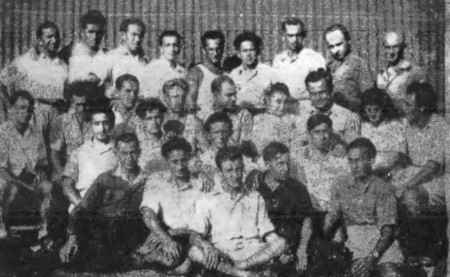
Survivors from Ostroh in Munich
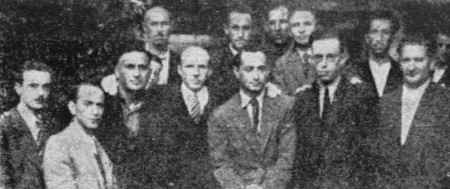
Bottom row, from right to left: Lublinski, Mussi Soroka, Shmuel Shtirnberg, Mendel Sirover, Leizer Ludmirski, Soime Rashtik, Mussi Greinems
Top row, from right to left: Isak Goldenberg, Faisi Finkelstein, Avraham Gutman, Muli Vishnivtski, Leizer Teitelbaum |
[Page 219]
The First Period of the German Occupation in Volhyn
The German armies overtook Volhyn in the very first days of the outbreak of the war with the Soviet Union. Just as it happened with the German offensive in Poland in September 1939, and their attacks in Ukraine in 1941, there were incidents when cities and towns that were further east were captured before the places that were in the west.
For example, Ludmir (Vlodimir-Volhynsk) was taken over already on June 23, that is, on the second day of the war, Ostroh on June 25 (in the city there were still fights going on for several days), Rovno was taken by the Germans on June 29, and Kreminitz on July 2.
In the occupied cities, there was a type of double government. From one side, the businessmen became the field commanders and the stationary German military; on the other side, the Ukrainians felt like the authorities, and with the help of their militia they began to conduct their parades.
The Ukrainian population primarily organized themselves around the newly created administrations. In the towns and the settlements that were on the side, where the Germans did not bother to go for a long time, the Ukrainians remained as undisturbed rulers.
The first anti-Jewish actions by the Germans and Ukrainians, were: their official limitation of their civilian rights; their prohibition of moving from one place to another; Jews were forbidden to appear in the streets before sunrise and after sunset, also forbidden to have any conversation with a non-Jew, and also forbidden to walk on the sidewalks. Very soon, it also became mandatory to wear a white armband with a blue Star of David (the armband was later changed for a yellow armband), and on top of all that, right away during the first days of the occupation applied the strictest regulation: obligatory labor. Truthfully, the Jews, as soon as the Germans took over the areas, were put in a state of complete dominance. They lost all rights. Every German and every Ukrainian could do whatever he wanted to do to each Jew.
German soldiers simply did whatever they wanted to do to any Jew. They beat, punished, insulted, and robbed. For the first few weeks, the Germans themselves forced the Jews to work, and with few words, beat them brutally: They beat if the Jew did not remove his hat before them, and another time if he did remove his hat. They cut the Jews' beards, ripped off their clothes, shoes; they coerced Jews to sing and dance, tortured Jewish girls, set fire to places of worship, burned Torah scrolls, and let other Jewish houses simply be burned along with the rest. The German soldiers recorded all these actions with their photographic apparats.
The Ukrainians, especially the militia, copied the German acts, and sometimes even joined in, other times did these on their own, in order to give an expression to their German-Ukrainian crimes. We will describe a few special incidents here.
In Kretburg, a Jewish girl by the name of Taubel (the witnesses did not give over her family name), put forth a real resistance towards the Ukrainians. She moved herself away, and defended herself with a knife in her hand. The two
[Page 220]
Ukrainian militiamen, Demitri Loszuk and Kolya Gonczarok, stabbed the girl with pitchforks on the spot. In Liuboml and in Tuczyn, on a Shabbath, the Germans forced the Jews to set fire to Torah scrolls. In Holubla, Kovlo region, the Germans, on the first day of capturing the city, saw four Jews with beards on the street, and without any rhyme or reason, shot them on the spot. The names of these victims: Khrisman, Weiner, Dovid Katz, and Pinchas Rezhenski. In Mizocz, the Germans set fire to a Jew's beard. In Poritsk, Germans and Ukrainians set fire to thirty Jews homes with firebombs. In Ostroh they burned the Torah scrolls and the shul on Tatarska Street.
Because of the murders in this manner, Jewish places became an arena for individual theft. Everyone became a thief: Germans, Ukrainian militiamen, and ordinary Ukrainians as well. They would tear into Jewish homes during the daytime and grab anything they wanted. With guns in hand, they would also demand things that were in front of their eyes.
|
|
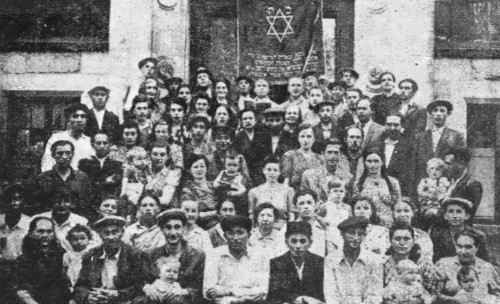
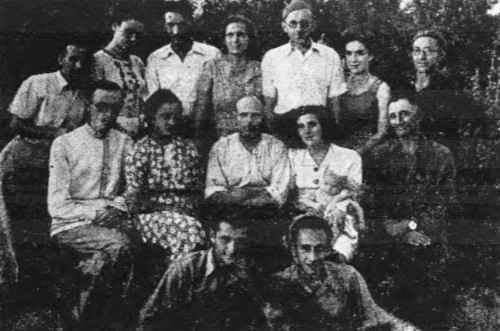
Survivors from Ostroh after World War Two |
[Page 221]
Ukrainian Aktzias
In the month of July 1941, the Ukrainian population organized events of robbing incidents and pogroms against the Jews. The actual witnesses could not always remember the finer details of these scheduled robberies and pogroms; they only remembered the month: July. You have to understand that these Aktzias were connected to the Petliura [Supreme Commander of the Ukrainian People's Army] celebrations – July 6. In large, organized masses, the Ukrainians took over the Jewish streets and areas of the cities and towns, stole things from Jewish houses, stuffed their bags, loaded up the wagons, and took everything to a different place.
A Ukrainian who stole things on his own to a certain extent protected himself from his neighbors, and he discreetly left with the stolen items. Those who robbed as part of a gang did not feel in any way at all that they were committing a crime, that they were doing anything illegal. On the contrary, they considered the thieves who stole in hiding very offensive, as people who were only looking out for themselves, while they themselves acted just as if they were carrying out a national obligation. During the looting, they demolished many Jewish houses, beat Jews mercilessly, and even sometimes, along with the thievery, they murdered innocent people.
In some of the cities, the lootings were accompanied by widespread pogroms, in the manner of the Petliura pogroms in the years 1918-1921. During those lootings, no Germans were seen. At all the Aktzias, the Ukrainian national activists were present; they had now taken over important places in the militia and in the independent administrations.
This flood of Ukrainian mass lootings and pogroms spread through the villages and small towns of Volhyn. In the larger centers, where the Germans were stationed and where there were German officials, the lootings did not take on any particular character.
On the basis of the differences between the lootings in the villages and small spots and the lootings in the larger cities, and on the basis of an entire list of differences, one can say that these lootings were organized and carried out without exception by the Ukrainians alone, without the inspiration of the Germans.
Esther Mattel (unknown family name) from Glinko decided, during the Petliura days, to flee from a pogrom in Glinko and get to Rowno. In those days, in Rowno, just as everywhere else, there were great Ukrainian protests. Esther Mattel smuggled herself into the crowds of demonstrators, presenting as a Ukrainian. The demonstrators went to the house where the German commander was. They began to shout fervently: “Down with the Jewish community! Beat them! Beat the Jews! Murder them!”
A German, likely a dignitary, came forward and approached a delegation of demonstrators. After hearing them out, the dignitary delivered a speech in German to this group of demonstrators, and a translator simultaneously translated into Ukrainian. The German gave them permission to carry out a pogrom against the Jews, disregarding the danger that would be evoked by instituting disorderliness during wartime. He ordered that the majority of Ukrainians should behave calmly.
On the highway not far from the village of Zdomysl, Koval region, a group of Germans who were driving by on July 9 restrained eight armed Ukrainians from the village of Kraska.
[Page 222]
The peasants proudly and with self-assurance informed the Germans that they were going to murder Jews. The Germans killed these peasants on the spot. The documentation about the incidents happening during the looting in the towns of Manievyc and Ratno confirms these events, stating that the Ukrainian lootings and pogroms of that month of July were inspired, organized, and carried out by the Ukrainians alone.
Jews who lived in the towns where the pogroms happened fled from their homes. After some time, some of the Jews, permanent residents of those towns, returned to their places. But there were places, villages, and small settlements, that remained Judenrein from the actual beginning of the German occupation, from the time of the Ukrainian Aktzias onward. Jews did not go back there.
German Aktzias
The German Aktzias began in the first days just after the German military took over the region. At that time, Jews had no idea what the term aktzia meant. The first aktzia was given the “traditional” name of a “pogrom,” or an even older term, a “shechita” [slaughter].
The first Aktzias were characterized according to local signs. For example, in Ostroh, the first aktzia was called “the first Monday” in order to distinguish it from the second aktzia, called “the second Monday.” In Mezrich (Miedzyrzec), they called the first aktzia “the bloody Shavuos.”
The Jews took the term “aktzia” from the Germans and then began to use it. They had already gone through this type of terminology during the Aktzias happening while the liquidations were going on, but now, while this particular liquidation was going on, all the Jews already knew the term well.
The term “chaperei” [Yiddish: snatching up; grabbing] was used by the Jews (it is unknown what term the Germans used for this action), since this best characterized this type of an action.
The Germans who took part in the initial Aktzias generally came on motorcycles, screamed loudly, and presented themselves as devils. Jews called them the “demons.” They were identified with the SS because they wore gray-green uniforms, and on their helmets and belts there were skulls, and on the arm was the SS mark.
In the later Aktzias, the Germans were identified with different markings. With time, the Jews already knew about the participation of the German officials in preparing the Aktzias and carrying them out, and these officials were known, for example, as the “regional commissariat.” Only later, in the Nurenburg trials, did it become clear that in the year 1941, the Germans created special units, the so-called “einsatzgruppen,” which were sent to all regions that, until the outbreak of the war, were under Soviet rule.
The main task of these units was, among others, the annihilation of the Jews. The destruction command was carried out with the order of “guard your back.” Members of the “groups” were recruited for different formations that were under the orders of the “central security main office” [Reichssicherheits haupt amt], under the direction of Himmler himself.
[Page 223]
In the time of the field commanders, organized annihilations of the Jewish people were carried out by these “einsatzgruppen.” As the regional commissioners took over the authority, the “einsatzgruppen” automatically became transformed into units of the local S.D. (Sicherheit Dienst, Nazi party security service). They carried out the liquidation of the Jews until the end.
During the rule of the field commanders, the following four types of Aktzias were carried out on the Jews:
- anonymous (nameless) Aktzias on individuals.
- Aktzia on the intellectual leaders of the Jewish societies and communists.
- “chapereien” (snatching, kidnapping, grabbing)
- Mass Aktzias as part of the liquidation.
The Aktzias did not happen in all places. It remains a secret until today whether the “character” [type] of the Aktzias was also planned, or whether they were simply enacted randomly. Similarly, until today, it has not been explained whether the selection of residents for each aktzia was planned or done by chance.
In the period of time that is now being discussed, the Aktzias were primarily carried out on men, foremost with men who were of working age. So, it occurred to those who remained that the young and healthy ones who were taken away were actually taken to work somewhere.
The number of Jews who died in the individual Aktzias cannot be determined in exact numbers. The numbers that the surviving witnesses provided could not be thought of as being precise. The Jews from Volhyn never calculated any statistic of those who perished. Because the representatives of the Ukrainian self-administrations, who were always at the assembly points, documented the number of those murdered or of those who remained, the Jews, in general, made no serious effort to record exact numbers as well.
The dejection and complete resignation were so profound that there was no interest in anything at all. With regard to the numbers, those received from the independent administrations of individual cities can be accepted as correct ones.
In the archives of the great Nurenberg trial, as in the trial of the “einsatzgruppen,” there are reports of these groups to the “reichs zicherheits hauptamt” [the Reich's main security office] about the number of murdered Jews, and precise details of certain Aktzias, and also in these reports there are summaries of the murdered Jews in particular areas until a specific date. But in general, these reports do not provide a clear picture about the total destruction of the Jews in the areas of war-torn Russia, and not even about the murder of the Jews of Volhyn.
Anonymous Aktzias on Individuals
In the month of July and in the first few days of August 1941, small groups of Germans, or a single German on a motorcycle, rode to a series of villages in various regions. In these villages, the local administrators summoned all the Jewish residents into one location.
Then, those who had gathered together were placed in rows, and from those, the Germans chose a number of people: every second one, third, fifth, seventh, or only the tenth. Those who were chosen were shot on the spot. They also shot the Jews whom the Ukrainians specifically indicated. The main thing, as mentioned, was that in these Aktzias
[Page 224]
the men were murdered. In some places, such as, for example, in Milyatin, in the Zdolbunow province, this fate struck women and children as well.
In Hoszcz, 150 Jews were sent into a lineup. They were the ones who were building a bridge. Every tenth man was shot. In Liuboml [Liubomyr], several days after the Germans arrived, all the Jews were ordered to be present in the marketplace. There they were ordered to get into lineups, and five men were shot: Shmuel Shuster, Shtreicher, Gelinter, Shmuel Weingarten, and Meyer Tzeilingold.
Name Aktzias, of Intellectuals and Communists
In the first weeks after taking over Volhyn, individual Aktzias were carried out in a long series of villages. These Aktzias gave the impression of revenge on intellectuals, political officials, and communists.
In many situations, they sent orders to those who had been summoned to present themselves in the “Uprava” (Ukrainian board of independent-administration), or to the German command. In other situations, the military took these people out of their homes. But in these Aktzias, it was not only intellectuals and communists who were murdered. There were incidents where Jews, who did not belong to either of these categories, were killed by name. Ukrainians who had personal issues with a Jew solved their problem in this manner.
In Ostroh, for example, in the communist Aktzias, Mitye Silberstein died. During Soviet rule, he was an officer in the tax department. Sioma Tabachnik, the son of Dr. Tabachnik, was killed because years ago he had insulted a colleague – a Ukrainian. Others in Ostroh were killed as well.
In Kostopol, in a “name” aktzia, a local resident, Feldman, was murdered, along with his son and son-in-law. In Koritnice, two Jewish families were murdered: Firschel and Feldman. In Uszcylog, on July 24, three Jewish families were murdered individually. In these last attacks, women and children were also killed.
In Tuczyn, July 18, 1941, the Ukrainian military sent named demands to 25 Jews (witnesses called them “brainheads”) to present themselves to the “Uprava.” The demands were signed by the chairman of the Tuczyn Uprava, Szerbanyuk. All these 25 people presented themselves. The military took them all behind the city and they were ordered to begin digging ditches. When the ditches were ready, the Germans arrived and murdered all 25 men.
In Korets, the second week after the arrival of the Germans, a number of Jews were arrested by the Germans, accused of being communists. They were then murdered in the orthodox cemetery.
On the holiday of the Sfanta Precista [“Most pure”; celebrating Virgin Mary] (July 1941), the Ukrainians herded together tens of Jews into a barn, and murdered them in the village of Sitni, two kilometers from Korets. Five days later, they once again amassed tens of Jews, the intellectuals, and murdered them in the previously mentioned village of Sitni.
In Koval, in the first weeks,
[Page 225]
15 leading Jews were arrested, among whom was the local rabbi of the Trisk dynasty – Velvele Twerski. The Jews from Koval and other distant and nearby communities collected large sums of money and some valuables in order to buy out the rabbi. A number of influential people and financial agents, Germans and Ukrainians, promised to free the rabbi for a significant amount of bail money. They took the money and the valuables, but the rabbi was murdered anyway. The arrested ones from Koval were murdered near Bankers' mill.
In Maciejow, they killed two young boys during the first week, and a few days later, another four adults.
In Mielniec, five people were arrested during the first days – former communists. Those were three Jews and two Ukrainians. All were buried alive, behind the city.
In Radzivilow, thirty people were killed, according to a list of names. Among them were two women – communists. Among the victims was the esteemed rabbi, and the businessmen Levitan and Chamad. In Boremel, 17 young men were killed, who, they claimed, were communists.
In Ostrozec, the businessman Aaron Resiczuk was murdered. A few days later they murdered Dovid Shteinshneider, Leizer Kornik, Avraham Eisenberg, and a few other people. In Kuzin, six people were killed according to the names on a list.
In Kreminiec, the Jewish intelligentsia was gathered in the Tivoli garden, where there was an official administration. With this group, there was to be a so-called discussion regarding creating schools, hospitals, and a number of other institutions for the Jewish population.
|
|
Survivors from Ostroh after World War Two |
[Page 226]
At this meeting, they asked the doctors, teachers, bookkeepers, and all kinds of businessmen to be present. There were 170 people. All were killed. They were murdered and buried on the spot.
In Wisznovic and in Lanovic a number of people were arrested, between ten and twenty people, and they were taken in an unknown direction. In Kostopol, six people were shot, among them two doctors. In Ludwipol, seven people were arrested and then shot in Lubiczanka, not far from the Catholic cemetery.
In Ostroh, they arrested the communist Potasznik, who hanged himself in the cellar of the military command house. In Piczayev, they arrested and shot two Jews.
All those who died in the Aktzias of this last chapter were killed according to a list of names, but the witnesses did not always remember the names of the victims.
Snatching Up [Capturing, Abductions]
In the months of July and August, in many towns and villages, there were many episodes of capturing Jews, who, understandably, were then murdered. In some of the towns and villages, the capturing happened only once, while in other places, this happened twice, and sometimes even three times. During these events, they searched for and grabbed only men. But in Ostrowiec [Ostrozhec], they also took women. And in Lubomel, during the second snatching, they took women and even children.
The snatchings took place in the following manner: During the day, primarily in the evenings, when Jews returned from work, trucks were positioned at the place where Jews gathered to leave for work and to return from work. Beside each truck, there was a German and a Ukrainian. They detained the Jews and loaded them onto the trucks. They noted the numbers of detained Jews. The trucks left with an exact number of people, and after a short or longer amount of time, the trucks returned empty.
At that time, Jews already knew what such a “truck” meant, so they tried to distance themselves from the trucks as far as possible, hiding as much as they could. At the times when the number of those “snatched” was not sufficient, the Germans and Ukrainians would go into the houses and drag out the people. The task of the Ukrainians who assisted the Germans was to show them the Jewish houses and which people on the street were Jews.
In spite of the fact that the Jews then already wore markings, white ribbons on the left arm, the Germans would not have been able to distinguish between a Jew and a non-Jew.
In Horokhovo, where the Germans themselves did the capturing, without the help of the Ukrainians, they captured 180 people, of them only 108 Jews, and the rest, 72 people, were Ukrainians. The captured were taken to places behind the city, where graves were prepared. There, on the hills, Germans with machine guns were waiting for them, so during the later general aktzia, the victims approached the graves with their faces forward, and a machine gun fired at them from behind, so that they fell right into the graves. They piled dead bodies in rows.
[Page 227]
Graves were previously calculated for a certain number of victims, according to the number that was determined on that day to be killed. In most cases, the graves for those captured were dug close to the city. Only in some places was it not possible, after the war, to establish where the graves were located.
There were many cases when the arrested were segregated somewhere, and some of the arrested were sent home.
Two such “snatchings” took place in Rowno in July and August. Nearly two thousand people died then – all men. They were all buried on Biala Street (Ulitza Biala), not far from the bridge.
In Koval, in July-August, three abductions took place. In the first abduction, only young and strong men were taken. The victims of this massacre were buried next to the brick yard on Gorki Street. During the second abduction, they also caught some young men, who apparently were needed to replace those previously captured, whom they had sent to work. At the third operation, anyone who came into their hands was taken, even old people. The victims of the second and third abductions were murdered and buried in the Bakhov forest.
In Maniewicze, the military had previously occupied all the roads that led out of the city. After that, twelve trucks arrived, and stopped at the marketplace.
The Ukrainian militia grabbed up the Jews from the streets, pulled them out of the houses, and took them to the marketplace. In the middle of the marketplace, there was a fat German sitting on a chair.
The Ukrainians brought all the captives over to the German, and each person had to bow before the German, who beat each one with a whip. That day, they grabbed 394 men in Maniewicze (this exact number was provided by the municipal administration to the local Jews). All of them were murdered and buried not far from the city.
That same day, towards evening, another eighteen people were grabbed, but after an hour they were released, likely because the number of people necessary for work was already complete.
In Mielnica, several hundred people were snatched at the end of July. At the point where they all gathered, a selection was made. The tradesmen were all chased home by dogs; the non-professionals were murdered not far from the church.
In Dubno, the first “snatching” [abduction] took place on July 22. One hundred and fifty people were grabbed on the street, and a selection was conducted among them in the prison yard. Sixty people were released. The other ninety were taken to the Jewish cemetery, to the graves that had been prepared there.
The second “snatching” took place on August 21. Jews then went into hiding. They were dragged out of the houses, and from all kinds of hiding places. The ones who were snatched were herded into the marketplace, from where they were taken to the city prison. From there they were taken in groups to the Jewish cemetery, where there were already prepared graves. This abduction lasted ten hours. According to witnesses, a thousand people died that day.
In Ostroziec, at the end of July,
[Page 228]
they snatched up 40 men and four women. They were murdered in the Yarow forest.
In Targovice, at the beginning of July, 130 men were captured, and they were killed in Romansova Gurka.
There were abductions in Zdolbunow. The first was at the beginning of July, the second on July 31. In both cases, they grabbed men on the street and took them away in an unknown direction.
In Horokhow [Horokhiv], the Germans themselves – on June 25 - grabbed the people on the street and later took them away in an unknown direction. As mentioned earlier, Ukrainians were also among those abducted, and they were probably released later.
On July 12, a second “snatching” took place, during which 300 men were captured and were taken away in an unknown direction.
Fifty men were captured in Kieszlyn, in August, and they were killed in a nearby aristocratic courtyard.
In August, many people were arrested in Beresteczko during an abduction, and they were murdered not far from the town.
One hundred and fifty people were snatched in Lokocz in July; they were murdered two kilometers from the town.
In Lubomel there were two abductions: the first in July. Three hundred people were captured and murdered at the old cemetery. The second operation took place on August 2. Then 280 people were murdered (among them women, the elderly, and children). They were buried in the Borki [Borecka] forest, four kilometers from the city.
In Lutsk, on June 29 (4 Tammuz), they snatched up people from the streets and dragged them out of the houses. They conducted a selektzia [selection, sorting process]. All those over 50 years of age were taken back home.
In Kolki, in July, men began to be captured on the street. With time, Jews heard about it and the young people tried to run away from the town. One hundred and fifty older people were caught on the street, who were murdered on the shore of Styr River, in the direction of Bialy Bor. Twenty-four of the elders among the captives were thrown directly into the Styr River, and they were pelted with rocks.
In Rozhycz, in July, 150 men were captured on the streets.
In Zofiowka, in July, Ukrainians themselves captured 150 men, took them to the train station, and handed them over to the Germans, who took them away. On the way to the train station, some of the men fell into the hands of the Ukrainians.
In Vladimirac [Wladimirec], there were two snatchings. One was at the beginning of July, the second at the end of that month. During both abductions, people were snatched up on the street and pulled out of their homes. The execution was carried out in the prison yard.
In Poritzk, in August, 30 Jews were captured, and they were shot outside the city.
Four trucks arrived in Kostopol on the 16th of August (23 Av). Men were snatched up on the streets, and they were dragged out of their homes. The victims were gathered into the barracks. All together they snatched up 464 people, who were taken away in groups to the sports ground behind the forest, and there they were all shot.
[Page 229]
There were many strangers who took part in that abduction. That is, not people from Kostopol, but militiamen who were brought in specifically for this task.
The Aktzia in Ostroh, 11 Av 5701 [1941]
In Ostroh, on Monday, August 4 (11 Av 5701), the Germans and Ukrainians began to drive the Jews from their houses. It was still early morning, and the Jews were still asleep. Many of the Jews were driven out in their night wear. The expelled Jews were assembled in rows and driven towards the new city, behind the forest, not far from the place where the potters lived.
On the way, leading the Jews to their death, the Ukrainians beat them with murderous blows. They drove everyone out of their homes, not only men, but also women, children, and even the sick. Even paralyzed people were forced to drag along with them. Similarly, Jews were forced to carry all the patients out of the hospitals and take them as well.
All day, Jews found themselves at the gathering point, not knowing that some tens of meters away from them graves had been dug and prepared for them. The site was surrounded by Germans and Ukrainians. Cars kept coming to the site non-stop, from which Germans and representatives of the Ukrainians – the Uprova, [Ukrainian insurgent army] and others, got out.
Only in the afternoon did the selektzia begin. The Jews were arranged in rows, and they marched in front of the eyes of the Germans, who divided the Jews into different groups. Specialists and able-bodied men were placed separately; separately were placed the women with children under the age of 12; and separately were placed the elderly and sick, that is – men, women, and children.
The official version that the Germans and Ukrainians spread on the site was that the sick and old would stay in place, and the able-bodied men and women would be taken to work. Therefore, people who had already passed the official selektzia tried to sneak from one group to another.
In particular, people tried to get into the lines of the old and sick so that they would not be taken out and sent who knew where. Getting in among the old and sick was not difficult. The Germans who took care of the old and sick themselves also brought in Jews from the other ranks, specialists and able-bodied, to go over to the old and sick. They said: Whoever is sick, whoever is not feeling well, should first calculate where he should go, on which side...
At four o'clock the mothers who had children were sent home. An hour later, the healthy men and women were added to the other women. German escorts drove them into the city and then told them to go home. Those who remained on the site: old, sick men and women were lined up in rows, regardless of age or gender, with 25 men in a column, and they were taken to the graves, where they were met with bullets from machine guns.
The murdering continued until seven in the evening. The Jews, who were sitting in the place and waiting for their turn, heard and saw everything. Those whose turn came, said goodbye and kissed those whose turn was to come in a few minutes.
Suddenly, at 7 o'clock, when there were still a few hundred people in the place,
[Page 230]
a German dignitary appeared and began to speak to the Jews with words of rage and hatred. “You accursed Jews, who caused the war and who are spreading inhuman diseases! We have to get rid of you all until the end. But we are not like you, we are refined people. So, we are freeing the women. Let them all get out of here quickly!”
The remaining women, even those who were already naked, left the place. Men, even children, continued to stay in the place. None of the Jews saw how this last group was murdered. Rumors began to spread that they were taken somewhere to work. Jews believed in the rumors, despite the fact that militiamen and peasants declared that they were on the site and saw that the fate of the last group was the same as the fate of all the Jews who were not sent home.
Exactly four weeks later, once again on a Monday, September 1, 1941, 9 Elul 5701, between seven and eight in the morning, Ukrainian militiamen and Ukrainian civilians began to drive Jews from their homes to the site that was close to the sawmill, on Wielbovna Street. During this aktzia, the emphasis was placed on the able-bodied and young people. They said that they needed people for work, but they were not told to go to the site.
At 10 o'clock, the entire living, remaining Jewish population of Ostroh was already on the site: young and old, women, men, and children. The Germans began to quickly conduct a selektzia. Young and healthy men were taken out of the masses. Trucks arrived, onto which the chosen people were herded and then taken away. The trucks came back empty and again the people were loaded onto them -- young, healthy, and able to work. In that aktzia, the specialists were separated from the merely able-bodied ones and set aside separately.
|
|
Wedding in the camp of survivors after World War Two |
[Page 231]
The managers of the job positions (in those times there were only communal and German job positions) came to the places with lists of their workers, and the workers and their families were taken out of the lineups that were created, as the ones to be taken away. The main ones to be taken away were parents of children, who did not want to allow their children to go alone somewhere unknown for work without being watched over and without help.
Also, many older people unable to work, who had experienced the previous aktzia, pretended to be younger. This action lasted until three o'clock. When the last car left, the Germans and the Ukrainians left the site, and the Jews who were not taken away, went to their homes.
In this aktzia, almost all the youth of the city and many children were killed. Jews estimated the slaughter at two thousand souls. The victims were killed in Netishyn, seven kilometers from Ostroh, a village that was already on the former Soviet side.
The Aktzias of “Final” Liquidation or “Judenrein” in Volhyn
The destruction of the Jews could be divided into two parts: Aktzias of partial liquidation and Aktzias of “Judenrein,” but this was only a matter of signs. This division appears to be a correct one, because of the different character of the two types of Aktzias and their development. Also, regarding the time, this division seems to be a correct one.
All the Aktzias that happened before August 1942 had the traits of a partial liquidation.
Therefore, August 2 must be considered as the turning point in the history of the Jewish destruction in Volhyn and as the beginning of the aktzia of “Judenrein.”
This was despite the fact that many towns and villages became Judenrein long before August 1942 – by transporting entire Jewish populations to other neighboring settlements.
The Jews were concentrated into one ghetto, in the area of one settlement even before the ghetto yet existed, in connection with an aktzia that was supposed to take place -- in the settlement where the Jews were transported. It also happened that Jews were moved from one settlement to another without any connection to specific events. The place from where the Jews were sent out became Judenrein and no Jewish foot was ever allowed to step there anymore.
This transportation of Jews was carried out by the Ukrainian civil administrations together with the Ukrainian militia, which transported the Jews under a “convoy,” a guard, to the new ghetto. Usually, during these Aktzias, nothing was allowed to be taken along. But at best, it was sometimes permitted to bring along just a small something.
Usually, these transports were accompanied by human sacrifices, despite the fact that they had not been brought from specific Aktzias. Only three Jewish communities in Volhyn became Judenrein before August 2, by killing all the Jews on the spot.
Klewan became Judenrein during the aktzia of Shavuot 5702 [1942], at the time when all the settlements in Rowno regions carried out Aktzias from partial liquidations.
In the town of Shatsk [Szack], that is in the Lubomler region,
[Page 232]
all the Jews were murdered on the spot on June 23, 1942 (8 Tammuz 5702), at a time when, in the entire area, the Judenrein Aktzias happened only on October 1, 1942. And in Kiwertz, in the Lutzk region, all the Jews were murdered still during the time of the field commanders – in mid-summer of 1941.
Since August 1942, when the Aktzias of the illegal liquidations were already in full activity, it became clear that the Germans were trying to deceive the Jews and divert their attention from the preparations they were making for total annihilation. In those months, the Jewish workshops used to receive large orders that would take many long weeks to fill.
Individual German dignitaries also ordered various things for themselves, and contrary to normal times, they did not press that the orders be filled as soon as possible. Only the local Ukrainian population rushed to take their orders from the Jews at every rumor about an imminent aktzia.
The ghetto consumers, the businesses that sold products for basic everyday life to the Jews, usually received larger quantities of products before an aktzia – such as potatoes, sugarcane, and sometimes also a little cereal. Very often, a ghetto, just before an aktzia, was required to give an extra contribution of money. And always, things - or products - were demanded in such quantities that were truly legendary and absolutely impossible to provide.
For example, they asked for tons of coffee and tea, leather, manufactured items, even tons of grain. The attention of the Jews changed from gathering the items and products with great care, to the thoughts of the catastrophe that they were preparing for.
But other than that, the Germans categorically denied any rumor about the Aktzias that spread in the ghetto. The authorities always assured the Judenrat that in that city, there would be no aktzia. Everything would be calm.
Despite all the reassurance that the Germans adopted in order to calm the Jews, they did not, in many cases, achieve their goal. In this last period, Jews already knew what awaited them, what German reassurances and their politics really meant. The news about the Aktzias that were going on in the various cities and towns spread in the fastest possible way and reached the most distant, small settlements wherever Jews lived.
In every Jewish settlement that still existed at that time, dozens of refugees from other ghettos were killed, from those ghettos that had already been liquidated, and they, the refugees, tried to enter a ghetto where Jews still lived. All Jews, even those who had been the greatest optimists until then, lost their belief in the possibility of survival, of saving themselves from the catastrophe.
People in the ghettos started talking about setting fire, burning everything down in the fire, and about escaping. They knew that no money contribution would help at all and that it was impossible to pay the imposed contribution or to fill the “orders.”
Despite all this, no one had the courage not to fill out the “orders” that the Germans had made. The failure to carry them out would, without question, have had fatal results
[Page 233]
for the entire Jewish community, and no one wanted to take on the responsibility for everyone's fate or be the direct impetus for a catastrophe.
Despite the alarming situation and the hopelessness all around, a spark of hope lit up in their hearts that they would be saved, that a miracle would happen. A healthy normal person does not bear, cannot bear the image of his own destruction. Therefore, until the last minute, people collected, gathered, and tried to put together what the Germans wanted, and in many cases, they even went to work until the last minute. In the last days of the aktzia agony, Jews reacted differently. There were people who became completely apathetic and did not want or could not undertake anything to save themselves. Others prepared themselves, ready to flee.
The Aktzias of the final liquidation began on a certain day and lasted until the last Jew was caught and then murdered. A few Jews were caught later and then murdered, basically until the final minute when the Germans began their withdrawal.
In the Aktzias of the final liquidation, it was primarily the Jews who were killed, those who were workers, specialists, as well as non-working ones. But these Aktzias had some differences, also in terms of how they segregated the victims.
Another complicated situation was created mostly in the ghettos, at the very last moment before the Aktzias of final liquidation.
There was a panic mixed with a calmness. From the beginning, there were no signs that should have hinted at unrest or nervousness, that would have brought angry thoughts about an imminent catastrophe. Only words of comfort and reassurance were heard from the Germans. And suddenly, all at once, the ghetto was surrounded by strong units of Ukrainian militia, and they started herding the people to the assembly point.
At the same time as the Jews were herded to the assembly points, the search in bunkers began, then dragging Jews out of them and taking them to the assembly point. In the process of amassing the Jews from the ghettos and bringing them to the assembly point, only the Ukrainian militia, which worked under the command of German and Ukrainian leaders, participated. Similarly, the guarding of the gathering places themselves was in the hands of the Ukrainian militiamen. The local dignitaries, such as the gendarmerie, local commandants, the commandant of the Ukrainian militia, the head of the municipality, and others, roamed around the ghetto and at the assembly points, and constantly gave instructions and orders to their people - the militiamen.
The Jews who were gathered in those places waited there until the trucks with the Germans arrived. Then they started loading the people onto the trucks and taking them to the extermination places. But in many places the Jews were herded on foot to the places of extermination. The method of extermination was one and the same in all Aktzias.
When they started bringing the people to the extermination places, the graves were already prepared. After getting down from the trucks, everyone had to go to a designated place and strip down naked, and generally, the men and women did this separately.
[Page 234]
Later, already naked, they lined up again, and after noting down the number of Jews there, they sent them to the pit. A German, with a machine gun in his hand, shot the people who were standing at the edge of the pit.
The Aktzias in the whole of Volhyn had more or less the same course. It was characteristic that in the Aktzias, relatively few Germans took part - a few tens, just as it was characteristic of the overwhelming participation of the Ukrainians in the executions - many hundreds. A division of Germans was present only while loading the Jews onto the trucks. These Germans took the Jews to the extermination site and carried out the murders.
It was already clear then that the same group of Germans, 50-60 men, did the task of executing in several designated places, literally going from one place to another. Usually, they were probably able to complete their task in one day, as they went from one area to another. But if they were not able to do all the executions in one day, the Jews actually waited in the designated assembly points for several days, until they were led away to their termination in the execution spots.
The few Jews that the Ukrainians and Germans had dragged out of their homes or hiding places during the time that the large number of Jews were still in the assembly places, were also taken to those spots. And those Jews who were found even later on after the day of actual execution, were held locked up somewhere until a larger number was once again gathered, and they were killed in Jewish cemeteries, or in the mass grave of the ghetto, if the pit was still open.
|
|
A group of survivors of Ostroh in Tajikistan (Russia) during the World War Two period
Standing from right to left: Grisha Bande, Perl Lerner-Putchnik, Avrasha Puner, Chana Ludumirski, Mitya Shonfer, Miriam Ludumirski-Weinshelboim (-)
Sitting from right to left: Moshe Chantzis, Etty Tabachnik-Shonfer, Zushye Ludumirski, Tabachnik, Mussi Soroka
Bottom row, right to left: Puchnik and Pumo Ludumirski |
[Page 235]
There were ghettos from which many Jews escaped. The Germans knew about this. It is possible that they knew this from the fact that the number of those murdered corresponded with the number of Jews who were given food tasks by the ghettos. In such a case, the Germans always officially announced after an aktzia that the aktzia had ended and the Jews who remained could return to the ghetto and continue working.
This amnesty did not seem unbelievable to the Jews, because until then it was always the case that every Jew who was saved from an aktzia could continue to work and live. However, even the Jews who did not believe in the German promises at all, also had no other choice but to return to the ghetto.
As already said, the Aktzias of the illegal liquidations took place in the autumn months, and the people, especially those who had small children and were left without a roof over their heads, had no vision for themselves other than to go back into the ghetto. In order to ensure the death of the Jews who returned to the ghetto, some houses were set up in the ghetto, which were apparently newly set up for that purpose. They gave the Jews relatively more freedom than in the former ghettos, as, for example, they were guarded less strictly.
The number of Jews began to increase. Hearing that the Jews were working again and had a roof over their heads, a lot of runaway Jews, who did not have these things, who could not even dry their soaked clothes, decided to return to the new ghettos.
A female teacher who returned to the Tuczyn ghetto, related they were surprised that she had returned. When she asked them why they had come back, the Jews answered that they came back after the “death,” because they did not have the strength to kill the children and other close ones and then themselves, and they had no more strength to wander around in hunger, frost, dampness, and horrific filth.
“In the ghetto, I felt a fearful atmosphere of depression,” said the teacher. At night she quietly left the ghetto with the children and went back into the forest, with the hope of finding her husband whom she had previously lost.
Now, one day, after the ghetto had existed for several weeks, the new Ukrainian militiamen surrounded it and all the Jews in the new ghetto were murdered.
There were places where the aktzia continued, with breaks, for long weeks. The ghettos were divided into two, or on the contrary, they were made into one, reworked, and mixed.
The rhythm of the events was so fast, despite the interruptions in time. The chaos and unrest were so great that one could not breathe and orient oneself to the fact that a part of the population was being liquidated.
Families lost each other in the general surrounding chaos. One part had already been destroyed a long time ago, the other part had been transferred to another ghetto. In various ghettos, there was a tendency to separate capable working people from the rest of the population and then kill them separately.
As it seems, the Germans wanted in that way to make their energies and themselves feel unsettled, wherever it was possible for them to create a resistance.
[Page 236]
But in various cities, during the Aktzias, specialists were isolated, and then they were killed in the course of the aktzia. But there were incidents when a group, and even individual Jewish professionals were allowed to carry out a certain specific task. After finishing the work, they were killed.
In various cities and towns of Lutzk and Ludmir areas, larger groups of specialists were left alone for a longer period. In the Lutzk area, this was until December 1942; in the Ludmir area - until December 1943. In each of the two areas, the camps of the specialists who were allowed to live, had a different character.
In the Lutzk area, the camps were of the standard type of labor camps, but on the contrary, in the Ludmir district, the camps were of a type totally unknown in Volhyn. The Germans called these camps “handworkers cooperatives.” The Jews of these co-ops did not wear any yellow patches and they were not officially protected by anyone.
The Jews who survived these “cooperatives” convey that their existence was completely “unofficial,” because the entire area was already officially Judenrein, and it was not permitted for Jews to be found there. That was why they did not wear any Jewish insignia and did not have any work papers with the letters yat [boy] on them.
If Jewish specialists were left anywhere, it was done in a particular secret manner, so that it was precisely the specialists who were left and no one else. During the time that the group existed, strict attention was paid to prevent any Jews from outside from coming in to them. That means, that the situation now was a completely different one than before the Aktzias of the partial liquidation, when the specialists were an anonymous mass.
The exact number of saved Jews is still unknown. After the liberation, a registry of the numbers of those rescued was not composed. Other than that, Jews did not return to their towns for fear of the bandits, but they concentrated themselves in the larger places.
In general, the situation was such that the later the aktzia-liquidation happened, the larger the number of Jews saved. Because as long as the ghetto existed, the Jews had more chance of survival in the ghetto, instead of outside. So, the largest number of Jews who remained alive in the Ludmir region was approximately 250 souls.
Similarly, as mentioned, many Jews fled to the ghettos during the time of the aktzia, and fled from the assembly points, and also fled while going to those places, and since there were forests all around them, they had more chances to survive than in the ghettos, where the liquidation Aktzias took place early and there was a long time to wait until liberation.
In Kremenitz, for example, seven people remained; in Kostopol, despite the forested areas all around, only two or three people. That's how many remained in Koval, despite the fact that in this area there were many Jewish partisans. These are small towns from which no living witness is left.
In Rowno, seven months after the liberation, 120 Jews gathered, and not even two minyanim [quorum for prayers] were from Rowno itself. The rest were from surrounding towns and larger cities in Volhyn.
[Page 237]
Forty souls was the total that remained in Ostroh, including those from the rest of the surrounding villages.
The largest number of Jews remained in Ludmir proper, thanks to the joyous and incomprehensible incident, which was that the Germans left the Jews there in the “handworkers' cooperative” until December 1943.
Many of the saved men were mobilized into the Red Army, and they died there on various fronts.
With the declaration of the repatriation at the end of 1944, according to which all the Jews from Volhyn who had the right, as former Polish citizens, to repatriate themselves to Poland, almost all the Jews left Volhyn and went to Poland. Later, in the year 1948, the Jews, who had evacuated Volhyn because of the war and gone into deep Russia, began to come back from the evacuation.
According to the reports that circulated in recent times, there were several tens of Jewish souls in many settlements. These had been evacuated and there were some Jews from the actual Soviet regions from before the war from 1939. The main thing was that the Jews from Volhyn were now concentrated in the large cities.
|
|
Survivors of the Holocaust, from Ostroh in Kaprysyn [Kobierzyn?]
Top row, from right to left: Yehoshua Shuchman, Lipe Finkelstein, Yoni Brunstein, Itzik Malenboim, Moshe Katz, Yitzchak Vludbowski, Aaron Zeigerson, Shmuel Kunin, Meyer Burstein
Middle row, from right to left: Eliezer Guberblit, Gittele Zimmerman, Moshe Kutzko and his wife, Yossi Roichman, Yossele Veingold, Yonatan Belcher, Moseh Zilberstein, Aaron Shtimmel
Bottom row, right to left: Leibel Buchtiger, Noyna Visznibitski, Mishke (partisan from Ostroh) |
Original footnote:
- From the Near Past, New York 1957 (excerpts from a larger text) Return
This material is made available by JewishGen, Inc.
and the Yizkor Book Project for the purpose of
fulfilling our
mission of disseminating information about the Holocaust and
destroyed Jewish communities.
This material may not be copied,
sold or bartered without JewishGen, Inc.'s permission. Rights may be
reserved by the copyright holder.
JewishGen, Inc. makes no representations regarding the accuracy of
the translation. The reader may wish to refer to the original material
for verification.
JewishGen is not responsible for inaccuracies or omissions in the original work and cannot rewrite or edit the text to correct inaccuracies and/or omissions.
Our mission is to produce a translation of the original work and we cannot verify the accuracy of statements or alter facts cited.
 Ostroh, Ukraine
 Yizkor Book Project
 JewishGen Home Page
Yizkor Book Director, Lance Ackerfeld
This web page created by Jason Hallgarten
Copyright © 1999-2026 by JewishGen, Inc.
Updated 10 Nov 2026 by JH