 |
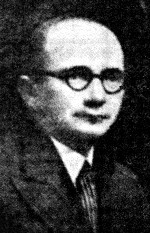
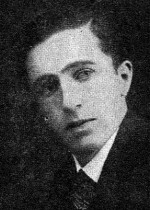
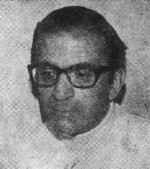
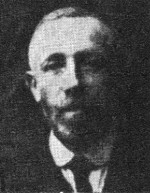
Moshe Tolpin
|
[Page 148]
Translated by Monica Devens
The teacher, Moshe Tolpin, was one of the most popular teachers in Ostroh who educated many generations of Jewish youth. A scholar and a popular figure among the educated Jewish circles in the city who, in addition to his work as a teacher of Hebrew, history, and studies in Judaism, was also a community activist with initiative and energy. Moshe Tolpin was beloved and respected by all the strata of the Jews in the city.
|
|
|
Moshe Tolpin |
The characteristic that set Moshe Tolpin apart was, first and foremost, his simplicity, his popularity, his good heart, and his deep faith, devoted to ideals that he carried in his heart throughout his entire life and until his last breath on earth.
Already from the beginning of his path as a teacher at the start of the 20th century, Moshe Tolpin ran a private Russian school for Jewish youth and later served as a teacher in the government Jewish school under the Russian regime and then continued to work as a licensed teacher under the auspices of the Polish government and, in parallel, was involved in teaching in a “Talmud-Torah.” Tolpin was crammed full, full of Torah and wisdom. Broad general knowledge and Jewish knowledge were mixed in him and, in this spirit, he educated his sons, Dr. Shmuel Tolpin and Prof. Yoka Tolpin, who each excelled in their Jewish-communal activities.
Moshe Tolpin embedded a Jewish-national consciousness in his many students. As his name, so he was – honest, his Zionism was friendly, wrapped up in love and dedication to the idea of redemption, and he excelled in all the good and noble qualities of the people of Israel. Despite being very busy with his work as a teacher, he always answered every call to participate in a Zionist or community activity.
In his old age, he continued his cultural-educational work as one of the collectors of Jewish folklore and as a researcher of Jewish language for the Jewish scientific institute in Vilna (YIVO) and published several research works in the field of Hebrew-Yiddish linguistics. Even at the end of his days, he continued to spread Hebrew language and culture among the adults and all of his students, and the broader community of teachers, lecturers, and cultural workers will remember him for good.
Translated by Monica Devens
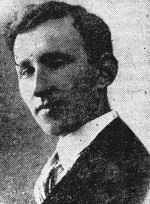
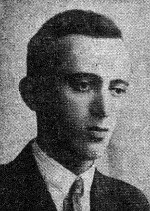
Leib Spielberg's milestones encompass a life story full of activity, loaded with many tasks in different periods of his life. A native of old Ostroh, son of a poor family, orphaned at a tender age through the loss of his father, Leib, the oldest son, even as a youth undertook to help his widowed young mother.
|
|
|
Leib Spielberg |
Already in the dawn of his youth, sitting on the school bench, he was captured by the Zionist idea and was one of the active group that came together in Ostroh and conducted a strong ideological campaign with their colleagues who followed revolutionary ideals before and after the Russian Revolution. Already in those days, Leib Spielberg excelled in his spiritual specialness and great energy, and was one of the activist members of the Zionist movement in Ostroh.
Already in the period before the Russian Revolution of 1917, when Zionist activity was forbidden and carried out in secret, Spielberg took many tasks upon himself and was among the most active members. His apartment served as a meeting place for the Zionist committee and a sizable part of the archives and secretariat of the movement were kept in his house despite the danger connected with this.
Spielberg participated in Zionist conferences and secret meetings as a representative of the Zionist committee of Ostroh. And after the Revolution, with the rise of the Communists to the government in Russia, when Zionism was persecuted by the Bolsheviks, Spielberg created the possibility for secret Zionist activity and worked greatly for the Zionist idea.
Spielberg stood out as a dynamic personality and conducted propaganda in the city and in the surrounding settlements as a representative of the Zionist movement. He was a popular man. Having an alert and sensitive heart, he worked for Zionism from an internal consciousness and this remained until the end of his days.
His community activities reached their height in the years preceding the Second World War when he was the head of the “Tziyon” society in Ostroh and devoted himself to various public works until he went to live in Rovno [=Rivne] and he continued there, too, and contributed of his energy and ability. In addition to his job as manager of a branch of “Tzensus” in Volhynia (a central group for the care of orphans and abandoned children), he was active in the community committee in Rovno, was among the leaders of “Tze'irei Tziyon” and “Ha-Po'el Ha-Tza'ir,” and filled other tasks in the Zionist movement.
During the Holocaust he was connected to the Judenrat and helped many in need of help and provided rescue to the extent of his ability.
He was killed tragically, together with the Jews of Rovno, in 1942.
Translated by Monica Devens
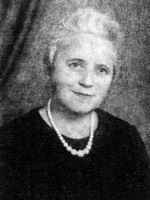
A wide-ranging community activist who persisted in creating help and aid for those knowing poverty and suffering. A gentle soul with good character, level-headed, who never tired of his activism.
|
|
|
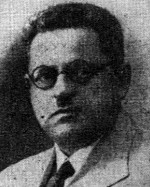
Yaakov (Kovki) Leikechmacher |
He joined many projects as a member and was appointed to important community institutions such as: vice-chairman of the community, member of the municipal administration (lawnik [=alderman]), member of the administration of the Jewish hospital, agent for the Jewish parents at the Polish secondary school in the city. He was also among the founders of the people's bank (ludovy) and its honored chairman and, in addition to these tasks, he was also the principal accountant of the Keren Kayemet and a member of the administration of the “Tarbut” school. Due to his standing in the community, especially with the Polish authorities in the city, he utilized many opportunities to be charitable to the needy.
After the Soviets entered Ostroh in September 1939 and after the stages of Sovietization, private businesses were also nationalized by the authorities and he managed to work as the principal bookkeeper for the leather company in the new city. Close to the outbreak of the USSR-German war in June 1941, he exploited his freedom in order to visit his daughter, Tania, who worked in the city of Lvov [=Lviv] in a government position, but due to the rapid advance of the Germans, he wasn't able to return to Ostroh and he fled, along with his daughter, to the depths of the USSR. They came to the city of Bilgorod [=Bilhorod-Dnistrovskyi] near Kharkov [=Kharkiv], where he found work as the bookkeeper for a cooperative of the physically disabled and his daughter, Tania, was accepted to the university in Kharkov. But not for long: the Germans came near there, too, and again Leikechmacher was forced to flee with his daughter to Bilgorod. After much wandering about, he came to Kazakhstan. As a result of the difficult conditions and absence of strength, he fell ill and did not recover from his illness and he died in exile in Kazakhstan, being buried in the cemetery in Dzhambul [=Jambyl] and followed on his last path by his daughter, Tania, and her husband, Shmuel Sunz from Ostroh.
Translated by Monica Devens
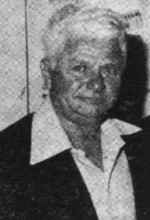
Among the unique figures with which Ostroh was blessed, it is fitting to mention the personality of Zusia Shamban. A special figure of realist, community activist in the good sense of the word, awake to every communal project. From his youth until his last day he was committed, body and soul, to the idea of the “Poale-Tzion” party. He was faithful in his dealings and in the tasks that the party laid upon him. He was an excellent speaker and appeared at public meetings in the city and in its surroundings under the auspices of his party. He was a unique person and blessed with successful activity in the field of the Jewish community in Ostroh.
During the terrible days of the Holocaust, he was in the Ostroh ghetto and he died, along with his family, at the hands of the bloodthirsty Germans and Ukrainians.
|
In the 30s, some of the young generation began to play an important role in Ostroh. Under normal circumstances, they would certainly later have become general activists, community administrators, magistrature councilmen, and so on. But with great sorrow, these young, talented people were brutally murdered. |
by Yitzhak Alperowitz
Translated by Monica Devens
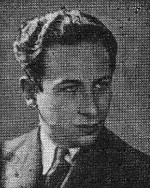
Ostroh was one of the bastions of Ha-Tzohar [=Revisionist Zionist party] in Volhynia. In the last period before the outbreak of the Second World War, young, talented leaders like Gedaliah Gedalivsky, Baruch (Buzi) Chasid, Abrasha Abelman and others stood at the head of this movement. These were the support pillars of the Revisionist movement in the city. The influence of Gedaliah Gedalivsky, a law student at the University of Warsaw, was great. He was among the best Zionist activists in Ostroh and of the standard bearers of Ha-Tzohar in the city. A fanatic believer in Jabotinsky's ideas with all the fibers of his being, and his thoughts were totally inclined to the Zionist-national idea and committed heart and soul to the Jewish people and its land.
|
|
|
Gedaliah Gedalivsky |
Already as a student in the Polish secondary school in Ostroh, he stood out for his natural talents and was known as of great diligence, expert in languages and in Polish, Russian, Hebrew, and Yiddish literature. Gedalivsky aroused respect for his community-Zionist work even from those who opposed him due to his high ethical level. A wonderful mixture of broad intelligence, common simplicity, nobility, deep passion, and a sharp and thorough analytical ability.
Gedalivsky was a symbol of communal and intellectual honesty, thoughtful and kind to people, always surrounded by respect and love from the members of the Revisionist movement. In the 1930s, when life began to get on a proper track and the community settings were crystallized anew, Gedalivsky was chosen as head of the Revisionist movement in Ostroh. His influence in the movement was notable, who knew how to respond sharply to his critics during the
[Page 152]
polemical evenings at city clubs between members of Ha-Tzohar and members of other parties.
Gedalivsky was the ideologue of Ha-Tzohar in Ostroh. Eventually he rose to the heights of the Zionist activity and claimed a central place among the outstanding activists of the Zionist movement in the city. His sharp wit, great organizing ability, his ability to express himself and to convince the other, won him great influence among the students and the working youth.
As one who grew up in an educated household, Gedalivsky was drawn to knowledge. He studied law and aspired to broaden the horizons of his thought. Philosophical and political problems, the content of his life, interested him the most. He was a man of strong will and lively energy who amazed with the breadth of his knowledge and his sharp intelligence. People listened to his lectures for hours and were impressed by the flow of his original ideas, comments, and viewpoints. His words were strewn with shades of sharp irony and his speeches always made a great impression in the city and he excelled as a talented and sharp speaker. The group of activists of Ha-Tzohar led by Gedalivsky made the most of every public platform for the benefit of the Revisionist idea.
Following the secret agreement between Nazi Germany and the USSR on August 23, 1939, Volhynia was annexed to the USSR and Sovietization and everything connected with it began as regards the structure of public life under the Soviet regime and the activity of all the political parties stopped entirely. The various types of Zionist movements were considered by the Soviet regime to be centers of activity against the Communist regime and many of their activists were arrested. One of the Revisionist leaders in Ostroh, Buzi Chasid, was arrested and transferred to the prison in Kiev [=Kyiv] and executed there by the NKVD in 1941.
The stormy waves of Stalinist terror against Zionist activists were felt at every step. Gedalivsky's friends knew that he was on the NKVD's “Black List,” so they advised him not to endanger himself and to move to Lvov [=Lviv] to continue his studies at the law faculty of the university in order to distance himself from the eyes of the informers who certainly passed on information about Gedalivsky's Zionist activities to the Soviet regime. And so he did move to Lvov [=Lviv], completed his studies with distinction, and on the day that he got his diploma as a licensed lawyer, he was immediately arrested by the NKVD. He was transferred to the prison in Lvov [=Lviv] where he was severely tortured by the investigators. Gedalivsky held up bravely during the difficult questioning and the physical tortures. The NKVD investigators did not succeed in breaking him, neither physically nor spiritually. He succeeded in sending messages about his experiences during the questioning at night and the difficult tortures to his wife, Sonia Greinims, from within the walls of the prison.
The USSR-German war broke out on June 22, 1941. The Germans advanced on Lvov [=Lviv] and, close on the retreat of the Soviets from the city, the NKVD executed Gedalivsky together with the political prisoners who were incarcerated in the Lvov [=Lviv] prison.
In this manner, a very rich life ended, many sided, of one of the best of the Zionist activists in Ostroh.
Moshe Soroka, Canada
Translated by Pamela Russ
|
|
|
Boruch (Buzhi) Chasid |
A young man with golden character traits, and a uniquely devoted friend to his friends, this was Buzhi Chasid. Whoever knew him, was unable not to love him. Intelligent, refined, had fine qualities, was known as one of the most knowledgeable history students among all the other students in the Polish gymnasium. He was a certified lawyer, completed studies at the Krakow university, a person for whom nothing more important existed than the party. As vice-president of the Revisionist Party in Ostroh, he always put aside his own personal career for societal work.
Just after the Russian military occupation of Ostroh, he was arrested because of a certain communication, and thrown into prison. Later he was taken from Ostroh and sent to Russia. When I was in Germany, I heard from a former Zdolbuniv resident, that when Buzhi was in Kiev, he was given the death penalty and was shot. Whether this report is correct or not, Buzhi is no longer among the living.
by Nachum Shochet
Translated by Monica Devens
Dr. Herzl Oderman grew up and was educated in a clear Zionist atmosphere. His father, Moshe, and his mother, Feiga, were enthusiastic Zionists already in Tsarist Russia before they came to settle in Ostroh and they educated their children in that spirit. It is worthy to note that his correct name was Herzl, given to him after the name of the visionary of the state of the Jews. In addition to his general studies at the Polish secondary school, from his earliest childhood he studied the subjects of Judaism (Tanakh, Jewish history), the Hebrew language and its literature, etc. at home. His brother-in-law, Yisrael Fogel, a Hebrew teacher and one of the Zionist activists in the city, influenced him with a great amount of information.
|
|
|
Dr. Herzl (Grisha) Oderman |
Hence his broad knowledge and much expertise, which was exposed in meetings and gatherings of the core group in which he knew to lecture about Mendele Mocher Sefarim” [=Sholem Yankev Abramovich, 1836-1917], Shalom Aleichem, Y. L. Peretz, Shalom Asch, Smolenskin, Bialik, Tchernichovsky and others. Indeed, he would lecture excellently about outstanding figures: Herzl, Sokolow Weizmann, about Hasidism, the Enlightenment, etc. No subject was foreign to him because he knew to prepare for every subject by studying the foundations of the requested material and, for that reason, they always listened to him enthusiastically and valued him as he deserved.
Herzl Oderman was a romantic with nobility of soul and internal freedom. He knew how to bring friends close to him, to encourage them, to direct them, and it was only natural that he was made “signor” among us and was loved by all of us. Only a minority among us could list to their credit influence like his on all that was around. There is no need to say that, because of his personal qualities and his flowing energy, he was the life spirit of the core group of “Ha-Shomer Ha-Leumi” in Ostroh and an activist and director of activists in all branches of the action. The only thing he didn't participate in was the choir because he didn't know how to sing and he was very sad about it, having a deep love for hearing songs in general and Hebrew or Jewish ones in particular. I remember how he asked me (the writer of these columns organized the choir and conducted it) to permit him to participate in the choir just so he could stand there.
Herzl Oderman was killed by the “Banderov” murderers, a Ukrainian gang that roamed around the region of Volhynia and Ukraine during the Second World War.
by Chaim Charbash
Minia Greinims was among the youth elite in Ostroh and taught and served as a guide to the youth in our city for years until its bitter end. He came to us almost a foreigner without knowing well Yiddish, the customs and tradition of Jews, but excellent with a sensitive heart and delicate soul. The shamed national pride and social oppression of the masses of Jews carved a deep furrow in his heart and enabled him to an energetic rebellion against the existing situation.
When the inclination to public activism instilled in him from his childhood connected his fate with the first youth movement in Ostroh – “Ha-Shomer Ha-Tza'ir,” in which he hoped to find and to create a solution for the youth rotting in degeneration. As a man of intellect and ethics, he advanced quickly to the first ranks of the cultural-societal activists in the city. He was not satisfied with his position as a leader and teacher for “Ha-Shomer Ha-Tza'ir,” but rather was called to influence every other organization in the city, such as: “He-Halutz,” “Ha-Oved,” “Ha-Liga Le-ma'an Eretz Yisrael Ha-Ovedet,” “Moadon Ha-Intelligentsia Ha-Yehudit” and so on. He being gifted with an excellent ability to speak, they listened to him happily and even obeyed him.
In addition to his broadly encompassing work of direction, he was tireless, too, in practical work. He was active in the school and a teacher in the “Tarbut” secondary school, arranged literary events and more, and was a faithful address for everyone dealing with problems to help him with good and fatherly advice. And what greatly saddened our souls was the fact that Minia Greinims, who had such great love for the land of Israel and the people of Israel, was never able to see the freed homeland, dying a hero's death in a foreign land.
|
|
|
Elimelech (Minia) Greinims |
Minia Greinims was born in 1911, completed secondary school in Ostroh and the law faculty in Warsaw. During the Second World War, he fought with the Red Army and fell in battle in the fields of Stalingrad in 1942. Many years have passed since his physical death, but his powerful spirit still lives among his many loved ones, who will always remember him with respect and affection.
by Chaim Finkel
Translated by Pamela Russ
Betty Eisenstein belongs to the generation that lived through the period of destruction, and as one who was saved from the hell, she collected stories and memories that had to be told.
|
|
|
Betty Eisenstein – Keshev |
In the chain of these memories, she found a ring that was the most valuable, that pressed against her soul, and she took upon herself to fulfill her mission of recounting that which she and the rest of those who survived the massacre of the Hitler days.
Her initial reaction, and that of all those who survived, was an emotional one. The profound rage against the mass murders was ignited, as she saw the destruction with her own eyes, saw what remained from the lively, richly spirited Polish Jewry. As a historian, she took to a systematic collective task, of amassing witness testimonies of the survivors, she read diaries that were written during the Nazi occupation under all kinds of circumstances: in cellars, on rooftops, in the forests, in camps, in ghettos, and from these spontaneous, chaotic memoirs, she was able to collect important information and then prepared it in a systematic, historical publication.
First, she began with writing the history of her place of birth, the city of Ostroh. But she was unable to complete the writing because she received a position with the Jewish Central Historical Commission in Poland in order to write a research document about the resistance acts of the Jews during the German occupation in Poland, with the support of actual witnesses, documents, and various other works that were found among the belongings of the Jewish Central Historical Commission in Poland, and among her own material that she was fortunately able to collect for her own initiatives.
[Page 157]
That is how her very important work was published under the name: “The Underground Movement in the Ghettos and in the Camps,” which was a product of her tireless work. The book was published in Polish in the year 1946, and opened with an extensive introduction from the historian Michal B. Borvitch.
This was the first book published in Poland by the Central Historical Commission, where the author, in an extensive format, explained the recovered documents of the resistance acts, which had a place in various locations in Poland, both with individuals and with organized groups in the ghettos and in the death camps. Her book made a huge impression in the Jewish world both with its photographic character and with the format of the work by Betty Eisenstein's material.
This work did not end with the publication in Poland. She tried to collect more material with this same theme, found in Germany in the years 1947-1948, and she finally concluded with the State of Israel. In this “Book of Ostroh,” we include some of her work, that which is tied to her place of birth, Ostroh, and also Volhyn, which is published with introductions in the books “Of the Near Past,” (volumes 3 and 4), under the title “The Jews of Volhyn,” where she also brings important information that is connected to Ostroh.
Betty Eisenstein Keshev was born in the year 1912 in Ostroh. In that city, she first studied in primary school, then she continued her studies in the Polish gymnasium. After completing the gymnasium, she continued her studies with pedagogical courses, and then, after receiving her diploma as a certified teacher, she worked as a teacher in the Tarbut school [secular Hebrew language school] in Alexandria, near Rowno, where she worked until the outbreak of World War II. At the same time, she was active in the Zionist circles.
When the Soviets took over Ostroh in September 1939, she returned to Ostroh with her husband Yakov Kaplan, and during this Soviet period she worked as a teacher until the outbreak of the German- Soviet war on June 22, 1941.
She was in the Ostroh ghetto until the ghetto's liquidation in 1942. Using an advantageous opportunity, she fled with her husband from that place of death, and they were lucky to reach the forests of Netishyn, not far from Ostroh. She was there with her husband and sister Sarah.
After her husband's death, after he was killed in a fight with the Germans, Betty and her sister went into the forests of Polesia, where they joined up with a Soviet partisan union. As partisans, they fought until they met up with the Russian army in the summer of 1944.
After Ostroh was liberated, she and her sister returned to their hometown, but she could not remain in the cemetery of the Jews of her town. She went to Rowno, then to Lublin, Warsaw, and Lodz.
In Lodz, she was hired as a academic assistant in the Central Historical Commission in Poland, and here she put in her full capacity in collecting material regarding the Churban [destruction] and period of revolt in Poland. She met many
[Page 158]
survivors of the Churban, she analyzed and instructed many others on how to collect material, and how to process it all in a systematic manner.
Betty was not only a historian, but also as a talented writer. She published many articles, various newspapers, and timely writings, where she brought out primarily the sufferings and pain of the Jews during the Hitler period. Her second husband was Shabtai Keshev, a journalist in Davar. Betty died on February 15, 1986.
by Bella Raichis
Translated by Monica Devens
Dov spent his youth in Ostroh. After the German incursion into the USSR, when fear and anxiety surrounded the Jews of the city, many began to flee eastward, with cries of parting and looks of despair all around.
Dov did not succeed in fleeing from the city so that, when the Germans conquered Ostroh, he did not hesitate for even a second, that the only route of escape was to the forest to join the partisans who operated in the area, and thus he left home and, after much wandering and much suffering, fled to the forest and joined a partisan unit and he was only 15. In the partisan unit, he stood out as a courageous fighter and the partisan command laid many tasks upon him, which he successfully completed.
After the end of the war, he looked for ways to get to Israel. He came to Poland and joined “Bricha,” through which he transported many immigrants across borders to Israel. During the years that he was in Poland, he was a member of the leadership of the general Zionists party in Warsaw. He worked a lot on behalf of the organization of the youth for emigration and instilled in them the Zionist idea.
In 1950, he immigrated to Israel and, here in Israel, he worked throughout almost all the years with children and youth as a teacher and educator in various educational institutions like: the Nitzanim youth village, Magdiel, the Ben-Shemen youth village. He fulfilled his many tasks with complete responsibility and brought to fruition what was laid upon him. He was honest and true to the homeland and, as a committed Zionist, he educated the youth in the spirit of love of the Jewish people and the homeland.
|
|
|
Dov Raichis |
by Chaim Finkel
Translated by Monica Devens
Yisrael (Izzya) Bokimer was born in Ostroh to an honored Zionist family, established in the community life of the city, from which he absorbed the best of the values of honesty, humility, and love of Israel.
|
|
|
Yisrael Bokimer |
While he was still a boy, he was already counted among the activists of “He-Halutz Ha-Tza'ir.” The decade of the 1930s was a time of pioneering awakening among the Jewish youth in Poland and, in 1935, Yisrael went for training at the Borochov kibbutz in Łódź with the goal of immigrating to Israel. He was among the outstanding members of the kibbutz and succeeded with a solid character and faithfulness to Zionist principles with which he was educated and in which he believed.
With the outbreak of the Second World War, Yisrael went back to the city of Rovno [=Rivne] where his family was living in those days and when the city was already under Soviet occupation. The annexation of parts of Western Ukraine to the USSR caused far-reaching changes in the lives of the Jews. Jewish communal institutions were forced to stop functioning and the Zionist movements were considered by the Soviet regime as centers of activity against the regime. But despite the official elimination of the Zionist movements, a faithful core group continued to operate in secrecy on behalf of Zionism and Yisrael was among these activists.
Zionist activity was uncovered by the NKVD and Yisrael was imprisoned along with his friends, sentenced, and exiled to the forced labor camps in Siberia. Yisrael was sentenced to 8 years in prison and, after serving his sentence, he was exiled for 8 more years in northern Siberia. The years of imprisonment and the exile in northern Siberia were years of hunger, humiliation, and an unceasing struggle with the harshest conditions, but the hope of some day reaching the shores of Israel strengthened his spirit and gave him strength to overcome all the barriers and the difficult conditions in the Siberian exile and they were many.
In 1958, he was finally able to realize his dream: he left the USSR – the land of tribulations and suffering to immigrate to Israel together with his wife, Chana, and his only son. When he arrived in Israel, he found his elder brother and other relatives and many friends who rejoiced in seeing him settling in Israel.
As a Prisoner of Zion, the country helped him get a job in his field as an accountant. He earned much respect at his work place as an outstanding professional, able, good-spirited, and a good example of righteousness and honesty. In his dealings with people, he left a good spirit and friendship, and these are the qualities that were deep in his character. Yisrael did not make himself stand out, was a man of moderation and order, well-mannered, and having a gentle soul and noble spirit.
His last years were filled with much suffering as a result of the difficult conditions of back-breaking work, hunger, and cold in the forced labor camps and in the Siberian exile. All of this eroded his strength and his health. He fought illness and did not want to give in, but his suffering overcame him and he was brought down in the end.
The life of Yisrael ended and the wick of his life was torn.
May these lines keep his dear memory alive and may his elevated figure be remembered for good among the members of his family, his friends, and his acquaintances.
by Neta Shavit (Bat Leah)
Translated by Monica Devens
The Hebrew school in the cities and towns of eastern Europe was the traditional “Cheder” where the children of Israel absorbed the cultural heritage and the history of our people. The conditions in which the toddlers learned with their rabbis in “Cheder” were different to incomparable to those of the schools of today. The students were around a long table, their prayers books in front of them, the rabbi with his stylus showing the voweled letters and teaching how to pronounce the sounds properly, the students repeating after him and reviewing them as a group. Over time, they began to study Chumash [=Genesis through Deuteronomy] with Rashi's commentary from the morning hours until late at night by candlelight and oil lamp. And thus, “time” after “time,” until they came to study in the Beit-Midrash, whether alone or in groups, and they began treating nights as days and being engaged in Torah. It is fitting to remember the “melameds” [=teachers] and give them respect.
Among the well-known and honored “melameds” in Ostroh who held an “improved” Cheder in his home was R' Yisrael Ben-Yitzhak and Leah Zeigerson, known among the natives of our city with the nickname, “R' Yisrael Piatker” (he was called that after the place he was born, Piatki).
|
|
|
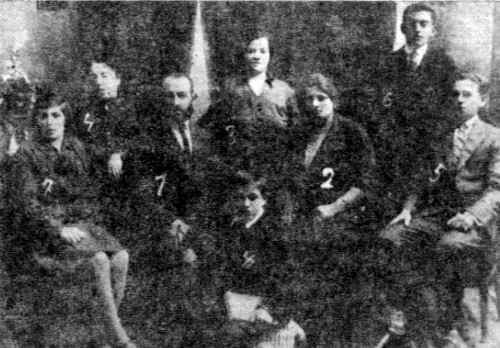
Yisrael Zeigerson, his wife, Esther, and their children: Tzviah, Babtzi, Aharon, Moshe, Leah, and Yitzhak |
My grandfather, R' Yisrael, saw in his “Cheder” the first step towards gaining knowledge of Chumash with Rashi's commentary and Tanakh. My grandfather's “Cheder” was different in a good way from the “Cheders” of other melameds in Ostroh in its internal organization and in its
[Page 161]
study program. He mentored generations of students and his influence over his students was great. Even though, as a “melamed,” he asked of his students a serious and honest relationship to the studies and he was known as a strict “melamed” and one who laid down discipline in his “Cheder,” he was pleased with the students, engaged with them lovingly, and through this would bring them to Torah. The children would study not because of “Fear Your Master As You Fear Heaven,” but rather because they respected him and they tried not to fail when he tested them. The students were proud of their rabbi, treated him with respect, and saw themselves lucky that they were able to receive Torah from him.
As fate would have it, my grandfather, R' Yisrael, died in the Ostroh ghetto in 1941. With him went my grandmother, Esther, daughter of Bluma and Aharon (of the Shostak family), and two of their daughters: Tzviah (born in 1902) and Babtzi (born in 1905). Their son, Yitzhak (born in 1915), was active in getting Jews out of the Majdanek death camp and succeeded in saving about 60 Jews from Nazi clutches while facing mortal danger. He was caught by the Germans during one of the actions and executed.
The following survived:
Aharon Zeigerson (born in 1906). He was drafted into the Red Army at the outbreak of the war and became part of the engineering corps. He was released from the army at the end of the war and immigrated to Israel in 1948 from Cyprus. His wife and son perished in the Holocaust. He re-married in Israel and had a daughter and son.
Moshe Zeigerson (born in 1908) wandered around the breadth of Russia during the war along with his wife, Fruma (born in 1912, of the Nafchan family) and their son, Menachem (born in 1937), and their daughter, little Raya. They arrived in Israel from the Föhrenwald (Germany) DP camp.
The daughter, Leah (born in 1912), left Ostroh in 1939 and joined a training kibbutz in Lutsk [?]. When the Russians entered Lutsk, she moved to Vilna, from where she immigrated to Israel in 1941. She joined the “Mahanayim” kibbutz, encountered her husband, Zev, whom she had married while still in the Lutsk training kibbutz. Zev came to Israel in 1939 with Aliya Bet [=illegal immigration]. Their two daughters were born on the kibbutz.
by Dr. Mark Greinims
Translated by Pamela Russ
Eliezer (Lazer) Zeigerson was very active in the religious circles in Ostroh, and was very respected for his great scholarship in Talmudic knowledge. He lived on Krasnogorska Street, and worked in manufacturing furniture. He died in August 1941 during the time of the first Aktzia that took place in the new city.
Sima and Lazer Zeigerson had five children. Two sons immigrated to America before World War 2. Sima died during the liquidation of the ghetto during the third Aktzia in October 1942.
Syuni Zeigerson and Buzhi Zeigerson-Nagel survived the war in Russia. As a member of Beitar, Syuni was very active in the movement, played football, and was a great sportsman. Now he lives in America.
Buzhi Zeigerson-Nagel is not among the living, and left behind two daughters and six grandchildren.
[Page 162]
Dorothy Greinims (Dvoira Zeigerson) was in the Ostroh ghetto. She survived two Aktzias and she was lucky to escape before the third Aktzia, with her future husband, Musia Greinims, into the forest, along with other people. At the time of heavy bombing by German airplanes, she was wounded, but thanks to her Aryan papers [false documents], she lay for eight months in the Slavuta hospital. She and her husband Mark Greinims immigrated to America in the year 1947. They have a daughter Lauren and a grandchild Simone (Sima).
|
|
|||
(May her memory be for a blessing) |
Mark (Musia) Greinims lived in the Ostroh ghetto until 1942, and then after the third Aktzia he went into hiding with his wife Dvoira. After the liberation by the Russians, he was drafted into the Red Army and was then in the military until 1945. After being released from the military he and his wife left to Munich. Later, they immigrated to America, and he studied to become a doctor. Now he lives in Jersey along with his family.
Sonia Greinims (Mark's sister) died in Rowno in 1942. She left Ostroh in 1939 with her husband Gedalia Gedalewski and went to Lemberg. Gedalia was killed by the Russians as he was a well-known Zionist leader. Other members of the Greinims family, such as the father Volf Greinims, the pharmacist, had a pharmacy in Ostroh and died in 1935.
Grisha Greinims (son of Volf Greinims) died in America in 1952. Before World War 2, he studied medicine in Vienna and in Paris, and practiced as a medical doctor in America.
Yankel Greinims, Gavriel Greinims, Anya Greinims, Chaya Rochel, and Minia Greinims, died during the Holocaust at the hands of the Nazis.
Translated by Monica Devens
Changes from the 1920s until the Second World War
| 1. | Zvi Bokimer | 15. | Yoel Finkelstein |
| 2. | Moshe Holbart | 16. | Mendel Nathanson |
| 3. | Moshe Abelman | 17. | Bezalel Bramnik |
| 4. | Shmuel Shreier | 18. | Shlomo Komandant |
| 5. | Zalman Gerschfeld | 19. | Chaim Davidsohn |
| 6. | Moshe Tolpin | 20. | Pini Takser |
| 7. | Yitzhak Lizak | 21. | Berel Linsky |
| 8. | Baruch Speiser | 22. | Izak Spielberg |
| 9. | Avraham Vilker | 23. | Yosef Glantz |
| 10. | Yoel Hornshtein | 24. | Ha-Rav R' Ephraim Guberman |
| 11. | Kalman Frenkel | 25. | R' Yoseleh Sfard |
| 12. | Mordechai Rabinowitz | 26. | Leibush Biber |
| 13. | Zigmunt Zussman | 27. | Ha-Rav Ginsburg |
| 14. | Sender Gonik |
| 1. | Avigdor Kammerman – Deputy Mayor of Ostroh 1928-1931 | 9. | Grisha Band – City Council Member |
| 2. | Moshe Abelman – City Council Member | 10. | Leizer Ginker – City Council Member |
| 3. | Zigmunt Zussman – City Council Member | 11. | Yaakov Greenberg – City Council Member |
| 4. | Shlomo Komandant – City Council Member | 12. | Yankel Bronstein – City Council Member |
| 5. | Bezalel Bramnik – City Council Member | 13. | Levi Brilant – City Council Member |
| 6. | Shlomo Vilker – City Council Member | 14. | Mordechai Goren – Chairman of the City Council 1939-1941 |
| 7. | Y. Mordechai Nordman – City Council Member | 15. | Mannes Gonik |
| 8. | Nehemiah Gairman – City Council Member | 16. | Sender Gonik |
Translated by Monica Devens
| 1. | Dr. Yisrael Pressman | 8. | Eliyahu Kaplan |
| 2. | Lawyer Meir Kagan | 9. | Yaakov Kaplan |
| 3. | Dr. Herzl (Grisha) Oderman | 10. | Doizik Barak |
| 4. | Elimelech (Mini) Greinims | 11. | Shlomo Bokimer |
| 5. | Gedaliah Gedalivsky | 12. | Avraham Charbash |
| 6. | Abrasha Abelman | 13. | Yupa Katz |
| 7. | Baruch Chasid |
Translated by Monica Devens
Tanchum Zabin, the veteran educator and head of the government school in Ostroh.
Moshe Tolpin, one of the veteran educators in Ostroh.
Yosef Finkelstein, was a teacher of modern Hebrew in Ostroh, both in more spontaneous situations and in the “Tarbut” school. He was also a pioneer of the journalists in the city and published regularly in the Volhynian press correspondences about what was happening in the city and many stories. He was killed along with his wife, his daughter, Fania, and her husband, and his son, Sitsha.
Mordechai Kaplan (son of R' Berele, the judge), Zionist activist and teacher of Jewish history in the Polish government teachers' college. He was killed during the Holocaust along with members of his family.
Yaakov Mordechai Nordman, teacher of Jewish history at the Polish government secondary school in Ostroh. A Zionist and community activist in the city, member of the Ostroh city council. Immigrated to Israel during the 1930s, served as the administrator of a school in Ramat Gan and was active in educational and literary activities in the city.
Mordechai Mishnah, from a distinguished rabbinic family. A teacher of Tanakh and Hebrew in more spontaneous situations and also in the Talmud Torah in Ostroh. A Zionist activist and secretary of the Keren Kayemet in the city. He was killed during the Holocaust along with his mother, the Rebbetzin, and his sister.
R' Moshe Shulvug, teacher of Tanakh in the Talmud Torah and also in more spontaneous situations. He passed away before the Holocaust, leaving a large family that was partially lost during the Holocaust.
Meir-Zvi Finkel, teacher of Tanakh in the Talmud Torah in Ostroh and also in more spontaneous situations. An activist of “Ha-Mizrachi” in the city and chairman of a subsidiary company. He was killed during the Holocaust (1941-1942) along with his wife and his two daughters.
Moshe Krichmer, teacher of Tanakh in the Talmud Torah in Ostroh and in more spontaneous situations. He was killed during the Holocaust along with his wife, Sarah.
Henna Rozenszturm – teacher in the Polish government school. Daughter of the veteran teacher, R' Moshe Shulvug, and wife of the community activist in the city, Dr. Rozenszturm.
Tzila Batt, teacher in the Polish government school in the city, killed during the Holocaust together with her husband.
|
JewishGen, Inc. makes no representations regarding the accuracy of
the translation. The reader may wish to refer to the original material
for verification.
JewishGen is not responsible for inaccuracies or omissions in the original work and cannot rewrite or edit the text to correct inaccuracies and/or omissions.
Our mission is to produce a translation of the original work and we cannot verify the accuracy of statements or alter facts cited.
 Ostroh, Ukraine
 Yizkor Book Project
 JewishGen Home Page
Copyright © 1999-2026 by JewishGen, Inc.
Updated 03 Aug 2026 by JH