 |
|
|
[Page 98]
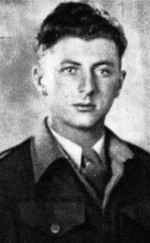
Amnon Ackerman
by MinaMina
Translated by M. David Isaak
Fateful days, great ones, before us and not far off.
Sons! Give all your strength, all your light,
the delight of your innocent lives
give with love, with simplicity, as something self-evident.(From the words of D. Shimoni)
|
While still a baby of 3 months, Amnon had to flee with his parents from the bloody riots of the year 1929 (5689) that broke out in the Land in general and in Haifa, his birthplace, in particular. His parents lived in the houses of the Arab market, at the very heart of the murderers' nest. While life still breathed in them, the parents fled with their then only son to Hadar HaCarmel.
He flourished like a rising cypress. Golden curls crowned his head, his face bright and full of charm. We who were close, who believed in the power of prayers, feared and hesitated to look at his face too much because of the danger an “evil eye” can cause.
Amnon was a student of the Re'ali School, where he studied faithfully and persistently. He knew how to lend a shoulder in every matter, and was disciplined with pleasant habits, both at home and on the street. Well-mannered and refined. He always preceded greeting his relatives and acquaintances, was well-liked in his class, always brimming with liveliness and friendliness. He loved music and studied it with great interest. Music occupied an important part in his spiritual life. When he strapped on the accordion and began to play, his whole being played and everything around him breathed the joy of living. In high school, Amnon joined the Tzofim [Scouts] attached to the school, and lived a full and active life. He participated in activities, gatherings, talks, and social evenings. He fulfilled every role and mission with devotion and vigor, without flinching. During the days of struggle with the British and the Arabs in Birya in the Upper Galilee, the Tzofim took part in the struggle; Amnon was among the Tzofim sent there.
When he turned eighteen, he went with his friends to Hachshara [agricultural training] for a Gar'in [pioneering core group]–to Kibbutz Dan and Dafna in the Galilee. Those days were days of hard struggle about aliyah [immigration] and the beginning of political tensions in the State. The Hachshara core groups were in the service of the Palmach. With the declaration of the Jewish State came the fateful days testing the new concept. The bloody struggles began. The Arabs began shooting on the roads, at Jewish settlements, and especially at border settlements. Palmach battalions went out to defend the settlements and guard the transport routes. Amnon was found among those escorting the convoys and on guard duty at night. Happy to find himself among the ranks of the fighters and defenders. His letters home were full of national pride,
[Page 99]
mixed in with words of humor and liveliness to calm his worrying Mother, soothe his Father and brother; reassuring that all will be “good”, and when his turn for leave came, he would come home to see them.
On one of the Shabbats, Amnon came for a few days of leave. We went to see him. Along the way, on Balfour Street, we met him accompanied by his younger brother. It touched our very souls to see how his brother leaned against him, hugging him, caressing him, with their hands inseparable. We looked at Amnon's handsome, radiant face, and the heart trembled. Dear, sweet sons of Zion, you must go out to battle with savages, desert dwellers. We felt the danger hovering over our sons, who rushed to defend the State. Yet we believed that good and beauty would triumph. Amnon returned to his Hachshara, to his base, to his company. Events developed. The British left the Galilee. The Arabs took control of a large part of the Galilee. The Nabi Yusha police fortress, commanding the roads of the Galilee, was in the hands of the Arabs. The Palmach decided to capture the Nabi Yusha fortress [near Safed]. The detailed plan was prepared: to storm, breach, and capture. And on the night the assault and demolition squads went out, Amnon was among the “assaulters”… The operation failed. 27 Palmach young men fell, and Amnon was among them. The cypress was felled, Amnon, the finest of sons, fell…
On the morning of Passover eve, the terrifying news reached the parents. The pain pierced the hearts of the parents and the younger brother. Grief enveloped relatives, friends, and acquaintances. There is no comfort. The memory of Amnon, the handsome and noble one, the dear son, will be cherished for generations to come. His heroism and devotion will be inscribed in the Yizkor Book together with all the heroes of Israel who fell in battle on the altar of our land.
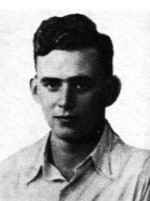
by Moshe'l
Translated by M. David Isaak
|
Asher is no more. He fell in a battle in the South, far away. He fell defending the Hebrew homeland. With his death, we lost a good and dear man. A loyal comrade to the kibbutz movement, to the working class, and to the entire people.
When I was abroad I did not know him, for he was a baby when I immigrated to the Land. However, I knew his family well, the source from which he was hewn. A progressive family that gave its children a higher education. The children spoke Russian among themselves, like all the educated youth in the city. They did not join a Chalutz [pioneer] movement and never even considered immigrating to the Land. In their eyes, I was a strange and incomprehensible person.
I would visit their home quite often. A house surrounded by ornamental gardens and a fruit orchard, far from the center of the city–something uncommon among the Jews in our surroundings. I loved the quiet and the beauty poured over this charming corner.
His father was handsome, tall, broad shouldered and strong. His mother was educated, wise, gentle and kind.
[Page 100]
In this environment, Asher received his education. Politically, he was influenced by the communist youth. He saw the solution to the Jewish question just as all the Jews who chose a leftist outlook saw it.
When he arrived at G'vat, I realized he had inherited all of his mother's fine qualities. To this day, I marvel at how this mother found the strength, in those terrible days and the panic of the German invasion, to send the tender, gentle 16-year-old boy out alone–without life experience, without means–into the wide world so that he might save his life. What heartaches a mother must have felt upon making that decision!
Asher wandered across great Russia and reached the steppes of Uzbekistan. He worked at all sorts of jobs in town and in the village. Afterward, he joined the Polish army and then came to the Land. The atmosphere in the army was unbearably harsh, and he agonized greatly until he reached the decision to “desert” – not to return, but stay in the Land. Anyone who knew Asher's upright character can picture for themselves how hard it was for him to take that step.
Upon arriving at G'vat, he did not adjust easily to the work and to life in the group, yet he never complained; he tried to prove to the newcomers who saw themselves as underprivileged that special rights should not be demanded, because there should be no discrimination between newcomers and veterans.
Upright, conscientious, gentle, sensitive, humble, kind-hearted, yielding, and shy–these were Asher's character traits.
The fact that he was the only survivor from the entire family weighed heavily on his conscience. He volunteered for the Brigade because he could not sit idly at home while others were fighting humanity's war of liberation against its enemies. In his letters I sensed a turning point in his political views: he became a Zionist of the Land of Israel, a kibbutz man. Everywhere he sought the company of kibbutz members or at least serious Land-of-Israel company. He put off for a long time his aunt's request to come to America to study, or at least to visit for a while. And when he finally decided to travel and prepared everything for the journey, the war broke out in the Land. He wanted to cancel the trip, because he saw it as fleeing from the front. Only with difficulty did we manage to persuade him, and he started the journey. But he knew it would be hard for him to acclimate in America in a bourgeois environment alien to his spirit.
With the outbreak of the War of Liberation, onboard the ship, he decided to return to the Land. While on the ship, sailing from Lebanon to America, he even decided not go ashore and meet with the family members who were waiting for him there. Instead, as soon as he could, he hurried back to the Land.
Upon arriving at G'vat, he did not want to rest from the journey, nor did he lend an ear to the words of comrades and friends who advised him to stay a while on the kibbutz. On his own initiative, he enlisted in a brigade that takes upon itself difficult and dangerous operations. In conversations with him during the few days he spent at home, I felt that he was absorbed in his restless inner world. As if fate were calling to him.
Asher hurried to reach the appointed place and the right moment–but from fate there is no escape. Rest in peace, dear Asher!
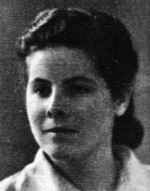
by Zivah
Translated by M. David Isaak
22 Nissan 5692 (1932) – 20 Tishrei 5709 (1948)
|
Our dear Michal perished on Hoshana Rabbah, 5701 (1940), at the age of 18, at the very beginning of her steps and the start of her path in life in general. She volunteered for the Nachal [Youth-Pioneers-Defense unit] even before it was time of her service in the army. She stood out because of her pleasant manners, nobility of soul, and purity of character. She approached every role at school, in her circle of friends, and in the Gadna [Youth Battalions] group with seriousness. During the bloody events in the Land, Michal knew how to fulfill every mission entrusted to her with precision, courage, and loyalty.
At the Gymnasium [High School], she worked diligently at her studies, took an interest in literature and music, and helped her friends prepare their lessons and helped with explanations. She also organized a discussion circle that dealt with current affairs of life in Israel. And during her breaks from studies, she went out, in the scorching summer days, to work on a kibbutz.
She was born in Tel Aviv. Her parents: Lola Fishman, a native of Kozanhorodok, among the first pioneers from her hometown, and Yaakov Grossberg, a native of Berdichev of the Third Aliyah wave, were among the first pioneers who conquered the Land. She inherited her pioneer spirit from her parents. Yet this heritage also drew from deep cultural roots, from the lifestyle that prevailed in the families of our hometown. The town was small, without amusement halls or cinema, yet how lovely and enthusiastic were its Jewish inhabitants! And how many are the moral values bequeathed to us by the pioneers, the builders of the Yishuv [Jewish settlement], among whom Michal's name will also shine, whose song of life was cut short mid-song.
How pleasant you were, Michal, in our company. How much spirit of life, vigor, and devotion bubbled within you! You were an example to us in your diligence with your studies, in your striving for education, and in your charming qualities. You showed initiative and alertness during the hard days that passed over us in our War of Liberation. Who could have imagined that your lofty aspirations would hover in midair and the thread of your life would be snapped off in the spring of your days, and your eternal resting place would be among the graves of too many of our finest friends who fell for our people and our Land.
Your memory will never depart from us!
|
|
JewishGen, Inc. makes no representations regarding the accuracy of
the translation. The reader may wish to refer to the original material
for verification.
JewishGen is not responsible for inaccuracies or omissions in the original work and cannot rewrite or edit the text to correct inaccuracies and/or omissions.
Our mission is to produce a translation of the original work and we cannot verify the accuracy of statements or alter facts cited.
 Luninyets, Belarus
 Yizkor Book Project
 JewishGen Home Page
Copyright © 1999-2026 by JewishGen, Inc.
Updated 23 Nov 2026 by JH